Tag: content strategy

  • Has Panda 4.0 Got You Down?

    Sad Panda 4.0 Image - Search Influence

    Now that we are 4 weeks post-Panda 4.0, there is a decent amount of data to sift through and determine if a website got caught in the Panda filter.

    Panda is supposed to provide consumers with search results that are helpful to their needs. This means websites that have some authority and provide a service to consumers are going to be more trusted and rank better. The better websites offer answers to consumers for what they are looking for and help them make decisions based on useful information. The content is engaging and gets people the information they need.

    Not Too Much Panda Drama
    Matt Cutts Panda 4.0 Tweet Image

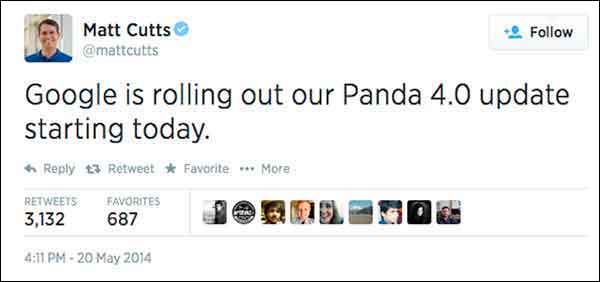
    Panda started rolling out May 19, so that’s our magic date for before and after data. When looking only at Google organic traffic and comparing May 19, 2014-Jun 15, 2014 to Apr 21, 2014-May 18, 2014, I saw a 6.71% increase for one plastic surgeon’s website. This is a respectable increase when you consider that summer is generally thought to be the start of the slow season for plastic surgery as an industry.

    For this plastic surgeon, I looked at the same date range for the last 4 years. Every year, this same date comparison resulted in a minor and expected decrease of Google organic traffic. This illustrates the typical seasonality. Given that history, we’re pretty excited to see an increase from Google organic traffic going into summer.

    I looked at another client’s website, this time for an apartment complex, which is up 15% in Google organic search. Last year showed a decrease for the same time frame comparison. Unfortunately, the client didn’t have Analytics data for 2012. I have always thought that summer would be a high season for his industry, but he says for his complex and his location, summer is not necessarily the busy season. I always like to see double-digit growth in Google organic traffic (that’s a no brainer), but I worry about the monthly Panda data refresh leveling things back out, which happens all the time. The fact that the site had an increase at least tells us that the site is trusted, and we are on the right path, so that’s the story to celebrate.

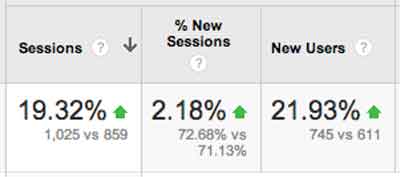
    One of our account managers has a charter-fishing website (which I think would be super fun to work on). This fishing charter client had a whopping 115% increase, but you have to consider that this is his high season. Last year the same time frame comparisons saw a 65% increase. Even with the seasonality, I think he was a winner with Panda 4.0. He has lots of great original photos and lots of engagement – it totally looks fun to go out on his boat! And that’s a major part of what makes a quality site.
    Site Traffic For Engaging Content Chart Image - Search Influence

    In the health industry, we have a drug rehabilitation clinic website, which experienced a 19% increase after Panda 4.0. So, the interesting part for this client is that their content is solid. We have been working more heavily on their citations and less on their content, so it’s possible this client is simply readjusting from the previous Panda. It’s also possible that clean local citations are helping the site’s quality and trust.

    Magic?

    I know everyone reads these posts for some super secret insight, to learn some nugget of goodness, and I will probably disappoint. The efforts of our account managers have helped our clients’ websites, some shown above, but really, as a group, we have done nothing extraordinary. If it’s an older client, we have taken the time to review all of the past years of work and get back to the basics. We fixed any technical SEO problems we found. We are also constantly refreshing content, constantly reviewing citations, and building social channels with planned content calendars. If it’s a newer client, we work on building a solid foundation of fresh content, consistent business data, and getting social.

    There is no magic here, just thoroughness.

    This Wasn’t Just Any Ol’ Panda Update

    This Panda update is largely thought to be a significant algorithm change rather than the monthly refresh. Barry Schwartz says it succinctly, “Panda 4.0 must be a major update to the actual algorithm versus just a data refresh. Meaning, Google has made changes to how Panda identifies sites and has released a new version of the algorithm today.”
    What Does This Mean Quote Panda 4.0 Update Image - Search Influence

    What does this mean? It means that if you look in Google Analytics and your visits took a dive towards the end of May 2014, then you need to dedicate some time, effort, and resources to your website. When there is a Panda data refresh every month, it’s not going to get better without some serious website rehab.

    As a side note, most of the clients I looked at had a small bump up in first week of June. I don’t know if there was a Panda refresh just 2 weeks after the Panda algo update, but I definitely see it across a large number of clients.

    The Panda Checklist

    Cleaning House For Panda 4.0 Update Photo - Search Influence

    There is so much you can do to “clean your house” for Panda, but here are the first efforts I would take to tackle the Panda beast.

    #1 Crawl Before You Can Walk

    Start with a detailed crawl of your website. You can use whichever website crawler you prefer (At Search Influence, most of us use the Screaming Frog SEO Spider). You’re really just looking for a comprehensive spreadsheet where you can look at your website as a whole. The crawl will give you a list of pages, images, CSS files, and many other goodies.

    With this list, you can sort, filter, get organized, and clean up your site.

    • Review how many H1s and H2s each page has. Subheadings are wonderful. Use them.
    • Check your canonicals. Make sure they are set up properly.
    • See what is being redirected.
    • Find what is 404ing.
    • Read the meta data for each page and see how amazing or how lame it is.

    With this list, you can find multiple pages on a single topic. Often enough, we find a client has multiple pages and posts on a single topic. I looked at a client two weeks ago who had 8 pages all on the #1 service she offered. Wow! I was so overwhelmed. I can’t imagine how a casual site visitor would feel (“Where in these 8 pages is the info I need?”) or how the Google bots sort this out. Confusion within your own site is absolutely a no-no. If I am confused about which page I should read, then the Google bots sure won’t know what to say about it. If they could talk and all.

    Once you review your site crawl and have some action items to improve the tags and architecture (i.e. make it easier for the consumer to find what they need), you can laser focus on individual pages within the site.

    #2 Am I a … Plagiarizer?!

    Put your site through a content checker. There are a few out there, so try several because no single tool is the best. If you wrote your content years ago or someone wrote your content for you, it’s a good investment to check for duplication. Who knows who has scraped your content or if your writer ripped it off from some other unsuspecting website owner.

    Search Influence’s Tracy Stoller, Content Lead, asks a pointed question, “Google is looking for quality content that is useful to searchers. If the content is on 40 other sites, what makes your site the useful one?

    #3 Improve the Content

    If you’ve discovered some redundant pages, you need to merge those pieces into a single primary page for the given topic. This is tedious, but it absolutely must be done.

    If you happen to find some duplicate content, rewrite it. Sit down and knock out some new text. If you are the business owner, then you know the details of your product and service like no one else. I like to suggest that a business owner talk about the service—just talk—and record him/herself. Then, have a transcript service type it up from the recording. This usually generates the most natural and most detailed text, even after editing.

    How long has it been since you updated the content on your site?

    I logged into a client’s WordPress site last week and saw that the page I was on had not been updated since 2010. We have been updating their content slowly, but, clearly, we missed this one. Some topics may not have much change in four years, but we can look at how the visitors came to that page and where they went after and how long they spent on the page, and we can certainly refresh the page with this information in mind. We can rewrite with more details and offer easy links to the most often visited next page. We want to make it as easy as possible for the visitor to get the information they need.

    Remember, content does not mean just text. Content is text and videos and images and calculators and quizzes and slideshows, etc. Multifaceted media on a single page creates an extremely consumer-focused experience.

    #4 Take Some Pictures!

    You need relevant images on your page of text. Text and images should be focused on a single topic. The image should be optimized around the same topical idea as the text on the page. If you create the image, and it’s original, that’s even better. I have combed through a client’s Facebook, Flickr, and Pinterest to grab any original images they have and reuse them on the website. If they already exist, and I have access to them, it’s one less thing I have to ask the client to do. You really need to see the impact of authentic, original images.

    Really, which of these says more to the consumer?

    Engaging Photos Comparison Sailor Image - Search Influence

    #5 Blogging

    Pages and blog posts are different animals. Pages are for the topics that are evergreen and should represent a business’ core products or services. Blog posts are for

    • Commenting on current events,
    • Answering specific questions that require high levels of detail (Q&A)
    • Showing current trends in your industry
    • Real engagement with your audience!

    Paula Keller, Search Influence’s Director of Account Management, says, “We see blog posts written about specialized topics from seven years ago still driving organic search engine traffic to a website. Blogging is good for the readers who come across it today, good for the search engines as the new content publication brings them back to your site, and has long-lasting benefits on your site’s authority.“

    #6 Video

    Video is not entirely necessary to overcome Panda, but it is a great addition to your content. The best videos are created with some input from the client or are created by the business owner with a handy smartphone.

    The best videos are instructional how-to’s or tutorials: 30 seconds on unclogging a sink, installing an ice maker water line, or one minute of an attorney educating us how to behave if we get pulled over or… (Yikes!) arrested.

    When you have a video created and ready, add the video to your Google account’s YouTube channel, and embed it on the topically relevant page. Mark it up with proper schema! I would add videos at a pace that is both slow and steady – once a month, once a quarter – whatever frequency you think you can actually stick to.

    #7 Consistency is The Key

    Okay, so I know that local citations work is not the first thing we think of when we are considering Panda (typically thought of as strictly a content algorithm). Panda is really searching for the quality, authoritative websites. Way back at the very first Panda, Google said, “It will provide better rankings for high-quality sites.” And one of the key efforts in building high-quality sites is having clean consistent business data across the local ecosystem.

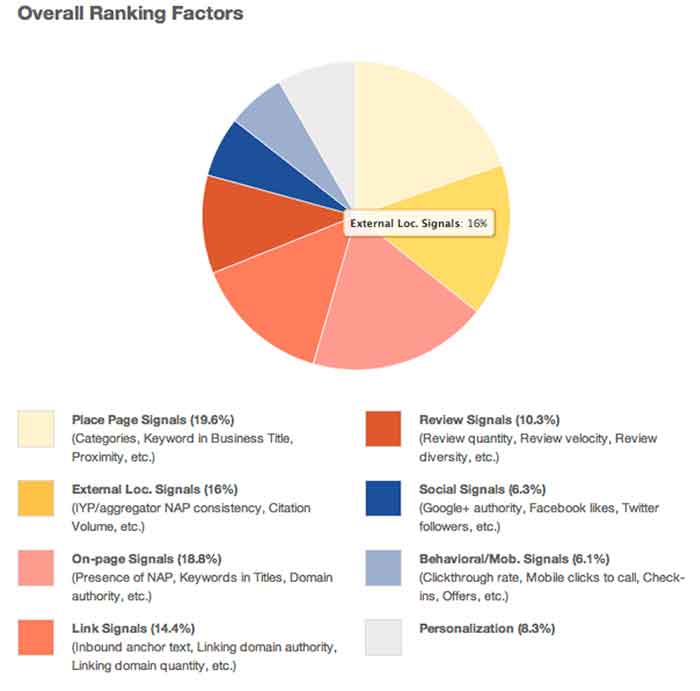
    David Mihm started his Local Search Ranking Factors “to help small business owners confused by Local Search, or those strapped for time, to prioritize their marketing efforts.” Many industry leaders contribute to the Factors (including Search Influence!). It was last published in August 2013, and it reveals that citation volume, NAP consistency, and other local signals account for 16% of the ranking factors.
    Overall Ranking Factors Chart Image - Search Influence

    Our own Mary Silva, Senior Internet Marketing Associate, adds, “Consistent and correct business NAP (Name, Address, Phone, and often Website) is the key to getting your site to rank locally. If Google finds inconsistencies in your business information across the web, then your business and its associated site are considered less authoritative and not as trustworthy.”

    You can clean your listings yourself, but be forewarned, it’s a serious time investment. There are tools out there to help you in this endeavor. Be sure to allocate some hours every month to reviewing those tools and taking any action to edit and update listings as you go.

    Learn to Love the Panda!

    If you need help getting your site back on track from Panda, we would love to help out. Just know that Panda can be your friend. The latest update shows that it’s a simple matter of some spring cleaning, getting back to the basics, and being a good citizen. We can help you get there!

  • Google Ranking: No ShortCutts to Success

    More often than not, our clients ask why their keywords aren’t as high up on Google as they should be. Is it a penalty issue? Is it an algorithm change? Or is it your content? Recently, I had a client that asked these exact questions. Here at SI, our job is to diagnose the answer.

    If you’re an online marketer, you know one name to be the Holy Grail of answers: Matt Cutts (for you non-online marketers, the head of Google’s Web Spam team).

    Recently, Cutts created a help video to answer the question we ask every day: What really determines why you’re not ranking as high as you think you should?

    The answer: It depends!

    Image of Google's There are No Simple Solutions Quote

    Make Friends With Webmaster Tools

    According to Cutts, you should first ALWAYS, ALWAYS, ALWAYS check Webmaster Tools. Here, you can see in detail what could be the issue, whether it be keyword stuffing within your content or some sort of crawl error.

    “We have seen sites that will launch a new development website that was previously no-indexed, and forget to take off the noindex tag,” Cutts said. “Or there’s 404s, or we can’t reach your site…”

    But what about the other algorithmic issues? How can you determine if it’s an algorithmic penalty or your content? According to Cutts, they don’t give much thought about algorithmic penalties because Google doesn’t really view them as penalties.

    “It’s a tough call to make,” he says, “because the web spam team is working on more general quality changes, not necessarily things specifically related to web spam…we just think of it as the holistic ranking.”

    Don’t Fear The Algorithm

    According to Cutts, in 2012 Google rolled out about 665 changes to how they rank search results, so the odds that they are rolling out some algorithmic change at any given point are pretty high. In fact, they might be rolling out a few. However, if the algorithm changes they make will impact your site in a big way, Google will notify you of those changes.

    For example, as Cutts says, Panda’s algorithm has become more integrated into indexing and has less of an impact on your rankings, whereas Penguin’s is still ever-changing and will more than likely have a bigger impact. In other words, Google will  likely send you a notification if you were affected by some change within Penguin’s algorithm.

    You’re probably wondering, what does this all mean? The reality is, it comes down to what you believe is best practice for your site. If your competitors are doing something that you think might be affecting their rankings in a great way, then use your judgement to determine if that’s something you should be doing for your site. As Cutts says, it’s difficult for Google to say that something is a penalty because it’s just a part of ranking. The good news is that it is algorithmic. As you change or modify your site based upon what you see within your competitors, you can see that these algorithms can reprocess the sites and you can and will rank again!

    Applause

  • 5 for Friday – Google SSL Warnings, Twitter & Amazon Collab, and more!

    1. Twitter and Amazon Link Up, Add Items To Your Shopping Cart With A Single Tweet – Buzzfeed

    452416003

    Amazon is using Twitter to drive sales with the new #AmazonCart feature. This may be a major breakthrough for ecommerce businesses. It’s super simple:

    1. The business tweets out a link for a product.

    2. Interested consumers can then reply to that tweet with the hashtag #AmazonCart.

    3. The product will instantly appear in the consumer’s Amazon cart.

    The consumer’s Twitter has to be linked to their Amazon account in order to do this, but the new feature should drive sales for E-commerce businesses with products on Amazon. Twitter users can also search the hashtag #AmazonCart to see what other people are buying. Isn’t technology great?!

    2. Become Your Own Rumpelstiltskin: Spinnin’ Crappy Online Reviews Into a Better Business – Search Engine Journal

    This is a great article on how to approach negative reviews. There are bad reviews from people who genuinely had a bad experience and bad reviews from people who are just plain irrational.

    How do you tell the difference between these people?

    If you look through an irrational person’s profile it’s full of negative reviews and they usually make overly dramatic and sadistic statements. People that genuinely had a bad experience  usually have a mix of positive and negative reviews if you look through their profile, there are some positive comments within their negative review and they make rational statements about their experience.

    How do you deal with this?

    Respond to the irrational reviewer with a generic, but genuine message without addressing specific points of concert. If they respond back, don’t respond again. Respond to the rational reviewer by addressing their specific concerns quickly and assuring the reviewer that steps have been taken to ensure that this will not happen again.

    3. New App Reveals How Much Information You’re Giving To Facebook – Search Engine Journal

    FacebookScaryScary! A new app, called Digital Shadow, was launched as a promotional tool for the upcoming video game Watch Dogs. It uses data you’ve given to Facebook to guess your location, your income, and your passwords. They use algorithms to predict your interest, desires, and fantasies. We live in an era where we like to document everything online from how we’re feeling to what we purchased to where we are in the world. It’s an eye opener to find out that there are people in the world that can use that information against you to hack your computer or to be more influential in their sales tactics towards you.

    4. Google Pauses Webmaster Tools SSL Warnings In Order Clarify Them In Future – Search Engine Roundtable

    Google recently sent out mass SSL warnings via Google Webmaster. They decided to pause the warning after they realized they were causing mass confusion. Now, Google is working on making the warnings clearer and tweaking the criteria before restarting them.

    Google is simply providing information about the server response for HTTPS access to your URL. If it responds, but the SSL cert does not match the domain, the warning lets you know. Basically, Google wants the hosts to either serve content via HTTPS properly, or not serve content there at all. Serving content via HTTPS without a valid TLS/SSL certificate will result in users seeing browser warnings. Avoiding this makes sense, no matter how many site users actually see the warning.

    5. Announcing Schema.org Actions – Schema Blog

    LegosAction

    Schema.org introduced vocabulary that allows websites to describe the actions they enable and how these actions can be invoked. You can use action schema to play a video, review a movie, or purchase a product. The new schema adds context to a link or content. It is a way of interpreting content to cite sources and authors and the type of activity that happened between the two. From what was said in the press release, the actions schema is still a work in progress and will be enhanced as more users use action schema and provide feedback.

  • 5 for Friday — Links, Stories, & Posts for Your Weekend

    five-5

    1. Google To Protect Paid Search Keyword Data, Making it ‘NotProvided’
    – Search Engine Journal

    This article discusses a report that Google will stop passing keyword data to analytics software, even for AdWords advertisers. The three main points of the article state that Google will likely stop providing referrer data for paid clicks on AdWords ads, Advertisers may see [not provided] in their Google Analytics reports or other analytics provider reports for paid search clicks, and Google AdWords reports will remain unaffected. How will this change effect you?

    2. The Art of Thinking Sideways: Content Marketing for “Boring” Businesses
    – MOZ

    Here the author speaks about different ways to create unique content for your clients. We have all had clients where we wondered if there was any way to promote their brand. As marketers it is our goal to raise brand awareness, improve search engine rankings, and increase sales for our clients.

    3. 73% Lose Trust in Brands Due to Inaccurate Local Business Listings [Survey]
    – Search Engine Watch

    If a business has incorrect information in an online listing will you lose trust in the business and look elsewhere? Have you ever looked up an address to a service or a business only to find yourself driving in circles because the info was incorrect? This happened to me personally a few weeks ago while looking for a restaurant. After I found myself lost for about 10 minutes I gave up and moved on to a new restaurant. This article has some interesting info about how potential customers will research your business information.

    4. How Brands Are Using Twitter’s Redesigned Profile Pages
    – Mashable

    This has some excellent examples of a few major brands who have recently updated their Twitter profiles. I agree that these new profiles provide the client the opportunity to add more content, but immediately thought they looked like a Facebook profile. Twitter is rolling this function out slowly to the general public. Check out the examples and let us know what you think!

    5. 80% of Local Searches on Mobile Phones Convert
    – Search Engine Watch

    Here is a study on local search on mobile devices. The stat that stood out to me was that four out of five local searches on a mobile device end in a purchase. Check out the infographic at the bottom of the article for more interesting data they found.

  • Why I Hate Your Website: A Guide to Good Web Content

    Hopefully you’ve read some of our other great blogs on sharable content and you’re sending out all those valuable signals that lead people back to your website. These leads are great and all, but what good are great signals and roadmaps if they lead you to something… disappointing?

    Imagine your favorite childhood adventure movie: A six-pack set of friends, perhaps accompanied by a talking animal of some sort, follow the strange, convoluted clues of an ancient map they found in someone’s grandfather’s attic. What if these young adventurers followed this map to the very end only to find a great big chest full of nothing?

    HeavilyGuardedContent

    That would be the worst movie ever.

    So, just to clarify, your website is that chest, and you’ll want to make sure that there’s some treasure up in there. How? Treasure = good content.

    Sidenote: I recently heard an interview on NPR with Pixar Animation Studio’s president Ed Catmull that relates to this topic. The interview was introduced with “content is king” so, you know I was tuned in. In the interview, Catmull downplayed the importance of technology in Pixar’s movies. “It’s not about the technology,” he says.  “We use the technology, we develop it, we love it, [but] it’s about the story.” So, if Pixar believes in content, you should too!

    So, what makes good web content?

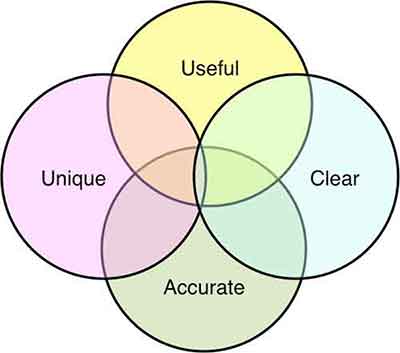
    From a broad perspective, here are four characteristics that can guide you to good content.

    Infographic

    Useful

    Your viewers have jumped down the rabbit hole in search for something. It’s your job to know what that something is. Have they arrived at this page looking for contact information? For pricing? To make a purchase? — Make sure you know why the viewer has made it to this point. Then, and only then, can you provide the solution.

    Be as detailed as possible, but also be concise. My number 1 rule: no fluff. Aaron Wall of SEOBook puts it perfectly, “Good writing does not add extra words for the sake of word count. Each word carries purpose and meaning.”

    Clear

    Make it easy for your visitors to find what it is they are looking for. Your site should not be iSpy, Contact Info Edition. Organization of your content is paramount. The longer your visitors have to search for information, the more likely they are to jump to another site. Make the information easy to skim.

    ispy-meme

    A major issue I see is vanity capitalization. If the intent is to highlight important information, the tactic has the opposite effect. With so many Capitalized words throughout the Content, it becomes Unclear why You are Capitalizing anything at all? See how difficult it was to read that one sentence? Capitalize words within your subheadings, headings, navigation bars, etc. all you like, but don’t go cap-crazy within your content. Sending too many signals to your reader that THIS or THIS or THIS or THIS and THAT are important throughout your page can become confusing. If everything is important, nothing is important.

    Pro Tip: Subheadings are a great way to point your site visitor in the right direction. But don’t go overboard.

    Unique

    Duplicate content is something I see a lot of. It’s not just a personal pet peeve; it’s bad for SEO. So, don’t fill out multiple pages with the same content just for the sake of having multiple pages. Not only is this confusing for your site visitors, but it is confusing for search engine crawlers as well. So, you’d think if it’s bad for your viewers and it’s bad for your ranking, people wouldn’t do it. However, you’d be surprised how many sites I see with duplicate content on top of duplicate content. Make sure each page has content unique to that section. If the two pages are too similar, find a way to combine them. Otherwise, reword things to show the unique purpose and perspective of that specific page.

    Accurate

    Make sure your hours of operation, your address, your pricing, promotional deals – any information that may fluctuate – is up-to-date. The more active you are on updating your site’s information, the more accurate your site will be. This is not only good for your visitors, but good for search engines. Being up-to-date on information makes you a more reliable source.

    I can’t count how many times I’ve wondered if a site was open on a particular day—whether it was due to an obscure holiday (Hey, it’s New Orleans, places close their doors for seemingly no reason whatsoever), or due to conflicting information—and their site was anything but helpful. Letting your site visitors know what’s what ultimately gives them the information they need to be customers. And that’s the point, isn’t it?

    Whether you’re adjusting old content or starting from scratch, think from the perspective of your site visitors. It’s also good practice to examine the sites you visit frequently. What are some frustrating aspects of navigating the site? What is some information you wish they displayed? The key aspects of good content are all around you, take note of them! Observing the successful (and less successful) aspects of other sites, whether they are related to your industry or not, can help you navigate your own site’s content.

    So, how about it? What are some examples of good content that you see on a regular basis?

    GoogleSearch

  • Social Media And Viral Content: Tips From Matt Siltala

    If you haven’t heard of Matt Siltala, get your butt to Google right now and start searching. As an online search industry leader and president of Avalaunch Media, Matt came to New Orleans this week to present at Pubcon, a social media and optimization conference and expo featuring multiple days of multiple-track sessions, leading-edge keynotes, and an all-day intensive Pubcon Masters Group training program.

    Prior to wowing the crowds at Pubcon, Matt was kind enough to visit Search Influence and give us the skinny on social media, content, and how to make things go viral. His presentation was amazing, informative, humorous, and vastly helpful in terms of SEO. So, I’ve put together some key takeaways businesses can and should focus on in order to promote their brands and make a name for themselves online.

    MattSiltala-01

    Find Your Target Market By Talking To The Right People

    When you’re trying to reach a target market, knowing who to talk to in order to get results within that market is most important. When you talk to someone with power, authority, and a willingness to help, there is a higher probability of getting your brand noticed and increasing awareness among your target market.

    Pro Tip: If you know who you want to target, use Followerwonk to compare, analyze, track, and group users. That way, you know exactly who you’re reaching, and what to say in order to entice them.

    What Makes Good Content?

    Oddly enough, controversy increases viewers and makes for some great content. Think about it. When do people get the most involved in content? During a debate! Any topic people disagree on will get more viewers. This is a theory that withstands the test of time. For example: Republican vs. Democrat, Mac vs. PC, Coke vs. Pepsi, and Matt’s popular Evolution of the Electric Guitar infographic, which includes a Guitar Hero controller, featured below.

    music history timeline evolution infographics electric guitars 3660x1186 wallpaper_www.wall321.com_28

    Build Up Your Instagram Following With Deals

    bdb414e7b829806b2e3cdd921638042f

    With millions of users posting pictures every day, Instagram has exploded in terms of social media marketing and brand promotion. Boutiques, restaurants, and more post photos of products, specials, daily deals, and location information daily, giving viewers a reason to follow them and stay consistently engaged in the brand. By monitoring hashtags and paying attention to channels, businesses will learn whom to target and how to peak people’s interests and gain followers.

    Pro Tip: Show products in context to help viewers visualize a final product. Whether that is a meal, an outfit, or a piece of furniture, demonstrating what the product will look like in conjunction with other products peaks interest and makes things easier to relate to.

    Processes On Pinterest

    More frequently, businesses are turning to Pinterest to gain a customer base. In fact, the “Pin It” action has gained more popularity than the Facebook “Like” and Twitter’s “Retweet.” Checklists, how-tos, recipes, and detailed processes are hugely popular on Pinterest because they get people thinking and and keep their interest longer than a simple image.

    Pro Tip: In terms of repinning vs creating new pins, employ 4:1 ratio. Remember that it’s not just about repinning for content, you repin to network. And make sure you get yourself noticed by commenting regularly.

    Focus On Visuals On Facebook And Twitter

    As with all other forms of social media, building a following and growing your popularity is key to brand success on both Facebook and Twitter. So, what is the key to getting lots of retweets, likes, shares, and comments? Images! Think about it, what is the most retweeted post of all time? Ellen Degeneres’ Oscar Tweet! Only three days after the Oscars the tweet had a record 3.2 million retweets. Now that’s a powerful image.

    Pro Tip: Identify influencers relevant to your industry and interact with them as much as possible on social media to grow your online presence and brand popularity.

    I could go on and on about the wealth of knowledge Matt dispelled on the Search Influence family, but rather than rambling I’ll leave you with a few of his final tips and tricks:

    1. Pay attention to Linkedin groups. If you get in contact with the owner of a relevant group to your industry they can help you tremendously. Not only can they contact a large group of people easily via email, the group they’re contacting will be the exact target market you need for shares and online visibility.

    2. Sign up for alerts from Help A Reporter Out. You can find experts, get free publicity, and gain tons of helpful contacts.

    3. The gift category in Pinterest is wildly popular. By using a dollar sign ($) in your post description, your post will automatically show up there.

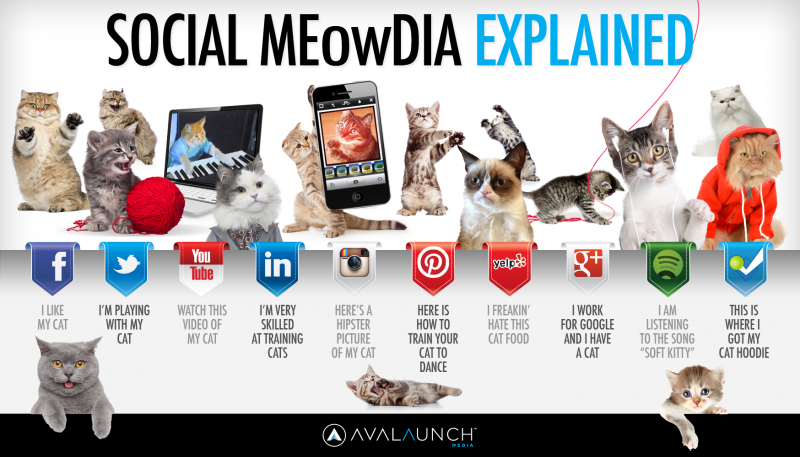
    4. Find a way to repurpose everything. Much like Matt’s wildly successful Social Meowdia Explained infographic (featured below), post, images, content, and more can be repurposed to gain popularity in a variety of forms. For example: an infographic can be turned into a blog, memes, content, etc.

    Social_Media_Explained4-800x457

    1. Remember that everything you do contributes to authorship. Every post you write, share, retweet, favorite, etc has your brand name attached to it. Everything you do online grows your authorship, so take advantage of that and be creative in what you post.

    For more information on Matt Siltala, check him out at Pubcon or visit his website! And for any questions on the information above, feel free to ask in the comments!

  • Content: The Beginning

    In the beginning there was the Internet.

    At least, that’s what I tell myself when I try to think back to my early childhood. Kids (whatever, I’m a kid, kids younger than me) are glued to smart phones, they have these things called tablets and nooks… but what of books? What of literature? These are some of the questions people had about television back when the youths first sat their little rumps down in front of the tube. Now, the eye of Sauron has turned to the Internet.

    internet.gif

    Don’t get me wrong, the Internet is chock-full of copious amounts of information (all the information, in my opinion—if it’s not on the Internet, it doesn’t exist) and can be extremely useful. Ah, but therein lies the issue!

    The Internet is an extremely powerful thing, a great source for random, trivial, and (sometimes) useful knowledge. However, with great power comes great responsibility. Although many can argue that the Internet is killing language (lik3 wut3v3r dude), excusing poor spelling, grammar, and vocabulary, the Internet has also bred a whole new generation of nit-picky grammar specialists. You know who I am talking about, that one person who loves to correct your use of words, followed by a sweet, misleading asterisk.

    What am I getting at?

    hercmeme.jpg

    Although a lot of time goes into straightening out the aesthetic and function of websites, many forget to think about the words.

    To quote the great V, “Words will always retain their power. Words offer the means to meaning, and for those who will listen, the enunciation of truth.”

    However, choosing those words can be a difficult, sometimes even Herculean, task. On the one hand, your content needs to be purposefully crafted, tailoring to those aforementioned language *specialists*, but on the other hand, your content needs to be clear, concise, and easily understood by a diverse audience, i.e. everyone.

    Good Content = Good SEO

    But how do I write good content? You may ask. Obviously, content will vary depending on your site, your brand, and your audience. But, say we were to tackle “good” content on a broad scale

    Check back for my next blog where I break down the concept of content, starting first with: The What — What Your Content Needs To Say.

  • Addressing Duplicate Listings In The New Google Places for Business

    Welcome back to the wonderful world of Google! Last week I explained in a post the email that Google Places for Business has been sending out to business owner accounts.

    Part of that email included a bit about your account containing listings that were identified by Google as being duplicates existing within your account. Now I’m here to explain to you the two most common ways in which we see duplicate Google listings and how they can be addressed.

    Internal Duplicates

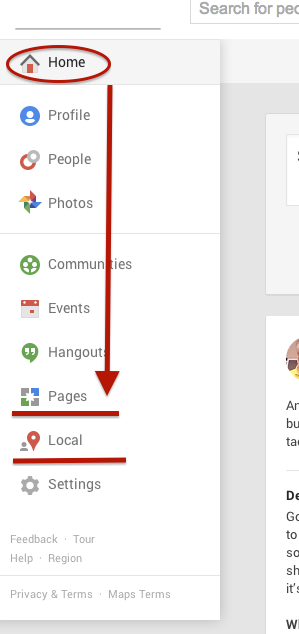
    Screen Shot 2014-03-14 at 1.00.44 PM (2)One way we tend to see duplicate listings in Google Places is from within your business owner account, in your own business dashboard. To see how your businesses are appearing in your account dashboard, go to the Places for Business dashboard, which can be found by going to plus.google.com. Then click “Local”(to see your  Location pages) and “Pages”(to see your Location, Brand, or other Google Plus Pages) in the drop-down on the left.
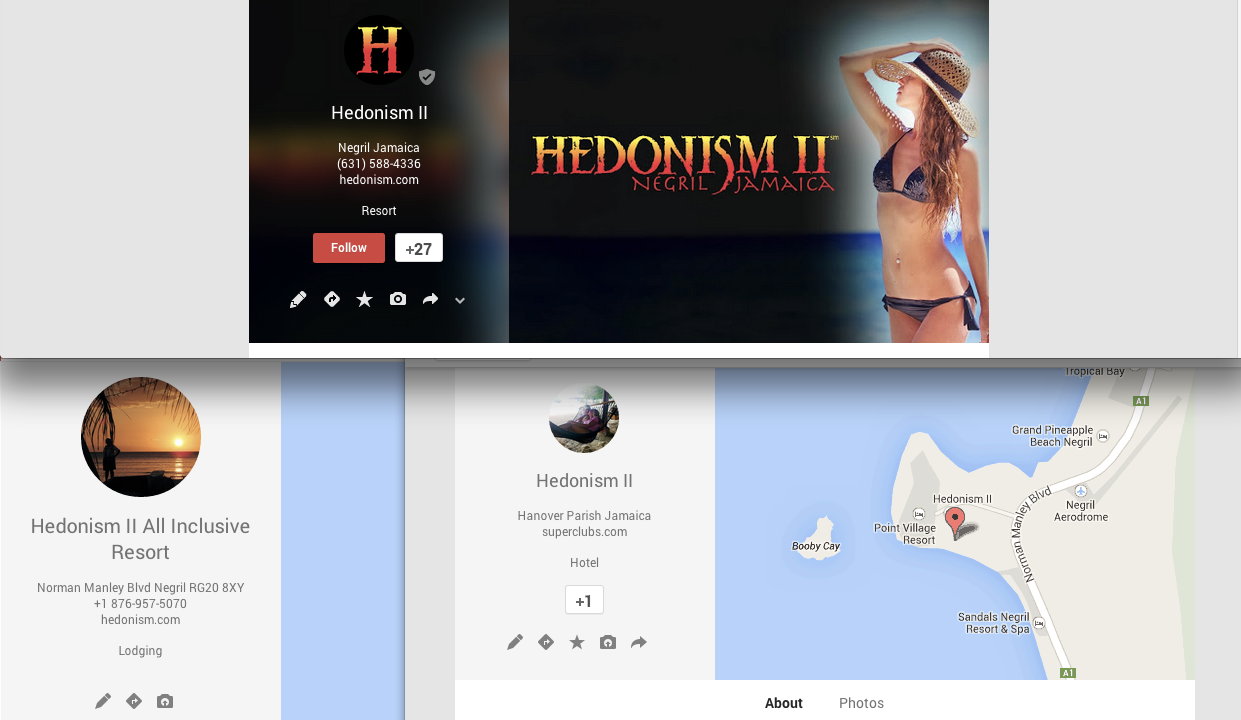
    The Local dashboard is where we generally identify internal listing duplicates. With the bulk dashboard updates performed by Google, we’ve seen this happening quite often. Since a lot of businesses have been force pulling their listings into the new dashboard by claiming them through the Places section of plus.google.com, there appears to be two listings in the dashboard of these accounts after Google’s mass update.

    Generally, one of these listings appears as verified (the one forced pulled into the new dash) and the other as unverified (the one Google pulled over). Sometimes they both lead to the same G+ page when you click through the “view this listing” link in each. This is just a weird hiccup, and if you wish to clean up the dashboard by deleting the unverified one, it will not affect your listing. As long as you have the verified listing in the new dashboard, you are the sole owner of said listing under this new update.

    In other cases, however, we’ve created a verified local social page through our force pull into the new dashboard that has all of our social content like G+ posting and YouTube videos. Then, when Google pulls in the location page from your old dashboard, that page is a “duplicate” with all your old reviews on it. In this case, both pages would have content that you wouldn’t want your business to lose through “deleting” a duplicate. So, you’d want to make sure the reviews from the location page are moved over to the newer, verified page before having it deleted. This will require a phone call to The Google Places Team support center.

    Obviously if one of these pages has content that you don’t mind losing or doesn’t have any content, that page can be deleted. If the one you want to delete is the verified one and you need the unverified page to be your primary, verified listing, you might be able to avoid having to reverify the listing through getting assistance from The Google Places Team.

    External Duplicates


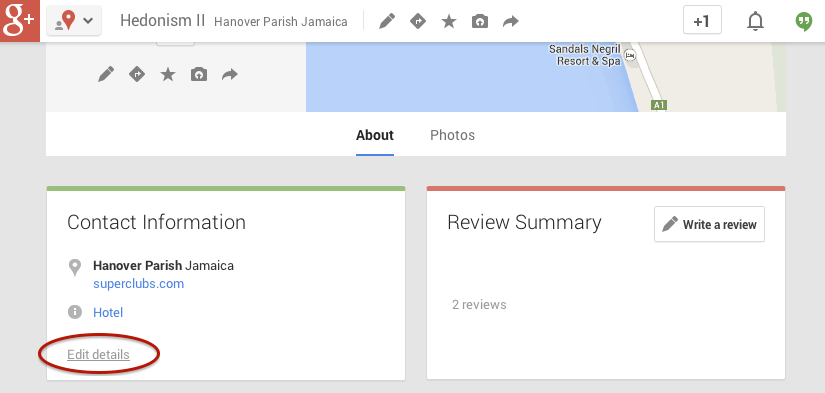
    Another way in which we see duplicate Google business listings is on the front end through Maps search results. You’ll see below that Hedonism II has a couple of duplicates that come up in Maps results. Getting these kind of duplicates cleaned up is a bit easier than the situation explained above. What you’ll do to remove these duplicates is called making a “community edit” or “mapmaker edit.”

    Screen Shot 2014-03-13 at 1.18.56 PM

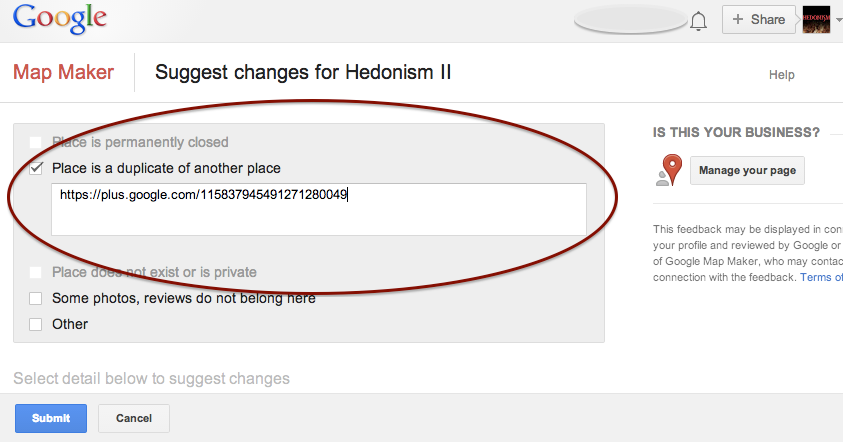
    Go to the duplicate listing you’d like Google to remove. Under the “About” section of the Plus page, then at the bottom of the “Contact Information”  you’ll see the option to “Edit details.” Once you click that, you’ll have to option click a check box to suggest to Google that this “Place is a duplicate of another place.” You’ll also have a box in which you can leave comments about the report. I suggest leaving a link to the correct/verified page in this field to help the duplicate identification process. See screenshots of this process below.

    In my experience, these changes will usually take affect within a week of reporting if Google deems it an accurate report. If no changes take affect in a week, I usually send the report again, wait a week, and repeat again as needed(I’ve never had to report more than 3 times, though).

    Understanding the many nuances of what’s going on here might seem fairly daunting, but the level of which you wish to understand these intricacies is dependent on how much control you wish to have on your business reputation/ presence in Google.

    Screen Shot 2014-03-13 at 1.20.25 PM Screen Shot 2014-03-13 at 1.21.06 PM

    If you have any questions, feel free to comment below!

  • Content Marketing: Doing It Right in 2014

    Feb14You might have heard the buzz: content marketing is not only here to stay, it’s critical for business success in 2014. The Internet noise is getting louder every day, and discoverability is becoming a greater challenge as the data streams expand with chatter from websites, blogs, and social media.
    If you’re looking to capture an audience online, you need an effective content marketing strategy in place.

    Why Content Marketing is Key

    Backlinks, keywords, and automated social tools just aren’t going to cut it anymore. Part of the reason is an increasingly Internet-savvy consumer base that can sort the authentic from the spammy at a glance—and the rest is due to major shifts in search engine algorithms, particularly Google.

    Google Hummingbird, the search engine giant’s most recent algorithm update, is all about promoting quality content and pushing it to the top of search engine results. In a definitive acknowledgment of the sharp increase in mobile search, Hummingbird aims to provide results that reflect the way people talk—delivering a conversational and contextual experience, rather than treating searches as keyword strings.

    In order to improve your search engine rankings, you need content that informs, answers questions, and adds value.

    Mistakes that Hold Your Content Marketing Back

    In order to get content marketing right, there are certain objectives you have to accomplish. Your content marketing should attract, engage, expand, and ultimately convert your audience.

    Some of the common mistakes that prevent content marketing from reaching those objectives include:

    • Producing in a vacuum. If your marketing department handles all of the content generation, from conception to execution, they’re eventually going to sound stale. Consider soliciting content ideas from other departments, working with a freelance copywriter, or seeking guest bloggers.
    • Publishing static content. To engage your audience, you need to win them over. This means providing something more than dry facts or market-speak—and giving readers a way to respond with thoughts of their own. Value quality over quantity, and produce content that informs, intrigues, and entertains. Make sure you’re always responding to comments and questions from readers.
    • Sharing on the wrong channels. When it comes to social media, a lot of companies have decided that more is more—and thinned out their efforts in order to reach as many social platforms as possible. This dilutes your brand and wastes your time. Most businesses can’t go wrong with Google+, Facebook, Twitter, and LinkedIn. As for the rest, experiment: keep what works, toss the rest.
    • Failing to analyze results. Content marketing is useless to your organization without analytics. You need to know what, where, and how your marketing efforts are working—where visitors are coming from, why they stay (or leave), and whether they come back.

    So What’s the Right Way?

    The real secret to effective content marketing in 2014 is quality. But what is “quality,” and how can you produce it?

    Quality content starts with defining your audience. Who are you creating this content for, and what do they want or need? What engages them? Find out as much as you can about your target audience—where they are online, what they respond to, even what they don’t like.

    When you move to the content creation phase, keep your target audience in mind. This includes the format of your content, whether your audience prefers text, images, video, interactive apps, or some combination of media. Finally, post your content on the channels your target market is most likely to frequent.

    The Internet changes, but content marketing remains one of the most effective strategies for online marketing success. Make 2014 the year you embrace content marketing done right.

    What’s working for you? Let us know in the comments!

    Image courtesy of Gerd Altmann

    Megan Totka is the Chief Editor for ChamberofCommerce.com. She specializes on the topic of small business tips and resources. ChamberofCommerce.com helps small businesses grow their business on the web and facilitates connectivity between local businesses and more than 7,000 Chambers of Commerce worldwide.

  • Un-blurring The Lines of The FTC and Native Advertising

    Un-blurring The Lines of The FTC and Native Advertising

    To those of us in SEO and other forms of web marketing, native advertisements may seem like a God-send, the perfect combination of advertising power and positive user experience. The content-driven marketing platform is under a great deal of scrutiny, however, as it becomes more and more commonplace on the web.

    While advertorials have been used for the greater part of the last century, native advertising is a more recent development that has capitalized on user experience in the digital age. In 2013, more than 70% of websites offered native advertising, and that number is likely to increase by around 10% this year (Mondaq). Due to their editorial nature, regulators—as well as members of the general public—are worried that native ads blend too seamlessly with unsponsored web content, and many are eager for the issue to be formally addressed.

    The SEO value of native advertising is obvious. It’s an excellent tool that not only allows for optimization, but also provides great content to the user. And as we all know, content is king. Native ad campaigns can be more successful than traditional online ads, and as marketers, we like to believe that’s because users enjoy the content we’re putting out.

    Critics, on the other hand, argue that the ad serves as a sneak attack, tricking users into clicking through. As Federal Trade Commission Chairwoman Edith Ramirez told Reuters, “By presenting ads that resemble editorial content, an advertiser risks implying, deceptively, that the information comes from a non-biased source.” The drama around native advertising recently culminated in an FTC workshop focused on the method. This idea of hiding advertising in content inspired the FTC workshop’s name, “Blurred Lines: Advertising or Content?”

    blurred-lines-logo
    http://www.ftc.gov/news-events/events-calendar/2013/12/blurred-lines-advertising-or-content-ftc-workshop-native

    Un-blurring the Lines

    The workshop’s panelists questioned standardization and responsibility, trying to keep all three parties—buyers, sellers, and consumers—in mind, with perhaps a little more favor to the consumers, who have the least agency in the situation. While everyone agreed that transparency is necessary, some argued that it wasn’t enough. Chris Jay Hoofnagle of Berkeley’s Law and Technology Center, for example, presented results from his research, showing that as many as 35% of consumers didn’t identify a native ad as an advertisement although it was marked. On the other hand, Chris Pedigo of the Online Publishers Association reported that more than 70% of websites that offer native advertising had not received complaints from users.

    These statistics are just two examples of the myriad of arguments that seem to complicate the issue rather than clarifying. If there was one thing everyone could agree upon at the end of the workshop, it was that more work still needs to be done before any definite regulation can be imposed. Even Jessica Rich, Director of the FTC’s Bureau of Consumer Protection, stated that native advertising may be too complex an issue for one-size-fits-all standardization.

    In the meantime, the responsibility remains on the publisher to use discretion and focus on un-blurring the lines with clear indications of sponsorship on native ads. That may not be an attractive idea to advertisers hoping to fool users, but those producing strong content know better. If a company is actually creating the content users want, it shouldn’t matter that it’s marked with their logo and a big “Sponsored” label.

    Publishers can look at the situation one of two ways: embrace the responsibility or abuse it. With freedom from regulation, publishers are free to respect users and clearly label native ads or take deals with eager corporations to disguise the content. We advertisers share in the opportunity, as we can always choose which publications we partner with.

    Running a Clean Campaign

    While partnering with a publication that sneaks in sponsored content may seem like a good tactic from a purely bottom-line-driven approach, some innovative companies have already proven to us that it’s really not necessary in the end. Several publications are working to show their dedication to corporate responsibility when it comes to native advertising, and it turns out native ads are successful no matter their labeling.

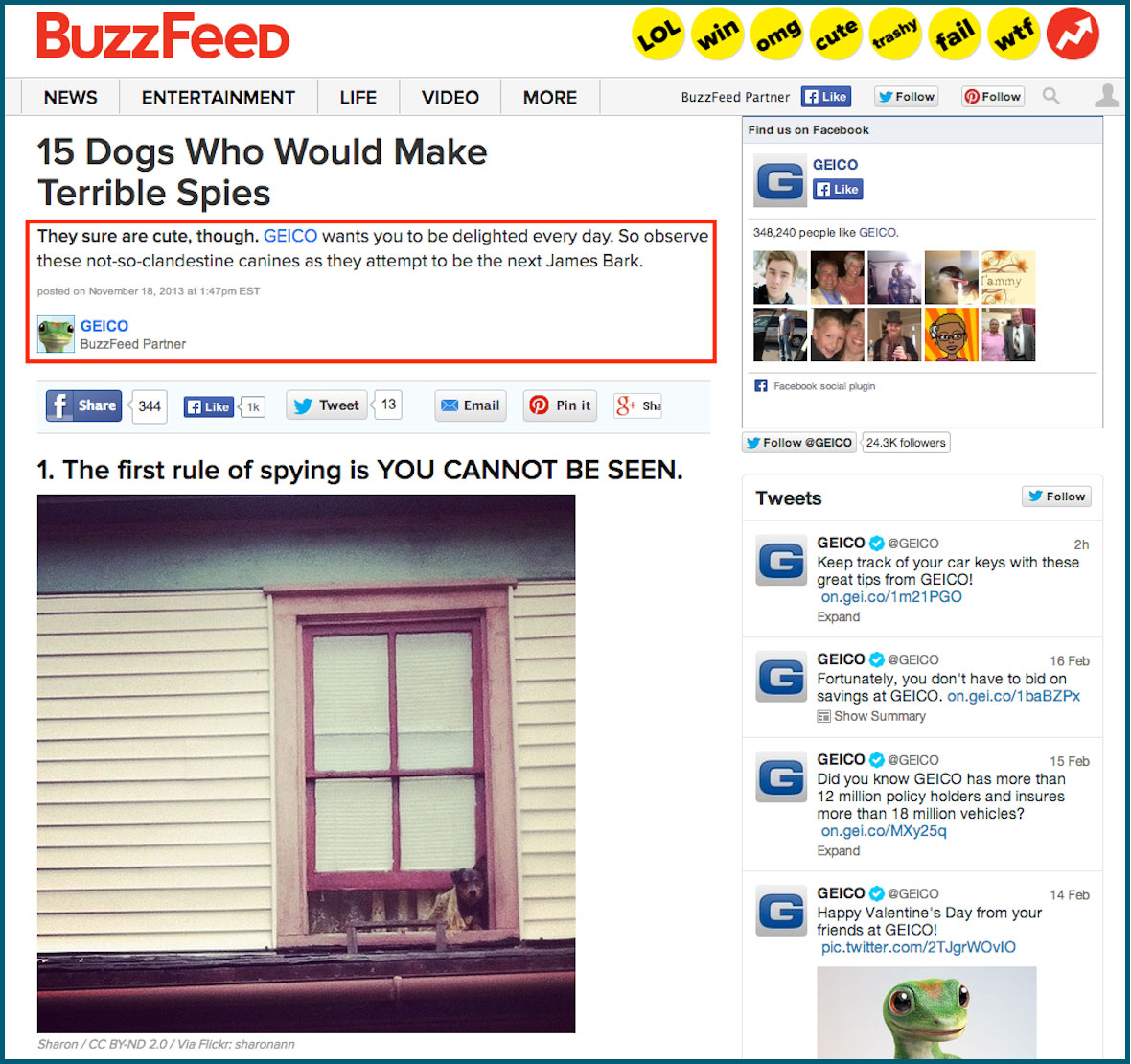
    BuzzFeed is a truly great example. The site rejects display ads entirely, relying on only native ads for advertising revenue. And it’s working out pretty well, according to Peter Kafka at All Things D, Buzzfeed planned to earn somewhere around $40 million in 2013, but the end number ended up being closer to $60 million. This sales boom comes in spite of the fact that advertisers’ contributions on the site are marked “Sponsored.” Buzzfeed’s pioneering efforts have obviously benefited the company greatly, and their sponsored content often drives more web traffic than traditional posts.

    infographic-pic
    http://www.buzzfeed.com/geico/15-dogs-who-would-make-terrible-spies

    Buzzfeed isn’t alone in their honest tactics. Many other companies acknowledge their native ads, including The New York Times, which announced in December that it would mark sponsored content with colored bars and “Paid Post.” According to the Times, publisher Arthur Sulzberger Jr. sent a letter to all employees emphasizing the “strict separation between the newsroom and the job of creating content for the new native ads.” The Times even published an article on their attitude toward native advertising, turning a policy into a great PR moment.

    IAB Playbook

    While no formal regulations are in place, the Interactive Advertising Bureau has set out to clarify the practice and set standards in the industry with the Native Advertising Playbook. By publishing the playbook, the IAB is acknowledging both the importance of native advertising and the danger it poses to unsuspecting consumers. Patrick Albano, the vice president of Social, Mobile and Innovation Sales at Yahoo and co-chair of the IAB Native Advertising Task Force explained that the organization set out with the goal of providing “guidance based on the state of the industry today while at the same time leaving room for flexibility to inspire innovation and growth.”

    The playbook goes over six different “core interactive ad formats” that are currently being used in native advertising: in-feed units, paid search units, recommendation widgets, promoted listings, IAB standard ads with native elements and custom ads. It also gives broader ethical principles advertisers can use to protect the consumer. With all native ads, the playbook suggests advertisers consider form, function, integration, buying & targeting, measurement and disclosure to “ensure that a unit will meet their brand objectives.”

    What This Means For Marketers

    To be completely honest, things are just as uncertain as before the FTC held its workshop. The workshop raised just as many questions as it answered and proved that no one has thought of a fair way to regulate native advertising. What the workshop really did is formally alert the industry to the FTC’s ever-growing interest into this marketing technique. As an industry I’m sure we’d hoped to avoid regulation altogether. We will now need to wait and see, and the good news is it’s not imminent given industry professionals and federal regulators still can’t seem to figure out what, in particular, should be regulated, much less in what way.

    In the meantime, Bureau Director Jessica Rich suggests that advertisers continue to rely on the FTC’s Dotcom Disclosure Guidelines when in doubt, while discussions continue. The IAB seems to be leading the discourse, with a series of native advertising workshops beginning in March 2014. Until then all we can do is focus on our own marketing efforts, working to keep consumers informed and clients successful. And native advertising is sure to be part of that process. In fact, with the advent of Penguin, native advertising seems to be our best hope. With each update, Google pushes even further back against search marketers, emphasizing the importance of well-thought-out and informative content. While I have always maintained that SEO is built on content, Google is regulating marketers in its own way by devaluing anchor text and deep links in favor of solid branding. So basically, if your native ads are giving users what they want, then Google’s happy, too.

    Has all of the recent hubbub around native advertising had an impact on your strategies? What do you see on the horizon? I’d love to hear your thoughts on the subject and on my theories. Please share below!