Tag: content strategy

  • Keywords: Now All-Natural and Gluten-Free

    Google has officially divulged that it rewards the mobile optimization of your website. Hooray! For most people, this doesn’t come as much of a surprise. There are studies dating back to last year claiming that up to 60% of consumers use mobile searches when making purchase decisions. The bottom line is that people are becoming increasingly hooked to their phones as each day passes.

    LookingAtPhonesImage

    How Has Search Intent Changed?

    Okay, so people love their phones—shocking. But what are the larger implications here? How might the mobile revolution affect the way you rank for specific keywords? Well, to answer that question, we need to delve into how search intent is evolving. With the mounting prevalence of semantic searches compared to conventional keyword-happy searches, users are now searching on the go and in an increasingly natural way. Gone are the days where using singular, valuable keywords are getting you exposure. In the ever-evolving search intent environment, content may be king, but nuance is noticed. One 2012 study estimated that “16 to 20% of queries that get asked every day have never been asked before.”

    What Does This Mean For Me?

    It’s officially time that we start thinking outside of the box when it comes to the keywords we are using in our content. Creating helpful, educational content for your users is about anticipating needs and answering questions. To keep up with the changing landscape of SEO, keyword brainstorming sessions need to become less about singular words and more about descriptive phrases.

    thinkoutsideimage

  • Defibrillate Your Clinic’s Social Media Plan in Five Steps

    Over the past decade, there have been steady increases in the acceptance, usage, and number of social networks. With membership in the hundreds of millions and even billions, social media networks like Facebook, YouTube, and Twitter have become excellent platforms for businesses that want to reach and engage their audiences. Because they form part of a more niche industry, it is crucial for hospitals, healthcare practitioners, pharmaceutical companies, and others in the healthcare industry to have a detailed online strategy in place across various social media platforms. Below are five steps to designing a comprehensive social media plan that take into consideration the challenges and specific needs of the healthcare industry.

    Challenges

    Healthcare providers face a number of unique obstacles when entering the world of social media. Businesses in this industry typically have multiple stakeholders, from existing patients to future patients to other physicians. Each stakeholder has unique expectations regarding communication standards and topics, and a fully fleshed out plan that follows these steps should take these expectations into consideration.

    The healthcare industry is strongly regulated by organizations like the FDA. However, in the recent surge of social media outlets and usage, the healthcare industry has faced a unique challenge: the reigning regulatory offices have not cited clear guidelines regarding the use and management of these social media platforms. Seeing as some information on the topic has been released, it is important that you review these sources before creating a social media plan for a business in the healthcare industry.

    Creating Your Plan

    1. Define Your Personality

    As a business and as a brand, you will need to define your online social personality: how do you want your stakeholders and audience to perceive you? Thinking of your brand as an individual will allow you to adopt a more coherent voice across your chosen social media platforms. To help define your voice, ask yourself questions like the following:

    • What color would you associate with your brand?
    • If your brand was a person, what kind of clothes would they wear?
    • What type of car would this person drive?
    • How would his or her friends describe him?
    • Does this person have likes or dislikes?

    Although it may be difficult in the beginning to uncover the personality of your practice, carefully designing this aspect of your social media strategy will allow you to create a more concrete tone and voice.

    Along with defining your voice, take the time to study and understand your stakeholders. Decide which groups you would like to reach: existing patients, future patients, other healthcare professionals, insurance companies, or any combination of these. This decision will impact the tone and purpose of your social media campaign, as each of your audiences will react best to content that is specifically designed for them. By keeping your target audience in mind, you will enhance your ability to focus your social media updates, allowing you to promote audience engagement and build a stronger, more trusting relationship.

    2. Listen

    After you have settled on the tone and audience of your social media strategy, pause to listen to the existing conversation. Determine how your audience and competitors interact within the social space, monitor conversations about your industry, and track the ways in which your brand is discussed online. Using tools like Google Alerts and hashtags, Sprout Social, monitoring forums and other online spaces to understand the existing conversations.

    Listening to the discussions that are in place across the spectrum of social media platforms will allow you to gain a sense of which healthcare topics are currently trending. It will also help you to identify the concerns, questions, and interests of your target audience, allowing you to build a strategy to address these topics during your social media campaign.

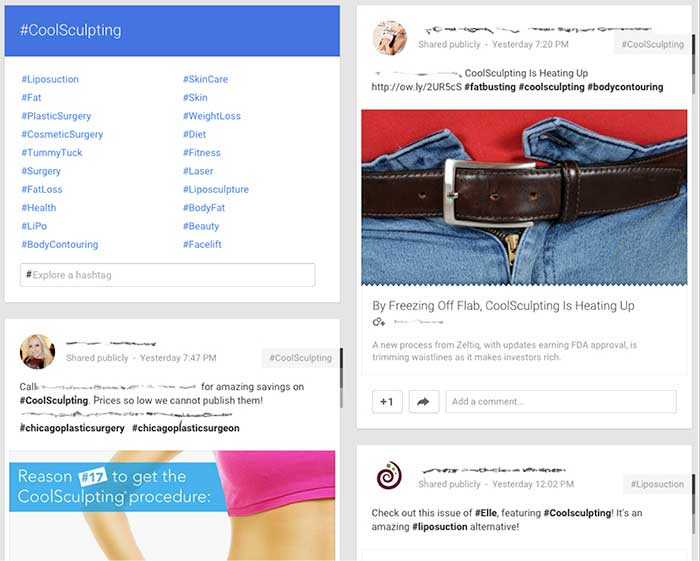
    GooglePlusIndustryHashtags

    Example using Google+ to review similar hashtags and industry competitors

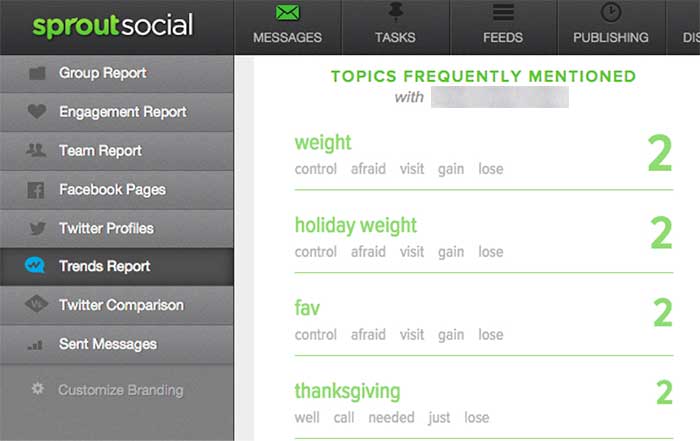
    SproutSocialConsumerConversation

    Example of using Sprout Social to understand how consumers are talking about your brand.

    3. Find Your Voice

    Next, begin your own conversations! Look for areas in the industry that lack a strong voice. Use that space to make a name for your brand and to demonstrate your expertise. Also, provide topics and the secure space for conversations regarding the health industry and health issues. Help moderate conversations to keep the discussions moving and the connections building. Encourage your audience to converse with you and with each other to foster a sense of community.

    To make use of your influence on social media, you can use a number of strategies:

    • Add personal, authentic stories: Depending on your goal, these can consist of success stories, anecdotes of achievement, or triumphs over a disease or disability.
    • Facilitate conversations and actions: Give healthy-eating challenges or build a place to help raise awareness for widespread health issues.
    • Wow the crowd with numbers: Build credibility by showing your audience the bigger picture. Share statistics, infographics, and other information about your industry or practice.

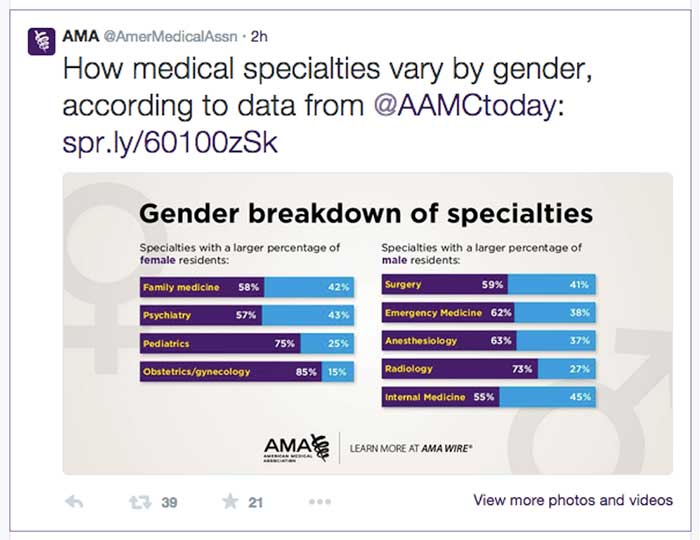
    AmericanMedicalAssociationExample

    Example from the American Medical Association using numbers to engage in a conversation. Only 2 hours after being tweeted this post received 39 retweets and 21 favorites.

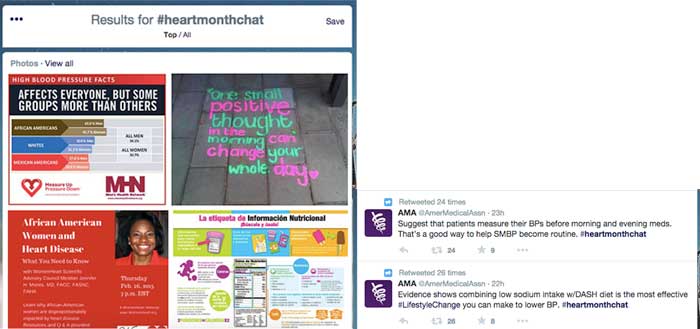
    TwitterHealthcareDiscussion

    Example of Twitter healthcare community discussing heart health online via #heartmonthchat and how the American Medical Association was able to find their voice in the conversation giving advice and statistics. Both tweets were retweeted and favorited several times.

    4. Collaborate

    Social media has become a frequent place of feedback for companies, and you can take advantage of this fact by using the social space to collaborate with your audience and with others in your industry. Do not be afraid to talk to your audience about their experiences and how to improve them in the future.

    Use social media as a place to work with other practitioners and organizations to raise awareness regarding healthcare topics. By working with others, you can increase your audience reach and further your message.

    GailZahtzHealthcareTwitterAdvice

    Example of Gail Zahtz (expert in patient-doctor relationships, offers advice to healthcare industry) collaborating with others in the healthcare industry to make information more readily available.

    5. Measure Your Success

    Although the last step in this plan is to measure your success, it is important to review your achievements on a regular basis and throughout each step of the process. Measure growth and success in the online space by an increase in followers, consistent interaction, and rising mentions across social media platforms.

    ThePlasticSurgeryInstituteFacebookLikes

    Example of growth of likes on Facebook using these steps. Prior to this campaign beginning, The Plastic Surgery Institute of Southeast Texas ~500 page likes.

    Consider the steps above when designing your own social media strategy. For more inspiration, check out some of these healthcare companies that have successfully created an empowering online presence!

  • 4 Internet Marketing Mistakes You Might Be Making

    There is nothing more frustrating than putting all your money and effort into your site’s content only to see a conflicting ROI. Many companies and businesses rely on Internet marketing to increase their profits, but some make simple and even unpredictable mistakes as they go about it. Feeling frustrated or annoyed with your results? You’re not alone.

    WAIT! Don’t break your computer just yet—we’re here to point out some mistakes you might be making.

    1.) Every part of your content concentrates on sales.

    Everyone wants to make sales and increase profits. That’s the whole point of your Internet marketing campaign, right? But new users who visit your site may not purchase your product or service right away. Smart buyers want to research your product, learn more about your brand, see what you offer, and compare your prices to the prices of your competitors. Your potential customers likely won’t have the compulsion to commit to a purchase right away unless you are a well-known company like Amazon. Don’t try to sell your product outright; rather, tell a story with your content. Ease your customer in slowly to make them believe in what you are selling.

    To do this, avoid making your content too product-specific. Let’s say you sell garden hoses, and garden hoses are all you know. You don’t want to talk about just garden hoses all the time; you’ll lose customer interest. And let’s face it—you can’t talk specifically about garden hoses non-stop while keeping your content interesting. So make sure you expand your content beyond your specific product. On certain pages of your site, spill expert gardening secrets, discuss ways to keep your lawn fresh, or start an FAQ section on popular gardening techniques. Always expand on your product and related topics to keep the customer engaged!

    2.) You’re using social media sites…incorrectly.

    One of the biggest components of any company’s campaign is the strategic use of social media. Coordinating posts on Facebook, Twitter, LinkedIn, and other social media platforms can take up exorbitant amounts of time and effort. Concentrating too much or too little on certain posts or topics can lead to fewer followers on a specific page, and no one wants to see multiple, random posts appear on their newsfeed every single day. Creating posts and utilizing social media should be a strategic and intelligent endeavor, not a disorganized, chaotic mess.

    Plan ahead by understanding the goals of your social media strategy. Do you want to drive traffic to your site? Generate more sales? Enhance your email list? Work toward brand awareness? Know your brand and, most importantly, know your customers! You don’t need to use every social media outlet; just figure out which channels your customers use most. If you’re not sure which media sites your customers prefer, just ask! It’s important to learn as much as you can about your clients, their social activity, and how to appeal to them. Absorb yourself in the community’s conversation and interact with your clients. Marketing 101: customer service and knowledge is the number one driving component to any business.

    3.) Your content is SEO-heavy.

    SEO is essential to any marketing campaign. You want Google to find your specific keywords and phrases to generate more traffic. SEO helps human users know you exist within their area!

    While all that is true, you do not want to write all of your content specifically for search engines. No one wants to read website content that has keywords stuffed into every sentence; content needs to be well-written and unique! When creating pages for your visitors, you want the writing to be memorable and easy to read. Once you start to write your content, all of the information you have about your product will flow out naturally, and the content will optimize itself: users will be more likely to share your content through social media, blogs, or websites when the writing is more natural. And if you want to give your content greater authority, be sure to link to other credible websites within your industry.

    4.) You aren’t calling your clients to action.

    You caught the fish, and now you have to reel them in.

    It is a very common misunderstanding that if you drive traffic, you will automatically increase sales. Maybe your new customers aren’t making purchases, and even your old customers who have been following your site and posts since the beginning of time still aren’t biting. Personally, I have followed many company sites without ever buying their products. Why is that?

    Creating an easily accessible path to your product is crucial. You want clients to have a simple conversion from viewing/visiting to buying. By embedding relevant calls to action within your text, you can ensure that content on your site gets potential customers deeply involved with your product. Every page for your products should have a link to sign up for your site, email list, or newsletter in three places: on the sidebar, below the article, and underneath the header.

    Don’t leave your customers to ponder what to do after reading your page. Send them along the right path!

    Image Sources:

    Smashing Computer Gif

    According to Google Gif

    Thumbs Up Gif

  • Search Tools, Edit Wars, and More: Get the Gist of Wikipedia for Businesses

    Wikipedia

    What is the Loch Ness Monster? Who is Monty Python? What is the history of Starbucks? Every time you do a Google search for practically any event, business, person, phrase, song, or obscure piece of trivia, Wikipedia seems to be right there at the top of the search results. Wikipedia, for those who are still using PalmPilots and pagers, is a free online encyclopedia. What makes Wikipedia unique is that it allows users to edit the content on all 35 million of its pages!

    A Brief History of Wikipedia

    With more than 500 million unique views each month, Wikipedia is currently the 7th most popular website on the Internet—but it didn’t start out that way. Wikipedia was launched in 2001, back in the dark ages of the Internet, and it was highly criticized for building a business plan in which no central organization would control editing and the general public would be responsible for the site’s upkeep. Because the site’s content was being created only by users, it took quite a while for the concept to gain traction in certain circles. In addition, some considered the website’s content to be untrustworthy because edits were so easy to make in the site’s early days. As you can see from the graph below, it took several years for the site to gain popularity, but within a few years, Wikipedia’s usage and traffic exploded.

    WikipediaGrowthGraph

    If you have ever visited Wikipedia, you’ve surely noticed that there are no advertisements, no fees to use the site, and no indications that the company is making a profit at all! This is partially due to the fact that they are a not-for-profit organization relying almost completely on donations from their users. A few times a year, the site hosts drives in order to cover basic costs like server space, bandwidth, software, office space, and salaries for its small staff. Of course, because all of their content is donated, there is no need to pay for updates and contributions!

    As time went on and Wikipedia increased in popularity, the company wanted to ensure that the site’s content was as trustworthy, current, and extensive as possible. Wikipedia began to create new processes that made editing content and creating pages more difficult, and it also added a review process. Only registered users can create new articles, some pages are protected from edits, and some pages are “semi-protected,” which means that only certain editors can make changes. All editors are allowed to submit modifications or updates. However, review is required for many of these edits, and all new articles must go through the review process. Depending on the page, edits can be reviewed by the public or by specific members of the Wikipedia staff, but if the edits are small enough, they might go live immediately without passing through the review process.

    What This Means for Your Business

    Because the site has such high authority and ranks so well in search results, Wikipedia offers incredible SEO opportunities for businesses. A business’s Wikipedia page can have very recent information, detailed descriptions about products and services, a history of the company, and even information about charities and community outreach programs the staff partakes in. However, because Wikipedia aims to always tell the full story from a neutral (and non-promotional) standpoint, dark spots in the company’s past are more prone to surfacing. Major lawsuits, media mentions, and other types of bad press could have a permanent place on a business’s Wikipedia page if that news is noteworthy enough. If your business is considering going down this path, always keep in mind that others will be able to write and edit all content about the business.

    Below, we have provided additional information (all from Wikipedia) on how to create a page, make edits, and more!

    Resources

    http://en.wikipedia.org/wiki/Wikipedia

    http://en.wikipedia.org/wiki/History_of_Wikipedia

    http://en.wikipedia.org/wiki/Wikipedia:Size_of_Wikipedia

    http://www.ehow.com/how-does_4809393_wikipedia-make-money.html

    http://en.wikipedia.org/wiki/Wikipedia:Your_first_article

    http://en.wikipedia.org/wiki/Wikipedia:Article_wizard


  • #LocalUp – Making Content The Sexy Part of Social

    The presentation below was developed for a joint conference put on by Local University and Moz in Seattle on February 7th, 2015, called LocalUp.

    My “beat” if you will as a Local U faculty member is Social Media, and given our work with customers of Search Influence, I have always leaned toward the advertising side of Social Media Marketing. With some of the changes being made by Facebook, most particularly, the elimination of “selling” content from the news feed, that focus is getting more important.

    Facebook is no longer a free lunch. You’ve got to pay to play.

    That said, it’s still very important to build community and engagement and good content makes it easier. That’s what this presentation is about. I hope you enjoy. I’d love to have your comments here or on SlideShare.

  • Big Results Can Come in Small (SEO) Packages

    tinygiftsimageMany small businesses fear that because they don’t have millions of marketing dollars at their disposal to build their SEO campaign, they simply won’t be able to compete with large corporations. However, there are many SEO tactics small businesses can employ to level the playing field and compete against large marketing budgets.

    If You’re Small, Focus Small

    If your small business offers many services but has a limited budget, it will be more effective to focus your SEO efforts on a small set of highly relevant keywords. For example, if you’re a hair salon and you offer haircuts, blow drying, hair coloring services, etc., it will be better for you to focus on the one service that you perform best. It’s more effective for you to try to be visible for a primary or specialty service than to try to be visible for all of your services—and not to be visible for anything in the end.

    pinonglobeimageYou’re Local, So Get Hyperlocal

    A big advantage you have as a small business is your attachment to the area. Focus your efforts on your local audience by hosting events, participating in your community, getting local reviews, and targeting your content to your locale. You can then leverage all of these hyperlocal efforts in your SEO campaign. That local event you hosted or local organization you helped can generate local content, local buzz, and website links back to your site, all of which tell search engines that you are locally relevant.

    Specific And Long Tail Is The Way To Go

    With limited funds, you need to be clever about the keywords you’re focusing your efforts on instead of going for the obvious ones. To go along with the hair salon example, instead of emphasizing keywords like “hair cut” or “hair coloring,” focus your efforts on more long tail phrases such as “tips to layer your hair” or “how to get an ombre effect.” It’s much easier to rank highly for these long tail, specific keywords than the obvious, broad keywords. While there may be less traffic, the traffic you do get will be highly relevant.

    The next time you think your SEO dollars and campaign efforts don’t stand a chance against giants in the industry, don’t forget that being small has its advantages. Leverage your nimble nature and cleverness for some easy wins!

    Thanks to Heiwa4126 for the globe image and to John Fingas for the tiny presents image.

  • 12 Days of SEO (as Told by Christmas Movies)

    December is finally here, and you know what that means – Christmas SEO! Here are my 12 (Days of Christmas) tips for your small business’ online presence, as told by my favorite Christmas movies:

    1. Accept That SEO Is a Gradual Process

    It may take some time, but if you strategize and take things step-by-step, you’ll be able to improve your results on Google.

    2. Keep It Consistent

    Just like the Rockettes’ kickline, it’s important to keep your business’ name, address, and phone number consistent across the web. This includes your website, social media outlets, and directories!

    3. Work on Positive Reviews

    Getting positive reviews from positive customers can go a long way. Once you have five reviews on your Google+ page, your average star rating will begin to show in search results. Tip: you can give customers this nifty review link to make it really easy.

    4. Don’t Let the Big Guys Push You Down

    Directories and national chains can be intimidating, but play up your strengths as a locally owned business. You can strategically find keywords to target that feature a maps pack; you can also optimize your business listing on the directories that are ranking high.

    5. Feature Fresh, Original Content on Your Site

    Duplicate content can be harmful to your site’s SEO, and it can be boring for potential customers. Make sure that your site’s verbiage isunique and engaging. It’s okay to be different!

    6. Avenge Your Manual Actions

    A manual action from Google may seem worse than being trapped on the Island of Misfit Toys, but there are ways to earn back trust and get in Google’s good graces. With time, money, and effort, you’ll get there one day. Just like Santa, Google checks its list twice. Once you’ve put in the work, wait and see what happens during the next algorithm refresh.

    7. Trust the Keyword Research

    Sometimes it may seem as though the keywords we recommend are not how people are searching, but the numbers don’t lie. Just don’t forget to check for outliers such as news articles, branded searches, and weird town names (Cadillac and Bath, Michigan).

    8. Get Backlinks That Are Natural and Relevant

    Just because you have lots of backlinks doesn’t mean they are good for your site. They may be spammy or unnatural. When getting links back to your site, you should have a combination of quality and quantity. Ideally, you want lots of good links coming from strong, relevant websites.

    9. Pay Attention to the Technical Side

    Keep all of your sitemaps updated and make sure you submit them to Google and Bing Webmaster Tools. It’s also important to add schema so that Google can easily find helpful information about your business. Don’t forget about optimizing your site’s images and meta data; it’s a quick and easy way to get your “ticket” on the Google Express.

    10. Verify High Authority Directory Pages

    Don’t get “lost” in map results or directory searches. Get your listings verified (usually via phone, mail, or email) and optimize them. I suggest claiming your Google+, Yelp, Bing, Foursquare, and Moz Local listings. If niche sites such as Houzz, Avvo, or Edmunds are available for your business, claim those listings as well. P.S.: this helps you with the recent Pigeon update!

    11. Engage with Customers Through Social Media

    It isn’t enough to have social media accounts; you need to be active and interact with your customers. Keep your content interesting and reward fans for commenting on your page. It could be as simple as liking their comments, favoriting their tweets, or saying “Thank you!”

    12. Analyze, React, and Keep Calm after Google’s Algo Updates

    The landscape of Google can seemingly change in the blink of an eye. While it’s important to brace for the worst, don’t forget to check for the best. A lot of recent updates have been good for my clients! Think of the glass of milk as half full and the cookie plate as half empty; be prepared to take action on the latter.

    Image Sources:

    Rockettes

    Christmas Story

    Christmas Vacation

    Miracle on 34th Street

    Mean Girls

    Polar Express

    Grinch

    Santa Clause

    Lost in New York

  • Five For Fridays: How To Get Yourself an Assistant, Get Rid of Spammy Links, and Go Evergreen!

    Screen Shot 2014-12-17 at 3.26.46 PM

    1. Think Like a User – Search Engine Land

    Sometimes we can get so caught up in trying to get attractive links that we forget why we are writing a piece of content in the first place. We try so hard to get people to read it that we fail to remember who it’s for. In one of her latest columns, Julie Joyce describes the importance of thinking like a user when trying to integrate links to our content. She gives us tips of where users really want links and how it could be helpful to go offline to see things from a different perspective.

    2. Go EverGreen! – Search Engine Land

    Why is it that some pieces of content seem to get more traffic year after year, while others die away to Internet uselessness? Neil Patel shows us the benefits of incorporating evergreen qualities to your content. These qualities can help your content continue to gain traffic and readers regardless of how long ago it was published. Even though it might take some ongoing work, he stresses the importance of relevance and quality so that your content can be seen for ages.

    Screen Shot 2014-12-17 at 3.42.31 PM

    3. Penguin, What Have You Been Up To? – Search Engine Land

    There has been a lot of debate about what magnitude the new Penguin algorithm update is going to have. In this article, Philip Petrescu shares data on Penguin’s latests impact. His data shows the effect the algorithm has had on low ranking websites and how it’s affected other countries of the world. He argues that the impact the algorithm has had depends on the rankings you currently have, the industry you are in, and who you’re competing against.

    GoogleNow

    4. Say Goodbye to Spammy Links – Moz

    Recently, Marie Haynes wrote a handy guide on how to use Google’s disavow tool. Even though this tool has been around for a while, it can still be confusing to use. With the constant updates Google is doing on its algorithms, it’s imperative to be on top of getting quality links to your site. This guide shows a step-by-step process to get rid of those spammy and unnatural links that are pointing to your website.

    5. Stressed at Work? How About a Personal Assistant – Mashable

    In this hectic world that we live in, most of us could use a little help. I know that I would love to have my own little minion. These five apps are here to become your own digital personal assistants. They can help you get organized, check the best route to work, store boarding passes, remind you of tasks, vocalize your social media feeds, and much more. Who would you hire as your virtual assistant?

    Image Sources:

    Thanks to Bill Selak for the number five image, Maria Sarfraz for the Google now image, and Splatito8127 for the Sequoia National Park image.

  • Five For Friday: A Very Twitter Christmas, Facebook Gets Scroogy With Likes, & More!

    iphone5borderimage

    1. Are Twitter Users the Most Efficient Holiday Shoppers? – MarketingLand

    Given their 160-character count limit, Twitter users are clearly efficient communicators. And now, we are learning that they are super efficient holiday shoppers as well. The popular social platform released a study highlighting its ability to influence shoppers in their decisions on retail establishments and which specific items to purchase. 54% of users are more likely to purchase an item if they saw it advertised on Twitter. The study also shows that Twitter users not only shop earlier, but they also shop more frequently for holiday purchases. I guess now we know where retail shops should be marketing during the holidays.

    2. Secrets to Properly Linking on LinkedIn – Business2Community

    We all have a LinkedIn page. We’ve entered in our resume details, uploaded a picture, maybe got endorsed by a friend or two, and received a glowing recommendation from our moms, but now what? How exactly can you benefit from this?

    Here are 12 secrets from LinkedIn pros! Adopting some of these habits will help you increase your presence and improve your network. Some tips include:

    • Message people in groups for free!
    • Share useful and relevant news (mainly for attention).
    • Use tools, like FiveHundredPlus, to stay organized.
    • Follow first; Like, Share, and Comment second.

    LinkedIn can be confusing, and it may seem unnecessary, but with the growing number of companies and business people joining and actively using the platform, it has become more beneficial to understand how it works. Creating a substantial network will help in the long run. So, go forth and connect!

    3. How-To: The Most Perfect List Post – Business2Community

    Everyone loves lists! However, with their increasing popularity and Internet users’ ever-prevalent short attention spans, how do you keep readers reading?

    Business2Community offers a near-perfect list of tips for creating the best and most effective list post. There are several things to consider when writing out a list, and remember, every detail matters. Some of the tips provided are:

    • Always, always, always have an introduction and a conclusion (excluding the distinguished SI Five for Friday posts).
    • Pick the right number (10 instead of 5, 7 instead of 8). Trust us, it’s science.
    • In the title, use “10” instead of “ten.” Seriously, it matters.
    • Write longer posts.

    These tips are guaranteed to help make your list go viral, or at least make sure your readers actually read through to the end.

    YouArePerfectImage

    4. The End of Facebook Like-Gate as We Know It – MarketingLand

    Say goodbye to the days of entering a contest on Facebook with the simple click of a Like button. Facebook engineers have dismantled the ability for companies to use Likes as the entrance fee for contests and prize drawings.

    The effects of this are two-fold. For one, companies will now have to engage users on a deeper level in order for them to connect with the business. This change effectively ends the use of “artificial incentives.” Two, they also expect to see more conclusive results when determining demographics, as opposed to the scattered results received when companies were giving away iPads haphazardly to gain social media presence.

    However, it is also being argued that ending Like-gating is solely meant to gain revenue for Facebook. The belief is that companies will pay for Likes if they have to. And now, they have to.

    5.  What’s the About Page Supposed to Be About? – CopyBlogger

    The About page seems pretty self-explanatory, but it has actually evolved over the years and is no longer a place for you to just describe your business/products. For a more effective page, use it to start a conversation with your reader and emphasize to potential clients that you have what they are looking for. Because this is often the most visited page on your site, it is wise to grab the reader’s attention from the get-go. Let your personality shine! This will assure your visitors that they are in the right place, and they are more likely to continue browsing your site.

    There are 5 steps to creating a superior About page:

    1. Engage with readers by introducing your personality and humor on the site. Don’t be afraid to be different.
    2. Get into the readers’ heads. Make them think you’re reading their mind by showing them you have exactly what they are looking for.
    3. Brag, but humbly. Include some testimonials so others are singing your praises.
    4. Near the end, insert a bit of your biography. Make sure you express why you do what you do, and why you love it.
    5. Call to action! Invite your readers to sign up for your email list, call, or contact you. Most of the time, they will!

    Image Sources:

    Thanks to Mariah Summers for the “You Are Perfect” gif.

  • Those Who Do Not Learn From The Past Are Doomed To Have Poor Search Value

    If you’re reading this blog you’re probably already aware that Google has been busy updating their algorithms. If you work in the Internet marketing industry you may be on edge, cowering at the very mention of any animal whose name begins with the letter P. Ever since the first Panda update in 2012, followed by the introduction of the infamous Penguin algorithm that laid waste to the search engine rankings of many a carefully formulated marketing campaigns, ended careers, crushed SEO companies, and changed the hierarchy of competing businesses across the globe, people have kept an ear to the ground for the approach of further updates.

    Unfortunately, the secrets behind these algorithms are tightly guarded, and only general guidelines and information are provided to the public by the clandestine data giant, Google. So what are we to do? How can we avoid being penalized for our efforts and implement a lasting marketing strategy that won’t blow up in our faces like some Looney Toons derived Acme product?

    Threading Through the Maze: Birth of the Search Engine

    In search for the most strategic tactics to create a future-perfect website, I believe we must first visit the distant past, the primordial pre-digital world of 1945. Yes, its time for a flashback.

    BackToTheFutureImage

    The heated global conflict of World War II has induced a brave new world of scientific development spurred on by allied nations sharing research to gain a technological edge in the war. In the wake of the conflict, a newly established international science community, having proven itself as an invaluable resource in every aspect of the war, is continuing to progress at an unprecedented rate. As the head of the U.S. Office of Scientific Research and Development, Vannevar Bush, has been coordinating between a broad range of scientific disciplines from all over the world since 1941. Frustrated with the inefficiencies involved with sharing massive amounts of data between specialized fields of study, namely the inability to quickly find pertinent information, Bush devised a solution that he described in his essay As We May Think.

    “The summation of human experience is being expanded at a prodigious rate, and the means we use for threading through the consequent maze to the momentarily important item is the same as was used in the days of square-rigged ships.”

    Bush’s vision was to create a system that more naturally indexed information by association, implementing “associative trails”  allowing a person to further explore particular ideas within an article as opposed to having to put down one resource to take up the search for information anew. He envisioned the ability to view multiple articles on a single screen, with the ability to add comments that could be stored and recalled with the article thereafter and the creation of links between related articles, allowing users to map out a network of information easily accessed and built upon by future users.

    Of course, in that day, the technology did not exist to implement Bush’s machine. Bush’s device, the “Memex”, he proposed would use every 60’s spy film’s favorite storage format — microfilm. His vision inspired further development within the scientific community that above all other things resulted in streamlining the exchange of information making exponential leaps and bounds in development and implementation of new science possible.

    Back to the Future

    WhereWereGoingDontNeedRoadsImage

    So you’re probably thinking at this point. “Awesome. A guy back in the 1940’s thought up something vaguely search-engine like. Great. Maybe next time I need to change the oil in my Nissan you can tell me about the inception of the steam engine.”

    Okay. I like nerding out about history. Guilty as charged, but this brief walk through the annals of history does have some significance to the modern webmaster. As much as technology changes and improves, the demands that drive development remain unaltered. The desire for an intuitive means to access a large network of information led to a series of advancements that reshaped modern society.

    The entire history and continued development of search engines lies within the scientific community as an effective means to index and provide relevant information to those that are looking for it. Every search engine adheres to these concepts and despite the negative association with algorithm updates in the Internet marketing community these updates are, at the very least, intended to improve on Google’s ability to provide the most relevant and desirable information to the user.

    For those looking to the future, bare in mind that Google isn’t just getting better at devising its algorithms and penalizing what it interprets to be undesirable marketing practices, Google also provides ever increasing access to information and incorporates more user behavior into how they determine the validity of a website. As the #1 search engine in the world, and largest provider of analytics solutions, Google has access to massive amounts of user data which is being actively used to determine search rankings. While you can fool search engine crawlers and automated ranking processes, Internet users of today are savvy, experienced, and don’t take kindly to spammy or misleading marketing practices.

    Preparing for the Inevitable

    The oversimplified answer to how to implement a website that will succeed on the search engines, and continue to do so, is one that embraces the ideals on which Bush’s Memex was based and all search engines were built — to put useful information into the hands of the people that are looking for it.

    STEP 1: To best do this, the important first step is determining what information your clients need and want most. Don’t get tripped up analyzing at this part of the process. Think simple. If it’s a product you’re selling, generally a wealth of user reviews on the Internet will tell of the user’s opinions and desires. Tap into these for inspiration.

    STEP 2: Next, create original, well-written and researched content. The content should provide users with the information they are looking for, clearly labeled and organized to enable a user to quickly find the tidbits that are most relevant to their search. Updating or adding to this information often is important. Keeping your site current and error-free will help continue visits to your site and an upward progression in ranks.

    Step 3: In addition to text, it’s important to provide high-quality images, videos, and other media, and it’s even more important to label these properly. The more original media you provide the better.

    Step 4: Established social media sites and Internet communities relevant to your industry are important places to have a presence in order to connect directly with potential clients and establish your site’s authority.

    I know these tips are nothing new. These are the time-tested practices for Internet success that have barely changed since the genesis of the Internet.

    I understand the general reaction to algorithm updates. It’s crushing to struggle up the ranks using all your know-how just to have those efforts ripped to pieces. And when battling for exposure in the dog-eat-dog world of marketing, many, if not most, will turn to any competitive advantage they can muster.

    It’s important to realize, however, that with regular updates occurring that further marginalize the gains of shady marketing practices, anyone looking for more than a flash in the pan needs to embrace the ideals from which the search engine was born and connect people to the information they are looking for.

    Image Sources:

    Thanks to Don’t Count Your Chickens and to halbschwer for the Back To The Future Gifs. Also, thanks to Mark Bourne for the Wile E. Coyote image.