Blog

  • Will Scott on Digital Disaster Plans for the Tampa Business Journal

    Key Insights:

    • Before a natural disaster occurs, audit where your customers find your business online so you have documented which channels to update in the aftermath.
    • Be intentional with your messaging after a natural disaster, and demonstrate empathy.
    • When you reintroduce your marketing strategy after a natural disaster, plan it at a steady pace that allows you to be nimble if there are any further developments in the recovery proces

    On October 21, 2022, following the aftermath of Hurricane Ian, Search Influence CEO and Co-founder Will Scott wrote for the Tampa Bay Business Journal about the importance of businesses reconnecting with customers after a natural disaster to provide accurate operational information.

    While this article is only available to Tampa Bay Business Journal subscribers, we believe this information is vital for all businesses.

    Read on to learn how to craft a better digital disaster plan for your company.

    Waves crashing onto beach during a hurricane

    Essential Steps for Businesses Following a Natural Disaster

    Step 1

    Take an audit.

    Where do your customers find your business? Make a list of all the places where you need to update your digital presence, including but not limited to:

    • Social media
    • Website
    • Email blasts
    • Google My Business profile
    • Yelp

    Hopefully, before the storm, you also made sure the inventory of your digital channels was up to date.

    Step 2

    Be intentional in your messaging, and demonstrate empathy.

    In the wake of a storm, emotions are high. Your customer can experience any range of feelings, from the joy that it is over to devastation from personal loss and everything in between.

    As you craft messaging to deploy on your owned channels, make sure it resonates with your audience and provides them with as much information as possible. Think through what information would be helpful rather than just saying you’re open.

    Also, you’ll need to continue to demonstrate that empathy as long as the community does. When the community begins to rally, reintroduce marketing tactics you had in place prior to the weather event.

    Step 3

    Begin to reinstate your digital marketing plan.

    Reintroduce your marketing plan at a steady pace to still allow you to be nimble if any further developments occur in the recovery process.

    When making your plan, think through your team and who you can assign to do what. Make sure these folks have access to logins and technology to do what they have to do. And verify they understand the message you want to put out there.

    If you are not sure what to say, this blog post can help with crafting content.

    Learn More About Digital Disaster Planning

    As a business founded and headquartered in New Orleans — a city no stranger to natural disasters — we take pride in helping our clients craft sincere and agile digital disaster messaging.

    Fill out our online form to learn how our digital marketing services can assist your business before, during, and after disaster strikes.

    Images

    Waves

  • 5 Higher Education Marketing Challenges Solved by SEO and Paid Digital Advertising

    5 Higher Education Marketing Challenges Solved by SEO and Paid Digital Advertising

    Key Insights

    • SEO and paid digital advertising works. And because they are trackable and measurable, we assure you they do.
    • Drive more qualified leads with SEO and paid digital advertising, which will help you capture prospects actively looking for your offerings.
    • Reach your audience at all stages of the funnel with SEO through broader, career-growth topics in the awareness stage and more specific, branded searches in the decision stage.
    • With the flexibility of these tactics, you can quickly adjust your marketing plan when it isn’t working.
    Prioritize SEO and paid ads to make the biggest impact on your marketing plan

    Education marketing leaders need reliable strategies to drive results. If you don’t know which strategy to favor to meet your enrollment goals, we are here to let you in on something — SEO and paid digital advertising will make the biggest impact on your marketing plan. And because they are trackable and measurable, we assure you they do. (When we refer to paid digital advertising, we mean paid search and display ads. Throughout the rest of the blog post, I’ll refer to paid digital advertising as paid digital ads.)

    While marketing leaders see SEO as important, we at Search Influence don’t believe that they have prioritized it as a key part of their strategy. We also know marketing teams spend a lot of money on paid digital ads but believe they don’t optimize their campaigns to their fullest potential because they don’t look at the data from the right angle.

    In this post, we’ll detail how SEO and paid digital ads can solve the top five challenges we hear from education marketing leaders. Overall, you’ll see that SEO and paid digital ads address the number one goal of a successful higher education strategy: qualified inquiries (at an acceptable cost) that turn into students.

    #1: How Do I Get More Qualified Inquiries?

    Most often, higher education marketing plans have both a quantity and quality issue when it comes to inquiries.

    • You don’t have enough new prospects entering the funnel
    • You receive a decent number of inquiries but not enough high-quality inquiries
    • It seems like you receive high-quality inquiries, but you don’t know how to evaluate their quality

    SEO and paid digital ads help you capture prospects actively looking for your degrees, programs, and certifications, which means you’ll receive more qualified inquiries.

    A comprehensive SEO strategy improves your rankings, which drives more website traffic and more inquiries. When these prospects inquire, you should expect higher quality leads because they got to your site through a search that indicates they are actively considering a solution and want to learn about your educational offerings. Similarly, paid digital ads fuel qualified inquiries in the same way — by driving website traffic from people actively searching for your programs.

    Paid display advertising (i.e., Facebook and LinkedIn advertising) helps you drive more qualified inquiries by targeting the RIGHT audience. Other tactics, such as organic social media, could reach a variety of people. However, when you specifically target your audience through paid digital advertising, the data gives you confidence that your messages reach the right people.

    Graphic showing magnifying glass over marketing metrics

    #2: I Know My Audience Is Out There. How Do I Reach Them?

    SEO and paid digital ads help you reach your audience in distinct ways.

    When people think about SEO, they usually think about reaching audiences that directly search for your programs. Less often, they think about the impact SEO can have at the top of the funnel — when prospects are not yet aware that education may be their answer.

    By writing blog posts about more general topics that your audience may be searching, you can be one of the first organizations to reach them and lead them to consider education. For example, higher funnel topics like “Most Popular Programming Languages for a Career in Web Development” or “How to Launch Your Freelancing Career in 3 Steps” can drive traffic from prospective students who are looking for career growth advice but might not yet have considered a degree. Yes — this is SEO!

    Although higher education marketers generally include paid digital ads as part of their strategy, we often hear from them that their campaigns don’t drive enough inquiries. This isn’t a problem with paid digital ads as a tactic. This suggests there’s an opportunity to adjust your campaigns, which means testing your target audience and/or fine-tuning the creative messaging.

    Campaign adjustments, through both expert human optimization as well as machine learning optimization, help you better reach your audience. For example, a campaign might drive very few inquiries or the wrong types of inquiries because your campaigns target either too narrow or too broad an audience. By making these types of adjustments, paid digital advertising can drive leads at an appropriate cost.

    #3: How Do I Drive Prospects Down the Funnel?

    Some higher education marketing leaders are surprised to hear that both SEO and paid digital ads can drive prospects down the funnel.

    A robust higher education SEO strategy includes a full-funnel approach to content that speaks to prospects in each stage of their decision-making process. Recommended content for each part of the funnel:

    • Top of the funnel: Career growth topics
    • Middle of the Funnel: Program/degree-specific content
    • Bottom of the funnel: Branded search engine optimization, which allows you to capture searches specific to your school/unit and assure that prospects find their answers quickly — and on your website

    Branded SEO is often overlooked and is one of my favorite tactics! Branded searches in the decision phase include application deadlines, reviews, tours, and tuition costs.

    Paid digital advertising allows you to tweak your creative messaging to fit your prospect’s place in the marketing funnel. With the proper campaign segmentation, you can:

    You can also run multiple ad variations to speak to more people. Over time, you will see which messages work more than others and switch them out.

    As you segment your messaging down the funnel, you can create specific messaging you wish your audience knew about. You don’t have to worry about overall/introductory messaging because your audience has already engaged with your institution and knows you. For example, a single ad could focus on:

    • A student’s success story
    • An alumni career achievement stat
    • An award, or special pricing

    #4: What Am I Getting for My Budget?

    The clear accountability of paid digital ads and SEO is a key reason many have moved the lion’s share of their budget to the digital arena.

    SEO and paid digital ads enable you to see the source of the prospect on an inquiry-by-inquiry basis, which means you can track the cost per inquiry and cost per application from each source and overall. Ultimately, this means you can tie ROI back to your campaigns.

    These direct metrics enable you to compare your stats to industry benchmarks and to peer organizations which both give you confidence your results stack up and tell you clearly what you get for your budget.

    Graphic showing a coin being put into a piggy bank

    #5: Can I Quickly Adjust My Marketing When My Plan Isn’t Working?

    The beauty of SEO and paid digital ads is that you can make adjustments along the way.

    With SEO, you can increase your emphasis on optimizations for a given program or degree if the work so far hasn’t been aggressive enough. If one program outperforms the others, you can pivot your time spent to another program.

    Contrary to traditional marketing or longer-term media buys that lock you into a specific time frame, with paid digital ads, you can make adjustments after you have specific data. Optimizations can range from creative/messaging updates to changes to where the ads run to who sees the ads.

    If a campaign has not met your goals, you can actually turn it off and reinvest that money into a campaign that drives results at an acceptable cost. For example, if you have campaigns on Facebook and paid search, and the paid search campaign drives quality leads, you can reallocate your budget from Facebook to paid search.

    Prioritizing SEO and Paid Digital Ads Will Have an Impact on Your Higher Education Marketing Plan

    As a digital marketing agency that started out as a search engine optimization agency, it may not be surprising that we have this point of view. Yet, we think it’s worth repeating: Higher education marketing teams know they should prioritize SEO in their marketing plans, but they often don’t.

    We also believe that universities that invest heavily in paid digital ads and don’t see expected results have not leveraged data to make the best optimizations.

    If you are ready to learn how SEO and paid digital ads can make the biggest impact on your marketing plan, please reach out to the Search Influence team via our contact us form or give us a call at (504) 208-3900.


     

  • Search Influence Partners with the Louisiana Hospital Association for a Virtual Training

    Search Influence presents “The Great Resignation: How to Stabilize and Even Boost Your Marketing in this Uncertain Time” in partnership with the Louisiana Hospital Association (LHA) on Thursday, Sept, 22, 2022. This is Search Influence’s fourth time partnering with the LHA for a virtual training exclusively for the organization’s members.

    Louisiana Hospital Association logo image

    Established in 1926, the LHA is a not-for-profit association representing all types of hospitals and healthcare systems throughout the state. The LHA carries out its mission by providing services and resources to members through advocacy, education, research, representation and communication.

    About the Virtual Training:

    The Great Resignation is impacting every industry, especially the medical industry. A recent survey by Marketing Hire News found that marketers are not an exception to this trend. But how can medical practices ride the wave of this turnover and still continue to push their marketing objectives forward? How can your in-house mar comm be prepared for turnover whether that is now or later? How can medical practices take advantage of the Great Resignation on the marketing front?

    The Great Resignation sounds scary but let HR handle the comings and goings of staff and deep dive on the marketing engine driving your company’s objectives and revenue. Best practices and strategic line of sight can keep marketing tactics such as third party review sites, patient testimonials and storytelling in motion while staff positions are vacant.

    Shore up four key areas of focus within the marketing communications function that can position your company to excel even without being fully staffed in-house.

    1. Plan
    2. Partners
    3. Performance
    4. Pivot
  • Search Influence Announces Platinum Partnership with Higher Education Association UPCEA

    NEW ORLEANS, Sept 8, 2022—Search Influence, an ROI-focused, digital marketing agency, is now a Platinum Partner of UPCEA, the leading association for professional, continuing, and online (PCO) education. As part of the partnership, Search Influence will share its expertise on higher education marketing strategies and how institutions can optimize, measure and track their search engine optimization (SEO) and paid ads strategies to drive more qualified prospects to their marketing channels. Search Influence will also collaborate on a study with UPCEA’s Center for Research and Strategy in order to provide insights to the PCO community that help them understand the impact of their SEO strategies.

    Search Influence is an UPCEA Platinum Partner

    Over the course of the two-year partnership, Search Influence will publish articles and blog posts, host webinars and appear at several UPCEA conferences to share the value of SEO and paid ads strategies, as well as how analytics and tracking help higher education marketers better understand how their marketing performs and how it contributes to driving inquiries.

    “In our experience, most institutions utilize SEO, paid search and targeted display ads as part of their strategy but don’t know how to measure their impact.” says Search Influence Co-owner and CEO Will Scott. “We’re eager to help demonstrate the ROI of these critical marketing tactics and how they drive recruitment.”

    Search Influence is a corporate member and has spoken at several UPCEA conferences, including their annual conference and Marketing, Enrollment, and Student Success (MEMS) conference. Additionally, one-third of Search Influence’s leadership team completed “Markets, Marketing, and Managing the Cycle from Prospects to Learners,” a course about the importance of data-backed decisions in enrollment management, led by UPCEA’s Chief Research Officer, Jim Fong.

    “We’re proud to offer these partnership options to our members. Search Influence’s investment in UPCEA demonstrates their passion in improving the effectiveness of PCO marketers, as well as their commitment to growing their team’s understanding of higher education marketing trends and challenges,” says Kim Zaski, UPCEA’s chief membership officer and vice president of corporate partnerships. “We view their partnership as a great opportunity for our members to benefit from Search Influence’s SEO and paid ads knowledge.”

    About Search Influence:

    Search Influence is a women-owned, ROI-focused, digital marketing agency who helps institutions drive prospects into and through the recruitment funnel with analytics-backed strategies that include search engine optimization and paid digital advertising.

    Founded in 2006, Search Influence’s core purpose is to optimize potential. We collaborate with well-regarded institutions both nationally and locally in New Orleans. Clients include Tulane University School of Professional Advancement, Tulane University School of Medicine, University of Maryland School of Public Policy, Palo Alto University, and Edgewood College.

  • Top 7 SEO Questions You May Be Asking

    This post was updated by Shira Pinsker on 8/31/2022 to reflect recent trends and refreshed statistics. It was originally published on 7/19/2021.

    Key Insights

    • A search engine optimization campaign aims to increase both the quality and quantity of organic traffic to your site.
    • The primary function of search engines is to deliver answers to questions in the most digestible way possible. This is the most important thing to remember when executing an SEO strategy.
    • SEO is a long-term strategy that, when done correctly, pays dividends in results.

    A strong search engine optimization (SEO) campaign is an essential tool for any digital marketing strategy. While effective paid advertising, social media, and other digital strategies are important, organic search brings in the majority of website traffic.

    Effective SEO campaigns can help drive conversions, improve user experience, and ultimately lead to increased customer satisfaction. In this post, we’ll provide the answers to seven SEO questions clients commonly ask.

    Person at desk viewing Google landing page on laptop

    1 – What is SEO?

    Search engine optimization is the “practice of increasing both the quality and quantity of website traffic and exposure to your brand through non-paid search engine results.” (Moz) SEO is performed through a combination of updates both on and off your website to help Google better understand who you are, what you do, and why searchers should see you at the top of search results.

    The most popular SEO tactics include content creation, technical improvements, and link building.

    2 – How do search engines work?

    The goal of Google, Bing, and other search engines is to display the results that are most likely to answer a user’s query in the most digestible format.

    Search engines take three steps to find, analyze, and rank content:

    • Crawl: Search engines comb the Internet and read over the code and content for each URL they find.
    • Index: Search engines store and organize the content found during the crawling process.
    • Rank: Search engines deliver content on the search engine results page (SERP) that is most relevant to a user’s query.

    3 – How does Google rank results?

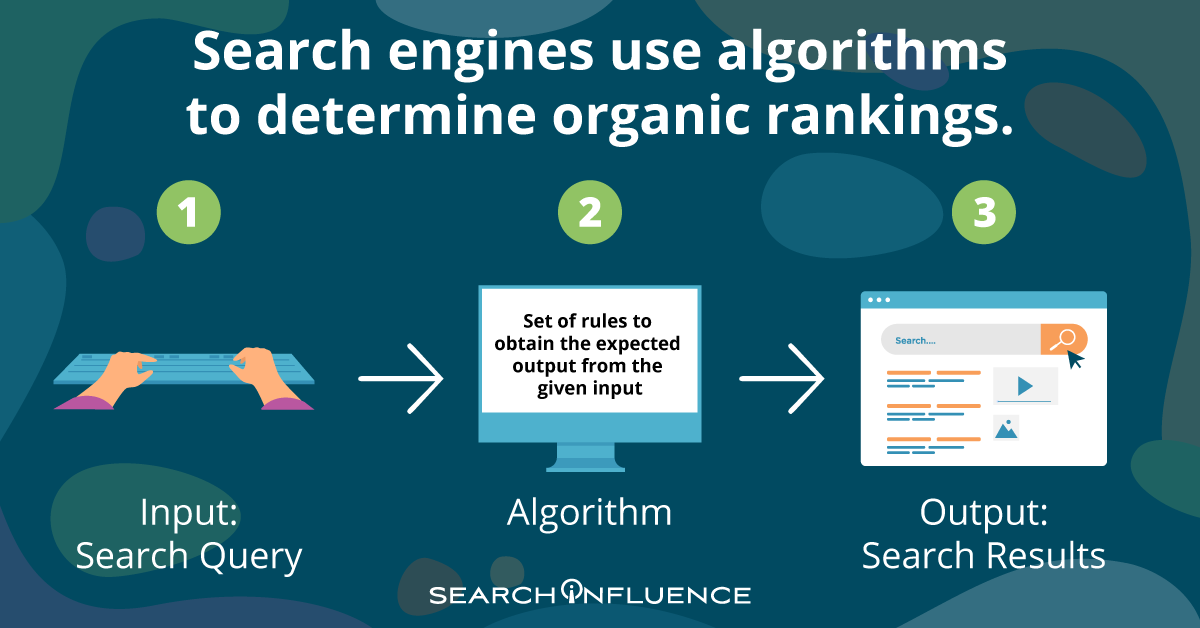
    To determine organic ranking, search engines use algorithms, a process or formula by which stored information is retrieved and ordered in meaningful ways. The algorithm is ever-changing; in fact, modifications are made on a daily basis. Search engines use three factors to rank pages: relevance, location, and authority.

    • Relevance is how your business matches what the searcher is looking for. The primary ways we send signals for which queries are relevant to your business are:
      • Content: All the text, videos, and images on your site. A huge factor in where your page will rank is how well the content on that page matches a search query.
      • RankBrain: The machine-learning portion of Google’s algorithm. While Google does not reveal the specifics of RankBrain, we do know Google’s main goal—fulfilling searcher intent. The best way to fulfill search intent is to provide the most accurate information in the best way possible for people who visit your page. Beyond content, the other factor here is user experience. How easy is it for users to find the information they are looking for on your site.
    • Location plays a big role in local search results as they are very attuned to the searcher’s location or the location included in the query. We can reinforce location information through:
      • Content: Using location in metadata and the body of content.
      • Schema markup: Code that tells search engines what content means. Location schema markup helps search engines easily identify and decipher location information.
      • Listing management and building: Building and maintaining correct business listings not only ensures users have the correct location information but also ensures Google has this information and reinforces your location.
    • Authority—being well known and trusted—is another important ranking factor. We send authoritative signals to Google by:
      • Backlinks: Links from other websites that point to your website. These work similarly to word-of-mouth referrals in real life. Both quantity and quality of these “referrals” are important. We want links from other sites that Google trusts.
      • Reviews: The number of reviews a local business receives, and the sentiment of those reviews, have a notable impact on their ability to rank in local results.
      • Citations: Multiple, consistent references to a business’s name, location, and phone number strengthen Google’s “trust” in the validity of that data.

    Graphic explaining process of search engines algorithmic rankings

    4 – How much content does a page need?

    A common practice for determining word count is to match the length of the top-ranking pages for your targeted topic. While this method may help you figure out how thoroughly you should cover the topic, Search Engine Journal reminds us “it is important to remember that copy on a page should be there to aid the human visitor, not a search bot.” User intent is king in terms of determining the length of content. The key is to think about what a user is looking for when landing on your page from organic queries. Is your target audience looking for a quick, concise answer or a longer, more in-depth explanation?

    5- When will I see results?

    The timing of results from an SEO campaign can vary based on the strategies deployed, the competition within your industry, and your business’s characteristics. You can typically expect to see organic improvement at six, nine, and 12 months.

    After deploying a targeted strategy, such as optimizing the content on a specific page, you will likely see initial movement in results (organic traffic to that page or keyword rankings for that targeted topic) at six months. Then, you can expect to see further growth at the nine-month mark. Finally, you should see a larger jump in results at 12 months.

    6 – Why do my rankings fluctuate?

    Fluctuations in rankings are completely normal and very common. Search engines are constantly crawling and recrawling websites and indexing new information. This means that a page’s rankings will naturally rise and fall as you and your competitors adjust your websites. Also, algorithm updates can cause these fluctuations because they affect how the ranking process works.

    7 – How long do I need to run an SEO campaign?

    The short answer here is forever. Search engine optimization is a long-term strategy. The internet is constantly evolving, and so are search engine results. Google is constantly improving its ranking system based on providing the best user experience, and therefore, what may have been best practice three years ago, may not be today.

    Need help navigating the world of SEO? Search Influence is here to help. Contact our SEO experts to learn more about digital marketing strategies that can drive more customers to your website.

    Images

    Laptop


  • New Orleans CityBusiness Recognizes CEO Will Scott in the 2022 Power List

    Key Insights

    • Weekly business publication New Orleans CityBusiness highlighted Search Influence CEO Will Scott in its quarterly edition of the 2022 Power List.
    • The July edition of the 2022 Power List focused on New Orleans’ top 20 influential professionals in the tech industry.
    • From the agency’s early start-up days to its status as a national digital marketing firm, Scott’s feature in the Power List covers all things Search Influence.

    On July 29, 2022, weekly business publication New Orleans CityBusiness named Search Influence Co-Founder and CEO Will Scott in its 2022 Technology Power List.

    Since 1980, CityBusiness has covered high-profile and emerging businesses in the metropolitan New Orleans area.

    Will Scott named to 2022 New Orleans CityBusiness Power List

    Will Scott’s Feature in the 2022 Power List

    The Power List, appearing quarterly in CityBusiness, takes a look at some of the most influential professionals in the Greater New Orleans region. This past month, the publication spotlighted the technology sector, an industry that has grown locally in recent years, with both established corporations and ambitious entrepreneurs looking to make their mark on the Crescent City.

    Among the 20 named leaders pioneering the New Orleans tech industry, Scott’s feature talks about all things Search Influence—from its grassroots foundation with COO and wife Angie Scott—to its status as a national digital marketing firm, reaching clients in all 50 states.

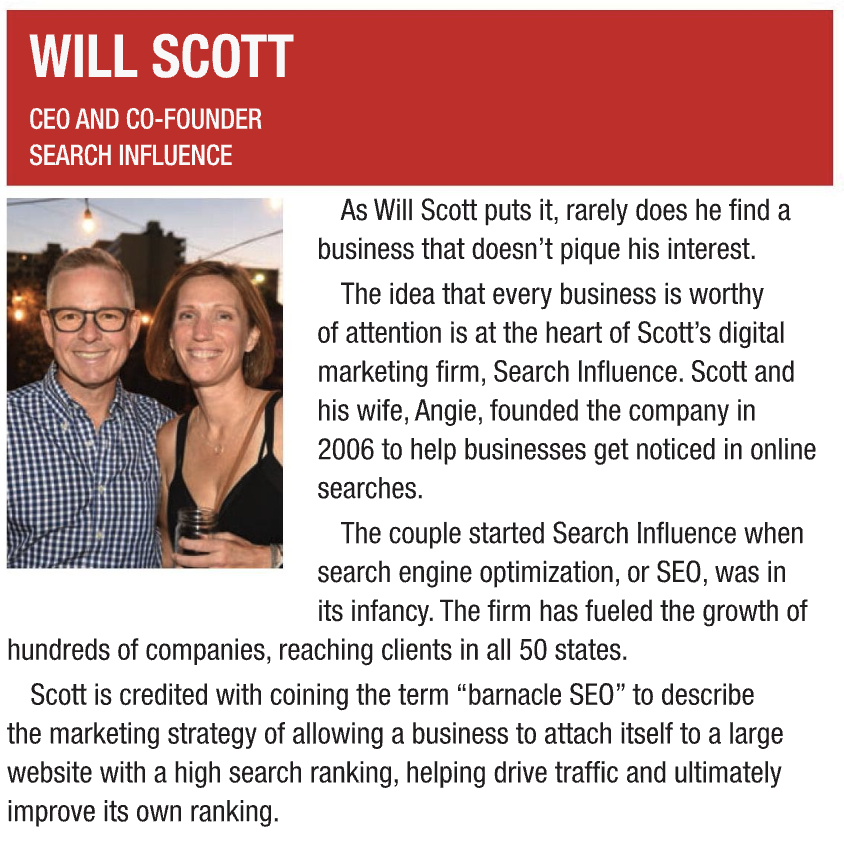
    “As Will Scott puts it, rarely does he find a business that doesn’t pique his interest,” writes CityBusiness. “The idea that every business is worthy of attention is at the heart of Scott’s digital marketing firm, Search Influence.”

    Fueling the growth of hundreds of companies since 2006, Scott is credited with coining the term “barnacle SEO.” In his feature in the Power

    Streetcar riding down st charles avenue in new orleans, la

    List, CityBusiness describes this marketing strategy as a method of allowing businesses to attach themselves to large websites with high search rankings, helping to drive traffic and ultimately improve their own rankings.

    Learn More About Search Influence’s Impact

    Led by Scott, the team of dedicated marketing professionals at Search Influence have helped businesses across industries optimize their potential.

    New Orleans made and proud, Search Influence works with clients in education, medicine, tourism, law, and beyond to deliver digital marketing results that lead to business growth.

    Fill out our online form today to learn more about Scott’s marketing expertise and the digital marketing services at Search Influence.

    Images

    Streetcar

  • Grow Traffic to Your Higher Ed Content With a Personalized Marketing Strategy

    Key Insights

    • Just like other businesses, higher education institutions need to use marketing tools and strategies to broaden awareness of their brand and attract new students.
    • Education marketing can help a higher education institution to present relevant, personalized information to prospective students, which in turn spurs their interest in enrollment.
    • When you use data to better understand prospective students and provide them with tailor-made content, they will be more likely to engage with you directly on the content you produce.

    When prospective students look for new schools online, they often focus their searches on programs and institutions that will help them achieve their educational and professional goals. The higher education market is extremely competitive, so it can be challenging for prospects to navigate their options and find the right program.

    With a personalized marketing strategy, your higher education institution can more effectively promote your program offerings, highlight what sets you apart from the competition, and attract more students.

    Student at university holding textbooks

    What Is Education Marketing?

    Like businesses, higher education institutions need to use marketing tools and strategies to broaden awareness of their brand and reach new students. In addition to traditional marketing techniques, schools also use digital marketing to increase traffic to their websites, giving prospective students valuable information about their programs and benefits. Education marketing efforts on the web often include search engine optimization (SEO), digital advertising, content creation, and outreach using social media and email.

    Benefits of Education Marketing

    Brand recognition

    Education marketing helps schools increase awareness of their brand, which can be especially useful for attracting new students. The more visible, compelling, and reputable a school’s brand is online— and out in the world — the more that students will be interested in attending.

    Lead generation

    One of the primary goals of any marketing strategy is lead generation, gathering contact information from potential consumers. Education marketing can help a school to present relevant, personalized information to prospective students, encouraging them to provide information via website form submissions, content downloads, or calls to the school. This allows the school to identify and develop a list of prospective students to engage with throughout the marketing funnel.

    What Is a Personalized Marketing Strategy?

    To stand out from competitors, businesses have started to ramp up their marketing efforts by using personalized marketing strategies. Personalized marketing uses data collected from consumers to deliver brand messages tailored to individual prospects. When educational institutions use personalized marketing strategies, they get the chance to know more about prospective students—their interests, browsing behaviors, and search terms, for example—and can then market their brand to them more effectively.

    This attention to detail is paying off for brands across the globe. According to SmartHQ, 72% of consumers claim that they respond to marketing messages that are exclusively crafted to their choices.

    Benefits of Using a Personalized Marketing Strategy for Your Education Marketing Content

    Gain a better understanding of prospective students

    When an educational institution uses a personalized marketing strategy, they learn more about their prospective students’ interests, habits, and desires. This crucial information helps higher education marketers develop smarter marketing strategies and create student-centric journeys through the marketing funnel, giving schools an advantage over competitors when it comes to enticing and recruiting new students. It can also help schools tailor their program offerings and incentives to better match what incoming generations of new students look for in their higher education options.

    Lead nurturing

    Lead nurturing is the process of developing relationships with potential consumers in order to nurture them through the student’s journey. When schools use data to better understand prospective students, they can more effectively market to them as they transition from interested prospects to enrolled students.

    Prospective student engagement

    When you use data to better understand prospective students and provide them with tailor-made, personalized content, they will be more likely to engage with the content you produce. Targeting users with relevant content leads to a 73% higher conversion rate, according to Aberdeen. Increased engagement is a good sign that prospects are interested and can be nurtured toward a final decision.

    Prospective student social sharing

    If your content is useful and engaging, it’s also more likely that prospective students will share it using social media and word-of-mouth. This is a great way to increase awareness of your brand and have your content distributed organically to other prospective students, even those who may not yet be in your personalized marketing strategy.

    Prospective student retention

    A personalized marketing strategy enables you to build closer relationships with prospective students. This helps to retain them from their initial interest in your institution to the moment they decide to enroll.

    Professor giving lecture in a college lecture hall

    Basics of Implementing a Personalized Marketing Strategies for Higher Education Institutions

    Student personas

    Student personas are semi-fictional profiles that mimic the demographic information, goals, and challenges of real prospective students you’re trying to reach and recruit. Personas are a great way to refine your messaging across all marketing tactics, improve your content strategy, and increase applications.

    Remarketing through digital ads based on actions and/or funnel stage

    Remarketing tailors digital ads to prospective students who have already shown interest by visiting pages on a school’s website or interacting with other brand content. This form of re-engagement is useful for nurturing prospects through the marketing funnel and keeping them interested in your brand.

    Program-specific email nurture

    Having data about your prospective students’ interests enables you to send them program-specific emails. These are far more engaging than generalized emails, and they give students valuable information about programs they’re interested in, which helps to nurture them as they consider enrollment.

    Action-driven email nurture

    Emails can also encourage recipients to take action that furthers their engagement with your brand. For example, effective action-driven emails may include a clickable link to a new blog post or video, an invitation to sign up for an event, or an opportunity to start a conversation with a student advisor.

    Appropriate calls to action

    Calls to action in emails and other communications should always be appropriate for the intended recipient. A call to action for a prospective student who is earlier along in the marketing funnel might ask them to request more information about a program, while a call to action for a prospect who’s in later stages of the marketing funnel might ask them to begin filling out an application.

    The Education Marketing Experts at Search Influence

    A personalized marketing strategy enables your educational institution to reach and engage prospective students. Our team of experts at Search Influence will help you to develop a strong marketing strategy and provide you with the digital marketing tools you’ll need to broaden your audience, including SEO, analytics and lead tracking, and content marketing.

    To learn more about the services we offer, fill out our online contact form.

    Images

    Student

    Lecture Hall

  • 5 Actionable Healthcare SEO Expert Tips for Providers

    5 Actionable Healthcare SEO Expert Tips for Providers

    Key Insights

    • SEO is a critical component of any digital marketing strategy, but it can particularly help healthcare organizations expand their online reach.
    • Investing in a strong SEO strategy for your healthcare organization can increase your website traffic, lead to a higher local search volume, and attract new patients.
    • To really witness the results of your healthcare practice’s SEO efforts, you’ll need to take actionable steps, such as creating a mobile-friendly site, choosing the right targeted keywords and making efforts to rank locally.

    doctor in white coat holding a stethoscope

    Search engine optimization (SEO) is the modern-day digital marketing pillar of an organization’s successful and compelling online presence. Today, countless businesses across industries use SEO efforts to rank higher in search engine results, with goals of driving traffic to their websites and giving their company’s name more word-of-mouth benefits.

    Your healthcare organization should be no different.

    By implementing robust healthcare SEO strategies, your medical business can expand its online reach, build brand awareness, improve user experience—and attract new, engaged patients. In this post, we’ll take a look at some of the benefits of medical SEO and how providers can utilize it effectively in their digital marketing strategy.

    What Is Healthcare SEO?

    The term healthcare SEO describes a range of search engine optimization strategies that providers and medical facilities use to enhance their online presence and organic reach, which includes strategically selecting keywords to craft high-quality, engaging content. Because search algorithms prioritize surfacing relevant, authoritative pages in order to provide users with an efficient search experience, a successful healthcare SEO strategy can make the difference in how high your pages rank in the search results. And the higher your pages rank, the higher the degree to which curious leads convert into patients.

    We believe the myriad of benefits of a comprehensive SEO strategy is the most impactful for providers aiming to become more visible, valuable, and available to their patients.

    What Are the Benefits of Healthcare SEO?

    The primary goal of a healthcare SEO strategy is to draw more patients to a practice’s web presence, content, and, ultimately, products and services. By enhancing your practice’s brand awareness, healthcare SEO can help you acquire those patients who otherwise would opt for a competing provider—simply because of that provider’s accessibility and presence on the web. At Search Influence, we advocate for strategies that drive higher patient volumes and increase your website’s traffic.

    Higher patient volumes

    It’s a no-brainer: consumers are more likely to buy a product or pay for a service if they know about a business in the first place. Healthcare SEO helps to bring awareness to prospective patients about certain providers and inform them of the practice’s services, unique qualifications, and products. The more awareness the general public has about a medical facility, the more likely that practice will see new patient numbers rise.

    Increase your website’s traffic

    More traffic means more visibility, which, in healthcare, attracts new patients.

    Improved search results increase website traffic while also organically enhancing a company’s brand identity. When more people visit a company’s website, the chances increase of that business’s name becoming a topic of conversation and users sharing its content across social media platforms.

    If you want to be sure you get the maximum value from the targeted healthcare SEO services you’re paying for, be sure your provider gives you access to Google Search Console and Google Analytics.

    Actionable Healthcare SEO Tips

    You can apply this SEO expert advice and best practices to all businesses, regardless of their specific products, services, or industries. However, with an action plan tailored to your distinct marketing goals, healthcare providers, in particular, can utilize these tried-and-true strategies to drive clinical success. To maximize the potential of your practice’s web presence, we recommend following these five effective and proven healthcare SEO tips:

    Choose the correct keywords

    Keywords play an essential role in every SEO strategy, no matter if you’re a start-up clinic or a reputable specialty hospital. Choosing the right keywords to target depends on several fundamental insights, such as:

    • Knowing your audience and their unique needs
    • Researching what potential patients plug into search engines
    • Understanding the dynamics of how, when, where, and why people search for healthcare services on the Internet

    Using keyword research tools, SEO experts can determine which keywords generate the most traffic, have the least competition, and drive the best results for a practice depending on their specific marketing goals.

    healthcare digital marketers pointing at laptop screen

    Create and update listings to improve local search

    When generating results, mobile devices, applications, and search engines often take the geographical location of the searcher into consideration. As a way to increase your reach and competitiveness in your target region, location-based SEO helps your content appear to audiences in a specific area. Without a website adequately optimized for location, your healthcare organization may get lost in the search engine shuffle, with potential patients opting to find services closer to where they live.

    Practices can optimize for local search by creating and updating listings on the most important listing websites. Some practice types are more hyper-local than others. For instance, urgent care SEO experts will focus on local listings and presence across the local search ecosystem. Review the local search ecosystem for a dynamic overview of the listing websites.

    Create unique, high-quality content for your website

    Posting new, engaging content regularly keeps potential clients invested and clicking. Maintain steady traffic streams and provide useful information about your product and services through various content types, such as blog posts, white papers, videos, and podcasts.

    Encourage your patients to leave online reviews

    Healthcare providers and businesses should encourage patient feedback—especially if the reviews are enthusiastic and positive.

    According to data from ReviewTrackers, a staggering 63.6% of consumers report that they prioritize checking Google reviews before visiting a business’s location. Aside from increasing your practice’s credibility, outside patient interaction also helps healthcare websites with search engine rankings. When patients review a company, that business’s online presence is effectively elevated in the search engine algorithms.

    Make your website mobile-friendly

    Mobile web traffic has gone up more than 200% in the last seven years, indicating that potential patients prefer to use their smartphones over desktop or laptop computers when searching for healthcare services. Poorly built and user-unfriendly websites come across as cold and act as red flags to prospective patients. Healthcare SEO can help your medical business present itself as more relatable while showcasing its professionalism, authority, and trustworthiness.

    The Knowledgeable SEO Experts at Search Influence

    If you want to increase organic traffic to your medical practice’s website, create engaging and original content, and ultimately draw more potential patients to your healthcare products and services, start with honing in on your healthcare SEO strategies. Search Influence’s team of SEO professionals have been developing SEO strategy for doctors since 2007, and we can help you take your practice’s search engine marketing to the next level and increase your online traffic and engagement.

    Ready to attract new patients and improve your online presence? Contact our team today by filling out our online form. We’d love to help you get started.

    Images

    Doctor

    Laptop


  • Healthcare Marketing Ideas: How to Communicate Through Severe Weather Events

    Healthcare Marketing Ideas: How to Communicate Through Severe Weather Events

    Key Insights

    • Unexpected events are just that — unexpected. Despite this, your healthcare practice can properly prepare for any unprecedented conditions by remaining proactive in pre-planning patient/provider communication strategies.
    • Keep your messages in touch with current events. Adjust automated and pre-scheduled messages, social media posts, and newsletters to fit the context of the current climate. In other words, don’t be tone-deaf!
    • In times of uncertainty, keep patients informed by reviewing all digital platforms for opportunities to regularly send out updates. No site or profile is too small for an update regarding office closures or changes to your hours of operation.
    • Keep messages, details, and updates across platforms accurate. There’s no quicker way to lose a patient’s trust than to send out information that seemingly contradicts itself.
    • Pre-planning communication strategies help your team save time, delegate responsibilities, and understand expectations when weather or pandemic-related events strike. It’s never too soon to start pre-planning your medical marketing strategies to circumvent a potential crisis.

    Healthcare worker typing on laptop at desk

    Picture this — it’s the height of a worldly crisis, and your healthcare clinic has no choice but to temporarily close its doors to patients. You’re rushing to get your office’s updates written, approved, and posted, on top of trying to figure out which marketing team member will update which platforms to keep patients informed and engaged with your clinic. You haven’t even decided how to release your updates, and you’re already overwhelmed.

    This scramble to release timely, accurate, and relevant information to the public signals the need for your team to plan cohesive communication strategies. Proactive communication — as opposed to reactive responses — helps anticipate what your patients most want to know, as well as how and when they prefer to receive updates regarding your facility.

    From adjusting automated messages and updating your office’s primary platforms to enhancing reader trust through accurate messaging, pre-planning your medical marketing strategies contributes to a more confident and patient-centered workflow. In this post, we’ll cover some healthcare marketing ideas to drive effective patient/provider communication during unpredictable times.

    Benefits of Proactive Communication for Patients and Staff

    No matter if your clinic is bracing for the rampaging effects of a Category 3 hurricane or a global pandemic, environmental threats are a direct segway to stressed hospital systems. Unexpected events and catastrophes often lead to last-minute office closures, causing an increase in delays in care and, ultimately, a decline in provider satisfaction. On the contrary, if your office remains open while other healthcare clinics in your area face closures, front desk staff may field relentless phone calls from patients inquiring about your hours of operation and whether they should even show up for their appointment.

    If you communicate proactively, you may be able to increase your show rate for those uncertain days and prevent less rescheduling — which can otherwise be a headache for staff and doctors alike. Streamlining communication between patients and staff begins with implementing agile practices in otherwise turbulent environments. In doing so, not only is patient experience improved, but care staff can relish the efficiencies of a more seamless and adaptive work environment.

    Once your patients trust that your digital platforms will provide them with critical information, you’ll start to really see these benefits. But to reap these rewards, your team will first need to adopt strategies that center your clinic as a reputable and dependable source of information.

    Adjust Automated and Pre-scheduled Messages

    We live in an automated world — pre-scheduled posts and emails help us run our marketing communications smoothly on a daily basis. So, what can you do to make sure that automation doesn’t hurt your brand? If patients receive or see messages contradictory to what they expect or heard through another channel, they may question what is accurate. During a crisis, adjusting all pre-planned messages before they reach your intended audience is the backbone of consistent and reliable patient-provider communication.

    Halt automated messages

    Your team is likely already in the habit of updating your office’s phone tree. Beyond that, your team should be turning off any automated appointment reminders. If a patient receives a message while the office is closed, that can cause questions regarding whether they have missed an important appointment — reducing their confidence in the communication they are receiving.

    Reevaluate pre-scheduled posts, emails, and newsletters

    Next, you should review any pre-scheduled social media posts and defer or cancel any that would appear tone-deaf or not make sense given the current climate. Even if it’s an engagement-driven evergreen post, if your audience sees that while they are in the middle of a natural disaster, it may look like your company isn’t paying attention to what’s going on in the world.

    The same principle applies to marketing emails or newsletters that you may have pre-scheduled or that go out on an automated cycle; if patients receive those during a time of crisis, then the messages will, at best, fall on deaf ears and not get the attention they deserve. In a worst-case scenario, they could insult a patient who might wonder why they are receiving an email about a non-timely topic during an emergency situation. No matter the type, reviewing and adjusting all pre-scheduled messages prevents the likelihood of insensitive content surfacing and tainting your brand’s empathetic reputation.

    Update Information on Primary Platforms

    Now that you’ve covered the basics and paused any messaging that may not make sense to your receivers, it’s time to shift focus to where patients might expect to find pertinent information. According to a survey conducted by Redpoint Global, a staggering 80% of patients report preferring to use digital channels to communicate with healthcare providers at least part of the time, which highlights the criticality of keeping digital content updated across all online platforms.

    To begin, you’ll want to review your healthcare system’s most influential platforms to suggest any updates be made to hours of operation, facility safety standards, or other relevant expectations patients may expect to have. While the breadth of your digital footprint may be more than you realize when first building a list of profiles to update, some of the most important platforms that will require reviewing include:

    • Your website
    • Email/text
    • Patient portal
    • Facebook
    • Instagram
    • Google My Business
    • Google Search
    • Any other websites that come up when someone searches your hospital or medical office’s name

    Install a website notification bar

    If you don’t already have a website notification bar, it’s a good idea to install a feature that puts a banner at the top of your site with your clinic’s latest updates. Before using this functionality, your team should be sure to complete a test run on your site to ensure it accurately delivers timely notifications. Because your staff may be limited in emergency or last-minute scenarios, it’s also important that 2-3 team members are trained and have access to update this, as well as create a new page with more details if necessary.

    Assure Patient Confidence With Accurate Messaging

    How can you assure your patients trust the information you’re delivering in the updates? Establish confidence in the accuracy of your messages by:

    • Dating the updates: Keeping a time record of updates helps your patients know the information you’re putting out is fresh. This can be especially important if the situation lasts longer than a day or two.
    • Communicating often: Keep the updates coming. Daily updates may make sense on some channels, particularly in the days of the most uncertainty.
    • Keeping it consistent: Be sure the messages and details across each platform refrain from contradicting one another. Consistent messaging is key to long-standing patient trust!
    • Being clear about patient expectations: Don’t make your patients assume — proactively communicate what they can expect from your staff and clinic.
    • Relaying information about future updates: Finally, note when and how patients can receive the next update.

    Strategies to Pre-plan

    So, you’ve reevaluated all automated and pre-scheduled messages, updated your primary platforms with accurate information, and now you’re looking at how to pre-plan your medical marketing strategies in times of crisis. Some of the most essential components of an effective pre-plan strategy include:

    • Delegating responsibility for updating platforms: Be sure there are 1-2 backups, just in case a staff member isn’t in a location with reliable internet access.
    • Implementing a shared password system: Store passwords in a secure management system like Passpack or Last Pass to ensure that the right people have access to the proper channels for updating.
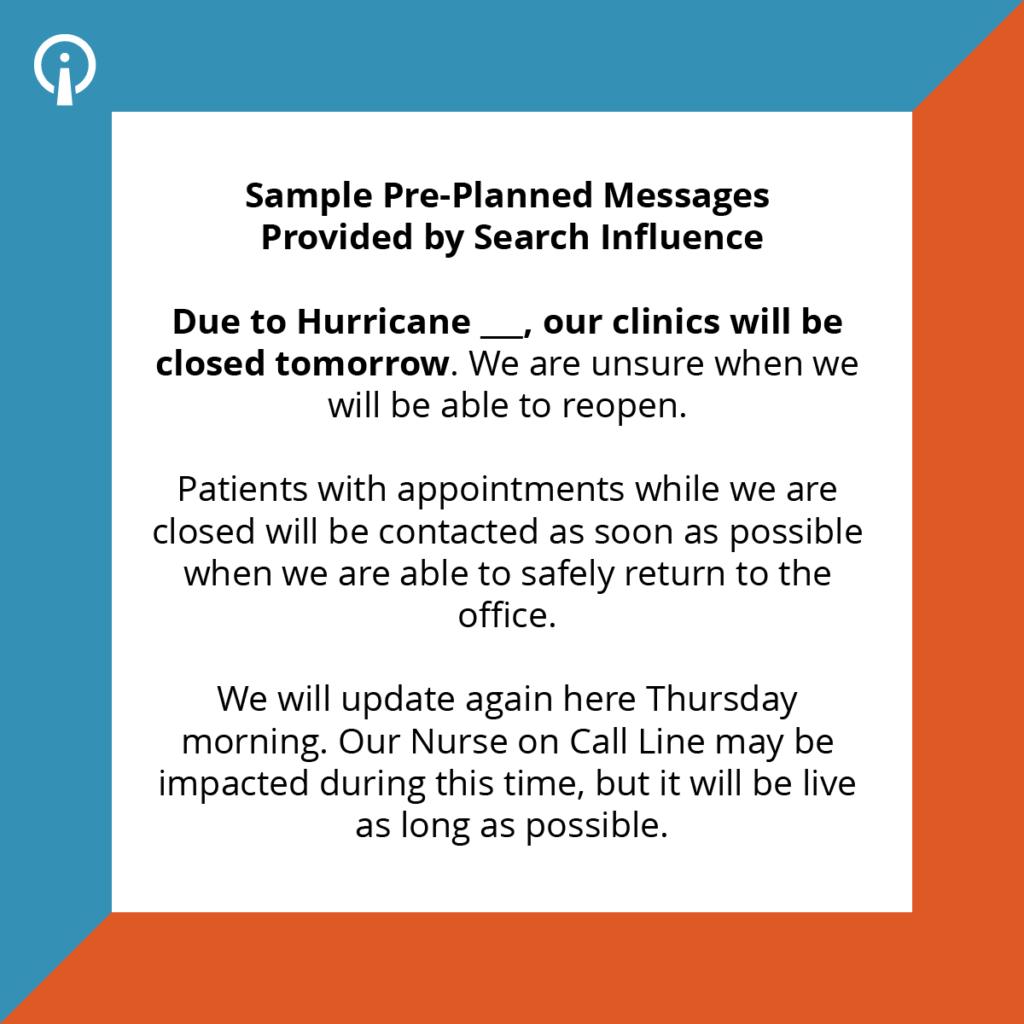
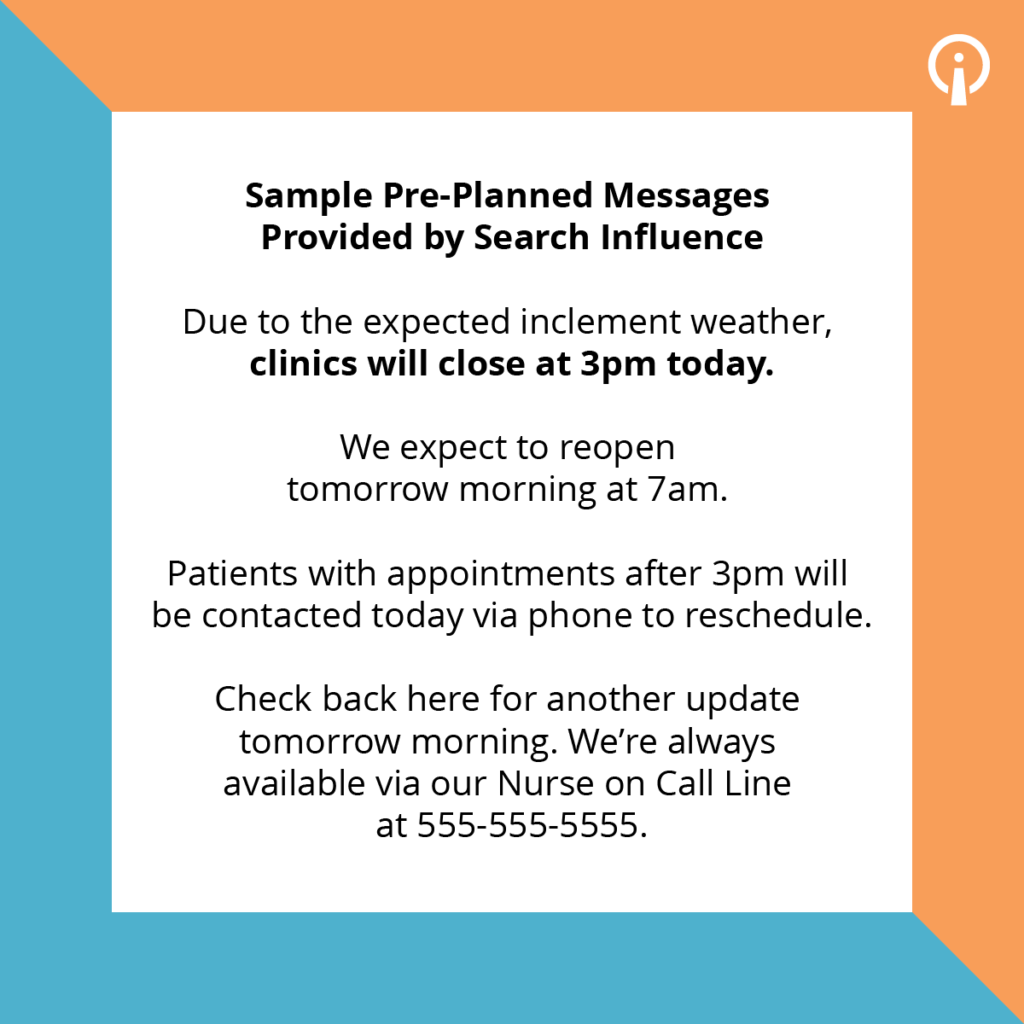
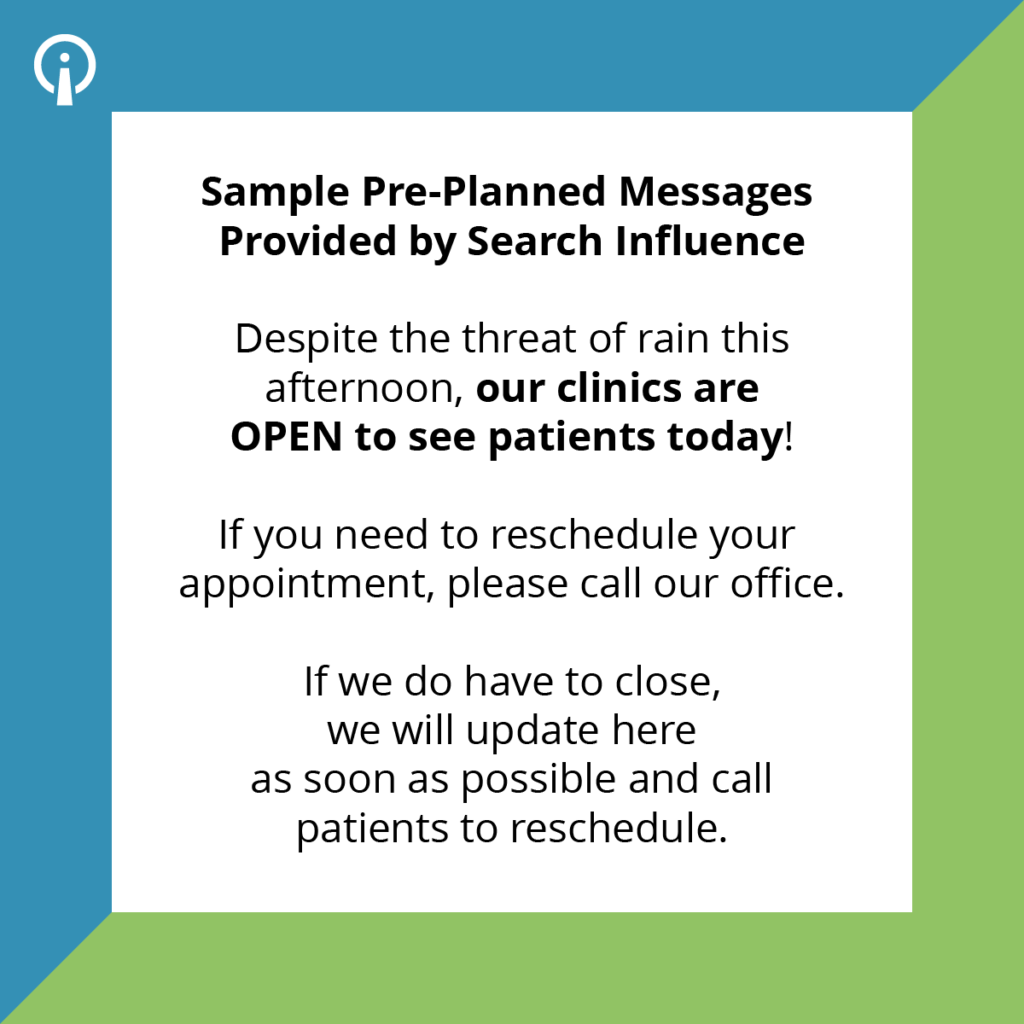
    • Writing and gaining approval for sample messages: Sample messages can be used as a basis for your real-time messages and demonstrate the most important points of all of your healthcare marketing ideas. This strategy can help save your team writing time while also ensuring communications get out quickly.
    • Pre-creating social media graphics and email templates: Just like pre-writing sample messages, pre-creating graphics and emails accompany the same benefits of saving your staff time in periods of urgency.
    • Carrying out a crisis communication drill: Take an hour or two to present a scenario to your team and have them “execute” the plan all the way up until posting or sending any messaging. This will pressure test if they are able to write the messages, access the platforms, and work the relevant systems. It will also force all the pre-organization to happen by making sure everyone has access to the plan.

    Anatomy of pre-planned messages

    Whereas we may be quick to assume communication is solely required for office closures, it’s almost equally as important to communicate that you are open if things are happening in your community that may be causing others to close. Ideally, pre-planned messages for office openings and closures are composed using the following anatomical focal points:

    • What’s the situation?
    • How are hours impacted?
    • How will existing appointments be handled?
    • When can patients expect the next update?
    • How can patients be helped while you are closed

    So, How Do You Get Started?

    With hurricane season fully underway and COVID-19 numbers still on the rise, now is the time to enact these medical marketing strategies and meet your business growth goals. Here’s a quick recap on how to get started:

    • Establish and gather your team of 2 or 3 people minimum so that you have coverage.
    • Compile and prioritize the list of communication channels and platforms. Then, define owners and set up access, logins, and training.
    • Pre-plan messages and get those approved.
    • Finally, conduct drills to make sure your team can execute the plan as intended without any preventable basic issues.

    Now that you’ve mastered the basics of proactive healthcare communication strategies, it’s time to set your plan into motion. At Search Influence, our digital marketing agency can help you create a communication plan that keeps your patients informed, engaged, and returning. To learn more, contact us today for help getting started on all of your healthcare marketing ideas.

    Images
    Stethoscope and Laptop Computer

  • Follow Our SEO Game Plan to Drive High Quality Leads to Your Medical Website

    Key Insights

    • SEO is a marathon, not a sprint. Spending time to create an SEO game plan is crucial in identifying key items to work on to support website growth.
    • Take time to identify the signs your website needs a checkup, diagnosis the issues that be added to your SEO gameplan, and begin tackling the items on your list.
    • SEO takes time. Continuing to optimize your medical website over time will show long-term benefits to your rankings and ROI.


    Your website should represent your practice’s brand and demonstrate your expertise in the industry. Traditionally patients turn to Google for the closest and best option when looking for a new medical practitioner. With that in mind, your practice should have a website that appeals to your target audience and is properly set up on the back end to support ranking on Google.

    Having well-optimized content on procedures and services provided, before and after galleries, and reviews/testimonials all support the overall experience of a user when visiting your site. Optimizing your site will give your medical practice higher quality leads which can support growing your practice.

    Yet, a great front end doesn’t always mean the backend is optimized to its fullest potential! It can be overwhelming to begin creating an “SEO game plan.” During this process, it’s important to remember that SEO is a marathon, not a sprint. Google wants to see consistent improvement and engagement from website owners. It takes time for Google to process and give your website credit for all the improvements you’ve made (generally a couple of weeks to 1 month per change).

    In this post, we’ll provide the steps to take and consider when reviewing your medical website and optimizing it to improve your business’s visibility in search engine results page (SERPs).

    Doctor examining a patient's blood pressure

    Symptoms: Signs Your Website Needs a Checkup

    You have a visually appealing website and layout, but your medical practice isn’t crushing goals and generating leads as you’d like. Do any of these resonate with your medical practice?

    • Leads don’t come in from the website
    • Patients can’t find you on search engines
    • Patients can’t find your office(s)
    • Your website loads slowly

    If you answered yes to any of the above, you’ve come to the right place! Let’s dig into the common causes of these challenges.

    Diagnosis: Common Causes of Website and SEO-related Issues

    Duplicate content

    Having high-quality and unique content is crucial to SEO and rankings. It is especially important as a medical professional to have unique content to show authority and overall expertise in the industry.

    However, duplicate content means the content displayed on your site also is displayed somewhere else on the internet. When this happens, Google has a hard time knowing which site is more relevant to a search query. This, in turn, forces search engines to determine which site’s content is more relevant to a specific search query.

    Incorrect Directory Information

    You must have your name, address, and phone number (NAP) consistent across the internet. Since many medical offices share one main address with unique suite numbers, ensure you have your suite numbers outlined in all listings online to keep your NAP consistent.

    As medical offices move to new buildings or expand, updating directories online to display correct information is a step sometimes missed in the move. This can add to the challenge of your patients having trouble finding your practices’ office because Google will display outdated information.

    Clunky, outdated websites that don’t load quickly

    Data suggests lower load times lead to a drop in overall conversions because a patient will bounce off a slow loading site to find another provider.

    There are plenty of free tools to utilize to consistently monitor your site speed. When partnering with a Healthcare SEO team, this is something that is included within your campaign and monitored for improvements.

    User experience

    A common reason a user leaves a website is that they can’t find what they were looking for. When a user visits your medical website, is it user-friendly? Is your navigation easy to digest and navigate?

    Website Responsiveness

    Your website should be a responsive website that is mobile-friendly and works seamlessly across all devices, whether a user is visiting it on a mobile device or tablet. Having a responsive website means your layout is flexible to screen size and adjust accordingly depending on the device. This is important to have as it offers a user a good experience regardless of what device they decide to visit you on.

    Contact form is missing, buried, or lacks a call to action

    When a patient visits your website, they should have a clear call to action (CTA) along with steps to follow after the CTA is complete. It is common that a patient would hesitate to fill out an on-site form due to unclear required fields.

    Doctor writing medical records at a desk

    Treatment: Procedures Needed and Expected Outcome

    Just as each patient is different and has different priorities, so do websites. There are many ways to diagnose your website and create an “SEO Game Plan.” You should triage website issues on a case-by-case basis.

    Taking a step back and completing a full SEO needs analysis is crucial to begin your SEO journey. Our team reviews a site’s health and identifies strategic areas of opportunity for improvement in the following areas:

    • Technical on-site SEO
    • Local search visibility
    • Link health
    • Content and keyword optimization
    • Website user experience
    • Conversion rate optimization

    As mentioned, SEO is a marathon, not a sprint. Typically, executing tactics happen over time. As each medical practice has its own priorities and time budgets to support these efforts, it can take time to get everything in place to begin seeing results. This all depends on the time and effort the medical practice is willing to put in.

    Generally, the tactics below are a standard of care for a website that needs the full treatment:

    • Re-write and expand website content for priority services and procedures. As website content goes live on your site, you may see an improvement in rankings in 2-3 weeks for that given topic.
    • Improve site navigation
    • Update local directory listings
    • Creating clear call-to-actions across the site for conversions
    • Redesign website (long term play)

    It is important to recognize that all websites can utilize optimizations from a user and technical perspective. Allocating time and resources to spend on analyzing your medical site’s needs is crucial in making sure you are set up for success.

    For more information on optimizing your medical website, contact the experts at Search Influence.

    Images

    Doctor