Category: Content Marketing

  • #FreelanceFriday: Freelancing Tips for College Students

    This blog is part of our Freelance Friday series, where we discuss everything and anything related to freelancers. For more freelance information, tips, and trends, follow us on Twitter.

    College is expensive. Tuition is sky high, textbooks cost an arm and a leg, and everyone needs a little extra income to go out and fully enjoy the college experience. Even with scholarships and saving accounts, it is nearly impossible to avoid some kind of financial strain during these years pursuing higher education.

    So, with time and experience typically at a premium for students, are there any legitimate ways to make some extra money on the side?

    Yes! Freelancing!

    Freelancers, digital nomads, work-at-home parents, and all independent workers currently comprise 33% of the U.S. workforce (approximately 53 million people). Freelancing is an umbrella term that encompasses writers, editors, graphic artists, designers, photographers, videographers, and many more people with specialized, in-demand skills. And, what’s great about freelancing is that it is open to anyone, including cash-strapped students.

    President Obama Asking You To Join The Movement - Search Influence

    Freelancing is a great way to get relevant work experience, which–whether through part-time jobs, internships, or freelancing–is incredibly important for a college student.

    Where freelancing offers a distinct advantage over a normal job is in its flexibility. Most jobs have a fixed schedule, whereas freelancing (in most cases) offers you the chance to work on your own schedule. It also allows you to work from anywhere–your dorm room, apartment, library, classroom, or when you go home for the holidays.

    If you decide to give freelancing a shot (and you totally should!), here are a few things you need to consider first, as well as a few things you need to do to position yourself for success.

    Figure out How Much Extra Time You Have

    Life as a college student is busy. You are already balancing classes, labs, papers, exams, presentations, and various extracurricular activities. Adding freelancing to the mix is only going to make you busier.

    A commitment to weekends and holidays will help you as a freelancer, but no matter when you work, prioritization and productivity are key. Because you are a student, schoolwork should also come first, but beyond that, you will need to figure out how to find more time in your schedule to freelance. You can prioritize your freelance work based on things like deadline, pay, research/planning/setup, estimated time to complete, and other markers.

    Determine What You’re Good At

    Your freelancing side gig does not need to relate to your major, but it can’t hurt. Freelancing opportunities can fall into all, one, or a combination of three things: something you are passionate about, something you are knowledgeable or skilled in, or something that is in high demand.

    Every topic with a web presence needs content creators. There are tons of niche markets you can work your way through, especially as a writer. If you really want to flourish, especially at first, stick to what you know best, but don’t be intimidated by exploring something new. College is the time when you should be exploring new things to help discover what you want to do in life.

    Identify Your Goals

    What do you want to gain by freelancing? More money? Of course. Experience? Always a plus. But what else are you looking to gain from this? Are you looking for a gateway to a full-time job? Do you just want to try out a field before committing to it? Will you continue freelancing after college?

    These are all great questions to ask yourself before and during your time as a freelancer. The answers should not dictate whether or not you do it, but they should provide guidance and purpose to what you are doing.

    Get the Right Tools

    What do you need to be successful as a freelancer? For most, a computer and reliable internet access should go without saying, but what else?

    Well, that depends on the field you are operating in. For some, that is all you need. The internet can help with the rest. Other more specialized skills will need more–graphic designers may need the latest software programs, while photographers will need a good camera, lighting, and other equipment.

    Know what you need upfront and familiarize yourself with these tools. Freelancing may be a side job for many, but that doesn’t make it any less important when it comes to planning, preparedness, professionalism, and time management.

    Understand You Will Have to Start From the Bottom

    This is a tough pill for many to swallow. Like most jobs, you have to start at the entry-level position. It’s a nearly unavoidable rite of passage. Accept it and work your way up. Thankfully, ascending the freelance food chain is typically easier and quicker than climbing the corporate ladder.

    It is important to build your skills and constantly improve your services and presentation. The more you freelance, the more you will learn how things are done, what you should and should never do, etc. Reaching out to other freelancers for advice and support is always a great idea.
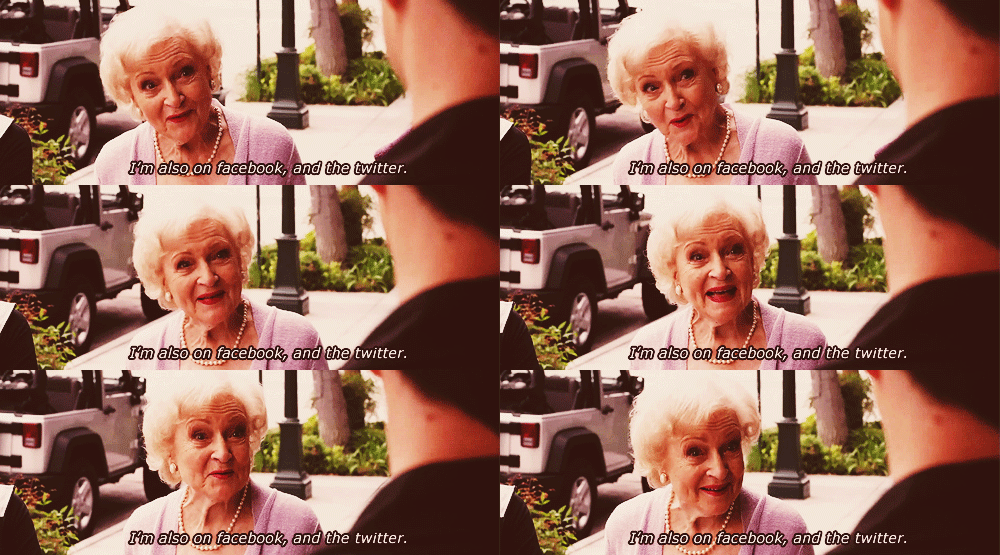
    Betty White Informing Us That She's On The Twitter And On Facebook - Search Influence

    Self-Promote

    Once you have been working for a while, it is important to create a portfolio of your best work as an example of your skill and proficiency. This is a crucial tool for landing other gigs. You can even include some pertinent school assignments as well, especially when you are just starting out.

    Creating a personalized website or blog as well as engaging on social media are also great ways to showcase past projects and seek out new work. Many freelancers today use Twitter and Facebook to stay up to date on industry news and find relevant opportunities.

    You shouldn’t feel bad about this kind of self-promotion. It is a crucial part of freelancing. And speaking of the importance of self-promotion, check out our freelance Twitter account. We frequently share the latest freelancing trends, tips, and best practices.

    Build Your Professional & Adult Skills

    Freelancing can help you build valuable workplace skills. Just like school, deadlines are extremely important, as are promptness and efficiency. Similarly, freelancing often calls for collaboration with a wide variety of people. While you may already be using these skills in school, freelancing will allow you to put better hone them in a more professional setting.

    As an independent contractor, you will learn to deal directly with your clients and gain valuable experience handling a variety of situations as they arise. You will also learn more about contracts as well as taxes.

    Treat Freelancing Like a Real Job

    Many people have made this mistake, especially those who have never freelanced before. They contract for a little while before quickly realizing that it is a real job. You are getting paid to provide a skill or service. You have to consider deadlines and often collaborate with others. How is that not a real job?

    In essence, freelancing is even more than just a job. You are essentially starting your own microbusiness. If you go into it knowing this, you can somewhat avoid the learning curve and work through any missteps early on that could cause you to lose clients, doubt your own abilities, or even quit.

    Use Your Freelance Career to Jumpstart Your Post-College Career

    Because freelancing is a real job, don’t be hesitant to include it on your resume and discuss it a significant positive in job interviews after you graduate. The work you’ve done has given you experience in the workplace–use that to your advantage! Be confident about your transition into the job market. You will have more experience than your fellow graduates.

    Of course, you can also continue, and likely expand, your freelancing business after school. You have spent the time and effort to build these relationships and skills, why not continue utilizing them!


    Image Sources:

    President Obama

    School Supplies Animation

  • #FreelanceFriday: 8 Sanity-Saving Tips for Work-at-Home Parents

    This blog is part of our Freelance Friday series, where we discuss everything and anything related to freelancers. For more freelance information, tips, and trends, follow us on Twitter.

    Everyone has seen it, but you have likely already forgotten about it. Sure, it was funny and readily made for internet mass consumption, but for many work-from-home parents, it is an all-too-real reality. I am talking, of course, about the dad who had his BBC News interview interrupted by his two spunky children on live television.

    Newscaster interrupted by child while working at home - Search Influence

    If life with kids teaches you anything, it is to expect the unexpected. Accidents and interruptions are going to happen no matter what, but that doesn’t mean you shouldn’t try to avoid them as much as possible, right?

    For parents who work from home, this is even more important. Working from home provides tremendous flexibility and freedom. But in order to get any work done while at home, rules and boundaries have to be set, preparation and organization are key, and you have to learn to adapt.

    Here are few tips for work-at-home parents for keeping the interruptions to a minimum.

    1. Use a Dedicated Workspace

    This alone will go a long way in setting boundaries. Though as the BBC News example proves, even this is by no means foolproof. In addition to having a positive effect on your productivity and work-life balance, having a dedicated workspace presents children with the kind of necessary boundaries that they can easily be mindful of–office door shut = no interruptions. It’s as simple as that. A dedicated workspace will also help you detach from all of the other distractions working from home can bring, such as dirty laundry, a sink full of dishes, and the never-ending allure of TV.

    2. Set Clear Expectations for Interruptions

    Major injuries, fires, tornadoes. These are good excuses. Petty arguments, tattletales, and boredom are not. Examples and expectations of good and bad interruptions need to be laid out ahead of time and reinforced after every interruption, positively or negatively.

    Even better, create a way for kids to get your attention without causing a big fuss, such as a nonverbal cue, especially if you are on the phone. If there is a time when you absolutely cannot be interrupted, make sure everyone knows.

    Could you let me finish - Search Influence

    3. Plan for Interruptions

    As any parent knows, you can plan all you want, but these things will still happen. They key is not getting frustrated and overwhelmed by them. If you go into your day knowing that at least one unplanned interruption will occur, then you can pad some of that extra time into your daily schedule. And if no interruptions happen, then even better and now you’ve got extra time!

    It also can’t hurt to plan for the worst-case scenario, kind of like crisis planning. What would you do if your kids barge in while you are conducting a live TV interview (or whatever situation applies to you)? If you have given it some thought before, then you should be able to handle it in the moment.

    4. Keep Kids Active and Entertained

    The best way to keep kids out of your way is to distract them and keep them occupied. Set aside toys your kid can play with, or introduce special movie time when you need a few spare hours–but it has to be more than just TV or computer games. You need projects that will occupy their time but do not need hands-on supervision from you.

    You can set up a kid’s desk next to your’s so they can color or play “work” independently. Playdates are great to help shoulder the load as well, and babysitters and mother’s day out programs can be a last resort when you really need to focus and get things done.

    5. Get Everyone on a Schedule

    The first thing that needs to be understood is that “work from home” is still work, no matter where you do it. Because of this, you need to set regular working hours. This will go a long way in helping others respect your time, space, and productivity. Treat your work from home like a “real job” and everyone else will too.

    To-do lists are also crucial tools to help stay on task no matter what is going on around you. Organization, planning, and prioritization are the keys to productivity.

    6. Be Strategic About Your Schedule

    You need to be tactical about planning, scheduling, and making the best use of your time. Find the optimal time of day when you can take care of your most thought-intensive work, perhaps early in the morning or late at night when the kids are sleeping.

    Parents with infants and toddlers also must take advantage of that most glorious time of day–nap time! Save the less intensive tasks (emails, planning, administrative, etc.) for when the chance of interruptions is high. This is where prioritization of tasks will also improve your efficiency.

    Meals being prepped - Search Influence

    7. Prep for the Week

    Prepping for the week should be something everyone does, whether you work from home or not. Get your schedule organized and plan meetings and phone calls. Find ways to save time later by doing what you can early, including weekly meal prep on Sunday.

    8. Just Go With It

    In life, especially with kids, sometimes, you just have to go with it. What’s the worse that can happen? A client finds out you have kids? Most will be understanding. As long as you plan ahead, are cognizant of deadlines, and your work isn’t negatively impacted, everything will usually be just fine.


    Images:

    Newscaster Interruption

    Jason Segal

    Meal Prep

  • Rookie Website Mistakes, Part 5: Weak Content

    Welcome to Part 5 of our series on Rookie Website Mistakes. In Part 4, we learned about single page website design and how they often put form over function much to the detriment of your SEO and the user experience. While we all want a shiny new website with all the bows and whistles, it’s more important to focus on quality content that will give the users what they want. Having weak content can prevent search engines from exploring your site and leave visitors with more questions than answers. Avoid this mistake by following the tips below.

    Hit the Sweet Spot of Content Length

    Unfortunately, there’s no magic number for how long your content should be. Because I can’t tell you that precisely 253 words will make your page number one, I’ll instead give you the frustrating advice my high school English teacher gave me–your content should be as long as it needs to be. Obnoxious, right? But, what it comes down to is that your content should provide all of the related information on the given topic you’ve chosen for the page.

    Very broad topics, like ‘what is family law,’ are going to be longer, while very specific topics, such as ‘features of Victorian-style roofing,’ might not have as many relevant details. Generally, more technical content like a plastic surgery procedure outline will be 500–700 words, while an ‘About Us’ page will be more around 250.

    If you’re not sure how much you should write on a given topic, scope out your competitor’s pages to see how much they’ve written. If they’ve written 500 words, chances are you can build out your own content to be more competitive than theirs.

    That being said, you don’t want to over-inflate your content just to make it longer. The other half of ‘as long as it needs to be’ is that it shouldn’t be any more than necessary to make your point. At Search Influence, we’ve named this superfluous content ‘fluff”; it provides the same amount of nutrition to your content as fluffy cotton candy. Fluffy content makes you sound less authoritative on the subject and doesn’t actually provide the reader with important or new information.

    Focus on EAT Content

    Google uses the acronym EAT to describe the characteristics of high-quality content: Expertise, Authoritativeness, and Trustworthiness. The opposite of fluff is EAT content. Producing EAT content gives you a better reputation in the eyes of Google, and it can help you rank above competitors writing on the same topic who don’t meet the EAT requirements.

    Of all the EAT qualifications, expertise sounds the scariest. When you’re a marketer or a small business owner, you might not feel like an expert on everything you want to write about, and you may not have a degree or certificate that proves you’re an expert. For some topics, like medical and financial, Google expects that you have some sort of formal training to back up your knowledge on the subject. But for most industries, “everyday expertise” that you’ve acquired from working in the field or having a first-hand experience is sufficient. Google evaluates expertise by looking at how useful and detailed the content is, so the goal should be to write what you know, and your expertise will shine through.

    You can also increase your EAT levels by incorporating specific statistics, studies, and other information from reputable sources. Make sure to cite the source and explain the findings in your own words if you can. You don’t need to be overly formal about this, either; saying something like “According to the CDC, 43 percent of sudden, unexpected infant deaths are caused by SIDs” would be sufficient.

    Save Your Spam for Quick Lunches

    Keyword stuffing is an old SEO practice that involves using a keyphrase as many times as humanly possible in the content, even if it doesn’t make sense in context. Sometimes, the keyphrase would even be hidden in the page footers and the background of the page! Google has caught on to this and will penalize sites they think are providing a poor user experience by being spammy. Focus on writing clear content that is centered on a theme and answers the reader’s potential questions. Then you can go back and naturally incorporate a few keyphrases throughout the content.

    Image of SPAM on a conveyor belt - search influence

    Try to pick long-tail keywords that are more specific. For example, instead of using the broad keyphrase ‘botox,’ you could use variations of the long-tail keyphrase ‘does Botox work on crows feet.’ Google is clever enough to pick up on variations, so you can use the exact match long-tail keyword from the example above, and then use ‘Botox for crows feet,’ ‘crows feet Botox,’ ‘treating crows feet with Botox,’ and even ‘Botox around the eyes’ throughout the content to keep things natural.

    If you’re unsure what keyphrases you should be using and trying to rank for, Search Influence can build you build a keyword strategy, track your keyword rankings, and even write content for you. Call us to discuss your content goals!

    Put Some Words Behind the Scenes

    While putting keywords in all sorts of nooks and crannies of your site is considered spam, there are some parts of the backend of your website where you should optimize for keyphrases. Make sure you check out this previous blog for an explanation of what the backend of the site means if you’re unsure what I’m talking about.

    Readers can’t see the metadata of a page when they’re viewing your content, but search engines can see it. It works as a sort of behind the scenes shortcut to what your page is about. Your title tag, meta description, and image alt text should all have relevant keyphrases to solidify ‘this is what this page is about.’

    But metadata is useful for people, too. The title tag and meta description appear in the search results; they encourage the viewer to click through to the page by showing them what kind of information they should expect from your content. Alt text on images will appear in place of an image if for some reason the image won’t display. It is also used by screen readers to describe an image to visually-impaired users. Without alt text, users and search engines could be missing out on crucial information.

    Craft a Killer Call-to-Action

    The final piece of really strong content is a great call-to-action. Now that visitors have read your content, what do you want them to do? This should be a specific action and related to the content they’ve just read. If you’re a cobbler and I’ve just read your page on all the different styles of shoes you can cobble, I should have a pretty clear idea if my shoes can be cobbled. So now, I may want to learn more about the process, what it will cost, or how I can go about making an appointment to have my specific shoe assessed. The call-to-action will direct me to something I will find useful and that will still serve your business needs and entice me to eventually come in to the shop. The goal is to use the call-to-action to convert.

    Strong content will build trust with the reader, provide them with valuable information, and help drive them to buy your product or service. Putting words on the page just for the sake of it could actually drive them away. Download our whitepaper for more information, and tune in next time to learn about mistakes made when going to replace an old website.

    Image Of 6 Rookie Mistakes White Page Graphic For Search Influence - Search Influence


    Images:

    SPAM

  • How to Spiel Like Spielberg: Using Videos to Showcase Your Business

    How to Spiel Like Spielberg - Search Influence

    YouTube changed history when it was created in 2005, allowing businesses and individuals to upload personal videos that had the potential to impact the world. Today, video dominates with four times as many customers preferring to watch a video about a business than reading content about it. If video has that much influence, businesses should consider the impact of having customized ads on YouTube. In addition to having a greater social media presence, an investment in online advertising increases your visibility, often consistently delivering qualified leads for your business. This combination is ultimately the best of both worlds.

    Grow Your Business With Our YouTube Ads Webinar

    The Search Influence team invites you to join us for a new webinar on how to showcase your small business through YouTube ads. With such a large audience at your fingertips, it is incredibly vital for your business to have a presence on this platform.

    In the webinar, you will learn:

    • Best practices and how to use video for your business
    • How to promote your business using video content
    • How video influences purchase behavior

    Grab the Attention of Your Most Ideal Client Base

    Our experts will discuss content diversity and techniques for offering a variety of educational, thought-provoking, and engaging visuals for current and potential clients. We will also share resources and tools for creating high quality videos that fit your budget. Feel like you don’t know much about professional videography? Our webinar will discuss best practices for making your video, from concept and production to branding and messaging. We will even share information on the best places to publish your video once it is complete.

    Finding your audience is just as important as creating the video itself. We’ll dive deep into the world of YouTube ads, providing you with details on how to target your client base, determine the stage of the customer journey they are in, and analyze and track leads. These tips will help you to generate buzz around your video content and capture your ideal audience across screens and devices.

    Contact one of our experts to learn how you can enhance your current marketing strategies.

    Image:

    Mobile Video

  • How to Write Clear CTAs That Convert

    According to Small Business Trends, “70% of most B2B websites lack a call to action.”

    With millions of websites in existence, the odds are slim that a user will visit your site and miraculously remember your URL or bookmark it for later viewing. Without a continued, personal connection through an email newsletter, a white paper download, a podcast subscription, a special offer, or another form, it may be the last time that person connects with your business online.

    A call to action, or CTA, attempts to establish that connection with your potential customers once they click on your PPC ad and head to your landing page. Even if you’ve got a CTA on your site, it may be deterring visitors rather than inviting them to explore your business. Here are some tips to make your CTA convert visitors into customers.

    Start Strong With Action Verbs

    There’s not a lot of space to get your point across, so it’s important to get straight to the point. Use an action verb to start your call to action. If you’re in the eCommerce world, consider using words like “shop” to start your CTA, possibly followed by “and save 50%.” The goal is to be direct and informative, highlighting the exact action you want your potential customer to take.

    Image of CTA Get Your Guide - Search Influence

    Focus on Value and Benefits

    As a general rule, think of how you might be able to finish your potential customer’s thoughts for their desires/pain points/expectations, and then use that action verb at the end of the following sentence: “I want to _______.” What was the first thing that came to mind that your clients might choose? Grow more leads? Find shoes that slay? Get My Custom Ad Analysis? Start My Free Software Trial? The answers to this hypothetical question are completely dependent upon your business, but one thing remains true—they need to focus on how you can delight your customer by providing them relevant solutions and unique selling points that make their life or job easier. Instead of phrases like “Buy Now,” which focus on an action a user has to do, get more creative by emphasizing what he or she will get out of clicking that CTA.

    In a case study from Unbounce, a B2B website owner reported a 38.26% increase in conversions after replacing just one action verb—Order Information vs. Get Information. With the former, “order” puts the customer in a difficult position—there’s either purchasing the service or not. But with “get,” the potential customer gets to see advantages or rewards. He or she is potentially awarded valuable, relevant information for choosing to continue the buyer’s journey. It’s this combination of value and relevance that can make or break a click.

    Another tip about delivering benefits: Don’t make claims or offers you can’t deliver on. This is going to be the start of a potential relationship with a new customer. The last thing you want to do is promise something you can’t afford.

    Image Of Girl Writing On A Blank Card At Her Desk - Search Influence

    Keep It Short and Be Specific

    According to research performed by Dan Zarrella at Hubspot, the most engaging Press Release headlines are between 90–150 characters. The same holds true for crafting landing page headlines and their corresponding CTAs. Be concise, focused, and goal-oriented. Going back to emphasizing value for the customer, consider these more focused and value-driven options.

    Generate Leads ⇒ Generate {higher quality} leads by {unique qualifier}

    Drive Sales ⇒ Drive {higher value or more} sales by {unique feature}

    Measure ROI ⇒ Measure ROI {across all channels} with our {unique product}

    Sure, the first versions were about as short as you could get, but the amended CTAs remain concise while giving a more in-depth and accurate portrayal of what the customer will get. Clear copy should help reduce any anxiety or confusion that someone may have about exploring your company. And let’s face it; people have a limited amount of time to explore your content. Make the time they spend on your site valuable, not wasted.

    Use Natural Language—Submit or Click Now? No Thanks.

    These antiquated terms used to be exciting when it really was a novel concept to be able to click on something and get immediate results. After all, most CTAs before the internet involved a number that you had to call. Now, though, that novelty isn’t the selling point; what you can provide your customer is. When thinking about writing your CTA, think about how you can connect with them. One way to use this in your writing is to use the words “you” and “my/our.” For example, “Drew Brees Can’t Stop Talking About Our Training Program. Learn Why and Get Fit.”

    Steer clear of using ornate language by cutting unnecessary adverbs and adjectives. These words may seem like they add value to your copy, but they’re hiding the value that you can provide your customer.

    Also, avoid using industry jargon in your copy. This can include words like, “franchise,” “utilize,” “virtualization,” “capitalize,” and especially acronyms that only a limited number of potential customers would even understand, like these marketing big ones: KPI, RSS, CAC, CSS, CRM. Doesn’t look too inviting does it?

    Does the Size and Layout of the CTA Matter On a Landing Page?

    Just like your copy, your page layout should be neat and clean. Kissmetrics recommends: “The size of your CTA buttons is also important. A too-small version won’t command attention, while a supersized one will make you seem desperate.”

    Think about how your landing pages look from a visual standpoint. Avoid the color red for your CTA. There are too many associations with danger, stop signs, stoplights, aggression, etc. You’ll likely see more positive results from calm colors like blue or green.

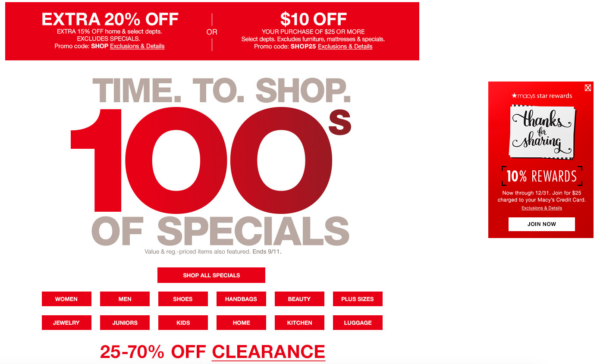
    Also, consider the size and spacing of your text on the page. It should be scannable so that a visitor can instantly pick out the information they’re interested in. Cut out the clutter. For instance, here’s an example from Macy’s current main landing page. Aside from the mixed messaging of the different values, can you spot the call to action?

    Image Of Macy's Landing Page Sale - Search Influence

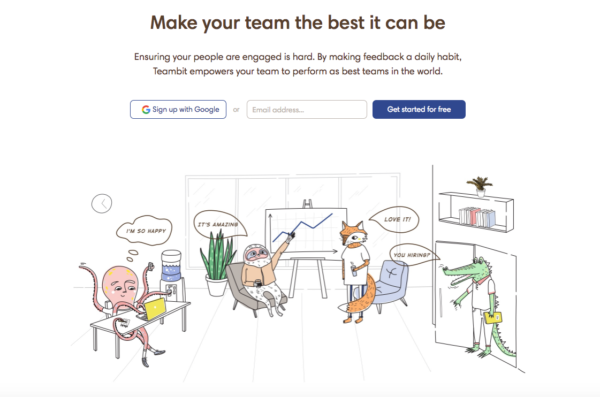
    Their “star rewards” offer is shifted to the right of the page. The goal for a button’s CTA is to predict where the user will look next. This one missed that mark. Also, it’s hard to tell what “JOIN NOW” means until you read the tiny print at the top indicating this CTA is for their rewards program. And finally, they’re asking a lot of their visitors to read the fine print on all of these different offers. A cleaner example of a landing page with less clutter and more clarity would be like this one from Teambit, an employee feedback, recognition, and survey startup.

    Image of Teambit Landing Page - Search Influence

    The value? Your team could be the best it can be. Sounds great. How do I go about doing that? Oh, I’ll get started for free. They have detailed information if you scroll through their page about just how they help people. But the reason why it succeeds is because it doesn’t worry about that up front. It focuses on the why with a compelling headline followed by clean copy and a simple CTA. Sometimes, it really is that simple.

    A Few Final Ideas for Crafting Great CTAs

    In addition to the previously mentioned points, here are a few examples of how you can make your CTAs stand out and drive conversions.

    1. Make sure to always display the benefits. If you’re offering a free guide, then say so right away (e.g. “Get the Knowledge You Crave – Download Our Free Guide.”).
    2. Try using a pain point that your potential customers may be hitting. For example, “Tired of Not Seeing Results In Your Ad Campaign? Watch Our Free Webinar to Find Out…”
    3. Also, you can try using an Influencer who supports and promotes your brand. This adds authority and intrigue to your CTA. Viewers who see that “Mark Zuckerberg Is Crazy About Our Team’s Marketing Ideas” will likely want to click on the corresponding, “Discover Why” button.
    4. Lastly, utilize testimonials from your current clients. This is a source that people often overlook. Your customers should be the biggest proponents of your brand. If a client has said that you’re the best company they’ve ever worked with, then take that and condense into copy to go along with a short, action-oriented CTA. Of course, always make sure to attribute ownership of the testimonial, and it goes without saying that creating a fake testimonial is a horrible idea for your brand. You’ve got to earn them.
    5. Numbers are great. If you have some success metrics, consider including them on your landing page. Are 100% of your employees certified in the service you’re promoting? Visitors should know that.

    Have any great examples of CTAs in landing pages or other types of content that you’ve seen? Share them with us! A great CTA can have your business seeing more conversions and fewer bounces. Need some more guidance on building a landing page that has strong calls to action that focus on your company’s brand and values? Reach out to us at any time.


    Images:

    Macy’s

    Teambit

  • Once Upon a Time… The Power of Storytelling in Content Marketing

    Once upon a time, there was a lonely copywriter. All day long, he wrote blogs and web content, press releases and social media posts. He spent hours toiling away at his computer, but no one ever seemed to care about what he wrote. Saddened by this, yet hungry to improve his plight, he set off on a perilous journey across the mysterious internet to find greater purpose in his writing.

    His journey brought him far and wide–from the slippery slopes of search rankings in the north to the massive backlink mines in the south. Along the way, he fought the bloated keyword stuffing behemoth and the two-headed monster of duplicate content, but he never felt any closer to his ultimate quest. Dire and lost, he thought he would never find the answer.

    When he had all but given up hope, the Content King appeared to him. Impressed by the copywriter’s perseverance and quest for knowledge, the Content King gave the copywriter one final test to prove his worth.

    The Content King asked the determined copywriter to describe his long journey and all that he had accomplished so far. Bolstered by his newfound experience, the copywriter recalled his voyage with great energy, weaving a cohesive narrative sprinkled with all the right details. The Content King ooh-ed and ahh-ed and gasped in all the right places.

    When he was done, the copywriter felt confident and proud. He knew this was just the boost he needed to continue his quest. He thanked the Content King and told him he was ready to set off again. The Content King chuckled and told him there was no need. He had already found the answer—for the power of storytelling is the true key to writing amazing content!

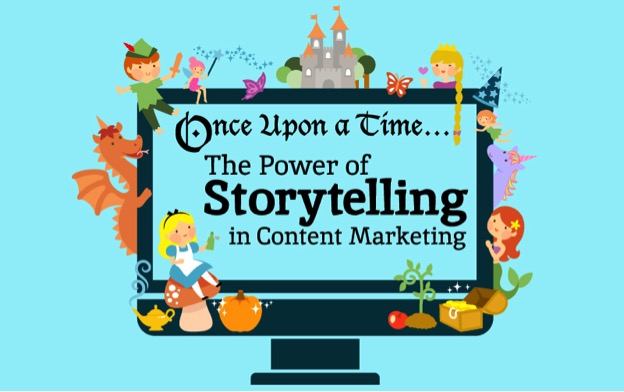
    Once upon a time..the power of storytelling in content marketing - Search Influence

    Everyone loves a great story. We learn from them. Stories can convey a wide range of emotions. They pique curiosity and are meant to be shared.

    From a marketing perspective, stories are also more interesting to read than standard copywriting. They also help garner trust between the storyteller and reader. With a story, a reader can establish just how much your business matches their needs and interests.

    Ultimately, your goal is to sell your audience something. But first, focus on having a conversation with your audience—that will open them up more to the sale. Telling a story adds humanity to any sales pitch, and the overwhelming majority of purchase decisions are influenced by emotion.

    Storytelling can be applied to any form of content writing—from blog posts and social media to newsletters and videos. The key is knowing your audience and appealing to them. Think about what emotion you want to communicate and plan to how to bring that out on paper (or on the screen).

    Knowing this, how do you translate that into writing better content? Here are 5 ways to incorporate storytelling into your content creation:

    Create Characters, Structure, and Drama

    It is said that there are only 7 basic story plots (the quest, overcoming the monster, rags-to-riches, etc.). Every story must have a beginning, middle, and end—or in literary terms, an introduction, rising action, and climax. So, how do these basic plots and the traditional 3-act structure fit into content marketing?

    First, you set your scene and introduce your main character. In marketing, this character is the main connection between you and the target audience, aka the customer. Because of this, it must be compelling and relatable.

    Next, create conflict (physical, emotional, psychological). Your audience needs to empathize with your story. Drama makes everything seem more real. For this, you really have to know your audience and their buyer’s journey.

    And finally, you’ll have to read to the end of this post for the third act….

    Personalize and Relate to Your Audience

    To get a reader to identify closely with the story, personalization and parallels are key. Telling the story from either your perspective or a related person’s point-of-view will help provide that connection and evoke empathy by sharing experiences, problems, and concerns. Being authentic is another important factor in making this connection. Without authenticity, you lose credibility.

    Get emotional - Search Influence

    Get Emotional

    Storytelling is an imaginative and clever way to get people to feel something. Stories spark emotions. People can feel happy, sad, afraid, and angry, as well as multiple layers of each, often overlapping another.  This complex nature of emotions is what makes storytelling so effective in marketing.

    Studies show content that evokes emotion is more popular, and those that leave the reader happy (as opposed to sad) are more likely to go viral. What people share on social media proves this every day When crafting a story, decide what emotion you want to arouse and then provide the necessary information and support for the reader to arrive at that emotion.

    Don’t Just Tell Something, Show It

    You want your targeted audience to know about the benefits and advantages you are offering. Do not just tell them matter-of-factly, but rather show them with a story. Integrate these crucial tidbits into the story and fill it will examples, details, and data so that your audience can experience and connect with these elements, and hopefully, make decisions based on the experience. Blankly stating a benefit or advantage will not cut it—they need to be shown how and why.

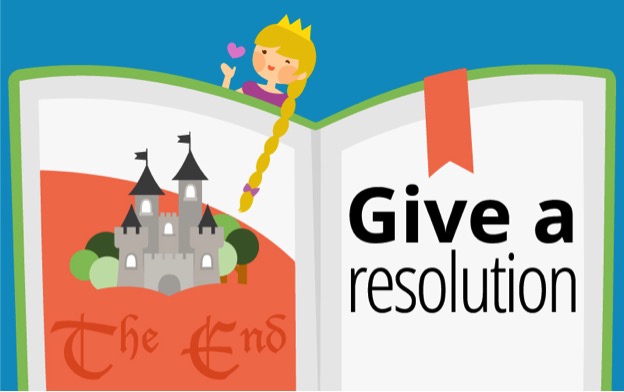
    Give a resolution - Search Influence

    Give a Resolution

    Finally, in Act 3, you resolve the conflict. The resolution should be your company and the products/services that you offer coming to the rescue. It fulfills the purpose behind the story. To seal the deal, the resolution should also include a clear call-to-action for your audience. And don’t forget, everyone likes a happy ending!

  • How to Use Google’s New Quality Score Columns to Drive Lower Costs Per Conversion

    If you’re a hands-on business owner using Google AdWords, you’ve no doubt come across the term “Quality Score.” You know it’s an important metric for the success of your account, but what does it mean? What factors contribute to this important number? And how does improving the overall quality of your account result in more leads? In this blog post, I’ll take you through a quick introduction to Google’s Quality Score and several strategies for monitoring, analyzing, and optimizing this metric.

    What Is Quality Score?

    According to Google, “Quality Score is intended to give you a general sense of the quality of your ads. The 1-10 Quality Score reported for each keyword in your account is an estimate of the quality of your ads and the landing pages triggered by them.” The main components of a keyword’s Quality Score are the Expected CTR for your account’s keywords and how your performance stacks up against that expectation, Landing Page Experience, and Ad Relevance. As your account runs and your keywords begin to receive impressions and clicks, Google ranks each keyword as Above Average, Average, or Below Average for the following criteria:

    • Ad Relevance – This component quantifies how closely related your keyword is to the ads in your ad group.
    • Landing Page Experience – Google rates your site based on the relevancy of your keywords to your landing page and the ease of navigation. Can the user find what they’re looking for on your landing page?
    • Expected CTR – AdWords knows the historical CTR of your ads. Using this information, the platform determines an Expected CTR for a given keyword and each keyword is then measured by how close actual performance is to that pre-determined expected performance.

    A keyword’s Quality Score used to be based on the keyword’s historical performance on Google until it achieved a significant number of impressions in your account. However, now Google reports a null score until that threshold has been reached. Once the keyword receives a significant number of impressions, its Quality Score will start to reflect how it performs in your account, and historical performance will be a lesser factor.

    Theoretically, your account level Quality Score is the cumulative result of the historical performance of all keywords in an account. It would be a painstaking process to capture this information on an individual keyword basis to determine the average Quality Score across the account. Luckily, there are wonderful geniuses who have developed scripts to do this for us. Google doesn’t confirm this Quality Score’s existence, but it’s generally accepted that there are different levels of Quality Score other than the visible keyword level Quality Score.

    Why Is Quality Score important?

    The components of Quality Score along with your set bid and the expected impact of your ad extensions are factors in the calculation of your Ad Rank. Your Ad Rank determines the position in which your ad will show as well as how much you pay for each click. Improvements in your Quality Score can lead directly to decreased Costs per Click. Without raising your monthly digital advertising budget, reduced CPCs allow you to generate more traffic to your site. The additional, cheaper traffic to your site creates more opportunities for Conversions at a reduced cost.

    Where Can I Find the Quality Score?

    Whether you’re using the new AdWords experience or the old interface, navigation is similar. However, there are a few additional functions currently only available in the old AdWords that we’ll explore in a later section.

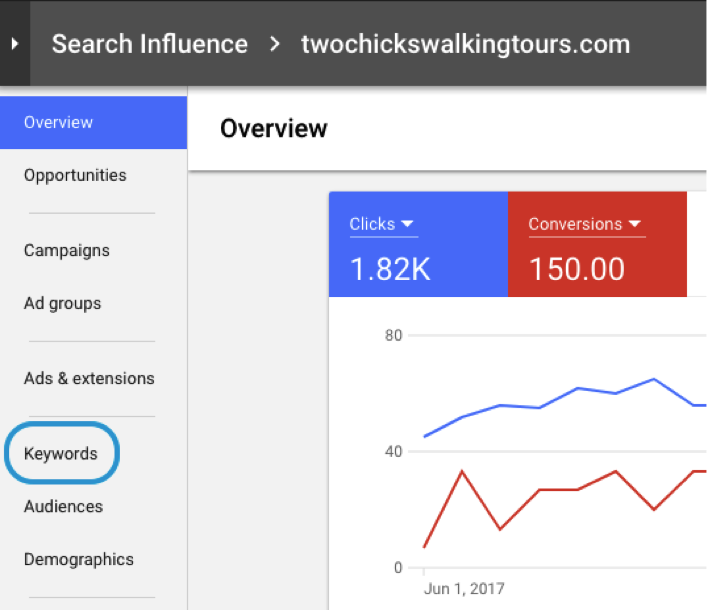
    1. Navigate to AdWords and select Keywords in the page menu.

    Screenshot of a keywords tab in Google AdWords - Search Influence

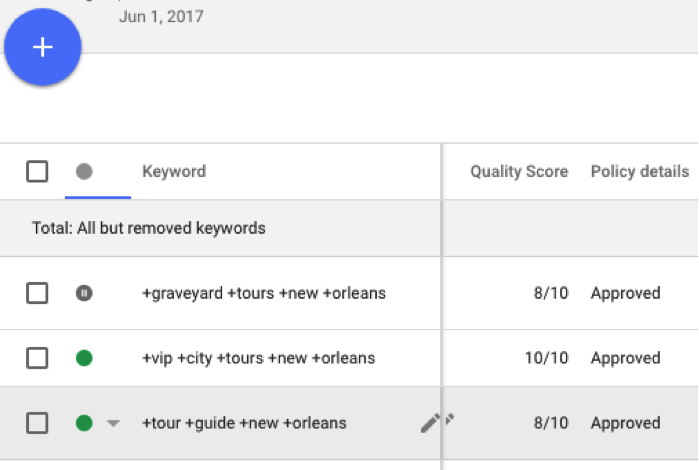
    1. If not already present, you may need to modify your columns to include the Quality Score column.
    2. Now you will be able to compare Quality Score across keywords.

    Screenshot of a Quality Score comparison in AdWords - Search Influence

    • You can sort by Quality Score or use the filter function to view only keywords with a specific Quality Score threshold.

    What Is a “Good” Quality Score?

    If a keyword’s Quality Score is 1-3, this is cause for concern. You’ll want to identify specific criteria needing improvement. If the score is 4-5, you can definitely make a couple of improvements, but you’ll want to focus on improving the areas that will have the biggest impact on your overall Quality Score. If the keyword’s Quality Score is 6 and above, the keyword is performing quite well, and you might only make minor adjustments.

    How Can I Diagnose My Quality Score?

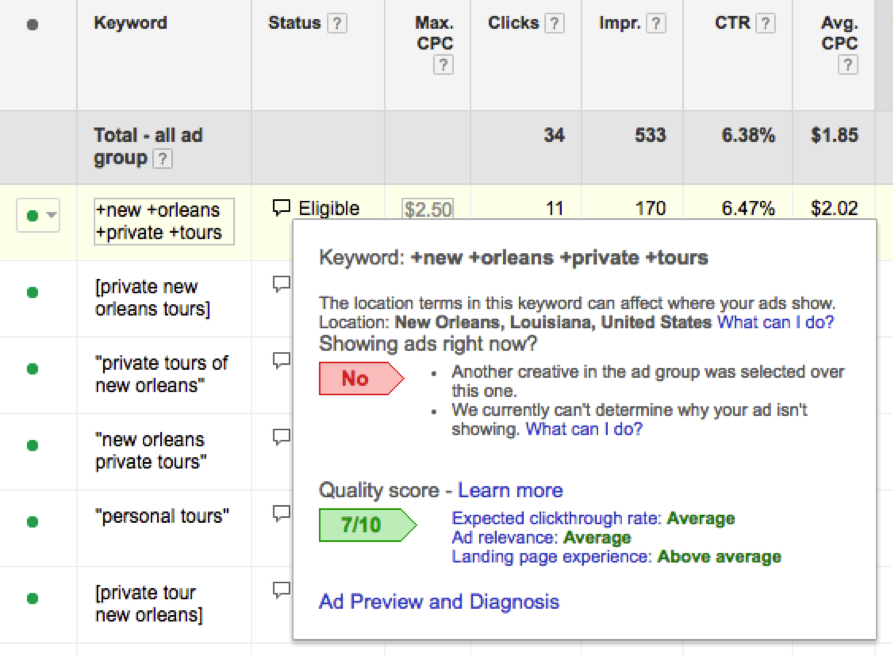
    You know that a Quality Score of 2 isn’t great, but how do you figure out where to start with improvements? In the old AdWords, you used to have to hover over the speech bubble next to the keyword to see Google’s rating of each of the three factors.

    Screenshot of keyword analysis in AdWords - Search Influence

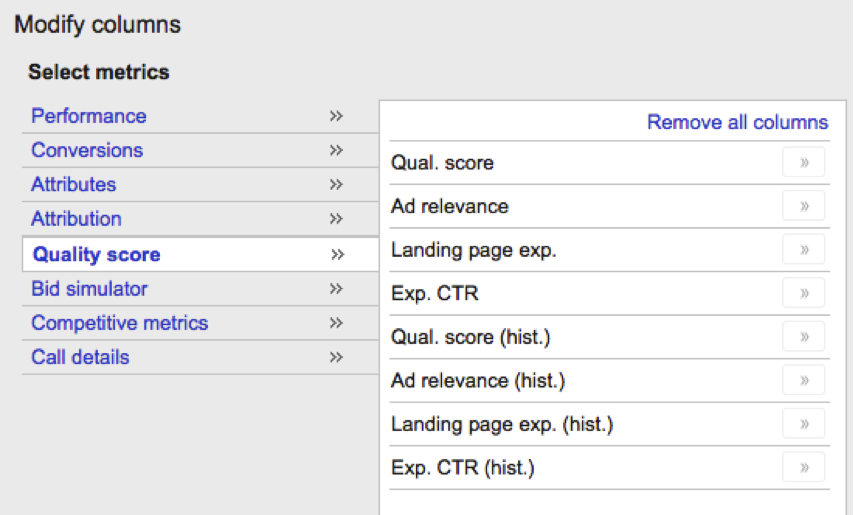
    This is extremely time-consuming. In the past, we’ve used a script to make this process a little more automated, but in early May of 2017, Google released brand new Quality Score columns to make the large-scale analysis of this data even easier. In the old AdWords, modify your columns and review the parameters available under the Quality Score heading. Unfortunately, these columns are not yet available in the new AdWords experience as of this posting.

    Screenshot of Quality Score columns - Search Influence

    Google now allows you to add columns to see your criteria rankings—Above Average, Average, or Below Average—within the platform. If a keyword has Above Average ratings for 2 out of 3 factors, you can easily identify which factor is having the greatest impact on the Quality Score for that keyword. There are also historical measurements of these metrics that can help you determine whether changes to your account positively or negatively affect the various components of Quality Score. For instance, reviewing historical Quality Score performance alongside current performance can help you determine if the new ads you implemented improved Ad Relevance or if the edits to your Landing Page contributed to improving the overall experience.

    How Can I Improve My Quality Score?

    So now that you’ve identified areas for improvement, what steps can you take to fix these issues? If your keyword has a Below Average Expected CTR, this is the easiest element of Quality Score to improve. Here are some strategies for improving this criterion:

    • Review the Search Term Report for this keyword for opportunities to implement more relevant keywords that users are searching and clicking in place of the keyword with a low expected CTR.
    • This could also mean that your ads are not compelling enough for people to click through. A quick way to give your account a natural CTR boost is including Dynamic Keyword Insertion (DKI) in your ads.

    If Ad Relevance is an issue in your account:

    • An ad is deemed relevant to a keyword when the keyword appears in the ad. Review your ads alongside your keyword to determine if the keyword in question is highly relevant to the ads for that ad group.
    • As I’ve already mentioned, account organization is key. Would the keyword be more relevant to another existing ad group? Is the keyword important enough to warrant the creation of a separate ad group?
    • You can also duplicate an existing ad and edit the copy to include a keyword with a low Quality Score to try and give that keyword a boost.
    • Ensure that your ads are answers to the queries the ad group most often receives. Reviewing your Search Term reports can help you figure out the information that users are most curious about.
    • Google also takes into account keyword density on the site, so improving your Landing Page could also be a factor to improving ad relevance.

    If your Landing Page Experience is subpar:

    • Don’t ignore the impact of your site’s mobile landing page experience!
    • Make sure that your keywords and ads are relevant to the content on the landing page.
    • Implement image optimizations like meta text, title tags, and alt text to include relevant keywords.
    • Brainstorm better CTAs for your buttons.
    • Improve your content.
    • Create more visible conversion points, like a highlighted click to call button on mobile, a click to call button at the top of the body content, and a corresponding form below.
    • Work to improve the navigation experience.
    • Forms or downloads on the landing page should clearly indicate what will happen if clicked by the user.

    You can’t have a “set it and forget it” mindset when it comes to Quality Score, especially considering the potential impact on your overall Cost per Conversion. I recommend performing a quarterly Quality Score analysis on your account and using insights from that analysis to drive the next quarter’s account optimizations, pacing out your changes, and using the historical Quality Score columns to judge the impact of your optimizations. If you have any other Quality Score tips, tricks or insights, please leave us a comment. If you’re new to AdWords and need some help setting up your account for success, please reach out to our team. We would love to help you optimize your potential!

  • #FreelanceFriday: How to Remove Unnecessary Filler and Fluff From Your Writing

    In digital marketing, it used to be good enough just to write content—about anything and everything. But now, and rightfully so, it is not enough for you to just have a well-written website. It needs to be one filled with original and high-quality content. What you write is important, but how you write it is equally critical.

    So, with the ever-increasing demand for top quality content creation, how do you make your writing even better? How do you make your content stand out in the crowd of competitors?

    One of the best (and easiest) ways to make your content more valuable is to remove any and all unnecessary filler and fluff from your writing. In general, filler is part of a sentence, whereas fluff refers to whole sentences in a piece of content that exist just to pad the word count, which ultimately dilutes the nutritional value of the overall content.

    Image of character from Despicable Me with a toy unicorn - Search Influence

    By focusing more on substance, your content becomes richer and more beneficial to the reader. Don’t pad your content with the superfluous; it just isn’t necessary. Visitors to your site come for information about your business, don’t allow them to get lost or bogged down sifting through content that is redundant or pointless.

    Here are 6 ways to make your blogs better by removing unnecessary fluff and filler:

    1. Create a Plan and Outline First

    Your writing should always be clear and concise. When it comes to fluff, rambling is often one of the major culprits. Organization and planning (which can include creating an outline), will help you stay focused and avoid fluff even before it happens. It can also help to strategize any necessary research before writing.

    2. Avoid Redundancy

    Redundancy makes your writing dull and laborious to read. It can also reveal gaps in your knowledge of the subject. Required high word counts unnecessarily force many writers to say the same things over and over again instead of expanding on the topic. More content is worthless if it is redundant.

    Image of Sherlock Holmes character stating the obvious - Search Influence

    3. Nix the Common Knowledge

    Removing fluff is not just about having a succinct and smooth writing style, it’s also about creating content that adds real value. Trying to make all content accessible to everyone is not only nearly impossible, but it also increases the risk of fluff. You cannot explain everything to everyone. Know your target audience going in and gear the writing toward them.

    4. Remove the Unnecessary

    You might be surprised by how many words you can easily cut from your writing. Focus on word economy over exceedingly descriptive or unnecessary exposition–which includes excessive adjectives, most adverbs, and qualifiers that can weaken your writing. Unnecessary words and phrases are easy to find and remove because they don’t change the meaning of the sentence when deleted.

    Image of character from The Hangover calculating mathematics - Search Influence

    5. Eliminate Complexity and Density

    Unless you are writing content for a highly technical client or industry, overly complicated sentences with jargon should be avoided. If a reader has to reread a sentence to understand it, then it needs to be rewritten.

    The same goes for overtly flowery language—it may seem well written, but it will make it harder to comprehend the meaning. The goal of your content should be to make it easy-to-read so that you can get through to the reader. Don’t bury your point in decorative language.

    6. Don’t Be Afraid to Edit Yourself

    When editing, it is essential to detach yourself—and be merciless even. When giving your first draft a close second read, you will almost certainly find words and phrases that are completely unnecessary or misleading. Write, edit, repeat until your final draft reveals itself. Getting your point across should be your primary concern, while style remains secondary.

    Improving your writing this way takes practice. First, you have to learn how to identify fluff and filler, and then you have to force yourself to remove it. The better you get at recognizing the unnecessary from the start, they less you will have to edit later, thus making you a better and more efficient writer.

    Images:

    Fluffy Unicorn

    Holmes

    Alan

  • #FreelanceFriday: Finding More Time in Your Schedule to Freelance

    This blog is part of our Freelance Friday series, where we discuss everything and anything related to freelancers. For more freelance information, tips, and trends, follow us on Twitter.

    Image Of Michael Scott Saying No Time - Search Influence

    “I don’t have time…”

    As writers, we have all said it at one time or another, most likely as an excuse for not writing more. And let’s not kid ourselves here, it is most certainly an excuse. There are 24-hours in the day for everyone. So, why can only some people pull off a freelancing side gig?

    Deciding to add freelancing to your daily schedule probably didn’t seem like that big of a deal at first. You can make your own schedule and work from anywhere at anytime. That all sounds great (and it really is!), but you still have to find the actual time to do it. It can certainly be tempting to let freelancing take a back seat to other tasks and priorities in your life—but don’t let it happen!

    For those who truly want to do it, they find the time. Freelancing (and writing in general) are choices. Likewise, you have to choose to find the time. Time management techniques and organizational skills can be developed and utilized easily. In the end, freelancing is all about scheduling and prioritization, especially when you are still working full-time at another job. Make those and other strategies for time management work for you and you will discover the time.

    Of course, this is all easier said than done. Here are a few tips that will help you fit your freelance business into your schedule.

    Image Of Parks And Recreation Saying Jammin On My Plane - Search Influence

    Assess and Make A Schedule

    We have talked about time management tips a lot—and for good reason. It is the key to freelancing. Start by evaluating your daily schedule. When do you wake up? Eat lunch? Work at other jobs? Go to bed? Fill in the intervening times with potential availability to freelance. Not all of it; just when it works well for you. There are tons of time management tools to help you with this.

    When you are getting started or overhauling your time management, try timing how long it takes you to complete this work. Work on improving that time, as well as adjusting your schedule as you need or see fit.

    Strengthen Time Management Skills

    Even if you are able to find the time, it is equally important to use that time well. Because this time is so valuable, you need to have a clearly defined time management schedule—prioritize, avoid distractions, stay organized, etc.

    Try working in small pockets of time in between bigger tasks. While you are waiting for the water to boil while cooking, on breaks at your normal job, during your commute, etc. The start and stop nature of this doesn’t work for everyone, but all of these small increments can add up quickly for those who can make it work.

    Image Of John Candy Saying No - Search Influence

    Don’t Be Afraid to Say No

    Such an easy word to say, but one that most people are so hesitant to utter. Learning to say no can help your freelance life in more ways than one.

    First, it allows you to decline jobs that you are not fully interested or invested in. Why waste precious time on something you don’t want to do in the first place? Doing this could prevent you from working on an assignment or project that is more aligned with your thoughts and aspirations.

    Second, saying no can also be employed in order to free up more time to do the actual work. If you made previous plans for multiple nights of the week, think about canceling or turning one of them down beforehand. A lot of work can be accomplished in a single extra evening.

    For best performance, you also need to learn how to say no to TV, social media, and other time-consuming forms of entertainment as often as possible.

    Find Your Peak Hours

    Most people already know if they are night owls, early birds, or in-betweeners. Whatever time of day, it’s all about finding that time period where your drive and mental capacity are at their highest and you are able to do your best work (speed and quality-wise).

    That is not to say that your peak hours have to be consecutive. Maybe you can work well at multiple points throughout the day. In fact, you can probably train yourself to work better at one time or another. Try to get as much done as you can in those times—as long as you keep things consistent and don’t waste time figuring out where you left off before.

    By finding and using these hours effectively, you will be able to get more done faster without the common plague of interruptions. Whether you like working into the wee hours of the morning or you are an early riser who can get things done with a hot cup of coffee, there exists a time especially for you.

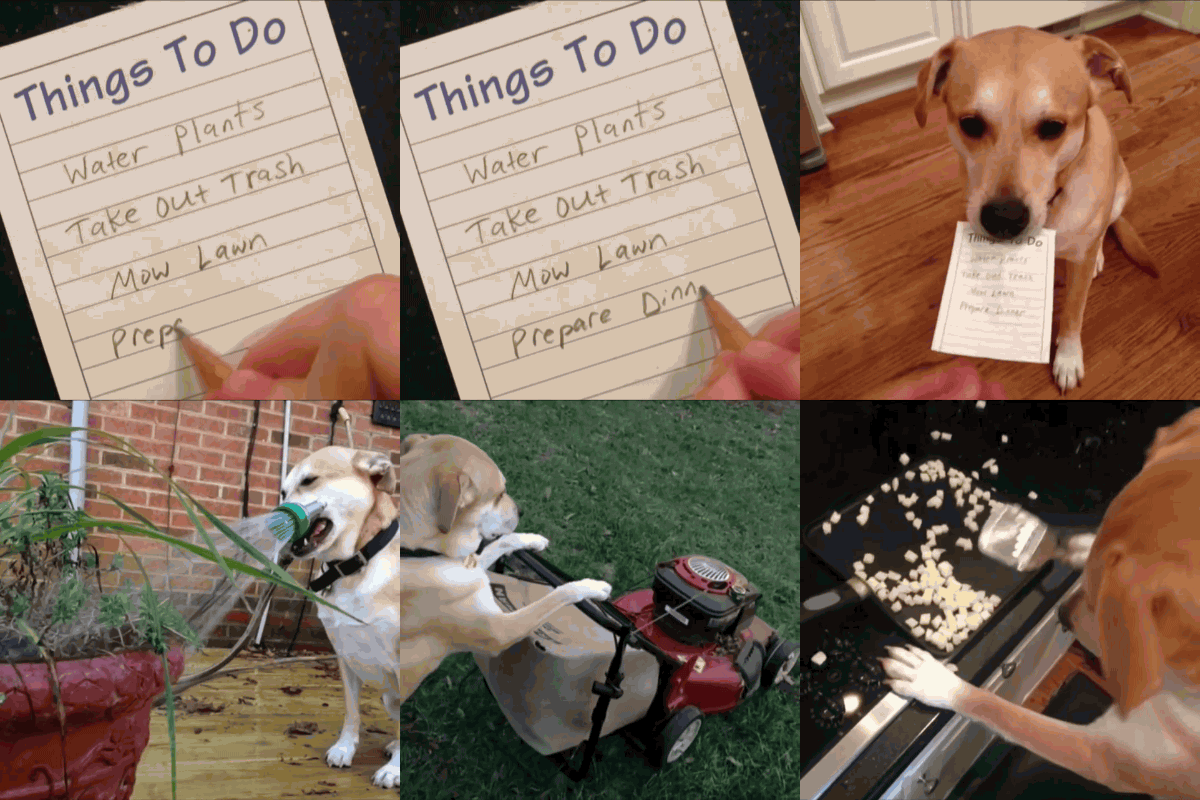
    Image Of Dog Doing Chores - Search Influence

    Outsource Your Work

    Admittedly, this tip may not be for everyone. But, if you are capable, it can be a huge timesaver to help you budget time. By subcontracting out lesser, but still necessary, chores, you can free up time to perform your freelance work.

    So many things (some obvious, others not so much) can be outsourced, including house cleaning, bookkeeping, laundry, cooking, lawn maintenance, house repairs, child care, pet care, and grocery delivery. Not all of these are needed, of course. But find one that fits your budget and schedule, then get to work—this isn’t new found free time, it’s extra time.

    In the end, to find more time for freelancing is a gradual process. Find what works for you and allow for adjustments and new routines along the way. Freelancing is still a job, no matter how much time you devote. The changes may not be easy at first, but they are more than doable if you want your freelance career to succeed.

    Image Sources:
    No Time

    John Candy—No

    Dog Doing Chores

  • NEW ORLEANS, May 24, 2017 — The Plastic Surgeon’s Guide to Press Releases

    Search Influence has done a little blogging about press releases in the past, but now it’s time to kick things up a notch—or 16 billion notches. According to the American Society of Plastic Surgeons, Americans spent roughly $16 billion on plastic surgery in 2016, which is an all-time high. With thousands of plastic surgeons vying for a place in this lucrative industry, your practice should be using every tool at its disposal to keep up with the competition. One such tool is the press release.

    All About Press Releases

    The press release is THE classic public relations tool. It’s over 110 years old, but don’t worry—it’s still very relevant. The modern press release is published online and distributed through networks like PRWeb. A press release can inform media outlets about a newsworthy event related to your practice. Not only is this great for publicity, but it also helps with SEO. When reputable news sites run your press release or write a story about it, they provide authoritative backlinks to your website, which makes your website more authoritative in turn.

    Now, if you’re low-key panicking about what PRWeb, SEO, and backlinks even are, stop. Take a deep breath. Then, contact Search Influence to get all your questions answered.

    Image of a woman trying to decipher the workings of the internet - Search Influence

    If you’re already an SEO pro, great! Let’s move on to exactly what you should talk about in your practice’s press releases.

    Good, Newsworthy Topics

    Step one of writing a good a press release is choosing a newsworthy topic to write about. You should think of it as an announcement, not an advertisement. Press releases are not intended to hype your friendly customer service, compassionate care, or other unique selling propositions. They should not include a personal point of view, like “we” or “you,” and they should not include any promotional language. You probably are an exceptional surgeon who provides stunning, natural results, but PRWeb will probably reject your press release if you say as much. Instead, focus your press release on important recent events or developments.

    Here are some great ideas for topics to write about, courtesy of InboundMD:

    • Celebrating Milestones or Anniversaries
    • Participating in Community Events
    • Hiring New People
    • Acquiring New Equipment
    • Offering New Services or Treatments
    • Opening a New Location
    • Winning Awards or Honors
    • Speaking at a Conference
    • Publishing a Study

    All of these topics let you announce a new event or development that might capture readers’ attention. They also all provide the opportunity to frame your business as an objective leader in your field. A lot of practices could run ads claiming top-of-the-line equipment, but fewer practices could back up their claim with an objective and authoritative news story about acquiring new equipment. Press releases are a factual way to set yourself apart from other practices and stand out to potential patients.

    Sections of a Press Release

    Now that you have an idea of what to write about, let’s move on to some practical how-tos. Press releases follow a very specific format, and the sections are as follows:

    • Title
    • Summary
    • Body
    • Boilerplate

    The title should concisely announce your newsworthy topic. It should include your company name and an action verb.

    The summary should build on your announcement with engaging details to draw in the reader. For example, if the title announces that you published a study, the summary can explain how that study might impact surgical procedures or medical treatments in your field.

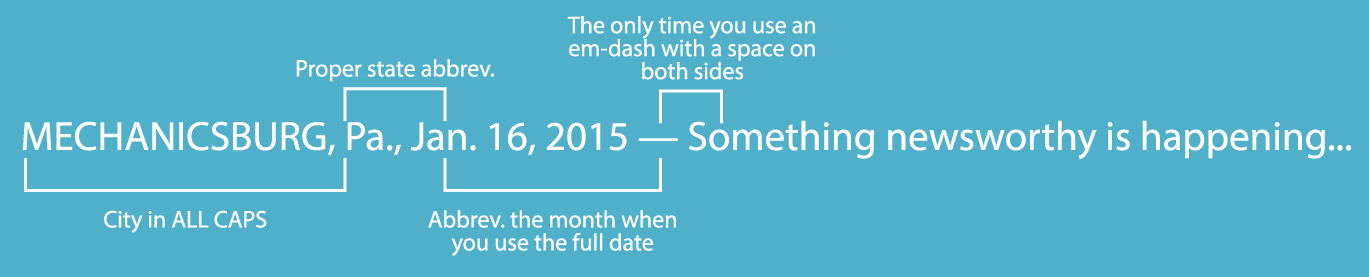
    The body is where the majority of the writing takes place. It should begin with a dateline, formatted like the image below:

    Image of a standard press release dateline example - Search Influence

    The dateline should be followed by a strong hook or lead to capture the reader’s attention. Then, the rest of the introduction paragraph should provide the reader with all the key details they need to know about your announcement. The following paragraphs should build upon these core details, until the final paragraph, which should briefly include your contact information.

    The body should be written in the third person, and language should remain objective, rather than promotional. However, you can include one or more quotations, from yourself or another knowledgeable figure, that can bend these rules a bit. A quotation can say, “I am proud of my practice’s dedication to technological advancements.” The rest of the body cannot. This is because the quotation is clearly attributed to an individual and framed as an opinion.

    The final section is the boilerplate, which is a brief, objective description of your practice.

    Pitfalls to Avoid

    Unfortunately, no list of things to do is complete without a list of things NOT to do. Press releases have fairly strict editorial guidelines, and as you know, the medical industry is heavily regulated. The following are some common mistakes made in plastic surgery press releases and how you can avoid them.

    It’s been mentioned several times already, but do not use promotional language or treat your press release like an ad. Objective language will not only get your press release accepted by PRWeb and news outlets, but it will also lead to more compelling writing. Again, tons of doctors claim that their practice offers experienced, well-trained care. You can prove that your practice offers such care by running a press release about the impressive experience and credentials a new hire brings to your practice.

    Don’t include general business information, except for your contact information and the boilerplate. It isn’t news that your practice offers Juvederm, Radiesse, and other injectable fillers. A lot of practices offer that. It is news, however, that your practice is the first in your area to offer a brand new line of injectable fillers. If you find yourself filling space with general business information, it might be a sign that you should choose a more in-depth topic.

    Don’t make any promises unless they are backed up by studies and statistics. This is not only because such promises can be too promotional for a press release, but also because everyone from Google to the American Medical Association has strict rules against misleading patients. Even seemingly innocuous claims about natural-looking or proportionate results can be flagged as misleading, as results can vary based on a large number of genetic and situational factors. To be safe, include reputable citations for all claims, and it doesn’t hurt to follow up with a disclaimer like “results may vary.”

    Ready to Start?

    This information should put you well on your way to writing the perfect press release for your plastic surgery practice. If you still have questions, or would rather leave the writing work to us, contact Search Influence! We’re happy to help.

    Images:

    Deciphering the Internet