Category: Content Marketing

  • Effective Online Marketing Messages: How to Pace Yourself

    A couple of weeks ago I wrote a post about over-saturating the market with online business communication. While in the last post we gave you tips on how to tell if you are indeed over-saturating the market, we promised we’d do a follow up with some steps to take to help avoid it and to put out effective online marketing messages.

    Effective Online Marketing Messages

    1. Consistent and timely messages. Plan, Plan, Plan! Decide ahead of time when you’re going to be communicating with your audience. In terms of email marketing, how frequently will you message? Monthly, Bi-Monthly, or Quarterly? Tuesdays or Thursdays? While your plan doesn’t have to be as detailed as blueprints, you should still decide when you are going to send and what you’re going to talk about. There are articles and case studies with varying results on when the best times of day to deliver are. Always keep your target demographic in mind. When are they going to have the time to read? I can promise you I won’t be reading any non-personal email after noon on Friday. Who cares at that point in time? Let me at the weekend. If you’re helping me decide what do to with my weekend maybe you should get me that during my mid week hump when I’m impatiently waiting for the weekend to roll around. If you’re tweeting or posting an update don’t overdue it and post daily until the day of the sale, event or whatever you’re pimping. You still need to be timely in your delivery. Again, when is your audience going to listen, care and be able to respond? Of course, don’t forget in social forums it’s not just about you, you must interact – it’s not about one way communication.Effective Online Marketing: Blueprint

    2. Only send something you would read yourself. Don’t send something just to send something. Often, companies find that the months slip by without sending out a message and then rush to put something together at the last minute when they need it. Tactic #1 will help you be prepared and avoid these last minute throw-togethers that could get multiple users unsubscribing from your list if they feel you’ve wasted their time. When it comes to social forums sometimes you can send something to send something but make sure you would read it. If it’s not  interesting, insightful, entertaining to your target demographic don’t do it. Of course be sure it matches your overall marketing message and brand identity.

    3. Define your Goal. What is the point of the message? Do you want readers to call in and book appointments? Do you want them to fill out a form requesting more information? Do you want them to purchase an item from your site?  Are you being re-tweeted? Gaining fans or growing your network? Once you define what it is you consider a “conversion,” figure out how you will measure this goal, and move on to step 4.

    Effective Online Marketing Messages: Track

    4. Track. Track everything, and watch the numbers, read into them, and learn from them. If you see a significant portion unsubscribing from your list, or a decline in conversions, or fewer click throughs on your links perhaps conduct some testing to see if the decline was a result of the message itself or of the timing.

    Tracking and measuring are almost as important as the timing and message itself, and the former should certainly influence the latter. The best part about planning ahead is that you will have a greater chance of learning from your mistakes and you’ll have time to adjust future messages to be more relevant and effective.

  • Email Marketing for Small Business: 9 Things Not to Do

    I am all about receiving e-mail marketing from eCommerce sites that I am interested in.  Seriously – my personal e-mail inbox has 2,445 unread messages – I sign up for everything 🙂 With that said, you have to say something enticing for me to open your e-mail.  And, for some reason, today I opened an e-mail from a local small business that seriously frustrated me.  The guilty party will remain nameless.
    E-mail Marketing Bandit

    In my current position at Search Influence, I do not work with email marketing on a daily basis.  However, in my previous job, I did.  I worked with both consumer emails and eNewsletters within organizations.  My intention here is not to call-out the small business who sent this email – but, to hopefully allow other small businesses to learn from their mistakes with some very basic email marketing tips.
    For starters, I will show you a screen shot of the email that I received.  At first glance, how many things can you find wrong with it?
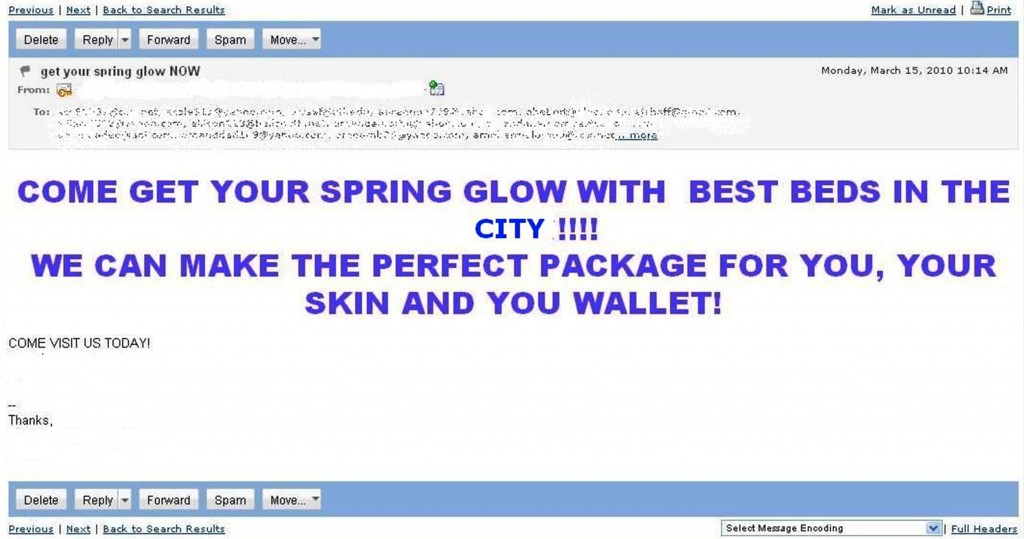
    E-mail Marketing No-No

    This is just to give you a visual.  There are some things that you cannot tell just by looking at this screen shot.

    At first glance, here are some things that I noticed that you should NOT do when sending an email to your customers:

    1. The very first thing you might notice is that the entire email is written in ALL CAPS and has a million exclamation points!!!!!!!!  This actually lessens the impact of your message and may appear that you are SHOUTING AT YOUR CUSTOMER!!!  It can also land your email in your customer’s spam folder.

    2. There are some obvious grammatical errors here.  One in particular is the misspelling of what is supposed to read “your” in the last line.  It is evident that whoever wrote and sent this email was in a rush and did not proofread their own work and also did not get someone else to proofread the work.  (And, if they did, then….well…I will leave it at that 🙂 ) You should ALWAYS proofread your work, and even get someone else to give it a once-over before you hit the “send” button.  In addition to proofreading, you should also send out test emails to yourself or fellow staffers, to make sure that it is functioning properly and that it looks just how you want it to look.

    3. The subject line used in this email reads “get your spring glow NOW.”  This is a weak subject line because it does not give a peek of what you can find inside the email; it pretty much IS all of what is inside this email.  The actual content of this email itself is not much more than what is listed in the subject line.  In the article “15 Email-Marketing Best Practices”, Mitchell Harper says “When your email arrives in your subscriber’s inbox, you generally have about half a second to catch their attention with the subject line of your email. After this, they will either delete your email or ignore it.”  He later suggests, “In your subject line, try and specify a benefit that the subscriber can expect by reading your email.”

    4. Here is something that you may not be able to see in the screen shot:  All of the recipients of the email are visible.  It is an email marketing best practice to not disclose the email addresses of the recipients of your email.  It allows your customers privacy.
    E-mail Marketing Best Practice: Privacy for your Recipients

    5. Second thing that you cannot tell just by viewing this screen shot:  there is not a single link within this email! How is the consumer supposed to dive in deeper and get more information? This is a major rookie mistake.  This particular business has a website.  Why would you not want to drive more traffic to your site?  This is a missed opportunity indeed.
    E-mail Marketing Best Practice: LINKS!

    6. There is no unsubscribe option given in this email.  According to Wikipedia, “The CAN-SPAM Act of 2003, signed into law by President George W. Bush on December 16, 2003, establishes the United States’ first national standards for the sending of commercial e-mail and requires the Federal Trade Commission (FTC) to enforce its provisions.”  Wikipedia later explains that under the CAN-SPAM Act of 2003, “A visible and operable unsubscribe mechanism must be present in all emails.”  This gives your customer the option of no longer receiving your business’ marketing emails.  Furthermore, if your customer decides to unsubscribe from your emails, you have 10 days to honor their request.

    E-mail Marketing Best Practice: Must offer an unsubscribe option!

    7. They are not promoting or offering anything worth my time to take any action here: no percentage off, no BOGO (buy one get one), no sale information.  You get the picture.  What are they trying to get me to do here?  And, an even better question: what are they willing to do to get me there?  There was no planning involved in this email.  Try to offer your readers something unique in each email that you send, whether it be a promotion or an important news story relevant to your business.

    8. The are no images in the email to catch the reader’s attention.  It is not a necessity to include imagery in your email content.  However, it is a good idea.  Pleasant and relevant imagery can catch the reader’s attention.  Even something as simple as including your company’s logo can help to build your brand recognition.

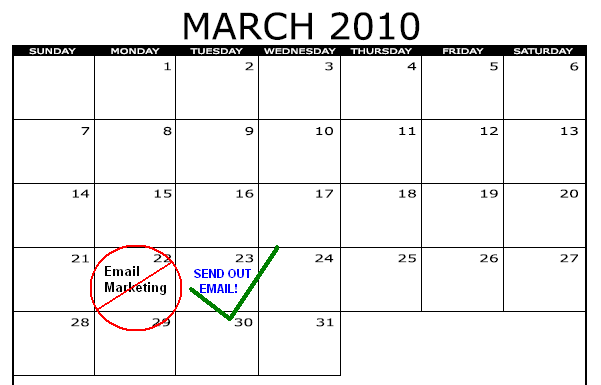
    9. Another not so obvious factor:  this email was sent out on a Monday.  According to the article by Mitchell Harper entitled “15 Email-Marketing Best Practices”: “Studies conducted by online research analysts have shown that the best days to perform a mail-out to your list are Tuesday and Wednesday, as this is when people are more receptive to communication. This means that they are more likely to read your content and click on links, meaning more sales. On Mondays, everyone is still recovering from a hectic weekend. On Thursday and Friday, people are already too busy looking forward to the weekend.”

    Search Influence‘s in-house email marketing guru, Janna Vastola, adds that she believes “The best time to send is Tuesday between 9-10 am.”
    E-mail Marketing: Timing Matters

    These are only a few basic email marketing tips. Essentially, what you put in is what you will get out.  First impressions are everything.  If your customers open an email from your business, such as the one outlined in this blog, they may not open another one, if it makes its way into their inbox.

    Take your time, plan and have a purpose for your email.  No matter how many email addresses you have on your email marketing list, they are all valuable to your business.  Your customers’ time is also valuable.  Make it worth their time to open your email and actually get something out of it.  Just because you operate a small business does not mean that you cannot create an email marketing campaign that rivals the biggest and best!


    { Prepare + Promote + Proofread + Professionalism = Positive Brand Image + Conversions + ROI (Return on Investment) }

    Resources:

    Photo Credits:

    • “Pug Shot” http://www.flickr.com/photos/jerry_reynolds/1449005045
    • “Privacy, Please!” http://www.flickr.com/photos/nitot/3488350975
    • “Unsubscribe” http://www.flickr.com/photos/johnhaydon/4349744825
    • “Weakest Link”  http://www.flickr.com/photos/96dpi/3371440496

  • Duplicate Content: Bad News for Rankings

    Recently, I received the phone call that no one in SEO ever wants to receive. In a nutshell, our clients’ site had completely fallen off the rankings. I, of course, began scrambling for what could have possibly happened within a week- the final result…..duplicate content! (Disclaimer: We did not place duplicate content up. It was a franchise site.)

    Acceptable Reasons for Duplicate Content

    Duplicate content is not looked upon highly by Google, and can either hurt your rankings or make them disappear completely. According to Google Webmaster Tools, there are a few places duplicate content is acceptable.

    – Discussion forums that can generate both regular and stripped-down pages targeted at mobile devices

    – Store items shown or linked via multiple distinct URLs

    – Printer-only versions of web pages

    Ways to Correct Duplicate Content

    If you come across an instance that could be duplicate content, here are some actions that can be taken to prevent it.

    – 301 Redirects: redirect all of your duplicate pages to one page. The duplicate content and redirected URLs will work themselves out in Google.

    – Robots.txt: Place this in your code on the pages you don’t want Google to index. In the case of the printable text, place it on those pages.

    – Rewrite Content:  If you have two sites that work together for one business, then edit one site so that the content reads the same, but will be indexed differently. You can also put a small blurb on one site and link to the site with all of the information.

    Various methods exist to correct duplicate content based on different scenarios. A great article I found when researching was in the Google Webmaster Tools. The easiest way to manage duplicate content is to avoid overusing.

  • Secret of Successful E-Mail Newsletters

    Many clients ask what the point of an e-mail newsletter is and how it can help them grow their business.  Will people read it?  Will it clog up potential customer inboxes? How much is it?

    There are several reasons I recommend e-mail newsletters. Not only do they provide free information, they are also one of the least expensive and most effective tools to draw attention to a site.  Below are some additional advantages to implementing a company e-mail newsletter.

    Stay in Touch
    Stay in Touch

    Stay in contact – Keep your business top of mind to your customers so that when they need a service you provide, they will contact you.  Newsletters serve as a reminder to customers to come back to your site.

    Develop relationships and trust – You become familiar to your subscribers. Familiarity encourages return visits and establishes customer loyalty.

    Promotional tool – A great way to communicate new products and announce new services.  Specials or discounts are a way to attract customers back to your site.  Offers entice subscribers who may not necessarily need the service but will be prompted to act during a special.

    Increase site traffic – Again, good to send out when launching a new product or service.  Gives subscriber a reason to visit the site, helping drive additional traffic .
    Set specific delivery time – Complete control of when information is disseminated.

    Trackable – Use the newsletter as a research tool to see what people read about most and what they are most interested in hearing about.  Research will allow you to write a newletter for a specific target audience.

    Provides immediate results – Real time statistics and data provide you with the information needed to evaluate the effectiveness of the newsletter.  Tweak future newsletters from that information.

    When developing your newsletter consider the following:

    • Content has to engage readers.  Articles should be more informative and less like an advertisement.
    • Keep articles brief.
    • Use images to attract reader’s attention.
    • Use links and provide URL’s as additional resources.
    • Frequency is key. Stick to a regular schedule. Try to send out same time every month or week.

    So if you are looking for a cost efficient way to target and reach a large group of customers or potential customers, consider an e-mail newsletter.