Category: Content Marketing

  • The Power of Utilizing Social Influencers for Your Brand

    What’s the Hype with Influencer Marketing?

    We are in the era of social media marketing being at the forefront of increasing brand revenue. I’m not talking about advertising on social media platforms in the traditional way. I am talking about teaming up with social media influencers or as many others may call them, bloggers.

    Influencers are proving to be one of the most trusted resources when it comes to consumer purchases. Consumers connect with influencers on a personal level and look to them for advice and insight on products and services. Each influencer has their own niche in which they thrive: cosmetics, clothing, home decor, health & fitness, parenting, traveling, food & booze, or even the best local spots in the area. They do their due diligence in growing their following and building trust, which is the true means to influencer success.

    Influencers are the way of the future, and it’s in your brand’s best interest to begin looking into this marketing method. Influencer marketing is just getting started, and according to Google Trends, the topic has grown tremendously since 2013 with no end in sight!

    Marketers around the world spent more than $5 billion on Influencer marketing on Instagram in 2018, helping to grow the influencer marketing industry’s success. It’s estimated that influencer marketing will grow to $10 billion by 2020.

    eBay reported that they had 1.3 million engagements (hashtags, reposts) per year, while American Express reported 3.7 million engagements per year, and Daniel Wellington had a record-breaking 1 million+ engagements per year—all thanks to Influencer marketing.

    Are you starting to believe the hype now?

    Three hands holding phones representing users liking photos on Instagram

    Finding Your Brand’s Match

    Finding your brand’s perfect match can be tricky. That is why I have compiled a list of questions to begin your quest.

    • What is it that you want the influencer to help you with?
    • What is your budget for influencer marketing? Do you want to team up with more than 1 influencer?
    • Will there be a contract involved? If so, is the contract flexible to work with the influencer’s rates?
    • Is the influencer aligned with your brand?
    • Will your campaign content look natural?
    • Does the influencer speak to your brand’s niche frequently?
    • Is there alignment with your industry and brand values?
    • Does the influencer have the reach to accomplish your goals?
    • Is the influencer capable of engaging your target audience?
    • Are they on the social media channels your audience frequents?
    • Is the influencer relevant?
    • Is their fan base similar to the buyer personas you’ve built for your company?

    Now that the quest has begun, it’s time to determine which type of influencer is the best fit for your brand. You may be asking, “There are types of Influencers?” The answer to that is YES! Not all influencers are the same or can provide you with the return that you’re looking for.

    Review this list of a few types of influencers and the pros and cons for each below.

    • Brand advocates: Brand advocates are influencers who currently do not have a contract with a brand but pass on positive information about the brand or product to their followers. Brand advocates are a great example of a cost-effective partnership. The reason for this is that many brand advocate influencers would highly consider a trade for product instead of a paycheck for promoting your brand.
    • Micro-Influencers: Micro-influencers are a category of content creators with highly engaged social audiences that range in size of 100 to 5,000 followers. They can be beauty enthusiasts, solo travelers, mommy bloggers, fashionistas, or foodies—they represent any passion with an audience. Micro-influencers usually achieve around 8 percent of active engagement per post, while premium social influencers come in around 4 percent.
    • Macro-Influencers: These influencers have a very large following, usually between 100,000 and 1 million followers. Macro-influencers offer a blend of reach and impression, but they cannot match the engagement rates of micro-influencers.

    How to Measure Success

    There are a couple of really important metrics that you are going to want your influencer to report on during the campaign. The metrics that really matter are: clicks, likes, shares, reactions, comments, brand mentions, impressions, and purchases. You can keep track of these metrics by creating custom promotional codes, using SmartURL tracking links like Bit.ly, creating custom hashtags, and of course using Google Analytics to track users’ referral sources.

    An easy way to measure the success of influencer campaigns is to track the amount of engagement your influencers’ content receives. This is why it is important to ask your influencer to report on clicks, lives, shares, comments, and impressions per post, story, or blog post. Engagement is a better indicator of success, since we can assume that content that receives the most engagement is more compelling and makes an effective connection with your target audience. With higher engagement comes higher visibility for your brand.

    This all ties back to micro and macro-influencers. In many instances, the macro-influencers will have a widespread reach, while the micro-influencer will have better quality engagement.

    Looking at the trends for 2020 Influencer Marketing

    Now that you believe the hype, what does 2020 look like for social media influencers? According to Google, there has been a 1500% increase in consumer’s searching for “Influencer Marketing.” There is a huge takeover happening within the micro-influencer community! That’s right, those micro-influencers are taking over the Influencing world. According to Social Media Today, “61% of consumers say that micro-influencers produce the most relatable content!” Where can you find these micro-influencers? The biggest platforms in 2020 are Instagram, Twitter, and the influencer’s personal blogs.

    Ready to revamp your brand’s social media marketing strategy but don’t know where to start? Team up with Search Influence to learn what metrics matter for your marketing plan. Contact us to get started today.


  • Chatbots – Are They Right for You?

    On the internet, there are two kinds of bots, those designed to deliver content or promote a cause and others designed to be a virtual sales assistant or customer service representative. The latter is commonly called a chatbot, and they are popping up all over the web. Facebook added chatbots to their business pages a couple of years ago to help businesses automatically respond to inquiries even if they couldn’t have a human watching their page 24/7. Google also has a bot for their business page managers that works similarly.

    While chatbots aren’t new, the last few years have seen a lot of hype about chatbots being the next big thing in online conversions, and we have seen an increase in the use of chatbots all over the web. But is using these autonomous bots helping or hurting when it comes to online conversions? Are they really right for your business? To find out, let’s dig into the pros and cons of chatbots:

    The Value Chatbots Add

    • Reduced labor costs: Having a chatbot working on your website 24/7 to receive customer service requests or sales inquiries means you don’t have to pay one (or more) human employee to do this work all day and night. This can be a huge labor cost reduction even after you factor in the cost for the bot to be developed and implemented.
    • Faster customer service: The response time of a chatbot is virtually instant, and they never get sick or take time off for holidays! Giving customers the answers to their questions quickly will help move them further down your conversion funnel.
    • Customer satisfaction: They can be programmed to give answers to common customer questions, which can lead to higher customer satisfaction on your website. This can help improve your bounce rate as well.
    • Serve multiple customers simultaneously: A human can only serve a few customer inquiries at a time. This problem does not exist with chatbots as they can manage many customer questions at the same time with no issues.

    A robot teacher surrounded by robot students

    The Cons of Chatbots

    • Chatbots are “dumb”: Customers often expect these chatbots to act similarly to their Google Home or Siri, which are packed full of advanced AI that has been developed over several years. That isn’t the case with the chatbots that the average business is using. These bots can get stuck, and complex queries from a customer may be answered incorrectly or not at all. Sometimes, even simple questions may not have been thought of during the development of the chatbot. These issues can lead to customer dissatisfaction and a reduction in brand loyalty.
    • High setup cost: While these chatbots can save you a lot in labor costs over time, the initial cost to implement them is typically very high. To be truly useful to your customers, each chatbot needs to be programmed to answer dozens of questions correctly, as well as variations of the same question, which increases development costs. And for the chatbot to continue to be useful, it will need to be updated as questions and answers change for your business, which can lead to hidden ongoing maintenance costs that you haven’t budgeted for.
    • Chatbots have no memory: This means repeat customers that have a different question are often forced to write the same thing over and over to get to the point at which their new question can be answered. Much like automated telephone systems, this can be very frustrating for your customers and can ultimately lead them to look elsewhere for the answers they seek.
    • Chatbots aren’t always the right fit: Many businesses are just too complex for chatbots to be a viable customer service solution. In some cases, using a chatbot will add unnecessary complications. Some businesses are better off adding a frequently asked questions (FAQ) page on their site, which will draw in additional traffic to their website.

    As you can see, there are some good reasons to use a chatbot on your business’s website, but using a chatbot can also backfire and hurt your conversion funnel. If you decide that a chatbot is appropriate for your company, it should be designed, developed, and implemented by professionals with your specific needs in mind.

    Before you build and install a chatbot on your website, take a step back and really think about whether the information the chatbot would provide could also be presented on your website on an FAQ page. At Search Influence, our digital strategists can provide you with consulting about decisions like adding a chatbot to your site and social media accounts. For insightful digital marketing advice, request a proposal today.

    Images: Robot teacher

  • How Clever Copywriting Can Improve Your SEO

    In the digital world, your marketing team can’t afford to lose track of SEO best practices. Google is smarter, attention spans are shorter, and the competition is fierce. To drive more traffic to your website, avoid copy that falls flat. In an online world full of skimmers and scanners, the best way to grab attention is by committing to an SEO copywriting strategy that’ll make you a VIP on the search engine results page. To do so, you’ll need to learn what sets quality SEO writing apart from copy that serves other promotional purposes.

    Specialized Copywriting Techniques

    Although colorful descriptions and flowery language can land you on The New York Times Best Sellers list, it’s unlikely that they’ll help you earn repeat customers. SEO copywriting serves to support sales and marketing goals, and the strategies used to do so make this writing technique a key player in marketing efforts. You want to effectively target prospects, drive them to your website, and earn plenty of conversions—in a perfect world, this would be a seamless process. Unfortunately, this isn’t the case for every buyer’s journey. If you’re keen on ramping up conversions in a world of digital hopscotch, the recipe for successful SEO copy includes these crucial ingredients:

    • Keywords and keyphrases
    • Clear calls to action (CTAs)
    • A skimmable format: H2s, we’re lookin’ at you!
    • Strong internal links

    Person scrolling on a glittery pink mouse

    SEO Copywriting in Action

    Now that you have the recipe, it’s time to get cooking.

    Keywords and Keyphrases

    So, what makes keywords “key” words? You want to identify words and phrases that are being used in search queries. For instance, if you’re a clothing retailer trying to promote and sell a product that you’ve listed on your website as a “winter long-sleeved top,” you’re likely to have better luck optimizing your content by using a more relevant search term or keyphrase: “checkered wool sweater.” If you’re still drawing blanks, there are tools on your side to boost your confidence in the keywords you choose. SEMrush allows you to research keywords and phrases and analyze various metrics, including search volume, competitive density, cost per click (the average price in USD that advertisers pay for keywords that trigger their ads), and much more! Be careful not to overdo it though, because stuffing too many keywords in your copy can run your readers away (and can bore Google, too.)

    CTAs

    Delicious copy is useless if you leave your leads hanging. You’ve got cute sweaters, so what? You have to direct your site’s visitors to the next step after they’ve read your blog post, browsed your service pages, or scrolled through your list of products. When it comes to calls to action that convert, let’s be clear about this: you need to provide easy-to-follow next steps. After reading your content, do you want users to sign up for a mailing list or purchase a ticket to an event? Nothing’s clunkier than “To learn more, contact us by filling out our form or calling 555-555 and register for our webinar!” Nail down one specific purpose for each piece of content and identify the clear next step for the site visitor. The last thing you want to do is conclude your beautifully written piece of content with a jumble of desperate pleas followed by a mess of tracking to sort through.

    H2s

    You have a very short time window to attract and delight your website’s visitors—in fact, you only have about 15 seconds. To beat the buzzer, you’ll have to ensure that the user can easily get the gist of your copy before deciding to read further. Wondering how to make the magic happen? Relevant, clever H2s. People are naturally drawn to lists and numbers, and you need to work these into your business’s SEO formula so that your content is not only pleasant to Google’s bots, but human readers as well.

    Internal Links

    Think about how you search for products or services online. If you click on something that isn’t helpful…adios! You wouldn’t waste your time digging deeper into a website that doesn’t seem relevant to your search from the start. Keep this in mind when you link to other pages within your copy. When writing user-facing anchor text, you should always make sure that it reads as a “sneak peek” of the landing page it leads to.

    Cat wearing glasses inspecting something on their laptop

    A Breakdown of the Do’s and Don’ts

    Do:

    • Sprinkle relevant keywords throughout the copy
    • Provide a clear call to action
    • Break up your copy with H2s
    • Include internal links

    Don’t:

    • Clutter your content with filler and fluffy language
    • Overwhelm the reader with never-ending, chunky paragraphs
    • Include links that aren’t related to the on-page content

    Ready to start writing? Great copy is just a piece of the puzzle when it comes to effective SEO strategies, and Search Influence knows how to bring it all together. We help businesses grow online by developing tailored SEO and digital marketing gameplans for each of our clients. Tell us what your business needs and let’s make it happen today.

    Images

    Mac

    Mouse

    Cat


  • How to Optimize Existing Content for Your Holiday Marketing Campaign

    All of a sudden you realize that the holidays are here and you’re not ready. You have your holiday merchandise in stock, but you haven’t promoted it or even thought about updating your site to include it. It kind of feels like it’s Christmas Eve and you still haven’t gotten that gift on your kid’s wishlist. Are you too late? Will any store still have it in stock? Well, if you have outdated holiday content on your site already, you just might be in luck.

    Animated photo of a person on a laptop computer

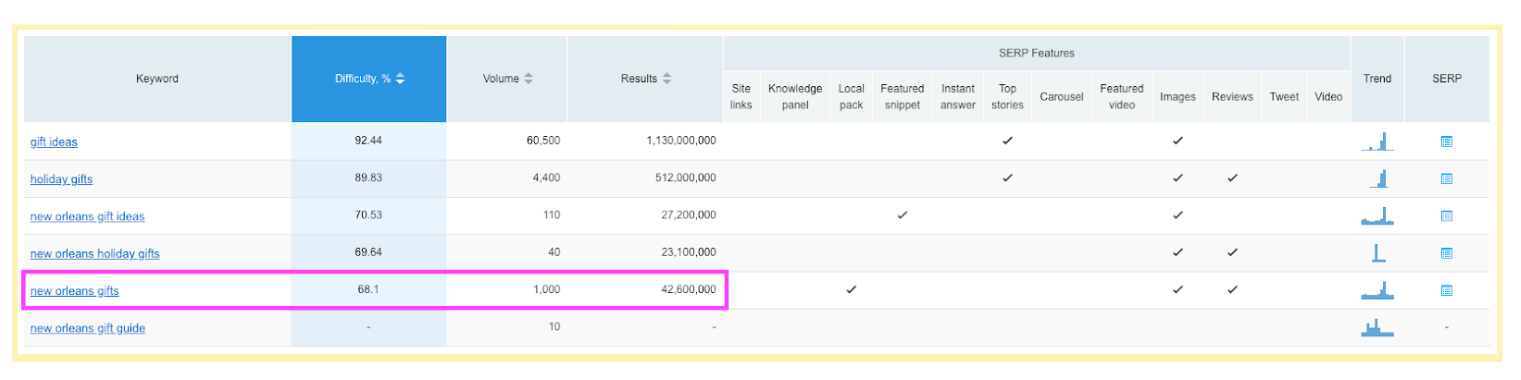
    Let’s take a look at a local t-shirt shop here in New Orleans, Dirty Coast, as an example. Dirty Coast offers a wide variety of beautiful t-shirts (and other swag) with clever, locally inspired designs. They’re one of my go-to places for that perfect gift for family members. While I may have a go-to place for New Orleans gifts, there are still about 1,000 people searching for “new orleans gifts” every month, according to a report pulled from SEMRush. Let’s take a look at how Dirty Coast can optimize their preexisting content for this year’s holiday marketing campaign.

    Make Your H1 Relevant and Competitive

    As you may or may not know, H1s are very important for SEO. You want to, ideally, have one relevant H1 on each page of your site. Dirty Coast’s 2018 Gift Guide page shows up as the 7th organic result for “New Orleans gifts”. Fleurty Girl, a local competitor of theirs, is showing up in the #1 spot, so let’s take a look at what they might be doing differently. For starters, the H1 on Fleurty Girl’s page is a little more relevant to the topic. While Dirty Coast has “THE 2018 GIFT GUIDE. GIFTS FROM NEW ORLEANS” for their H1, Fleurty Girl’s H1 is “The Best New Orleans Gifts: Your Ultimate Gift Guide From Fleurty Girl.” The topic “gift guide” actually doesn’t get much volume, so it would be a good idea to adjust the H1 to be more relevant to a topic with a higher search volume like “new orleans gifts.”

    Screenshot of an SEMrush report

    Structure Your Content

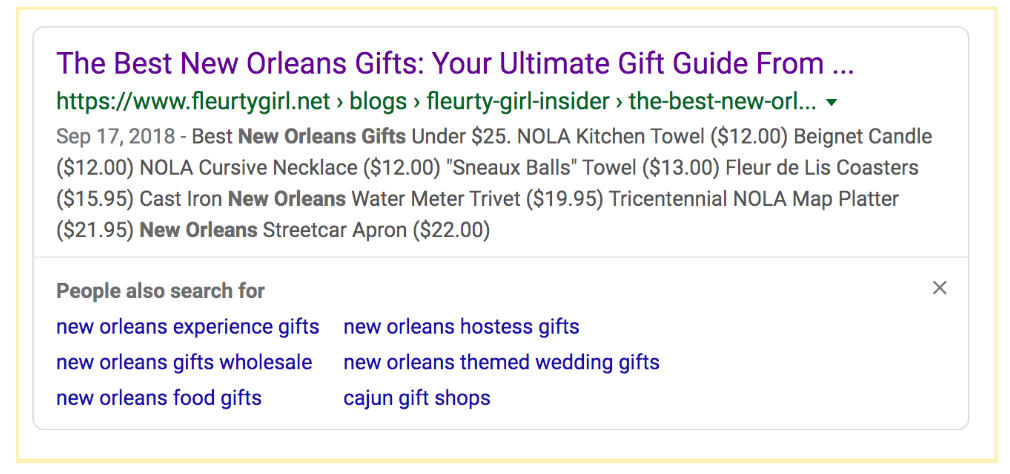
    Google loves lists. And on top of that, people like them too! As Matthew Bains discusses in this blog about Writing Tips to Create Web Content That Converts, skimming content is the new normal and bulleted lists help. Taking a look at our example, Fleurty Girl’s page has a numbered list wrapped in H2s and H3s, as well as being organized by different price points. You can see that Google is pulling this list into the description for this page.

    Screenshot of a Google search result

    While the images for each section on Dirty Coast’s site are nice to look at, Google can’t read the headers within these images. So it would actually be better to have the section headers as text wrapped in H2s on the page instead.

    Screenshot of dirty coast website showing recommended holiday gifts for customers' friends and family

    Make Your Content Relevant

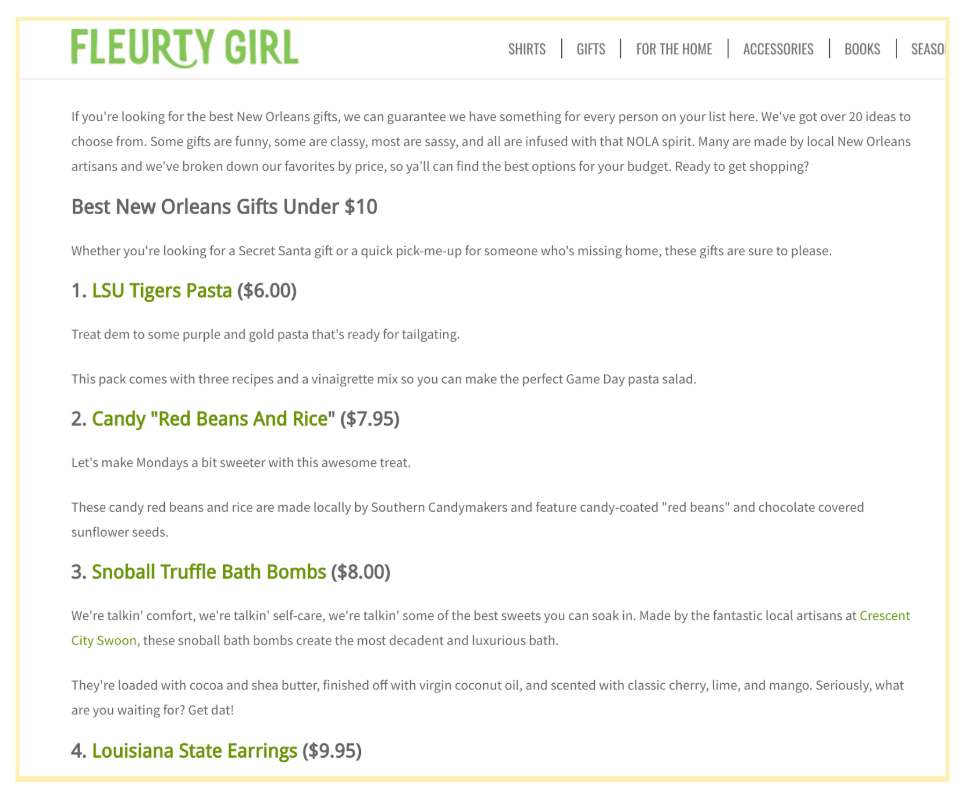
    With so little content on the Dirty Coast page, there’s not much opportunity for Google to recognize the content’s relevance to the searched term. Product descriptions can help with that. In looking at the descriptions on the Fleurty Girl blog, there were a total of 11 natural opportunities for them to bring the topic of “new orleans gifts” back up within the content on the page, which ultimately helps Google further associate that page with the search terms. Additionally, it would be nice if users were able to read more about these products, including their prices, without having to click through to the individual product pages.

    Screenshot of Fleurty Girl's website showing best New Orleans gifts under $10

    Add and Optimize Images

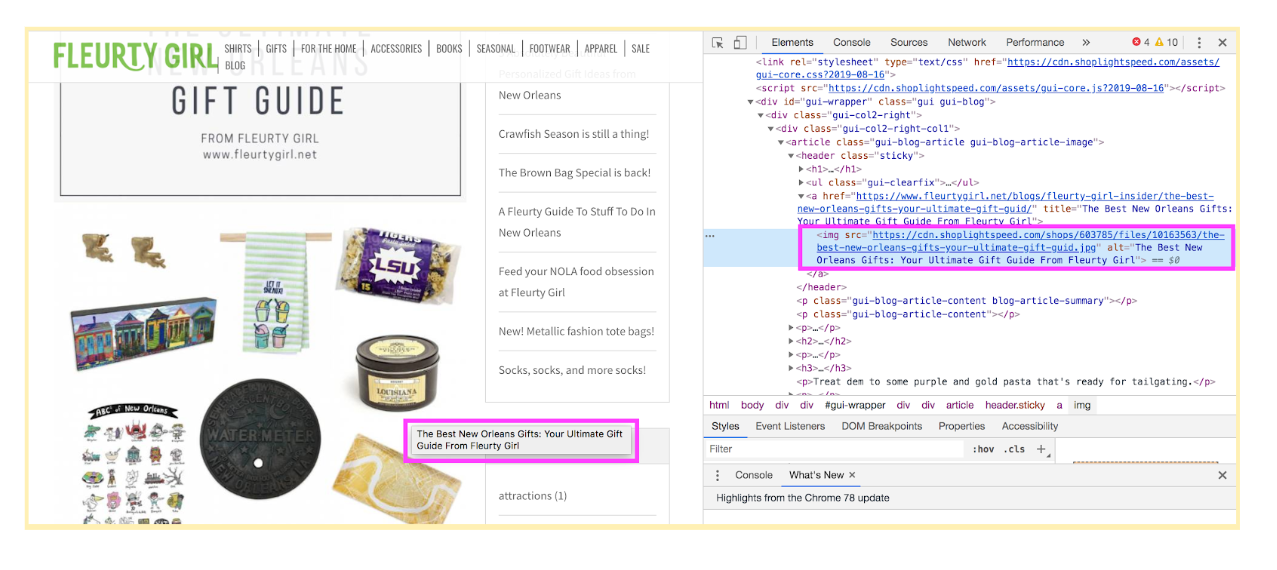
    If you don’t already have images, you should. Luckily, Dirty Coast has some, although they may want to update them along with their product lists to only include products that they’re offering this year. In addition to updating them, they’ll want to optimize their images and make sure they have title tags and descriptive alt text. (Side note: you can read more about how to optimize your images in this blog by Shane Kretzmann). Google reads the alt text and title tags to better understand which images to display in image searches. And remember, image searches can also be a great source of traffic to your site!

    Screenshot of Fleurty Girl's online gift guide and the corresponding code

    Always Include a Call to Action

    If you have an e-commerce site, you should be linking to your product pages so that users can easily make purchases. And if that’s still not enough to convert a potential customer, that additional call to action at the bottom of the page telling them to come on in and check out these holiday gifts in person is a nice, soft CTA to tie it all together.

    Need Help?

    As with most things, recommendations may vary on a case by case basis. And these are just some of the things to think about when optimizing your content. Search Influence specializes in optimizing content for a variety of marketing needs. Whether you’re preparing for the holiday season or if you’re just looking to achieve better organic results from the content that’s already on your site, we can help! Contact us today.

  • How to Be More Than Content With Your Content

    It’s not a good idea to buy everything in bulk—veggies, bread, condiments are a big no-no—and content’s no exception. Just like that 2-week-old bag of spring mix in your fridge, your content can go bad (It can even have an expiration date!) and not yield the results you expected. To drive your website’s visitors to action, you’ll need to bring something fresh to the table. If you’re currently struggling to elevate the value of your content and prevent it from getting smelly and dated, maybe you should take a closer look at your strategy (if you have one) and identify where your team is missing the mark.

    The Big Secret

    That 70s Show gif

    Quality. Over. Quantity.

    Less isn’t always more, but it’s definitely a start when it comes to an overwhelming amount of lackluster content. Creating content for the sake of having it won’t impress your audience—it may even bog them down and send them down a rabbit hole rather than your marketing funnel. However, you shouldn’t ignore the significance of great content’s impact on your organization’s overall marketing success. Content marketing is extremely cost-effective and offers a great return on investment compared to traditional marketing techniques. Major ingredients in a quality content salad include keywords, internal links, and headlines to break up text.

    Your audience turns to your content for insight, entertainment, and to inform their purchase decisions; but they don’t want to spend ALL of their time navigating your content—they have to buy something eventually, right? While you shouldn’t bury your audience with a mass production of daily blogs, social posts, and digital downloads all at once, you still gotta give the people what they want. The content production sweet spot lies somewhere in the middle; to get there, you’ll need a game plan for your team. Follow these best practices to help you develop top-notch content that gets results:

    I mean, it's simple gif from That 70s Show

    1. Know Your Audience

    Understanding your audience personas will help you stay abreast of relevant topics to cover and leverage behavior on social platforms to deliver your content to the appropriate channels. Knowing your audience really comes down to researching and understanding their pain points, learning how these problems affect them, and tracking their progression through the marketing funnel so that you can deliver the right stuff at the right time. Awareness of their stage in the buyer’s journey will help you deliver content that is both better tailored to the users you want to reach and more likely to earn you more conversions, more frequently.

    Lightbulb going off about head that 70s show

    2. Develop A Strategy

    Content serves to help your audience solve problems big and small while reinforcing the strength and uniqueness of your company’s offerings. Developing a content strategy will better help you understand the best time, place, and content type to post. When developing your content strategy, Hubspot suggests focusing on these key points: content format, channels for posting, and a system for managing the creation and publishing of your content. A CMS, or content management system, can help create and organize your digital resources and enhance the user experience. In addition, you should be on top of your editorial calendar—will that blog be outdated if you wait to post it? How useful is Tuesday’s weather forecast while you’re getting dressed for work on Thursday morning? Vary how often you publish time-sensitive content so that you don’t have to deal with the stress of constantly churning out new material.

    Alright, kitty, kitty, don't panic, you know what to do gif

    3. Set Goals

    You post content for a reason, whether it’s solving problems for users, generating leads, or increasing brand awareness. If you align the content you produce with a S.M.A.R.T. goal or one of your company’s goals, you’ll buttress your strategy with a specific purpose in mind. In turn, you’ll know what you plan to measure when the time comes to start analyzing your content’s performance. Your goals can include increasing leads by a certain percentage or even driving more social engagement. By setting goals, you’ll create a plan for your content that can be checked and adjusted.

    Floating heads gif from That 70s Show

    4. Switch It Up (And Around!)

    If you really want to ramp up your content’s impact, get creative. Within the digital space, there’s plenty of wiggle room to do just that. That awesome client testimonial on your website has the potential to be a killer case study, or you can transform it into a stellar infographic. The stories you tell don’t have to live solely on your website. You can repurpose your content so that it can be posted on multiple platforms; you can introduce your stories to new audiences without having to do more legwork. How’s that for bang for your buck?

    When it comes to all of these best practices for creating awesome content, Search Influence has it down to a science. We have the tools and expertise to help you optimize your content’s potential, whether you aim to strengthen your social media presence or paint a better picture of your content’s performance with analytics. Share your goals with us, and we’ll help you get there.

    Images

    One

    Two

    Three

    Four

    Five

    Six

    Seven

  • Applying Stephen King’s Writing Tips to Create Web Content That Converts

    All great ideas start with words—maybe even just an utterance. “What if… let’s try…” There’s the excitement about the idea, talking about it over scribbled notes and endless cups of coffee, and then putting those words down on the page and getting your business plan running. Years ago, once you conceived of your brand and wanted to advertise and market your company, traditional media was the only option. And there was often a great rift between short and cheap advertising options like yellow pages listings and extensive and expensive options like TV commercials, billboards, and local print or magazine ads.

    Now, with the exception of niche industries where images alone can represent a business, website content is the dominating force for 1) convincing a visitor to your site that you can help them solve their problems, and 2) reassuring Google that you’re an authoritative source in your industry. However, not all writing is transferable across different mediums. Sprawling lines from Faulkner would be lost on visitors to websites, and similarly, website content would make a horrible novel. But, we can still take some inspiration and writing advice from one of the most prolific and spooky writers of our time, Stephen King. Here’s an essential checklist for writing website content, alongside some quotes from the horror bard’s technical writing opus, On Writing.

    Know Your Audience

    “The scariest moment is always just before you start. After that, things can only get better.”

    Shawshank redemption gif

    It’s daunting to start a website from scratch, but that’s the perfect time to draft buyer personas before writing any copy. Buyer personas serve as a representation of a business’ ideal customer. They should be based on existing and prospective customer data, such as demographics and psychographics. Explore your ideal customer’s pain points, preferences, shopping habits, demographic information, etc. Once you’ve figured out who your ideal buyer is, you’ll be closer to understanding your brand’s tone. Is it more professional and reassuring, or playful and creative? Whatever you land on, the objective will be the same—welcome the reader with inviting copy, earn their trust by assuring them of your expertise and authority, and move them toward a sale with focused language that’s action-oriented.

    All the best copy in the world won’t help if your audience can’t find your website. Think about how your audience might be searching for you on Google. What questions do you hear from clients or patients? Gather these common questions before even starting to draft your copy, and think about how you can answer them. You should also do keyword research on how users are searching for your company and similar competitors. If you’ve never performed keyword research, Moz has a great breakdown with strategies and online tool suggestions. Once you’ve recognized trends in search terms, try to fit those terms into your copy naturally (bonus points if you can work them into your H1s and H2s).

    • Understand your customers’ worries
    • Establish buyer personas
    • Find your appropriate tone
    • Do your research

    Keep It Simple

    “One of the really bad things you can do to your writing is to dress up the vocabulary, looking for long words because you’re maybe a little bit ashamed of your short ones.”

    Gif from the movie "Misery"

    There’s a time and place for long, drawn-out sentences. For websites, follow King’s advice and keep it simple. Think short sentences (below 20 words) and short paragraphs (around five lines). Research suggests “the new norm is skimming.” One great way to help out the skimmers of the world? Bullet points and lots of H2s. Put some of your unique selling propositions (USPs) as bullet points. That way, if someone is skimming, they’ll catch your most marketable features. Large H2s with USPs also help deliver valuable info in a short amount of time and space. Considering the average user’s attention span is now eight seconds, the more skimmable, the better.

    Also, a quick note about jargon—it’s best to avoid it. While you might think it shows off your expertise, it will more than likely come off as exclusive and confusing. Odds are, someone visiting your site doesn’t know as much about your business or industry as you do; don’t constantly remind them of that by throwing around obtuse industry phrases and abbreviations. It’s all about connecting and building trust. The best way to achieve this is by sticking with the brand voice that you established from your target research.

    • Short sentences. Short paragraphs.
    • Use bullets when possible
    • Avoid jargon
    • Make it accessible

    Avoid Filler and Fluff

    “I believe the road to hell is paved with adverbs, and I will shout it from the rooftops. To put it another way, they’re like dandelions. If you have one on your lawn, it looks pretty and unique. If you fail to root it out, however, you find five the next day… fifty the day after that… and then, my brothers and sisters, your lawn is totally, completely, and profligately covered with dandelions. By then you see them for the weeds they really are, but by then it’s—GASP!!—too late.”

    Mouse pushing spool in the film The Green Mile

    King does an interesting job here of showing how not to use filler and fluff language by… using filler and fluff. “Totally, completely, and profligately.” We get it. It’s a bit much. So what exactly are filler and fluff?

    Filler language uses too many words to describe something when fewer will do. It can also be generic terms that don’t add value to your sentences. Think, I need to finish this term paper so I’ll keep adding some sentences that don’t really say much and hope the professor doesn’t notice, kind of sentences.

    Fluff language comes down to vocabulary, or, often, a writer’s love for a thesaurus. The goal is genuine, but the result is copy that ends up wasting the reader’s time. When going over first drafts of your website copy, comb through every sentence and ask yourself, “Is this adding value?”

    • When in doubt, cut, cut, cut
    • Watch out for unnecessary adverbs and adjectives

    Develop a Brand Lexicon

    “Amateurs sit and wait for inspiration, the rest of us just get up and go to work.”

    Typewriter scrolling from the movie The Shining

    So you’ve done keyword research to understand what people are searching and to what degree. You’ve created buyer personas. The next step should be to develop a brand lexicon with your team. How will you refer to your customers? As clients, patients, buyers? How do you refer to your team? Staff, crew, talent, personnel, employees? How do you talk about your services or products? Finalize your choices and make it consistent throughout your entire website. Once you’ve got a list going, make it accessible for your writers and editors, either in a digital or print format.

    This isn’t to say you shouldn’t have a variety of language in your writing. Mix up the way you write about your company and services. We don’t talk to each other in narrow language scopes. When we talk about a wedding, we don’t just mention repetitions of basic services that could be common keywords (weddings, wedding services, wedding DJ). We bring up the flower arrangements, lighting, cake, bridesmaid dresses, centerpieces, dance floor, photo booth, signature cocktails, first dance, flower girl, ring bearer. It’s this variety of language that sends positive SEO signals to Google. You’re not writing to a keyword (something Google hates). You’re writing to the experience.

    • Draft a lexicon that pairs with your brand’s tone, and stick to it
    • Use varying language, not just keywords

    Trust Your Editing Team

    “Write with the door closed, rewrite with the door open.”

    You're going to be a writer someday, Gordie from Stand By Me

    There’s almost always a team of support to make sure your website content is just right. For the first draft, don’t worry too much about hitting every mark. Get the important information down first, and then go back and revise. While writing is for exploring, editing should be for fine-tuning. When editing, get collaborative and make sure multiple team members oversee the drafts. There are often subtle details that even the keenest eye will overlook when editing alone.

    You may also find that there are just too many words at first. You wanted to make sure every.single.awesome.detail. about your company was included and, as a result, went a little overboard. That’s okay. It’s always easier to cut down than to try to beef up your sentences with additional information. The latter often leads to filler and fluff anyways, and you should know that’s a no-no at this point.

    • Set up a team dedicated to editing
    • Don’t be afraid to revise, revise, revise

    Finish Strong

    “Description begins in the writer’s imagination, but should finish in the reader’s.”

    Its the most important part of the story, the ending from Secret Window

    Hopefully, at this point you’ve started to write some copy. Hurray! But, are you making sure you’re giving your readers an actionable “next step” in their buyer’s journey? Focus on getting closer to a natural call to action at the end of your copy. You can start off more broad by talking about what you offer customers, but by the time you’re reaching the bottom of your copy, the focus should be heavily on the reader.

    One quick trick you can use while editing—search for how many times you’re referencing your business in the collective first person, e.g., we can better help… our team is skilled… we, we, we. If there’s a lot of them, then get the hypothetical red pen out and start marking. Make it more about who you’re talking to. What do they get from working with you? How will their frustrations be solved? Start with your capabilities and expertise, but end with the reader taking action into their own hands.

    • End with a natural call to action
    • Focus on the user

    Above all, good website content comes from authors that know their brand inside and out. You’ve got your elevator pitch down, and you can talk comfortably at networking events about what puts your business above the competition. This authenticity and confidence in your brand will shine in your writing. It’s about making a connection in a short amount of time, recognizing the worries of your readers, and assuring them their goals can be met by working with you. So don’t rush it—get to know your brand, do some research, plan accordingly, keep it simple, and focus on the end-user.

    Feel like you could use some assistance with your website content? The content marketing team at Search Influence can develop a content strategy that helps get the right visitors to your site at the right time. Reach out to our team at any time to get started.

    Images

    Misery

    The Shining

    Stand By Me

  • How Repurposing Your Content Can Extend Its Shelf Life

    You may have noticed the recent box office trend of classic movies coming out again as modern remakes. From fairy tale retellings to musical biopics, some fans are excited to see their favorite characters come back to life, while other viewers might wonder why these stories are being repeated. Clearly, there’s a value in repurposing well-known content—based on the success of these movies—and it’s a value that businesses can borrow and put to use in their content marketing.

    Scene from the 2019 version of The Lion King

    What Does Repurposing Mean, Anyway?

    When you see the word “repurpose,” you might be thinking of “revamping,” but there’s a very important difference between the two. Revamping is simply reusing old content for the same purpose that it was originally created. This tactic updates the timestamp on the content so it stays relevant, but it isn’t changing anything that would allow it to resonate with new audiences. Repurposing content means changing the format the content was originally presented, thereby reaching new audiences and enabling company growth.

    To repurpose content, you wouldn’t simply repost an old Facebook photo or retweet an old stat; you have to be adding new value to the original. The real advantage of repurposing comes when you’re able to reach new customers in previously untouched segments for your business. Think about all the recent Marvel blockbusters. These superhero movies have created a massive base of fans, many of whom might not have read the comics but still enjoy watching the movies. Turning a classic comic into a big-screen action flick is a great example of how Marvel was able to repurpose their storylines into a different style of content and gain new, loyal customers.

    I understand that reference

    Which Content Is Worth Repurposing?

    The effort of repurposing should only be used on your best performing content; after all, not every Avenger made the cut from page to screen. Because repurposing will breathe new life into your existing content, you don’t want to use something that’s too dated or low-quality.

    How can you tell which pieces of content are the best? Look for what Buffer classifies as evergreen content, or content that is both timeless and high-quality. When your content isn’t dependent on a certain timeframe—things like limited deals or promotions—you can feel confident that it will remain relevant no matter when you repurpose. And if you know your content is high-quality, then you also know it will continue to get traffic. Analytics and lead tracking are great ways to find out how your customers interact with your site and what your strongest marketing efforts are.

    How Can I Repurpose My Content?

    Once you know which content of yours performs the best, it’s time to get creative and get your content in front of some new eyes. Four easy ways to start repurposing include:

      • Create an Infographic: Chances are, your business already has some pretty impressive statistics. But what’s the point of all those numbers if nobody knows them? Infographics help customers process data visually and are an easy way to turn lots of text into an image that’s more shareable on social media.
      • “Roundup” Blog Posts: An easy way to fill out a blog is with a repeating “roundup” post that compiles all your top hits at the end of every week or month. These not only create a place for customers to quickly find your best content, but it can also encourage regular visitors to read something they might have otherwise missed.
      • Turn Testimonials Into Case Studies: Case studies let you share your own successes from the perspective of your client. This information is valuable to potential customers who want to know how you were able to help people like them, and a well-written case study gives your current client the benefit of being promoted.
      • Turn Blog Posts Into Videos or Podcasts: Customers might love your regular posts, but when your content is only available in a readable form, it means you’re competing with other tasks in their day. By utilizing videos or podcasts, regular readers have more ways to enjoy your content, and it might even draw in new listeners who only have time for audio.

    The ideas don’t have to stop there. With just a little brainstorming, you can come up with plenty of other ways to repurpose content.

    Winnie The Pooh trying to think

    Does Repurposing Content Even Work?

    While a solid piece of work should be able to stand on its own, repurposing content gives you the ability to bring new life to something old and put it in front of a brand-new audience. While you might remember the original Disney animated classic of a recent remake, think of how many young viewers will experience the new version as their first movie-going experience. And, more importantly, how many will become lifelong fans after that.

    Repurposing content meets some very important business needs, too. Marketer Neil Patel’s recommendation of “write less… promote more” allows companies to save time in their creation process while still getting their name out there. Repurposing content allows you to do less work while actually gaining more rewards.

    From those classic movie remakes to sitcom spinoff series to covers of songs that become more popular than the original, everyone has been exposed to repurposed content in some form or another. As Mark Twain said, “there is no such thing as a new idea,” but one good idea can inspire countless more. By keeping all your great content to yourself or leaving old blog posts to get dusty on the metaphorical shelves of your website, you’ll never know how many great ideas it could spawn.

    Starting with quality content is the best way to create new ideas you’ll want to repurpose again and again. From SEO services to social media management, Search Influence knows how to help businesses develop that content. Let’s chat about how we can help you.

    Images

    Lion King

    Reference

    Pooh

    Spongerobert


  • How User-Generated Content and Engagement Can Help Boost Your SEO

    As we continue moving toward an increasingly digital world, the importance of user-generated content, and the engagement that it produces, is becoming more prevalent in the realm of SEO. What users say about your brand, and how often, can have a real impact on your online visibility. How you promote, engage, and moderate this content is equally important. Below, we’ll look at the good and the bad while also finding ways to use this sort of content to the benefit of your business.

    So What Is User-Generated Content?

    User-generated content (UGC) is as straightforward as it sounds—any content that is created by a user and shared on an online platform. This content can include reviews, testimonials, images, and comments that are shared on platforms such as social media, blogs, or internet forums. Think product reviews on YouTube or reviews of a restaurant on Yelp. Additionally, this type of content can also be shared directly on your business’s website (we’ll go into that more later).

    Eric Cartman walking down the halls in a Yelp Critic shirt

    What Are the Benefits of UGC?

    The most obvious benefit of UGC is the publicity of your brand, products, and/or services. But what does this mean in terms of SEO? For starters, it provides more information and context for search crawlers. Search engines can provide a user with results from both your website and other platforms that mention your brand. For example, a Twitter user’s tweet praising a good experience with your company’s customer service could show up on search engine result pages (SERPS). More content means more opportunities for search engines to find your brand and provide that information to users.

    As mentioned earlier, user-generated content doesn’t have to come from outside sources. There are ample opportunities to obtain UGC directly from your website. In a Reddit AMA last year, Google’s own John Mueller suggested that allowing users to make comments (say, for instance, on your website’s blog entries) is one way of getting more content onto your website. Allowing users to make comments and engage in a discussion will give crawlers more content to consume, thus providing them with more context. Want to share positive feedback from some of your customers or clients? Consider adding a testimonials section to your website that highlights this feedback to impress other potential customers.

    Woman at computer approves and thinks this user generated content is legit

    Another benefit of user-generated content is that it brings authenticity to a brand. According to Stackla, 90% of consumers (a 4% increase in just two years!) believe authenticity to be an important factor when deciding which brands to support, while 61% of marketers say this is what makes content marketing most effective. Authenticity is what drives and encourages engagement from potential customers. Users are 28% more likely to engage when given UGC such as product videos and official brand authorized content. If users are engaged, this will result in more time spent on a site and a higher likelihood that this will result in conversions.

    Are There Any Downsides to UGC?

    Unfortunately, there is a glaring disadvantage to user-generated content if it’s not handled appropriately: People won’t always give your business glowing reviews. We’ve all seen scathing Yelp reviews or tweets go viral. Are they always warranted? Not necessarily, but search engines don’t know that, and they sure don’t discriminate. Just as positive content about your business can give you an advantage in SEO, conversely, negative content can result in poor SEO performance. You may not always be able to do away with the critics, but there are certainly ways to help combat that type of content.

    How to Manage UGC

    So what can you due to limit or control this sort of content? One of the easiest and most obvious ways is to hire someone with the knowledge and know-how to manage it for you. Keeping up with and finding ways to control user-generated content can be incredibly time-consuming, so giving that responsibility to experienced professionals will not only save you time but will also ensure that it’s done in a thoughtful and SEO-friendly way. Finding ways to incorporate user-generated content on your website is one of the easiest ways of managing content since it gives you complete control over the type of content that is shown. Allowing users to submit review videos to your site or to offer a testimonial of their experience are just two ways to get more authentic content onto your site.

    It’s important to keep in mind that user-generated content will happen whether you like it or not. How you choose to handle it is a critical decision for a successful, sustainable business. There are plenty of services available for your business to utilize to achieve the online success you desire. Ready to get started? Contact our team today to see how we can help grow your business.

    Images

    Ilya Pavlov on Unsplash

    Cartman

    Legit

  • How to Develop a Strong Content Strategy

    Notepad with words content marketing concept and glasses

    You’ve heard it time and time again, “Creating a strong content marketing strategy is essential.” Is it really that important? Well, according to the Content Marketing Institute, content marketing produces three times as many leads as outbound marketing yet costs about 62 percent less.

    You might still be wondering, what goes into creating a content marketing strategy? Is all of this planning really necessary? While it might seem like something you can just do on a day-by-day basis, building a strategy helps you work more efficiently because you and your team will have already decided how to handle potential issues. But because there are many elements to putting together a successful marketing plan, we’ll walk through some of the most important ones.

    Define Your Goals and Set Your KPIs

    What are you hoping to achieve? You might be looking to get more traffic, position your company as an expert in the industry, increase revenue, improve your search engine rankings, or increase brand awareness. Hone in on what’s most important to your business and clearly define your goals. Set yourself up for success by making your goals S.M.A.R.T. When doing so, make sure your goals are measurable and decide which KPIs (Key Performance Indicators) make the most sense for tracking your campaign’s success. And remember, not every metric is a KPI.

    Know Your Audience and Solve Their Problems

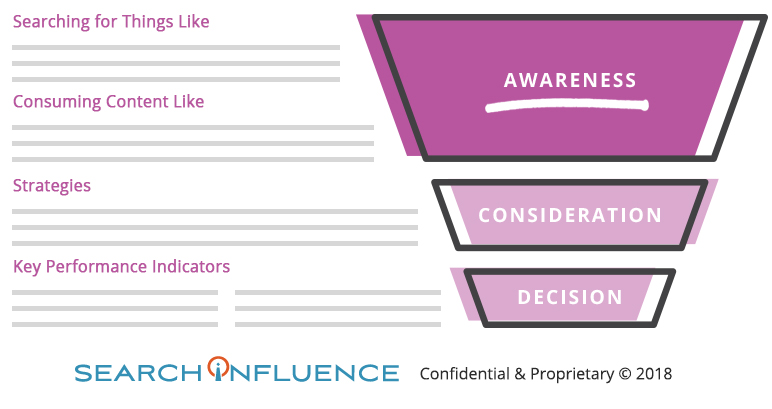
    How will your content help your customers? Your product or service exists and matters because it solves a problem for someone somewhere. Ideally, it should solve a variety of problems for many types of people. An effective content strategy addresses the appropriate audiences by using a variety of content types and educates your audience while they look for information about their problems. But not everyone is at the same stage in their problem-solving quest. Some might still be understanding their problems while others are out there looking for solutions. Keep the marketing funnel in mind as you build out your content strategy.

    Content strategy with words awareness, consideration, decision

    Decide on Publication Platforms and Content Types

    How do you reach your audience? As you work through the process of understanding your audience, you’ll get a better feeling for where they spend their time. First, focus on covering the essentials on your website and blog, and then consider opportunities to broadcast your content beyond that. Make sure your site covers everything that your audience needs to know about your company, its products and services, and what sets you apart. Use your blog to demonstrate your expertise in your niche and maybe even use this as an opportunity to build out other content types that can be shared elsewhere or repurposed into different formats (like infographics and videos).

    Create a Content Calendar

    When do you post what? Now that you know what you want to create, you need to think about how to execute your plan. Creating a content calendar makes it easier to stay focused, keep everything organized, and be productive. You can start with just one month of content in the beginning, but you’ll want to continue building it out in advance and take note of seasonal events, holidays, and other dates that might help you create timely, relevant content further down the road. Take a look at the content types you’ve decided on and then lay out your content strategy, keeping in mind the best times to post and how often to do so. Note any evergreen topics that are relevant throughout the year. They can help you fill in current gaps in your content or provide some flexibility in a time crunch.

    Distribute Your Content and Measure the Results

    What does success look like? It’s finally time to see how successful your strategy has been. To do so, you’ll want to refer back to the KPIs you set and see if you’ve hit your targets. Be sure to think about what’s changed in your industry. Were there any special events or seasonality that might have caused spikes or lowered performance? Be sure to look at your results month-to-month and year-over-year. Monitor your progress and make adjustments at regular intervals.

    Does all of this sound like too much? Creating an effective content marketing strategy can be challenging and stressful, but Search Influence can help! Our content marketing experts know how to research, plan, and execute the goals that are most important to you. If you’re looking to get support on building a content marketing strategy or if you would like a consultation while creating one internally, we’ve got you covered. Speak with one of our strategists today at (504) 208-3900 or fill out this form to request a marketing analysis and proposal.


  • Four Steps to Improve Your Content Marketing Strategy

    How much content have you consumed today? Probably more than you realize. The American Marketing Association estimates that the average consumer is exposed to upwards of 10,000 brand messages a day. As consumers, we have no shortage of options for anything our hearts desire, from where to get our teeth cleaned to who we call when the A/C breaks. And as marketers, we have no shortage of ways to reach those consumers. With these four steps, you can evaluate and enhance your content marketing strategy to help stop the endless scroll and capture the eyes of your target audience. Take note and let’s make this one piece of content worth your consumption today.

    A person scanning content on a website at Search Influence in New Orleans, LA

    Evaluate your Current Content Strategy

    According to Content Marketing Institute’s 2018 benchmark report, 38 percent of B2B marketers say they have a content strategy, but they don’t actually have it documented anywhere. If you don’t write down your plan, do you really have a plan at all? Whether it is lack of time or lack of people, many businesses understand the value of content marketing but don’t have the capacity to fully implement a fleshed-out strategy.

    By performing an audit of your current content strategies, you can document your successes and areas of opportunity, determine the key metrics that align with your business goals, and get your whole team on board with a plan.

    A content audit should record the following details in one organized place:

    • Who is creating your content (all stakeholders/departments involved)
    • Where content is being published
    • How frequently new content is getting implemented
    • What types of content you are creating (i.e. videos, blog posts, social posts, etc.)
    • What measurable results you are achieving (i.e. page views, rankings, likes/shares, etc.)

    Once you understand the current state of your content strategy, you can then set goals moving forward. Your content marketing goals should align with overarching company goals, and they should be specific, measurable, attainable, relevant, and time-bound (S.M.A.R.T). For more tips on how to set goals for your marketing strategy, check out our recent blog about S.M.A.R.T. goals.

    Woo the Right Audience

    When optimizing your content strategy, it’s important to not only think about your company’s goals, but also to frame your content around your target audience’s goals and pain points. You’ll first want to define your audience by creating up-to-date buyer personas.

    A buyer persona is a fictional “character” that represents a focused and clearly defined target audience based on actual customer behaviors and demographic research. By gathering insights from recent customers about their motivations, concerns, and decision-making processes, you can better understand how to appeal to a similar audience and nurture the right leads. You will also want to survey stakeholders within your company who interact firsthand with your customers in order to reveal any inconsistencies and better examine how prospects are converted.

    Your persona should include details like age range, gender, income, education level, and location, as well as what platforms they use regularly, their interests and hobbies, and any barriers that prevent them from making a decision. For B2B companies, you will also want to consider the persona’s job title, industry, company size, and career goals. Put all of these factors together into one organized document that you can share with your marketing team and content creators.

    Once you build buyer personas, you will be better able to deliver consistent content to reach your audience in all stages of their journey. You can map different content types, like blog posts vs. paid ads, to different stages of their journey in order to give your content creators more guidance. For example, an awareness level blog post will likely share more general industry-specific information, while a consideration level post will weigh the pros and cons of two possible solutions to a pain point. Buyer personas allow you to create intentional, cohesive content that can help you, in time, build a community of loyal brand advocates.

    Improve the Quality of Your Content

    Gone are the days of stuffing in your keywords to optimize content or sneaking in internal links to your product pages without the proper context. It may seem obvious that everyone wants to create quality content, but what does that actually look like these days?

    Stephen Colbert tapping on his watch

    Well, it starts by making the right first impression. And you have less than three minutes to do that. According to Harvard Business Review, the average viewing time for content is 2 minutes and 27 seconds. By optimizing your content titles and subheadings around what your prospects are actually searching for, you can answer their questions and eliminate their doubts more quickly. Skimmers can see immediately if your content is worthy of their time. Bulleted lists can also break up content, while a multimedia approach that incorporates a mix of text, video, and custom graphics can enhance engagement.

    Of course, the old adage “show don’t tell” still plays a major role in determining quality. Show the value of your services and products by featuring customer testimonials and case studies as part of your content strategy. Include any accreditations or awards naturally in your content, and promote mentions you get in local publications. Check out how we showcase our client success stories or read our testimonials at Search Influence for more ideas on how you can prove your value through firsthand accounts and reviews.

    Finally, quality is not just in the eyes of the consumer. You also have to impress the search engines. You’ll want to consider Google’s guidelines for quality, specifically the Expertise, Authoritativeness, and Trustworthiness (E-A-T) of the content. According to Google, high E-A-T content should contain factually accurate information that is sourced from accredited experts in that field.

    There are a couple of quick ways to improve your E-A-T quality right away. First, rather than publishing blogs from a generic company author, create individual authors and corresponding bios for your content creators so they can publish content in their name. Additionally, you can improve the trustworthiness of your content by citing reputable sources and accredited experts in the industry.

    Build a Distribution & Publishing Schedule

    Now that you have taken stock of your current strategy, honed in on the right audience, and improved your quality, you’re ready to share this beautiful content with the world. Remember that documented plan we talked about earlier? Time to make that a reality. Build out a schedule for publication, including the number of posts or pieces of content you will publish monthly, when they will go live, who will author them, and how they will be promoted.

    You should consider any of the following types of content to publish:

    • Website and blog content
    • Advertising on Google Ads or Bing
    • Social media posts (Facebook, Instagram, Twitter, LinkedIn, Pinterest, YouTube, etc.)
    • E-books, digital downloads, or case studies
    • Infographics or custom graphics
    • PDFs of brochures or product manuals
    • Video tutorials, product spotlights, or podcasts

    Remember to focus on the platforms that matter most to your buyer personas, and determine what metrics you will track for each platform. For a Facebook post, for example, you may want to focus on shares, while you may look at conversion rates or cost-per-click for your online advertising campaigns. Success should always tie back to your S.M.A.R.T. goals and target a specific aspect of your buyer persona’s customer journey.  

    Ultimately, content marketing is a cycle of continuous improvement. As you start out, don’t worry about trying to get your content on every possible platform. Remember that, as your library grows, it will become easier to start creating new types of content. For instance, you can turn a series of blog posts into a robust digital download, or you can break up a custom infographic into several small, focused graphics for social media.  

    Even if you start small, building and maintaining a content marketing strategy takes time and a dedicated team. At Search Influence, we aim to serve as an extension of your team by offering content marketing services built around your brand goals. From idea creation to distribution and reporting, we’ve got your back. Request a free analysis with one of our strategists today.