Category: Content Marketing

  • Will Scott Returns to SMX Online With Generative Engine Optimization Master Class

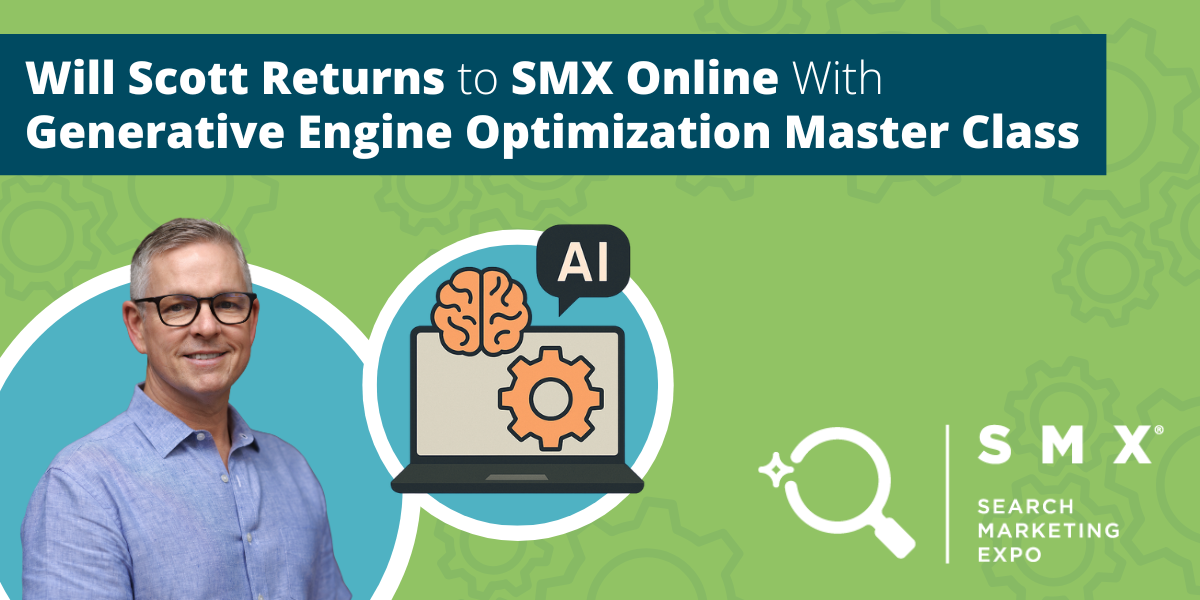
    On Tuesday, April 14, 2026, Will Scott, Co-Founder and CEO of Search Influence, returns to SMX Online to teach his Generative Engine Optimization (GEO) Master Class, the best-selling Master Class in SMX Online history.

    The live, online session runs from 11:00 a.m. to 4:45 p.m. ET and is available both live and on demand for $199.

    Designed for experienced marketers navigating AI-driven search, this intensive training delivers actionable, real-world strategies on how to stay visible as platforms like Google AI Overviews, ChatGPT, and Perplexity reshape how content is discovered.

    What You’ll Learn in the GEO Master Class

    This is not a theoretical overview of AI SEO. It’s a hands-on, tactical course that focuses on how generative engines actually retrieve, evaluate, and cite content today.

    Attendees will learn how AI platforms differ from traditional search engines and what that means for content structure, keyword strategy, and authority signals. The course dives into creating content that works for humans and machines alike, including entity optimization, formatting for AI extraction, and writing in a way that earns citations in AI-generated answers.

    Will also explores how keyword strategy has evolved in an AI-first world, shifting from static phrases to conversational, intent-driven language. Competitive analysis also plays a key role, with practical exercises that show how to evaluate which brands are winning AI visibility and why.

    Rounding out the day are sessions on measuring AI visibility, tracking performance across platforms, and future-proofing your content strategy as generative search continues to evolve.

    Who Should Attend

    The Generative Engine Optimization Master Class is built for SEO professionals, content strategists, and digital marketers with 2–5 years of experience who are ready to expand beyond traditional optimization. It’s especially valuable for agency marketers, in-house teams managing complex websites, and leaders responsible for long-term content strategy.

    If you’re already strong in SEO fundamentals but need clarity on how AI is changing rankings, visibility, and brand authority, this course is designed for you.

    Meet AI SEO Expert Will Scott

    Will Scott is a recognized authority in SEO and AI-driven content strategy and a longtime advocate for adapting marketing to how search actually works. He is widely known for coining the term “barnacle SEO” and has been a featured speaker at industry events, including PubCon, SMX, and Local U.

    Will leads the Search Influence team in delivering AI-enhanced, data-driven SEO strategies for industries such as higher education, healthcare, and hospitality. With a degree in architecture from Tulane University, he blends strategic systems thinking with practical execution, making complex concepts actionable for marketers.

    Save Your Seat

    Generative search is no longer optional knowledge. It’s the foundation of future visibility. If you want to understand how AI platforms select sources, summarize content, and decide which brands get cited, the GEO Master Class is built to give you that edge.

    Register now for the Generative Engine Optimization Master Class on April 14, 2026, and learn how to optimize for AI SEO performance.

    Get in touch for our super-secret 15% discount code.

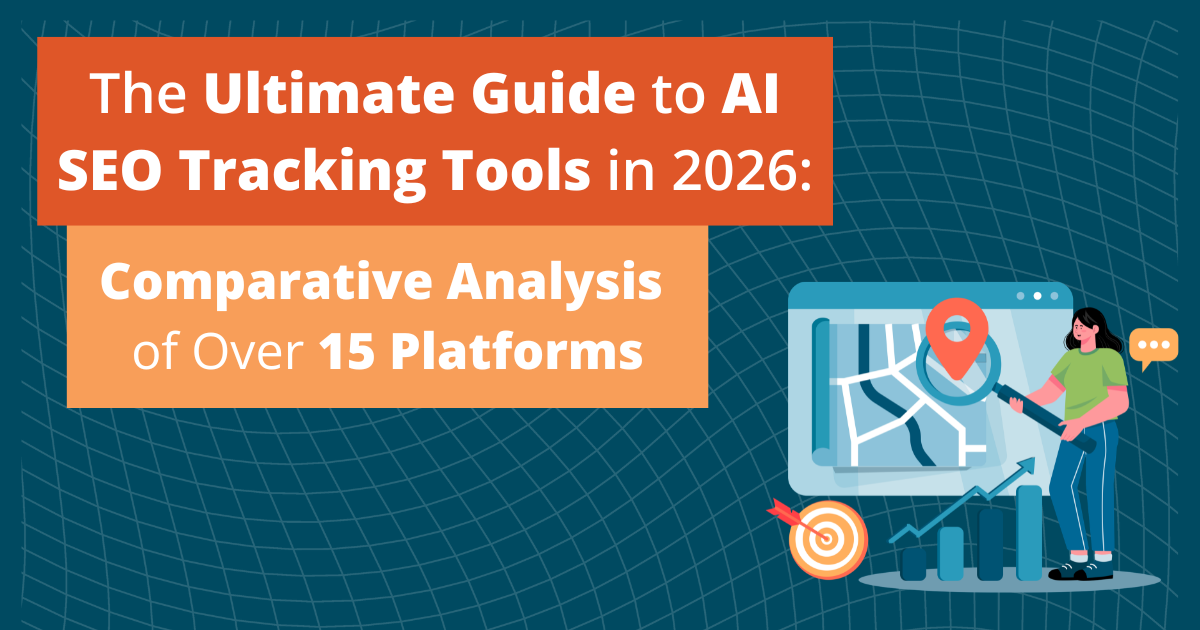
  • AI SEO Tracking Tools 2026: Comparative Analysis of Over 15 Platforms

    AI SEO Tracking Tools 2026: Comparative Analysis of Over 15 Platforms

    Co-Author: Collin Guedon
    This post was updated by Will Scott & Collin Guedon on 2/13/26 to reflect current best practices. It was originally published on 8/20/25.

    Key Insights:

    • AI search adoption is surging: With AI search nearing 1 billion users and tools like ChatGPT becoming mainstream, tracking brand visibility in AI-generated answers is now essential for SEO success.
    • Generative Engine Optimization (GEO) is the new frontier: The shift from ranking pages to providing “best answers” across platforms like Google AI Overviews, ChatGPT, Perplexity, and Gemini requires a different optimization approach.
    • AI SEO tracking tools vary widely in capabilities: From enterprise-focused solutions like Scrunch AI and Profound to budget-friendly options like RankScale and WriteSonic, pricing, platform coverage, and refresh rates differ significantly.
    • Early adoption offers a competitive edge: Brands that start monitoring AI search performance now can secure AI visibility before the market becomes oversaturated.
    • Selecting the right tool depends on business size and goals: Enterprises need robust compliance and integration features, while SMBs and agencies may prioritize affordability, speed, and content creation integration.

    The AI revolution has fundamentally changed how brands appear in search results.

    With AI search approaching 1 billion users and an estimated 27% of consumers using AI for roughly half of their internet searches, tracking AI visibility has become a core element of modern SEO strategy rather than an experimental add-on.

    As Google commits $75 billion to AI integration and ChatGPT becomes one of the most visited websites globally, organizations need a clear, trustworthy source to compare AI SEO tracking platforms.

    This guide is designed as a living resource, updated regularly with new pricing, user ratings, case studies, and product changes so readers can make decisions based on current information rather than outdated launch-era reviews.

    This analysis builds upon a September 2024 evaluation of AI SEO tracking tools presented at the SMX GEO Master Class. The current version incorporates updated data through December 2025, including findings from extended research using Claude and Gemini’s deep research capabilities.

    If you would like weekly updates on the state of AI SEO and tracking tools, subscribe to The Visibility Report, an AI-enabled newsletter from Search Influence CEO and AI SEO Expert, Will Scott.

    Methodology & Industry Context

    This guide synthesizes information from platform documentation, public pricing pages, case studies, and independent industry analyses focused specifically on AI search visibility tracking (not just AI content creation).

    Primary Research Inputs

    • Review of 25+ AI SEO tracking and monitoring tools active as of late 2025
    • Direct reference to official case studies and customer stories from tools such as Scrunch AI, Peec AI, Profound, Otterly AI, and WriteSonic
    • Publicly available funding information and usage metrics shared in company announcements and investor updates
    • Pricing verification from each tool’s published pricing page (Starter and entry-level plans where available)

    Most Notable Recent Updates as of 2/13/26

    • AirOps closed a $40M Series B round, marking a major expansion milestone for the platform and signaling growing investment momentum in AI-powered content engineering.
    • AI visibility consistency under scrutiny. New research from SparkToro highlights significant variability in AI-generated brand recommendations, even when identical prompts are used. The findings suggest that point-in-time AI visibility measurements may reflect volatility rather than durable performance signals. For teams investing heavily in AI tracking, the takeaway is to prioritize trend analysis over isolated snapshots when evaluating AI search visibility.
    • Google tests AI opt-out controls. Google is experimenting with opt-out mechanisms for AI Overviews as Gemini 3 becomes the underlying model.
    • OpenAI retires older models. OpenAI has begun deprecating GPT-4o, signaling faster iteration cycles across models.
    • OpenAI shared details on how internal agents collect, analyze, and act on data. The architecture offers early insight into how agentic search systems may evolve, with implications for how brands are discovered and evaluated beyond traditional query-response patterns.
    • AI agent link safety emerges as a concern. OpenAI outlined security considerations as AI agents increasingly browse and act on behalf of users.

    Emerging Tools Worth Noting

    • KIME is a newer platform focused on analyzing how domains appear across LLM-generated outputs. Its feature set includes domain citation tracking, competitor comparisons, and dashboards that surface how different AI models reference brand information. I’m flagging it here as part of the growing ecosystem of tools in the AI visibility space. More to come as I spend additional time looking into it.
    • LLMrefs takes a different approach to AI visibility tracking by focusing on keywords rather than individual prompts. Instead of monitoring how a brand appears for specific user-style questions, the platform tracks broader keyword-level patterns across multiple AI responses. The idea is that keyword-based monitoring may make it easier to identify general visibility trends across many related prompts, rather than analyzing each prompt individually.
    • Sembit Corp is developing an AI Search Optimization product called ZeroChannel.ai that takes a task-driven approach rather than operating as a traditional monitoring platform. Instead of focusing primarily on dashboards, ZeroChannel.ai analyzes AI search results and citations across systems such as ChatGPT and Google AI Mode/Gemini, then generates playbooks of recommended actions to improve AI visibility. The platform is currently used by roughly 20 brands, with early feedback focused on its emphasis on execution and outcomes — specifically, achieving first-mention visibility for unbranded prompts.
    • Promptwatch is an AI visibility platform focused on tracking how brands appear across prompt-level responses in systems like ChatGPT, Gemini, Claude, Perplexity, and related AI search experiences. The platform emphasizes real prompt data, citation analysis, and crawler logs to show which pages AI systems are reading and citing, alongside visibility metrics and competitor comparisons. Promptwatch also layers in optimization insights to help teams identify content gaps and prioritize where to publish to improve AI visibility. It’s positioned as a data-driven option for marketing and SEO teams that want to connect AI mentions, citations, and crawl behavior to tangible traffic and visibility trends.

    Comprehensive Comparison Matrix

    Tool Starting Price* Platforms Covered (High Level) Typical Refresh Rate G2 Rating & Reviews** Key Differentiator Best For
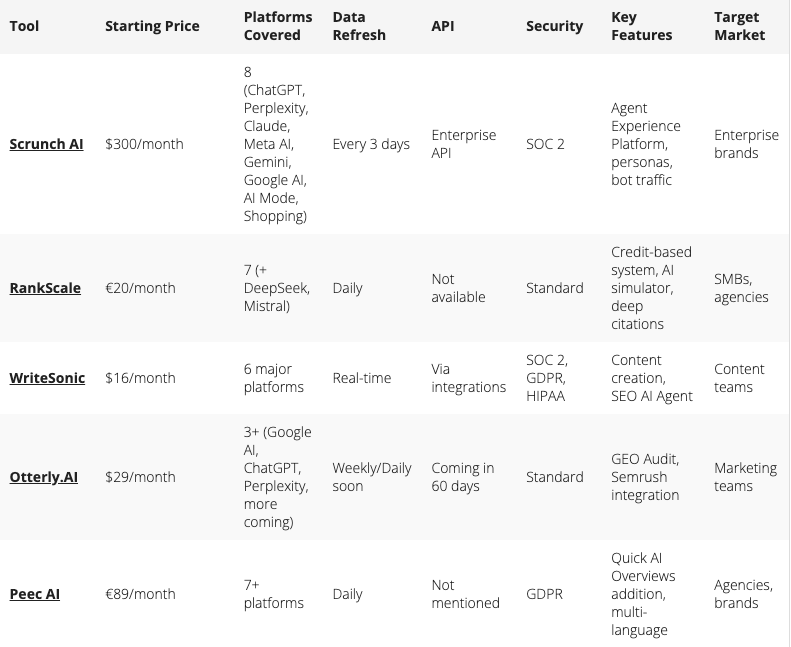
    Scrunch AI $250/month ChatGPT, Perplexity, Claude, Meta AI, Gemini, Google AI Overviews, Google AI Mode ~Every 3 days 4.7/5 (≈38 reviews) Agent Experience Platform (AXP) for machine-readable “answer-ready” content Enterprises needing compliance, governance, and multi-platform coverage
    RankScale $20/month 7+ AI search platforms, including DeepSeek and Mistral Flexible (hourly–weekly) Listed on G2, currently no public reviews Credit-based “full drill-down” analytics with persona and sentiment insights Data-driven SEOs and analysts testing AI visibility at low cost
    WriteSonic GEO $49/month Multiple major AI platforms via tracking and analytics (plus integrations across 2,500+ apps) Near real-time via Cloudflare and integrations 4.7/5 (≈5,901 reviews) Combines AI search tracking with AI content creation and SEO workflows SMBs, agencies, and teams wanting an all-in-one AI content + tracking stack
    Otterly AI $29/month Google AI Overviews, ChatGPT, Perplexity (with additional platforms like Google AI Mode, Gemini, and Microsoft Copilot planned) Weekly (with more frequent updates planned) 4.9/5 (≈37 reviews) GEO auditing and Semrush App Center integration Semrush users and agencies wanting GEO within existing workflows
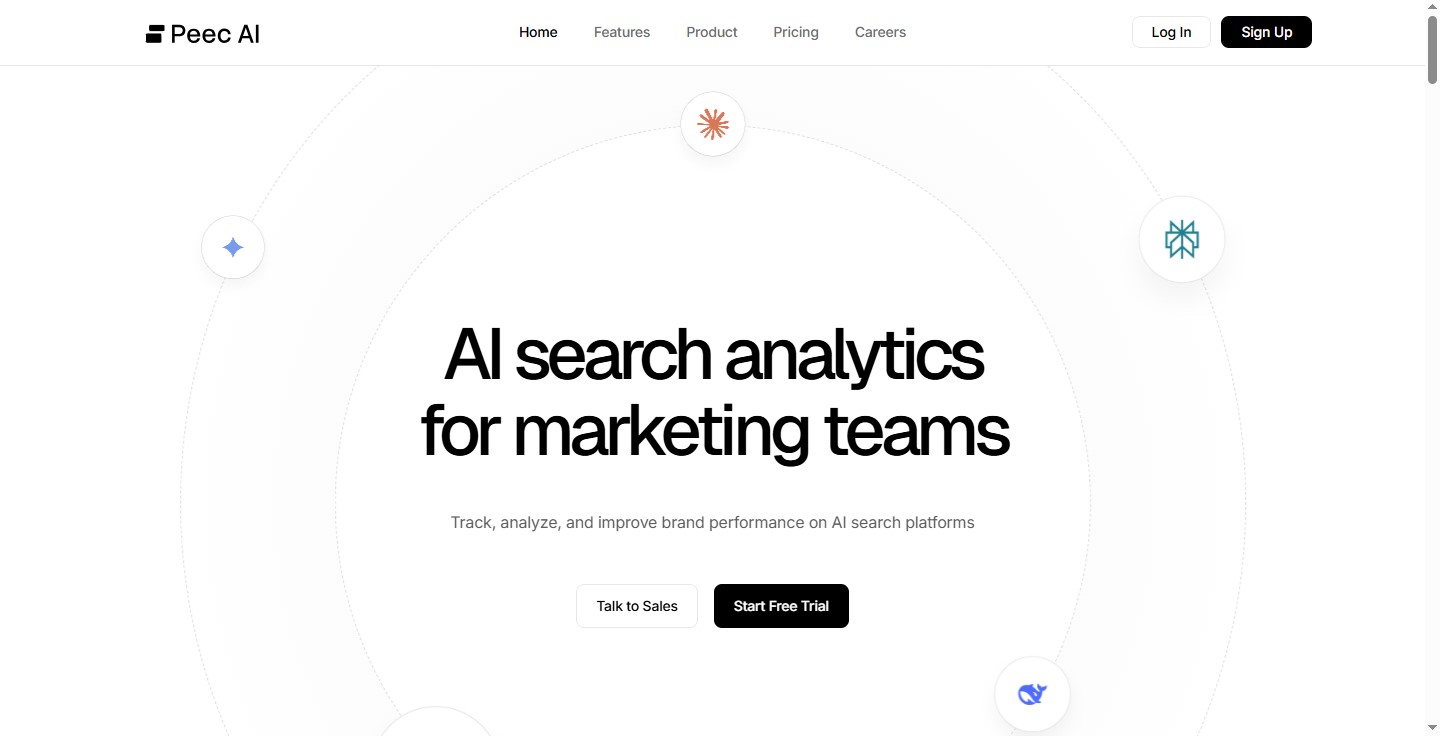
    Peec AI €89/month 7+ AI search platforms with multi-language tracking Near real-time 5.0/5 (1 review) Strong European focus, GDPR alignment, and rapid feature iteration European marketing teams and global brands needing multi-language AI visibility
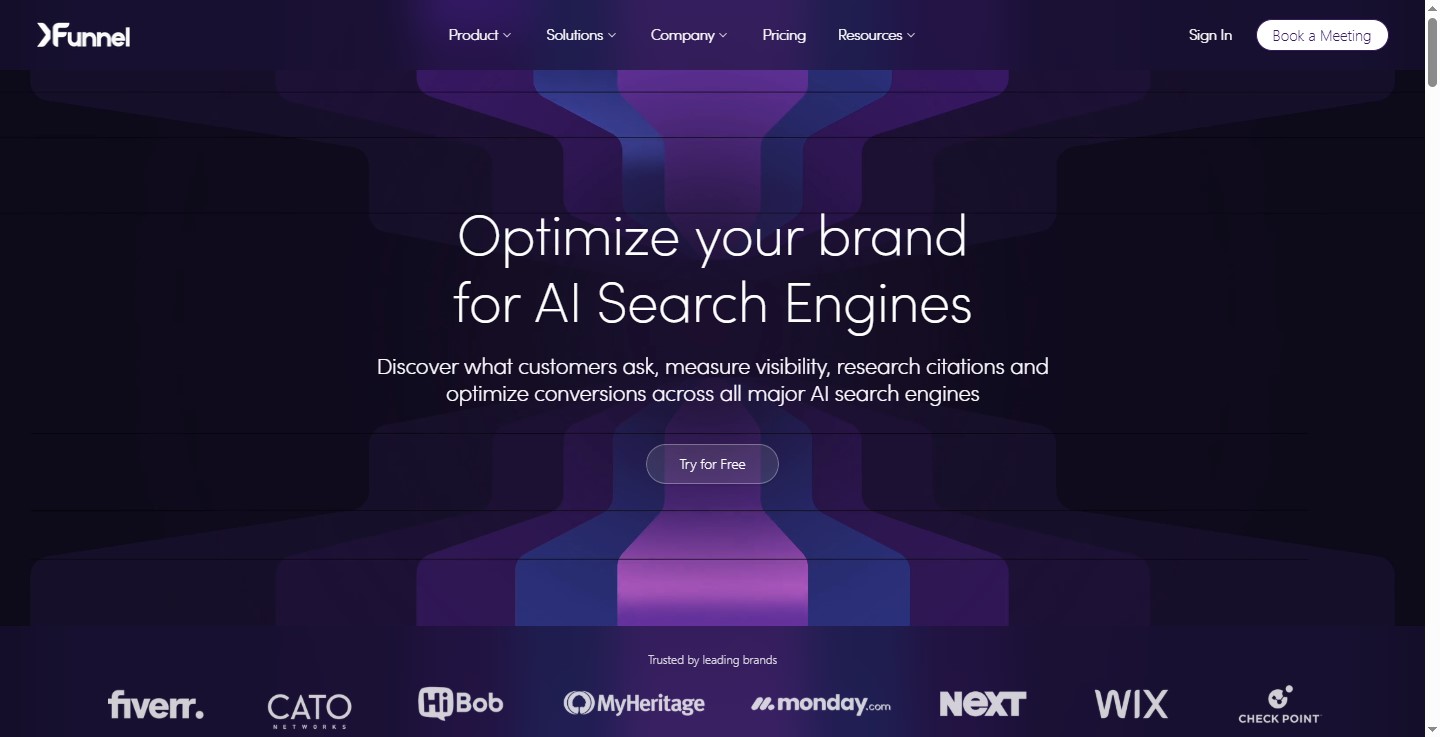
    xFunnel $197/month Custom AI search engine coverage based on client strategy Custom per engagement Listed on G2, currently no public reviews Full-service GEO: strategy, content, optimization, and experimentation Brands wanting a hands-on services partner rather than a self-serve tool
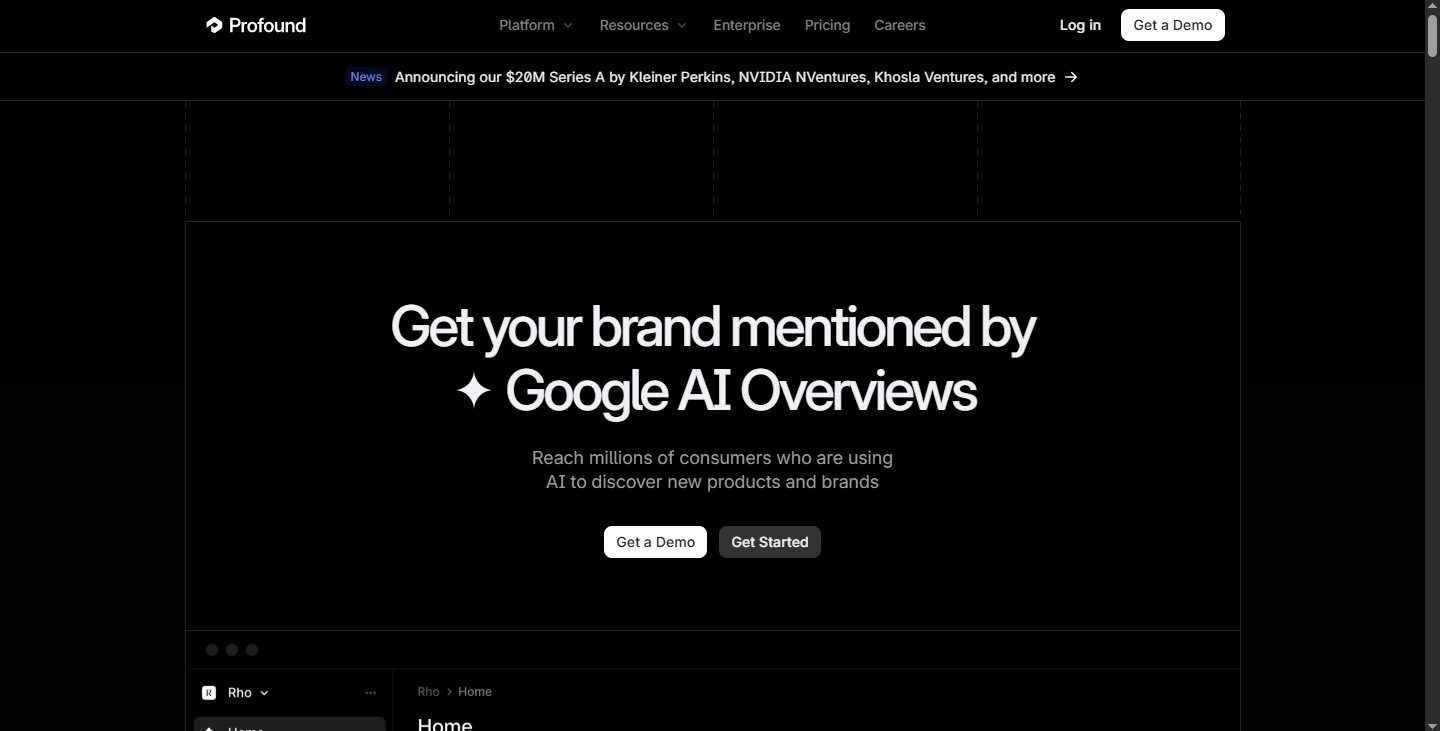
    Profound $99/month AI answer engines across 18+ countries, with multi-language coverage Typically daily 4.6/5 (≈142 reviews) Conversation Explorer for AI search “share of voice” and answer analysis Enterprise and upper mid-market brands focused on AI answer share-of-voice
    Waikay.io $69.95/month ChatGPT, Google Gemini, Claude, Perplexity On-demand, report-based Listed on G2, currently no public reviews Entity-based, knowledge-graph-driven AI Brand Score and hallucination detection Brand perception monitoring and entity-level AI analysis
    Advanced Web Ranking $99/month Google AI Overviews plus 4 additional LLMs via AI Brand Visibility features Weekly trends 4.3/5 (≈21 reviews) Deep SERP history plus AI Overviews research (e.g., pixel depth, source overlap) Teams already using AWR for traditional SEO ranking who need AI Overviews data
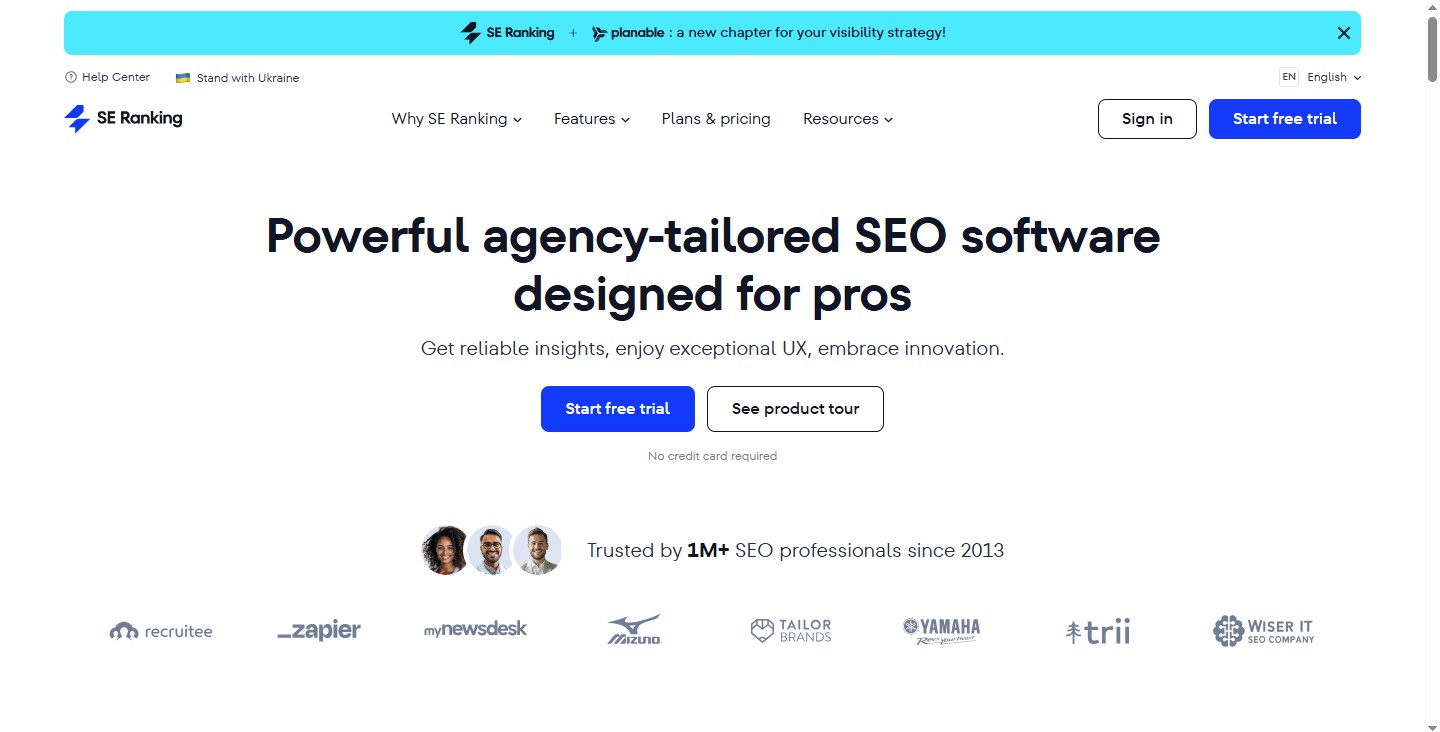
    SE Ranking $52/month Google AI Overviews, Google AI Mode, ChatGPT (additional platforms in development) Daily for tracked keywords 4.8/5 (≈1,401 reviews) Integrated SEO suite with AI search tracking and automated fixes (OTTO) All-in-one SEO + AI tracking for SMBs, agencies, and mid-market teams
    RankZero $89/month ChatGPT, Gemini, Perplexity, Claude (on request), DeepSeek (on request), Mistral (on request), xAI Grok (on request) Daily (instant fetch for new prompts) Not publicly listed on G2 Revenue-first GEO with direct AI visibility → revenue attribution and deep GA4/GSC integrations Agencies and e-commerce teams focused on revenue impact
    Rank Prompt $49/month ChatGPT, Gemini, Perplexity, Google AI Overviews Scheduled prompt runs (usage-based) 4.3/5 (early reviews) Prompt-based, multi-location AI visibility tracking with built-in content execution Franchises, multi-location brands, and agencies
    Rankshift €49/month Selectable AI models (configurable per account) Flexible (daily, weekly, or monthly) Listed on G2, currently with limited public reviews Cost-efficient, flexible prompt scheduling with unlimited users and projects Agencies and teams managing large prompt libraries
    LLM Scout $39.99/month ChatGPT, Claude, Gemini, Perplexity, Google AI Overviews Weekly reports (standard) Not publicly listed on G2; 5/5 rating (425 reviews, per company site) Buyer-intent prompt tracking with auto-generated prompts and citation-level visibility Marketing teams, SEO teams, and agencies focused on buyer-intent AI discovery and competitive visibility

    The AI SEO Tracking Market Is Exploding, and For Good Reason

    The global AI SEO software market is projected to reach $4.97 billion by 2033, up from $1.99 billion in 2024. This explosive growth reflects a fundamental shift in search behavior that demands new tracking capabilities.

    Key market drivers:

    • 75% of marketers now leverage AI to optimize their SEO workflows (WriteSonic research)
    • 82% of enterprise SEO specialists plan to increase their AI tool investments (Industry surveys)
    • 88.1% of AI Overview queries are informational, requiring answer-focused optimization (Semrush AI Overviews Study)
    • 60% of consumers now start product research with AI assistants (Profound research, 2025)
    • 47% of marketers have already implemented AI SEO tools for competitive advantage (Industry data)
    • Google’s AI Mode launched for all US users on May 20, 2025, accelerating AI adoption

    What’s driving this surge?

    Traditional SEO focused on ranking pages; AI SEO requires optimizing for direct answers across multiple AI platforms. When consumers “outsource browsing to AI,” as Scrunch AI CEO Chris Andrew puts it, brands must adapt their strategies from targeting “best pages” to providing “best answers.”

    The emergence of Generative Engine Optimization (GEO)

    This paradigm shift has created Generative Engine Optimization (GEO), a new discipline focused on optimizing content for AI systems rather than traditional search engines. Modern AI SEO tools monitor brand visibility across:

    • ChatGPT and SearchGPT
    • Google AI Overviews and AI Mode
    • Perplexity AI
    • Claude and Meta AI
    • Gemini and other emerging platforms

    A Comprehensive Look at Today’s AI SEO Tracking Landscape

    Our research identified 25+ AI SEO tracking tools currently available, ranging from purpose-built startups to established SEO platforms adding AI capabilities. The sector attracted substantial investment throughout 2024-2025, with over $77 million in collective funding during the May-August 2025 period alone, validating the market opportunity:

    • Profound: $23.5M total funding ($3.5M seed in August 2024, $20M Series A in June 2025)
    • Scrunch AI: $19M total funding ($4M seed in March 2024, $15M Series A in July 2025)
    • AirOps: $15.5M Series A (October 2024)
    • Peec AI: €7M raised in just 5 months (April-July 2025)
    • BrandLight: $5.75M Series A (April 2025)

    Each tool approaches the challenge in a different way, creating a diverse ecosystem of solutions tailored to various organizational needs.

    Tool-by-Tool Analysis: The Ten Market Leaders

    Scrunch AI: The enterprise powerhouse setting the standard

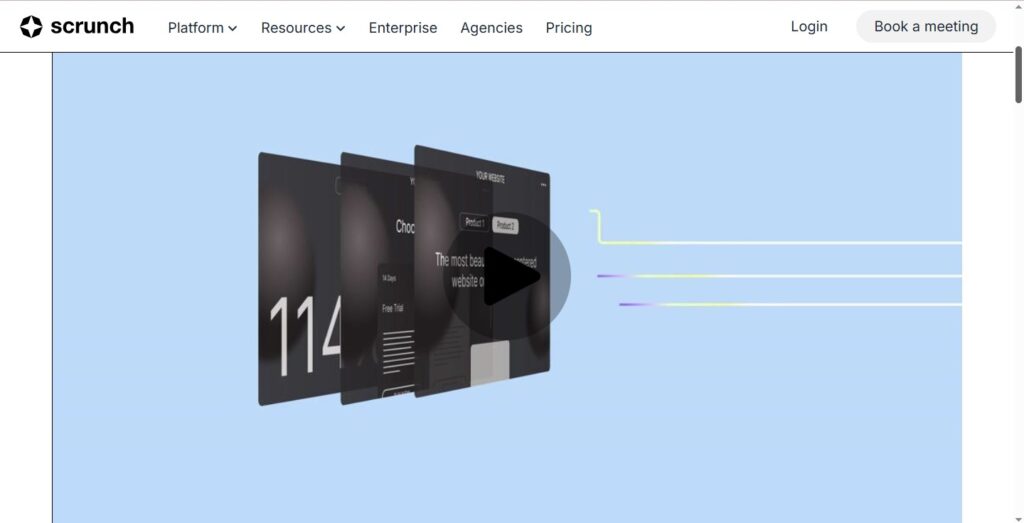
    Launched in November 2024, Scrunch AI focuses on large organizations that need structured, repeatable control over how their brands appear across AI search experiences. With $19M in total funding and a customer base of 500+ brands (including organizations such as Lenovo and Penn State University), Scrunch AI is positioned as an enterprise-oriented platform for AI search visibility.

    Key Capabilities

    • Pricing: Plans reportedly start around $250/month (Starter) and scale up for larger deployments and enterprise contracts.
    • Platform coverage: ChatGPT (including Shopping surfaces), Perplexity, Claude, Meta AI, Gemini, Google AI Overviews, Google AI Mode (as of July 2025).
    • Data refresh: Approximately every 3 days.
    • Security: SOC 2 Type II compliance with SAML/OAuth SSO support.

    Scrunch AI’s approach centers on an Agent Experience Platform (AXP) that creates machine-readable versions of content designed specifically for AI agents. Customers have reported significant improvements in AI visibility when this layer is implemented at scale.

    Additional features include:

    • Configurable personas for understanding how different audience types see the brand in AI conversations
    • Risk management dashboards that turn unknown AI behavior into managed risks
    • Bot traffic analysis through Cloudflare integrations to monitor AI crawler activity
    • Dedicated account management for enterprise clients

    User Reviews & Social Proof

    • G2 Rating: Approximately 4.7/5 based on around 38 reviews (Scrunch AI profile on G2).
    • Representative sentiment reflects ease of setup (“setup took under an hour”) and appreciation for real-time or near-real-time tracking that changes how teams monitor AI mentions.

    Recognition & Credentials

    • SOC 2 Type II–compliant infrastructure.
    • Trusted by 500+ companies, including well-known technology and education brands publicly listed on its website.

    Case Studies & Results

    A Scrunch AI case study published in July 2025 describes how Runpod used the platform to achieve roughly 4× growth in new paying customers per month within about 90 days. The case study reports metrics such as 40 new customers per day and an approximate 8% conversion rate (2,100 conversions from 28,000 visitors), illustrating how AI visibility data can be tied directly to acquisition outcomes.

    CEO Chris Andrew’s vision is clear: “90% of human traffic will go away as consumers outsource browsing to AI agents. Brands must adapt from targeting ‘best pages’ to providing ‘best answers.’”
    RankScale: Deep analytics for data-driven marketers

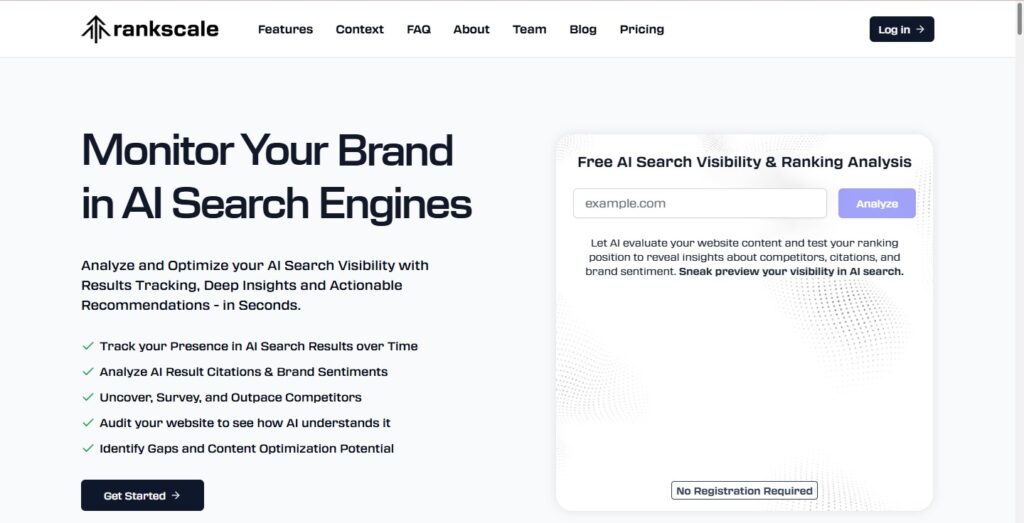
    RankScale positions itself as an analytical tool for “geeky minds,” using a flexible credit-based system that starts at about $20/month for 120 credits. This model allows teams of any size to experiment with AI search visibility while controlling costs.

    Technical Specifications

    • Platform coverage: Tracking across 7+ AI platforms, including DeepSeek and Mistral.
    • Tracking intervals: Flexible scheduling with hourly, daily, or weekly runs.
    • Key features: AI search engine simulation, citation analysis, sentiment tracking, and trend summaries.
    • Support: 24/7 live assistance for users who need configuration or interpretation support.

    The platform emphasizes simplicity and data-driven insights, providing recommendations for improvement and highlighting signals that correlate with AI visibility changes.

    User Reviews & Social Proof

    • G2 presence: RankScale is listed on G2, but as of late 2025, it shows no public reviews and therefore no aggregated star rating.
    • External technical reviews, such as coverage from Whatagraph, have noted a clean interface and robust feature set while calling for more extensive documentation around newer analysis features.

    Recognition & Credentials

    • Marketing materials describe RankScale as being built for “1000+ leading brands and agencies”, though detailed public client lists are limited and should be treated as company claims.

    Founded by Mathias Ptacek, RankScale boasts a solid feature set and is continually developing additional functionality, with a specific focus on simplicity and data-driven insights, including recommendations for improvement, trends, and signals. The platform has earned positive reviews from Whatagraph, which praised its simple interface while noting that some analysis features need better documentation.
    WriteSonic GEO: Democratizing AI SEO with integrated content creation

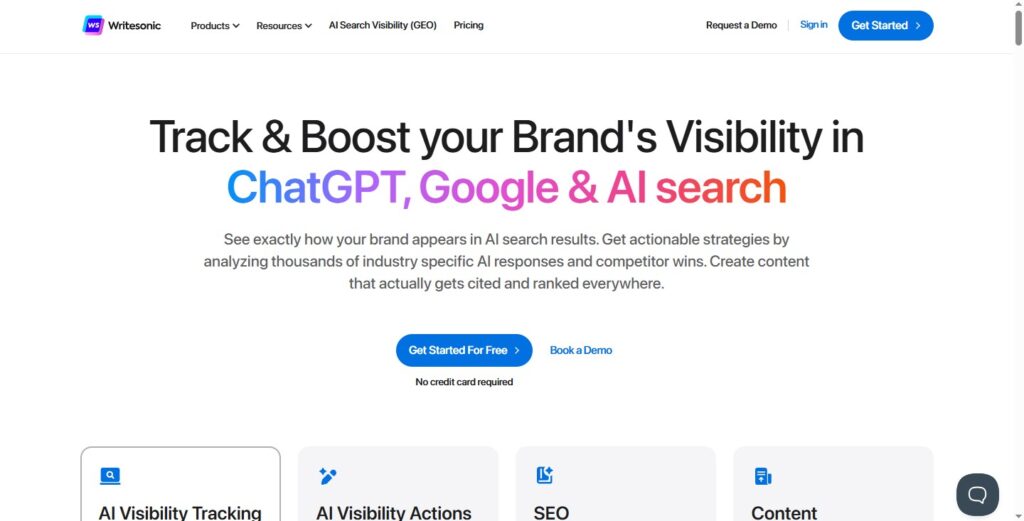
    WriteSonic GEO combines AI search visibility tracking with a mature AI content creation ecosystem. While earlier pricing referenced very low entry points, current plans show Lite tiers around $49/month, with higher-tier pricing scaling to more advanced usage and collaboration features.

    Platform Highlights

    • User base: More than 10 million users globally, according to company materials.
    • Real-time tracking: Cloudflare integration surfaces AI crawler interactions that standard analytics often miss.
    • API capabilities: Access to 2,500+ app integrations via platforms like Pipedream.
    • SEO AI Agent: Public beta launched in February 2025, designed to assist with SEO tasks across both traditional and AI search.

    The GEO layer sits inside a broader toolset the company often describes as “the Ahrefs for AI Search,” with:

    • AI Traffic Analytics to reveal AI-originated visits
    • Brand Presence Explorer tracking how frequently a brand appears in AI answers across major platforms
    • Integrated workflows for traditional SEO and AI search optimization
    • One-click publishing to WordPress and social platforms

    User Reviews & Social Proof

    • G2 Rating: Around 4.7/5 based on approximately 5,901 reviews, reflecting broad usage across marketing and content teams.
    • Representative feedback notes that the platform helps “track, benchmark, and optimize brand visibility across AI search engines,” with users citing the combined value of content creation and tracking.

    Recognition & Credentials

    • SOC 2 Type II, GDPR, and HIPAA compliance statements on the company’s materials.
    • A partnership with Microsoft focused on GenAI innovation for enterprises.
    • Website messaging indicates adoption across a broad range of companies “from Series A to Fortune 500.”

    Case Studies & Results

    A published case study describes how Biosynth scaled to roughly 5,000 weekly product descriptions using WriteSonic’s AI content generator. According to the case study, the platform became an integral part of Biosynth’s marketing toolkit for scaling scientific product descriptions.
    Otterly AI: Rapid growth through strategic integrations

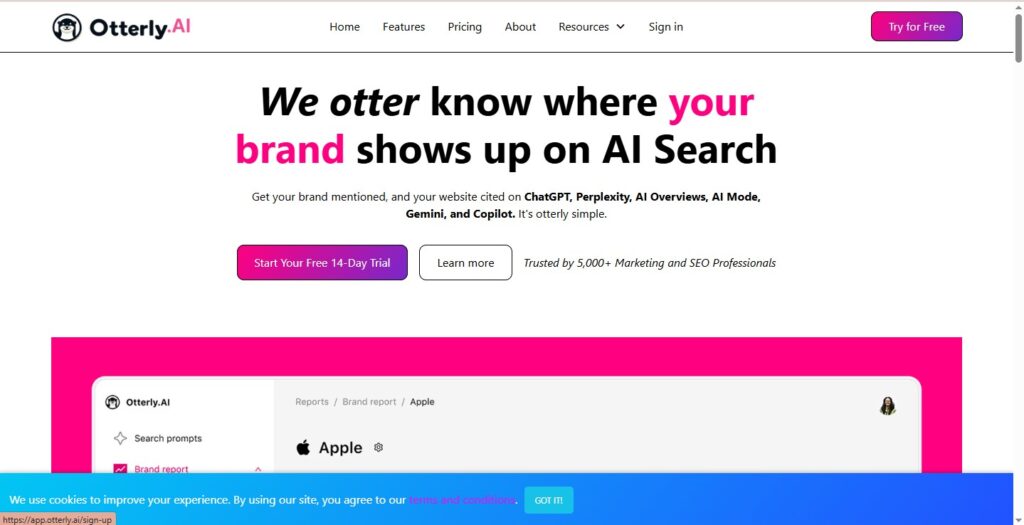
    Otterly AI emerged from stealth in December 2024 with around 1,000+ customers and has since reported growth to more than 5,000 users. Its strategy centers on integrating GEO capabilities into existing SEO workflows, particularly through the Semrush App Center.

    Key Characteristics

    • Pricing: Approximately $29–$489/month, depending on feature access and scale.
    • Differentiator: GEO Audit tool with deep integration into Semrush, enabling AI search visibility analysis alongside traditional SEO metrics.
    • Data updates: Weekly refresh cycles, with more frequent updates on the roadmap.
    • Platform coverage: Google AI Overviews, ChatGPT, Perplexity, with Google AI Mode, Gemini, and Microsoft Copilot planned.

    This bootstrapped Austrian startup plans to become “the Semrush of AI search” without external funding. As covered by TechCrunch, their integration strategy provides:

    • Familiar workflows for Semrush users
    • Single sign-on convenience
    • Real-time visibility alerts
    • Sentiment analysis capabilities

    User Reviews & Social Proof

    • G2 Rating: Around 4.9/5 based on roughly 37 reviews, suggesting strong satisfaction among early adopters.
    • Representative sentiment emphasizes the value of “knowing where your brand shows up on AI search” and the speed at which meaningful insights can be obtained.

    Recognition & Credentials

    • The company notes compliance with SOC 1, SOC 2/SSAE 16/ISAE 3402, and ISO 27001, reflecting a security posture aimed at professional and enterprise use.
    • Marketing materials indicate that 10,000+ marketing and SEO professionals rely on Otterly AI (treated as a company claim unless independently verified).

    Case Studies & Results

    An AI search experience case study describes how Bacula Enterprise achieved a #1 ranking in ChatGPT responses for “best HPC backup software” using Otterly AI’s GEO capabilities (June 2025). This example illustrates how targeted GEO work can reshape answer rankings for highly specific B2B queries.
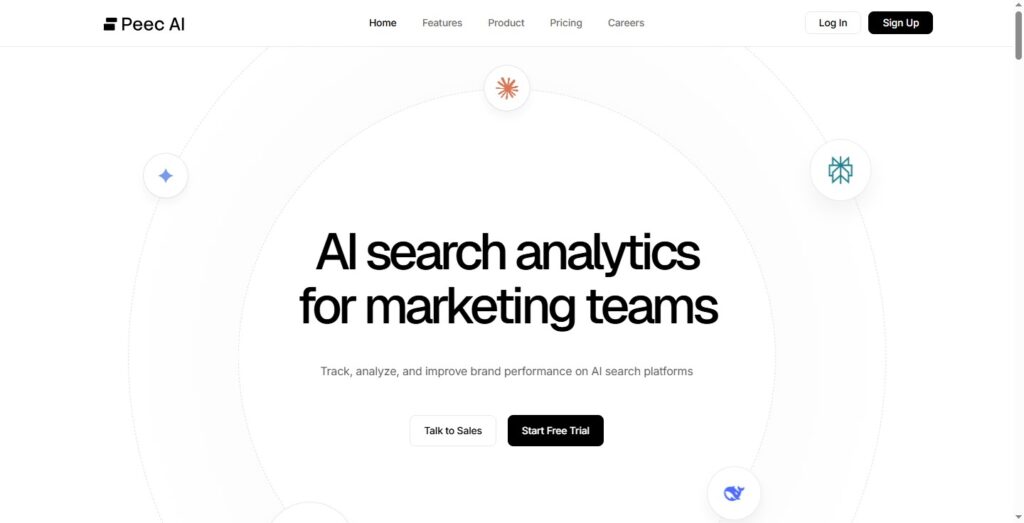
    Peec AI: Real-time tracking with proven results

    Based in Germany, Peec AI has grown quickly, raising approximately €7M in funding within five months (€1.8M pre-seed in April 2025 and €5.2M seed in July 2025). The platform focuses on real-time AI visibility and multi-language support, making it particularly attractive for European and global brands.

    Growth Trajectory & Capabilities

    • Revenue: Reached around €650K ARR within four months of launch, with reported €80K weekly growth and a target of €4M ARR by year-end.
    • Pricing: Ranges from about €89–€499/month.
    • Clients: Trusted by 1000+ marketing teams, including brands such as idealo and Wix, which provide testimonials on its site.
    • Platform coverage: Tracks AI visibility across 7+ platforms.
    • Compliance: Focus on GDPR alignment and multi-language reporting.

    Peec AI emphasizes actionable, AI-powered recommendations rather than raw dashboards, with rapid feature shipping, such as adding AI Overviews tracking within weeks based on user feedback.

    User Reviews & Social Proof

    • G2 Rating: Approximately 5.0/5 (with a small but positive early review base).
    • Representative feedback highlights its positioning as “AI search analytics for marketing teams,” with an emphasis on clarity and speed.

    Recognition & Credentials

    • The platform’s messaging emphasizes GDPR-conscious architecture and multi-language capabilities tailored for European markets.

    Case Studies & Results

    A case study on Peec AI’s blog reports that Momentum achieved roughly a 10× improvement in AI search visibility using the platform by July 2025. The story illustrates how real-time insights and iterative optimization can quickly shift a brand’s standing in AI-generated results.
    xFunnel: End-to-end AI search engine optimization

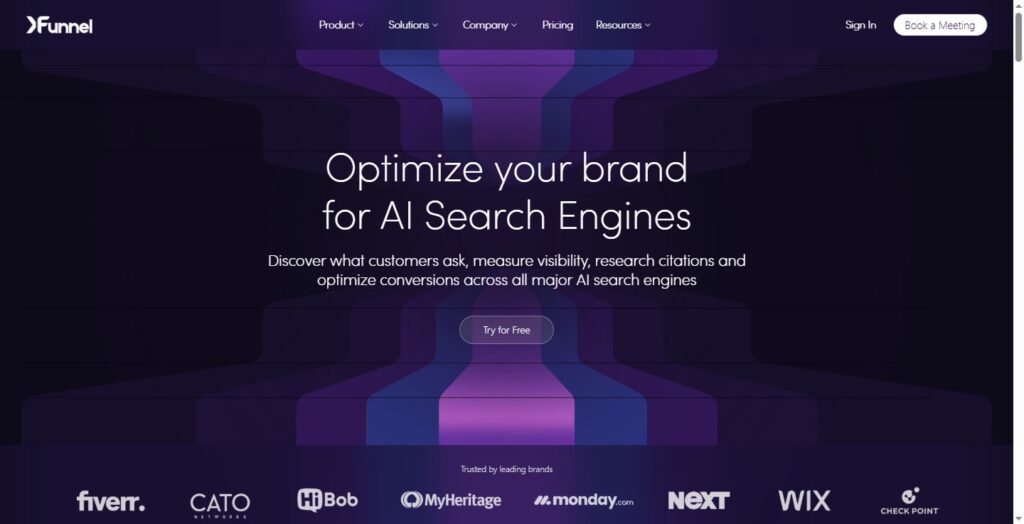
    xFunnel operates as a service-driven GEO partner rather than a purely self-serve SaaS platform. Founded by Neri Bluman and Beeri Amiel, who together have raised more than $150M across prior ventures, xFunnel focuses on turning AI search into a revenue channel for established brands.

    Unique Positioning

    • Pricing: Around $197/month as an indicator of entry-level service, with custom pricing for full-scale engagements.
    • Clients: Publicly listed brands include HubSpot, Monday.com, Wix, Fiverr, Check Point, and Next Insurance.
    • Focus: Full-cycle AI search engine optimization, from strategy and experimentation to content and optimization.

    xFunnel Delivers

    • Experiment-driven strategy development to understand what drives AI answer inclusion and conversions
    • Tailored optimization playbooks executed by xFunnel’s team
    • Dedicated analyst support and an AI-friendly affiliate network
    • Content development and user-generated content (UGC) strategies for AI visibility
    • Published AI search behavior studies that feed back into client playbooks

    User Reviews & Social Proof

    Recognition & Credentials

    • xFunnel has announced that it is “joining the HubSpot family,” signaling closer integration into a widely adopted marketing ecosystem.
    • Customer pages highlight several recognizable technology clients; however, detailed metrics are often shared only within private case studies.
    Profound: Premium enterprise solution with major backing

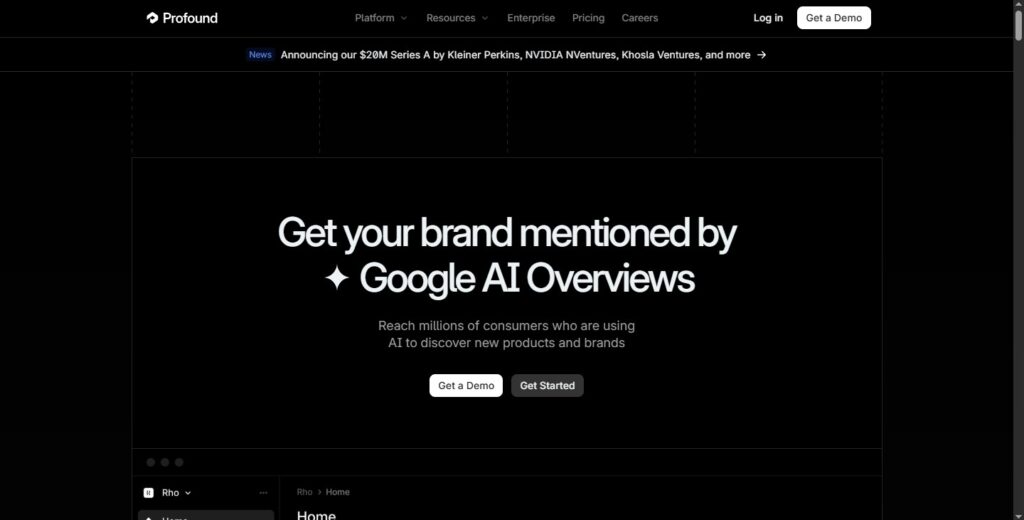
    Profound is positioned for upper mid-market and enterprise organizations seeking detailed AI answer share-of-voice insights across multiple countries and languages.

    Enterprise Credentials

    • Funding: Approximately $23.5M total funding ($3.5M from Khosla Ventures in August 2024 and $20M Series A led by Kleiner Perkins, with NVIDIA participation, in June 2025).
    • Starting price: A published entry point around $99/month, with higher enterprise tiers running significantly more. Earlier coverage referenced enterprise-only access at higher price points, underscoring that many deployments are large-scale.
    • Compliance: SOC 2 Type II certified.
    • Scale: Processing about 100+ million AI search queries monthly across 18 countries.

    Key Capabilities

    • Conversation Explorer: Real-time insight into AI answer engine search volumes and answer patterns.
    • Multi-language support: Coverage across 20+ languages, supporting global brands.
    • Agency “God View”: Multi-client management suited to agencies and large consultancies.

    Profound notes that clients often see 25–40% lifts in AI answer share-of-voice within roughly 60 days of implementation.

    User Reviews & Social Proof

    • G2 Rating: Around 4.6/5 based on approximately 142 reviews, indicating strong enterprise satisfaction.
    • TechCrunch and Adweek confirm enterprise sophistication
    • As noted by iPullRank CEO Michael King: “Profound has the strongest reporting, and they are rapidly adding additional features like their conversation explorer and bot tracker that help you understand what’s going on.”

    Recognition & Credentials

    • SOC 2 Type II security certification.
    • A partnership with G2 focused on powering AEO and AI search marketing strategies.
    • Public customer lists referencing brands such as U.S. Bank, Plaid, and MongoDB.

    Case Studies & Results

    A case study on Profound’s site describes how Ramp increased AI brand visibility from 3.2% to 22.2% in roughly one month — a 7× improvement. The case study emphasizes that Profound’s insights helped Ramp understand which aspects of its narrative AI answer engines prioritize.
    RankZero: The agency-first & e-commerce platform favorite

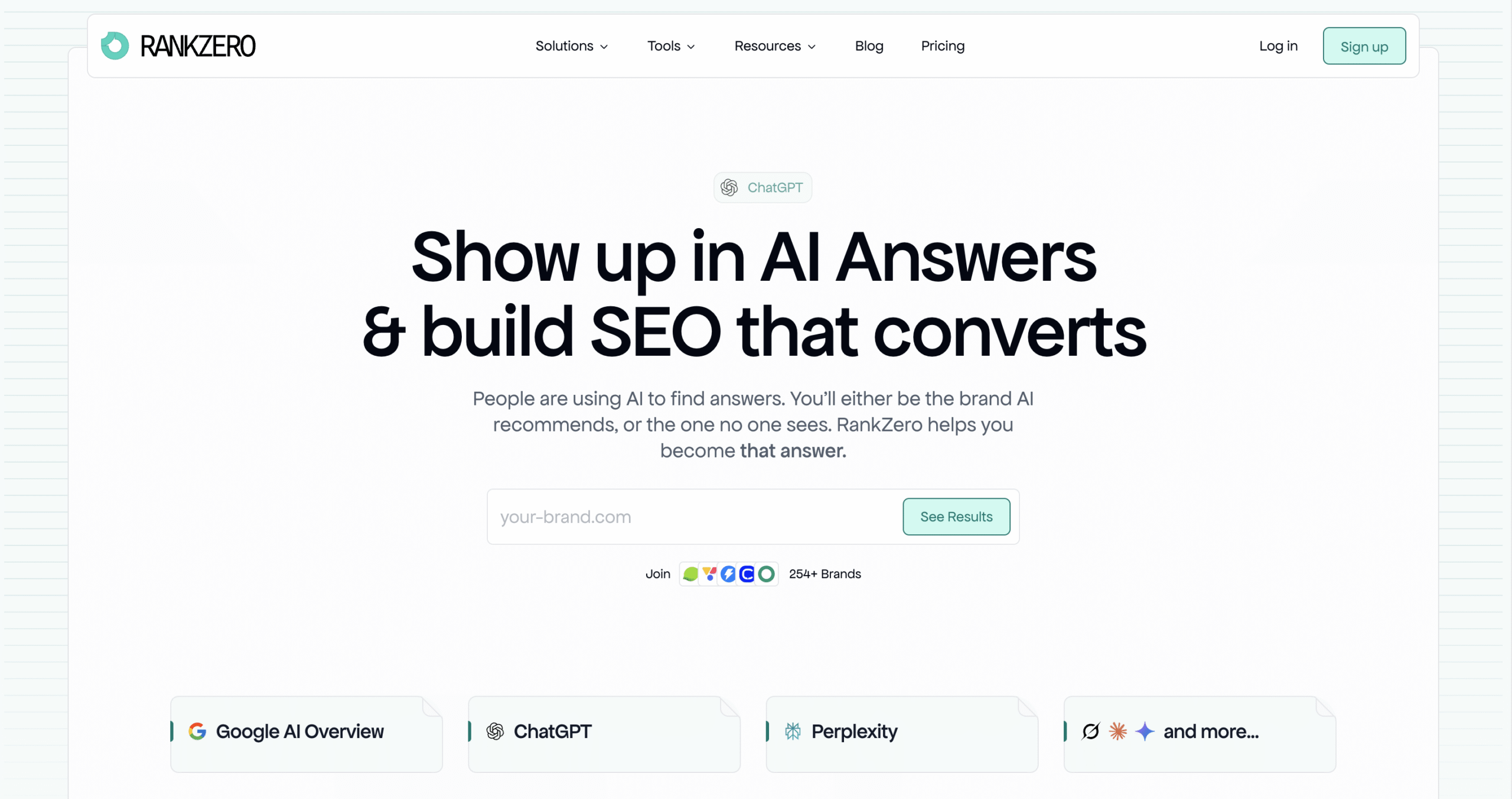
    RankZero has positioned itself as a revenue-first solution in the GEO space, recognized as a key player in Dawn Capital’s E-Commerce Market Study. Trusted by over 260 brands, the platform moves beyond vanity metrics to deliver concrete traffic attribution and technical optimization, built specifically for agencies and e-commerce teams.

    Key Capabilities

    • Pricing: Plans start at $89/month with unlimited scalability for agencies.
    • Platform coverage: ChatGPT, Gemini, Perplexity, Claude (on request), DeepSeek (on request), Mistral (on request), xAI Grok (on request)
    • Daily updates with instant data fetch (no 24-hour wait when adding new prompts)
    • Deep integrations with Google Search Console and GA4. Also, other integrations such as Shopify, Looker, Make, Zapier, and Google Sheets (on request).
    • Direct correlation of AI visibility with actual revenue performance

    Validated as one of the leaders in the European e-commerce and search landscape, RankZero prioritizes actionable intelligence and ecosystem connectivity. The platform includes a robust suite of free technical tools and integrations, enabling:

    • Automated, client-ready white-label reporting
    • Instant audits for live client pitches
    • Sentiment analysis and product positioning for e-commerce
    • AI Health Checker, LLMs.txt Generator, Structured Data Generator

    User Reviews & Social Proof

    Adoption: 260+ brands, with strong uptake among marketing agencies and e-commerce companies.

    Recognition & Credentials

    • Spotlighted by Dawn Capital as a leader in the e-commerce and search sector
    • Enterprise-grade, verified integrations with Google Search Console and Google Analytics.
    Rank Prompt: The region-focused platform

    Rank Prompt is an AI visibility and Answer Engine Optimization (AEO) platform designed to help brands understand how they appear inside AI-generated answers across tools like ChatGPT, Gemini, Perplexity, and Google AI Overviews. Instead of relying on traditional keyword rankings, Rank Prompt evaluates real, user-style prompts to determine whether a brand is mentioned, how prominently it appears, which competitors are cited, and which sources influence those responses.

    The platform combines prompt-level visibility tracking with analytics, citation analysis, technical SEO, and content execution, allowing teams to not only diagnose why they do — or do not — surface in AI answers, but also act on those insights directly. Rank Prompt supports one-click multi-location tracking, making it particularly well-suited for franchises and businesses with multiple locations that need consistent AI visibility across regions.

    Key Capabilities

    • Pricing: Tiered pricing based on usage credits and feature access, with plans starting at approximately $49/month. Higher-tier Pro and Agency plans include additional credits, multi-brand management, collaboration features, and white-label reporting.
    • Platform coverage: Tracks brand visibility across ChatGPT, Gemini, Perplexity, and other AI-driven search and assistant experiences.
    • Prompt-based reporting: Measures brand mentions, competitive presence, and visibility trends across scheduled and historical prompt runs.
    • One-click multi-location tracking: Designed for franchises and multi-location businesses, Rank Prompt allows teams to track AI visibility across multiple regions or countries with a single configuration. The same prompt set is automatically applied to each location, enabling fast, side-by-side comparisons of how different branches appear in AI-generated answers.
    • Content generation & publishing: Includes a trained content generation agent that converts AI visibility gaps and missed prompts into publish-ready articles. Rank Prompt integrates directly with WordPress, allowing teams to draft, edit, and publish content based on real AI prompt data without leaving the platform.
    • White-label exports: Generates branded PDF reports combining AI visibility, SEO data, analytics, and citation insights for client-facing use.
    • Analytics & SEO integrations: Connects with Google Analytics and Google Search Console, and includes technical SEO audits, content analysis, and on-page diagnostics.
    • Citation intelligence: Enriched citation data surfaces the sources influencing AI answers, including metadata and preview details for referenced pages.
    • Collaboration & reporting: Supports collaborators, dashboards, quick reports, and scheduled monitoring for ongoing visibility tracking.

    Rank Prompt is also developing a citation automation workflow that enables brands to identify AI-influencing listicles and articles and automatically reach out to authors and publishers to secure brand inclusions — bridging the gap between AI visibility insights and citation acquisition.

    User Reviews & Social Proof

    Rank Prompt is listed on G2, where it currently holds a 4.3 out of 5 rating based on early user reviews. Reviewers highlight the platform’s prompt-based tracking approach, clarity into why brands do or do not appear in AI answers, and the ability to connect AI visibility insights directly to content and citation strategy.

    Rankshift: Flexible prompt monitoring built for efficiency

    Rankshift is designed around flexibility and cost control, offering a monitoring model that adapts to how teams actually work. The platform enables users to select which AI models to track and how frequently prompts are run — daily, weekly, or monthly — enabling them to scale prompt coverage without unnecessary usage or cost. This scheduling approach is positioned as both budget-conscious and resource-efficient, particularly for teams managing large prompt libraries.

    Key Capabilities

    • Pricing: Plans start at €49/month, scaling up to €639/month depending on usage
    • Free trial: 30-day free trial available
    • User access: Unlimited users included with every subscription
    • Projects: Unlimited projects per account
    • Prompt scheduling: Flexible cadence (daily, weekly, or monthly) with the ability to deactivate prompts at any time
    • Agency support: Unlimited pitch seats for agencies at no additional cost
    • Analytics: Deep citation analytics and crawler analytics module
    • PR workflows: Dedicated workspace for tracking citations and collaborating on follow-ups
    • Research tools: Prompt research and suggestion module to identify new monitoring opportunities

    By adjusting monitoring frequency, organizations can track a high volume of prompts while maintaining predictable costs — an approach well-suited for agencies and teams managing multiple brands or clients.

    User Reviews & Social Proof

    • Adoption model: Bootstrapped platform with growing use among agencies and teams prioritizing flexible AI visibility tracking
    • Funding: No external funding; fully bootstrapped

    Recognition & Credentials

    • Founders: Pieter Verschueren & Denis Debacker
    • Positioning: Emphasis on sustainable monitoring practices and operational flexibility rather than fixed usage tiers

    LLM Scout: Buyer-intent AI visibility tracking

    LLM Scout positions itself as a buyer-intent-focused AI visibility tracking platform, designed for marketing, SEO, and agency teams who need clear insights into how AI models perceive and surface their brands across conversational search queries.

    Key Characteristics

    • Pricing:
      • Standard: $39.99/month (ChatGPT only, 1 brand, 25 prompts)
      • Advanced: $99.99/month (Most popular – all LLM models, 100 prompts, AI Analytics)
      • Agency: Custom pricing (unlimited clients, prompts, and seats)
      • 7-day free trial included on all plans
    • Platform coverage: ChatGPT, Claude, Gemini, Perplexity, and AI Overviews
    • Data refresh: Weekly reports as standard
    • Setup: 2-minute onboarding process with auto-generated buyer prompts
    • Auto prompt discovery: Platform automatically generates high-intent buyer questions relevant to your category, eliminating the manual work of identifying which prompts to track
    • Citation-level tracking: Shows not just brand mentions but which URLs and sources AI models cite when recommending brands
    • Prompt-level transparency: See exactly which questions include or exclude your brand with full AI response context
    • Competitive positioning analysis: Compare visibility against competitors across different prompt types and AI models
    • AI readiness reports: One-time audit option available for brands wanting a comprehensive assessment before committing to ongoing tracking
    • LLM Scout serves three primary audiences:
      • Marketing & growth teams: Track how AI models surface brands and identify visibility gaps in AI-driven discovery
      • SEO & content teams: Understand which content, citations, and prompts drive AI recommendations
      • Agencies & consultants: Multi-client dashboards with white-label reporting capabilities

    User Reviews & Social Proof

    • Rating: 5.0 stars based on 425 reviews (per company website)
    • Notable customers: Platform tracking data shows usage by brands including Accenture, SAP, Salesforce, Notion, Airtable, ClickUp, Miro, Intercom, and Zapier (public brand pages available on their site)
    • Testimonials: Users report seeing brand visibility improvements in AI answers within weeks of implementing recommendations

    Recognition & Credentials

    • Active affiliate program for agencies and consultants
    • Additional services include AIO (AI Optimization) consulting and standalone AI Readiness Report purchases
    • Regular webinar series focused on AI search optimization strategies

    Traditional SEO Platforms Adapt to AI Reality

    Established SEO platforms are rapidly adding AI capabilities to maintain relevance:

    Advanced Web Ranking

    Advanced Web Ranking (AWR) has expanded from traditional rank tracking to cover AI Overviews and AI brand visibility:

    • AI features: Google AI Overview tracking for desktop and mobile, with AI Brand Visibility leveraging four popular LLMs.
    • Starting price: $99 a month.
    • AI Overview Study Tool: A free resource tracking weekly AI Overview trends and measuring how often AI Overviews appear.
    • Key Finding: 57% of searches now include AI Overviews (June 2025).
    • Unique Insight: Only 47.7% of AI Overview sources come from top 10 organic results.
    • Pixel depth: Research shows AI Overviews can push organic results down an average of 1,686 pixels when expanded, requiring substantial scrolling to reach traditional listings.
    • G2 Rating: 4.3/5 based on over 20 reviews.

    AI Overview tracking is enabled by default across all plans using Google Universal search engines, giving existing AWR users a direct way to monitor AI features without leaving their current stack.

    Semrush AI Toolkit

    Semrush has introduced an AI Toolkit to extend its reach into AI search:

    • Pricing: Core plans start around $139.95/month, with an AI Toolkit available as an additional $99/month add-on.
    • Platform coverage: ChatGPT, SearchGPT, Google’s AI Mode, Gemini, Perplexity, and related AI surfaces.
    • Features: Brand performance reports, sentiment analysis, and competitive perception metrics, plus integrations with ContentShake AI and Copilot.
    • Data cadence: Weekly updates.
    • 2025 restructure: Semrush reorganized its offerings into seven focused toolkits, each containing dedicated AI capabilities.

    For existing Semrush customers, the AI Toolkit provides a low-friction path to begin tracking AI search visibility alongside keyword rankings and backlinks.

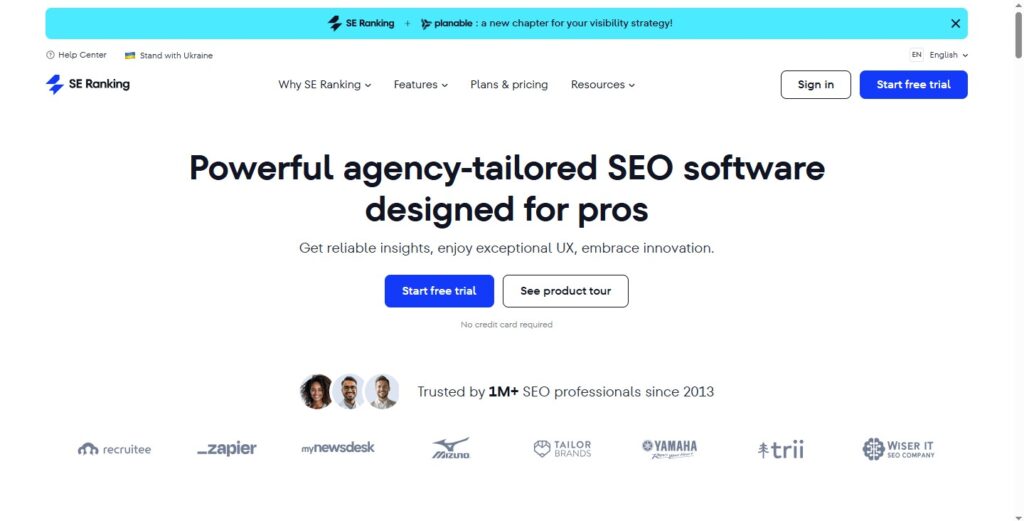
    SE Ranking

    SE Ranking combines a comprehensive SEO platform with AI search tracking capabilities used by more than 1M+ SEO professionals.

    • Pricing: Core subscriptions start around $52/month (Essential). AI search tracking features are often used within plans in the $119–$259/month range (with approximately 20% discounts for annual billing), and free trials are available.
    • Platform coverage: Google AI Overviews, Google AI Mode, and ChatGPT, with Perplexity, Gemini, and additional AI platforms on the roadmap.
    • Data refresh: Daily for tracked keywords.
    • Security: GDPR-aligned infrastructure and secure servers.
    • G2 Rating: 4.8/5 based on over 1,400 reviews.

    SE Ranking focuses on translating AI data into clear business metrics, including:

    • Monitoring brand mentions, links, and positions in AI-generated answers
    • Identifying prompts that most frequently surface the brand
    • Comparing AI answer visibility against competitors
    • Tracking changes in visibility over time

    Automation via OTTO enables teams to address issues identified in AI search results with minimal manual intervention.

    Research from August 2025 analyzing 10,000 keywords found only 9.2% URL consistency in Google AI Mode across repeat queries, highlighting the variability and volatility of AI-generated results.
    Ahrefs AI Content Helper

    Ahrefs has added an AI Content Helper that, while not a dedicated AI search visibility tracker, supports AI-aligned content creation:

    • Launch: Initial release in September 2024, with enhancements in February 2025.
    • Features: Chat-style interactions supporting 174+ languages, content drafting, and optimization suggestions.
    • Philosophy: Emphasis on topical coverage and authority rather than strict keyword density metrics.
    • Reported outcomes: Users have reported average traffic increases of around 72% after aligning content with Ahrefs’ recommendations.

    Ahrefs’ AI-first content tooling can complement AI tracking tools by ensuring that content is structured in ways more likely to be surfaced in AI answers.

    Emerging Players and Specialized Solutions

    The market continues to evolve with new entrants addressing specific niches:

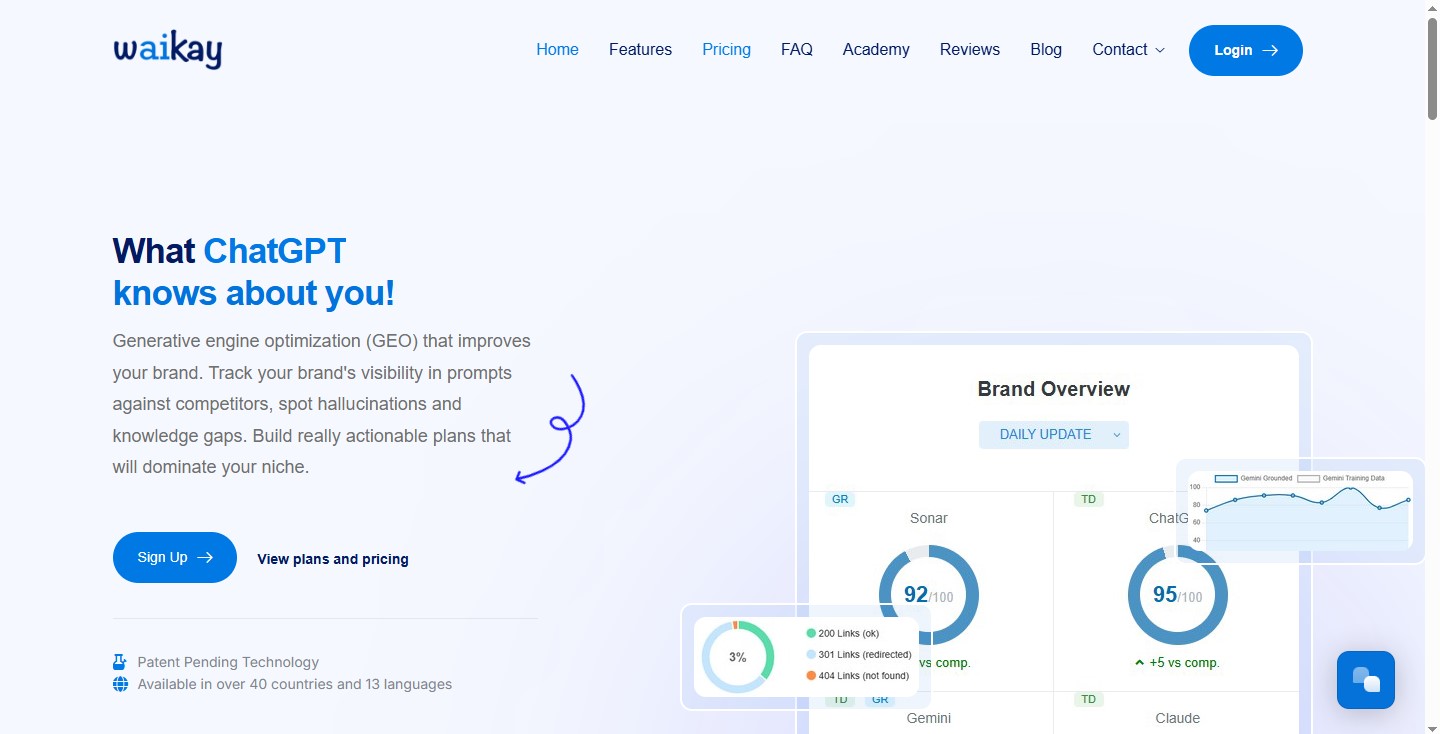
    Waikay.io: AI brand perception monitoring

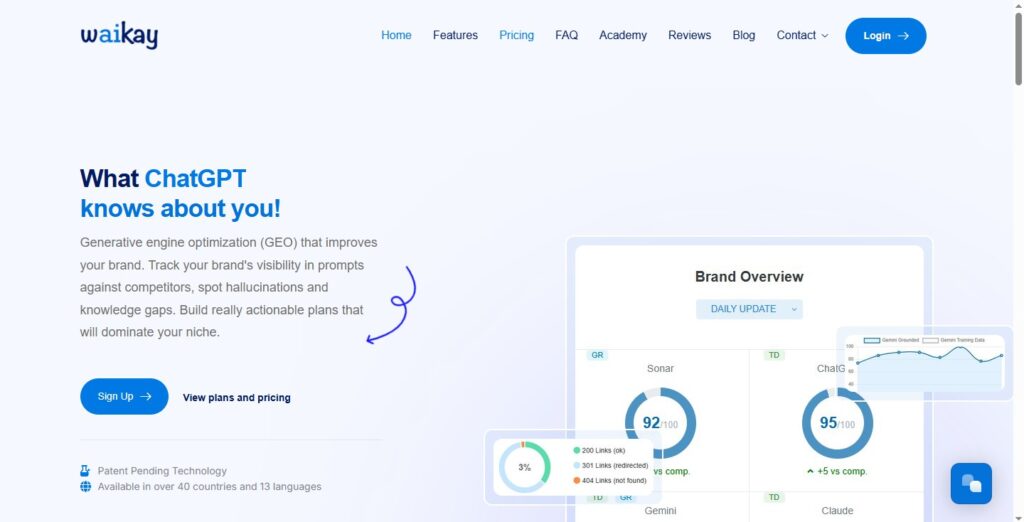
    Launched on March 19, 2025, Waikay.io represents a pure-play approach to AI brand monitoring. Created by SEO veteran Dixon Jones and InLinks Optimization Ltd, the platform addresses the critical shift from traditional SEO to AI optimization with patent-pending technology for interrogating large language models.

    Waikay.io’s core innovation lies in its entity-based analysis using knowledge graphs rather than simple keyword approaches. The platform provides a comprehensive AI Brand Score out of 100, showing how ChatGPT, Google Gemini, Claude, and Perplexity perceive brands across key topics. Unique features include:

    • Hallucination detection: Flags misinformation about your brand
    • Broken link alerts: Notifies when AI cites incorrect brand URLs
    • “Check, flag, or delete” workflow: Manage AI-generated claims
    • 13 language support: Global brand monitoring
    • Bidirectional topic analysis: See how topics relate to your brand and vice versa

    Pricing remains highly accessible, with a free tier followed by plans at $19.95 (8 reports), $69.95 (30 reports), and $199.95 (90 reports) per month. Early case studies show impressive results, with some brands achieving a 350% AI visibility surge using the platform’s actionable intelligence and optimization recommendations.
    AirOps: Content operations platform (not SEO tracking)

    AirOps is fundamentally different from other tools listed here. It’s an AI-powered content operations platform that includes SEO optimization features rather than a dedicated tracking tool. Founded in 2021 and securing $15.5 million in Series A funding (October 2024), AirOps focuses on workflow automation for content creation and optimization at scale.

    The platform integrates over 30 AI models, including GPT-4, Claude, and Gemini, offering:

    • Drag-and-drop workflow building: No code required
    • Human-in-the-loop approach: Quality control built in
    • Direct CMS integration: Seamless publishing
    • SEO integration: Through Semrush and DataForSEO

    Notable clients like Webflow report 5x faster content refresh and 40% traffic increases, while Toys “R” Us achieved a 90% reduction in product launch time. AirOps targets experienced content teams needing workflow automation rather than dedicated SEO tracking, with enterprise pricing requiring direct sales contact.

    SE Ranking: AI visibility tracking with accurate data

    SE Ranking brings together a powerful SEO platform and specialized AI search tracking tools used by 1M+ SEO professionals.

    • Pricing: $119-$259/month (20% off annual subscription, free trial available)
    • Platform coverage: Google AI Overviews, AI Mode, ChatGPT (Perplexity, Gemini, and others coming soon)
    • Data refresh: Daily for tracked keywords
    • Security: GDPR-compliant, secure servers

    SE Ranking differentiates by converting complex AI data into clear business metrics:

    • Monitor brand mentions, links, and positions in AI search tools
    • Learn which prompts trigger visibility in AI-generated answers
    • See how your AI search visibility stacks up against competitors
    • Track how your presence in AI answers changes over time
    • Intuitive interface with full-scale SEO suite integration
    • Agency-specific features for multi-client management

    Their June 2025 research analyzing Google’s AI Mode behavior across 10,000 keywords revealed only 9.2% URL consistency across repeat queries, highlighting the volatility of AI search results.

    Purpose-built tools:

    • Surfer AI Tracker: Add-on for Surfer users (June 2025), $95-495/month
    • BrandLight: Premium reputation management ($4,000-$15,000/month), emerged in April 2025 with $5.75M funding
    • GrowthBar: AI content optimization ($79/month)
    • Frase: AI brief generation ($15-$115/month)

    Technical Capabilities Comparison

    API and integration excellence

    Leaders in technical integration:

    WriteSonic:

    • Comprehensive REST API documentation
    • 2,500+ app integrations
    • Native Zapier support

    Scrunch AI:

    • Enterprise-grade APIs
    • Custom integration support
    • Cloudflare bot tracking

    Integration gaps:

    • Most tools lack data warehouse connections
    • Only seoClarity offers direct BigQuery/Snowflake integration
    • Custom development often required for enterprise needs

    Security and compliance landscape

    Enterprise-ready platforms:

    • SOC 2 Type II: Scrunch AI, WriteSonic, Profound
    • HIPAA compliant: WriteSonic only
    • GDPR certified: Peec AI, WriteSonic

    Data update frequency

    Refresh rates significantly impact use cases:

    Update Frequency Platforms Best For
    Real-time/Daily WriteSonic, Peec AI, RankScale Crisis management, rapid response
    Every 3 days Scrunch AI Enterprise accuracy requirements
    Weekly Otterly AI, Surfer AI Tracker Strategic planning, reporting
    Custom RankScale Flexible needs

    Review Authenticity: Separating Hands-On Experience From Desk Research

    Our research revealed that most published reviews appear to be desk research rather than hands-on testing, creating evaluation challenges.

    Reliable sources with verified usage:

    Red flags for surface-level reviews:

    • Lack of specific pricing details
    • No mention of implementation challenges
    • Missing discussion of limitations
    • Generic “Top X Tools” format without depth

    Strategic Recommendations by Organization Type

    For large enterprises (1000+ employees)

    Primary recommendation: Scrunch AI

    • Budget $300-$1,000/month for comprehensive features
    • SOC 2 compliance meets security requirements
    • Dedicated account management
    • Cloudflare integration for bot traffic insights

    Alternative: Profound (if you can gain access)

    • Premium features for Fortune 500 needs
    • Conversation Explorer for search volume data
    • Multi-language support

    For mid-market companies (100-1000 employees)

    Best balance: Peec AI

    • Rapid ARR growth validates effectiveness
    • €89-499/month pricing scales with needs
    • Multi-language capabilities for expansion
    • Strong client testimonials

    Integration play: Otterly AI

    • Semrush integration leverages existing tools
    • $29-489/month flexible pricing
    • 3,000+ customers validate approach

    For small businesses and agencies

    Maximum value: WriteSonic

    • $49/month entry point
    • Combines tracking with content creation
    • 10+ million users prove accessibility
    • End-to-end workflow optimization

    Budget option: RankScale

    • $20/month lowest price point
    • Professional features at starter pricing
    • Good for testing AI SEO capabilities

    For specific use cases

    Use Case Recommended Tool Why
    Brand reputation BrandLight Comprehensive monitoring at enterprise scale
    Content teams Surfer AI Tracker Integrates with existing workflows
    European companies Peec AI GDPR compliance, EU focus
    Technical analysis RankScale Granular data, citation tracking
    Conversion focus xFunnel Buying journey optimization

    Additional Resources and Industry Analysis

    Essential reading:

    Market analysis:

    Newsletter:

    Frequently Asked Questions

    What is the most affordable AI SEO tracking option?

    Among purpose-built tools, RankScale stands out for affordability, with plans starting around $20/month on a credit-based model. This structure allows teams to control costs while experimenting with AI visibility tracking. Entry-level tiers from platforms like WriteSonic GEO and Waikay.io also offer relatively low monthly commitments.

    Which AI SEO tools are best for enterprises?

    For enterprises, Scrunch AI and Profound are strong options. Scrunch AI offers features such as SOC 2 Type II compliance, SSO integration, and an Agent Experience Platform (AXP) aimed at large organizations. Profound focuses on multi-country, multi-language AI visibility and offers Conversation Explorer for AI answer share-of-voice, along with enterprise-grade reporting and security.

    How often do AI SEO tracking tools update their data?

    Refresh rates vary significantly. Tools like WriteSonic GEO and Peec AI emphasize near real-time tracking, Scrunch AI typically refreshes data every three days, and platforms such as Otterly AI and Advanced Web Ranking often update on weekly cycles. SE Ranking offers daily updates for tracked keywords.

    Do I need a separate tool for AI SEO tracking if I already use an SEO platform?

    Not necessarily, but it often helps. Traditional SEO platforms such as Semrush, Advanced Web Ranking, and SE Ranking have introduced AI search tracking features. However, purpose-built GEO tools like Scrunch AI, Peec AI, and Otterly AI generally offer more detailed AI-specific metrics, platform coverage, and workflows. Many organizations use a combination: traditional SEO suite + dedicated AI visibility tracker.

    Which AI platforms should my brand be monitoring?

    At a minimum, most brands should monitor visibility in ChatGPT, Google AI Overviews, and Perplexity, as these represent large portions of current AI search activity. Depending on geography and audience, it is also prudent to track Google AI Mode, Claude, Gemini, Meta AI, and other emerging answer engines.

    How much does AI SEO tracking typically cost?

    Pricing ranges from around $20/month for entry-level tools like RankScale to $1,000+/month for enterprise GEO platforms such as Scrunch AI or high-touch service offerings like BrandLight. Many mid-market solutions cluster in the $89–$499/month range, with higher tiers for advanced features, higher volumes, or multi-brand usage.

    The Path Forward: Evolution, Not Revolution

    The AI SEO tracking market represents a fundamental shift in search visibility strategy. Key takeaways for success:

    Market momentum is undeniable:

    • $4.97 billion market by 2033 (CAGR of 10.7%)
    • 1 billion AI search users approaching rapidly
    • 25% drop in traditional search predicted by Gartner (2026)
    • 84% of marketers use AI tools for trend identification

    Investment validates the opportunity:

    The substantial funding rounds throughout 2024-2025 demonstrate investor confidence:

    • Profound: $23.5M total ($3.5M seed August 2024 + $20M Series A June 2025)
    • Scrunch AI: $19M total ($4M seed March 2024 + $15M Series A July 2025)
    • AirOps: $15.5M Series A (October 2024)
    • Peec AI: €7M (€1.8M pre-seed April 2025 + €5.2M seed July 2025, led by 20VC)
    • BrandLight: $5.75M Series A (April 2025)
    • WriteSonic: Bootstrapped to 10M+ users

    Tool diversity ensures options for everyone:

    From RankScale’s accessible $20/month entry point to Scrunch AI’s enterprise sophistication at $1,000/month, the market offers solutions for every organization size and need.

    Early adoption provides a competitive advantage:

    Organizations that recognize AI SEO tracking as an essential evolution, not a separate discipline, will maintain visibility as AI-powered search becomes dominant. The window for early-mover advantage is closing rapidly.

    Success requires selecting tools that enhance rather than replace human expertise. By matching platforms to specific needs, technical capabilities, and strategic objectives, brands can navigate the expanding universe of AI-powered search while preparing for whatever comes next in this rapidly evolving landscape.

    Ready to start tracking your AI search visibility? Explore the tools mentioned in this guide and request demos to find your perfect fit. The future of search is AI-powered. Make sure your brand is part of the conversation.

    Need help executing on your GEO/AI SEO strategy? Get in touch. We’re deep in the “cause and effect” and have a tested roadmap for AI search success.

    Acknowledgments: Special thanks to the tool providers who contributed direct insights to this analysis: Chris Andrew (Scrunch AI), Mathias Ptacek (RankScale), Klaus-M. Schremser (Otterly AI), Malte Landwehr (Peec AI), Neri Bluman (xFunnel), Shaun Davidson (ZeroChannel.ai), Frank Vitetta (LLM Scout), Johannes Notheis (RankZero), Trevor Anderson (Rank Prompt), James Berry (LLMrefs), and Pieter Verschueren (Rankshift). Their feedback ensured accuracy and provided a valuable perspective on the rapidly evolving AI SEO tracking landscape.
  • Instagram SEO Playbook: How to Win Over Google and AI Search

    Instagram SEO Playbook How to Win Over Google and AI Search

    This post was updated by Rebecca Michelet on 12/15/25 to reflect current best practices. It was originally published on 11/13/25.

    Key Insights

    • Instagram is now part of the search landscape. Google’s indexing update means public Instagram content can appear alongside websites, articles, and videos, expanding what visibility means for every brand.
    • Discovery depends on relevance, not reach. Algorithms now reward clear, consistent context that helps users find relevant content faster on both Instagram’s Explore page and in Google search.
    • Social and search now shape each other. The lines between platforms are disappearing, and visibility depends on how well your strategy connects storytelling with search intent.
    • Authority is earned through clarity and consistency. Profiles, captions, and visuals that reinforce who you are (and what you’re known for) help algorithms and audiences recognize your expertise.
    • AI is redefining what it means to be found. As generative tools reference social content in answers, brands that post with intention will lead the next wave of discoverability across search and AI.

    Search engines are getting extra social lately.

    Google’s been busy expanding its reach, and it’s now pulling public Instagram posts and profiles directly into search results.

    Your feed just became part of the search universe. For brands and creators, that means every post has the potential to rank, not just resonate. The problem? Most treat Instagram strategy like an art project, not a search tactic.

    That gap decides who shows up first and who never shows up at all.

    It’s time to post with purpose. This playbook teaches you how to treat your Instagram like SEO, built to rank, not just scroll.

    What Is Instagram SEO?

    Instagram SEO is the strategy behind making your content findable, both inside the app and beyond it. It’s how you craft profiles, captions, hashtags, and visuals so that they not only attract followers but also earn visibility in search results.

    The goal is simple: help people (and algorithms) understand what your content is about and why it matters.

    Instagram SEO has entered a new era

    Traditionally, Instagram SEO focused on the platform’s own search function, optimizing for in-app discovery through relevant keywords, hashtags, and engagement. But that world just got much, much bigger.

    In July 2025, Google began indexing public profiles, posts, and Reels, giving your content a direct line to the world’s largest search engine.

    And it doesn’t stop there. AI tools like ChatGPT, Gemini, and Google’s AI Overviews are beginning to pull Instagram content into their own generated answers, referencing social posts alongside articles and web pages.

    That means your captions, keywords, and hashtags now have a dual job:

    • Engage your audience (the scroll-worthy part)
    • Signal context to search and AI systems that decide what to surface (the rank-worthy part)

    Why Search and Social Can’t Be Separate Anymore

    Every post now speaks two languages: one for people and one for algorithms. The more those messages align, the easier it is for both to recognize your brand as relevant and trustworthy.

    Search and social are no longer parallel strategies. They’re parts of the same visibility engine. What earns engagement on Instagram can reinforce authority in search, and the clarity of your SEO can help social content reach new audiences.

    Together, they create a loop of discoverability that rewards consistency, clarity, and intent.

    image of an instagram logo

    How to Optimize Instagram for Search and AI Visibility

    Now that Instagram feeds into Google and AI results, optimization isn’t optional. Every detail on your profile and in your posts shapes how algorithms understand your brand and where you show up.

    Here’s how to make your Instagram work smarter for search.

    Optimize your profile for search context

    Your profile is where discoverability starts. It’s both a visual first impression and a key data point that search engines and AI tools use to understand your brand’s relevance and authority. A strong profile bridges your social identity with your search presence, giving users and algorithms the context they need to trust what they’re seeing.

    What to do:

    • Use a keyword-rich bio that includes your brand, industry, and (if relevant) your location. Write naturally, but make sure the words you’d want to rank for appear early.
    • Keep your name, handle, and profile image consistent across Meta platforms (and anywhere else your brand appears). Consistency builds recognition and reinforces entity alignment.
    • Add a link in bio that leads to a meaningful destination. Link to key internal pages such as services, program listings, or resource hubs that reinforce what you want to be known for.
    • Complete every profile field, including your category, contact details, and business information. These small details help confirm legitimacy and topical authority for both users and search crawlers.
    • Treat your highlights and pinned posts as secondary signals. Label them clearly with relevant keywords or phrases that reflect your expertise.

    An optimized profile becomes the anchor of your Instagram SEO strategy and the foundation for everything else to build upon.

    Write captions that reflect search and AI language

    Instagram captions carry their weight and more. They tell both your audience and search engines what your content means and why it matters. The right phrasing can help your post resonate with people while signaling relevance to AI tools that decide what to surface.

    What to do:

    • Speak like your audience. Use plain, direct phrasing that mirrors how people search. A caption like “what to do during a weekend in New Orleans” performs better than one filled with stiff, bleak terminology.
    • Use long-tail keywords with intent. People search in phrases, not single words. Using specific, natural keywords helps your posts surface in both Google and AI-driven results.
    • Add clarity through structure. Algorithms read relationships the way people do (who’s doing what, and for whom). Think in patterns like subject, action, object: “Search Influence helps universities improve SEO visibility.”
    • Answer real questions. Captions that solve problems or explain value are easier for both users and algorithms to understand: (ex, “what to do after a car accident”)
    • Match your on-screen text. Keep phrasing consistent across Reels, carousels, and captions so both people and machines connect the dots.
    • Lean on proven formats that teach or explain. AI tools favor content that answers questions directly, and people tend to share it more, too. Think FAQ or Q&A Reels, “how-to” carousels, and tip-based lists.

    Captions written with intention earn visibility in both the feed and search results, helping your audience find you faster and engage for longer.

    Use hashtags, alt text, and structure to reinforce meaning

    Relevant hashtags and alt text help algorithms understand the context behind your visuals. They give search engines, AI tools, and even screen readers clearer cues about what your content represents, which improves both accessibility and visibility.

    What to do:

    • Focus on relevance. Use up to three highly relevant hashtags that accurately describe your content and the community you want to reach.
    • Avoid hashtag stuffing. The practice of adding long lists of tags for reach is no longer effective. Instagram’s new hashtag limit signals the end of that trend. Hashtags will still help categorize content, but they won’t meaningfully drive reach. Precision and clarity now matter more than volume.
    • Prioritize a solid keyword strategy. Strengthen discovery by using clear, descriptive keywords in your captions, on-screen text, audio, and bio.
    • Write natural alt text that describes what’s on screen while subtly reinforcing your topic or entities. Think of it as another way to teach search engines what your post is about.
    • Keep a logical post structure. Use line breaks, spacing, and clear formatting so both users and algorithms can quickly identify key ideas. Clean captions signal clarity, which AI-powered search engines reward.

    Each of these small details adds up to stronger discoverability. When your visual, written, and structural cues all point in the same direction, search engines and AI tools know exactly how to classify your content and who should see it.

    Strengthen interlinking between platforms

    Search engines and AI tools use connections between your website and social profiles to verify identity and relevance. When your Instagram activity points back to your site (and your site points back to Instagram), it helps algorithms confirm that both belong to the same trusted entity. Those links also give users clear paths to learn, engage, and convert.

    What to do:

    • Link with purpose. Use bio links, Stories, and post CTAs to direct users to pages that expand on your content, such as articles, services, or case studies.
    • Embed with intent. Add Reels or posts to your website where they strengthen context, such as testimonials or event highlights.
    • Stay consistent. Keep the same handle, URLs, and naming conventions across platforms to help algorithms and users connect the dots.
    • Reference across channels. Mention your website in captions or Stories when relevant, and link to Instagram posts from your site when they add visual context.

    When those signals align, both users and search engines can follow a clear trail of relevance, one that reinforces authority across every platform.

    Monitor and test your visibility across search and AI tools

    Visibility is always shifting. Regular testing helps you see where your Instagram content appears across Explore pages, Google search results, and AI tools — plus, how those systems interpret it.

    What to do:

    • Search for yourself. Each month, test branded and topic-based prompts in Google. Note when your posts or profile appear.
    • Watch for mentions and citations. Check if AI summaries reference your brand, posts, or captions. These signals show your content is being recognized as a trusted source.
    • Identify what works. Look for patterns in visibility to see which formats, keywords, or topics consistently surface.
    • Refine and repeat. Use your findings to adjust your captions and hashtags.

    Treat this step as ongoing maintenance. The more you measure, the faster you can fine-tune what helps your content rank and resonate.

    Advanced Instagram SEO Strategies

    Once your Instagram profile and posts are optimized, the next phase is strengthening how your brand connects across the web. These advanced Instagram SEO tips focus on off-page and contextual signals, which act as the cues that help Google and AI systems verify your identity, recognize your authority, and include your content in richer search experiences.

    Use schema and structured data to strengthen Instagram visibility

    Schema markup doesn’t live inside Instagram, but it works behind the scenes to connect your social presence to your website’s authority. By adding structured data to your site, you’re giving Google and AI platforms the proof they need to confirm your Instagram account belongs to the same verified brand.

    What to do:

    Start with foundational schema types like Organization, Person, and Event to define who you are and what you do. Within that markup, use the sameAs property to list your verified social URLs, like Instagram, Facebook, LinkedIn, and others.

    Example:

    "sameAs": [
    
      "https://www.instagram.com/searchinfluence",
    
      "https://www.facebook.com/searchinfluence",
    
      "https://www.linkedin.com/company/search-influence/"
    
    ]
    

    This creates a direct line between your website and your social profiles, reinforcing brand trust and helping algorithms understand how your content fits into larger entity networks. It also supports accurate attribution in AI-generated search results, where structured data helps your content surface and be cited correctly.

    Build authority through mentions and tagging

    Mentions and tags strengthen your network of credibility. Every time you connect with another verified account, you’re giving algorithms extra context about your brand’s relevance and relationships.

    What to do:

    • Tag collaborators, partners, and organizations in posts, Reels, and Stories to build visible connections that reinforce trust and expertise.
    • Encourage reciprocal mentions through joint campaigns, shared content, or reposts to show consistent engagement between verified entities.
    • Focus on relevant tagging. Partner with accounts that reflect your niche, values, or audience to expand visibility in meaningful ways.

    These authentic connections give search engines and AI tools clearer signals of authority, helping your brand appear alongside other trusted names in search.

    Align content calendars with search trends

    Search and social trends shift fast. Aligning your Instagram schedule with real-time search demand helps your content stay visible when audiences are actively exploring related topics.

    What to do:

    • Study what’s trending. Use tools like Google Trends and TikTok Creative Center (TikTok and Instagram trends often go hand-in-hand) to identify keywords, questions, and topics gaining traction in your space.
    • Spot crossover moments. When a topic starts spiking in Google or TikTok, create a Reel or carousel that adds your brand’s take. This timing boosts your chance of appearing in both social feeds and search results.
    • Plan for peaks. Build posts around predictable cycles (seasonal interest, product launches, or industry events) to meet audience curiosity right as it grows.
    • Revisit quarterly. Review analytics and search trends every few months to refine your calendar and ensure content reflects current interest signals.

    By syncing your posts with how people search and engage, your Instagram feed becomes part of the larger discovery landscape, showing up where curiosity, relevance, and visibility meet.

    Applying Instagram SEO in Higher Education

    The same strategies that help brands stand out now shape how universities are discovered online. As Google and AI tools begin indexing Instagram content, higher education marketers have a new opportunity to influence visibility across both search and social.

    Findings from AI Search in Higher Education: How Prospects Search in 2025 by UPCEA and Search Influence show how search behavior is evolving:

    • Social media plays an expanding role in program discovery.
    • Nearly 7 in 10 respondents said regular social recommendations influence what they explore/purchase.
    • Among learners using social media to research continuing education, 35% said they would use Instagram.

    For colleges and universities, that means Instagram content now supports both storytelling and search visibility. Optimized posts can appear in Google results and AI-generated summaries, helping prospective students encounter your institution at the moment curiosity begins.

    Higher education applications

    To turn visibility into value, higher education marketers need to bring SEO precision to Instagram strategy. Applying search principles to social content helps universities connect what they share to how prospects search.

    Here’s how to put that strategy into action:

    • Showcase programs through Reels. Use short-form video to highlight classroom experiences, alumni achievements, and student life moments that illustrate your institution’s impact.
    • Tag with purpose. Include degree names, job titles, and institutional accounts to help search engines and AI tools recognize relationships between people, programs, and career paths.
    • Share faculty insights. Turn research, thought leadership, or current-event commentary into accessible posts written with context that supports search visibility.
    • Guide discovery with links. Direct users to program details, faculty bios, or admissions pages to capture intent and move prospective students toward the next step.

    Institutional benefits

    When used strategically, Instagram becomes part of the enrollment pipeline. Optimized content strengthens visibility at the awareness stage and builds the kind of credibility that influences applications and conversions.

    The impact shows up in three key ways:

    • Wider reach. Optimized Instagram content can surface in Google results and AI-generated summaries, expanding where prospective students encounter your institution.
    • Greater credibility. Consistent tagging, structured profiles, and cross-platform links help search engines recognize your university as a trusted source.
    • Quality engagement. Posts written with SEO awareness attract prospects already interested in your programs and lead them toward inquiry and enrollment.

    Common Mistakes to Avoid

    You’ve mastered the do’s. Time for the don’ts.

    Even small missteps can make your Instagram content harder to find. These are the habits that quietly weaken your visibility on and off the platform:

    • Keyword and hashtag overload. Overstuffing captions signals spam and makes it harder for algorithms to identify what matters. Keep hashtags intentional and tied to context.
    • Unclear or incomplete bios. Leaving out details like your industry, location (if relevant), or brand focus prevents search engines from understanding who you are.
    • Vague or missing alt text. Alt text helps algorithms interpret your visuals. Use it to describe what’s on screen in clear, specific language.
    • Trend chasing without strategy. Jumping on every viral sound or topic dilutes your relevance and confuses your audience.
    • No visibility tracking. Skipping regular tests in Instagram search bars, Google, and AI tools means missing out on what’s actually helping you rank.

    Attention to detail beats post volume every time. Keep your structure clean, your context strong, and your brand voice consistent across every update.

    someone using the instagram app on their phone

    FAQs About Instagram SEO

    Does Google index all Instagram posts?

    No, Google only indexes public Instagram profiles, posts, and Reels. Private accounts and Stories remain inaccessible to search engines. Indexing is determined by visibility settings and engagement signals, so consistent public activity increases your chances of appearing in search results.

    How long does it take for Instagram content to appear in Google results?

    Indexing can take anywhere from a few days to several weeks. Timing depends on how often Google crawls your account and the authority of your connected website or entity. Keeping your profile active, public, and properly linked through structured data can speed up discovery.

    What’s the difference between Instagram SEO and social media marketing?

    Instagram SEO sits at the intersection of social media marketing and search engine optimization. It focuses on improving visibility and discoverability within both the Instagram app and external search engines. In contrast, social media marketing encompasses broader goals like engagement, audience growth, and storytelling across social channels.

    How can I tell if my Instagram content appears in AI Overviews or ChatGPT responses?

    Search your brand or topic-related prompts directly in Google, ChatGPT, and Gemini. If your Instagram content or handle appears in summaries, citations, or linked examples, it’s being referenced. Regularly track visibility to identify which posts or keywords are driving the most inclusion.

    Can Search Influence assist with social media marketing?

    Yes. Search Influence advises on strategies to help you apply SEO principles to your social media presence. Our team provides recommendations that enhance visibility and connect what you post to how your target audience searches.

    Let’s Talk Your Instagram SEO Strategy

    Visibility is shifting fast. As Google indexes Instagram content, every post influences what people see, when, and where.

    Search Influence helps you stay ahead of the social search shift. Our experienced team advises on strategies that position your brand to capitalize on trends and lead in search, not lag behind it.

    Now’s the time to align your social strategy with search. Let’s chat about what proper Instagram SEO can do for you.

    Images:
    Unsplash
    Unsplash

  • How to Optimize Content for AI Search Engines

    How to optimize content for AI Search Engines

    Key Insights

    • AI search content optimization means structuring your content so AI systems can easily interpret, retrieve, and cite it in AI-generated answers.
    • Traditional SEO remains the foundation — clean site structure, structured data, and authority signals still drive AI visibility.
    • Organizing key insights, FAQs, and comparison tables makes your content easier for AI search engines to understand and surface in AI Overviews.
    • Writing in clear, natural language and updating regularly helps AI platforms recognize your content as accurate, relevant, and current.

    Search Influence leads in AI search content optimization by helping brands structure content that both humans and AI systems can easily understand and retrieve.

    Just as Frank Lloyd Wright believed buildings should grow naturally from their environment, AI-optimized content should grow naturally from meaning and structure. The future of search belongs to those who can design information that fits its landscape, where every heading, list, and table works like a carefully engineered beam.

    At Search Influence, we’re the architects of AI search visibility, helping site owners and marketers craft pages that perform beautifully across AI-powered search engines.

    This isn’t a theoretical guide. It’s the nuts and bolts of how to build AI-optimized content that earns citations, captures AI-generated answers, and stays visible in an evolving AI search landscape.

    Why Optimizing for AI Search Matters

    AI-powered search engines like Google’s AI Overviews, Perplexity, and ChatGPT don’t just rank pages; they summarize them. Instead of serving ten blue links, these AI engines generate conversational AI answers synthesized from multiple trusted sources.

    That means search visibility no longer stops at position one. You need your brand’s content to be included inside the AI answer.
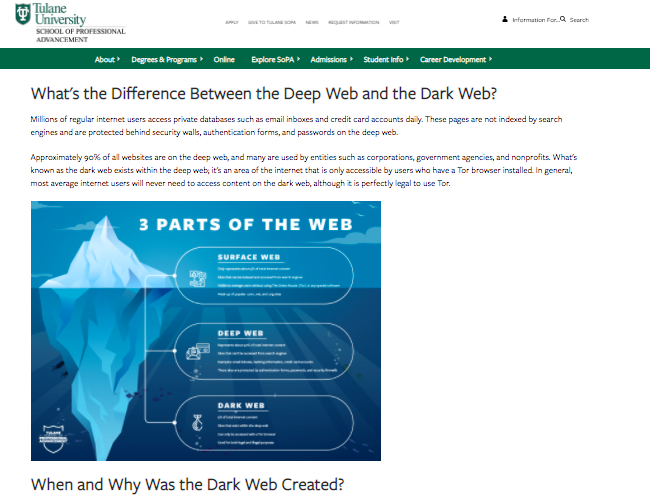
    Click-through rates are declining as zero-click searches rise, and users are becoming increasingly satisfied with direct responses from AI platforms. If your valuable content isn’t structured for retrieval, AI systems may skip over it entirely.

    Optimizing for AI search isn’t about replacing traditional SEO; it’s about building on it. Think of AI search optimization as a natural evolution: combining the best of search engine optimization, structured data, and modern AI tools to help both humans and algorithms recognize your authority.

    At Search Influence, we help brands adapt their digital marketing strategies so they stay visible as AI models rewrite the rules of search behavior.

    Traditional SEO Is Still the Foundation

    Before you dive into AI search optimization, make sure your traditional SEO is rock-solid.

    AI search engines still rely on the same crawl and ranking infrastructure as traditional search engines. If AI crawlers can’t read, index, or trust your site, no amount of clever structure will help.

    Key traditional SEO best practices still matter:

    • Clean architecture and crawlability: Ensure internal linking is logical, pages load quickly, and site maps are up to date.
    • Mobile-first performance: Many AI search tools prioritize user experience metrics tied to page speed and responsiveness.
    • E-E-A-T signals: Add clear bylines, About pages, and author or brand context. Even a simple byline builds trust for AI engines.
    • Structured data: Implement schema markup for FAQs, products, or local business details. It helps search engines understand relationships between entities.

    AI systems like Gemini and Perplexity still rely on traditional search engine crawlers to determine credible citations. Traditional SEO is the foundation, and AI SEO is the architecture built on top.

    Creating Key Insights at the Top

    The best-optimized pages start strong. Your top 200 words are prime real estate for both readers and AI search platforms.

    AI models scan for concise, self-contained summaries near the top of a page to define its topic and relevance. These “vectors of meaning” determine whether your page gets cited in AI search results.

    How to create effective key insights:

    • Write a 3–5-bullet “Key Insights” section summarizing the core takeaways (see the top of this blog!)
    • Use keyword-rich, natural language that mirrors user intent (think “how” and “why” phrasing.)
    • Keep each insight standalone. If a model were to pull that one bullet out, it should still make sense.
    • Include one light mention of expertise or authority (e.g., “Based on Search Influence’s experience optimizing higher-ed sites for AI visibility…”)

    Pro Tip: Treat key insights like metadata in human language — short, factual, and extractable. AI systems interpret them as anchors for what your page means. More AI SEO pro tips here.

    Building a Machine-Readable Table of Contents

    Table of Contents screenshot

    Think of your table of contents as a blueprint that helps both humans and AI search engines navigate your page.

    Just as a building’s floor plan shows how rooms connect, a well-structured TOC tells AI crawlers where each topic begins and ends. This improves comprehension, organization, and retrievability.

    How to do it right:

    1. Use jump-linked headings (<a href=”#section-name”>) or your CMS’s automatic TOC generator.
    2. Reflect natural search queries in each heading — e.g., “How to Optimize for AI Search” rather than “Optimization Overview.”
    3. Keep heading hierarchy consistent (H2 → H3 → H4).
    4. Use descriptive, not vague language.
    5. Add ItemList schema markup around the TOC for extra machine clarity.

    A good TOC tells AI engines how the story flows and helps your content appear in multiple passage-level citations within AI-generated responses.

    Writing a Semantic Triple Intro

    A semantic triple intro is a concise statement that defines your topic in the format of subject + predicate + object.

    Example: “AI search content optimization is the process of structuring web content so it can be easily retrieved, summarized, and cited by AI-driven search engines.”

    This tiny sentence packs a big SEO punch. It clearly tells AI systems what your page is about before anything else.

    Why it matters:

    • AI engines convert text into numerical “embeddings.” The first few sentences shape your page’s meaning signature.
    • A strong semantic triple reduces ambiguity and helps your content rank for related natural language queries.

    How to do it:

    • Use your main keyword naturally.
    • Define what it is and what it does.
    • Follow with a quick credibility line (e.g., “At Search Influence, we help businesses earn visibility in AI-generated answers.”)
    • Avoid filler like “In today’s world…” — it wastes your most valuable context window.

    Chunk Content for AI Retrieval

    Psst… You wanna know a secret? AI engines don’t read like people; they retrieve by passage.

    Instead of analyzing an entire web page, AI systems break text into smaller “chunks” and compare them to user queries.

    Best practices for chunking:

    • Keep each section around 150–300 words.
    • Focus on one topic per chunk.
    • Start each with a clear claim or question, then support it with concise examples or bullet points.
    • Use transition phrases like “For example” or “This means” to preserve context.
    • End each chunk with a short takeaway sentence that restates the point (see below).

    Chunking multiplies your retrieval opportunities. Each section can be surfaced as its own AI search answer.

    Using FAQs to Capture Long-Tail AI Queries

    If AI Overviews had a favorite format, it would be the FAQ.

    Why? Because FAQs naturally mimic how people search in natural language. Each question represents a distinct user intent that AI tools can easily identify, summarize, and cite.

    Why it matters:

    • Long-tail questions like “How do AI search results work?” align perfectly with how users phrase queries in AI-driven search and voice search.
    • Each Q&A acts as a self-contained data node, making your page more likely to appear in AI-generated responses.
    • Structured FAQs feed into the Google Knowledge Graph, improving your search visibility across generative search engines.

    How to implement:

    1. Use tools like AlsoAsked or Semrush to identify conversational long-tail questions centered around your topic.
    2. Phrase questions naturally. Avoid stiff or keyword-stuffed wording.
    3. Begin each answer with a semantic triple that defines the topic clearly.
    4. Support with concise bullets, data, or short examples.
    5. Add FAQPage schema markup so AI crawlers recognize the format.

    Think of FAQs as the structural beams that make your content citation-ready. Each question builds another route to reach your audience.

    Visuals, Tables, and Comparison Content

    Table comparing different tools

    Text isn’t the only thing AI engines read. AI search platforms use tables, charts, and labeled visuals to understand relationships and compare information.

    Why comparison content works:

    • Tables make AI-generated answers more precise. They can extract facts directly instead of summarizing loosely.
    • Comparison charts satisfy evaluative intent, a frequent category in AI search queries (e.g., “AI SEO vs. traditional SEO”).
    • Data tables strengthen embeddings by clarifying relationships between key details.

    How to structure tables for AI systems:

    • Use real <table> tags or Markdown tables, never screenshots.
    • Label columns descriptively: “Traditional SEO Tactics” | “AI SEO Tactics.”
    • Keep it simple: 3–5 columns, 5–10 rows.
    • Write factual captions, not marketing fluff (e.g., “This table compares how traditional and AI-driven search optimization differ in structure and retrieval focus.”).
    • Include schema markup where relevant.

    AI can quote directly from a well-structured table, boosting your authority in AI-powered search engines.

    Writing for Humans and Machines

    The best AI-optimized content reads smoothly to humans and structurally to machines.

    Follow these hybrid writing rules:

    • Use clear, factual sentences that stand alone if excerpted.
    • Keep paragraphs under 120 words.
    • Avoid vague language. Replace “this” or “it” with clear nouns.
    • Add internal linking every 150–200 words to reinforce relationships between entities.
    • Balance narrative and structure: storytelling for people, schema for crawlers.

    Remember: clarity isn’t just stylistic, it’s structural. It helps AI understand what matters.

    The Blueprint for AI Search Visibility

    Let’s recap your new building plan for AI search optimization:

    1. Lay the foundation: solid SEO fundamentals first.
    2. Frame the entryway: start with a clear semantic triple.
    3. Add the blueprint: summarize early with key insights.
    4. Map the layout: create a TOC and structured content chunks.
    5. Finish the details: use FAQ schema, visuals, and comparison tables.

    The goal? A digital structure that humans and AI engines recognize as sound.

    Search Influence helps brands design these frameworks to thrive in a world of AI-driven search and generative engine optimization.

    AI Content Optimization FAQs

    1. How to optimize content for AI search?

    AI search content optimization is the process of structuring digital content so AI systems can retrieve, summarize, and cite it accurately.

    To optimize effectively, focus on clarity, organization, and accessibility. Start by breaking your page into self-contained sections with clear H2s and H3s, ensuring each chunk of content addresses a single topic. Use structured data and schema markup to help AI crawlers interpret meaning, and reinforce relationships through strong internal linking.

    Keep your content current with up-to-date examples and sources. AI platforms prioritize pages that demonstrate freshness and accuracy. The more clearly your structure communicates what each section is about, the easier it is for AI search engines to select, summarize, and cite your work in AI-generated answers.

    2. How to write content for AI search?

    Writing for AI search means combining clarity, structure, and contextual depth that both humans and algorithms can understand.

    This approach starts with writing in natural language that reflects how people actually search using long-tail, conversational keywords that match user intent. Begin your piece with a strong semantic triple and support it with concise, fact-based explanations.

    Avoid vague language, dense jargon, or keyword stuffing, which can confuse both readers and AI engines. Instead, focus on writing self-contained paragraphs that answer one question or explain one concept at a time.

    The goal is to make your content easy to read, easy to reference, and easy for AI systems to understand, all while delivering genuine value to your audience. These are insights marketers can’t afford to miss.

    3. What is AI search?

    AI search is an intelligent system that uses language models to interpret and synthesize web information.

    Unlike traditional search engines that simply match keywords, AI-powered search engines like Gemini, GPT, and Perplexity analyze meaning, relationships, and intent behind queries.

    These AI models draw from multiple authoritative sources, summarizing content to deliver direct, conversational answers. Instead of serving a list of blue links, AI search engines generate synthesized overviews, making accuracy and structure more important than ever.

    Understanding how AI search works helps you build content that earns citations and remains visible across this new landscape of AI-generated results.

    4. How do AI search results work?

    AI search results are generated by analyzing and summarizing multiple high-authority sources into one synthesized response.

    When a user enters a query, AI systems identify relevant passages, or “chunks,” from indexed web content. These passages are then combined, summarized, and rewritten in natural language to provide a complete answer.

    Structured, fact-based content with schema markup and clear sectioning helps AI determine what information to include and who to cite. The result is a unified, conversational overview drawn from many sites, with attribution given to the most trustworthy and clearly organized sources.

    This is why creating structured, authoritative content is key to being referenced within AI-generated answers.

    5. Why is AI-optimized content important now?

    AI-optimized content is crucial because generative search engines prioritize structured, factual information over traditional keyword density.

    As tools like Google’s AI Overviews reshape how people access information, visibility now depends on whether your content is retrievable and citable by AI systems. Instead of focusing solely on ranking position, site owners must think about inclusion in AI-generated summaries, the new “position zero.”

    Structured content supported by schema markup, internal linking, and fresh data is far more likely to be featured in these overviews. Investing in AI optimization now ensures your content stays relevant and continues to attract attention even as user behavior and search technology evolve.

    6. How do I know if my content is AI-optimized?

    AI-optimized content demonstrates clear structure, entity consistency, and schema integration that make it retrievable by AI systems.

    To evaluate your current pages, look for clear topic separation, consistent use of entities (like names, products, or locations), and properly implemented structured data.

    Each section should serve a specific purpose and read well both in context and isolation. Lists, FAQs, and tables should be properly labeled and formatted for easy parsing. You can test your content’s performance in AI platforms like Perplexity or use emerging AI SEO tracking tools that monitor how your content appears in AI Overviews.

    If your web pages are easily understood, cited, or summarized by AI tools, you’re on the right track toward sustainable AI visibility.

    7. How often should I update my content for AI optimization?

    Regular updates signal freshness, an important trust metric for AI retrieval.

    AI engines and traditional search algorithms value recency because it suggests reliability. Reviewing your content quarterly helps ensure that statistics, external links, and schema markup stay accurate and relevant.

    Update examples, visuals, and tables as trends evolve, and consider adding new FAQs to reflect emerging search behavior. Regular optimization also gives you an opportunity to re-chunk long sections into smaller, more focused passages that align with current AI retrieval models.

    In a rapidly changing AI-driven search environment, staying up to date is not optional; it’s the difference between being cited and being invisible.

    Stay Ahead With Search Influence

    AI search is shaping how every Google search result is generated and displayed.

    Search Influence specializes in turning traditional SEO content into AI-optimized assets that perform across every AI search platform.

    Here’s how we can help you build your next competitive edge:

    • Audit your top pages for AI readiness, analyzing structured data, schema markup, and retrievability.
    • Upgrade your content architecture for the AI era.
    • Implement optimization strategies that strengthen traditional rankings and AI citations.
    • Track performance to understand how AI engines reference your brand.
    • Consult and educate your team on how to create comprehensive content that satisfies both search algorithms and users.

    AI search is rewriting the rules of visibility, and the brands that adapt their structure now will own tomorrow’s results.

    Let’s talk about how we can audit your site for AI readiness and start building your AI-optimized content framework today.

  • Will Scott to Lead Generative Engine Optimization Master Class on October 7

    Search is no longer limited to ten blue organic links. Today, platforms like Google AI Overviews, ChatGPT, and Perplexity generate direct answers that change how people discover information.

    If your content isn’t optimized for these generative engines, you risk being left out of the results entirely.

    On October 7, 2025 (11:00 am – 4:45 pm ET), Search Influence CEO and Co-Founder Will Scott will lead a live, online Generative Engine Optimization (GEO) Master Class with Search Engine Land. This intensive session will show SEO professionals and content strategists how to align with AI-driven search while continuing to perform in traditional results.

    Why AI SEO Can’t Wait

    AI-powered search surfaces content differently than Google’s organic results. Instead of ranking pages, these engines parse entities, measure authority, and pull contextual answers.

    For marketers, that means adapting keyword strategy, strengthening trust signals, and structuring content so AI systems can cite it directly.

    Will Scott, who coined the term “barnacle SEO,” has long helped businesses prepare for shifts in digital visibility. His GEO Master Class is designed to provide a practical framework so marketers can maintain and expand reach across both AI-driven and traditional search environments.

    What the Master Class Covers

    Fundamentals of GEO

    Learn how generative engines interpret relevance, authority, and citations, and what that means for your content.

    Content Structuring for AI

    Explore formatting and entity optimization techniques that improve your chances of being cited in AI-generated responses.

    Keyword Strategy for AI Queries

    Move beyond static keywords and into conversational phrasing, questions, and modifiers that trigger AI responses without losing organic visibility.

    Competitive Analysis for AI Visibility

    See how competitors perform in generative results, where opportunities exist, and how to adapt their wins to your own strategy.

    Authority and Trust Signals

    Understand how AI systems assess brand authority and what steps you can take to strengthen recognition.

    Measurement and Iteration

    Gain tools and frameworks for tracking appearances in AI answers and adjusting content accordingly.

    Future Outlook

    Get an informed view of what’s next in AI search and how to prepare your strategy today.

    Who Should Attend

    This training is built for content strategists, SEO specialists, and digital marketers with 2–5 years of experience who need actionable techniques for AI SEO. Whether you manage in-house content or work with multiple clients, the session will equip you with skills to keep visibility strong in a generative-first world.

    Agenda at a Glance (ET)

    • 11:00–12:15 — GEO fundamentals: entities, citations, and semantic relevance
    • 12:30–1:45 — Keyword and entity optimization, with a schema deep dive
    • 2:00–3:15 — AI-ready content strategies and hands-on competitive analysis
    • 3:30–4:45 — Measurement, tools, and a forward look at AI search

    About Will Scott

    With decades of experience in SEO and digital marketing, Will Scott has been at the forefront of shifts in search behavior. Beyond leading Search Influence, he has presented at SMX, Pubcon, and LocalU, sharing strategies on AI-driven search and optimization.

    Earlier this year, he led a two-day AI for SEO Master Class with SMX and presented at LocalU Global on using AI for local search. His upcoming session with Search Engine Land builds on that momentum, offering professionals practical frameworks they can apply immediately.

    “Marketers don’t need to abandon SEO. They need to evolve it,” Scott explains. “Generative Engine Optimization is about ensuring your content is both discoverable by AI systems and valuable to human readers.”

    Register Now

    The Generative Engine Optimization Master Class will be held live online on October 7, 2025, from 11:00 a.m. to 4:45 p.m. ET. Registration is $249 and includes on-demand access.

    Don’t miss your chance to learn directly from Will Scott and gain practical skills for AI SEO.

    Register now to secure your spot.


    Images:
    Unsplash Image 1
    Unsplash Image 2

  • The Future of SEO Is AI: Will Scott on What’s Changing and What’s Next

    The Future of SEO Is AI: Will Scott on What's Changing and What's Next

    You’ve probably noticed search isn’t what it used to be. The “10 blue links” are buried under AI-generated answers, featured snippets, and who-knows-what pulled from who-knows-where.

    So if you’re in SEO, the obvious question is: what now?

    That’s the focus of a recent conversation between Will Scott, CEO of Search Influence, and Will Brooks on the Partnerships for Profit podcast. They didn’t talk theory. They talked about real-world shifts in how AI is reshaping search and what marketers can do to stay relevant.

    🎧 Watch the full episode on YouTube

    The Big Shift: From Keywords to Context

    One of Will’s most important points is that SEO isn’t going away. It’s just evolving.

    “It’s not about chasing rankings anymore,” he says. “It’s about making sure the machine understands that you are the best result.”

    That means writing for both humans and machines. Google’s AI Overviews, ChatGPT, and Gemini all rely on systems that prioritize context, relationships, and structure — a big change from the days of exact-match optimization.

    What This Looks Like in Practice

    If you’re thinking, “Okay, so what should I actually be doing differently?” here’s what came out of the episode:

    • Structure matters more than ever. Use schema, clear headings, and answer-based formatting. Will explained how internal linking and semantic cues are essential to showing up in AI results.
    • RAG is real. That’s Retrieval-Augmented Generation — how AI pulls from sources like your website to answer a question. If your content isn’t clear and accessible, it won’t be pulled. Tools like the Web Content Chunker can help structure content for better AI processing.
    • AI tools can help, but don’t replace strategy. Will talked about using AI SEO tracking tools to speed up workflows, but emphasized they’re only effective when used by people who know what they’re doing.

    “The AI’s not going to save you,” Will joked. “But it might save you time if you use it right.”

    One example he shared: A healthcare client where AI-assisted content helped speed up landing page creation by 40%, but only after a strategist built a proper outline and prompt structure first. Without that, the outputs were generic and flat.

    So, What Should You Do Now?

    Here’s the short version:

    • Audit your content. If it’s full of fluff, unclear, or hard to navigate, it’s probably invisible to AI systems. Comprehensive site audits can help identify these gaps.
    • Write with structure. Think FAQs, summaries, and natural language, not walls of text.
    • Understand your entities. Your brand, products, and topics need to be clearly defined so search engines know how they connect. Technical SEO expertise plays a big role here.
    • Experiment with AI, but don’t blindly trust it. Use it to brainstorm, draft, and revise, but always edit with human judgment.

    Why This Conversation Matters

    This episode is worth your time not because it has “hot takes” but because it grounds big ideas in practical reality. Will doesn’t hype the tech. He talks about what’s working (and not) across real campaigns, including insights from the latest SEO trends and challenges his team is navigating.

    If you’re trying to figure out how to keep your content visible in an AI-powered search environment, this is a solid place to start.

    🎙️Here’s the full episode if you want to dig deeper.

    One Last Thought

    SEO isn’t dead. It’s just growing up. And like any maturing system, it rewards clarity, credibility, and consistency over gimmicks.

    If you’re willing to adapt, there’s a real opportunity to stand out, not just in search results, but in the answers users actually see. Want to see how AI-ready your website is? Check out our AI Website Grader for a comprehensive assessment.

    👤Follow Will Scott on LinkedIn 🏢Learn more about Search Influence

  • Digital Advertising Strategy Checklist: What to Do Before You Spend $1

    Digital Advertising Strategy Checklist: What to Do Before You Spend $1

    Key Insights

    • A paid ad campaign is only as effective as the strategy behind it. Even great creative will underperform without a defined goal, audience, and conversion path.
    • Digital ads can increase brand awareness by up to 80%, but only if execution is precise. Relevance, targeting, and optimization unlock that potential.
    • Success happens before launch. From audience research to tracking setup, what you do before you spend determines whether your budget drives impact or disappears.
    • Landing pages, follow-up, and lead handling are make-or-break moments. Campaigns don’t just need clicks. They need infrastructure that turns attention into results.
    • Partnering with the right agency brings structure, expertise, and performance insight. Like a choreographer guiding a performance, an agency keeps every element moving in sync.

    A paid ad campaign isn’t just a collection of assets. It’s a well-orchestrated system. Each part, from targeting to tracking, must function in sync to drive measurable outcomes.

    Before your campaign ever goes live, your digital advertising strategy should already be working behind the scenes: identifying the right audience, crafting the right message, selecting the right platforms, and preparing your brand to handle the response.

    Unsure where to start? This step-by-step digital ad campaign checklist outlines everything you need to lay the groundwork.

    What Is a Digital Ad Campaign Plan?

    A digital ad campaign plan is a tactical blueprint that maps every part of your campaign to a specific business goal.

    It connects your audience targeting, messaging, platforms, and creative assets to a single, measurable outcome, whether that’s generating leads, increasing sales, or raising brand awareness.

    Without a campaign plan, brands often end up with scattered targeting, mismatched creative, and disappointing results.

    Think of it like entering a dance competition without rehearsing a routine. You might have great moves, but without choreography, you’ll lose the rhythm, the audience, and the scorecard.

    Ad campaign planning gives your strategy structure and flow.

    Digital Ad Campaign Checklist

    Digital Ad Campaign Checklist

    Step 1: Define the goal and conversion action

    Every campaign should start with one question: What action do you want your audience to take?

    Whether you’re aiming to generate leads, drive purchases, or boost brand visibility, choose one primary goal. Then define the conversion that reflects success. This could be a form submission, a phone call, a sale, or a demo request. Make sure your analytics tools are set up to track this action from day one.

    Without a clear goal and measurement in place, you’ll have no way to judge success.

    Step 2: Conduct market and audience research

    Knowing your audience is the foundation of any effective digital strategy.

    Collect demographic data like age, location, income, and education, but also go further. Explore psychographics such as values, interests, and buying behaviors. Analyze your competitors to find gaps in their targeting or messaging. Build detailed buyer personas so you can create ads that resonate.

    The more you understand your audience, the more relevant and persuasive your campaign will be.

    Step 3: Choose the right paid digital channels

    Each digital platform offers different strengths. Choose the channels that match your audience and campaign goal.

    If your audience is actively searching for your product, Google Ads may be the best choice. If you’re building awareness or retargeting existing prospects, social media platforms like Facebook, Instagram, or LinkedIn offer valuable reach and targeting tools. Consider where your audience spends time, how they consume content, and how different digital marketing channels handle tracking, budget, and creative.

    A successful campaign starts by meeting people where they are.

    Step 4: Build a targeted keyword strategy (for search campaigns)

    For search campaigns, your keyword strategy controls who sees your ads and when.

    Group keywords based on user intent, separating awareness-stage searches from ready-to-buy queries. Prioritize keywords with strong search volume and an acceptable cost-per-click (CPC). Use long-tail variations to attract higher-quality traffic. And build a negative keyword list to prevent your ads from showing up in irrelevant searches.

    The right keyword strategy filters out noise and brings in people ready to act.

    Step 5: Define audience segments (for social and interest-based campaigns)

    When targeting users on platforms like Meta or LinkedIn, segmentation matters.

    Break your target audience into clear, testable segments based on behaviors, interests, demographics, or past site activity. Create custom audiences from your CRM or website traffic. Use lookalike audiences to expand reach while maintaining relevance. Plan to test multiple segments to see what performs best.

    The more precisely you segment, the more efficiently you’ll spend and the more likely you’ll convert.

    Step 6: Develop landing pages built to convert

    Your ad’s job is to spark interest. Your landing page’s job is to close the loop.

    Avoid sending paid traffic to your generic homepage. Instead, create campaign-specific landing pages that reflect the ad message and guide users toward your CTA. Keep it simple: fast load time, mobile optimization, and one clear call to action.

    For one of our clients, launching dedicated landing pages (without changing the ad creative or increasing spend) resulted in 42% more qualified leads and a significantly lower cost per lead. The only campaign difference was the destination.

    Step 7: Set up tracking and conversion measurement

    Before you launch, your tracking setup needs to be airtight.

    Install all necessary tags and pixels, such as Google Tag Manager, Meta Pixel, LinkedIn Insight Tag, and others. Define conversion goals inside your analytics platform. Use consistent UTM parameters to trace traffic sources and campaign performance. Test your tracking setup thoroughly before launch.

    If the campaign data is wrong, your decisions will be, too.

    Step 8: Write clear, compelling ad copy

    Your copy should hook attention, communicate value, and prompt action, all in just a few lines.

    Write with your audience’s mindset in mind. What do they want? What do they need? Use plain language that reflects their voice and avoids fluff. Your content strategy should always prioritize strong CTAs and include testing multiple versions for performance.

    The best ad copy doesn’t just sound good. It earns clicks and drives conversions.

    Step 9: Design ads that match your audience and platform

    Your ad creative should feel native to the platform while standing out in the feed.

    Use the right format (carousel, static image, or video) and ensure consistency between your ad visuals and landing page. Adapt your aesthetic to meet audience expectations, but always stay true to your brand.

    Excellent design reinforces your message and keeps users engaged all the way through the funnel.

    Step 10: Plan A/B tests from the beginning

    Testing isn’t something you tack on later. It’s part of the plan.

    Decide what to test (copy, creative, CTA, landing page, or audience) and establish the metrics and sample sizes needed for valid results. Run structured tests and analyze outcomes at regular intervals. Then use what you learn to refine the campaign mid-flight.

    A/B testing turns good campaigns into great ones.

    Step 11: Align internal lead handling processes

    What happens after a lead converts is just as important as getting the click.

    Make sure leads are routed to the right place, like your CRM, inbox, or sales team, immediately. Train staff to follow up quickly and consistently. If you’re qualifying leads, define scoring criteria so your team knows who to prioritize.

    A well-oiled lead handling process ensures your marketing efforts turn into measurable pipeline growth.

    What Happens After Campaign Launch?

    Going live is not the finish line. It’s the start of real optimization.

    Once your campaign is in motion, ongoing performance monitoring is critical. Data from your ads, landing pages, and audience segments will show what’s working and what’s not. Use those insights to adapt early and often.

    Post-launch digital advertising tips include:

    • Monitoring keyword and audience engagement regularly
    • Reviewing click-through and conversion rates on each
    • Adjusting bids and budgets based on cost-per-result
    • Promoting high-performing variants, pausing underperformers
    • Iterating landing pages to improve conversion efficiency

    Your goal now is to reduce waste and improve return. Campaigns that are actively managed outperform set-it-and-forget-it approaches every time. Keep refining based on performance data, and your digital advertising strategy will only get stronger.

    Why Partner With a Digital Advertising Agency?

    Even with the best intentions, many brands and their marketing teams stumble after launch. Maybe your ads are generating clicks, but they aren’t converting. Or you’re spending money across multiple platforms without a clear sense of what’s actually driving results.

    Sometimes, despite having all the right tools in place, performance plateaus, and no one knows why.

    That’s because executing a successful digital marketing strategy requires more than checklists and best practices. It takes coordination and expertise.

    An experienced agency helps you:

    • Align your campaign tactics with business objectives from the start
    • Develop a competitive content marketing and creative strategy
    • Identify and eliminate inefficiencies in targeting and bidding
    • Access certified experts across platforms like Google, Meta, and LinkedIn
    • Make data-driven adjustments in real time, not weeks later
    • Build a scalable, repeatable strategy that evolves with your goals

    Think back to the dance competition example. You can have the right stage, the right costume, and even the right audience, but without a choreographer, the performance lacks direction. A digital ad agency acts as that choreographer, bringing coordination, timing, and strategic vision to ensure every part of your campaign moves in harmony.

    And when everything clicks, that’s when the real performance begins.

    Digital Advertising Strategy FAQs

    Digital Advertising Strategy FAQs

    How effective are online advertising campaigns?

    When planned and managed properly, online advertising campaigns are highly effective. Paid media allows for precise targeting, measurable results, and scalable performance across different goals, from lead generation to sales to brand awareness. Overall strategy success depends on aligning platform, messaging, and audience with a clearly defined conversion goal.

    What’s the difference between paid search and paid social advertising?

    Paid search targets users based on their intent, making it ideal for capturing active demand. Paid social reaches users based on demographics, interests, and behaviors, even when they’re not actively searching. Depending on your audience and overall campaign objectives, both can play a role in an effective digital marketing strategy.

    How do you optimize ad spending?

    Ad spend is optimized through ongoing analysis and adjustment. This includes refining audience or keyword targeting, rotating creatives, adjusting bids based on performance, and improving landing pages to increase conversion rates. Optimization is not a one-time task. It requires continuous testing, measurement, and iteration.

    What are the best practices for digital ad tracking setup?

    Well-executed tracking is a strong foundation for any digital marketing campaign. Set clear conversion goals, implement tags and pixels correctly, and use UTM parameters for clean reporting. Accurate tracking ensures your ad efforts are evaluated based on reliable data, allowing for better optimization.

    What does ad campaign success look like?

    Ad campaign success means achieving measurable outcomes tied to your strategy, whether that’s clicks, conversions, or revenue. High click-through rates, low cost per acquisition, and positive ROI all point to a well-executed digital marketing plan. Ongoing performance analysis helps refine your strategy and improve future campaign effectiveness.

    Build Smarter Campaigns From the Start

    Digital ads have the power to increase brand awareness by up to 80%, but only when they’re built on a solid strategy. Too often, businesses invest in paid advertising without the structure or support to turn clicks into real outcomes.

    That’s where execution matters.

    Since 2006, Search Influence has helped organizations do digital advertising the right way. As a Google Premier Partner, we combine platform expertise with performance-driven thinking to deliver campaigns that convert, scale, and adapt.

    If you’re ready to stop wasting budget and start building a smarter, more efficient digital advertising strategy, we’re ready to help. Let’s start the conversation today.

    Images:
    Pexels
    Pexels

  • Shopify App Store SEO – A Quick and Dirty Guide to (App Store Optimization)

    Shopify App Store SEO – A Quick and Dirty Guide to (App Store Optimization)

    Key Insights

    • Don’t Suck: Running your app store business with the same considerations as a real-world business can go a long way toward good Shopify App Store SEO.
    • Think Like an SEO: SEO at its core is straightforward: keywords, content, and links.
    • Write for the User, Mostly: What’s best in life is conversions, acquisition, sales, whatever you call the victory condition.

    [ez-toc]

    Don’t let your app’s performance on the Shopify App Store keep you up at night.

    Shopify App Store SEO or ASO “App Store Optimization” doesn’t have to be rocket science. In fact, my quick review of the top-ranked articles in Google shows it’s just good old-fashioned SEO.

    The proof, as they say, will be in the pudding. But, we’ll have to wait a bit for that.

    So here’s the story. My Strava and Facebook friend and once and future client, Matt, reached out with a question. “Why are we on the third page of the Shopify App Store for our primary search term?”

    That search term is “email marketing” on the Shopify App Store, but on Google, one would likely need to search for “Shopify email marketing.”

    Shopify is the leading software platform for online stores and offers third party tools on their app store for anyone who doesn’t know.

    A Shopify Store is super simple to set up, and there are a ton of app developers and designers ready to provide a solution if what you need isn’t available right out of the box.

    At Search Influence, we don’t do a ton of e-commerce marketing, but we have had a few clients in the space with relative success. E-commerce is an area where our Online Ads team, in particular has interest in digging deeper.

    Shopify app store home page

    In general, the same rules apply for most app store optimization as with search engines. The nuances depend on the platform (Apple App Store, Google Play Store, Amazon, etc.) and mileage may vary. However, thinking of ASO issues as SEO issues makes a big difference.

    Don’t Suck

    Mike Blumenthal, known to the Local Search community as “Professor Maps,” says the first rule to getting good reviews is “don’t suck.”

    As it turns out, this is also true in App Store SEO.

    Running your app store business with the same considerations as a real-world business can go a long way toward good Shopify App Store SEO.

    This article on the Shopify blog outlines best practices for success on the Shopify Web Store and discusses how you might get penalized. Many of these are similar to Local SEO and review optimization and a couple of items specific to Shopify App Store Optimization (ASO).

    On the Shopify App Store, you can get penalized for:

    • Poor support: i.e., failing to respond to Shopify merchants in a timely fashion or in a professional manner. Your support of your Shopify App users is similar to the importance of user sentiment in ranking in online review sites, which is a thing in Local SEO.
    • Frequent bugs and crashes: In other words: Is your app working? Does it do what you say it will?
    • Incentivizing reviews or fake reviews: Shopify indicates they’ll take “strict punitive action” if they discover fake reviews. In Local SEO, this is a mixed bag, right? Yelp hammers fake reviews and many legitimate reviews from folks who aren’t “good Yelpers,” but Google takes a much more laissez-faire approach.
    • Any violation of the Shopify Partner Program Agreement.

    Think Like an SEO

    Anyone who has spoken with me about SEO has heard me say that SEO at its core is straightforward: keywords, content, and links.

    • Keywords: What are people searching for when the answer should be your offering?
    • Content: Does your site’s content demonstrate you as a trusted resource for that offering?
    • Links: Do other sites reinforce your relevance and authority for those search terms by linking to you?

    Like so many other things, simple doesn’t always mean not easy.

    There are some artificial constraints in the case of a listings database like the Shopify App Store. There are restrictions on title, description, and page content, just like SEO.

    • The length of your app name
    • The icon you can use
    • The constraints on your app listing content

    The Shopify requirements for public apps details what you should and shouldn’t do with your listing.

    That said, your app name (equivalent to the title for Shopify App Store SEO) can only be 30 characters. This is a pretty darn tight constraint.

    So, back to SEO basics, what do we need to be thinking about for Shopify ASO?

    1. Keywords: What are the humans who want what you have to offer typing into the Shopify App Store search box?

    Like website SEO, in Shopify App Store SEO, you need to have a clear idea of people’s search terms.

    You can get some clues from the existing categories in the Shopify App Store. You can look at the categories for ideas and then validate that with traditional keyword research. If your best keyword matches a category, that makes life much easier.

    Notice how many of the apps on page one of the Shopify App Store search results for “email marketing” have email marketing in their app name.

    Free to install Shopify apps

    But on page 3, you’ll notice most don’t have “email marketing” in their app name.

    free to install marketing apps

    Even industry giant Mailchimp is on page three—at the time of this writing, right above Springbot.

    So, how do you do keyword research? Tools! You need tools.

    • Google AdWords Keyword Planner. You need an account but don’t need to buy ads.
    • SEMrush or ahrefs. These are Swiss Army knife SEO tools with WAY more features than keyword research and well worth the money if SEO or Shopify App Store optimization is important to your e-commerce business.
    • Answer The Public. This is a robust tool, but the feature most of us use is the ability to generate questions that might be searched for about a given topic.

    2. Get those keywords in your content!

    The most powerful place to get a keyword for SEO is your page title < title >. It’s also beneficial to have it in your page description—not so much for SEO, but for user experience.

    When optimizing your app store listing, the app name serves as your title tag. It will be what shows up in the app store search results. If possible and natural, include your keyword here. Keep in mind that you only get 30 characters.

    Like with meta descriptions and other meta tags in website SEO, including your keywords in your Shopify app tagline makes an impression on humans and may affect the Shopify App Store SEO factors.

    You can also add keywords with the images you upload of your app. As with good website design, consider the user and make these descriptions actually represent what’s in the image. Don’t make all of your image descriptions, which render in HTML as text (or alt tags), your most important keyword if you can avoid it.

    example of code on the back end of shopify

    While we’re looking at source code, this is a great way to diagnose if you discover you have a broken link.

    3. You built it; you uploaded it, now link to it!

    It is entirely natural for you to link to your app on the Spotify App Store. Opportunities for links:

    • Link to it from your website.
    • Make a promotional video and link to it from your YouTube channel.
    • Go guest blog somewhere and link to it.
    • Share it on your social media channels.
    • Tell your friends
    • Include it in ads, if you can

    Shopify App Store optimization isn’t one-size-fits-all. Look for links in all the usual places.

    Shopify does sell ads on the Shopify App Store, but organic traffic is the gift that keeps on giving.

    And if you want hard data, it does appear you can track your Shopify app listing with Google Analytics. If you’re serious about selling online, this seems like a must.

    Aside: While I haven’t dug in, it appears that App Store Analytics either integrates or has functionality similar to Google Search Console.

    Write for the User, Mostly

    In the movie Conan the Barbarian, the main character, played by a young Arnold Schwarzenegger, is asked by a Mongol general, “What is best in life?” To which Conan replies, “To crush your enemies, to see them driven before you, and to hear the lamentations of their women.”

    A meme titled 'what is best in life?'

    I think we can all agree it’s best not to be a barbarian.

    And, in the world of e-commerce and online marketing, that’s not really what’s best in life.

    What’s best in life is conversions, acquisition, sales, whatever you call the victory condition.

    What that means is:

    • Be a storyteller
    • Help your customers understand how you solve their problems
    • Write good marketing copy

    Consider whether the language you use communicates authority and trustworthiness.

    Bringing It All Together

    Shopify App Store optimization is SEO. The format is more constraining, but sometimes constraints spark creativity.

    Think about the exact keywords your customer would use to find you.

    Make sure your content speaks to what your customers are searching for and supports their position in the buyer’s journey.

    Be a human—a human telling a story to other humans of why they need your help.

    Finally, think about how you can quantify your ASO efforts. Any good SEO knows that you can’t just load the search engine results page and be confident you’re seeing the same thing your users do. From a quick review, it looks like the tools from App Store Analytics may be helpful.

    And if you need help, contact Search Influence. Since before most people could spell it, we’ve been doing SEO, and I’m confident the same rules apply. And, of course, you’d make our Digital Advertising Manager, Jeanne, happy if you let us run some ads too.

    Happy selling!

    Images:
    Barbarian meme

  • How to Use Consideration Content to Move Prospects Down the Funnel

    Key Insights

    • Understanding the buyer’s journey is key to developing content that leads to conversions.
    • The goals of consideration content are showing prospects how you can address their problem and getting them to add your business to their list of options.
    • There are several types of consideration-level content that can be created and tracking methods to determine if your content is successful.

    Imagine you’re the marketing coordinator for a small college that caters to working adults looking to change careers. Your ideal prospect is at home with their kids, frustrated with their current employment, and they decide they’d like to go back to school and get a degree or certification. They’ve now identified their need for your service.

    They begin researching going back to school and land on a blog on your college’s site titled “8 Reasons to Consider Going Back to School.” Your team’s goal is now to get the prospect from the very top of the funnel to the consideration phase and through to conversion. But, how? In this post, we’ll discuss the consideration stage, what consideration content looks like, how to plan content creation, and how to track its success.

    A woman on a laptop

    What Is the Consideration Phase?

    The consideration phase is a stage in the marketing funnel. The marketing funnel visualizes the path that your potential customers will travel through on their purchase journey. This funnel consists of five stages: awareness, consideration, decision, conversion, and delight.

    • Awareness: The prospect is aware of their problem or need and potential solutions to address it.
    • Consideration (also sometimes referred to as Interest and/or Evaluation): The prospect shows interest in solving their problems by evaluating their options.
    • Decision: The prospect is actively evaluating your brand and maybe others.
    • Conversion (also referred to as Commitment or Close): The prospect closes and becomes a customer.
    • Delight: This stage involves maintaining communication with your customers after they’ve made a purchase. Your goal is to establish brand loyalty and make customers promoters of your business.

    Understanding the buyer’s journey is a key to developing content that leads to conversions. You’ll want to create content that understands your prospects’ problems and help them understand the options to mitigate their problem. The consideration phase in the buyer’s journey is where you want to offer your target audience content that will have them actively consider your business as a solution to help solve their problem. You’ll want this content to be informational but not too sales-y and overly promotional.

    Defining Consideration Content

    During the consideration phase, your content should highlight your products and services. What makes your product or service unique? What do your current customers and clients think about you? Are there free trials or demonstrations you can offer? You’ll want to help your prospect decide on their solution, and there are several types of content you can create to guide them to the decision phase.

    Downloadable Content

    Downloadable content can help usher your prospects from consideration to conversion. There are multiple types of downloadable content, including:

    • White Papers: A report or guide that informs the reader about a specific topic. White papers are usually an authoritative, in-depth persuasive piece that presents a problem and then provides the reader a solution.
    • E-Books: These longer-form downloads are similar to physical books. In contrast to white papers, they may be longer in length and even more in-depth. E-books may include a layout that makes information easier to digest.
    • Content Downloads: This type of content is usually in the form of a PDF and shorter than both a white paper and an e-book and includes informational content about a topic related to your product or service.

    Videos

    Video content is great for storytelling and demonstrations. This could be a how-to video or a customer giving a riveting review of their experience with your services. The great news: you can create effective and engaging video content in-house with online resources.

    Cost Calculators

    Everyone has a budget, and cost calculators can help your prospect see the projected cost of your services or product and if there are any money-saving bonuses available. Cost calculators allow a user to input a few variables and get an estimated cost for the product or service. These are common across colleges and universities to calculate student tuition but can be useful for other industries like software companies or home improvement businesses.

    Webinars

    These virtual events can be a workshop, lecture, or even a simple presentation. Webinars allow your prospects to engage with your business while gathering relevant information about your product or services.

    Planning Consideration Content: How to Brainstorm

    You should build your consideration content around two things:

    • Answering your prospects’ questions
    • Addressing their pain points

    Here are some ideas to help brainstorm and begin planning out consideration-level content.

    Tap Into Customer Feedback

    You can utilize customer feedback from review sites, surveys, and testimonials to get an idea of your customers’ frequent questions, concerns, and general feedback. This creates relevant, helpful content since it’s based on what your customers are already saying and asking about your business.

    Focus on the Sales Process

    During your sales process, you probably get a lot of good questions from prospects. This is a great place to get content ideas. If a prospect has a specific question during a consultation, it’s likely other people who may be researching your product or service have it as well.

    Use Search Phrases

    Doing keyword research can give you an idea of questions people have about your industry and services. This can be done in a few ways:

      • Google Search Console: With Google Search Console, you can see which queries give impressions to your website. Look for queries that have high impressions but no clicks; these may give you ideas of what people are looking for and provide questions to answer.
      • Google Auto Suggestions: If there are phrases or questions you know your customers or prospects use to find you or ask, you can place these into Google and take note of the suggestions Google presents to you. These searches are so common that Google is suggesting them to you.
      • Google Keyword Planner: Google Keyword Planner is usually used for Google Ads campaigns, but you can use it for organic content development as well. Similar to above, add the phrases to the tool to get more keyword ideas.
      • Answer the Public: This tool visualizes search questions and suggested searches. Drop a keyword related to your product or service, and Answer the Public will provide you with hundreds of questions that can be used to help you develop your content.

    A man writing notes with a pen and paper

    How to Set Goals and Track Success

    Now that you know what consideration content is and how you can start planning your own content, how do you get users and prospects to engage with your content? To get them to take that desired next action, you’ll need the right call to action. What is the next step to expect from a prospect at this stage? You’ll need to understand your buyer’s journey to know what the appropriate call to action is.

    Typically, moving into the consideration stage involves the prospect making a small commitment in exchange for their contact info for one of the pieces of downloadable content we mentioned above.

    Depending on your buyer’s journey, the next step could be a light or hard ask to:

    • Visit your website
    • Sign up for a webinar
    • Download a PDF or white paper
    • Filling out an inquiry form

    When your prospect takes whatever action you define, this will move them into the consideration stage of the marketing funnel.

    How will you know if your content is successful? What metrics should you measure? To successfully track and measure your digital marketing efforts, you should set up Google Analytics to report site traffic, visits, conversions, and other tracking metrics.

    At the consideration stage, you should be measuring:

    • Call-to-action performance
    • Content downloads
    • Site traffic
    • Time on site
    • Bounce rate
    • Comments
    • Video watch time

    Consideration content is all about engaging your prospects, answering their questions, and moving them to the next stage in the funnel. Now that you know how to create content, what will you work on first?

    Partner with Search Influence to develop a custom marketing strategy that aligns with your business goals and helps move your prospects down the marketing funnel and closer to the sale. Schedule a free consulting session with one of our strategists to get started.

    Image Source:

    Woman on a laptop

    Man with a notepad

  • Skimmers, Swimmers, and Divers: Content Strategy for Higher Education Websites

    Key Insights

    • Higher education sites need to be accessible and navigable for visitors in all stages of the marketing funnel.
    • A website optimized for the ultimate user experience can positively impact SEO and search rankings.
    • Learn how to create web content that accommodates readers that are skimmers, swimmers, and divers—this can help create a positive user experience that’ll drive returning site visitors!

    Website content should accommodate a variety of visitors—you want to create the optimal user experience no matter if visitors are just skimming content and gathering a few key points, swimming around on a few pages, or diving deeply into multiple pages and reading as much information as they can. A positive user experience can increase site dwell time and help drive conversions.

    skimmer swimmer and diver graphic

    By optimizing your site for skimmers, swimmers, and divers, you’ve established that it’s an informative, helpful resource for your prospect—no matter what stage of the marketing funnel they’re in. Increased site dwell time also sends a positive signal to search engines and can help your search engine optimization (SEO) efforts. A site developed with the user in mind can create a strong sense of trust with the university, making users more willing to convert, whether by submitting basic personal information, contacting the admissions department, or even filling out an application.

    According to a study by MeasuringU, the most common reasons for visiting a university’s site are to learn more about the school, browse its academic programs, and view course information. While those may be the top sources of traffic, we know there’s plenty of other valuable content higher education sites can leverage to delight users.

    Let’s review common content found on higher education websites and how it can be catered to each type of visitor—whether they’re a skimmer, swimmer, or diver.

    Defining Skimmer, Swimmer, and Diver Website Visitors

    While reading this blog, you’ll likely tackle the following content either as a skimmer, swimmer, or diver.

    Skimmers will read the headings, bullets, and key stats and quickly make a decision on how to move forward.

    Swimmers may read some of the sub-content, watch a video (if available), and click onto a deeper page.

    Divers will read all the content on the page, watch a video (if available), and will go to other pages on the site.

    My blog post is organized with clear headings, bullet points, and plenty of white space if you’re here to just skim the highlights or even swim a little. I also have in-depth content under each heading, clickable internal and external links, and a straightforward navigation bar if you’re ready to dive into this topic or even deeper to learn more about overall higher education marketing strategies.

    Just like a thoughtfully structured blog post that accommodates each type of reader, website content for any higher education institution should be curated to skimmers, swimmers, and divers.

    How User Experience (UX) Can Affect SEO

    Why are we even trying to accommodate different kinds of site visitors/readers? It all comes down to creating a positive and informative experience for your audience since they’re likely to spend more time on (and revisit) an accessible, easy-to-navigate site. Search Engine Journal points out that Google’s algorithm consistently takes user experience into account.

    A site optimized for UX is likely to be awarded in search engine result pages (SERPs). It makes sense that UX and SEO go hand-in-hand—the goal of both is to help readers find the information they’re looking for/complete their task with the most relevant information.

    In a previous blog post, we discussed seven actionable steps you can take to make your higher education website more engaging for prospects and students.

    Higher Education Website Content

    Because a higher education site is extensive and covers so many topics, optimizing content for skimmers, swimmers, and divers won’t look the same for every type of page. When building out content, keep your readers top-of-mind by asking what they want and what they’d like to accomplish from each page.

    Let’s focus on three categories of content. All examples and screenshots are from our higher education client, Tulane School of Professional Advancement (SoPA).

    Program and Degree Pages

    Your school’s academic program and degree pages can become quite information-heavy very quickly. These pages usually contain crucial information on in-depth topics such as:

    • Admission requirements
    • Required courses
    • Transfer credit eligibility
    • Tuition

    How can you make these topics accessible without overwhelming your readers? Structure them as accordions. Accordions are structured as a vertical menu with clear headers. Users can click these headers to reveal more information about the topic.

    Formatting sections of an information-dense page as accordions not only cleans up the entire page, it also minimizes scrolling and lets your readers control how much or how little they want to read on the page.

    An example of an information-dense page as open accordions

    An example of an information-dense page as closed accordions

    When visiting the above page for Tulane School of Professional Advancement’s health and wellness degree, swimmers and skimmers may review more general information about the degree before they’re ready to dive into logistics like admission requirements and transfer credits. Less content and less scrolling can help readers not bounce off the page because they feel overwhelmed by too much information.

    Site visitors who are further down the conversion funnel or even first-timers who prefer to get as much detail as possible can click on each topic to get more in-depth information in the drop-down. Accordion menus give readers control over how much content they can consume at a time—and everyone likes to feel in charge.

    Pro tip: Make sure to use clear, concise headers for each accordion section.

    You can also embed videos and other multimedia to enhance on-site text and give swimmers and divers other ways to explore your content during their research.

    An example of an embed videos to enhance on-site text

    Acceptance Criteria and Application Deadlines Content

    Any information pertaining to an institution’s acceptance and application deadlines should be limited to pages specific to admissions and applying. This content should only be on a few key pages within your school’s site since application and deadline info isn’t evergreen (content that is timeless and remains relevant) and needs to be updated every few months.

    When crafting evergreen content for an academic certificate or degree program page, we don’t want to mention the next application date within the content itself. Pop-ups or stick bars can be used to communicate urgency to prospective students browsing your website when deadlines are approaching.

    Course Requirement Pages

    Most potential students probably won’t dive deeply into course requirement pages unless they’re transfer students.

    Having a list of the course names within a program on its dedicated pages makes sense, but having detailed descriptions of each class is more information than potential students need at the moment. Detailed course descriptions are best displayed in a separate on-site course catalog or on an internal site for current students.

    SoPA Cert Page

    Tulane SoPA lists all the course requirements needed for an IT Strategic Planning Certificate without cluttering the table with course descriptions. The course reference number is listed, so deep divers can look up the course description in the on-site course catalog if absolutely necessary.

    Higher Education Blog Content

    Following a consistent blogging schedule not only provides useful, industry-relevant content to your current and prospective students, but also keeps your site updated and signals to search engines that it’s trustworthy.

    Most of the following guidelines can be applied across your site content, not just for blog posts.

    Break Up Content

    Structure blogs with subheaders so readers will know exactly what the post covers at first glance. Subheaders—H2s and H3s—visually organize your content and help make it more accessible and scrollable for readers, whether they’re skimming, swimming, or diving headfirst into your blog.

    Other ways to break up long lists and paragraphs include:

    • Bullet points
    • See what I did there?

    Images and Graphics

    Images are a powerful tool that can make your blog posts pop and entice visitors to read your content. They can also be used to break up content, making it more skimmable for readers intimidated by a wall of text. Try using more than one image. HubSpot reports that blogs with an image every 75 to 100 words get double the shares compared to other blogs.

    Pro tip: Use diverse photos and vector graphics to reflect different genders, races, body types, and abilities in your blog images; all prospective students should see themselves represented in your creative.

    Infographics can be repurposed as mini-infographics and featured alongside related blog content to add more visual appeal, break up the text, and to expand on information covered in the blog.

    Mini-infographic

    Mini-infographics are excellent ways to include statistics or facts in a more interesting, eye-catching manner.

    Links and Calls-to-Action

    Help your readers move along the marketing funnel with clear, specific internal links and call-to-action opportunities in all blog content. Internal links should send your readers to additional and helpful pages deeper into your site. Links unrelated to the hyperlinked text or blog content can create distrust with visitors, leading them to bounce off your page.

    When creating an internal link, always ask how the page can help your reader. If you can’t come up with a straightforward answer, then ditch that link.

    Every blog should end with a call-to-action, or, an opportunity for your reader to take the next step. Depending on where they are in their prospective student journey, this next step could be:

    • Visiting a program page to learn about a degree
    • Contacting an admissions counselor
    • Starting their application

    Blog Categories

    While this isn’t exactly content-related, sorting blogs by category helps users easily search blogs catered to their interest (enhancing UX!) and can help minimize bounce rate. Even if site skimmers and swimmers don’t do a deep dive into too many blogs, they’ll be able to see the depth of topics covered.

    SoPA blog list

    Content Download for Degree Programs

    Content downloads are one to two-page info sheets about a specific program or degree. They function as gated content (the user must provide basic info in exchange for access) to capture leads who are interested in this program or degree.

    SoPA 1-Pager Download

    Content downloads can be the ultimate deep-dive for visitors wanting to get as much information as possible. They’re also a measurable way to track site visitors that eventually turn into leads. Divers or visitors further down the marketing funnel are more likely to submit their email to download more in-depth information about a program.

    This submitted email can be used as a trigger to launch an email nurture campaign that helps guide potential students along every stage of the marketing funnel.

    Elevate Your Higher Ed Content Marketing Strategy With Search Influence

    Work with digital marketing experts who can help you lead an effective content marketing strategy that helps you move prospective students down the funnel. Contact one of our strategists today to discuss your lead nurturing tactics and digital marketing strategy.