Tag: local search

  • AI Is Here, and It’s Affecting Your SEO: A Look at Google’s RankBrain

    In late October, Google announced that they are actively using an artificial intelligence algorithm called RankBrain as part of the search results engine. This has rolled out slowly since early 2015 and has become a factor for website owners and search marketers to pay attention to, according to Bloomberg.

    “RankBrain has become the third-most important signal contributing to the result of a search query.”

    What are you saying? What madness is this?

    RankBrain is used as a way to interpret the searches that people submit to find pages that might not have the exact words that were searched for. It correlates words on your website page to those expected to be seen about the topic. A very simple example from Search Engine Land: RankBrain helps determine whether your page is about “apple,” the fruit, or “Apple,” the company.

    RankBrain is self-learning. It’s analyzing billions and billions of searches and click actions to determine what content is more helpful to consumers and what is less helpful. When there are content updates on your site or a competitor’s website, this algo is reanalyzing and reconfiguring search results. This is not done in real time.

    How often does RankBrain update?

    Because it is self-learning, it is constantly updating itself. But the real question is: how often is it updating search results?

    “Google periodically updates the system by feeding it a load of new data to help it better reason with new concepts.”

    So Google is feeding it batches of search data, and it’s crunching through the data in batches. The algo is constantly updating itself as it learns from the content it’s analyzing, but the search results are not constantly updating. Search results are updated in batches, which may explain some unexpected ups/downs in Google organic traffic that don’t match up to announced algo updates.
    1511-SI-Newsletter-KG-A-02

    Does Google’s RankBrain change any SEO that we do?

    As RankBrain learns more and more, and as Google feeds it more new data to crunch, we may see some organic traffic blips, up or down. These will not likely be announced data updates. Google has said they typically won’t announce data updates. Ups and downs are expected as the AI figures out how your content relates to specific search terms relative to the other content in your market.

    With the launch of Hummingbird and the continuous Pandas, Search Influence has long seen the need for really informative consumer-focused content. We have seen consistently positive results across many websites in many industries with this standard of content. If your content is written in accord with Panda and Hummingbird, meaning it is rich text, educational, and really on topic, RankBrain should not be a problem for you.

    For further reading, this blog post by Cyrus Shepard was one of the more influential in our constantly evolving content standards, and I think it is definitely related to this discussion.

    What’s Next?

    “Facebook Inc. uses AI techniques to filter the newsfeed that comprises the personalized homepage of the social network and Microsoft Corp. is using artificial intelligence to increase the capabilities of its Bing search engine.”

    Google is actively using self-learning artificial intelligence, its driverless cars have driven over 1 million miles, and it has the dead/undead Google Glass. Reach into your sci-fi knowledge, and consider what Google might do next.

    Image Sources:

    Google RankBrain

    Smartphone

  • Google My Business Brings the Holiday Cheer with Special Office Hours Pre-Sets

    4

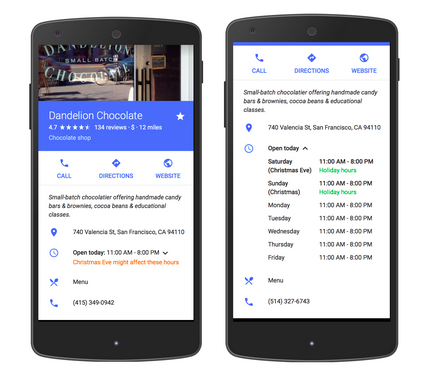
    Yesterday, a new My Business feature was published by Google in the product forums. This new feature allows business owners to pre-set special hours to their My Business listing for holiday closings or special times that are exceptions to your day-to-day office hours.

    google my business special hours exampleThere is more information in Google Support documentation. If you have many locations to update, there is a spreadsheet upload feature. If your business has hours that extend into a second day, there is information on how to manage that scenario.

    Editing Your My Business Special Hours

    This morning, I updated the office hours of a local credit union. This feature will be especially helpful in publicizing the dates their office is closed in the upcoming weeks. It will also be especially helpful to the community for finding the times each branch is closed, and we know Google is focused on user experience.

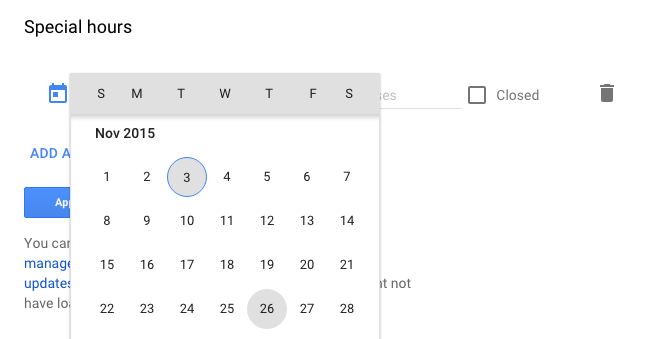
    Once you log into your Google account, navigate to your list of locations and choose one location to edit the location details. Scroll down to “Special Hours” below the standard “Hours.”

    choose the holiday date for special hours

    Click on “Special Hours,” and you can choose a day from a drop-down calendar and either apply early closing hours or mark if the office is closed the entire day.

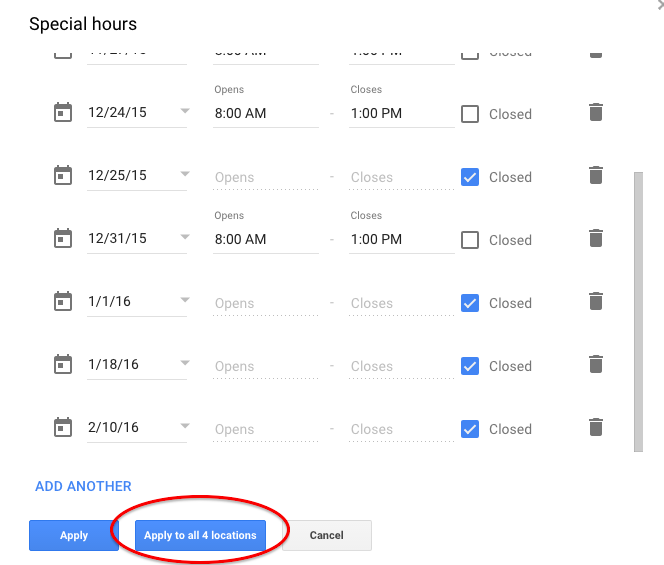
    If the hours will be the same at all of your locations, Google has thoughtfully provided a button to apply the hours to all locations within your account.

    Your final Special Hours or office closing times may look something like this for your summary review. Some days they are closed, and some days the branch is closing early:

    apply special hours office closed times to all locations

    Great New Feature

    You may want to set up some reminders to update your holiday hours every quarter or every six months.

    I know businesses have wanted this feature for quite some time, and now it’s available just in time for Thanksgiving and the December holidays. Very good timing, Google!

  • ‘Tis the Season: Ten Ways to Enhance Your Online Presence All Year Round

    2

    Traffic to your website depends on how relevant your landing page is in relation to the terms being searched and how well optimized your site is in the eyes of Google. If demand for your products and services is low for a certain time of the year, chances are search volume will also be lower, resulting in less traffic to your site. Having a strong online presence is all about understanding user behavior and optimizing your site to achieve the best results. In order to accomplish this, utilizing a seasonal SEO strategy will help boost your overall online performance annually.

    Whether your business maintains consistent demand or changes with the time of year, there’s something for everyone when it comes to seasonal SEO!

    What Is Seasonal SEO?

    Seasonal SEO refers to optimizing your site for seasonal keywords in order to get more visibility in search engine results during a specific time of the year. For example, let’s say you own a jewelry business. Around the holidays, search volume will increase for Christmas presents. Instead of just optimizing your site for vintage jewelry, you may try optimizing for “Christmas vintage jewelry,” “vintage jewelry for Christmas,” or even “holiday vintage jewelry” in order to enhance your site’s ability to be found amidst the high search traffic for the season. Optimizing your site seasonally could prevent your business from missing out on additional holiday revenue.

    22310142726_1b807169fc_z

    Capitalizing on the Seasons

    So how does one go about optimizing for the seasons? Here are five tips to get your site ready, no matter the time of year.

      1. Do your research. Don’t just blindly select any season to optimize your site. Look at year-over-year data on Google analytics to make inferences on when traffic to your site is the highest in order to determine what season optimizing your business will most benefit from. You will want to concentrate your efforts on one to two seasonal holidays, three at most.
      2. Start planning now! Once you’ve selected which seasons you will be optimizing for, create a seasonal SEO calendar to outline which items you intend to seasonally optimize. (Local SEO consultant Andrew Shotland has provided an excellent resource here.) Keep in mind that searches for most seasons start much further in advance. For example, planning for Valentine’s Day starts mid-January. Once more, it can take a while to gain momentum when it comes to SEO, so starting months in advance is key.
      3. Create unique pages of seasonal content and optimize it for the appropriate seasonal keywords. During the season, place the seasonal landing page in the main navigation, HTML sitemap, and XML sitemap so that humans and search engine bots can access it more easily. Create one or two seasonal pages annually, three at most.
      4. Update your meta descriptions for seasonal pages and your site. Meta descriptions exist to facilitate a higher click-through rate between the search engine results page and your website. Not only is it a good idea to create seasonally focused meta descriptions for seasonal pages, but it is also a good idea to update the meta descriptions of your year-round pages (i.e., your home page) so that they’re seasonally focused for the time being. After the holiday season is over, be sure to change them back.
      5. Do not delete seasonal pages once the season is over. It can take a while for new pages to gain authority and recognition with Google. Once you get a seasonal page to rank, deleting that page would mean that you would be starting from scratch the following year. You can simply reuse the seasonal pages for next year by updating the content. Because you may not want to keep these pages in your navigation all year round, it is very important to keep these pages indexed in both your HTML and XML sitemaps so that these pages remain crawlable and hopefully indexed all year round. When the season rolls around again, be sure to implement it back into your navigation again. Rinse and repeat.

    Off-Season Businesses

    But what happens if you own a seasonal business? Perhaps your store is closed during certain times of the year (i.e., a ski company closed for the summer), or perhaps nobody is looking for your swim store’s bikini line in the middle of January! Do not fear: indeed, while search traffic to your site will be lower off season due to its correlation to current consumer demands, there are still steps you can take to maintain your online presence year round.

      1. Do your research. Look at year-over-year traffic and conversions in Google analytics to ensure you’ve identified the correct high season for your business.
      2. Display positive customer reviews off-season. While the season is still in its prime, be sure to gather customer reviews about your business, especially your Google+, Yelp, and Bing pages. For example, a family may decide in May that they would like to take a winter ski trip. They may begin reading reviews on ski resorts and ski gear months in advance in order to be well prepared for their upcoming trip.
      3. Engage in social media all year round. It is critically important to always be engaged with your clients and potential clients on social media. Here’s why.
      4. Play up off-season hype. When it’s snowing outside, it wouldn’t hurt your business to post a picture of a sunny beach with your company’s sandal line to generate top-of-mind awareness even off season.
      5. Create interesting blog topics year round. This will provide readers with plenty of content during peak season as opposed to taking a break from posting during off-season months. It will also generate fresh content for your site, which signals to Google that your site contains relevant content for viewers.

    How do you maintain your business’s online presence year round?

  • A Little Bit Goes a Long Way: Small Steps For Improving Your Online Presence

    Establishing your online presence can seem like a daunting task for small businesses or those who are less knowledgeable about the tech world. Fortunately, there are a few simple ways to market your brand and engage your customers without the hassle. Taking actions like creating social media accounts, keeping your content relevant, and being proactive are valuable ways to attract and keep prospective clients and customers.

    Create Social Media Accounts

    One of the easiest ways to promote your product or service(s) online is by interacting with current and potential customers. A good way to do that is through social media. In the last decade, the social media world has exploded in popularity. Social networking services such as Facebook, Twitter, and Instagram (because who doesn’t love artsy photos of…things) are just a few simple ways to promote your brand while giving you the opportunity to interact with potential clients. The best part about them? They’re free and can be set up in just a few easy steps. Sharing content on your social media account allows you to not only communicate with current clients or customers, but it may also lead those consumers to share it with those who wouldn’t have seen it otherwise.

    Keep Your Content Relevant

    Whether it’s on your social media accounts or your website, it’s important to keep your content fresh and up-to-date. There are few bigger turnoffs to online users than seeing out-of-date information about your company. Offering a new product or service? Customers should know about it (and let’s be honest, you definitely want them to). Moved to a new location? Be sure to change your address. No one wants to get to your “location” only to find out that you’re no longer there.

    CC1

    Be Proactive

    If you’re famous, it’s probably best to avoid reading what people are saying about you online. If you’re a business, you better be. Read online reviews to find out what is or isn’t making your customers happy, and make any necessary adjustments when possible. Engage with your customers directly to show them that you hear them and are working on ways to improve a product or service. Think like a customer. What were some experiences that caused you to support or abandon a certain brand or business? You can’t make everyone happy, but you can certainly take steps to appease the majority.

    There are many other ways to improve your online presence, but these are just a few, easy steps to get started. Interacting with consumers through social media, providing relevant and up-to-date content, and getting proactive will help you to market your brand in a digital world.


  • Retool Your Online Presence: 3 Tips for Small Auto and Home Repair Businesses

    Everyone can relate to the frustration surrounding a defunct air conditioning unit or a well-traveled car falling apart—which is part of the reason why HVAC and auto repair companies are ubiquitous, particularly in the small business arena. As it stands today, there are over 1 million home and auto emergency companies represented in the U.S. alone. With such a large presence, it may be difficult to stand out, particularly in the ever-evolving world of digital marketing and search results. How does my company get noticed?

    Thrive Analytics, a digital marketing research company, sought to shed some light on this question. Their research indicated that while the fastest-growing methods of business awareness were related to digital platforms (websites, social media, e-mail), 60% still spent the majority of their media budget on traditional types of marketing (newspapers, yellow pages, direct mail).

    Additionally, their polling discovered that only 53% of these businesses had and maintained a website. However, the majority of those sites were archaic by today’s standards, and even more so when considering the ever-growing importance of mobile searching. Suffice it to say, many businesses in these industries do not get the maximum return from the growing digital market. So how can you counteract this?

    1. Develop and maintain an up-to-date and mobile-friendly website.

    The Local Search Association announced early this year that mobile searches have surpassed computer searches in terms of volume. Also consider this statistic from that same press release: “70% of the nearly $18 trillion US GDP is driven by consumer spending that occurs within 20 miles of home or work.”

    This is an extremely important factor for businesses servicing people’s homes and vehicles, since they are reliant on proximity. Your business will run the risk of losing a market share locally that is becoming more and more dependent on search results for information.

    2. Find your presence on social media.

    While many businesses have a presence on social media sites, it takes more than mere existence in order to drive customers. Staying on top of your social media with relevant content and attractive profile and cover images is more important.

    This is also applicable for mobile users. According to comScore’s 2015 U.S. Mobile App Report, the amount of time people spend on digital media has increased 50 percent over the last two years. Social media platforms are a huge part of this number—with Facebook ranking as the #1 smartphone app by total time spent. In an industry where social media usage is often stale or non-existent, this can be an opportunity to differentiate yourself and grab attention.

    3. Think about how you are spending on marketing.

    Sure, traditional marketing methods are comfortable and certainly have merit, but if you are trying to reach a new customer base, it would be foolish to not consider the shifting search demographics. Of the businesses polled in Thrive Analytics’ report, 37% of responders said lack of experience with online media was their biggest apprehension, while 27% said it was time. This is where it make sense to enlist the help of a company that understands the market and can help maximize your presence. It does not need to be a task directly undertaken by your employees, and it would represent a smart way to allocate media dollars.

    For small businesses that make up a large portion of the small business landscape and a relatively small section of the digital marketing field, building up your online identity and marketing strategies could be the key to drawing in customers ahead of your competitors.

  • Franchise Marketing: If You Aren’t Following These 4 Tips, You Aren’t Doing It Right

    1508-SI-Custom-KL-C-02-featured

    Franchise opportunities and the franchise sector grew by a whopping 28,800 jobs in June 2015, according to the latest report from the ADP Research Institute. It’s true: franchises in the U.S. are growing at a powerful rate. With this growth comes a need for specific digital marketing solutions to deliver optimal franchise marketing results for companies with multiple locations.

    A strong local Web presence that is consistent with the franchise or corporate brand is proven as one of the most effective lead sources. In fact, local franchisee websites were voted among the most effective customer lead sources behind only customer referrals, according to the 2015 Franchise Local Marketing Trends survey conducted by franchise software company FranConnect.

    Strategize to Succeed in Online Marketing

    Local website marketing strategies are a necessity for success, yet many franchisors are not providing any support to ensure their franchisees succeed online. Consider this: nearly half (48.2 percent) of franchisees manage local marketing, including franchise SEO, by themselves without corporate support. Another 44.6 percent manage their local marketing through corporate support, according to data from the survey.

    Set your franchisees and multi-locations up for successful Internet marketing and franchise SEO with this local marketing checklist.

    1. Create location landing pages for every location within your multi-location business.

    Each business location or franchise should have its own location landing page on the brand website. This strategy allows major search engines like Google, as well as your customers, to better decipher the different locations in specific geographic areas.

    1508-SI-Custom-KL-C-02-a

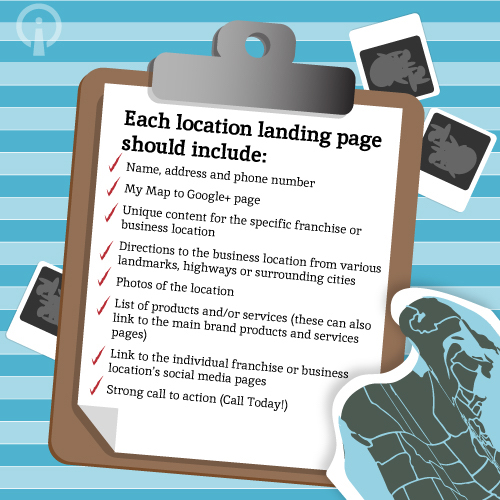
    2. Each location landing page should include the following for successful SEO for franchises:

    • Name, address, and phone number
    • My Map to Google+ page
    • Unique content for the specific franchise or business location
    • Directions to the business location from various landmarks, highways, or surrounding cities
    • Photos of the location
    • List of products and/or services (These can also link to the main brand products and services pages.)
    • Link to the individual franchise or business location’s social media pages
    • Strong call to action, such as “Call us today,” “Schedule an appointment,” or “Get a free case evaluation” for a law firm, for example.

    3. Leverage online directory listings for new franchisees.

    More than half of franchise CEOs and marketing execs have said that online directory listings for new franchisees are often created by corporate (some with agency and franchisee support). At the same time, 16.7 percent stated that new listings are simply not established, according to the Local Marketing Trends survey mentioned above.

    1508-SI-Custom-KL-C-02-b

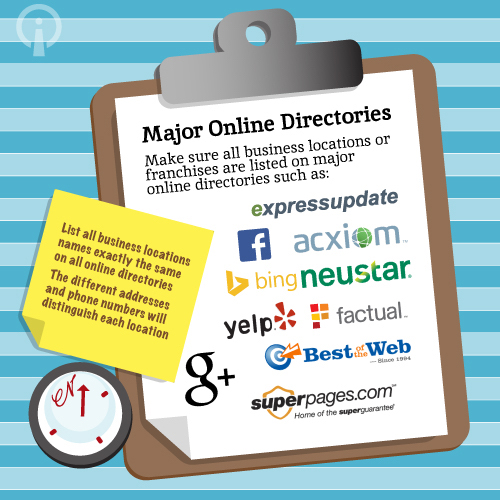
    4. Confirm that all business locations or franchises are listed on major online directories, such as the following:

    • Google
    • Bing
    • Yelp
    • Facebook
    • ExpressUpdate
    • Localeze
    • Acxiom
    • Factual
    • Best of the Web
    • Superpages

    Be sure to list all of your business locations’ names exactly the same way on all online directories instead of “Company Name – Specific Location.” The different addresses and phone numbers will distinguish each location.

    The secret to setting up every franchise or business location for local marketing success is that it takes work. The fact is that 60 percent of corporate franchise offices have marketing teams of only one to three people, according to the Local Marketing Trends survey. Search Influence provides online marketing solutions for franchise and multi-location businesses, whether they consist of two business locations or several hundred. Contact us to find out how we can maximize your franchise marketing online, including franchise SEO and more.

  • Hang Out with LocalU and SI to Master the Art of Facebook for Business

    Hang Out with LocalU and SI to Master the Art of Facebook for Business

    With the recent changes to Facebook’s business integration, business owners may be puzzled about how to best use the social platform for marketing and customer interaction. These questions and more will be answered this Friday, September 25 at 11 a.m. EST at Local University’s live hangout featuring Search Influence CEO Will Scott. Scott will be joined by some of the biggest names in the local search & social community: Mike Blumenthal, Mike Ramsey, Matt Siltala, and David Mihm.

    Local University, aka LocalU, offers full- and half-day crash courses in SEO and the basics of Internet marketing for business owners in various cities throughout the year. Past cities have ranged from Seattle, Philadelphia, Birmingham, and New Orleans. LocalU also hosts Google Hangouts discussing new and updated online marketing best practices.

    September’s Hangout is sure to give business owners a deeper look into the importance of Facebook marketing, including how to navigate the updates to Facebook’s business interface.

    With over 890 million daily active Facebook users, Facebook is an integral part of building customer relationships and brand awareness.

    If you’re looking to learn more about the complex world of Facebook marketing, this hangout is one business owners won’t want to miss. Hang out with LocalU and SI as we discuss all things Facebook marketing: best practices, fan-building strategies, new communication features, and more!

    RSVP today to reserve your spot and add it to your Google calendar automatically!

    You can even begin submitting your Facebook marketing questions on the event page today as well.

    See you Friday!

  • Ya-Who? The Slow Decline Has Already Begun for Yahoo’s Local Listing Service

    Changes can surprise the SEO world (looking at you, phantom Google updates), and sometimes, changes can be seen a mile away. This is when everyone should look at Yahoo and their local listings. Their importance is diminishing every day, and eventually they will be a thing of the past, like Google Plus Authorship.

    The Decline of Yahoo

    Though Yahoo’s importance is not as cut and dry as Google Authorship, I’m going to throw out some information that has me making this prediction with as much certainty as predicting that New Orleans will get rain sometime in July.

    Is It Worth the Trouble?

    Now, you can argue that since Yahoo was still the 3rd most common search engine as of July 2015 according to comScore, it is worth it to pay attention to Yahoo Local listings.

    That is a good argument that we should still pay attention in the SEO world, but that is only one side of it.

    Though a very high-ranking search engine and site in general, I’m arguing that their local listings are not worth the time and effort that comes from hassling with support over email, phone, or even Twitter. Since Marissa Mayer took the helm in 2012, Yahoo has been turning their focus away from their older products, such as their Maps and even directory service. Along with these seems to be native local listings.

    From an SEO standpoint, Yelp is the real “Y” of the listing world, especially with the ever-rising importance of reviews. I see it becoming the only “Y” in a year or so. So with that in mind, “Y” even bother with Yahoo?

    Yahoo-logo

    Image Credits:

    Homer Simpson GIF
    Yahoo Logo

  • For Small Law Practices, Online Resources Can Be Judge & Jury

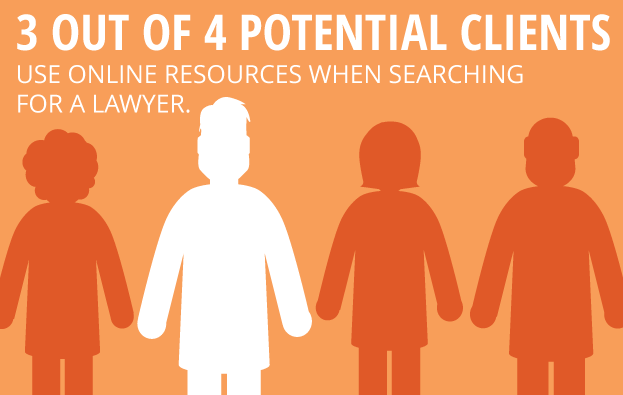
    For many solo practitioners and small law firms just starting out, establishing a consistent client base is the number one priority. In the increasingly competitive land of marketing your law practice, it’s imperative to look beyond the traditional methods such as putting your picture on a billboard, directly contacting potential clients, or simply hanging out your shingle. According to a survey conducted by the Research Intelligence Group, three out of four potential clients use online resources when searching for a lawyer. With that in mind, utilizing a few simple tips can make a huge difference in getting your new law practice found online.

    1511-SI-Newsletter-KG-E-02

    1. Develop and Promote High-Quality Content

    If you’re just in the initial stages of developing your website, it’s wise to keep things simple and focus on quality rather than quantity. For instance, create a few targeted website pages that are written with the potential client in mind, rather than cluttering up your site with an overload of information. Once you have high-quality content in your arsenal, make sure to utilize a social network to promote that content. Also, consider focusing on one social network that you expect will attract the most business, and write timely and substantive posts for that one network.

    LawyerFortunCookie

    2. Create a Blog

    One important way to increase your online visibility and improve your chances of getting to the top of Google’s organic search results is to create a relevant and authoritative blog on your website. A blog is a great way to establish your authority on subjects relevant to your practice while also allowing for the occasional posting of upcoming community events or helpful nonlegal articles. You can also set your blog to automatically post to social media platforms such as Facebook, Twitter, and LinkedIn.

    GavelAndGlobe

    3. Focus on Local

    Think of your potential client base and how you would traditionally market to that group. Getting involved with your community by speaking at regional networking events and participating in local organizations can help establish yourself as a local expert in your field. Internet marketing is another step in that process and can go a long way in bringing in new business. For example, creating consistent profiles across local directories can help you rank higher on Google. Also, consider developing a strategy for gaining local user reviews on websites such as Yelp.

    Starting your own law practice can be daunting, but utilizing these simple tools can make a big impact in helping potential clients find you online.

    Image Sources:

    Lawyer Fortune Cookie

    Gavel and Globe

  • Word of Mouth in the Digital Age: The Importance of Online Reviews

    SmallBusinessWoman

    Having just moved, I’ve spent a lot of my free time shopping on Amazon. From new bathmats to nice wine glasses, a majority of my paychecks have gone towards furnishing my new house. One thing I really needed, though, was a solution to the rock of a mattress that came with the apartment. I needed a mattress topper. Since it was something I would use every night, I wanted the ability to test out the feel of it first. The only negative of Amazon is that you can’t do that. So, whose opinions can I trust other than my own? Fellow customers.

    I spent all night (on the rock) searching through different mattress toppers. I didn’t look at the actual toppers as much as the reviews, though. “This one’s too lumpy,” or “This one smells funny” were the words that guided me to finding the perfect topper. And now, I’m sleeping like a queen, thanks to my fellow customers.

    In this scenario, I was the customer, and the product was the business. I passed up on a lot of toppers that were probably just as good as the one I ended up getting. Having a lot of bad reviews or no reviews at all were the deciding factors for me, and these things can be the deciding factors for whether or not your business succeeds online.

    Consumers Trust Online Reviews Statistic Image

    Why Reviews Matter

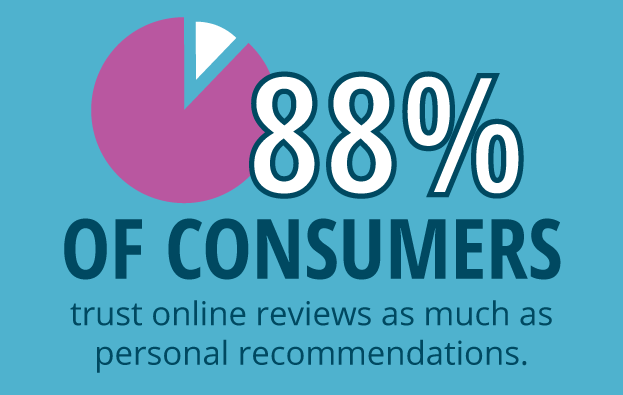
    According to a study done by BrightLocal, “88% of consumers trust online reviews as much as personal recommendations.” Reviews can greatly impact consumer decisions, showing how valuable positive reviews are to local businesses. In the same study, “72% of consumers say that positive reviews make them trust a local business more.” Thus, positive reviews increase conversions.

    Negative reviews can hurt business and prevent a potential customer from converting. However, negative reviews can also be a positive thing. Negative reviews give a business unique insight in the ways they can improve, and they can also help eliminate consumer suspicion if there are too many positive reviews. A study done by Econsultancy found that “68% of consumers trust reviews more when they see both good and bad scores, while 30% suspect censorship or faked reviews when they don’t see anything negative at all.” Overall, businesses should leverage the value of negative reviews by working to enhance their business and improve customer relationships.

    SEO Benefits of Reviews

    Not only do consumer reviews enhance customer experience, but they also provide some SEO benefits:

    • Improving local rankings by showing Google that people are engaging with your brand on third-party sites like Yelp.
    • Adding new content to your site. Search engines like to see unique content being added to a site regularly.
    • Increasing chances of ranking for long-tail keywords. Users reviewing your business tend to use the same terms that other potential customers may use when searching for your business.
      • Add reviews to many pages on the site in order to increase the amount of pages ranking for long-tail terms.
    • Adding schema markup for reviews, which enables rich snippets.

    AmazonReviewScreenshot

    Sources:

    http://searchengineland.com/88-consumers-trust-online-reviews-much-personal-recommendations-195803

    https://www.brightlocal.com/2014/07/01/local-consumer-review-survey-2014/#methods

    https://econsultancy.com/blog/8638-bad-reviews-improve-conversion-by-67

    https://econsultancy.com/blog/9366-ecommerce-consumer-reviews-why-you-need-them-and-how-to-use-them/