Tag: local search

  • Trends in SEO: 2020 and Beyond

    The beginning of a new year marks a fresh start, new outlooks, and perhaps new approaches to a person’s conventional wisdom or habits. Digital marketing, though constantly evolving through the calendar year, is no different. As we begin to envision digital success in the new year, one important exercise is to evaluate where you have been and which trends you need to follow to stay ahead of the competition moving forward. Many of the topics we will discuss are not necessarily new information or revelations, but rather, the relative importance of them has increased and will continue to do so as search goes in a certain direction. With that out the way, let’s jump into the biggest trends that will impact SEO throughout 2020.

    Start Learning and Understanding Google’s BERT Update

    Announced in the latter half of last year, this announcement made waves in the search community due to the potential implications around how digital marketers perform keyword research and develop content. BERT, or Bidirectional Encoder Representations, originated as an open-source research project that aims to better understand the contextual relationship between words and how that tacit relationship may affect the meaning, or intent, of those words when used together. In plainer terms, it is a framework that tries to better understand natural language to deliver better search results rather than serving up more direct, literal word-for-word results.

    Bert from Sesame Street using a banana as a phone and saying hello?

    So, Why Does BERT Matter for Businesses?

    Google posted a blog on October 25th, 2019 announcing their reasoning behind introducing this new algorithmic feature. In his post Pandu Nayak, a Google Fellow and Vice President of Search at Google stated:

    “Particularly for longer, more conversational queries, or searches where prepositions like “for” and “to” matter a lot to the meaning, Search will be able to understand the context of the words in your query. You can search in a way that feels natural for you.”

    Essentially, Google is trying to deliver better results by understanding searcher intent rather than responding to an exact query. This has large implications for content because SEOs will now have to consider intent, or what customers are trying to find, rather than getting bogged down with the exact search value of a keyword string. That is not to say that keyword research does not serve a purpose; this type of research will be helpful to understand broad trends or high-level areas of the search funnel, but what businesses and digital marketers will need to better understand is what the searcher ultimately wants.

    The English language is chock-full of nuance, so this is really a move to try to get at the heart of that nuance. An example of that would be a query such as “how to play a stand up bass”—it is fairly apparent we are not talking about bipedal fish. Trying to better understand the relationship between words and why context matters when delivering search results is at the core of this BERT update. It bears mentioning that John Mueller from Google recently came out and reflected the idea that keyword research is not “dead,” but rather, diminishing in importance a bit:

    “There’s probably always gonna be a little bit of room for keyword research… And even if search engines are trying to understand more than just those words, showing specific words to users can make it a little bit easier for them to understand what your pages are about.”

    While it’s hard to trust Google when talking about these topics, it seems to me he’s implying there will still be value in optimizing towards general keywords with established search volume.

    This discussion leads nicely into another concern for digital marketers moving forward:

    Expansion of Voice Search

    This will be a much shorter section because, as it stands, most of the SEO recommendations made for voice search align with already established SEO trends applicable in normal search context. However, while there are not special SEO tactics needed for voice search, the level of adoption of this product is something to be mindful of because of—you guessed it—BERT!

    People tend to use more natural, longer-tail questions when using a voice-assistant device. A happy coincidence of generating content with BERT in mind is that it will inherently align with the intent of a lot of voice searches. This matters because, according to analytics firm Comscore, nearly half of the searches in 2020 will be done via a voice device.

    As we know, voice search typically serves up a single result that answers the query; in order for businesses to best position themselves for voice search, they will need to be mindful of both BERT and another large issue moving into 2020 and beyond:

    The Rise of Zero-Click Searches

    If you have used Google to find an answer to an inane question in the last few years, you have undoubtedly performed a zero-click search. It may be fairly obvious why these are called “zero-click searches,” but it’s important to understand why this is happening and the ways brands and businesses can work around a system that diminishes traffic to their website. The decline of clicks is likely the reality for the foreseeable future. As mobile and voice search grows, the need for Google to provide quick, relevant answers versus pushing you to a third-party site increases. The goal from there should be to figure out how to get your brand best positioned to be the answer that voice and mobile searchers are looking for.

    As mobile search increasingly becomes the search method of choice for users, it’s helpful to visualize just how this impacts user behavior. Let’s take a basic question like “how to fix a bike tire.”
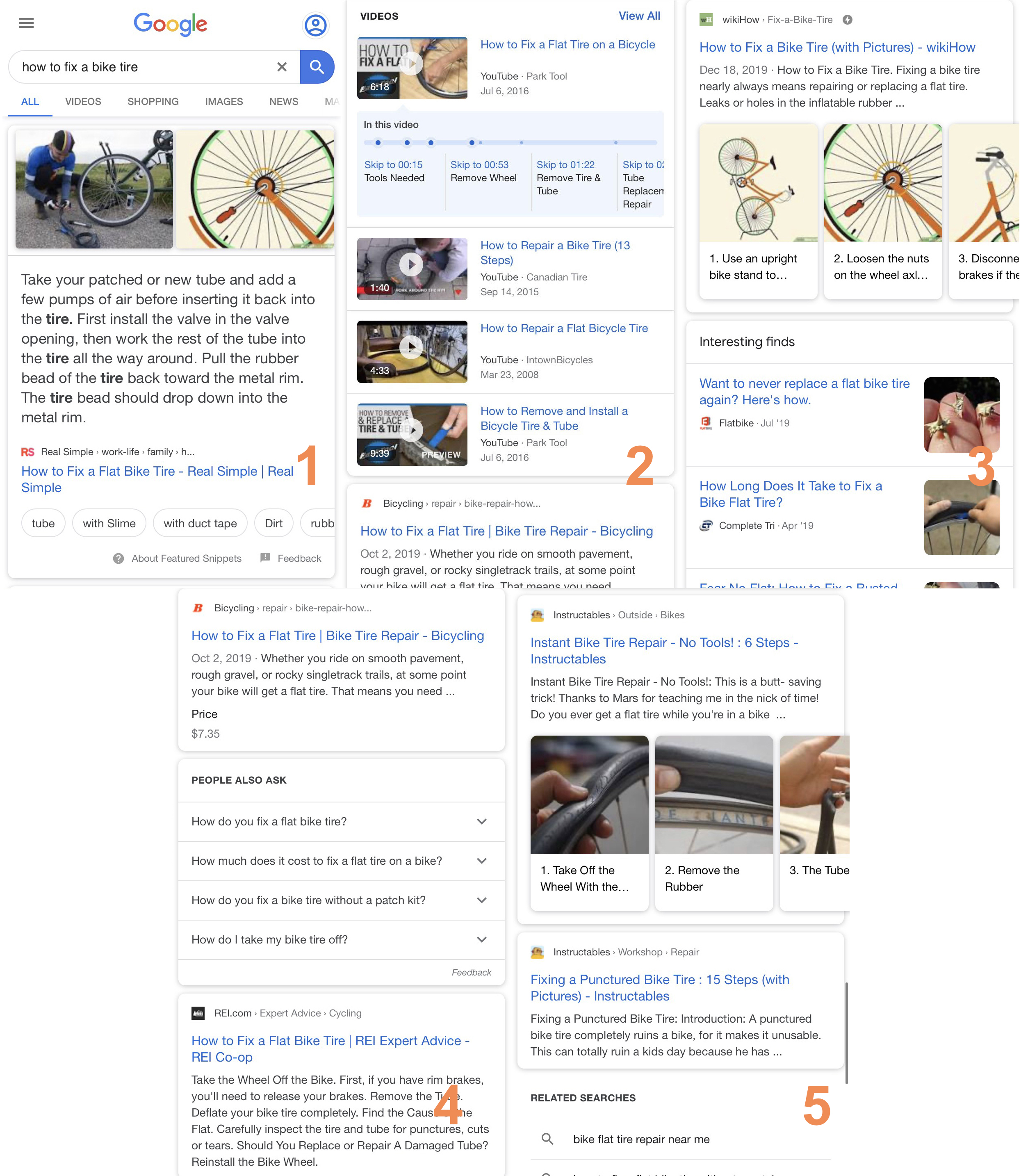
    Screenshot of mobile search on Google for Search Influence blog

    As you can see, there is competition amongst featured snippets, video content, and embedded images. While discussing this very topic at Local U Advanced in Denver, CO, Cindy Crum from MobileMoxie offered a really interesting visual way to see why zero clicks are becoming more and more important to deal with. If we block out anything that is not a traditional “organic result” in the SERP, you will see that other types of results occupy most real estate.
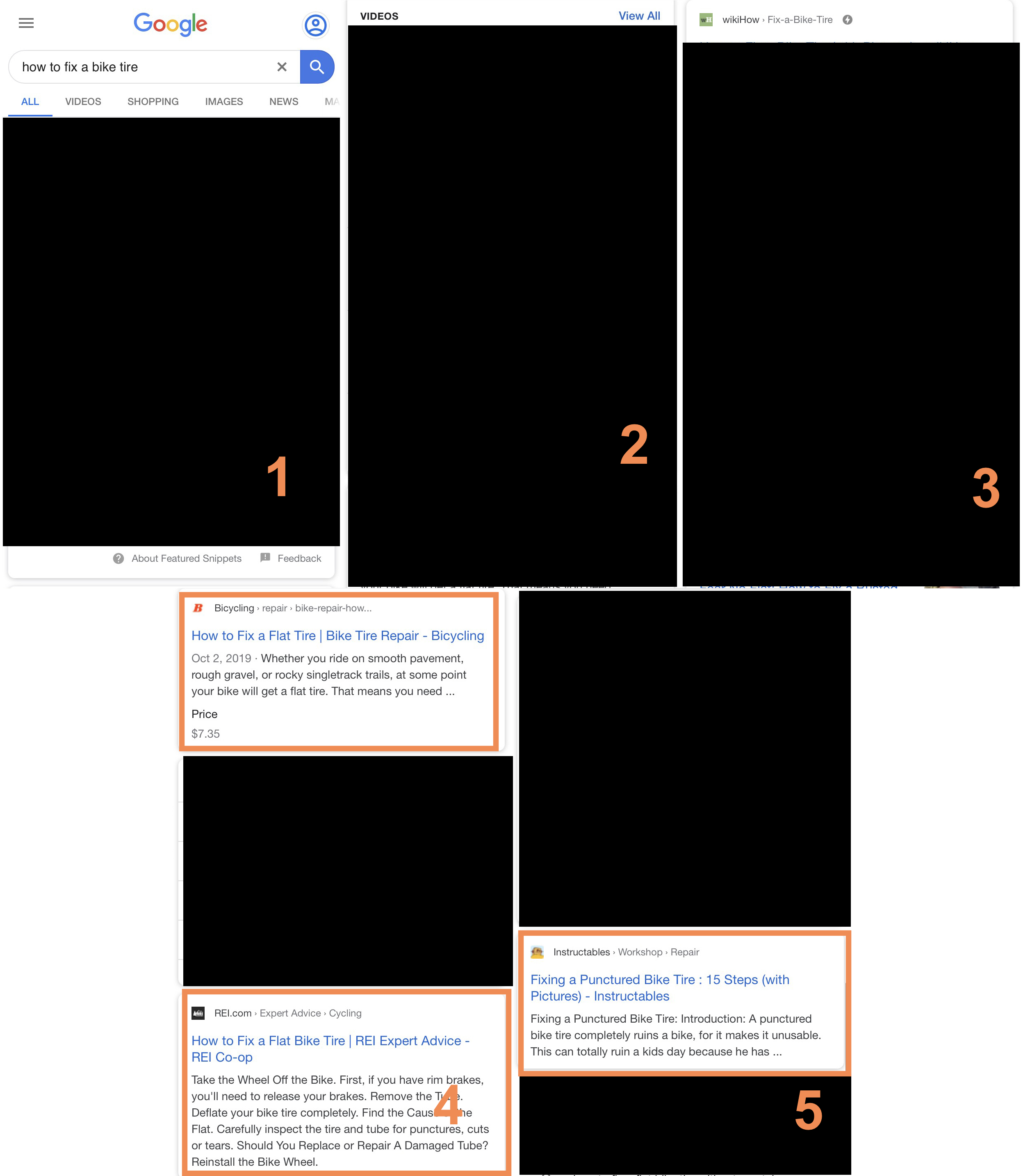
    Mobile search on Google with all non-organic results blacked out

    How to Combat Zero-Click Searches

    It may be time to stop thinking purely in terms of organic traffic. Much of SEO for businesses moving forward is about visibility. How can we position ourselves to be the brand that answers the questions our clients want to know? This is why content will continue to be the backbone of any SEO strategy. Doing proper research into the questions, queries, or searches that align with your business goals and striving to be the authority in your industry is the best way to ensure you remain competitive—and visible—in a landscape that does not necessarily reward good content with clicks.

    In shorter terms, you really want to try to be the featured snippet. This is an extremely difficult task as we know there is a high barrier to entry and it takes content tweaks, patience, and a strong will to see it through to grab snippets. Good content research includes finding the least competitive snippets and prioritizing those over a more competitive, higher level search. Doing simple keyword research is not enough nowadays. Moving forward, thinking about how these searches propagate results is equally as important.

    Google Maps: The New Home for Local Search?

    When people think of search, the Google homepage with the requisite search box is likely most people’s first mental image. However, for businesses moving forward, there should be an increased focus on how the Google My Business/Google Maps product is influencing and driving local search.

    Another big takeaway from the Local U Advanced conference is the volume at which users are going directly to Google Maps to find local businesses. According to the data from industry thought leader David Mihm’s presentation, from March of 2018 to August of 2019, 72% of all impressions on search were on Google Maps as opposed to Google Search (the traditional SERP). This is a huge discrepancy, and one of the big takeaways is that businesses are not leveraging Google My Business as much as they should.

    In order to be competitive in rankings in Maps, it is important to breathe as much life and information into your listing as possible. This includes driving reviews and optimizing descriptions, including appointment links, booking platforms, a healthy number of photos and videos, answering questions, and, finally, ensuring you are engaging with reviews. While proximity to a location plays a huge role in how the Maps listings are displayed, if you are actively managing your profile, the chances are that you will see some benefit.

    Also, consider how public-facing this listing is. If it looks sloppy, incomplete, or utilizes blurry images, users might be less engaged and less inclined to click through to your listing. While this seems relatively simple, many businesses fail to leverage this product—or even use it at all.

    Design Your Site for Mobile First. Always.

    This is not new for 2020, or even 2019 for that matter, but that does not minimize the importance of designing your site to perform well on mobile. Back in late 2018, the SEO community started talking about mobile-first indexing, and this was a major shift in the way search engine crawlers—and Google—understood and indexed your site.

    In response to Internet searches becoming an increasingly mobile experience, Google decided to push developers and business owners in that direction by making the mobile version of the site the version that is indexed in Google. In other words, Google crawls the mobile version of your site and makes determinations about its health on that basis. Web development is often thought about in terms of desktop computers, but it is becoming increasingly the case that your mobile version is at least, if not more, functional than the desktop experience.

    One of the biggest factors and problems searchers find with mobile sites is the overall speed. We know there is a direct correlation between load times and how many people will abandon your page. In the same way that users respond negatively to slow sites, the crawler will factor that in when crawling your site. A slow experience is not good for users, crawlers, or your business.

    This became increasingly visible to digital marketers when they rolled out site speed evaluation in Search Console. Google is essentially giving people feedback about their site speed in the hopes that flagging this will lead developers and businesses to try to create better mobile experiences for users. As seen below, this a report that is now standard in all Google Search Console reports.
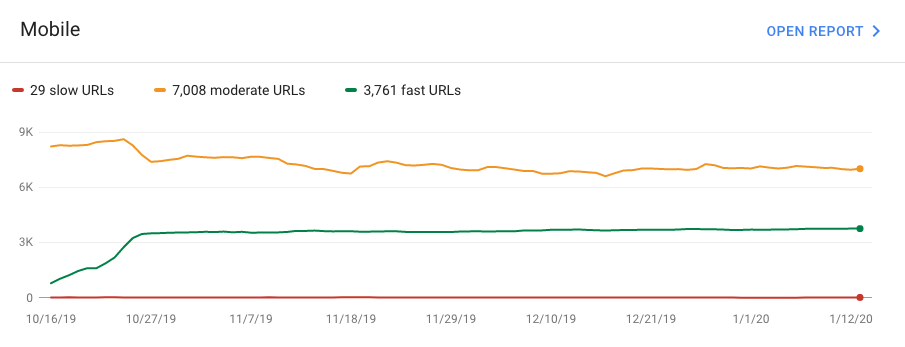
    Example of Google Search Console speed tests for Search Influence blog

    Google has been poking and prodding at digital marketers and developers for a while, indicating their sites are “relatively slow.” To the extent that this is accurate is questionable in my view—my belief is Google is inclined to tell you that your site is slow because they want you to go after improvements that ultimately make Google’s life easier. In that way, I do not see it as super nefarious because ultimately it helps everyone in the end, from users to large businesses.

    What’s Old Is New

    While we have pinpointed some newer aspects or changing directions, there are some old tenets of SEO that will remain very important moving forward. Backlinks are still relevant, you need to leverage structured data, video content will remain a huge differentiator in terms of content, leveraging E-A-T guidelines and content can help drive traffic, and, finally, write good content that serves the need of your users.

    SEO is constantly evolving. Many of these trends will change over the coming months, and different algorithms will impact different industries in unique ways. It will be next to impossible for businesses to develop the “perfect” site for ranking well—the best we can do is interpret what Google is asking for and do our best to align with their needs while also considering the needs of users. Ultimately, Google is incentivized to provide the user a good search experience, so by reading the tea leaves and (skeptically) following their guidance, your site should be in a good place to grow its audience.

    Do you have questions about how SEO could help your business? Need a consultation? The team at Search Influence has experience managing SEO campaigns of all shapes and sizes. Reach out to us today for more information.

    Images

    B.E.R.T.

  • 10/10 Would Recommend: Leveraging Reviews and Testimonials in the Digital Age

    This post was updated by Anita Shah. It was originally written by a Search Influence alum on January 12th, 2016.

    Customer review comment boxes

    Before you book a room at a hotel or make a reservation at a new restaurant, do you read the online reviews? According to a study conducted by BrightLocal, “86% of consumers read reviews for local businesses (including 95% of people aged 18-34).” But don’t worry, this statistic is not limited just to businesses like restaurants and hotels; these numbers apply to businesses across industries.

    How You Can Use Feedback for Brand Awareness

    Reviews and testimonials have traditionally provided insights into how a business can better serve its customers. With the evolution of digital marketing, the role of reviews and testimonials has also evolved. Feedback about customer experiences is now critical for gaining new clients. With so many consumers turning to the internet before opening their wallets, reviews and testimonials are user-generated content that drives consumer decisions. A review and testimonial webpage showcases real customer experiences and creates a new, powerful platform for interaction between businesses and customers.

    Having a regularly updated review or testimonial page on a website is a great way to communicate the quality of your services and to get the individuality of your business across to potential customers. Authentic reviews throughout social media and review sites like Yelp or BBB will also promote your brand. In the digital age, consumer interaction via these platforms is an affordable and necessary method of gaining new leads.

    How Reviews and Testimonials Impact SEO

    SEO rankings are not just based on what you have to say about your business. As Google continually alters its algorithm for increased transparency, consumer content—or what other people have to say about your company—is impacting SEO.

    In fact, the 2018 Local Search Ranking Factors study by Moz states review signals are the third most important maps pack ranking factor. Some other examples of review signals include the following:

    • Review quantity
    • Review velocity
    • Review diversity

    Keyword-rich onsite content is one of Google’s most important ranking factors when it comes to organic search. Customer reviews are likely packed with those high-yield keywords for which you want to be ranking. Utilizing these reviews on your website allows you to put customers to work for you, so you can secretly shape your SEO structure without lifting a finger.

    The Importance of Authenticity

    Remember that reviews and testimonials are real-life recommendations. There may be some negative ones, and that’s okay. Econsultancy reports that 68% of consumers actually trust online reviews more when they can see a mixture of both positive and negative feedback. As long as the negative reviews make up a minority of the input, a business should expect beneficial outcomes.

    Since a review and testimonial page should be a space that helps reduce the risk of duplicate content, a quality review would not be a simple, bland statement. Comments such as “Great service!” or “Quick response time” may not help with an SEO campaign. These reviews also fail to highlight what makes your business unique, superior, and reliable. An effective review or testimonial does not necessarily have to be lengthy, but it should showcase what makes your business stand apart from the competition. Particularly good reviews can be placed in a spot of prominence on a website or even repurposed as a social media post.

    How to Garner Positive, Effective Reviews

    The idea of positive reviews is great, but what about those inevitable few detractors? To minimize negative input, there are three things to consider when asking for a review. You must ask for the review at the right time, with the right messaging, and through the right platform.

    If that sounds like a lot to think about, then let Search Influence take care of it for you. Our specialists can help put you a click ahead of the competition. Reach out today.

    Images:

    Comment Boxes
    Cartoon Customer

  • How to Bounce Back From a Bad SEO Experience

    If you or someone you love is struggling to bounce back from a bad SEO experience, please call 504-208-3900 today.

    Let me first start by saying, I am truly sorry. I hate to hear our competitors are delivering anything less than a successful (and profitable) SEO campaign, and I really hate to know these companies are giving a great company, like mine, a bad name. Shame! I hope this blog can be therapeutic and we can strengthen your trust in SEO and humanity… together.

    If you’re reading this, you don’t need me to tell you how SEO is an investment and how it should be included in your marketing strategy. Actually, the more I think about it… maybe you do. Maybe the value was never clearly communicated or our competitors did a poor job in setting expectations. Again, on behalf of the industry—I apologize.

    Frustrated business owner after a bad SEO experience with Search Influence competitor

    A big step in therapy is acceptance. Together, let’s accept that an immediate impact is not possible with SEO. Let’s also accept that in the SEO world, Google controls life. If we understand the algorithm and play by the rules, there’s no reason this experience should be negative. As a reminder, Google is responsible for 94% of total organic traffic, so yes, we play by the rules. If you think I’m just drinking the Google Kool-Aid, know that 61% of marketers say improving SEO and growing their organic presence is their top inbound marketing priority.

    If you’ve ever sat in on one of my webinars or pitches, you’ve heard my analogy—SEO is the marathon and paid search is the sprint. SEO is organically strengthening a brand’s authority, and it’d be illogical to believe anything organic can efficiently mature and be optimized in a short period of time. If you’ve heard “we can increase rankings immediately” or “I promise you’ll be on page one,” SEO wasn’t the right campaign for you. If you are looking for immediate results, it’s possible with paid search. I don’t want to beat a dead horse, but expectation-setting and communication is key to any partnership. It’s possible that your previous SEO campaign was strong and could have been very successful, but expectations on results and return wasn’t effectively or honestly communicated.

    Over the last seven years, I’ve worked with and regained trust of many business owners and marketing executive who’ve come to Search Influence a little gun shy. Over the years, I’ve had time to think of all the things I wish clients would have asked our competitors when they weren’t doing their job. I’d also like to share some of our unique selling points that aren’t broadcasted because it’s so natural to our team and part of our core, we sometimes forget to share.

    Anyone investing in SEO, especially while recovering from a negative experience, should consider the following when interviewing new marketing partners.

    Partner With a Transparent Agency

    Like any relationship or partnership, communication and trust are crucial. At Search Influence, we truly see our team as an extension of your company and brand, and we want you to trust and challenge us as much as you would your own. In employee interviews, you ask for references and work experience. Why should hiring a marketing partner be any different?

    When you’re vetting through agencies, ask for client references. We know that customers are 88% more likely to trust a review or testimony from a complete stranger as much as family and friends. If numbers are all you care about, ask for success stories. I encourage you to not only ask for references and case studies within your own industry, but in others, as well. Analyzing an agency’s ability to target different types of audiences like college freshman vs. concrete manufacturers or write strong legal web content vs. e-commerce ad copy shows willingness to understand your audience and shows they aren’t cookie cutter.

    Team collaborating on SEO marketing efforts

    Don’t Be Afraid to Ask the Hard Questions

    No relationship is perfect, but before starting a new partnership, don’t you want to know why it didn’t work out with all the other ex-girlfriends? Don’t you want to know who broke up with who and why, and if we ever break up, are you going to be salty and never return my stuff?  

    The first cut is the deepest, so let’s cut to the chase and ask the hard questions that are extremely important. I strongly encourage you to ask the following questions:

    • What happens if it’s not working and I’m not seeing results?
    • What’s the number one reason clients part ways with your company?
    • How do you hold yourself accountable?
    • If you create logins on behalf of my company, will you share them with me?
    • Should I ever leave, will you remove work from my site?

    In my opinion, how the agency responds to these direct and powerful questions says more about their core values than the strategy alone.

    See What’s Behind the Curtain

    If Search Influence sees ourselves as an extension of your company, don’t you want to know how we operate? If I were in your shoes, I’d want to understand a day in the life of my campaign. I’d want to understand the frequency of internal communication, who Q/A’s site edits before they go live, how many editors sign off on press releases, and how frequently will I be hearing from my team.

    Maybe you’re not interested in a list of references or reading success stories, but are instead interested in what’s behind the curtain. To tease a little bit of the magic, I’ve listed just some of our day-to-day activities that are so routine we almost forget how glamorous it is to the other side of the curtain.

    • Results-Driven
      • Every campaign starts and ends with your goals. The strategy, the work, and the focus is centered around what we need to do in order to deliver success. We track conversions and measure success so we can confidently show you a positive ROI.
    • Think Like Your Target Audience
      • We evaluate the entire consumer journey and create buyer personas to understand their behavior online. We analyze their interests, triggers, frequented sites, content consumption, and more to implement a strategy to target and convert your audience into customers.
    • Transparency and Accountability
      • We’ve created a reporting dashboard to how you how your campaign is performing 24/7. Not only can you see campaign success, but you can see what our team is actively working on and tactics coming up the pipeline.
    • Proactive, Not Reactive
      • We’re constantly learning from each other through our daily department huddles and weekly company meetings. Our constant collaboration allows us to share what’s working and what’s not working and how we can improve. With every learning, we confidently and proactively bring new ideas to each campaign.

    Don’t let one bad breakup keep you off the SEO market forever. Get in touch with the SEO experts at Search Influence today so we can help you create and implement a targeted digital marketing plan.

    Images

    Frustration

  • How I Learned to Stop Worrying and Embrace Google Algorithm Updates

    Author’s Note: During the course of writing this blog Google took an unusual step (for them) and announced an impending core algorithm update. While this blog does not discuss this update specifically, the underlying themes about handling these updates should remain applicable. To learn more about this core update, I recommend reading some of industry news sources I have mentioned below. 

    Much like the sun will rise in the east and set in the west tomorrow, digital marketers and business owners alike will hear rumblings every few months about supposed updates to Google’s ever-elusive algorithm and begin to worry. For some businesses, these updates (or “improvements,” as Google usually euphemizes) can generate significant dips in traffic to their site and seemingly undo previously successful SEO efforts. A prime example of that scenario would be back in August of 2018, when SEOs noticed a noticeable drop in site traffic, particularly in the medical vertical.

    This led to wild speculation about the scope, purpose, and future impacts of this particular update. Undoubtedly, many digital marketing practitioners felt the effects of this update with diminished traffic to their sites. As someone who has worked on numerous SEO campaigns and strategies, I can certainly relate to the consternation around Google reconfiguring their algorithms to change the way sites are rewarded organically. In many instances, these updates can positively impact sites that may be less authoritative and in some cases utilize underhanded tactics that do not necessarily meet searchers actual needs.

    Lisa Simpson taking a scientific approach to Google algorith updates

    This is certainly very frustrating from a marketer’s perspective, as the parameters around what is best practice and how to win organically can shift seemingly overnight. When this is combined with Google’s textbook evasiveness around these updates, it may be overwhelming.

    So, How Should I Respond to a Google Algorithm Update?

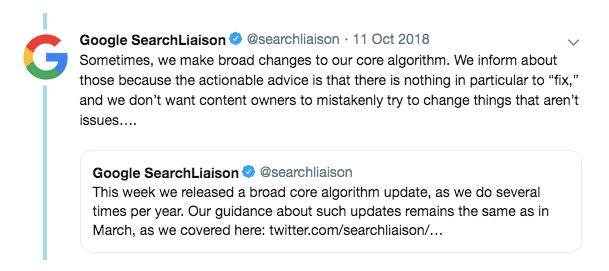
    Google has made efforts to become more communicative with SEOs in recent years (they even updated their “SEO Starter Guide” for the first time in over seven years back in April of 2019), however, they still are very cagey about what they are willing to reveal as it relates to specific algorithmic updates. In certain cases, if there’s enough of a perceived backlash from the larger SEO community, then Google representatives may take steps to address it publicly; however, those answers are typically engulfed in vaguery as well. Take this statement from Google’s Search liaison Danny Sullivan in the aftermath of the August and September 2018 updates as an example.

    “We understand those who do less well after a core update change may still feel they need to do something. We suggest focusing on ensuring you’re offering the best content you can. That’s what our algorithms seek to reward.”

    The word “seek” is pretty telling here, as it underscores the idea that the algorithm is imperfect. Also, consider the fact that Google is constantly reworking their algorithm to best serve searchers, another implicit sign that there is room to improve. The first thing you can do to help yourself respond to algorithm updates is to realize that 1) it’s not a perfect reward system and 2) these changes are out of your control. Additionally, the solution is intentionally vague and does not really define what “best content” really is.

    Screenshot of Twitter discussion of Google algorithm updates

    Above we see the acknowledgment. One can waste a lot of time questioning Google’s decision-making, but it is important to evaluate whether these updates have actually had a tangible effect on your business. In many cases, these updates may impact certain industries, but certain sites within that industry do not see the effects. Before looking at the macro of the issue, the focus should be on if there is any tangible impact on the micro level; in other words, did this update actually impact me? From there, you can start to take the steps needed to recover, if you even need to.

    How Do I Know When a Google Algorithm Update Is Occurring?

    Since Google does not typically acknowledge when an update is happening, digital marketers rely on third-party tools and anecdotal evidence to connect the dots. The best way to stay on top of this is by following some of the industry leaders who follow and discuss news stories of the day, such as (to name just a few) Search Engine Roundtable (who does an amazing job staying on top of chatter around updates), Search Engine Journal, or Search Engine Land.

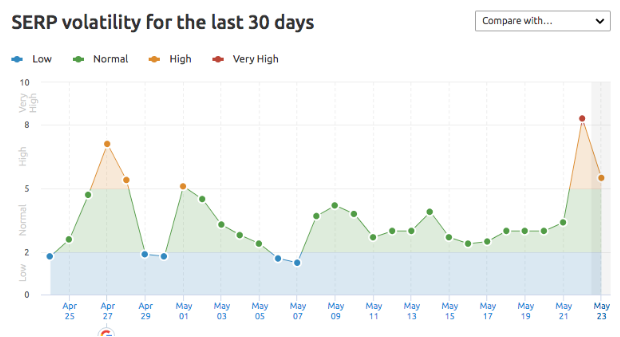
    Most reporting around these updates comes from what SEOs and digital marketers are seeing in real time, as well as from new tools that help monitor search engine volatility. One of these tools is SEMRush’s Sensor that measures the level of volatility across industries and across different countries. Often, the sensor will pick up on this volatility and the news about updates will follow in the next few days.


    SEMRush's Google algorithm sensor

    As you can see here, April 27th and May 22nd are of particular interest. SERP (Search Engine Results Position) volatility is noted as very high, meaning sites’ rankings have fluctuated greatly. As I write this blog on May 23rd, I am starting to see chatter around the typical sites about potential updates to Google. These are largely unconfirmed, and it’s unlikely that this is a massive update, but we do not know that until more SEOs and digital marketers weigh in or Google confirms these updates. What this tells us is that somewhere, in some verticals, rankings have fluctuated. Whether or not this is a result of an update or some other unknown factors is hard to know.

    It is important to remember this: these anecdotes and 3rd party tools are just signs, not concrete evidence. There are many examples of overreaction to this data and many times it can lead to unnecessary scrambling when it may just be a minor change or something completely unrelated to an algorithm change.

    Well, My Traffic Is Way Down, Now What?

    This is where it becomes tricky, as you must be familiar with your overall SEO strategy as well as the possible sources of these issues. This is why monitoring tools like SEMRush’s Sensor as well as the various industry news sources is imperative to running an effective SEO campaign. If your traffic is down as a result of an algorithm update, then there is almost assuredly highly skilled digital marketers attempting to diagnose and find solutions to the problems.

    Take this post about how to recover from the “Medic Update” from Search Engine Journal. This is chock-full of the usual pain points about these updates, Google’s vague acknowledgments, and some evaluation of previous updates. In addition, however, we get plenty of great strategies around content to help rectify the issue. The volatility of SEO and rankings allows for your site to recover if you continue to be ardent about following best practices and putting effort into your strategies. Furthermore, you cannot get locked into a fixed set of best practices. In many cases, the best solution is to try a new approach you may have avoided or not known prior.

    In the moment, these updates can seem like a business-altering minefield, but it is very important to remain focused on long-term strategy. SEO is oftentimes a slow, non-linear process, so it’s important to keep that in perspective before getting overwhelmed by a bad few months after an update.

    If you need help with your SEO strategies, the team at Search Influence has the expertise to navigate through the ups and downs of Google algorithm updates. To learn more, contact us today.

    Images

    Laptop

    Lisa

    Google Twitter

    SEMRush

  • What Are Good Backlinks Vs. Bad Backlinks?

    Backlinks are one of the many components of behind-the-scenes SEO strategy. A backlink is essentially a link on a site that leads users to a different site. Think of backlinks as a continuous chain that links websites to one another; some chains are firm, strong, and reliable (good backlinks) and others are rusty, neglected, and not doing their job (bad backlinks).

    The Role of Backlinks in an SEO Strategy

    Before diving into the nitty-gritty of backlinks, let’s differentiate between backlinks and internal links. While both sound similar and have substantial SEO value, they play different roles. An internal link is clickable text (a.k.a. a hyperlink) on your site that leads to another page within your site. We go into more detail about internal links and their juicy SEO power in our past blog post. (See? I just made an internal link!)

    A backlink is a hyperlink that lives on another site and links back to yours. WPBeginner points out that backlinks are one of the many tools used by search engines to calculate search result rankings. (And just like that, I gave a backlink to WPBeginner’s site!). Think of backlinks as an approving nod from one site to another. When used correctly, backlinks acknowledge the authority of another site.

    Dr. McCoy and Captan Kirk nodding in agreement about backlinks

    Google has used backlinks as a ranking signal for keyword searches for almost two decades. Google didn’t really differentiate between the quality and quantity of backlinks until their Penguin algorithm update rolled out in 2012 to closely monitor backlinks and prevent spammy “black hat” SEO backlink tactics. This update gave the SEO world a clearer picture of what Google considers legitimate backlinks that actually add to sites’ authority. Now, the strongest backlinks come from authentic, well-known sources, such as newsworthy press releases, trusted editorials, news articles, or webinars.

    For the sake of consistency, we’re going to focus on Google’s backlink policy and how sites are affected in Google search results in the remainder of this post. Because backlinks can have a significant impact on search rankings, we’re going to explore what separates strong backlinks from rusty ones.

    What Is a Good Backlink?

    A good backlink is a relevant outbound link to a trusted, authoritative site. Generally, a site is viewed as trustworthy if it has lots of strong backlinks pointing to it. Google views these backlinks as one way to confirm that your site contains helpful, quality content.
    New call-to-action
    Now, let’s break down some key factors of a good backlink.

    It Comes From an Authoritative Site

    Earlier we mentioned that a backlink should link to an authoritative site, but what exactly does this mean? An authoritative site provides trustworthy, well-sourced content that is updated regularly. It’s considered an expert in its field. For example, readers interested in sustainable building requirements may read multiple online blogs or articles on the topic, but they would likely consult the Environmental Protection Agency’s site, epa.gov, to reaffirm this information and treat it as the most authoritative source on the topic.

    Not all quality backlinks have to come from a source as renowned as the EPA, but keep in mind similar characteristics when searching authoritative sites.

    The Anchor Text Is Specific

    Hyperlinking to a page with clear, specific anchor text is a big win for both the user and search engines. Concise anchor text will give users an idea of where this link will bring them if they choose to click on it, while search engines will use the keywords in said anchor text to figure out the topic of the page it lives on.

    Let’s put this advice into action—which anchor text would you feel more comfortable clicking?

    1. Click here!
    2. Dive even deeper into why anchor text matters in backlink strategies.

    I hope you went with number two.

    Barack Obama gif related to importance of anchor text in backlinks

    It’s Relevant to On-page Content

    Backlinks aren’t just there to take up space and serve as an SEO metric—they should enhance the reader’s experience. Backlinks need to be relevant to the content they’re in and actually provide supplemental information. Think of it from the reader’s perspective—backlinks won’t add any value if they’re bringing readers to completely unrelated sites.

    Google aims to provide users with helpful, rich content that answers queries. Unrelated, distracting backlinks just get in the way of that. Google considers relevant backlinks to be much more valuable than a backlink from a random, unrelated site. A dermatology clinic site that links to a used car Q&A forum would probably send a red flag to Google (and also confuse readers browsing the site).

    What Is a Bad Backlink?

    Don’t let anyone tell you any backlink is a good backlink; it’s simply not true. Since Google focuses mostly on quality over quantity, they track and evaluate backlinks to flag potentially spammy practices.

    Here are a few clues that a backlink may be rusty and untrustworthy.

    They Come From One Site

    The well-known saying “variety is the spice of life,” may not be referring to backlinks, but it’s a mantra we can use here. If a site has a plethora of backlinks, but almost all of them come from one site, this will look spammy to Google. You should actively strategize to build strong backlinks from a range of relevant sites.  

    It’s Hidden or Paid

    Yes, a hidden backlink is basically what it sounds like—it is invisible to a user and Google. Sounds sketchy, right? It is. A backlink that is hidden—whether by manipulating text and background colors or hiding the link in a punctuation mark—is a “black hat” SEO strategy that clearly defies Google’s best practices.

    Gif of Homer sliding into bushes after violating Google's linking policy

    Paid backlinks are a grey area because some methods of paid links are viewed as legitimate. Just because a link has been paid for doesn’t automatically mean it’s bad. Since this a gray area, you should be highly selective with paid methods. If the site’s content is related to your industry, you won’t be penalized for paying for ad space. Paid directory business listings are also fine, as long as they’re reputable.

    It’s Sourced in Spammy Forum Comments

    New call-to-actionThis relates back to the importance of backlinks being relevant and actually helpful to readers. Linking back to your site from off-topic discussion forums just for the sake of a backlink will look suspicious. Like most things in SEO, the intent of posting links to forums may have originally been authentic, but this strategy can too easily turn from trustworthy to spammy.

    Acquiring Good Backlinks and Ditching the Bad

    Congratulations, you’re now armed and ready to differentiate good backlinks from the not-so-good! Because strategic link building is so effective for search rankings, it can be one of the most challenging SEO strategies. But great news—you don’t have to do it alone! Search Influence can help increase your website’s authority by building a strong backlink strategy that’s relevant to your business. Our range of SEO services can also help increase your online presence and ability to reach customers. Let’s start a conversation about how we can help you.

    Images

    Lock and chain

    Star Trek

    Barack Obama

    Homer

  • Unfamiliar With “SEO?” Here’s Why Search Engine Optimization Is Important

    Magnifying glass zooming in on SEO

    I entered the digital marketing industry in 2012 when Search Engine Optimization was a simple blend of keyword stuffing and link building. If anyone suggests those strategies still hold up, then they’re living in the past. SEO has changed because the search behavior of consumers has changed. According to Google, 84% of Americans are shopping for something at any given time, in up to six different categories. During their journey, shoppers are searching online, verifying references, reading reviews, connecting with local businesses, and (the most important step of all) converting.

    The once linear buyer’s journey has become a multilateral experience full of content consumption, brand impressions, strategic ad targeting, online searches, remarketing, and email marketing. To be successful, brands must be present in the ever-changing and always competitive online market.  As digital marketers, our job is to connect searchers to the right businesses, and SEO is one of the most effective ways to do that.

    What Is SEO?

    SEO allows businesses to connect with the right audiences by increasing the quality and likeliness to convert traffic to a website while improving brand recognition.

    The way Google connects businesses with audiences is through its algorithm, which changes about 500-600 times a year. The algorithm is intended to keep up with consumer behavior and keep searchers from ending up on untrustworthy websites. To quickly connect searchers to businesses, Google’s algorithm includes some of the most popular “checklists” that searches have indicated are important.

    Can I trust them?
    Are they located close to me?
    Do they offer the service I need?

    New call-to-action

    How SEO Works

    The three most effective constituents for any SEO campaign include content, brand authority, and local presence.

    Content

    Content helps answer the question “Do they offer the service I need?”

    It looks like on-site content, blogs, videos, whitepapers, email marketing, infographics, content marketing, product descriptions, information about the business’s history, and social posts.

    Shoppers consume content differently on mobile devices than on desktops and through different avenues like video, blogs, graphics, and social posts. Content is the most effective way to communicate who you are and what you do to search engines and your audience. This gives businesses a great opportunity to get creative and engage with audiences outside the traditional text of website content.

    Website content

    Create and optimize unique content for each service or product that you want to rank for next time a user is searching. For example, a lawyer who specializes in personal injury should have dedicated pages for each practice area they offer like medical malpractice, car accident, wrongful death, etc. Having dedicated pages for “medical malpractice” precisely and effectively communicates to Google that the content on these pages strictly focuses on “medical malpractice.” This strongly impacts content relevance and organic rankings when people search “medical malpractice lawyer.”

    A click to a site, organic or paid, is a very strong sign of a user’s level of intent and conversion. On-site content should be used to communicate competitive advantages, prices, products, and services. Onsite content should deliberately be written in to drive conversion behavior, with strong calls to action like “call now”, “sign up for our newsletters”, “contact us today”, or “buy”.

    Videos

    Research by HubSpot suggests that using videos on landing pages will increase conversions by 86 percent.

    Businesses need to communicate their message and engage with their audience. A video can be a 30-second teaser for a series of blogs, 2-minute testimonials of a happy client, or 5-minute highlight summary of a recently sponsored community event. Videos are great for users engagement and even better for product promotion.  Almost 50 percent of internet users look for videos related to a product or service before visiting a store.

    Blogs

    According to HubSpot, companies that published more than 16 blog posts per month got about 4.5 times more leads than companies that published zero to four monthly posts.

    This type of content should be slightly more engaging and address identified topics and related topics interesting to the audience. Blogs should always be shared on social, and including videos is a great way to complement the content and increase engagement.

    Brand Authority

    New call-to-actionThis helps answer the question “Can I trust this businss?“

    It looks like earned media like press releases and brand mentions, industry recognition and noted awards, customer reviews, backlinks for all off-site work and publications, and Google posts.

    88 percent of people trust a review from a stranger as much as they would a referral from a friend or family member. Having reviews on your site builds trust with readers while highlighting customer satisfaction. Potential customers trust user-generated content, and all businesses should encourage their clientele to leave reviews or have a dedicated strategy in place to generate them.

    Other ways to increase brand awareness off-site are through earned media publications like brand mentions and press releases. Anytime a business has a newsworthy topic like a major event, community sponsorship, new leadership, or a new location, creating and publishing a press release can establish brand trust and awareness while gaining reputable backlinks.

    Brands should always assure they are receiving link backs from any third party publications and sponsorships. Not only do links build trust with Google, but it also provides a way for referral site traffic from other sources and sites.

    Local Presence

    This help answer the question “Are they conveniently located to me?”

    It looks like local on-site content, correct and consistent listings on maps like Google, Apple, Yelp, and Bing, and showing up in Google’s Maps Pack.

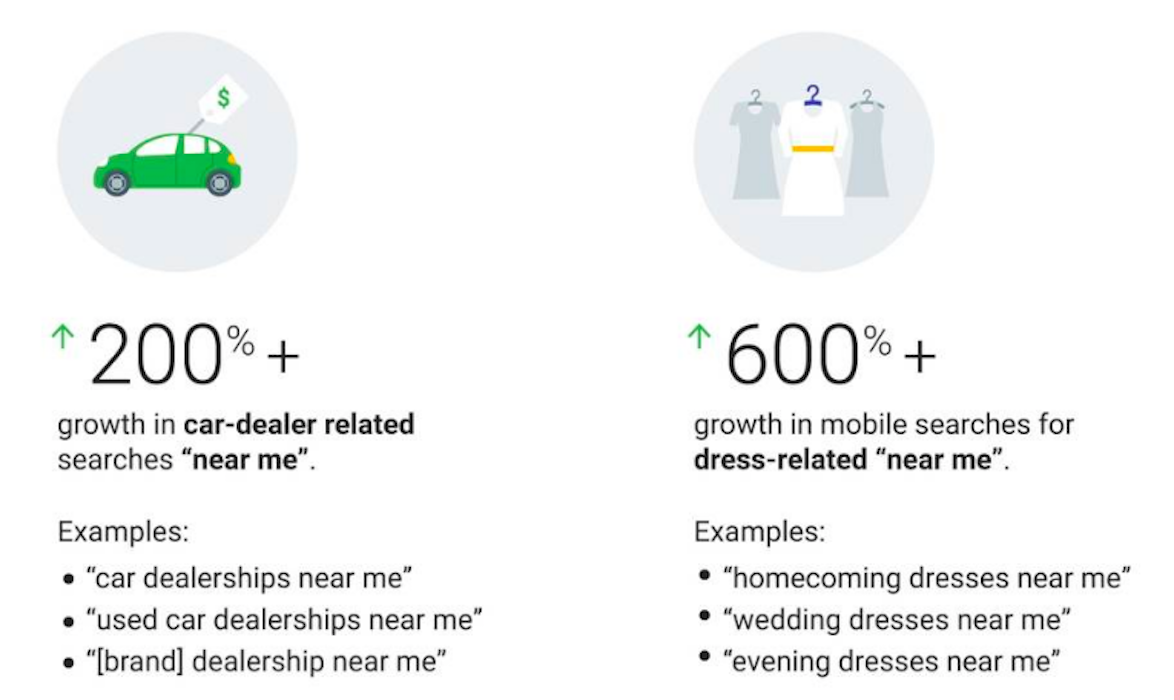
    While consumer behavior continues to move off of the streets and onto the internet, communities supporting local businesses stay strong. In 2018, HubSpot’s data stated that 72 percent of consumers who did a local search visited a store within five miles. Being found locally is crucial, especially for businesses in the service industry like landscapers, restaurants, groomers, mechanics, etc. According to Google, mobile searches that include the phrase “near me” have grown by 500 percent in the last two years.

    Google graphic showing the dramatic increases in near me searches

    So how can businesses communicate they are in fact “near” searchers? First, make sure that you claim and optimize the correct name, address, and phone number across the major local directories like Google, Apple, Yelp, and Bing. Also, build out local landing pages for each location on-site to include a map, local content, hours of operation, and directions. Check out our location page for a concrete example.

    The way consumers search for dresses, landscapers, and car dealers will continue to change, and therefore the digital marketing industry will too.  Just as our campaigns have strayed from the simplicity of keywords and link building, our marketing campaigns will continue to develop and change. In an everchanging and competitive industry catered to consumers, businesses must have a strategy to be successful. If you don’t, Search Influence’s digital marketing experts can help you develop one. Call us at 504-336-3379 to learn more.

    Images

    Magnifying Glass

    Google Data


  • SEO News: Data Aggregator Factual Now a “Submission Only” Source for TDCs

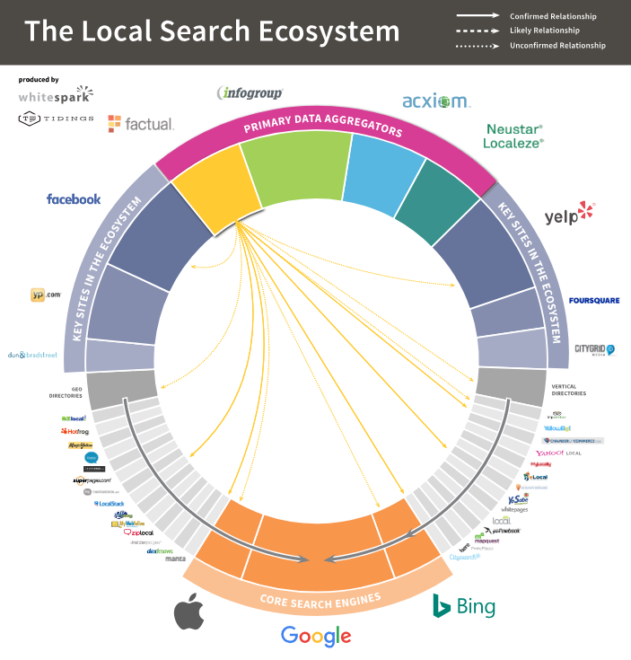
    SEO professionals who deal with clients’ backlink profiles and citation distribution on a daily basis are likely familiar with Factual, one of the largest data aggregators in the local search space. Factual does not accept listing submissions or edits from individual users; rather, they utilize trusted data contributors (more on that later) to help collect, validate, and then disseminate what they describe as “the ongoing accuracy of core business attributes.” In basic terms, you want to have your business listed on Factual as a platform because it helps push that data to other data collecting websites, expanding your digital reach across the internet.

    What Does Factual Moving to Submission Only Mean?

    Factual going to submission only means that third-party trusted data contributors (TDCs) can no longer guarantee that these data submissions will be accepted on Factual’s end. In TDCs like Yext or Moz, users can submit their business data, and the TDCs will push that information all at once to data aggregators, of which Factual is just one. Some other examples of data aggregators would include Acxiom, Neustar/Localeze, and Infogroup. TDCs help SEO professionals by guaranteeing that accurate listings will populate on these very important aggregators. 

    Yext logo


    This helps SEO professionals save a lot of time because it allows them to manage a client’s core data, have the data sent to these aggregators, which then send the data to more sources. Additionally, these tools help measure the accuracy of the listings, telling you if there is a discrepancy in name, address, phone number, or other attributed data. There is tremendous value in having accurate data for these reasons:

    • The data gets pushed from these four aggregators to numerous other internet sources.
    • Having consistent data for your name, address, phone number, and website adds authority to your business, in terms of SEO.

    Why Does Factual Going Submission Only Matter?

    Data aggregators that are willing to accept data from third-party tools as well as measure their accuracy help SEO and/or link builders tremendously in terms of time saved. For those at an agency or juggling numerous clients, monitoring these listings individually and having them edited is a gigantic time suck and oftentimes can be less than effective.

    By eliminating Factual from the equation, there is one less data aggregator that you can manage en masse via third-party tools. Factual will remain an important directory and aggregator, but you have to manage the data in a different way; more than likely, manual review on the physical listings will the best way to ensure accuracy. If there are inaccuracies, the best course of action would be to follow the guidance on how to make edits on their FAQ page.

    Why Did Factual Go to Submission Only for TDCs?

    This is a bit unclear, but Factual made this decision across all platforms. They did not cherry pick the sources that they would allow to guarantee submission or measure accuracy, but rather decided to limit the functionality available to the TDCs. 

    Factual’s next steps might be indicative of a larger trend industry-wide, or it might be just an internal decision based on factors we are not aware of. Regardless, this is worthy of monitoring going forward, because if more TDCs follow suit, local listing and data distribution management might be a bit more challenging in the near term.

    Even though the SEO industry is always changing, the marketing experts here at Search Influence are always keeping up with industry trends to optimize our clients’ SEO campaigns. If you think your business could use help with listing management or other SEO strategies, contact us today to start a conversation.

    Images

    Whitespark

    Yext

  • How Long Does It Take to See the Benefits of SEO?

    Gif with matthew mcconaughey about SEO turnaround time from Search Influence in New Orleans, LA

    That’s always the question when a business starts something new: how long will it take? The short answer is that SEO campaigns generally see mature results in 6 to 12 months. But any business that starts working on SEO will also see several benefits immediately.

    SEO campaigns should have two goals: to tell external entities on the internet (especially search engines) that your website is an authoritative source of information within your industry, and to help convert potential customers into actual customers once they’re on your site. There are numerous ways to accomplish both of these. Over the course of this post, I will cover a general timeline of an SEO campaign and the accompanying deliverables businesses should expect.

    The Sales Process

    If you haven’t done any SEO work before, then your first step should be reaching out to digital advertising firms. They will perform competitive research before coming back to you with a pitch. This first step is critical because the timeline for the results of an SEO campaign depends on where a business starts off relative to its competition. Obviously, some industries are more competitive than others, but generally, a business’s presence online can be measured by several on-site and off-site factors. Digital marketers will evaluate your website’s content and layout, perform keyword research, and determine how easy it is for leads to complete conversions on your site. Common conversions include filling out on-site forms, booking consultations, product purchases, etc. There are also several off-site tactics that will signal your website’s authority within your industry to search engines, including backlinks from reputable websites, accurate and consistent listings, and social media activity. This research allows digital marketers to set realistic goals from the start and ensure that the work they perform will make a difference.
    New call-to-action

    Campaign Kickoff and Month One

    Once you’ve partnered with a digital marketing firm, they will schedule times to discuss which strategies you would like to move forward with and establish which metrics matter the most to your business. Then, they can use the research that they’ve already compiled to build a plan of attack. Several aspects of an SEO campaign can have immediate effects on your website, such as building out new pages, cleaning up bad links, setting up call tracking, making your site mobile-friendly, and purchasing an SSL certificate. Your team can also begin working on longer-term strategies, such as establishing an overall content strategy. This first month lays the groundwork for the rest of your campaign.

    Month Two and Beyond

    As your SEO campaign progresses, your digital marketing firm can use site data from Google Analytics and other tracking methods to analyze changes in your site’s traffic and on-site conversions to measure the performance of your current strategies.

    After reviewing the results of your campaign, it might make sense to complement your SEO work with other digital marketing strategies, including paid search or social media advertising. The effectiveness of these tactics will depend on your industry, but paid advertising is generally geared toward immediate results. Supplementing SEO with paid campaigns is a logical step to take if your business is more focused on e-commerce or other B2C transactions. However, several elements of SEO (creating landing pages, being HTTPS-secure, and having a mobile-friendly site) will help amplify your paid campaign’s results.

    Keywords, Keywords, Keywords

    Up to this point, I haven’t particularly focused on keyword rankings because it’s difficult to estimate how long improving them will take. Obviously, ranking well for relevant keywords is important and should be part of any SEO campaign. If you’ve never done any SEO or content work before, your rankings will quickly improve from their baseline once your campaign begins. A well-planned strategy can expedite the process, but it will probably take time to crack the first few results for more competitive keywords.

    New call-to-actionSimply being the first result for a search doesn’t necessarily offer value to your business. It’s essential to perform keyword research to see what your customers are actually searching for. By focusing on natural queries and long-tail keywords, businesses can be more selective about which keywords they target. Plus, earning strong rankings for long-tail keywords can be done relatively quickly and inexpensively while attracting people who are more likely to be interested in your services. As always, driving more potential customers to your site should be your focus. Ranking well for relevant keywords certainly helps, but there are other important factors to consider.

    So Now What?

    In general, the results of SEO are gradual, but your business can immediately benefit from on-site optimizations, reconciling conflicting listings, and having a clearer idea of where you stand relative to your competition. As search engine algorithms and user behavior change, you will also have to make adjustments along the way. With that in mind, you should choose the digital marketing firm that you work with carefully. Search Influence has helped businesses expand their client base online since 2006. If you’d like to know more about the timeline of SEO campaigns, give us a call at (504) 208-3900.

    Images

    Keywords

  • How Small Businesses Can Build Quality Backlinks in 2019 and Beyond

    A man drawing a graph representing backlink growth through Search Influence in New Orleans, LA

    Backlinks have traditionally been one of the most important ranking factors in Google’s mysterious SEO algorithm. So what exactly is a backlink, and why is it important? A backlink is simply a link on someone else’s site that leads to your site. Google values them because your site must be reputable and authoritative if lots of other sites value your content enough to share it. The classic ways to acquire backlinks can still be useful, but the landscape of link building is changing.

    What Makes a Good Backlink?

    The main thing about link building is that quality and quantity both matter. Google values links from sites with strong domain authority (think national sites that everyone in your niche has heard of) and relevance to your industry. For example, if a small business gets a backlink on The Wall Street Journal, they’re getting a top-notch link. That being said, a handful of great links won’t necessarily outweigh hundreds of decent links. For SEO purposes, a “follow” link is better than a “nofollow” link, as nofollow links are not technically backlinks. However, while they shouldn’t be a large focus of a link-building campaign, nofollow links help with branding and shouldn’t be discounted.

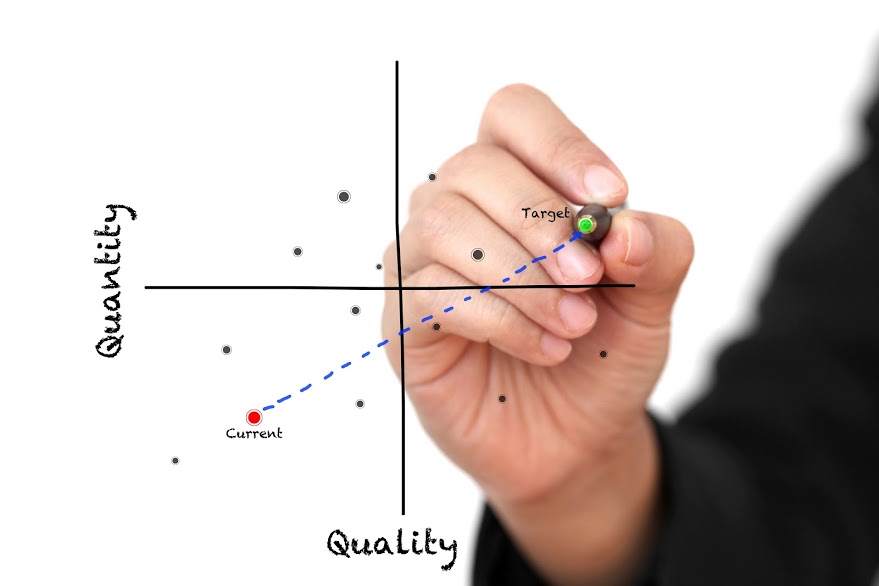
    A hand drawing a graph from current to target representing goal setting for Search Influence in New Orleans, LA

    Beware of Spammy Link-building Tactics

    Before Google’s Penguin algorithm update, the quantity of backlinks was most important, so businesses invested tons of money in “black hat” link-building tactics that placed backlinks on random sites with software. Though some sketchy SEO companies still employ software to build links, Google is not only aware of this tactic, they will actively punish a business’s rankings if they find that most of their backlinks are bought.

    The Penguin update came out in 2012, so the “quality over quantity” issue is well known throughout the SEO world, but many small businesses or recent start-ups aren’t aware of it. If you are paying a company to build backlinks for your site with software or other black hat methods, you are paying to penalize your search engine rankings.

    What Are the Tried-and-true Ways to Build Links?

    Building quality backlinks isn’t an easy task—that’s why links are still highly valuable in Google’s algorithm. These link-building strategies have been covered ad nauseam, so we won’t go into too much detail here. Most of the ways to get links back to your site start with an outreach campaign to other website owners and businesses.

    A woman on a laptop representing the backlink strategies at Search Influence in New Orleans, LA

    One of the simplest ways to find a potential backlink is searching for business mentions of your site that are unlinked and asking the site owner to add a link. Another straightforward tactic is to use competitive research, wherein you find who links to your competitors’ sites and target those businesses with your outreach campaign. A similar strategy, which we’ve already delved into, is to search for broken links on relevant sites and either ask them to replace the broken link with one to your own content or point out the error and ask for a different backlink on the page.

    How Do I Build Backlinks in 2019 and Beyond?

    The digital marketing industry received confirmation that SEO trends are changing when Moz published their survey of 2018’s local ranking factors, which found that interacting with Google My Business is one of the most important factors in Google’s local ranking system. So while this may mean that backlinks hold less value than they have in the past, link building is still crucial to a well-rounded SEO plan, as we explained in our analysis of Moz’s survey. The traditional methods of link building still apply, but, in today’s world, businesses need to remember that…

    Content Quality Is King 

    Link building nowadays relies heavily on getting people to share your content, and the main way to get people to share your content is—wait for it—to have great content that people want to share.

    An image of someone pantomiming their mind being blow at Search Influence in New Orleans, LA

    So, then, what qualifies as great content?

    One of the biggest factors for Google, and your audience, is that your content meets Google’s E-A-T guidelines. This means that your content demonstrates expertise, authority, and trustworthiness. It should thoroughly cover the topic and answer your audience’s questions, especially because most people find sites through indirect queries. In addition, useful content that draws people in is one of the main principles of inbound marketing. There are some more specific tactics to create fantastic content, but the main goal is that it helps your audience with their pain points.

    Once you’ve got high-quality content, how do you get people to share it?

    Include images or video. Articles with an image receive up to 94 percent more views than plain text articles, and social media posts that include an image or video get up to 10 times more engagement than content without one. Of course, you need to find a good image to include. You should also focus the content on channels targeted to your audience (so making your content easily shareable on Instagram is going to be different from posting it on YouTube).

    It should go without saying that you should share your awesome content on all of your social media channels (and get your friends to do so, too). However, sitting back and hoping it goes viral and is featured on Ellen isn’t exactly practical. You need to build networks with influencers in your niche, reach out to them, and ask them to include a link to your content.

    Optimize Your Outreach Strategy

    The businesses that you target for your link building campaign should find your content useful—as in, their audience will find it useful. You need to demonstrate to them why it’s worth their while to share your content or link to your site. And, while it’s best to have backlinks on websites with strong domain authority, don’t ignore smaller businesses that are relevant to your industry. Smaller businesses may be more likely to include your link in their content, and any backlink will help build brand awareness, which is a growing part of modern SEO strategies.

    A man at a desk representing the marketing strategies of Search Influence in New Orleans, LA

    Don’t Be Impersonal

    No one wants to read spam emails, and if your outreach emails have obviously been carbon-copied and sent to 200 people, it’s likely that the recipients won’t want to take their time to help you. Sending emails to tons of people does take a lot of time, so it’s fine to use the help of a template, such as these from Hubspot. But you should still make sure that the contents of your email are specific to the person you’re sending it to. Better yet…

    Find Content on Their Site That Could Use a Link to Your Content

    You’re going to be more successful building links if you find a specific article that would benefit from including your link in it, rather than just sending an email saying “Hey, I wrote this. Can you stick it on your site somewhere? Thanks!”

    Let’s say you’re a smoothie company, and you’ve written an amazing, super-detailed article about the nutrients in common smoothie ingredients. After scoping out businesses that would benefit from this information, such as a nutritionist’s website or a lifestyle blog, see if they have any pages that relate to your article. Maybe you find a parenting website that has a blog about making sure kids are getting enough vitamins from their food, and you know that your article would provide helpful additional information. The writer will likely be more receptive to including your link because you’ve shown them exactly where it should be on their site.

    Reciprocate the Link Love

    Website owners love seeing their name and work out there as much as you love seeing yours, so including relevant links to another business’s content on your own site is a great way to open the door. At the very least, they are more likely to share the article and could help create a partnership. You can offer to guest blog and invite them to guest blog on your site. You can even syndicate your content to get the most out of your work while maintaining a good relationship with influencers in your field.

    Link-building Tips for Local Businesses

    A local business owner representing the local seo services of Search Influence in New Orleans, LA

    To bolster their local SEO strategy, small businesses need to ensure that they create brand awareness, both on- and offline. You should build relationships with other related businesses. For example, a restaurateur could reach out to a local farmer’s market. Try to go even further and create strategic local partnerships, where you and another business leave reviews on each other’s sites and share each other’s content. You should also network and reach out to influencers in your industry.

    Link building can be one of the most challenging aspects of boosting your search rankings, but it doesn’t have to be. At Search Influence, we can help you find the right link-building strategy through both tried-and-true methods and by creating quality content to build brand awareness. If you’re ready to take your link building to the next level, start a conversation with one of our SEO experts today.

    Images:

    Mind Blown

    Internet, So Helpful

    No, Thanks

  • Gutenberg Has Arrived–Are You Ready?

    WordPress 5.0 has been officially released as of Thursday after many delays and false starts. Are you ready for this new editor? Short answer: probably not.

    WordPress logo - Search Influence

    A New WYSIWYG Editor From WordPress

    WordPress 5.0 replaces the old native text editor with its new “What You See Is What You Get” editor called Gutenberg in reference to the inventor of the printing press. This allows users to create content blocks for images, text, videos, and a slew of other elements that they would want to add to a site. At face value, this sounds great since almost every other modern day CMS offers this functionality. This is definitely a step in the right direction for WordPress. They’ve always touted themselves as being a platform that caters to both developers and content publishers, but the standard text editor was never really enough for someone without some coding experience to publish anything aside from text. Gutenberg promises to streamline this process for non-developers creating websites.

    This update is not without flaws, however. If you check the WordPress GitHub, there are currently 285 bugs as of writing this and nearly 1400 issues total! As with any major release, bugs abound, but Matt Mullenweg reports that 5.0 is still stable enough for an official release. In addition to the bugs that have already been reported, an overhaul of the editor itself does run the risk of causing some issue on your website. Depending on whether or not you have a custom template, a plugin used for editing such as Visual Composer, and how your content is laid out on your pages will affect the transition to Gutenberg.

    Classic Editor Plugin Isn’t Going Anywhere Anytime Soon

    There is some good news here though. WordPress has already released the Classic Editor, which can be installed before upgrading to version 5.0. This plugin will not only maintain the Classic Editor we all know and love, but it will also hide references to both Gutenberg and updating to it. The best part about the Classic Editor is that it will be supported until 2022, so you won’t have to worry about Gutenberg until then. With the feature to hide the references to Gutenberg, you won’t have to worry about someone else who may use your site activating it and causing chaos on your site.

    If you do decide to try out Gutenberg, it is highly recommended that you create a full backup of your site and test out compatibility in a demo environment of your site. Once you’ve concluded that Gutenberg is compatible with all of your plugins and theme features, you can feel somewhat safe attempting to upgrade. In all likelihood, themes and plugins that relied on the classic editor, will probably not work that well with Gutenberg.

    So, before you update to WordPress 5.0, make sure you install the Classic Editor Plugin or you will default to Gutenberg, which has the potential to wreak havoc on custom templates and some plugins that haven’t been kept up in a timely manner. In addition to this, like many WordPress updates, there are likely to be some bugs lying about so maybe waiting until it’s a bit more stable would be a good idea. Need some assistance updating to 5.0? Our development team at Search Influence can help. Fill out the form to the right, or give us a call at 504-208-3900.

    Images:

    Yass