Blog

  • 14 Social Media Mistakes to Avoid in 2014

    We’ve all seen them… misfired tweets, Facebook fails, and huge national brands that just don’t get it. Last year we recapped the 12 worst social media mistakes of 2012, but brands just keep making the same errors over and over again. For 2014 we’re going to be proactive. Here are 14 mistakes to avoid this year, so that your brand isn’t ridiculed by friends, fans, followers, or the general public:

    1) Avoid relating ANY holiday to your brand:

    Unless you are a major fireworks distributor or 1-800-Flowers, holidays are NOT about you. Don’t force it. Even if you think your message fits in flawlessly with the holiday, chances are someone will take offense. Don’t believe me? Google MLK Day Social Media for proof.

    2) Not understanding your company’s image

    Banking giant J.P. Morgan decided to host a Twitter Q&A session utilizing the hashtag #AskJPM in November. Although they received thousands of amazing questions such as, “As a young sociopath, how can I succeed in Finance? #AskJPM” and “What’s it like working with Mexican drug cartels? Do they tip? #AskJPM”, the company quickly realized that Twitter was not the appropriate medium for a company discussion.

    3) Using trending hashtags without first checking their meaning

    Utilizing hashtags is a great way to get more eyes on your tweets, but don’t hijack trending tags without first researching the message behind them. Baked goods company Entenmann’s faced backlash after utilizing a trending hashtag without realizing that #notguilty referred to the verdict in the Casey Anthony trial.

    4) Getting too political

    This one practically speaks for itself. No one wants to hear outspoken thoughts about gay marriage, political candidates, or religion from a brand. Italian pasta company Barilla came under fire last year after stating that they would not feature gay families in any ads. After thousands of people tweeted at them with the hashtag #boicottabarilla, they finally issued a semi-apology (in Italian) from their brand account. The lesson here? Don’t get your brand involved in political affairs, and respond quickly if you find your company in a similar situation. Most users prefer their pasta without a side of prejudice.

    5) Creating fake controversies

    Real time marketing is a hot buzzword, but faking a crisis is not the way to achieve success. Brands like Chipotle and JC Penney have faked problems on their own social media networks to achieve attention. Effective real time social media campaigns react to events as they happen, not create unnecessary controversy.

    6) Responding generically to complaints

    If your company does something to upset a large amount of fans, you should not reply to them all with the same generic message. Either issue a blanket public apology to all of your fans, or personalize each response.

    7) Not responding to negative feedback or customer questions

    Not responding at all to complaints is also a bad policy. A study from Maritz Research and evolve24 found that over 50% of respondents expected a reply from a company regarding public complaints on Twitter. Deleting or ignoring complaints is not the way to approach social media management. Furthermore, if you engage with an unhappy customer, you should not stop answering them after one tweet.

    8) Beginning tweets with “@” or “.@”

    It might seem like beginning tweets with an “@” is Twitter 101, but tons of brands still make this mistake all the time. If you begin a tweet with a user’s handle, only that user and their followers can see it. Some companies have taken the lazy approach to combatting this problem, by adding a period before the @ symbol. Don’t do this! It looks sloppy, and if you’re getting paid to write tweets, you should be thinking about ways to word your response differently.

    9) Using #too #many #hashtags #on #Instagram

    This one is fairly self explanatory. Hashtags can lead to natural discovery, or can be utilized to chime in on a trend or theme (such as #TBT). Using too many hashtags in one post not only looks silly, but makes it extremely difficult to read.

    10) Posting photos on Pinterest that don’t link back to your site

    Pinterest can be a great platform for both small and large businesses to get their products noticed. However, pinning products without a link back to your site is a waste of everyone’s time! You want to eliminate any hassle or additional steps in the sales funnel so that someone who finds your amazing product can buy it on the spot. Pin directly from your website and see your sales soar.

    11) Leaving the URL in your Facebook post

    Facebook’s link preview feature is a great way to show off your links in a visually appealing and enticing way that encourages customers to click through. However, once that preview generates, delete the original link! This will clarify your posts, and allow readers to easily figure out where you want them to click.

    12) Avoid using click bait to get users to read your posts

    Which websites are exploiting Upworthy-style click bait to get viewers to read and share? The answer may surprise you.

    13) Cross posting content from Facebook to Twitter (and vice versa)

    Some companies save time by cross posting their Facebook posts to Twitter. Although this is occasionally fine, many Facebook posts are simply too long for Twitter’s 140 characters. These are shortened by including a fb.com link in the post, which defeats the purpose of the tweet. Tailor your message for each specific social media channel.

    And finally…

    14) Handing the keys to your channels to someone who isn’t responsible

    This should go without saying, but the vast majority of brand social media fails are due to someone accidentally tweeting or posting from the wrong account. This is not a job for an unpaid intern. Make sure that whoever is running your brand’s accounts is trustworthy and reliable.

  • Should You be Using Google’s URL Shortener in Your Social Media Campaigns?

    The other day I was visiting my normal news sites, Mashable, Coding Horror, and news.google.com among others. While getting my information download I came across a few postings I thought had true value, and I wanted to share them with my social media friends and family. I immediately went to my handy dandy Google URL Shortener which I had added to my Chrome browser toolbar and – click – presto, I have a short url ready to paste to any social media platform, in my clipboard, cocked and loaded. And so I shared, and then shared some more.

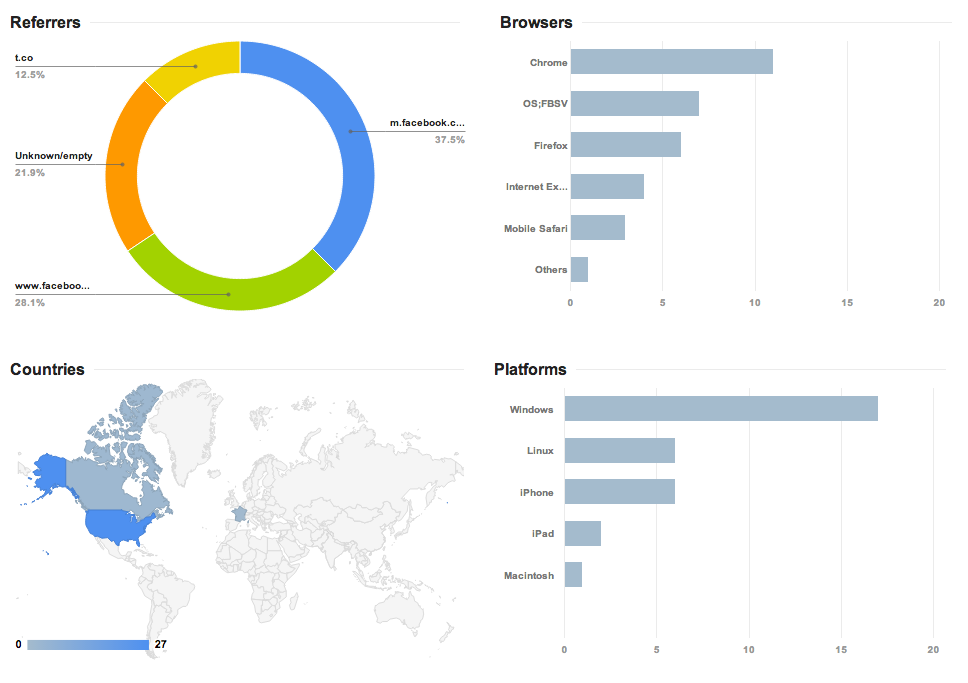
    The nice thing about Google’s service is you can track anyone’s goo.gl URL analytics by adding .info, or simply +, to the end of it. For instance, the analytics to the URL http://goo.gl/zlzlYv, which points to townsend.bunksite.com/, can be seen at http://goo.gl/zlzlYv.info. I occasionally went back to my .info page to see which of the links I shared actually had any value (received clicks on their respective pages) to my friends, family and followers.

    google diagram

    Google gives some good basic analytics data about URL click throughs, although I’ve seen more in depth analytics from URL shortening service competitors. But I digress, it was about this time when I started wondering, with being the obvious search leader and giant, does using the Google URL shortener give an SEO advantage in search results? It might make sense for Google to use URL shortener data(like number of clicks for a shortened URL) in order determine rank worthy content. Also, it seems logical that since this is another metric to look at how users share content, they would want to encourage the use of their shortener, perhaps by giving some advantage to companies using goo.gl for their social media campaigns, much like the seo benefits of using Google Plus Maggie told us about earlier this month.

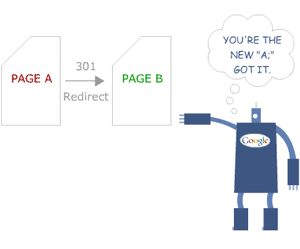
    The obvious benefits of using Google as your URL shortening service include proper redirects. You know if you are using their URL shortener you will never run into problems with shorteners that don’t properly treat the redirect conversion as a 301 redirect or don’t properly transfer PageRank or any future possible negative impact. Most popular shorteners conform to the standards set by Google, but still, it’s better to be safe.

    Another important issue for short url providers is trust. You must trust the service uptime (availability) is as close to 100% as possible. You have to trust that the redirect process will happen at a speed measured in milliseconds, not seconds.  You also need to trust the provider isn’t going to just disappear one day. With an average of 5,922,000,000 (nearly 6 trillion) Google searches every single day, I think they can handle the job of keeping up with this level of service. Besides, you are probably already trusting them to handle your site analytics, search results, pay-per-click advertising and storing documents, among other services. Why not keep all your data in one place?

    It is worth noting that Google has pulled the plug on some beloved services in the past, but they generally provide users with a lot of advanced warning before the twilight date. Also, they always provide a way to migrate user data from the shuttered service.

    So, we know the Google URL shortening service is worthy of using and helps keep our data in one place, but is there actually a positive weight given to these URLS  that translates into higher rankings on the SERPs? For that, I spoke with our Google and Local SEO expert here at Search Influence, Mary Silva.  Here is what she had to say on the subject:

    “There’s not necessarily any kind of weight given to using the Google URL shortener for linking. Also, Matt Cutts has explicitly said that “goo.gl isn’t an effort to kill anything,” and isn’t some sort of attempt to kill other “product X” URL shorteners.

    redirect-google-301
    http://moz.com/learn/seo/redirection

    In terms of SEO effects of the shortener, it’s important to recognize that there have been reports that once in a while the Google URL shortener has created broken links, so that would obviously not be beneficial in terms of back-linking and other similar efforts. Always double check that the short url actually works, regardless of the provider you use.  Another thing to note is that the Google URL shortener creates a 301 redirect which passes 90-99% of link juice to the redirected page, and is the most ideal for redirects for SEO practices, which isn’t the case for all URL shorteners.”

    So, is Google going to rank your linked content higher just because you used their URL shortener?  Nope. Content is king and there is no exception to that just because you use Google’s products. Should you use Google’s URL shortener? While no url shortening service is perfect, using this one is certainly no worse than others. Knowing that the service provider is fairly reliable may bring some peace of mind.

  • New Influencer Faces: February 2014

    New Influencer Faces: February 2014

    We’re still growing over here at Search Influence! We’d like to introduce our five newest employees to join the team!

    61605_10151534204818975_2038639398_n

    Sydney Lippman has been hired as a Junior Account Assistant. Originally from Atlanta, Sidney moved to New Orleans to attend Tulane University where she is pursuing a degree in communications and a minor in business. Prior to joining Search Influence, Sydney has worked as an marketing intern for DEL Development Corp.

    IMG_20130203_170708

    Jakia Norah has been hired as a Junior Web Developer.  She is a New Orleans native and recently graduated with an Associate’s Degree in Computer Information Technology at Delgado Community College with a concentration in Web Design. Prior to working at Search Influence, Jakia was a sales representative at T-Mobile in Metairie.

    photo (3)

    Alessandra Madrid has been hired as an Account Associate. Born and raised in Guatemala City, Guatemala, she moved to New Orleans nine months ago. Alessandra has also lived in San Antonio, TX and Barcelona, Spain. She attended Trinity University where she earned a B.S. in Business Administration with concentrations in International Business, Marketing, and Communication Management. Before joining Search Influence, Alessandra worked at Colgate-Palmolive and Burson-Marsteller, where she developed a passion for the world of marketing and communications.

    photo

    Nakia Thomas has been hired as an Internet Marketing Associate.  Born and raised in Louisiana, Nakia received her bachelor’s degree from LSU in Communication, She started her career in sales and marketing then slowly spread her wings into the writing world. Nakia is excited about making the shift from a freelance content writer, ghostwriter, and editor to a Search Influence team member.

    Alex-croppedAlexander Talbot has been hired as an Internet Marketing Associate. Born and raised in the New Orleans metropolitan area, Alex graduated from Loyola University in May of 2013 with a double major in Marketing and Economics. Alex previously worked as a marketing representative for Samsung and has played music in several different bands locally for the past 8 years. Alex is excited to further his professional experience in order to reach a deeper understanding of the world and how to aid in its betterment.
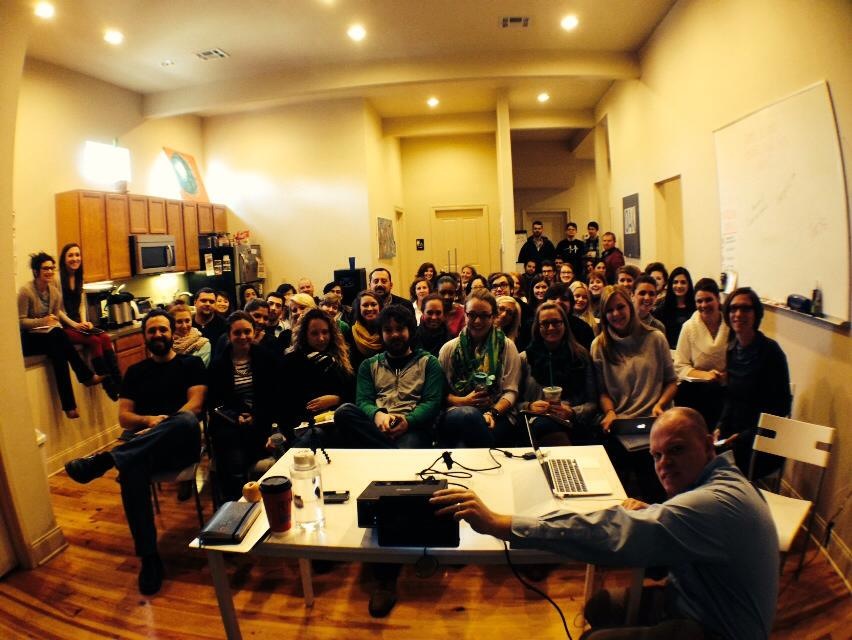
     Welcome to Search Influence, Sydney, Jakia, Alessandra, Nakia, & Alexander!

  • Lunchtime at Search Influence’s NEW Office Space

    When I first started at Search Influence back in October, I was employee #50. Now, just four months later, we’re nearing 70 employees! As a result, 8120 Oak Street has turned into a veritable can of sardines. Check out this picture from our most recent company meeting…

    SI company meeting

    Our Direct Team (along with a few others, most notably Will & Angie, our founders) even work in what is essentially a converted attic – cleverly nicknamed The Treehouse.

    As Search Influence continues to grow, so must our office space. While it’ll be hard to say goodbye to the many memories we’ve made on Oak Street, we’re all looking forward to some room to breathe.

    Where are we headed next? While nothing is confirmed quite yet, it looks like we’ll be headed downtown, to the CBD, or Old Metairie.

    Lunchtime is something we take very seriously here at SI. Every Influencer has their favorite lunch spot – whether it’s Jimmy John’s delivery, pho from the cleverly named Pho Bistreaux or a juicy burger from trūburger (perfect for Fat Fridays). I’m here to assure you that all of our potential new locales have plenty of lunchtime options.
    Downtown

    Brave the lines at Mother’s (401 Poydras) for one of the best po-boys the city has to offer. In addition to serving up delicious tacos, Felipe’s Taqueria (301 N. Peters) is the perfect place to grab a margarita after work. Who knows, maybe it’ll even be the next Carrollton Station? Can’t tear yourself away from your desk for more than a minute? There’s sure to be a Lucky Dog cart nearby!

    CBD

    The Store (814 Gravier) has some great lunch specials and a semi-secret taco bar in the back. Missing Pho Bistreaux? Don’t worry, Viet Orleans Bistro (300 Baronne) is just a few steps away. There’s also a Jimmy John’s (900 Poydras) and a Reginelli’s (930 Poydras) right around the corner.

    Old Metairie

    In addition to coffee shops, there’s Zoës Kitchen (701 Metairie Rd. Suite 1A103), Naked Pizza (701 Metairie Rd. Suite 2A105) and Lee’s Hamburgers (1507 Metairie Rd.). On hot days, venture down to Sal’s Sno-Ball Stand (1823 Metairie Rd.) for one of Metairie’s best kept secrets.

    Stay tuned for more once our new location has officially been announced!

  • The Power of CrowdFunding

    I’ve always been amazed by the power of crowd-sourced fundraising. Combined with the virility of social media, a project can get a lot of attention, which can introduce new backers and have the project funded rapidly before it’s deadline.  Crowdfunding sites such as Kickstarter and Indiegogo are the most well known platforms. These sites serve as a great creative and entrepreneurial outlet that didn’t exist years ago. I’ve selected my three favorite projects below. (more…)

  • A Drive Down Leigh Circle

    If I know one thing about Search Influence, it’s that we would be nothing without the help of our Development Department. Starting with one member, Luke Ledet, in 2010, the department has grown quickly to 11 people in correlation with our expanding company. They work tirelessly to improve not only our client’s websites, but also our company’s website, software, and many things I could never dream of comprehending.

    (more…)

  • Un-blurring The Lines of The FTC and Native Advertising

    Un-blurring The Lines of The FTC and Native Advertising

    To those of us in SEO and other forms of web marketing, native advertisements may seem like a God-send, the perfect combination of advertising power and positive user experience. The content-driven marketing platform is under a great deal of scrutiny, however, as it becomes more and more commonplace on the web.

    While advertorials have been used for the greater part of the last century, native advertising is a more recent development that has capitalized on user experience in the digital age. In 2013, more than 70% of websites offered native advertising, and that number is likely to increase by around 10% this year (Mondaq). Due to their editorial nature, regulators—as well as members of the general public—are worried that native ads blend too seamlessly with unsponsored web content, and many are eager for the issue to be formally addressed.

    The SEO value of native advertising is obvious. It’s an excellent tool that not only allows for optimization, but also provides great content to the user. And as we all know, content is king. Native ad campaigns can be more successful than traditional online ads, and as marketers, we like to believe that’s because users enjoy the content we’re putting out.

    Critics, on the other hand, argue that the ad serves as a sneak attack, tricking users into clicking through. As Federal Trade Commission Chairwoman Edith Ramirez told Reuters, “By presenting ads that resemble editorial content, an advertiser risks implying, deceptively, that the information comes from a non-biased source.” The drama around native advertising recently culminated in an FTC workshop focused on the method. This idea of hiding advertising in content inspired the FTC workshop’s name, “Blurred Lines: Advertising or Content?”

    blurred-lines-logo
    http://www.ftc.gov/news-events/events-calendar/2013/12/blurred-lines-advertising-or-content-ftc-workshop-native

    Un-blurring the Lines

    The workshop’s panelists questioned standardization and responsibility, trying to keep all three parties—buyers, sellers, and consumers—in mind, with perhaps a little more favor to the consumers, who have the least agency in the situation. While everyone agreed that transparency is necessary, some argued that it wasn’t enough. Chris Jay Hoofnagle of Berkeley’s Law and Technology Center, for example, presented results from his research, showing that as many as 35% of consumers didn’t identify a native ad as an advertisement although it was marked. On the other hand, Chris Pedigo of the Online Publishers Association reported that more than 70% of websites that offer native advertising had not received complaints from users.

    These statistics are just two examples of the myriad of arguments that seem to complicate the issue rather than clarifying. If there was one thing everyone could agree upon at the end of the workshop, it was that more work still needs to be done before any definite regulation can be imposed. Even Jessica Rich, Director of the FTC’s Bureau of Consumer Protection, stated that native advertising may be too complex an issue for one-size-fits-all standardization.

    In the meantime, the responsibility remains on the publisher to use discretion and focus on un-blurring the lines with clear indications of sponsorship on native ads. That may not be an attractive idea to advertisers hoping to fool users, but those producing strong content know better. If a company is actually creating the content users want, it shouldn’t matter that it’s marked with their logo and a big “Sponsored” label.

    Publishers can look at the situation one of two ways: embrace the responsibility or abuse it. With freedom from regulation, publishers are free to respect users and clearly label native ads or take deals with eager corporations to disguise the content. We advertisers share in the opportunity, as we can always choose which publications we partner with.

    Running a Clean Campaign

    While partnering with a publication that sneaks in sponsored content may seem like a good tactic from a purely bottom-line-driven approach, some innovative companies have already proven to us that it’s really not necessary in the end. Several publications are working to show their dedication to corporate responsibility when it comes to native advertising, and it turns out native ads are successful no matter their labeling.

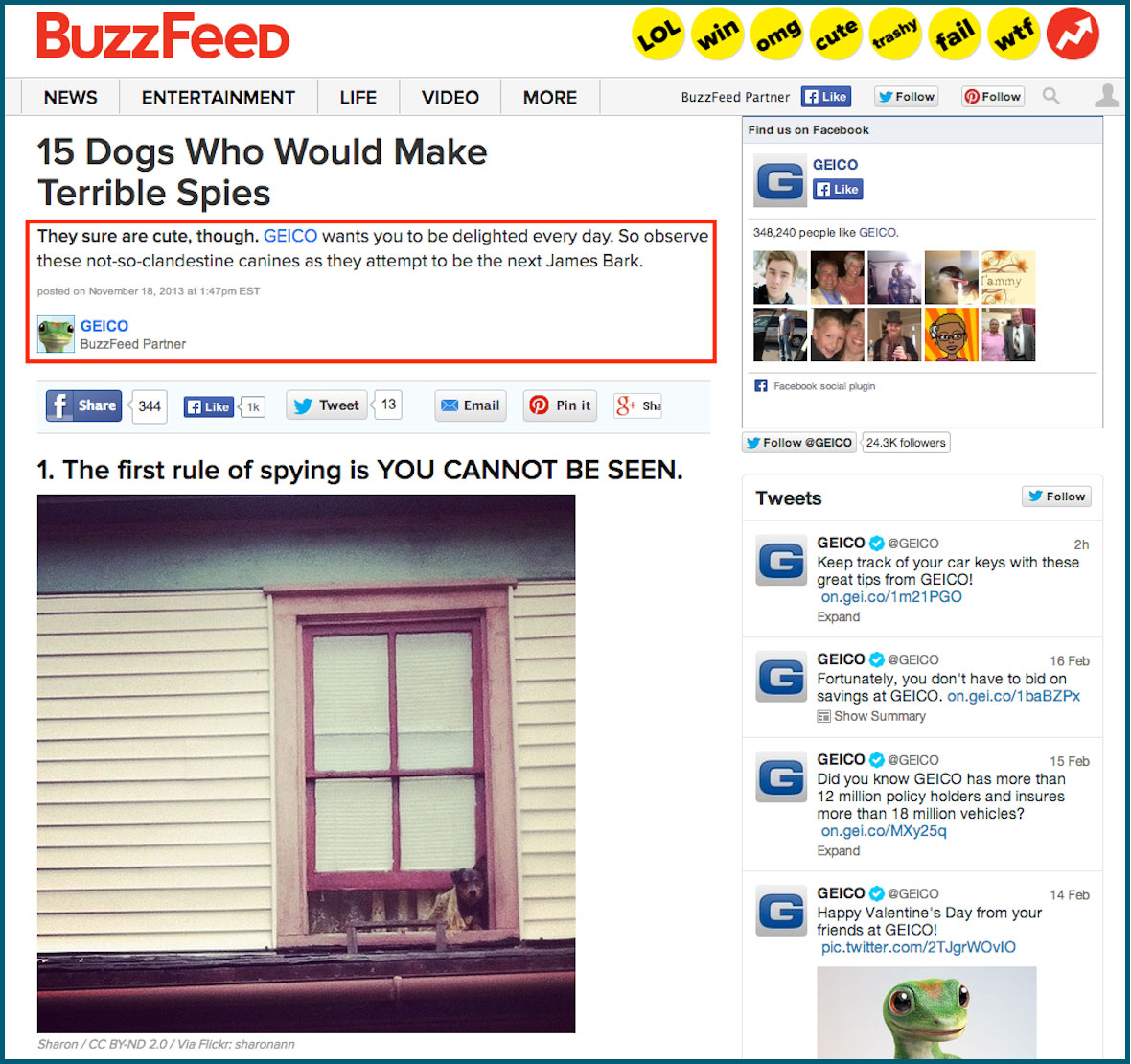
    BuzzFeed is a truly great example. The site rejects display ads entirely, relying on only native ads for advertising revenue. And it’s working out pretty well, according to Peter Kafka at All Things D, Buzzfeed planned to earn somewhere around $40 million in 2013, but the end number ended up being closer to $60 million. This sales boom comes in spite of the fact that advertisers’ contributions on the site are marked “Sponsored.” Buzzfeed’s pioneering efforts have obviously benefited the company greatly, and their sponsored content often drives more web traffic than traditional posts.

    infographic-pic
    http://www.buzzfeed.com/geico/15-dogs-who-would-make-terrible-spies

    Buzzfeed isn’t alone in their honest tactics. Many other companies acknowledge their native ads, including The New York Times, which announced in December that it would mark sponsored content with colored bars and “Paid Post.” According to the Times, publisher Arthur Sulzberger Jr. sent a letter to all employees emphasizing the “strict separation between the newsroom and the job of creating content for the new native ads.” The Times even published an article on their attitude toward native advertising, turning a policy into a great PR moment.

    IAB Playbook

    While no formal regulations are in place, the Interactive Advertising Bureau has set out to clarify the practice and set standards in the industry with the Native Advertising Playbook. By publishing the playbook, the IAB is acknowledging both the importance of native advertising and the danger it poses to unsuspecting consumers. Patrick Albano, the vice president of Social, Mobile and Innovation Sales at Yahoo and co-chair of the IAB Native Advertising Task Force explained that the organization set out with the goal of providing “guidance based on the state of the industry today while at the same time leaving room for flexibility to inspire innovation and growth.”

    The playbook goes over six different “core interactive ad formats” that are currently being used in native advertising: in-feed units, paid search units, recommendation widgets, promoted listings, IAB standard ads with native elements and custom ads. It also gives broader ethical principles advertisers can use to protect the consumer. With all native ads, the playbook suggests advertisers consider form, function, integration, buying & targeting, measurement and disclosure to “ensure that a unit will meet their brand objectives.”

    What This Means For Marketers

    To be completely honest, things are just as uncertain as before the FTC held its workshop. The workshop raised just as many questions as it answered and proved that no one has thought of a fair way to regulate native advertising. What the workshop really did is formally alert the industry to the FTC’s ever-growing interest into this marketing technique. As an industry I’m sure we’d hoped to avoid regulation altogether. We will now need to wait and see, and the good news is it’s not imminent given industry professionals and federal regulators still can’t seem to figure out what, in particular, should be regulated, much less in what way.

    In the meantime, Bureau Director Jessica Rich suggests that advertisers continue to rely on the FTC’s Dotcom Disclosure Guidelines when in doubt, while discussions continue. The IAB seems to be leading the discourse, with a series of native advertising workshops beginning in March 2014. Until then all we can do is focus on our own marketing efforts, working to keep consumers informed and clients successful. And native advertising is sure to be part of that process. In fact, with the advent of Penguin, native advertising seems to be our best hope. With each update, Google pushes even further back against search marketers, emphasizing the importance of well-thought-out and informative content. While I have always maintained that SEO is built on content, Google is regulating marketers in its own way by devaluing anchor text and deep links in favor of solid branding. So basically, if your native ads are giving users what they want, then Google’s happy, too.

    Has all of the recent hubbub around native advertising had an impact on your strategies? What do you see on the horizon? I’d love to hear your thoughts on the subject and on my theories. Please share below!


  • Why You Wish You Could Work on Oak Street

    To those of you who are not familiar with New Orleans and all the wonderful neighborhoods, shops, restaurants, activities, and festivals, you’re missing out. Though I’ve only lived in New Orleans the last year and a half, I’ve become very familiar with this awesome city and what it has to offer. Each week there is new festival or fun event to attend, and it is literally impossible to eat at every restaurant in the city in a lifetime.

    Oak Street tiles - New Orleans

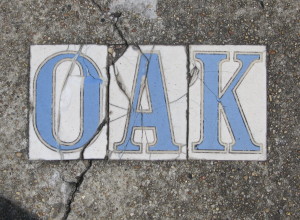
    While there are many great areas and aspects to the city, my absolute favorite is Oak Street. This is where my second home (work) is and where my coworkers and I spend most of our free time. Nestled snugly between the streetcar line and railroad track, Oak Street is located in the Black Pearl neighborhood which is very close to Tulane and Loyola Universities, Audubon Park, and the zoo. This also lends to a diverse mixture of age groups living within a few block of each other.

    Food And Drinks

    Jacques Imo's

    The variety of people in the area leads to an eclectic blend of businesses on Oak Street. There really is something for everyone. For instance, Oak Wine Bar below our office is a staff favorite for their happy hour drink specials. And they hosted our most recent company holiday party!

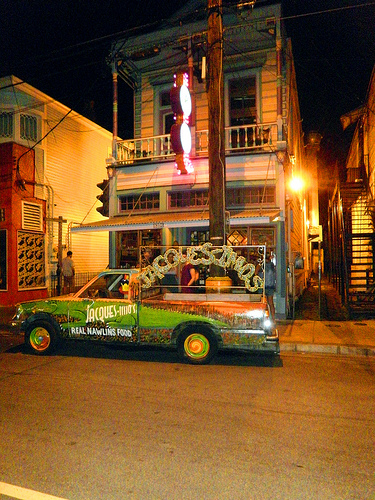
    Maple Leaf Bar is a great place for live music or to kill time while you wait for a table at the famous Jacques-Imo’s, a popular tourist spot and a local favorite! The lucky few get to eat in the truck!

    The majority of my favorite memories are taking a long Friday lunch break at either Tru Burger or Cowbell. While on opposite ends of Oak St. and very opposite in menu and style, they both make a great burger! Both are great places to stop and enjoy a meal.

    Old school charm is what makes Oak St. businesses stand out, even the newest business on the block, a chain restaurant called https://mellowmushroom.com/location/la-new-orleans-8227-oak-street-70118/, feels like its been here forever.

    Shops

    Fresh Smoothies New OrleansIn addition to the amazing restaurants and bars on Oak, you can also find a wide range of shops. The chic furniture shop Eclectic Home is great for the urban dweller looking to liven up there living space. Situated a few store fronts down is the always delicious D’ Juice. Boasting the freshest smoothies blended with fresh fruit and veggies, it is a great stop for a refreshing recharge. Located just across the street from D’ Juice is the Castellon Pharmacy. Stepping in there feels like a blast from the past. This old pharmacy continues to maintain its unique charm in the ever changing world we live in.

    Culture

    The unique culture of New Orleans and Oak St. could not be better represented than by the enormously beautiful Catholic church, Mater Dolorosa. The church takes up a good portion of the block and it’s chorus of singing church bells can be heard many blocks away. The church and the eclectic shops are a constant reminder of the city’s rich history rooted in many religions and long time acceptance of all cultures.

    Mater Dolorosa Larger Image

    Events

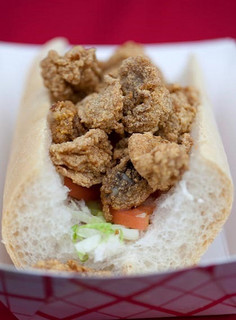
    Po Boy Fest Poy BoyOnce a year Oak Street gets even more exciting, playing host to the famous Po Boy Festival. The Po Boy is unique to New Orleans and is a favorite dish amongst locals. Restaurants from all over the city gather to share their own creations with festival goers as live music blares from a stage set up smack in the middle of the road.

    The reasons we love the Oak Street and working here every day are endless. There are so many great places to enjoy and there is something here for everyone. I know our time on Oak Street will come to an end one day, but until then I plan to take advantage of all the great things it has to offer.


  • Career Advice from the Facebook Queen (and some life lessons, too)

    Sheryl Sandberg is one of the most influential women in the world, according to Time, CNN Money, and Forbes. She’s the COO of Facebook, and in my opinion, one of the biggest badasses out there.  I’ve been reading her book, Lean In: Women, Work, and the Will to Lead and it is changing my perspective on life, offering tips on how to navigate the business world, and giving me a little gumption to speak up for myself. I haven’t finished reading the book yet, but I guarantee I’ve learned some lessons that are going to stay with me for a while. Check them out:

     Quote from Sheryl Sandberg

    1) Don’t Dis-credit Yourself

    Many women (including myself) suffer from “impostor syndrome.” I often feel that my accomplishments really aren’t accomplishments, but rather things I’ve muddled through with many errors along the way. The truth is, we need to start acknowledging our efforts and own our accomplishments. You did it! With or without the help of others, you’ve most likely accomplished a lot of positive things in your life, and you need to be proud of yourself for that!

    2) Fake It Till You Make It

    When something negative happens in the workplace, sometimes it’s best to keep going and put a smile on. Recently, I had a frustrating experience at work (as we all do), and I was fuming mad before a conference call. However, I put those feelings aside and lead the call successfully. When these situations arise, do something that takes your mind off the situation. Even if that means stopping work to go for a walk, call  a family member, or run an errand. Anything you can do to get away from the problem (for a while) will ultimately help reduce a negative reaction to the situation, which will make you look like and feel the professional woman you are.

    3) Jump Into Opportunity (don’t wait for it to come to you)

    Men apply for a job when they meet 60% of the requirements, but women apply for a job only when they meet ALL of the requirements. We hold ourselves back because we think we are not ready, instead of thinking, “There is an opportunity here and I can learn by doing it!” Apply for positions that offer growth, adaptability, and room for you to fill a gap that the company needs. Don’t NOT apply for a job because you’re scared. We are rarely handed things in life and you should take advantage of every opportunity.

    4) Don’t Be Discouraged – Be Persistent!

    Sheryl tells the story of leading a Q&A section and reaching a point where she had time for two more questions. When she answered those questions all the women put their hands down, but all the men who still had questions kept their hands up. She answered a few other questions, but only the men got answers because they kept their hands up! Ladies, we need to be as persistent as men! There is no reason why we should stop asking for more information, details, and answers. We live in the same world as men, and we need to start acting like we deserve to be in it.

    Lean In Book by Sheryl Sandberg

    5) You Don’t Have To Be Liked by Everyone

    This is a complex that a lot of women have. We want to be liked by everyone, because we don’t want to be perceived as bossy or rude. Women think we can please everyone, but men know that’s not humanly possible. There are going to be times where we have to make tough decisions. Those decisions are not always going to provide positive outcomes for everyone, but we need to learn to make decisions that are going to positively affect a great number of people. You’re inevitably going to hurt someone’s feelings or make someone mad, but there’s not much you can do about that. So, make decisions that create positive outcomes and keep the ball rolling.

    The moral of the story is, ladies, if you want to be a badass at life, go out there and do it! There’s no reason we should not be a part of conversations and advocating our thoughts and beliefs. I fully believe that we can have our cake and eat it, too. We just have to start leaning in and participating in life the same way men do.

    Cheers, Sheryl! You’ve inspired me more than you know. Thanks for the encouragement 🙂


  • Don’t Panic! The Google 3 Weeks Places Update Isn’t Worldwide!

    Now that we’re done making sure your Google business account doesn’t get suspended for a name violation, we’re on the the next Google worry.

    HomeAlone
    http://www.flickr.com/photos/the_napkin/6469892859/

    You may have heard the buzz lately about an email going out to business owners in Google Places telling them that they have three weeks to update their listing. If the listing isn’t updated,  it will no longer be visible to Google users. The good news is that this is actually something that is only occurring for Australian businesses. Basically, you don’t have to worry!

    When we first heard about this issue at Search Influence, we were alarmed because an update like this could potentially affect many of our clients’ accounts. So, I decided to delve deep into the web and find out as much as I could from various online sources, and what I found was even more worrisome and ambiguous. Search Engine Watch’s post was the first that brought this issue to my attention. The post provided great information on what needed to be done by those receiving the email, but nothing about the scale of the email rollout and who was being contacted and why.

    The Word From Google

    Search Engine Journal’s post was awesome enough to give us the exact email google sent out, which reads as follows:

    Hello,
    Due to changes in Google Maps, we’d like to inform you that unless you review and confirm the information in your Google Places account, we will no longer be able to keep and show it to Google users after February 21, 2014.

    If you wish to keep your listing active, follow these three easy steps:

    1. Log in to your Google Places account
    2. Review and update your information
    3. Click the “Submit” button

    Sincerely,
    The Google Places Team

    The fact that the email instructed businesses to click a “Submit” button when updating indicated to me that these were businesses in the old dashboard. So, I thought I had a clue as to who was being contacted at this point.

    Next, I went to discussions on MOZ and Google Product Forums where I started seeing comments that maybe this was only something happening in Australia.

    Calling The Google Places Team

    Google-Plus-Logo

    After seeing both of these slightly alarming, but informative posts I decided to go straight to the source and call The Google Places Team. They were super helpful in taking the time to get to the bottom of the email and were forthcoming about the issue at hand. They also understood that something like this could affect a company like ours on a pretty large scale. The rep on The Google Places Team reached out directly to Google and was able to confirm with me that this is indeed something only happening to Australia Maps.

    There have been speculations as to whether or not this is something that could start happening outside of Australia, because Google has a tendency to do things in a test market before rolling them out worldwide. From what the Google rep told me, however, it seems like this is only happening because of an issue that was occurring specifically with Australia Maps.

    So, DON’T WORRY! United States Places Businesses are NOT at risk!!

    If you’re interested in reaching out to The Google Places Team, log in to your Google places account that has your business listing and click here:  https://support.google.com/business/contact/business_c2c