Blog

  • Is Facebook No Longer Effective for Small Business?

    Image Of Facebook LogoIt’s well known that Facebook is, by far, the largest and most successful social network in the world. Here are just a few of the astonishing statistics for this social giant:

    • More than 1,310,000,000 (that’s 1.3 billion) active monthly Facebook users
    • Over 680,000,000 active mobile Facebook users
    • Number of users rose 22% from 2012 to 2013
    • 48% of Facebook users visit the site every day
    • The average number of friends per Facebook user is 130
    • 48% of 18- to 34-year-olds check Facebook when they wake up
    • 28% of 18- to 34-year-olds check Facebook before they get out of bed

    Facebook is obviously home to a massive potential audience. The problem for businesses, especially small businesses, is the same as the advantage: Facebook is massive. And it’s hard to be noticed in the crowd.

    Finding Your Facebook Audience: Then vs. Now

    For quite some time, Facebook has remained the cornerstone of social media marketing. Small business marketers discovered and fine-tuned strategies to grow their Facebook pages organically, gathering page “Likes” and fans who would spread their message willingly to their own friend networks.

    However, there have been a few changes along the way. In late 2013, Facebook acknowledged that the organic reach of posts would drop off for everyone. Advertising Age reported that a statement from Facebook read: “We expect organic distribution of an individual page’s posts to gradually decline over time as we continually work to make sure people have a meaningful experience on the site.”

    Facebook’s New Algorithm

    The driving force behind the “meaningful experience” Facebook is promoting came in the form of algorithm changes. Near the end of 2012, the social network changed its news feed algorithm—and users immediately saw a decline in organic post reach. At the time, Facebook denied the algorithm was intended to reduce news feeds.

    However, another update to the algorithm in 2013 filtered news feeds even more, and this time Facebook stated the reach reduction was deliberate. Coincidentally, the network began offering promoted posts: a program that lets companies buy the ability to push their posts into more Facebook news feeds.

    Organically, page posts will now show up in only around 1 to 5 percent of the news feeds of people who have “Liked” your page. A number of variables, such as relevance and shares, can increase the percentage of exposure within that range—but only paid, promoted posts will exceed it.

    Are Promoted Posts Worth It?

    With organic reach on Facebook in decline, and the reality that businesses must pay to have their posts pushed to enough news feeds for the chance of going viral, is it worth investing your time and resources in Facebook marketing?

    The answer likely depends on your existing circumstances. If you already have a strong Facebook network with a substantial number of followers, you’ll probably benefit by continuing to post actively and buying the occasional promoted posts. It should be noted that promoted posts can cost anywhere from $5 to $300 per post—and the per-action cost of these promotions can run high.

    For small businesses lacking the time and the budget to sink into Facebook as a primary platform, this form of social marketing may no longer be viable. It won’t hurt to maintain a presence on Facebook, but relying solely on this platform to increase your business could be a costly mistake.

    What do you think—has your Facebook reach declined recently? Have you ever tried a promoted post? Share your thoughts in the comments!

    Image courtesy of Gerd Altmann

    Megan Totka is the Chief Editor for ChamberofCommerce.com. She specializes on the topic of small business tips and resources. ChamberofCommerce.com helps small businesses grow their business on the web and facilitates connectivity between local businesses and more than 7,000 Chambers of Commerce worldwide.

  • The Balder Side of Life

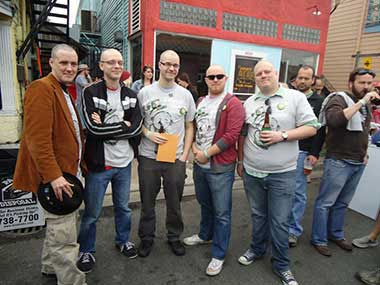
    Every year a neighborhood bar that caters to celebrating German heritage in New Orleans hosts a special event. This event is one of caring and hope. The participants all sport identical hair cuts. The floor is littered with a variety of browns, blacks, and yellows in various hues. It is in this hallowed hall that St. Baldricks takes place each March.

    599376_756312970785_1308427025_n2

    St. Baldricks is a charity organization that raises money for children’s cancer research. They have raised over $127 million for research by doing a different kind of charity work. St. Baldricks doesn’t ask its participants to walk, sell candy, or do anything physical. All they ask you to do is take a seat in a barber’s chair and allow a volunteer to shave your hair off in solidarity with all the kids that lose their hair due to cancer treatments.

    I have participated in this event for four years and helped raise several thousand dollars with some of my closest friends, two of which have been with me each year. Geoff Gauchet was the first to tell me about this wonderful organization and invited me to participate. And although I was a bit hesitant at first, I fell victim to the age old dare of “I’ll do it if you do it,” from one of my closest friends, Jacob Mayer.

    I have asked these two friends to explain why they participate in this organization.

    What made you want to participate in St. Baldricks?

    JM: Peer pressure! OK, that’s only part of it, but I knew some friends who had been doing it for a while and some more friends who wanted to get involved. The more I learned about the organization, the more I wanted to be a part of it.

    GG: My boss at one of my past jobs did it every year, and so one year I decided to give it a shot.

    How long have you have you been participating?

    539943_10151339506891960_1601968395_n1

    GG: This will be my 7th year. I get knighted as a Knight of the Bald Table this year, which is an honor for anyone who’s given 7 years of a service to the organization.

    JM: This will be my fourth year! I think.

    Your team name is Hairy Shearers, what’s that about?

    GG: It’s a reference to The Simpsons. Harry Shearer does a large number of voices on the show, and in one episode there was a barbershop named Hairy Shearers, a pun on cutting hair and his name, obviously.

    JM: Since Shearer is a voice actor for the Simpsons, that make this joke so meta. So meta, y’all.

    How do you get the word out about your participation in this event? Do you utilize social media or do you have a specific method for raising funds?

    GG: I use social media almost primarily. I post my donation link about once per day. As it’s been 7 years, I’ve learned the key times of the day to post for maximum visibility. I also print up a flyer and post it on the fridge at work, and usually email family members.

    JM: Any way I can: Facebook, Twitter, emailing my coworkers, bugging my family, etc.

    How do your friends and family react to your shaggy appearance prior to the event?

    150179_10151339505226960_313243748_n1

    GG: My parents love the event not just for the cause, but because my hair is usually ridiculous right before the event. I wanted to keep my beard at first, but my dad donated extra money on the spot to have them shave it off, so now I do the whole thing. Friends and coworkers usually don’t recognize me for a second. It freaks me out when I catch myself in a mirror.

    JM: It’s literally the first thing my family and coworkers mention when they see me in the month or so leading up to the event. “HEY WHEN YOU GETTIN’ DAT MOP CUT OFF?” or “HEY SHAVE YOUR BEARD, YOU GROSS WEIRDO.” You know, stuff like that. But they’re all very supportive of the cause and sympathetic to my disheveled appearance.

    Please join Geoff, Jacob, and myself at the Deutsches Haus on March 29, 2014 at 6:00pm to watch us once again lose our hair for charity.

    Also, feel free to donate to St. Baldricks:
    Team Hairy Shears
    Geoff Gauchet
    Jacob Mayer
    William Monson

  • New Influencer Faces: March 2014

    New Influencer Faces: March 2014

    Here at Search Influence, we keep on growing! We’re happy to welcome seven new employees to our team.

    Photo Of New Influencers-Brooke Folse

    Brooke Folse (Account Associate): Brooke was born and raised in Lafayette, LA. She graduated from The University of Louisiana at Lafayette with a degree in Marketing. Prior to joining Search Influence, she worked in the Oil & Gas Industry doing marketing and performing research in Colorado, Ohio and Pennsylvania. She is excited to explore all of the activities and culture that New Orleans has to offer.

    Photo Of New Influencer, Lauren Arceneaux

    Lauren Arceneaux (Account Associate): Originally from Rayne, LA, Lauren made her move to New Orleans in 2012 after graduating from The University of Southern Mississippi with a B.A. in Fashion Merchandising and Apparel Studies. Before Search Influence, she worked as a Territory Sales Manager for a local publishing company.

    Hernandez, Andrea (AA)

    Andrea Hernandez (Account Associate): Andrea was born and raised in San Pedro Sula, Honduras and moved to New Orleans 10 months ago. She attended Northeastern University in Boston where she earned a B.S. in Business Administration with concentration in Marketing, and a minor in Communications.  Andrea’s passion is digital marketing and she is excited to join the Search Influence team.

    Photo Of New Influencer, Gussie Matthews

    Gussie Matthews (Account Associate): Originally from St. Louis, MO, Gussie graduated from College of Charleston with a degree in media communication. Prior to Search Influence, Gussie worked in online marketing for an eCommerce website.  As a first-time resident of New Orleans, she’s looking forward to warm weather, Saints football, and cheering on the St. Louis Cardinals from afar.

    Photo Of New Influencer, Lindsey Nunez

    Lindsey Nunez (Junior Account Associate): A New Orleans native, Lindsay received her bachelor’s degree from Louisiana State University in Mass Communications with a concentration in Public Relations. Prior to joining Search Influence, she taught English to business professionals in Prague, Czech Republic.

    Photo Of New Influencer, Bridget JuelichBridget Juelich (Junior Account Associate): Bridget is originally from St. Louis, MO, and attended Loyola University where she earned a bachelors degree in Mass Communication and a minor in Marketing. Previously she worked as the Social Media and Marketing Coordinator for the Elms Mansion. Bridget also worked for other local businesses such as Tales of the Cocktail and the Donnelley Center for Nonprofit Communications.

    Photo Of New Influencer, Rachael Borek Rachael Borek (Junior Internet Marketing Associate): Originally from Baton Rouge, Rachael attends the University of New Orleans and studies Sociology. Before joining Search Influence, she worked as a PC-Technician for St. Joseph’s Academy’s one-to-one laptop program in Baton Rouge. She still spends time doing IT related volunteer work locally.


    Welcome to Search Influence, Brooke, Lauren, Andrea, Gussie, Lindsey, Bridget, and Rachael!

  • Can’t Code #2: Binary Basics

    The most basic code in the world of digital technology is binary code, which employs the binary digit, or “bit” for short. This code consists of 1’s and 0’s. The 1 means that something is; the 0 means that something isn’t. There’s no room for ambiguity when using bits. We’ll explore just how computers process binary information to create a meaningful user experience in the next installment of this blog series, but in the present post, I’d like to first discuss how binary digits operate, and what it means to count in binary.

    There’s Nothing Special About the Number 10

    The number system that we commonly use today, the one that consists of 1’s and 2’s and 8’s and 9’s, came to us from India a very long time ago. It supplanted the more cumbersome Roman Numeral system of X’s, V’s, and M’s. The most important characteristic of this “Hindu-Arabic” number system, and the feature that ensured its primacy over Roman numerals, was its most lowly number: zero.

    Zero revolutionized counting by providing a placeholder for intervals of 10. When you count past 9, the 9 becomes a 0, the integer to the left becomes a 1, and you’ve got 10. Ten 10’s become 100, ten 100’s become 1000, etc. Ten, as a numeric concept, suggests completeness; a closed circle; the beginning of a new cycle. But in order to understand binary, it’s first necessary to understand that, despite all this, there’s nothing inherently special about the number 10.

    The Counting System

    We have adopted a “base-10” or “decimal” counting system for the simple reason that our species has 10 fingers. The Hindu-Arabic system, and it’s trademark number 0, allows us to essentially count sets of fingers with ease. 10 is one set of fingers. 20 is two sets of fingers. If we had 8 fingers, the way we count would be very different. We’d be using a “base-8” or “octal,” rather than a decimal, counting system. 10, however, would still represent one set of fingers.

    To illustrate this, let’s visualize the following scenario: E.T., the titular character from the 1982 Steven Spielberg film, is trying to count 20 penguins in a row. Let’s briefly evaluate E.T.’s anatomy: he’s got tiny little legs, which leaves him very low to the ground, a long neck, long arms, and most importantly, 4 fingers on each hand, 8 fingers total. And with those 8 fingers, he begins to count 20 penguins. Let’s listen as he counts:

    1, 2, 3, 4, 5, 6, 7, 10 little penguins!

    11, 12, 13, 14, 15, 16, 17, 20 little penguins!

    21, 22, 23, 24 little penguins all in a row!

    Do you see why E.T. counted 24 penguins whereas we, with our 10 terrestrial fingers, would have counted 20 penguins? The number 10, as we have established, is a symbol used to represent one set of fingers, no matter how many fingers are in the set; and 20 is used to represent two sets of fingers, no matter how many are in the set. While we would have counted the row of penguins on just two sets of our ten terrestrial fingers, E.T. required two and a half sets of his eight alien fingers. The reason that his above counting scheme might look odd to us is that he had no use for integers “8” and “9,” and therefore his count is “missing” four numbers that would be included in our own: 8, 9, 18, and 19.

    Counting Penguins With Just Two Fingers

    Here’s how this relates to computers: computers only have two fingers. The “binary” code that serves as the language of computers is a base-2 system, and thus only utilizes two integers: 0 and 1. It doesn’t involve integers 2 through 9. By the time your computer has counted to 2, it’s reached 10; much like by the time E.T. has counted to 8, he’s reached 10. Imagine a person with two fingers counting a line of 10 penguins in the same way that E.T. used his 8 fingers to count 20 penguins. It would look like this:

    1, 10, 11, 100, 101 little penguins!

    111, 1000, 1001, 1010, 1011 little penguins all in a row!

    This hypothetical two-fingered person would never get to twenty, or thirty, or forty, because she wouldn’t even know what “2,” “3,” or “4” were. The only numbers that would exist between 0 and 100 in her mind would be 1, 10, and 11. Any other numbers would involve integers higher than 1, and therefore would not be counted.

    Using binary might be a really awkward way of counting penguins, but as it turns out, it’s a pretty effective way of transmitting information over vast distances. In the next installment of Can’t Code, we’ll take a look at how computers use these binary numbers to create useful information and media. In the meantime, here’s a decimal to binary converter to play around with in order to reinforce your understanding of the ever-lovin’ bit!

  • 8 Tips for Handling Bad (and Good!) Online Reviews

    Have you ever had a bad experience at a business? How did it affect your opinions of that company? More often than not, one bad experience will hinder how someone views a business, even if the experience was handled in the best way possible by the business owner/manager. This can affect the online reputation of a business greatly if people decide to write an online review about you.

    Reviews

    While the thought of negative reviews may scare you, do not let these reviews discourage you! Remember that a dissatisfied customer is more likely to write a review after a bad experience than a satisfied customer writing about a positive experience. Negative reviews can even help you learn how to improve your business. Here are some tips for actively handling these reviews:

    1. Actively check your reviews on various platforms across the web.

    A good way to keep up is to assign one day per month (or bi-weekly) to check your online reputation on the different platforms. The list can be endless, but these are some important ones to consider:

    **Note that you will most likely have to create an account and verify that you are the owner / manager to be able to respond to the reviews as the business owner.

    2. Always be transparent with your customers. This includes:

    • NEVER posting (or having your staff post) fake reviews.

    • NEVER deleting reviews that are negative. This will just anger the person that posted the review, in turn causing a downward spiral effect. Most likely, the angry reviewer will continue to post reviews until they are acknowledged by the business. Instead, take the time to listen to your customer and their concerns.

    3. Make an effort to respond to every review – positive and negative.

    • For positive reviews: A quick, “Thank you for your feedback, NAME! We appreciate your business. We hope you continue to be a BUSINESS NAME supporter!” is sufficient for a positive review. Responding to positive reviews can reinforce the already positive opinion that the reviewer has of your business, and reinforce brand loyalty with that person (because who doesn’t like being responded to by a business?).

    • For negative reviews: The dissatisfied customer will appreciate being heard, and outsiders will appreciate that the business takes the time to respond when something isn’t right.

    4. Be personal in your responses.

    Use the customer’s name if provided, and bring in information from their original review. This will keep the customer from thinking you just have a generic response to all reviews.

    • For example, if a person leaves a bad review on a spa page and you notice in their review they had a massage that day, you could say something along the lines of: “Hi NAME, I’m sorry your massage was not up to par….”

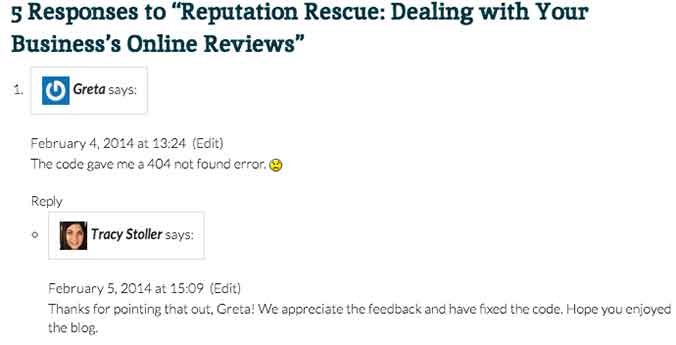
    • Another example comes from our blog! Check out how Tracy Stoller responded to a comment about an error in a code we provided in a previous blog.

    response

    5. Provide a business email that the reviewer can contact you on.

    Don’t try to make it all perfect on the review. You will be able to go more in depth with the customer through an email, depending on the severity of the review/situation. It’s up to you to decide when to try to go into more depth to resolve the issue.

    • You could say something along the lines of, “I truly apologize for XYZ. Please contact [email protected] to help us resolve this issue for you.”

    6. Remember that sometimes people have unrealistic expectations of a business.

    yelp-meme

    If something happened that is completely out of your control, explain yourself in the reply. However, do not have a negative tone toward the customer – simply explain the situation to the best of your ability.

    • For example, a customer leaves a horribly negative review after coming to your restaurant and you are all out of their favorite beer. You can apologize for the inconvenience, but explain that things like this happen occasionally. Explain when the product would be restocked and invite them back. This would be an example of when to NOT provide a contact email, because the situation is not that extreme.

    7. Do not offer gift cards or other repayment for a negative experience on the review site.

    If something is serious enough that you feel the need to refund the customer, provide your contact email and do so through email. Offering repayment or gift cards publicly can be seen as bribery by an outsider reading reviews.

    8. Invite your customers to leave reviews!

    Post a link to your Yelp! page (or other review site) to your social media accounts and invite your followers to talk about their experiences. This could lead to people leaving positive reviews that would not have normally done that on their own.

    It’s important to remember that you can’t please everyone, but continuously having timely responses to your reviews can only benefit your business.

  • What Happened To GetListed.org?! Check Out The New Moz Local!

    If you’re a local SEO geek like me, you were probably super excited to learn that this past Tuesday Moz Local was officially released. If you go to GetListed.org, you’re now redirected to Moz Local, which can also be accessed directly at moz.com/local.

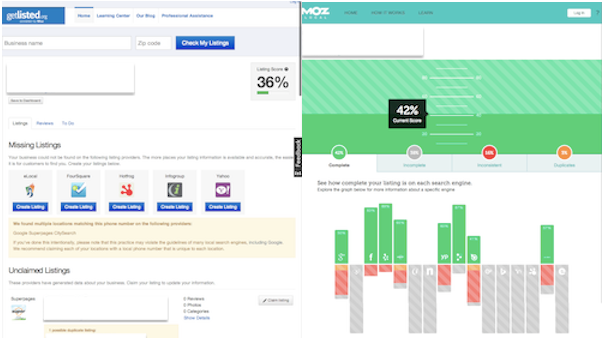
    So, you might be asking yourself what exactly has changed and what is Moz Local. You can still do the same free reputation lookup that you used to be able to do with GetListed by clicking “Check my Listing Score.” Now, however, the results are very stylized, as is Moz’s style, and much more visual in nature.

    Here’s a comparison view:

    Screen Shot 2014-03-21 at 11.58.27 AM

    Understanding Moz Services

    So, outside of the free reputation monitoring tool, Moz Local offers the paid service of being a “self-service location data management software that syndicates listings to all five major U.S. data aggregators,” at a cost lower than services like Yext and UBL. One of the 5 major data aggregators that they submit to is Factual, which if you’ve ever tried to clean up your listings in, you know it can be fairly impossible because you basically need to be a developer to do so.  For $49 per year per location, they feed your listing informations to major directories and help you stay on top of how your business is appearing on those sites with a beautiful and easy to read visual report. The time you would have spent locating and figuring out what’s going on in these sites, is greatly reduces by using a helpful and comprehensive service like this. Using efficient tools like this is a great way to make sure you’re being productive and not just keeping busy.

    Moz Local is definitely geared towards businesses and agencies who manage multiple locations and/or businesses online. If you want to add multiple listings and locations to the tool at once, you can do it all in one spreadsheet with formatting similar to that of the UBL  and Neustar/Localeze upload spreadsheets and exactly the same as Google’s multiple location spreadsheet. So, if you’re familiar with any of those, it’s super easy. If you’re not familiar with those, they’ve got a super helpful page to ensure that you’re filling out the fields properly!

    Answering Questions

    You might be thinking, “But what about the directory partners that require listing verifications?” Well you don’t have to worry about that! Here’s the direct response to that question from Moz:

    When you submit a listing on Moz Local, it must match an existing Google Places or Facebook listing across all of the following attributes: Business Name, Address, Phone Number, and Website. Because you’ve already gone through the phone or postcard verification process with Google and/or Facebook, your Moz Local listings will be validated if they exactly match Google and Facebook.

    Thinking Forward

    Much like other services such as Yext, if you cancel your Moz Local subscription, many of your listings with Acxiom and Localeze will be reverted back to their status prior to your subscription.

    Your best bet to prevent something like that from ever happening would be to use Moz Local as a tool to get your information to those sources correctly, but also take the action of still claiming and owning your listings. This is especially important to do on major sites like Google, Yahoo, Bing, Facebook, Yelp, and Foursquare.

    I hope you’re all as excited about Moz Local as I am! If you’ve got other questions about Moz Local, see their FAQ section here.

    tumblr_mc3hg5VpQP1qcy0p7o1_500

    Feel free to comment below if you’ve got any input or feedback on your experience with this beautiful new upgrade.

  • Google suggests: An overview of SEO

    Three months ago I started working at Search Influence. I thought I knew a lot about SEO, boy was I wrong. After what seemed like a crash course in everything we do here, I thought I would put together an overview of what I’ve learned:

    SEO

    After 45 (!) trainings I know a lot more about SEO, but I also found out you are never done learning. SEO continuously evolves, and that’s because of Matt Cutts, the head of Google’s Webspam team. To be honest, I only knew him from the 30 Day challenge he talked about at my favorite platform TED. He is the one that changes Google’s algorithm 600 times a year! Another honest confession, I thought this algorithm only changed 25 times a year. I was just a little off.

    Keyword Research

    One of my first trainings was on keyword research. This is a process in which we look at the historical online search behavior for a given product or service to determine what keywords we are going to focus on throughout a client’s campaign. This is an extremely important process and happens at the beginning of our partnership with a client.

    Google Keyword Tool

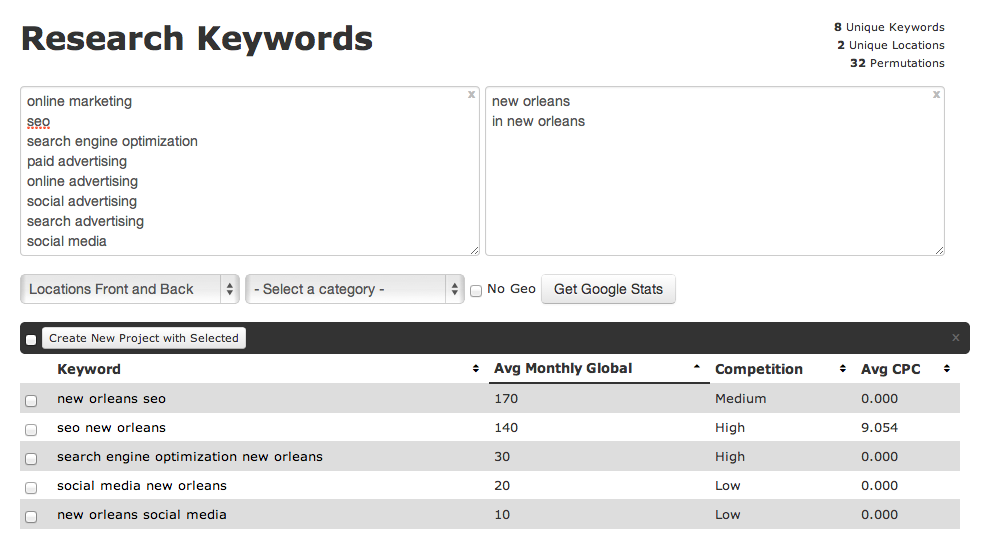
    For the keyword research we use Google’s keyword tool. After adding a long list of root terms and a list of geographic modifiers (the physical location of the client and/or their service areas) the tool shows the approximate number of search queries matching the keywords that were found on Google.

    Google Keyword Tool

    A brilliant tool, but not perfect as it provides search statistics based on Google.com traffic only. But of course, Google captures 72% of all search traffic so we feel better about relying heavily on their research. When needed, we utilize other things like Google Webmaster tools and Google Adwords Keyword tool.

    Google Analytics Organic Keywords

    Before I started working at Search Influence, keyword research was much easier. My colleagues logged into Google Analytics and could see which words people used when searching Google to find the designated website. In October 2013, however, Google stopped offering this information to provide additional privacy and security for its users.

    Google Suggest

    Last month a light bulb went on in the head of a Search Influencer. ‘Why didn’t we think of this earlier?!’ She was talking about Google Suggest, a feature that has been around for five years. Just enter a letter or a word in Google’s search field and you will see associated terms in a dropdown menu. Google describes Google Suggest as:

    “Autocomplete predictions are algorithmically determined based on a number of factors, like popularity of search terms, without any human intervention. Just like the web, the search terms shown may include silly or strange or surprising terms and phrases.”

    Although we benefit from Google Suggest, I agree the search terms shown are sometimes (very) silly or strange, just see for yourself:

    http://youtu.be/DJT67NApROI

    After seeing this, I was curious what Google would suggest when entering ‘Search Influence’:

    Google Suggest

    Reasonable. Logical. But Google also suggested…

    Google Suggest

    What???

    So overall, Google Suggest can be helpful, but it can also make you laugh. (Or make you mad: over the past few years Google Suggest has been sued for racist search suggestions and defamatory language next to individual names or companies).

    So what do I suggest? Use it, but

    Google Suggest

    Do you have any questions about SEO? Let us know in the comments!

  • Are You Being Productive Or Just Keeping Busy?

    Over two months have passed in 2014, and like most of you, I can honestly say that I have been very busy. I would be willing to bet that 50+ business days into the year, I, like a lot of you reading this have logged 150-200 hours of meetings, and have received and answered well over a over a thousand emails. Doesn’t that sound busy? This past weekend, as I was doing my weekly review, I found myself wondering, have I been productive as well? Have I been focusing on the projects that will make Search Influence a great place to work? What about the things that will allow us to serve our customers better?  How much time have I (and the teams I support) put into developing the Internet Marketing products that will help our customers succeed online tomorrow?

    4556099850_bcd9318b5b

    If you find yourself wondering the same thing, or worse, in an honest moment, answering no to that question, here are three things that you can do to avoid being busy, yet unproductive.

    1) Review your long-term initiatives or goals on a regular basis

    9331682959_2e179c31c6

    In the book Getting Things Done, the author David Allen challenges readers to undertake a weekly ritual wherein they will review and process everything in their inbox, their to-do lists (that’s right, lists), their previous and upcoming calendars, and their projects or “larger outcomes,” I find that this review of my long-term projects and initiatives, or “larger outcomes” allows me to ask myself if I gave each of these areas the attention they deserved, and to make sure that I have some actions or meetings teed up to assure that I keep moving toward success in the upcoming week. Think about it, if you move the needle on the 4-5 of the most important things every week, in 3-6 months, you will have made a significant impact on some areas that are important to you.

    2) Be ok with saying “no” occasionally

    Remember those thousand emails that you have processed so far this year? Or the over 150 hours of meetings? Chances are, in a few of those, someone has asked you to take on a small project or task. If you have a reputation for being someone who can get things done, you might get asked for help in more than a few. I completely get the urge to tell everyone “yes.” In fact, I think that you should be looking for ways to tell people “yes” whenever you can. Sometimes, the best way to support the people who are asking you for help is to tell them “no.” Two potential benefits immediately come to mind:

    • Hopefully the initiative you chose to prioritize over helping someone will have a positive impact on all parts of the organization you are working in, including theirs.
    • By telling them “no,” you may be empowering an employee to try to complete the task or solve the problem on their own.

    There are also other ways that you can say “no,” while offering to provide some support:

    • Offer someone else in your part of the organization as a resource. Who knows, the task or assignment may even be a good developmental opportunity for someone more junior.
    • Ask if your support or action is needed right now. If not, perhaps you won’t have to tell them “no,” just “maybe later.

    3) “Unplug” To Focus

    4447008001_9867947867

    How many potential communication inputs do you have to distract you during the workday? Here are mine:

    • Email
    • Chat
    • Text
    • Phone
    • Face to Face
    • Social Media

    Those are six ways that anyone who needs me can get in touch with me at any point throughout the day. Those are also five potential distractions if I am trying to work on something that needs my undivided attention.

    When was the last time that you set three hours aside to work on something extremely important, but three hours and six interruptions later, your three hour window was shut, and you had barely made a dent in your project? Now, I will be the first to admit that as a manager, it is hard to take actions that make it seem like I am not available to support my teams.

    Availability
    Concept smartphone tablet pc and laptop in hands Isolated on white backgroundOne thing that I have come to realize is that being available to others does not necessarily mean being available every moment of the day, or even workday for that matter.


    And how available are you in these meetings you are in anyway? I have found that there are times when I need to eliminate (ok, minimize) the potential distractions by unplugging from all communication devices (except my cell phone, of course).

    If anything is important, but not urgent, it will be waiting for me when I plug back in. And if anything is urgent, I let my teams (and my family) know that in an emergency, I can be reached via my cell phone.

    Then I turn to whatever it is that needs my undivided attention and try to knock it out. Again, hopefully, whatever it is I am working on will have a significant impact on those that I have chosen to unplug from for a few hours, so in the long-run they will benefit, too.

    In short, its very easy to stay busy these days. There is always a meeting to go to, a text we could respond to, emails to deal with, and unplanned, “urgent” work to be done. And all of that has to get done. The challenge is making sure that you are handling the things that are not extremely urgent, but are critically important.

    How do you make sure that you are getting to the things that matter most to your organization and the people who depend on you?


  • Social Media And Viral Content: Tips From Matt Siltala

    If you haven’t heard of Matt Siltala, get your butt to Google right now and start searching. As an online search industry leader and president of Avalaunch Media, Matt came to New Orleans this week to present at Pubcon, a social media and optimization conference and expo featuring multiple days of multiple-track sessions, leading-edge keynotes, and an all-day intensive Pubcon Masters Group training program.

    Prior to wowing the crowds at Pubcon, Matt was kind enough to visit Search Influence and give us the skinny on social media, content, and how to make things go viral. His presentation was amazing, informative, humorous, and vastly helpful in terms of SEO. So, I’ve put together some key takeaways businesses can and should focus on in order to promote their brands and make a name for themselves online.

    MattSiltala-01

    Find Your Target Market By Talking To The Right People

    When you’re trying to reach a target market, knowing who to talk to in order to get results within that market is most important. When you talk to someone with power, authority, and a willingness to help, there is a higher probability of getting your brand noticed and increasing awareness among your target market.

    Pro Tip: If you know who you want to target, use Followerwonk to compare, analyze, track, and group users. That way, you know exactly who you’re reaching, and what to say in order to entice them.

    What Makes Good Content?

    Oddly enough, controversy increases viewers and makes for some great content. Think about it. When do people get the most involved in content? During a debate! Any topic people disagree on will get more viewers. This is a theory that withstands the test of time. For example: Republican vs. Democrat, Mac vs. PC, Coke vs. Pepsi, and Matt’s popular Evolution of the Electric Guitar infographic, which includes a Guitar Hero controller, featured below.

    music history timeline evolution infographics electric guitars 3660x1186 wallpaper_www.wall321.com_28

    Build Up Your Instagram Following With Deals

    bdb414e7b829806b2e3cdd921638042f

    With millions of users posting pictures every day, Instagram has exploded in terms of social media marketing and brand promotion. Boutiques, restaurants, and more post photos of products, specials, daily deals, and location information daily, giving viewers a reason to follow them and stay consistently engaged in the brand. By monitoring hashtags and paying attention to channels, businesses will learn whom to target and how to peak people’s interests and gain followers.

    Pro Tip: Show products in context to help viewers visualize a final product. Whether that is a meal, an outfit, or a piece of furniture, demonstrating what the product will look like in conjunction with other products peaks interest and makes things easier to relate to.

    Processes On Pinterest

    More frequently, businesses are turning to Pinterest to gain a customer base. In fact, the “Pin It” action has gained more popularity than the Facebook “Like” and Twitter’s “Retweet.” Checklists, how-tos, recipes, and detailed processes are hugely popular on Pinterest because they get people thinking and and keep their interest longer than a simple image.

    Pro Tip: In terms of repinning vs creating new pins, employ 4:1 ratio. Remember that it’s not just about repinning for content, you repin to network. And make sure you get yourself noticed by commenting regularly.

    Focus On Visuals On Facebook And Twitter

    As with all other forms of social media, building a following and growing your popularity is key to brand success on both Facebook and Twitter. So, what is the key to getting lots of retweets, likes, shares, and comments? Images! Think about it, what is the most retweeted post of all time? Ellen Degeneres’ Oscar Tweet! Only three days after the Oscars the tweet had a record 3.2 million retweets. Now that’s a powerful image.

    Pro Tip: Identify influencers relevant to your industry and interact with them as much as possible on social media to grow your online presence and brand popularity.

    I could go on and on about the wealth of knowledge Matt dispelled on the Search Influence family, but rather than rambling I’ll leave you with a few of his final tips and tricks:

    1. Pay attention to Linkedin groups. If you get in contact with the owner of a relevant group to your industry they can help you tremendously. Not only can they contact a large group of people easily via email, the group they’re contacting will be the exact target market you need for shares and online visibility.

    2. Sign up for alerts from Help A Reporter Out. You can find experts, get free publicity, and gain tons of helpful contacts.

    3. The gift category in Pinterest is wildly popular. By using a dollar sign ($) in your post description, your post will automatically show up there.

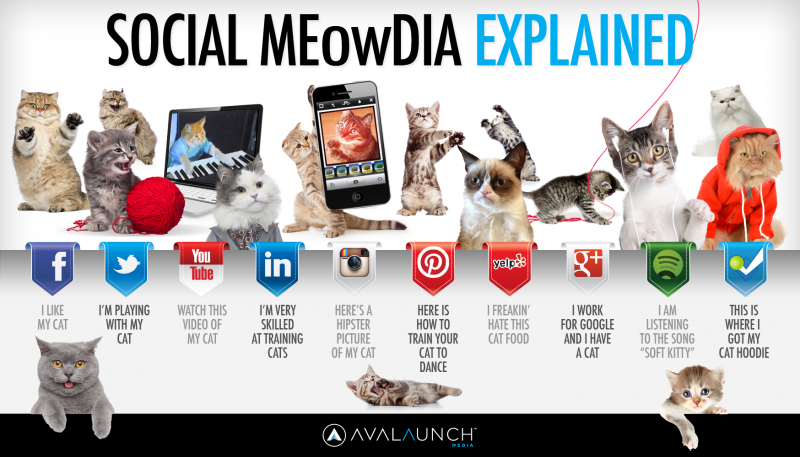
    4. Find a way to repurpose everything. Much like Matt’s wildly successful Social Meowdia Explained infographic (featured below), post, images, content, and more can be repurposed to gain popularity in a variety of forms. For example: an infographic can be turned into a blog, memes, content, etc.

    Social_Media_Explained4-800x457

    1. Remember that everything you do contributes to authorship. Every post you write, share, retweet, favorite, etc has your brand name attached to it. Everything you do online grows your authorship, so take advantage of that and be creative in what you post.

    For more information on Matt Siltala, check him out at Pubcon or visit his website! And for any questions on the information above, feel free to ask in the comments!

  • Content: The Beginning

    In the beginning there was the Internet.

    At least, that’s what I tell myself when I try to think back to my early childhood. Kids (whatever, I’m a kid, kids younger than me) are glued to smart phones, they have these things called tablets and nooks… but what of books? What of literature? These are some of the questions people had about television back when the youths first sat their little rumps down in front of the tube. Now, the eye of Sauron has turned to the Internet.

    internet.gif

    Don’t get me wrong, the Internet is chock-full of copious amounts of information (all the information, in my opinion—if it’s not on the Internet, it doesn’t exist) and can be extremely useful. Ah, but therein lies the issue!

    The Internet is an extremely powerful thing, a great source for random, trivial, and (sometimes) useful knowledge. However, with great power comes great responsibility. Although many can argue that the Internet is killing language (lik3 wut3v3r dude), excusing poor spelling, grammar, and vocabulary, the Internet has also bred a whole new generation of nit-picky grammar specialists. You know who I am talking about, that one person who loves to correct your use of words, followed by a sweet, misleading asterisk.

    What am I getting at?

    hercmeme.jpg

    Although a lot of time goes into straightening out the aesthetic and function of websites, many forget to think about the words.

    To quote the great V, “Words will always retain their power. Words offer the means to meaning, and for those who will listen, the enunciation of truth.”

    However, choosing those words can be a difficult, sometimes even Herculean, task. On the one hand, your content needs to be purposefully crafted, tailoring to those aforementioned language *specialists*, but on the other hand, your content needs to be clear, concise, and easily understood by a diverse audience, i.e. everyone.

    Good Content = Good SEO

    But how do I write good content? You may ask. Obviously, content will vary depending on your site, your brand, and your audience. But, say we were to tackle “good” content on a broad scale

    Check back for my next blog where I break down the concept of content, starting first with: The What — What Your Content Needs To Say.