Blog

  • 5 Ways Technology Has Changed the Olympic Games

    Just like the rest of the world, the XXII Winter Olympics has captured my attention ever since Team USA walked out in those hideous sweaters Friday night. For 16 days the world will sit in front of the TV, eat King Cake, and watch every move, detail, and technique performed by these athletes. Six days in and I feel like a complete failure at life because I’m not an Olympian. I complained throughout the mere three weeks of training I put into the Rock-N-Roll half marathon, so how these athletes dedicate years of their lives to training is mind blowing. In addition to the support of family, friends, and coaches that help inspire and guide these athletes to Sochi, the growth of technology has also played a big part in reaching the gold.

    Here are five ways technology has changed the Olympics.

     1) Slim, Trim, and Faster Than the Speed of Light – Custom-Fit Track Suits Shave Off Seconds

    5 Ways Tech Changed the Olympics - Blot

    Far from the flowing tanks and short shorts our parents remember on seeing Bruce Jenner, Nike’s custom-fit track suit has allowed for a faster, sleeker champion. Besides the fact that it may or may not take an hour for someone to squeeze themselves into this skin tight suit, athletes are able to move faster than ever. With the help of Nike, in 2008, Team Jamaica’s Usain Bolt broke the 100 meter record with a 9.63 second run, earning the title Fastest Man on Earth.

    2) Not a Long Shot – Dual Lens Innovation for Measuring Long Jumpers

    In 2012, Summer Olympic sponsor BMW launched a dual-lens camera with 3-D imaging to measure track and field long jumpers in motion. This piece of technology immediately measures velocity and calculates the athlete’s body motion and positions. In years past, analyzing movement at this level would rely heavily on the coach’s eye and basic video. Now, this data is immediately available for review and improvement to technique.

    5 Ways Tech changed the Olympics - Phelps

    3) What a Drag – Speedo Creates Full-Body Swimsuit to Speed Up Swimmers

    In 2008, Speedo introduced us to the very toned quads of Michael Phelps as he and the rest of Team USA sported the full-body swimsuit. The compression of this bodysuit is made to improve swiftness and reduce drag in the pool. I think it’s pretty obvious that this suit helped Phelps become the most decorated Olympian of all time – leaving Mark Spitz in the bubbles.

    4) Every (One-Millionth of a) Second Counts – Finish Times Fine Tuned

    What’s worse than winning silver? Losing to Phelps by one hundredth of a second! In the 2008 Summer Olympics in Beijing, Serbia’s Milorad Cavic finished second to Phelps by one hundredth of a second, helping Phelps earn his seventh gold medal.  How did they find that time? Forget stopwatches and timers! Thanks to technological advancements in capturing finish times, athletes are measured by one-millionth of a second, making the games more competitive than ever.

    5) Beyond Fame and Gold Fortune – Athletes and Host Cities Go Viral on Social Media

    From athletes posting pictures of the atrocious living conditions in the Sochi Olympic Village, to news sources leaking pictures and interviews of athletes biting the gold, social media has taken over the Olympics. In postings, pictures, and tweets going viral, athletes invite viewers into their lives from training days in the US to the slopes in Sochi.

    For example:


    McKayla MaroneyAt the 2012 London Summer Olympics, McKayla Maroney’s look of disappointment as she received her silver medal went viral! From generating memes to photoshopping her into pictures, “
    McKayla is not impressed” blew up on social media. At this year’s Winter Olympics, it was bound to happen again when Ashley Wagner’s similar face of disappointment lit up the screen after receiving her fourth place score in a team figure skating program.

    Social media has allowed viewers back home in the States to stay updated with team members and make a personal connection with athletes. Not only does this help with support, it invites us to feel closer to Team USA than we’ve ever felt before.

    Got a favorite social media update about the Olympics? Post in the comments!


  • Watch the Possibilities Unfold

    For many years we’ve considered the fold, or the first 600 pixels of content on a website, to be the gateway for user interaction and hopefully the production of leads. To take advantage of this, we’ve filled this space with as many buttons, forms, and click-through opportunities as humanly possible. The result, oftentimes, was a cluttered site with so many calls to action that viewers didn’t know where to look first.

    So what’s changed?

    Tablets and smartphones have helped us by naturally encouraging users to scroll. These smart devices have not only made it easier to scroll, they’ve also made it fun! Because of this, the purpose of those 600 pixels has changed. Instead of using the space above the fold as the one and only location for possible lead generation, we can use this area to help direct the viewers’ eye down the page to discover more.

    How do we do that?

    Have you ever seen a social media contest that directs you to “like” the page and enter to win? The designs for these ads usually include a directional arrow that points up to the “like” button, to help you understand exactly where you need to go next. Often times the call to action for this type of contest will be sometime similar to ”Like & Enter” or “Like us to find out more.” The need for a clear call to action on websites such as the ones used for contests is now more important than ever.

    An even better example of a great call to action is Amazon’s graphic to get customers to take a look inside of one of their books.

    Screen Shot 2014-01-22 at 3.56.49 PM

    What is it about Amazon’s call to action that makes you want to click on that book? How can you achieve a similar effect? Here are three tips for creating a successful call to action:

    1. Use a Contrasting Color

    According to The Institute for Color Research, we subconsciously make judgments about people, products and their environment within 90 seconds of seeing them. Between 62% and 90% of that initial judgment is based solely on color.

    The most important thing to consider when selecting your call to action color is to choose one that will stand out on the page. If most of your page has varying shades of blue, a bright green button will do the trick, or a golden shade of orange. As KISSmetrics highlights in their infographic on color, this can be achieved by using analogous colors for the background of the page’s main content, while using a complementary color as your call to action color.

    Take a look at the Amazon example again. Did the contrast of the blue and the orange catch your attention?

    2. Remember these 3 C’s: Clear, Compelling, and Concise

    “Read the Case Study”
    “Try it For Free”
    “Take a Tour”

    All three calls to actions are common, but effective. They tell the user what they will be doing: reading, trying, and touring. By eliminating the concerns of the user, you compel them to want to find out more. Case studies, free trials, and tours are great ways for the user to find out more information. If you can do compel the readers clearly and be concise in your wording, you will have successfully created a perfect call to action.

    Amazon’s example achieves this in two ways. The call to action, “Click to Look Inside” is to the point, but they’re actually able to abbreviate this even more by emphasizing “LOOK INSIDE.”

    3. Give Directional Cues

    Whether you’re attempting to get your customer to scroll down the page or trying to direct them to your form, you need to use directional cues to show them where they need to go next. From arrows that point to the call to action, to imagery that implies the need to scroll down to see more, people subconsciously want to be prompted towards their next step.

    The arrow for Amazon’s click to look inside serves two purposes. It implies the action of opening a book while also directing customers to click on the image of the book to see what’s inside.

    Another great example of directional cues is on the Nike Better World site. While there is not an arrow or obvious directional cue, customers will subconsciously want to scroll through the page because of the visual implication of movement. They use a very subtle, but effective approach for directing their customers to look further to see more.

    Michael Lykke Aagaard, a A/B testing guru, blogged about testing he did on the positioning of a CTA. He states that this test showed a 304% increase in conversions for the placement of the CTA under the fold. If that isn’t proof enough, try it for yourself and watch the possibilities unfold.


  • Welcome to “Can’t Code”

    Lessons, Musings, and Complaints about Digital Technology

    I started working at Search Influence a few months ago. Before that, I had a lot of web design experience, but all of it was very informal and self-taught. Due to budget cuts at the University of New Orleans, my graduate department asked me to volunteer as their “web guy” when they were unable to afford a real administrator. This meant that I had to do some very quick, ad-hoc studying in order to fulfill this role. Up to that point, I’d learned a lot about the most basic architectural features of the internet, like HTML and CSS, but it took a lot of research before I could make sense of the web’s more sophisticated components. At the time, PHP, Javascript, the infamous WordPress “Loop,” and other institutions of cyberspace appeared to me like confusing, mystical clouds of information.

    Image of Indonesian Students Using a Laptop

    I felt simultaneously intimidated by these topics and ashamed to inquire about them because I felt I should already know the answers. Finally, out of necessity, I set aside my ego and asked my more well-informed peers to share their skills with me, a request that was, of course, met with enthusiasm. The process of learning these skills was still challenging, but being open and honest about my ignorance was my shortest path to success (think I saw that on a poster somewhere).

    That experience made me reflect on the “digital divide.” Even as someone who was raised on computers, I struggled to understand how people operated behind the point-and-click Windows interface that I grew up on. I could only imagine how difficult this same endeavor would be for, say, my grandparents, or my childhood friends whose families were too poor to have a Nintendo, much less a laptop. Even though digital technology has permeated some of the hardest-reached socioeconomic crevices of our society, the standards of what constitutes “literacy” in a rapidly evolving economy is a moving mark. While many people are becoming comfortable with the Graphical User Interfaces (GUIs) created to help them interact with digital information, knowing a little code helps to fully participate in and understand the digital spaces of our lives.

    What Now?

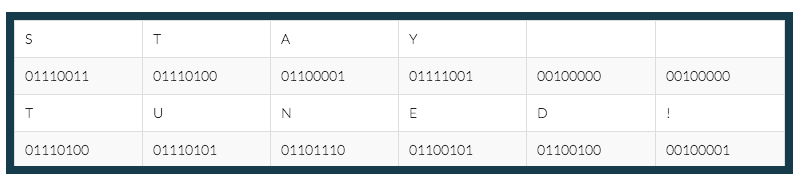
    Image of binary data

    Beginning with this post, I’d like to share what I’m learning as a Junior Web Developer at Search Influence, in the hopes that others with a low to moderate level of computer literacy may learn something. Future posts will appear monthly on the Search Influence blog and cover various facets of the digital technologies that I use to complete my daily tasks. Some posts will describe what these technologies are used for, some will provide a tutorial on how to use them yourself, and others may simply give commentary on the history and social implications of these technologies.

    Next month, I plan on covering the very basics: ones and zeros. We commonly see long strings of 1’s and 0’s in the popular media that are meant to represent some form of digital information. But where does this code come from, and why is it used?

    Chart-border

    Stay tuned for the answers next month! And for any code questions you want answered, comment below.

  • HAPPY FRIDAY, BOYS! (and girls)

    HAPPY FRIDAY, BOYS! (and girls)

    Here at Search Influence, we’re all about tradition.

    We’ve got loads of candy in the kitchen, an anonymous question of the day on the community whiteboard, king cakes all Mardi Gras season long, double booked conference rooms, and every single Friday afternoon ends the same way.

    No matter what you’re doing, or how busy and stressed out you are, you’ll know when it’s five o’clock.  You’ll hear it coming loud from the Development Department.  It’s time to listen to “This is How We Do It” by Montell Jordan.  It’s a tradition that began with a former Influencer that we refuse to break (Shout Outs, J-Luft!).  I mean, seriously, is there any better way to start off your weekend!? It’s 3 minutes and 59 seconds of head bobbing, hand waving, and lip syncing – or loud singing – bliss.  In that moment you forget everything that you’ve ever known and remember what’s important in life.  The weekend.

    While this doesn’t exactly mean it’s time to pack up and go, because let’s be real, we’ve still got stuff to do, it’s a signal of what’s to come.  You may think that we’ve grown tired of one another after spending over 50 hours a week sitting two feet apart, but that’s not the case.  For some odd reason, some of us just can’t seem to get enough.

    Carrollton Station New Orleans

    So after we convince ourselves that we’ve accomplished all that we can in a workweek, or slowly peer pressure one another to leave, one-by-one we head on down three blocks to the station. Carrollton Station.

    While I could go on for days about all of the fun things that have happened, conversations we’ve had, or the moments we can’t quite seem to forget (or remember) at the station, instead I’ll fill you in on the reasons why we keep going back.


    Activities

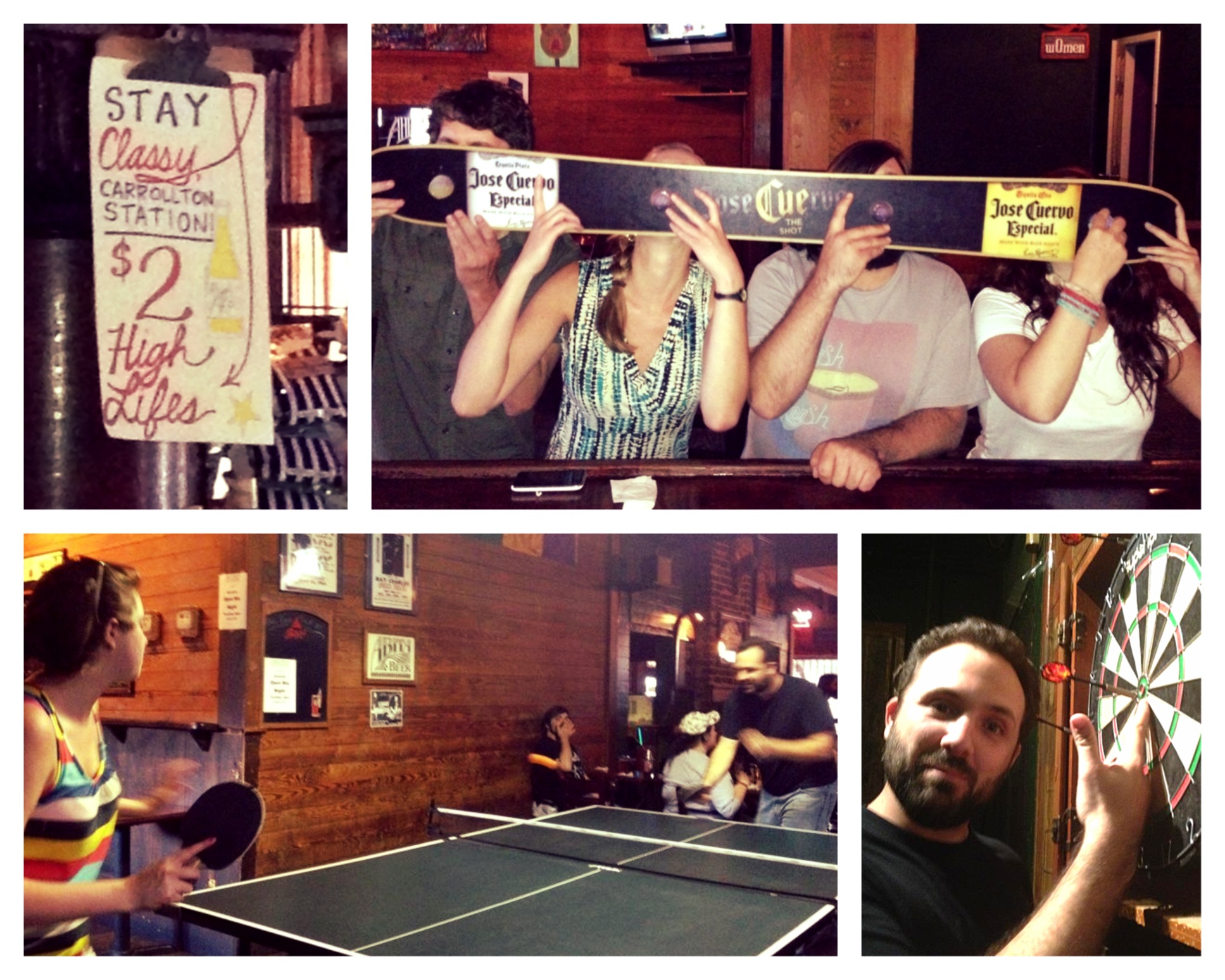
    Carrollton Station Activities

    After sitting at a computer for over 8 hours a day, it’s time for a little cardio.  On any given Friday, you can see Influencers doing any combination of the following:

    • Ping Pong Tournaments
    • Darts
    • Shot skis – For added team building
    • Buying drinks for co-workers – Because you owe them for helping you out that week
    • Starting/Building Fires in the back patio area – It’s cool, we have Boy Scouts on the team
    • Watching the Saints  – Vuvuzela horn every time they score and free shots after the game

    Conversations

    While we try to avoid talking shop, it’s inevitable.  The nights always seem to begin with those topics, because it tends to take a few drinks for us to forget about the work week. But those stories always lead to funnier stories, which turn into inside jokes we laugh about for years.  This is the time when you really get to know your co-workers and decide that you’re also friends.

    Food & Drinks

     I guess it’s more drink than food…but it’s alright! We worked hard this week and we’re sleeping in tomorrow.

    • $1 Tacos  –  Pretty self explanatory
    • “Blue Moonshine Death Berries” –  Everclear soaked berries in some concoction of a drink
    • Jello shots  – Randomly passed around for free
    • Fireball, Fireball, Fireball, SHOTS

    Music

    Most nights involve some sort of live music.  If there’s not some crazy Russian band or local New Orleans brass group lined up, the ‘skinny thigh guitar guy’ will start his acoustic jams.  If for some reason there’s nothing on the schedule, there’s always the jukebox. It’s important to mention that the Dev boys always end up singing “There is A Light That Never Goes Out” by The Smiths.

    The Usuals

    Since it’s a neighborhood bar, you typically end up seeing the same faces or hearing familiar sounds.  Outside of the SI group and the usual three bartenders (shout out Lillian), you’ll probably spot the bar cat, named Powder Cat, roaming around the backyard and patio.  “Wait, did I just hear a dolphin?” Nope. That’s just the sound of a frequent patron’s laugh that we all know and love.  And don’t forget about our friend, Harvey.  He keeps talking about rounding people up and having some pajama party at the Station? (Not sure what that’s all about.)

    After Party

    There’s no telling what mood will strike, who will stay out, or where you’ll end up, but it’s possible that you’ll find yourself at one of these places:

    At Search Influence we work hard and we play hard.  We’re all about teamwork and team building, and if you make friends along the way, well that’s even better!  As the company continues to grow, so do our weekly gatherings at Carrollton Station.  If you’re in the neighborhood on a Friday, stop on by. The more the merrier!

    What’s your favorite memory from a Friday night out with co-workers?

  • No really, … was there a Google update in January 2014?

    It’s curious how when you’re looking so intently at one thing, something so much bigger sneaks up behind you. Like when you’re a six-year-old kid all excited at your birthday party opening presents, your mom buzzing around taking lots of pictures demanding everyone to “smile,” and your dad sneaks in behind you rolling in a bright shiny new bicycle!

    Google January 2014 update is a nice present
    Thanks PorticoMecanica for the picture of such a big smile.
    http://www.flickr.com/photos/portocalamecanica/

    That’s how I have been feeling the last week or so. Like I just got a bright shiny bicycle with a horn and a bell and handlebar fringe!

    I have been head down, concentrating on a project with numerous Excel spreadsheets, lots of cups of coffee, data overload, and a glazed look in my eye.  When I was poking around in yet more data, I found that Google snuck up behind me with a big bright shiny present.  I gotta say, it’s a pretty exciting surprise when I see the majority of our clients have an increase in January’s organic traffic; and not just any increase, impressive increases that makes big smiles all around the office.


    So, was there a Google update when I wasn’t looking?

    Because the increases in Analytics are seen across so many clients, across so many industries, there had to be an algorithm shakeup.  Lo and behold, on January 9th, Barry Schwartz announced the chatter on it “Is Google Search Updating?

    The post’s comments express some winners and losers as expected with any update.  I had to dig to find some excitement similar to my own:

    Vibhu Gauba
    • 16 days ago
    “Tracking almost like 700-800 clients of ours and all have moved up !!!!”

    and …

    SAJID
    • 16 days ago
    “Wao… Thats gonna be a wonderful update… My traffic rose about 250% from last few day”

    Barry Schwartz’ post drove me over to Algoroo. Algoroo was developed by Dejan SEO, and they say “Algoroo tracks Google algorithm changes by observing turbulence in rankings of thousands of keywords.  When the bar is high, it’s likely that Google has made a tweak to their algorithm.”

    They posted on recent, significant algo updates which is interesting and related to the topic.  This unannounced, unacknowledged January update is the 6th most strongest update since May 2013 Penguin.

    When we look at the Algoroo chart for more recent dates, we see some definite turbulence in keyword rankings:

    algoroo-Google-algo-changes-Dec-2013-Jan-2014

    The chatter indicates that there was an unannounced update, and a fellow blogger commented, I’m going to enjoy it while I can.

    Crawl Rate as an Indicator?

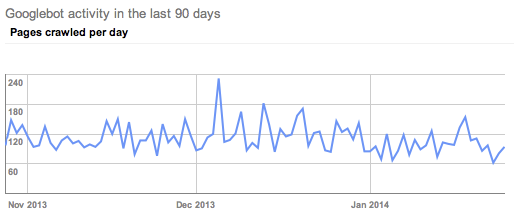
    Some of the commenters on the webmasterworld forum had a short burst of discussion around crawl rates trying to find some commonality among websites’ changes, or at least as an indication of “something” happening.

    White Dove says, “I’ve seen an increase of crawling activity, including pages that don’t exist anymore.”

    Shai comments, “Although no major changes in rankings, I can see some strange crawling occurring on around 30 sites. Not found anything in common between any of them yet.”

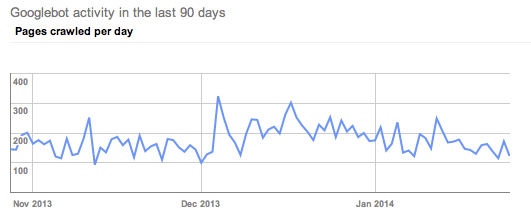
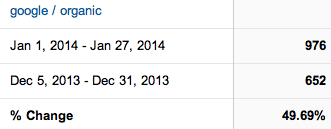
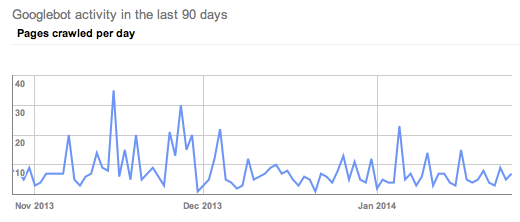
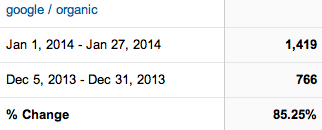
    I want to check this out, so I’m looking at clients who I know have improved organic visits in January and scoping out their crawl rates. (Screen shots are Google organic visits Jan 1, 2014-Jan 27, 2014 Compare to: Dec 5, 2013-Dec 31, 2013.  Crawl rate charts are showing last 90 days.)

    divider

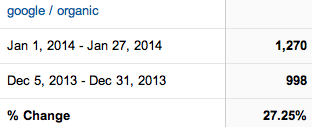
    Client A has fantastic organic increases in January.  I will take 27% organic increase any time.

    client DC google organic increases january 2014

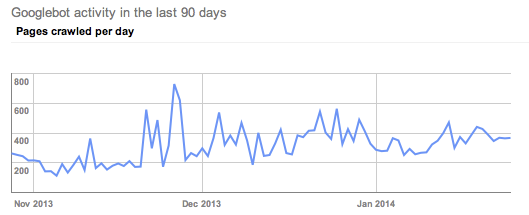
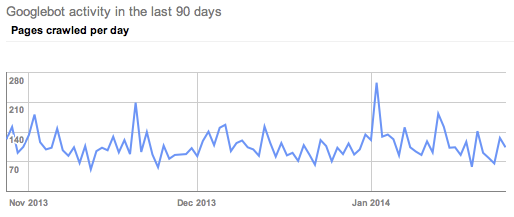
    A’s crawl rate shows a clear uptick in crawl rate, but not in January. His crawl rate started picking up in late November.

    client DC google crawl rate January 2014

    divider

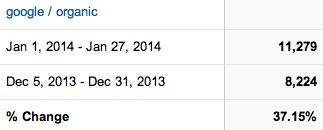
    Client B had a 37% increase in Google organic traffic.

    DL google organic traffic January 2014

     His crawl rate picked up in early December.

    client DL google crawl rate January 2014

    divider

    Client C had great improvements.

    client DD google organic visits January 2014

    If anything, I would say his crawl rate slowed in January.

    client DD google crawl rate January 2014

    divider

    I had to dig around to find these somewhat obvious examples of the above crawl rate changes.  Most of the clients within this same industry had crawl rates like Client D.

    Client D has exciting organic visit increases in January.

    client N increase in google organic search Jan 2014

    The crawl rate doesn’t indicate any clearly obvious trends.

    client N pages crawled per day last 90 days

    All of the clients looked at above are in the same industry, so let’s look at another industry to see if the trends are widespread.

    divider

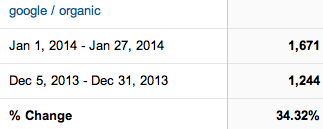
    Client E is enjoying a 34.32% increase in Google organic traffic in January.

    client S January 2014 google organic

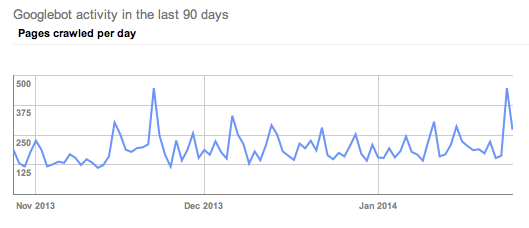
    Their crawl rate also picked up in late November.

    client S Google crawl trends January 2014

    divider

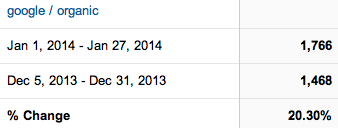
    Client F has a 20% increase in Google organic.

    client G google search in January 2014

    His crawl trends seen in Google Webmaster tools show a slight decrease in crawl rate in January.

    client G WMT crawl data

    divider

    I poked around at other clients in GWT, and I’m not real sure we can pull any decided trends from the crawl rate theory.  I didn’t check every Search Influence client, nor did I create elaborate charts of crawl rates per month. I’m comfortable seconding Shai from the webmasterworld forum, “Not found anything in common between any of them yet.”

    Search Queries

    I’m not seeing any huge changes in rankings data for the keywords we are tracking.  We have some ups and downs, but nothing out of the ordinary.  We update tracking information regularly, so until the next keyword ranking report is updated, Google Webmaster Tools can tell me some great information, too.

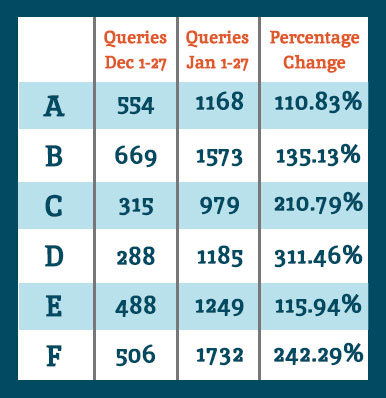
    Google Webmaster Tools Search Queries data shows a lot of keyword data that we don’t track in our keyword reports. So for the example clients noted above, I see they all had an increase in Google search results shown in GWT.

    QueriesChart

    When we look at the Queries data for the same comparisons as the organic search data at the top of this post, we see they all had an increase in showing up for searches.  Google defines Queries as: “The total number of search queries that returned pages from your site over the given period.”

    I interpret this as our websites are ranking for more varied keywords and more than we are tracking.  It’s typical for a website to rank for more than you are actually tracking. It’s unreasonable to track for all of the possibilities.

    I want to acknowledge that there is seasonality in January search for some industries.  Some of the organic increases can be attributed to seasonal search trends, but never at these levels.  Also, last week I spoke with client F telling him about the January organic goodness, and his response was January was usually dead for him, and the phones this last month have been ringing.  Yes, seasonality is often a factor for any month-to-month increases or decreases, but these data are suggesting something bigger.

    Bottom Line

    Any time there is any Google algorithm update, whether announced or perceived, there will be winners and losers.  I’m happy our client sites are on the positive side of whatever changes were implemented.  Yes, it’s good to be a winner today, but it’s not without effort.  I can repeat what everyone has been talking about for months and months:

    • Clean fresh content on a regular basis
    • Encourage client engagement on Google+
    • Cleanup any residual devalued links
    • Earn links with great content and local community participation

    These are just a few actions to take in earning trust and traffic from Google search.

    If you’ve noticed any changes in search traffic or rankings in January, we would love to hear about it in the comments below.

  • Reputation Rescue: Dealing with Your Business’s Online Reviews

    Reputation Rescue: Dealing with Your Business’s Online Reviews

    These days more customers are turning to their social networks and online review sites before making purchases. While local directories and review sites are important for your business’s online presence and SEO, it also opens up the door to both positive and negative reviews from customers.

    Reputation Rescue Infographic

    Copy and paste the code in the area below to place “Reputation Rescue: Dealing with Your Business’s Online Reviews” image on your site for free.

    Yes, People are Actually Looking at Them

    It’s been estimated that about half of American consumers have written at least one online review. Even those not writing reviews are reading them, with 70% of consumers saying they read reviews before making a purchase decision. The same number, seven out of ten, share the reviews they read with friends and family, meaning that these reviews are reaching even more people.

    And Making Decisions Based Off of Them

    For positive reviews, this is great! In fact, 87% of consumers say a positive review confirmed their decision to make a purchase. As one might expect, a similar yet opposite effect comes from negative reviews. Four out of five consumers report having reversed a purchase decision based on negative reviews. Yep. That’s 80%.

    But You Can Take Action

    Luckily, for businesses, there is a positive way to handle negative reviews. Respond quickly and publicly, keeping your response polite yet personal. Own the issue without being defensive and try to rectify the situation while still keeping your response simple. A whopping 97% of people found the reviews of a product they purchased to be accurate. This confirms that no one should be brushing off negative reviews. Responding correctly will give future customers confidence that they will not have the same experience.

    You know the saying about the best defense, right? Give your business a good offense by encouraging reviews from loyal customers. Reach out to customers via Facebook, Twitter, and email. Make reviewing your business as easy as possible and send those that do review a thank you.

    Real Reviews = Real Revenue

    Getting a considerable volume of real, accurate reviews will lead to real revenue. Positive online reviews have been shown to increase sales by 74%, and on a related note, consumers who conduct research online spend 18-36% more than those who do not.

    Don’t be scared to put your business out there! Transform your online review portals into revenue-making tools by garnering your existing customer relationships, addressing negative experiences, and improving your online presence. Reviews also create 21% higher purchase satisfaction and 18% higher customer loyalty. These are huge numbers for something that you aren’t even spending money on.

  • 3 Reasons Why Your Business Should be Active on G+

    Google Plus LogoSome may know Google Plus as a weak attempt by Google to compete with Facebook. However, it can be used for much more than just engaging with your target audience. Google’s social media platform can also help your SEO efforts while providing quality content and information to followers.

    Here are three reasons why your business needs to be active on G+:

    1. Google+ Posts are Crawlable

    Unlike other social media platforms, all Google+ posts are crawlable by the search engines. Your business’ Twitter or Facebook profile may show up for your brand name search, but specific posts and updates are not indexed. All Google+ posts are indexed in minutes, and some even say seconds.

    You can use your G+ posted content to target specific keywords. Each post has its own url, and the first 45-50 words in the post become the title tag. Links within Google+ posts are followed links. As you post content linking back to your website and that content is shared, the authority of your Google+ page and website are growing.

    2. Boost CTR with Google Authorship

    Screen Shot 2014-02-03 at 4.05.26 PM

    According to Google, authorship has no impact on the SERPs. However, Google Authorship can help you get more traffic to your website, which is why we are all trying to rank on page 1 to begin with, right?

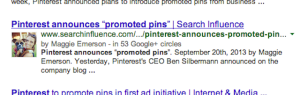
    By associating a G+ profile with pages on you wrote on your website, the profile photo of your G+ shows up with those pages in the search results. The image in the search results sets your site apart from the others and makes it more eye catching. Authorship increases the likelihood a searcher will click your site in the search result. And although authorship does not have a direct correlation with rankings now, we anticipate it will in the near future. And for now, using it for more traffic to your site is enough incentive to get on board.

    3. Potential Increase in Rankings

    The number of +1’s your G+ business page gets has been shown to correlate with top rankings in the SERPs. Moz did a correlation study to determine what aspects of a website show a strong connection to high Google rankings. The number of +1’s came in second only to page authority, with number of linking domains and Facebook shares, likes, and comments as the next most influential. Searchmetrics also did a similar study that found the number of +1’s to be the most highly correlated factor with top Google rankings.

    Yet, Matt Cutts is very adamant that the number of +1’s for a Google business page “has no direct impact on their web search ranking algorithm” and “correlation does not equal causation.” Although this may be true, a business can no longer ignore Google+ and its added SEO value.

    As a social platform, G+ is equally as important as Facebook. And Google+ goes far beyond social reach, it provides a great opportunity to boost your SEO efforts. So go ahead and get active on G+, the benefits are only continuing to grow!

  • 5 Management Tips (from a New Manager)

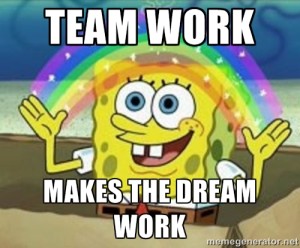
    spongebob memeI’ve been at Search Influence for just over a year and a half. However, in the last four months my role has changed from managing clients to managing people: exciting and terrifying all at once. It is one thing to be great at your job, but it is another to be great at teaching other people to excel at their jobs.


    Management decisions are not always clear, and in a managing role you will discover, at times, you need help to know the right resolution. Over the past several months I’ve taken note of what has been successful for me in my new role.

    Look Up

    Pull inspiration from the people above you. Everyone has a boss or a supervisor, use their experiences and successes to help guide you. Most likely, they have dealt with many of the problems you will face and can be a mentor for your tough decisions.

    Take note, there is no standard style of management, however, discussing difficult situations and seeking encouragement from someone you look up to will build your confidence as a manager.

    Change Your Focus

    News flash: Your role is no longer about you! Before becoming a manager, your success was measured by task completion and things like client happiness or productivity. Now, you are measured on how well the people you manage can perform.

    Making the switch from focusing on your own successes and failures to those of your team can be difficult, especially for young managers.  Your successes are now graded upon how well your team succeeds. However, once you accept this, the “ah ha!” moments from your employees, will be incredibly gratifying experiences.

    Get Help

    Find blogs, news sources, and email alerts on management styles and approaches.

    Great resources include:

    Communicate Often

    communication

    Be honest with your employees. Don’t be afraid to set expectations, give constructive criticism, or shower them in praise. When they are doing something right, acknowledge it, and acknowledge it publicly. Words of affirmation give encouragement and continue the preferred behavior. On that same note, don’t be afraid to take charge and have the more difficult conversations. Explain to your team what you expect from them. If they are not meeting your expectations, give them the resources and guidance on how to improve.

    Ask for Feedback – And Use It

    In the same vein of giving feedback, go out and ask for it! No one expects you to be perfect, but how can you get better without knowing your shortcomings and successes?

    For many people it can be intimidating and difficult to hear what you need to improve upon. However, in the long run you will appreciate being able to create the right type of management skills.

    Managing a team isn’t always easy. However, if you give yourself the right tools, you and your employees will have a better chance for success!


  • Social Media Marketing and the Super Bowl: It’s All About Preparation

    Thought Bubbles Photo

    If you’re like me and you love sports and social media, there isn’t a better day than Super Bowl Sunday. From the creative commercials to everyone constantly updating their feeds with their own thoughts on the game, it’s the ultimate setting for sports and marketing to collide. Rather than sit back and let this once-a-year event pass by, business owners should seize the opportunity to jump into the frenzy and promote their brand.

    But what do you say and when do you say it? The answers to those questions lie in preparation. Follow these simple tips so that you’ll be prepared to jump on the chance to be one of the social media accounts people are talking about the next day.

    Log In
    When something unexpected happens (like last year’s power outage at the Superdome here in New Orleans), you have to be ready. That doesn’t mean fumbling around trying to log into your Twitter, Facebook, or any other platform your business operates. By being logged in and thinking fast you can comment on a big moment right away.

    Football And Football Helmet Photo

    Know Your Audience (And Who’s Playing)
    Identify what content you want to create that relates to your brand, then follow the conversation surrounding the game and try to work it in at the appropriate times. For instance, are their certain hashtags your customers are using related to the game or big topics that have emerged? If so, try to join the conversation and interact.

    Get Creative With Promotions
    Use a promotion to drive customers to your website or place of business the week leading up to the big game. For example, offer a special that provides a discount if a certain player scores a touchdown or if the opening kickoff is returned. You can also take advantage of the many prop bets associated with the game, such as a discount on one product if the coin flip lands head and a discount on another if it lands tails.

    These are just a few things you can do leading up to kickoff. Just be sure to formulate a strategy early so that you aren’t scrambling once game day arrives. And, as always, try to keep your content tasteful, but colorful and fun at the same time.

  • It’s SNEAUXmageddon!

    It’s SNEAUXmageddon!

    Down here in New Orleans, let’s just say we are not used to the cold. With freezing temperatures threatening, the entire city is shutting down, (but here at Search Influence we are still hard at work!) Although many people are referring to the winter storm as Sneauxmageddon (the world is ending, didn’t you know?), others are taking advantage of the unusual circumstances.

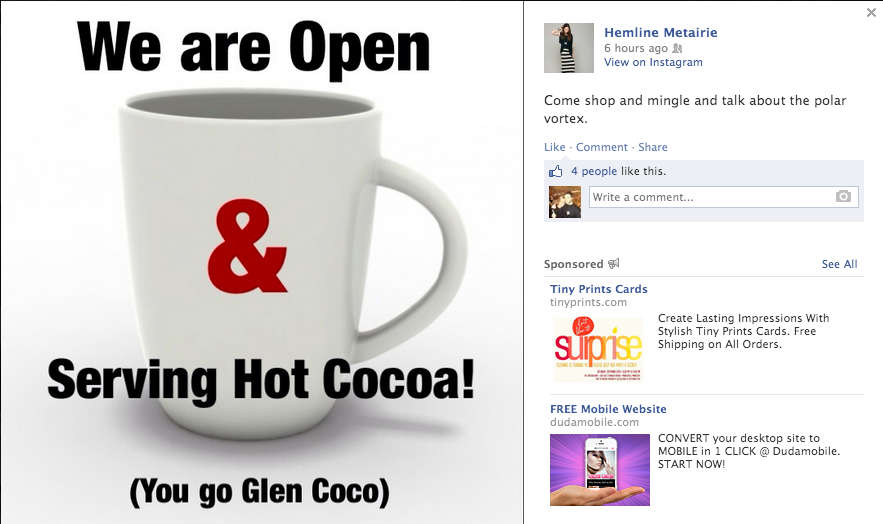
    Hemline Metairie is offering hot cocoa to shoppers, urging them to spend their days off shopping at their store.

    hot cocoa

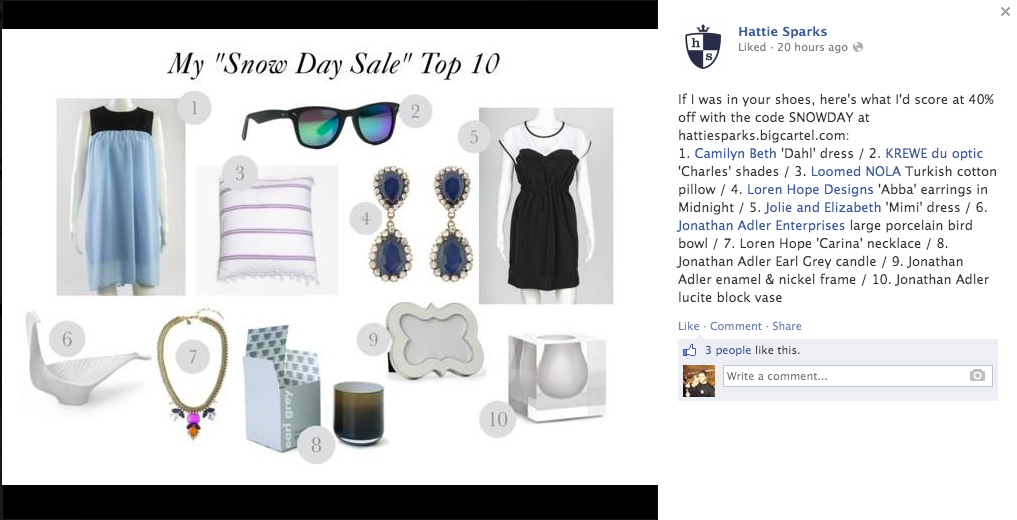
    Over at Hattie Sparks, they are taking a different route. Closing for the day to stay warm, they are offering 40% off to online shoppers who have plenty of time to spare while at home.

    Hattie Sparks SnowDay


    The brave restaurants that have remained open are serving warm treats that we know all too well: hot gumbo, steamed mussels, and anything to keep us warm.

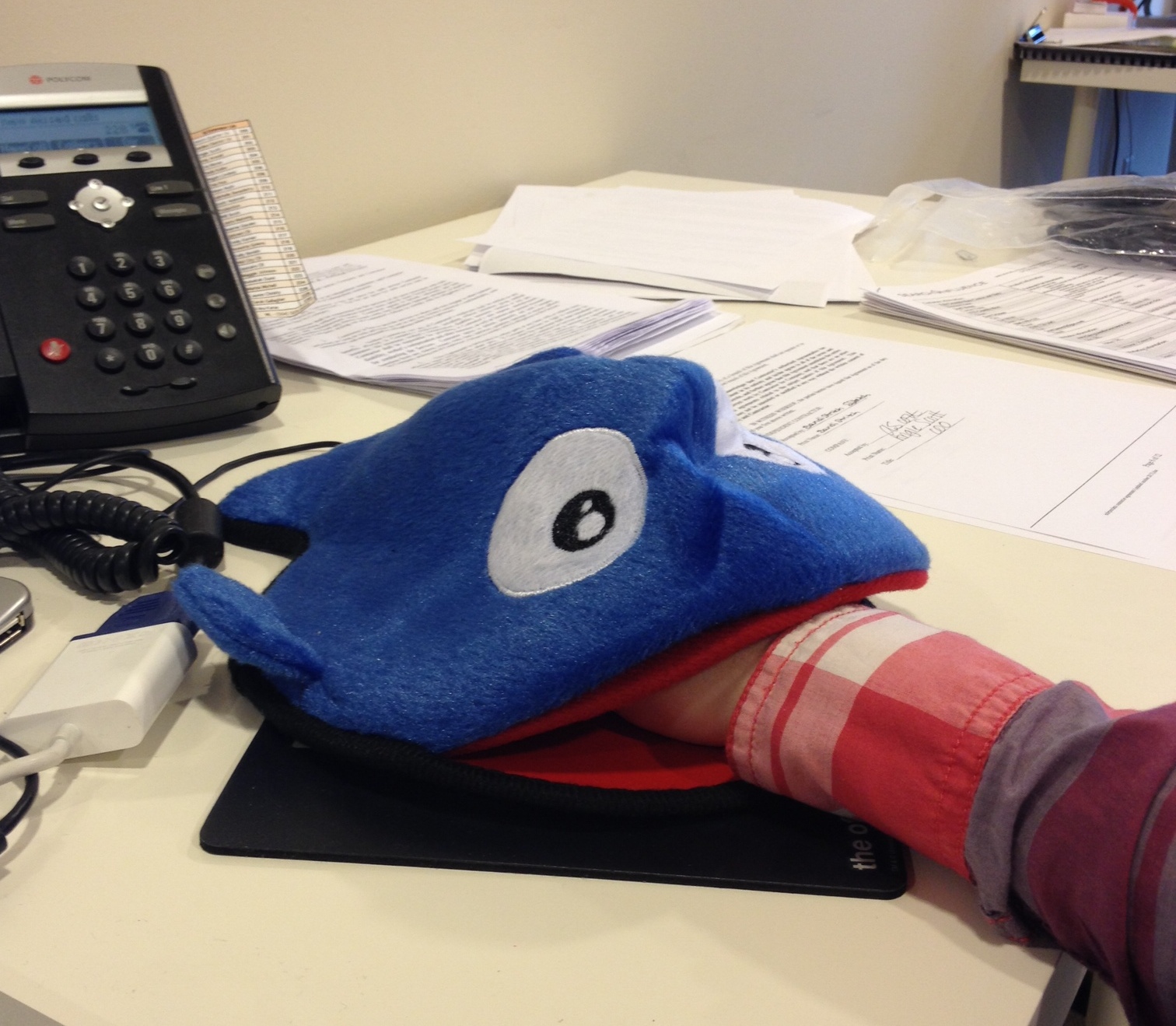
    At Search Influence, we are bundling up with scarves, hats, and coats hidden deep in our closets. And to be sure we remain productive in the cold weather, we resort to some interesting methods. Check out Influencer Lauren Christy‘s hand-warming mouse pad!

    Lauren's Hand Warmer Mouse Pad

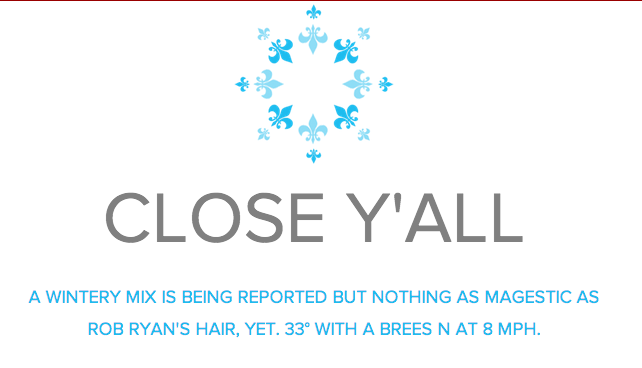
    Although the temperatures are dropping, creativity is on the rise. Websites like isitsnowinginnola.com, have popped up to add some local flair to the typical weather report (chanting “Snow me something, mister!”)  Currently, the forecast states that the snow is “No, it ain’t.”

    Close Y'all

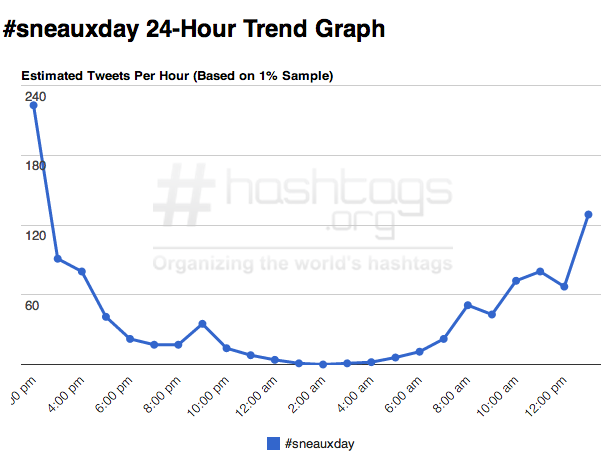
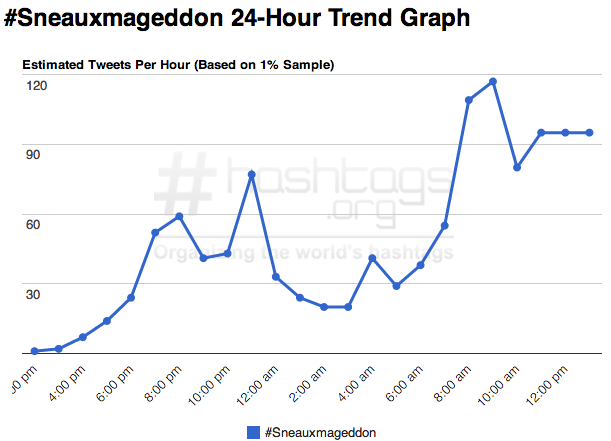
    Hashtags have also emerged to describe the wintry weather in New Orleans. The graphs below from hashtags.org show that they are definitely catching on!

    sneauxday


    sneauxmageddon

    See what others are up to by following hashtags #Sneauxday and #Sneauxmageddon. What’s been your favorite thing to come out of the winter storm?