Blog

  • Social Media And Small Businesses

    Early last year, an article was featured on StreetFight.com  that made some overzealous claims about social media marketing for small businesses. The negative stance was made loud and clear: social media marketing + very small businesses = zero return.

    I take the most issue with the article’s claim, “The type of business most likely to realize a social media return on investment are B2C businesses whose customers are younger than 50 and that focus on entertainment, retail, personal services, or tourism. B2B or home services, or businesses catering to older people, do not fare nearly as well.”

    In my experience, that just isn’t true. Every business can benefit from social media marketing. Here’s why:

    Social Media is for Everyone

    First, let’s talk about the age comment. The whole “social media is only for young people” idea is dead. Besides the fact that every family member I have over the age of 50 is actively engaged on Facebook (and some are even on Twitter), there are numerous statistics that prove age assumptions wrong. The fastest growing age group using Facebook is surprising – 45-65 years old.

    So, in all actuality, Facebook has transcended the age divide.

    Second, the article singles out B2B companies, saying that these businesses do not do well on social media. Wrong again. According to Vocus, 90% of B2B companies are currently on Facebook. Outside of Facebook, Twitter has emerged as a popular platform for B2B, with 85% of B2B marketers citing Twitter as the top social platform, followed by LinkedIn at 82%. If those stats are not enough, there is a whole list here.

    B2B Benefits

    Social media generates leads and leads make B2B. That’s a fact.  Social media allows businesses to:

    • generate brand awareness

    • increase customer engagement

    • establish a personalized/genuine relationship with customers

    • respond to customer reviews and make improvements

    • share special offers and highlight products

    The list goes on, but what I’m driving at is that social media drives site traffic. When executed well, social media marketing acts as a hook, getting customers intrigued. All social media business profiles should direct the customer back to the site. Regardless of the products sold, even if the business isn’t based in “entertainment, retail, personal services, or tourism,” social media marketing can work for small business.

    Low Cost Alternative to Traditional Marketing

    As the article points out, sites like Twitter, Facebook, LinkedIn, Pinterest, and Google+ are all free, so the only cost is time. However, the easy-to-use formats of all these sites allow for quick updates. Plus, there are numerous scheduling tools out there, like Hootsuite, that allow you to make posts into the future. The benefits behind social media marketing are well worth the time SMBs are dedicating to it. Most businesses don’t have the time to run their own social media profiles, so these customers usually contract with Search Influence and our partners to manage their social profiles for them.

    Finally, the article says “Sure, social signals are important for SEO. But as far as knowing that inputting X equals Y placement in search results, we don’t know the equation and never will.” Even if we don’t know exactly what X and Y are, we do know that there is an obvious correlation between social media traffic and site traffic.

    For instance, an increase in followers leads to more shares, and shares are a great way to spread your website content and brand name. An active social presence will also generate inbound links and improve customer satisfaction as Facebook, Twitter, and other social networks provide the optimal forum for direct customer-business feedback. In other words, social networks increase online visibility, and they don’t just provide a small window of visibility – these business profiles open a genuine link between customers and businesses.

    Putting Social Media to Work

    So, small businesses shouldn’t count out social media marketing just yet. Create profiles that promote products and engage your customers in a genuine fashion. Of course, all of this support for social media marketing would fall on deaf ears without a direct example. One of our clients, a small business of the exact strain highlighted in the Streetfight article, reached out to Search Influence two years ago. At the time, they only had 97 Facebook fans and site traffic in the low hundreds.

    Now, after a strategically designed Facebook ad campaign and other SMO tactics, the client has over 27,000 likes on their Facebook page alone and generates monthly site traffic in the thousands. Although their site traffic was not driven by Facebook alone, their Facebook ads had a click-through rate five times the average for other Facebook ads.

    Annual ad spending is increasing most rapidly on Facebook. By the end of 2014, 88% of small businesses expect to put some of their marketing dollars on Facebook, up from 43% in 2009. Recent estimates show ad spending on Facebook and other U.S. social networks increasing by 31.6% in 2013 (eMarketer, 2013).

    Even though social media marketing may still be a bit undefined, many online marketing experts predict that it will only become more prevalent. The future of links-to-like upheaval hasn’t been determined, but the power of the “like” is only growing stronger. Don’t count out social media marketing because you are afraid that you won’t generate a fan base due to age restrictions or the size of your company. Explore the social media networks out there and find the site that best works for your business.

    Top 5 Keys to B2B Social Media Success

      • Be authentic – good content is still key

      • Promote your brand – send signals that direct viewers and fans back to your website

      • Be personal – social media works best when directed towards a specific audience, which is easier than you think with the Facebook Ad Campaign tool.

      • Be engaging – post things that will be shared or liked. Find what kind of content works best for that specific social network. Don’t be afraid to use humor or to have fun! Like we did with this post!


  • How To Handle Automated Software Headaches

    To set the ‘scene,’ you’ve either recently purchased or are about to purchase a piece of software that is meant to offer improvements for your business. Whether it’s some form of automated process, or software that adds another form of datum for you to analyze and use for future success (such as SEO analytics information), there’s a great deal of caution that you should take with these programs.

    What Happens With Software

    software junk

    In short, I don’t mean that some of these programs aren’t worth their money or that they won’t do what you require of them. But you should expect a moderate amount of troubleshooting when applying this software into your business process.

    Most of the software that is developed and published for sale and use work as they should to a certain degree, but only under the right circumstances. Software testers can only do so much. The only real test comes from real-world use by people who aren’t familiar with the inner workings of the software.

    At the same time, patches and other forms of software updates are constantly in development (or at least, a good development team should always seek to make improvements) and can make drastic changes to a program that you are just getting used to, usually based on customer feedback that you might not be aware of, or agree with.

    How To Deal

    Thumbs UpIn order to avoid, or at least brace yourself for these moments of frustration, the first step is to read the manual. It’s usually large, bulky, and annoying, but within it are the instructions that you need to run the program correctly and avoid some of the smaller problems.

    The next thing to do is to make sure you always have a way to contact the original developers of the program, so that you can speak with an expert when there’s an issue that you can’t overcome on your own. Phone is always preferable in order to have instant contact, however most developers rely on e-mail.

    Finally, in order to prepare for updates and patches, make sure that you read up on the developer blogs that tend to be published on the website for the program itself. Not only is it a way for them to keep their website active, but they generally tend to suggest ways to use their program, bugs or issues to avoid, as well as patches and fixes that are currently under development. Keeping up with these blog updates, will keep you informed of future changes for the software.

    Now What?

    Enough preparation allows you to be more familiar with the good and the bad of any automated software you’re using. You can then expect some of the unexpected, and you’ll know the steps you will need to take in order to make the proper fix and continue using software to suit your business needs.

    If you’re interested in how a development team can improve your search rankings and help with your software issues, check out this blog on SEO Tips by one of our Software Developers, Shane Kretzmann!

  • Q&A on ShortStack

    For anyone that doesn’t know, ShortStack is an app that allows you to run contests and promotions from your Facebook page. It can also help boost social engagement and get more likes on your page. I recently had a client ask about using ShortStack for a Facebook contest and this overview helped explain it quickly and easily.

    First Question

    1. If I put this on facebook, will only my fans see it?  If I’m trying to get more traffic, where do I put it then? How can I get more people to see my contest?

    When you put an image or a form or text or anything in the ShortStack, you can choose the permissions who can see it underneath each addition. Visibility can be set to everyone, only fans of the page, non fans of the page, or admin only.

    We had an image that said “Like our page to find out more,” and we set it so only non fans could see it. So if someone came to the tab that didn’t like the page, that’s what they saw.  We then had another image and a form for fans only. Once someone liked the page, they saw the new image with details and the form.

    The little buttons underneath each thing tell you what is what. The thumbs up is fans only. The thumbs up with a strike through is non fans only. Little people are everyone.


    You can also check yourself and see what it will look like for different people (Fans vs Non Fans). Under “Live Preview” in the left corner just click the thumbs up. You will see what fans of the page see, and if you click on the non fan view (thumb with strike through) you will see what they see.

    Second Question

    When I install the final product through ShortStack, where does it appear on our facebook page?  Does it have to be used on a personal page or business page?

    If the login information being used is for a Facebook account that is connected to a business page, when you are ready to publish the ShortStack tab will show the pages you are a manager of and you can choose the pages you want. 

    Good luck in your next contest or promotion! I hope some of these questions/answers help.

    BIG THANKS to Maggie Emerson who helped me answer these questions for my client!

    Check Out More:

    ShortStack provides more information and tips on their own website. http://www.shortstack.com/

    They also have their own FAQ page along with video tutorials.


  • The Scoop on Sender Score

    Jan14Any business that sends regular emails to a list of subscribers has a Sender Score. Your score is a method of determining how mail servers (inbox gatekeepers, so to speak) view your reputation as a trustworthy email source.

    To keep it simple, think of it this way: if you’re not monitoring your Sender Score, the emails you send to your subscriber list may not have a positive impact on your business. Unfortunately, a poor Sender Score could land your emails in the spam folder, never to be seen by your subscribers.

    Five Things You Need to Know about Email Marketing

    Let’s start off by saying that Sender Score is important, and you should not only know what yours is, but you should constantly work to improve it. A great first step to take to acquaint (or reacquaint) yourself with email marketing protocol is to make sure you understand the CAN-SPAM Act.

    Once you know the law, you can move on to nuances like double opt-in email marketing vs. single opt-in email marketing.

    Many top email marketing firms are of the opinion that a double opt-in subscriber system is superior to a single because it ensures not only a higher level of recognition, but also of subscriber retention. In an article that defines both systems and gives advice on whether or not to use them, one email marketing expert adds,

    “…Double opt-in serves you when you already have a good amount of interactive leads, and don’t want to have any more headaches with bad email addresses.”

    Increase Your Score

    No matter what system you decide to use, the goal is the same: you want to increase your Sender Score (trust us!), and here are the top 5 ways to do just that:

    1. People who get frustrated when they have trouble unsubscribing from email lists may be inclined to mark your emails as spam (which is BAD). Make it easy to unsubscribe from your email list.
    2. Use a consistent theme to reinforce your brand when you send emails to your subscriber list. Your email subject line should accurately reflect your email message and include a reference to your brand.
    3. Analyze your reader engagement data once you’ve sent out an email to your list. Knowing how many people are opening, reading and clicking around vs. unsubscribing from your list is a very handy way to evaluate the effectiveness of your email content.
    4. Maintain your reputation by focusing on how to avoid complaints and keeping up your subscriber list hygiene. List hygiene is determined by how frequently you send emails to unknown users and spam traps.
    5. Be sure your emails are coming through authenticated. That means ‘showing’ ISPs (Internet Service Providers) you’re doing your best to follow their authentication protocols, which may include reverse DNS, Sender Policy Framework (SPF), SenderID, and/or Domain Keys Identified Mail (DKIM). Using a reliable email marketing service will prevent many authentication issues.

    How to Interpret Your Sender Score

    Once you have your Sender Score, you can begin to interpret your level as an email marketer. But how do you know what the Score means? Here’s the gist: any score over 90 is GREAT. If you score that high, give yourself a pat on the back, because you’re doing it right!

    If you score between 50 and 80, you’ll need to take a step back and spend some time figuring out what the problem is. For example, how many of your emails are accepted vs. rejected? How high is your unknown user rate? Any score under 50 indicates you’re a spammer. “But wait! I’m NOT a spammer!” you might be thinking. Unfortunately for you, the mail servers think you are. It’s up to you to rebuild your reputation.

    That’s why it’s so important to maintain your Sender Score, lest your emails wind up marked as spam or worse: your IP is blacklisted and your emails never arrive to an inbox at all!

    So pay close attention and monitor your email marketing activity and you’ll be well on your way to a great Sender Score. Good luck email marketers!

    Kelly Lucia is  the Lead Staff Writer atPostsbyGhost.com. A ghostwriting service that provides businesses with the opportunity to build their online presence and grow their companies, Posts by Ghost offers strategic blogging, content marketing and SEO assistance to businesses of all shapes and sizes. Kelly hit the ground running as a web copywriter several years ago and hasn’t stopped since. Over the last few years she’s developed a vast range of knowledge within the realm of content writing, and she prides herself on being able to write clear and unique content for an immense variety of industries, from overseas blogs about raffle tickets to small business and marketing advice on ChamberofCommerce.com.

  • The New Google+ and How To Avoid Getting Your Business Account Suspended

    As you all probably know by now, every Google account now has a personal Google+ profile associated with it. A common practice in SEO and setting up a Google Local listing in the past has been to create a Gmail account specifically for business purposes. This generally included using a business name as a First and Last name in the Google account setup. For example, if I owned “Delicious Cupcakes Shop,” the Google account name would be Delicious (First) Cupcakes (Last), not Mary Silva.

    What Changed?

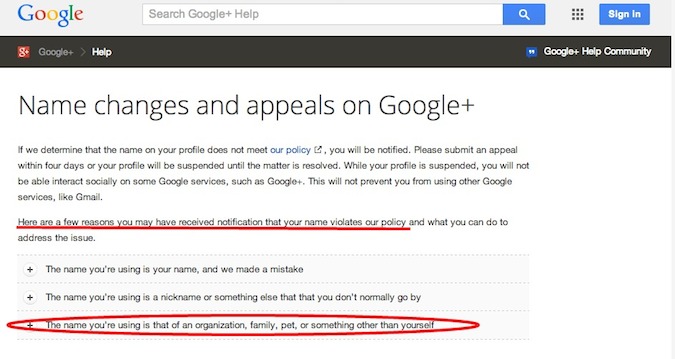
    Now we’ve learned, however, that with the new Google+ profiles being created for accounts, having a non-human name as your profile is grounds for having your account suspended and your Google services revoked. This includes having your account associated business page removed from search results. If your profile goes more than 60 days under suspension, Google will start to automatically remove your content from their system. Learn more about “Google+ Profile Suspensions” here!

    Also, regardless of the Google suspension penalty, having a page with your business name that would now be a public profile would possibly lead to confusion and appear as a sort of duplicate business page. So cleaning up your account name is definitely an essential move to make now.

    Even Google has acknowledged that having what they consider an “improper name” will happen, and offer explanation on what happened. They’re clearly aware of the fact that many accounts may have been set up with something other than a person’s name.

    Name changes and appeals on Google+ - Google+ Help

    What Now?

    If you’re like many other business account managers who have set up an account using your business name as the account name, you might ask, “What’s the next step in getting this cleaned up?” Well, it’s actually quite simple! All you have to do is follow the next few steps:

    Step 1: Log in to Google at plus.google.com

    Step 2: There are 3 circumstances you might encounter after login:

    2a: If your account is being accessed for the first time since the Google update that created Plus pages for each account, you will see a form where you will set up the Plus page for your account for the first time. Update the “First” and “Last” name fields with whatever human name you desire.

    2b: If your account has already been set up through Google+, then you’ll have to check that the name of the account is a human name and not the business name. Here’s how!

    • In the top right corner of your homepage, hover over the user photo and then click “view profile”
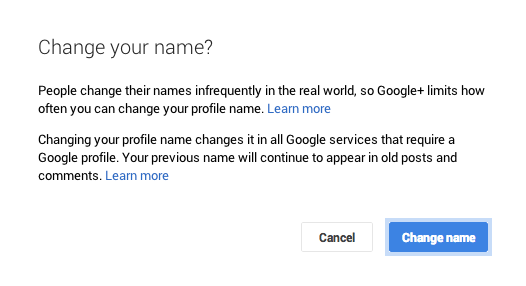
    • Next, hover over the name and you’ll see that you can “click here to change name”. Update the “First” and “Last”name fields with whatever human name you desire.

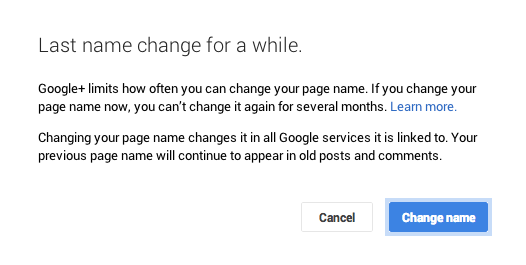
    Note that for both profiles and pages, Google limits how often you can change them, so choose wisely whenever changing this information in your account.

    Screen Shot 2014-01-20 at 12.18.28 PMScreen Shot 2014-01-20 at 12.15.54 PM

    2c: If the your account has already been flagged/suspended, you’ll see a red banner across the top of your page when you login informing you of the suspension. Follow the same steps for part 2b but you’ll have to check back in 48 hours to make sure Google accepts the changes and removes the suspension. You’ll also have to see if the account has lost Google privileges and respond accordingly.

    Hope this has been helpful to anyone who has encountered this issue or has a business account with Google! If you or your business have experienced similar trouble with Google, let us know in the comments!

  • Everything You Need to Know About Google Carousel

    Whether you’re looking to improve your position or simply figure out what the heck this carousel is doing in your Google search results, this blog post is for you. Let’s start out with a little background information.

    What is the Google Carousel?

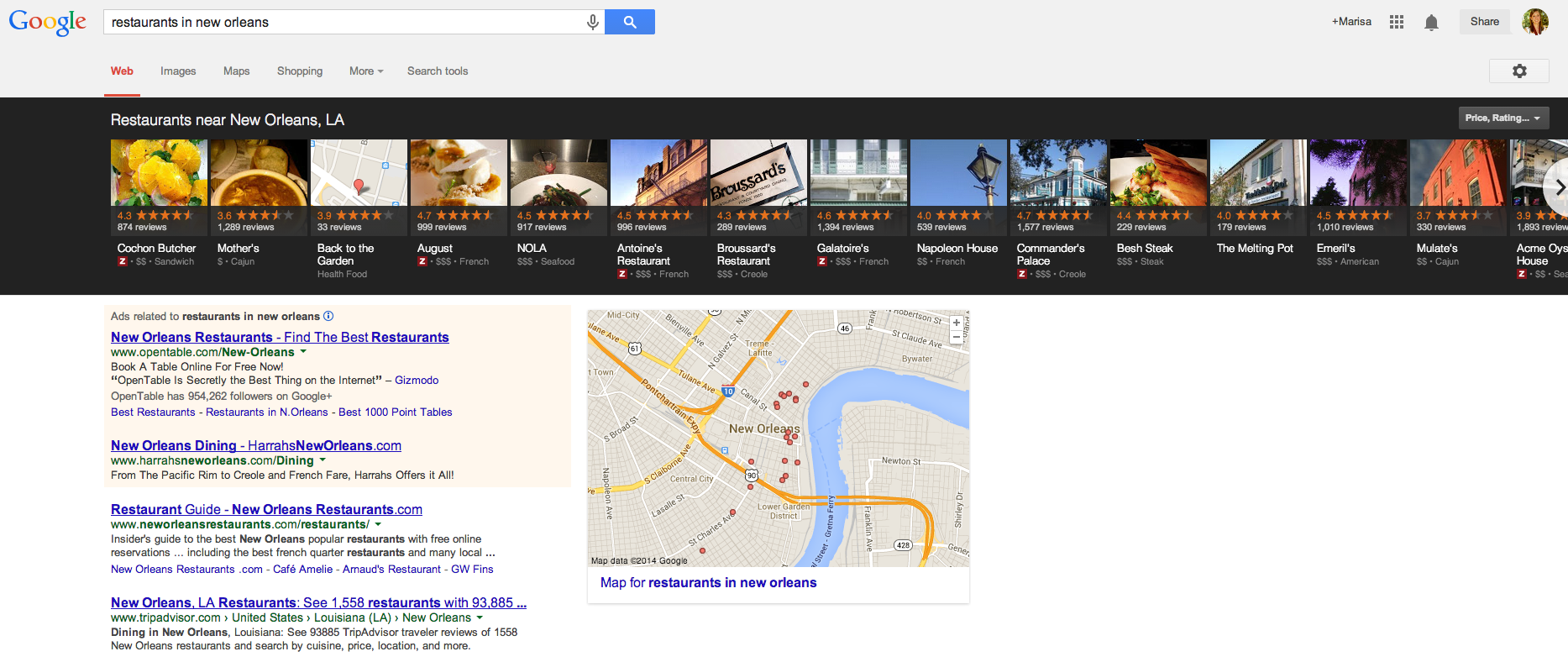
    As you have probably noticed by now, Google has incorporated a new carousel into several of its search results. If you haven’t seen it yet, the carousel is a row of about 20 listings displayed in a long black box at the top of search results. The image below shows an example of the carousel pulled for the search query “restaurants in new orleans.”

    Click the image below to enlarge

    Search Result Displaying Google Carousel

    How Does it Work?

    Google pulls the information for each carousel listing from the Google+ pages of relevant businesses. Upon clicking a result in the carousel, another search will be performed for that brand. There are pros and cons to having these carousel results display in searches related to your business. Here are just a few:

    Pros of the Google Carousel

    • Your website could potentially be displayed in 2 locations on Google search results: the carousel and regular Google organic results below the carousel. Psst – if you’re looking for some help with those organic rankings I know a guy

    • If you have great reviews and ratings on your Google+ page, your average star rating will appear as a fantastic means of comparison to your competitors (who may not have the same stellar rating as you)

    • Results are displayed ABOVE paid search results, putting you ahead of competitors who are paying to hold that prime real estate above the fold

    • If done carefully, some service area businesses can rank for local searches in the carousel where they may not have appeared in map pack results before the carousel

    Cons of the Google Carousel

    • When clicking a carousel result, another search is done for your brand rather than being taken to your website or Google+ page, which means more clicks are needed to get to your website and may result in a drop off of potential visitors

    • The carousel occupies a lot of space “above the fold” in search results, pushing down those precious organic results you worked so hard to obtain

    • Google chooses the image that is displayed in each carousel result from the images that are uploaded on your Google+ page

    There are a number of keywords and phrases that trigger the carousel. Mike Blumenthal has compiled a list of 300+ keywords and phrases that trigger these results. From a business standpoint, there are several reasons why you want to review these search terms and determine if search queries related to your industry are pulling this carousel, and whether or not your company shows up in the results.

    The Optimal Carousel Location

    A study of user engagement performed by Mike Ramsey suggests that the optimal locations in the carousel are positions 3 and 8, while Ethical SEO did a similar study and found that the 1st and 5th positions in the carousel were most popular. Although the exact prime locations differed, the main takeaways from these studies tell us the following:

    1. Searchers are clicking in the carousel

      • 30% of people in Ethical SEO’s study

      • 48% of people in Mike Ramsey’s study

    2. Reviews and ratings are important

      • Searchers cited Zagat scores and amount of reviews on a particular result as determining factors for clicking

    3. Images should be eye catching

      • In Mike Ramsey’s study, the carousel listing with the highest Zagat rating and number of reviews that contained a boring gray exterior photo of the restaurant was not clicked nearly as much as the result next to it that featured a beautifully plated entree

    Lookin’ Good in the Carousel

    Come See How Good I Look in Google Carousel ResultsIf you have little or no reviews on your Google+ page, what are you waiting for? You’ve worked hard to establish your business and provide positive customer experiences. Build up your following on Google+ and don’t be afraid to remind customers of your brand. Encourage potential and current customers to read your reviews. Highlight previous testimonials or reviews in Google+ status updates. Post pictures of your product, staff, events – anything to send your audience down memory lane and potentially inspire them to recount their experience in the form of a review.

    As mentioned previously, Google will select the image that appears in carousel results, so be mindful of the images you upload to your Google+ page. If you are a restaurant, upload images of plated dishes. If you are a jewelry store, upload images of your most popular designs. A good image will differ from industry to industry, however, across the board a good image will be:

    • Attractive

    • Eye catching

    • Clear (don’t upload stretched out or blurry images!)

    • And depict what you do

    Top Ranking Factors

    If you’ve been diligently working to improve your rankings for the map pack in blended results, many of those efforts also contribute to carousel ranking factors. Search Engine Journal’s recent study cites three top factors for ranking in the carousel: social signals, external factors, and content structure. The strongest of these appeared to be social signals, which include:

    • +1Amount of +1s on your Google+ page

    • Amount of +1s on a website’s URL that is attached to your Google+ page

    • Amount of reviews on your Google+ page

    • Rating of your Google+ page

    Next, external factors proved very important. In particular, the number of citations across the internet was cited as the most important external factor. An additional point to that is these citations should be clean and correct across the board. You may have several location citations, but it will only serve to confuse Google if the information is not consistent from one citation to the next. All this should sound familiar, as citations are nothing new to local search ranking factors and something Search Influence has preached for years.

    The last of these top ranking factors is content structure. Placing the keyword in the title, the location in the title, the keyword in the URL, and the location in the URL were all found to have a correlation to rankings. Although these factors are important, you don’t want to come off as sounding unnatural or spammy. Do exercise caution with these aspects of content structure, as you want this content to be natural.

    With any new update or change Google makes, there is always more to be found and mentioned. What are some things you’ve noticed about the Google carousel? What factors have you seen improve carousel rankings? What trends and/or benefits have you noticed since Google rolled out the carousel? Sound off in the comments!

  • LocalU Is Coming To Dallas!

    8891398231_4fe04d69b9

    Local businesses and small business marketers in the Dallas / Fort Worth area are in for a treat! The traveling road show of local online marketing, LocalU, is making its way to Dallas, TX on Thursday, January 23. I had the opportunity to attend LocalU when they came to New Orleans, and we even invited some of our clients to attend.

    Audubon Nature Institute’s Lani McWilliams even provided us her key takeaways from the event – there’s so much info presented at these events that she couldn’t even narrow it down to just 10. These top 14 takeaways are just a small sampling of the info that you will learn at LocalU to help market small businesses online.

    What You’ll Learn:

    LocalU, my friends, is a must see seminar if you want to learn all things related to local business marketing online, including:

    • local search engine optimization
    • social media
    • review management
    • paid online advertising

    … and, at $89 with the discount code LocalU, it’s a steal-of-a-deal!

    Who You’ll See:

    At the half day / four hour event, you will hear from the brightest minds in local online marketing including:

    • Search Influence’s own CEO, Will Scott
    • Mike Blumenthal
    • Mary Bowling
    • David Mihm
    • Mike Ramsey
    • Ed Reese
    • Aaron Weiche

    When and Where:

    LocalU Dallas
    Thursday, January 23
    Pegasus Ballroom/Magnolia Hotel on Commerce St.
    Check-in: 8:00 am
    Sessions: 8:30 am – 12:30 pm

    The faculty hopes to see you there!

    Buy tickets here!


  • Search Influence Holiday Party

    Here at Search Influence, we do things a little differently than most companies. Our office artwork is created by our employees, we play the same song every Friday at 5pm, and our holiday party is… well, a little later than most holiday parties.

    This year, our holiday party fell on January 11, 2014 and employees didn’t have to travel far to get there (it was downstairs from our office at Oak Wine Bar)! For a special holiday bonus, the party fell at the same time as the Saints vs. Seahawks playoff game, so many Who Dat fans showed up in jerseys and other black and gold attire. Much to our dismay, the Saints couldn’t pull out a win, but we still managed to have a great time despite the loss!

    Search Influence Holiday Party   Search InfluenceBefore the party, the whole office voted on the holiday drink name. Some ideas were “Will Scotch” (after CEO, Will Scott) and “The Optimizer.” The grand winner was “Under the Influence,” which was a delicious concoction of vodka, prosecco and St. Germain.

    Many influencers enjoyed the photo booth at the party. The pictures from the photo booth are some of the best, and I think we may have broken a record for the most people in a photo booth picture (sorry Boogie Booth)!

    All in all, the holiday party was a huge success. Who knows, maybe we’ll be lucky enough to have another holiday party in 2014!

  • Why is Google Doing That?

    nest

    Techcrunch announced yesterday that Google acquired the connected device company Nest for approximately $3.2 billion dollars USD. [1] While this may seem like a large investment to us laymen (laywomen? laypeople…), it is understood that Google’s disposable capital cannot be quantified by the finite numbers we are used to using. So this investment may not mean as much for the company as the tech-blogosphere would suggest. But what will happen if the people at Wired and Techcrunch are right, and Google keeps doing more Google-y things like buying every robot ever along with the firms that produce them? Well for one thing, SEO will probably work a little differently.

    Prediction 1:

    In the Future Google/Future SEO Realm/Matrix, display space will be even more precious and SEM will get more expensive.

    A lot of SEO bloggers have been beating this drum for a while now. It’s obvious to most that if the screen space is smaller, the amount of results consumers are willing to investigate will reduce as well. The Google Glass has approximately 90% less surface space than traditional smartphone platforms.[2] Intuitively, this kind of face streaming will probably devalue the real estate of any ranking positioned outside of the top three. As the displays get smaller and smaller, SEM will gain more and more popularity as companies like Bing and Google are likely to price gouge for the precious paid display space on these next generation platforms.

    Prediction 2:

    In the forthcoming Future Google Realm, it will be simply irresistible – if not physically irresistible – to share everything.

    With the iphone, consumers were given the opportunity to commodify everything they experienced in their lives.[3] As we begin to wear microphones and cameras on our faces[4] and while the most mundane of our home appliances become members of the global village,[5] there will be more and more opportunities and incentives to share everything. As we begin to create more devices and metrics to record social media, sticking out in the endless void of user created content will become even more challenging, and social currency will become even more invaluable. With the creation of these new outlets, we should expect to see SEO become even more dependent on social media rankings, while performing well in these arenas will be crucial for any successful business.

    In conclusion, now is the perfect time to start honing your SEO and social media chops. Now I’ll leave you with a gif of a stock photo model using different technology.

     output_dAJDKN
    [1]To put this in context, Instagram sold to Facebook for $1 billion in 2012. 

    [2]Made this up.

    [3]A recent study showed that users are three times more likely to share content via their Iphone versus their desktop. http://bit.ly/1d3DAAw

    [4]Shout-out to Google Glass.

    [5]Google’s Nest acquisition will likely lead to the existence of a consumer experience where home appliances – fridge, oven, stove, coffee maker etc. – will all be connected to the internet and synced up to your smart phone.

  • SEO vs. PPC: What’s The Difference Anyway?

    A while back, SEO guru David McBee wrote a post in his awesome blog about how he differentiates SEO tactics from PPC strategies. In David’s mind, it can all be related to the difference between dieting and plastic surgery. SEO is a diet, and PPC is plastic surgery.

    To illustrate his point, David created this awesome infographic which I think spells things out pretty well. In many ways, this categorization really gets to the root of the differences between what you would do to increase your site’s profile online using SEO tactics versus the much more immediate PPC strategies we all employ.

    The SEO Diet

    It is very true that SEO is like a diet for your online presence. You need to be in it for the long haul, and you really need to establish clearly defined goals before you start. In exactly the same way that a crash diet will not yield the long term results you are looking for, link baiting or deploying tons of spammy content will not help you reach your idea SEO weight.

    I really like the comparison of PPC to plastic surgery because I feel like you should be putting the same kind of thought to the planning stages of a PPC campaign that you would before a procedure like a face lift or tummy tuck.

    The PPC Procedure

    You need to figure out exactly what you want to focus on and a lot of thought has to go into what you want to look like on the other side. Nothing is worse than not being prepared for an onslaught of traffic hitting your site on the heels of a successful PPC campaign.

    What do you think of David McBee’s comparison? What would you say the SEO/PPC dichotomy resembles in your experience? Let us know in the comments! We would love to hear from you, even if you are on a juice cleanse SEO diet.

    Link for infographic: http://davidmcbee.com/seo-is-a-diet-ppc-is-plastic-surgery-infographic/