Category: Industry Insights

  • Business Continuity Messaging During COVID-19: What You Need to Do Right Now

    Business Continuity Messaging During COVID-19: What You Need to Do Right Now

    Now more than ever, the internet is the first and primary source of information about local businesses. The messaging (or lack thereof) that companies disseminate may affect the quality and quantity of their customers when the economy begins to open back up. 

    We’ve seen far too many businesses fail to communicate their situation, regardless of whether they are open at this time. You already have the tools to communicate to your customers: 

    • Your website
    • Social media
    • Your CRM or customer email list
    • Google My Business

    Ensure that you’re poised for recovery by addressing your messaging strategy now. Create a plan to keep or build your audience’s trust. 

    To remain top-of-mind, you must cultivate customer intent. It will be more competitive when the economy opens back up, so you want potential customers to be further down the sales funnel at that point. Many people want and intend to spend their money with local businesses or on causes impacting their communities. 

    Messaging Guidelines

    Prior to the pandemic, Millennials (in 2020, this includes people who are 24-39 years old) were projected to represent $1.4 trillion in buying power this year. They now make up the largest segment of the workforce, are the most common users of social media and most likely to buy online. 

    Millennials spend their money in alignment with their values and often spend more on a product if the brand contributes to charitable causes. In March 2020, Millennials indicated they expect brands to step up their communication during this crisis:

    • One-third of respondents said that brands should communicate more than normal.
    • Half of the respondents thought that brands should continue their marketing efforts during this time.
    • One in four of those surveyed also said that they believed brands have the power to be “as impactful as the government” during this crisis. 

    Ensure Clarity in Your Messaging

    Marketing messaging now needs to focus on making positive brand impressions. Whenever possible, demonstrate social responsibility and clarify to your current and prospective customers how your business is operating during this period. 

    If your business is operating: 

    • Which steps do customers need to take to get in touch?
    • What is your plan for the short and long term?
    • How are you ensuring customer and employee safety?
    • Is your business supporting the community with donations, fundraisers, etc.? 
      • If so, how are you doing this?
      • How can your audience help?

    If you are unable to do business as usual:

    • How has this situation impacted the business and your employees? 
      • How can your audience help?
    • Is your business supporting the community (i.e., donations, fundraisers, etc.)?
      • If so, how are you doing this? 
      • How can your audience help?

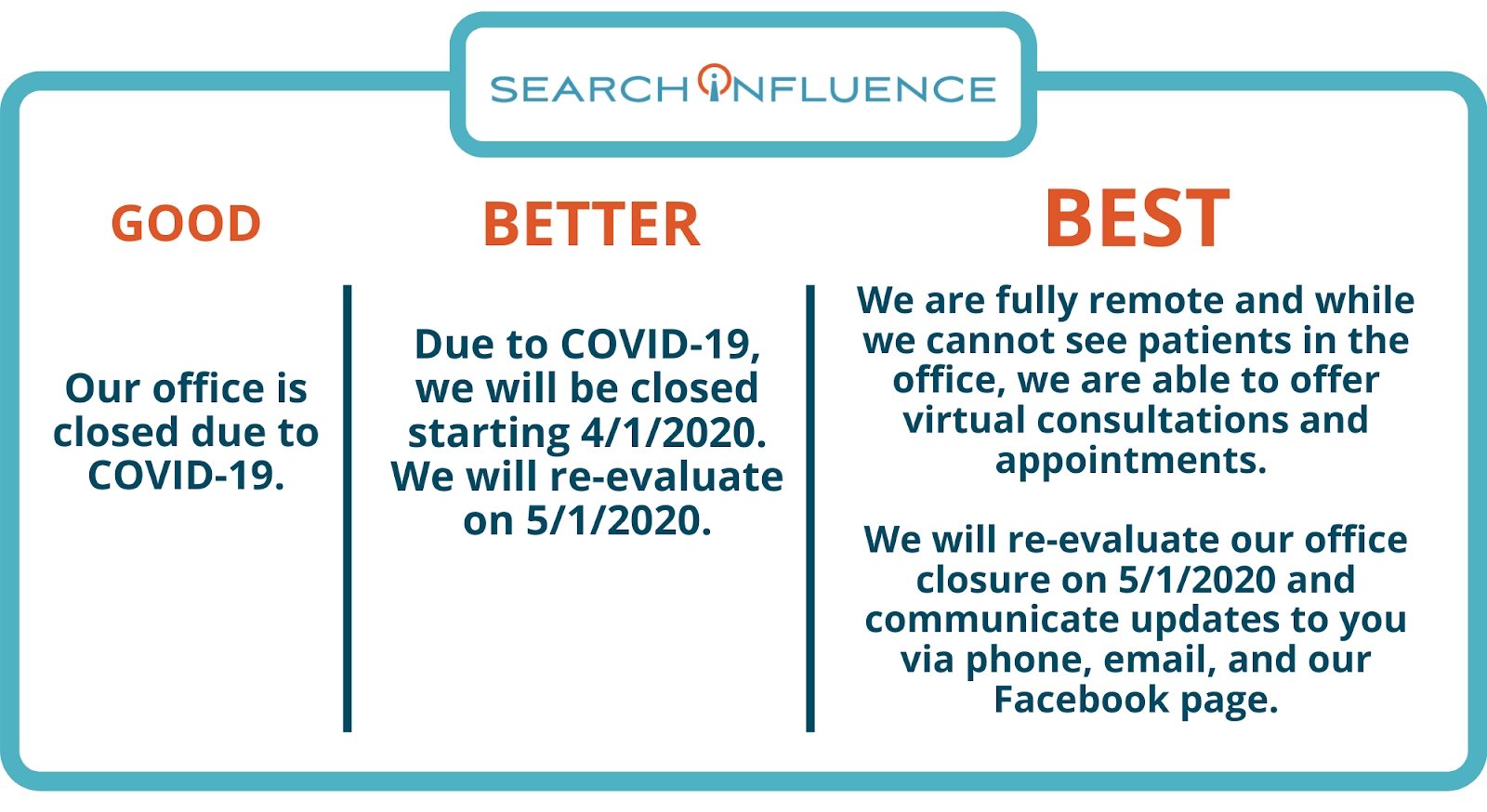
    Good Better Best messaging by Search Influence for COVID-19 Marketing

    Don’t Add to the Noise: Make Relevant and Meaningful Updates

    If you’re in a community with stay-at-home orders or one that has been hit particularly hard, it’s important to keep your audience up-to-date. An update of “No change in business at this time. We will keep you updated,” is better than radio silence.

    Savvy consumers understand the dynamic nature of doing business today and are more tolerant than normal about changes. Don’t withhold an update because you fear things may change. Even if you’re a small business that has relied on in-store sales and light social media posting to drive business, there are opportunities to be agile. 

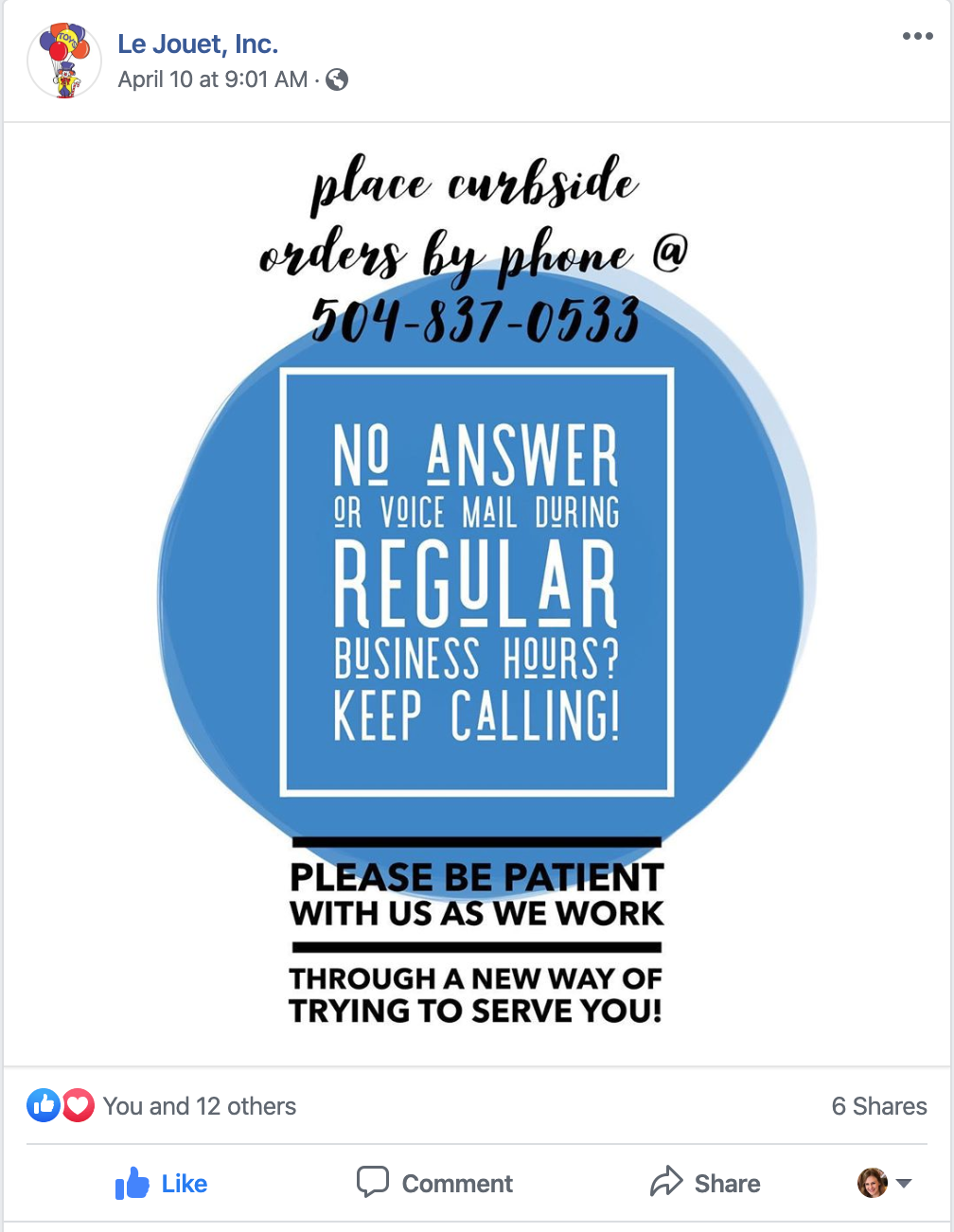
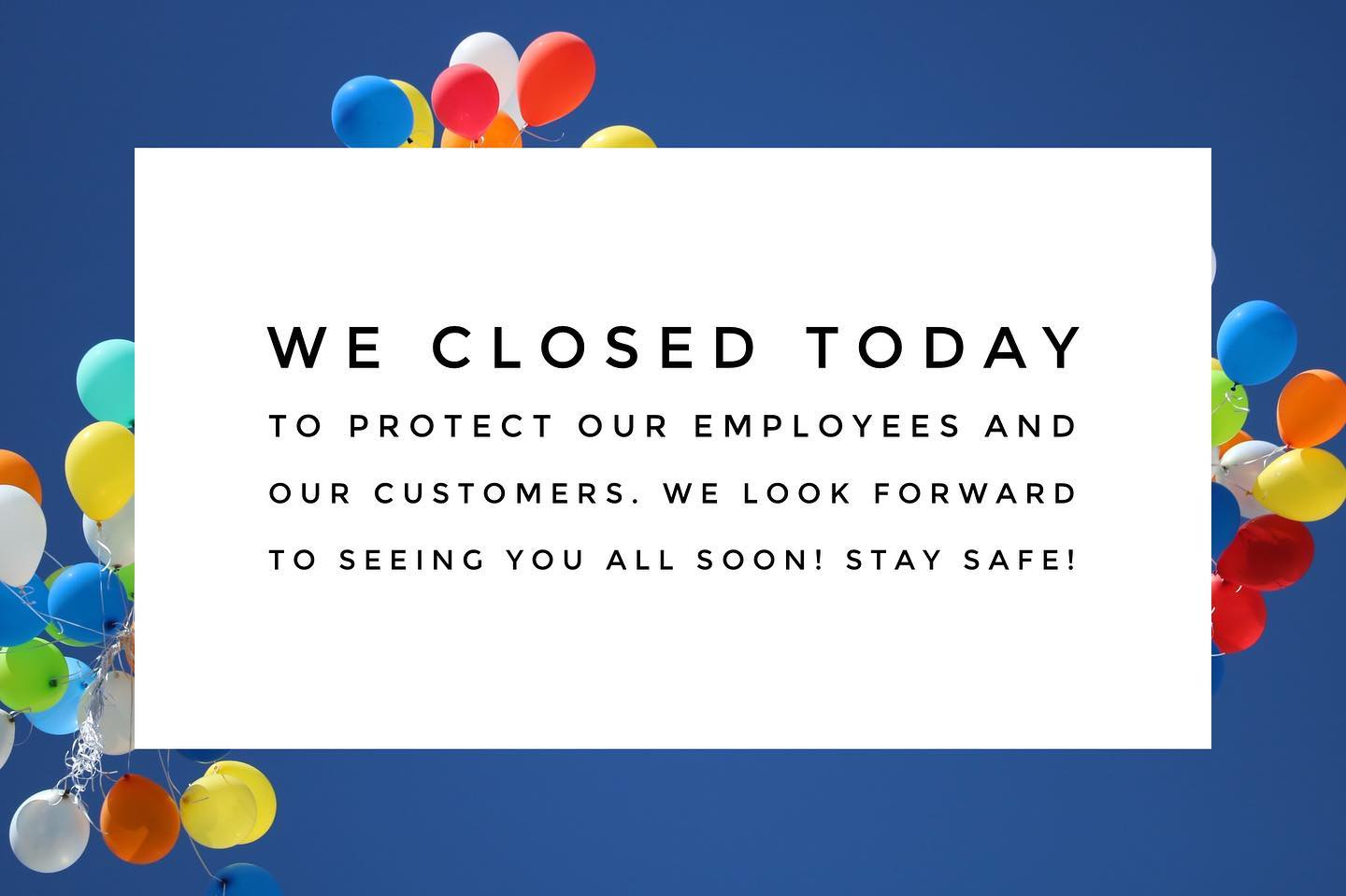
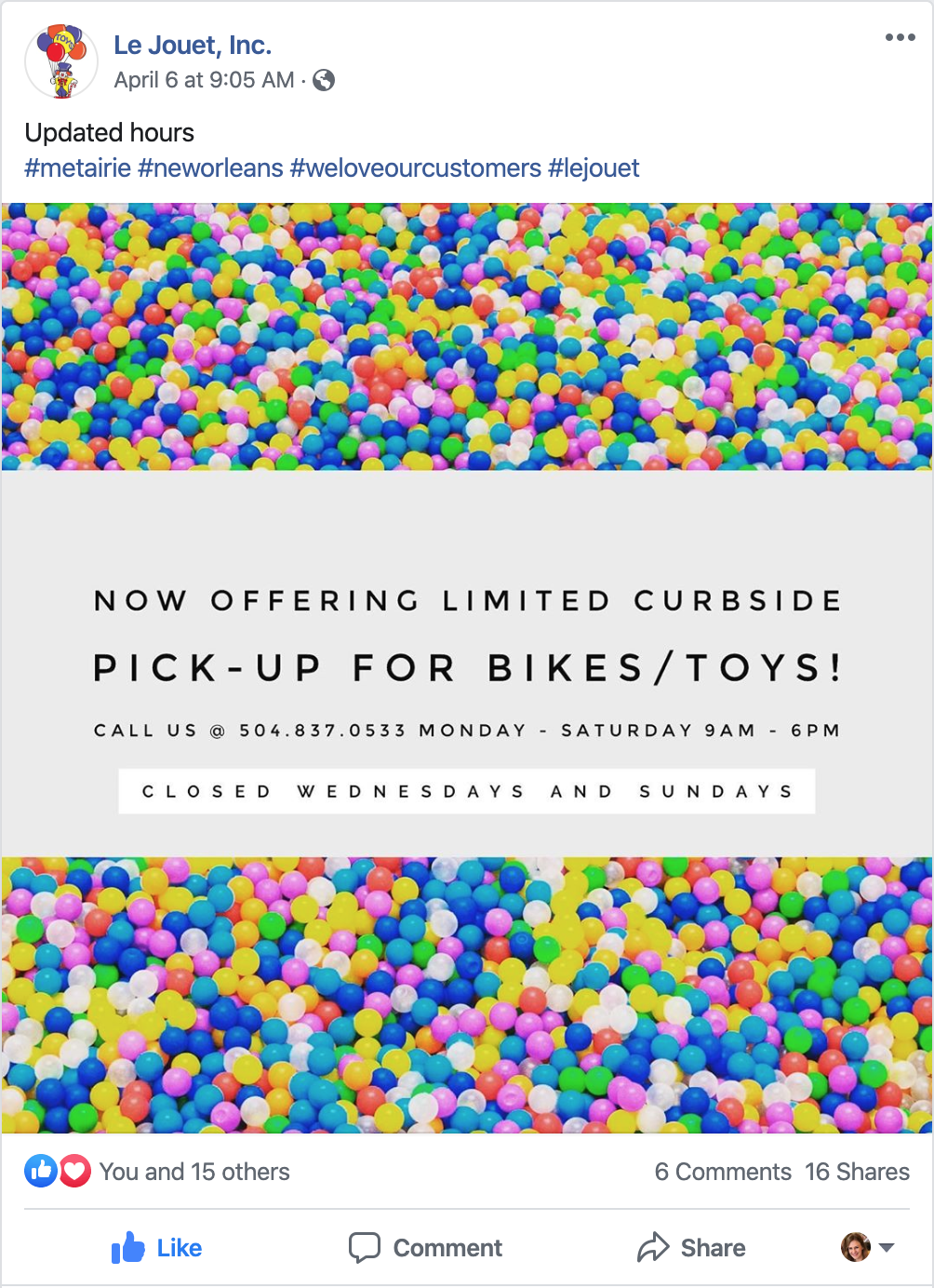
    For example, an iconic New Orleans toy store initially closed to comply with stay-at-home orders. As they realized they could keep people safe and still move inventory by offering personal shopping and curbside pickup services, they made adjustments and kept their customers informed.
    Do Good. Get Good: Earned Media for Those Who Communicate

    A strong communication plan helps earn customer loyalty and saves a deferred investment due to lost customers. In the short term, you may even get some added exposure by earning media mentions and placements because of the good you are doing. 

    One of our clients, Audubon Nature Institute, allowed an African penguin to tour the empty Aquarium of the Americas and used the hashtag #ClosedButStillCaring. The public loved it and demanded more, so Audubon produced a video of the penguins roaming the Aquarium. Local media outlets always look for feel-good stories and they picked up this one!

    Messaging Tactics

    Ensure this information is accessible to anyone who needs it.

    Audit All Messaging

    Audit and create a list of all customer / prospect touchpoints. Look at everything, from the obvious (social media and website content) to the less obvious (your voicemail recording when someone calls). 

    Examples of communications to audit: 

    • Your voicemail recording
    • Any automated responses someone might receive if they fill out an inquiry on your website. 
      • Online appointment confirmation emails
      • Online order confirmation emails
    • If someone on your Houzz.com profile (or any other 3rd party website), do they receive a different automatic email? If you have the ability to update the content, make sure you include this in your audit. 

    Google My Business COVID-19 Considerations

    Website traffic data indicates people are more likely to Google you first, even loyal customers. With Google presenting more and more information in the search results, people will often read the information in Google’s knowledge panel without making it to your website. 

    Update your Google My Business by using these features:

    Write a COVID-19 Business Statement

    Now that many states and communities are on the cusp of re-opening some businesses, it’s critical to communicate clearly and effectively with customers and employees about what is and isn’t expected at your establishment. 

    Make a specific page on your website dedicated to your COVID-19 statement and updates. We recommend that you also add a sticky banner or pop-up that links to this page site-wide. This should be obvious because it’s the first info people are looking for when they visit your site right now. 

    There is a free WordPress plugin for this feature, and tools like Unbounce can also accomplish this. Here are some examples from our clients: 

    In our next post, we’ll dive deeper into what the experts say about marketing during the COVID-19 outbreak, including how you can make messaging effective if you do continue advertising. Stay tuned for more COVID-19 marketing content from the team at Search Influence!


  • Google and Facebook’s Small Business Grants: What You Need to Know

    This post was updated in May 2020 to include additional qualification guidelines provided by Google. 

    So far 2020 has proven to be quite the year. The news of COVID-19 and the restrictions placed on businesses came with the looming sense of “What’s going to happen next?” Thankfully, you won’t have to look much further than Google and Facebook for your answers. Although they are the biggest search engine and social network in the world, they too are human. Nobody could have seen this sudden and unforeseen halt of usual business and many companies feel a big strain. Google and Facebook hope to take the weight off of small businesses with the roll out of special grants programs. 

    Dwight Schrute Thank You gif

    Google’s Small Business Grant Program 

    Google unveiled an $800 million plan to help support small businesses affected by the economic disruption caused by COVID-19. The company allocated $340 million of this money for Google Ads credits to small businesses so these businesses can stay in touch with their customer base.

    Some may be thinking, “Why the big handout?” Well, during this decline in business advertising, the search engine that helps us get recognized every day could also be in danger. Google hopes that by providing small businesses with ad credits, those companies will invest that money back into Google’s  advertising efforts. During a time like, this having a “you scratch my back and i’ll scratch yours” relationship is priceless and appreciated. 

    Qualifying for Google’s Small Business Grant 

    The million dollar question: how does it all work? The good news is that you don’t have to do anything to apply! Is it just me or do you hear the hallelujah chorus, too?

    • In order to qualify to receive credits, your business must have been an active user of Google Ads directly or through a partner in 10 out of 12 months in 2019 and in either January and/or February of 2020.
    • There is no process in reaching out to obtain your credits, just watch your account. Credits will roll out in phases, beginning in late May. 
    • Businesses can redeem these credits until the end of 2020
    • The credits can be used across throughout 2020 on all Google platforms including Search, Display, and even Youtube, and for any campaign type. 
    • Each customer is eligible to receive one credit, even if you run ads in multiple accounts or multiple campaign types. 
    • The size of the ad credit will depend on past ad spend and the location of the account. 

    Their Googliness...is truly off the charts gif

    Facebook’s Small Business Grants Program

    Facebook is offering $100 million in cash cash grants and ad credits to help during this challenging time. The company wants to help small businesses support their workforce, assist with rent, connect with more customers or cover operational costs. 

    Eligibility for Facebook’s Small Business Grant

    Although the grants are available in more than 30 countries, they have limited the number of U.S. cities to those near a location where Facebook operates. Qualifications: 

    • Check the available locations to see if your business is eligible. There is also a roll out process for application availability, starting in New York City and San Francisco, then the San Francisco Bay area, then to all other eligible cities. 
    • Your company must have between 2 and 50 employees and have been in business for over a year. 
    • You must be a for-profit company who has experienced challenges from COVID-19

    Recommendations for Google Ad and Facebook Spend During the COVID-19 Crisis

    In this time of economic uncertainty, you may wonder if anyone would convert or even be receptive to your marketing messages. The answer is yes! 

    Google Ads are producing results for some industries. 

    • Less people are searching Google at this time, but that means your brand has the possibility to occupy a larger share of voice. 
    • Due to decreased competition in March 2020, a Search Influence medical practice client showed up in 27% more searches, resulting in the campaign’s lowest cost per lead since 2017. 

    Search Influence has also seen combined success of Facebook and Google paid search for a continuing education school at a large private university. 

    • To this point in 2020, the client earned 47% of the inquiries they received in 2019, spending just 29% of their annual budget to this point. 
    • To tie this back to a key search trend, education is an area where one study noted very little decrease in traffic and conversions. 

    If your business is not open, you are not able to move your services online, or you do not want to drive traffic to your website, now is a good time to plan for the future

    • Update your website and optimize your Google Ads strategy so you know how you want to allocate your Google Ads grant money and your website looks its best when you drive traffic there. 
    • Need advice on how to best utilize Google credits or Facebook grant money? Contact one of our strategists today.

    Images

    Google

    Dwight

  • Search Influence to Host Webinar “Digital Marketing in the Times of COVID-19: What We’ve Learned and What’s Next”

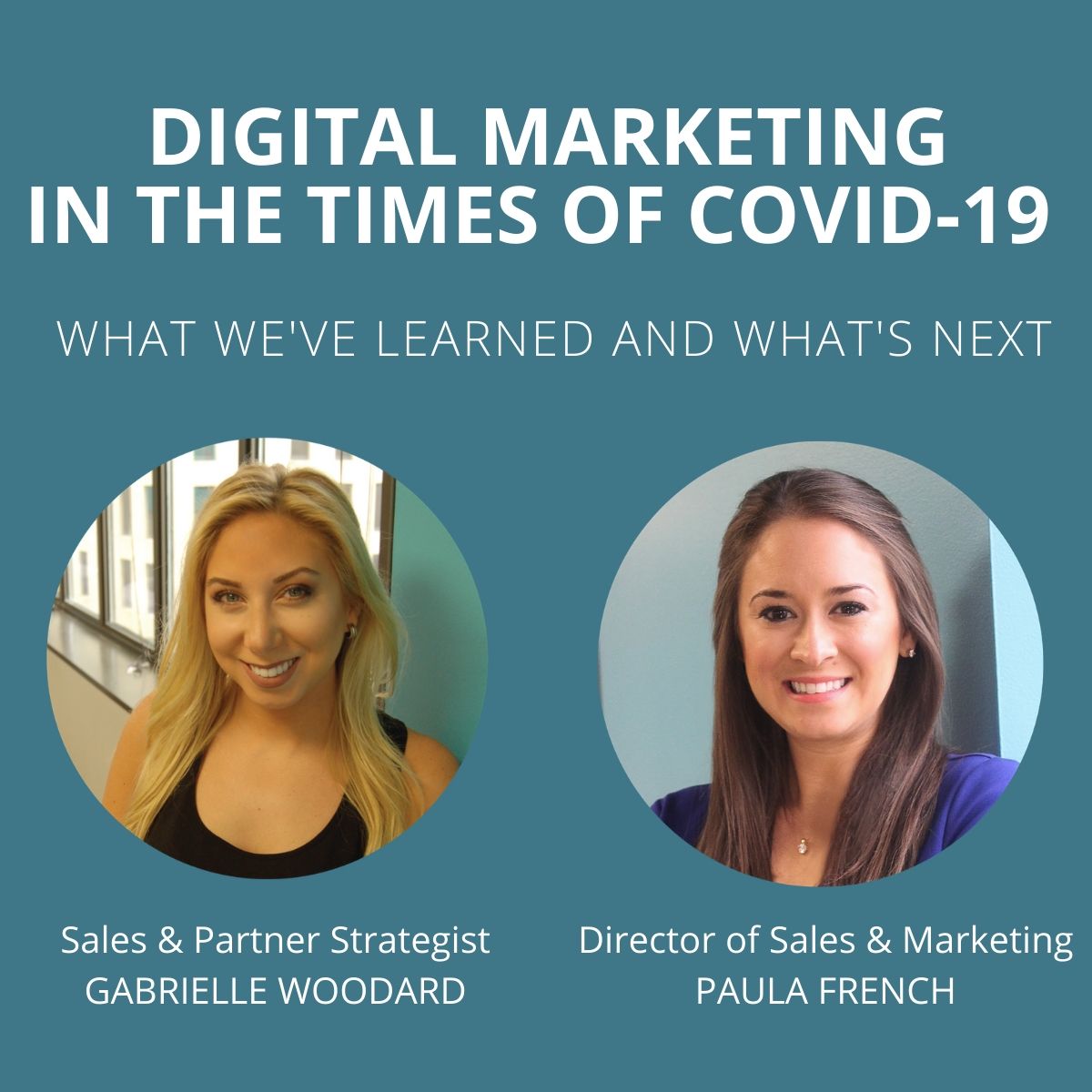
    April 14 marks the 30th day under the stay-at-home directive for New Orleans, where Search Influence’s headquarters are located. As we look to the future, we want to share learnings from a month of client status changes, closures, and postponed events.

    Join me (Paula French) and our Sales & Partner Strategist Gabrielle Woodard on Tuesday, April 14 for the free webinar, Digital Marketing in the Times of COVID-19: What We’ve Learned and What’s Next. Gabrielle and I will share best practices for executing campaigns during a crisis and the steps needed to ramp back up when the economy looks more certain. We’ll also include time to address your questions.

    We look forward to connecting with you soon!

  • Top 6 Marketing Planning Activities During COVID-19

    During this time of crisis, many businesses may find themselves with extra time on their hands, but limited money to spend on marketing. While it can be hard to think about the future, this is the perfect opportunity to do just that and take a deep dive into your marketing plan. Luckily, we’re here to help.

    We’ve laid out the top 6 marketing planning activities to ensure your business is ready to hit the ground running, once you’re able to resume business as normal.

    Person using highlighter on business documents on desk

    1. Reconsider Your Marketing Efforts

    Collect all your marketing efforts into a master list and determine their relevance. Your list may include:

    • Website
    • Digital paid advertising (Facebook, Google, LinkedIn, etc.)
    • Google My Business listing
    • Review channels (Yelp, TripAdvisor, etc.)
    • Social media pages
    • Other listings or directories

    Do these tactics still make sense? For example, is your business listed in a directory that is no longer relevant to the services you provide?

    2. Optimize All Current Marketing Strategies

    Audit each tactic and ensure it is optimized. A basic checklist for various platforms:

    • Website
      • Is your site structure intuitive? Do you have a clear navigation?
      • Does each page contain a call-to-action?
      • When was the last time you wrote content?
      • Do you have metadata for each page?
      • Is your website mobile friendly?
    • Listings/Directories
      • Is all information up-to-date?
      • Ensure your name, address, phone number, and website URL are consistent across all listings/directories.
      • Add any additional information you can to flesh out your listing in order to increase organic rankings.
    • Review channels
      • Evaluate both the quality and quantity of reviews on all channels, paying special attention to Google, Facebook, and Yelp.
      • Are you utilizing reviews/testimonials on your website?
      • How are you soliciting reviews? Can this process be improved?
      • How often are you responding to reviews, both positive and negative?
    • Social media pages
      • Do all of your social media channels accurately reflect up-to-date business information and brand?
      • How often do you post on social media channels?
      • Is your tone, voice, and messaging consistent across platforms?
      • Are you utilizing all relevant platforms?
    • Digital paid advertising
      • Are you consistently monitoring all forms of digital paid advertising?
      • Look at the data. What trends are you seeing? Verify if you’re getting an adequate return or results. How has this changed over the years? Is there a better allocation for these dollars?
      • Do you need support? Speak to a digital paid advertising specialist.

    3. Perform Competitive Research

    Evaluate how your current strategies stack up to your competitors by performing competitive research and analysis.

    • Identify your competitors or similar businesses.
    • Perform a SWOT analysis on your business’ and your competitors’ websites, social media, content marketing, and digital paid advertising.
    • Pro tip: an easy way to see your competitors overall web presence is to simply Google keywords relevant to the business or industry.
    • Take a look at what your competitors are doing in areas they excel in. Can you implement any of these strategies into your marketing plan?

    4. Develop Marketing Materials

    Quality marketing materials are imperative to a successful marketing strategy but can be extremely time consuming to produce. Time is on our side right now, and the creation and curation of marketing materials can be done at little to no cost!

    Restaurant owner taking photographer of their menu items for marketing use

    An easy place to start developing marketing materials is taking photos. Pick up your smart phone and start snapping away. A few tips for success:

    • Use the photography composition rule of two-thirds, which suggests how you arrange subjects in your frame. Most digital cameras have an option to add the rule of two-thirds grid onto the screen.
    • Focus on one subject. When appropriate, stage people in your scenes – grab your roommate, significant other, or a family member. (Of course, follow appropriate social distancing guidelines!)
    • Lighting is key! Ensure you have great—ideally natural—lighting, and that your space is not backlit (meaning the light source comes from behind the subject.)

    According to Wordstream, “marketers who use video grow revenue 49% faster than non-video users.” The same tips for above apply here, plus a few others:

    • Use a tripod for a steady video. If you don’t have a tripod, get creative—stack books on a table or chair.
    • Film horizontal versus vertical.
    • Have a clear objective or call-to-action.

    Remember that great idea you had for a blog post 6-months ago, but didn’t have the time to write it? Let those creative juices flow and begin building up or revamping your content materials.

    Once you’ve made your way through optimizing your website content, it’s time to start looking at other strategies. Here are different content formats to add to your arsenal:

    • Blog posts
    • EBooks
    • Whitepapers
    • Infographics
    • Case studies
    • Podcasts
    • Templates, worksheets, and checklists

    5. Set Concrete Marketing Goals

    Many businesses will need to rethink and reforecast business and marketing goals as a result of COVID-19. To formulate new goals, consider the analysis, research, and asset creation you’ve done, and how the crisis is affecting your business. Think about what you would like to accomplish once we are able to return to business as normal and develop a plan surrounding it.

    Utilize SMART Goals to create your plan. SMART goal setting is a simple, trackable method that allows you to create clear and achievable business and marketing objectives, instead of vague resolutions. It is one of the most effective tools for achieving goals in the corporate world due to its scalability, ease of use, transparency, and proven success. A SMART goal is:

    • Specific
      • What do you want to accomplish?
      • How will you accomplish it?
      • When will it be accomplished?
      • With whom will it be done?
      • Why do you want to do this?
    • Measurable:
      • How can you measure progress and know if you’ve successfully met your goal?
      • What metric will you use to know the goal has been reached?
      • What precise amounts can you include?
    • Achievable:
      • Review your specific and measurable goal to ensure it seems reasonable with a little bit of stretch.
      • Are you confident this goal is achievable and sets realistic expectations?
      • Do you have enough time to reach your goal?
      • Do the involved parties have the tools and skills they need to accomplish it?
      • What obstacles would prevent me from reaching this goal?
    • Relevant:
      • Why am I setting this goal now?
      • What is the business’ overall objective?
      • How is this goal aligned with the overall objectives?
    • Time-bound:
      • Do I need additional milestones to keep this goal on track?
      • Do I have enough time to accomplish it in the given time frame?

    Be agile with your goals. Plan specific dates to review your progress and check/adjust when necessary, at least once a month.

    6. Maintain Audience Engagement

    According to Forbes, it costs 5 times more to attract customers than to retain existing ones. The most important thing to do during this time is to keep your audience engaged. Take advantage of any no-cost marketing, such as organic social media posts, blogging, and SEO. If possible, keep paid advertising running. If you are unable to service your customers or consumers remotely, run brand-awareness campaigns. Consumers are spending up to 30% more time online during social distancing. Make sure your brand is front and center so consumers choose your business once doors open again!

    Unsure where to begin? Contact one of our strategists today!

  • 6 Messaging Adjustments to Remain Relevant During COVID-19

    As digital marketers, a global crisis like COVID-19 (also known as the coronavirus) can affect all aspects of your digital campaigns, from advertising spend to messaging. The faster you can pivot, the better for your business and for your consumer.

    Although there isn’t a one-size-fits-all approach to handling each campaign or client, here are six key ground rules to follow to stay relevant in the midst of any crisis.

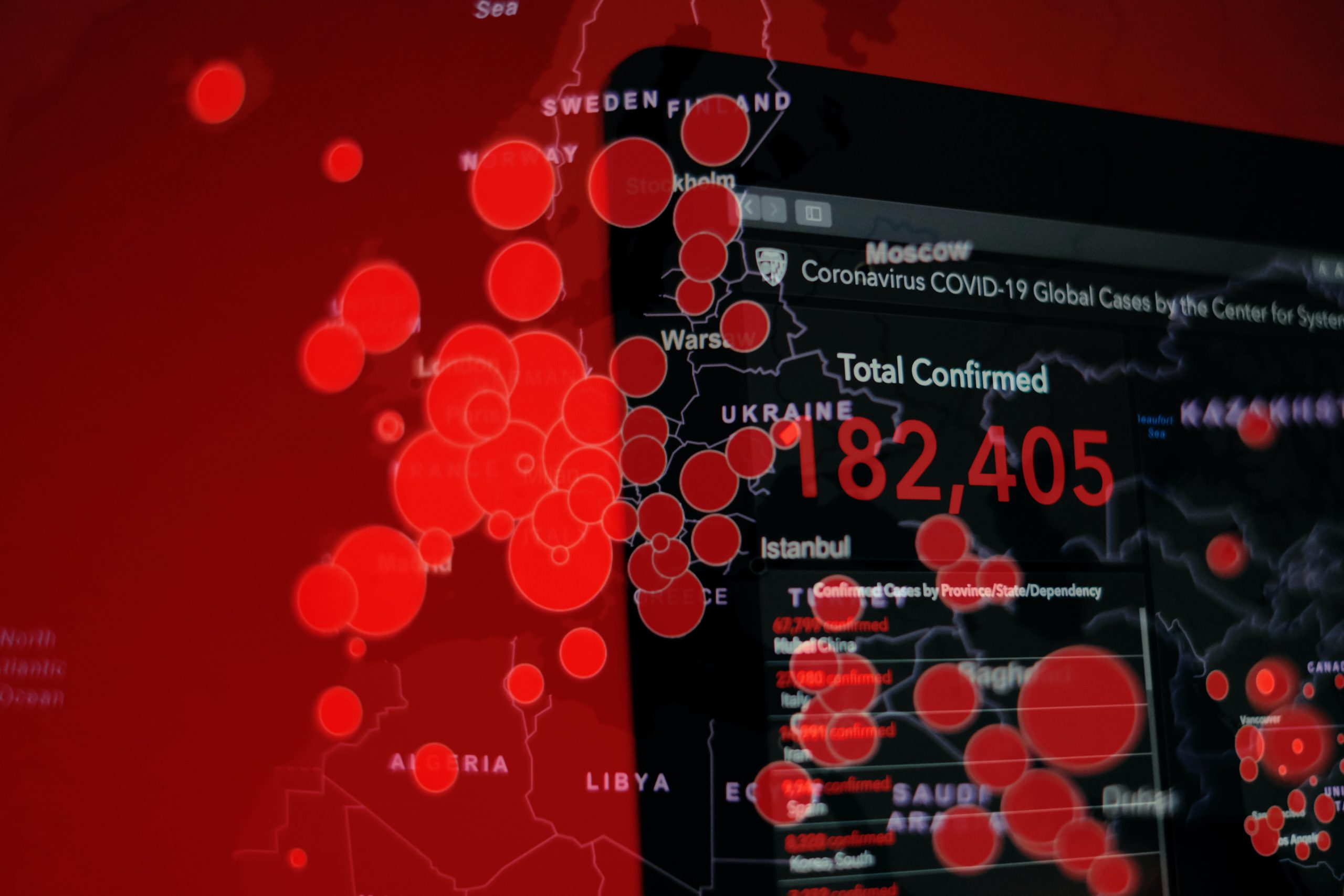
    Graphic showing growing cases of COVID-19

    Align with Local and Federal Agencies and Authorities

    Ensure your marketing aligns with federal and local mandates and encourages safe and approved behavior. Marketing messages out-of-step with government recommendations may come off as insensitive or even be interpreted as malicious.

    • Verify that your marketing campaigns do not call for behavior that puts your clients or potential customers at legal risk or in danger. If so, put a pause on that campaign until the crisis is over.
    • Sign up for alerts to stay up-to-date on all federal and local decisions, since circumstances change daily (and even hourly.) This will allow you to update your marketing to keep them timely.
    • Use local and federal officials as your guide as to when you can resume paused marketing efforts.

    Update Messaging for Closures

    During a crisis, it’s likely that some businesses will have to shut down or limit their operations.

    • Pause marketing that encourages any immediate action that they cannot task. For example, if you work in the museum, zoo, or tourism industries, preserve resources by pausing any marketing that encourages visits to your attractions.
    • If customers already purchased tickets to your attractions for specific dates, provide messaging about how you will honor those existing tickets on future dates.
    • Promote opening dates only when you have a clear picture of when your attractions can reopen.

    Review All Creative

    While maintaining business and bringing in revenue is important during difficult and uncertain times, make sure your marketing is in tune with the current climate.

    • Review all of your copy to ensure the tone reflects current sensitivities and realities.
    • Consider local context when rewriting copy. Are customers and audiences in your market more or less sensitive to the portrayal of a particular issue?
    • Scrutinize your visuals to ensure they reflect current sensitivities. As governments have instituted social distancing guidelines, pay careful attention to creative that depicts interactions such as hand shakes, hugs, and close groups.
    • Constantly reassess campaigns. What felt comfortable to say or portray two weeks ago may no longer feel appropriate.

    Promote Digital Consultations

    If you are a doctor, lawyer or in another progressional service, your customers may still need your expertise during COVID-19 and other crises, even if your offices remain closed to the public. If you are able to make the switch to digital consultations, focus your marketing on promoting these services.

    • Shift all marketing calls-to-action from “Schedule a Consultation” to “Schedule a Virtual Consultation.” Not only does this set the expectation of how and where you will fulfill your services, but it also indicates that you are abiding by all local and federal mandates.

    Maintain Awareness Through Virtual Content

    Stay engaged with your audience and maintain brand awareness by offering fun and/or useful online content. Your audience, especially caregivers of young children, are looking for ways to keep their children entertaining while still being safe.

    • Consider virtual tours If you are in the museum, zoo, or tourism industries.
    • Offer downloadable entertainment, such as coloring sheets, crossword puzzles, or at-home scavenger hunts.

    Consider Optics When It’s Time to Transition

    There will eventually be a light at the end of the tunnel. Make a plan to slowly transition back to your campaigns that were running before the crisis hit.

      • Review all of your campaigns before relaunching and be sure to add in any new, relevant information that might have to come to light during the crisis.
      • Refresh your creative messages to articulate the mood of the current climate, post crisis.

    Unsure where to begin? Take advantage of a free consulting session with one of our strategists today!

    Images

    Emergency pull

    COVID-19 Map

  • Business Disruption Marketing Checklist: How to Communicate When You Are Closed, Remote, or Open

    Business Disruption Marketing Checklist: How to Communicate When You Are Closed, Remote, or Open

    Some businesses must close during a time of crisis. Others may be fortunate enough to remain open, even if that means limiting customer interaction or operating remotely. For a business equipped to operate during a time of crisis, saying that you’re open can be just as important as saying that you’re closed.

    Regardless of industry, communication about your status will help mitigate disruptions and profit loss as much as possible, and when you are reopen, can help you get back on your feet more quickly. Consider taking these steps to protect your business before, during, and after a time of business disruption.

    Marketing Checklist If Business Will Be Completely Closed

    1. Pause all advertisements for short-term actions or foot traffic. (Keep advertising long-term sales cycle services.)
    2. Pause any pre-scheduled social media posts.
    3. Add a special notice or banner across the top of the website and to any “Contact” pages notifying visitors that the business will be closed.
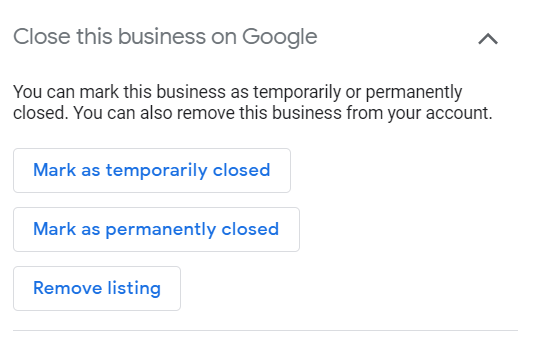
    4. Mark business as “temporarily closed” on Google My Business. Update hours on Facebook and other listing websites that show business hours of operation.
    5. Update all email signatures that the business will be closed and staff will have limited or no access to email (depending on the business). 
    6. Set up email auto replies for all accounts that will not be checked regularly, especially general inquiry emails like [email protected], [email protected], etc. 
    7. Update all voicemail recordings.
    8. Create a post on social media (Facebook, Instagram, Twitter, LinkedIn, etc.) to notify followers of the business’s status.
    9. Collect all passwords to ensure that all accounts (email, social media, website, etc.) can be accessed remotely. 
    10. Notify customers and vendors via email that the business will be closed and provide contact information should they need to contact the business during that time. 
    11. If applicable, forward calls to a mobile phone or a line that will have service. 
    12. Collect contact information for all employees, communicate the business’s plan company-wide, and provide regular updates during and after the crisis.

    Marketing Checklist If Business Will Remain Open Or With Modified Operations

    1. Pause advertisements for services that may be limited during this time. 
    2. Add a special notice or banner across the top of the website and to any “Contact” pages notifying visitors that business is operating.  
    3. Update all email signatures that the business is operating. 
    4. Update all voicemail recordings that the business is operating. 
    5. Create a post on social media (Facebook, Instagram, Twitter, LinkedIn, etc.) to notify followers that business is open.
    6. Pause any pre-scheduled social media posts that might be insensitive to the current climate. 
      1. For example: “It’s a beautiful day to go to the beach!” 
    7. Collect all passwords to ensure that all accounts (email, social media, website, etc.) can be accessed remotely. 
    8. Notify customers and vendors via phone or email that the business will remain open. If any communication will be modified during that time, provide the appropriate contact details.
    9. If applicable, forward calls to a mobile phone or a line that will have service. 
    10. Collect contact information for all employees, communicate the business’s plan company wide, and provide regular updates during and after the crisis. 

    Marketing Checklist For After The Crisis

    1. Unpause advertisements.
    2. Remove related messaging from email signatures and voicemails.
    3. Remove call forwarding and update auto reply email settings. 
    4. Update special notice or banner on website to indicate the business is open / back to standard operations. This message can be left on the website for a few days or until things get back to “normal”.
    5. Update social media followers (Facebook, Instagram, Twitter, LinkedIn, etc.) that the business is open and share any pictures, news, or any other updates that might be meaningful to that audience.
    6. Update hours on Google My Business, Facebook, and other listing websites that show business hours of operation.
    7. Notify customers and vendors via phone or email that the business is open and will be operating as usual moving forward. If the business is not able to operate as usual, provide the appropriate details and keep customers and vendors informed until business has returned to normal.

    We truly hope you find this list helpful during any business disruption period and that it helps mitigate the negative impacts of closure or altered operations. If you have any additional tips, comment with them below!

  • Want to Learn the Key to Raving Fans for Your Brand? Authenticity!

    Want to Learn the Key to Raving Fans for Your Brand? Authenticity!

    Brand authenticity is in the eye of the beholder. It’s easy to see when a person or a brand is inauthentic, but it’s not as easy to put one’s finger on what actually is authentic.

    When actions don’t match words, it’s easy to see the inauthenticity. Boeing, for instance, previously a vanguard of quality, recently covered up a very deadly error. Milli Vanilli, right?

    I can point to a small handful of brands that strike me as truly authentic. Two, in particular, are at opposite ends of the spectrum.

    Burger King

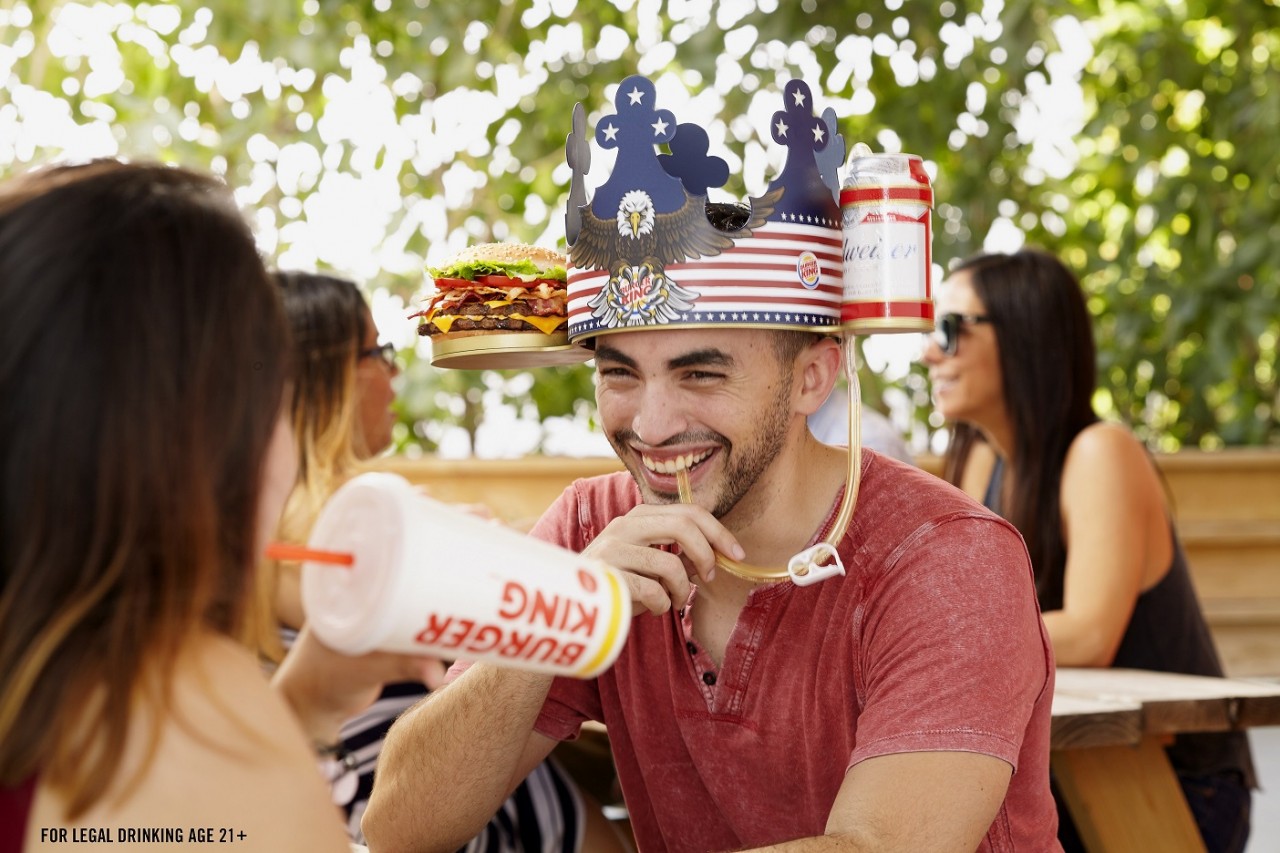
    Burger King, the #2 burger, has done a great job of using humor to demonstrate their brand ethos.

    Their mascot is creepy, no doubt. The head of the King used in their commercials and advertising is weird and discomforting.

    Instead of treating this and the associated press as a problem requiring management, Burger King humorously embraces the freaky King as an authentic representation of their brand. And, they do it while embracing other brands and current events to enhance their relevance.

    Take, for example, Burger King taking McDonald’s head-on in a Halloween-themed commercial with the tagline “Come as a clown, eat like a king.” Or, the pantomime King’s first words, a throwback to a classic Budweiser commercial “Whassup”?

    Man with Burger King hat with burger and Budweiser attached and woman drinking soda

    More recently, Burger King Argentina reached out to the Duke and Duchess of Sussex as they seek to step back from their royal duties with an offer of a different source of income.

    As you can see, these are humorous and on-brand with a consistency that’s lasted a decade or more.

    I mean, come on, “Cheetos Chicken Fries!?”

    Picky Bars

    On a very different scale is a small sports nutrition brand in Bend, Oregon called Picky Bars.

    Picky Bars is the brainchild of three current and former professional athletes, two of whom are husband-and-wife team Lauren Fleshman and Jesse Thomas. Fleshman is a former professional runner and Thomas a former professional Ironman triathlete. For this brand, authenticity is apparent in their relationship and their sporting credentials.

    The two produce a weekly podcast called Work, Play, Love, where they talk about their lives, their kids, and their respective business ventures. There are moments when you feel like you just walked into a dinner party where the hosts are uncomfortably tense, having just finished a big argument. Lauren and Jesse both talk about their challenges with their kids, childcare, and the not-so-glamorous parts of their entrepreneurial adventures.

    Jesse Thomas posing in front of I Love Carbs bumper sticker

    It’s educational, funny, and sometimes sad, but very, very real.

    As a vehicle for getting to really know the minds behind the products, the podcast format is great.

    And, they’re equally transparent about the business, as exemplified in Jesse’s 2019 Year in Review blog post, which is a study in brand authenticity.

    Beyond the podcast and blog, Jesse’s humor shows through in the marketing for Picky Bars, particularly on Instagram.

    Jesse takes part in sporting events wearing an inflatable dinosaur costume he calls Barosaurus. In one of their more popular videos, Jesse places an I (heart) Carbs bumper sticker onto his car, which is immediately driven away by the couple’s pre-schooler.

    Pickybars owners posing in the Barosaurus costume at a race
    Original Instagram Post

    While these are very different examples, each is authentic in its own way, ultimately making us feel as though the brand or, in the case of Picky Bars, the founders are speaking to us directly.

    Capturing brand authenticity in marketing is a great way to build brand awareness and trust, but consumers often don’t appreciate when it feels forced. Finding this delicate balance is often a challenge as businesses create their brand voice. The marketing professionals at Search Influence can create advertising campaigns that capture your brand voice and showcase your products and services in a way that speaks to your customers in an effective way. Start a conversation today to learn how we can optimize your potential.

    Images

    Burger King

  • Free Search Tools to Find the Best Deals for Black Friday and Cyber Monday

    Free Search Tools to Find the Best Deals for Black Friday and Cyber Monday

    Ariel Tusa, Account Supervisor at Search Influence, kicked off the holiday shopping season by sharing online shopping tips with WVUE. Make the most out of your Black Friday and Cyber Monday with these money-saving tools:

    Person shopping using mobile device during Black Friday

    SlickDeals: Find the best in-store or online prices for items on your list. Users can up-vote or down-vote items other people share on the site, so the best deal will be at the top! Push notifications even alert you about fast-selling items that are on sale.

    Honey: No more avid coupon-searching—this free Chrome Extension automatically finds and applies available promo codes when you shop online. On some websites, Honey even alerts you if there is a better deal out there. Get rewarded with cash back when you shop with the extension turned on.

    Camelizer: Download this extension for Mozilla Firefox or Google Chrome to track product price history on Amazon and other popular retailer sites to compare and find the best online deals.

    Rakuten: Shop your favorite brands and stores on this retail site with automatic promo codes applied to items, plus cash back. Getting paid to shop? Yes, please.

    And our favorite part about these tools? They’re all FREE! Search Influence not only wants to optimize your holiday shopping experience, we want to optimize your customers’ online experience. Our online advertising services can help your business get found by potential customers looking for the products and services you provide. Let’s start a conversation today.

    Images

    Shopper

  • Three Lessons From the Fried Chicken Frenzy: Popeyes’ Brilliant Marketing Moment

    Three Lessons From the Fried Chicken Frenzy: Popeyes’ Brilliant Marketing Moment

    The drive-thru line on Sunday, Nov. 3 at a Popeyes Louisiana Kitchen in Metairie blocked traffic and almost caused an accident in the traffic lanes as I drove by. The highly anticipated fried chicken sandwich that had sold out just two weeks after its original release was back on the menu. Meanwhile, tumbleweeds blew through the local Chick-Fil-A parking lot because… they’re closed on Sundays.

    The Chicken Sandwich War: How It All Started

    With the launch of Popeyes’ first-ever chicken sandwich in August 2019 and the Popeyes marketing team’s quick reply to a tweet by their rival Chick-Fil-A, The Great Chicken Sandwich War began. In case you were wondering, Twitter is most definitely still relevant in today’s marketplace and can have a direct impact on consumer behavior when used well. And, people are still petty.

    Chick-Fil-A, while not without its own political controversy, remains one of the most popular fast-food chains in the nation and is known for its chicken sandwiches: bun, pickles, chicken. In the midst of Popeyes new product release on August 19, Chick-Fil-A touted their sandwich as “the original” on Twitter, seemingly throwing shade at Popeyes’ chicken sandwich:

    In a matter of 15 minutes, the marketing team at Popeyes decided to reply quite simply with “…y’all good?” and Twitter went bananas. Chick-Fil-A’s original tweet had ~3,000 retweets while Popeyes’ response earned ~86,000.

    From there, the Internet did its thing. Memes, gifs, homemade videos, and taste tests that compared the two chains’ sandwiches flooded social media feeds while the lines at Popeyes grew. Within two weeks, the 3,102 location restaurant chain ran out of its seven-week supply of chicken sandwiches.

    Positioning: A Limited Time Offer or Just the Best Dang Chicken Sandwich?

    Popeyes couldn’t have planned a better product release, and they really have social media to thank for its wild success. When they first announced the product (during Wendy’s campaign announcing the return of spicy nuggets), they made no mention of it being a limited time offer (LTO), which has become a frequently used tactic in the fast food industry. LTOs include things like Taco Bell’s nacho fries and the McRib at McDonald’s. Typically LTOs are launched with creative or gimmicky advertising messages making it known that the product is not a permanent menu item, creating a sense of urgency for the consumer to get it while it lasts.

    Popeyes didn’t take that stance. Instead, they added the sandwich to the menu specifically positioning it to compete for Chick-Fil-A’s top spot in the chicken sandwich standings. And they used their advertising to challenge their competitor rather than pressure the consumer.

    And well, people love a good competition. As the social media buzz grew, it caught the attention of news outlets, who are always looking for content the general public is interested in engaging with. And so began their coverage about Popeyes running out of product, celebrities joining in on the fun, and partaking in taste tests. This is when Popeyes experienced a huge jump in earned media value, according to Apex Marketing Group, who placed a $65 million media valuation on the national coverage Popeyes earned before, during, and immediately after the time the sandwich stock sold out.

    UGC: The Power of User Generated Content

    It’s the digital marketer’s dream: an idea, product, or creative approach that goes viral and sets the world on fire, creating more demand for the product than there is inventory. In today’s world of completely saturated and constantly flowing feeds, achieving that level of buzz can seem impossible. The key, as this case study shows, is to consider the opportunity for consumers to actively participate. Everyone’s a content producer (or “influencer” in their own right), so give the people something to talk about.

    The perfect recipe in Popeyes’ case was starting slow and kicking it up a notch by engaging in some banter with Chick-Fil-A. This ignited a fire of user-generated-content which is inherently more viral than any single advertising or marketing message published by a brand. Wendy’s has been engaging in similar hilarity on Twitter for quite some time with its competitors and customers, but given Chick-Fil-A’s political notoriety, this was just the right chicken fight to pick.

    Although the wave of UGC wasn’t even intentional on Popeyes’ part, their team did a great job of highlighting customers and showing social proof when announcing that the sandwich was returning (see: the first tweet embedded in this post).

    3 Key Lessons Learned From Popeyes Brilliant Marketing Moment

    • Twitter is still relevant and people are still petty. They love a good competition and will jump at the chance to back a brand they feel loyal to. This nationwide game of chicken sandwich thrones began because of two tweets between rival fast food chains.
    • Smart competitive positioning can make or break a new product launch. When launching its first ever chicken sandwich, Popeyes did NOT focus on gimmicky advertising pushing that the product was only available for a limited time, which is a common tactic in fast food marketing. Instead, they positioned it for what it was, a challenge to direct competitor Chick-Fil-A, and it paid off in droves.
    • To truly ignite a viral fire digitally, marketers must give customers the opportunity to actively participate and then leverage the power of user-generated content.
  • Website Cookies: Should You Be Concerned?

    Website Cookies: Should You Be Concerned?

    You’ve probably noticed that many sites notify you that they use cookies and ask you to save them. You may have also noticed that these notifications are more frequently appearing on sites. Why have cookies become so prevalent, and should you be worried?

    What Is a Cookie?

    A cookie is a small text file that stores a unique ID placed on your computer by an advertiser or publisher to help them keep track of your usage and behavior.

    Why Am I Suddenly Hearing so Much About Cookies?

    Recently, there has been a lot of legislation around privacy on the internet. The first example of this is the European Union General Data Protection Regulation (GDPR).

    More recently, California has gotten into the act with the California Consumer Privacy Act (CCPA).

    The impact of the CCPA is not as widely known, but the GDPR calls for disclosure and consumer control of tracking information placed on a user’s computer.

    In essence, a website owner or publisher has to give the user an opportunity to review and/or opt-out of tracking cookies.Expect this trend to grow as more governments express concern over the use of user data.

    What Are Cookies Used For?

    Cookies are used to keep track of your usage of websites and your interaction with advertising.

    Most people are familiar with the phenomenon where they look at a pair of shoes in an online store and then those shoes follow them around the internet. This is called “retargeting” or “remarketing.”

    Cookies are also used to store usernames, passwords, and other information for websites you visit frequently.

    And, cookies allow website managers to understand the way you are using their website so they can better tailor their content to you and future users. An example of this is the cookie that gets set by Google Analytics, the most popular analytics package on the internet.

    So, cookies are potentially really useful if you like to see ads tailored to your interests, or if you don’t like having to re-enter all your information on websites.

    Beyond targeted advertising, cookies can start to tell a lot about you as an internet user. Do you prefer Nike or Adidas; Ford or Volvo; Gucci or the Gap?

    Should I Be Worried About My Privacy?

    First, you should accept that privacy in this day and age is a comforting illusion. Just kidding. No really, I’m not kidding—there is no privacy on the internet.

    Most cookie usage is completely benign and, in many cases, helpful. Like any technology, cookies can be used for good and evil. And, most cookies are used in aggregate form such that your personally identifiable information is not available.

    Examples of negative cookie usage:

    • Excluding certain demographic groups from finance and housing offers—which is illegal.
    • Showing hateful political ads to groups known for a propensity to violence—which should be illegal if it’s not already.

    By your interactions with various websites and advertisers, you are sharing a lot of information. If used legally, it is not necessarily personally identifiable.

    If you are the type to take online surveys or play online sweepstakes, or even give up your email address for a 20% off coupon, you are now connecting the real you to the virtual you. You are giving up your privacy in exchange for some value.

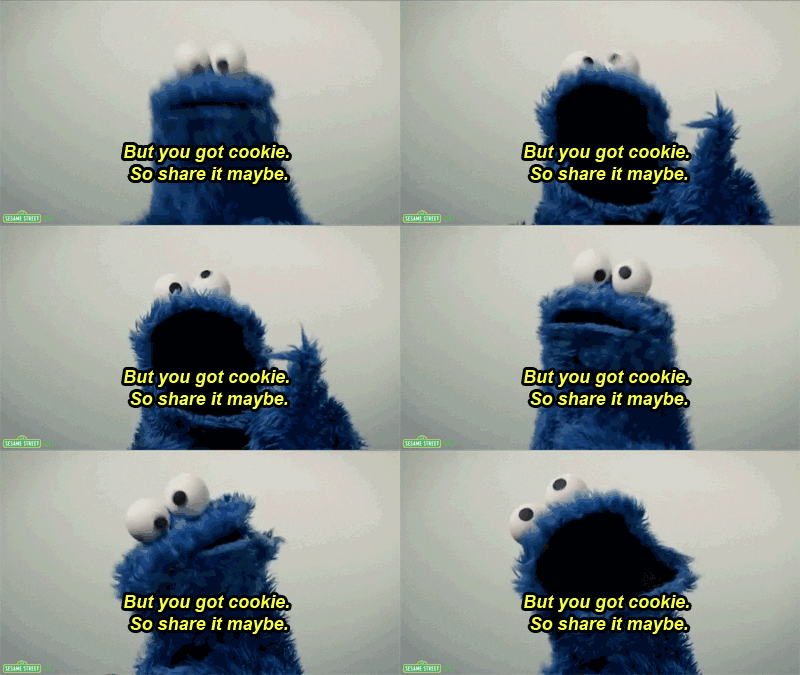
    But you got cookie, so share it maybe Cookie Monster quote

    Websites with access to particularly sensitive data, like doctors and hospitals, have very strict rules about personally identifiable information and its use, dictated by HIPAA (Health Insurance Portability and Accountability Act of 1996).

    With enough distinct data points, it’s possible to get pretty close to identifying you individually. And you can easily imagine how once credit card data gets into the mix, you can tie humans out in the world, driving around and buying stuff to website visitors.

    Credit card companies are already selling your data. One of the biggest data aggregators, Acxiom, maintains a website where you can see all they know about you. It’s currently down for revision, but when it’s back up you can go to https://aboutthedata.com to see all the details.

    They know what cars you drive, what you paid for your house, and how much debt you have. It’s a lot of potentially scary information.

    So if you’re prone to worrying about your privacy, yes, you should worry. In the general case, however, you don’t have much to fear.

    How Can I Keep Myself Safe?

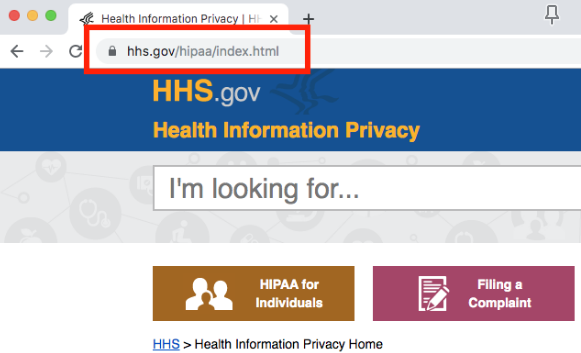
    If you are supplying private information like health or financial information, make sure the site you are using is secure. You can tell a website is secure because it will have a small lock in the address bar next to the website address.

    Example of an HTTPS secure site helping protect users data

    If you’re really browsing where you don’t want to be tracked, you can use the private browsing mode enabled by your web browser.

    In Google Chrome, this is called “incognito mode.” In the Safari browser from Apple, it’s called a “private window.”

    These modes are intended to not store any cookies beyond your current session and should provide a firewall between your existing cookies and the sites you visit.

    The Future of Online Tracking

    Today, an advertiser can buy ads that connect with you on computer, mobile phone, or even a billboard you drive by.

    The personalized billboards of the Tom Cruise movie “Minority Report” are not far off.

    Fortunately, governments the world over are starting to legislate data use. It is hard for governments to move as quickly as technology entrepreneurs, but GDPR and other similar regulations will keep the good actors in line.

    But listen, be smart! Just like you wouldn’t want to leave your wallet on a park bench, you don’t want to go giving up all sorts of private information to anyone who asks for it online.

    If you don’t trust a site or it is not secure, don’t give it personal or financial information. Think twice about whether that 20% discount is worth the information you have to give up.

    Advertisers and website publishers will continue to innovate to get closer to you as a customer This is a good thing if done appropriately.

    Some simple steps on your part can keep you as safe online as you are in the comfort of your own home.

    If you own a website and are concerned about the legality of cookies, the digital marketing experts at Search Influence can help. Start a conversation today.

    Images

    Cookie Monster