Category: Industry Insights

  • CCPA and Political Ads: What You Need To Know and Why It Can’t Wait ‘til 2020

    The recently-passed California Consumer Privacy Act and proposed changes to political ads will change the digital marketing landscape in 2020. I know what you are thinking: 2019 just started, why should I already be concerned about complying with new rules and regulations that go into effect in 2020? As many companies learned through complying with the GDPR (General Data Protection Regulation), it’s much better to start implementing changes as soon as possible.

    With the recent breaches of consumer data, privacy and transparency have been major concerns. Passing the GDPR in 2018 was a huge step toward combating privacy concerns, but U.S. companies can still expect much more to come in the way of regulation and legislation. Not only will the US start enforcing their own data regulations, including the CCPA, but new rules are arising that would require greater transparency for political advertising.

    Lock on the keyboard of a computer at Search Influence in New Orleans, LA

    Key Components of the California Consumer Privacy Act (CCPA)

    Effective January 1, 2020, the CCPA aims to protect the privacy, security, and rights of California consumers. The law allows citizens, or the state itself, to bring action against a company for violations of the law. According to Varions, the rights given to Californians from this privacy act include the following:

    • Know what personal information is being collected
    • Know if their personal information is being sold or disclosed and to whom
    • Say no to the sale of their personal information
    • Access to the personal information that is being collected
    • Equal service and price if they choose to exercise privacy rights

    Why Being GDPR Compliant Doesn’t Mean You’re Automatically CCPA Compliant

    While the goals of the CCPA and the GDPR are extremely similar, businesses need to be aware that just because they comply with the GDPR requirements does not mean they are compliant with the CCPA. In many ways, the CCPA expands on ideas and regulations of the GDPR. For example, the CCPA requires a way for consumers to control their own information, as opposed to the required consent for data in the GDPR. The CCPA’s rule on notifying consumers if their data is sold to third parties and allowing them to opt out is another major difference.

    So what do marketers need to do to prepare for this 2020 deadline? First and foremost, they need to be sure to closely examine the data that they currently collect and how it is used. Data fields on forms, profiles, and landing pages are an important part of this scrutinization process. If they collect personal information, clear language and cookies need to be in place to inform users about what information will be stored, shared, or sold. Privacy policies must also be updated with steps the consumer can take to have their personal data deleted.

    What Could Change With Political Advertising for the 2020 Elections?

    The 2020 elections are not far off, and many political campaigns at both the national and statewide level have already been kicked off. After the controversy over the 2016 elections, protection of data and transparency with political advertising has been top of mind. In March of 2018, new regulations were proposed by the FEC for how political advertisers should run disclosures that are clear about who paid for the ad. After commissioners met in June, there was still no clear decision for an approved proposal.

    Currently, the FEC law requires that advertisements include disclaimers for three ad types: Communications by Political Committees, Express Advocacy by Any Person, and Solicitations by Any Person. The newly proposed rules would apply to the same ad types, but require that these ads state who paid for them and if a candidate authorized the ads. Another difference these policies propose is that advertisers will no longer be able to omit ad disclaimers based on size constraints. Instead of omittance, “adapted disclaimers” must be used, which would have the largest impact on online advertisements.   

    Keep in mind that while the majority of marketers may not be working directly with a political campaign, these rules still apply to anyone who expressly advocates for or against a candidate in paid digital ads. This could encompass a large variety of digital advertising users, even outside the realm of politicians. The urgency behind the push for new policies should encourage all advertisers to be more transparent in regards to paid political ads, not only in preparation for inevitable future regulation but also in an effort to maintain good faith with consumers.

    Despite the fact that the FEC has yet to pass an official regulation from these proposals, the Digital Advertising Alliance (DAA) has implemented new guidelines “designed to bring greater transparency and accountability” to political advertising. Under these guidelines, the DAA is urging political advertisers to use a purple PoliticalAds icon in the top right corner of ads, which will link to any required disclosure information. For advertisers using this icon, there should be little to no work left to do in order to comply with the FEC regulations once a final decision is made about the proposed disclaimer policies.

    Woman tapping on her watch at Search Influence digital marketing agency in New Orleans, LA

    What Else to Expect Before 2020

    A lot is still changing as far as privacy regulations are concerned. The CCPA has seen a lot of criticism for how quickly the law was pushed through, and for what some say is oversight on how certain aspects will be enforced. This backlash has led to speculation that the CCPA could still see a lot of change before it goes into full effect on January 1, 2020.

    Advertisers should be sure to keep an eye out for any more changes. Many data collectors are now pushing for federal regulation before other states pass laws and create a patchwork of varied laws, making compliance across the country much more difficult. However, don’t be deterred from continuing to take advantage of digital advertising channels. As stated in our recent blog by Alison Zeringue, spending on digital marketing and advertising has continued to grow. In addition to spending more on digital advertising, we are also seeing marketers increasing the use of targeted audiences, despite new regulations and privacy concerns being at an all-time high.

    If you’re concerned about the changes to digital advertising, the experts at Search Influence are here to help. We follow the news and the trends to ensure that our clients’ digital marketing campaigns are effective while following the letter of the law. In addition to creating regulation-compliant online ads, we track their performance as well. Start a conversation today to learn more about how we can help your business grow.

    Image:

    Tapping on Watch


  • 4 Reasons Why Digital Marketing Spend Keeps Growing & Isn’t Stopping

    4 Reasons Why Digital Marketing Spend Keeps Growing & Isn’t Stopping


    Digital marketer working on strategies at a computer in New Orleans, LA

    Cambridge Analytica. GDPR. Brexit. The 2016 presidential election. Privacy has been at the forefront of national news related to Facebook as well as social and digital media in general for the last few years.

    Yet, spending on digital marketing and advertising continued to climb in 2017 and 2018, with spending on social advertising growing more sharply in 2018 than it had in any other year since Duke began its CMO Survey. In fact, according to the same survey (the largest of its kind), digital marketing currently makes up 44 percent of marketing budgets and is expected to increase to 54 percent in five years.

    Interestingly, companies report a lack of confidence in their digital marketing capabilities and, despite increased spending, are having difficulty proving its impact on their revenue.

    So, with all the privacy concerns and difficulty proving its value, why are more and more advertisers and marketers shifting more of their budgets towards digital marketing?

    It’s Changing. Quickly.

    With the maturation of digital media, tech innovations, and younger generations growing up with constant access to the internet, the marketing landscape has changed dramatically in recent years, significantly more than it had in decades prior. To keep up, marketers need to invest time, resources, and media spend in the digital space.

    The largest opportunity for most companies is access to skilled capabilities to ensure these growing digital expenditures are impacting the company’s bottom line. Sixty percent of marketing leaders reported growing capabilities and skills by training and hiring, while a much smaller portion seek out relationships with agencies, specialists, or consultants.

    Sounds like a lot of wheel-reinvention to me. Working with a professional digital marketing agency can mean the difference between growing investments for the sake of growing ROI vs. growing investments because you’re falling behind.

    It’s Where Americans Are Spending Their Time.

    Like it or not, advertising funds most of the content and media we consume, and it drives popular culture in the U.S. Since TV’s inception, advertisers have paid big bucks to produce the content that people watch.

    Today’s digital media is no exception. YouTube stars rise to fame and fortune by producing content that viewers watch, earning the attention of advertisers and sponsors. Social media influencers make their living by producing content for the masses to consume that promotes products to certain interest groups.

    Today, most Americans have a smartphone. When Pew Research first started collecting data on smartphone ownership in 2011, they calculated 35 percent of Americans owned a smartphone. The share as of February 2018 was up to 77 percent.

    There’s no contest. Digital media is where nearly every demographic, in every market of the U.S. (and the world) is spending their time. For advertisers, digital media offers the opportunity to do more than just make an impression, which is about all one could expect from a billboard or traditional TV ad.

    It’s Highly Influential in Purchase Decision Making.

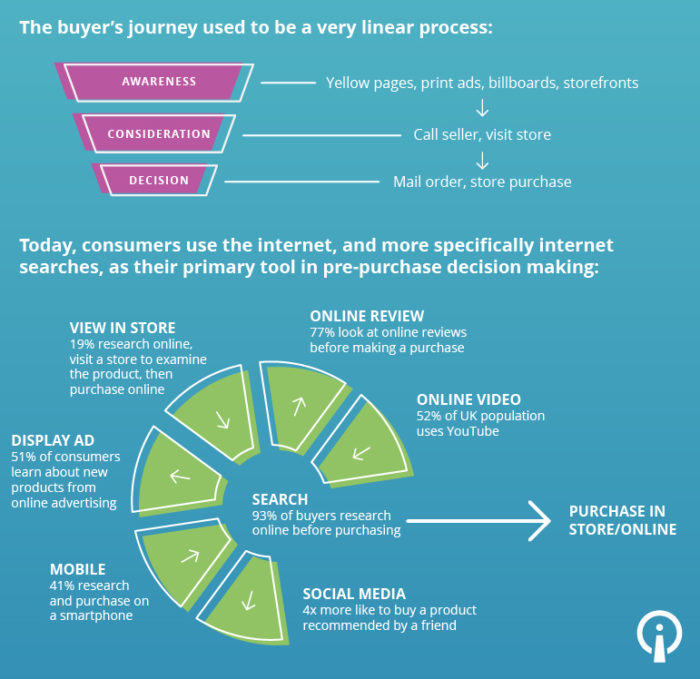
    The buyer’s journey used to be a very linear process: the buyer becomes aware of a need, they consider their options, they express intent, and make a decision. Today, consumers use the internet, and more specifically internet searches, as their primary tool in pre-purchase decision making.

    According to Google, 93 percent of consumers do research online before making a purchase. And, in general, people find user-generated content (like reviews and testimonials) to be highly influential in their purchase decision making. The internet is bursting with this type of content, and digital marketing helps brands share it with the masses in a cost-effective manner.

    Because of marketers’ ability to target specific audience segments based on their interests and online behavior, digital marketing can be far more personalized than traditional marketing. Billboards, TV, and print advertising broadly segment an audience and provide the same messaging to one large group. Digital marketing allows businesses to increase engagement and brand loyalty through personalization that anticipates potential customers’ needs and desires.

    It’s Trackable and Offers More Insights on Effectiveness Than Traditional Advertising.

    As digital marketers, we love data. So what we love most about digital marketing is its trackability.

    With the right amount of expertise and technical know-how in place, digital marketers can often tell you which channels are producing the most business and highest ROI. When’s the last time a billboard or TV campaign could do that?

    What’s key is making sure you’re focused on the metrics that matter, otherwise you might get totally lost in the information overload.

    These aren’t the only reasons for the continued growth in digital marketing expenditures worldwide. Accessible technology is the way of the world today, so businesses who want to keep up in the increasingly competitive digital space should carefully consider their digital marketing capabilities and hire experts who can prove their ability to produce a real ROI. Let’s talk about how we can help you.

    Images:

    Working at Laptop

  • Why You Should Consider Hiring a Digital Marketing Agency

    As 2018 comes to a close, now is the perfect time for business owners and stakeholders to reflect on the year that they’ve had, evaluate the current state of their firms, and develop solid business resolutions for a productive 2019. We often speak with businesses that are trying to decide between utilizing their in-house staff for digital marketing or hiring an external agency. The post will discuss the factors you should consider when making this choice. Regardless of the current state of your marketing, you should develop a plan that will help you strategically allocate your resources to set your business up for success in 2019.

    Experience

    Marketing is an investment, often a significant one. Spend your dollars wisely and entrust them to someone who has experience generating results. Marketing agencies, whether they work within one industry or a range of markets, should have several case studies detailing their experience with businesses similar to yours and the returns they have been able to achieve. Because your business can approach digital marketing through a myriad of strategies and platforms (Search Engine Optimization, Paid Search Ads, Google Display Ads, Social Media, Content Marketing, etc.), you need to find an agency that can detail how they plan to accomplish your stated goals via the numerous outlets they have at their disposal. An agency should be able to speak to the certifications of their team within each of these platforms, previous campaigns they have run, and their overall digital marketing expertise to help you to feel confident in moving forward. Though you or members of your team may have had some success running a Paid Search campaign in the past, did that campaign perform to its true potential? Which previous campaigns can you compare that to? Digital marketing agencies have historical data and industry benchmarks, as well as teams of strategists, to steer campaigns in the right direction. While a member on your staff may be a self-proclaimed Facebook expert, does that qualify them as someone you would trust to develop an engaging social media campaign across several platforms with custom graphics and promoted posts? Though your in-house marketing team may have some digital marketing experience, do they have the time to navigate the continuous algorithm updates that Google makes throughout the year? An agency’s experience should demonstrate their ability to provide direction to your marketing and, most importantly, a return on your investment.

    Cost

    As with any decision, cost will be an integral factor. Depending on your goals, a holistic marketing campaign may be more expensive than expected. Conversely, doing it yourself, or doing nothing at all, may already be costing you more than you think. A well-designed strategy executed by experienced marketers should pay for itself while also allowing you and your team to save time. Even if you have an in-house marketing team, and many of our current clients do, a digital marketing agency can augment their efforts, increasing your reach and efficiency. Additionally, by having an agency, you will be able to tap into their established tools and reporting. Are you thinking about moving forward with a digital marketing agency but are still worried that the cost will be prohibitive? Share your concerns with the agency you are considering. They should be transparent about their pricing and explain the scope of the campaign they are pitching, as well as the strategies they plan to employ. You can also ask if it is possible to begin your partnership as a piloted effort, in which the agency will be able to earn additional business by effectively performing a portion of the work you are looking to accomplish. We have experienced this situation several times. Though our aim is to develop a comprehensive strategy to reach our clients’ goals as quickly as possible, we have plenty of experience starting off with a slice of a company’s marketing budget and then using the quality of our work and results to prove that they have partnered with the right firm.
    31 questions to ask a marketing agency

    Voice

    Another potential issue that business owners and key stakeholders mention is that they doubt an external agency’s ability to properly capture the voice and culture of their organization. The process of finding a digital marketing agency should provide an opportunity to get an outsider’s opinion of how clearly you’re projecting your voice online. The agency you choose to partner with can help you find or refine your voice and maintain consistency in your messaging. One of the benefits of a relationship with a respectable agency is the amount of time they will spend consulting you during the initial outreach and objective setting process. Most agencies will invest a significant amount of time getting to know your organization and analyzing existing messaging to ensure that your voice is effectively captured and presented. Additionally, you should always be able to review and edit materials they create on your behalf. No one knows your business the way that you do, but through the steps listed above, the right agency can surprise you with how quickly they grasp and effectively market the culture you have created.

    Tracking

    31 Questions Checklist square imageEffective and easily digestible analytics and lead tracking, along with the ability to show a return on investment, are the best reasons for you to consider hiring an agency. You should expect any digital marketing firm you work with to provide comprehensive reporting that offers insights into the impact of their campaigns. This is no place for ambiguity, and the right agency will effectively demonstrate “where the rubber meets the road” on an ongoing basis. Effective reporting allows your agency to effectively hold itself accountable to reaching the goals you agreed upon.

    After considering the four factors discussed above, you and your team should reflect on the performance of your current digital marketing strategy and feel more confident in moving forward with an agency in 2019. Since 2006, Search Influence has helped hundreds of clients improve their presence online. If you still have any questions about how partnering with a digital marketing agency can help your business grow, fill out our form for a free marketing analysis or call us at (504) 322-3828.

    Images:

    Goal setting

    Whiteboard

    Tracking

  • 7 Qualities of an Effective Marketing Agency (and How to Test for Them)

    7 Qualities of an Effective Marketing Agency (and How to Test for Them)

    I often joke that, in digital marketing, you’re an expert if you know more than the person you’re selling to. This was recently brought home to me while attending a startup conference: a member of the photography team, who was still an undergraduate in college, said he hoped to open a marketing agency upon graduation.

    This may seem like shocking hubris to anyone who’s been in the industry for any length of time, but many customers, especially smaller businesses, don’t understand the value of experience. They presume instead that since the marketing is digital, youth is a qualification in and of itself.

    We know, however, that regardless of the industry, experience improves effectiveness. I’m sure we’d all rather have an experienced mechanic, doctor, or plumber, and that experience—i.e. a bigger pool of knowledge on which to draw—helps assure they’re not misdiagnosing or reinventing a perfectly good wheel.

    When thinking about which agency to choose, we thought it would be helpful to break down the decision-making into a number of key areas.

    We’ve also put together a printable checklist for you when you do get into the decision-making process.

    Fit

    Company Culture

    At Search Influence, we use the acronym “CHARGED” to define our values. We live these values every day, and they are reinforced in our office, our incentives, and our hiring. In fact, even our employee assessments are based, to some extent, on how CHARGED the employee is. You can read more about our CHARGED values and how we came to them.

    Team

    Whether they are executives empowered with maintaining this strategic relationship or line employees executing the deliverables, it’s important you have confidence in your team.

    Because Search Influence started at a time when there were few available educational resources, we’ve developed extensive training internally. We also take advantage of best-of-breed third-party resources—mostly from our vendors, like Google, HubSpot, and Facebook.

    And finally, for the team which will be working on your account, who are they? What’s their experience level? Who are they supported by?

    Contacts

    On a day-to-day basis, who will be managing your account, and how are they supported?  Do you know who their manager is? Do you have access to leadership in the company?

    We make a point of having our Team Leads and our Director of Account Management reach out to new clients to assure they know whom they can go to if they need more support.

    Qualifications

    Areas of Specialty

    One of the challenges of smaller agencies is that they either have to be a Jack & Jill of all trades or they have to outsource specialized skills. It’s easy enough to claim to be an expert in content marketing or paid search, but these fields are richly nuanced and oftentimes require years of study to execute well.

    Certifications

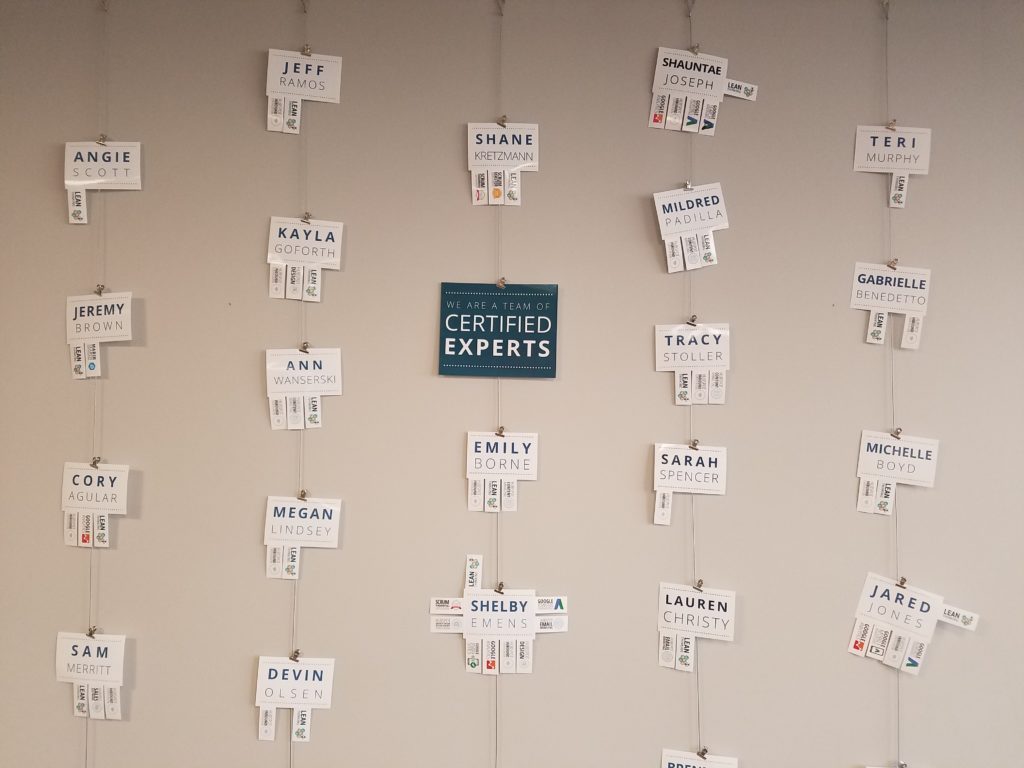
    On the topic of specialization, certifications are a great way to prove knowledge in a given area. When the bar is so low to call oneself an expert or even an agency, it’s important to have evidentiary proof. Certifications are a great tool for that proof.

    Speaking and Publishing

    There’s no greater proof than the peer review required for both speaking and publishing. Our team members speak regularly to audiences in both digital marketing and in the industries of the clients that we serve.

    We are complimented when asked to share our knowledge from both the podium and in other media. Equally instructive as the thought leadership of an agency are their publications, whether written or via interview, in educational resources like blogs and podcasts.

    Process

    Processes

    Every account and engagement requires a unique approach. Within those unique strategies, there are naturally a number of repeated tasks. If an agency doesn’t have processes for common practices, there is a lot of wasted effort.

    Search Influence’s early years included supporting very large partners like Yodle and Advance Digital. We had to think about how we execute more than most agencies. When you are called upon to produce tens of thousands of pieces of content per month, you need a process. Our clients, even the most creative, benefit from our process-focused approach.

    Internal Communication

    We’ve heard the horror stories of traditional agencies and their “Job Jacket”—in essence, a folder that moves from department to department. While multitasking may not be all it’s cracked up to be, there are plenty of times when teams have to work in parallel to deliver work.

    As a nearly 13-year-old agency, we’ve had a lot of time to develop both processes and software systems to support the many stakeholders in delivery. Some of our systems are custom and some use modified open-source software. At any time, we can see both where a project is in the process and what’s left to be delivered.
    31 questions to ask a marketing agency

    External Communication

    “What have you done for me lately?” is a common refrain in the service industry. As an agency, we are most responsible for answering that question to our clients.

    Nearly a decade ago, we realized there was too much data to manually report, and we built a platform that pulls analytics, leads, and advertising effectiveness into one seamless interface. Our platform and our processes have ingrained a practice of monthly review and report that helps both our internal team and our client teams focus on the metrics that matter.

    The Challenger Agency

    Can You Learn From Them?

    In The Challenger Sale, Matthew Dixon and Brent Adamson show us that the best salespeople know as much, or more, than their prospects about their target industry.

    One of the benefits we can bring to our clients is to educate them about their own industry from our perspective, working with a number of their peers. Face it, when you’re head-down in your business, it is not always easy to keep on top of trends and industry news.

    Do They Push You?

    It’s OK. We all get comfortable doing the same old thing.

    A great marketing agency should push you. Sometimes the ideas we bring make our clients a little uncomfortable. Especially in traditional, conservative industries, or in those where there’s been a recent leadership transition, it can be hard to take on initiatives that feel risky or out of character.

    Einstein is often attributed with the saying, “The definition of insanity is doing the same thing over and over and expecting different results.” But you may know it more accurately as, “Do the same things, and expect the same results.”

    Are They Experts?

    Google says an expert is “a person who has a comprehensive and authoritative knowledge of or skill in a particular area.”

    This is hard to test for. How do you know it’s comprehensive? How do you know it’s authoritative? Ultimately, unless one is also an expert in a particular area, one must look to third-party endorsements and results.

    We are fortunate at Search Influence to have a number of industry authorities who refer us business and will vouch for the quality of our work. We also have a number of clients who credit us with their business success. Hopefully, any agency you’re thinking of hiring can say the same.

    Industry Variety

    Broad Experience

    Entrenchment in an industry is not necessarily the same as specialization. And specialization may not equal expertise.
    31 Questions Checklist square image
    In order to have the broadest view of our craft, we need to see how it is executed in multiple industries. Pioneers make discoveries and are often on the fringe. As such, it benefits all of our clients that some of them are in niche industries that call for new, creative tactics.

    Adjacent Industries

    Medicine offers great examples of the value of adjacency. Historically, some areas of medicine have been less likely to be eligible for insurance reimbursement. These “cash” specialties have had a greater incentive to be pioneering in marketing as a whole.

    Examples of leading-edge specialties in the medical industry include plastic surgery and weight loss surgery. The medical industry has changed, and we now know that most practitioners need to consider the impact of marketing—most especially ratings and reviews.

    Your Industry

    It’s great if the agency you’re vetting knows your industry directly. You will likely save some time educating them.

    That said, people are people and marketing is about people first. We don’t need to have worked in your exact industry to be able to drive customers through your doors.

    Confidentiality

    Contractual Confidentiality

    Even if your industry doesn’t mandate confidentiality, you certainly don’t want your business on the streets.

    With over a decade in highly regulated industries, not to mention being responsible for thousands of OPCs (other people’s clients), we take confidentiality very seriously and even include it in our contracts. Even with our contracts, we’re sometimes asked to sign a non-disclosure agreement, and we’re happy to do so.

    Data Security

    Nobody is immune to a data breach. Some of the biggest names in industry, including Target, Macy’s, and many more, have been affected.

    What most don’t know is that some of these cases are the result of sloppy data management by vendors. In the case of Target, the breach occurred when hackers used a third-party HVAC provider’s stolen credentials to break through from a “billing, contract submission, and project management” platform.

    Employee Confidentiality

    Many misunderstand the intent of employment agreements. A key component of the agreement every Search Influence employee signs is client confidentiality. We have access to sensitive business details of our clients and it is critical our employees understand their role in that.

    In many cases, especially in law and medicine, we have a legal responsibility to protect not just our client’s information, but their clients’ and patients’ as well.

    Results

    Tracking/Reporting

    John Wanamaker (1838-1922) is credited with the now-famous phrase, “Half the money I spend on advertising is wasted; the trouble is I don’t know which half.”

    The sad part is that many agencies still survive on the wrong half of that equation. It’s understandable. Quantifying the impact of ad spending on- or offline is hard. There are many factors that affect a customer along their path to purchase.

    We see it as our job to identify which half is wasted and to stop it!

    And to put our money where our mouth is, we invest in assuring that our team members are experts in a number of analytics packages through third-party training, as well as on the job. If you want proof, ask about our certifications.

    Metrics That Matter

    Reports suck. The main reason reports suck is that most of them don’t tell you what you really want to know. We find that, for each campaign, there are usually only a few metrics that matter and the rest is noise.

    We try to work closely with our clients to understand their goals, and from those goals, to understand what metrics will show we’re on track.

    ROI

    It’s hard to believe, but some agencies don’t understand that marketing is an investment. A defining characteristic of an investment is that one should expect a return.

    In other words, how does a dollar spent lead to many dollars earned? We believe marketing has to earn its place in the budget. The way we do that is by making marketing accountable to dollars earned.

    If your prospective agency isn’t comfortable talking about how they will make you money, walk away.

    And call us.

    Search Influence takes pride in exhibiting our CHARGED values. Start a conversation today by calling (504) 881-1597.

    Images:

    Teamwork

    Do Something Great

  • Gutenberg Has Arrived–Are You Ready?

    WordPress 5.0 has been officially released as of Thursday after many delays and false starts. Are you ready for this new editor? Short answer: probably not.

    WordPress logo - Search Influence

    A New WYSIWYG Editor From WordPress

    WordPress 5.0 replaces the old native text editor with its new “What You See Is What You Get” editor called Gutenberg in reference to the inventor of the printing press. This allows users to create content blocks for images, text, videos, and a slew of other elements that they would want to add to a site. At face value, this sounds great since almost every other modern day CMS offers this functionality. This is definitely a step in the right direction for WordPress. They’ve always touted themselves as being a platform that caters to both developers and content publishers, but the standard text editor was never really enough for someone without some coding experience to publish anything aside from text. Gutenberg promises to streamline this process for non-developers creating websites.

    This update is not without flaws, however. If you check the WordPress GitHub, there are currently 285 bugs as of writing this and nearly 1400 issues total! As with any major release, bugs abound, but Matt Mullenweg reports that 5.0 is still stable enough for an official release. In addition to the bugs that have already been reported, an overhaul of the editor itself does run the risk of causing some issue on your website. Depending on whether or not you have a custom template, a plugin used for editing such as Visual Composer, and how your content is laid out on your pages will affect the transition to Gutenberg.

    Classic Editor Plugin Isn’t Going Anywhere Anytime Soon

    There is some good news here though. WordPress has already released the Classic Editor, which can be installed before upgrading to version 5.0. This plugin will not only maintain the Classic Editor we all know and love, but it will also hide references to both Gutenberg and updating to it. The best part about the Classic Editor is that it will be supported until 2022, so you won’t have to worry about Gutenberg until then. With the feature to hide the references to Gutenberg, you won’t have to worry about someone else who may use your site activating it and causing chaos on your site.

    If you do decide to try out Gutenberg, it is highly recommended that you create a full backup of your site and test out compatibility in a demo environment of your site. Once you’ve concluded that Gutenberg is compatible with all of your plugins and theme features, you can feel somewhat safe attempting to upgrade. In all likelihood, themes and plugins that relied on the classic editor, will probably not work that well with Gutenberg.

    So, before you update to WordPress 5.0, make sure you install the Classic Editor Plugin or you will default to Gutenberg, which has the potential to wreak havoc on custom templates and some plugins that haven’t been kept up in a timely manner. In addition to this, like many WordPress updates, there are likely to be some bugs lying about so maybe waiting until it’s a bit more stable would be a good idea. Need some assistance updating to 5.0? Our development team at Search Influence can help. Fill out the form to the right, or give us a call at 504-208-3900.

    Images:

    Yass

  • How to Set S.M.A.R.T. Marketing Goals

    Think Tank Around Measuring Diversity - Search Influence

    Once you’ve identified the metrics that matter most to your business (download our guide: “Marketing: What Metrics Matter?” for our 4-step process), goal setting is the next step in achieving success. Setting business goals can be a daunting undertaking for some, but it’s much simpler if the right method is followed. Don’t set goals just because you feel as though you should have them—goals are only beneficial when there is value in achieving them.

    What Are S.M.A.R.T. Goals?

    S.M.A.R.T. goal setting is a simple, trackable method that allows people to create clear and achievable business objectives, instead of vague resolutions. It is one of the most effective tools for achieving goals in the corporate world due to its scalability, ease of use, transparency, and proven success.
    New call-to-action

    What Does S.M.A.R.T. Stand For?

    S – Specific

    M – Measurable

    A – Attainable

    R – Relevant

    T – Time-bound

    6 Step Process For Establishing a S.M.A.R.T. Goal

    Step 1: Make it Specific

    Goals should be written simply and clearly define what you are setting out to do.

    Answer the Following Questions:

    • What do you want to accomplish?
    • How will you accomplish it?
    • When will it be accomplished?
    • With whom will it be done?
    • Why do you want to do this?

    Example:

    • Increase the average number of prospective student leads by deploying a Facebook Lead Generation campaign in order to ultimately enroll more students and increase revenue to the school.

    Step 2: Make It Measurable

    Having a measurable goal means that someone can see, feel, hear, or identity in some way when it has been achieved. This may sometimes mean breaking your goal into several measurable elements.

    Answer the Following Questions: Goal Setting Guide Image

    • By what metric will you know the goal has been reached?
    • What precise amounts can you include?
    • Can you use words like “increase by X %; improve by X amount”?

    Example:

    • Increase the average number of prospective student inquiries (through phone calls or website form fills) to 325 per month.

    Step 3: Make It Attainable

    Review your specific/measurable goal to make sure it seems reasonable with a little bit of stretch. Are you confident this goal is achievable and sets realistic expectations?

    Answer the Following Questions:

    • Do you have enough time to reach your goal?
    • Do the involved parties have the tools and skills they need to accomplish it?
    • What obstacles would prevent me from reaching this goal?

    Example:

    • The average number of prospective student inquiries is currently 290, so an increase of 35 leads seems achievable.

    Step 4: Make It Relevant

    Making sure your goal is relevant assures it is aligned with the broader business goals. Reaching goals is only beneficial when they contribute to the company’s success in some way.

    Answer the Following Questions:

    • Why am I setting this goal now?
    • What is the company’s overall objective?
    • How it this goal aligned with the overall objectives?

    Example:

    • The school has decreased the cost of tuition, requiring an increase in enrollment to 100 total students. If the “close rate” of prospective students remains constant, then the total number of prospective students must increase to 325 per month in order to ultimately enroll 100 students.

    Step 5: Make It Time-bound

    Goals should exist in a timeframe that creates a practical sense of urgency appropriate to the importance of achieving it. If the end date is many months down the road, set milestones throughout the period to evaluate progress.

    Answer the Following Questions:

    • When is the deadline?
    • Do I need additional milestones to keep this goal on track?
    • Do I have enough time to accomplish it in the given time frame?

    Example:

    • The deadline is January 30th, giving us 90 days to increase the average number of prospective student inquiries.

    Step 6: Finalize Your Goal By Putting Them All Together

    Review what you have written, and craft a new goal statement based on what the answers to the questions above have revealed.

    Example:

    By January 30th, increase the average monthly prospective student leads to 325 per month by deploying a Facebook Lead Generation campaign.

    Putting S.M.A.R.T. Goals Into Action

    Now that the goal is defined, create an action plan by asking:

    • What strategies will you deploy in order to achieve this goal?
    • When will you deploy them?
    • How will you keep track of its progress?
    • Who needs to be notified of its progress and how often?

    S.M.A.R.T. Goals Worksheet

    Wondering how to put this into action? Download our Marketing Goal Setting Guide, which includes a S.M.A.R.T. Goals Worksheet as well as a 4-step process to setting Metrics that Matter.

    Need some human support? Contact us today to speak with one of our strategists about how we can support you in setting marketing goals for your business at (504) 208-3900 or fill out the form to the right.

    Images:

    Chalkboard

  • Trust Your Marketing to a Team, Not a Machine

    You’ve probably heard something like this before: “Automated marketing is bad for business!” But, actually, I’m not sure I 100% agree with that—I know, you’re surprised, right? A marketer telling you that machines and automation are a good thing? Well, hear me out. Artificial intelligence is growing at a rapid pace, and in the field of digital marketing where there is data OVERLOAD, you’d be silly not to take advantage of this technology. I’ll admit, I’m one of the silly ones that have, at times, been afraid to trust machines with my campaign performance. But, as AI has become smarter, the real value lies in combining the best that humans have to offer with the speed and data processing capabilities of machines to achieve total marketing domination.

    What Can Technology Do for You?

    SO. MUCH. DATA! Does it make your head spin?! Luckily, machines don’t get dizzy easily, and they are able to process many more data points than we could ever hope to. The more data and history a machine is able to analyze, the more it can learn to make decisions for the future—this is the machine learning aspect. CUE THE FEAR: THE MACHINES WILL TAKE OVER! Just kidding (but more on this later).

    Machines were built to automate simple tasks. If it is a mundane task that is done over and over and over and… well, you get the point. These are the types of things that are perfect for machines to take on. Why pay someone for hours of work when a machine could do this in minimal time? This frees up your time to focus on the more important and creative work that you enjoy doing.

    This technology is now more readily accessible than ever. Google, Facebook, HubSpot, Salesforce, and many other platforms invest heavily in machine learning so that you as a business or marketer don’t have to. Google alone has continued to release new features (such as Smart Bidding options and responsive ad types) that make it easier to set up, run, and manage a successful campaign. They’ll also typically release these features in beta and test them first to assure they have the intended impact before releasing them to the public, so you know that these tools are reliable.
    31 questions to ask a marketing agency

    What About People?

    Wow, machines sound pretty amazing! What’s left for us mere humans to do? In marketing, the most important thing a human can do is to understand your business and marketing goals. With that understanding, marketers can devise strategies to reach your target audience and accomplish your goals. Marketers can deploy these strategies and understand the intentions behind them.

    Humans have two other amazing attributes that give us an advantage over AI: we are innovative and we are creative. We need humans to drive the innovation to test new theories and ideas. Automated systems and machines can only produce the same results if provided the same data, and it’s our innovation that continues to drive machine learning. With machines, however, we are able to test new ideas faster and with better accuracy.

    Because machines have gotten rid of all that boring work, we have more time to be creative and to apply that creativity to your marketing. Marketers can understand your business, what makes you unique, and why you love doing what you do, and they can assure that this message is prevalent throughout your marketing. They can come up with creative concepts and imagery that define your brand and make you stand out among your competitors. Could a machine do all that?

    Human + Machine = WINNING

    In other industries, we wouldn’t let the machines take over, so why would we do that in marketing? Think about it: autopilot technology has existed since 1912, yet we still have human pilots fly planes. Self-driving cars still have a human driver behind the wheel. Even machine assembly lines are often spot-checked for quality by human beings.

    “We need to stop thinking of machines as rivals. Instead, we should see them as an opportunity to take our creativity to the next level,” says Ben Jones, Google’s global creative director.

    So how can humans work together with machines? Let’s go through a few examples.

    1. Use human creativity to write ad copy and create compelling ad graphics, then use machines to make it more personalized. For example, Google’s responsive display ads allow us to put in a combination of assets that the algorithm integrates to be specific to the person it’s targeting, including the content the ad is shown next to and the size of the ad placement. Now that’s powerful! Otherwise, we’d have to create hundreds of combinations of ads to be able to show in all of the available inventory, and on top of that, we’d have to spend a lot of time organizing these ads.31 Questions Checklist square image
    2. Once a marketing strategy is created, marketers can set up campaigns and machines to manage it. However, it’s not a “set it and forget it” mentality. Machines can make decisions based on past performance and data, and they are capable of processing data, but they can only process the data provided. And while machines are getting better at reconciling offline and online data, humans should have the oversight to determine if campaigns are driving the bottom line.
    3. Marketers can work with businesses to define KPI targets, which are then fed into machines to optimize campaigns and work toward these goals. As mentioned above, it helps to have the human oversight to understand that marketing is doing what it is intended to do.

    How Can an Agency Help?

    Agencies have access to more technology, humans, and data. With larger marketing budgets, they are able to invest in some pretty powerful marketing automation tools, those that aren’t so readily (cough*inexpensive*cough) available. And as an important investment, they have likely researched and evaluated several platforms before choosing the one that would help them best achieve client goals most efficiently.

    Agencies also have the benefit of working with many clients across various industries with different objectives, so they’ve been able to put the machine through many different scenarios to figure out what works best in each situation.

    So rather than trusting your marketing to just a team or a just a machine, combine the power, speed, and intelligence of the machine with the creativity and empathy of a human team for a truly winning combination. The experts at Search Influence can help you integrate automated systems into your marketing strategy while providing creative feedback to ensure that your marketing campaign reaches its full potential. If you have any questions about implementing these tactics, start a conversation with one of our marketing strategists today.

    Images:

    Girl with AI

    So.Much.Data.

    Code

  • How to Align Your Marketing Team Around a Successful Strategy

    How to Align Your Marketing Team Around a Successful Strategy

    With the explosive growth of the marketing technology landscape in the last several years, it can be easy to get completely lost in tactics, technology, and metrics. “Digital marketing is so awesome,” they say, “because you can track everything,” they say.

    True, but what’s also true is that the 6,000+ vendors of MarTech platforms overwhelm us with SO. MUCH. DATA. How does a company know they are making the right decision when one can easily twist and turn data and draw correlations to tell a desired story? Confirmation bias is a real thing, and it can plague the effectiveness of any given marketer’s plan.

    So how does one manage to take advantage of the right data and make strategic marketing decisions without finding themselves adrift in a sea of marketing bologna? It’s easy to say, but less simple to execute: start with a solid strategic plan.

    In this post, I’ll review the essential steps to creating a highly organized and well-researched marketing strategy, which should then serve as the anchor for all future decision-making in your marketing journey. That is, until the next time you review and update your strategic plan (a bit of foreshadowing: it’s an ongoing process).

    How to Create a Successful Marketing Plan

    Start With Gaining Alignment

    The most successful marketing plans we’ve developed for clients have started with gaining alignment from all the stakeholders involved in marketing the business. From the top of the marketing department to the most front-line sales executives, making sure all parties are heard is important to gaining an understanding of the current state of sales and marketing and gathering input on the future ideal.

    Get an Outside Perspective

    Bringing in professionals for the research and development of a strategic marketing plan can help to make sure your plan is truly objective. Wrangling a lot of stakeholders, some of whom are more dominant than others, can leave you feeling like you’re chasing your tail and not making progress. When you hire a marketing agency for the development of your marketing plan, the third-party perspective can help to ensure the project not only stays on track, but also that all voices are heard.

    One way we’ve done this is to host workshop-style meetings with all stakeholders, facilitating discussions of their ideas on strengths and weaknesses, opportunities and threats, as well as their best customers, gaining insights on what marketing tactics were perceived as successful or not in the past.

    We bring to the table some initial research, like competitor profiles and trends in their marketing, as well as data analysis of existing customer profiles, if provided in advance. This information serves as the foundation for the discussion, and we prompt the stakeholders with specific questions to get them thinking more deeply about where and how marketing can help the business grow. In this process, we’ve seen clients experience some internal revelations and uncover operational opportunities for improvement, which are incredibly valuable to identify.

    We take away all the inputs and begin the fun part: planning a strategic marketing plan that accomplishes a measurable goal. And on that note…

    Define a Measurable Goal

    It’s critical for a marketing strategy to be informed by a S.M.A.R.T. goal. Digital marketing is indeed awesome because it’s measurable, but you have to know WHAT to measure up front. Otherwise, you’ll waste a lot of time on the wrong tactics and pulling reports on the wrong metrics.

    It’s critical for your sales and marketing stakeholders to be aligned on this measurable goal. If you have enough data to understand your sales pipeline, you might be able to identify a specific number of inbound leads that marketing should deliver per month or week. As a part of planning your marketing strategy, make sure you align everyone on how you will determine whether the marketing strategy was successful, at both a high level and an individual-tactic level.

    What to Include in a Marketing Plan

    There are tons of resources out there regarding what to include in a marketing plan, but the key elements are:

    • Competitive Analysis
    • SWOT Analysis
    • Buyer Personas
    • The Buyer’s Journey
    • Strategic Tactics
    • Key Performance Indicators

    Competitive Analysis

    In order to know where you stand in the marketplace, it’s important to take a close look at the competition your prospects are likely considering. Typically, we like to note basic business information for context, such as the number of employees, revenue (if available), years in business, and how they compare from a pricing perspective. Next, we review their marketing and brand presence, specifically noting key differentiators, how they’re appealing to the audience via messaging and measurable-goal visual communication, and, of course, the products or services for which they are a true competitor.

    SWOT Analysis

    SWOT stands for strengths, weaknesses, opportunities, and threats. Strengths and weaknesses are meant to look inward, whereas opportunities and threats look to the external marketplace, industry, and geographic landscape. An in-depth analysis here on the state of your business, not just marketing, can be incredibly insightful from the top down, and the key to a successful SWOT is stepping back and being as objective as possible. Questions you can ask yourself and your team include the following:

    Strengths

    • What advantages does your company have?
    • What do you do better than anybody else?
    • What unique resources can you draw on that your competitors cannot?
    • What are the reasons your clients choose you?

    Weaknesses

    • For what reasons might your prospective clients not choose your company?
    • What do other companies offer that your company does not or cannot?
    • What could be improved about the products or services that you offer?
    • What types of clients are you at risk of not serving well?

    Opportunities

    • What opportunities do you see in the marketplace?
    • What new ideas could you be taking advantage of?
    • What trends are popping up in your industry?
    • What positive changes in the market do you see?

    Threats

    • What obstacles does your company face in growing sales?
    • What are competitors doing? Is competition increasing?
    • What negative changes in the market do you see?

    Buyer Personas

    A buyer persona is intended to serve as a representation of a business’ “ideal” or target customer. It should be based on research and data about your existing and prospective customers, including their demographics and psychographics. The best process for buyer persona development involves surveying or interviewing actual customers, asking them deeper information than simply gender, age, and household income. An ideal buyer persona may include the following: background, demographics, identifiers, goals, challenges, how you help their challenges, and what marketing messaging will speak to the persona. You may find that you have several personas, or maybe you have just one. There’s no hard and fast rule about what a buyer persona should include or how many a business should have.

    The Buyer’s Journey

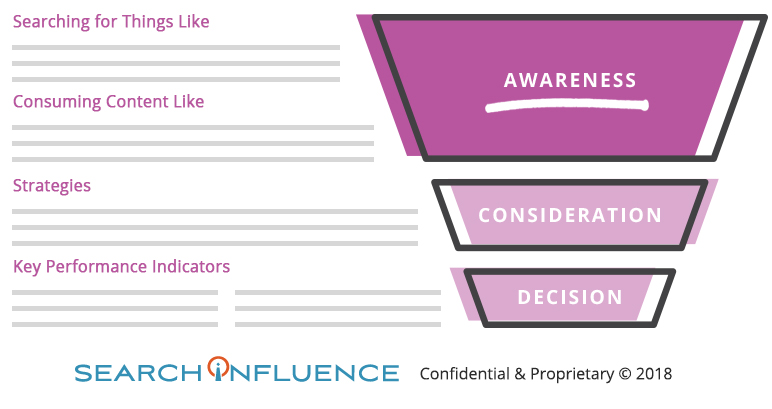
    When the Search Influence team develops a marketing plan for a client, the buyer’s journey is where we spend the majority of our time and is what informs the strategic tactics and key performance indicators (KPIs). Once your buyer personas are identified, the buyer’s journey maps out your prospective customer’s behavior at each stage of the marketing funnel, which allows you to think strategically about how you can reach the audience at each stage. When complete, our buyer’s journeys typically look something like this:

    Strategic Tactics

    Specific marketing tactics you hope to employ to achieve your goals are outlined here. This may include everything from traditional media and print collateral all the way through your digital campaign strategies and creative direction. It’s a good idea to spend time evaluating these tactics and considering a realistic budget required to deploy them all. Perhaps you will need to do a phased implementation due to your budget or internal resources. Now’s the time to make that plan.

    Key Performance Indicators

    In addition to outlining a marketing plan’s overall goal and objective, we recommend that your plan defines Key Performance Indicators (KPIs) for each phase of your marketing strategy and, if necessary, specific tactics. Defining this up front will help ensure that all stakeholders fairly evaluate the performance of a given tactic as time goes on and keep them anchored to the ultimate goal.

    Finish With Gaining Alignment…Again

    Remember the work you did with your team to collect their input early in the process? Call another meeting with them and present the finalized plan. Use this as an opportunity to set expectations for ongoing roles and responsibilities and get the team moving on the plan. They’ll enjoy seeing how their input shaped the finished product and be more willing to pitch in to make it happen. Trust us, you will need their support!

    We’ve led the charge through this arduous process several times with our clients. I say WITH our clients because, if you couldn’t tell by now, it requires a lot of collaboration and partnership. If you are looking for full support in leading this endeavor or even just some hours consulting with our team on the process, we’ve got your back! Speak with a strategist today at (504) 208-3900 or fill out this form to ask for a consultation within 24 hours.

  • The Travel Marketer’s Guide to Capturing the Romance Market

    The Travel Marketer’s Guide to Capturing the Romance Market

    With the right targeting and audience intelligence, it can be easy for travel marketers to sweep romantic travelers off their feet. Many businesses in key travel markets are missing the opportunity to market to romantic travelers. The latest data shows that romantic travel trends go beyond the obvious honeymooners and destination wedding travel, though those segments shouldn’t be ignored! According to the Travel Industry of America, romantic getaways are trips “with a spouse or other love interest without children to rekindle the romantic feelings in the relationship.” From outdoor adventure travel to “foodie” trips, today’s couples are doing things differently and travel marketers should take notice. Whether you market a destination city or you’re a business within a destination city, positioning carefully to appeal to romantic travelers is a good idea for 2018 and beyond. Read on for more details on the latest romantic travel trends all marketers need to know.

    Top Romantic Travel Trends in 2018

    Romantic travel is booming, and it’s more than just the honeymoon. According to statistics from TripSavvy, a quarter of all American weddings are destination weddings. On average, couples who plan destination weddings are a little older with more disposable income compared to other newlyweds. With travel to a beach or somewhere overseas, the average budget for a destination wedding is $28,000. The added expenses make for a shorter stack of invitations, but the guests who attend destination weddings also plan to spend more than $600 on average.

    After the wedding, couples currently spend three times as much on honeymoons as they do on other vacations making honeymoons a$12 billion dollar industry. Other popular trends in romantic travel surfacing in 2018 include would-be grooms planning getaways around the proposal (thanks to social media for the increased pressure for the perfect proposal!). All kinds of couples enjoy “foodie” trips, choosing destinations with the best dining options as a top priority. Where entertainment and music drew travelers in earlier decades, cuisine is a top priority for today’s travelers.

    Not Just for the Newlyweds: Who Are Today’s Romantic Travelers?

    While family trips need to balance the different preferences of all the kids, couples traveling romantically tend to spend more on dining and activities when it’s just the two of them.

    Marriage drives a high percentage of the travel in America, but households with children travel less often, shocking, right?! While single households were responsible for 21 percent of trips, married households took a whopping 61 percent of trips, according to the same research from TripSavvy. Couples without children have taken an average of 3.1 trips in the past year, compared to couples with children, who took 1.9 trips indicating the sweet spot for the travel market is married couples without children.

    When planning a romantic getaway, a strong majority of those surveyed said that they traveled to a particular city for the local cuisine and entertainment. The next most popular getaway option was bodies of water, such as lakes or beaches. Other common, but significantly less popular plans centered around gambling, outdoor sports, and cruises. Romantic couples are interested in local attractions, but they also want a setting where they can enjoy each others company. By emphasizing a quiet, relaxing atmosphere, nearby nightlife, and quality restaurants, most cities have something to offer couples trying to unwind.

    Romance For All: LGBTQ Travel Trends

    Now more than ever, it pays to be inclusive. LGBTQ travelers are especially aware of the attitudes in different parts of the world.  Just as some countries still require a marriage certificate to share a hotel room, many regions still have laws and prejudices against homosexuality and other lifestyles. Because some travel agents are unaware of those nuances in different regions, many LGBTQ travelers use agents who specialize in serving clients with similar priorities.

    If there are festivals like Pride Parade in your area, think about whether your business can participate in some way. Decorating for the occasion, offering special discounts, and sponsoring a local non-profit are a few ways to show support. Make sure to share the ways in which your business shows support via your social media channels and look for ways to make your imagery more inclusive by default.

    Most of these travelers want a safe place where they won’t be excluded on the basis of their orientation, identity, appearance, or anything else. That said, your employees have a big impact on the perception of your brand. Employees who bring prejudices into the workplace can be a complicated problem, especially in politically divisive times. While it’s impossible to satisfy every customer, a negative review that implies intolerance can be especially impactful. The best course of action is prevention, making sure that you create a safe and inclusive environment both for customers and employees. In the event you suffer a negative review from a customer, make sure to respond publicly stating that your company does not share the views of this individual though feedback is appreciated.

    Not A Tropical Oasis? “Romantic” Doesn’t Have to Mean Bikinis

    Commercials have marketed beaches as the “ultimate” romantic getaway, but there are loads of alternatives for landlocked businesses. = With employment up and cautious optimism about the economy, Americans are looking to travel frequently, and in smaller doses. Over the past 12 months, Google Trends has shown an increase in the search terms “weekend getaways” and “couples getaway near me,” Indicating growing demand for this information online. With the help of local SEO professionals, you can dominate the search results for travelers within driving distance.

    All kinds of activities and attractions can be adapted for a romantic audience. Historic districts, museums, festivals, and even agriculture can be romantic. With a scenic overlook and the right photographer, your area’s cotton fields start to look as romantic as a vineyard or a country album cover.

    In all, romantic travel is about a lot more than honeymooning couples. A growing number of adults are looking at travel as an investment in their relationship and their own quality of life. At Search Influence, we have everything you need to market to those couples and drive leads to your business. If you’re interested in honing your local SEO strategy, then request your marketing analysis today to get started.

    Images:

    Couple at a Scenic View

    Couple Walking in Hand

  • Non-Secure Site? Prepare Your Website for the Google Chrome 70 Rollout

    Since last year, we have been explaining what HTTPS means and the important updates announced by Google. Let’s do a brief refresher course.

    What Is the Difference Between HTTP and HTTPS?

    HTTP and HTTPS protocols both fulfill the same core function to transfer data over the internet. HTTPS stands for Hyper Text Transfer Protocol Secure and is the most secure protocol that enables data transfers. It allows for security because it applies encryption on the data being sent. This makes you far less vulnerable to attacks on your information.

    HTTP isn’t encrypted, therefore snoopers with access to a network could look at and modify your precious data passing between you and the website.

    For a more in-depth look at the importance of security, check out our blog post on the topic of “Internet and Security” by our web developer Jared Jones.

    What Are Google’s Upcoming HTTPS Changes?

    The current version of Google Chrome shows a “not secure” sign alongside the web address bar for any websites that still use the HTTP standard.

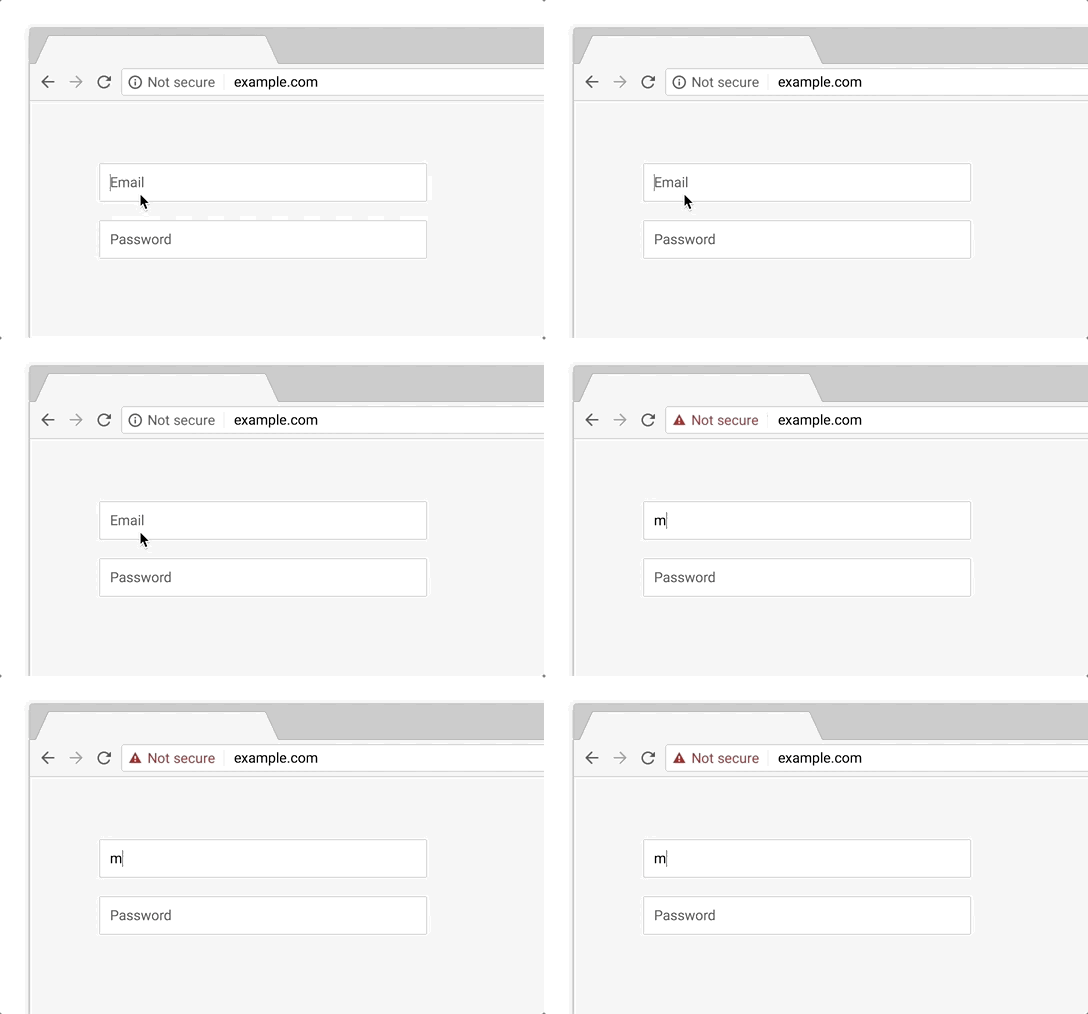
    With the upcoming release of Chrome 70 in October 2018, Google announced that they will begin to shout out the “not secure” notification even louder. All websites still being served via HTTP will receive a negative visual indicator in red that reads, “not secure” beside the URL in Chrome’s address bar.

    “Eventually, our goal is to make it so that the only markings you see in Chrome are when a site is not secure, and the default unmarked state is secure. We will roll this out over time, starting by removing the “Secure” wording in September 2018. And in October 2018, we’ll start showing a red “not secure” warning when users enter data on HTTP pages,” according to Emily Schechter, the Chrome Security Product Manager.

    Example of a URL for a non-secure site - Search Influence

    In other words, now is the time to think of HTTPS as mandatory!

    How Do You Add HTTPS to Your Website?

    An SSL certificate is needed to convert your site to HTTPS. When you install this certificate and migrate your website to HTTPS, it facilitates the important encrypted connections.

    Google’s SSL requirements are crucial to your website because they provide authentication and establish trust when customers visit your pages.

    Brush up on our detailed explanation of SSL Certificates by reading Influencer, Alison Zeringue’s blog post.

    We Have Your Back!

    The majority of internet users tend to trust Google when it tells them something isn’t secure. Be prepared for all the new Google Chrome changes and keep your website secure. Call our team at Search Influence today at 504-595-1623 to help you protect your clients and provide encryption of all sensitive information on your website.

    Images:

    Not Secure

    We Got This