Category: Digital Advertising

  • What Does An SEO Agency Actually Do For My Business?

    Key Insights

    • Good SEO agencies focus on your website with the same vigor and attention-to-detail that you have with your brick and mortar.
    • Expertise, authority and trust (E-A-T) is the foundation of a good long-term SEO plan. If your website doesn’t have these factors, it is impossible to rank well in search engine results.
    • SEO agencies help their clients develop a long-term plan by auditing their site, pinpointing keywords and building E-A-T, which comes with a unique set of challenges because it cannot be directly measured.

    Any good SEO agency knows that owners and executives are protective and calculated when it comes to businesses and their bottom line. Because of this, agencies know they must instill trust and deliver results. However, as a business owner/leader, that doesn’t mean you will know exactly what those results should be and how they improve your business results.

    SEO agencies may vary in their approach, but their overall goal for your business website is to present it as a resource search engines will want to show searchers.

    An SEO Agency Should Help You Understand Your Website’s Strengths and Opportunities

    A good SEO agency will first familiarize itself with your website, typically done by conducting a website audit. With an audit—which generates performance metrics surrounding your site’s visibility, speed, and traffic—an SEO agency can pinpoint opportunities and highlight success areas!

    Once your agency knows where you are thriving and where you can grow, they can begin forming your long-term SEO plan. This plan will align with the business goals you’ve set and can be a major tool in helping you reach them.

    An SEO Agency Should Identify Relevant and Authoritative Keywords

    Even those unfamiliar with SEO may have heard the terms “keywords” or “long-tail keywords” tossed around in conversations or articles. In simple terms, keywords and long-tail keywords are the phrases found on your website that match a person’s search query. Without optimizing your content with relevant keywords, Google (let alone searchers) will not be able to find it. This fact alone makes it a key priority for your SEO agency.

    While defining the term “keyword” is simple, deciding which keywords to focus on in your SEO plan is not as cut and dry. An SEO agency familiar with your industry and business will be able to successfully conduct keyword research to pinpoint phrases that your customers and potential leads will use to find your content. More than that, they will know how to strategically implement those keywords across the pages of your website for the best impact.

    An SEO Agency Should Enhance Local Relevance

    Local relevance measures how well your content matches a search query that includes or intends a location. This refers to searches like “urgent care near me” or “restaurants open now.”

    A huge chunk of daily searches look for you using locally relevant search results. Recent research done by Russ Jones, the Principal Search Scientist at Moz, found that “58% of people search for a local business on their smartphone daily.” The more your business website is locally relevant, the higher you will rank in those search results.

    Jones’ study additionally found that “50% of local searches on mobile lead visitors to a store within one day.” This means more foot traffic to your brick and mortar, not just your website.

    An SEO team that knows this will complete tactics customized to your business/industry specifically geared to building local relevance. These tactics should include:

    • Maintaining your Google My Business profile
    • Creating local listings by promoting NAP (name, address, phone number) consistency across multiple websites—sites that may show up in search results before your business’s actual website. Creating local listings also ensures that Google doesn’t generate and automatic listing for you, which could show potential customers the wrong information.

    An SEO Agency Should Establish Expertise, Authority, and Trustworthiness

    An agency looking out for your business’s best interests will prioritize your website content’s expertise, authority, and trustworthiness, otherwise known as E-A-T.

    What makes E-A-T challenging is that it is not something you can directly measure and it’s not a direct ranking factor that you can pinpoint. However, a good SEO agency will have the knowledge and experience to establish and influence your E-A-T through various channels.

    These tactics include:

    • Regularly updating your site with rich content
    • Organizing your site’s structure to make the most sense for your customers and industry
    • Ensuring that your site is secure

    Your site’s show of expertise, authoritativeness, and trustworthiness are essential factors for your existing customers, potential leads, and Google. In fact, it is heavily referenced in Google’s Search Quality Rater Guidelines because it is the sites with the best apparent E-A-T that Google awards the most visibility to (i.e., those on the first page of Google’s search results).

    A person on a laptop and smartphone

    An SEO Agency Should Improve Expertise

    Showing expertise is all about showing what you know and how you know it. It is crucial for SEO because it communicates to searchers and Google that you know what you’re talking about. Not establishing expertise leaves you at risk of being left out of search results.

    How do SEO agencies improve website expertise for clients? Through the content on your website. But it is not enough to simply post any ol’ content. Experienced SEO agencies know that the content on your site should do two things:

    • Answer the questions your customers ask. You know your industry and customers, and your SEO agency does too. They will have learned both your industry and target market so well that they know exactly what your potential leads need to know from you. This may be done in blog posts or a frequently asked questions page.
    • Showcase your qualifications. This will look different depending on your industry. For example, a doctor will add where they went to medical school or completed residencies. This might be done on your About page with a written biography or videoed introduction.

    An SEO Agency Should Build Authority

    Authority refers to your brand’s reputation within your field.

    The list of reputable, authoritative brands on the internet goes on and on. And despite these websites aligning with different industries, they all have one thing in common: Searchers seek them out for specific things. Google notices this and rewards those sites with top rankings because of it. Because those websites have proven to be knowledgeable and reliable resources, their authority is strong and hard to compete within search engine results pages.

    An SEO agency will map out exactly how to build your authority in topics you already show expertise in. You can accomplish this by aligning yourself with authoritative experts in your industry with guest blog posts or building up your backlink profile by developing content authoritative experts will want to link to.

    Above all, an SEO agency will ensure that all of your content can be fact-checked. The fastest way to damage authority is to share false information.

    You may also hear the term “domain authority” thrown around in talks about website authority. The term refers to a score of how likely your site is to rank over competitor sites.

    This score, created by Moz, is “based on data from [their] Link Explorer web index and uses dozens of factors in its calculations.” While it is different from E-A-T website authoritativeness, pointing your SEO plan towards E-A-T will help you increase your domain authority.

    An SEO Agency Should Increase Trustworthiness

    At the base of relationships—personal or business—is trust. If your website and its content can’t be trusted, Google will likely shield searchers from it.

    Your SEO agency will show trustworthiness through on-site optimizations that include:

    • limiting the number of ads that display at once.
    • installing an SSL certificate (the lock icon that shows next to your URL on most browsers).
    • ensuring you have a user-friendly, attractive-looking website.

    They will also show trust through your site’s content. This means completing tactics like clearly displaying your contact information, reviews or testimonials, and privacy policies.

    An SEO Agency Should Make Sure Your Customers Can Find You

    Your customers are on the internet and they are looking for you! Your SEO agency’s job is to make sure that they can find you. Contact Search Influence today to learn more about what an SEO agency can do for your business, your customers, and your bottom line.

    Images:
    Smart phone and computer

     

  • How to Drive Better Results with a Stronger Agency Relationship

    Key Insights

    • Define and communicate your goals.
    • Designate a decision maker and stakeholders.
    • Make time for your agency.
    • Be open to sharing your business results.
    • Provide feedback to your agency partners.

    A great relationship and a solid rapport with your agency lays the groundwork for excellent results and ideal collaboration throughout the lifespan of your campaigns. With open lines of communication, your agency can better customize your user experience to you and your campaign goals. If you’ve built a strong relationship with your agency, you’re likely to feel more in the loop with goal setting and goal achievement.

    This post will cover some ground rules for building stronger relationships with your agency and explain how a strong relationship can influence campaign results.

    A group of people working at a table

    What You Should Expect from Your Agency

    When you first hire an agency, setting ground rules or expectations and knowing everyone’s roles and involvement is crucial to having a great partnership.

    An agency should assign you one point of contact versus having you track down the right graphic designer, website developer, or content editor. Your account manager should work as a liaison to agency teams that support all facets of your campaigns and maintain responsibility for all communication. Additionally, your account manager should be knowledgeable of campaign optimizations and, ultimately, campaign results.

    The account manager should set a monthly meeting cadence, with a bare minimum of one monthly reporting meeting per month. In the infancy of a campaign, bi-weekly check-ins are recommended so you can make refinements to the quality of the leads your marketing agency generates. Forbes suggests that ongoing communication helps both the client and agency ensure the opportunity for success while strengthening the relationship. In meetings, the account manager should report and discuss the following:

    • Campaign results & progress (both good and bad)
    • Upcoming optimizations and tactics
    • Needs for photo and video assets to support optimizations

    The account manager should be able to thumb through your current assets and make suggestions on whether or not your assets are usable. If they are unusable, they might pair you with one of their preferred photography or videography vendors. Additionally, they should request insight into how their campaigns are affecting your bottom line and business.

    In order to make sure they positively affect your bottom line, your marketing agency should work with you to define:

    • Clear key performance indicators (KPIs)
    • This includes primary KPIs and secondary KPIs

    KPIs should be defined and established at the start of any new campaign. Your goals should stay central to all conversations since these goals will indicate the success of your campaign. If your ongoing discussions with your agency do not include goals or KPIs, inquire how your agency is measuring success for the campaigns they manage.

    A person on a computer and smart phone at the same time

    Define & Communicate Your Goals

    It’s crucial that a business defines and communicates its goals to their agency so there’s transparency and no room to question what you define as success. Your agency needs to know the end goal for your campaign in order to achieve those results.

    When your agency asks you about goal setting, start by thinking about how you’d define success. Ask yourself:

    • Is it a certain revenue number?
    • A certain number of sold tickets or appointment bookings?
    • Improvement in targeted keywords?
    • Increased website visits?

    If this is data you haven’t been tracking for past campaigns, your agency should have a model that will prompt you and your team to make some assumptions. These models should help you set targets or estimate certain metrics, such as the number of leads or the conversion rate.

    Designate a Decision Maker and Stakeholders

    Having too many cooks in the kitchen is never a good thing—and not ideal for your agency relationship. You must determine who will be involved with the agency, both directly and indirectly. Clearly defining one central point of contact to interact with your account manager daily makes communication run smoothly for both teams.

    Having the ability to make quick and accurate decisions ensures your agency achieves success faster. When considering the best point-of-contact for your account managers, you want to ensure that this person has decision-making power. A lack of autonomy could delay projects for days or even weeks until the point-of-contact can bubble up requests for approval to the top person with decision-making power.

    Make Time

    During and after choosing roles and delegates for your agency partnership, ensure your team dedicates adequate time for managing and maintaining an A+ relationship with your agency.

    At the very minimum, your agency will ask you to join monthly reporting meetings, bi-weekly performance reviews, and respond to emails with feedback to information that needs your approval, including:

    • Content marketing
    • Blogs
    • Ad copy
    • Graphics
    • Videos
    • Other assets crucial to the success of your campaigns

    Your agency will want your opinion on creative and feedback on performance in the infancy of your campaigns because this essential feedback can influence the success of your campaigns. Once you are comfortable with your agency and feel like they act as an extension of your team, you may feel comfortable auto-approving creative assets—which then takes a load off your plate!

    Provide Assets

    As previously mentioned, assets can potentially make and break your campaigns. In the startup phase of campaigns, you must provide high-quality assets to ensure the success of your campaigns. These requests might be as simple as logins to your website, CRM systems, or third-party listings such as Yelp, Bing, and Google My Business. This request might also include creative assets such as:

    • Images
    • Videos
    • Logos

    These assets often aid campaigns such a Google and Facebook Display. Therefore, we must use professional, high-quality assets. High-quality assets can help cement the trustworthiness of your brand and products. It’s logical to assume that users might be hesitant to buy from a brand using low-quality assets in their ad campaigns. If you are in a position where you don’t own high-quality video and image assets, you should be upfront with your agency and don’t be afraid to ask for help. Your marketing agency should be able to aid with getting new creative, whether that be leading the charge on a logo / creative overhaul or simply matching you with the right photographer or videographer in your market. Creative assets are so important that it’s always worth investing in five-star creative before launching any campaign.

    Be Open to Sharing Your Business Results

    As you form your relationship with your marketing agency, you should consider them an extension of your current internal team. You want to establish this comfort level so you feel good about sharing business results with your agency.

    Being transparent about your agency’s revenue is the bare minimum of information you should provide. This level of transparency helps your agency understand and calculate your return on investment. Your marketing agency should want to influence your bottom line and cannot know how they affect your bottom line without full transparency.

    Provide Feedback to Your Agency partners

    Ultimately, the best thing you can do to ensure your agency gives you top-notch service is to provide your marketing agency with feedback. A good agency will want to hear the good AND the bad to cater to their relationship and to meet your wants and needs. Your agency should solicit feedback about the following:

    • Quality of completed work or deliverables
    • Feedback on the quality of campaign leads generated
    • Any satisfaction or dissatisfaction with your existing relationship

    An agency is not able to make any changes without feedback from you. Per the American Marketing Association, ​​one of the most complex relationships in our industry is the client and agency partnership—so establishing a good cadence for feedback should be at the top of your priorities!

    If you follow the above six ground rules, you should have a successful agency relationship that feels like a match made in heaven. Remember that transparency and openness on both sides are crucial to achieving both teams’ desired results.

    For more info on our consulting services, contact the experts at Search Influence.

    Images:
    Group working
    Individual working

  • Should You Switch to Google Analytics 4?

    Key Insights:

    • A new version of Analytics is available and comes with some major changes.
    • Google Analytics 4 (GA4) is more beneficial to those with both website and app properties to track together than for website-only users.
    • We recommend setting up both old (Universal) and new (GA4) properties to run concurrently and change over fully only when that seems comfortable for the user and situation.

    In October 2020, Google officially launched its new form of Google Analytics properties known as GA4. GA4 originates from the integrated “App + Web” properties, which Google rolled out as an option for Universal Analytics properties years ago, but GA4 makes App + Web configuration the standard for all online properties. If the prior iterations of Google Analytics were variations on a theme, then GA4 is a completely different song.

    Since many businesses depend on Google Analytics data to assess their success and address the user experience of their online properties, any major change to the platform will have a significant impact. In this post, we’ll look at the details behind some of those changes and help you determine if the transition to GA4 is immediately beneficial to you.

    A person typing on the computer

    What Makes GA4 Such a Major Change?

    The major, fundamental difference between GA4 and prior Google Analytics versions comes down to reporting mechanisms.

    Prior versions of Google Analytics treated Pageviews as the primary metric for web property activity reporting, with a Session as the primary identifier for an individual user’s path. This measurement and reporting was based entirely on data stored in browser cookies. There are many, many resources for a thorough technical breakdown of how Universal Analytics and prior Analytics versions define and utilize Sessions and Pageviews and how they used cookies to collect that data.

    For our purposes here, we need to know that Google defined Sessions as an activity reported via a browser cookie from one browser (interpreted as a “user”) before either removal of the Analytics tracking cookie or 30 minutes of inactivity on the reporting website. Within that basic Session framework, the reporting on that user’s activity centered on Pageviews, with user-defined Events as an auxiliary means to target and measure specific user actions. You could find plenty of data about your users’ paths to and across your web properties without using Event measurement at all.

    The key conceptual change with GA4 is that Google made Events the foundational metric of reporting, with a Pageview treated as a specific type of Event rather than a separate entity. While GA4 still measures Sessions (and still utilizes browser cookies to do so), the identification of distinct users and their activity is no longer as dependent on cookies or Sessions to organize web activity. Instead, GA4 primarily uses data pulled from device identifiers and contextual Event analysis to identify distinct users and align them with their measured activity on a website or app.

    If you are using Analytics for reporting on a single website with no connected applications or alternate platforms, this change is likely only relevant to your developers. But if you are using Analytics to track app activity, you’ll have cleaner data that’s more representative of how users interact with applications without that data tracking being reverse engineered to fit the way users interact with a standard website in a browser.

    There are many other changes to reporting and measurement, and the most significant changes are broken down thoroughly by Bounteous. Likewise, the structure and nature of Event and Conversion reporting have changed a great deal, which earned the full Simo Ahava treatment shortly after launch last year.

    Why Make This Major Change Now?

    The biggest reason for these changes is to unify and consolidate Analytics tracking across multiple distinct web properties. The most obvious and direct use case is the fact that GA4 was directly born out of the App + Web property versions.

    Important background for the GA4 changes from the website tracking perspective goes back to the ongoing browser wars against cookies and cross-site tracking. Browsers’ evolving approaches toward user privacy and cookie policies constitute an entirely separate can of worms, but relying less on browser cookies is definitely a solid future-facing plan given the way browsers, internet software, and devices have trended toward greater privacy considerations. We have gone into great depth previously about how changing cookie and privacy policies impact cookie-based Google Analytics tracking.

    Google’s continued use of cookies for Analytics tracking in GA4—combined with the fact that, in most cases, the Google Analytics cookie is not being set as a dreaded third-party cookie—means that the actual difference in tracking capabilities for traditional websites is insignificant.

    Concepts like Sessions and Pageviews don’t apply to apps the same way they do to websites because of how these online properties are built and used. GA4’s biggest and most impactful immediate step forward is establishing a unified measurement system across these contrasting user platforms.

    While we’re still learning the capabilities and possibilities with the new GA4 properties, it’s difficult to point to any clear advantage of using the new GA4 properties for website-only organizations at this stage.

    Change Is Good Though, Right?

    There are a few specific changes that are causing significant adjustments for working with our clients’ tracking and reporting at Search Influence so far:

    User Explorer takes a full 24 hours to populate with user data.

    User Explorer has been a huge piece of our testing and QA process for our clients when testing ad campaigns, especially E-commerce Tracking. It lists site users by an anonymized identifier known as a “client ID,” showing the full activity history of each user, including:

    • Session breaks
    • Goal completions
    • E-commerce transactions via E-commerce Tracking

    There’s no way to identify a specific user just by looking at the client ID in your reports. But if you are the user and note your own client ID as you’re using the website, you can see what Google sees, which is extremely helpful in ensuring Goals and transactions are reporting properly.

    In the past, this User Explorer data was usually available to view within 10-20 minutes of performing the activity. If we had to test E-commerce Tracking reporting for a test purchase on a client’s website, we could complete the transaction and expect to see whether or not it tracked correctly pretty quickly. If it did, great! If it didn’t, we could investigate, adjust, and try again almost immediately.

    Currently, in GA4, it takes a full 24 hours for User Explorer data to populate. The results of this can dramatically slow down the process of setting up complex tracking configurations. With GA4, we cannot verify if anything is working until a full day after our tests. If something is not reporting as expected, the best-case scenario is making quick updates and performing another test…and then waiting another 24 hours to see if our adjustments solved the problem. What previously could have been 30 minutes to an hour of work now is spread across at least two full days.

    Many previously standard dashboard reporting sections need to be manually configured.

    For detailed breakdowns of specific dashboard and reporting changes in GA4 vs. Universal Analytics, Krista Seiden has already broken it down more thoroughly than I could. A general takeaway from what we’ve experienced so far is that many reports and metrics combinations that were accessible options straight from the dashboard menu now need to be set up directly by the user. I think in the long term, this will end up being a good thing since the Universal Analytics dashboard had gotten a bit bloated and overwhelming. But we could access several important reports for client reporting purposes “out of the box” that now need to be “manually” generated by modifying options and dimensions for other more general reports.

    Eventually, this will be beneficial, as it’ll allow users to have more control over what they can see and help them understand what data they see.

    A screen showing the pages views of a site

    So, Should I Use GA4 or Not?

    The short answer here is a clear and resounding, “Probably, but don’t completely flip out about it just yet.” There is little doubt that GA4 will eventually replace Universal Analytics as the standard, and as such, it’s appropriate to start considering a transition to the new property type. For organizations trying to unify reporting across websites and apps, some immediate benefits might accelerate the payoff of using the newer version.

    But for website-only businesses and content creators, the immediate benefits of transitioning to the new properties seem pretty marginal, with a lot of organizational strain engrained in adjusting to the new configurations and reporting structure. All Analytics users were forcibly transitioned from Classic Analytics to Universal Analytics in 2016, but as of now, Classic Analytics tracking code and syntax still fundamentally work and report effectively. The situations are not directly analogous, but it’s highly unlikely that Universal Analytics will be deprecated to any meaningful extent any time soon.

    In my opinion, the better immediate option (and what we’re beginning to employ for new clients and strategize for existing clients at Search Influence) is to track Universal Analytics properties and GA4 properties concurrently.

    One of the benefits of GA4 and Universal Analytics being entirely separate properties that don’t acknowledge or interfere with each other is that we can set up both to report simultaneously without any conflicts. This allows us to monitor and learn about the differences between the properties without any major irreversible overhaul to what we already have set up for our clients.

    Once we’re confident that we’re getting everything we need from GA4 so that Universal Analytics is truly redundant, we can then pull the trigger on switching fully. By that point, we’ll already have accumulated some reporting data to avoid any unfillable gaps in comparative historical data.

    To see our most recent thoughts on how to handle the release of GA4, check out this blog post written by our CEO Will Scott.

    Whether you’re trying to decide if your business should make the move to GA4 or want to brush up on your analytics and lead tracking, Search Influence is ready to help! Reach out to one of our digital marketing consultants for a free strategy session.

    Image Sources:

    Person on a laptop

    Computer screen

  • Which Email Marketing Strategy Will Help Me Reach My Goals?

    Key Insights

    • Email marketing is still 100% relevant
    • Establish specific goals for your email marketing campaign
    • Determine the metrics you want to measure before executing your campaign
    • Think of conversion and retention campaigns as umbrella campaigns. Choose a more specific subset campaign once you decide which aligns best with your marketing goals

    You may have gotten a notification in your email inbox about this blog. Or, you started your morning organizing the daily or weekly emails in your inbox. Hello, email marketing!

    Yes, we’re still talking about email as an effective marketing strategy in the age of TikTok and Instagram. When done correctly, email campaigns can help businesses build brand loyalty and nurture potential leads into customers. Companies have the chance to get directly in front of their audience,—99% of consumers check their emails every day—while exhibiting the value of their products and services.

    Remember: if your audience chose to subscribe to your email list, they have some interest in your brand. Don’t waste their time with irrelevant content that has them reaching for the “Unsubscribe” button.

    In this post, we’ll define conversion and retention email campaigns, explore campaign types within those categories (campaign-ception!), and find the right email marketing strategy for your campaign.

    Determine Your Goal: Conversion or Retention?

    Before you decide on a strategy, you need to identify your main goal. Do you want your campaign to result in X% more subscribers buying a product or downloading an ebook? Perhaps you want only X% to Y% subscribers to hit “unsubscribe” in the next quarter or X% more engagement with your content.

    These are examples of conversion and retention goals—now, let’s find out which type of goal is for you! Think of conversion and retention campaigns as umbrella campaigns. Once you decide which aligns best with your marketing goals, you’ll choose a more specific subset campaign.

    Once you pick a goal that’s S.M.A.R.T. (specific, measurable, attainable, relevant, and time-bound) and your metrics to measure, you’ll know if your email marketing strategy should be a conversion or retention campaign.

    Conversion goals focus on your subscribers completing the desired action prompted by your email.
    Examples:

    • Download an ebook
    • Purchase a product
    • Fill out a form
    • Register for a service

    Retention goals focus on keeping your subscribers engaged and satisfied with your brand. You can measure their success by monitoring how subscribers interact with your emails.
    Examples:

    • Rate of subscribers vs. unsubscribers
    • Open rate
    • Click-through-rate
    • Content engagement

    An animated envelope with a notification symbol on the top

    Conversion Email Campaigns

    Conversion email campaigns focus on building brand loyalty and establishing trust with potential leads that have shown interest in a business’s product or service. They nurture leads through the buyer’s journey with the ultimate goal of, you guessed it, conversion.

    If your industry has a more extended buyer’s journey, conversion campaigns nurture prospects from the top of the marketing funnel and through the entirety of your buyer’s journey.

    The first email in a conversion campaign won’t end with “buy now.” You’ll have to build trust with your audience before we get there! (However, if your buyer’s journey is on the shorter side, you can always adjust your email campaign’s length).

    Drip Campaigns

    A drip email campaign is a multi-email strategy that targets your leads along every stage of the marketing funnel. Drip emails are relatively simple to set up and can be great tools for a quick-start campaign.

    Purpose: Drip emails are sent at regular intervals to potential leads. Each email is connected to an overarching goal or strategy.

    Recipients: Recipients are potential leads identified in real-time or when they take a specific action (e.g., fill out a landing page form) that serves as a catalyst to start the drip campaign.

    Content: Content will align with your marketing funnel. Campaigns typically start at the top of the funnel with more general content (introductory information, overview) and eventually lead readers to content encouraging decision-making. A specific call-to-action will be outlined in each email.

    Timing: These emails are sent automatically according to an established campaign timeline.

    Possible Metrics: Open rate, click rate, and the desired conversion.

    A typewriter spelling out the word goals

    Nurture Campaigns

    Nurture email campaigns are similar to drip campaigns, but they’re even more detailed and contain many moving parts.

    Purpose: Readers are nurtured through the marketing funnel by content sent over a period of time, ultimately leading them to the desired action.

    Recipients: Similar to drip campaigns, recipients are potential leads that are identified in real-time or when they take a certain action (e.g., fill out a landing page form) that serve as a catalyst to start the nurture campaign.

    Content: Content should be tailored to your marketing funnel and your lead’s behavior. They should receive specific content based on which action they took. Did they request general information? Have they downloaded your ebook? Content could include F.A.Q.’s, testimonials, additional information, benefit stories, and a call-to-action leading them to the next step in the funnel.

    Timing: Communication is automated with a customized timeline based on a set of defined actions (unlike drip campaigns that follow one general schedule). If your lead takes the desired action, they stop receiving one series of emails and move on to the next email series (or another step.)

    Possible Metrics: Open rate, click rate, desired conversion, and length of time in each email segment.

    Retention Email Campaigns

    While both conversion and retention email campaigns do build trust with readers, retention campaigns focus more on trust than promoting products or services. Customers receiving these emails fall into the “Delight” stage of the marketing funnel. Delight content focuses on maintaining the loyalty of established customers.

    You want to retain customers and build brand loyalty by delighting and engaging them with helpful updates, promotions, sales, news, and upcoming events—delivered right to their inbox.

    Here’s what that this looks like:

    One-Off Campaigns

    One-off email campaigns are short, sweet, and focused.

    Purpose: These email(s) offer specific promotions or timely events your business is running.

    Recipients: Those already familiar with your brand, such as subscribers who have already made a purchase or leads near the bottom of your marketing funnel.

    Content: Keep it short and visual! Content should be easily skimmable and focused around eye-popping graphics.

    Timing: Timing will vary with the offer and strategy. You can send out multiple emails leading up to the event or just send one the day of to create a sense of urgency.

    Possible Metrics: Open rate, click-through-rate, and visiting a specific site page.

    Newsletter Campaigns

    Newsletter email campaigns are non-promotional and sent out periodically to customers.

    Purpose: Update customers about your business and establish a sense of loyalty and trust—you’re not asking them to convert!

    Recipients: Broader audiences that have subscribed to your mailing list. Your audience can be at different levels in your marketing funnel, but they are usually familiar with your brand.

    Content: Newsletters contain topical company news, important updates, helpful tips, and other content that makes readers feel like an insider at your business.

    Timing: Campaigns are recurring and regularly occur monthly or quarterly.

    Metrics: Open rate, click-through-rate, and unsubscribe rate.

    Email campaigns can be an excellent marketing tool with a pretty impressive R.O.I.—it can generate $38 for every $1 spent! If you’re not sure where to start, contact our team at Search Influence. Together we can help craft, set up, and optimize an email marketing campaign that’s tailored to your goals.

    Images:

    Envelope

    Typewriter

  • Facebook Ads Boycott: What Advertisers Need to Know

    Facebook Ads Boycott: What Advertisers Need to Know

    Key Insights:

    • A Facebook Ads boycott is taking shape under the hashtag #StopHateforProfit aimed at forcing action from Facebook regarding its policies on hate speech, political ads, and disinformation.
    • While the list of brands pausing Facebook Ads grows, so does the opportunity for smaller or competitor brands to eat up some of the market share, likely at lower costs due to the already high usage rates of social media and apps, as well as decreased competition.
    • SMBs and values-driven organizations, especially those already in a fragile state due to the economic impact of COVID-19, will need to take a hard look at opportunity costs.

    A person scratching out Facebook's name on a smart phone with a stylus

    What do Coca-Cola, Birchbox, Eddie Bauer, The Hershey Company, Verizon, and The North Face have in common? At least this: you won’t see their ads on Facebook in the next month.

    In the last week, an advertiser boycott of the highly effective Facebook Ads platform has taken shape under the hashtag #StopHateforProfit, a campaign that picked up steam when civil rights groups backed it in June. So far, full support comes from groups including the Anti-Defamation League, Color of Change, Common Sense Media, Free Press, the NAACP, and Sleeping Giants.

    Many believe Facebook has a history of refraining from action against misleading political advertisements, hateful content, and disinformation. They have called for brands to pause advertising on the platform in July to make Facebook feel the heat.

    What do these groups want? The call to action for Facebook involves stopping hateful content— in particular, generating ad revenue from offensive content—and a further list of demands. This list includes (but is not limited to) policing Facebook groups over 150 members in size and flagging hateful content for review. Learn more about what is included in this AdWeek article.

    The social media giant has weathered other scandals and criticism in the past, most recently the Cambridge Analytica scandal over privacy. Facebook, with its 7 million advertisers, is likely to weather this boycott as well. But some in the industry believe this time is “different” due to the current climate and public sentiment among Americans.

    The boycott organizers have called on more advertisers to follow suit. At Search Influence, we’ve had at least one client consider pausing their advertising to take part in this boycott.

    A neon sign of a heart and a 0

    How should an advertiser decide if they should take part? Consider these facts:

    Facebook Ads Are Still Highly Effective

    In the first quarter of the year, thanks to quarantine and economic shutdowns, people spent more time in apps and on social media than ever before. Worldwide, average weekly time spent in apps and games on Android phones grew 20% year-over-year in Q1 2020, and experts expect this to normalize going forward.

    For companies who depend on Facebook Ads for the growth of their livelihoods, joining this boycott will be a difficult task. Costs and targeting options available in Facebook Ads are unmatched in the digital advertising industry. The knowledge of their effectiveness for advertisers is evidenced by the fact that many of the advertisers participating in the boycott only committed to pausing their ads for one month, only in the US, and only on Facebook—but not Instagram, which is owned by Facebook and still managed through Facebook Ads platform.

    Opportunity Will Be Created by Advertisers Who Pause

    At the onset of the COVID-19 pandemic, consumers in quarantine spent more time than ever on social media and in apps, which created more “inventory” for ads to be served. At the same time, advertisers pulled their campaigns due to budget cuts. Less competition drove down costs dramatically. Due to these reduced rates, we saw our clients’ budgets stretch farther than ever and their campaigns experience record engagement rates. Portfolio wide, our clients who continued spending on Facebook Ads saw improved costs across the board for every campaign objective. For conversion-objective campaigns—which we typically use for our clients who need to generate leads or purchases—costs per acquisition were down 32%.

    Some industry experts predict this boycott could create similar conditions to the early days of the pandemic. While the list of brands pausing Facebook Ads grows, so does the opportunity for smaller or competitor brands to eat up some of the market share, likely at lower costs due to decreased competition and already high usage rates of social media and apps.

    Pausing Digital Ads Can Affect Your Campaigns’ Performance

    If you plan to pause and restart your Facebook or other digital advertising campaigns for a boycott (or any other reason), it’s important to understand the opportunity cost created by the downtime. Disrupting your data can send your campaigns back into “learning” mode, and create a setback. It won’t be as simple as turning your campaigns back on and expecting results at the same pace as when you stopped. Platforms like Facebook Ads are designed to nurture campaign improvements the longer a campaign runs because the platform collects more data and optimizes as time goes on. For example, a conversion-objective campaign will gain more conversions as data is collected about what parts of the audience are converting at higher rates than others.

    Big Brands Benefit in Publicity

    Brands like Starbucks and Ben & Jerry’s may (or may not) take a sizable hit from suspending their Facebook advertising for a month or more, but they certainly benefit from publicity. By joining this cause, they’re being featured in the media and press coverage on the boycott. If we could place a valuation on the earned media as a result, it could certainly make a dent in the share of voice lost from their campaign pauses.

    Also of note are companies joining the boycott likely for the goodwill who don’t stand to lose much. The Clorox Company plans to maintain its total advertising budget, but shift it’s spending to other media. Surely a company with soaring stock prices that profited from the global pandemic can afford to risk their advertising results for the rest of the year… but can a small business with less prior experience testing and tuning other advertising platforms afford the risk?

    Is Joining the Boycott Right for Your Organization or Business?

    While you may feel compelled to take part in a boycott backed by civil rights groups should it align with your values, it’s important to weigh the consequences fully. With many SMBs already in fragile financial states due to COVID-19’s economic impact, now may not be the ideal time to risk losing additional business. Could more jobs be at stake? As an advertiser, you should also consider how this aligns with your target customer. Will you be perceived as insensitive, or “not down for the cause,” if you continue to advertise?

    Five factors you should consider:

    • What is your opportunity cost of pausing advertising on Facebook?
    • How significantly are Facebook, Instagram, and Audience Network ads contributing to your overall performance?
    • If you pause, what would it take for you to be comfortable resuming your Facebook Ads, What is the likelihood that those conditions will be met? In the meantime, can you withstand the pause in advertising?
    • If you pause, where will you funnel that media spend? What are the results you could expect from those channels?
    • As an alternative to boycotting, are there other ways your organization could support civil rights groups?

    As a small or medium-sized business or organization, we recommend consulting with your digital advertising team or an expert here at Search Influence to fully evaluate whether joining a boycott of Facebook Ads is the right move for your short and long term growth. Contact us today to learn how you can enhance your online marketing efforts with our recommendations.

    Images:

    Facebook

    Neon Sign

  • In Uncertain Times, Stretch Your Budget with Online Advertising

    In Uncertain Times, Stretch Your Budget with Online Advertising

    Throughout these past few months, our industry has experienced roadblocks, challenges, and changes that alter the way we look at the work we do for our clients. We will take a look at three clients and how their experiences measure up to what the experts say about advertising and marketing in the current landscape.

    March/April 2019 vs. March/April 2020

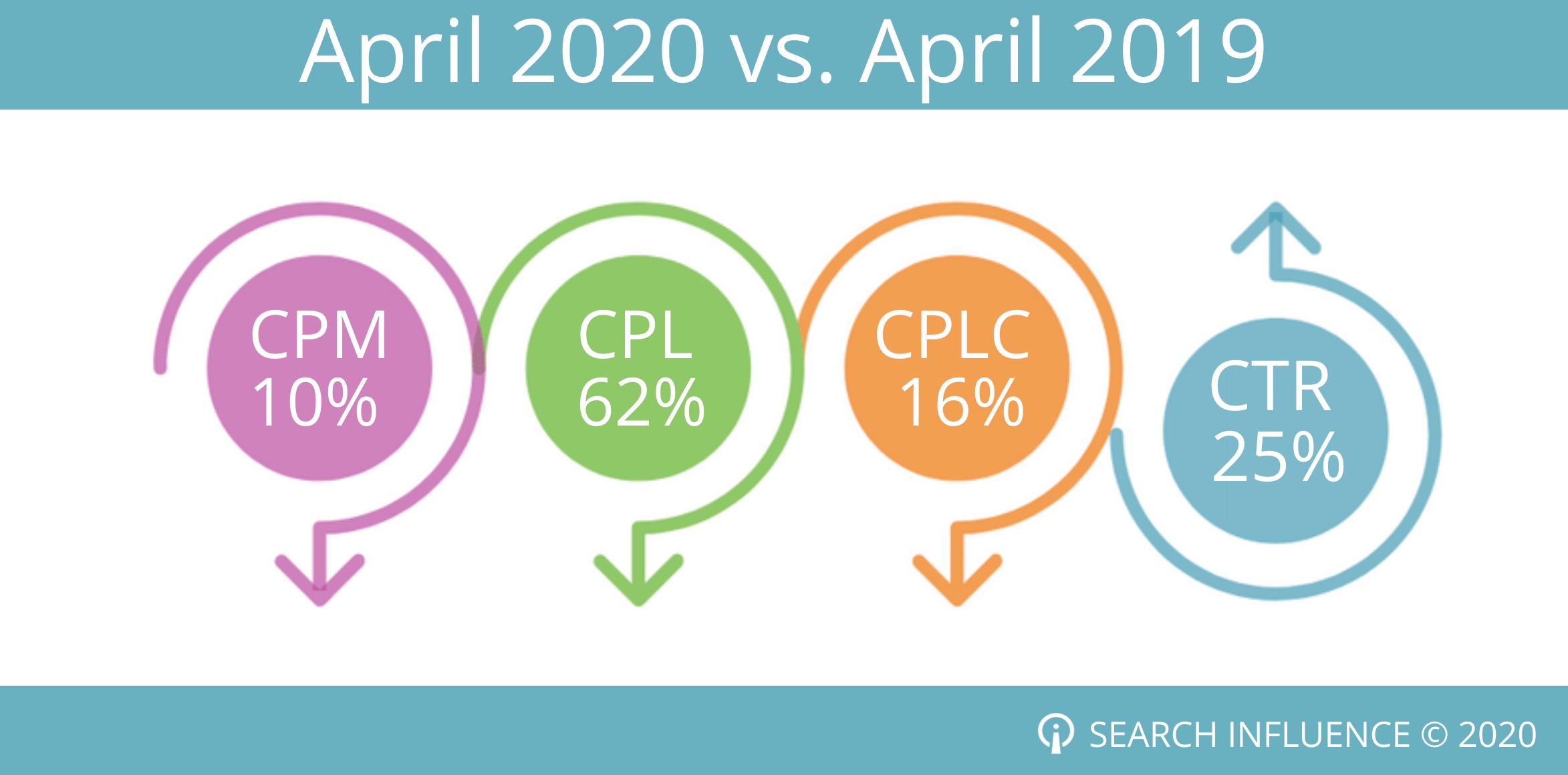
    • All cost metrics have improved across the board—aligning with the fact that experts say it is cheaper to advertise right now.
    • Campaigns with Brand Awareness, Lead Gen, Reach, Traffic, and Video View objectives perform especially well.
    • Engagement has increased, demonstrated by a 25% improvement in Click-Through-Rates (CTR)—the percent of impressions who clicked on an ad.

    March/April 2019 vs. March/April 2020
    We see that increased digital ad inventory and lower competition generate low-cost ads. Digital media and social media usage are up with advertiser competition down, which means it costs less than ever right now to reach larger audiences.

    • Campaigns leveraging video ads, Cost per ThruPlay decreased 64%.
    • Cost Per Engagement has decreased for every objective, which demonstrates a higher level of engagement.
    • CPM and Cost Per Click (CPC) decreased for every objective.
    • 32% in Cost Per Lead (CPLs) for conversion campaigns.

    A Search Influence branded graphic showing CPM, CPL, PCLC, CTR from April 2019 to April 2020

    Client Impacts

    Audiology and Speech Therapy Client

    Since the start of COVID-19, an audiology and speech therapy client found itself in flux due to restrictions on non-emergency medicine & procedures. The practice was quick to adopt teletherapy and virtual speech therapy options for its patients. New services and forced closures of the physical clinics created an urgent need to inform existing patients of these new services. It was also imperative to continue the acquisition of new prospective patient leads. The client needed a new gameplan.

    Strategy & Tactics

    • Communicate clearly on the website and via email marketing for current patients.
    • Implement Facebook and Instagram Display Network ads with careful monitoring & adjusting.
    • Change advertising creative quickly to promote teletherapy options.
    • Pause all other messaging.

    The client found success running advertising in March. The campaign hit a new performance threshold and exceeded the typical monthly lead volume by 69%, at the lowest CPL to date. In April, the lead volume grew an additional 25% and CPL reduced further, by 16% month-over-month. This indicates that the campaign budget is being spent more efficiently than ever on the Facebook Ads platform, with a highly engaged audience.

    Higher Education Client

    This client offers degree programs and continuing education for a non-traditional student with a focus on online classes. The client was poised for potential growth due to the online nature of their product, but new uncertainties surrounding the future of higher education and the traditional in-person instruction created potential problems.

    Our client had to focus on yield while building their pipeline for future semesters. Also, the non-traditional student decision cycle and the journey are typically a long one.

    Strategy & Tactics

    • Transition remaining courses online.
    • Play up financial aid, transfer policies, credit for life/work experience messaging.
    • Continue digital advertising—no spending reduction.
    • Leverage client-produced Facebook Live Series for top-of-funnel.
    • Shift blog post strategy focus to online learning & other timely topics.

    In March, Facebook Display generated the highest number of inquiries in a single month since its launch, primarily from our lead generation campaign. We saw a 111% increase in inquiries from Google Smart Display month-over-month. In Q1 of 2020, our client achieved 47% of 2019’s inquiries and spent only 29% of the budget.

    Reconstruction Surgery Client

    A multi-physician cancer reconstruction client with national and international clients had their operations limited by state restrictions on non-emergency medicine. Unfortunately, cancer doesn’t stop in a pandemic, but with fewer people attending routine medical appointments, we wondered if the diagnosis would slow down? With restrictions in place requiring the practice scale back, the client also had to figure out how to be productive and build the pipeline for the future. It was clear we needed to keep their medical marketing plan running full-steam.

    Strategy & Tactics

    • Communicate clearly on the website and via email marketing for current patients.
    • Add to top-of-funnel strategy.
    • Continue paid advertising with careful monitoring and adjusting.

    During the month of March, our client continued advertising in paid search and saw its lowest CPL in three years on Google Ads and patient inquiries were up 27% in March compared to February 2020 (on Google). In April, based on a drop of impressions, we decided to redirect the budget from Google Paid Search to Facebook Advertising while still keeping the Google Paid Search campaign on.

    After this adjustment, we hit our lead volume goal and reduced the CPL acquired via Facebook by 14%. All-in-all, this resulted in exceeding our pre-COVID-19 stated goal for leads from Facebook & Google advertising.

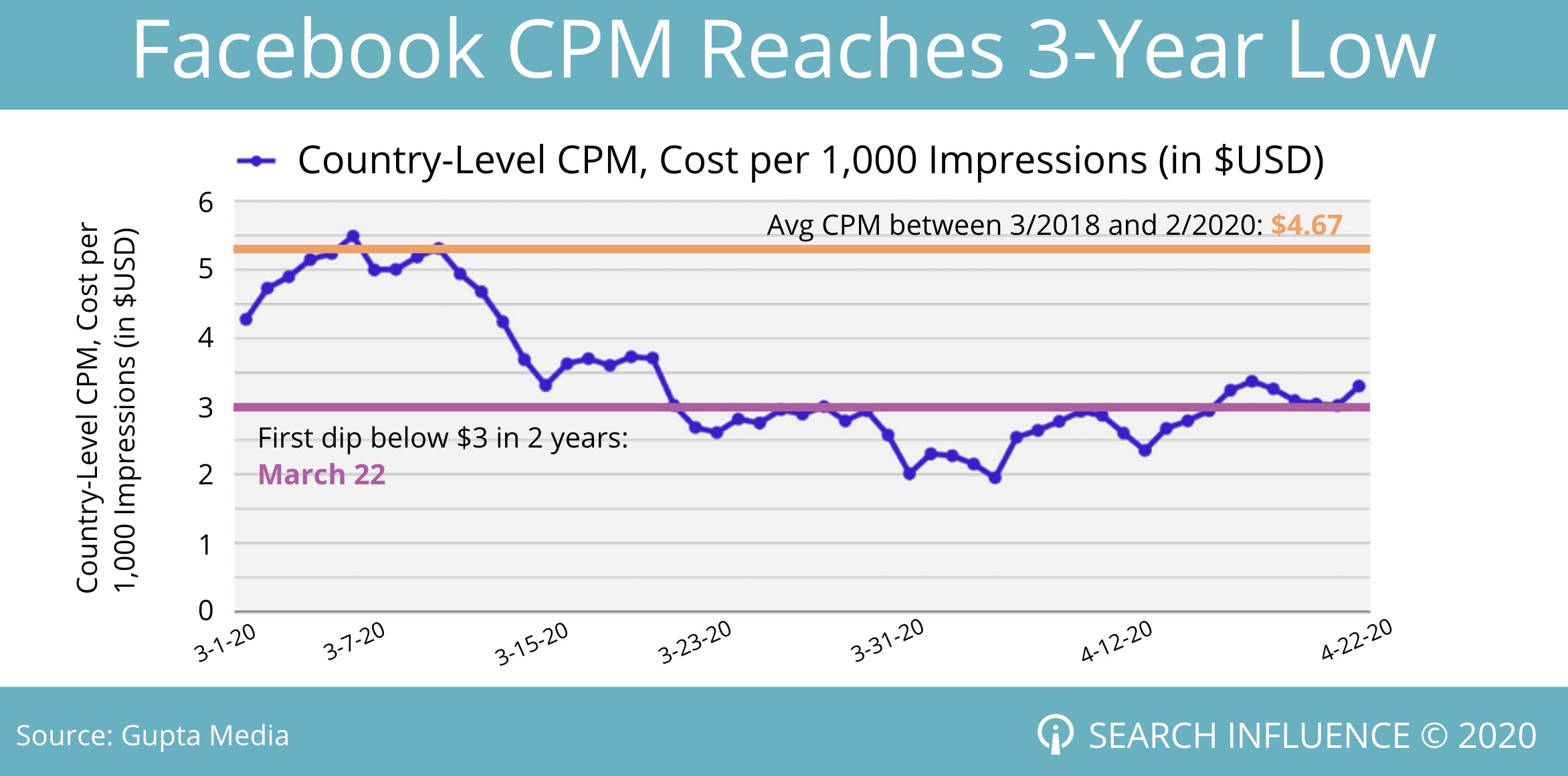
    Search Influence branded graphic showing Facebook CPM totals between March 2020 and April 2020

    Lessons

    • Rapid pace of technology adaptation among the greater population has changed consumer behavior for the long haul—those who already offered online options and services see growth.
    • The low cost of Facebook Ads make budgets stretch farther than ever. On Google, while search volume is down, those who search have high intent.
    • Online courses within your industry could offer new revenue stream opportunities. Do you have a special way of doing something that you can share with others in your industry?
    • Facebook lead generation campaigns are making up for volume drops in other lead gen avenues, due to a massive increase in usage of Facebook’s platform.
  • Should You Advertise During COVID-19? Here’s What the Experts Are Saying

    Should You Advertise During COVID-19? Here’s What the Experts Are Saying

    The dramatic increase in media consumption due to global stay-at-home orders has led to changes in consumer behavior. The data from Facebook, Instagram, and streaming services for television gives us insights as to how we can adapt digital marketing to align with these consumer shifts.

    A phone, person, and dollar sign icon

    Before this time, video was producing the highest engagement rates and often the best advertising results. Now, Nielson predicts homebound consumers could account for an almost 60% increase in the amount of global time spent watching video.

    People are also spending significantly more time on social media. While people use social media to catch up on current events, it’s clear they’re also spending time there for entertainment as a break from the barrage of virus-specific news.

    In a public Facebook report, the company openly discussed massive increases in traffic, messaging, and bandwidth usage. They have seen a 50% increase in messaging across their platforms.

    More than ever, people are also spending time on apps and downloading. This is noteworthy from a digital marketing perspective because display network advertising can reach potential customers while they use apps.

    • On average, consumers around the world spent 20% more time playing games and using apps each week in Q1 2020 than they did in Q1 2019.
    • In Q1 2020, consumers spent over $23.4 billion in app store purchases, the largest quarter ever in terms of consumer spending.
    • There were over 31 billion new app downloads, a 15% increase from Q4 2019.

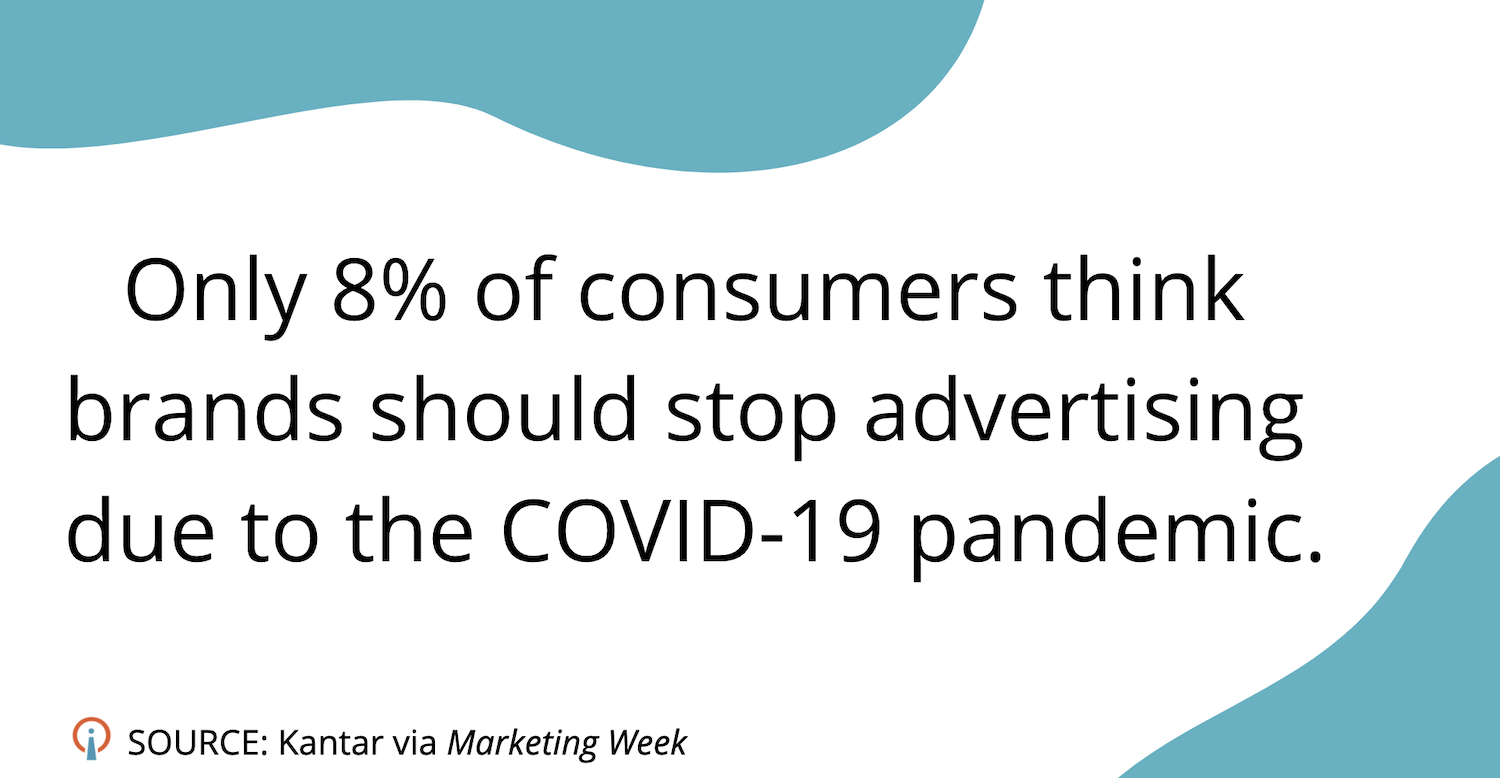
    Kantar Media, a global data consulting company, surveyed more than 35,000 consumers globally and found that only 8% of people think companies shouldn’t stop advertising due to the pandemic.

    8% of people think companies shouldn’t stop advertising due to the pandemic graphic

    88% of the U.S. population uses a computer or mobile device while watching either digital video or traditional TV, and this number is likely to be even higher during social distancing.

    In the week of March 9, Nielsen tracked a 10% increase in viewership of local news in the 25 to 54-year-old demographic. These viewers are probably browsing Facebook, Twitter, or Instagram on their phone while the news is on in the background.

    Current Increases:

    • The local CBS affiliate in New Orleans, WWL-TV, has seen its viewership quadruple.
    • Medical, legal, and home improvement industries have increased their advertising.
    • Feel-good advertising has become more common, including large organizations sending out “thank you” messages to their staff and front-line workers.

    Facebook Advertising

    With people consuming digital media at such a high rate, there are more opportunities to show ads to potential customers. That, coupled with the fact that many advertisers have reduced their budgets, means there is less competition for each impression, which lowers the cost and increases the effectiveness of your ads.

    In the US, the average cost per thousand impressions (CPM) for Facebook ads fell below $3 for the first time in two years on March 22. The average CPM has remained close to this $3 average for about two months. For comparison, the average CPM in the US from March 2018 to February 2020 was $4.67.

    The Costs to (Dis)Engage

    Kantar conducted an experiment to see how a popular beer company’s sales and market share would be affected if it cut its ad spend. Their research found that if the beer company paused all of its marketing campaigns, it would see a 13% decrease in sales and struggle to recover that lost market share.

    Kantar’s global head of media, Jane Ostler, shared an impactful insight, “Brand health becomes vulnerable when companies stop advertising…If they do this for longer than six months, it destroys both short- and long-term health.”

    Studies have also shown that during the Great Recession, brands that continued advertising recovered 9x faster than those who didn’t. All of the data from 2008 and the models for the current situation point in the same direction: not advertising for six months or more will have drastic effects.

    Lessons From the Great Recession

    While “unprecedented” may be the word of the year, we do have the examples from the Great Recession from 2007-2009 to draw upon for insights when it comes to the economic impact of a recession.

    During the Great Recession, two primary changes emerged in the packaged goods industry: shifting channel preference and reduced brand loyalty.

    • By channel, consumers were more likely to shop through dollar and value stores. They weren’t as concerned about shopping at their usual grocery and big box stores.
    • Reduced brand loyalty meant shoppers were more likely to choose cheaper, private-label items, such as Walmart’s Great Value brand, over big-brand favorites like Dawn and Bounty.

    This created a huge opportunity for brands to sell products to consumers who would otherwise not have made the switch. This also meant established brands needed to protect their relationships with customers by keeping them engaged.

    Ten years later, we predict that these trends in consumer behavior will return, except this time the shift in preference is to online shopping.

    For your business to be competitive online, consumers need to know that you exist, what you’re offering, and how to initiate a transaction with you online—whether that is through submitting an inquiry, a virtual consultation, or actually purchasing something.

    The Path Forward

    There’s a natural instinct to cut back on advertising to reduce expenses. Instead, you should focus on how to improve the efficiency of your marketing.

    There are more and more business transactions happening online. Properly set up analytics will allow you to track your leads to give you a better idea of which marketing efforts are driving your leads and sales.
    Industry-wide, there’s no question that digital advertising is the most cost-effective option for advertisers because of the surge in digital media usage and reduced competition. The low CPMs and lack of competition will not last forever.

    With the right team of experts, you can help secure the health of your company. At Search Influence, we provide businesses with an array of digital marketing services to help them reach customers online. Contact us to chat with an expert on our team.

  • 3 Reasons Why YouTube Advertising Is More Effective Than TV Advertising

    Advertising on YouTube grows in popularity each year—especially in 2020, as viewers shift their attention online during the COVID-19 pandemic. Between 2014 and 2016, the number of small-and medium-sized businesses advertising on YouTube doubled (Source: YouTube Global Internal Data, Global, 2016). Traditional TV advertisers should reevaluate whether YouTube can produce results for their campaign.

    Three reasons why YouTube advertising is more effective than TV advertising:

    1. Viewers pay more attention to YouTube than TV
    2. Precise targeting and quick adjustments improve campaign performance
    3. KPI measurement ensures an effective campaign

    A person using Youtube's app on a tablet

    Viewers Pay More Attention to YouTube than TV

    Studies help us infer that YouTube advertising is more cost-effective than TV advertising for brand recall, due to the attention being spent on each platform. According to a Google and Ipsos eye-tracking research study, paid YouTube mobile advertising is 84% more likely to receive viewers’ attention than TV advertising.

    Viewers miss 55% of TV advertising time due to three distractions:

    1. multitasking
    2. switching channels
    3. fast-forwarding

    YouTube’s own data shows that users who both see and hear ads experience higher brand awareness, higher ad recall, and higher consideration than those who only see or only hear ads. Typically, YouTube viewers are engaged with the platform because they select the videos they want to watch at that moment.

    On YouTube, the chances could be higher to serve an ad with sight and sound to a fully engaged viewer. While there can be an option to “skip” YouTube ads, the advertiser does not pay for skipped ads, ensuring budget is not wasted on disinterested viewers.

    Precise Targeting and Quick Adjustments Improve Campaign Performance

    Both YouTube and TV advertising allow for demographic and psychographic targeting; however, YouTube has many more precise targeting options that can easily and continuously be tweaked to improve campaign performance.

    See the YouTube targeting options below, pulled from Google’s documentation:

    • Keyword contextual targeting: Use keywords that help match your ads to web content.
    • Demographic: Reach people by age, gender, or parental status.
    • Topics: Reach people based on certain topics.
    • Affinity audiences: Select from interest-based groups to reach potential customers at scale and make them aware of your business. These audiences were built for businesses running a TV ad that want to extend the campaign to an online context at an efficient price.
    • Custom affinity audiences: Advertisers can create audiences that are more tailored to their brands, compared with broad, TV-like audiences.
    • In-market audiences: Find customers who are researching products or services and actively considering buying something like what you offer.
    • Remarketing: Reach viewers based on their past interactions with your videos or YouTube channel.

    All of the YouTube targeting options can be reevaluated and adjusted at any time to find the most cost-effective audience to reach your campaign’s goal.

    For example, during prime-time hours of an average day in the U.S., more viewers ages 18-49 visit YouTube than any TV network. With this baseline knowledge, you can start your YouTube campaign by targeting ages 18-49. As the campaign collects data, you can review your KPIs at the targeting level and decide to pause or add targeting options.

    If your brand speaks to an older demographic, you may want to consider running TV advertising during prime-time hours. However, with the value YouTube provides, consider running a YouTube campaign complementary to a traditional one.

    KPI Measurement Ensures an Effective Campaign

    All digital advertising allows you to measure the success of your campaign by setting goals, or target KPIs (key performance indicators).

    Setting target KPIs—using metrics such as cost per conversion and click-through rate—allows us to take a step back from the day-to-day campaign analysis and optimizations to assess the big picture data. In doing so, we determine whether we’re being effective with optimizations and meeting campaign goals.

    Contrary to assessing the success of a TV ad campaign, digital advertising performance can be associated with very specific parts of the campaign. If the campaign is not meeting goals, you can single out the KPI metrics in need of attention and make improvements. This ability allows you to adjust specific components, such as a particular ad’s creative message or a single target audience.

    The data you cultivate through YouTube advertising is much more specific, actionable, and accessible than TV advertising. Having an abundance of data to make campaign adjustments improves the metrics and sets you up to meet campaign goals and ensure a successful campaign.

    Test A YouTube Campaign Now

    Now is a great time to test a YouTube advertising campaign, as plenty of eyes are shifted online during the COVID-19 pandemic. TV advertising is a great platform as part of a robust 360-campaign strategy, but as digital advertisers we prefer full control over our campaigns to guarantee measurable success.

    Need advice on how to set up a YouTube video campaign in Google? Contact one of our strategists today. You may also want to check out our top 6 marketing planning activities during COVID-19 to get started.

  • 4 Campaign Strategy Changes During COVID-19

    MacBook Pro, white ceramic mug,and black smartphone on table photo

    COVID-19 has impacted every person and business across the globe, and the environment changes daily. Updating your marketing and advertising strategies during this time can be overwhelming.

    We can help you figure out where to start and what to change! This guide covers four campaign strategy changes to help navigate your business through COVID-19:

    1. Adjust advertising spend
    2. Evaluate targeting
    3. Tailor offerings and messaging
    4. Employ machine learning

    Before making any drastic adjustments, look at the data. Be aware that traffic and behavior on your site is likely impacted by the move to remote work.

    • For example, you may observe an influx of traffic but a decrease in conversion rates. Many businesses filter out internal traffic via IP address and this can be extremely difficult as your team has begun working from home.
    • First, ask your team to filter out traffic per device using the Google Analytics Opt-out Browser Add-on.

    4 Campaign Strategy Changes During COVID-19

    1. Adjust Advertising Spend

    You may initially consider stopping or reducing your ad spend. Based on your customers’ behavior, your industry, and your offerings, a reduction may make sense.

    If your business offers an essential need (food, medical, etc) or a product or service with a longer buyer’s journey (education, legal, cosmetic surgery) you may want to consider increasing your paid advertising. Especially for those industries with a longer buyer’s journey you need to keep feeding your marketing funnel to ensure you’re able to push prospects to convert when we all get back to (the new) normal—an empty funnel now means no business later.

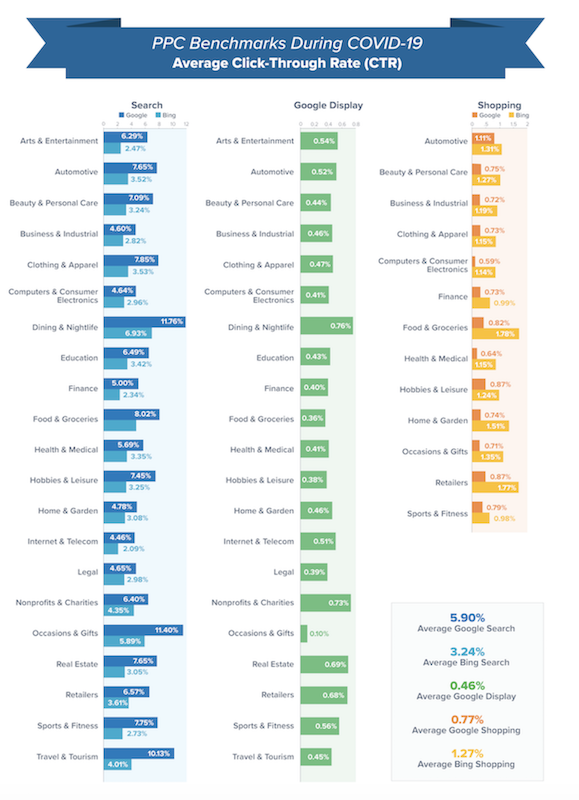
    We also see that CPMs, CPCs, and conversion rates are in flux. With fewer businesses competing in ad auctions, it is cheaper to compete. According to Wordstream, pay-per-click campaigns during COVID-19 are seeing both positive and negative impacts.

    • Pros: CPCs and CTRs are up.
    • Cons: many businesses are struggling with Conversion Rate.
    • Your advertising platforms can inform your decision to pause, reduce, maintain, or increase your advertising investment at this time.

    PPC Benchmarks during COVID-19 Average Click-through rate

    2. Evaluate Your Targeting

    Keep a pulse on the performance of your targeting methods (geographic, demographic, interest-based, custom audiences, etc) and their segments.

    • If your business has moved entirely online and thus is available to a wider audience (for example, a neighborhood gym that has moved to livestreams), you way consider expanding your geographic targeting.
    • A restaurant that typically caters to tourists and now offers pickup and delivery may narrow their targeting to hone in on the local market.

    3. Tailor Your Offerings and Messaging

    Consumer behavior is changing rapidly in response to the constant change in our environment. How can we, as business and marketing professionals, be more helpful to our customers in these fluctuating moments? The answer—tailor your offerings to the environment and consumers needs. Google’s data on online behavior and search trends can give us insight into those changing needs and how we can best serve others.

    Across markets, Google searches fall into 5 behaviors:

    • Assembling critical information
    • Discovering new connections
    • Adjusting to changes in their routines
    • Praising everyday heroes
    • Self care

    Tailor your offerings and messaging to complement these 5 consumer behaviors:

    • Provide clear, regular updates about your businesses operations. These should appear on your website, social platforms, and business listings. Highlight local delivery/pickup, online, and virtual options in your ad copy and creative.
    • Create new relationships with customers and other businesses. Connect with your audience, your larger community, and look for opportunities to work together with other partners (local, regional, etc.)
    • Adapt to changing needs and routines. Consider your target audience, and ask yourself what else they might need at this time. People are turning to at-home hobbies such as cooking, dancing, exercising, and crafts. How can you educate or serve these new interests? More parents than ever are juggling childcare and working from home. Use your ad copy and creative to highlight how you can support them during this time.
    • Celebrate heroes across your community, employees, and customers. Healthcare workers and others providing essential needs and services put their lives on the line to take care of us. Share genuine praise and support for our everyday heroes.
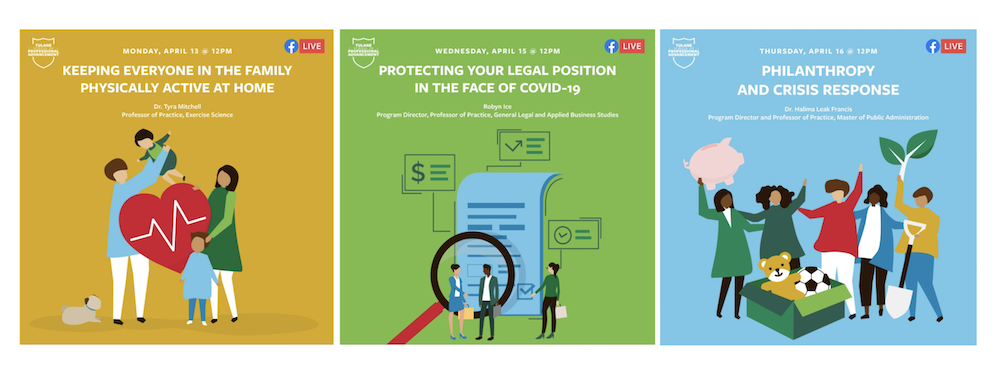
    • Find ways to add value. Host Q&A sessions, webinars, or provide free services when possible. For example, the Tulane School of Professional Advancement hosted a series of free, public Facebook Live events addressing COVID-19 topics.

    Tulane SoPA free, public Facebook Live event flyers

    “Eighty-four percent of U.S. consumers surveyed say that how companies or brands act during the current market is important to their loyalty moving forward.” – Google

    4. Employ Machine Learning

    Machine learning allows ad platforms, like Google or Facebook, to take informed actions based on the ever-changing data it analyzes in real-time. Smart bidding, automated targeting, and dynamic creative are just some of the ways you can take the guesswork out of your advertising campaigns.

    In this ever-changing environment and time of such great uncertainty, now more than ever we should take advantage of machine learning in our paid advertising. For example, Google recommends that retailers “enable automatic item updates in the Google Merchant Center to keep your product data up to date, especially for price and availability.”

    If you have the means, use this time to test and hone your advertising efforts; act lean and be critical of your digital campaigns. Set your businesses up for success, both now and post-pandemic, by remaining active in the advertising sphere. Stay home, stay safe, and optimize your business’s potential during COVID-19 with these campaign strategy changes.

    Need advice on how to best utilize Google credits or Facebook grant money? Contact one of our strategists today.

    Images:

    Laptop
    PPC Benchmarks

  • The Most Important Facebook Ad Metrics for Achieving Your Goals

    By now, most marketers buy into the idea that they need to advertise on Facebook and Instagram, but how do they know if those ads work? Enter about a million metrics to analyze.

    A screenshot of some Facebook Ad metrics available

    That’s only a fraction of what is available, and yes, it can get overwhelming pretty quickly. The first step to figuring out which Facebook Ad metrics you need to monitor is figuring out your goals. Campaign goals usually break down to these four categories:

    • Increasing brand awareness
    • Driving traffic to your website
    • Generating leads
    • Generating sales

    Let’s look at these and determine what your primary KPIs (key performance indicators) should be for each goal, as well as some secondary KPIs to watch.

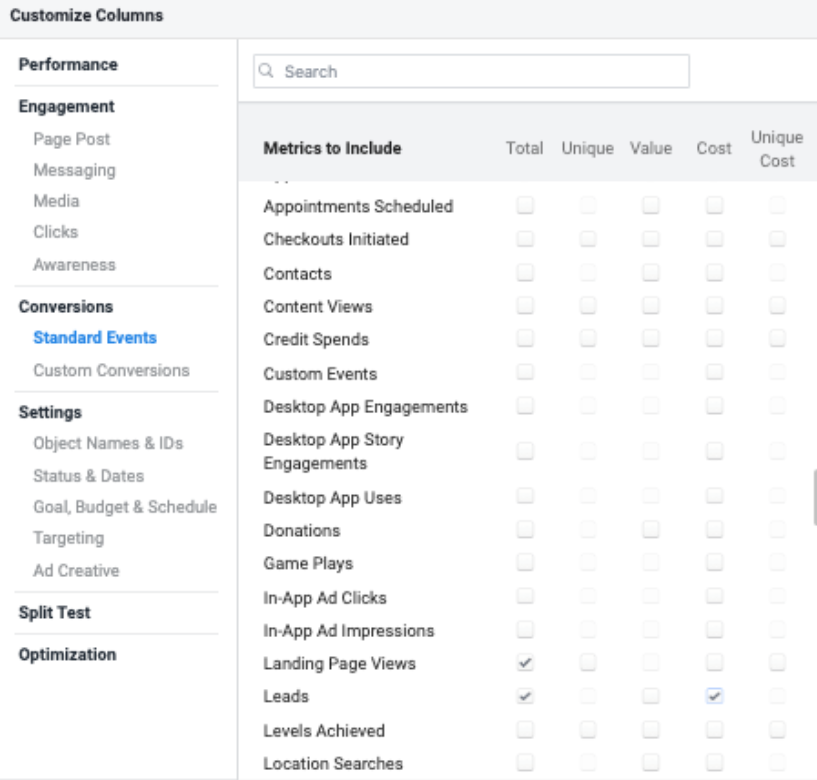
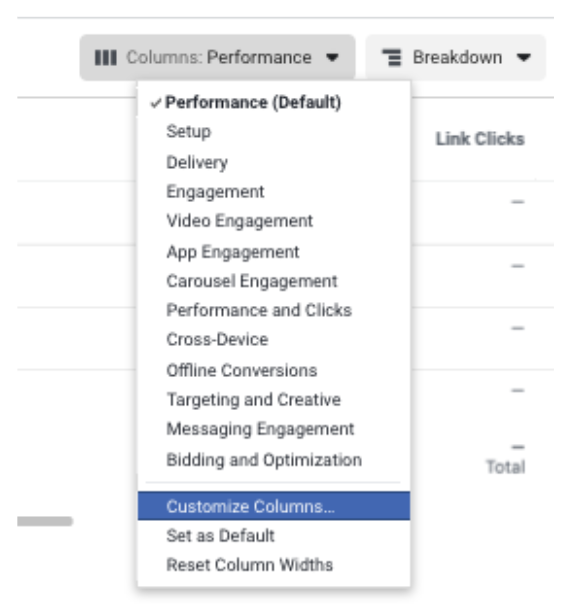
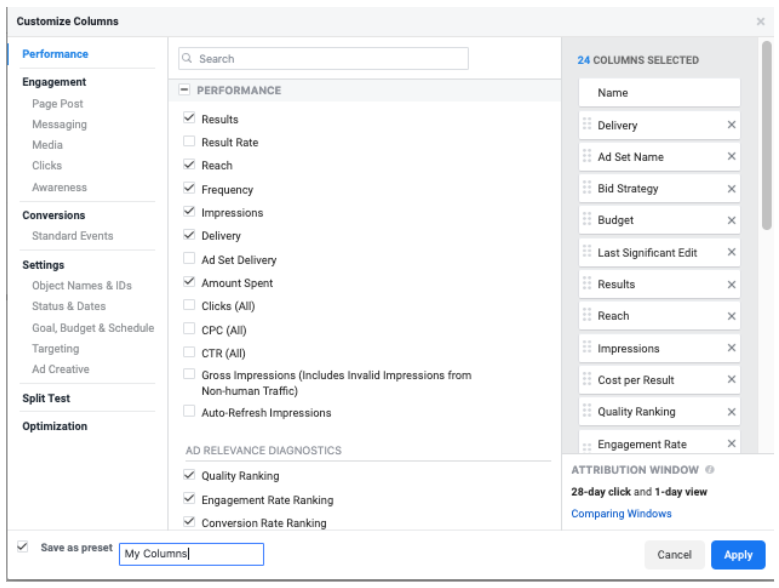
    To see some of these metrics, you’ll need to customize your columns. Some of these are not included in the preset table views. Select Customize Columns from the Columns dropdown menu.

    The columns dropdown menu of Facebook ads

    Increase Brand Awareness

    When increasing brand awareness is your goal, you’ll probably want to show your ads to as many people within your target audience as possible. You’ll also want to show them those ads enough times to make an impression, but not so much that you drive them crazy.

    Brand awareness campaigns are a necessary and often undervalued piece of the marketing funnel. Their impact is notoriously difficult to measure, which means people often overlook their importance. Think about it; you can’t exactly put a number to how “top of mind” your brand is to your audience.

    Primary KPI

    Estimated Ad Recall Lift
    Estimated Ad Recall Lift (EARL) is a tricky metric because it doesn’t measure an action, which is what most other Primary KPIs will measure. Estimated Ad Recall Lift (People) is an “estimate of the number of additional people who may remember seeing your ads, if asked, within two days.”

    Secondary KPIs

    Estimated Ad Recall Lift Rate, Cost per Estimated Ad Recall Lift
    These are calculated based on the Estimated Ad Recall Lift metric. The rate is found by dividing the EARL by the Reach. The cost is found by dividing the Amount Spent by the EARL.

    Since EARL isn’t an action, it doesn’t tell us if the campaigns are “working,” but looking at the rate and cost does help us understand which creative is resonating for the audience and is best used as an indicator when optimizing campaigns. For example, when reviewing ad copy, the ads with the highest Estimated Ad Recall Lift Rate are the ones most likely to be remembered by a user.

    Drive Traffic to Your Site

    If your main goal is to get people to click through your ad and to your site, you might think clicks would be the primary KPI, but you would be wrong. Firstly, Facebook has several click metrics that can confuse newbies.

    The Clicks (All) metric measures ANY click on your ad. So if someone clicks the page name to go to your Facebook page or likes the post, that all gets counted. Link clicks are only counting clicks on your link. This link could be in the text description or the CTA button. Even this isn’t the main metric you want to watch, though.

    Primary KPI

    Landing Page Views
    While clicks on your ad are good (and necessary to get users to your site), what you really need to be reporting on is landing page views. A landing page view is counted when someone clicks the ad and then “successfully loads the destination webpage or Instant Experience.”

    Secondary KPIs

    Link Clicks
    While you don’t want to focus too much on link clicks, you do want to monitor the delta between link clicks and landing page views. If you are getting a lot of clicks and a drastically lower number of landing page views, your site might be too slow. When people lose patience with a slow loading page, they bounce.

    Cost Per Landing Page View
    When looking at creative or targeting performance, the cost per landing page view can help you optimize for efficiency.

    Click-Through Rate
    The CTR is the percentage of impressions that resulted in a click and is often a measure of your ads’ effectiveness. A high CTR is an indication that your ad is resonating with your audience. This measurement doesn’t necessarily mean that it’s a “good” ad; it just means it’s a good ad for that audience. Your top CTR ad for an audience of women over 40 in Manhattan might not perform as well with an audience of millennials in Los Angeles, even if the offer appeals to both.

    Generate Leads

    This one is pretty obvious…

    Primary KPI

    Leads
    If your goal is leads, make sure you have your pixel set up to track your calls, form fills, and other conversions. Hopefully, you’re already using the Facebook Pixel to track the success of your campaigns. This tool is a must for any campaign with a goal that occurs off of Facebook (leads, app downloads, sales, etc.)

    Secondary KPIs

    Cost Per Lead
    The only thing better than a lead is a cheap lead. Watch the CPL to monitor effectiveness.

    Generate Sales

    You would think the first thing you look at is sales, but what you really need to focus on is your return.

    Primary KPI

    Return on Ad Spend
    Your ROAS is a simple little formula—Revenue/Ad Spend—but it’s a big deal. Ten transactions for a $50 item is probably worth more to your business than 15 transactions for a $20 item. But if you spend $5,000 to get those ten transactions and only $100 to get those 15 transactions, you’re looking at 10% ROAS compared to 300% ROAS. Looking at the number of transactions or revenue alone does not give you the full picture. ROAS does.

    Secondary KPI

    Transactions and Revenue
    Though these don’t provide the same context as ROAS, they are still significant and should be monitored along with transaction rate (transactions/clicks) and average order value (revenue/transactions).

    Bonus KPI to Watch

    Frequency
    This indicator is the average number of times each person saw your ad. It is calculated by dividing the number of impressions by reach. It’s essential to monitor your ad frequency to make sure you are hitting the sweet spot between the audience not noticing your ad and users screaming if they have to look at it again. We’ve all experienced an ad that follows us around the Internet or shows up every time we log into Instagram.

    You’ll usually want people to see your ads more than once, but ad fatigue is real. People will start ignoring your ads entirely if they have seen them too many times. It might be a good idea to plot frequency along with your primary KPI to see how your rate affects performance. This Adspresso blog explores frequency’s effect on CTR and CPC. One last tip: once you figure out the KPIs you need to track, you can save your columns by checking the box at the bottom left of the Customize Columns box.

    A screenshot of some Facebook Ad performance metrics available

    By the way, if you’re wondering if there are a different set of metrics you need to monitor for your Google campaigns, we can help you sort through the metric options in Google Ads too. At Search Influence, we’ve helped businesses across the country improve their digital advertising campaigns. To take the performance of your ads to the next level, contact one of our strategists today.

    Images:
    Laptop