Category: Digital Advertising

  • Facebook Introduces Conversion Tracking for Advertisers

    Data.

    This is the most fundamental building block when trying to determine the success of a Pay-Per-Click campaign.

    Data tells you if that “iffy” ad copy you wrote is actually paying off and it also tells you when something’s gone belly up and is stinking up your cost per lead. But despite being extremely useful, data is also extremely problematic especially when you are using third party report tool with unrelated PPC platform.  The data gets well… unpleasant. This statement has been especially true for me using tools such as Analytics to track Facebook advertising performance.

    Don’t misunderstand, I am a huge fan of Google Analytics because it is useful and free (two of my favorite software attributes). While Analytics has proven to be useful in determining the actual run-of-the-mill site metrics, figuring out specific Facebook ad details has been tedious. I mean we’ve all seen that highlighted message they displays when you start using expressions and Advanced Segments – “This report is based on sampled data. Learn more.

    Google Analytics Sample Data Warning
    Google Analytics Sample Data Warning.

    I hate this message.

    I especially it when I’m trying to figure out performance of a Facebook ad. I constantly ask myself, “Why is Analytics ignoring all the information built into the URL? Is this bounce rate even correct? Why doesn’t Facebook allow conversion tracking so I don’t have to deal with these messy urls?”

    Whether it was other advertisers demanding more functionality or FB’s development team telepathically sensing my frustration, Facebook is now offering conversion tracking! Even though it is still in beta, Facebook conversion tracking is going to allow advertisers to see at a glance how well new images and adcopy is converting visitors. No more relying completely on Google Analytics and its jaundiced sampled data!
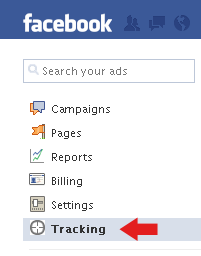
    Facebook Tracking
    Facebook new "Tracking" tool.

    Another benefit of Facebook conversion tracking, conversion data can be compared for accuracy. This is huge for me because having Facebook conversion data allows me to see how accurate the Analytics conversion data is. I trust Analytics but ultimately things do fall through the virtual cracks because of outages, page load errors, or malformed urls. Plus having multiple  sources of data allows advertisers to determine the percent of data loss between platforms.

    While I will never know why Facebook didn’t include conversion tracking initially, I am happy after months of tedious URL building and endless data confusion it’s being offered. With an increasing number of advertisers using Facebook, we should see more advanced conversion tracking options. Now if only they’d do something about the archaic reporting tool…
  • Exploring the Successfulness of Facebook Advertising

    Hi, my name is Anthony and I am a recovering search marketing luddite.

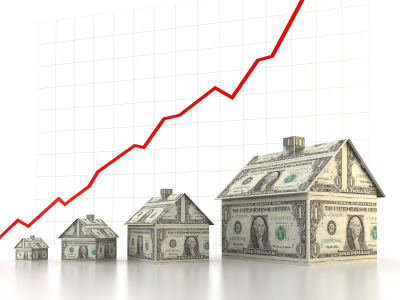
    Facebook Yields High ROI on PPC Ads
    Facebook Yields High ROI on PPC Ads

    For years there have been only three internet ad services I viewed successful: Google Adwords, Yahoo Sponsored Search, and MSN Adcenter.  Don’t misunderstand; I was aware of other services.  I am a social media packrat after all, but I never considered them realistic alternatives to the holy SEM trinity. They seemed like gimmicks. As PPC manager at Search Influence, I provide these services to our clients but I never realized how truly profitable social media advertising was until I started comparing the conversion rates. The numbers spoke loud and clear – Facebook (to my surprise) was generating a high return with a significantly lower cost because of demographic targeting and editorial-like advertisements.

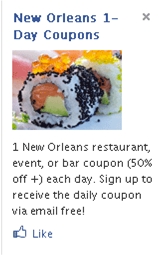
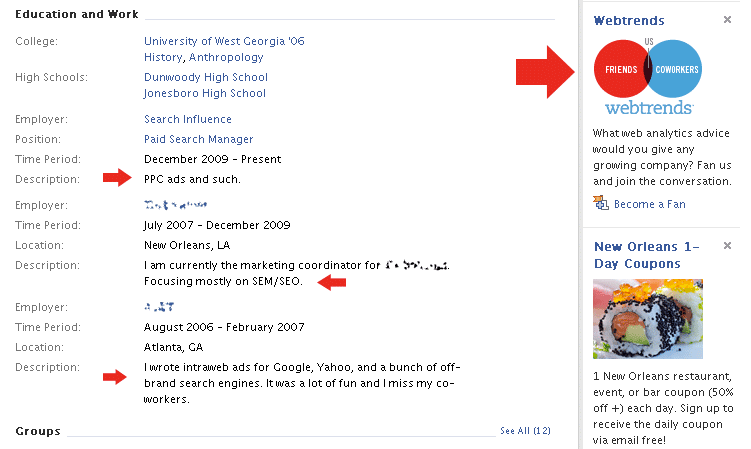
    Relevant Facebook Ad
    Facebook ad that targets keyword's in an user profile

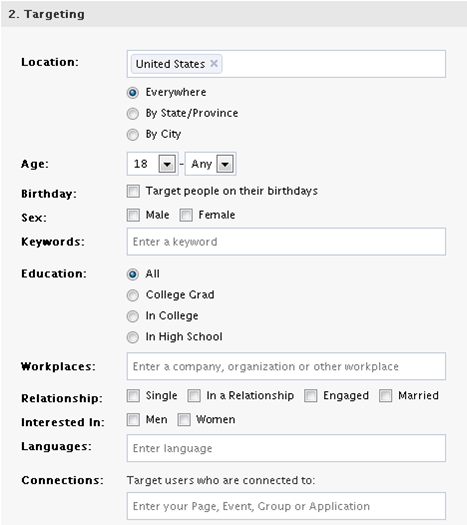
    Demographic targeting has always been the corner of successful search marketing.  Though Google Adwords has demographic targeting capabilities, it lacks Facebook’s knowledge of its users. Facebook allows internet marketers to directly advertise to their core audience based not only geo-location, age, and sex, but a plethora of user define information.

    Facebook Demographic Targeting
    Facebook Demographic Targeting

    Facebook Advertising allows you to target by:

    • Geo-location
    • Age
    • Sex
    • Education Level
    • Relationship Status
    • Sexual Orientation
    • Keywords

    Instead of trying to convince a “researcher” to click through (as you compete with nine other ads and organic results), you can use demographic targeting to directly advertise to your potential client. Showing highly relevant ads to a smaller and more focused group of viewers leads to higher quality leads and lower cost per click (cpc).

    While demographic targeting is key to finding your audience, the proper verbage is also needed. Unlike search engine advertising, these users are not looking for tax specialists or new-age spa retreats. This type of user is uploading pictures from their kid’s birthday and accepting event invites.

    Facebook Editorial Ads
    Example of Facebook Ad

    So how do you engage these users?

    Write magazine-like editorial ads for your targeted demographic.

    The reason magazine and newspaper ads are so successful is they provide a great value proposition to a targeted user. Incorporating graphical elements gives Facebook ads a stark advantage over search engine advertising. This element not only allows user to visually convey the ad purpose, it is also a good way to generate a higher quality click-through rate (CTR). A relevant image will always be worth a thousand plus words.

    In the end, while search engine paid advertising is beneficial in capturing high-level researchers, Facebook allows you direct access to a potential client. With a well-written advert, you can lead the horse to water instead of yelling at him to drink.

  • Facebook Advertising Delivers Low Cost Per Lead

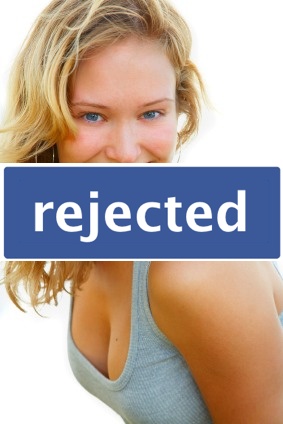
    In the middle of August we started testing Facebook Advertising for one of our plastic surgeon clients.  The surgeon wanted to reach potential tummy tuck and breast augmentation patients.  We selected a number of stock images and loaded the ads.  However, Facebook rejected all of our ads (The Downsides) because they did not follow the Facebook advertising guidelines.

    Facebook Advertising Rejection

    Facebook Advertising Early Lessons

    This was a shock to me, the surgeon and the 5 other people who saw the Facebook advertising mockups, because we thought we used:

    • relevant and appropriate images and language
    • correct grammar
    • spelling and punctuation
    • proper sentence structure
    • and targeted the ads appropriately

    After trying many Facebook ad combinations, I realized Facebook was rejecting the images, so we decided to try the practices’ logo instead.

    Facebook Advertising Effectiveness

    Is facebook advertising effective?  I had run an unsuccessful Facebook advertising campaign in early 2008 that turned out to be a waste of money!

    So, I wasn’t very optimistic going into the campaign. We decided to start out by testing $150 in August.  After several days of looking at the impressions, click through rate and cost, I was still discouraged.  However, when I logged into Google Analytics, I noticed that Facebook was referring a decent percentage of the sites visitors and these visitors were completing contact forms at a very high rate.  At the end of August, I calculated that of the almost  $150 spent in August on Facebook Ads, there were 11 completed forms, which is about a $13.63 cost per lead.

    Facebook Advertising ROI

    WOW! A $14 cost per lead for plastic surgery is amazing! So, for September we decided to increase the budget to $200.   Again, I noticed a lot of activity in September and, as of Sept 30th, Facebook advertising had referred 17 completed forms for a total cost per lead of  $11.76.

    Low cost per lead means more money in your pocket

    Overall, $350 was spent on Facebook ads and 28 contact forms were completed during August and September, averaging a total of  $12.50 cost per lead.

    I am pleasantly surprised at how well it all worked, and I am very excited to explore more Facebook advertising opportunities in the future!

    Related Posts:


  • Simple Landing Page Strategy

    Lately I have been doing a lot of research on landing page strategy and as I read about what not to do and what you must do, I think someone needs to break it all down into a simpler form.  Where are we going wrong, maybe it’s all just too much?  Make it simple.  All you need are these 5 things arranged properly and it is most likely going to perform better than what you are using now:

    Coming in for a smooth landing
    Coming in for a smooth landing

    1.)    Your Company Logo clearly marked in the top left corner of your landing page.

    Your company logo is your brand and it is what is going to clearly connect your landing page to your website.  You do not need or want the exact navigation that exists on all of your web pages, it offers too many distractions and takes up too much room, most likely forcing the more important information (the Form) below the fold.

    2.)    The only content needed is a few credible and useful facts that must satisfy the users search inquiry.

    Display this text concisely using bullet points.  The messaging should match the ad copy and try to use relevant keywords. Only add relevant images that will enhance the users intent to take action.  Do not use stock photos for design because it will likely distract the user from the intended action.

    3.)    Make the point of your page loud and clear with clear and obvious calls to action.

    To be golden be loud and clear
    To be golden be loud and clear

    If you want the user to fill out the form or call a number don’t make it difficult for them. Add the phone number clearly in the top right of the page.   Add a visible contact form that is above the fold, and does not ask irrelevant questions like “how did you hear about us?”  Since, we can track all of our leads in analytics, we do not need to ask this question, so don’t ask it!

    4.)    Add your credibility symbols above the fold.

    This is very important, because the users need to immediately see a reason to trust your brand, if they do not see it right away, they will not scroll to the bottom of the page, but they will hit the back button to find it somewhere else.

    Visible trust symbols are also very important for the ad copy.  For example many of our client’s are plastic surgeons, and we cannot say, “board certified” in the ads unless it is proven on the landing page.

    5.)    Offer links to more information or to other pages on your website.
    Link to the website at the top and the bottom of the landing page and from your logo.  Add “read more” links to your bullets points, which will allow the uses to find more information.   Remember you do not want to use too many links out because this will distract them from the purpose of the page, but not using any, the user will use the back button and navigate off the page, which is the last thing you want to have happen.

    Everything else will distract you from your purpose.  Yes your pages should look good and be visually appealing, but they should be simple.  Make sure all content is fact and not marketing jargon, also provide links to read more.  Read more about this in Technique: How to build the best PPC landing page , 7 deadly sins of landing page design and 8 Dimensions Of Excellent Landing Pages.

    Airplane image courtesy of Flickr user: Rennett Stowe

    Bullhorn image courtesy of Flickr user: LuMaxArt