Category: Digital Advertising

  • Paid Search vs. Paid Social in an AI-Driven Funnel

    Paid Search vs. Paid Social in an AI-Driven Funnel graphic

    Key Insights

    • Paid search and paid social do not compete. They complement each other. Paid social creates demand and brand awareness, while paid search captures high-intent users actively searching for solutions.
    • AI has compressed the marketing funnel. Users now move fluidly between social media feeds, AI Overviews, and search engine results pages, making an integrated strategy more important than ever.
    • Paid search is now a validation channel as much as a conversion channel. In AI-influenced SERPs where organic visibility is shrinking, paid placements reinforce credibility and brand trust.
    • Paid social drives measurable downstream search demand. Strong social campaigns increase branded search queries and high-intent traffic that paid search can convert efficiently.
    • Full-funnel orchestration drives stronger performance than channel silos. When paid social and paid search share messaging, data, and optimization insights, brands achieve greater efficiency, higher ROAS, and sustained growth.

    Search Influence approaches paid search vs. paid social as a unified strategy designed to connect demand creation, intent validation, and conversion across the modern marketing funnel.

    The traditional marketing funnel hasn’t just shifted. It has compressed. AI accelerates the speed at which users move from discovery to decision, collapsing awareness, consideration, and conversion into overlapping, nonlinear moments.

    Today, influence happens across algorithmic social feeds, AI Overviews in search engine results pages, short-form video content, conversational search experiences, and branded search queries. A user may first encounter a brand through paid social ads, validate it in search results, scan an AI-generated summary, and then click a paid search ad, all within a single session.

    One of the biggest misconceptions in digital marketing is that paid search and paid social compete. They don’t.

    Paid social creates awareness and demand among targeted audiences. Paid search captures that intent when users actively search for solutions. When aligned, they amplify each other.

    This isn’t a search vs paid social debate. It’s a guide to orchestrating both channels together for measurable growth in an AI-influenced world.

    AI’s Impact on Digital Advertising

    AI compresses the marketing funnel into overlapping micro-moments. Users no longer move predictably from awareness to research to purchase. Instead, they:

    • Discover brands in social media feeds
    • Validate through AI-generated summaries
    • Compare via search engines
    • Click paid search ads when immediate intent peaks

    AI Overviews reduce organic search visibility, pushing organic search results further down search engine results pages. Paid search ads often remain one of the most stable and visible placements.

    At the same time, conversational discovery changes when intent forms. Users don’t always start with specific keywords. We’ve shifted from keyword-first journeys to influence-first journeys.

    In this environment, channel silos fail. Users move seamlessly between platforms. A digital marketing strategy that isolates paid search advertising from paid social advertising misses the interconnected behavior of modern consumers.

    Search and paid social must be planned together to capture qualified traffic at every stage of the entire marketing funnel. Learn more about how AI search affects paid ads.

    What Is Paid Search?
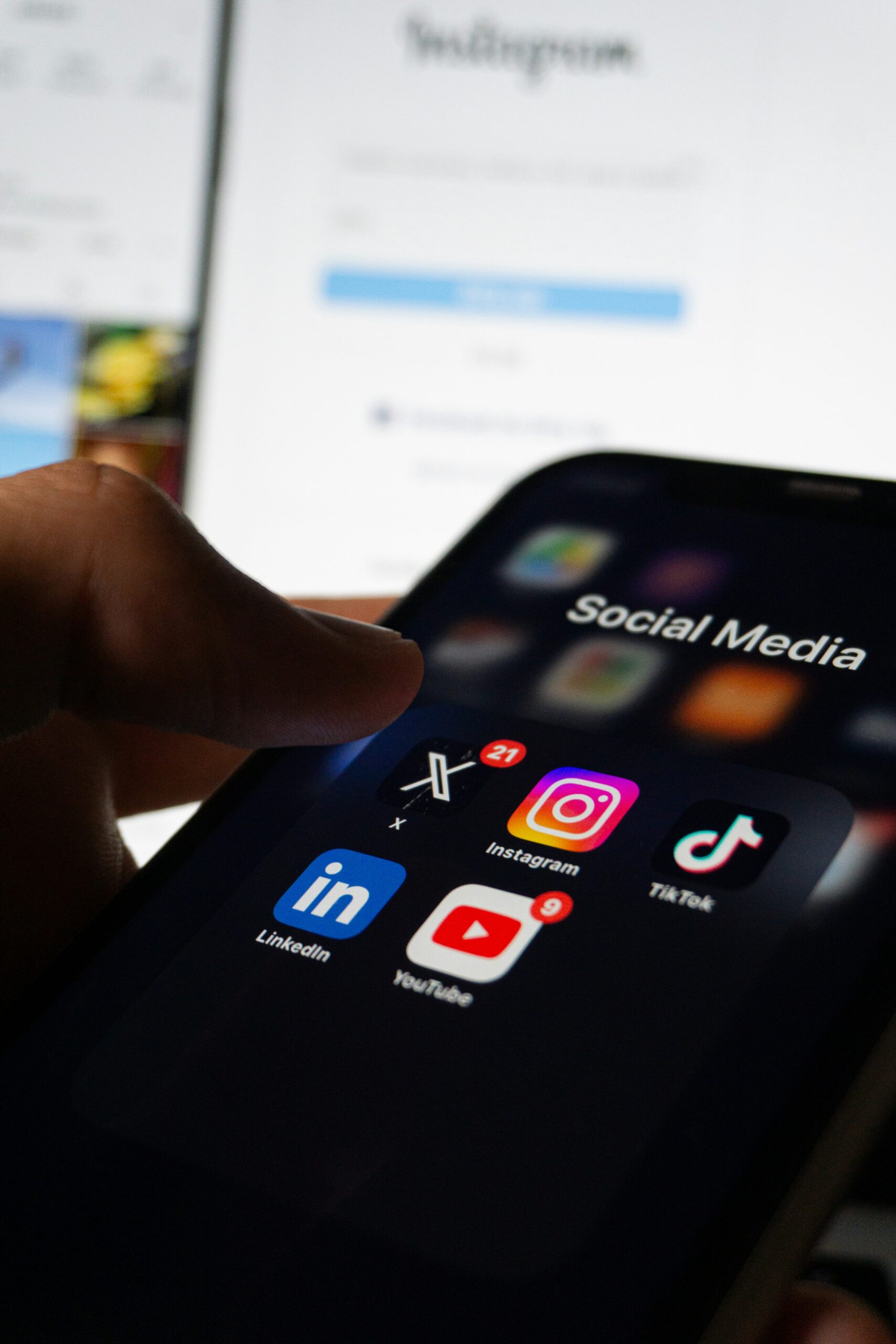
    A close up of a smartphone screen

    Paid search involves paying for ad placement in search engine results pages when users actively search for answers, comparisons, or solutions. Through platforms like Google Ads, advertisers bid on specific keywords and search queries to appear in front of high-intent prospects.

    Unlike paid social, paid search captures existing demand. It doesn’t create awareness; it intercepts it at decision moments.

    In an AI-powered search environment, the role of paid search has shifted from early discovery to validation and confirmation.

    AI feels authoritative but abstract. Users understand that AI aggregates sources, but they can’t always see nuance, depth, or accountability. Paid search ads, by contrast, are explicit and brand-backed. When a recognizable company appears consistently in paid search results, it signals investment and legitimacy.

    Repetition builds credibility. Seeing a brand appear in AI summaries, organic search results, and paid search ads reinforces familiarity. And familiarity increases trust.

    In AI-influenced SERPs where organic visibility is shrinking, paid search is essential for:

    • Brand protection
    • Competitive defense
    • Capturing demand at the moment of immediate intent
    • Maintaining immediate visibility in high-competition spaces

    Pros of Paid Search

    • Captures users actively searching with immediate intent
    • Performs strongly for branded, transactional, and solution-aware search queries
    • Benefits from AI-enhanced bidding, automation, and cost per click optimization
    • Provides clear attribution through Google Analytics and conversion tracking
    • Delivers immediate visibility in competitive search engine results
    • Functions as a reliable pay-per-click conversion engine when demand already exists

    Cons of Paid Search

    • Limited ability to create demand or introduce new audiences
    • Dependent on existing awareness and search volume
    • Rising CPCs as advertisers bid more aggressively using AI automation
    • Vulnerable to diminishing returns without upper-funnel support
    • Less effective for shaping early-stage perception

    You’re competing over a fixed pool of in-market users. Without channels that increase brand awareness and consideration, you limit audience expansion and eventually cap conversion volume and efficiency.

    For some industries, particularly those classified as Your Money or Your Life (YMYL), such as healthcare, finance, and legal, additional compliance layers apply. Without accreditation or verification (like LegitScript), paid search ads may be rejected. These sectors face stricter advertising policies and higher E-E-A-T expectations.

    What Is Paid Social?

    Paid social is algorithm-driven advertising designed to reach users before intent is fully formed.

    Unlike paid search, paid social does not rely on users actively searching specific keywords. Instead, AI-powered social media platforms analyze behaviors, engagement patterns, and demographic signals to place social ads in front of highly targeted audiences.

    Paid social shapes perception. It frames problems. It introduces solutions.

    Social exposure often plants the initial seed of awareness. Users then conduct branded or category searches later for validation, comparison, and confirmation before converting.

    Importantly, social media posts are increasingly included in AI Overviews, further blurring the lines between social and search visibility. This phenomenon, along with the increased number of users searching directly on social channels, is called social search.

    Paid social operates earlier in the funnel, but its impact often shows up later in paid search performance.

    Pros of Paid Social

    • Powerful at generating awareness and introducing new brands
    • Reaches highly targeted audiences without relying on search intent
    • Leverages AI algorithms to expand reach efficiently
    • Enables visual storytelling through engaging ads and video ads
    • Strong performance in early and mid-funnel stages
    • Influences future search behavior and branded search volume

    Cons of Paid Social

    • Lower immediate conversion intent compared to paid search
    • Longer path from first touch to measurable conversion
    • Attribution complexity across devices and platforms
    • Requires continuous creative testing to stay efficient
    • Performance can fluctuate as platform AI algorithms evolve

    Strategies for Integrating Paid Search and Social

    • Social-to-Search Funnel: Use highly visual, engaging paid social ads (Meta, TikTok) to create demand and introduce your brand. Users often turn to search engines to learn more after seeing a social ad, which you can capture with branded paid search campaigns.
    • Search-to-Social Retargeting: Capture high-intent traffic through search, then use platform pixels (like the Meta Pixel) to retarget those visitors on social media with nurturing content, testimonials, or special offers.
    • Synchronized Messaging: Ensure that ad copy, visuals, and offers are consistent across both platforms to create a seamless, trustworthy user experience.
    • Data Sharing for Audience Targeting: Use search query data to create targeted interest groups in social campaigns. Conversely, use social data (like Page Insights) to understand the demographics and interests of your audience to refine keyword targeting.
    • Remarketing Lists for Search Ads (RLSAs): Use social media interaction data to build custom audiences in Google Ads. This allows you to bid higher for users who have already engaged with your brand on social.
    • Leverage Social for Keyword Insights: Monitor the language, questions, and comments in your paid social ads to identify new high-performing search keywords.

    Real-World Example: Hospitality Client Synergy in an AI Environment

    One of our hospitality clients provides a clear example of how paid social and paid search work together to drive measurable results in an AI-driven landscape.

    Meta Performance: Demand Generation & Efficiency

    In January 2026, Meta delivered exceptional efficiency without increasing budget:

    • Revenue: $152,020.58 (29.1% increase month-over-month)
    • Spend: $34,197.79 (essentially flat)
    • ROAS: 4.45 (29% improvement)
    • CPC dropped 51% to $0.39
    • Reels-only promoted ads drove higher engagement at lower costs

    This performance wasn’t accidental. Highly visual, engaging ads in Reels created awareness among the right audience. AI-driven delivery expanded reach to highly targeted audiences most likely to engage.

    Meta served as the demand generator, increasing brand exposure and consideration.

    Google Paid Search: Demand Capture & High-Intent Revenue

    At the same time, paid search delivered:

    • Revenue: $80,550.26
    • Spend: $20,162.22
    • ROAS: 4.00
    • CTR: 20.81%
    • $59,734.49 driven by the “Locals In Market” campaign
    • 173% year-over-year growth in conversions and revenue

    As Meta increased brand awareness, branded search queries and high-intent searches increased. Users who first encountered the brand in social media feeds later searched for tickets and local offerings.

    Paid search captured that demand when users were ready to book.

    Channel Synergy in Action

    This is what full-funnel orchestration looks like:

    • Paid social increased awareness and engagement.
    • Increased awareness led to measurable increases in high-intent search queries.
    • Paid search captured those users when they were actively searching.
    • Consistent messaging across platforms reinforced trust and reliability.
    • AI-driven optimization improved efficiency on both platforms simultaneously.

    In an AI world where users validate across multiple touchpoints, this synergy becomes even more important.

    A person using a laptop

    Paid Search vs. Paid Social FAQs

    Is paid search the same as paid social?

    Paid search and paid social are not the same. Paid search captures existing intent while paid social creates demand before intent exists.

    Paid search ads appear when users are actively searching for specific keywords in search engines. Through platforms like Google Ads, advertisers bid on search queries to show up in search engine results pages at the moment of immediate intent. These users are already evaluating solutions.

    Paid social advertising works differently. Social ads appear in social media feeds based on user behavior, interests, and engagement patterns, not specific search terms. Instead of responding to explicit queries, paid social shapes perception earlier in the marketing funnel.

    Which is better: SEO or SMO?

    SEO and SMO are complementary strategies that work best together by reinforcing visibility, authority, and demand across AI-driven discovery.

    Search engine optimization builds long-term organic search visibility by aligning content with user intent and search engine algorithms. It drives organic search traffic and strengthens brand authority in search engine results.

    Social media optimization amplifies reach and engagement on social media platforms, helping brands connect with highly targeted audiences before intent is fully formed.

    As AI-powered search engines blend signals from multiple sources, including website content and social media posts, visibility across organic search and social media increasingly reinforces credibility. Brands that invest in traditional SEO, AI SEO, and social media create multiple touchpoints, increasing familiarity and perceived trust.

    How is AI affecting paid search?

    AI is reshaping paid search by reducing organic clicks and making paid placements more critical for visibility, validation, and competitive defense.

    AI Overviews now answer many search queries directly within search engine results pages. This reduces clicks to organic search results and compresses visible real estate. Paid search ads often remain one of the most prominent placements on the page.

    At the same time, AI-driven bidding systems optimize pay-per-click campaigns dynamically based on the predicted likelihood of conversion. Advertisers bid more efficiently, but competition increases, raising cost per click in many industries.

    AI also changes user psychology. When users see a brand appear consistently in AI summaries, organic search results, and paid search ads, familiarity increases. That repetition reinforces credibility.

    How is AI affecting paid social?

    AI is transforming paid social into a primary discovery engine by using algorithms to surface content before users actively search.

    Social media platforms rely heavily on artificial intelligence to determine ad placement. Instead of relying on specific keywords, algorithms predict which highly targeted audiences are most likely to engage with particular ad formats, video ads, or messaging.

    This means paid social advertising plays a growing role in creating demand. Engaging ads in social media feeds often influence what users search for later in traditional search engines. Social exposure increases brand recall and branded search queries.

    AI also introduces volatility. Platforms frequently auto-enable new AI features related to copy generation, image optimization, and targeting. Advertisers must adapt quickly to maintain performance.

    In an AI-influenced journey, paid social shapes the early narrative. Paid search captures the resulting intent. When aligned strategically, both channels strengthen performance across the entire marketing funnel.

    Talk to Us About a Full-Funnel Paid Media Strategy

    At Search Influence, we don’t execute isolated channels. We design integrated digital advertising strategies aligned with real user behavior.

    Our AI-enabled digital marketing approach:

    • Increases campaign efficiency by allocating ad spend where performance is strongest
    • Reaches the right audience with precision targeting across search engines and social media platforms
    • Delivers qualified traffic from high-intent prospects
    • Uses AI to analyze performance in real time and continuously refine campaigns

    We combine paid search advertising, paid social advertising, SEO, analytics, and data insights into a unified strategy designed for how users search, scroll, and decide today.

    If you’re ready to move beyond search vs paid social and build a performance-driven marketing strategy across the entire marketing funnel, meet with our Director, Paula French.
    Images:
    Unsplash
    Unsplash

  • All of Your Higher Education Marketing Questions Answered

    All of Your Higher Education Marketing Questions Answered

    This post was updated by Paula French on 1/22/26 to reflect current best practices. It was originally published on 11/7/25

    Key Insights

    • Half of all prospective students now use AI tools daily or weekly, making AI-optimized content and entity SEO essential for institutional visibility.
    • Fewer than 50% of higher ed marketers track cost per inquiry (CPI), even though those who do report stronger ROI and campaign satisfaction.
    • 82% of prospective students are more likely to consider programs that appear on page one of search results, underscoring the link between SEO investment and enrollment growth.
    • Most universities lack a formal SEO strategy. 51% admit they don’t have a defined plan, leaving major opportunities for early adopters to dominate AI and organic search.
    • Integrated, data-driven marketing across SEO, content, email, and paid media consistently outperforms siloed efforts by improving student engagement, retention, and brand trust.

    AI Overviews, social search, and shrinking applicant pools have rewritten how students discover programs.

    The old playbook won’t cut it; higher education marketers need clear, actionable guidance fast. This FAQ compiles the most-searched questions we hear from universities and colleges and gives concise, research-backed answers you can apply today.

    This guide draws on three cornerstone studies from Search Influence and UPCEA:

    Together, these reports reveal how today’s students search, how institutions measure success, and where colleges can strengthen their digital foundations. By applying these insights, your marketing team can build an integrated strategy that reaches prospective students across multiple channels and platforms.

    Ready to level up your visibility across digital marketing channels? Let’s start with the basics.

    General Higher Education Marketing FAQ

    What is higher education marketing?

    Higher education marketing is the process of promoting academic programs and institutional value to attract, engage, and enroll students.

    It helps higher education institutions communicate who they are, what they offer, and why they matter to students, families, and communities. Because prospective students make decisions over months or even years, higher ed marketing often targets multiple audiences, from high school students to alumni and employers.

    Success depends on building a unified digital marketing strategy that combines brand storytelling with recruitment goals across multiple platforms. By integrating search engine optimization (SEO), digital advertising, content marketing, email marketing, social media, and PR, institutions can reach students at every stage of their decision-making journey while reinforcing trust and brand recognition.

    What are common marketing mistakes colleges make?

    Common marketing mistakes include underfunding SEO, inconsistent messaging, and failing to track ROI.

    Many colleges focus heavily on awareness but neglect measurable outcomes like inquiries or conversions. Others overlook technical SEO, rely on outdated personas, or split marketing and admissions efforts into silos, causing disjointed communication.

    According to Search Influence and UPCEA’s Marketing Metrics Report, fewer than half of higher education marketers consistently track cost per inquiry (CPI), making it difficult to prove campaign performance.

    To avoid these pitfalls, institutions should refresh audience research, develop clear KPIs, and schedule regular SEO and accessibility audits to keep content relevant and visible.

    How can AI improve college marketing campaigns?

    AI improves college marketing campaigns by helping institutions analyze data, personalize outreach, and optimize performance.

    Artificial intelligence can identify which students are most likely to apply, surface trending keywords, and even predict when to re-engage inactive prospects. AI-powered chatbots and automation tools also allow universities to provide instant responses and tailor messaging to individual interests.

    Search Influence’s 2025 research found that 50% of prospective students use AI search tools weekly, and 1 in 3 trust those tools for program research. With proper oversight and brand alignment, colleges can use AI to streamline workflows, improve targeting, and stay visible in AI-driven search environments.

    How do colleges measure marketing success?

    Colleges measure marketing success by tracking metrics like inquiries, applications, conversion rates, and cost per inquiry.

    These indicators show how effectively marketing turns awareness into enrollment. A strong measurement plan tracks the full student funnel — from impression to click, inquiry, application, and enrollment — using tools like CRM systems, GA4, and Looker Studio dashboards.

    The most effective higher ed marketing teams use dashboards like Looker Studio, Power BI, or Tableau to create data visualizations and surface the metrics that matter.

    Search Influence’s Marketing Metrics study found the average CPI for professional and online education is about $140. Institutions that review KPIs monthly and adjust quarterly see better alignment between marketing efforts and enrollment goals, improving both efficiency and ROI.

    How has higher education marketing changed in 2025?

    Higher education marketing strategies in 2025 have shifted toward AI-driven search, conversational content, and data-informed decision-making.

    Students now rely on AI tools, social search, and short-form video to discover programs instead of just traditional search engines.

    As a result, institutions must create structured, citation-ready content that answers questions quickly and builds trust. With 1 in 3 students trusting AI for research, universities that adapt early with AI-optimized content, transcripts, and accessible multimedia will gain a lasting visibility advantage.

    What’s the role of marketing in student retention?

    Marketing supports student retention by maintaining engagement and strengthening community after enrollment.

    Consistent communication helps students feel informed, supported, and connected to campus resources and culture. When retention-focused marketing shares success stories, wellness initiatives, and career resources, it reinforces the value of the student’s decision to attend.

    Retention campaigns might include orientation emails, progress check-ins, and alumni outreach. By treating current students as an ongoing audience, institutions improve satisfaction, increase graduation rates, and build loyalty that lasts beyond commencement.

    How should universities balance brand awareness and program-specific marketing?

    Universities should balance brand awareness and program-specific marketing by distinguishing long-term reputation goals from short-term enrollment targets.

    Brand campaigns showcase the institution’s mission, faculty excellence, and campus life, while program campaigns speak directly to prospective students evaluating their next step.

    When both are managed under one unified digital strategy, the impact multiplies. Broad brand storytelling fuels recognition, and targeted program pages capture conversions. Shared messaging calendars and attribution tracking ensure that every channel, from video to search, contributes to the same institutional goals.

    SEO for Higher Education FAQ

    How is AI changing higher education search?

    AI is transforming higher education search by prioritizing context, authority, and trust signals over keyword repetition.

    According to our AI Search in Higher Education report, how prospective students search has become increasingly diversified: 84% use search engines, 61% use YouTube, and 50% use AI tools.

    Institutions that adapt to AI-first search behaviors will see stronger rankings, visibility, and engagement.

    How do universities benefit from search engine marketing?

    Search engine marketing helps universities reach qualified students through a blend of paid and organic visibility.

    SEO builds long-term authority and organic traffic, while paid search campaigns deliver immediate exposure for time-sensitive initiatives like application deadlines or open houses.

    When SEO and paid ads work together, they cover the full student journey, helping institutions lower costs per inquiry while improving overall visibility.

    What are common SEO mistakes colleges make?

    Common SEO mistakes include outdated or unstructured content, a lack of strategic links to program pages, and a lack of citations for programs.

    Next, we see weak internal linking and missed opportunities to drive prospects from blog pages to program pages.

    Many institutions overlook technical elements like schema markup or have a challenge with implementing it as deeply as needed.

    Search Influence’s SEO Readiness Research Study found that 51% of higher ed marketers lack a formal SEO strategy, and only 19% excelled in audits. Regular audits, technical maintenance, and clear governance can quickly improve performance and help colleges compete for attention online.

    How does ChatGPT or Gemini impact higher ed SEO?

    ChatGPT and Gemini are changing SEO by influencing how students consume information.

    Instead of clicking through multiple websites, users often receive summarized answers directly within AI-generated results.

    To stay visible, institutions must ensure their content is accurate, well-structured, and clearly attributed. Creating pages that answer student questions concisely, like tuition costs, outcomes, or requirements, increases the chances of being cited in AI Overviews.

    Why are student testimonials essential for SEO success?

    Student testimonials boost SEO by adding authentic content that reinforces expertise and trust.

    Testimonials create fresh, relevant text that both search engines and prospective students value.

    Featuring these stories on program pages, blogs, and video platforms supports Google’s E-E-A-T principles (Experience, Expertise, Authoritativeness, Trustworthiness) and helps potential students see themselves in your campus community.

    What’s the best approach to link building for higher education?

    The most effective link building approach focuses on authority and relevance.

    Universities can earn backlinks by publishing research, contributing expert commentary, and partnering with associations or media outlets.

    Quality always outweighs quantity; credible academic and industry sources signal trust to search engines. Regularly reviewing link profiles ensures ongoing improvement without the risks of spammy or irrelevant backlinks.

    How can universities appear in Google’s AI Overviews?

    Universities appear in AI Overviews when their content is credible, well-structured, and up to date.

    Successful universities create off-site citations through directories, earned media, and social channels that reinforce co-occurrence and co-citation.

    Pages that use schema markup, summarize information clearly, and cite trustworthy sources are more likely to be pulled into generative results.

    Updating program data quarterly, maintaining consistent branding, and writing in a clear, student-focused tone all improve a university’s ability to show in AI Overviews.

    What is entity SEO, and why does it matter for colleges?

    Entity SEO helps search engines understand a university’s identity, structure, and expertise. By marking up elements like programs, faculty, and events with schema and maintaining consistent naming conventions, institutions make it easier for search engines to recognize authority.

    Strong entity SEO enhances visibility in both AI and traditional results, ensuring your institution is accurately represented wherever prospective students search.

    Can Search Influence assist with social media as part of AI SEO?

    Yes, Search Influence integrates social media and AI SEO strategies to help colleges strengthen visibility across both traditional and emerging search environments. Our approach connects entity optimization, structured data, and content strategy with social engagement signals.

    Search Influence will guide your social media team or will produce optimized social media content in support of your SEO strategy.

    This integration ensures that universities build authority where students spend their time (on search engines, AI tools, and social platforms), resulting in greater reach and improved brand perception.

    Where can I find reliable recommendations for tracking competitor visibility in AI searches?

    Tools like RankScale, Scrunch, and Profound can help universities monitor how competitors appear in AI-generated search results.

    These tools track which websites are cited in AI Overviews, how often they’re mentioned, and what types of content earn inclusion. Using this data, marketing teams can identify content gaps, update program pages, and refine SEO strategies to stay competitive as AI-driven search continues to evolve.

    Higher Education Paid Search FAQ

    Can Search Influence help with paid digital advertising for universities?

    Yes, Search Influence manages digital advertising campaigns that are built to generate qualified leads and maximize ROI.

    Our team uses geo-targeting, remarketing, and deadline-based ad strategies to attract prospective students at key decision points.

    Aligning paid campaigns with SEO and landing page optimization ensures cohesive messaging and better conversion rates across your digital marketing efforts.

    What is paid search vs SEO?

    Paid search provides (mostly) immediate visibility through paid placements, while SEO builds organic authority over time.

    Both are essential to a balanced marketing strategy. Paid campaigns can drive quick results, while SEO ensures lasting presence.

    When integrated, they reinforce each other: paid search captures attention now, and organic SEO keeps your institution visible long after the ad spend ends.

    How can paid digital advertising (PPC) support enrollment campaigns?

    Paid digital advertising (sometimes called PPC) supports enrollment campaigns by driving traffic to high-value program pages during key application and decision periods.

    Ads highlighting deadlines, scholarships, or open houses meet students when urgency is highest.

    With tools like lookalike audiences and remarketing lists, colleges can re-engage previous visitors and nurture them toward inquiry and enrollment.

    What metrics matter most in higher ed paid digital advertising (PPC)?

    Conversion rate, cost per inquiry, and return on ad spend are the most important metrics in higher education paid digital advertising (PPC).

    Secondary indicators (like click-through rate, quality score, and impression share) help diagnose performance.

    Tracking inquiries and applications through CRM data gives institutions a full picture of what drives real conversions, ensuring that budgets support measurable enrollment growth.

    Should colleges bid on branded keywords?

    Colleges should bid on branded keywords to protect visibility and prevent competitors from appearing above their own organic listings.

    Branded campaigns are inexpensive, reinforce awareness, and ensure control over messaging.

    By occupying both paid and organic positions, institutions increase credibility and make it easier for students to find official information quickly.

    How does AI automation improve Google Ads performance?

    AI automation enhances Google Ads performance by dynamically adjusting bids, targeting, and creative based on real-time engagement data.

    Smart Bidding and Performance Max campaigns can optimize spend while identifying new audience opportunities.

    Marketers should still monitor automation closely, ensuring that AI-driven adjustments align with institutional priorities, brand tone, and geographic goals.

    Higher Education Content Marketing FAQ

    How does Search Influence approach content marketing?

    Search Influence approaches content marketing through a research-driven process that aligns every piece with SEO and audience intent.

    It starts with an audit to identify opportunities and ends with measurable results in search visibility and student engagement.

    Our strategy includes building content clusters, applying schema for clarity, and measuring outcomes like AI Overview inclusion and inquiry lift. The result is a scalable, data-informed system that helps institutions consistently publish high-performing, search-optimized content.

    What is content marketing in higher education?

    Content marketing in higher education uses educational storytelling to inform and inspire prospective students while building institutional trust. This approach includes creating program guides, faculty Q&As, alumni success stories, and student life videos, all tailored to different stages of the enrollment journey.

    Because prospective students spend significant time researching before applying, consistent, high-quality content helps position universities as credible sources of information. A well-organized content library improves search rankings, nurtures leads, and supports long-term brand awareness.

    What content helps convert prospective students online?

    Content that converts prospective students combines transparency, proof, and personality.

    Decision-making students look for information about tuition, career outcomes, accreditation, and campus culture. They also rely on authentic voices, such as student testimonials and alumni stories, to validate their choices.

    To increase conversions, universities should highlight outcomes, answer cost-related questions directly, and include clear CTAs such as “Request Information” or “Apply Now.”

    Research from Search Influence shows that 82% of prospects are more likely to consider programs that appear on page one, underscoring the link between optimized content and enrollment success.

    What tools are best for managing higher education content marketing campaigns?

    The best tools for higher education content marketing streamline planning, optimization, and reporting.

    Platforms like HubSpot, SEMrush, Clearscope, and MarketMuse allow teams to manage campaigns, track SEO performance, and measure engagement in one place.

    Paired with collaboration tools like Asana or Notion, these systems help marketing teams coordinate across departments and maintain consistent messaging. Monitoring AI search performance with tools like RankScale or Profound adds another layer of insight, helping institutions stay competitive in emerging search environments.

    How can universities repurpose existing content?

    Universities can repurpose content by adapting top-performing assets into new formats to reach different audiences.

    A student panel can become a blog post, a webinar can be turned into short video clips, or a research summary can be reimagined as an infographic for social media.

    Regularly updating and linking repurposed content increases its lifespan and search value. A quarterly refresh of stats, links, and calls to action ensures content remains accurate and relevant to prospective students.

    How do you create content that performs well in AI Overviews?

    Content performs best in AI Overviews when it’s concise, structured, and authoritative.

    Pages that clearly answer questions, include schema markup, and cite reputable sources are more likely to be featured in AI-generated summaries.

    Breaking long content into sections, adding TL;DR summaries, and maintaining up-to-date statistics all help AI tools recognize value and accuracy. Universities that optimize for clarity and structure are better positioned to appear in both AI and traditional search results.

    What role does accessibility play in higher ed content marketing?

    Accessibility ensures that every student can access and understand institutional content, regardless of ability or device.

    Accessible pages — those with alt text, transcripts, readable design, and proper heading structure — improve both usability and SEO.

    Beyond compliance, accessibility signals inclusivity and professionalism, strengthening brand trust. Accessible content also performs better in search because it’s easier for major search engines and AI systems to interpret.

    Email Marketing for Higher Education FAQ

    What is higher education email marketing?

    Higher education email marketing is the practice of nurturing relationships with prospects, students, and alumni through personalized communication at each stage of the student lifecycle. Unlike generic campaigns, effective email strategies deliver content that reflects the recipient’s goals and timeline.

    When emails are segmented by audience and behavior, such as application status or event participation, they create a sense of relevance that drives engagement and enrollment.

    What are the benefits of email marketing for colleges?

    Email marketing benefits colleges by providing a direct, measurable way to engage prospective and current students.

    It delivers high ROI, builds brand awareness, and reinforces trust by keeping communication consistent throughout the decision-making process.

    It’s also one of the most cost-effective digital marketing strategies available, allowing institutions to send targeted, timely messages that guide students from interest to enrollment.

    What’s the role of email in student conversion?

    Email plays a critical role in conversion by guiding students from awareness to action.

    Well-timed sequences can nurture interest with program highlights, student stories, and reminders about upcoming deadlines.

    Each message builds confidence, encouraging students to move from inquiry to application. When combined with personalized calls to action and responsive design, email becomes one of the most reliable conversion tools in enrollment marketing.

    How can universities improve email engagement rates?

    Universities can improve email engagement by segmenting audiences, personalizing content, and testing messages.

    Emails that reference a student’s program of interest or desired start term feel more personal and relevant.

    Short subject lines, strong preview text, and mobile-friendly formatting also improve open and click rates. Maintaining list hygiene and monitoring deliverability ensures that your most engaged contacts always see your messages.

    How should email integrate with other higher ed marketing channels?

    Email works best when it complements SEO, social media, and paid campaigns.

    When a prospect engages with a search ad or social post, follow-up emails can provide more detail, invite them to a virtual event, or connect them with an admissions counselor.

    This omnichannel approach keeps communication consistent across touchpoints and helps institutions track the full impact of their digital marketing strategies.

    How often should colleges email prospective students?

    Most colleges email prospects weekly during active recruitment seasons and scale back to biweekly or monthly when engagement naturally slows.

    Frequency should balance consistency with respect for inbox fatigue.

    Using preference centers or opt-down options allows prospects to control how often they hear from you, improving engagement while reducing unsubscribes.

    What’s a good open rate benchmark for higher ed?

    A good email open rate ranges from 17-28%, depending on audience size and message type. Smaller, more targeted lists usually perform best because they deliver content tailored to specific interests.

    Regularly testing subject lines, send times, and content length can reveal what resonates most with your audience and help refine your email marketing strategy.

    Snap Poll FAQ: AI Search Strategy in Higher Education

    In October 2025, UPCEA partnered with Search Influence to conduct a snap poll examining how higher education institutions are responding to the rise of AI-powered search usage. The poll was shared through UPCEA’s Membership Matters newsletter and the UPCEA CORe discussion site, reaching marketers and leaders across higher education.

    A total of 30 UPCEA members participated, offering a real-time snapshot of institutional readiness for AI search. The questions and response breakdowns below reflect current strategy, challenges, and tracking practices. Together, they highlight a consistent theme seen across Search Influence and UPCEA research: while awareness of AI search is widespread, execution, measurement, and infrastructure are still developing across many institutions.

    Which of the following best describes your institution’s current strategy

    for addressing the rise of AI-powered search tools (e.g., Google’s AI Overviews, ChatGPT, Gemini, Perplexity)?

    • 60%: We’re in the early stages of exploring how to adapt to AI search
    • 30%: We have a formal strategy and are actively optimizing content for AI tools
    • 6.67%: We know it’s important, but haven’t taken any action yet
    • 3.33%: We don’t think AI search will significantly impact student discovery

    What challenges does your institution face in adapting to AI-powered search? Select all that apply.

    • 70%: Competing initiatives or limited bandwidth
    • 36.67%: Lack of in-house expertise or training
    • 26.67%: Unclear return on investment (ROI)
    • 26.67%: Uncertainty about how AI search works or what to do next
    • 26.67%: Leadership buy-in or institutional support is missing
    • 10%: Other

    Has your institution’s website appeared in AI-generated search results (e.g., Google AI Overviews, ChatGPT, Perplexity)?

    • 56.67%: Yes — we know it does
    • 26.67%: Maybe — we’ve seen it once or twice, but don’t track
    • 3.33%: No — not that we’re aware
    • 13.33%: Not sure

    Which of the following best describes how your institution tracks visibility in AI-generated search results?

    • 64.29%: With a tool or tools
    • 28.57%: We don’t track this formally
    • 7.14%: Manually

    What are the reasons behind your team’s current approach to AI search? Select all that apply.

    • 59.26%: To ensure accurate and trustworthy information is presented in AI tools
    • 48.15%: To increase visibility and stay competitive in search rankings
    • 22.22%: Other priorities are taking precedence right now
    • 14.81%: We’re waiting to see how AI search evolves before taking action
    • 11.11%: Other

    Marketing for Higher Education Research

    Search Influence’s higher education marketing research helps universities make data-driven decisions and adapt to AI-era search. In partnership with UPCEA, these reports provide education marketing benchmarks leaders can act on. Supporting budget asks, KPI frameworks, and practical AI SEO ramp plans that align institutional priorities with enrollment marketing campaigns.

    AI Search in Higher Education: How Prospects Search in 2025

    This study shows how students increasingly use AI tools to explore and evaluate programs, and what that means for your visibility. We found that 50% of prospects use AI weekly, 1 in 3 trust AI for program research, and 82% prefer programs on page one of search results.

    The report explains which platforms students use most, how often, and why trust varies by task. You’ll also see how YouTube and university websites influence AI-assisted decisions and how early movers gain a durable edge.

    The takeaway is clear: SEO is a prerequisite for AI visibility, and institutions that operationalize AI-ready content now will win share.

    Download the Study

    Marketing Metrics Research Report: What Gets Measured Gets Managed

    This report details how tracking cost per inquiry and campaign performance improves marketing efficiency and team confidence. Benchmarks include an average CPI of about $140, with email commonly managed in-house and digital advertising more often outsourced.

    We highlight persistent gaps, fewer than half of teams track CPI consistently, and show how to fix them with standardized definitions, shared dashboards, and quarterly target setting. You’ll learn which metrics correlate with higher satisfaction and where to focus first to tighten attribution.

    Use these insights to build executive-ready reporting that unlocks smarter budget allocation.

    Download the Study

    2023 Higher Ed SEO Readiness Research Study

    This study reveals that most institutions view SEO as foundational but lack a formal plan and consistent reporting. Findings include 51% of universities are without an SEO strategy, only 19% excel in third-party audits, and just 31% of institutional leaders receive regular SEO updates.

    We outline concrete risks and map the fixes. Recommendations include governance models, entity maps, structured data, and content refresh rhythms tied to academic calendars.

    The study is a practical roadmap for building sustainable SEO operations.

    Download the Study

    Learn More About Our Higher Education Marketing Agency

    Search Influence is a higher education digital marketing agency that helps universities attract, engage, and enroll students through data-driven strategies.

    From AI-ready SEO and content to paid media and analytics, we partner with colleges and universities to extend reach, raise organic traffic, and convert interest into enrollments across multiple channels.

    Contact us to learn more about our integrated higher education digital marketing services.

  • Search Influence Named to New Orleans CityBusiness’s 2025 Best Places to Work List

    Search Influence Named to New Orleans CityBusiness’s 2025 Best Places to Work List graphic

    At Search Influence, people power our performance, and once again, that commitment is being recognized.

    We’re proud to share that our AI SEO marketing agency has been named to the New Orleans CityBusiness 2025 Best Places to Work list in the Small Company category.

    This is our team’s fourth year in a row receiving this honor and our sixth time overall, a milestone made even more meaningful as we head into our 20th year serving clients across higher education, healthcare, and tourism.

    What the Best Places to Work Recognition Means

    Since 2003, the CityBusiness Best Places to Work program has highlighted organizations that demonstrate excellence in employee satisfaction, workplace culture, benefits, and long-term team support. Companies are evaluated through a two-part process involving an employer questionnaire and an anonymous employee survey measuring satisfaction across leadership, communication, pay and benefits, and overall culture.

    To be selected, companies must meet strict survey participation requirements and achieve high levels of positive employee feedback. Recognition indicates not only strong policies on paper but a workplace where employees genuinely feel valued and supported.

    A Culture Built Over Two Decades

    As Search Influence approaches its 20th anniversary, this honor underscores nearly two decades of intentional culture-building. What began as a two-person operation in a spare bedroom has grown into one of New Orleans’ most enduring digital agencies and a national leader in AI SEO strategy.

    Our long-standing employee tenure is a testament to that culture. Benefits that support our fully remote team include:

    • Generous PTO that grows with tenure
    • Moveable company holidays
    • Comprehensive health insurance options
    • 401(k) with employer match
    • Paid parental leave
    • Flexible schedules
    • Continuing education opportunities
    • The employee-created IDEA Committee for inclusivity and representation

    As a woman-owned digital marketing agency with a predominantly female leadership team, we continue to prioritize equitable advancement and meaningful support at every level.

    Looking Ahead

    As search continues shifting toward AI-powered results, the work we do as an AI SEO marketing agency continues to evolve, driven by the same commitment to people-first strategy that has defined our organization for 20 years.

    We’re honored to be recognized once again and excited for what the next chapter brings.

    Contact Search Influence to learn more about our award-winning work.

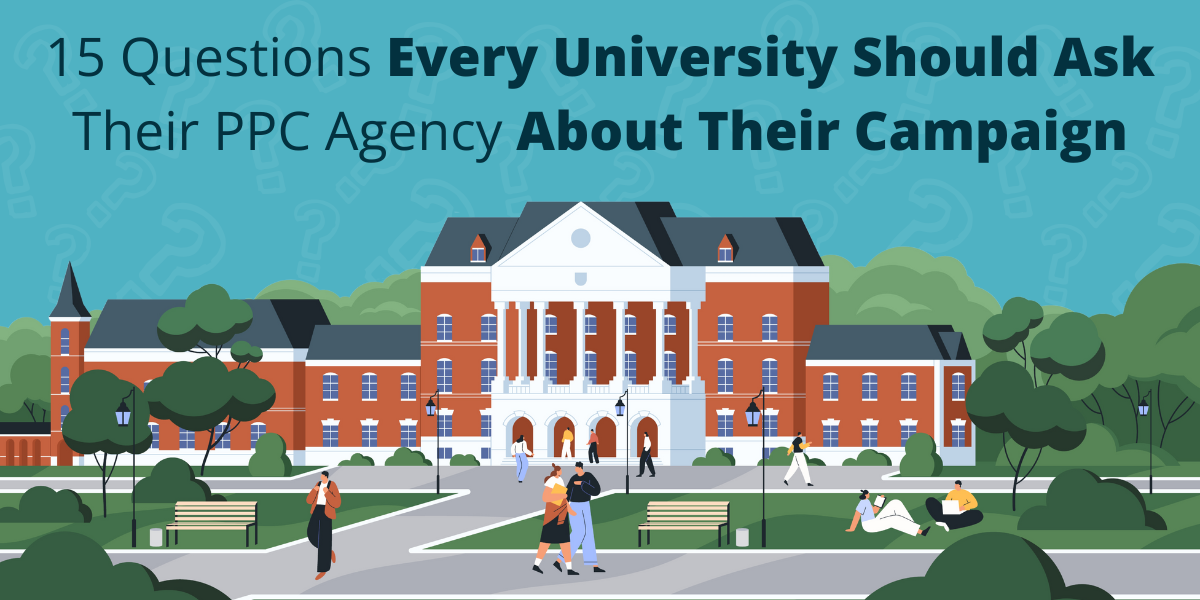
  • 15 Questions Every University Should Ask Their PPC Agency About Their Campaigns

    Key Insights

    • Many universities rely on a PPC agency, but most campaigns aren’t built to connect ad spend directly to student enrollment outcomes.
    • A strong Google Ads agency should track meaningful conversions, such as inquiries, applications, and campus visits — not just clicks.
    • Ongoing PPC management, post-launch optimizations, and negative keyword strategies are essential to avoid wasted ad spend.
    • Transparent reporting, real-time dashboards, and CRM integration should be standard for any higher ed paid advertising campaign.
    • Search Influence combines PPC advertising with search engine optimization (SEO), delivering a full-funnel strategy tailored to higher education institutions.

    Universities invest heavily in paid search and display advertising to reach prospective students. Still, not every PPC agency delivers the transparency and strategy required to connect those campaigns to enrollment outcomes. Too often, agencies measure success in clicks or impressions, failing to show how those digital marketing efforts translate into inquiries, applications, and enrolled students.

    This blog provides 15 questions higher education leaders can use to evaluate their current Google Ads agency or PPC marketing company. These questions go beyond surface-level performance metrics and focus on alignment with institutional goals, proper campaign management, and integrating PPC with broader digital marketing strategies.

    By setting the right expectations, you’ll quickly see whether your PPC advertising campaigns are optimized for today’s competitive, AI-driven search environment or your budget is stretched thin without producing results.

    Questions to Ask Your PPC Agency

    1. How do you align PPC campaigns with our enrollment goals?

    A PPC agency should align campaigns with university enrollment goals by connecting paid search strategies to inquiries, applications, and enrollments.

    In higher education marketing, this means campaigns must be tied directly to the admissions funnel, not just surface-level metrics like clicks or impressions. Campaign management should include keyword research, ad placement, and bid strategy that align with institutional objectives and admissions cycles.

    One of the most important measures of this alignment is higher education cost per inquiry (CPI). In our 2024 study created in collaboration with UPCEA, Higher Ed Marketing Metrics Research Report: What Gets Measured Gets Managed, we established the first industry-wide CPI benchmark for professional, continuing, and online (PCO) education, finding an average CPI of about $140. This benchmark gives universities a precise reference point for evaluating whether their campaigns are efficient compared to peers.

    We design PPC campaigns around your enrollment goals, prioritizing CPI and cost per enrollment. This ensures that your ad spend drives measurable student recruitment outcomes and aligns with industry best practices.

    2. What conversion actions are you tracking?

    An effective PPC agency should track conversions tied to student recruitment, including form fills, calls, campus tour sign-ups, and event RSVPs.

    Tracking these actions provides actionable insights into whether PPC ads produce conversions that matter. Without accurate conversion tracking, PPC campaigns can’t show how ad spend supports enrollment objectives.

    We connect conversion actions directly into CRM systems, tying campaign management to the admissions funnel. By aligning pay-per-click advertising with key performance indicators (KPIs), we help universities measure ROI in ways most PPC agencies overlook.

    3. How do you optimize campaigns post-launch?

    Strong PPC agencies optimize campaigns after launch by running ongoing A/B tests, refining negative keywords, and adjusting bid strategies to improve performance.

    Post-launch optimization includes keyword research, ad copywriting, and monitoring ad groups across platforms like Google Ads, Microsoft Ads, and the Google Display Network. Without continuous updates, PPC costs rise, and wasted ad spend becomes unavoidable.

    At Search Influence, we use Google Analytics and other performance tracking tools to refine PPC management services weekly. By monitoring ad placement, web traffic trends, and audience targeting, we keep campaigns efficient and focused on producing qualified student inquiries.

    4. What role does AI play in our paid ads strategy?

    Modern PPC agencies should use AI to enhance paid search campaigns through smarter bidding, predictive audience targeting, and automated ad creation.

    AI can improve bid management and ad placement, but without human oversight, it risks inflating PPC costs and generating irrelevant traffic.

    Our approach combines AI-powered campaign management tools with human expertise in higher education marketing. By balancing automation with strategy development, we maximize ad spend efficiency, reduce wasted ad spend, and ensure PPC ads produce conversions tied to business goals.

    5. How do you integrate SEO and paid ads?

    A strong PPC agency should integrate paid ads with SEO to maximize visibility on search engines and strengthen digital marketing strategies.

    Paid search campaigns and search engine optimization work best when combined, creating a consistent presence that supports both immediate conversions and long-term visibility.

    At Search Influence, we unify PPC marketing with SEO services to deliver a comprehensive digital marketing plan. By aligning paid and organic strategies, universities gain a competitive advantage, capture more web traffic, and improve online success across online platforms.

    6. Can you show us real-time performance dashboards?

    A transparent PPC agency should provide real-time dashboards integrating Google Ads, GA4, and CRM data.

    These dashboards allow higher ed leaders to monitor campaign management without waiting for monthly reports, ensuring ad management aligns with enrollment goals.

    We create custom dashboards highlighting cost per inquiry, campaign performance, and other key performance indicators. These tools give universities immediate visibility into PPC performance and help them quickly adjust their digital marketing efforts.

    7. How do you feed PPC data into our CRM?

    Effective PPC agencies should integrate PPC data into CRM systems to connect clicks with inquiries, applications, and enrollments.

    Without CRM integration, pay-per-click advertising cannot be tied to real ROI, making campaign management incomplete.

    We connect PPC advertising directly into admissions CRMs, enabling universities to attribute web traffic and inquiries to specific ad groups, platforms, and campaign strategies. This level of integration provides actionable insights for optimizing PPC budget allocations.

    8. What certifications does your team hold?

    Certified PPC experts should manage higher education campaigns with credentials in Google Ads, Google Analytics, and Meta platforms.

    Certifications prove technical expertise, but higher ed experience ensures that knowledge translates to enrollment outcomes.

    Our PPC experts hold platform certifications and apply them directly to higher education campaigns. We deliver PPC management services that outperform generalist marketing agencies by combining industry expertise with advanced platform knowledge.

    9. How do you ensure our budget is spent efficiently?

    A reliable PPC agency should maximize budget efficiency through negative keyword strategies, pacing adjustments, and cross-channel ROI tracking.

    Inefficient campaign management leads to wasted ad spend, inflated management fees, and poor alignment with business objectives.

    Our team focuses on reducing PPC costs by lowering the cost per qualified inquiry. We monitor bid strategy across Google Ads and programmatic advertising to ensure ad spend is optimized across online platforms. This approach helps universities avoid wasted ad spend while boosting enrollment ROI.

    10. What reporting cadence and metrics do you provide?

    A PPC agency should report on enrollment-focused metrics such as inquiries, applications, cost per lead (CPL), and cost per enrollment (CPA).

    Reporting should include actionable insights, not just clicks and impressions, to show how PPC advertising supports student recruitment.

    We provide monthly and quarterly reporting built around the KPIs that matter most in higher education. Our reporting connects paid search and paid media performance directly to student recruitment goals, ensuring transparent and accountable campaign management.

    11. How do you handle audience targeting for higher ed?

    Higher education PPC agencies should use precise audience targeting strategies, including geo-targeting, demographic segmentation, and program-specific ad groups.

    Effective ad management also requires compliance with platform policies while reaching students most likely to apply.

    Our campaign management uses advanced audience targeting techniques across social media marketing, search engine marketing, and remarketing campaigns. With years of higher ed experience, we ensure ad placement reaches qualified students while staying compliant with advertising regulations.

    12. What’s your approach to ad creative and testing?

    A strong PPC agency should continually test ad creative to improve engagement and drive conversions.

    This includes responsive search ads, video ads, ad copywriting, and programmatic advertising designed to boost inquiries. Campaigns should evolve with student behavior to maintain a competitive advantage.

    We run ongoing ad creation and testing cycles, using actionable insights from ad platforms like Google Ads, YouTube ads, and social media advertising. This process ensures PPC ads produce conversions and align with student search intent.

    13. How do you stay ahead of AI and platform updates?

    PPC agencies should proactively adapt to AI advancements and ad platform updates to maintain effective campaign management.

    Search engines and online platforms frequently roll out updates that affect ad placement, bid strategy, and audience targeting.

    Search Influence monitors how AI affects paid ads in real time, adjusting strategy development across Google Ads, search, and social media platforms. This proactive approach keeps universities ahead of competitors and prevents wasted ad spend.

    14. How do you prove campaign ROI to university leadership?

    A PPC agency should prove ROI by tying PPC campaigns to student enrollment outcomes through clear attribution.

    Reporting must connect ad spend to inquiries, applications, and seats filled, providing leaders with actionable insights.

    We create enrollment-focused ROI reports highlighting cost per inquiry and enrollment. By connecting PPC performance to business goals, we make it easy for university leadership to see the value of their paid advertising campaigns.

    15. What’s your experience with higher education institutions?

    PPC agencies with higher education experience can better manage enrollment seasonality, compliance, and admissions cycles than generalist agencies.

    Higher ed campaigns are complex and require specialized knowledge in paid advertising, remarketing campaigns, and digital marketing strategies.

    Search Influence is a higher ed marketing agency with years of experience managing PPC campaigns for universities. Our industry expertise helps institutions boost sales of their academic programs, allocate PPC budgets strategically, and achieve online success through comprehensive digital marketing.

    Solve Your Higher Ed Marketing Puzzle With SEO and Paid Digital Ads

    SEO and paid ads together improve student recruitment results. Universities that integrate search engine optimization with PPC advertising maximize their limited budgets and create a consistent presence across online platforms.

    Our white paper demonstrates how SEO and paid ads work hand-in-hand to:

    • Capture students actively searching for programs
    • Maximize limited budgets through smarter campaign management
    • Deliver real-time outcomes that can be optimized mid-campaign
    • Drive action at every stage of the admissions funnel
    • Attribute the source of your most valuable prospects
    • Prove ROI with measurable results tied to enrollment

    Ready to See If Your PPC Agency Measures Up?

    If these 15 questions leave you uncertain about your current campaigns, you may not be getting the most from your ad budget. Most PPC agencies focus narrowly on clicks or impressions, but universities need a partner that understands how digital marketing strategies drive enrollment.

    Search Influence blends AI-driven paid search with proven SEO strategies, offering universities a strategic partner for campaign management that reduces wasted ad spend and increases inquiries.

    Download the white paper today to see how SEO and paid ads work hand-in-hand to drive measurable impact for universities.

    Images:
    Unsplash
    Unsplash

  • Boost Paid Search Results With Demand Gen + Performance Max – October Client Insider

    Boost Paid Search Results With Demand Gen + Performance Max – October Client Insider

    Unlock the Power of Demand Gen + Performance Max

    The Upgrade Your Paid Search Strategy Needs

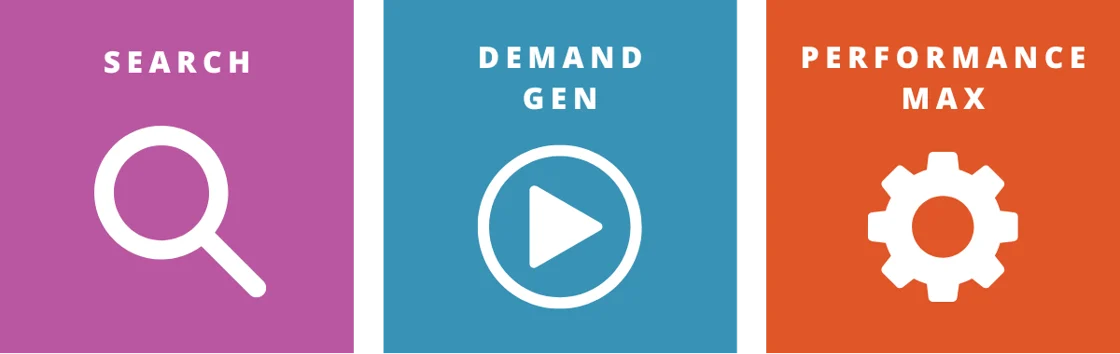
    Different kinds of paid advertising

    Paid Search captures intent. When someone types in a query, your ads put your business front and center. But what about reaching people before they search?

    Google’s Demand Gen and Performance Max campaigns are built to do just that:expand your visibility, build your awareness, and move your prospects toward conversion.

    How Demand Gen Works

    Demand Gen campaigns act like a premium version of Display, placing your ads in social-style feeds where discovery happens. These campaigns help you spark interest early by reaching audiences across:

    • YouTube Shorts and in-feed video for immersive, mobile-first experiences
    • Discover feeds to connect with users scrolling curated content
    • Gmail placements where ads appear natively within inboxes
    • Google Display Network with high-quality, visually engaging inventory

    By building awareness in these environments, Demand Gen presents your brand before customers even begin searching.

    How Performance Max Drives Conversions

    Performance Max extends your reach across all of Google’s properties while using AI to optimize performance. With this campaign type, you benefit from:

    • Cross-channel reach across Search, YouTube, Display, Discover, Gmail, and Maps
    • Predictive audiences powered by Google AI and your first-party data
    • Creative optimization that tailors ad combinations from your assets
    • Real-time bidding and budget pacing to maximize conversions against your goals

    The result is a campaign that complements Paid Search, capturing high-intent traffic while driving new conversions efficiently.

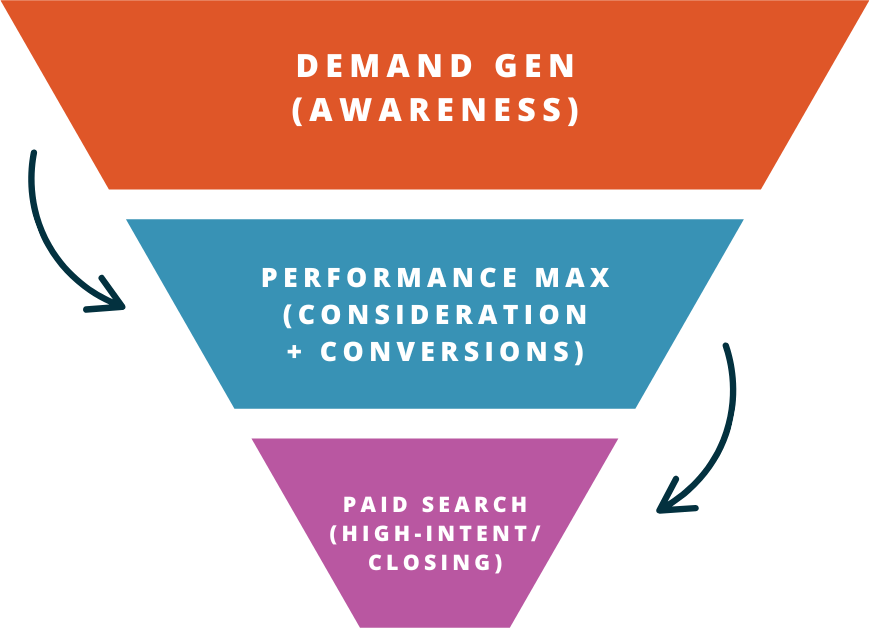
    Paid search funnel

    Why Add Both to Your Strategy

    Together, these campaigns build a full-funnel approach: Demand Gen fuels awareness, Performance Max converts interest, and Search closes the loop. Adding them ensures your ads reach customers at every stage of the decision journey.

    Looking to take your Paid Search strategy to the next level? Talk to your Account Manager about adding Demand Gen and Performance Max to your campaigns today.

  • What Your Marketing Dashboard Isn’t Showing You, And How Ours Does

    What Your Marketing Dashboard Isn’t Showing You, And How Ours Does

    Key Insights

    • Most dashboards miss critical context. Standard marketing analytics dashboards typically show surface-level numbers like impressions or clicks, but fail to connect them to real business outcomes like inquiries, acquisitions, or revenue generated.
    • Search Influence marketing dashboards integrate multiple platforms. By pulling from CRMs, call tracking, Google Analytics, Google Ads, and even offline sources, our digital marketing dashboard examples provide a single source of truth for marketing performance.
    • Lead quality matters as much as lead quantity. Search Influence’s marketing dashboards go beyond counting form fills by integrating qualified lead scoring and call tracking data, helping marketing teams focus on the channels most likely to drive conversions.
    • SMART goals make marketing dashboards actionable. Unlike generic marketing dashboard templates, we build dashboards that align directly to Specific, Measurable, Achievable, Relevant, and Time-bound goals, keeping marketing teams focused on progress toward shared objectives.
    • Customization is the ultimate advantage. Search Influence creates customizable dashboards tailored to your business model, ensuring your key marketing metrics tell your story, not someone else’s.

    Imagine looking at your business through a foggy window.

    You can make out some shapes, maybe website traffic here, some social media metrics there, but you’re missing the sharp details that let you make smart decisions.

    That’s how most marketing dashboards work.

    They give you a handful of numbers, but without context, connections, or clarity. They leave digital marketers staring at charts that raise more questions than they answer.

    So what’s the solution?

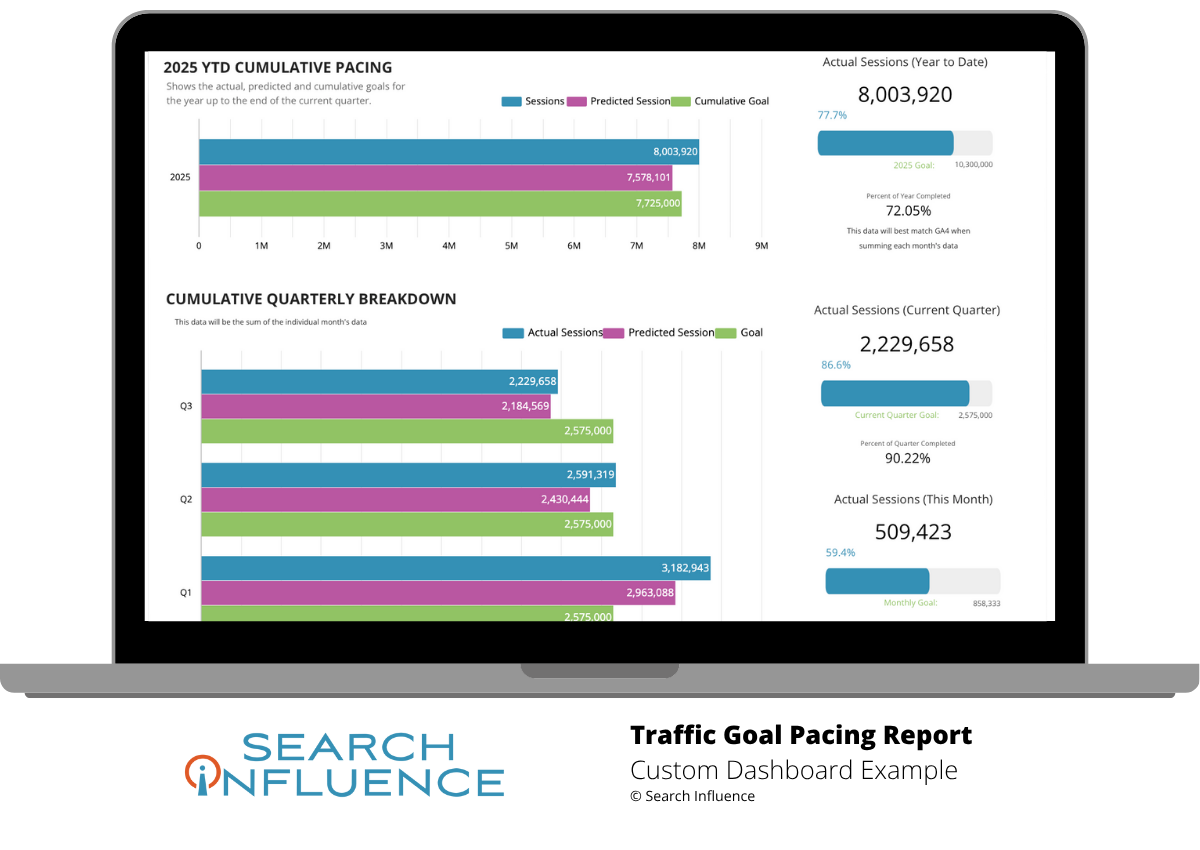
    At Search Influence, we think a marketing dashboard should do more than just decorate your monthly report. It should tie together multiple platforms, align with your marketing objectives, and give you actionable insights you can use to improve campaigns in real time.

    Even our “standard” dashboards are built to outperform most marketing dashboard examples you’ll see from other agencies.

    And when you need something truly unique? We scope and create custom dashboards that match your business model.

    Here are six key points your dashboard probably doesn’t show you, and how ours does.

    1. Leads From All Sources in One Place

    The Problem: Standard digital marketing dashboards usually spotlight one channel: Google Ads, Facebook Ads, or maybe website form fills. But leads don’t live in silos.

    The SI Difference: We integrate CRM systems, call tracking tools like CallRail, and web forms into one unified lead generation dashboard. Instead of bouncing between platforms, you get a single web analytics dashboard that tracks inquiries, lead generation efforts, and revenue-driving conversions.

    The Benefit: You see the full story of your marketing efforts without the guesswork. One login, one source of truth, and one number you can trust.

    2. Cost Per Inquiry (CPI) and Cost Per Acquisition (CPA)

    The Problem: Many marketing analytics dashboards stop at cost per lead (CPL). But CPL doesn’t tell you whether those leads turn into paying customers.

    The SI Difference: Wherever your CRM and analytics dashboard data allow, we go deeper. We create dashboards that can connect your marketing spend with inquiries and acquisitions, creating a real picture of ROI. Even when we can’t attribute it down to the channel, we show overall CPI and CPA so you understand the cost of growth.

    The Benefit: You make data-driven decisions based on revenue potential, not just click costs.

    3. Lead Quality, Not Just Quantity

    The Problem: A thousand form fills don’t mean much if they’re all spam or unqualified leads.

    The SI Difference: We work with clients to score lead quality. CallRail, for example, allows calls to be tagged and scored. We pull that data into your marketing performance dashboard so you know which channels bring in prospects most likely to convert.

    The Benefit: You stop wasting budget on low-quality leads and double down on marketing channels that actually drive growth.

    4. Multi-Source Data Integration

    The Problem: Your marketing data lives in silos — Google Analytics, social media dashboards, CRMs, email campaign platforms, and more.

    The SI Difference: We merge it all into a single digital marketing dashboard. From SEO dashboards that pull in Google Search Console and keyword rankings, to email marketing dashboards that show open rates and conversions, to paid advertising performance across Google Ads and LinkedIn Ads, everything comes together in one place.

    The Benefit: You see how each channel supports your marketing strategy, without drowning in complex data.

    5. SMART Goal Alignment and Progress Tracking

    The Problem: Many dashboards are just a random collection of numbers. They don’t tell you whether you’re meeting your marketing objectives or hitting key metrics.

    The SI Difference: We build dashboards around SMART goals — Specific, Measurable, Achievable, Relevant, and Time-bound. Your key performance indicators aren’t buried in a sea of metrics; they’re front and center. And for stakeholders who want more detail, we make the detailed metrics accessible with a click.

    The Benefit: Everyone sees progress toward the same goals, whether it’s organic traffic growth, lead generation, or improved conversion funnel performance.

    6. Customization for Your Business Model

    The Problem: Off-the-shelf marketing dashboard templates limit what you can measure and how you can view it.

    The SI Difference: Whether you’re in higher education tracking enrollment inquiries, healthcare tracking patient leads, or hospitality tracking bookings, we scope and build customizable dashboards tailored to your operations.

    The Benefit: Your marketing data tells your story, not someone else’s template.

    Search Influence’s Marketing Dashboard Best Practices

    Our dashboards aren’t just pretty charts. They’re high-powered decision-making tools that would even make HAL gush.

    Here’s what we prioritize:

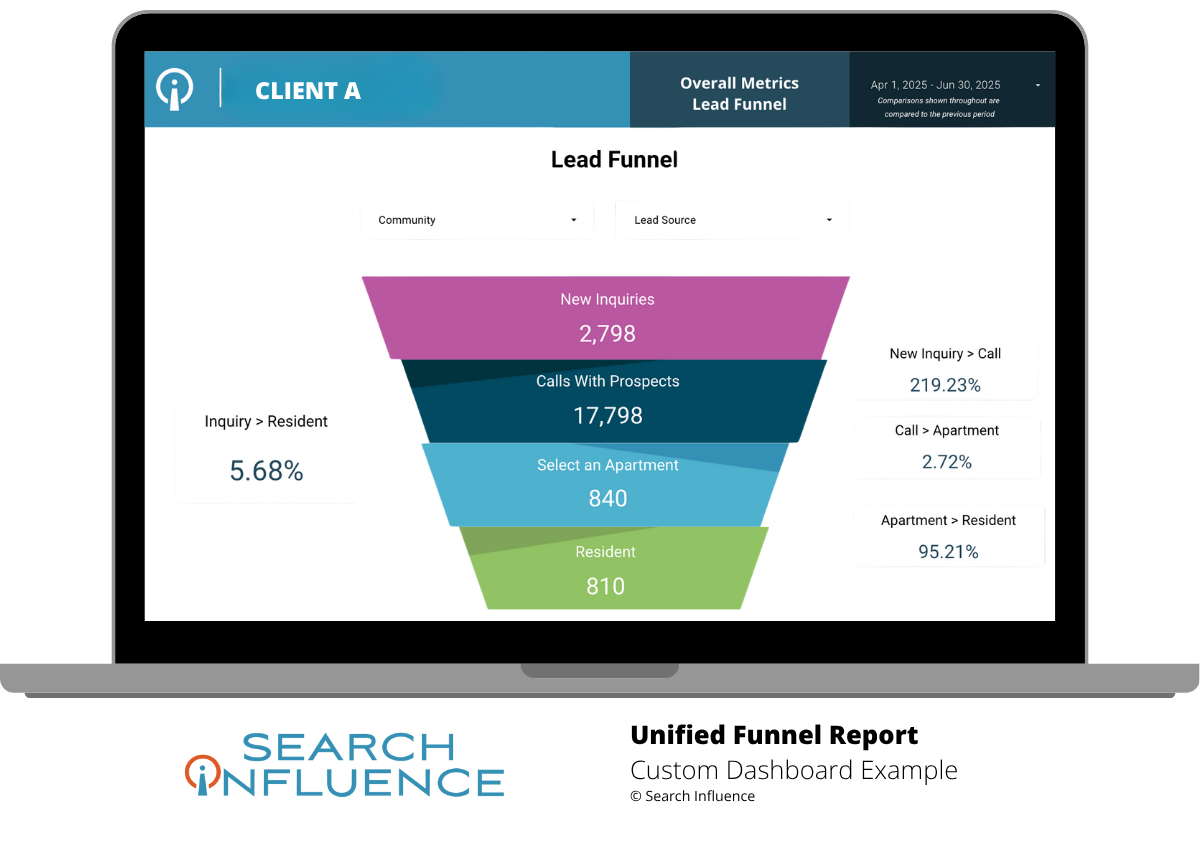
    • Funnel visualization that shows your conversion funnel step by step
    • Integration of all relevant data sources for complete marketing reporting
    • Emphasis on lead quality, not vanity metrics
    • KPI key metrics tracking aligned to SMART goals
    • Custom configurations designed for your specific business

    Marketing Dashboard FAQs

    What does a marketing dashboard include?

    A marketing dashboard includes metrics, visualizations, and KPIs that track marketing performance.

    In practice, this means a dashboard isn’t just a list of numbers; it’s a carefully structured view of how your campaigns are performing across channels. A strong digital marketing dashboard example might combine website traffic, keyword rankings, and lead generation data into charts that reveal trends over time.

    Instead of hunting through Google Analytics, Facebook Ads, and email campaign reports separately, you get one clear picture. Some dashboards even layer in benchmarks or targets, so your marketing teams can quickly see if campaign data is above or below expectations.

    How to create a dashboard for marketing?

    Creating a dashboard for marketing requires defining goals, selecting KPIs, and integrating data sources.

    The process starts with your marketing strategy: What do you want to achieve?

    If your goal is lead generation, your key performance indicators may include cost per lead, lead quality, and conversion funnel stages.

    From there, you identify the data sources (Google Analytics, Google Ads, social media, CRM, etc.) and use a marketing dashboard tool to connect them. The best dashboards allow customization, so you can highlight priority metrics for executives while still offering detailed metrics for specialists.

    Or, you could call Search Influence.

    We scope dashboards that reflect both your goals and your business model, whether that’s patient inquiries, student applications, or e-commerce sales.

    What are the three essential elements of a marketing dashboard?

    A marketing dashboard has three essential elements: relevant KPIs, real-time data, and visual clarity.

    Relevant KPIs ensure the dashboard focuses on the numbers that matter most, not vanity metrics. Real-time or near-real-time data makes sure decisions are based on current performance, not last quarter’s results.

    And visual clarity means presenting complex data in a way that’s easy to interpret, through graphs, funnels, or tables. For example, a marketing KPI dashboard might display how organic traffic, paid advertising, and email campaigns each contribute to overall lead generation. Without all three elements, dashboards risk becoming confusing reports rather than tools for data-driven decisions.

    What is a marketing dashboard used to do?

    A marketing dashboard is used to monitor campaign performance, track ROI, and guide strategic decisions.

    Think of it as a single source of truth for your marketing data. Instead of siloed reports, it consolidates insights into one analytics dashboard so you can evaluate the effectiveness of your digital marketing campaigns. Marketing dashboards typically show you where leads are coming from, how much they cost, and how they move through the conversion funnel.

    Beyond reporting, they’re decision-making tools: Should you increase spend on Google Ads?

    Should you shift resources from LinkedIn Ads to search engine optimization?

    A well-built dashboard answers those questions with clarity.

    What are marketing metrics?

    Marketing metrics are measurable values that indicate the effectiveness of marketing efforts.

    These include everything from social media metrics like engagement and reach, to SEO dashboards that track keyword rankings and organic traffic, to financial metrics like customer acquisition cost and revenue generated.

    The key is to focus on the right mix of performance metrics that align with your goals. For example, a B2B business might prioritize cost per qualified lead, while a retail brand might zero in on website performance and conversion rate.

    By tracking marketing metrics consistently, marketing professionals can see which channels deliver ROI and which need refinement.

    How to measure marketing performance?

    Measuring marketing performance involves tracking KPIs, comparing results to goals, and analyzing trends over time.

    A web analytics dashboard tracks website performance and website traffic, while a social media dashboard pulls in data from platforms like LinkedIn Ads or social media ads.

    But raw numbers aren’t enough.

    The value comes from comparing outcomes to your SMART goals: Did organic traffic hit the growth target?

    Did email campaigns generate the expected inquiries?

    Did your company’s marketing efforts lower acquisition cost?

    By tying performance metrics back to objectives, you gain actionable insights to optimize campaigns. Measuring performance this way isn’t just reporting; it’s steering your marketing strategy with confidence.

    Why the SI Marketing Dashboard Difference Matters

    Most dashboards give you half the picture. They skip over lead generation efforts, gloss over ROI, and bury key insights in complex data.

    Search Influence dashboards give you the whole landscape with all its beautiful details, Ansel Adams style.

    Whether you use our standard marketing dashboard or a fully custom build, you’ll see a clear, actionable view of your digital marketing campaigns. You’ll know how your marketing channels are working together, how your website’s search engine performance is trending, and where to focus resources for the biggest impact.

    If you’re ready to go beyond surface-level reporting, it’s time to see what your marketing dashboard could really do.

    Schedule a consultation and see how Search Influence dashboards turn data into decisions.

  • Search Influence Honored as One of 2025’s Best Women-Owned Businesses by New Orleans CityBusiness

    Search Influence is proud to announce that New Orleans CityBusiness has named us one of the 2025 In the Lead: Best Women-Owned Businesses honorees.

    The special section, profiling recognized companies, will appear in the September 19, 2025, issue of New Orleans CityBusiness.

    This honor comes alongside our recognition as an honoree in the 2025 CityBusiness Empowering Women Award and adds to our ongoing distinction of being named five times to the publication’s Best Places to Work list.

    Together, these awards highlight our growth as a digital marketing agency and our commitment to creating a workplace where women lead, innovate, and thrive.

    What the Award Represents

    CityBusiness selects honorees based on business performance, innovation, workplace culture, and community impact.

    To qualify, companies must be owned in whole or majority by women and based in the Greater New Orleans area. Honorees are chosen for achievements such as:

    • Demonstrating strong growth in revenue or employees
    • Trailblazing in industries traditionally dominated by male-owned firms
    • Building a workplace that supports employees with programs that foster morale and growth
    • Showing consistent community engagement and mentorship

    At Search Influence, these values align directly with our mission. 75% of our leadership and 79% of our team are women, and our culture emphasizes mentorship, inclusion, and opportunity.

    A Women-Owned Digital Marketing Agency Making an Impact

    From our beginnings in a spare bedroom to becoming a nationally recognized digital marketing agency, our growth has always been rooted in people. Being a women-owned company means leading with empathy and strength while ensuring every team member has the tools to succeed. Flexible schedules, paid parental leave, and clear paths for professional development are just a few ways we support our team.

    We also give back by hosting YouthForce interns each year, helping mentor the next generation of women interested in business, technology, and marketing.

    Driving Innovation Through AI SEO and Digital Advertising

    This award also celebrates how we’ve helped clients succeed through innovation.

    Search Influence has been an early adopter of AI SEO strategies, ensuring our clients appear in AI-powered search results like Google’s AI Overviews and conversational assistants.

    Our dual approach, optimizing client visibility in AI search while using AI tools to improve SEO workflows, keeps our partners ahead of rapid industry changes.

    In addition to SEO, our expertise spans digital advertising and data-driven email marketing.

    For nearly 20 years, we’ve delivered measurable results through strategies that blend human creativity with advanced analytics.

    Looking Ahead

    Recognition as one of the Best Women-Owned Businesses underscores what we’ve always believed: When women lead, companies and communities grow stronger.

    We’re grateful to New Orleans CityBusiness for this honor and proud to stand alongside other local businesses that are making an impact.

    As AI, search, and digital advertising continue to evolve, Search Influence remains dedicated to helping our clients thrive in a competitive environment. Our story proves that innovation, inclusion, and community commitment are the foundation of lasting growth.

    Ready to maximize your success with a proven women-owned digital marketing agency?

    Contact Search Influence today to discuss how AI SEO and digital advertising can drive your next stage of growth.

  • Higher Education Advertising Strategies for Centralized vs. Decentralized Teams

    Higher Education Advertising Strategies for Centralized vs. Decentralized Teams

    Key Insights

    • Team structure drives advertising performance. A centralized marketing team delivers efficiency and consistency, while decentralized teams excel in agility and program-level targeting.
    • Most universities operate in hybrid models. Few are purely centralized or decentralized. Hub-and-spoke and collaborative networks are common, and each impacts paid advertising differently.
    • Aligning strategy with structure prevents wasted spend. The right setup helps higher education marketers avoid overlapping ads, mixed messages, and underperforming budgets.
    • Paid advertising success comes from clarity. Institutions that match their organizational model to their media strategy see stronger ROI, better audience targeting, and more meaningful enrollment outcomes.

    If you’re responsible for higher education advertising at an institution, you already know the challenge.

    Every school, program, and department wants visibility, and they all want it yesterday.

    Meanwhile, leadership expects a unified brand that builds credibility and delivers enrollment results.

    That tension comes to a head in paid campaigns, where budgets are closely watched and wasted spend is difficult to justify.

    Should all campaigns be managed by one centralized marketing team to ensure control and consistency? Or should departments run their own ads to tailor messages for specific programs and audiences?

    Most institutions operate somewhere in between. Knowing where your structure falls (e.g, centralized, decentralized, or hybrid) is the first step toward building a digital advertising strategy that makes every dollar work harder.

    Variations in Centralized and Decentralized Higher Education Advertising

    Not all universities fit neatly into “fully centralized” or “fully decentralized.” Recognizing your model is key to avoiding wasted budget and reaching the right students.

    Centralized Variations

    Centralized structures are common when leadership wants control, efficiency, and a unified voice. Within this approach, there are two main models institutions typically follow:

    Fully centralized

    In this model, one marketing office controls all budgets, creative, targeting, and reporting. Paid campaigns for undergraduate admissions, graduate programs, and brand-building all flow through the same team. This creates consistency and accountability, but campaigns often move more slowly, and programs with niche audiences may feel underserved.

    Hub-and-spoke

    With a “hub-and-spoke” setup, the central office sets strategy and creative standards, and likely also provides already-approved ad templates. The departments then execute campaigns within those guidelines.

    For example, a nursing school might adapt central paid search templates to highlight clinical outcomes, while the business school uses the same framework to promote MBA career paths. This model gives programs flexibility without losing alignment, but it requires clear governance to work well.

    Decentralized Variations

    Decentralized structures give schools more autonomy and agility. Instead of waiting for central approval, departments can quickly tailor campaigns to their audiences. Two common models fall under this approach:

    Fully independent

    In a fully independent model, each school or department manages its own advertising, from budgets to creative to targeting. For example, the business school might run a Meta campaign to boost MBA enrollment, while engineering launches LinkedIn ads for prospective undergraduates.

    This setup gives programs agility and control over their own messaging, but it often leads to inconsistent brand voice, overlapping campaigns, and higher costs when departments compete for the same prospective students.

    Collaborative network

    In a collaborative network, departments run their own campaigns but share certain resources, such as analytics platforms, vendor contracts, or a CRM. For example, multiple schools may use a shared DSP to buy media while still creating their own ads.

    This structure lowers costs and improves visibility across programs, but it depends on adoption. Without consistent use of shared tools, you can still end up with inefficiencies and fragmented audience targeting.

    Pros and Cons of Each Structure

    Centralized Structure

    A centralized marketing team shines when leadership prioritizes consistency and efficiency. But in practice, it can also create friction when programs need specialized campaigns.

    Pros

    • Cohesive brand identity: Every ad, across search, social media, and display, reinforces a unified message for prospective students.
    • Economies of scale: Media dollars go further when a centralized marketing team buys in bulk, lowering CPCs and CPMs.
    • Clear reporting: Centralized audience data makes it easier to connect campaigns to enrollment outcomes.
    • Policy alignment: There’s easier institute-wide compliance with accessibility, privacy, and government regulations.

    Cons

    • Slower response times: Campaigns for specific academic programs or niche demographics may lag.
    • Creative bottlenecks: One team reviewing all assets can delay launches.
    • Departmental disconnect: Faculty and program chairs may feel their priorities aren’t represented.

    Decentralized Structure

    Decentralized models work best when agility matters most, but that same autonomy often leads to inefficiency and fragmentation in higher education campaigns.

    Pros

    • Agility: Departments can launch or pivot enrollment marketing campaigns quickly.
    • Tailored messaging: Schools can highlight unique career outcomes, campus life, and student success stories.
    • Encourages innovation: Independent teams are often able to test new tools, channels, or creative approaches.

    Cons

    • Brand inconsistency: Prospective students may see conflicting messages across multiple channels.
    • Budget inefficiency: Overlapping campaigns may compete for the same target audience.
    • Limited ROI visibility: Multiple CRMs or landing pages can make performance tracking difficult.

    Paid Ad Strategies for Each Structure in Higher Education

    Understanding your structure is only useful if it translates into smarter campaigns. Each model requires a different approach to ensure your ad dollars are invested wisely and drive enrollment.

    For Fully Centralized Teams

    When one marketing office owns all advertising, scale and consistency are your biggest advantages. The challenge is making sure campaigns still connect with prospective students across different programs.

    • Plan around the calendar: Create a campaign roadmap that aligns with enrollment cycles, campus events, and application deadlines. This ensures steady awareness throughout the year.
    • Leverage remarketing: Use centralized retargeting to reach visitors across all university web pages, reinforcing brand visibility and creating a unified experience for potential students.
    • Allocate budgets strategically: Prioritize spend where it aligns with enrollment goals, career outcomes, and high-demand academic programs, not just where the loudest requests come from.

    For Hub-and-Spoke Models

    This hybrid structure allows departments to highlight their strengths while the central office maintains control of strategy. It works best when there’s clear communication and shared insights.

    • Distribute audience research: Share data on audience behaviors and search insights to help schools tailor campaigns to the right demographics.
    • Provide creative frameworks: Branded ad templates and pre-approved copy blocks let departments develop authentic content that still feels consistent.
    • Centralize reporting: A shared dashboard helps leaders and departments monitor engagement, compare performance, and refine higher education marketing strategies.

    For Fully Independent Departments

    When every college runs its own campaigns, speed and specialization come naturally. The risk to avoid, however, is waste, including duplicate targeting, inconsistent messaging, and missed opportunities for collaboration.

    • Hold quarterly ad reviews: Bring departments together to compare results, share key strategies, and reduce overlap.
    • Encourage light-touch brand guidelines: Even voluntary frameworks help create a more unified experience for prospective students.
    • Pool funds for high-cost media: Channels like YouTube, CTV, or sponsored content often deliver deeper connections with specific demographics but may be out of reach for one department’s budget alone.

    For Collaborative Networks

    A collaborative network provides autonomy but relies on shared resources to cut costs and increase efficiency. The success of this model depends on adoption across departments.

    • Invest in shared platforms: A common CRM or analytics system makes it easier to track engagement and communications across the institution.
    • Coordinate retargeting pixels: Prevent schools from competing for the same audiences online by unifying tracking.
    • Offer training: Equip decentralized teams with the skills to interpret insights and use digital marketing tools effectively.

    How to Decide Which Model Works for Your Institution

    Choosing between centralized vs decentralized marketing structures isn’t about which one is “better.” It’s about which one matches your institution’s size, resources, and enrollment goals.

    A small liberal arts college with a handful of academic programs may thrive under a centralized marketing team, while a large research university with multiple colleges often needs hybrid structures to balance control and autonomy.

    Key factors to consider include:

    • Number of schools and programs: The more academic programs you offer, the harder it becomes for one office to manage every campaign.
    • Central marketing staff size: If your team is lean, decentralized departments may need more responsibility.
    • Technology and infrastructure: Institutions with robust CRMs, shared analytics, and advanced digital marketing tools can unify campaigns more easily.
    • Leadership priorities: Some universities value a unified experience and brand voice above all. Others prefer program-level autonomy to reach specific demographics.
    • Hybrid effectiveness: Many higher education institutions succeed with hub-and-spoke or collaborative models, where central offices provide guidance and resources while departments tailor ads for their own prospective students.

    The right fit comes down to aligning your organizational design with your advertising goals.

    Common Challenges in Higher Ed Paid Ad Management

    Even with a well-chosen model, challenges are inevitable. Higher education advertising is complex, with multiple audiences, competing priorities, and budget pressures. Some of the most common issues include:

    • Budget allocation disputes: Programs often compete for limited funds, leading to tension over who gets priority.
    • Duplicated targeting: Without coordination, two departments may spend against the same prospective student audience in major search engines or social media platforms.
    • Fragmented tracking: Multiple CRMs, landing pages, or disconnected web pages make it difficult to attribute campaigns back to enrollment outcomes.
    • Compliance requirements: Accessibility standards, privacy regulations, and institutional diversity goals must all be reflected in campaigns.
    • Balancing consistency with flexibility: Universities need cohesive brand visibility, but also space for departments to highlight authentic content such as student success stories, career outcomes, and campus life.

    Addressing these challenges requires more than good intentions. It takes shared governance, modern tools, and clear reporting structures.

    How an Advertising Agency Can Bridge the Gap

    Many institutions find that bringing in an external partner helps them balance competing needs. An experienced higher education advertising agency acts as both strategist and coordinator, offering:

    • Cross-department coordination: Ensuring enrollment marketing campaigns complement, rather than compete with, each other.
    • Centralized analytics: A unified view of performance across digital marketing channels, from paid search to sponsored content.
    • Audience research: Fresh insights into audience behaviors, college options, and what drives potential students to engage.
    • Budget optimization: Redirecting spend toward the channels and creative that attract more students and deliver ROI.
    • Neutral facilitation: Acting as a “traffic controller” to balance requests from different colleges and departments.

    The right partner doesn’t take control away from internal teams. It creates alignment, so every program benefits from a smarter strategy and cleaner execution.

    FAQs About Centralized vs. Decentralized Marketing Strategies

    How does team structure impact higher education advertising strategies?

    Structure determines who controls budgets, creative, and targeting. Centralized teams create consistent messaging, while decentralized teams allow program-level customization. Hybrid structures aim to capture the benefits of both.

    What KPIs should universities prioritize in paid ad campaigns, regardless of structure?

    Metrics like cost per inquiry, cost per enrollment, website engagement, and conversion rates from landing pages tie directly to marketing goals. These help link advertising dollars to measurable enrollment outcomes.

    How do you measure ROI across multiple departments?

    Shared CRMs, attribution models, and centralized dashboards allow institutions to consolidate insights. Without these, it’s nearly impossible to connect spending with results across multiple academic programs.

    How can universities prevent brand inconsistency in decentralized campaigns?

    Use creative frameworks like branded templates, approved copy blocks, and optional reviews. This allows departments to create authentic content while maintaining a consistent look and feel.

    Is it better to manage university paid media internally or with an external agency?

    It depends on your resources. Internal teams know the culture and campus life deeply, while agencies bring advanced tools, digital marketing expertise, and broader insights. Many educational institutions benefit from a hybrid approach (internal vision with external execution support).

    Digital Advertising for Higher Education: Smarter Ad Spending Starts With Structure

    The structure of your marketing team is one of the biggest factors in the success of your higher education advertising.

    No model is “right” or “wrong” on its own. The key is aligning your digital advertising strategy with how your institution actually operates. When structure and strategy match, you avoid wasted budget, reduce audience overlap, and deliver a unified experience for prospective students.

    Download the ROI White Paper

    At Search Influence, we’ve seen firsthand how much team structure impacts campaign performance. That’s why we developed “3 ROI Models to Prove the Value of Your Education Marketing,” a practical guide to help higher education institutions measure and improve the impact of their digital advertising.

    In the white paper, we share:

    • Three proven models for evaluating higher education marketing campaigns
    • How to turn data and insights into smarter, faster decision-making
    • Tips for preparing confident conversations with leadership and stakeholders
    • Strategies to refine campaigns in real time to attract more students and strengthen ROI

    Don’t wait until the next enrollment cycle to maximize your ad spend. Download our ROI white paper today and start building a more measurable, effective advertising strategy tailored to your institution.

    Images:
    Unsplash
    Unsplash

  • Digital Advertising Strategy Checklist: What to Do Before You Spend $1

    Digital Advertising Strategy Checklist: What to Do Before You Spend $1

    Key Insights

    • A paid ad campaign is only as effective as the strategy behind it. Even great creative will underperform without a defined goal, audience, and conversion path.
    • Digital ads can increase brand awareness by up to 80%, but only if execution is precise. Relevance, targeting, and optimization unlock that potential.
    • Success happens before launch. From audience research to tracking setup, what you do before you spend determines whether your budget drives impact or disappears.
    • Landing pages, follow-up, and lead handling are make-or-break moments. Campaigns don’t just need clicks. They need infrastructure that turns attention into results.
    • Partnering with the right agency brings structure, expertise, and performance insight. Like a choreographer guiding a performance, an agency keeps every element moving in sync.

    A paid ad campaign isn’t just a collection of assets. It’s a well-orchestrated system. Each part, from targeting to tracking, must function in sync to drive measurable outcomes.

    Before your campaign ever goes live, your digital advertising strategy should already be working behind the scenes: identifying the right audience, crafting the right message, selecting the right platforms, and preparing your brand to handle the response.

    Unsure where to start? This step-by-step digital ad campaign checklist outlines everything you need to lay the groundwork.

    What Is a Digital Ad Campaign Plan?

    A digital ad campaign plan is a tactical blueprint that maps every part of your campaign to a specific business goal.

    It connects your audience targeting, messaging, platforms, and creative assets to a single, measurable outcome, whether that’s generating leads, increasing sales, or raising brand awareness.

    Without a campaign plan, brands often end up with scattered targeting, mismatched creative, and disappointing results.

    Think of it like entering a dance competition without rehearsing a routine. You might have great moves, but without choreography, you’ll lose the rhythm, the audience, and the scorecard.

    Ad campaign planning gives your strategy structure and flow.

    Digital Ad Campaign Checklist

    Digital Ad Campaign Checklist

    Step 1: Define the goal and conversion action

    Every campaign should start with one question: What action do you want your audience to take?

    Whether you’re aiming to generate leads, drive purchases, or boost brand visibility, choose one primary goal. Then define the conversion that reflects success. This could be a form submission, a phone call, a sale, or a demo request. Make sure your analytics tools are set up to track this action from day one.

    Without a clear goal and measurement in place, you’ll have no way to judge success.

    Step 2: Conduct market and audience research

    Knowing your audience is the foundation of any effective digital strategy.

    Collect demographic data like age, location, income, and education, but also go further. Explore psychographics such as values, interests, and buying behaviors. Analyze your competitors to find gaps in their targeting or messaging. Build detailed buyer personas so you can create ads that resonate.

    The more you understand your audience, the more relevant and persuasive your campaign will be.

    Step 3: Choose the right paid digital channels

    Each digital platform offers different strengths. Choose the channels that match your audience and campaign goal.

    If your audience is actively searching for your product, Google Ads may be the best choice. If you’re building awareness or retargeting existing prospects, social media platforms like Facebook, Instagram, or LinkedIn offer valuable reach and targeting tools. Consider where your audience spends time, how they consume content, and how different digital marketing channels handle tracking, budget, and creative.

    A successful campaign starts by meeting people where they are.

    Step 4: Build a targeted keyword strategy (for search campaigns)

    For search campaigns, your keyword strategy controls who sees your ads and when.

    Group keywords based on user intent, separating awareness-stage searches from ready-to-buy queries. Prioritize keywords with strong search volume and an acceptable cost-per-click (CPC). Use long-tail variations to attract higher-quality traffic. And build a negative keyword list to prevent your ads from showing up in irrelevant searches.

    The right keyword strategy filters out noise and brings in people ready to act.

    Step 5: Define audience segments (for social and interest-based campaigns)

    When targeting users on platforms like Meta or LinkedIn, segmentation matters.

    Break your target audience into clear, testable segments based on behaviors, interests, demographics, or past site activity. Create custom audiences from your CRM or website traffic. Use lookalike audiences to expand reach while maintaining relevance. Plan to test multiple segments to see what performs best.

    The more precisely you segment, the more efficiently you’ll spend and the more likely you’ll convert.

    Step 6: Develop landing pages built to convert

    Your ad’s job is to spark interest. Your landing page’s job is to close the loop.

    Avoid sending paid traffic to your generic homepage. Instead, create campaign-specific landing pages that reflect the ad message and guide users toward your CTA. Keep it simple: fast load time, mobile optimization, and one clear call to action.

    For one of our clients, launching dedicated landing pages (without changing the ad creative or increasing spend) resulted in 42% more qualified leads and a significantly lower cost per lead. The only campaign difference was the destination.

    Step 7: Set up tracking and conversion measurement

    Before you launch, your tracking setup needs to be airtight.

    Install all necessary tags and pixels, such as Google Tag Manager, Meta Pixel, LinkedIn Insight Tag, and others. Define conversion goals inside your analytics platform. Use consistent UTM parameters to trace traffic sources and campaign performance. Test your tracking setup thoroughly before launch.

    If the campaign data is wrong, your decisions will be, too.

    Step 8: Write clear, compelling ad copy

    Your copy should hook attention, communicate value, and prompt action, all in just a few lines.

    Write with your audience’s mindset in mind. What do they want? What do they need? Use plain language that reflects their voice and avoids fluff. Your content strategy should always prioritize strong CTAs and include testing multiple versions for performance.

    The best ad copy doesn’t just sound good. It earns clicks and drives conversions.

    Step 9: Design ads that match your audience and platform

    Your ad creative should feel native to the platform while standing out in the feed.

    Use the right format (carousel, static image, or video) and ensure consistency between your ad visuals and landing page. Adapt your aesthetic to meet audience expectations, but always stay true to your brand.

    Excellent design reinforces your message and keeps users engaged all the way through the funnel.

    Step 10: Plan A/B tests from the beginning

    Testing isn’t something you tack on later. It’s part of the plan.

    Decide what to test (copy, creative, CTA, landing page, or audience) and establish the metrics and sample sizes needed for valid results. Run structured tests and analyze outcomes at regular intervals. Then use what you learn to refine the campaign mid-flight.

    A/B testing turns good campaigns into great ones.

    Step 11: Align internal lead handling processes

    What happens after a lead converts is just as important as getting the click.

    Make sure leads are routed to the right place, like your CRM, inbox, or sales team, immediately. Train staff to follow up quickly and consistently. If you’re qualifying leads, define scoring criteria so your team knows who to prioritize.

    A well-oiled lead handling process ensures your marketing efforts turn into measurable pipeline growth.

    What Happens After Campaign Launch?

    Going live is not the finish line. It’s the start of real optimization.

    Once your campaign is in motion, ongoing performance monitoring is critical. Data from your ads, landing pages, and audience segments will show what’s working and what’s not. Use those insights to adapt early and often.

    Post-launch digital advertising tips include:

    • Monitoring keyword and audience engagement regularly
    • Reviewing click-through and conversion rates on each
    • Adjusting bids and budgets based on cost-per-result
    • Promoting high-performing variants, pausing underperformers
    • Iterating landing pages to improve conversion efficiency

    Your goal now is to reduce waste and improve return. Campaigns that are actively managed outperform set-it-and-forget-it approaches every time. Keep refining based on performance data, and your digital advertising strategy will only get stronger.

    Why Partner With a Digital Advertising Agency?

    Even with the best intentions, many brands and their marketing teams stumble after launch. Maybe your ads are generating clicks, but they aren’t converting. Or you’re spending money across multiple platforms without a clear sense of what’s actually driving results.

    Sometimes, despite having all the right tools in place, performance plateaus, and no one knows why.

    That’s because executing a successful digital marketing strategy requires more than checklists and best practices. It takes coordination and expertise.

    An experienced agency helps you:

    • Align your campaign tactics with business objectives from the start
    • Develop a competitive content marketing and creative strategy
    • Identify and eliminate inefficiencies in targeting and bidding
    • Access certified experts across platforms like Google, Meta, and LinkedIn
    • Make data-driven adjustments in real time, not weeks later
    • Build a scalable, repeatable strategy that evolves with your goals

    Think back to the dance competition example. You can have the right stage, the right costume, and even the right audience, but without a choreographer, the performance lacks direction. A digital ad agency acts as that choreographer, bringing coordination, timing, and strategic vision to ensure every part of your campaign moves in harmony.

    And when everything clicks, that’s when the real performance begins.

    Digital Advertising Strategy FAQs

    Digital Advertising Strategy FAQs

    How effective are online advertising campaigns?

    When planned and managed properly, online advertising campaigns are highly effective. Paid media allows for precise targeting, measurable results, and scalable performance across different goals, from lead generation to sales to brand awareness. Overall strategy success depends on aligning platform, messaging, and audience with a clearly defined conversion goal.

    What’s the difference between paid search and paid social advertising?

    Paid search targets users based on their intent, making it ideal for capturing active demand. Paid social reaches users based on demographics, interests, and behaviors, even when they’re not actively searching. Depending on your audience and overall campaign objectives, both can play a role in an effective digital marketing strategy.

    How do you optimize ad spending?

    Ad spend is optimized through ongoing analysis and adjustment. This includes refining audience or keyword targeting, rotating creatives, adjusting bids based on performance, and improving landing pages to increase conversion rates. Optimization is not a one-time task. It requires continuous testing, measurement, and iteration.

    What are the best practices for digital ad tracking setup?

    Well-executed tracking is a strong foundation for any digital marketing campaign. Set clear conversion goals, implement tags and pixels correctly, and use UTM parameters for clean reporting. Accurate tracking ensures your ad efforts are evaluated based on reliable data, allowing for better optimization.

    What does ad campaign success look like?

    Ad campaign success means achieving measurable outcomes tied to your strategy, whether that’s clicks, conversions, or revenue. High click-through rates, low cost per acquisition, and positive ROI all point to a well-executed digital marketing plan. Ongoing performance analysis helps refine your strategy and improve future campaign effectiveness.

    Build Smarter Campaigns From the Start

    Digital ads have the power to increase brand awareness by up to 80%, but only when they’re built on a solid strategy. Too often, businesses invest in paid advertising without the structure or support to turn clicks into real outcomes.

    That’s where execution matters.

    Since 2006, Search Influence has helped organizations do digital advertising the right way. As a Google Premier Partner, we combine platform expertise with performance-driven thinking to deliver campaigns that convert, scale, and adapt.

    If you’re ready to stop wasting budget and start building a smarter, more efficient digital advertising strategy, we’re ready to help. Let’s start the conversation today.

    Images:
    Pexels
    Pexels

  • Higher Education Marketing Strategies: Align SEO & Paid Ads for Smarter Results

    Higher Education Marketing Strategies: Align SEO & Paid Ads for Smarter Results

    Higher Education Marketing Strategies: Align SEO & Paid Ads for Smarter Results

    Key Insights

    • The modern student journey is multi-channel: Your marketing efforts must span search engines, social platforms, and AI tools.
    • SEO builds long-term visibility: SEO is a key strategy for sustaining awareness and reducing overall acquisition costs over time.
    • Digital ads deliver speed and precision: Paid ad placements boost visibility during critical enrollment windows and for time-sensitive offers.
    • Together, SEO and ads drive better results: Aligning both helps you maintain visibility and adapt to changing search behaviors.

    Today’s prospective students are intentional researchers in their college search.

    They explore degree programs, admissions requirements, and career outcomes on platforms like Google, ChatGPT, TikTok, and YouTube, often before visiting your website. To reach them during these early moments of consideration, your higher education marketing strategies must prioritize visibility across search engines, social platforms, and AI-driven tools.

    This is where SEO and digital ads work in tandem to keep your institution present, credible, and competitive.

    When aligned well, these tactics guide prospective students from first search to final enrollment with greater efficiency and impact.

    Search Engine Optimization (SEO) at a Glance

    Search Engine Optimization (SEO) at a Glance

    What is SEO?

    SEO stands for search engine optimization. It’s a long-term strategy that improves your website’s visibility in organic (non-paid) search results. This involves refining your content, technical structure, and site authority so your pages appear more prominently when prospective students search on platforms like Google, ChatGPT, and other AI-driven tools.

    In higher education, visibility at key points in the decision-making process directly impacts who finds your programs and who doesn’t. SEO helps your institution show up across the enrollment journey, from early awareness to application. When your site is optimized effectively, it becomes easier for students to find the information they need and easier for you to convert interest into action.

    Why is SEO important for higher education institutions?

    SEO is important for higher education institutions because it helps your programs appear where student intent begins. Research shows that 68% of online experiences start with a search engine, making visibility in those early interactions critical for attracting qualified prospects.

    Today’s students are self-directed and often explore degree options, admissions requirements, and tuition costs on their own, sometimes weeks or months before they ever reach out to an academic institution. If your content doesn’t surface during that initial research phase, your school may never make the shortlist.

    By investing in SEO, higher ed institutions build lasting authority, credibility, and trust. It reinforces your brand presence without relying entirely on paid channels and sets the foundation for long-term enrollment growth.

    What are the benefits of higher education SEO?

    A strong SEO strategy does more than drive traffic. It brings the right traffic. In aligning your content with what prospective students search, you improve visibility and engagement at every stage of the recruitment pipeline.

    Some of the leading benefits of higher education SEO include:

    • Capturing high-intent search traffic from students actively searching for programs like yours
    • Supporting content marketing by making blogs, guides, and admission web pages more discoverable
    • Improving user experience through technical SEO that enhances site speed and mobile responsiveness
    • Boosting credibility with higher rankings, rich snippets, and inclusion in AI Overviews and other AI-powered search features
    • Enabling smarter decisions through keyword research and user behavior analytics
    • Strengthening long-term visibility as ad costs rise and search algorithms evolve

    SEO is not just a marketing add-on. It’s a strategic asset that improves performance across digital channels. When done well, it strengthens your institution’s credibility and reaches students where they’re actively searching.

    What does higher education SEO entail?

    Higher education SEO requires a strategic approach that reflects how 1) students search and 2) how modern search engines and AI platforms process content. It focuses on clarity, structure, and alignment with user intent.

    Key elements of a higher education SEO strategy include:

    • Conducting keyword research based on student goals, questions, and decision-making stages
    • Using entity-based and semantic SEO to match how AI systems interpret and connect information
    • Optimizing on-page elements like meta tags, headers, and image alt text
    • Creating evergreen content such as program pages, tuition details, and frequently asked questions
    • Improving technical performance through mobile-friendly design, fast load times, and structured data
    • Strengthening internal linking and earning high-quality citations from trusted sources
    • Monitoring performance metrics and adjusting tactics to respond to algorithm changes and user behavior

    This ongoing work creates a structured foundation that helps your institution remain relevant across traditional and AI-driven search platforms.

    Digital Advertising (Paid Ads/Pay-Per-Click) at a Glance

    Digital Advertising (Paid Ads/Pay-Per-Click) at a Glance

    What are digital paid ads/PPC?

    Digital paid advertising refers to any online campaign where you pay to promote your content, programs, or brand across platforms where prospective students spend time. These ads can appear in search results, on social media feeds, within videos, or across websites through display networks.

    PPC, or pay-per-click, is one of the most common payment models used in digital advertising. Instead of paying for impressions, you’re charged only when someone clicks your ad. In this way, paid advertising describes the strategy, while PPC refers to how you’re billed.

    Common platforms include Google Ads for search and display, Meta (Facebook and Instagram) for interest-based targeting, YouTube for video promotion, and programmatic networks for broader reach. Each offers a different way to connect with prospective students based on their behaviors, demographics, and intent.

    Why should digital advertising be part of your higher ed marketing strategy?

    Digital advertising is a vital tool for reaching students during critical decision-making windows. Unlike organic strategies, which take time to gain traction, paid ads offer “immediate” visibility in high-traffic environments like search results and social feeds. This immediacy is especially valuable during application pushes, event promotions, or when organic rankings fluctuate.

    For colleges and universities competing for attention in crowded markets, digital ads offer the agility to respond to shifting trends and student behavior in real time. They also create a clear path to visibility when SEO alone can’t secure top placement, especially for high-volume, high-competition keywords.

    When time-sensitive goals are at stake, paid ads allow you to act quickly, focus your message, and precisely reach your target audience.

    What are the benefits of digital ads?

    Digital ads offer a level of control, speed, and insight that is difficult to achieve through other channels. With the right setup, you can run targeted campaigns that respond to real-time behavior and performance data.

    Benefits of digital ads include:

    • Fast results, bringing qualified traffic to your site shortly after a campaign launches
    • Trackable performance that allows you to connect ad spend to inquiries and applications
    • Targeting precision based on factors like location, age, device, interests, or behavior
    • Budget efficiency through dynamic allocation based on campaign performance
    • Seasonal flexibility to scale campaigns up or down as enrollment cycles shift
    • Campaign testing to compare messages, creative formats, and calls to action
    • Retargeting power to re-engage visitors who left your site without taking the next step

    Well-executed campaigns go beyond visibility gains. They deliver measurable insight into which messages and channels are driving potential students to act.

    What does a digital advertising strategy entail?

    A strong digital advertising strategy involves setting clear goals, targeting a well-defined audience, and choosing ideal platforms for delivery. This helps your institution stay adaptable while reaching students where they spend their time online.

    Key elements of a digital advertising strategy include:

    • Identifying high-intent keywords and audience segments by program, location, age, and behavior
    • Choosing platforms that align with campaign goals, such as Google, YouTube, Meta, LinkedIn, or display networks
    • Writing ad copy, headlines, and landing pages tailored to each platform and audience
    • Designing creative assets that reflect your brand and support campaign objectives
    • Setting budgets, bids, and targeting rules by geography, demographics, or device
    • Launching campaigns with tracking to measure clicks, inquiries, and conversions
    • Adjusting creative, targeting, and spend based on performance
    • Retargeting visitors who viewed your site but didn’t convert

    This coordinated approach helps higher ed marketers reach the right students at the right time while maintaining full visibility into campaign success.

    Why SEO and Digital Paid Ads Work Better Together

    Why SEO and Digital Paid Ads Work Better Together

    When used together, SEO and digital ads give you better control over how and when students discover your programs. They serve different purposes but share the same goal: helping your institution show up, build trust, and guide prospective students toward taking the next step.

    Maximize visibility in search results

    Running both SEO and paid search campaigns lets your institution appear in multiple positions on a single results page. This increases your visibility, reinforces brand credibility, and reduces the likelihood of competitors taking that spot instead.

    Drive traffic while SEO gains traction

    SEO is a long-term, yet sustainable, investment. Paid ads help you stay visible in the meantime, especially when launching a new program or entering a competitive market. While your organic rankings build, ads keep inquiries flowing.

    Test messaging before you commit

    Digital ads allow you to quickly test headlines, descriptions, and offers. The best-performing messages can then be applied to SEO page titles, meta descriptions, and even on-page content, improving both click-through rates and relevance.

    Validate keywords with real results

    Paid search shows you which keywords actually drive clicks and conversions. This data can guide your SEO strategy by helping you focus on the terms students search most often and respond to rather than relying solely on keyword tools.

    Retarget prospects who leave

    SEO may attract the initial visit, but not every student is ready to apply right away. With paid ads, you can retarget those visitors and keep your institution top of mind, especially during high-stakes decision windows.

    Lower CPC with better landing pages

    SEO principles like clear structure, fast load times, and relevant content can improve your ad landing pages. This often leads to higher Quality Scores in Google Ads, which reduces your cost-per-click and increases return on ad spend.

    Share data to make smarter decisions

    When SEO and paid ad teams work together, both channels benefit. Search terms, audience behavior, and performance metrics from one can shape strategy for the other, leading to stronger messaging, better targeting, and higher conversion rates.

    How to Align Your Strategy and Budget with Goals

    A thoughtful, comprehensive marketing plan considers how SEO and paid ads contribute at different points in the recruitment cycle. While both digital marketing strategies play a unique role, aligning your investment with your institutional goals (rather than dividing tactics by default) helps you make more strategic, data-informed decisions.

    Use SEO for:

    Building visibility for evergreen content

    Program pages, admissions FAQs, and degree outcomes are high-interest assets that students search for year-round. SEO ensures these pages consistently rank and remain discoverable across enrollment cycles.

    Answering long-tail, high-intent questions

    Students often search with specific phrases like “best online MPH programs for working adults.” Optimizing for these longer queries helps your content meet students at key decision-making moments.

    Strengthening authority over time

    Search engines and AI platforms reward content that demonstrates expertise and trust. By publishing helpful, on-topic SEO content regularly — and earning backlinks and citations from reputable sources — you signal authority over time and improve your chances of ranking across high-impact search terms.

    Supporting decision-making after inquiry

    SEO helps prospective and admitted students find the content they need after expressing interest, such as financial aid resources, enrollment steps, and orientation details. Optimizing this type of content ensures your institution remains visible and helpful beyond the initial click.

    Reducing long-term CPI

    Unlike paid ads, organic traffic doesn’t require a cost per click. A strong SEO foundation lowers dependency on paid placements over time, driving qualified leads while keeping cost per inquiry (CPI) in check.

    Use digital ads for:

    Accelerating time-sensitive goals

    Campaigns tied to deadlines, events, or scholarships need instant visibility to drive action. Paid ads allow you to deliver focused, high-priority messages exactly when timing matters most.

    Launching new programs or locations

    New academic offerings or secondary campuses often lack the organic search authority to rank well early on. Paid ads help you build awareness and attract early interest while SEO efforts gradually take hold.

    Competing on high-volume search terms

    For highly competitive keywords where top rankings are difficult to secure, paid ads keep your institution visible. This ensures you’re not missing out on critical traffic during peak search activity.

    Testing and refining your message

    Digital campaigns offer a fast, low-risk way to test headlines, offers, and positioning statements. Use this performance data to gain insights, inform future updates, and shape messaging across other channels.

    Reaching segmented or niche audiences

    With detailed targeting options, paid ads let you focus on specific groups, like adult learners, out-of-state students, or those interested in a particular program. This helps extend your reach beyond what organic search alone can deliver.

    Questions to help allocate budget

    Before deciding how much to invest in SEO or digital ads, it’s important to clarify the goals, timeline, and audience of each initiative. Use the following questions to guide a smarter, more intentional allocation of resources:

    • Is this a short-term campaign or a long-term visibility play?
    • Do you already rank organically for target keywords, or are you starting from scratch?
    • Are you trying to increase awareness, generate inquiries, or drive completed applications?
    • What is the lifetime value of the program or student audience you’re targeting?
    • Do you need geographic or behavioral targeting that SEO alone can’t deliver effectively?
    • What insights from past campaigns can inform your channel mix for this initiative?

    Think of SEO as the groundwork for sustained visibility and trust, while paid campaigns offer speed and flexibility. By evaluating timing, audience intent, and program priorities, you can allocate budget where it makes the most impact.

    Create a Stronger Higher Education Marketing Strategy

    The most effective higher education marketing strategies don’t rely on a single channel. They align tactics to meet student expectations at every stage of their search journey.

    By pairing long-term organic visibility through SEO with the immediacy and precision of digital advertising, your institution will reach more prospective students, guide them through complex decisions, and support better outcomes from first search to final enrollment.

    If you’re looking for a more intentional way to prioritize your marketing efforts and budget, we’d be honored to help. Download “Solve Your Higher Ed Marketing Puzzle With SEO and Paid Digital Ads” to learn how to:

  • Focus on the tactics that make the biggest enrollment impact
  • Reduce wasted spend and improve lead quality
  • Increase conversions with personalization, testing, and retargeting
  • Tie campaign performance to ROI metrics that matter to leadership
  • See how you can integrate SEO and paid advertising to power your enrollment pipeline today.


    Image Credits:

    Unsplash , Unsplash and Pexels