Author: Search Influence Alumni

  • Confusion Is Next Part 4

    Confusion Is Next: A 4-part Look at Music SEO In A New Era Of The Music Industry

    Part 4 – Same As It Ever Was?

    There is much already written about how and why we use schema and microformats for SEO purposes, but most discussions of this practice tend to revolve primarily around address/contact information and compilation of online reviews. Schema, in essence, just more clearly isolates exactly what a search engine should extract from a site, page or – most importantly for this particular discussion – media item. Our own Doug Thomas offered a fascinating look at the basics of how schema can be used for many different purposes in a post last year. I want to make it clear that I can only speculate as to the actual direct contribution of schema to Internet radio. It feels pretty safe to assume that as this market becomes increasingly competitive, however, the more descriptive information there is associating an artist’s material with other more firmly established artists and genres across the internet, the more likely a musician is to reach a wider audience.

    The important distinction to make is for microdata’s use in the presentation of music is in regard to the desired function of the information being processed. When listing a business address or embedding a video testimonial or compiling reviews for a company’s online ranking, the most important content that needs to be targeted for extraction from the formatting is basic information about the business, its location and its purported quality according to consumers. The goal is to get a search engine to pull a relatively simple assessment of an item or page of content that points as directly as possible to the business or source website. As we discussed in Part 2, this is not necessarily the focus for musical work.

    As you can see, between the schema properties available for the CreativeWork classification and the MusicRecording classification, there is a great deal of information that can be provided to a search engine for any function. Obviously, the data provided through schema should include standard title, album and technical information. What I think could be of increasingly great importance to aspiring new artists, however, are the more relative and subjective microformatting properties available within the CreativeWork schema. A handy way to think about this is as a contemporary substitute for the “Recommended If You Like…” stickers that came on CD’s for radio and promotional performances back when CD’s were still actually real things people used.

    “Genre” is obviously a key component that should probably be used with as much specificity as possible without descending into comically pompous territory. “Pop” is probably not specific enough to help anyone, but some exceedingly overwrought and ultimately marginalizing mega-description like  “Neo Nerdcore Post-Synth-Wave” wouldn’t really tell anyone anything either (unless that’s an actual thing, in which case, sorry. I’m getting old).

    More intriguing, though, are CreativeWork schema parameters like “audience,” “discussionURL,” “isBasedOnURL,” “reviews” or “typicalAgeRange.” These all seem to provide great opportunities to associate a band or musician’s work with something a listener might actively search for, either on a standard search engine or on an internet radio provider. Again, I can provide no certain evidence that any of this will lead to any direct boost in profile on any music-centric site at this moment. I can say, however, that using schema is a really simple and effective way for descriptive information about a work or its creator(s) to be transmitted and received. Simple and effective is generally considered good for business, so it shouldn’t seem outlandish for schema or some similar style of microdata-driven assessment of material to be used in the development of new music dispersal services.

    Furthermore, if there’s one thing we DO know, it’s that schema is utilized very effectively already within standard organic search results. If Daisy is indeed about to usher in a new era of Internet radio that incorporates a more hands-on human element, then organic search results may suddenly become much more important for artists than they had been to this point. In short, forming clearer connections and associations for musical material through the inclusion of a few simple schema properties whenever a media item is linked or embedded by an artist just seems like a solid practice all around for artists (as well as marketers) looking for rewarding careers.

    Click here for Part 1

    Click here for Part 2

    Click here for Part 3

  • Confusion Is Next Part 3

    Confusion Is Next: A 4-part Look at Music SEO In A New Era Of The Music Industry

    Part 3 – Into The Blue Again

    Entities like Youtube, Spotify, Pandora, Soundcloud and Last.fm, alongside the usual social dispersal mechanics of Facebook and Twitter, have certainly made it easier for people to get the music they want legally at minimal (if any) cost. These sites aren’t really doing a ton for artists yet, beyond making music from performers with already existing publishing deals more easily accessible to a wider audience. A great deal of ire has been directed toward Spotify in particular for the ridiculously low royalty rates it pays out to artists. It seems silly to cast Spotify as The Problem, since distributing music without fairly compensating its creators is already what most people are going to do one way or another. It’s important to remember, however, that Spotify probably shouldn’t be viewed as a likely solution to the music industry’s current crop of problems either. Regardless, Internet radio and subscription listening services have to be viewed as, at the very least, a step in the right direction for an “industry” with basically no viable mass financial structure in place at the moment. If there is an available outlet for an artist to target, this is it. It is a market pretty clearly on the rise.

    There had long been rumblings about hip-hop legend Dr. Dre’s development of a new music streaming-focused branch of his Beats Electronics audio equipment company. The revelation last December that Nine Inch Nails creator Trent Reznor had been brought on board the project as Chief Creative Officer made the enterprise even more intriguing. Certainly, celebrity musicians attaching their names to commercial projects is not particularly novel, but the combined reputation and industry experience of these particular celebrity musicians adds a fascinating angle to the in-progress streaming service, which is (unofficially) being referred to as Daisy.

    Both Dre and Reznor have been directly and successfully involved with pretty much every angle of the music industry. Both have been wildly popular performing and recording musicians in their own right. Both are viewed as recording and production visionaries within their particular genres. Both have operated legitimately successful and well respected record labels, wherein both were known to have taken a very hands-on approach to discovering and developing their artists. Both — particularly Reznor — have been extremely candid and open-minded about the issues facing musicians in the brave new Internet-driven world of music promotion and distribution. Basically, in neither case does this feel like a pop star allowing his or her name and face to be associated with caviar-infused vodka or some such thing; it feels a bit more like something that could actually turn into a serious market force.

    Well, the March announcement that Len Blavatnik, owner of the Warner Music Group, had invested $60 million in the project means it better turn into some kind of force now. Details of the specific function and implementation of the streaming service have been kept decidedly on the down-low, but the plan has already at least won the ear of Apple CEO Tim Cook. The pitch appears to involve a more financially viable model for musicians themselves, which isn’t particularly surprising given the personnel involved. But the really intriguing part of all this is the heightened attention the Daisy platform appears to be granting to the search and recommendation features.

    Most of what we know about what Daisy is trying to do comes from a Reznor profile in The New Yorker, which is blocked by a pay wall, so I’m going to shamelessly blockquote Pitchfork, against all better judgment:

    The service “uses mathematics to offer suggestions to the listener… [but also] would present choices based partly on suggestions made by connoisseurs, making it a platform in which the machine and the human would collide more intimately.”

    Comparing Daisy to Spotify, he told The New Yorker, “Here’s sixteen million licensed pieces of music,’ they’ve said, but you’re not stumbling into anything. What’s missing is a service that adds a layer of intelligent curation.”

    “That first wave of music presentation which felt magical, the one where the songs are chosen by algorithms that know who you listened to… has begun to feel synthetic.”

    He described Daisy as being “like having your own guy when you go into the record store, who knows what you like but can also point you down some paths you wouldn’t necessarily have encountered.”

    Now, “intelligent curation” is a really intriguing but delightfully vague expression of how the team is actually going to make this work. There are no details about the procedure and regulations with regard to artist submissions or access yet, so I’m jumping a few steps ahead here. But if Daisy is gearing up for a legitimate run against Spotify and Pandora and stays true to Reznor’s word, it’s going to very quickly make some form of SEO for musicians extraordinarily important. Even if Daisy underperforms relative to its recent investment, it will likely come on the market with enough clout to make other more established Internet radio sources at least think about altering or updating their approaches.

    In the interest of keeping this a series of (hopefully) easily digestible blog posts, and not an entire book, I’m going to keep the discussion of how the current main players in Internet radio actually DO approach things a bit limited. Know that there is much to be read on the subject, however, and it’s all pretty fascinating for music and Internet buffs alike. Pandora, in particular, makes heavy use of the Music Genome Project, which I could happily read about for weeks on end. For my purposes, let’s just establish that Pandora takes into account a whole lot of really detailed technical elements of how music sounds and how it is created when generating playlist connections. Spotify Radio (and many other Internet radio platforms) work more like they are pulling from a huge encyclopedia of genre and era-specific historical reference points, as if their databases are full of every NME Top 100 list and VH1 countdown ever made.

    Both the Pandora and the Spotify approach have their strengths and weaknesses, but where both run into issues is with brand new music that hasn’t been passed through the classification funnel yet. As Internet radio continues to grow and become a greater force in exposing new music to new listeners, it stands to reason that aspiring artists will want to provide as much information as possible about their musical material in order to make it easier to include alongside other more established artists’ material.

    What really intrigues me about all of this, though, is the idea of using SEO techniques to somehow link a band’s online “associations” in such a way that it might be reflected by Daisy or Spotify playlists. No matter how many hordes of ex-college radio DJs Trent Reznor and Dr. Dre are going to hire to add the supposed human element to Daisy, there is still going to be a lot left up to automated algorithms. What this means is…oh, hello there, schema, I didn’t even see you standing over there. Perhaps we should sit down and chat a minute in Part 4.

    Click here for Part 1

    Click here for Part 2

    Click here for Part 4

  • Confusion Is Next Part 2

    Confusion Is Next: A 4-part Look at Music SEO In A New Era Of The Music Industry

    Part 2 – How Do I Work This?

    What is interesting about music SEO as a concept is that the focus isn’t really on steering traffic to a musician’s website in the same way that it would be for, say, a lawyer or dentist. With more traditional businesses, media like videos or sound files are frequently treated as neat bells and whistles that can help attract more attention to the actual service or product that business provides, as detailed on that company’s website. For a musician, these media ARE the service or product. A YouTube video for a lawyer can be strategically utilized to drive traffic back to a home destination. More and more for musicians, YouTube videos ARE the destination.
    When it comes down to it, how do you even approach optimizing a band’s website? I’ve looked for online resources, and the results have been alarmingly banal and obvious. If you have to be told by “SEO experts” to include your band name in your band’s website title and domain name, I’m just not sure what else to even tell you. Have you heard of this thing called MySpace? It’s supposed to be pretty sweet. Anyway, some sources provide theoretically legitimate guidance like implementing meta data on all of your site’s pages and maximizing external link opportunities, but think about it: who are you optimizing for?

    I signed up for a mailing list that granted me access to a 20-minute video on SEO’s importance to musicians in researching this post. In the video, the key example was a wedding band in Oakland targeting the keywords “wedding band Oakland.” That’s fine, and from there, plenty of SEO professionals will know what to do to help a local wedding band get some additional online presence. But this doesn’t do much for a new indie-electronic/neo-shoegaze/whatever-core three-piece doing all original material and who would, in different times, have viewed a modest advance from Touch And Go as a massive coup. Although I really enjoy the mental image of a lovesick college student Googling “new neo-math rock quartet Indianapolis that girl with the glasses in intro world lit would probably like,” people just don’t really use Google that way.

    Moreover, there’s the question of what it is you’re actually trying to optimize. It feels somehow already out of date to optimize an actual website for a band or musician. Facebook, Soundcloud and Bandcamp pages are all probably afforded much greater significance by active musicians and their fans than individual websites. Facebook is likely to be more current on listings and news and allows more direct contact (for better or worse) between musicians and fans, Soundcloud makes it easier to hear music and Bandcamp allows a musician to get something resembling a paycheck with relative ease. Getting a traditional website to do all of those things sounds like an awful lot of unnecessary trouble for an amateur garage-punk quartet.

    Basically, the focus with a musician needs to be on the music they are actually making, which – if found and digested by listeners – may or may not eventually lead to the band’s actual website. Establishing domain authority matters dramatically less than establishing connections between the artist being promoted and musical works or musicians that are already better known to most audiences. Ranking for targeted keywords is essentially meaningless; reaching listeners searching for other materials is crucial.

    In Part 3, we’ll look at how musicians are actually reaching listeners (legally) in 2013.

    Click here for Part 1

    Click here for Part 3

    Click here for Part 4

  • Confusion Is Next Part 1

    Confusion Is Next: A 4-part Look at Music SEO In A New Era of The Music Industry

    Part 1 – Well, How Did We Get Here?

    It’s hard to even discuss the impact of the Internet on the music industry in 2013 without feeling like that annoying guy in a faded Pearl Jam t-shirt still whining about the good old days when MTV actually played MUSIC, maaaaaan. It seems like all conversations about the Internet and music tend to pretty quickly veer toward creative property and ethics and the death of the record industry and piracy, which are all completely valid and occasionally  interesting ways of thinking.

    They’re also all completely moot points. The game has changed, the record industry is largely irrelevant to anyone not dead-set on Lady Gaga-level superstardom, and people are going to continue to get music for free, legally or not.

    We are where we are. There’s very little out there to encourage anyone to pursue a career in music from a financial perspective. Music listeners will increasingly start to feel the effects of this if no one is able to effectively fill the sizable void left by that same record industry we all spent the late 90’s and early 00’s actively and systematically trying to obliterate. I’m not defending the record industry here. Still, we can thank the recording industry for one-time revolutionary, now pleasantly nostalgic institutions like flexi-discs, maxi-singles, huge cardboard boxes for compact discs and the concept that musicians should be paid something – anything, no matter how shamefully miniscule – for their recorded work. It all seems so delightfully quaint now, doesn’t it?

    The problem is that the whole process of starting a band or being a musician had been predicated on the idea of being discovered and getting signed by a record label for so long that no one knows what to do now that “getting signed” is kind of an obsolete concept.  As approximately everyone with a writing job for a music or music industry magazine has written that around every 4 seconds for the last 5-15 years, the Internet has made it easier than ever before to make and share music. The problem is getting those billions of potential listeners, to whom any musician has access at any given time, to care.

    So wait, we have a crowded, Internet-centric market with more options available to Internet users than anyone knows what to do with? This sounds like exactly the kind of problem that SEO is designed to handle, right?

    Yes, it does. But thinking about how to make that actually work very quickly veers away from the beaten path of optimization and promotion techniques that might typically be applied to more traditional businesses.

    In Part 2, we’ll take a closer look at how promoting music online differs from standard SEO practices.

    Click here for Part 2

    Click here for Part 3

    Click here for Part 4

  • The Best Things in Life are Free

    Facebook Contest Reach

    In today’s ad-heavy world with million-dollar Super Bowl spots and thousand-dollar billboards, it’s easy to forget that some of the best advertising can be pretty inexpensive–like everyone’s favorite vehicle: social media!

    Recently, we strategized and implemented a sweepstakes giveaway for one of our local clients that was mainly held through Facebook. The main goals were to build Facebook fans, generate sweepstake entries, and increase brand awareness of course. There was no real cost to implement, as it was a graphic and form design that lived within the Facebook platform. The only traditional “paid” advertising we did for the contest was minor Facebook promotion.

    The results were astounding!

    In less than three weeks, the client received over 6,500 form entries. Their fan count increased an average of 1,076 likes per week during the contest—better than their average of 857 new likes per week during the 10 weeks prior to the giveaway. The contest entry form on their site received over 5,000 visits, and the sweepstakes was actually picked up by multiple giveaway sites. The Facebook page’s reach saw a definite spike when the contest was released, as illustrated below.

    Facebook Contest Reach

    Not only were we able to generate new likes, but we were also able to drive traffic to the site Considering the cost was so minimal, small businesses should consider a contest or entry giveaway as a way to honor their loyal customers and drum up new visitors.

    Keys to “Free” Promotional Success:

    • Cross promotion: Just because you’re promoting something on Facebook, doesn’t mean you shouldn’t Tweet it! Make sure you’re reaching all those fans that you’ve worked so hard to build whether that’s Google+, Instagram or whatever!
    • Reminders: Don’t just post your contest, share it with your followers, and never speak of it again. Social media users are very in the moment. If you’re not in their feed, they won’t remember you. Make sure you’re posting consistently between the contest start date and the end date.
    • Simplicity is key: We’re all lazy and private people. We don’t want to give you our home address, working hours, or business name to enter a contest. Your entry method should be simple and easy to use. K.I.S.S. – Keep It Simple, Stupid!

    For many businesses, advertising costs can add up and quickly. It’s nice to remind people of the little and easy things they can do to generate business interest and hype. Every business owner “likes” that!

  • The Changing Face of Studios

    Summer is definitely the season for block busters. But that seems to be the majority of what we get from Hollywood now. When even comedies need over-the-top special effects–shows like the This is the End or World’s End–things start feeling odd. Hollywood’s profits have been dropping steadily as the ubiquity of online streaming, both legal and illicit, has increased.

    Film is Captured Forever

    So how has that impacted film? Well we see very few dramas or interesting new ideas from the mainstream world. The foreign market is where most of the money is, and action-packed, special-effects-filled blockbusters are what sells. From well liked movies like The Avengers to critical and technical flops, like “Dragonball,” foreign markets are often a majority source for profits. Not mention that this market even dictates the way the movies are made, with studios doing anything to get the attention of big markets like China. So unless you can harness an asset and make money off the tie-ins and merchandising, like Man of Steel, (which made enough money to break even before it even premiered) your options are limited for production in the mainstream.

    Forex Money for Exchange in Currency Bank

    Alternatives exist: Much ado About Nothing was well received and produced on a ‘micro-budget.’ Crowd-funding through sites like Kickstarter has entered the world of film production. The final big funding source has yet to truly enter the fight, but it seems likely that streaming sites, like Hulu and Netflix , may start producing their own high-quality films, since they already control the most popular form of after-market consumption.

    So don’t worry–while Hollywood continues to crank out highflying, action-packed thrill rides for the world, quality films that really make an impact will still be made. The Godfathers and Lincolns of the future will still be made but will be proceeded by a Netflix logo instead of a WB.

  • Responsive Design: An Introduction

    Responsive Design–What’s the fuss about? You hear the phrase “responsive design” but still don’t get it or why you should be paying for it? Allow me to explain it without all of the technical details.

    Making mobile versions of your website is common these days, but the implementation can make web developers’ heads spin. First thing to note is there are mainly two different approaches to making your site AWESOME on your veiwers’ devises and/or desktops.

    Concept smartphone tablet pc and laptop in handsThe first way is to have your main site for desktops and an additional (smaller) site for phones, tablets, and/or  ‘phablets’ (phone + tablet), which usually adds to your hosting, looking something like ‘mobil.yoursite.com.’ This works, but it doubles your content, number of domains, and space you are going to need to host such a site. Let’s not forget to mention the fact you will need to edit the mobile site every time a phone is made. Try to count how many sizes of tablets, phones, and monitors there are. Go ahead, I’ll wait. No? Me neither. Just getting up to date is enough to give a developer job security for the next decade. Or make his/her head explode.
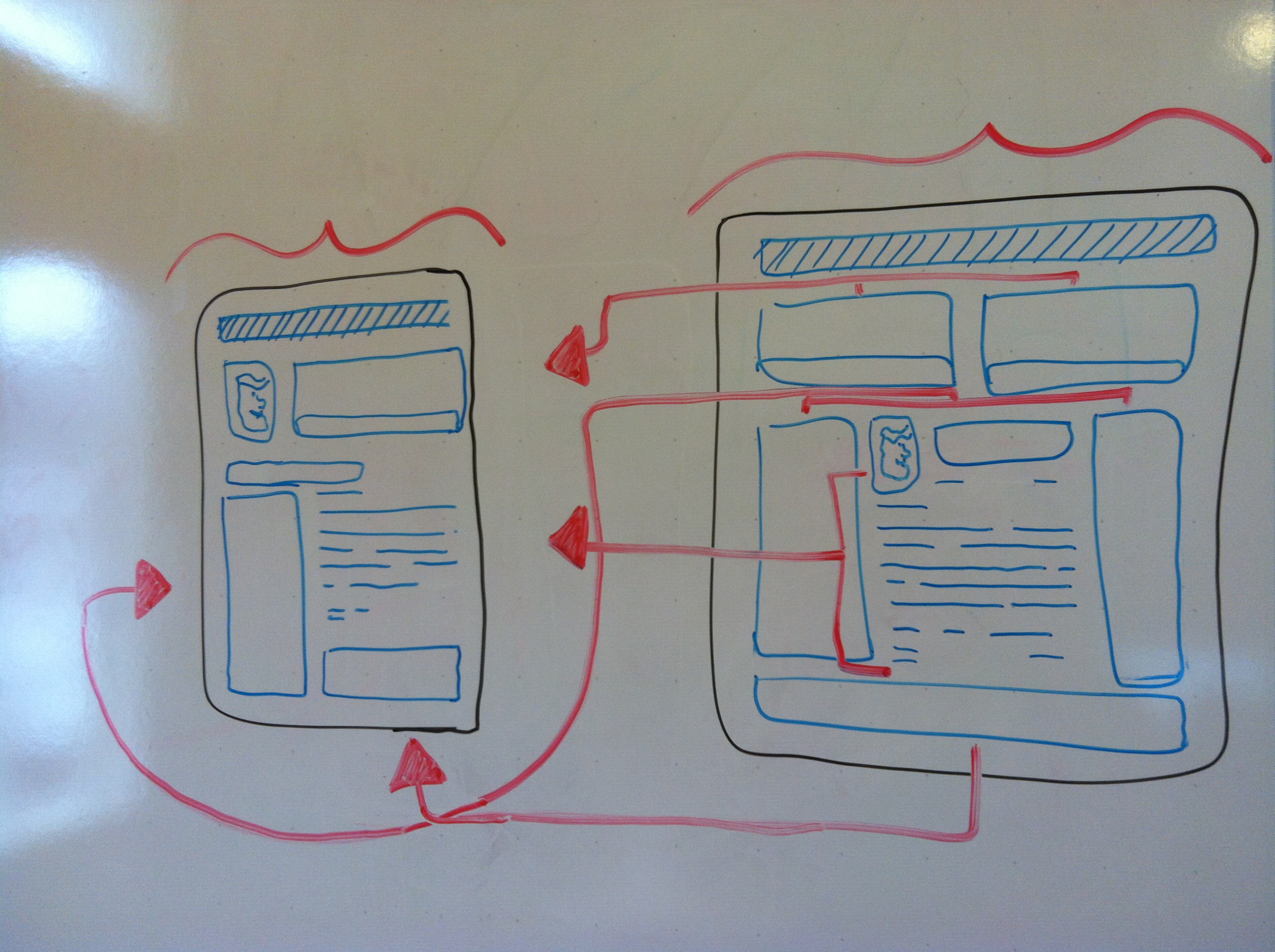

    Now wouldn’t it be great if your site just magically resized itself no matter what size the screen was and no matter what the pixel ratio was? I’ve beaten around the bush to get to the point, which is that responsive design using CSS (Cascading Style Sheets) can display your site according to the size of the user’s browser window. So whether your customer is on the latest iphone or tablet or wall projector, your site will handle it like a champ, displaying the site elements however you want them at that given size.

    Man, can it get any better? It actually does. Because you are using CSS instead of external files, which can bog down your site’s load time, it reacts in real time by styling itself. IT’S ALIVE!! If you’re on a desktop you can do a neat trick. You can actually resize your browser window and watch your site ‘take shape.’

    photo (1)
    With responsive design, you can change a website’s dimensions without worrying about the design elements.

    Use THIS SITE as an example if your site is not yet responsive. The elements on the page should ‘pop’ into new locations as it gets smaller/ larger. This ability to resize your site essentially free of cost it a great asset to your company and can save anyone, even smaller companies, big money.

    So responsive design has come a long way and still has a ways to go when it comes to the ever-expanding technologies and the shape of the web. Soon it will be as common term as “social media.” Now you should have a better idea of what people mean when they refer to sites being responsive, and the technical stuff won’t be as alien to you as before.

  • Find Out ‘What’s News’ in Miami, July 11-13

    It’s that time of the year again, when media gurus convene for the annual AAN (Association of Alternative Newsmedia) convention, which is set to take over the Miami scene July 11th-13th. The 3-day convention is jammed packed with speakers discussing the latest in media and news technology, including our very own Will Scott, who will be presenting that Friday afternoon.

    AAN
    “Networking, Inspiration, Innovations, and Parties” are what you are slated to find at this year’s AAN convention.

    In a time when the digital world is constantly changing and the concept of media is continually redefined, the 36th annual AAN convention is the perfect place to catch up with the latest and greatest. Top industry leaders, publishers, editors, and community organizers will be sharing their knowledge through presentations, workshops, and exhibits. The convention’s location in Miami lends itself to vibrant culture and alternative lifestyles, undoubtedly supporting the program’s 4 promises: Networking, Inspiration, Innovations, and Parties. Come out and see for yourself.

    Miami Cover
    The 36th Annual AAN Convention in 2013 is hosted by the Miami New Times.

    What exactly IS alternative newsmedia? The AAN prides itself on being a collection of news sources that focus on local culture and art, write in an informal and narrative style of journalism, and generally report on topics that are less likely to be covered by larger news providers. Think Washington City Paper, SF Weekly, and Miami New Times.

    So if we are talking news, why is Search Influence going to be there? For one, Search Influence is helping to sponsor the event! More importantly, digital marketing is a large part online media, and many companies leverage digital media sources to advertise their services and connect to clients. Will’s session will highlight “20 Quick and Great Digital Revenue Ideas” that anyone can easily implement. Come learn more about how your business can better use online media from Will and fellow industry leaders Friday, July 12th from 4:30 to 5:45 p.m.

    Recap: AAN 36th Annual Convention | Miami, Florida | July 11-13 | Networking + Inspiration + Innovations + Parties |Search Influence’s Will Scott

  • Penguin 2.0 May Not Be Done Just Yet

    Penguin 2.0 reconfigure?We’ve been watching Penguin 2.0 and its effects, and as a team we have noticed some fluctuating data that suggests the algorithm has not quite settled in yet.  In another blog post, I put it out there that rankings are not everything, and they are not the primary measure of success.  Ranking reports have known flaws, but they can be used as a weather vane.  When we look at the ranking weather for a few clients, we see some ups and downs, clearly with some effect from the most recent Penguin, but it appears that the players on Google page 1 are still moving around more than a month after the rollout.

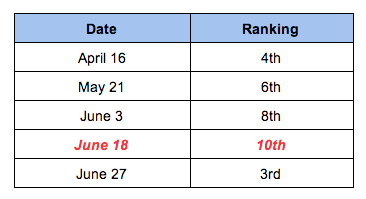
    When we look at a few examples, we see the musical chairs being played on page 1 with nobody being safe and comfortable for very long.  We’re watching rankings for a  plastic surgeon in New Jersey for the term “rhinoplasty New Jersey.”

    SEO for plastic surgery

    Here’s a summary of his rankings hopping all over.  His biggest drop was on June 18th:

    Rhinoplasty New Jersey

     The same client for “breast augmentation New Jersey” had more subtle changes, but they are meaningful.

    Breast Augmentation New Jersey

    So it looks like he got a little hit from Penguin 2.0, but may be rebounding.  We have done nothing out of the ordinary for this surgeon to move his site from 10th to 3rd in just nine days, so we make an assumption that Penguin is still adjusting.

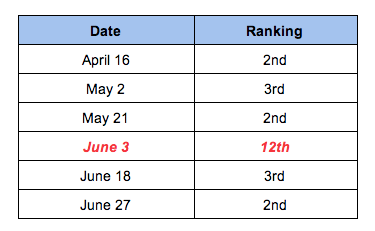
    Another example in ranking fluctuations for “Columbus allergist” is in a doctor’s rankings seen below.  His biggest decrease was on June 3rd vs the guy above who got the hit on June 18th:

    Columbus Allergist

    Rankings Aren’t Everything!

    Rankings are not the only measure by which we watch successes and failures. Organic traffic is another layer of data, and in some organic traffic trends, we see noticeable changes around June 3rd then again around June 18th.

    The client represented in the chart below is a cocktail bar in the South.  They saw a dip in organic traffic after May 22, but they enjoyed an unexpected bump in early June (the traffic dropped off again after that early June peak, but what I want to know is what’s behind that weird little bump up earlier on?):

    Penguin 2.0 adjustment in early June?

    The next example is a traffic bump around June 18th.  This client is a completely different business on the west coast.  We see a little effect from Penguin, then a weird spike:

    Penguin 2.0 adjustment June 18th?


    And Then There Are Other Data Too

    Bounce rates before and after Penguin 2.0It gets a little fuzzier when you start looking at Bounce rates and Time on Page and these data in Analytics.  Who’s to say that these increases or decreases are a direct effect from Penguin?  You could argue your site is having better or worse quality traffic because of ranking and where your site now shows up vs where it showed before Penguin.  You could argue lots.  All I know is that 3 of the 4 clients mentioned above saw an improvement in Bounce rate after Penguin.


    Bounce rates before and after Penguin 2.0 2013Bounce rates improved after Penguin 2.0

    So … what?

    I’m not convinced that Penguin 2.0 was a one time algorithm update, it did its thing on May 22nd, and we’re experiencing the good or the bad or the indifferent.  I think it’s still shaking out, and we may still see a few odd spikes or odd drops in ranking or traffic or some other data.  We may have a few more weeks before websites settle into a relatively comfortable placement on page 1, and it is only then that we can claim some clear understanding of the full effect of Penguin.

    And because Penguin 2.0 is still reconfiguring, it may not be time for drastic action.  If your site is experiencing some definite ups and downs, then yes, you should look at your backlinks quality, the anchor text quality, internal links, etc.  All of this stuff is covered in many other blog posts.  You should have been long ago working on authoritative backlinks and building up your social cred.  But it’s not time to throw up your hands, and just Disavow everything. It’s not time to scrap your website and start with a brand new domain and design.  Take some time to digest what’s going on before bulldozing ahead.

    What I would really like to know is if anyone else noticed definite odd fluctuations around June 3rd and June 18th.  Or if you noticed unusual changes at anytime after May 22nd.  Leave a comment, and let us know.

  • 4 Ways to Build Your Local Presence

    Jun13Hometown support can keep your small business going through difficult times, and can be beneficial to your community. The people who live in your town aren’t just friends and neighbors; they’re also your customers—or they should be. If the locals in your city don’t know your business exists, it’s time to put some work into building your small business presence around town.

    Show up in Local Search Results

    When people want to find a good pizza place while driving around town, they pull out their smartphone and do a quick search for pizzerias. About a quarter of all Google searches have “local intent,” meaning they’re aimed at finding results nearby. Whether you show up in search results is not something you can afford to leave to chance. Claim your spot on Google Places for Business, Bing Places for Business, and Yelp to place in those results

    Once you sign up for those services, you can manage your business listings. Include high-quality photos when possible, and fill out all the information you can. Make sure you include your hours of operation, all means of contacting your business, and your website’s URL, if you have one. Double check to ensure your information is exactly the same in every place it’s listed. Don’t be afraid to post a sign in your business or place a link on your website asking happy customers to leave feedback on those sites, as well.

    Give Back to the Community

    Six out of ten entrepreneurs feel philanthropy has made their businesses more successful over time. Eighty-nine percent of them donate money to charities personally and through their companies. The size of your company will affect how much you can give, and in what ways. Many entrepreneurs form their own non-profits to benefit a cause close to their hearts, but you can find many smaller ways to help.

    Some potential ways to give back include: a company volunteer day; customer donation requests or a donation box; sponsoring a community team or event; offering a mentorship or internship program in collaboration with local schools; and pledging a percentage of your profits to a certain charity. If you can, come up with a way to donate that’s unique to your business.

    Join the Chamber of Commerce

    Sometimes businesses overlook their local chamber because of the membership fee, but the price to join may be well worth your investment. In addition to being listed in their materials, you can network with other members, and participate in community events. Become an active member, and your face and brand will become more recognizable to the community, leaders, and other business owners.

    Being a Chamber member can also boost your reputation. In fact, nearly a third of people believe member businesses to be reputable, and to have good business practices. Consumers are 63 percent more likely to purchase from a small business who’s a chamber of commerce member.

    Earn Trust

    Conduct your business in a trustworthy manner and you’ll earn happy, repeat customers, positive online reviews, and referrals. Earning the trust of your community requires more than just delivering on product promises. Local businesses must build more personal relationships with their customers. Learn your customers’ names, and use them. Send customers postcards with special offers for being loyal to your business.

    As a local business, you have the unique opportunity to really listen to and address the concerns of your customers. Keep communication flowing, and always follow up with your clients. These are perks big businesses can’t offer, and they’ll go a long way toward building your local reputation as a trustworthy business.

    Local presence is key for business owners who want lasting relationships with the customers in their region. The trust, availability, and value your business can bring to the table not only help ensure a solid customer base for you, but enrich the overall vibe of your city. Make sure you can be found easily online—and off—to become a vibrant part of the fabric of your community.

    Diana Doherty is a freelance writer specializing in SEO content, and is a contributor to ChamberofCommerce.com. She loves all things tech, photography, craft, military family life, and business. She earned her BA in English Writing Arts from SUNY Oswego.