Tag: small business

  • These 10 Expert Tips Will Drive Traffic to Your Business’s Website

    Grow Your Business Graphic

    It doesn’t take a web expert to know that more traffic to your website means more business. However, researching ways to improve your online traffic isn’t always easy. We asked our in-house experts for their thoughts and came up with these ten ways to drive traffic to your website.

    1: Implement Schema Markup and Rich Snippets on Your Site

    Schema Markup is structured data that labels existing elements on your website so search engines can better understand the content. Essentially, when Schema.org markup is implemented into your website’s HTML source (the only place where it should be visible), it clearly defines specific parts of your content, such as your business address and telephone number.

    Rich Snippets are a structured data markup only recognized by search engine algorithms. When used on appropriate content, Rich Snippets can show exact content from a website on Search Engine Result Pages (SERPs) of search engines like Google, Yahoo, and Bing. These snippets are the few lines of text under every search result. For example, if you run a medical practice that wants to advertise its high rate of patient satisfaction, you can markup content from patient testimonials so that your glowing reviews show up when people search for doctors in your area.

    Healthgrades Screenshot

    2: Improve Your Site Speed

    Site speed is the amount of time a page needs to completely load. This matters for both users and search engines, as users are less likely to stay on a website that takes a long time to load and search engines will penalize your website for being too slow. Google’s PageSpeed Insights Tool is a great way to analyze your site for ways to improve your site speed and will provide you with detailed information on how to fix each issue.

    3: Use Google Search Console

    Google Search Console (formerly Webmaster Tools) allows you to indicate to Google the various details of your site. A very important part of this process is submitting your sitemap so that search engines can better crawl and categorize your site—if you haven’t done this yet, you should! Search Console will give you a report on the average ranking of your website on SERPs for specific search queries. These reports will let you know what you should be improving on your site to gain a high position and click rate.

    4: Publish Press Releases

    Press Releases are great when you have an announcement to make or a story to tell. They’re also highly useful for helping you own your business name in SERPs. Sites like PRWeb and Cision will distribute your press releases for you and get them published on news sites and blogs. For a little extra money, they’ll also send your release to journalists and bloggers, in hopes that they’ll publish it on their sites as well.

    5: Perform On-Site Link Building

    Internal Linking is a link from one page to another on your website. This process fosters a great user experience, as anyone visiting your site will find themselves easily hopping from one page to another without having to really search for the information they’re looking for. Search engines like Google are very focused on user experience. Good internal link building helps googlebot understand the relationship between pages, among a set of content.

    6: Perform Off-Site Link Earning

    By submitting your website to online forums, specifically those that pertain to your business’ physical and professional communities, you’re naturally increasing the chances that someone will visit your website. Engaging on social platforms like StumbleUpon, Reddit, Digg, and Delicious can be more valuable than you think.

    7: Perform Off-Site Citation Building

    Similarly to off-site link earning, submitting business listings to niche directories (industry & categorical), data feeds, major directories like Google, Yelp, Bing, Foursquare, YP.com, and secondary directories like Merchant Circle, HotFrog is a great way to drive traffic to your website.

    8: Syndicate Your Videos

    It’s no secret that having a YouTube channel filled with optimized videos drives up web traffic. However, you should also syndicate your videos across other sustainable video channels, such as Vimeo and DailyMotion. Videos will earn links and citations on social sites because they’re highly shareable. These increase link source diversity.

    9: Post and Promote on Social Media

    This may seem like a no-brainer, but you would be surprised by how many businesses don’t actually do this. Paying for promoted posts on Facebook offers a relatively inexpensive way to get your business in front of target consumers. Facebook also offers radius-based targeting for ads, which lets you target people who are/were:

    • Living in your area
    • Located in your area
    • Recently visiting your area
    • Traveling to/in your area

    Posting and promoting isn’t limited to Facebook, though! LinkedIn and Pinterest are other examples of great social media sites that are perfect for driving traffic to your website.

    10: Be a Resource in Your Industry Through Sharable Content

    It’s one thing to be ahead of your competition, but it’s another thing entirely to be an industry thought leader. You can do this by creating shareable content. For example, you MUST have a blog. Your blog should be on site, not offsite. If your website is hosted on a CMS like WordPress, then you can easily integrate a blog within your existing site! Not only does blogging build authority for your brand and show off the human side of your company, but according to Hubspot, businesses who prioritize blogging experience 13 times increase in ROI.

    You should also start to create infographics. They combine easily digestible—but valuable—information with a visually appealing information, making them highly shareable across all social media websites. For example, this infographic, created for a medical directory, was shared more than 900 times, got more than 300 Facebook shares, and was pinned more than 150 times.

    Want more information? Watch our recent webinar for more information and tips.

  • Make Your Social Media Strategy Sizzle with Summer-Focused Content

    Summer Promotions

    How Is Summer Different than the Rest of the Year?

    Warmer temperatures make people more active in the summertime. With kids out of school now, many families will take at least one vacation over the next few months. And since 81% of Americans save money specifically for the summer season, there is more opportunity for your business to gain customers and grow.

    What Can a Small Business Do to Stand Out?

    Larger, national brands don’t have to work as hard to benefit from the seasonal surge, but small businesses can also succeed through social media campaigns. Using location-specific social media, optimized pages, and summer-focused content, you can take your business to the next level this summer.

    What’s the First Step?

    The first thing on your summer to-do list: claim and optimize your social media pages. Yelp, Facebook, Twitter, Google+, and Instagram will be the heavy hitters this summer. Google+ and Yelp both require verification, so you should start this process immediately. Facebook, Twitter, and Instagram don’t have lengthy verification procedures, but they should be optimized with branded images to familiarize users with your business. All of these sites also need to link to your main website and other social media profiles if applicable. Alternatively, you’ll also want your website to link to your social media profiles for quick and easy connections. Now that the website and social media interlinking of your business is setup, the real work starts.

    My Profiles Are Optimized, Now What?

    Now it’s time to get to work. The theme is summer, so your posts should reflect the season. Here are a few content creation tips:

    • High energy and fun
      • Summer is all about having a great time, so your posts should reflect the sweet summertime mood. There is no set formula for social media posts. You need to experiment a bit to find out what attracts the most engagement from your audience. Mix it up and show your employees having fun on top of working hard.
    • Holidays and events
      • Independence Day and Labor Day are two major federal holidays during the summertime. If your business is open on these days, make sure to post about your hours of operation. Social media is also a great, free way to notify your customers about holiday promotions.
      • Keep a close eye on your city’s calendar of events, and try to coordinate promotions and posts accordingly. Here in New Orleans, we have this handy calendar provided by New Orleans Online. A fashion boutique, for example, could take advantage of the upcoming outdoor festivals and offer a sale on tank tops, shorts, sunglasses, and other festival gear. Food vendors at the same festival can get a lot of social media interaction if they post pictures of their fan’s favorite dishes.
    • Deliberate engagement
      • In between selfies and status updates, social media users are constantly scrolling through their timelines. Make yourself not only appear but also encourage interaction by asking fans to like, share, or tag a friend. Users love to engage with their favorite brands, but make sure you have someone on deck to respond.
    • Encourage locals and tourists
      • Large brands or franchises may have the backings of national companies, but small businesses have the strength of the ever-growing “Go Local” trend that swept the nation this past decade. You should highlight your locality in your posts. Some locals prefer to patronize businesses that will stimulate the local economy, and many tourists are searching for the more “authentic” local experience.

    These tips will help make your social media outlets stand out instead of getting lost in the ever-growing sea of likes.

    Sounds Like a Lot of Work

    Nothing ventured, nothing gained. Take it from the pros: Social media optimization is a complicated and time-consuming undertaking. Research provides insights into your industry’s most successful social media approaches, and then the posts are written, edited, and published on a timeline that encourages engagement from your target audience. Search Influence offers a full range of social media optimization services including content creation, brand management, and graphics creation. Now is prime time to prepare your business for the upcoming season, and we’d be more than happy to help out.

  • Paper Vs. Digital To-Do Lists? Influencers Give Their Opinions

    1608-SI-TheInfluencer-KL-A-05Large

    If you take a moment to look around today’s workplace, you will probably notice two sets of distinct people: those that use technology for everything, including their to-do lists, and those “old schoolers,” who embrace technology but are quick to pull out a tablet and pen to write down everything they need to do. I wanted to find out more about this phenomenon here at Search Influence, so I interviewed four colleagues to get the scoop on how they complete their tasks. Here is what I found out.

    Influencers:

    • Chris Roberts – Software Developer
    • Jensen Quadros – Account Associate
    • Presley Brouillette – Account Manager
    • Mary Silva – Internet Marketing Team Lead

    How do you get your projects done on time? Do you prefer writing your to-do list down, or do you use an online reminder system?

    CR: Dev Team uses two software programs, Trello and Pivotal, to keep track of projects. We check these routinely throughout the day and keep most project related information stored there.

    JQ: I prefer writing down my task list on a notepad. All the work we do is on the internet and all of our systems are on the computer, so being able to write a to-do list down is something I like. I get all my work done on time by making sure I’m getting as much crossed off of my list as possible by the time Friday comes around. Sometimes, I put items with later due dates on my list just in case I have extra time to get ahead.

    PB: I don’t have an online reminder system; however, I just use a Google Sheet and type everything in there. Each day, I highlight the things that I need to get done that day, whether it be client related, internal project related, or follow ups. That way, I know how I should manage my time. If for some reason I cannot get something done, I will re-date it for tomorrow and make it a first priority.

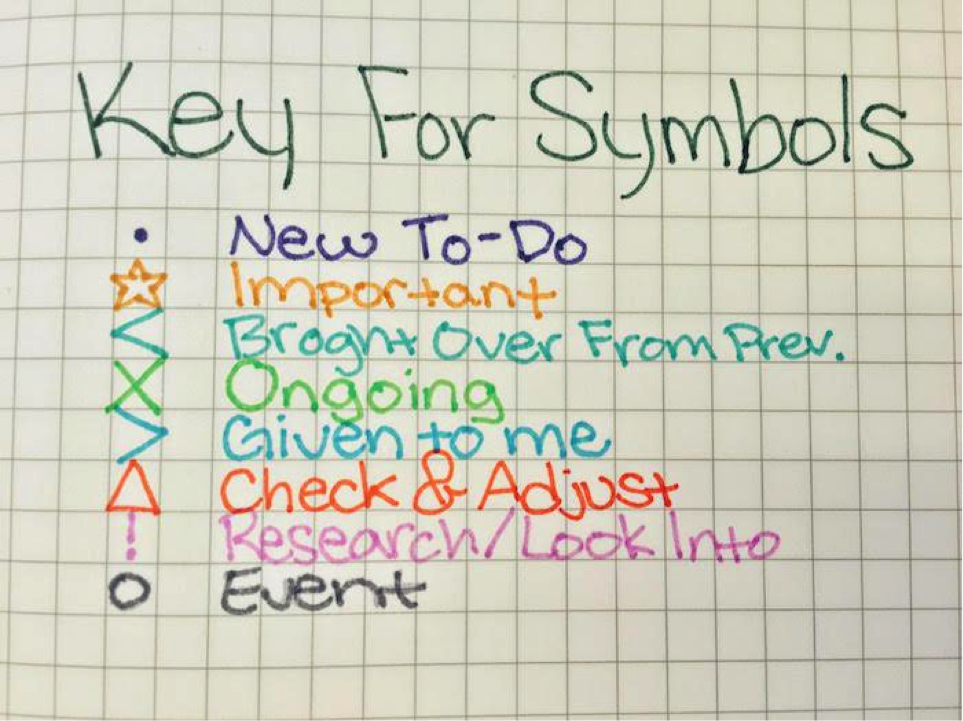
    MS: HANDWRITTEN TO DO LISTS ARE THE BEST! I use a journaling bulleted list system—but I developed some of my own symbols outside of traditional bullet journaling—in my Search Influence Moleskin.

    How does your organizational system help you or your team stay organized?

    CR: It facilitates collaboration between team members and visibility to management, plus our team is familiar with these two systems.

    JQ: I use this list system because I like having a physical copy of my list in front of me at all times. I frequently have lots of different tabs and windows open, so even if I did keep my to-do list in a Google Doc, I wouldn’t be looking at it as much as I look at my physical copy. I also like organizing my list by client because, when I check on each client’s campaign to create my to-do list, I get an idea of where the client is overall. Thus, I’m not blindly writing down tasks on my list; I have an understanding of where each task item is in the scope of the client’s campaign. This is especially helpful when you’re working in account management.

    PB: The best thing about having something in a spreadsheet is that you can link directly to other things. Because we work in online marketing, most of the things we do are online. That being said, in my spreadsheet, I can directly link to client websites or our internal task management systems.

    MS: I prefer a handwritten to-do list for two reasons. For one, I think actually writing what I have to do down helps me think through things more critically and also helps each thing on my to-do list stick and stay top of mind. The other reason I prefer writing my to-do lists is that in my role working on the technical production side of Search Influence, I often have at least 20 tabs or windows open in Chrome and ten applications open on my computer throughout the day. Having a digital to-do list would add to the clutter and also make it harder to navigate to quickly. I like being able to just look down at my bullet journal and get to my next to-do easily. Bullet journaling in particular is great because it works well for longer to-do lists—I often have 30 to-dos on my list a day. It allows me to get everything down as it comes up while still prioritizing along the way, not having to create a new list as new things come like you would for a chronological-type list where the first thing is highest priority.

    How do you prioritize your to-do list: by importance or by due date?

    CR: Currently, our managers meet weekly to prioritize software tasks.

    JQ: I prioritize by order of importance and by due date. I have an understanding in my mind of what items will be most important to get done by each day of the week. It’s really common for other things to pop up in the middle of the day and divert my attention from my to-do list, but after I’m done with the one-off item that needs my attention, I go back to my list.

    PB: A little of both. I highlight everything that has a due date of today. From there, I prioritize things by importance.

    MS: The bullet journaling makes prioritization easy. Here’s a picture of my “key” for marking objects:

    Bullet Journaling

    I don’t usually color code my actual lists because the symbols themselves are great enough to easily differentiate to-do list entries. The symbols not only allow me to tell that obviously something that has a star next to it is really important but also indicate that something with an exclamation mark, which means to research or look into something, might take longer and be less time sensitive. So it might also be lower priority.

    How often do you update your to-do list?

    CR: Multiple times a day.

    JQ: I update my to-do list once a week. Every Monday morning, I spend a good bit of time checking through each client’s campaign. After I figure out what items need to be completed for the week, I start working right away.

    PB:  Literally all day, everyday! Nothing better than deleting something that you completed!

    MS: Daily. When I create my new list for the day, new items are marked with a dot. For old items, the dot becomes a left facing angle bracket (“<“), indicating that I let it go a day and therefore increased its priority. I also just really enjoy the satisfaction throughout the day of physically crossing things off my list when they’re done.

    What would happen if you lost your to-do list system?

    CR: We would probably attempt to recover the data and switch to another system.

    JQ: If I lost my to-do list, I would have to create another one. However, I wouldn’t want to do that because I spend a lot of time creating my to-do list!!

    PB: I don’t even want to think about it. Die from a heart attack probably.

    MS: I’d probably forget to do a few of the things, but generally since I hand write my lists, I think I have them pretty firmly etched in my brain.

    Feature Image Credit

  • From Europe, with Love: A Marketer’s Guide to Capitalizing on Tourism

    1601-SI-Newsletter-0112-Big-KG-B-01

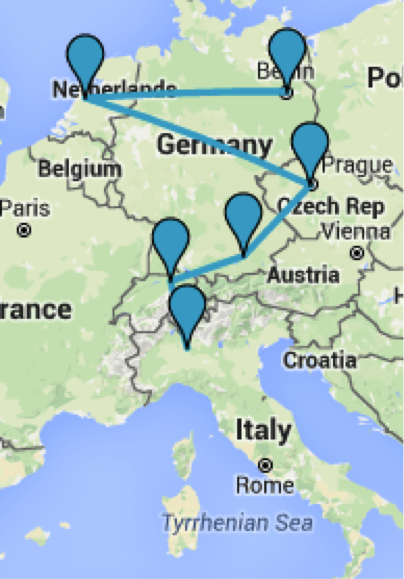
    I recently took my first ever solo trip and explored six European cities in two and a half weeks. On my trip, I realized the importance of tourism for small businesses. Every tourist needs places to stay, food to eat, and things to do while visiting—and that leaves a big opportunity for businesses, especially on search (and social)!

    MB 1

    Let’s take a look at my search (and purchase) journey, starting at the very beginning.

    Selecting a Destination & Finding Places to Stay

    One of the most important parts of going on a solo trip is making sure you are going to the best places, and going in the most efficient order. At Search Influence, we help city tourism and marketing organizations, like New Orleans, and I can attest to the importance of the work we are doing. How else would I have discovered Milan, Zurich, Munich, Prague, Amsterdam, and Berlin!? Truth be told, I also used the recommendations of friends, Redditors (read: opportunity for businesses), and Rick Steves to solidify my plans. When it came time to decide, looking at the city tourism websites helped me to make my final decision.

    MB 2

    The next toughest part of preparing for the trip was finding places to stay. Solo travelers feel a lot of pressure when picking hostels, or Airbnbs, because it can have a huge impact on your trip, and on your impression of the city. I have personally never paid so much attention to reviews in my life! The thought of picking a hostel that didn’t seem 100% right was frightening. I wanted to make sure they had Wi-Fi (everywhere, not just in the lobby) and were clean, in a good location, and recommended by other travelers on HostelWorld and Reddit (Pro Tip: if you search the city name + “hostel” you can find some awesome recommendations from Redditors). The most surprising thing for me is that after the fact, Airbnb was the only one to push for a review. While I am going to go back and leave reviews everywhere else, I thought this was a missed opportunity.

    Searching Abroad & What You Can Do to Attract Tourists

    Now, let’s find some organic online marketing opportunities using some of my search history, which I like to think of as representative of many travelers.

    • should i get the berlin tourist pass
    • van goh vs rijksmuseum
    • indonesian restaurant amsterdam
    • caridejuv ucen opera
    • u modre kachnicky
    • bike tours munich
    • rashes on legs
    • jungfraujoch trip from zurich
    • malpensa to ostello bello

    Based on this mishmash of tours, museums, restaurants, skin ailments, directions, etc., there are a few strategies you can adopt in order to acquire traveling customers. I would try to build trust with the customer in the organic search results, and to take it a step further, I would use paid ads to target them for likely-to-convert terms.

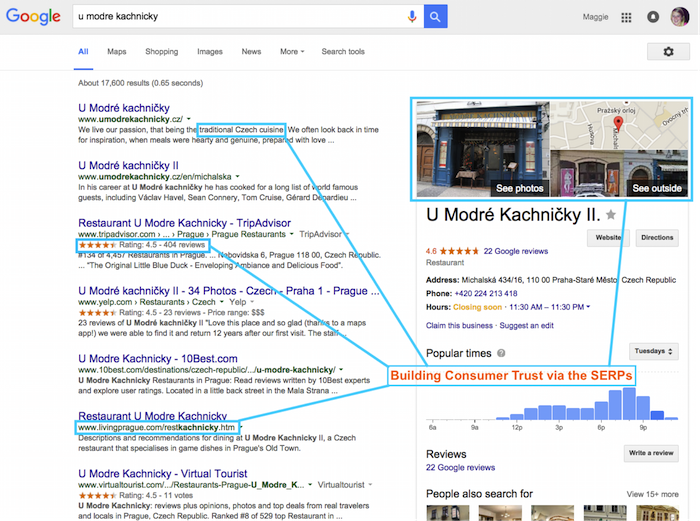
    Organically, you can build trust and authority with potential customers. In the screenshot below, the restaurant dominates the branded search result, which can build a sense of trust with someone who doesn’t know much about the area. My favorite tactics include the ones below:

    • Relevant meta data
    • Large numbers of positive ratings (on trusted sites with Schema markup!)
    • Local directories
    • Clear photos of the front of the restaurant
    • A correct map on Google+
    • Features on travel blogs
    • Active social media profiles (not pictured)

    MB 3

    By showing authority online (on and offsite), you can capture and convert a tourist (with money to spend) into a customer. You may even have an impact on locals, tourists trying to be locals, and the special breed of traveler who goes around touching statues for good luck!

    MB last

  • Search Influence Will Give One Of These Businesses $10k. Who Should It Be?

    1512-SI-Newsletter-1229-Big-KG-A-01

    Search Influence is proud to be celebrating our 10th year of helping businesses succeed online. We can think of no better way to celebrate our 10-year anniversary than to give away $10,000 worth of free online marketing services to one lucky Louisiana-based business. It’s our “Make Your Dreams Come True” contest, and we need you to help decide the winner.

    Our five finalists are as follows:

    The grand prize winner will be chosen based on the number of votes each finalist receives via Search Influence’s Facebook contest page between now and January 8, 2016. People can vote daily, so please make sure to visit often. The winner will be announced on Wednesday, January 13th at Search Influence’s 10-year anniversary celebration in New Orleans.

    Good luck to our five finalists!

  • The Easy Guide to Holiday Marketing: Four Tips to Help Land Last-Minute Shoppers

    The Black Friday frenzy might be over, but that doesn’t mean people are done shopping. If your customers are anything like me, they’ll be walking through your doors at noon on Christmas Eve.

    So how do you score the last-minute shoppers? Here are a few easy, last-minute marketing tips to help your business succeed this holiday season:

    Last-Minute Holiday Gift For Marketing Blog

    1. Go Mobile

    According to Think with Google, 28% of all holiday retail sales were influenced by shopping-related mobile searches last year. Having a mobile-friendly site weighs heavy in user experience; users can better navigate your inventory, contact you, and see what kind of holiday deals you can offer them.

    2. Utilize Social Media

    Utilizing social media sites like Facebook, Twitter, and even Instagram can be a great way to draw customers into your brand. Showing them their shopping options and being easily accessible is a way to set your business apart in such a busy and competitive season.

    Last Minute Holiday Present For Marketing Blog

    3. Tailor Your Content

    Tailor your content specifically for the holiday season. Your social posts should be helpful to the customer, something along the lines of “We’ve picked out the perfect gifts, so all you have to do is buy them!” Your posts shouldn’t add to the stress of their last-minute shopping. Website content should feature holiday hours, holiday shipping notifications, and anything else that might affect a customer this holiday season.

    4. Make Your Business Stand Out

    Offering incentives like free shipping, free gifts with purchase, and giveaways can help your business stand out among local competitors. Advertise these incentives on your site, social channels, and in your store. With so many ways to reach your business, you want shoppers to easily know why they should choose you over a competitor.

    Use these four super quick and easy ways to better market your business this holiday season.

    Image Credits:

    Orange gift

    Red gift

  • Will Camp Out for Marketing Tips: Your Black Friday Survival Guide

    1

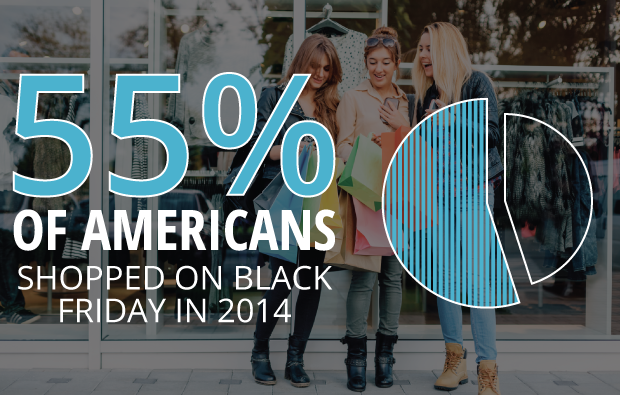
    November is here! A month full of falling leaves, dropping temperatures, giving thanks, and many people’s favorite shopping day: Black Friday. Last year, 133.7 million people shopped during the Black Friday weekend, according to a Fundivo.com study. As a local business, you may be trying to get a piece of the Black Friday pie this year, but you might not know where to start. Follow these tips to make the most of your online marketing efforts on one of the busiest the shopping days of the year.

    Plan Early

    The time to start thinking about marketing for Black Friday is now. If you traditionally experience a high volume of customers and sales during this time, like a retail store, you won’t necessarily be able to think about your marketing plan as you’re stocking extra inventory a few days before.

    One of the first things to decide is what your business is going to offer for Black Friday. Is it going to be a storewide sale? Will you sell a product you don’t typically offer? Consider your goals and determine what makes the most sense for your business.

    Get the Word Out

    Once you’ve chosen your Black Friday offer, you need to let people know about it. By promoting your offer online, you’ll be able to reach significantly more potential customers than by promoting it in-store alone.

    If you don’t have extra budget specifically for your Black Friday offer, use social media to connect with your fans. Stand out amongst competitors by posting images of products that will be available during your sale or offer an online-only incentive to entice shoppers to stop in on Black Friday.

    If you’re willing to put a bit of spend behind your efforts, Facebook advertising is an affordable alternative to a costly pay-per-click campaign. You can use their impressive targeting options to get your message in front of your specific demographic. Facebook targeting ranges from gender, age, and location to education, income level, interests, shopping habits, and more.

    Also, consider adding a page to your website with information specific to your Black Friday offer. That way, anyone scouting out sales in your area beforehand will know exactly what to expect from your business.

    Be Creative

    Black Friday isn’t just for retail. Although retail stores tend to see the majority of the action, it doesn’t mean other industries can’t jump on the bandwagon.

    Not everyone loves waiting in line overnight and battling crowds all day, but who doesn’t love a bargain? If you’re a service area business, reward your customers for being productive with home maintenance on Black Friday by offering discounted service or installation. Since many people take the day off work, it’s a great time to take advantage of gaining some extra business.

    Restaurant offers are also a great way to capitalize on Black Friday foot traffic. Let customers know ahead of time that appetizers are half off or you’re offering happy hour prices all day so they know where to go when they need a break from the shopping crowds.

    Make sure your business is taking full advantage of Black Friday this year by creating your marketing plan early, making your offer known, and utilizing creativity to gain more customers.

    Image Sources:
    Jingle All The Way
    Glee
    Gossip Girl
    Shopaholic

  • Stalking, Espionage, and More: The Guide to a Successful B2B Marketing Campaign

    Dealing with business to business, or B2B, clients in search engine optimization, search engine marketing, or social media can be challenging. There is an extra layer of difficulty associated with a technical business that you don’t typically have when working on B2C campaigns.

    The key to starting a B2B online marketing campaign is to focus on your business. Having a jumping-off point of information also allows you to craft thoughtful questions to ask in your initial meeting. Here are some easy things you can do to understand a technical client’s business and industry (besides scouring their site).

    Understanding the Client

    1. Watch the Tube – I love watching YouTube videos that my clients have created. Industrial clients tend to be good at showing off their technology via video. It can be super insightful, and it may help with your strategy down the road.

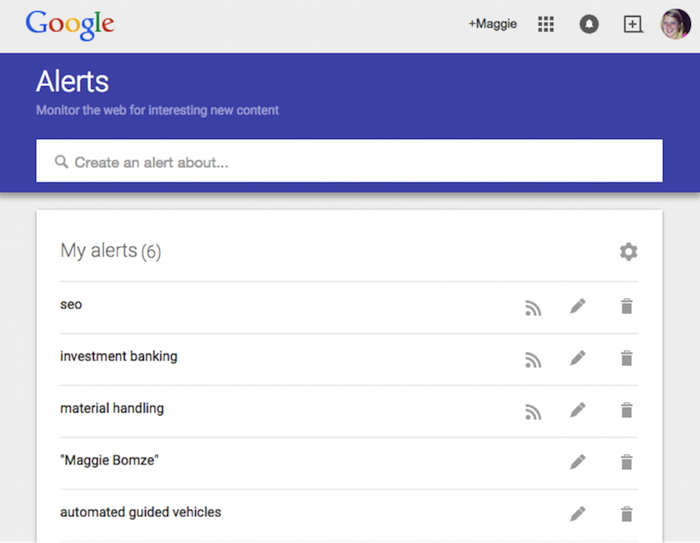
    2. Set up a Google Alert – Reading up on industry news can initially help with learning about the B2B client, and it can be informative later on when you need ideas for social media posts and press releases. (Side note: I think it’s 110% acceptable to have a Google Alert about yourself, so go on and set that up too.)

    MB Blog 1

    3. Do Some Stalking – Head over to LinkedIn to find out who you are going to be speaking with and what their background involves. I’ve also gone as far as joining engineering groups on LinkedIn to see what people in the industry are talking about (and more importantly for SEO and SMO, what types of posts get them engaged). I would also advise checking out any professional associations, charity organizations, and conferences where they regularly attend or present.

    Reaching the Client’s Customers

    1. Infiltrate the Buying Center – Find out (most likely by asking) which industries the client works with, and ask the right questions to find out who the decision makers are in the buying process. This can help you with ad targeting and creating relevant content for C-level buyers vs. operational team members.

    2. Find the Trigger – I always ask technical clients about their sales cycle, and most importantly, what triggers the need for our client’s goods/services. It is helpful to know what other businesses are going through and where search engine optimization fits into the B2B marketing plan.

    3

    Relaying that Knowledge to Your Team

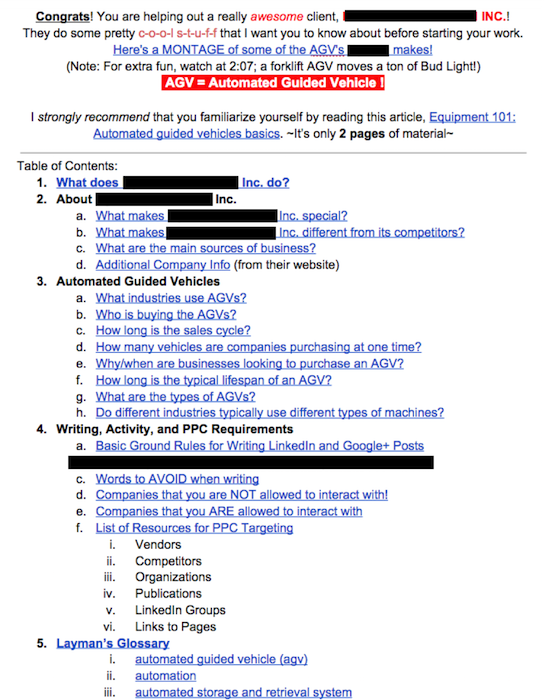
    1. Shout It from the Rooftops – Let the appropriate people on your team know the information they’ll need in order to produce the highest quality work for your client. This might be the hardest part of a B2B marketing campaign. Ask anyone on my team: I’m guilty of giving everyone all of the info I have on a super-technical topic! One short-term solution is to keep an ongoing “Everything you need to know” doc and organize it through bookmarks. This way, your team can quickly get to the info that impacts their task.

    MB Blog 2

    What are some of your tips for working with B2Bs in SEO? Let us know in the comments!


  • A Little Bit Goes a Long Way: Small Steps For Improving Your Online Presence

    Establishing your online presence can seem like a daunting task for small businesses or those who are less knowledgeable about the tech world. Fortunately, there are a few simple ways to market your brand and engage your customers without the hassle. Taking actions like creating social media accounts, keeping your content relevant, and being proactive are valuable ways to attract and keep prospective clients and customers.

    Create Social Media Accounts

    One of the easiest ways to promote your product or service(s) online is by interacting with current and potential customers. A good way to do that is through social media. In the last decade, the social media world has exploded in popularity. Social networking services such as Facebook, Twitter, and Instagram (because who doesn’t love artsy photos of…things) are just a few simple ways to promote your brand while giving you the opportunity to interact with potential clients. The best part about them? They’re free and can be set up in just a few easy steps. Sharing content on your social media account allows you to not only communicate with current clients or customers, but it may also lead those consumers to share it with those who wouldn’t have seen it otherwise.

    Keep Your Content Relevant

    Whether it’s on your social media accounts or your website, it’s important to keep your content fresh and up-to-date. There are few bigger turnoffs to online users than seeing out-of-date information about your company. Offering a new product or service? Customers should know about it (and let’s be honest, you definitely want them to). Moved to a new location? Be sure to change your address. No one wants to get to your “location” only to find out that you’re no longer there.

    CC1

    Be Proactive

    If you’re famous, it’s probably best to avoid reading what people are saying about you online. If you’re a business, you better be. Read online reviews to find out what is or isn’t making your customers happy, and make any necessary adjustments when possible. Engage with your customers directly to show them that you hear them and are working on ways to improve a product or service. Think like a customer. What were some experiences that caused you to support or abandon a certain brand or business? You can’t make everyone happy, but you can certainly take steps to appease the majority.

    There are many other ways to improve your online presence, but these are just a few, easy steps to get started. Interacting with consumers through social media, providing relevant and up-to-date content, and getting proactive will help you to market your brand in a digital world.


  • Retool Your Online Presence: 3 Tips for Small Auto and Home Repair Businesses

    Everyone can relate to the frustration surrounding a defunct air conditioning unit or a well-traveled car falling apart—which is part of the reason why HVAC and auto repair companies are ubiquitous, particularly in the small business arena. As it stands today, there are over 1 million home and auto emergency companies represented in the U.S. alone. With such a large presence, it may be difficult to stand out, particularly in the ever-evolving world of digital marketing and search results. How does my company get noticed?

    Thrive Analytics, a digital marketing research company, sought to shed some light on this question. Their research indicated that while the fastest-growing methods of business awareness were related to digital platforms (websites, social media, e-mail), 60% still spent the majority of their media budget on traditional types of marketing (newspapers, yellow pages, direct mail).

    Additionally, their polling discovered that only 53% of these businesses had and maintained a website. However, the majority of those sites were archaic by today’s standards, and even more so when considering the ever-growing importance of mobile searching. Suffice it to say, many businesses in these industries do not get the maximum return from the growing digital market. So how can you counteract this?

    1. Develop and maintain an up-to-date and mobile-friendly website.

    The Local Search Association announced early this year that mobile searches have surpassed computer searches in terms of volume. Also consider this statistic from that same press release: “70% of the nearly $18 trillion US GDP is driven by consumer spending that occurs within 20 miles of home or work.”

    This is an extremely important factor for businesses servicing people’s homes and vehicles, since they are reliant on proximity. Your business will run the risk of losing a market share locally that is becoming more and more dependent on search results for information.

    2. Find your presence on social media.

    While many businesses have a presence on social media sites, it takes more than mere existence in order to drive customers. Staying on top of your social media with relevant content and attractive profile and cover images is more important.

    This is also applicable for mobile users. According to comScore’s 2015 U.S. Mobile App Report, the amount of time people spend on digital media has increased 50 percent over the last two years. Social media platforms are a huge part of this number—with Facebook ranking as the #1 smartphone app by total time spent. In an industry where social media usage is often stale or non-existent, this can be an opportunity to differentiate yourself and grab attention.

    3. Think about how you are spending on marketing.

    Sure, traditional marketing methods are comfortable and certainly have merit, but if you are trying to reach a new customer base, it would be foolish to not consider the shifting search demographics. Of the businesses polled in Thrive Analytics’ report, 37% of responders said lack of experience with online media was their biggest apprehension, while 27% said it was time. This is where it make sense to enlist the help of a company that understands the market and can help maximize your presence. It does not need to be a task directly undertaken by your employees, and it would represent a smart way to allocate media dollars.

    For small businesses that make up a large portion of the small business landscape and a relatively small section of the digital marketing field, building up your online identity and marketing strategies could be the key to drawing in customers ahead of your competitors.