Tag: small business

  • Amazon Has a House Party, and Your Local Business Needs an Invite

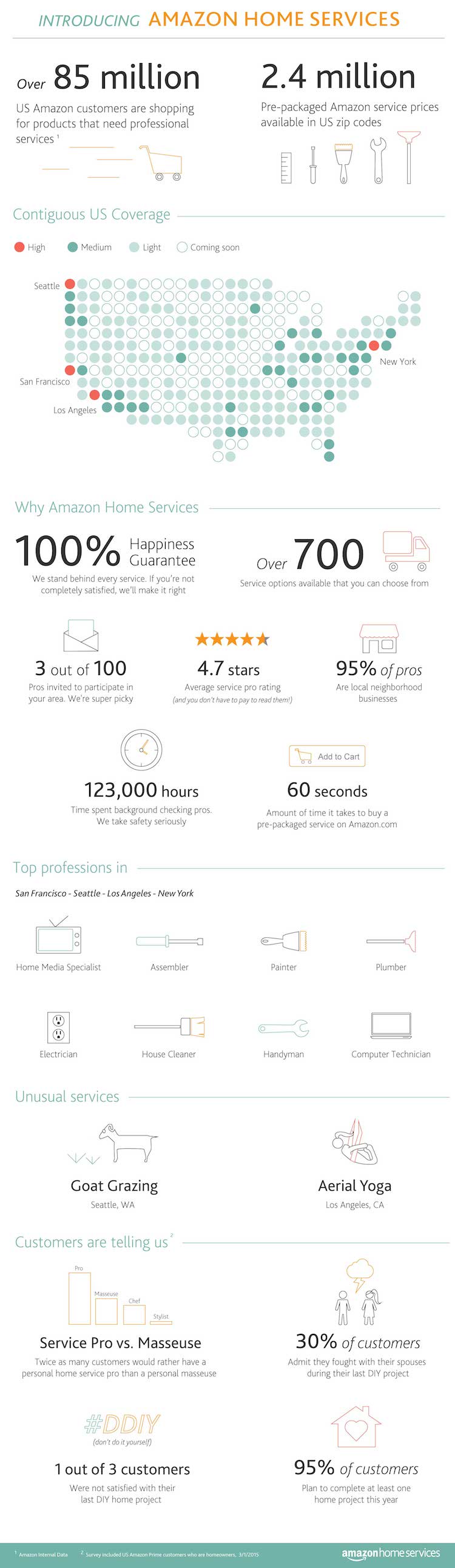
    Amazon Home Services Map Image - Search Influence

    To compete with Angie’s List, Craigslist, Yelp, Home Advisor and other marketplaces, Amazon has recently launched its own marketplace called Amazon Home Services.

    What makes this platform different from the others? How could it help you, as a local business, with an increase in leads and improved Google rankings?

    Amazon has its own ecosystem: loyal customers and Amazon Prime members. Being a part of this ecosystem means being exposed to 85 million potential customers. “In less than 60 seconds, customers can now browse, purchase and schedule hundreds of professional services from wall mounting a new TV to installing a new garbage disposal to house cleaning, directly on Amazon.com,” according to the company’s recent press release. And your business can be a part of it.

    In contrast to Google, which ranks services in terms of the most accurate answer to the searcher’s query, Amazon ranks services in terms of what product the searcher is most likely to buy. This functionality is easier for small businesses. Indeed, Amazon’s algorithm will automatically show the best service to match what the searcher is looking for. In other words, when a searcher is looking for a television on Google, the result will include everything in relation to televisions except a list of local services, while Amazon will include all the repairs/installation services related to a television based on the searcher’s geolocation. That is why it will potentially make it easier for small businesses to rank on Amazon. But there is a catch: to be part of that ecosystem, you need to be invited by Amazon.

    So how can you get invited? First, you need to have a strong Web presence, a good strategy for displaying information about your services, a good reputation and finally, great online reviews from your customers. (But really, you’d want all of these things anyway.) On top of that, you need to be licensed and insured.

    Are you ready to apply? Don’t jump to it too fast! Google just announced it is going to open its own marketplace for local businesses, which means more visibility for you as well as more leads, since most people search on Google.

    Amazon Home Services Image - Search Influence

    Image sources:

    Amazon Home Services infographic

    Amazon Home Services map

  • Healthy Content: 4 Tips to Drive Conversions in the Medical Industry

    Healthy Content Marketing Image - Search Influence

    In the medical and plastic surgery industries, it can be hard to get past the medical jargon and engage with readers online. But despite these challenges, building up an online presence is vital in this day and age. Everyone online wants to gather information quickly, and they seek immediate gratification when it comes to scheduling appointments and learning about procedures. To keep their interest, you have to present your content in a user-friendly, engaging and attractive way. Let go of the olden days of long-winded explanations and paragraphs upon paragraphs of medical terminology that no one can understand. Step into the 21st Century with these four types of content:

    1. Infographics

    We all want something that is nice to look at and easy to understand. Infographics are not only engaging, but they can also be super informative! The medical terminology that your current and prospective patients need to know can be easily explained in shorter phrases and pictures or guidelines. Infographics help your patients connect with you and your practice.

    Infographics are also more likely to be shared by your customers. People love sharing fun and interesting infographics on their own social media pages, so this will ensure more conversions and potential new clients! Find out more about how infographics can give your content marketing strategy a facelift.

    2. Videos

    Videos are another great visual way to engage your website visitors. You could explain your processes and surgical procedures easily without scaring visitors off with long, complicated paragraphs. This is also a great way to introduce yourself and your practice to potential patients.

    You don’t have to do a stand-up; you could make a slideshow video with voiceover narration, or if your budget allows, an animated video. Make sure you include a call to action at the end so the viewer can take the next step in becoming a patient!

    3. Lists

    Lists are great. You’re reading one now! Putting the number of listed items in the title is especially helpful so people know exactly what they’re getting into. Readers are more likely to click through and take the time to read if there are 10 or fewer items. They’ll think it will only take a couple of minutes, then BAM! They’re hooked. They’re converting, and they’re your next patient!

    Make sure to write lists that are interesting and preferably not common knowledge, such as “10 Things You Didn’t Know about ____” or “5 Ways to Look Younger Without Surgery.” You could even promote your products or services with a list of great products for this, that, or the other thing. Keep it short, sweet, and to the point.

    4. Guides

    Because you specialize in a certain medical field, you have knowledge that is credible, useful, and interesting. Write it down! Guides can be about absolutely anything, and they’re excellent sharing material for those who want to stay informed and keep their social media followers/friends informed. For an example, check out the Search Influence guide on how your online presence can win and lose patients.

    An excellent way to drive up conversions is to make your guide a downloadable file and request information from the reader before they can download. This allows you to add them to your email newsletter list, which will make them more likely to become a patient in the future.

    Deciding how you want to present yourself online can be time-consuming and frustrating, but these four winning types of content are fun, engaging, and can help your conversion rates. Play around with some ideas and be sure to use different content on different pages to keep people wanting more!

    Interested in more content marketing tips for medical marketing? See how natural content can help your practice’s website attract patients.


  • This National Small Business Week, Step up Your Online Marketing

    It’s National Small Business Week—time to celebrate the successes and the insane amount of work small business owners put in. The struggle is real.

    You know you’re a small business owner when…

    …Your nightmares are about getting bad Yelp reviews.

    …Your social media “strategy” consists of bribing your college-aged daughter to handle your Facebook and Twitter accounts.

    …Your holiday hours did not quite make it to the Internet, and customers actually showed up only to find your business closed.

    To cure these and other headaches, start with a little TLC for your website and your online marketing strategy—after all, both of these play a huge role in bringing you customers, but they may unfortunately also be keeping you up at night. Follow these top three online marketing tips for small businesses.

    If You Can’t Beat ‘Em, Join ‘Em

    It may sound upsetting that Yelp listings are front and center in a Google search for your business while your own website is far down the list of search results. But savvy small business owners know that Yelp and other large online directories can win over customers with minimal effort. So if you can’t beat the Yelps of the world, join ‘em!

    This strategy is also known as Barnacle SEO. Basically, your business needs to attach itself to large, fixed objects and then wait for customers to float by in the powerful current. Identify the large, high-ranking online directories that matter to you most, such as Yelp, and add your information there in the hopes of “borrowing” some of the page one rankings. There are many trusted online directories like Yelp out there you can barnacle up to: Angie’s List, Foursquare, Google+, Avvo (for lawyers), Healthgrades (for doctors), and even TripAdvisor.

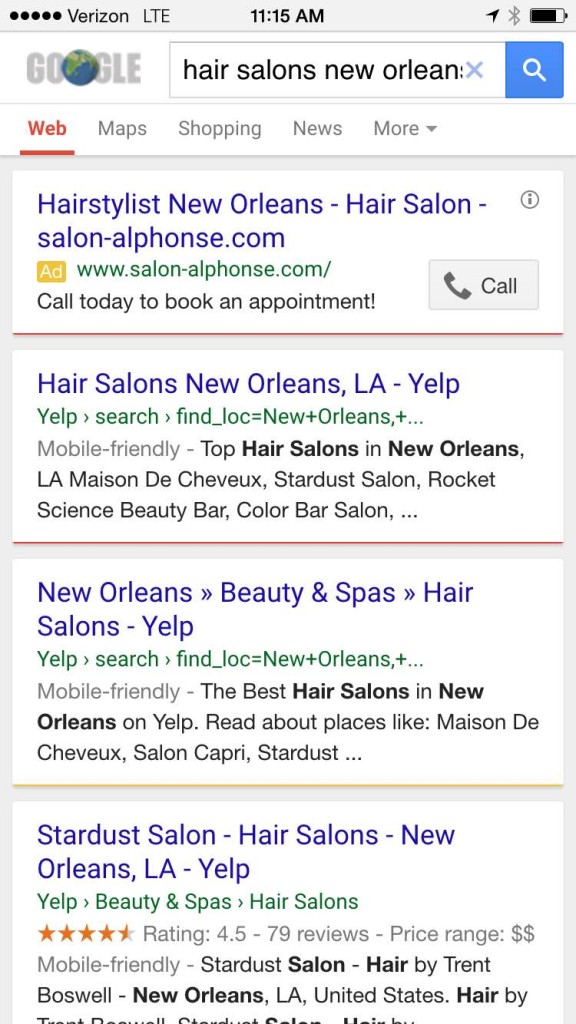
    And this tip comes with a bonus: this strategy also works well for customers searching on smartphones because these websites are optimized for the mobile experience—providing the targeted information that local customers searching on their smartphones really need. When you perform a Google search for “hair stylists New Orleans,” for example, the top results are mostly from Yelp:

    Yelp Mobile Screenshot Image - Search Influence

    Target Your Social Media Efforts

    Another thing that keeps you as a small business owner up at night? Social media—or more specifically, finding the time for it. For starters, why is social media worth your time? The latest statistics from the Pew Research Center paint a pretty compelling picture that customers are on social media: 74 percent of online adults use social networking sites.

    As a time-starved small business owner, you must get the most for your social media time. This requires targeting your social media efforts. Start by channeling your ideal customer. What is your typical customer’s age, marital status, and family status? Where is your customer physically located? Do your customers fall into a certain income bracket?

    Once you know who your target customer is, find the social media channel that appeals to them. For example, Facebook still skews significantly female and is the top-used social network for U.S. teens, making it ideal for fast-moving consumer goods, according to Business Insider. Instagram is also popular among females ages 18 to 44, so clothing, accessories, and those types of brands tend to perform well on this network. While LinkedIn is most popular for adults, Twitter is primarily a news source and attracts mostly male users. YouTube reaches more adults ages 18-34 than any single TV network. Pinterest is the place for food and drink-related information as well as parenting tips.

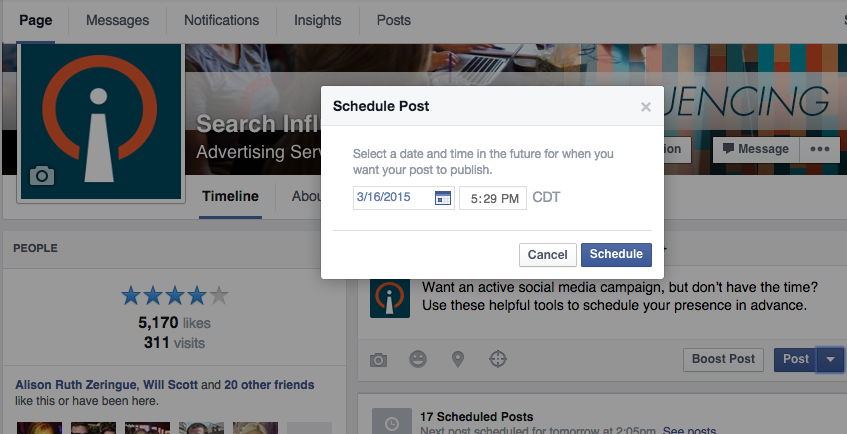
    But remember, whichever social networks you decide to focus on, automate your posts with these quick tips.

    Facebook Scheduled Post Image - Search Influence

    Avoid Customers Crying in Your Parking Lot

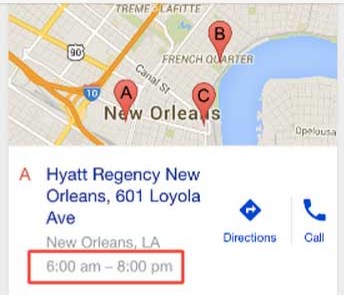
    If you’ve ever done a Google search for your business, you’ve likely seen this kind of result:

    MapsTimeViewImage

    But what happens when you have special holiday hours? Will customers see your normal hours in a Google search and show up in your parking lot over the holidays? Currently, Google My Business has not built out the functionality for saving holiday-specific hours ahead of time. As the profile setup currently stands, you’ll need to manually edit the hours of operation on a given day when your business is open (or closed) outside your standard hours of operation. See Google’s steps on how to update your business’ hours.

    Also, remember to let folks know when you are, in fact, open on the holidays. For instance, let everyone know your restaurant is open on Independence Day and post your holiday-specific menu for the day or highlight any patriotic specials. Is your medical practice open for limited hours on Memorial Day this year? Post a piece to your blog or social media profiles highlighting the top summertime health hazards from boating accidents to severe sunburns.

  • More Locations, More Problems? Optimize Your Franchise SEO—Part 1

    Franchise SEO tips image - Search Influence

    Do you ever feel like your efforts to market your business with more than one location are ineffective? Do you live with the constant doubt about whether or not you did as much for one location as you did for another, or if your franchisees are doing something counterproductive that will painfully squander your efforts? You may also be wondering how to get users from all of your markets to find their corresponding local franchise business. How much is too much when it comes to overstuffed keywords for franchise SEO and duplicate web pages with franchise marketing?

    You don’t need to be an industry professional to know that comprehensive search engine optimization (SEO) requires a balance of more than a dozen simultaneously active elements. From consistently monitoring your targeted keywords to constantly generating new, compelling website content, maintaining high search engine rankings proves to be a multidimensional effort. It seems like all it takes is one surprise update or manual action from Google, and your entire SEO strategy can collapse like a house of cards. For multi-location businesses and franchises, this balancing act becomes even more complex, which is why Search Influence is here to help you not only maintain, but maximize the results of your Internet marketing and digital franchise efforts.

    In this two-part series, you will receive a five-step guide that should answer all of your questions about multi-location or franchise SEO. This first piece will focus on building the corporate brand—a frequently forgotten necessity in effective franchise marketing for any business, regardless of the number of locations.

    Build Your Brand

    This may seem logical, but many times, webmasters and marketers get so caught up in the challenges that come with the individual locations that they forget they have a brand to promote. These recommendations have nothing to do with location-based information; however, they are just as significant to your franchise SEO and Internet marketing success.

    1. Focus on the Main Pages

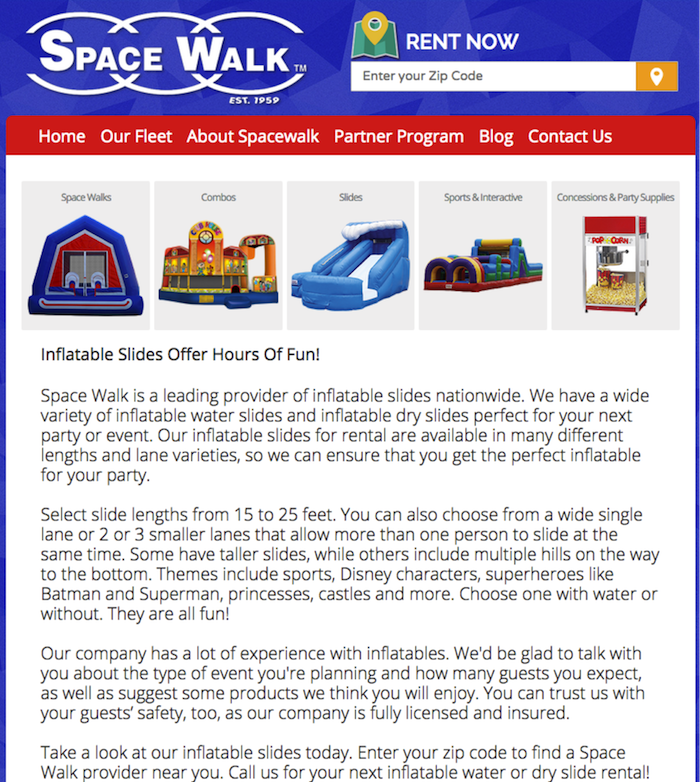
    When I refer to the main pages, I am referring to the homepage, the “about us” page, your blog, and your products and services pages—in other words, any page that contains content that is applicable to the brand and its offerings.

    These pages need to contain the best content on your site, as they will likely be the most visited. Depending on how many locations you have, you may want to include each location in the title tags of these pages, but I would avoid this practice if you have more than three, as title tags should not appear forced or spammy.

    Space Walk Franchise SEO Image Search Influence

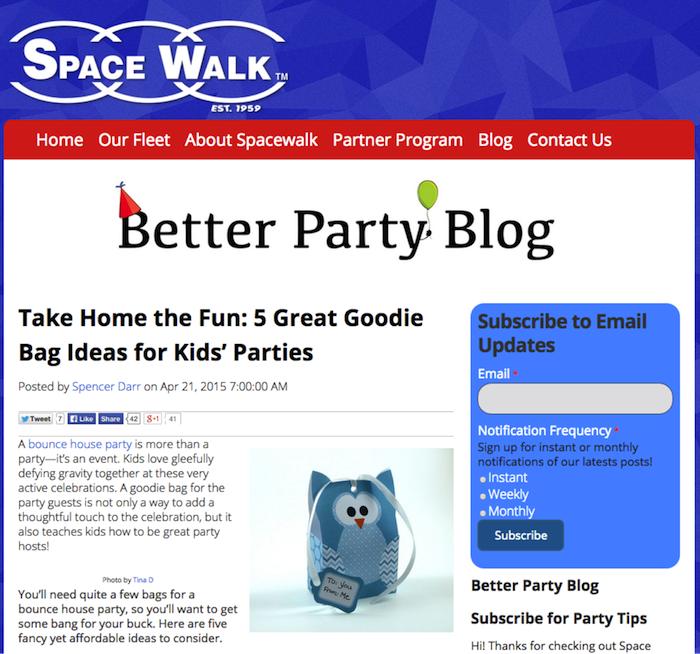
    The blog, on the other hand, can be more versatile with regards to the content that you create. Your blog should be focused mainly on industry-specific topics, but it should also have a touch of personality. Things like showcasing your community involvement or a franchisee’s achievement are both great blog topics. Search engines love active blogs, because they show that you are keeping your site up to date by offering the latest and greatest industry knowledge in a timely fashion.

    Better Party Blog Space Walk Fanchise Image - Search Influence

    Having a mobile-friendly site is important to your franchise’s digital marketing efforts, especially with our heavy reliance on smartphones today. As Google rolled out one of its most significant algorithm updates in April 2015, your site could have been practically wiped off the map if it was not mobile-friendly, and the same is just as true today.

    2. Off-Site Authority for Your Brand

    Since Google’s more recent Penguin updates, the link building game has changed. Instead of worrying about getting links to your website and becoming keyword obsessed, we need to be thinking about building authority and a stronger overall presence for the brand.

    The simplest way to do this is by creating social profiles for your brand. This is not to say that franchisees cannot or will not create their own individual pages, but you should own the brand and its voice by claiming and being active on the major social channels.

    What are the major social channels, you ask? Google+, Facebook, and YouTube are all surefire winners here. But why Google+ and YouTube? One, they are both owned by Google, and you always want to make friends with the decision maker. Two, YouTube is the second biggest search engine in the world. By regularly posting content to these profiles, search engines will get a better sense of what you offer and, in turn, what you should be found for. Note: you will have to rely on your franchisees to help you verify their individual Google+ listings.

    Listing your company in categorical directories can also help the cause of brand building. If there is a relevant directory for the product or service you offer, your business should be listed, along with all of the details of your offering. In this scenario, becoming a part of industry associations can have as much of a benefit online as off.

    There is nothing that can beat real, newsworthy press. Whether it be a press release, a magazine article, or a blog post, when your brand is mentioned online, Google is going to recognize it and correlate the content around it to your website. A link back to the site in these cases can prove helpful as well.

    Now that you have a better sense for basic brand building, stay tuned for part two of this blog series, which will explain how to manage the optimization of all of your individual locations. At Search Influence, we are best equipped to help you succeed with your franchise marketing plan and franchise SEO efforts. Contact us today with any inquiries regarding how we can guarantee a successful online marketing strategy for your company.

  • Googleplasty: How to Reshape Your Search Results (Part 2)

    As more businesses begin to take efforts to improve their online presence, standing out in search results of highly competitive markets and areas becomes even more difficult—and nowhere is this perhaps more true than in the cosmetic medicine industry.

    In order to reshape your search results through the art of “Googleplasty,” you must know what factors make your business rank high in a Google search. Since we now know all about the different types of search results from part one of this two-part blog series, let’s talk about the most important factors that play a role in how high your practice ranks.

    The following three “Top 5” lists of factors are from from Moz’s 2014 Local Search Ranking Factors survey. The information came as a result of surveying 40 industry experts to determine what had the most influence on ranking in Google search results.
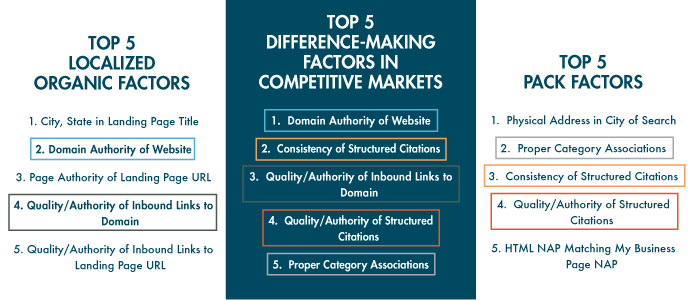
    top 5 search ranking factors

    As you can see, all of the factors that are integral in competitive markets also play a part in either localized organic or maps pack results. Due to their repeat importance, I think they’re the five factors most worthy of discussing in detail.

    1. Domain Authority of Website

    domain authority

    First up on our list as the most important factor in competitive markets is Domain Authority, which isn’t much of a shocker. Domain Authority is a proprietary measurement (created by Moz geniuses) of a domain’s power within a 100-point scale. This score can be used to predict if a site is likely to rank in Google’s search results and can also be used to track a site’s growth and increase in strength.

    It is a metric that combines other metrics such as age, number of links, and quality of links, so it’s not easy to manipulate through singular or direct efforts. As it is directly put on Moz’s site, “The best way to influence this metric is to improve your overall SEO.”

    Using Moz’s MozBar to see domain authority of pages in search results, you’ll see that the top five business sites in the localized organic results for “plastic surgeon albany ny” have Domain Authorities of 31, 32, 22, 21, and 26, respectively. As you can see here, having a score that is higher by a single point won’t guarantee that you rank above your competitor, but in this search example, business sites past the first page of results tended to have Domain Authorities lower than 20.
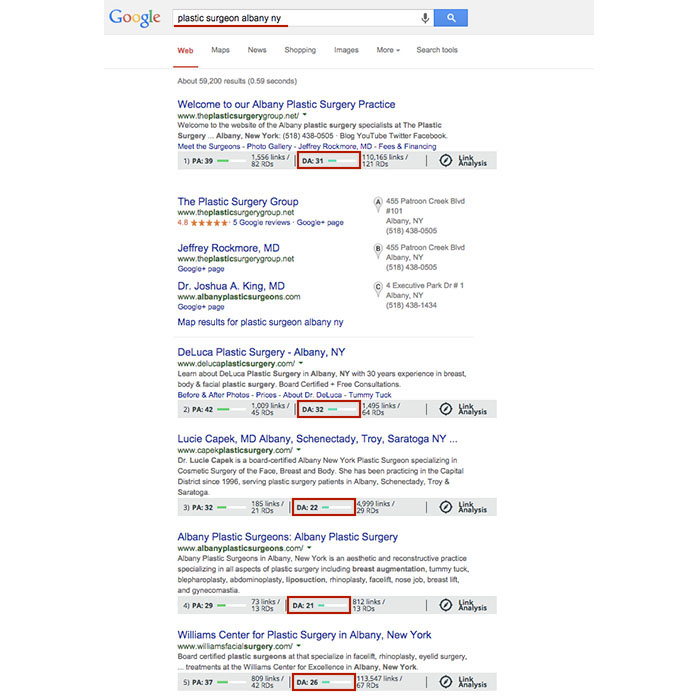
    Domain Authority Search Results

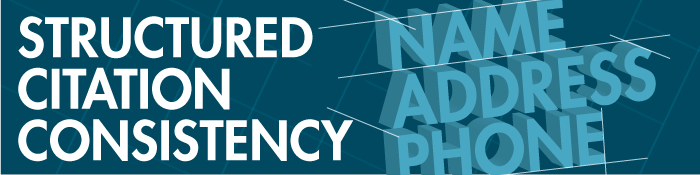
    2. Consistency of Structured Citations
    structured citation consistency

    While this factor isn’t as high ranking for localized organic results, it is third for the top maps pack factors and second here in the top factors for competitive markets. One reason for this is that in many competitive markets, such as plastic surgery or cosmetic dermatology, you’ll find maps packs in search results.

    To start, a citation is a place on the Web where a business’ name, address, phone number, and often website can be listed (sometimes referred to as the NAP of a business – name, address, phone). Any combination of the NAP, with or without all parts, listed on a site is considered a citation. A structured citation in particular is a listing of business information found on a directory website (e.g. YellowPages.com and Yelp.com). On the other hand, an unstructured citation can be business information on non-directory sites like newspaper sites, press release sites, and blogs, to name a few.

    By increasing the number of matching information sources (and therefore matching signals) to Google, you also increase your chances in having Google match this information to search queries, according to a recent webinar with Google’s Heather Wilburn. So if you want to be matched with potential patients searching for businesses like yours in your area, consistent business information across the Web is one of your best bets, especially in competitive industries like cosmetic surgery.

    3. Quality/Authority of Inbound Links to Domain
    inbound links to domain

    An inbound link to your domain (aka inlink or backlink) is exactly what it sounds like, a link leading to your website. The relevance to your industry or location and the authority of a website linking to yours in and of itself are the two best traits for quality links. Buying links or having links from random, spammy sites will hurt, not help you. Links from local sites and popular sites are a pretty safe bet. You can seek out local sponsorship opportunities as a good link-building effort or help other sites clean up their broken backlinks by using your working ones.

    To differentiate between natural link building versus spammy link building, remember that it’s all about user experience and what makes sense to the user. If your efforts don’t uphold the ideal of providing the best user experience possible, then they’re probably not good.

    4. Quality/Authority of Structured Citations

    structured citation quality

    As mentioned above, a structured citation can be any directory site that lists any variation of your business’ NAP or website. While consistency is most important, you also want to make efforts to build high-quality, authoritative citations in directories.

    Just like there are many factors to improve your own site’s authority, there are also many factors to determine the quality of a directory. You can delve into Whitespark’s blog on how to identify quality citation sources for a detailed breakdown, but basically a good rule of thumb is to look for high domain authority and human moderation in directory sites. Examples of human moderation include how DMOZ requires submission review by its team before a link goes live or how Google Plus, Yelp, and Bing listings all require verification via phone call or a postcard sent to the business.

    Google also considers niche directories highly authoritative. A niche directory is an industry-specific or location-specific directory. Since the Pigeon algorithm update, this kind of citation building has become especially important, and searching for your industry’s keywords will often help you identify these niche directories. If you search for “plastic surgeon columbus oh,” you’ll see that the directories healthgrades.com, vitals.com, and smartplasticsurgery.com appear on the second page of search results. Often, these types of directories require either verification or payment for those seeking to be listed on their site. If you understand the concept of barnacle SEO, you know that being listed on these types of big, authoritative sites is a great way to improve your own visibility to potential customers. Use your discretion to decide if the opportunity cost of getting on a directory isn’t too high to be worth the effort.

    Warning: If a site ever requests a “reciprocal link” to its site on your site in order to be listed, this is NOT A GOOD practice, and they are not worth your time.

    5. Proper Category Associations
    category associations

    Having proper category associations is another important factor for ranking in the maps pack that can set you apart from the rest in a competitive market. It’s a pretty simple concept, and it basically boils down to the part of the guidelines for representing your business on Google that tells businesses to “Choose categories that are as specific as possible, but representative of your main business.” A cosmetic surgeon with the primary category on the Google Plus local listing set to “surgeon” is less likely to rank above one with a primary category set as “plastic surgeon” in the maps pack, for example.

    Though this is a lot to grasp and take action on all at once, having the foundation and understanding of best practices to improve user experience and to better your business online will greatly improve your successes online in the long run.
  • Getting Vocal About Buying Local: How Small Businesses Give the Big Easy its Charm

    Some of Search Influence’s online marketing clients are small, local businesses that serve a neighborhood, town or region. To find out how small, local businesses impact a city as well as more about the trendy “buy local” movement, we talked to Mark Strella of StayLocal!.

    Power to the SMBs

    The real impact of locally owned, independent businesses in New Orleans became known just days after Hurricane Katrina struck the city. While Wal-Mart and Starbucks waited for New Orleans to recover, local bars, venues, and hardware stores reopened without hesitation.

    Ten years later, the predominance of small, local businesses can be seen on nearly every street in the Greater New Orleans area. And the biggest advocate for preserving New Orleans’ cultural singularity is StayLocal!.

    StayLocal! is the Greater New Orleans’ Independent Business Alliance, a non-profit, member-supported organization that connects local New Orleans business to customers, resources, and each other. StayLocal! works to foster the culture of the city by helping local businesses—and subsequently, New Orleans—thrive.

    Project Manager Mark Strella tells us more about StayLocal! and its efforts to support locally owned, independent businesses in New Orleans:

    So what exactly does “locally owned, independent business” mean?

    To us, it means a business in which majority ownership resides within the five-parish New Orleans region. That means the business is owned by New Orleans residents, and decisions about the business are made here, by locals. Or in plain English: not a chain.

    Who are some of the locally owned independent businesses you work with?

    We work with local businesses of all types around the New Orleans area. We work with a lot of retail businesses, from smaller guys who sell around town at markets and pop-up shops, up to bigger local businesses who have numerous locations, and ones in between. We also work with service businesses and folks in the food industry. Our goal is to be these businesses’ ally: we’re here to provide them with the resources they need to thrive and be around for years.

    As a New Orleans resident, how can I benefit from buying locally?

    There are a bunch of reasons, and everyone has a reason that is particularly dear to them. For me, it’s that one of the reasons I love New Orleans is that it looks like nowhere else. And so much of that is because of how strong our local business presence is. Most cities in the country don’t come remotely close to being so heavily populated by businesses that are locally owned, rather than the standard menu of chain stores. So when you buy local, you’re supporting that part of our culture and identity and actively doing your part to ensure it stays a part of what you love about New Orleans.

    It’s also better for our economy when you spend at a local business versus a chain. That local then takes your money and re-spends it locally, whether it’s on supplies, or accountants, graphic designers, marketers, etc. So that money stays here in New Orleans, whereas money spent at a chain or online leaves New Orleans and benefits some other city. Studies show that spending locally has two or three times a local economic benefit than shopping at a non-local business.

    I’ve seen quite a few television shows poke fun at the buy-local movement, specifically Broad City and Unbreakable Kimmy Schmidt, so it must be a pretty big trend. Where does New Orleans stand in the push for staying local?

    Ha, I have too, and that’s a testament to the buy-local movement’s success. It’s cool now. I think its success is a reaction to the rise over the past years and decades of chain businesses and now even online giants. People see these faceless businesses everywhere they go and they start to crave authenticity. They gain a greater appreciation for the local business down the street that’s owned and run night and day by their neighbor.

    I think New Orleans is way out in front. We’ve always had a thriving local business scene. One study a few years ago showed we had one of the best local business to non-local business ratios of any city in the country. And we have such great appreciation for it as a culture. Our entrepreneurship and start-up scene is huge, thanks in large part to a number of great organizations that are fostering entrepreneurship like Idea Village and Propeller. And when we have this buy-local culture deeply imbued in our behavior as residents— that supporting all things local is simply what we do as New Orleanians—those new businesses have a huge audience to serve.

    What events does StayLocal! host or promote throughout the year to encourage New Orleanians to buy local?

    We do a ton of stuff. We recently put out the second of our Neighborhood Guide series, which points residents towards local businesses in a specific neighborhood. The neighborhood we did was Central City. Last year, we did Mid-City. And up next is Algiers Point. We have a constant stream of good information on our social media channels, so we definitely encourage folks to like us on Facebook, follow us on Twitter, yada yada, so that we can turn them on to new local businesses. We also are very active in the fall and holiday season pointing New Orleanians towards local shopping options, through our shop local for the holidays campaign, as well as Small Business Saturday.

    And then in general, we spend the rest of our time working with the businesses in our network, helping them run a better business. We do workshops and run all kinds of initiatives and promotions to help our members better connect with one another and access tools that will boost their biz.

    Last question: what should I tell my co-workers before they buy their next cup of coffee at Starbucks?

    … it’s just important to say “everything in moderation,” and to think of the big picture and what matters to you. If you care about the economic health of the city, think about how local coffee shops re-spend their revenues locally and use local service providers and local firms, creating more jobs and opportunities for New Orleanians. If you care about living in a unique place, think about what New Orleans would be like without its local businesses. If you care about innovation here in New Orleans, we have so many coffee shops doing amazing things with coffee. Mojo. French Truck has its new spot in the Lower Garden District. Spitfire is incredible. So often, local is simply better. But if Starbucks is your thing and that’s not changing, try taking that mindset and applying it to anything else you buy and see what’s out there locally instead.

    For more information and to find your new favorite local business, visit Stay Local! at StayLocal.org. Be sure to also follow them on Twitter and Facebook.

    Image source:

    StayLocal!

    Proudly NOLA Owned

  • Googleplasty: How to Reshape Your Search Results (Part 1)

    As businesses grow more in touch with their online presence, it becomes more and more challenging to stand out in the search results of highly competitive markets and areas—and nowhere is this perhaps more true than in the cosmetic medicine industry.

    Search Influence - Plastic Surgeon Local Google Search Results

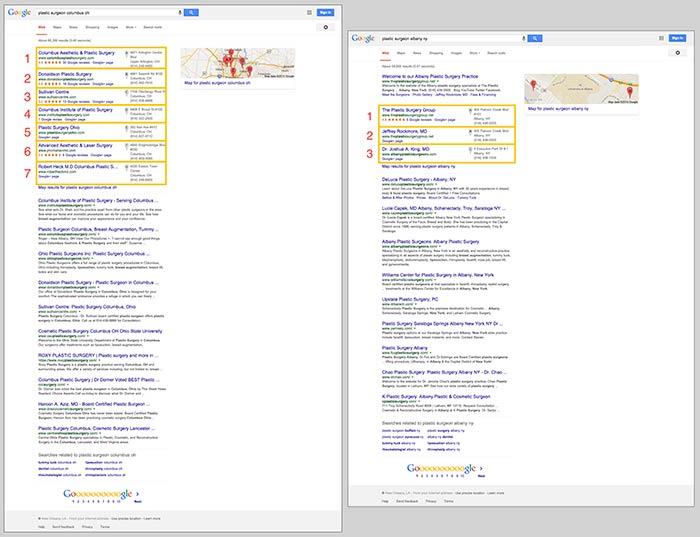
    First things first, let’s make sure we’re on the same page about the two major kinds of results that we see in desktop results for plastic surgeons. “Localized organic” search results and “maps pack” results typically appear together in what is referred to as “combined” search results. The factors that determine what appears in these two areas are not the same, as you can tell by the the difference in results and by the appearance of a site more than once between the two. Maps packs can come in a variety of forms and don’t show up for all search queries, which is also important to note.

    In the screenshot below on the left for the search “plastic surgeon columbus oh,” you’ll see 10 localized organic results below a 7-count maps pack. In the screenshot on the right for “plastic surgeon albany ny,” you’ll see 10 localized organic results, but the 3-count maps pack appears below the first organic result.

    Search Influence - Google Maps Pack Plastic Surgeon

    Stand Out in the Maps Pack

    In the maps pack itself, the most striking features are the review stars and rating display. The data in the maps pack area is pulled directly from Google Plus local listings in Google Maps. So, to make your practice stand out in the maps pack, you should claim and verify your Google Plus listing via Google My Business.

    Once you’ve claimed and verified your listing, you’ll want to get reviews from your patients. It’s important to understand that one or two reviews a month over a few months is better than 15 reviews in one week. As with most online marketing strategies, natural behavior is the best behavior.

    Stand Out in Localized Organic

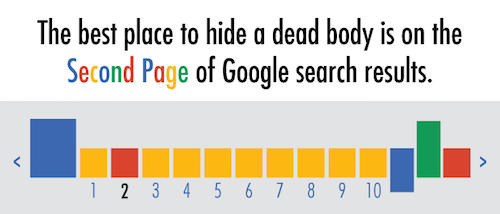
    The most obvious way to stand out in the localized organic results is to be ranking as high as possible and to AT LEAST be in the top 10 so that you’re on the first page. As the age-old SEO joke goes, “The best place to hide a dead body is on the second page of Google search results.” Hardly anyone looks past the first page, and—according to eye-tracking data—not many look past the top half of the search results page.

    Search Influence - dead body Google Search Results meme

    The Google PageRank algorithm that determines these rankings takes into account somewhere around 200 factors, so it’s not as simple as pinpointing one or two efforts to be made.

    Now that we’ve got a better understanding of what we’re looking at in search results, we can start to understand the major factors that affect ranking in each of these sections. Stay tuned for my next blog, where we’ll talk about the top five ranking factors in the maps pack, in the localized organic results, and in competitive markets!

  • SEO for 2015: Meet the New Boss, Same as the Old Boss

    The world of SEO is constantly changing. Google, the big prize for search engine ranking, may change its search algorithms from 500 to 600 times a year, and major updates like Panda, Penguin, and Pigeon are rolled out on a fairly regular basis. And while your business can’t shift SEO strategies daily to incorporate every change Google unveils, it makes sense to take a fresh look at your SEO approach at least annually—or does it?

    The answer is yes, and no. While there are some aspects of SEO that can and should be refreshed or updated to keep up with changing algorithms and your audience’s needs and tastes, the good news for online marketers is that the basic SEO strategies you’re already familiar with will continue to be effective—in 2015 and beyond.

    Here’s a look at what will change in the SEO landscape for 2015 and what will remain the same.

    Sticking to the basics still works

    Best practices for SEO strategies have always revolved around delivering high-quality, targeted, and useful content with a few well-chosen, naturally incorporated keywords—and for 2015, that won’t change. Google-sanctioned “white hat” SEO tactics continue to be the most effective strategies for driving SEO and boosting search engine rankings.

    Another basic element of SEO that will remain the same is the need for both on-page (what you say about yourself) and off-page (what others say about you) factors. Successful SEO includes creative, useful, and engaging content creation for your website, social media, and other online channels, along with promotion that drives off-page SEO by attracting links to your content from other authoritative sites.

    Going mobile will be an imperative

    By now, most companies are aware that a responsive, mobile-friendly website is essential for attracting and retaining customers—but mobile SEO is more important than ever when it comes to Google. Responsive site design will be a crucial aspect of ranking high on Google, since the search engine now reports whether or not a site is mobile-friendly to both users and webmasters.

    If you’re not sure whether your business website is mobile-friendly enough, Google offers a free online testing tool, along with a link to information about their mobile-friendly criteria and how it may affect your search engine results.

    For small business, local SEO will be king

    In 2015, it will be important for businesses—especially small businesses—to make sure their websites are optimized for local area searches. Google and other search engines are giving more attention to local directories and citations, including hyperlocal content (relevant content authored by local experts within their geographic areas).

    One effective SEO strategy for optimizing local search is to make sure your phone numbers, addresses, and location pages are consistent with off-page directory listings. If you haven’t done so already, check out third-party business directory and review websites such as Yelp, Google+, and Yahoo Business to ensure that your local information is correct.

    Thinking like a publisher will benefit your SEO

    As search engine algorithms continue to shift weight away from obvious marketing and promotional content and toward contextual relevance, individuals are becoming more important than companies with regard to search engine rank. To take advantage for SEO improvement, more companies are transferring authorship credit to individuals—including text article writers, infographic designers, and video and podcast producers. Giving content creators their own voice will lend your content more weight with search engines.

    Links and keywords will lose center stage

    For a long time, keywords and links have been the cornerstones of SEO. But with a massive shift toward contextual search and high-value content, these primary factors no longer carry the same weight. Inbound and outbound links still matter for search, but their importance has been dwindling as more algorithms place relevance over popularity and authority.

    The same shift is apparently underway with keywords. While a few well-chosen and well-placed keywords still serve to help search engines determine the overall meaning of a page or piece of content, it’s more important that your content answers the right user questions and remains useful and engaging.

    If you’ve been sticking to SEO best practices, your strategy for 2015 is likely to only require minor changes in order to remain effective for the coming year and beyond.

  • Don’t Be Afraid To Stop & Ask For Directions: Making Google My Maps for SABs

    As promised in my last blog about the new Google My Maps, I’m here today to teach you how to how to create My Maps for service area businesses (often referred to as SABs) that have highlighted boundaries of what counties or parishes they service.

    Before we delve into this guide, let’s start with the basics like what exactly is a KML file. KML is the file format used to show geographic data in mapping programs. It is an XML based format and stands for Keyhole Markup Language. Now that you know what this file type is, let’s see how you can use it.

    How to Use Old 2011 KML Files

    Fun Fact: The U.S. Census Bureau holds kml files for all county guidelines here!

    As you can see, they’re from December 2011, so any boundaries that have changed since then will be incorrect. In a very general sense however I’ve found these codes very useful in the past. Each file contains all county boundaries in one state, but the tricky part is that they don’t tell you what state it is in the file name. I went ahead and downloaded them all a long time ago and updated the file names to reflect the state they contain. It’s pretty closely in alphabetical order so if you just use a list of US states in alpha-order next to the list of files in numerical order it should match pretty closely.

    Once you’ve figured out which file contains the state you’re looking for, find the county or counties that you want to display in your map, and move it’s entire code for each county (should start with “Placemark” attribute and end with the closing of the “Placemark” attribute) just below the “Document” attribute. Once you’ve moved the boundaries you want to keep to the top of the KML file, remove all the excess counties and leave the closing attributes for “Document” and “kml” at the bottom.

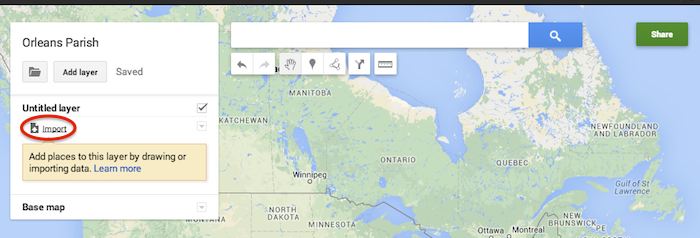
    Now that you’ve successfully prepared your KML file, in My Maps, click Import on the left and choose your KML file from your computer.

    Import A KML File To My Maps - Search Influence

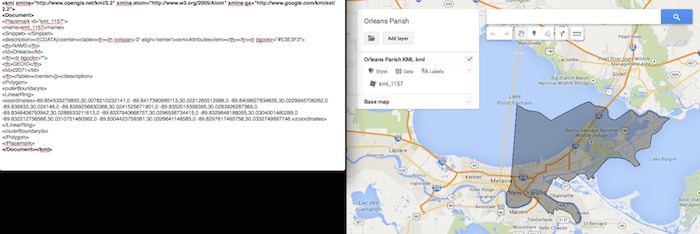
    See the screenshot below for an example of how your KML file should generally look if you’ve done it correctly. The screenshot shows the file for Orleans Parish of Louisiana in TextEdit and then what said file looks like imported into My Maps. (NOTE: In order to show a not so massive screenshot of the KML code, I removed about 3/4 of the coordinates. There are a massive amount of coordinates used to make up these detailed boundaries.)

    Preparing Viewing A KML File In Google My Maps - Search Influence

    How to Use New 2013 KMZ Files

    The U.S. Census Bureau also has the most up to date 2013 files, which are KMZ format (note the .kmz instead of .kml extension). This is essentially zipped KML files with a .kmz extension, but if you use a Mac like me, unzipping or unpacking the zipped file is not easily achieved. The 500k file contains the most detailed boundaries out of the 3 options.

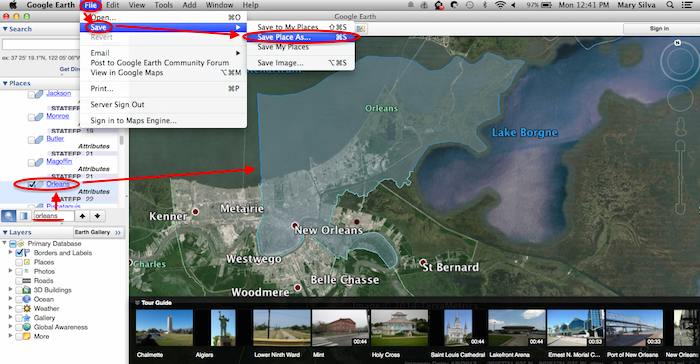
    So, the way I handle this KMZ file is to open the entire file in Google Earth and export just the KML file of the areas I want displayed. To do so you’ll use the search feature of Google Earth on the left at the bottom of the “Places” window to search for and select the areas you want displayed. Since many counties have the same name you’ll want to make sure it’s showing up in the state and location it’s supposed to. Also, note that if you’re trying to add multiple counties in the same state, the Attribute number to the right of the county will be the same for all counties within the same state. This should help you easily identify the counties you’re looking for when adding multiple.

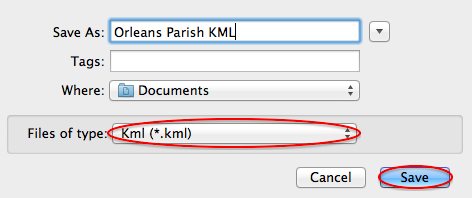
    Once you’ve selected the geographic areas you want displayed on your map in the “Places” section, then save the file as a KML file by clicking File>Save>Save Place As….

    Saving A KML File from Google Earth for Google My Maps - Search Influence

    My Maps will not accept a KMZ file, so make sure to save as a KML.

    Saving a Map in Google Earth As a KML File to Use in My Maps - Search Influence

    Once you’ve saved your file, follow the same steps mentioned above to import the KML file to My Maps. I’m not sure if the paid My Maps Pro is any different, but it appears to me that you cannot import multiple KML files to one My Map. So, in the event that you want to represent multiple service areas in one My Map, you’ll want to have all of the geographic area codes in one KML file.

    This Google Earth process can also be used instead of manually editing the older KML file codes as shown in the first instructional section in case you don’t want to delve into the coding via text edit. It’s definitely an easier route, but for me, Google Earth can sometimes run slow when trying to handle these files and I don’t mind manually editing code.

    Hopefully these steps and screenshots help out a fellow My Mapper!

  • 5 For Friday: Local Search, News, Advice, Measuring Success, and Penguin Refresh

    Five

    1. Local Businesses: Watch Out!
    – Search Engine Watch

    Apple’s newest gadget, the Apple Watch, is likely to have a major impact on local search. The expected increase in hyper-local searches means added pressure will be placed on businesses to ensure they can be found easily online. “Users will be able to search for locations via dictation or favorites, map out the routes and receive touch feedback at each turn – including different notifications to denote right or left turns” said Apple’s Vice President of Technology Kevin Lynch.

    2. SEO Success: Ranking #1 Isn’t What it Used to Be
    -Search Engine Land

    Following “Pigeon”, Google’s latest algorithm update, it has become increasingly apparent that rankings do not equal success. Instead you should focus on the following 5 metrics to more effectively measure SEO success: organic traffic, organic landing pages, organic conversion sources, Google My Business impressions and clicks for driving directions.

    PigeonUpdateImage

    3. Awaiting the Penguin Refresh
    – Search Engine Watch

    Google’s John Mueller recently announced that a Google is working on a Penguin update that is expected to launch in the “reasonable future.” In the meantime, Muller encourages webmasters to “focus on cleaning up site issues and making sure the sites are as good as they can be in and of themselves rather than focusing on individual factors of individual algorithms.”

    4. Social Customer Service: Now More Important than Ever
    – Search Engine Watch

    The social media revolution has had countless impacts on the success and failure of businesses. Consumers have more power than ever before; therefore, it is crucial businesses are aware of their concerns. Tips for success include: taking complaints and issues offline as quickly as possible, responding in less than an hour, and creating content that helps the customer, while maintaining a positive attitude.

    5. App-sessed
    – Marketing Land

    A new study shows that users spent 21 percent more time on apps in the last year. The data revealed that users are spending the longest amount of time on music-related apps and the shortest (but also most frequent) amount of time on social networking apps.

    MobileAppImage

    Image Sources:

    Pigeon Update Image

    Social Media Apps Image