Tag: local search

  • Search Tools, Edit Wars, and More: Get the Gist of Wikipedia for Businesses

    Wikipedia

    What is the Loch Ness Monster? Who is Monty Python? What is the history of Starbucks? Every time you do a Google search for practically any event, business, person, phrase, song, or obscure piece of trivia, Wikipedia seems to be right there at the top of the search results. Wikipedia, for those who are still using PalmPilots and pagers, is a free online encyclopedia. What makes Wikipedia unique is that it allows users to edit the content on all 35 million of its pages!

    A Brief History of Wikipedia

    With more than 500 million unique views each month, Wikipedia is currently the 7th most popular website on the Internet—but it didn’t start out that way. Wikipedia was launched in 2001, back in the dark ages of the Internet, and it was highly criticized for building a business plan in which no central organization would control editing and the general public would be responsible for the site’s upkeep. Because the site’s content was being created only by users, it took quite a while for the concept to gain traction in certain circles. In addition, some considered the website’s content to be untrustworthy because edits were so easy to make in the site’s early days. As you can see from the graph below, it took several years for the site to gain popularity, but within a few years, Wikipedia’s usage and traffic exploded.

    WikipediaGrowthGraph

    If you have ever visited Wikipedia, you’ve surely noticed that there are no advertisements, no fees to use the site, and no indications that the company is making a profit at all! This is partially due to the fact that they are a not-for-profit organization relying almost completely on donations from their users. A few times a year, the site hosts drives in order to cover basic costs like server space, bandwidth, software, office space, and salaries for its small staff. Of course, because all of their content is donated, there is no need to pay for updates and contributions!

    As time went on and Wikipedia increased in popularity, the company wanted to ensure that the site’s content was as trustworthy, current, and extensive as possible. Wikipedia began to create new processes that made editing content and creating pages more difficult, and it also added a review process. Only registered users can create new articles, some pages are protected from edits, and some pages are “semi-protected,” which means that only certain editors can make changes. All editors are allowed to submit modifications or updates. However, review is required for many of these edits, and all new articles must go through the review process. Depending on the page, edits can be reviewed by the public or by specific members of the Wikipedia staff, but if the edits are small enough, they might go live immediately without passing through the review process.

    What This Means for Your Business

    Because the site has such high authority and ranks so well in search results, Wikipedia offers incredible SEO opportunities for businesses. A business’s Wikipedia page can have very recent information, detailed descriptions about products and services, a history of the company, and even information about charities and community outreach programs the staff partakes in. However, because Wikipedia aims to always tell the full story from a neutral (and non-promotional) standpoint, dark spots in the company’s past are more prone to surfacing. Major lawsuits, media mentions, and other types of bad press could have a permanent place on a business’s Wikipedia page if that news is noteworthy enough. If your business is considering going down this path, always keep in mind that others will be able to write and edit all content about the business.

    Below, we have provided additional information (all from Wikipedia) on how to create a page, make edits, and more!

    Resources

    http://en.wikipedia.org/wiki/Wikipedia

    http://en.wikipedia.org/wiki/History_of_Wikipedia

    http://en.wikipedia.org/wiki/Wikipedia:Size_of_Wikipedia

    http://www.ehow.com/how-does_4809393_wikipedia-make-money.html

    http://en.wikipedia.org/wiki/Wikipedia:Your_first_article

    http://en.wikipedia.org/wiki/Wikipedia:Article_wizard
     

  • Let’s Get Medical: How To Manage Healthcare Listings On G+

    When it comes to adding healthcare listings in Google My Business (now the one-stop shop that includes Google Plus business management), there are many things to consider when managing multiple entities within one location. While building out multiple listings unnecessarily is not ideal, some instances may call for multiple listings in order to distinguish between unique departmental differences.

    If there are multiple departments within your hospital or practice that have unique information (for example, a different phone number from the main hospital or practice) and operate differently from the primary location (for example, unique hours are typically considered an operational difference), then it is best to build out separate location pages for each of the departments to provide this information to customers more clearly.

    Let us delve into an explicit example of this. If your general hospital houses a hospital pharmacy and an emergency department, then these departments serve different purposes and might have separate hours and phone numbers.

    IMPORTANT NOTE BEFORE PROCEEDING: The following examples are ENTIRELY FICTIONAL BUSINESSES.

    Creating Pages:

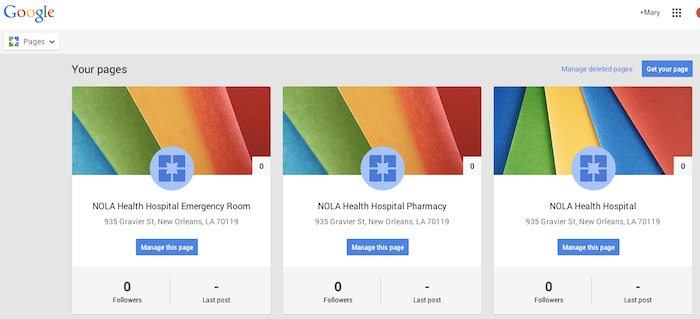
    Let’s say the aforementioned example is called NOLA Health Hospital. NOLA Health Hospital, in this instance, should have three Local (Storefront) Google Plus Pages. Note that these pages, while most likely using the same address, should have unique phone numbers. They should also have unique names; for example, “NOLA Health Hospital,” “NOLA Health Hospital Emergency Room,” and “NOLA Health Hospital Pharmacy” would be the proper names. These pages should also list their hours of operation according to their department-specific hours. If these pages were properly set up in the Google My Business dashboard, they would look like the following screenshot.

    Google My Business Dashboard - Search Influence

    Setting Categories:

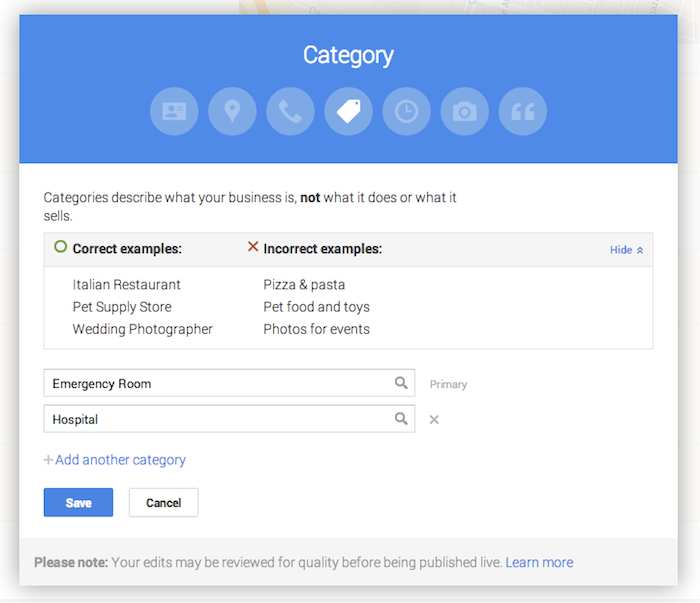
    Now that you have created the pages, it is important to use the categories to distinguish the differences between them. Google’s guidelines for businesses explicitly state that “For each department, the category that is the most representative of that department must be different from that of the main business and that of other departments.” This means that the primary category for each page should be different. In this example, NOLA Health Hospital Emergency Room will have the primary category “Emergency Room,” NOLA Health Hospital Pharmacy will have the primary category “Pharmacy,” and the general hospital of NOLA Health Hospital will have the primary category “Hospital.”

    Google Plus Page Editing - Search Influence

    While these settings are typically arranged during the page creation process, they can also be edited after the page is created. Click on “Manage this page” from the Pages dashboard, then click “Edit” in the top right-hand corner, and finally click into the “Category” section of the editing page to adjust the category. This is also where you can build out supplemental categories for the page. However, it may be wiser to use a few specific categories, as Google’s guidelines advise that it is best to “choose the fewest number of categories it takes to describe your overall core business.”

    As always, if you’re ever confused about how to proceed with your page, you can find the Google My Business “Guidelines for representing your business on Google” on the support site.

  • SEO for 2015: Meet the New Boss, Same as the Old Boss

    The world of SEO is constantly changing. Google, the big prize for search engine ranking, may change its search algorithms from 500 to 600 times a year, and major updates like Panda, Penguin, and Pigeon are rolled out on a fairly regular basis. And while your business can’t shift SEO strategies daily to incorporate every change Google unveils, it makes sense to take a fresh look at your SEO approach at least annually—or does it?

    The answer is yes, and no. While there are some aspects of SEO that can and should be refreshed or updated to keep up with changing algorithms and your audience’s needs and tastes, the good news for online marketers is that the basic SEO strategies you’re already familiar with will continue to be effective—in 2015 and beyond.

    Here’s a look at what will change in the SEO landscape for 2015 and what will remain the same.

    Sticking to the basics still works

    Best practices for SEO strategies have always revolved around delivering high-quality, targeted, and useful content with a few well-chosen, naturally incorporated keywords—and for 2015, that won’t change. Google-sanctioned “white hat” SEO tactics continue to be the most effective strategies for driving SEO and boosting search engine rankings.

    Another basic element of SEO that will remain the same is the need for both on-page (what you say about yourself) and off-page (what others say about you) factors. Successful SEO includes creative, useful, and engaging content creation for your website, social media, and other online channels, along with promotion that drives off-page SEO by attracting links to your content from other authoritative sites.

    Going mobile will be an imperative

    By now, most companies are aware that a responsive, mobile-friendly website is essential for attracting and retaining customers—but mobile SEO is more important than ever when it comes to Google. Responsive site design will be a crucial aspect of ranking high on Google, since the search engine now reports whether or not a site is mobile-friendly to both users and webmasters.

    If you’re not sure whether your business website is mobile-friendly enough, Google offers a free online testing tool, along with a link to information about their mobile-friendly criteria and how it may affect your search engine results.

    For small business, local SEO will be king

    In 2015, it will be important for businesses—especially small businesses—to make sure their websites are optimized for local area searches. Google and other search engines are giving more attention to local directories and citations, including hyperlocal content (relevant content authored by local experts within their geographic areas).

    One effective SEO strategy for optimizing local search is to make sure your phone numbers, addresses, and location pages are consistent with off-page directory listings. If you haven’t done so already, check out third-party business directory and review websites such as Yelp, Google+, and Yahoo Business to ensure that your local information is correct.

    Thinking like a publisher will benefit your SEO

    As search engine algorithms continue to shift weight away from obvious marketing and promotional content and toward contextual relevance, individuals are becoming more important than companies with regard to search engine rank. To take advantage for SEO improvement, more companies are transferring authorship credit to individuals—including text article writers, infographic designers, and video and podcast producers. Giving content creators their own voice will lend your content more weight with search engines.

    Links and keywords will lose center stage

    For a long time, keywords and links have been the cornerstones of SEO. But with a massive shift toward contextual search and high-value content, these primary factors no longer carry the same weight. Inbound and outbound links still matter for search, but their importance has been dwindling as more algorithms place relevance over popularity and authority.

    The same shift is apparently underway with keywords. While a few well-chosen and well-placed keywords still serve to help search engines determine the overall meaning of a page or piece of content, it’s more important that your content answers the right user questions and remains useful and engaging.

    If you’ve been sticking to SEO best practices, your strategy for 2015 is likely to only require minor changes in order to remain effective for the coming year and beyond.

  • Five For Friday: Do You Like Your Friends, Busting SEO Myths, and More

    1. You’re Doing It Wrong: This App Tells You If You Actually Have Friends – Tech Crunch

    Ever wonder if you actually like your friends? There’s now an app for that. The app, called “pplkpr,” monitors your heart rate through a wristband and sends you text message updates about your relationships. It even helps you schedule time to hang out with people it deems “better friends.” So next time you want to bail on plans to sit around and watch Netflix, just say “My app thinks I shouldn’t hang out with you.”

    2. Is Google Making You Dumber? – Mashable

    By keeping your browser homepage set to the default page, usually Google, you’re missing out on the opportunity to see something new every day. Changing your homepage to a more engaging site could allow you to learn a new word every day or to expand your horizons through photos. There are no limits on what page you set it to, and this article offers some great options if you’re looking for a daily knowledge boost.

    3. …But When Will I Get My Robot Butler? – Tech Crunch

    When Siri plays Hall & Oates instead of finding the nearest Walgreens, it makes me wonder if it’s even possible to build functioning, humanoid robots. Though constantly portrayed in popular culture, robots that mimic humans might never be a reality. Issues with artificial intelligence and voice recognition hold us back from being able to send a robot to take the trash out. Till large advances are made, it looks like I’m still going to have to do my chores myself.

    4. A Special Set of Skills: How to Not Let Your Phone Get “Taken” – CNet

    Though you might not need Liam Neeson to get your device free, hackers are taking phones hostage at alarming rates. By hiding ransomware links or apps, hackers can threaten to encrypt your device or lock your phone entirely unless you pay up. If you keep to reputable app sites and stay away from sketchy links, you can avoid having your phone “taken” right in your very hands.

    5. Myths Busted! 5 SEO Myths That Need to Be Debunked – Search Engine Watch

    SEO is always changing and updating (with the help of “P” named animals). With such a fast-paced industry, misconceptions easily find their way into common thinking. These myths can encourage unrealistic goals and set impossible standards. By demystifiying these myths, we set ourselves up for greater success and more satisfied customers. After all, the best place to hide a dead body is on the second page of Google results…

    Image Sources:

    Bye Felicia Image

  • 6 Methods For Healthcare Providers To Turn Great Service Into Great Reviews

    As society continues to evolve into a highly mobile culture, we see how heavily online reviews influence the selection of a practice or practitioner. In fact, among patients who look for online reviews of doctors, an estimated one-third reported choosing a physician based on good ratings, according to a national survey published in the Journal of the American Medical Association. Most people trust an online review just as much as they trust a personal referral from a close friend or family member. Maintaining a positive online reputation is essential, because while your healthcare practice cannot control what patients write, you can control your response to their reviews.

    People Hate Us On Yelp Image - Search Influence

    The medical industry is highly competitive, so the more positive reviews your business obtains, the more likely it is that your business will be found online. The success of your business heavily weighs on online reviews, so you’ll need to learn how to effectively ask for reviews from your customers. Here are six methods to encourage your customers to leave reviews.

    Make Writing Reviews Simple For Everyone

    Most people, unless they have a negative experience to share, will not make the extra effort to leave your practice a review. You need to make it as easy as possible for your patients to leave a review for your company, and you can do this by adding links to your review profiles in multiple places, such as in a follow-up email, on a thank-you page, etc.

    Get Listed On The Top Business Review Sites

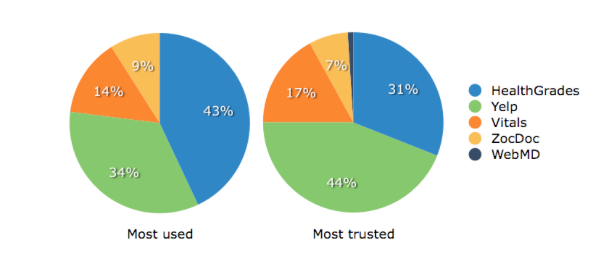
    Everyone has their preferred review sites, so it is necessary to have a strong online presence across the most popular ones. All profiles and listings need to be consistent and include as much current information about the practice as you can squeeze in (photos, certifications, awards, degrees, etc.).

    Business Review Sites For Health Industry Pie Charts Image - Search Influence

    Healthcare providers should have a listing on the following directories:

    1. Yelp
    2. Healthgrades
    3. Google+ Local
    4. Vitals
    5. RealSelf
    6. RateMDs
    7. Facebook
    8. Twitter
    9. LinkedIn

    Ask customers to leave a review on their favorite site—never pressure them to write reviews on multiple sites.

    Be Genuine While Asking For Reviews

    Let your customers know that you would appreciate it if they could take a few moments of their time to share their experience on one of your company’s review sites, as their opinion matters not only to the company, but also to other customers. You can do this by saying something as simple as, “Do you read online reviews? We do, and so do other customers. That’s why we’d love it if you would take a few moments to review your experience.” Just be honest; the worst answer you will get is a “no.”

    Never Pressure A Patient For Reviews

    You should always request that patients rate their experiences, but never make them feel pressured to leave a review. Even if a customer is extremely satisfied with your services, writing an online review may be the last thing on their mind. However, if a client had a great experience with your business, they will probably be happy to share their thoughts when prompted. The best approach is to simply ask your most satisfied customers to add their positive feedback to one of your business review sites.

    Consider Your Customers

    If your customers are millennials, consider yourself lucky! Most millennials are already comfortable with sites that allow users to share experiences online, and they will likely be happy to share their thoughts on your business without much prompting. Bombarding customers under the age of 25 with requests to post a review will probably push them away. However, if you have older or less social media-savvy customers, they may require direct prompting.

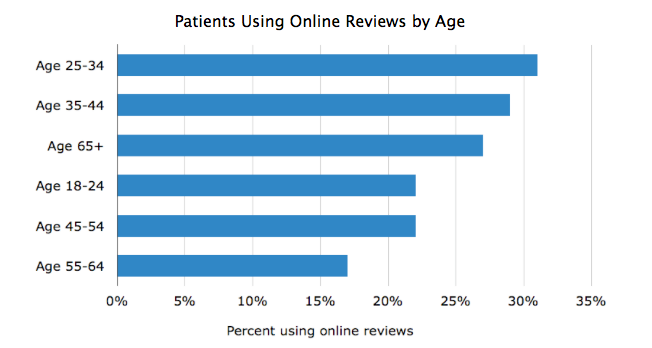
    Software Advice, a company that reviews practice management software, conducted a study to better understand online reviews and the processes of researching and writing these reviews. This study found that the largest age group of patients using online reviews ranges from ages 25–34, with males being 25% more likely to leave a review than females.

    Alt Text - Percent Of Patients Using Online Reviews By Age Bar Graph Image - Search Influence

    Don’t Ignore Negative Reviews

    While your overall goal is to gather good reviews, unsatisfied reviewers will inevitably make their way online to air their bad experiences. Bad reviews aren’t necessarily a business-killer; it’s how you handle the negative review or situation that defines the impact it will have on your business.

    Take note of negative reviews and respond to the criticism in a non-defensive manner. This can be done with a standard, generic reply that thanks the reviewer for the comment. Always ask the complaining patient to contact you directly so that you can further resolve his or her dissatisfaction offline.

    Take a negative review as an opportunity to better your customer service and your facility. Many negative patient reviews involve simple issues that can easily be resolved: long waiting times, issues with billing practices, lack of parking spaces, etc. If your complaints are targeting things that can easily be fixed, take advantage of this useful feedback to better your practice.

    Provide And Deliver Top-Quality Customer Service

    At the end of the day, the best path to having great reviews is to offer a great product and customer experience. If you’re doing everything you can to create a remarkable experience for your customers, there’s no harm in reminding them about the importance of sharing reviews.

    Image Sources:

    Most Used and Most Trusted Reviews Chart and Patients Using Online Reviews By Age Graph

    People Hate Us on Yelp


  • Five for Friday: Beef Up Your Local SEO, Twitter Welcomes Newbies, and More

    1. Google’s Domain Registration Service Now Open To All US Residents – Search Engine Journal

    Google now has a proprietary domain registration service! What’s great about this service is that, like most Google products, it’s fully integrated with Gmail forwarding as well as other goodies provided by Google’s partners – Squarespace, Weebly, Wix, and Blogger. Streamlined and familiar, domain registration starts at $12, with additional add-ons available. For more information about this service in different countries, you can sign up to a mailing list.

    2. A Step-By-Step Introduction to Amazon Product Ads – PPC Hero

    Amazon has always been kind enough to direct customers to your product, and it sometimes even directs them straight to your website. With Amazon Product Ads, the company helps you become better at selling your wares the right way – with the consumer in mind, but the seller at heart. This article details the step-by-step process on how to utilize APAs to the fullest, and it educates you on the nuances of selling products online.

    3. How to Have a Successful Local SEO Campaign in 2015 – Moz

    These tips are typically a no-brainer for us optimizers, but as evinced by our recent SI Conference, there are nuances to local SEO, and SEO in general, that we sometimes just don’t see right off the bat. With the new Google updates, optimizing is getting more personal and organic than ever. Check out the interesting click map to see just how organic SERPs are becoming.

    4. The Big List: 80 Of The Hottest SEO, Social Media & Digital Analytics Tools For Marketers – Marketing Land

    Note: this is not a ranked list of SEO tools, but rather a running total of great tools out there at the moment. Perhaps we will see some of these in our near future as employees of Search Influence. It’s nice to see kind things said about the tools we currently use, if not only to solidify the reasons why we chose the ones we did.

    5. Report: Twitter Planning New Home Page For Logged-Out Visitors – Marketing Land

    As an avid Twitter user, I’ve always been concerned with the esoteric universe that is Twitter’s inner sanctum. What’s in a homepage, you ask? Well, currently Twitter leaves a lot to be desired (a marketing ploy perhaps); there’s no indication of what the user interface even remotely looks like based on their homepage. Reports indicate that, unlike many social media home pages, Twitter may give in to human curiosity and allow potential users to glimpse its inner workings.


    Image Sources:

    Oh Boy Gif

  • Behind the Scenes: How Social Media Is Being Used in the Local Film Industry

    Unless you have been living under a rock for the past ten years or so (and not just any rock, but one without TV or Netflix), chances are you have watched a movie that was filmed here in New Orleans. The city – and the state as a whole – has seen an explosion of film and television productions over the past several years, earning the region the title of “Hollywood South.”

    From comedies like 21 Jump Street to Oscar-winners like 12 Years a Slave, Louisiana has even surpassed film production stalwarts like Los Angeles and New York City to become the country’s production capital – all thanks to the highly lucrative tax credits introduced in 2002.

    And while the big-budget movies are driving the local industry (check out NOLA-shot blockbusters Jurassic World and Terminator: Genisys in theaters this year), this influx has also helped inject momentum into the independent film industry – more specifically, the micro-budget indie film scene. These are projects made by passionate local filmmakers looking to find a foothold in the industry at large.

    These are not films the average moviegoer is typically going to be able to see or even hear about. So how do these filmmakers get the word out? How do they raise the funds to even get it made? And how do people find out where they can see these smaller films?

    The best and easiest way is through social media, an umbrella term that can be divided into several different platforms (Facebook, Twitter, Instagram, etc.). The most effective social media strategies take a multi-faceted approach into account and are tailored to suit each medium’s strengths to maximize effectiveness.

    I talked to a few local filmmakers about the importance of social media and other Internet marketing strategies. I found that first and foremost on these filmmakers’ minds is exposure, whether for fundraising or promotional purposes.

    Fundraising and Promotion

    “Facebook is a useful platform that enabled a community to form around the project. It is very useful in promoting fundraisers and screenings,” explains Sam Bass, who has helped with the social media campaigns for two films, How to Disappear Completely and Give Light: Stories from Indigenous Midwives. “Twitter is better for engaging with people outside of your immediate community with the potential to lead to significant opportunities and connections.”

    “We began our social media campaign to draw attention to our Kickstarter,” says Hunter Burke of Construct Films, who is using social media to raise funds for and promote the film Atchafalaya. “It was the quickest and most effective way to get our message out.”

    Greg Tilton, director-producer of reddit doc, had a similar mindset, but he wanted to lay the groundwork for their project before asking for fundraising help. “Social media was key because I did not want our IndieGoGo campaign to be the first time someone had heard of the project,” he states. “It’s been successful because people who don’t know me or my immediate network are following and engaging the project.”

    Mac Alsfeld, the writer-director-star of Father-Like Son, found social media to be most effective after the film was made. “We heavily relied on Twitter to build a relationship with festivals,” he explains. “I think it is important to show festivals that you are the type of filmmaker that will market yourself and that festival to potential filmgoers.”

    Getting Help

    For these filmmakers and others, this was a very important part of the behind-the-scenes process. For the most part, they were navigating the tricky waters of social media without any substantial professional Internet marketing experience – though some had help.

    Burke turned to a friend who had social media marketing and crowdfunding experience. “I really owe a lot to him for educating me on what is standard, what has worked in the past, and also coming up with some wonderful ideas. Without him, I would have been totally lost.”

    Lucky enough to be dating someone in the tourism and marketing industry, Tilton found it helpful to have someone more experienced to bounce ideas off of. “As I experimented, talked to her, and read a lot of articles online, I slowly built up my knowledge. She was a great sounding board for ideas.”

    Thoughts on Social Media

    Even without much prior experience, these filmmakers now have some very astute thoughts about the medium overall gained from their newfound experience.

    “I do believe that it is VERY important to have a presence within the social media community,” declares Kenna J. Moore of Ghost of Elysian Films, who was awarded the Emerging Vision Award for a Louisiana Filmmaker at the 2013 New Orleans Film Festival and the Louisiana Shorts Jury Award in 2014. “It is crucial that our image and what is being put out there is closely monitored. I like to have a presence but stay away from all of the ‘look-at-me’ syndrome that one can easily fall victim to in most social media settings.”

    “The thing about social media is that it is, at its core, incredibly voyeuristic,” says Tilton. “Many people do follow the musings of their interests, so there is a large audience to be engaged and many want to be a part of something big. You can find that audience.”

    Tips for Fellow Filmmakers

    As for fellow indie filmmakers feeling overwhelmed by social media, all the filmmakers have useful tips to share:

    Bass: “Have a social media strategy. Know how to work it. And don’t panic when nothing happens for a week. The most important things are follow-through and relationship building.”

    Alsfeld: “Show people that you have passion. Use your social media to blast information. And even more importantly, have fun. Don’t be boring.”

    Burke: “We performed the best when we released media. Posting a picture, an interview with the filmmaker, or a sample of the score really got our audience interested. People really responded to something they could interact with. Make it a fun experience. Keep it simple. Leave them wanting more.”

    Moore: “I’ve learned that social media has pros and cons. Some people gain opportunity and references from it. Some social media activity allows for negativity and distraction. I would encourage people to stay focused.”

    Tilton: “If you have nothing to say, don’t say anything. So many people are retweeting and posting haphazardly. It’s just a jumble of buzzwords and hashtags. Just make sure it’s always quality and you will find that pays off bigger.”

    Additional Resources
    Here are some more tips directed specifically at indie filmmakers on making the most out of social media:

    7 Tips for Promoting Your Indie Film on Social Media via Premium Beat

    6 Tips on Using Social Media for Your Indie Film via Media-Match

    Image Sources:

    3, 2, 1 Film Image

    Social not-working Image

    The End Image

  • Five for Friday: Is Your Social Media In Good Hands? Link-Dieting & More

    1. New Year, New Link Takedown – Search Engine Land

    As we all know, many sites were put on Google’s naughty list thanks to Penguin’s distaste for bad links. Their next move? Request, request, request. Looking back on 2014, Google certainly got a lot of action. Torrent Freak reports that Google received a 75% increase in link removal requests in 2014 as compared to the previous year. We’re talking highs of 12 million URLs requested for removal per week. 2014 was clearly the year of cleanup.

    2. Project Share Aware: Sugar Bowl Not So Sweet For Some – MarketingLand

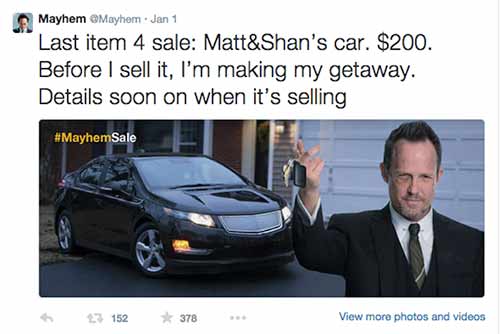
    An unsuspecting real-life couple, dubbed “oversharers” by Allstate, was burglarized during their outing to the Sugar Bowl. You might be wondering why an insurance company would do such a thing. Allstate’s latest campaign, Project Share Aware, aimed to alert the public to encroaching social media-savvy burglars. Long story short, if you’re telling people where you are in a public sphere, those without your best interest in mind (aka burglars) can take advantage of your oversharing. The event went as far as holding a fake online sale of the couple’s property using #MayhemSale on Twitter. Many claim this was just another ploy of Allstate’s fear-mongering advertising tactics, but it certainly made a few rethink their privacy settings. Although rattled, the couple did walk away a little sweeter with free Sugar Bowl tickets.

    MayhemImage

    3. Modern Family: Device Edition – Search Engine Land

    This may not come as a surprise, but if it’s not on a modern advertiser’s to-do list, it certainly needs to be. What am I referring to? Cross-device advertising. We’re talking about your new modern family, each member gazing at their device of the moment, whether it’s a PC, mobile, or tablet. John Crosley, Bing Columnist, argues that households engaging with multiple devices within one day tend to be more receptive to advertising. The overall goal? Reaching your audience, wherever they are and on whatever device they may be using at the moment. Let’s just say cross-device advertising is the Lily of Modern Family.

    ModernFamilyLionKingImage

    4. New Year’s Resolutions: Cutting Carbs or Social Media? – Community2Business

    Which did you pick? If you picked social media, you’re probably in the right place. As you step into 2015, take some time to rethink how you’re reaching your audience. Some top tips include boosting visuals, knowing when the time is right, and monitoring your #HASHTAG.

    First things first, if your post lacks engaging visual content such as images, memes, or infographics, your audience will likely yawn and pass through. Also, consider donning those visual-friendly social media platforms like Pinterest or Instagram. Tick, tock – we’re talking about time. Although articles regarding the perfect posting times abound, don’t forget you’re unique! Pay mind to your particular market or industry and play around with tools to measure what time is actually best for you to post. Finally, it’s time to discuss the beloved hashtag. While this is an incredibly relevant and useful tool, it can be abused. Make sure you are picking appropriate wording and wisely follow the rule of no more than three hashtags per post!

    MeanGirlsButterImage

    5. Boost Your Newsworthy-ness! – Business2Community

    Based on an analysis of 2014 search trends, the most searched items were Robin Williams-related. This was followed up by the World Cup, ISIS, Frozen, and more. What can we take away from this? People want news! Alongside your SEO efforts, focus on making your business reflect the most recent, exciting news in the industry. As an added bonus, if you regularly update this information, it will be new news. And as we all know, Google loves to bask in fresh, updated content. Now, that’s killing two birds with one stone!

    Image Sources:

    Mayhem Last Item 4 Sale Tweet

    Modern Family Gif

    Mean Girls Gif

  • Big Results Can Come in Small (SEO) Packages

    tinygiftsimageMany small businesses fear that because they don’t have millions of marketing dollars at their disposal to build their SEO campaign, they simply won’t be able to compete with large corporations. However, there are many SEO tactics small businesses can employ to level the playing field and compete against large marketing budgets.

    If You’re Small, Focus Small

    If your small business offers many services but has a limited budget, it will be more effective to focus your SEO efforts on a small set of highly relevant keywords. For example, if you’re a hair salon and you offer haircuts, blow drying, hair coloring services, etc., it will be better for you to focus on the one service that you perform best. It’s more effective for you to try to be visible for a primary or specialty service than to try to be visible for all of your services—and not to be visible for anything in the end.

    pinonglobeimageYou’re Local, So Get Hyperlocal

    A big advantage you have as a small business is your attachment to the area. Focus your efforts on your local audience by hosting events, participating in your community, getting local reviews, and targeting your content to your locale. You can then leverage all of these hyperlocal efforts in your SEO campaign. That local event you hosted or local organization you helped can generate local content, local buzz, and website links back to your site, all of which tell search engines that you are locally relevant.

    Specific And Long Tail Is The Way To Go

    With limited funds, you need to be clever about the keywords you’re focusing your efforts on instead of going for the obvious ones. To go along with the hair salon example, instead of emphasizing keywords like “hair cut” or “hair coloring,” focus your efforts on more long tail phrases such as “tips to layer your hair” or “how to get an ombre effect.” It’s much easier to rank highly for these long tail, specific keywords than the obvious, broad keywords. While there may be less traffic, the traffic you do get will be highly relevant.

    The next time you think your SEO dollars and campaign efforts don’t stand a chance against giants in the industry, don’t forget that being small has its advantages. Leverage your nimble nature and cleverness for some easy wins!

    Thanks to Heiwa4126 for the globe image and to John Fingas for the tiny presents image.

  • Law & Order SEO: Finding The Culprit Behind Your Decreased Organic Traffic

    As digital marketers, we regularly analyze site traffic to ensure that our efforts are producing positive results. But what happens when you’re doing all the right things in your SEO campaign (high-quality website content, blogging, link-building, etc.) and your Google organic website traffic is consistently going down?

    1) Traffic Deep-Dive

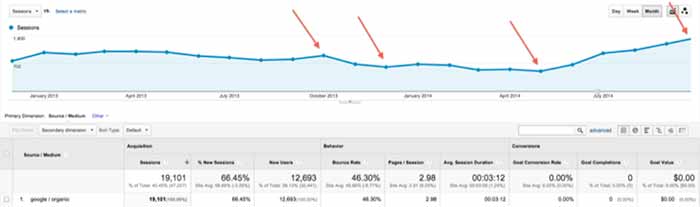
    First, log into Google Analytics and narrow your search down to Google organic traffic over the largest date range possible. Look for trends of upward or downward traffic and make annotations of known changes that might have caused traffic to change (such as a new website launch or the installation of a blog). Also, check traffic by landing page to see if only certain pages were affected.

    TrafficDeepDive

    2) Compare to Algo Timeframes

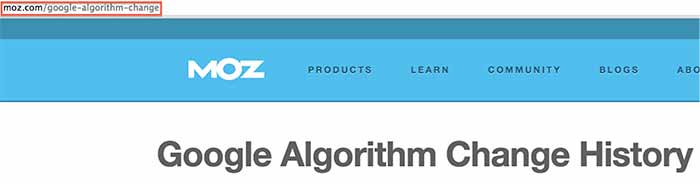
    Next, see if any of the changes correspond to one of Google’s algorithm updates using the Moz algorithm timeline. Keep in mind that the date might not be exact, because the updates often take time to roll out. If you can attribute the traffic change to an algorithm update, take the necessary action depending on the update. Hit by Panda? Focus on your content strategy. Hit by Penguin? Take a close look at your inbound links and check for a manual action.

    AlgorithmChangeIssue

    3) Investigate Other Possible Culprits

    If your traffic change didn’t correspond to a Google algo update, this is when your analysis gets a little tricky, as there are many possible reasons for the change. Here are some things to check when searching for the source of your traffic change:

    • Rollout of a new website (setting up 301 redirects is essential to this process as well as carrying over all SEO optimizations)
    • Removal or adjustment of your content
    • Relocation of your business (your citations need major focus)
    • Discontinuation of an ad campaign that was generating traffic
    • Adjustment of technical elements of your site, such as meta-tags or robots.txt
    • Change or removal of your Google Analytics tracking code (surprisingly common)
    • Change in the marketplace or seasonality (like a decreased demand for your products/services in general or during a certain part of the year)—check out Google Trends
    • Messy directory profile (check your percentage of correct citations using Moz “Check My Listing”)

    These tips will hopefully help you get to the root of the issue and take the necessary action to achieve your SEO goals. If you need a professional team to do the work for you or to assist you in your efforts, you can always call us: we’ll be happy to discuss our SEO packages with you.

    Have any additional recommendations for things to check? This list is not exhaustive, so please help add to it!