Tag: local search

  • Game On! Google’s Knowledge Graph Now Shows Video Games

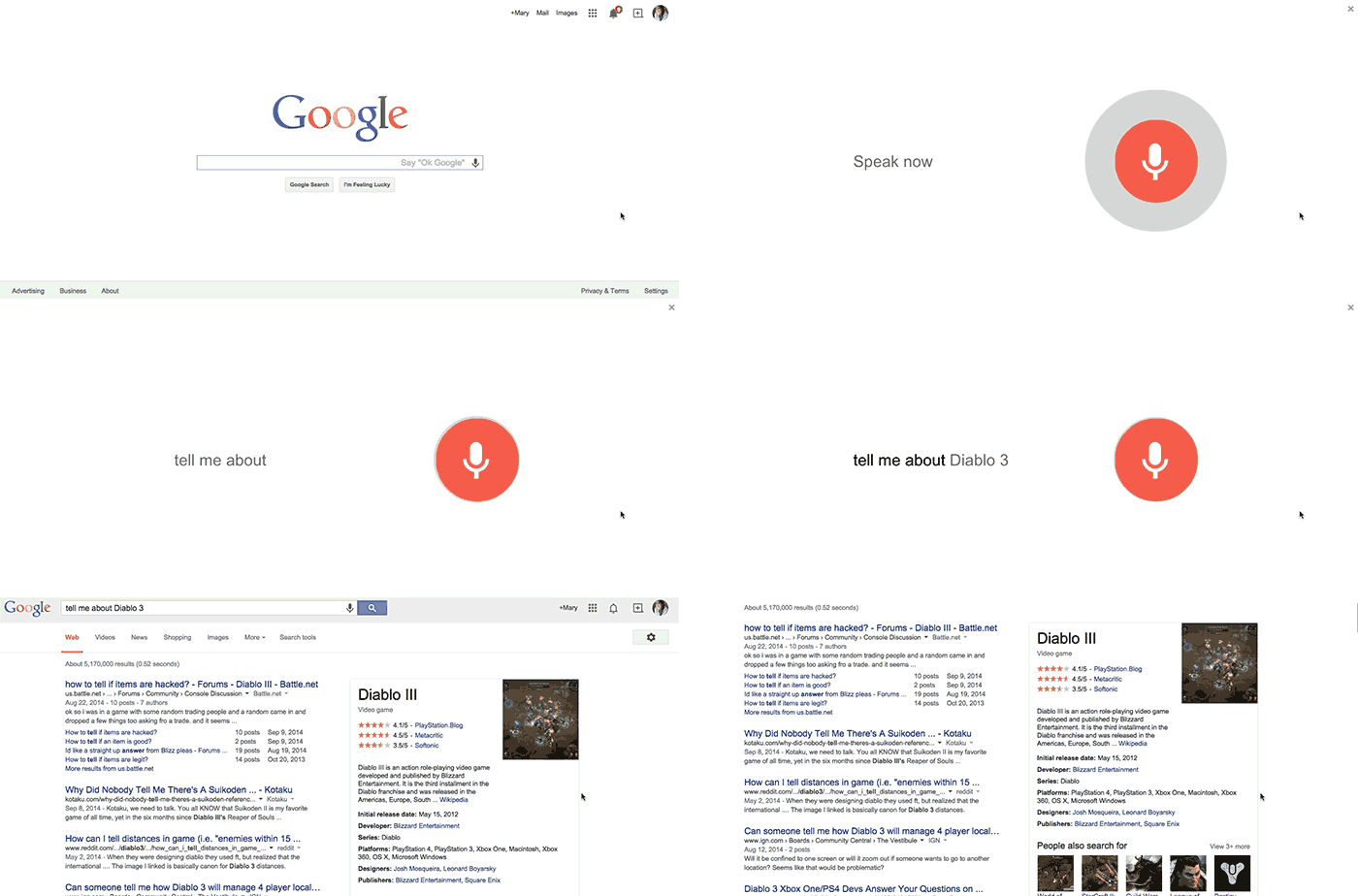
    As of a couple days ago, Google’s Knowledge Graph now includes information about video games! For those of you unfamiliar with the Knowledge Graph, it’s the box that appears on the right side of search results usually for searches like famous people, books, movies, and businesses. It includes pertinent, concise information on the subject matter. Accessible through desktop, mobile, and voice searches, the Knowledge Graph is Google’s way of connecting “real-world things” to provide “more meaningful results.”

    OK-GOOGLE-TELL-ME-ABOUT-DIABLO-3

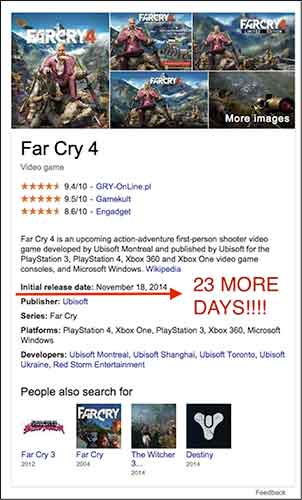
    With video games, there are a few basic information points that users typically look for when searching for video games. With this addition to the Knowledge Graph, Google has created basic title information for video games, like release date, rating, developer, platform, and publisher, among other things, easy for users to find.

    FarCry4KnowledgeGraphImage

    In the past, when I wanted to find the release date for a new video game it would take a bit of clicking around on various sites (usually Wikipedia or IGN) to locate that information. Now I can find out when Far Cry 4 is coming out just by searching “Far Cry 4,” which to me is pretty amazingly convenient!

    Another exciting feature for gamers is the “people also search for” section, which enables you to easily discover a new game! It is worth noting, however, that it seems (at least for now) in this section, games in a series are plagued by their previous or original titles. To me, that’s wasted space. I’d obviously know to check out Far Cry 1-3 if searching for Far Cry 4 and would like to see a more varied selection.

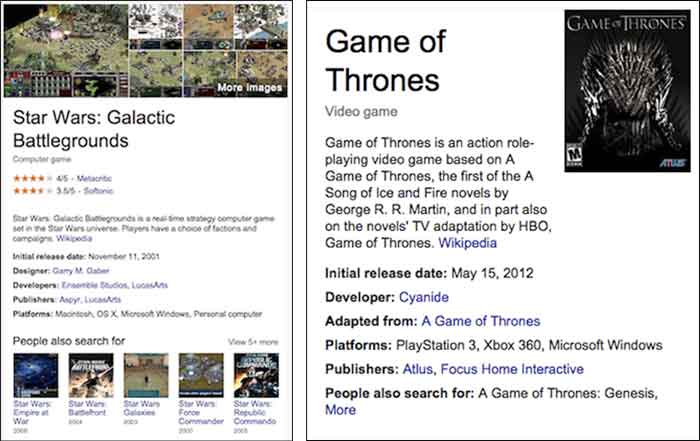
    I did a test to see if some of my all-time favorite games would also show up in a search (even if they’re much older games). Diablo II, Game of Thrones (the RPG) and the lesser-known Star Wars: Galactic Battlegrounds all passed! As suspected, however, it seems like the less recognized games, like Game of Thrones, miss out on some of the listed data, such as game photos, ratings, and a “people also search for” section. As an avid gamer, I know better than to judge a game purely based off ratings, but it’s still great data to have, now made easily accessible to searchers via the Knowledge Graph.

    StarWarsGameOfThronesKnowledgeGraphImage

    For more information on this awesome update, check out VentureBeat’s article including direct info from a Google spokesperson.

  • Avoid Detours: Claim and Edit Your Apple Maps Listing with Maps Connect!

    In the past, the only way you could edit Apple Maps listing was through user feedback on the mobile app. Recently, with our company’s big move from Uptown to the CBD New Orleans, the best way to go about getting our address updated in Apple Maps at that time was to email the whole company and have them mass-submit user feedback about the address change. (P.S. it worked!) These kind of mass-effort cleanup requirements made editing your business information as difficult as crossing The Narrow Sea in Game of Thrones. Thankfully, with the release of Maps Connect from Apple, you can now claim, verify, and edit your Apple Maps listing via mapsconnect.apple.com without the hassle of the above process.

    While the data provided to Apple Maps still primarily comes from Yext and major data feeds, such as Localeze, Factual, and Acxiom, the new Maps Connect allows businesses to be in direct control of their Apple Maps information. Businesses no longer have to rely on data feeds to change their information.

    While it’s a pretty intuitive and user friendly process, I’m going to walk you through it!

    Step 1:

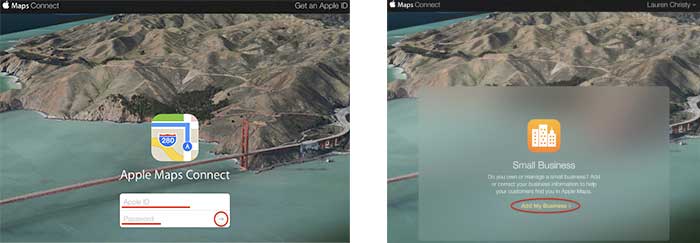
    Click “Add My Business” to get going.

    Step 2:

    Log in with your Apple ID or create a login if you don’t already have one.

    AppleMapsConnectImage

    Step 3:

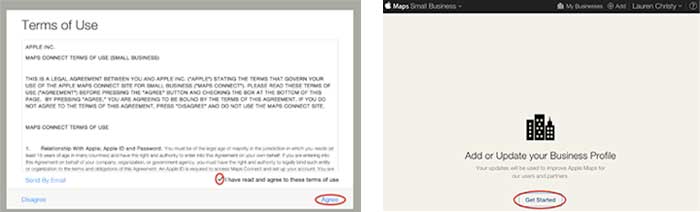
    Read the “Terms of Use,” check “I have read and agree to the terms of use,” then click “Agree.”

    Step 4:

    Click “Get Started” to finally start the actual claiming process.

    GetStartedAddorUpdateBusinessProfile

    Step 5:

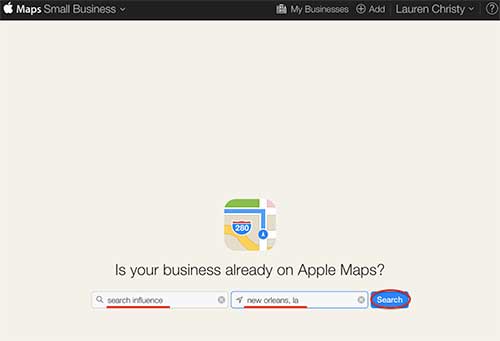
    Search to see if your business is already on Apple Maps by entering your business name, city, and state in the respective fields, then click “Search.”

    IsYourBusinessonAppleMapsImage

    Step 6:

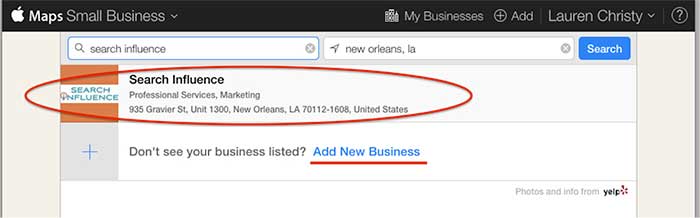
    Based on the results you get, either click on your pre-existing listing to claim it, or click “Add New Business” if yours is not already on Apple Maps.

    NOTE: You should always try searching for truncated versions and any possible variations of your business name before assuming it’s definitely not in a directory.

    AddNewBusiness

    Step 7a:

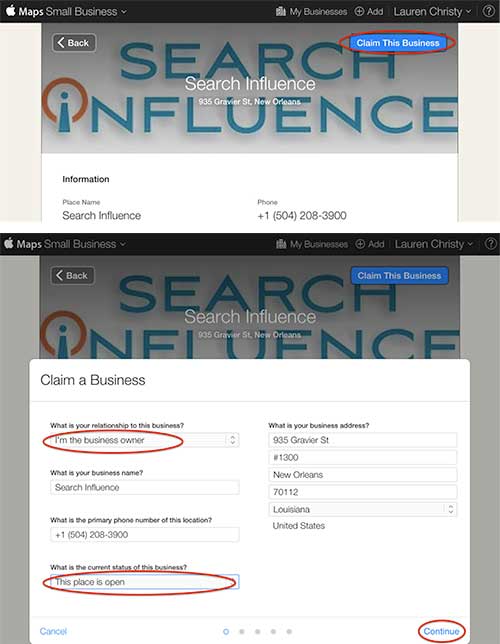
    If claiming a pre-existing listing, you’ll be taken to the live listing of your business where you can click “Claim This Business” in the top right-hand corner. Then you’ll choose your relationship to the business, change any of the business information that is inaccurate, choose the status of the listing, and click “Continue.”

    ClaimThisBusiness

    Step 7b:

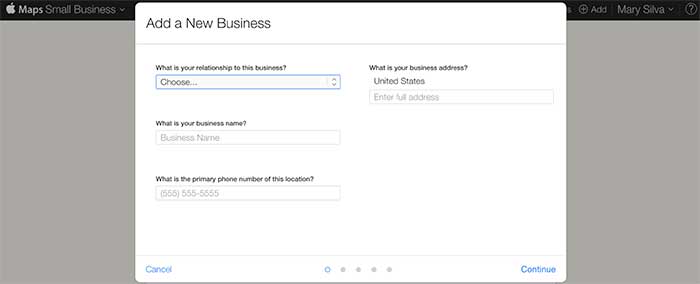
    If creating a new listing, you’ll be taken to a screen to fill out your businesses NAP (Name, Address, Phone Number) and your relationship to the business.

    FillOutBusinessNAP

    Step 8:

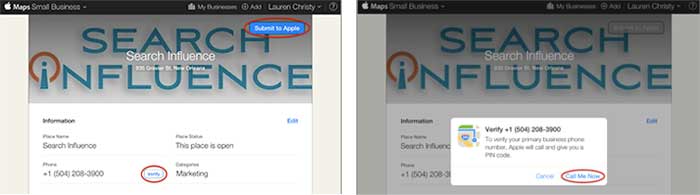
    In either case, the last step is a phone verification. By clicking “Submit to Apple” in the top right corner or “Verify” next to your number, you’ll be taken to a screen to verify your phone number by clicking “Call Me Now.”

    SubmitToApple

    Much like other higher-level directories (think Google, Yahoo, Bing,and Yelp) this phone verification is an immediate, real-time call to the business number to relay a pin. If the phone call with the code doesn’t work the first time, much like Apple’s process for bad pin-code entries on products like the iPhone and iPad that have passcode locks, you have to wait 1 minute to try again, then 5 minutes the next try, and 25 minutes after that. You can circumvent the wait time, however, by logging out of Maps Connect and logging back in.

    Since this is an automated process, businesses like ours with phone tree systems will suffer the inability to phone verify for now. I reached out to Apple Support to see if there’s an option to request a manual phone call to verify or some kind of domain-email verification. Within 24 hours the replied that they “manually reviewed and approved [our] profile” which I assume was because of our domain email being used in our account. Hopefully they’ll take a tip from from Google, Bing, and Yahoo and eventually allow a postcard verification option. Maps Connect is also currently only available to U.S. businesses.

    According to the folks at Search Engine Land, “Updates or new listings will show up within a week or could show up more quickly depending on the situation and whether the listing was flagged and/or there’s additional verification required. Beyond this, Apple has additional fraud prevention measures in place, but didn’t discuss them extensively.” So be patient when making any updates or edits.

  • The Saints Fan’s Guide To Schema

    Saints season is underway as our boys in black and gold try to bring another Super Bowl win back to the Bayou. Fall season isn’t just a time to enjoy football accompanied by ice cold bevs, a few Lit’l Smokies, and a seven-layer dip, it’s also the best time to ask yourself if you’re getting the most out of schema – one of the most untapped resources in online marketing.

    QUARTER ONE – SCHEMA, BUT WHAT IS IT?

    First off, Who Dat. Secondly, schema is an HTML markup that you can add to web pages to make them more easily readable by search engines. Schema is essentially a type of label similar the numbers on a player’s jersey. Schema gives the crawler an idea of what the content on a page can be categorized as, sort of like how numbers on a jersey can tell you what position a player is (btw, go number 9!!! #breesus).

    QuarterOne

    QUARTER TWO – OKAY…SO, WAIT, WHAT?

    Trust me, schema is great. Still don’t believe me? According to a Searchmetrics case study, pages with schema.org integration on average rank four positions higher compared to pages without schema. Not to mention Google officially recognizes schema in the same way that coors light Bud Light is recognized as the official beer of the NFL.

    QuarterTwo

    HALFTIME – STAND UP & GET CRUNK!

    Also, time to dispose of a few soft pretzels and tray of N’awlins Nachos.

    QUARTER THREE – I AM PRETTY FULL, BUT WHISTLE MONSTA IS HERE, SO LET’S DO THIS.

    Now that you are all in on the schema bandwagon, you need to figure out what kind of schema you should be using. This is where you need to develop your schema playbook. There is an incredible amount of schema out there – and that is an understatement. To get started, try checking out the local business schema on schema.org. If you have reviews on your page, another good starting place may be schema.org/Review.

    QuarterThree

    QUARTER FOUR – CLEAR HIERARCHY, FULL HEARTS, CAN’T LOSE

    Time to implement schema and bring home that elusive win. Schema markup is added within HTML tags on site pages. Both HTML and the schema are structured according to a clear hierarchy, which is important to remember when choosing which schema properties to use for markup.

    QuarterFour

    0:00 4TH QTR – FINAL SCORE: SAINTS WIN! SAINTS WIN!!!!

    And most importantly, you win too. Schema is often misunderstood, but if used correctly, it can be one of the most powerful tools in an online marketer’s arsenal. Thanks for reading, and GO SAINTS!

    Take a more in-depth look at schema with this blog from SI web developer, David Fransen.

  • What’s Black and White and Impacts 3-5% of Search Queries? Panda 4.1!

    In the last two months, Google has been busy improving the Panda. In early August (Aug. 8, 2014, to be exact), there was a lot of chatter from the SEO community seeing the flux in Google Analytics accounts, which was generally accepted as an unconfirmed monthly Panda data refresh.

    In early September, there was a large Panda data refresh, and on Sept. 25, Google’s Pierre Far announced yet another Panda algorithm update, (the previous Panda algo update was May 19).
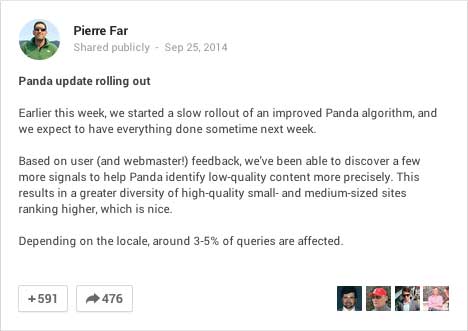
    GooglePlusPostPandaAnnoucedImage

    And just to keep you on edge, ceaselessly examining your Analytics data, the rollout of this Panda has been sloooowwwwslothlike. Google confirmed that some Google data centers were not updated until “October 6 or later.” So, your website could have seen the algorithm at some point before Sept. 25 and after Oct. 6 – that’s a two-week time frame to analyze!

    What is Panda?

    There are so many blog posts out there describing the Panda algorithm, I will just summarize it briefly. If you’re interested in reading about it in more detail, here’s a good blog post, and some excellent reading here.

    Panda is an algorithm that filters the search results to:

    1. Reward high-quality content with more presence
    2. Push sites with thin content down to rank lower

    Google says low quality or thin content is text that

    •   Is very short in length
    •   Offers very little useful information to the consumer
    •   Is unoriginal or copied

    Your website content should not be self-serving; it’s all about providing information to the consumer to educate them with detailed and authoritative information.

    PandaContentPullQuoteImage

    This most recent Panda is an algorithm update, which is supposed to reward more high-quality small and medium-sized websites. From Par’s G+ post:

    “Based on user (and webmaster!) feedback, we’ve been able to discover a few more signals to help Panda identify low-quality content more precisely. This results in a greater diversity of high-quality small- and medium-sized sites ranking higher, which is nice.”

    This update is significant because it added more signals to better identify lower quality sites. Earlier algo updates have rewarded big directories for local searches, so this update is exciting because small- and medium-sized websites have a fighting chance for ranking in their local markets.

    Google Updates vs Data Refreshes

    To paraphrase, an update is a change in the algorithm. A data refresh is when the algorithm has not changed, and new data that is pushed through the data centers, such as new crawl data, is updated in the various data centers across the Google universe.

    Updating the data centers is one reason why updates are seen at different times for different geographies.

    I am quoting this really old Matt Cutts blog post here:

    Algorithm update: Typically yields changes in the search results on the larger end of the spectrum. Algorithms can change at any time, but noticeable changes tend to be less frequent.

    Data refresh: When data is refreshed within an existing algorithm. Changes are typically toward the less-impactful end of the spectrum, and are often so small that people don’t even notice. One of the smallest types of data refreshes is an:

    Index update: When new indexing data is pushed out to data centers. From the summer of 2000 to the summer of 2003, index updates tended to happen about once a month. The resulting changes were called the Google Dance.”

    What are data centers? Google crawls the websites out there and caches those in their gigantic index. That index is huge and is stored on thousands of machines. Those thousands of machines live in various Google data centers around the world. To truly geek out, read more about Google data centers here – these centers are where the Internet exists.

    Did Panda Help or Hurt Your Site?

    When you look in Google Analytics, it may be easy to see a drop off or dramatic increase. For example in the graphic below, I’m guessing Panda rolled out in the business’ local area around Oct. 6, and it didn’t go well for the site:

    Panda rolled out Oct 6, 2014

    And on Sept. 29, this site was Panda-happy:

    increase in Google organic traffic after Panda September 2014

    For most of the sites I looked at, the visual changes were more subtle, so I usually toggle between the data by week vs. the daily data. The weekly data shows me a week where the decreases started, which correlates to the earlier rollout dates:

    weekly analytics view to pinpoint Panda rollout

    When I switch to the daily data, I can clearly see the dips in traffic. I have to pinpoint Saturday, Sept. 20t or Wednesday, Sept. 24 as the day this site got the Panda.

    daily Analytics shows dips in Google organic traffic after Panda

    The Sept. 20 might be a little early to fit in the Panda time frame, and I am accustomed to seeing a spike immediately before an algo filter, so I’m going for Sept. 24. Using Sept. 24 as the before and after date, this website has seen 12% decrease in Google organic traffic.

    12% decrease in Google organic traffic after Panda Sept 2014

    This website with the 12% decrease in Google organic traffic after Panda is a good website for an authoritative local business. What this drop tells us is even if the content on the site offers really great information for the consumer as this one does, it might be old and/or thin. Someone may have copied it over the years. We might need to add other content to our pages with images and videos. Content is not just text. We need to take a good look at the age of the text and the variety of the content on the page. With this review, we can create a strategy for improving the content for the next Panda data refresh.

    What to Do Now

    PandaImageWebsite owners or managers who see a Panda smack really need to take a critical look at the content on the site. To succeed, the content needs to be information rich, and not self-serving.

    An example of self-serving content is content that is stuffed with keywords, abundant keyword use on a page not only in the body text, but also in the URL and alt tags. This is also sometimes referred to as over-optimization.

    Self-serving can also mean the content talks too much about the business instead of talking about the product or service the consumer is trying to learn about. Talking about the business is great as long as it’s on the About page or the home page. Leave products or service pages to be about those topics.

    This is a great list compiled by Josh Bachynski “The Complete Google Leaked PANDA Do & Don’t LIST – 2011 to Present.”  This list really dives into the aspects of good and not-so-good content.

    Google published a list of questions to ask when writing content. The full list is here. I have chosen some to republish below:

    • Would you trust the information presented in this article?
    • Is this article written by an expert or enthusiast who knows the topic well, or is it more shallow in nature?
    • Are the topics driven by genuine interests of readers of the site, or does the site generate content by attempting to guess what might rank well in search engines?
    • Does the article describe both sides of a story?
    • Does this article provide a complete or comprehensive description of the topic?
    • Are the pages produced with great care and attention to detail vs. less attention to detail?

    Diversity of content and freshness of content are also factors to consider.

    Diversity of content helps readers in various ways. Content can mean images. Original images are best rather than stock images, but stock images work. Content can also mean videos, charts, calculators, and reviews. Content is anything that helps the consumer learn more to make well-informed decisions.

    For content freshness, a blog is probably the easiest approach to keep the website updated regularly without having to rewrite your page’s content too often.

    If you have a specific owner or practitioner who is the authority on the information, claim that using Author markup – authorship thumbnails are gone from SERPs but that doesn’t mean the Author authority is gone.

    There are so many tactics for coming back after a Panda smack, and the best strategy is a mix of tactics. It will likely take time to create really good content and build back your website credibility, but it is a necessary investment for your site’s success.

    If you think your site is suffering from the Panda, give us a call. We would be glad to help.
  • Five For Friday: Paging Dr. Google, Panda 4.1 Is On The Loose, And More!

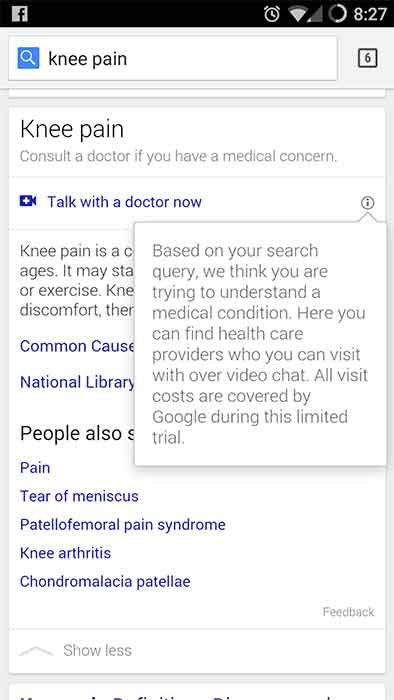
    GoogleKneePainAnswerImage

    1. Google Gets a Medical Degree
    -Mashable

    In what may prove to be the coolest Google project all year, reports have surfaced that the search engine plans to implement a feature to their already lauded Helpouts initiative. The new project will attempt to take health-related symptomatic searches and connect users with real doctors online. All costs are being covered by Google during the limited trial period, however it may cost you as the service is refined. The impact this will have on health professionals is exciting, and could transform an entire industry. The opportunities this service poses are truly endless, especially when you consider the degree of Google’s philanthropic endeavors.

    2. The Forgotten Curriculum
    -Moz

    Carla Dawson of MobyDigital discusses the pros and cons of teaching SEO at universities.

    As a recent graduate frustrated with the absence of tech-related courses being taught at my alma mater, I strongly believe in this move to educate the average university student on the subject of SEO. The article poses quite a few points of contention and agreement, here are a few that stuck out:

    1) Pro: Everyone says they know SEO. Without a standard for learning SEO, there can be no true credibility among firms. Teaching these skills at universities will quell [most] questions about a persons knowledge base.

    2) Pro: Today’s student is tomorrow’s potential client. Students who learn SEO in a formal setting will be able to sell [and be sold] SEO services more effectively.

    3) Con: Google algorithmic changes are frequent, and transform the industry.  The single most significant obstacle to teaching a standard course on SEO is the fluid nature of the industry.

    3. Panda Does Not Approve of Average Content
    -Business 2 Community

    The most recent tweak to the Panda Algorithm is in full swing. Nothing about this update is drastically different from what we have seen before, but Google is making it clear that authentic, well-vetted content from small and medium sized businesses remains a staunch priority.

    This checklist, provided by Google, is a great resource for those writing content for their business:

    • Would you trust the information presented in this article?
    • Is this article written by an expert or enthusiast who knows the topic well?
    • Does this article have spelling, stylistic, or factual errors?
    • Does the page provide substantial value when compared to other pages in search results?
    • Was the article edited well, or does it appear sloppy or hastily produced?

    TheAngryPandaCommercialSquareGifImage

    4. The Semantic Future of Link Building
    -Moz

    In his most recent submission to the MOZ Blog, Paddy Moogan discusses the impact on link authority, as Google continues to prioritize semantic search over exact-match keywords. As Google continues to understand search intent more and more, the rules surrounding link building will change. Paddy argues that the quantity of links, the anchor text of the links, and deep linking will matter less and less in the coming years.

    5. What Is Your Take on B2B Marketing Strategy?
    -Search Engine Land

    The recent banishment of the Google Authorship markup inspired annoyance in people like Derek Edmond, of KO Marketing. The impact on B2B Marketing from this discontinuation is very real to a certain niche, but as the wild world of SEO ebbs and flows, Derek reminds us of four tactics employed by B2B marketers that have had success in the past. Will marketers continue to build on these tactics, or abort them entirely?

    1) Purchasers prioritizing “thought leaders” in their industry. This tactic was primarily employed by the use of Google Authorship and Derek believes some kind of platform will fill this void in the future.

    2) Infographics are well respected, and oft-cited, however the market for infographics is so saturated that it is becoming increasingly difficult to create effective infographics.

    3) Derek argues that guest-blog posting is tricky game. The useful expertise provided by credible commenters can boost your authority as a business. On the contrary, Google considers guest blogging to be spammy, and it is easy to have unreliable sources hurt your authority.

    4) Derek warns against the dangers of spammy content, and questions the SEO usefulness of using Twitter to market your business. Matt Cutts of Google has stated that the search engine does not consider social signals when it comes to rankings. However, Derek argues that using Twitter as a tool to build relationships proves to be invaluable.

    Thank you to Panda Cheese for the great angry panda commercial!

  • Five For Friday: Amazon Gets Physical, Tinder Cleans Up, & G+ Asks, Am I Pretty?

    FiveForFridaysColorfulFive

    1. Google Testing New Local Interface In Web Search Results – Search Engine Roundtable

    Google is testing a new interface for showing the local web search results. Back in August, we saw that Google was showing the local carousel within the results, but this new interface is simply a list of the results and isn’t going to preview a map within the carousel.

    2. Tinder Spammers Move to SMS After Improvements To Dating App’s Security – Tech Crunch

    For awhile now, the dating app Tinder has been overwhelmed with spam bots, or accounts created to flirt with Tinder users and then direct them to adult sites. However, this summer, Tinder was called out by Symantec and therefore had to address the issue with an update. At first it appeared the update addressed the issue, but a new report is showing that the spammers have just moved to using SMS texts.

    3. Report: Amazon To Open New York Retail Store – Marketing Land

    Recept news reports say that Amazon is planning to open a Manhattan store just in time for holiday traffic. According to WSJ, the new store, opening at 7 West 34th Street, is to operate as a mini-warehouse of sorts, allowing returns and pickups. Others had reporting that this might be a place for Amazon to showcase it’s upcoming products such as new e-readers, the Fire Phone, or Fire TV. Either way, this could be a game changer for this e-commerce provider.

    4. Google Adds The Ability To Post Polls On Google+ – Marking Land

    As of October 9th, Google+ is giving users the ability create and share polls. This was a tool Facebook was offering back, but then pulled back in 2012 finding it redundant. This new feature in Google+ will on the web and Android versions within the next few days, and then eventually iOS.

    5. Google Makes Conversational Search Even More Intelligent – Search Engine Journal

    OpenTableLogoImageOn October 9th, Google announced an update to their conversation search functionality which should make it easier for planning. Overall the new features include, location-based searches, making reservations, and finding directions. These new features are now available on the Android and iOS app. What does this mean for businesses? It’s more even important to optimize your site for local search as well as to verify your Google+ local listing. If you own a restaurant, then you should ensure you are listed on OpenTable so you don’t miss out on potential customers!

  • 5 For Friday: Local Search, News, Advice, Measuring Success, and Penguin Refresh

    Five

    1. Local Businesses: Watch Out!
    – Search Engine Watch

    Apple’s newest gadget, the Apple Watch, is likely to have a major impact on local search. The expected increase in hyper-local searches means added pressure will be placed on businesses to ensure they can be found easily online. “Users will be able to search for locations via dictation or favorites, map out the routes and receive touch feedback at each turn – including different notifications to denote right or left turns” said Apple’s Vice President of Technology Kevin Lynch.

    2. SEO Success: Ranking #1 Isn’t What it Used to Be
    -Search Engine Land

    Following “Pigeon”, Google’s latest algorithm update, it has become increasingly apparent that rankings do not equal success. Instead you should focus on the following 5 metrics to more effectively measure SEO success: organic traffic, organic landing pages, organic conversion sources, Google My Business impressions and clicks for driving directions.

    PigeonUpdateImage

    3. Awaiting the Penguin Refresh
    – Search Engine Watch

    Google’s John Mueller recently announced that a Google is working on a Penguin update that is expected to launch in the “reasonable future.” In the meantime, Muller encourages webmasters to “focus on cleaning up site issues and making sure the sites are as good as they can be in and of themselves rather than focusing on individual factors of individual algorithms.”

    4. Social Customer Service: Now More Important than Ever
    – Search Engine Watch

    The social media revolution has had countless impacts on the success and failure of businesses. Consumers have more power than ever before; therefore, it is crucial businesses are aware of their concerns. Tips for success include: taking complaints and issues offline as quickly as possible, responding in less than an hour, and creating content that helps the customer, while maintaining a positive attitude.

    5. App-sessed
    – Marketing Land

    A new study shows that users spent 21 percent more time on apps in the last year. The data revealed that users are spending the longest amount of time on music-related apps and the shortest (but also most frequent) amount of time on social networking apps.

    MobileAppImage

    Image Sources:

    Pigeon Update Image

    Social Media Apps Image


  • HashTag, You’re It: Tagboard Allows Businesses To Display Hashtags In One Place

    Do you use a certain hashtag to promote your business on social media? Do your customers have a popular hashtag they use when posting about your business?

    If you answered yes, then it’s time to get excited because TagBoard makes it a whole lot easier to keep track of popular hashtags from your fans across multiple social media platforms.

    What is Tagboard?

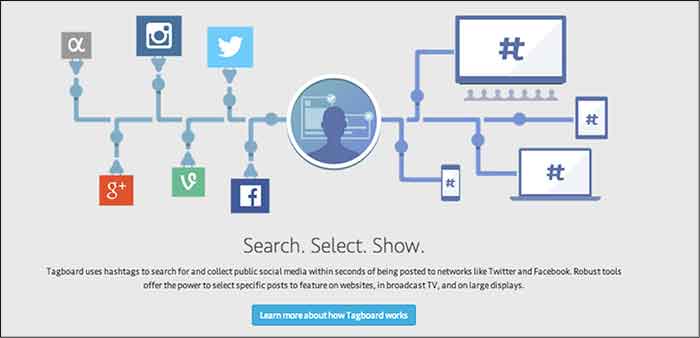
    Tagboard is a tool that lets you see all similar hastags across multiple social media platforms. The platforms that Tagboard searches are:

    TagboardPlatformsDiagramImage

    How can your business benefit from Tagboard?

    Tagboard uses an easy way to search for specific hashtags! All you have to do is search any hashtag to see a feed of all related hashtags and updates from the various social networks Tagboard scans.

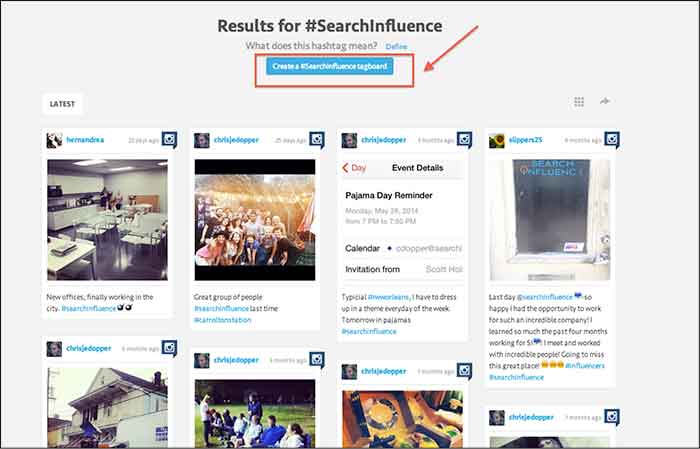
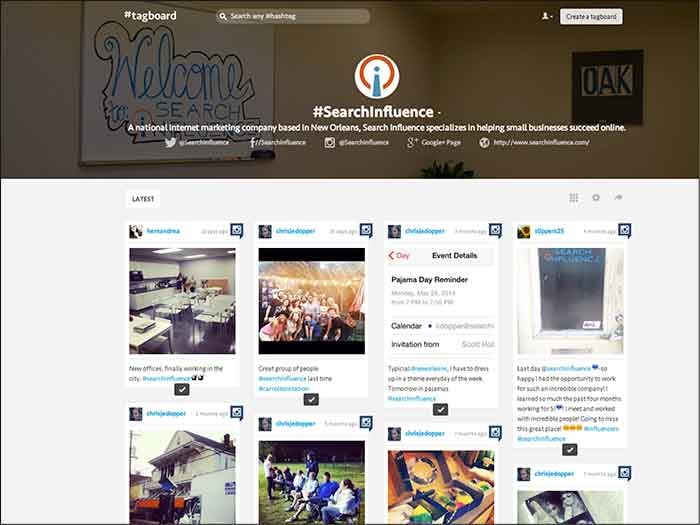
    Take Search Influence as an example. When searching for #SearchInfluence, multiple posts populate the board. If you want to use this hashtag as your own and custom brand it, you simply click on “Create #Hashtag Tagboard.” This is beneficial to getting your hashtag out there once created and seeing the interaction once the hashtag goes viral across multiple platforms.

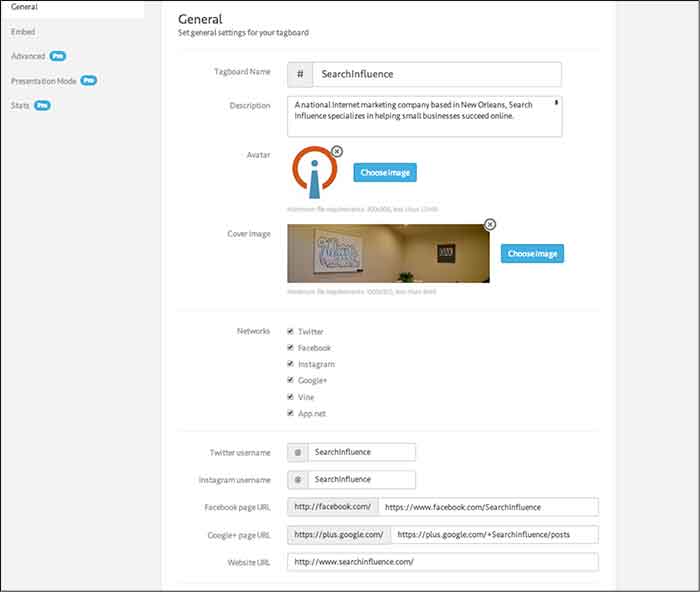
    TagboardResultsImage

    Once “Create #Hastag Tagboard” is selected it prompts you to complete a short form to fill out and customize to your brand and business.

    TagboardSettingsImage

    After filling out the form, your tagboard is complete and ready to be shared. Simply click on the “Share Tagboard” button and copy and paste the link into anywhere you want to promote or share you Tagboard.

    TagboardHomepageImage

    You can make multiple custom Tagboards for multiple hashtags. The possibilities are endless.

    Bonus SEO Benefits!

    As a bonus, Tagboard.com is an authoritative website in itself! Moz’s Open Site Explorer reports Tagboard has a domain authority of 68/100. When you go through the steps above to create your own hashtag Tagboard, the resulting page provides a followed link back to your website and other social media networks.

    Using Tagboard to claim your hashtags is a great way to further your website’s SEO and online reputation.

    What hashtag do you use to promote your business? Comment below to share your successes in using hashtags.

  • 5 for Friday: New Apple Gadgets, Net Neutrality, And Twitter Says Buy, Buy, Buy!

    5ForFridayImage

    1. Apple’s Big Reveal
    -Mashable

    This week, it’s impossible to ignore Apple’s big unveilings. While the new iPhone 6 may come with some interesting upgrades, for me, “the big reveal” was all about the Apple Watch. The new gadget is very slick looking and appears to be packed with features. Apple aims to put our entire social networks on our wrists while combining a fitness tracker, texting and voice capabilities, as well as a ton of fun apps. Check out this article, which talks about the technology behind Apple Watch.

    2. Twitter’s Advances Its E-Commerce Plans
    -TechCrunch

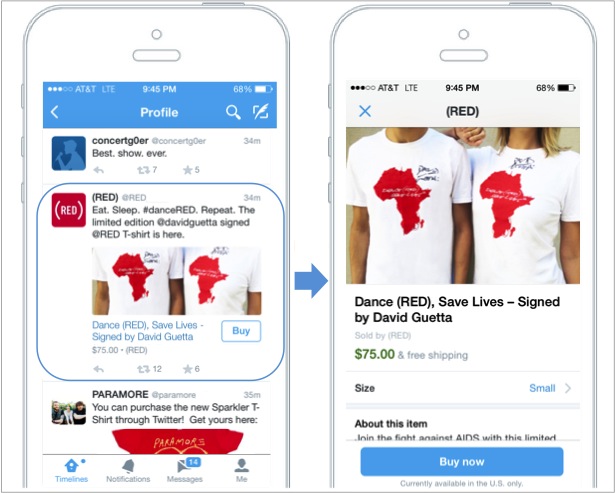
    As the ever growing competition between social media giants continues, Twitter explores alternative revenue options other than advertisements. The Nathan Hubbard, Twitter’s head of commerce, says of the microblogging platform, “[We] want to be a bridge between a consumer wanting something and getting it.” While still in the testing phase, the “Buy” button is a big step for Twitter in a series of initiatives built to generate more profit from its 271 million users. How do you feel about the option to buy goods from within Tweets?

    TwitterBuyNowButtonImage

    3. Facebook Converts Higher Value Into Better Marketing Services
    -Bloomberg

    While on the subject of social media advertising, check out this article on Bloomberg, which talks about Facebook’s incremental improvements to its array of advertising services. Marketers today are willing to spend more money for better conversion tracking, innovative new promotion options (such as video ads), and improved mobile ads.

    4. Social Networks for Net Neutrality
    -TechHive

    SaveTheInternetImageOver a dozen large websites, such as Netflix, Foursquare, and WordPress, joined “The Internet Slowdown Day” protest on Wednesday, looking to garner public support in the fight for net neutrality. Citing big Internet providers as the enemy, the websites simulated what the fast and slow lanes of the Internet would look like by displaying the loading page icons on their home pages. As September 15th approaches (the deadline for second-round comments on FCC proposed net neutrality rules), the conversation about Web traffic regulations is as pertinent as ever.

    5. Are You Using All Possible Keyword Sources?
    -Moz.com

    This highly informative post by Neil Patel uncovers some of the potential sources for your keyword research that you may not have thought of previously. While you may already have a preferred tool, the author suggests several unorthodox ways to supplement your research and, ultimately, lead to a better SEO campaign.

    Image Sources:

    Save the Internet Image

    Twitter Buy Now Button

    App Filled Five Image

  • On Social Entrepreneurship and Social Media – Interview with Alexandra Ernst of Project Pangia

    ProjectPangiaOwnerImageA year and a half ago, Project Pangia was born from the mind of Alexandra Ernst. After graduating from Loyola University New Orleans and working with The Walt Disney Company, she set out to create a business of her own. Having a passion for travel, meeting people, and social change, she aimed to create a business that would connect people. Project Pangia is a global initiative based on social and interactive development through the exchange and tracking of travel bracelets. With the help of social media, Ernst has managed to successfully fund an $18,000 Kickstarter campaign, create jobs for various underprivileged women in Bali, Indonesia, and spread these bracelets to more than 17 countries.
    How did you come up with the idea for your business?

    Project Pangia started as an idea for a travel website. I’ve always had the entrepreneurial spark and I wanted to create something. More than creating a normal business, I wanted to create something that connected people around the world and had some social impact.

    I began thinking about how our generation uses social media; we all have Facebook, Instagram, and Twitter – people sometimes just sit and browse through these sites for hours looking at other people’s posts or thinking about what they are going to post. Then, I started thinking about how I could utilize these tools but be able to connect with people not only on a virtual level but also on a human level. This evolved into a travel networking site, but I needed something that would allow me to do it on a fixed budget. It all came full circle when I thought about the idea of creating these bracelets. I said, “What if I give these bracelets to one person; they can hand one off to another person and somehow be able to see where these bracelets are going?”

    How does the exchange of bracelets work?

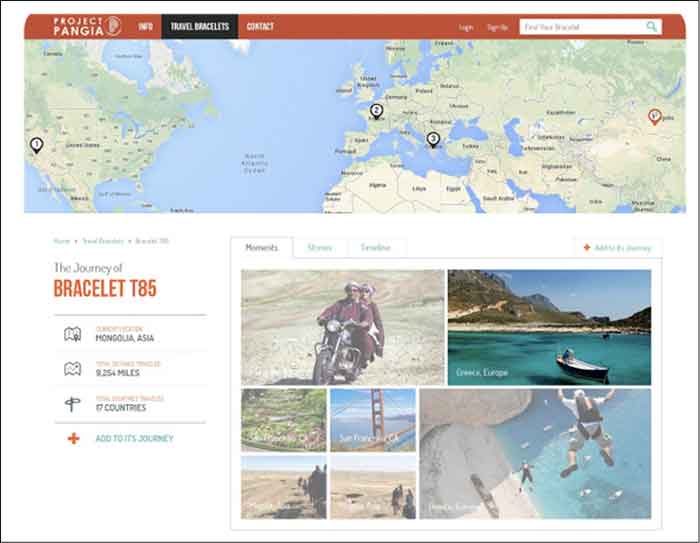
    As it is explained on the Project Pangia website, every bracelet is handmade and stamped with a unique code, which is registered on the site. Every bracelet is handmade and stamped with a unique code, which is registered on the site. You can track your impact as your bracelet is passed along from one hand to another in the “spirit of kindness.” Each new recipient can add to the bracelet’s story online before passing it on to someone new. We keep you updated as your bracelet reaches certain milestones so you can witness just how far one simple act of kindness can go.

    What is the goal/vision for your business?

    A huge part of it is working in underprivileged communities that otherwise wouldn’t have these opportunities of having fair compensation for their work, quality working conditions, and mentorship. For now, I’ve handled the production aspect in Bali – we used recycled surfboards and other sustainable materials for our production, packaging, and shipping. Ultimately, I would like to offer other communities around the world these types of opportunities through collaboration and partnerships.

    Project Pangia also aims to spread kindness and spread the message of “travel in kindness.” By doing so, we are creating cultural awareness and connecting people through the use of personal interaction, as well as through embracing the use of technologies and social media platforms.

    Finally, as the business grows, I want for Project Pangia to have a strong online presence on a global level and I have been slowly creating this by displaying my products and the stories that arise through them on my website, Facebook Page, Instagram, and Twitter.

    ProjectPangiaScreenshotImage

    If you are active in social media, what platform do you find elicits the most activity?

    Facebook and Instagram have definitely been the two that have grown at the fastest rate. In January 2014, my Facebook page had about 200 followers. Once I began to post more consistently and I began to push a couple of Facebook Ads, it grew to almost 3,900 in just a few months.

    My Facebook page was definitely my most important and effective tool for my Kickstarter campaign. If it weren’t for Facebook it would have been impossible for me to successfully fund it. By creating Sponsored Posts through Facebook I was able to drive a lot of traffic to my campaign. Also, my campaign was shared via Facebook 1,523 times! It was definitely where I saw more interaction from my followers who eventually became my backers. My goal was $18,000 and I raised $18,295.

    My Instagram has also continued to grow. I constantly want to push more imagery, and I think nowadays there’s an overload of information and people don’t want to read that much. Therefore I want to show them as many pictures of my products and their impact, and my followers have responded very well to that. A month ago, I had about 300 followers and it has nearly doubled in less than a month.

    I try to be very meticulous and careful about what I post, which is why I do not post as often as other businesses. Something very important to keep in mind is that you can’t just post anything online; you have to be very intentional with what you are writing.

    What other tools aside from social media are you utilizing to push your business online?

    I currently use a WordPress site and as someone without much technical background, this platform has truly allowed me to manage my website effectively. WordPress even has a tool that measures traffic within the same platform. I also have Google Analytics installed with the site and I use Hootsuite to create social media posts ahead of time and make sure I stay organized.

    Do you have any advice for other young entrepreneurs who want to leverage the use of social media with their business?

    It’s way more time and money than you’ve ever imagined, so you better love it with all your heart and truly believe in it. However, once you start seeing how people respond and the feedback they give you it makes it all worth it.