Tag: google my business

  • Found: Yelp Reviews Copied and Published as Google Reviews

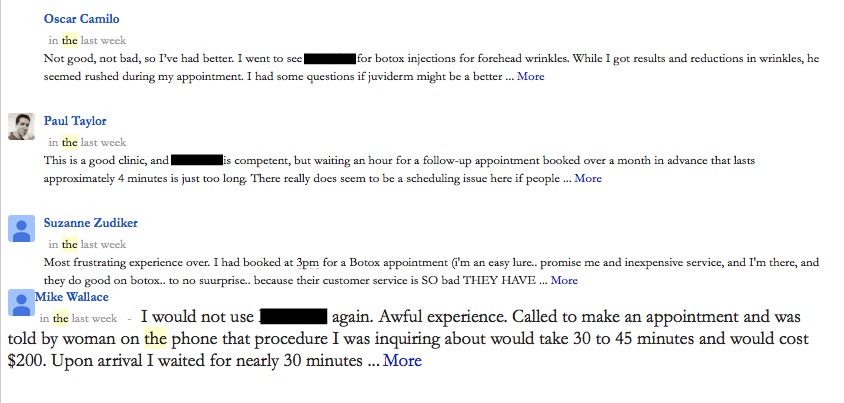
    In the last week, one very alert client saw saw some very recent reviews on his Google Plus Local listing that looked pretty suspicious.  All 4 of these reviews were published within the week:

    Google reviews are copies of Yelp reviews

    The client immediately flagged “Oscar” as a spam review on Friday, November 29th.  By Tuesday, December 3rd, we saw that the review was gone.  Removed from the client’s G+ Local.  That was super fast response by Google, which was a pleasant surprise.

    When we looked at the Google+ profiles for Paul, Suzanne, and Mike,

    • none of the 3 had information on their G+ Profiles except where they lived.  No posts.  No videos.
    • none of the 3 lived within 1,200 miles of our client.
    • 2 of the 3 had 100-200 people in their Circle, despite having no account activity.

    With the fast success of the first spam review removal, we immediately flagged the other 3 as spam reviews. Within 1 day, 2 of the 3 remaining spam reviews were removed.   The only one that’s left is “Paul.”  We’re watching Paul, and hopefully, that one will come down fast too.

    Plagiarizing Yelp Reviews

    These Google reviewers were pretty easy to mark as spam based on their Google+ profiles being so bare and their slim reviews profiles — only 1 review each — but I think the real reason they were taken down was because they are not original review text. They are all copy and pasted from Yelp reviews.

    And stating the obvious, the copied reviews are for different businesses and from different reviewers, so there is nothing legitimate about the Google reviews published on our client’s Google listing.

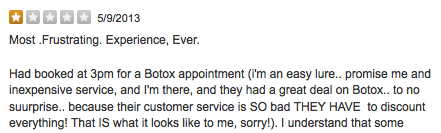
    Suzanne’s Google review…

    Yelp review copied for Google review

    appears to be a close copy of “Cecile Mighty Mouse M.” May 2013 review on Yelp.

    Plagiarized Yelp review used on Google

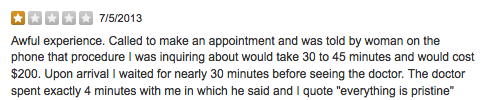
    Mike’s Google review:

    Google eview copied from Yelp review

    appears to be a close copy of “Ben S.” July 2013 review on Yelp.

    Yelp review plagiarized for use by Google reviewer

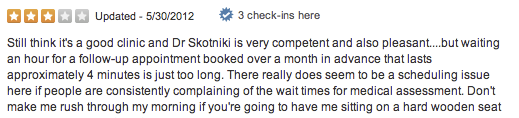
    Paul whose review is still on our client’s G+ Local as of this moment,

    Google review copied and used by Google reviewer

    is a close copy of  “Grainne sounds like Grawn-ya…not Grainy M” May 2012 review on Yelp

    plagiarized reviews on Google

    If you’re curious to see if a review is spam, try dropping a chunk of it into Google to see if a Yelp review shows up as a close copy. If so, then definitely flag as spam to Google. Has this happened to you? Share your tips and stories of spam comments below.

  • 4 Tips to Writing Attention-Grabbing Social Media Posts

    CONTENT CONTENT CONTENT

    We are bombarded by content and information everyday. The average person reads a couple thousand words and sees about 247 images each day. Something interesting from a marketing standpoint: we see anywhere from 3,000-20,000 marketing messages every day! All of these words and images are pieces of informative content that we have to internally process.

    I mean seriously think about it…

    TEXTS                                                      PHONE CALLS
    EMAILS                                                   RADIO
    WEBSITES                                             TELEVISION
    TWEETS                                                  MENUS
    FACEBOOK POSTS                          BLOGS
    SEARCH RESULTS                              STREET SIGNS
    INFOGRAPHICS                                  BOOKS
    GOOGLE+ POSTS                              MAGAZINES
    PINS ON PINTEREST                         NEWSPAPERS
    PRESENTATIONS                                FOOD LABELS
    BILLBOARDS                                         MAIL

    Whew—it’s exhausting just thinking about it! And I guarantee there is more than what I listed! Most of it probably goes in one ear and out the other, so, as marketers, we only have a split second to catch the attention of someone who is already being bombarded by information. Here’s a list of 4 types of social media posts that are guaranteed to catch the eye of your clients’ audience.

    1. Anything that drives interaction
    Any post that encourages a user to interact with a page usually works well with social media marketing. By interact I mean liking a post, sharing it, commenting, retweeting, +1, pinning on Pinterest, etc. If you can do this organically (without forcing it), then it’s even better!

    Tri County Equipment Facebook Post

    2. Anything with eye-appeal
    We are a very visual culture (why do you think the iPhone took off like it did?)! If you can integrate words into a visual image that presents the information is a well-designed way, then you’re golden! I’m talking about the infographic, people. There are good and bad infographics out there. But a good rule of thumb is don’t over load it with information, and make sure what you are presenting is relevant to your client’s industry. This example below was pinned 508 times and liked 76 times on Pinterest.

    Infographic About Zimbabwe

    3. Anything That Links the Brand to Current Events
    If you can find a way to tie the brand into something that is relevant to current events in the news and/or pop-culture world, you need to post about it! People often try too hard with this one, so please don’t force it! The brand needs to truly be relevant for this to happen organically.

    Volkswagen Google+ Post for Shark Week 2013

    4. Anything That Stirs An Emotional Connection
    We are an emotional species, and significant life events can really change our lives. If you can stir an emotional feeling in someone, they are likely to be more drawn to the brand. Note: This doesn’t always have to be the warm and fuzzy feelings! If you want to touch on the controversial subjects, there is an audience for that as well!

    Susan G Komen Facebook Post

     Now get out there and create some engaging content!

  • You’re So Vain, You Probably Think This URL is About You: Claiming Your Google+ Vanity URL

    Google has rolled out a batch of Google+ updates yesterday, and among those updates, they are now offering vanity URLs for Google+ Pages or Profiles.

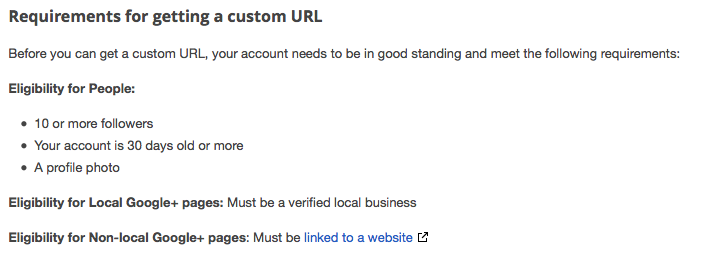
    Requirements for getting a custom URL are pretty straightforward:

    requirements G+ vanity URLs

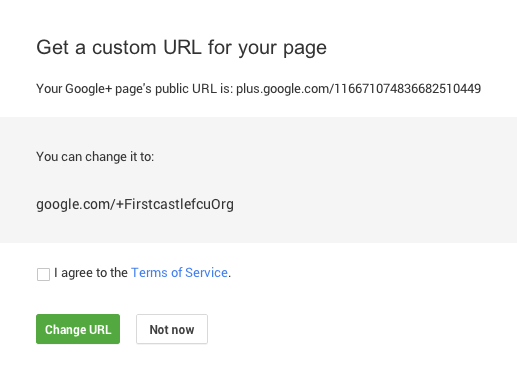
    Well, this a fun and interesting small project, so I thought I would walk through it with a client.  I logged in, and there it was! I’m not sure it could be any easier.

    Google+ vanity URL is provided with "org" - for non profit?

    Ah, but there is always a catch.  I don’t like the URL they gave me.  What is that “Org” on the end?  I don’t want that.  It’s not part of the client’s name.  I guess it’s there because their domain is a .org? They are a non-profit organization, unlike many domains which are .org, but still.

    custom URL for your Google Plus Page

    After a little investigating, it doesn’t appear we have the option to truly edit the vanity URL although Google mentions they may give you multiple vanity URL options to choose from. Not in this case.  That is an unfortunate scenario, but I’m going for it anyway.

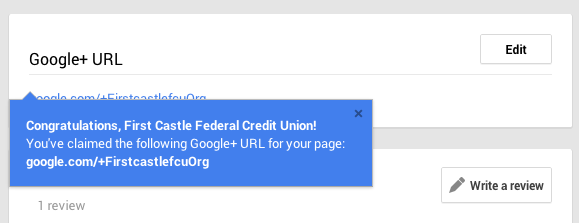
    Super easy to just walk through the steps.  And you can edit it – see the “Edit” button handy right there.

    Screen Shot 2013-10-30 at 12.03.20 PM


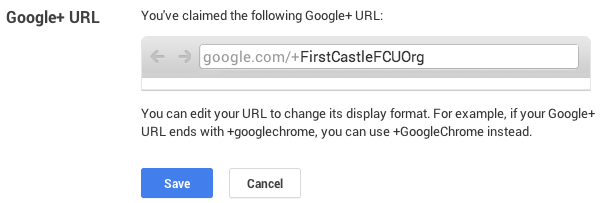
    But when you edit it, you can only edit for capitalization.  I can’t get rid of the “Org.”  Aarrggh.

    edit your Google Plus vanity URL

    It said I can never, ever edit the URL again.  So we can have a vanity URL, but you can’t create it.  You are stuck with what Google gives you.

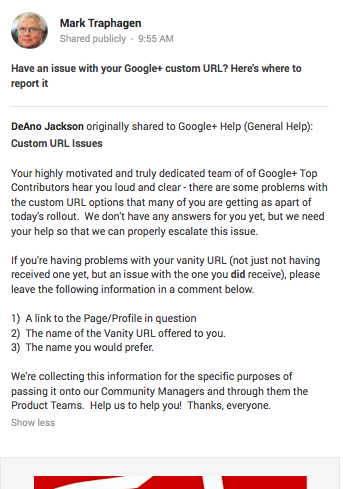
    Or you can pursue it as Mark Traphagen suggests in his G+ post which drives you over to Google+ Help Page

    Mark Traphagen Google Plus vanity URL post

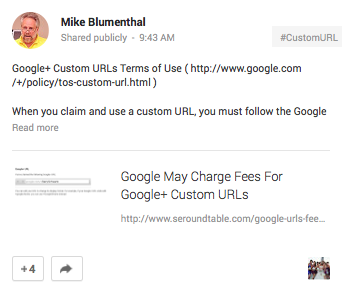
    And Mike Blumenthal gives us a heads up that it may not always be free:

    Mike Blumenthal G+ vanity URL post

    Overall, it’s straightforward and simple (thanks, Google!). If you meet the requirements, this option should be available to you shortly, as Google is currently rolling it out.

  • Google Plus Rolls out Vanity URLs! Kind of…

    Google+ has rolled out new costume vanity URLs to select brands and users. This is pretty awesome, if I do say so myself. The vanity URLs look cleaner and are easier to remember, so they are better associated with brands. Also, it looks so much better on your professional printed materials than, “Follow me on G+ https://plus.google.com/u/0/111184837779438209699/posts.”

    If you or your business are one of the lucky chosen ones, you will receive a message from Google via email and notification in your Places Dashboard (or LBC…not quite sure. Get it together, Google!). They will present you with the vanity URL of their choosing. You can request a different URL if you like, and after several business days, Google will contact you saying it has been approved or denied.

    I am sure there is method to the madness. I just cannot tell what that method is. For example, if you are Lady Gaga (https://plus.google.com/+LadyGaga/posts), who has over 7.8 million people followers you get one. Or, if you are MTV UK (https://plus.google.com/u/0/+mtvuk/posts) who only has 240,000 followers, you get one as well.

    One for you Lady Gaga. You go Lady Gaga!

    YouGoGlenCoCo

    But, if you’re Jimmy Kimmel (https://plus.google.com/u/0/107381356195126362734/posts), who has just over 1 million followers, you will not get one.

    And none for Jimmy Kimmel!

    The vanity URL does not come without concessions. The URL can be revoked at anytime. Google has even stated they may charge for it one day. I’m not sure why they would charge for it other than the fact that they can. Hopefully they roll these vanity URLs out to everyone for free. Let’s face it, we know the have the ability to do so. Facebook and Twitter do it!


  • Google Slider Replacing the Maps Seven Pack?

    Many people have seen the slider on the top of Google search results when searching for “things to do various city,” but have you seen it when searching other local terms lately? When I searched the term, “Pizza New Orleans,” I noticed the slider appearing instead of the seven pack for the first time today! I search this term often–not because of my love for pizza, but because of my client’s pizza chain. Never in the history of everdom have I seen the slider show up for this particular term.

    What if Google is leaning more towards this instead of the seven pack? This can be a good and bad for local businesses. Good because your business will not be pushed all the way to the bottom of page one, way under the seven pack. Potentially bad, because many people may be driven to click the pretty images on top of the screen vs. clicking on the plain jane search results.

    What does this mean for me, you ask? How can I be a part of this beautiful slider? As our fearless leader says, “Barnacle SEO is the answer!” A well optimized Google Place listing and page are the first steps.  Your best possible scenario is to be the Theo’s Pizza of the page! Theo’s is the first Google Place listing in the slider AND the third organic listing on the page. As per usual, the more real estate the better.

    It’s going to be very interesting to see where Google takes this and how far it will go. Will it eventually replace the seven pack? Only God–I mean Google knows!

    P.S. This doesn’t show up for everyone. A few of my co-workers have seen this in the wild and a few have not. Have you noticed this type of result for other queries besides “pizza” or “things to do?” Tell us in the comments below!

  • What Local U can do for Your Business

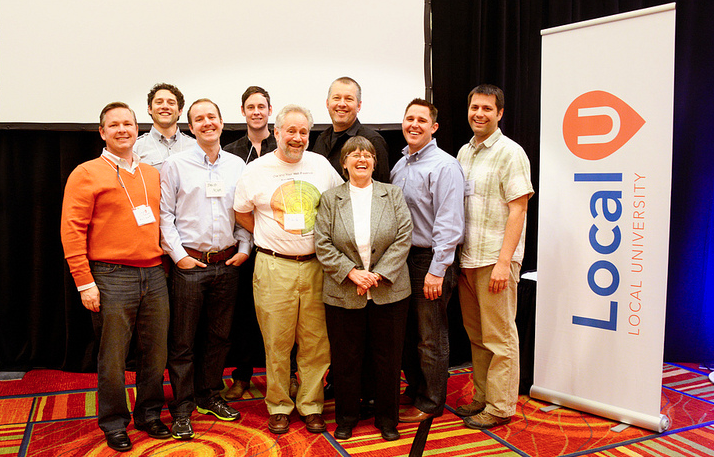
    Local University Staff
    Local U brings together the brightest minds in Local Search.

    With Local U just around the corner, I’m getting really excited about the opportunity it’s bringing to New Orleans. While there are so many things I love about the this city, it’s not necessarily known for its booming tech industry… yet. Local businesses could use a technological boost, and that’s exactly why I’m so eager to have Local U in our city. This informative event brings together some of the top players in local search to give entrepreneurs an introductory training session in Internet marketing.

    Local University will take place at Tulane’s Lavin-Bernick Center on May 7, from 8:30 am – 1 pm, featuring tons of great speakers and topics. It’s extraordinary to have so many great minds come together to share their wisdom. Experts in the field such as Mike Blumenthal, Mary Bowling, Ed Reese, Aaron Weiche, and Mike Ramsey will all be there, as well as the lead Consumer Support staffer from Google Places.

    Local U logoI see local U as the perfect way for anyone who is managing their local online marketing, or managing those who do, to learn practical tools they can use for any current or future enterprise. There’s no better way to spread the word about your business in this day and age than online, and this conference gives you the know-how to do just that. I know a lot of people who have no idea how to clean up their reputation online or connect with clients through social media, and they often don’t know where to turn to harness these skills.

    With sessions like Getting Social Online and Going Local with Google, individuals who have never previously taken an interest in search engine optimization, local search, or even social media can learn how simple techniques can maximize their online presence. If you’re interested in learning more about marketing your business online, make sure to sign up now!

    See you at the conference!

    Click Here to Sign up for Local U New Orleans!

  • Google Places For Business Dashboard Update: News Roundup

    Peugeot 207 dashboard

    Earlier this month, Google started slowly rolling out the new Google Places For Business Dashboard which includes an updated interface, deeper integration with Plus, and a promise of faster updates. The dashboard is now available to all new users in the U.S. To help better understand the new features, we have compiled a great list of resources on this much-needed updated.

    From Google:


    From Mike Blumenthal a.k.a. Professor Maps:


    From Around the Web:

  • 5 For Friday — Links, Stories & Posts For Your Weekend

    Number 5 Street Falmouth1. The Marketing Value of YouTube – SEO MOZ

    The author here discusses the impacts YouTube can have for your product. YouTube is a great resource if you are looking to build your brand. It is important that you put up quality videos over the quantity of videos. Check out the article for some great information if you are looking to build a presence on YouTube.

    2. Google Places Is Being Updated To Google + Local – Search Engine Journal

    This talks about the transition from Google Places to Google + Local.  The post describes how this should make the process easier to use, faster updates, and integration with Adwords (Express) and G +.

    3. SEO & Keywords: Think Conversions, Not Rankings – Search Engine Watch

    Here the author talks about how rankings should not be the ultimate goal when it comes to SEO services. The author lists 4 steps you should take to produce stronger SEO results in the long run.

    4. Indecision 2.0: Are Apps Taking Away Your Power to Decide? –  Mashable

    Are we too dependent on social media to make simple decisions we face on a daily basis? I sure hope not. This is an interesting article about different apps that can help you make decisions you are not comfortable making, or if you just want some help making a decision.

    5. Google On Developing For Google Glass – Search Engine Round Table

    This post has an informative video on how developers can develop apps for Google Glass. In this article, it lists four key developer guidelines from the video to help you better understand the process.

  • Google+ Communities Storm Into the Social Media Scene

    Google Plus communities, the newest section of the social networking site (often referred to as G+ for short) are meant to bring people of similar interests, work experience, or hobbies into one place. These communities can be created by anyone with a G+ account, opening up a whole new vista of networking and sharing potential for users.

    The communities are designed for users to have a forum to share similar ideas, thoughts and beliefs and promote discussions amongst peers. The pages themselves can be made open to the public, restricted to certain users or undiscoverable by anyone not personally invited. They are also controlled by a moderator. Community types vary: users have the ability to create general communities such as “People Who Love Food” to more specific versions like “Vegans Rule.” They can also be industry- or location-specific, like “Lawyers’ Association” or “Lawyers of Southeast Louisiana.”

    According to Social Media Today, there are several beneficial aspects to a G+ community:

    • No Edgerank: updates reach 100% of users
      • Companies don’t have to pay to promote posts in G+ stream
    • The content posted in the communities can be picked up by search engines
      • Facebook does not have public search engine and the content posted is not searchable
    • Google provides authorship to G+ users
    • Businesses engaging on Google+ may potentially rank higher

    Sounds enticing. But don’t be so quick to dump your Facebook social media campaign yet. G+ Communities could be very beneficial to a company that wants to reach 100% of their followers without having to pay to do so. But, how many followers do companies actually have on G+ compared to Facebook, and if they are on G+, how many are actively using it? Google+ has 500 million users and only 235 million active users compared to Facebook’s 900 million, but how much time do they have to spend to be considered active? According to a study by comScore, the average G+ user only spends 3 minutes a month on the social network compared to the average Facebook user, who spends around 7 hours a month.

    Facebook is still the king of social media and remains the place users spend the most of their Internet leisure time — but it’s not a bad idea for companies to expand their social media strategies to G+ and create a community for consumers to interact with their brand. While it’s disappointing to see Google, the innovation giant, reinventing the wheel, there are a few advantages to Google Plus communities that make them worth your attention. Let’s just hope that the social network’s next move will be something that we haven’t seen before.

  • The Notorious IPO – Like The Future For Social Networking?

    To paraphrase whomever The Notorious B.I.G. was paraphrasing in 1997, it would appear that the new financial expectations levied upon social media platforms are about to start making life much more complicated for users, advertisers and entrepreneurial site designers alike. You’re now looking at me almost as if there’s no rationally defensible way that Biggie could have been posthumously addressing the 21st century plight of social media startups back in 1997, and to that I can only respond with two simple words: holograms, son.

    All juiciness aside, some recent developments on the business end of social networking are sure to have a lasting impact on the way the average person uses these platforms. This flux goes hand-in-hand with the way advertisers and shareholders will have to go about making money off of the average person’s use of these platforms in the future. Unsurprisingly to anyone at least fleetingly familiar with the planet Earth in 2012, the central player in these developments are the perennial big poppa of social networks, Facebook.

    As you’re probably aware, Facebook’s revolutionary IPO move several months ago arrived with financial expectations about as humbly understated as the dialogue in an Aaron Sorkin script. As you’re also probably aware, things didn’t actually end up going all that well. Regardless of whether or not this should have been that much of a surprise in retrospect, Facebook’s disappointing yield for shareholders will have a major impact on how other social media resources have to approach the development of their platforms in the future.

    As The Atlantic‘s Derek Thompson points out, new pressures being placed on Tumblr to shift its focus from accommodating users to establishing and adhering to a strict and viable business plan marks the first step in what will likely be a sweeping change in the general philosophy governing social media:

    The first few years of the social media revolution have been a golden age of tech utilitarianism, where maximizing users’ delight was considered, quite literally, the only currency that mattered. In Part II of the revolution, the desired currency is poised to change from attention to profit

    It is not difficult to envision a pageview-centric future where quirky overnight Tumblr sensations like Dogshaming or McKayla Is Not Impressed are promptly equipped with chain pet store-sponsored submission forms or Kodak-provided stock photo templates of the moon landing and the Tiananmen Square protest for greater ease of Maroney-meme insertion. While such developments wouldn’t necessarily strip such silly internet curios of their fundamental entertainment value, instant monetization would definitely take a bit of the fun out of discovering such pages and watching them circulate and expand in popularity. Much of the appeal of these sorts of Tumblr pages — and all social media-generated sensations — involves the users’ ability to at least pretend that they or one of their “friends” were the first to discover a particular page or meme. Obviously, this illusion is immediately eliminated once sponsorship is pulled into play; it’s hard to envision any business model by which these sites could remain free to use without more deeply integrating corporate sponsorship into site content.

    Meanwhile, corporate entities are starting to consider newly raised issues related to social media advertising on their end in the wake of a controversial decision by Australia’s Advertising Standards Bureau regarding Facebook user comments. Essentially, the Bureau ruled that (in Australia) a company must screen its page and posts to ensure the accuracy of all product-related information contained not only in its own officially posted content, but also in the content added via general user comments. The implications of such a decision could be outright devastating for the future efficiency of Facebook promotion, should such regulations be incorporated on any sort of broader international scale. I don’t think I’m going to shatter any advertisers’ utopian dreams by stating that the types of people who purchase and “like” your product aren’t necessarily the same people you’d want writing your advertising copy. And in the case of the Australian company in question, Smirnoff Vodka, they might well be the absolute last people you’d want having any impact on your legal standing.

    This whole situation leaves companies in a quite precarious position. It seems like a magnificent waste of time and brainpower to constantly screen a boatload of throwaway Facebook user comments; however, disabling user interactions altogether would seem to fundamentally defeat the purpose of marketing on social media platforms. It’s not difficult to see how some companies could determine that it’s simply not worth the trouble.

    What we have in place, then, is an interesting sort of standoff. I couldn’t possibly isolate any direct inspiration for this, but I like to envision the advertisers and investors as one grizzled old gunslinging action hero, with the anonymous multitudes of invisible social networkers seated at their computers represented, perhaps, simply by a single empty chair. Advertisers still salivate at social media platforms’ unprecedented access to consumers in age brackets and demographics they have been unable to effectively reach otherwise, but getting too close to these general users just might land them in legal trouble. Social media investors naturally dream of throwing their weight around to help shove these advertisers closer to these same consumers, since that’s the most logical way to enhance the financial prospects of their investment.

    Of course, at stake is that essential feeling of “mine-ness” that drew users to social networking to begin with. Push advertising too hard on these users, and they could vacate the premises as quickly as that neon pink anime-style cat that wallpapered your big sister’s old MySpace page. General social media users, meanwhile, are facing a looming decision as to whether their enjoyment of the social networks they’ve become accustomed to using sufficiently outweighs the frustration of finding more and more of their personal lives either directly monetized or, at the very least, more strategically molded into streamlined business plans.

    These problems are by no means new revelations, but the stakes are suddenly much higher. Facebook has proven that merely getting a ton of people on board and radically redefining the concept of “word-of-mouth” isn’t enough to make real, investor-friendly truckloads of cash. The Australian Advertising Standards Bureau has proven that the line between mingling and marketing is likely going to become a lot less blurry than it probably seemed for advertisers developing marketing strategies over the last few years.

    If there’s one thing that’s fairly certain in all of this, it’s that a major shake-up is imminent. Sticking with the Facebook example, it’s unlikely that advertisers are going to coolly walk away from a massive, captive audience simply because it might be a bit of a hassle to adhere to ad copy standards thus far unenforced in most of the world. It’s equally unlikely that Facebook investors are going to calmly give Mark Zuckerberg back his old T-shirts, say “sorry it didn’t work out,” and shuffle home to listen to Morrissey records until they find another fish in the sea. Most unlikely of all, perhaps, is that Facebook users will coolly kick back and say, “hey guys, we’ll be here waiting for you no matter what. You just figure out what you think is best for us and let us know how it’s going to work from now on.”

    Whatever happens, it feels like the optimal time for enterprising online marketers to start getting more familiar with alternate social networking platforms. Given the inherently fast-paced, fleeting nature of social media, the very fact that many of us might feel a sense of comfort or predictability with marketing on Facebook and Twitter should be some kind of indication that those bubbles are soon to burst.

    Will the great user-friendly potential of Google+ finally be met with the corresponding cultural acceptance and ascribed relevance it has lacked to this point? Will users gravitate toward the conceptually alluring “private” approach to social networking, as demonstrated by the forever-in-progress Diaspora? Will users decide that they are serious enough about social media to begin paying to keep their online networking strictly social on a site like as many are starting to suggest? Perhaps in a few years, the very concept of unchecked social networking will have become a quaint little “two thousand-late” fad, just a laughably nostalgic relic of misguided youth like slap bracelets, Power Gloves and Britney Spea… oh. Right.

    In any case, even if Facebook and Twitter users prove willing to endure a more thoroughly streamlined and business-friendly approach to their online interactions, this will likely lift many of the restrictions that currently define appropriate approaches to marketing on these platforms. If television audiences are still willing to revolve entire Sundays around roughly 11 minutes of football for every hour of commercials, it’s certainly possible that marketers can beef up their approach without driving away the very audience they’re courting.

    I realize that this post has done more in the way of raising questions than providing answers, but that’s really the point. For businesses, marketers, shareholders and general internet users alike, the catch-all answer for everything has long been that “social networking is the future.” The recent travails of Facebook and the future implications of these troubles for other sites should be making everyone stop, take a deep breath and ask just what is the future for social networking. As a man much wiser than I once said, things done changed.