Tag: Facebook

  • Unlike Your Dad, These Guys Know How To Use The Internet

    internet dads father's day image - search influence

    The other day, I was trying to remember why I had posted a curious image on my friend’s Facebook wall in 2010. In a stroke of brilliance, my friend suggested we do a “reverse Google search” to see where the picture originated from, all while we were using Google Chromecast to watch this search unveil on my TV screen.

    In the middle of this (pretty standard) activity, I thought to myself about how incredibly bizarre this whole process would sound to someone just 10 years ago. Facebook walls? Reverse Google search? CHROMECASTING? We’ve all grown so blasé about these daily—yet bewildering—Internet tactics that we’ve lost sight of the magic and brilliance behind them.

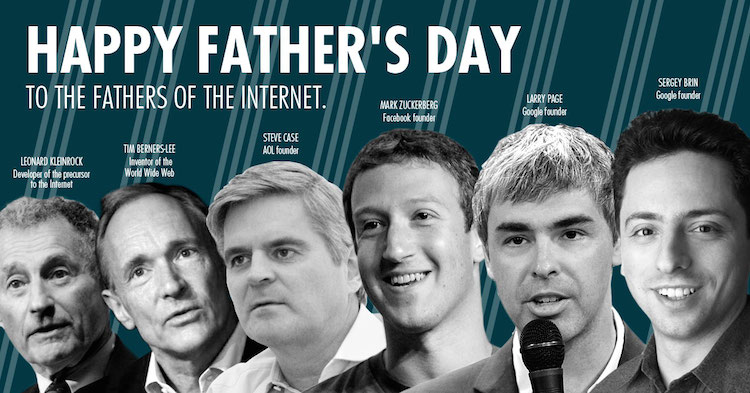
    So this Father’s Day, I’m here to remind you about the extraordinary minds behind all this wizardry. The men whose ideas have allowed me (and probably you, too) to stream Game of Thrones while Facetiming friends across oceans and also maybe simultaneously perusing Instagram (because what are we if not all impressive “multitaskers” these days). I present to you the fathers of the Internet:

    Leonard Kleinrock

    Kleinrock Image - Search Influence

    Before the Internet, people had to gain an understanding of how computers could communicate (or network) with each other. That’s where Leonard Kleinrock, an American engineer hailing from Harlem, came into play. Kleinrock pioneered the mathematical theory of packet networks, which, essentially, is the technological backbone of the Internet. By figuring out how to send “packets” of information across networks, Kleinrock was able to develop the ARPANET, which is the bare bones seedling that grew into the Internet we all know and love today. In fact, on a historical day in early September 1969, a team at Kleinrock’s Network Measurement Center connected one of their computers to an “Interface Message Processor,” thereby becoming the very first node on the ARPANET, and, perhaps more importantly, the first computer ever on the Internet.

    Tim Berners-Lee

    Berners-LeeImageSearchInfluence

    These days, it seems like there’s a browser for every kind of taste or personality. Are you over the age of 50? Internet Explorer. Do you enjoy plain bagels and go with the flow? Safari’s got your name all over it. Back in the day, though, there was only one browser, and it was created by Tim Berners-Lee in 1989. The World Wide Web (sound familiar?) was the first web server and also marked the advent of HTML. Through the World Wide Web, Berners-Lee was able to bring together the concept of the Internet and hypertext, which now establishes web pages as you know them. Today, Berners-Lee remains the Director of the World Wide Web Consortium, a Web standards organization he founded in 1994.

    Steve Case

    Case Image - Search Influence

    You may not have heard of Steve Case, but you (and just about anyone living in the 1990s) most likely became acquainted with the Internet thanks to his brainchild: America Online. In February 1991, after a few trial and error test runs, AOL was launched, and with it came online games, chat rooms, AIM, and a whole new way for people everywhere to interact online. Its goal was to focus on making the Internet a part of everyday life. To say he succeeded would probably be a huge understatement.

    Mark Zuckerberg
    Zuckerberg Image - Search Influence

    Perhaps the first name you immediately knew on this list, Mark Zuckerberg is one of the most recognizable Internet names, surpassing even the infamous Tom of Myspace. Just in case you somehow have yet to hear, Zuckerberg and his college friends founded what was then known as The Facebook in June 2004. By the end of the year, the site had 1 million users. Today, the site has more than 1 billion monthly active users. You can thank Zuckerberg for turning social media into the cultural phenomenon and world changer that it is today.

    Larry Page
    Larry Page Image - Search Influence

    You’ve likely learned more from Larry Page’s creation than your own father. This guy revolutionized the way we use the Internet, and even our brains! In 1996, Page and his friend Sergrey Brin began collaborations on a search engine called BackRub. Fortunately, that name didn’t stick, and instead they decided to name their website Google, which they officially launched in 1998. Since then, the company has become the world’s most popular search engine, an everyday verb, and an overall technology powerhouse. In fact, today, Page is the CEO of Google, which now processes more than 40,000 searches every second (!) on average, more than 3.5 billion searches per day, and 1.2 trillion searches per year worldwide. Thanks, Larry Page, for giving us access to more information than we can even fathom.

    So this Father’s Day, take time to thank these men for all the ways they’ve made your life easier. No more flipping through encyclopedias to understand what the plural form of “beef” is, significantly fewer phone conversations, the beauty of Netflix?! Thank you, all you great fatherly geniuses. Without you, I wouldn’t even have a job.

    Image sources:

    Leonard Kleinrock

    Steve Case

    Mark Zuckerberg

    Larry Page


  • Facebook Enters The Game of GIFs: A Feast For People, Not Pages

    Search Influence Game of Gifs Blog

    tyrion dancing

    On May 29, Facebook confirmed that it would begin supporting animated GIFs! Up until this point, only Giphy GIFs could be used on Facebook, but they appeared like videos where you’d have to click a play button for the animation to start. For now, however, this new, universal GIF support only extends to personal profiles and not Pages.

    In the past, I’ve jokingly (sort of) said that Google Plus would always be better than Facebook because it supported GIFs. As a freelance photographer and creator/curator of cinemagraphs (animations that consist of seemingly still photographs with subtle repeated movement in them—example below), I’ve always been annoyed that I could only share my art on Tumblr and G+. So I was really excited when I learned about the addition of GIF support to Facebook late last week. Sadly, I realized very soon after this announcement that Facebook had not extended this support to Pages.

    Cat Tail Animation Cinemagraph Gif

    So What GIFs CAN Pages Use And See?

    People can share GIFs in the comments of posts by Pages but not on the walls of Pages. Also, Pages cannot share, reshare or comment using GIFs. So Pages can see when people post GIFs, but if they try to reshare a person’s GIF status or post their own, it will have to be opened in a new window for the GIF to play. A statement from a Facebook spokesperson on Business Insider said “Like many features that we release on Facebook, we want to ensure that this drives a great experience for people first before rolling it out more widely. While Pages cannot currently post GIFs, we are exploring ways to enable this in the future.” This also means that GIFs cannot currently be used in ads. Here’s to hoping they mean to roll this out for Pages in the very near future.

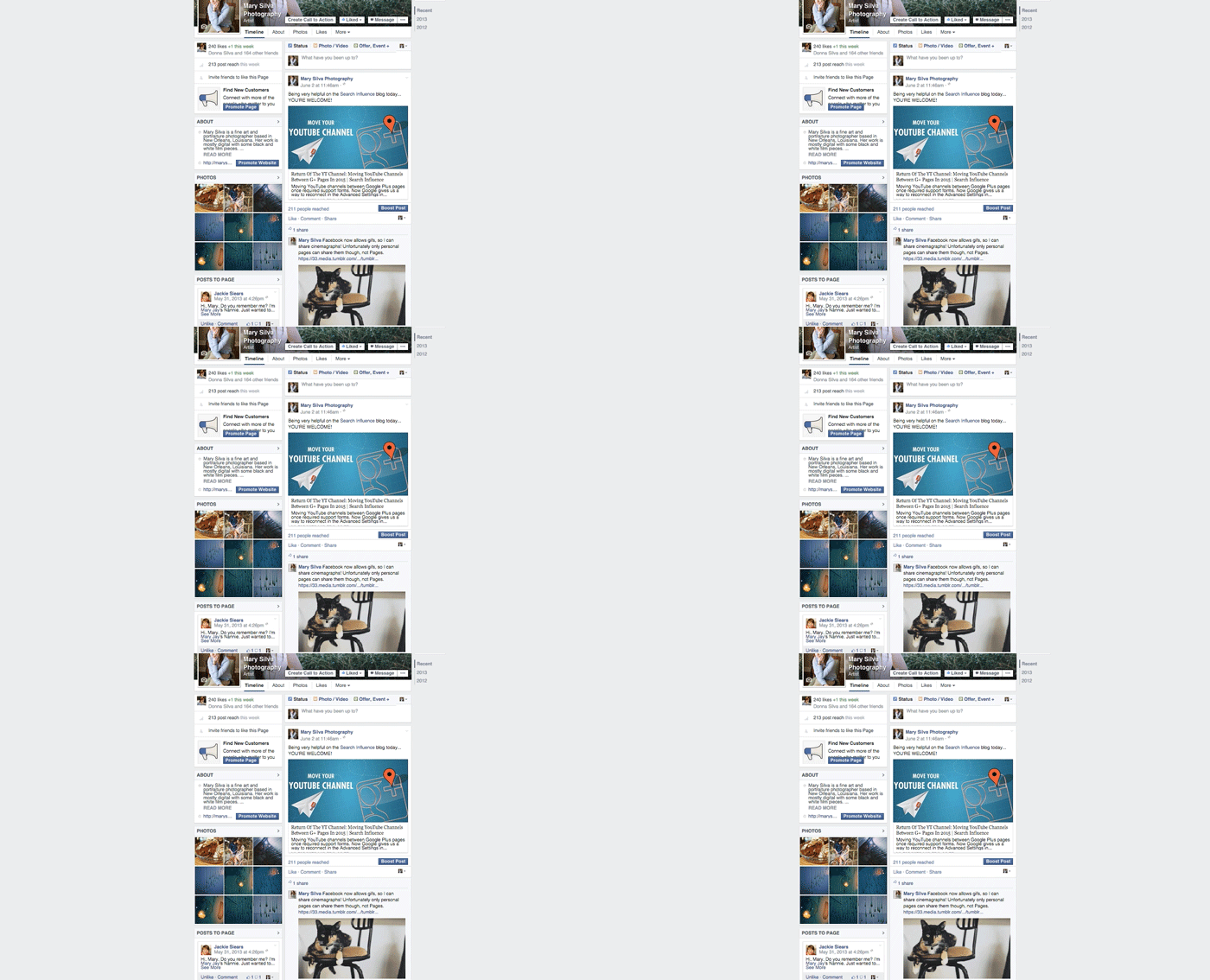
    Here’s a GIF of the previously shown cat GIF moving in the comments of a post on a Page:

    Search Influence Gif on Facebook Page

    There are also other stipulations to using this new feature even on your personal Page. You cannot upload a GIF; it must be hosted elsewhere. So I suspect we’ll see a lot of sharing from sites like Tumblr (who just rolled out a GIF search—perfect timing) and Imgur.

    For now, I’ll just be happy that I can at least share my cinemagraphs that are already on my blog on my personal Facebook Page now.

    Thanks to HuffpostTV for the dancing Tyrion GIF!

  • Give Your Facebook a Facelift: Social Media for Dermatologists and Plastic Surgeons

    Facebook Facelift Image - Search Influence

    Time Magazine recently posed the question, “Can Plastic Surgery Make You More Likeable?” Certainly, there are many benefits to cosmetic procedures for the patients, but it is also time for plastic surgeons and other physicians to think about how to make their practices more “likeable.” Facebook and social media can be used to attract new patients and shape the local perception of a business. For example, Search Influence helped one plastic surgery practice attract nearly 70,000 new fans on Facebook. Search Influence can help create and manage the online presence of your business through social media, but if you want to get started on your own, follow these five steps:

    1. Make a Facebook Page

    Most Internet users visit social media sites daily, and social media can be a cost-effective place to advertise. Facebook accounts are free to create and maintain, and AdWeek reported last year that advertising on Facebook is 70 percent cheaper than the industry average. While using it effectively will take a significant amount of work, creating a Facebook page for your practice takes only a few minutes. With pictures and information about the procedures you offer, a Facebook page allows potential clients to learn about your practice without following an external link. This can be a great place for a list of services and a few testimonials from past patients. It’s a streamlined version of the most relevant information, and you can direct people to call your office or visit your website to learn more.

    2. Get More “Likes”

    It’s easier said than done, but awareness about your practice will grow as users “like” your page. To draw their attention, it helps to have compelling pictures and interesting information. Showing a little personality can encourage people to identify with your practice, which helps set you apart from the competition. As more people interact with your page, Facebook will give you demographic information about their ages, where they live and other details that can help you better know the local market.

    Struggling to get potential patients and customers to follow you on Facebook? One way to get more likes on Facebook is through Facebook fan-building campaigns, which have been effective for Search Influence plastic surgery clients.

    3. Get People Involved

    Ask questions, and post updates that encourage people to interact with your page. When fans “like” an image you’ve posted, it makes it more likely that their friends will also see your page. If you post about local events and holidays, it will help connect you with your community.

    4. Update Your Page Regularly

    While it’s inadvisable to offer medical advice over social media, your page or a separate blog can be a great place to explain procedures or post updates about your practice. If you explain medical terminology and correct common misunderstandings, then potential patients will see you as more qualified and trustworthy.

    5. Pay to Play

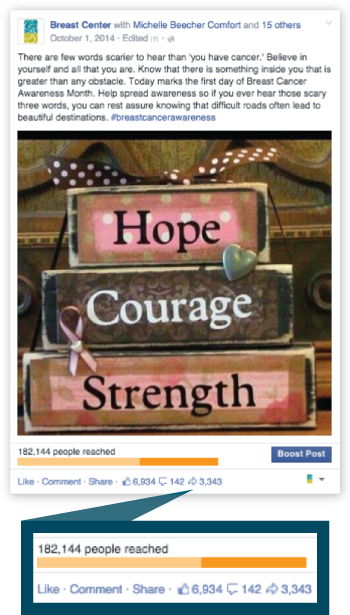
    Advertising your page on Facebook involves a lot of choices. Do you want help accumulating “likes,” or is it more important that people visit your website from your Facebook posts? While pay-per-click (PPC) advertising assures that people are viewing your page, your name will show up on more news feeds if you pay for exposure. For example, a promoted Facebook post for a Search Influence plastic surgery client reached more than 182,000 people.

    First Promoted Facebook Post - Success Study - Search Influence

    Because of the variety of choices involved, streamline your social media strategy and achieve successful results with the team at Search Influence managing your advertising plan. Search Influence can advertise on several sites and measure results in the ways that matter most to your practice, including new patients and calls to your office.

    If you want to give your whole business image a facelift, then injecting social media into your marketing plan is the most cost-effective option. Our team at Search Influence can help you create and manage your online image, and we can advertise on a variety of platforms including Facebook, Google+, Youtube, Pinterest and Twitter. Continuously providing updates can be a lot of extra work for your busy staff, and some employees may already spend too many work hours on their social media accounts. Let Search Influence manage your online image to make sure everything is handled professionally. Find out more about our services by browsing our website.

  • Web Augmentation: 9 Tips to Get Your Plastic Surgery Practice Trending

    Web Augmentation for Medical Practice Marketing Image - Search Influence

    Every second, there are almost 50,000 unique searches on Google. With that much traffic, it’s crucial to establish your plastic surgery practice as an online authority. By using social media, search engine optimization, and paid search strategies, you’ll be able to climb to the top of Google’s rankings in short order.

    Tips for Social Media

    Utilize “Audience Insight” on Facebook

    As of March 31, 2015, there are 1.44 billion monthly active users on Facebook, making it the platform with the largest audience for your advertisements. With Audience Insight, Facebook helps you sort through your targeted demographics in order to understand the kind of content that is popular among them.

    Use targeted Facebook ads

    If you use targeted Facebook ads, you can choose what kind of Facebook users will see your microdermabrasion advertisements. Not only can you sort your audience by age, location, and gender, but you can also target them according to their relationship status, whether they have children, and their personal interests. Facebook fan-building campaigns are also effective in making patients and customers into fans.

    Tag and post about local events and businesses 

    If you want to maximize your visibility, you’ll have to post outside of your practice. By sharing posts about local events and businesses, you’ll increase your presence in the community. Your potential clients will start to follow and share your content if your page is a reliable source for interesting information. 

    Tips for Search Engine Optimization

    Research Longer Keywords

    A short keyword like “chemical peels” is a competitive keyword, which means a lot of practices will be using it. Try to find a longer keyword that your audience will search for, like “chemical peel for rough skin in NJ.”

    Host Webinars

    Live Internet events boost your SEO rankings because they keep your audience on your website for a long time. Set up some demonstrative or informational webinars that prove your expertise while optimizing your search results.

    Make Your Site Mobile-Friendly

    More and more people use their phones and tablets, rather than a computer, to browse the Internet. A mobile-friendly website will ensure that the information on your website is accessible to everyone. In fact, mobile website traffic for our plastic surgery clients’ websites averaged 48.6 percent. And that doesn’t include tablet traffic; it is purely mobile.

    Another way to pump up your plastic surgery website is to use natural content on your practice’s website. Find out about how medical marketing is making the switch to natural content.

    Tips for Paid Search

    Post Lots of Information on Your Landing Page

    By having a wealth of information on your landing page about topics that are relevant to your practice—such as eyelid surgery—you ensure that your potential client gets the knowledge they desire. When this happens, they’ll stay on your page longer, and their trust in your expertise will grow.

    Invest in High-Quality Video Production

    Potential clients will seek out videos demonstrating a procedure before they schedule an appointment for one. If your practice has a high-quality video demonstration of laser hair removal, 79 percent of the potential clients who watch it will visit your website. In addition to videos, other types of content can help attract patients searching online for your practice. Find out the four ways to drive conversions in the medical industry.

    Have Your Contact Information Readily Available

    The content you make available on your website is meant to inspire more people to come to your practice. Having your contact information readily available increases the chance that potential clients will call your site, visit it, or save it for later.

    Implementing these tips will get your plastic surgery practice trending in no time!


  • Five For Friday: Death to G+, Facebook Video Calling, A Tech Movie Rec & More

    1. Schema Marks Up Gmail – Moz

    Not too long ago, thanks to a pair of excellent blog posts from David and Ian, we learned all about schema—what it is, what it does, and how it can dramatically help a client’s online marketing strategy.

    After that wealth of knowledge was handed down, it should come as no surprise that schema.org markup can improve your email, too. It aids in allowing people to take action on Gmail quickly and simply. The Moz blog gives a comprehensive introduction explaining who should be using schema markup in their emails and why.

    2. Is Google Plus on its Deathbed? – Marketing Land

    Mark Traphagen, a columnist for Marketing Land, addresses the persistent rumors that Google Plus is going to dismantle the network and its social media component because of its perceived lack of popularity. To counter, he offers several key points that show why these Google+ detractors are misguided.

    3. Why Video is a Marketer’s Best Friend – Marketing Land

    Search Influence has been using videos for online marketing purposes for as long as I can remember (i.e. the year I have worked here). As the Video Coordinator (<—- a fancy, self-given title) over on the Production Team, I have learned why and how videos are so important. For those who may not know, Marketing Land breaks down why video is the perfect medium to enhance all online marketing strategies.

    4. Facebook Announces Video Calling – Search Engine Journal

    Facebook announced on its blog two new updates to its messenger services: video calling and a new app called “Hello,” which functions as a caller id, call blocker and search tool.

    5. SI Movie Recommendation: New Sci-Fi Thriller Ex Machina – The Independent

    In the new sci-fi film Ex Machina, a tech genius and CEO of Bluebook (a fictional Google-Facebook hybrid) has managed to successfully create a robot with artificial intelligence using the data collected by his worldwide, all-knowing search engine. The film touches on some really intriguing themes, such as consciousness, voyeurism, technology and human-machine “singularity.” It is a really interesting and exciting film that, as an employee at a tech company, really resonates—and it’s getting rave reviews across the board!

    The film is rated R for language, nudity, and some violence. It stars Oscar Isaac, Domhnall Gleeson and Alicia Vikander. It is written and directed by Alex Garland (28 Days Later, Sunshine and The Beach).

    Image sources:

    Missy Elliot Gif

    Ex Machina

  • This National Small Business Week, Step up Your Online Marketing

    It’s National Small Business Week—time to celebrate the successes and the insane amount of work small business owners put in. The struggle is real.

    You know you’re a small business owner when…

    …Your nightmares are about getting bad Yelp reviews.

    …Your social media “strategy” consists of bribing your college-aged daughter to handle your Facebook and Twitter accounts.

    …Your holiday hours did not quite make it to the Internet, and customers actually showed up only to find your business closed.

    To cure these and other headaches, start with a little TLC for your website and your online marketing strategy—after all, both of these play a huge role in bringing you customers, but they may unfortunately also be keeping you up at night. Follow these top three online marketing tips for small businesses.

    If You Can’t Beat ‘Em, Join ‘Em

    It may sound upsetting that Yelp listings are front and center in a Google search for your business while your own website is far down the list of search results. But savvy small business owners know that Yelp and other large online directories can win over customers with minimal effort. So if you can’t beat the Yelps of the world, join ‘em!

    This strategy is also known as Barnacle SEO. Basically, your business needs to attach itself to large, fixed objects and then wait for customers to float by in the powerful current. Identify the large, high-ranking online directories that matter to you most, such as Yelp, and add your information there in the hopes of “borrowing” some of the page one rankings. There are many trusted online directories like Yelp out there you can barnacle up to: Angie’s List, Foursquare, Google+, Avvo (for lawyers), Healthgrades (for doctors), and even TripAdvisor.

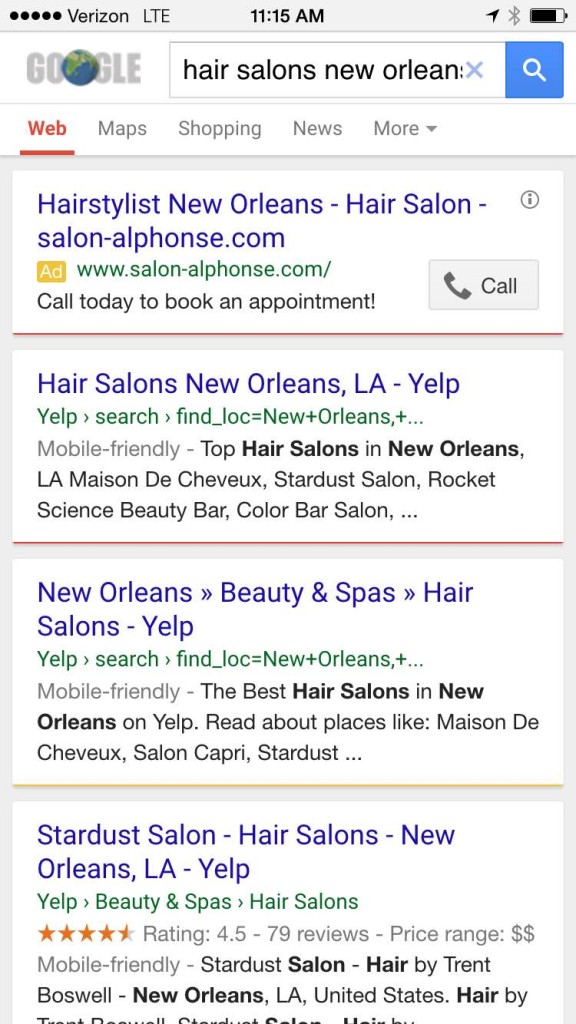
    And this tip comes with a bonus: this strategy also works well for customers searching on smartphones because these websites are optimized for the mobile experience—providing the targeted information that local customers searching on their smartphones really need. When you perform a Google search for “hair stylists New Orleans,” for example, the top results are mostly from Yelp:

    Yelp Mobile Screenshot Image - Search Influence

    Target Your Social Media Efforts

    Another thing that keeps you as a small business owner up at night? Social media—or more specifically, finding the time for it. For starters, why is social media worth your time? The latest statistics from the Pew Research Center paint a pretty compelling picture that customers are on social media: 74 percent of online adults use social networking sites.

    As a time-starved small business owner, you must get the most for your social media time. This requires targeting your social media efforts. Start by channeling your ideal customer. What is your typical customer’s age, marital status, and family status? Where is your customer physically located? Do your customers fall into a certain income bracket?

    Once you know who your target customer is, find the social media channel that appeals to them. For example, Facebook still skews significantly female and is the top-used social network for U.S. teens, making it ideal for fast-moving consumer goods, according to Business Insider. Instagram is also popular among females ages 18 to 44, so clothing, accessories, and those types of brands tend to perform well on this network. While LinkedIn is most popular for adults, Twitter is primarily a news source and attracts mostly male users. YouTube reaches more adults ages 18-34 than any single TV network. Pinterest is the place for food and drink-related information as well as parenting tips.

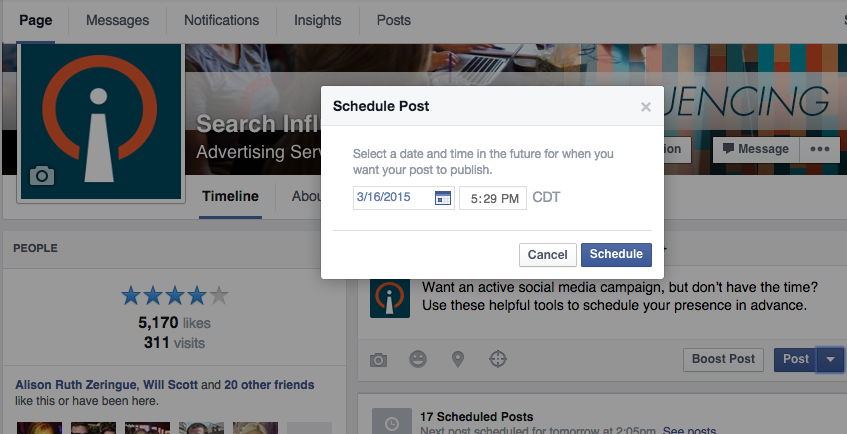
    But remember, whichever social networks you decide to focus on, automate your posts with these quick tips.

    Facebook Scheduled Post Image - Search Influence

    Avoid Customers Crying in Your Parking Lot

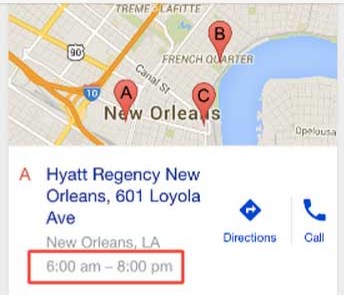
    If you’ve ever done a Google search for your business, you’ve likely seen this kind of result:

    MapsTimeViewImage

    But what happens when you have special holiday hours? Will customers see your normal hours in a Google search and show up in your parking lot over the holidays? Currently, Google My Business has not built out the functionality for saving holiday-specific hours ahead of time. As the profile setup currently stands, you’ll need to manually edit the hours of operation on a given day when your business is open (or closed) outside your standard hours of operation. See Google’s steps on how to update your business’ hours.

    Also, remember to let folks know when you are, in fact, open on the holidays. For instance, let everyone know your restaurant is open on Independence Day and post your holiday-specific menu for the day or highlight any patriotic specials. Is your medical practice open for limited hours on Memorial Day this year? Post a piece to your blog or social media profiles highlighting the top summertime health hazards from boating accidents to severe sunburns.

  • Making Patients & Customers into Fans: Are Facebook Fan-Building Campaigns Effective?

    Medical Facebook Likes Image Preview - Search Influence

    Looking to connect with your ideal patients and customers online? Facebook fan-building campaigns are just what the doctor ordered for creating the perfect online experience for your audience as well as building your community of followers.

    But before we delve into the specifics of Facebook fan-building campaigns and how this online marketing strategy can win you customers and patients alike, let’s briefly go over what fan building is. Fan building is a way for businesses to acquire likes on Facebook and to connect with all the people that matter to them. While a business can acquire fans organically, paid ads are more effective and efficient at increasing a business’s fan base and amplifying the rate of fan growth.

    Part 1: Are Page Like Ads Effective at Fan Building?

    Short answer: Yes. Facebook page like ads are effective.

    Case Study 1: 

    Let’s look at Client A. Client A is a well-established business specializing in reconstructive surgery. Search Influence started a fan-building campaign for Client A toward the end of 2011 and have been actively managing it ever since.

    In order to maximize the client’s budget, we focused ad copy around the authoritative nature of our client in the field of reconstructive surgery and targeted these ads to users we identified as most likely to convert (in the form of a page like) based on their interests and online behaviors.

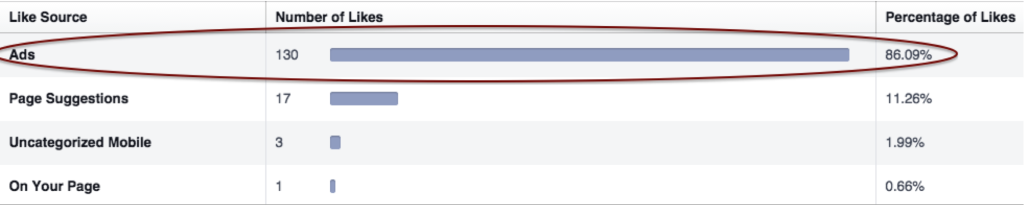
    Prior to the Facebook fan-building campaign, Client A had around 550 page likes from various organic sources. Not a shabby number to begin with, but we were able to get that number up to 21,000 within a year. Within two years, Client A had more than 30,000 fans … within three years, more than 65,000 fans. And likes acquired from our fan-building advertising campaign made up of a majority of the fan growth:

    Page Likes By Source (Daily):

    Facebook Fan Buikding Likes Image Search Influence

    The above segments the daily page likes gained by source. As you can see, likes as a result of fan-building ads made up more than 85 percent of the likes gained.

    Case Study 2:

    Client B is a multi-location addiction treatment and recovery facility. We started running a fan-building campaign for Client B toward the end of 2012. The campaign lasted two years and increased Client B’s fan base by more than 6,000. For Client B, we focused on grabbing the attention of users by including encouraging and supportive language within our ad copy, and we targeted users that we identified as most likely to be interested in the services offered by the client or to know someone that could benefit from the services offered.

    One of the main roadblocks was getting users to like a page that focused on such a sensitive subject. After all, why would anyone want to publicly like a page about addiction treatment and recovery? Well, if you fill your page with interesting content that is relevant to your business and engaging to your audience, users are more likely to follow and interact with your page. So with Client B, we first got users’ attention with our page like ads, and we kept their attention with the content on the page!

    Once we stopped running Client B’s fan-building campaign, we noticed that while the fans gained from the campaign were still there … the rate at which new fans were coming in has stalled. Take that as you will, but we came to the conclusion that fan-building campaigns are, in fact, effective. Moreover, fan-building campaigns are sustainable (more on that next).

    Part 2: Is Fan Building Sustainable? YES!

    Fan-building campaigns are a sustainable way to increase your fan base. If you create an effective campaign with the right message and proper targeting, page likes gained from fan-building campaigns don’t just disappear once the campaign ends. Users like pages because they’re interested in the product, the business, or the brand, and they want to know what’s going on and to get updates.

    That being said, just having an active fan-building campaign isn’t the be-all and end-all to building and maintaining fans. As demonstrated in Case Study 2, an effective fan-building campaign only starts with knowing who your target audience is, how to reach them, and what message will speak best to your target audience. From there, the campaign flows into what is actually on your page.

    You can get page likes by having the most interesting and enticing messaging in your ads and by targeting the exact audience that should be interested … but if your page is boring and dry, you’re not going to be able to sustain the page likes you gain and maximize your fan-building campaign’s potential.

    Lagniappe: Likes For Lives

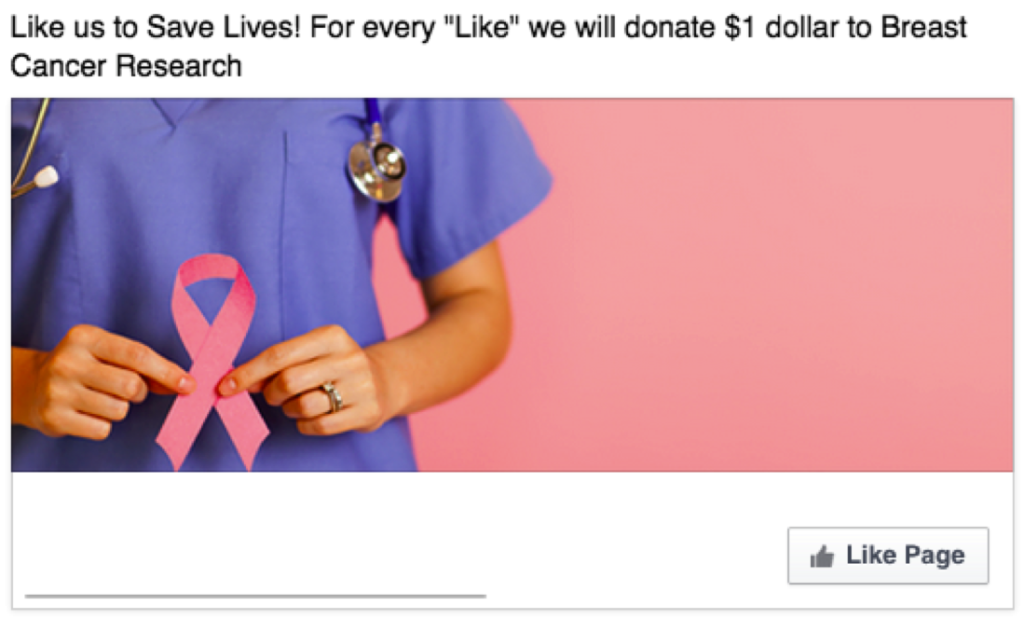
    A relatively recent tactic used for fan-building campaigns is called “Likes For Lives.” The concept behind Likes For Lives is that for every like a business receives on its page, it will take some sort of action to save a life. The action is usually a donation of some sort.

    Below is an ad from our most recent Likes For Lives campaign we ran for a client of ours during October 2014. October happens to be breast cancer awareness month, so we decided to incentivize Facebook users to click like by pledging to give a $1 donation for every like. This particular Likes For Lives campaign gained our client 748 likes from October 10 to October 30, 2014. The average cost per like was 48 cents.

    The Likes For Lives campaign generated more clicks in the 20 days that it ran compared to this client’s monthly average of 150 likes from its regular fan-building campaign. Therefore, a Likes For Lives campaign for this specific client was very successful.

    Likes For Lives Faebook Fan Building Image Search Influence

    One of the best ways to stand out and speak to users, no matter what type of advertising campaign you’re running, is to have a unique and attention-grabbing ad copy. And Likes For Lives campaigns provide just that. If you know who you’re trying to reach and how to create the targeting needed on Facebook to reach them, why not utilize the Likes For Lives incentive to build your fans and help a cause? Likes For Lives campaigns are a great way for all businesses, especially those with a health care focus, to gain positive brand awareness and to strengthen the fan base.

  • Ain’t Nobody Got Time for That: Make Social Media Fit Into Your Busy Schedule

    Ain’t Nobody Got Time for That: Make Social Media Fit Into Your Busy Schedule

    It isn’t news that an active social media campaign is an integral part to any business model. In these modern times, simple and frequent Facebook posts can go a long way when potential clients are choosing between you and the competitor. Time, however, is also important, and budgeting out a few posts a day can take a shocking amount of it. Surprisingly, many businesses are unaware of the various ways they can solve this problem on their own.

    Simple Tools

    Facebook Audience Scheduled Post Image - Search Influence

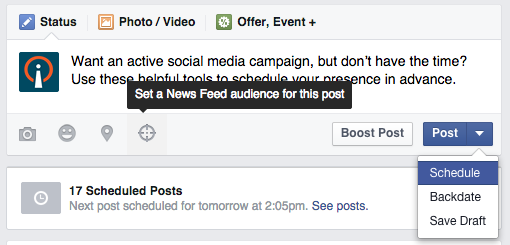
    One of the best and most widely used solutions is the scheduling feature in Facebook. To use it, simply enter in the text, link, and/or image that you wish to post to your business’ profile page. Once you’re ready to publish, click the small drop-down arrow next to the “Post” button. From there, choose “Schedule,” and then pick the day and time you wish to have your update sent to your followers’ newsfeeds. Although it may take you some time to schedule all the posts you will want to share for the whole month, the amount of time it will save you overall is definitely worth it!

    Facebook Scheduled Post Image - Search Influence

    More Advanced

    Another tool that helps companies organize their social media presence is Hootsuite. On the surface, it may not seem as intuitive and user-friendly as Facebook scheduling, but with a little practice, it becomes a lot faster. The only catch is the $9.99 per month you’ll need to pay for pro service. With the upgrade, you’ll gain access to bulk scheduling, enabling you to schedule an entire week’s, month’s, or even year’s worth of posts at the drop of a hat.

  • Five for Friday: Go Natural, Rock Your SEO, Navigate Apple Maps, and More

    1. How Your Band Can Rock SEO – Moz

    Most people don’t discover new music by Googling “indie rock bands.” Folks are more likely to discover a band through other means and then turn to the Internet to search for tour dates, song lyrics, etc. If you’re a musician, this presents a unique opportunity for optimizing your band for search engines. Learn how to reach a wider online audience with these tips for improving your band’s search engine optimization.

    2. Want to Transfer Your YouTube Account to the Proper Google+ Page? – Search Engine Roundtable

    Does this YouTube predicament ring a bell? Say you’ve been uploading industry-related videos to your YouTube account, which is connected to your personal Google+ page. You’ve finally gotten around to creating a Google My Business account for your company, and you want to transfer your industry-focused YouTube account over to your business page. Now you can! The only catch is that this move can’t be undone, so make sure it’s really what you want to do.

    3. Apple’s Maps App Gets Reviewed – Blumenthals

    Apple’s Maps app, which has heretofore only partnered with Yelp for integrated customer reviews of businesses, has now expanded to incorporate reviews from TripAdvisor and Booking.com. It’s still pending an announcement from Apple, and it’s unknown whether this change is still in its testing stage, but you will likely begin seeing reviews from a wider audience across multiple platforms.

    4. Beat the Competition with Natural Content – Marketing Land

    Google’s algorithm updates are all focused on one thing: improving online content. Search engines have gotten smarter, and so have people. If your business is just providing “common sense” information with keywords stuffed in, you are not likely to convert a lot of searchers to customers or clients. Optimize your content for intent by providing natural, factual, quality information that tells your company’s unique story!

    Act Natural Search Influence Image

    5. Facebook Dominates Ad Spending – Marketing Land

    Where have businesses been focusing their advertising efforts? The numbers are in! In 2014, social media advertising grew 41 percent, and perhaps unsurprisingly, Facebook pulled in 75 percent of total advertising spending on social networks globally, accounting for $11.4 billion of the total $15.3 billion spent.

    Image sources:

    Act natural

  • Five for Friday: Social Media Ad Wars, De-Spam Yourself, Text for Food, & More!

    1. Google Fiber Launches New Product! – Google Fiber

    This week, Google Fiber introduced its newest Web connectivity feature, Fiber Dial-Up, to help us all get back some of the time that’s constantly being consumed by ever-present technology. The folks at Google were able to recognize that many of us can’t seem to find enough time during our busy days to get back to the little things, like “texting your mom, hugging your child, running to the restroom …” This is where the dial-up mode idea started, and now Google has found a way to give us our time back so we can go back to enjoying the little things in life. Check it out here and get ready to meditate to the relaxing and nostalgic sounds of dial-up. What will you do with your time?

    Thanks, Google! (April Fools!)

    2. E-Commerce and Text: Two Sides of the Same Coin – Tech Crunch

    Two important messaging announcements hit the tech world recently:

    1. 600 million users of Facebook Messenger will soon be able to order food, buy products, and text directly with businesses.
    2. Magic messaging company is raising an astonishing $12 million from Sequoia to allow you to order any on-demand service simply by sending a text message.

    In short, this means that mobile messaging is now a commerce platform in which the user can seamlessly go from text messaging to ordering food, products, and direct business communication. This is the beginning of the “conversational commerce” revolution—a term coined by Chris Messina—that will open up much more opportunity for companies to join the texting revolution and ditch their countless applications. This will absolutely simplify companies’ paths to their consumers by eliminating the need for apps and non-compatible services and allowing marketing messages to reach users directly through their texting service. Put more simply: we all text more than ever, so why not expand texting’s potential to sending payments, buying products, ordering on-demand services, paying bills, and more? What do you think about this development—will the ability to text a business or make online purchases via text increase your participation in e-commerce?

    3. Twitter and Facebook vs. Google and Yahoo – Marketing Land

    Last week, online research firm eMarketer released data predicting that Twitter and Facebook are poised to surpass both Yahoo and Google in terms of display advertising revenue in the United States. Additionally, Yahoo and Google are both predicted to see a share decrease in online display ad revenue in 2015.

    The financial success in ad space for both Facebook and Twitter is attributed in large part to marketers allocating more of their budgets to mobile display advertising. This goes to show that advertising on social media outlets is paying off for both marketers and social advertising platforms. How do you think these trends will play out over the course of the year? Will Google and Yahoo hold their own against these competitors, or is social media the wave of the future for online advertising?

    4. Moz Releases New Spam Score Feature – Moz

    Over the past year or so, Moz has been developing a metric that can determine whether or not a site may trigger a negative reaction from Google. Utilizing 17 different factors, the folks at Moz have compiled an algorithm that calculates the “spamminess” of a given website in order to predict any penalties or bans that Google might graciously bestow upon that site. This calculation will assign a site with a “Spam Score” of either “Looks Good,” “On The Borderline,” or “Trouble’s Lurking.” For now, this tool only operates on the subdomain level, but it will soon launch on a larger scale to be able to grade full pages or root domains. Subscribe to Moz.com or start a free trial to learn more about this feature and access your Spam Score now!

    5. Dive Into Your Content With Analytics – Moz

    When such a large part of our business has to do with content marketing, it’s important to stay up to date on the latest creative trends and most successful channels. However, sometimes the best information is in your Google Analytics data. Last week, Jeff Sauer from Moz published a thorough analysis showing how reviewing performance metrics in Google Analytics can inform your content strategy, thereby validating your content marketing efforts and producing greater traffic and revenue results.

    Sauer dives into Google Analytics and provides examples of how we can explore content groupings, specific dimensions, and even coding features to highlight common content topics, adjust our definitions, and monitor the effectiveness of our content. These practices can be extremely helpful for advertisers who are looking to get the most out of their marketing and really optimize their content to its fullest potential. Check out Sauer’s article here for his full analysis, along with some helpful tips!

    Image Sources:

    Gotcha!

    This Means War

    I Don’t Like Spam