Tag: content strategy

  • Grow Your LinkedIn Network With These 3 Optimizing Tips

    With over 400 million users, LinkedIn has become a social networking must for companies large and small. While other platforms like Facebook and Twitter are commonly used in marketing and SEO campaigns, LinkedIn can have a significant impact on online visibility and SEO opportunities. Instead of neglecting your LinkedIn account, utilize it to grow your business’ traffic and network.

    1. Be Consistent

    The Devil Wears Prada Who Are You - Search Influence

    For your traffic to increase, customers have to know it’s you. One of the biggest mistakes a company can make is not maintaining brand consistency across all marketing platforms. LinkedIn provides you with the opportunity to upload banners, background images, videos, and photos. Utilize all of these to tie back into your brand, logo, tagline, and color scheme.

    This also applies to the written content on your LinkedIn profile. If your business’ website uses a formal tone, don’t be overly casual on your social media. This creates brand confusion and can lead to customers not connecting with you because they think you’re someone else. Don’t lose out on growing roots with a client because someone can’t figure out if your profile is the right one.

    2. Engage Your Network

    Parks And Recreation Aziz Ansari On Social Media - Search Influence

    While you may have a lush profile, if it’s not active, no one is looking at it. It’s important to create, share, and like fresh and relevant content to your industry. Shower your followers with content at least twice a day and watch your network grow. This keeps your profile engaging as well as current. When creating or sharing content, make sure to add variety. For example, it can be good to post an interesting article in the morning and then ask an engaging question in the evening. This allows for different types of client interaction and can make a profile look more personable.

    As I’m sure you’re aware, blog posts are great when it comes to a site’s SEO. By posting your company’s blog posts on LinkedIn, you not only help your profile, but you also improve your website’s ratings, which can lead to more business.

    3. Let Your Keywords Shine

    SEO Friendly - Search Influence

    While your company can be searched on LinkedIn by name, it can also be found by keywords. The keywords used in your SEO campaign are the same words you should be using on your social media platforms. Your keywords should shine through your content from your posts, to your description, and to your headline. While it’s still important to stay natural, try to fit in a keyword or two in the first 156 characters of content on your profile. Google previews these first characters, and with the help of keywords, your profile can be more easily found.

    LinkedIn Superman - Search Influence

    By not growing your LinkedIn network, you’re leaving opportunities like referrals and website traffic in the dust. Social media platforms are crucial to interacting with current and potential clients. As LinkedIn’s numbers grow, so can yours. Make sure your profile is the cream of the crop and optimize.


    Image Sources:

    Devil Wears Prada Image

    Aziz Ansari On Social Media

    LinkedIn Superman


  • Site Audits and Your Business: An Introduction

    Just like any portion of your business, your website requires constant maintenance to ensure that it is running as optimal as it should. It’s very well known that Google loves to constantly change their algorithm, forcing websites to adapt quite frequently or else their search engine rankings will suffer. Whenever a video game patches in a major update, they release a list of patch notes so that players can stay abreast of changes. Google, however, does not afford webmasters that same luxury. The massive changelog initially has to be discovered, and then Google (most times) will decide to give some insight on how they just changed the internet. So, what does a site audit have to do with this? A site audit doesn’t just look at one aspect of a website; it looks at the entire thing. By inspecting every nook and cranny of a website, it’s tough to miss anything.

    What is a site audit?

    In essence, a site audit is exactly what it sounds like—an audit of your website in its entirety. A slew of benchmarks are measured to determine the overall “health” of your website and suggestions are made on how to improve any issue that may arise (and they will arise). The factors covered in site audits are technical, content, and off-site. These three topics also contain an array of subcategories that are necessary to cover.

    Endless Knowledge Image Of A Man With His Brain Open - Search Influence

    It is also important to know that a comprehensive site audit is no easy or simple task. They require a few days of dedicated brain power to aggregate all of the information that is necessary to give you an in-depth view of your site. These reports generally end up over 30–40 pages long and are full of pertinent information and screenshots. If they aren’t, you may have been fleeced.

    The Technical

    Technical factors on the website are simultaneously the most important and least important impacting parts of a website. For example, every website should have a robots.txt file on the root directory of their website. If you happen to disallow search engines from crawling your site with this file for whatever reason, it will never show up in any search engine. Ever. Never ever. The flipside of this is that having a good robots file also doesn’t guarantee that your website will ever reach high search engine results, even though a bad robots file will guarantee that you won’t reach them. Server configuration is also another large part of the technical aspect of site audits. Many people use sites like Godaddy to host their website, but these often have default settings that your site will be set to until you change them.

    Image Of Dog Moving Joysticks - Search Influence

    There is far too much to go over in the course of a standard blog post, but Search Influence does offer Comprehensive SEO site audits and can go over every nook and cranny of a website to measure its health.

    The Content

    As Bill Gates oh so famously quoted, “content is king,” and that still continues to ring true. While images and videos are definitely a plus for any website, the content is the real hero of this story. To make things even more confusing, quality is better than quantity but quantity is still a necessity or your content will be determined to have low quality. But, if your quality is too high, your content will be considered low quality.

    Content on your website should be a certain length —300 words per page is the gold standard, but more definitely doesn’t hurt. Your content must also be relevant to your business and to the page itself. In addition to this, the only way Google will be able to relate your content to your topic is if you add in relevant keywords. If you add too many keywords, however, Google gets very angry and stops liking your website. This makes content writing a sort of a magic area to ensure the best message is being sent to search engines crawling your site.

    After the main content is created, the next step is to set up the metadata for each page. Metadata is coding on the backend that gets read by search engines and can also be displayed in search engine results.

    Image Of SI Title Page In Search - Search Influence

    Image Of SI Meta Description - Search Influence

    The screenshots above show the metadata for our own site. Without having this code in place, search engines that encounter your website have no idea what it’s about. When a search is performed, the search engine will produce a snippet to show in their results.

    Image Of SI SERP - Search Influence

    This screenshot is the preview snippet for our company as displayed in Google. Notice how that title tag and meta description both populate into the search engine results page. This not only helps Google recognize your website and relate it to the topics you would like to rank for, it also provides users with a preview of the web page.

    The Off-Site

    Off-Site factors are probably the toughest part about increasing how favorably search engines see your site— it is also the most important. This section is overwhelmingly dominated by websites that are linking to your website. Having plenty of websites link to you helps to add authority to your site, but if one site links to your site too much, it will appear spammy and both websites can see punishment. A good start to increasing the number of unique domains that link to you, or your backlink profile, is to start with social profiles and high-ranking local profiles such as Yelp!

    After some time of making your business presence known online (and offline), you’ll find that news sites and blogs will link to your site as well. The more this happens, the more authoritative your website becomes, and the more search engines will prefer it to others.

    If this all seems overwhelming, contact our Sales Team. They are happy to go over the logistics of this process and see if it’s a fit for your company’s budget. The SEO Experts at Search Influence are always willing to help a website in need.

    Image Sources:

    Brain of Knowledge Image

    Shiba Image

  • Follow the Numbers: Trends to Guide Your 2017 Plastic Surgery Marketing Plan

    With 17.1 million surgical and minimally invasive cosmetic procedures performed in the United States in 2016, a few key trends stand out as opportunities. According to a report released by the American Society of Plastic Surgeons, patients are trending toward fat grafting, non-invasive fat reduction, and facial enhancements. These trends present areas of potential growth for plastic surgeons by focusing their annual marketing plans on the procedures that patients are most interested in learning about. After all, the first step to any great marketing campaign is to understand how to appeal to your target demographic.

    What Do the Numbers Show?

    The first and most notable pattern is that patients are using their fat to enhance other areas of their body. Using liposuction, plastic surgeons remove unwanted fat from the abdomen and inject it into other areas, including the face, buttock, and breasts, to enhance and sculpt the desired look. This process of fat grafting showed a 26 percent increase for the use of buttock augmentation and a 72 percent increase for use in breast augmentation in 2016.

    Patients love the longevity of the results achieved using this method, and that’s certainly a potential benefit to highlight in a marketing campaign. Plus, patients often mention the added benefit of two surgeries in one, as they are especially happy to remove unwanted fat while also enhancing desired body parts. In addition to the cosmetic benefits, this surgery is also a popular option for breast reconstruction patients for many of the same reasons.

    Do Patients Know All Their Options?

    Audrey Hepburn getting a closer look - Search Influence

    While these innovative procedures are gaining popularity, doctors might not realize that many potential clients don’t even realize that this is an option for them. In fact, recent studies show that only 23 percent of women understand the full range of breast reconstruction options available. This indicates that marketing campaigns targeting new customers should focus on disseminating the facts and shining a spotlight on industry advances. By presenting the full range of innovative options available, like fat grafting, patients are more inclined to take the first step to schedule a consultation.

    Paid search and Facebook advertising campaigns may be especially effective in this instance, as both are often great avenues for reaching highly specific demographics. For example, Facebook’s targeting options include new people who have moved into your office’s geographic area or even specifications like salary, industry, and age. You probably already have an idea of the ideal customer for your medical practice, and using these targeting features, you are not only more able to reach them, but you can also present them with the information that they actually want to learn about.

    The same applies to Google searches. After all, if someone is searching on Google to learn about new augmentation options available, don’t you want your practice to show up in the top results as a trusted source for their desired information? Your campaigns should focus on the keywords that match the data trends, and your content should focus on informative, highly-curated landing pages that prove you’re a reputable source. All of these elements combined can lead to big conversion results.

    What About Non-Invasive Trends?

    Another major trend shown in the data from 2016 indicates a move toward non-invasive techniques for skin tightening, rejuvenation, and fat reduction. Injection procedures, like Kybella, that target areas of fat in areas under the chin or along the bra line increased 18 percent in 2016. Additionally, procedures like cryolipolysis (to “freeze” away fat cells) also showed an upward trend with a 5 percent increase. Other non-invasive skin tightening procedures saw a similar 5 percent increase.

    Broadband light and laser treatments are among these popular options for non-invasive skin tightening and offer versatile results with little to no downtime for the patient. While these procedures do not require surgery, patients still want to know that they are receiving services from a reputable, board-certified physician. This is a major area of opportunity for plastic surgeons to focus on in marketing campaigns. An emphasis on innovative technology to achieve long-lasting results shows patients that your office is ahead of the curve and committed to new advances in the field.

    How Do Trends Look Year Over Year?

    Looking at the changes and trends from 2015 to 2016, we can also note which types of procedures show an increase or decrease in popularity. With nearly 1.8 million cosmetic surgical procedures performed, liposuction showed a noticeable jump, up 6 percent from 2015, which may reflect our earlier trend toward fat grafting. Additionally, breast augmentation remained a popular choice for patients, filling the top slot and showing a 4 percent rise from 2015. Finally, as a fairly new procedure to gain in popularity over the last few years, the labiaplasty procedure increased by 36 percent in 2016.

    Another notable movement is the focus on the face, with an increase in facelifts by 4 percent from 2015. In conjunction with the surgical focus on face enhancements, non-invasive procedures, among the 15.5 million performed in 2016, showed a similar trend. Filling the number one slot, Botox procedures increase by 4 percent, with a total of 7 million procedures performed annually. Soft tissue fillers and chemical peels also showed steady inclines in usage from 2015 to 2016.

    How Do You Build Relationships with Patients?

    One possible pattern indicated in these trends is the frequency in which patients are meeting with their plastic surgeons. Patients feel more comfortable discussing all areas of their body with their surgeon, and a long-term relationship can develop between patient and physician. This indicates that a person may be interested in learning about multiple procedures, including both non-invasive and surgical options. A dynamic marketing campaign should reach new target demographics while also building on the loyalty of current patients.

    Emoji Gif - Search Influence

    Email newsletters and Facebook campaigns are great ways to stay in contact with your audience and keep them engaged in your services. Share patient testimonials, highlight employee profiles, and add personal elements that showcase the people-centric side of your business. Encourage happy customers to share their results with Facebook reviews and always make time to answer questions and comments that arise from your posted content. By creating multiple platforms for engagement online, you’re opening a line of communication with clients that can build trust, keep them informed, and ultimately create long-term success for your medical practice.

    If you’re ready to create a dynamic marketing campaign that draws on current trends and builds your plastic surgery practice as an industry leader, the first step might be less invasive than you think. Focus on your audience, deliver relevant information, and stay true to your brand.

  • How a Debate About Onions Showed Google Might Not Be Infallible

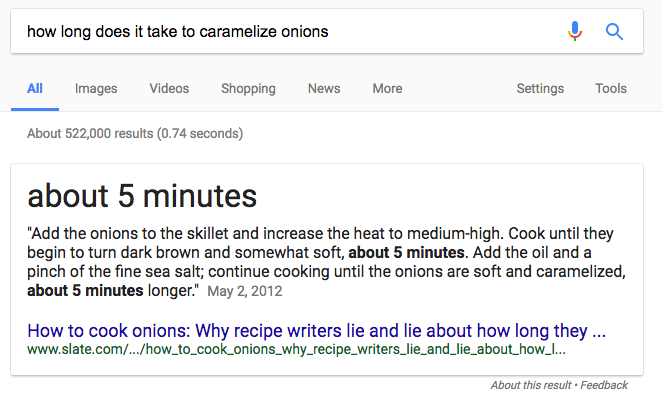
    A couple of weeks ago, I was driving to meet a friend for dinner when I heard a segment on NPR’s Marketplace that featured Tom Scocca talking about his article on Gizmodo about caramelized onions. At first, it seemed like many a segment on NPR we’ve come to expect—interesting and mildly entertaining. It wasn’t until the segment got to the point of the matter that I was hooked. When people were searching on Google for “how long does it take to caramelize onions?” they were getting misinformation. How could such a simple question turn up a false response from the world’s largest, and arguably smartest, search engine? I wondered, are there other moments like this that have happened between users and Google?

    How Did Google Misinterpret What Is Common Knowledge to Most Chefs?

    To be fair to Google, this wasn’t entirely their fault. The initial blame goes back to the thousands of recipes that live on the internet telling readers how to caramelize onions, from an at-home amateur cook’s blog to the New York Times. For whatever reason, instead of telling home cooks to patiently take their time to cook the onions on a low to medium heat for upwards of 30-45 minutes, a lot of recipes listed the expected cooking time as 5-10 minutes. If you’ve ever attempted to caramelize onions in this amount of time, I’ll go ahead and break it to you—it’s impossible. To save you from a bunch of food chemistry, I’ll just say that it has to do with the sugar content in onions.

    Purple Onion Cut In Half - Search Influence

    So, why is there so much content online that gives users, and in turn Google, misinformation? The simplest answer is that writers of recipes were trying to simplify a process that would turn an ordinarily easy recipe for a weeknight meal, like French Onion Soup, into a 1 ½ –2-hour ordeal. In Scocca’s Slate article written in 2012, he gave many different examples of well-known chef’s attempts and failures at trying to achieve caramelization in less than 20 minutes. The article is littered with keywords Google would love and came from a highly reputable source. At its beginning, he references the 5-10 minute myth, and for a while, this had a positive response—The New York Times changed their language when talking about caramelization in their recipes, and even the Wikipedia page was updated as a result.

    But, when people typed “how long does it take to caramelize onions” into Google, they continued to see the false expected cooking times appear in Google’s search result box that is supposed to give users “one true answer,” a term coined by Danny Sullivan, founder of SearchEngineLand.
    How Long Does It Take To Caramelize Onions Google Search - Search Influence

    It turns out, Google was looking at Scocca’s Slate article, with all of its high word count and keyword-laden, well-written text, as the authoritative source. The only problem was that its algorithm focused on and crawled the first paragraph that referenced the 5-minute cooking time. The myth Scocca was trying to debunk ended up getting “bunking,” to use his inverse take on the word.

    Users Push for Quick Answers

    Google hasn’t always answered questions. Users typed in what they were looking for, and they got a list of web pages that may help them find it. But Google realized people wanted short, quick answers to questions, so they developed the short answer box. It’s virtually set apart from the search results and has a slight drop shadow.

    This also isn’t the first time Google has had issues with its short answer box. About a month ago, if you were to ask “Is Obama planning a coup d’etat against the U.S. government?” the response was that he indeed was planning a communist coup at the end of his term. Ask why a fire truck is red and you got a Monty Python joke. While the latter could lead to some harmless John Cleese quotes passed around the office, the former could actually misinform the public in a harmful way.

    Why Are Firetrucks Red Google Search - Search Influence

    Google’s Response and Their Plan to Fight False Information and Fake News

    Google has been dealing with this for a couple of years now. In 2015, they announced that they were using RankBrain, an artificial intelligence algorithm, in combination with Knowledge Graph, which pulls information for short queries from sources like Freebase, Wikipedia, and the CIA World Factbook—very reputable sources. It currently contains 3.5 billion facts. And, with all of these instances of inaccurate snippet responses, Google was quick to fix the issues. Searching for the cooking time for caramelizing onions now brings up the correct answer. Also, along with Facebook, Google also upped their fight against fake news by using fact check systems in their searches and feeds. So the big question is, how does all of this relate to your small business, practice, firm, bakery, brewery, insurance agency, etc.?

    The Importance of Rich, Accurate Content

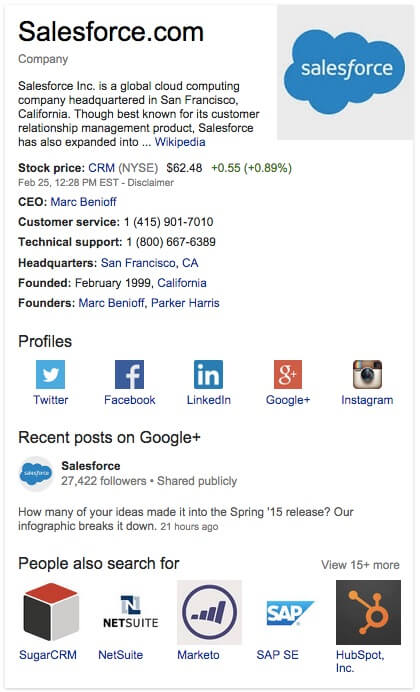
    Whether you’re working on new content or need on-site or local search optimization, the importance of producing educational, on-point, authoritative content is key. The Knowledge Graph’s “panels” pull information from your “about us” page, including contact information. These show up in the sidebar of searches and can include photos from your Google+ page as well as any reviews of your business. So, it should be a no-brainer that your Google+ page should be up to date and any reviews of your company are responded to promptly. Above all, make absolutely sure that your NAPs are consistent and current; an incorrect address showing up in a panel is not the quick answer that potential customers want.
    Salesforce Google Plus Account Screenshot - Search Influence

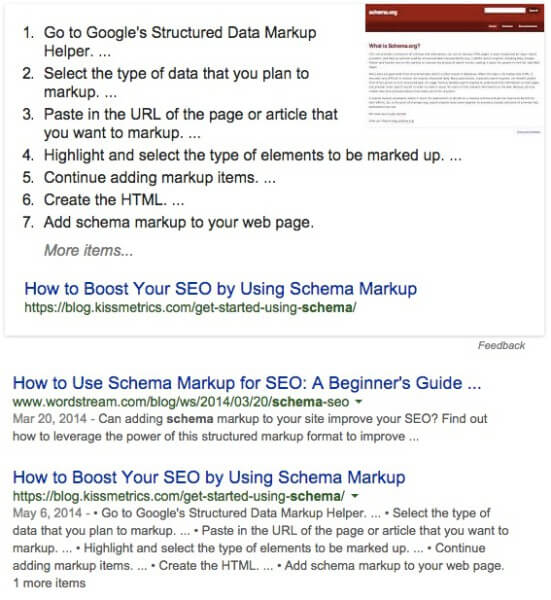
    There’s also the chance that your longer content could be pulled into a short answer box. At first, Google’s Knowledge Graph was pulling just short answers to questions, but it has since gotten smarter at pulling answers from longer content, like how-to guides with 20-point checklists or in-depth, 1,000+ word content that gives users lots of useful information to peruse. As always, make certain your content is not only accurate but also engaging enough to pull viewers deeper into your site and actually convert.

    Does This Completely Change SEO?

    In short, no. As this article from SearchEngineLand points out, in most cases, “the source getting pulled into the Knowledge Graph is already in the first few organic search results anyway.”
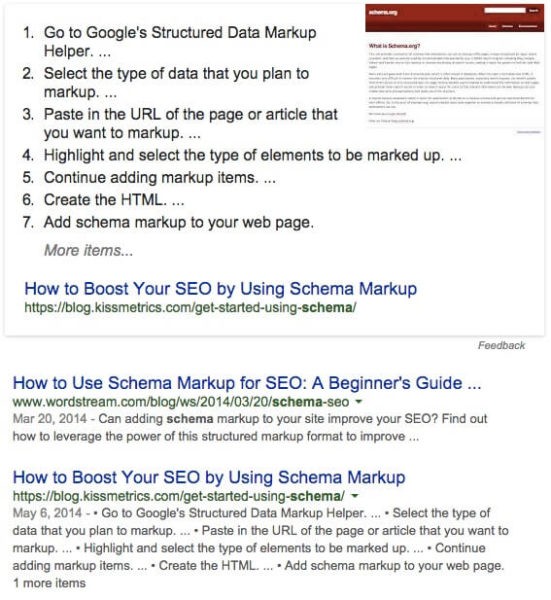
    How To Boost Your SEO Using Schema Markup Screenshot - Search Influence

    Good SEO will improve your ranking regardless and will, in turn, improve your chances of showing up in a short answer box. But even if your business never shows up there, your target audience is still searching for more than just a quick answer. They’ll want to dive into your site for in-depth, relative information. Similar to previous algorithm updates with Hummingbird and Panda, there may be some minor ups and downs in organic search numbers. But if your content is consumer-focused, educational, expertly written, and optimized, then your SEO plan will help out Google’s Knowledge Graph as well.

    If anything, these inaccuracies in Google’s AI have taught us that the search begins and ends (ideally in conversion) with the user. Keep in mind the unique relationship between your business and your potential client.

    Make It Easier for Google

    So, what are some additional steps you can take to make sure your site is up to current SEO best practices? Check out our recent white paper on things to avoid when building or optimizing your website. It includes valuable information, like configuring your URLs and making sure you’re mobile-friendly. Have any more questions on how to increase website traffic? Reach out to us at any time.

    Images

    Onions

    Short Answer Box via Gizmodo

    Fire Truck via TheOutline.com

    Knowledge Graph Panel via SearchEngineLand

    Short Answer Box via SearchEngineLand

  • #FreelanceFriday: Best Places to Work Remotely (Other Than a Coffee Shop)

    This post is part of our Freelance Friday series, where we discuss everything and anything related to freelancing. Follow us on Twitter (@SIfreelance) for more freelance-focused content—from writing tips to industry-related best practices.

    Everyone knows that freelancing = freedom. And one of the major draws of that freedom is the ability to work from anywhere.

    So, where do most freelancers work? Well, to be honest, mostly at home and in coffee shops.

    Many people have delusions of grandeur when it comes to working remotely, picturing themselves on a far-off beach somewhere with their laptop in one hand and a cocktail in another. While certainly feasible, that is not really how freelancing works for most people.

    But, that does not mean you are restricted to the confines of your home or apartment as a freelancer. You don’t even have to join the countless clichéd coffee shop denizens clacking away on their laptop amidst the distracting chatter and overpriced macchiato.

    Here is a list of the best places to work remotely (other than a coffee shop):

    Library

    Today, the world’s information may be collected primarily online, but for centuries before, libraries possessed this wealth of knowledge. So, why not surround yourself with both? Plus, it is quiet and littered with big desks and comfy chairs.

    Image Of Ferris Bueller In The Library Dancing With Children - Search Influence

    Museum

    Seeking similar worldly inspiration in a different setting? Surround yourself with great art. Also, like the library, museums offer peace and quiet and lots of space to get lost in thought.

    Park

    Nature can also be a great source of inspiration–from the towering trees to the serene green fields. Enjoying the sun and fresh air is always better than being hunkered down in an office. Just make sure you have access to Wi-Fi.

    College Campus

    Campuses are kind of like a combination of all the above. There is a library, student center, and lush green spaces spread throughout. You spent hours and hours studying here while in school, so why not go back to get some actual work done?

    Mall

    The food court can be a rowdy place, but if you can tune out the ambient noise, malls are a great place to get work done—especially on weekdays. Free parking and close access to food never hurts either!

    Image Of Robyn Sparkles Let's Go To The Mall - Search Influence

    Hotel Lobby

    Likewise, during the week, hotel lobbies are typically deserted, leaving copious amounts of room and silence to get work done. Wi-Fi may be password protected, but a passing employee likely won’t mind divulging the access code if you ask nicely.

    Bar

    During the day, bars are just like coffee shops, only better. You also likely won’t have to fight for table space with all the other writers crammed into the coffeehouse.

    Fast Food Restaurant

    McDonald’s, Burger King, Wendy’s, Subway, Taco Bell, and others all offer free Wi-Fi. In the ongoing fast food wars, these restaurants are all trying to one-up one another with new amenities. Take advantage of it to get some work done—just take it easy on the snacking.

    Image Of Good Burger Kennan And Kel - Search Influence

    Airport

    Not just a great spot to people watch. Most airports offer the same amenities as those mentioned before—Wi-Fi, food, bathrooms, plenty of space, ambient noise, inspiration, etc. Plus, you don’t have to deal with the hassle of traveling or missing your flight.

    Co-Working Spaces

    This option is definitely great, but can end up being fairly expensive. Co-working spaces are a hot new trend and growing fast. Every major city and most mid-major cities are filling up with these unique shared spaces. Typically, they can be paid by the day or monthly, and certainly gives the feel of “going” to work, but on your own terms.

  • Freelance Friday: Let Stephen King Teach You How to Edit Your Own Writing

    This blog is part of our Freelance Friday series, where we discuss everything and anything related to freelancing. Consider following our Freelance Twitter account.

    Image Of Stephen King Giving Writing Tips - Search Influence

    Stephen King once said, “To write is human, to edit is divine.” Writing and editing go hand-in-hand. You cannot have one without the other. Like a novel or short story, every blog post, page of web content, and even social media post must be edited before it is published.

    While many writers can (thankfully) depend on outside editors for their work, many freelance writers must rely on themselves for editing—a tricky and sometimes mistake-prone arrangement.

    Even for writers who have the benefit of an unaffiliated editor, self-editing is the first line of defense and an important one. Mistakes happen and simple issues are easy to overlook. Improving your competency as a self-editor will only benefit your writing.

    Here are 10 easy tips for editing your own writing:

    1. Read It Aloud

    This is perhaps the most common and easiest tip, nonetheless, an important and proven one. Reading out loud to yourself­–or to another person–can highlight glaring errors that you might have missed. When you read silently, your mind will often compensate for the errors, such as missed words, because it knows they should be there. Reading aloud helps expose those oversights. Plus, things always sound better in your head, but your writing is smoother and more colloquial when easily read aloud.

    2. Set It Aside, or Better Yet, Sleep on It

    After completing an assignment, put it aside and don’t even think about it for a while. Refresh your mind. If possible, sleep on it and let it sit until tomorrow. Return to it when it is not so fresh in your mind and you are not so easily swayed by the post-writing haze. Putting physical distance between it can also put emotional distance between it. A fresh mind will give you a much-needed fresh perspective.

    3. Print It Out

    Another trick to help you catch those mistakes is to print out your work and edit it by hand rather than on your screen. Getting the chance to review it in another form helps simulate an “outside” editor perspective. Make sure to have your handy red pen ready!

    Image Of An Editor Counting Pages - Search Influence

    4. Change the Format/Style

    This tip works similarly to printing it out, but if you don’t have access to a printer, these changes should work just as well. Change the text to a different font, bigger size, or even a different color. You can also  convert regular text into HTML for an altered view. Seeing things in a different format often sheds new light on something you have been working on for a long time.

    5. Read It Backward

    Though this may seem odd, it actually works! You will be surprised at how many misspellings and typos you will ultimately find. It forces you to read more slowly and carefully, plus, it helps you focus on the actual text rather than getting distracted by the context.

    6. Focus on One Thing at a Time

    Don’t waste time editing every word and every sentence. Accept the fact that some things, even major chunks, will be cut out in the edit. To avoid wasting time editing something you are just going to remove anyway, do the “big picture” editing first by starting with structure and overall content. Major cuts, additions, and rewrites need to happen before you focus on the individual words and sentences.

    Image Of Johnny Depp Contemplating With A Slinky - Search Influence

    7. Know Your Writing Weaknesses

    If you are an experienced writer, you should know your own weaknesses—from simple things like words/phrases you overuse, typos you often make, and common spelling errors to more complex issues like active and passive voice. Identifying these beforehand will make them easier to find and fix while editing.

    8. Make Time for Multiple Rounds of Edits

    As stated previously, time brings all things to light. The more time that passes in between writing and editing, the more detached you are and the better your writing can become. Write, break, edit, repeat. And if the mere thought of editing seems daunting, you can break it up as well. One read-through can be for big picture things, the next for punctuation, another can be dedicated to common errors, and so on.

    9. Don’t Over Edit

    We have talked a lot about what needs to be edited and how to edit, but is there such a thing as over-editing? The optimal middle ground exists somewhere in between an impossible grasp for perfection and those too negligent to run spell check. In the end, editing is about being efficient and improving the content, not rewriting it.

    Image Of Kathy Bates Swinging A Sledgehammer In Stephen King's Misery - Search Influence

    10. Be Ruthless

    Finally, don’t be afraid to edit yourself. It doesn’t make you a bad writer, it makes you a good editor—two sides of the same coin. Ultimately, being a better editor will, in turn, make you a better writer. Keep paragraphs short. Reduce sentences to only their essential parts. Avoid overusing clauses, adverbs, and too many adjectives. When editing, you are no longer looking at it as the writer; instead, you should approach the piece from the POV of the reader.

    To end with another famous editing quote—one that has been attributed to many different writers over the years in many different iterations, but perhaps best recapitulated by, again, Stephen King: “Kill your darlings, kill your darlings, even when it breaks your egocentric little scribbler’s heart, kill your darlings.”

    Be ruthless in your editing. In the end, the writer in you will thank you.

  • Fake News, Audience Targeting, and the Death of the 4th Estate

    Content marketing. Political marketing. Fake news. Content amplification. These are all instruments in providing pertinent information to audiences who will become newly inspired and be provided with valuable takeaways. What happens when you elevate content? Your audiences increase, consumption rises, and you essentially engage and “steal” influencers. Here are 3 key ways to leverage more devoted and more precious followers.

    1. Understanding the Traditional Media Tailspin

    Though traditional media has been effective throughout the history of marketing, it is important to realize the descent and, in some cases, collapse it has experienced in the last few years. Newspaper advertising looks to take the hardest hit with a decline in revenues between now and 2020, falling from $18.8 billion to $14.9 billion. (Source: Marketing Charts) While print dropped, digital advertising soared. As consumer behavior shifted online, this new media rose and grew tremendously over the years. Digital advertising has demonstrated continued growth where revenue rose 6 percent last year to $209 million. (Source: NYT) Surviving the tailspin and crash of traditional media and understanding digital marketing is essential to getting re-established as a marketer and to attracting audiences.

    Image Of Papers Writing - Search Influence

    2. Attach Yourself to Amplified Content

    Seek audiences floating by in the online and social media currents and latch onto them by serving them pertinent, targeted content. You will need to learn what interests your targeted audiences and how to keep them engaged at the right time. Once you know your audience, have and maintain a large online presence.

    Social interaction vector image - Search Influence

    To obtain online existence that lasts,  you will have to create valuable and amazing content. Venture into using infographics, videos, memes, guides, reviews, etc. These are all great ways to persuade and capture. But, you must realize your wonderful content will need help.

    Though your content is at it’s highest quality, it is competing with countless information out there. To wean out the competition, you should look into Content Amplification Tools. Taboola, Polar, and Nativo are some tools to name a few. These resources all strive to streamline the creation of producing ads, optimize ads in real time, deliver ads across devices, and drive traffic to your content.

    3. Learn from Political Marketing and Fake News

    Want to “steal” and keep influence and get away with it? You can!

    We’ve seen “fake news” in the news in the last year and a half and the tremendous amount of influence it’s had on audiences worldwide. We’ve seen it influence the 2016 presidential election, and we’ve witnessed big brands such as Pepsi and New Balance endure its pitfalls when their statements were misconstrued as political biases that went viral. What is the lesson here? Though brands should be careful not to get involved in sticky situations, it’s vital to realize what has made audiences so enthralled and how to keep them.

    Image Of Fake News Keyboard Button - Search Influence

    When we revisit the 2016 presidential election, we remember just how loyal audiences were to the candidate they supported. They were essentially brand loyal, and the victory of their candidate was the product they sought and trusted. How can other big brands gain such loyalty and following? It’s using social media, like Facebook, to promote content. It’s considering sponsored posts to reach even more audiences and raise awareness. More importantly, it’s big brands considering and creating a plan of action to think more strategically and to elevate the truth of their brand. The big lesson here is, “Will our audiences believe us?” If they believe, “How do we build and keep their trust?”

    Brands will, more than ever before, think critically, keep demonstrating authenticity, and share valuable insights while taking back what fake news has stolen.

  • What You Can’t Do On LinkedIn: Hacking LinkedIn and Getting Results

    Hypertargeting. Automated bid management. Ad scheduling. We take for granted these social media advertising features available on platforms like Facebook. But, what do you do when these “advantages” are not available on other sites, like LinkedIn? Here at Search Influence, we decided to design some experiments to see if we could manually hack these features within the LinkedIn advertising platform.

    Targeting Options

    We all know how great Facebook’s targeting is with purchase behaviors and in-market audiences backed up by actual third-party data. There’s no way that LinkedIn can touch Facebook in this realm, right?

    According to Business Insider, LinkedIn is gradually increasing its user base, even as other platforms like Facebook and Twitter have seen decelerating growth. What LinkedIn has to offer is the opportunity to reach one of the fastest-growing groups of business-minded professionals when they are in “work-mode,” browsing for new career opportunities, exploring professional affiliation groups, and researching industry-specific content. In fact, Buffer reports that 60% of LinkedIn users are interested in seeing industry-related content with company news as a close second. So how can you capitalize on this information-hungry audience?

    LinkedIn offers the opportunity to target all levels of the professional hierarchy, from young company influencers, performing research and reporting on their findings, to higher-level corporate decision-makers looking for their next business partnership. The targeting opportunities on this platform are specifically geared towards a professional audience. With these options, you can:

    • Target specific Companies by name and narrow in your Job Titles to reach the exact people you want to hear your message,
    • Use specific Degrees or Skills to seek out only the users who meet your qualifications or
    • Sift through Member Groups to find people with similar or desirable professional or educational affiliations.

    With all of these occupation-oriented targeting options, LinkedIn offers advertisers the ability to closely align your social engagement goals with your company’s brand and mission to reach users who are demanding industry-relevant content.

    Ad Scheduling

    Facebook offers ad scheduling, and while it’s not as granular as other platforms, such as AdWords, which allows you to schedule your ads in 15-minute increments, it still provides a heightened level of control over when your ads are shown.

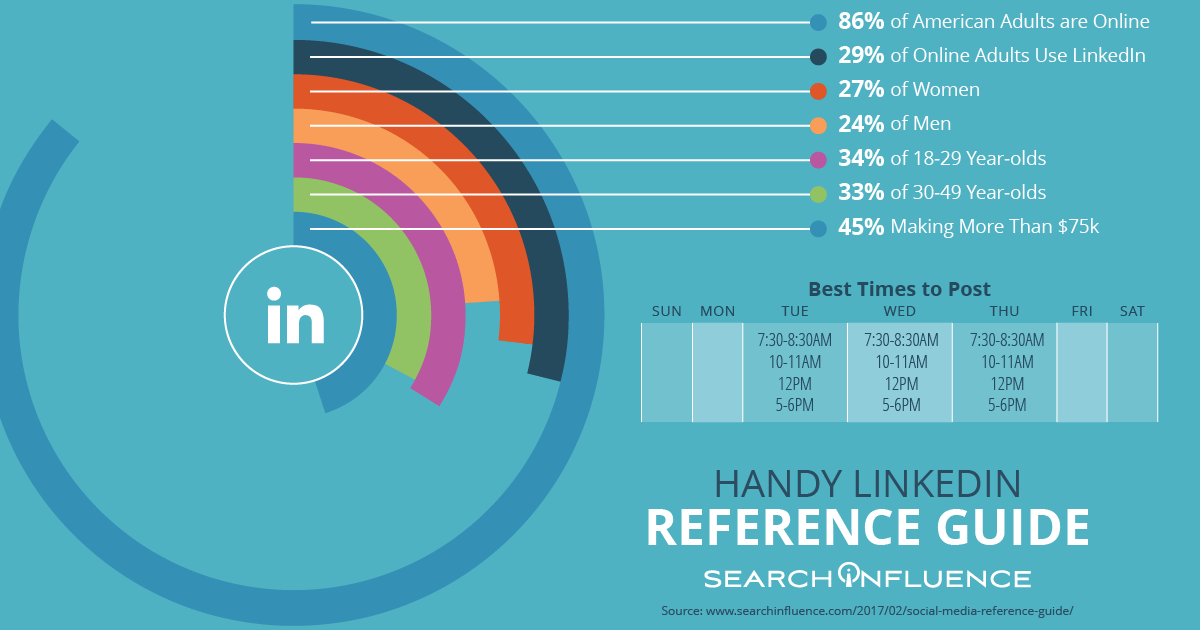
    Unfortunately, LinkedIn does not afford advertisers these same features, so we took it upon ourselves to apply manual ad scheduling to see if the benefit was worth the time. Research has shown that the best time to publish content on the LinkedIn platform is Mondays through Fridays, during business hours. Makes sense, right? Target working individuals with work-related content during work hours.

    Linked-In-Best-Times-to-post imge - Search Influence

    Our online advertising team put this premise to the test. Many of our clients suffer from budgets that are too small to run ads for the duration of the month. When you factor in LinkedIn’s $10 daily minimum and the fact that the platform allows you to spend up to 20% more than your daily budget on any given day, and you most often will, this effectively makes the minimum daily spend $12. If we extrapolate that figure across a 31-day month, an individual campaign needs AT LEAST $372 to run. To be most effective with our clients’ monthly spends, we wanted to capitalize on the users who are most likely to engage with the content, i.e. people who are on LinkedIn during the weekdays.

    We implemented a “Weekend Pausing” test for a few of our clients. This test included Sponsored Updates campaigns, and we ran our test from November of 2016 through December 2016, pausing on weekends and holidays when users are least likely to be browsing the platform with intent.

    We began by establishing baseline performance for each of the clients and decided that our main metrics for measurement would be engagement and cost per engagement.

    Image Of Engagement Metrics For Online Advertising LinkedIn - Search Influence

    So, what did we find? One client saw a 28% decrease in cost per social action and an 18% overall decrease in spend for a 14% overall social action increase. One client spent 23% less budget and received 63% more social actions for a cost per social action that was 53% less than the baseline. However, when we looked at overall engagement, which includes clicks as well as social actions, we saw an overall engagement decrease of 13% and a 39% decrease in engagement rate, refuting the idea that LinkedIn users are most active during weekdays. An extended period of testing would be required to investigate the full impact of weekend pausing on LinkedIn engagement rates.

    Bid Management

    Other platforms offer automatic bidding options to get you the lowest cost per result. Facebook does this across all of its placements, including Instagram and the Audience Network, to achieve the lowest average cost per result. There are also manual bidding options on the Facebook platform for those advertisers who want a little more control.

    Luckily, LinkedIn does provide some competitor bidding data so that you can make an informed decision when setting your manual bids, which is the only option available on this platform. Previously, the consensus for LinkedIn bidding best practices was to bid as high to the top of the bidding range provided by LinkedIn in the Bid & Budget tabs of the campaign manager as the client’s budget allows.

    Image Of Competitor Bidding Data For Online Advertising LinkedIn - Search Influence

    What we were curious to test was whether we could maximize clicks and decrease overall cost per click by strategically bidding down, towards the middle of the bidding range. Our online advertising team devised a test across multiple clients in various industries with different budgets. Since our goal was to maximize clicks and engagement, we chose clients with Sponsored Updates campaigns. We established baseline metrics for each of our client’s prior performance and began strategically lowering and raising our bids from the top of LinkedIn’s provided range to the bottom in predetermined increments each day.

    Once our bids were set towards the lower bound of the range, clicks and impressions significantly decreased. After moving up and down the range a couple of times, we hit a “sweet spot” right around the middle of LinkedIn’s bidding range where performance was optimized. We discovered that bidding around the middle of LinkedIn’s bidding range resulted in an average click increase of 39%, an average CTR increase of 14%, and an average CPC decrease of 30%. Through the manual manipulation of our bids, we were able to generate more engagement for our clients at a lower price!

    What Can You Do With LinkedIn?

    While many advertisers might suggest channeling efforts from LinkedIn to Facebook, I suggest rethinking the platform’s purpose. What our experiments have revealed is that if you can devise a strategy that considers the platform’s utility as a connector of business-minded individuals, and you’re willing to put in the effort to manually optimize your campaigns for the highest level of budget efficacy, you can churn out excellent results.

    If you have strategic questions about using Linkedin or need support getting started with Linkedin advertising, contact a member of our team.

  • Up Your Social Media Game With This Handy Reference Guide: The When, How, and Where of Social Posting

    Up-Your-Social-Media-Game-With-This-Handy-Reference-Guide - Search Influence
    Another year, another seemingly endless parade of social media posts gone by. If you haven’t jumped on the social marketing bandwagon yet, 2017 is the year to begin because things are continuing to go up and up. Here are some highlights.

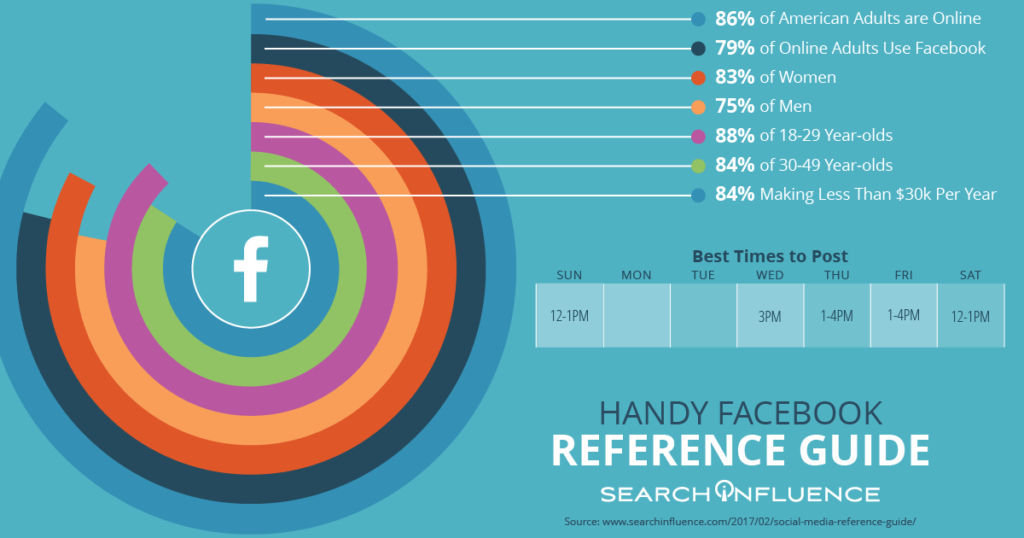
    79% of Online Adults Use Facebook

    The Pew Research Center has done a lot of work tracking the social media usage of American adults. Of all platforms, Facebook has a staggering reach among adults across demographics.

    Handy-Facebook-Reference-Guide - Search Influence

    Of these Facebook users, 76% check in every day and use Facebook as a way to learn about the news, local businesses, trending topics, and more. Facebook is truly on the way to becoming all pervasive, even among adults aged 65 and older.

    57% of Consumers Are Influenced by Online Information

    More than half of internet users surveyed said that they are influenced to think more positively of a business after reading positive reviews or comments about the business online. This means that creating a space for customers to give reviews and interacting with these reviews has tangible benefits and can convert potential customers that are lurking in the background of your social media.

    Social Media Ad Spending Has Hit $35.98 Billion – and Keeps Climbing

    Businesses are learning the advantages of using social media to market to their customers and using that knowledge to their advantage. Social media advertising is becoming the new normal, and we have abundant experience creating campaigns that convert. Contact us if you are ready to get started with paid ad campaigns for your institution or business.

    Sources:

    http://www.pewinternet.org/2016/11/11/social-media-update-2016/

    http://webbiquity.com/social-media-marketing/47-superb-social-media-marketing-stats-and-facts/

    http://www.pewinternet.org/2016/11/11/social-media-update-2016/

    http://coschedule.com/blog/best-times-to-post-on-social-media/

    https://www.emarketer.com/Article/Social-Network-Ad-Spending-Hit-2368-Billion-Worldwide-2015/1012357#sthash.eESedQLL.dpuf

    https://www.emarketer.com/Article/Facebook-Twitter-Will-Take-33-Share-of-US-Digital-Display-Market-by-2017/1012274#sthash.0WToy3rM.dpuf

  • Freelance Friday: 8 Tips for Boosting Productivity When Working From Home

    This blog is part of our Freelance Friday series, where we discuss everything and anything related to freelancing. If you are a freelance writer and are looking for additional work, consider applying at Search Influence.

    Picture Of An Office Employee Jumping With His Briefcase - Search Influence

    Workforce productivity is a key metric tracked by most businesses. In an office setting, you can use innumerable tools to track productivity and often have at least one manager (if not multiple) on your back making sure your numbers are high.

    Picture From The Office - Search Influence

    But what about freelancers? By design, we all know there are more distractions and temptations at home than in the office. Without the structure, supervision, and accountability of office life, freelancers are vulnerable to diversion, lulls, and even apathy. Freedom and flexibility are the great advantages of freelancing, but it shouldn’t come at the cost of productivity.

    So, how can you ensure that your productivity is maximized, even while working from home? It all boils down to this: Treat freelancing as you would any other office job. You have to manage yourself and your schedule effectively.

    The fact of the matter is that freelancing full-time is a real job. You may think you already know this from experience, but unless you structure your daily schedule to mirror a normal job, it never truly will be.

    Freedom and flexibility are the great advantages of freelancing, but it shouldn’t come at the cost of productivity. Change your mindset–doing this will ensure maximum productivity.

    Here are 8 easy tips to boost productivity when working from home.

    1. Create a dedicated workspace.

    Working from the couch is just a distraction waiting to happen. Create a space specifically dedicated to working in your home, preferably an office. It certainly doesn’t have to be a cubicle, but rather, a comfortable, stress-free area where you can get work done and where others know you are working so that they do not disturb you.

    2. Maintain a regular sleep schedule and get started early.

    Getting an adequate night’s rest is important for everyone, freelancers included. Starting early kicks off your day on the right foot and will help you get more work done. Just because you work from home doesn’t mean you should stop mid-afternoon for a power nap. Get to bed early, wake up well-rested, and stay refreshed.

    Photo From Forgetting Sarah Marshall Sweatpants Everyday - Search Influence

    3. Shower and get dressed.

    Rolling out of bed in your pajamas is fine for the weekend, but not for a workday. For most, a shower helps to wake you up and getting dressed puts you in the right mindset. Getting ready for work at home should be no different than getting ready for work at an office—at least the commute is shorter.

    4. Structure your day into attainable blocks.

    We all like accomplishing things, especially small, work-related goals. If you structure your day into blocks dedicated to a specific task, you can move seamlessly from one to the next and still get a feeling of accomplishment after completing each step. This way you can also hold yourself accountable and monitor your progress more efficiently. Scheduling and organization are a must!

    5. Take regular breaks, but limit them.

    Regular breaks to stretch, clear your head, or eat lunch, can recharge you and promote better work afterward. There is a reason why companies are legally obligated to give their employees breaks. You—as a company of one—are entitled to those same mental and physical health benefits. But as both the employee and boss, you have to make sure that time is used effectively. Taking a nap or running errands for extended periods of time are not efficient breaks.

    6. Avoid distractions.

    Admittedly, this may be the toughest one to accomplish. Distractions are everywhere at home. From TV and social media to the dishes and laundry, there is a never-ending list of things that seem more important or fun than doing your work. This is where discipline and accountability play a major role. Unplug the TV, download an app that limits your social media usage, and know that household chores can be done at more appropriate times (but let’s be honest, you weren’t really going to do the dishes or fold the laundry, were you?).

    Photo Of Fred Flintstone Clocking Out Early Quitting Time - Search Influence

    7. Set a clear end time.

    You may not officially work from 9–5, but quitting time is important nonetheless. When working from home, it is easy for your work life and personal to blend, but having a firm start and end time will go a long way in preventing this. Knowing that you are stopping at a certain time, will encourage you to get the work completed in time so that you are not forced to work “overtime” (without the time and half pay). Making plans after work is a great way to make sure you stick to this.

    8. Communicate expectations with anyone who will be home with you.

    Though freelancers may typically work alone, that doesn’t mean they live alone. Whether it is a roommate or a family member, make sure they are aware that you are working and should not be disturbed. Ultimately, it is on you to ensure that others respect your work schedule. To do this, you have to respect it first. Set aside your personal life when working from home and maintain your productivity.