Tag: content strategy

  • Applying Stephen King’s Writing Tips to Create Web Content That Converts

    All great ideas start with words—maybe even just an utterance. “What if… let’s try…” There’s the excitement about the idea, talking about it over scribbled notes and endless cups of coffee, and then putting those words down on the page and getting your business plan running. Years ago, once you conceived of your brand and wanted to advertise and market your company, traditional media was the only option. And there was often a great rift between short and cheap advertising options like yellow pages listings and extensive and expensive options like TV commercials, billboards, and local print or magazine ads.

    Now, with the exception of niche industries where images alone can represent a business, website content is the dominating force for 1) convincing a visitor to your site that you can help them solve their problems, and 2) reassuring Google that you’re an authoritative source in your industry. However, not all writing is transferable across different mediums. Sprawling lines from Faulkner would be lost on visitors to websites, and similarly, website content would make a horrible novel. But, we can still take some inspiration and writing advice from one of the most prolific and spooky writers of our time, Stephen King. Here’s an essential checklist for writing website content, alongside some quotes from the horror bard’s technical writing opus, On Writing.

    Know Your Audience

    “The scariest moment is always just before you start. After that, things can only get better.”

    Shawshank redemption gif

    It’s daunting to start a website from scratch, but that’s the perfect time to draft buyer personas before writing any copy. Buyer personas serve as a representation of a business’ ideal customer. They should be based on existing and prospective customer data, such as demographics and psychographics. Explore your ideal customer’s pain points, preferences, shopping habits, demographic information, etc. Once you’ve figured out who your ideal buyer is, you’ll be closer to understanding your brand’s tone. Is it more professional and reassuring, or playful and creative? Whatever you land on, the objective will be the same—welcome the reader with inviting copy, earn their trust by assuring them of your expertise and authority, and move them toward a sale with focused language that’s action-oriented.

    All the best copy in the world won’t help if your audience can’t find your website. Think about how your audience might be searching for you on Google. What questions do you hear from clients or patients? Gather these common questions before even starting to draft your copy, and think about how you can answer them. You should also do keyword research on how users are searching for your company and similar competitors. If you’ve never performed keyword research, Moz has a great breakdown with strategies and online tool suggestions. Once you’ve recognized trends in search terms, try to fit those terms into your copy naturally (bonus points if you can work them into your H1s and H2s).

    • Understand your customers’ worries
    • Establish buyer personas
    • Find your appropriate tone
    • Do your research

    Keep It Simple

    “One of the really bad things you can do to your writing is to dress up the vocabulary, looking for long words because you’re maybe a little bit ashamed of your short ones.”

    Gif from the movie "Misery"

    There’s a time and place for long, drawn-out sentences. For websites, follow King’s advice and keep it simple. Think short sentences (below 20 words) and short paragraphs (around five lines). Research suggests “the new norm is skimming.” One great way to help out the skimmers of the world? Bullet points and lots of H2s. Put some of your unique selling propositions (USPs) as bullet points. That way, if someone is skimming, they’ll catch your most marketable features. Large H2s with USPs also help deliver valuable info in a short amount of time and space. Considering the average user’s attention span is now eight seconds, the more skimmable, the better.

    Also, a quick note about jargon—it’s best to avoid it. While you might think it shows off your expertise, it will more than likely come off as exclusive and confusing. Odds are, someone visiting your site doesn’t know as much about your business or industry as you do; don’t constantly remind them of that by throwing around obtuse industry phrases and abbreviations. It’s all about connecting and building trust. The best way to achieve this is by sticking with the brand voice that you established from your target research.

    • Short sentences. Short paragraphs.
    • Use bullets when possible
    • Avoid jargon
    • Make it accessible

    Avoid Filler and Fluff

    “I believe the road to hell is paved with adverbs, and I will shout it from the rooftops. To put it another way, they’re like dandelions. If you have one on your lawn, it looks pretty and unique. If you fail to root it out, however, you find five the next day… fifty the day after that… and then, my brothers and sisters, your lawn is totally, completely, and profligately covered with dandelions. By then you see them for the weeds they really are, but by then it’s—GASP!!—too late.”

    Mouse pushing spool in the film The Green Mile

    King does an interesting job here of showing how not to use filler and fluff language by… using filler and fluff. “Totally, completely, and profligately.” We get it. It’s a bit much. So what exactly are filler and fluff?

    Filler language uses too many words to describe something when fewer will do. It can also be generic terms that don’t add value to your sentences. Think, I need to finish this term paper so I’ll keep adding some sentences that don’t really say much and hope the professor doesn’t notice, kind of sentences.

    Fluff language comes down to vocabulary, or, often, a writer’s love for a thesaurus. The goal is genuine, but the result is copy that ends up wasting the reader’s time. When going over first drafts of your website copy, comb through every sentence and ask yourself, “Is this adding value?”

    • When in doubt, cut, cut, cut
    • Watch out for unnecessary adverbs and adjectives

    Develop a Brand Lexicon

    “Amateurs sit and wait for inspiration, the rest of us just get up and go to work.”

    Typewriter scrolling from the movie The Shining

    So you’ve done keyword research to understand what people are searching and to what degree. You’ve created buyer personas. The next step should be to develop a brand lexicon with your team. How will you refer to your customers? As clients, patients, buyers? How do you refer to your team? Staff, crew, talent, personnel, employees? How do you talk about your services or products? Finalize your choices and make it consistent throughout your entire website. Once you’ve got a list going, make it accessible for your writers and editors, either in a digital or print format.

    This isn’t to say you shouldn’t have a variety of language in your writing. Mix up the way you write about your company and services. We don’t talk to each other in narrow language scopes. When we talk about a wedding, we don’t just mention repetitions of basic services that could be common keywords (weddings, wedding services, wedding DJ). We bring up the flower arrangements, lighting, cake, bridesmaid dresses, centerpieces, dance floor, photo booth, signature cocktails, first dance, flower girl, ring bearer. It’s this variety of language that sends positive SEO signals to Google. You’re not writing to a keyword (something Google hates). You’re writing to the experience.

    • Draft a lexicon that pairs with your brand’s tone, and stick to it
    • Use varying language, not just keywords

    Trust Your Editing Team

    “Write with the door closed, rewrite with the door open.”

    You're going to be a writer someday, Gordie from Stand By Me

    There’s almost always a team of support to make sure your website content is just right. For the first draft, don’t worry too much about hitting every mark. Get the important information down first, and then go back and revise. While writing is for exploring, editing should be for fine-tuning. When editing, get collaborative and make sure multiple team members oversee the drafts. There are often subtle details that even the keenest eye will overlook when editing alone.

    You may also find that there are just too many words at first. You wanted to make sure every.single.awesome.detail. about your company was included and, as a result, went a little overboard. That’s okay. It’s always easier to cut down than to try to beef up your sentences with additional information. The latter often leads to filler and fluff anyways, and you should know that’s a no-no at this point.

    • Set up a team dedicated to editing
    • Don’t be afraid to revise, revise, revise

    Finish Strong

    “Description begins in the writer’s imagination, but should finish in the reader’s.”

    Its the most important part of the story, the ending from Secret Window

    Hopefully, at this point you’ve started to write some copy. Hurray! But, are you making sure you’re giving your readers an actionable “next step” in their buyer’s journey? Focus on getting closer to a natural call to action at the end of your copy. You can start off more broad by talking about what you offer customers, but by the time you’re reaching the bottom of your copy, the focus should be heavily on the reader.

    One quick trick you can use while editing—search for how many times you’re referencing your business in the collective first person, e.g., we can better help… our team is skilled… we, we, we. If there’s a lot of them, then get the hypothetical red pen out and start marking. Make it more about who you’re talking to. What do they get from working with you? How will their frustrations be solved? Start with your capabilities and expertise, but end with the reader taking action into their own hands.

    • End with a natural call to action
    • Focus on the user

    Above all, good website content comes from authors that know their brand inside and out. You’ve got your elevator pitch down, and you can talk comfortably at networking events about what puts your business above the competition. This authenticity and confidence in your brand will shine in your writing. It’s about making a connection in a short amount of time, recognizing the worries of your readers, and assuring them their goals can be met by working with you. So don’t rush it—get to know your brand, do some research, plan accordingly, keep it simple, and focus on the end-user.

    Feel like you could use some assistance with your website content? The content marketing team at Search Influence can develop a content strategy that helps get the right visitors to your site at the right time. Reach out to our team at any time to get started.

    Images

    Misery

    The Shining

    Stand By Me

  • How User-Generated Content and Engagement Can Help Boost Your SEO

    As we continue moving toward an increasingly digital world, the importance of user-generated content, and the engagement that it produces, is becoming more prevalent in the realm of SEO. What users say about your brand, and how often, can have a real impact on your online visibility. How you promote, engage, and moderate this content is equally important. Below, we’ll look at the good and the bad while also finding ways to use this sort of content to the benefit of your business.

    So What Is User-Generated Content?

    User-generated content (UGC) is as straightforward as it sounds—any content that is created by a user and shared on an online platform. This content can include reviews, testimonials, images, and comments that are shared on platforms such as social media, blogs, or internet forums. Think product reviews on YouTube or reviews of a restaurant on Yelp. Additionally, this type of content can also be shared directly on your business’s website (we’ll go into that more later).

    Eric Cartman walking down the halls in a Yelp Critic shirt

    What Are the Benefits of UGC?

    The most obvious benefit of UGC is the publicity of your brand, products, and/or services. But what does this mean in terms of SEO? For starters, it provides more information and context for search crawlers. Search engines can provide a user with results from both your website and other platforms that mention your brand. For example, a Twitter user’s tweet praising a good experience with your company’s customer service could show up on search engine result pages (SERPS). More content means more opportunities for search engines to find your brand and provide that information to users.

    As mentioned earlier, user-generated content doesn’t have to come from outside sources. There are ample opportunities to obtain UGC directly from your website. In a Reddit AMA last year, Google’s own John Mueller suggested that allowing users to make comments (say, for instance, on your website’s blog entries) is one way of getting more content onto your website. Allowing users to make comments and engage in a discussion will give crawlers more content to consume, thus providing them with more context. Want to share positive feedback from some of your customers or clients? Consider adding a testimonials section to your website that highlights this feedback to impress other potential customers.

    Woman at computer approves and thinks this user generated content is legit

    Another benefit of user-generated content is that it brings authenticity to a brand. According to Stackla, 90% of consumers (a 4% increase in just two years!) believe authenticity to be an important factor when deciding which brands to support, while 61% of marketers say this is what makes content marketing most effective. Authenticity is what drives and encourages engagement from potential customers. Users are 28% more likely to engage when given UGC such as product videos and official brand authorized content. If users are engaged, this will result in more time spent on a site and a higher likelihood that this will result in conversions.

    Are There Any Downsides to UGC?

    Unfortunately, there is a glaring disadvantage to user-generated content if it’s not handled appropriately: People won’t always give your business glowing reviews. We’ve all seen scathing Yelp reviews or tweets go viral. Are they always warranted? Not necessarily, but search engines don’t know that, and they sure don’t discriminate. Just as positive content about your business can give you an advantage in SEO, conversely, negative content can result in poor SEO performance. You may not always be able to do away with the critics, but there are certainly ways to help combat that type of content.

    How to Manage UGC

    So what can you due to limit or control this sort of content? One of the easiest and most obvious ways is to hire someone with the knowledge and know-how to manage it for you. Keeping up with and finding ways to control user-generated content can be incredibly time-consuming, so giving that responsibility to experienced professionals will not only save you time but will also ensure that it’s done in a thoughtful and SEO-friendly way. Finding ways to incorporate user-generated content on your website is one of the easiest ways of managing content since it gives you complete control over the type of content that is shown. Allowing users to submit review videos to your site or to offer a testimonial of their experience are just two ways to get more authentic content onto your site.

    It’s important to keep in mind that user-generated content will happen whether you like it or not. How you choose to handle it is a critical decision for a successful, sustainable business. There are plenty of services available for your business to utilize to achieve the online success you desire. Ready to get started? Contact our team today to see how we can help grow your business.

    Images

    Ilya Pavlov on Unsplash

    Cartman

    Legit

  • How to Develop a Strong Content Strategy

    Notepad with words content marketing concept and glasses

    You’ve heard it time and time again, “Creating a strong content marketing strategy is essential.” Is it really that important? Well, according to the Content Marketing Institute, content marketing produces three times as many leads as outbound marketing yet costs about 62 percent less.

    You might still be wondering, what goes into creating a content marketing strategy? Is all of this planning really necessary? While it might seem like something you can just do on a day-by-day basis, building a strategy helps you work more efficiently because you and your team will have already decided how to handle potential issues. But because there are many elements to putting together a successful marketing plan, we’ll walk through some of the most important ones.

    Define Your Goals and Set Your KPIs

    What are you hoping to achieve? You might be looking to get more traffic, position your company as an expert in the industry, increase revenue, improve your search engine rankings, or increase brand awareness. Hone in on what’s most important to your business and clearly define your goals. Set yourself up for success by making your goals S.M.A.R.T. When doing so, make sure your goals are measurable and decide which KPIs (Key Performance Indicators) make the most sense for tracking your campaign’s success. And remember, not every metric is a KPI.

    Know Your Audience and Solve Their Problems

    How will your content help your customers? Your product or service exists and matters because it solves a problem for someone somewhere. Ideally, it should solve a variety of problems for many types of people. An effective content strategy addresses the appropriate audiences by using a variety of content types and educates your audience while they look for information about their problems. But not everyone is at the same stage in their problem-solving quest. Some might still be understanding their problems while others are out there looking for solutions. Keep the marketing funnel in mind as you build out your content strategy.

    Content strategy with words awareness, consideration, decision

    Decide on Publication Platforms and Content Types

    How do you reach your audience? As you work through the process of understanding your audience, you’ll get a better feeling for where they spend their time. First, focus on covering the essentials on your website and blog, and then consider opportunities to broadcast your content beyond that. Make sure your site covers everything that your audience needs to know about your company, its products and services, and what sets you apart. Use your blog to demonstrate your expertise in your niche and maybe even use this as an opportunity to build out other content types that can be shared elsewhere or repurposed into different formats (like infographics and videos).

    Create a Content Calendar

    When do you post what? Now that you know what you want to create, you need to think about how to execute your plan. Creating a content calendar makes it easier to stay focused, keep everything organized, and be productive. You can start with just one month of content in the beginning, but you’ll want to continue building it out in advance and take note of seasonal events, holidays, and other dates that might help you create timely, relevant content further down the road. Take a look at the content types you’ve decided on and then lay out your content strategy, keeping in mind the best times to post and how often to do so. Note any evergreen topics that are relevant throughout the year. They can help you fill in current gaps in your content or provide some flexibility in a time crunch.

    Distribute Your Content and Measure the Results

    What does success look like? It’s finally time to see how successful your strategy has been. To do so, you’ll want to refer back to the KPIs you set and see if you’ve hit your targets. Be sure to think about what’s changed in your industry. Were there any special events or seasonality that might have caused spikes or lowered performance? Be sure to look at your results month-to-month and year-over-year. Monitor your progress and make adjustments at regular intervals.

    Does all of this sound like too much? Creating an effective content marketing strategy can be challenging and stressful, but Search Influence can help! Our content marketing experts know how to research, plan, and execute the goals that are most important to you. If you’re looking to get support on building a content marketing strategy or if you would like a consultation while creating one internally, we’ve got you covered. Speak with one of our strategists today at (504) 208-3900 or fill out this form to request a marketing analysis and proposal.


  • Four Steps to Improve Your Content Marketing Strategy

    How much content have you consumed today? Probably more than you realize. The American Marketing Association estimates that the average consumer is exposed to upwards of 10,000 brand messages a day. As consumers, we have no shortage of options for anything our hearts desire, from where to get our teeth cleaned to who we call when the A/C breaks. And as marketers, we have no shortage of ways to reach those consumers. With these four steps, you can evaluate and enhance your content marketing strategy to help stop the endless scroll and capture the eyes of your target audience. Take note and let’s make this one piece of content worth your consumption today.

    A person scanning content on a website at Search Influence in New Orleans, LA

    Evaluate your Current Content Strategy

    According to Content Marketing Institute’s 2018 benchmark report, 38 percent of B2B marketers say they have a content strategy, but they don’t actually have it documented anywhere. If you don’t write down your plan, do you really have a plan at all? Whether it is lack of time or lack of people, many businesses understand the value of content marketing but don’t have the capacity to fully implement a fleshed-out strategy.

    By performing an audit of your current content strategies, you can document your successes and areas of opportunity, determine the key metrics that align with your business goals, and get your whole team on board with a plan.

    A content audit should record the following details in one organized place:

    • Who is creating your content (all stakeholders/departments involved)
    • Where content is being published
    • How frequently new content is getting implemented
    • What types of content you are creating (i.e. videos, blog posts, social posts, etc.)
    • What measurable results you are achieving (i.e. page views, rankings, likes/shares, etc.)

    Once you understand the current state of your content strategy, you can then set goals moving forward. Your content marketing goals should align with overarching company goals, and they should be specific, measurable, attainable, relevant, and time-bound (S.M.A.R.T). For more tips on how to set goals for your marketing strategy, check out our recent blog about S.M.A.R.T. goals.

    Woo the Right Audience

    When optimizing your content strategy, it’s important to not only think about your company’s goals, but also to frame your content around your target audience’s goals and pain points. You’ll first want to define your audience by creating up-to-date buyer personas.

    A buyer persona is a fictional “character” that represents a focused and clearly defined target audience based on actual customer behaviors and demographic research. By gathering insights from recent customers about their motivations, concerns, and decision-making processes, you can better understand how to appeal to a similar audience and nurture the right leads. You will also want to survey stakeholders within your company who interact firsthand with your customers in order to reveal any inconsistencies and better examine how prospects are converted.

    Your persona should include details like age range, gender, income, education level, and location, as well as what platforms they use regularly, their interests and hobbies, and any barriers that prevent them from making a decision. For B2B companies, you will also want to consider the persona’s job title, industry, company size, and career goals. Put all of these factors together into one organized document that you can share with your marketing team and content creators.

    Once you build buyer personas, you will be better able to deliver consistent content to reach your audience in all stages of their journey. You can map different content types, like blog posts vs. paid ads, to different stages of their journey in order to give your content creators more guidance. For example, an awareness level blog post will likely share more general industry-specific information, while a consideration level post will weigh the pros and cons of two possible solutions to a pain point. Buyer personas allow you to create intentional, cohesive content that can help you, in time, build a community of loyal brand advocates.

    Improve the Quality of Your Content

    Gone are the days of stuffing in your keywords to optimize content or sneaking in internal links to your product pages without the proper context. It may seem obvious that everyone wants to create quality content, but what does that actually look like these days?

    Stephen Colbert tapping on his watch

    Well, it starts by making the right first impression. And you have less than three minutes to do that. According to Harvard Business Review, the average viewing time for content is 2 minutes and 27 seconds. By optimizing your content titles and subheadings around what your prospects are actually searching for, you can answer their questions and eliminate their doubts more quickly. Skimmers can see immediately if your content is worthy of their time. Bulleted lists can also break up content, while a multimedia approach that incorporates a mix of text, video, and custom graphics can enhance engagement.

    Of course, the old adage “show don’t tell” still plays a major role in determining quality. Show the value of your services and products by featuring customer testimonials and case studies as part of your content strategy. Include any accreditations or awards naturally in your content, and promote mentions you get in local publications. Check out how we showcase our client success stories or read our testimonials at Search Influence for more ideas on how you can prove your value through firsthand accounts and reviews.

    Finally, quality is not just in the eyes of the consumer. You also have to impress the search engines. You’ll want to consider Google’s guidelines for quality, specifically the Expertise, Authoritativeness, and Trustworthiness (E-A-T) of the content. According to Google, high E-A-T content should contain factually accurate information that is sourced from accredited experts in that field.

    There are a couple of quick ways to improve your E-A-T quality right away. First, rather than publishing blogs from a generic company author, create individual authors and corresponding bios for your content creators so they can publish content in their name. Additionally, you can improve the trustworthiness of your content by citing reputable sources and accredited experts in the industry.

    Build a Distribution & Publishing Schedule

    Now that you have taken stock of your current strategy, honed in on the right audience, and improved your quality, you’re ready to share this beautiful content with the world. Remember that documented plan we talked about earlier? Time to make that a reality. Build out a schedule for publication, including the number of posts or pieces of content you will publish monthly, when they will go live, who will author them, and how they will be promoted.

    You should consider any of the following types of content to publish:

    • Website and blog content
    • Advertising on Google Ads or Bing
    • Social media posts (Facebook, Instagram, Twitter, LinkedIn, Pinterest, YouTube, etc.)
    • E-books, digital downloads, or case studies
    • Infographics or custom graphics
    • PDFs of brochures or product manuals
    • Video tutorials, product spotlights, or podcasts

    Remember to focus on the platforms that matter most to your buyer personas, and determine what metrics you will track for each platform. For a Facebook post, for example, you may want to focus on shares, while you may look at conversion rates or cost-per-click for your online advertising campaigns. Success should always tie back to your S.M.A.R.T. goals and target a specific aspect of your buyer persona’s customer journey.  

    Ultimately, content marketing is a cycle of continuous improvement. As you start out, don’t worry about trying to get your content on every possible platform. Remember that, as your library grows, it will become easier to start creating new types of content. For instance, you can turn a series of blog posts into a robust digital download, or you can break up a custom infographic into several small, focused graphics for social media.  

    Even if you start small, building and maintaining a content marketing strategy takes time and a dedicated team. At Search Influence, we aim to serve as an extension of your team by offering content marketing services built around your brand goals. From idea creation to distribution and reporting, we’ve got your back. Request a free analysis with one of our strategists today.


  • How to Set S.M.A.R.T. Marketing Goals

    Think Tank Around Measuring Diversity - Search Influence

    Once you’ve identified the metrics that matter most to your business (download our guide: “Marketing: What Metrics Matter?” for our 4-step process), goal setting is the next step in achieving success. Setting business goals can be a daunting undertaking for some, but it’s much simpler if the right method is followed. Don’t set goals just because you feel as though you should have them—goals are only beneficial when there is value in achieving them.

    What Are S.M.A.R.T. Goals?

    S.M.A.R.T. goal setting is a simple, trackable method that allows people to create clear and achievable business objectives, instead of vague resolutions. It is one of the most effective tools for achieving goals in the corporate world due to its scalability, ease of use, transparency, and proven success.
    New call-to-action

    What Does S.M.A.R.T. Stand For?

    S – Specific

    M – Measurable

    A – Attainable

    R – Relevant

    T – Time-bound

    6 Step Process For Establishing a S.M.A.R.T. Goal

    Step 1: Make it Specific

    Goals should be written simply and clearly define what you are setting out to do.

    Answer the Following Questions:

    • What do you want to accomplish?
    • How will you accomplish it?
    • When will it be accomplished?
    • With whom will it be done?
    • Why do you want to do this?

    Example:

    • Increase the average number of prospective student leads by deploying a Facebook Lead Generation campaign in order to ultimately enroll more students and increase revenue to the school.

    Step 2: Make It Measurable

    Having a measurable goal means that someone can see, feel, hear, or identity in some way when it has been achieved. This may sometimes mean breaking your goal into several measurable elements.

    Answer the Following Questions: Goal Setting Guide Image

    • By what metric will you know the goal has been reached?
    • What precise amounts can you include?
    • Can you use words like “increase by X %; improve by X amount”?

    Example:

    • Increase the average number of prospective student inquiries (through phone calls or website form fills) to 325 per month.

    Step 3: Make It Attainable

    Review your specific/measurable goal to make sure it seems reasonable with a little bit of stretch. Are you confident this goal is achievable and sets realistic expectations?

    Answer the Following Questions:

    • Do you have enough time to reach your goal?
    • Do the involved parties have the tools and skills they need to accomplish it?
    • What obstacles would prevent me from reaching this goal?

    Example:

    • The average number of prospective student inquiries is currently 290, so an increase of 35 leads seems achievable.

    Step 4: Make It Relevant

    Making sure your goal is relevant assures it is aligned with the broader business goals. Reaching goals is only beneficial when they contribute to the company’s success in some way.

    Answer the Following Questions:

    • Why am I setting this goal now?
    • What is the company’s overall objective?
    • How it this goal aligned with the overall objectives?

    Example:

    • The school has decreased the cost of tuition, requiring an increase in enrollment to 100 total students. If the “close rate” of prospective students remains constant, then the total number of prospective students must increase to 325 per month in order to ultimately enroll 100 students.

    Step 5: Make It Time-bound

    Goals should exist in a timeframe that creates a practical sense of urgency appropriate to the importance of achieving it. If the end date is many months down the road, set milestones throughout the period to evaluate progress.

    Answer the Following Questions:

    • When is the deadline?
    • Do I need additional milestones to keep this goal on track?
    • Do I have enough time to accomplish it in the given time frame?

    Example:

    • The deadline is January 30th, giving us 90 days to increase the average number of prospective student inquiries.

    Step 6: Finalize Your Goal By Putting Them All Together

    Review what you have written, and craft a new goal statement based on what the answers to the questions above have revealed.

    Example:

    By January 30th, increase the average monthly prospective student leads to 325 per month by deploying a Facebook Lead Generation campaign.

    Putting S.M.A.R.T. Goals Into Action

    Now that the goal is defined, create an action plan by asking:

    • What strategies will you deploy in order to achieve this goal?
    • When will you deploy them?
    • How will you keep track of its progress?
    • Who needs to be notified of its progress and how often?

    S.M.A.R.T. Goals Worksheet

    Wondering how to put this into action? Download our Marketing Goal Setting Guide, which includes a S.M.A.R.T. Goals Worksheet as well as a 4-step process to setting Metrics that Matter.

    Need some human support? Contact us today to speak with one of our strategists about how we can support you in setting marketing goals for your business at (504) 208-3900 or fill out the form to the right.

    Images:

    Chalkboard

  • Trust Your Marketing to a Team, Not a Machine

    You’ve probably heard something like this before: “Automated marketing is bad for business!” But, actually, I’m not sure I 100% agree with that—I know, you’re surprised, right? A marketer telling you that machines and automation are a good thing? Well, hear me out. Artificial intelligence is growing at a rapid pace, and in the field of digital marketing where there is data OVERLOAD, you’d be silly not to take advantage of this technology. I’ll admit, I’m one of the silly ones that have, at times, been afraid to trust machines with my campaign performance. But, as AI has become smarter, the real value lies in combining the best that humans have to offer with the speed and data processing capabilities of machines to achieve total marketing domination.

    What Can Technology Do for You?

    SO. MUCH. DATA! Does it make your head spin?! Luckily, machines don’t get dizzy easily, and they are able to process many more data points than we could ever hope to. The more data and history a machine is able to analyze, the more it can learn to make decisions for the future—this is the machine learning aspect. CUE THE FEAR: THE MACHINES WILL TAKE OVER! Just kidding (but more on this later).

    Machines were built to automate simple tasks. If it is a mundane task that is done over and over and over and… well, you get the point. These are the types of things that are perfect for machines to take on. Why pay someone for hours of work when a machine could do this in minimal time? This frees up your time to focus on the more important and creative work that you enjoy doing.

    This technology is now more readily accessible than ever. Google, Facebook, HubSpot, Salesforce, and many other platforms invest heavily in machine learning so that you as a business or marketer don’t have to. Google alone has continued to release new features (such as Smart Bidding options and responsive ad types) that make it easier to set up, run, and manage a successful campaign. They’ll also typically release these features in beta and test them first to assure they have the intended impact before releasing them to the public, so you know that these tools are reliable.
    31 questions to ask a marketing agency

    What About People?

    Wow, machines sound pretty amazing! What’s left for us mere humans to do? In marketing, the most important thing a human can do is to understand your business and marketing goals. With that understanding, marketers can devise strategies to reach your target audience and accomplish your goals. Marketers can deploy these strategies and understand the intentions behind them.

    Humans have two other amazing attributes that give us an advantage over AI: we are innovative and we are creative. We need humans to drive the innovation to test new theories and ideas. Automated systems and machines can only produce the same results if provided the same data, and it’s our innovation that continues to drive machine learning. With machines, however, we are able to test new ideas faster and with better accuracy.

    Because machines have gotten rid of all that boring work, we have more time to be creative and to apply that creativity to your marketing. Marketers can understand your business, what makes you unique, and why you love doing what you do, and they can assure that this message is prevalent throughout your marketing. They can come up with creative concepts and imagery that define your brand and make you stand out among your competitors. Could a machine do all that?

    Human + Machine = WINNING

    In other industries, we wouldn’t let the machines take over, so why would we do that in marketing? Think about it: autopilot technology has existed since 1912, yet we still have human pilots fly planes. Self-driving cars still have a human driver behind the wheel. Even machine assembly lines are often spot-checked for quality by human beings.

    “We need to stop thinking of machines as rivals. Instead, we should see them as an opportunity to take our creativity to the next level,” says Ben Jones, Google’s global creative director.

    So how can humans work together with machines? Let’s go through a few examples.

    1. Use human creativity to write ad copy and create compelling ad graphics, then use machines to make it more personalized. For example, Google’s responsive display ads allow us to put in a combination of assets that the algorithm integrates to be specific to the person it’s targeting, including the content the ad is shown next to and the size of the ad placement. Now that’s powerful! Otherwise, we’d have to create hundreds of combinations of ads to be able to show in all of the available inventory, and on top of that, we’d have to spend a lot of time organizing these ads.31 Questions Checklist square image
    2. Once a marketing strategy is created, marketers can set up campaigns and machines to manage it. However, it’s not a “set it and forget it” mentality. Machines can make decisions based on past performance and data, and they are capable of processing data, but they can only process the data provided. And while machines are getting better at reconciling offline and online data, humans should have the oversight to determine if campaigns are driving the bottom line.
    3. Marketers can work with businesses to define KPI targets, which are then fed into machines to optimize campaigns and work toward these goals. As mentioned above, it helps to have the human oversight to understand that marketing is doing what it is intended to do.

    How Can an Agency Help?

    Agencies have access to more technology, humans, and data. With larger marketing budgets, they are able to invest in some pretty powerful marketing automation tools, those that aren’t so readily (cough*inexpensive*cough) available. And as an important investment, they have likely researched and evaluated several platforms before choosing the one that would help them best achieve client goals most efficiently.

    Agencies also have the benefit of working with many clients across various industries with different objectives, so they’ve been able to put the machine through many different scenarios to figure out what works best in each situation.

    So rather than trusting your marketing to just a team or a just a machine, combine the power, speed, and intelligence of the machine with the creativity and empathy of a human team for a truly winning combination. The experts at Search Influence can help you integrate automated systems into your marketing strategy while providing creative feedback to ensure that your marketing campaign reaches its full potential. If you have any questions about implementing these tactics, start a conversation with one of our marketing strategists today.

    Images:

    Girl with AI

    So.Much.Data.

    Code

  • How to Align Your Marketing Team Around a Successful Strategy

    How to Align Your Marketing Team Around a Successful Strategy

    With the explosive growth of the marketing technology landscape in the last several years, it can be easy to get completely lost in tactics, technology, and metrics. “Digital marketing is so awesome,” they say, “because you can track everything,” they say.

    True, but what’s also true is that the 6,000+ vendors of MarTech platforms overwhelm us with SO. MUCH. DATA. How does a company know they are making the right decision when one can easily twist and turn data and draw correlations to tell a desired story? Confirmation bias is a real thing, and it can plague the effectiveness of any given marketer’s plan.

    So how does one manage to take advantage of the right data and make strategic marketing decisions without finding themselves adrift in a sea of marketing bologna? It’s easy to say, but less simple to execute: start with a solid strategic plan.

    In this post, I’ll review the essential steps to creating a highly organized and well-researched marketing strategy, which should then serve as the anchor for all future decision-making in your marketing journey. That is, until the next time you review and update your strategic plan (a bit of foreshadowing: it’s an ongoing process).

    How to Create a Successful Marketing Plan

    Start With Gaining Alignment

    The most successful marketing plans we’ve developed for clients have started with gaining alignment from all the stakeholders involved in marketing the business. From the top of the marketing department to the most front-line sales executives, making sure all parties are heard is important to gaining an understanding of the current state of sales and marketing and gathering input on the future ideal.

    Get an Outside Perspective

    Bringing in professionals for the research and development of a strategic marketing plan can help to make sure your plan is truly objective. Wrangling a lot of stakeholders, some of whom are more dominant than others, can leave you feeling like you’re chasing your tail and not making progress. When you hire a marketing agency for the development of your marketing plan, the third-party perspective can help to ensure the project not only stays on track, but also that all voices are heard.

    One way we’ve done this is to host workshop-style meetings with all stakeholders, facilitating discussions of their ideas on strengths and weaknesses, opportunities and threats, as well as their best customers, gaining insights on what marketing tactics were perceived as successful or not in the past.

    We bring to the table some initial research, like competitor profiles and trends in their marketing, as well as data analysis of existing customer profiles, if provided in advance. This information serves as the foundation for the discussion, and we prompt the stakeholders with specific questions to get them thinking more deeply about where and how marketing can help the business grow. In this process, we’ve seen clients experience some internal revelations and uncover operational opportunities for improvement, which are incredibly valuable to identify.

    We take away all the inputs and begin the fun part: planning a strategic marketing plan that accomplishes a measurable goal. And on that note…

    Define a Measurable Goal

    It’s critical for a marketing strategy to be informed by a S.M.A.R.T. goal. Digital marketing is indeed awesome because it’s measurable, but you have to know WHAT to measure up front. Otherwise, you’ll waste a lot of time on the wrong tactics and pulling reports on the wrong metrics.

    It’s critical for your sales and marketing stakeholders to be aligned on this measurable goal. If you have enough data to understand your sales pipeline, you might be able to identify a specific number of inbound leads that marketing should deliver per month or week. As a part of planning your marketing strategy, make sure you align everyone on how you will determine whether the marketing strategy was successful, at both a high level and an individual-tactic level.

    What to Include in a Marketing Plan

    There are tons of resources out there regarding what to include in a marketing plan, but the key elements are:

    • Competitive Analysis
    • SWOT Analysis
    • Buyer Personas
    • The Buyer’s Journey
    • Strategic Tactics
    • Key Performance Indicators

    Competitive Analysis

    In order to know where you stand in the marketplace, it’s important to take a close look at the competition your prospects are likely considering. Typically, we like to note basic business information for context, such as the number of employees, revenue (if available), years in business, and how they compare from a pricing perspective. Next, we review their marketing and brand presence, specifically noting key differentiators, how they’re appealing to the audience via messaging and measurable-goal visual communication, and, of course, the products or services for which they are a true competitor.

    SWOT Analysis

    SWOT stands for strengths, weaknesses, opportunities, and threats. Strengths and weaknesses are meant to look inward, whereas opportunities and threats look to the external marketplace, industry, and geographic landscape. An in-depth analysis here on the state of your business, not just marketing, can be incredibly insightful from the top down, and the key to a successful SWOT is stepping back and being as objective as possible. Questions you can ask yourself and your team include the following:

    Strengths

    • What advantages does your company have?
    • What do you do better than anybody else?
    • What unique resources can you draw on that your competitors cannot?
    • What are the reasons your clients choose you?

    Weaknesses

    • For what reasons might your prospective clients not choose your company?
    • What do other companies offer that your company does not or cannot?
    • What could be improved about the products or services that you offer?
    • What types of clients are you at risk of not serving well?

    Opportunities

    • What opportunities do you see in the marketplace?
    • What new ideas could you be taking advantage of?
    • What trends are popping up in your industry?
    • What positive changes in the market do you see?

    Threats

    • What obstacles does your company face in growing sales?
    • What are competitors doing? Is competition increasing?
    • What negative changes in the market do you see?

    Buyer Personas

    A buyer persona is intended to serve as a representation of a business’ “ideal” or target customer. It should be based on research and data about your existing and prospective customers, including their demographics and psychographics. The best process for buyer persona development involves surveying or interviewing actual customers, asking them deeper information than simply gender, age, and household income. An ideal buyer persona may include the following: background, demographics, identifiers, goals, challenges, how you help their challenges, and what marketing messaging will speak to the persona. You may find that you have several personas, or maybe you have just one. There’s no hard and fast rule about what a buyer persona should include or how many a business should have.

    The Buyer’s Journey

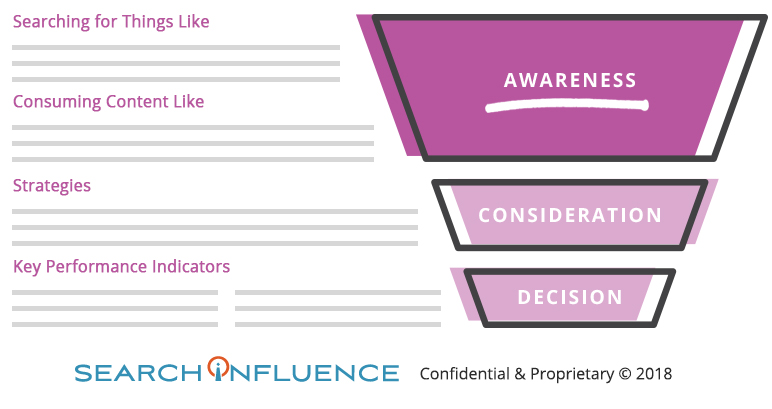
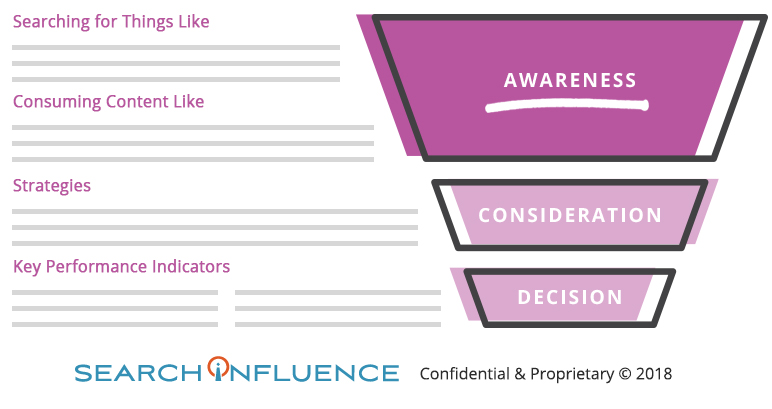
    When the Search Influence team develops a marketing plan for a client, the buyer’s journey is where we spend the majority of our time and is what informs the strategic tactics and key performance indicators (KPIs). Once your buyer personas are identified, the buyer’s journey maps out your prospective customer’s behavior at each stage of the marketing funnel, which allows you to think strategically about how you can reach the audience at each stage. When complete, our buyer’s journeys typically look something like this:

    Strategic Tactics

    Specific marketing tactics you hope to employ to achieve your goals are outlined here. This may include everything from traditional media and print collateral all the way through your digital campaign strategies and creative direction. It’s a good idea to spend time evaluating these tactics and considering a realistic budget required to deploy them all. Perhaps you will need to do a phased implementation due to your budget or internal resources. Now’s the time to make that plan.

    Key Performance Indicators

    In addition to outlining a marketing plan’s overall goal and objective, we recommend that your plan defines Key Performance Indicators (KPIs) for each phase of your marketing strategy and, if necessary, specific tactics. Defining this up front will help ensure that all stakeholders fairly evaluate the performance of a given tactic as time goes on and keep them anchored to the ultimate goal.

    Finish With Gaining Alignment…Again

    Remember the work you did with your team to collect their input early in the process? Call another meeting with them and present the finalized plan. Use this as an opportunity to set expectations for ongoing roles and responsibilities and get the team moving on the plan. They’ll enjoy seeing how their input shaped the finished product and be more willing to pitch in to make it happen. Trust us, you will need their support!

    We’ve led the charge through this arduous process several times with our clients. I say WITH our clients because, if you couldn’t tell by now, it requires a lot of collaboration and partnership. If you are looking for full support in leading this endeavor or even just some hours consulting with our team on the process, we’ve got your back! Speak with a strategist today at (504) 208-3900 or fill out this form to ask for a consultation within 24 hours.

  • #FreelancerFriday: 10 Common Rookie Freelancing Mistakes and How to Overcome Them

    In his rookie season, Peyton Manning threw a league-high 28 interceptions as his team struggled to a 3–13 record. As a rookie, Tom Brady was third string and only managed 1 completion for six yards.

    Even a pair of all-time greats had to start somewhere as newcomers in the league. The point is, they got better—much better—but not without first learning from their rookie mistakes.

    Freelancing is not professional football, but like most things, it requires a set of skills that are built up through time, practice, continued education—and most importantly—learning from your past mistakes.

    No matter if you are freelancing your way through college or retirement, there will always be a few bumps in the road. Here are the most common rookie freelancing mistakes and tips on how to overcome them:

    1. Using an unprofessional email address

    This is the most common and frustrating, yet easiest-to-fix mistake a rookie freelancer can make. Avoid anything that is immature, ambiguous, cutesy, or just unnecessary to your freelance business. This includes nicknames and writer-based names like “SEOwriter” or “MommyBlogger.” To keep things simple, your email address should be your actual name and little else.

    2. Exaggerating your experience

    Just like a resume for any job, it is not acceptable to lie about your writing and freelancing experience. Don’t say you wrote for a publication when you didn’t. Don’t say you are an expert in technical writing when all you’ve written are lifestyle blogs. It will always catch up to you, and it will ultimately cost you jobs and payment when the truth is discovered.

    3. Not marketing yourself or building your brand

    As a freelancer or contract worker, you are essentially setting up a business for yourself. And just like any business, marketing is very important. Without marketing, you are leaving a lot of business out there. Craft your own unique selling proposition on how you are different from other freelancers. Next, create a comprehensive marketing plan through various channels, including email and social media. Daily activities focused on brand building and business development will help increase your visibility and build interest in your services.

    4. Never turning down work

    I know, it seems counterproductive to turn down work, but accepting every job only creates problems, including poor time management. Not all jobs are created equally. You have to learn to identify and turn down the bad ones, or you’ll just end up wasting your time, often with more stress and less money. You can’t just accept work for work’s sake; it’s not the best path to earning more.

    5. Missing deadlines

    Lots of people miss deadlines, not just newcomers. But since rookies are more prone to mistakes, this is especially important when you are first starting out and are trying to establish a positive professional reputation. If missing the deadline is unavoidable, tell your editor as soon as possible. Don’t pile on the excuses—just apologize and accept responsibility. The next step is to confirm when it will be completed or ask for an extension.

    6. Ineffectively balancing your workload

    It is common to underestimate how long and how much effort a certain project will take, especially if you are a new freelancer or fighting others to land the gig. Be honest with yourself, and remember, it is usually better to under-promise and over-deliver. Avoid taking on a lot of new work all at once, or before you fully complete a big project. Find and take advantage of your most productive time of the day, make and stick to a schedule, stay organized, and know your limits.

    7. Being afraid to ask your editor questions

    The writer-editor relationship is a special one that needs to be nurtured over time. When a writer is just starting out, there is a lot of uncertainty on both sides of the table about one another. Undoubtedly, questions will arise for new writers working for a new client. You cannot be afraid to ask these questions. Experienced editors should be expecting questions from freelancers and always be eager to answer them. Asking editors questions is the best way to avoid simple misunderstandings and ensure the project is completed exactly as they wanted.

    8. Not accepting criticism & refusing to learn new things

    As a freelancer, feedback is just part of the job—it’s unavoidable. You must learn to accept criticism gracefully, or better yet, use the feedback to improve your work. Of course, not all criticism is justified, but more often that not, it is. Don’t be argumentative. Make your case politely if needed, or accept the feedback, thank them, and make the changes.

    Another stubborn trait that many new freelancers possess is the refusal to learn new things or even adapt their skillset—whether it is their style, habits, equipment/applications, etc. Nothing reveals amateur status more than a stubborn refusal to adapt. Freelancers should always be working to improve themselves, which includes additional training, earning certifications, and keeping up with current market trends.

    9. Not standing up for yourself or reading your contract

    As a contracted worker, not an employee, it should go without saying that, eventually, someone is going to try and take advantage of you and your work. This can include deadline changes, endless rounds of edits, pay discrepancies and delays, or any additional countless ways freelancers can be unfairly treated.

    This goes hand-in-hand with contract negotiations. Unfortunately, many freelancers do not even read their contract upfront before signing, which only opens you up to unfair treatment and/or legal issues down the line.

    10. Poor Communication

    Freelancing these days is rarely a face-to-face thing. Communication is largely done via email, phone and video calls, or text and instant messaging. Because you are not an in-office employee, maintaining communication is very important. Equally important is the tone, clarity, and detail in your communication. You likely will not talk to your editor or project manager on a daily basis, so you want to be sure both parties are always on the same page to avoid delays and mistakes.

    Mistakes are going to happen when you’re first starting out in the freelancing game. But, with practice, some patience, and by following these pointers, you can be a freelancing pro in no time.

    Images:

    Tom Brady

    Betty White

  • The Travel Marketer’s Guide to Capturing the Romance Market

    The Travel Marketer’s Guide to Capturing the Romance Market

    With the right targeting and audience intelligence, it can be easy for travel marketers to sweep romantic travelers off their feet. Many businesses in key travel markets are missing the opportunity to market to romantic travelers. The latest data shows that romantic travel trends go beyond the obvious honeymooners and destination wedding travel, though those segments shouldn’t be ignored! According to the Travel Industry of America, romantic getaways are trips “with a spouse or other love interest without children to rekindle the romantic feelings in the relationship.” From outdoor adventure travel to “foodie” trips, today’s couples are doing things differently and travel marketers should take notice. Whether you market a destination city or you’re a business within a destination city, positioning carefully to appeal to romantic travelers is a good idea for 2018 and beyond. Read on for more details on the latest romantic travel trends all marketers need to know.

    Top Romantic Travel Trends in 2018

    Romantic travel is booming, and it’s more than just the honeymoon. According to statistics from TripSavvy, a quarter of all American weddings are destination weddings. On average, couples who plan destination weddings are a little older with more disposable income compared to other newlyweds. With travel to a beach or somewhere overseas, the average budget for a destination wedding is $28,000. The added expenses make for a shorter stack of invitations, but the guests who attend destination weddings also plan to spend more than $600 on average.

    After the wedding, couples currently spend three times as much on honeymoons as they do on other vacations making honeymoons a$12 billion dollar industry. Other popular trends in romantic travel surfacing in 2018 include would-be grooms planning getaways around the proposal (thanks to social media for the increased pressure for the perfect proposal!). All kinds of couples enjoy “foodie” trips, choosing destinations with the best dining options as a top priority. Where entertainment and music drew travelers in earlier decades, cuisine is a top priority for today’s travelers.

    Not Just for the Newlyweds: Who Are Today’s Romantic Travelers?

    While family trips need to balance the different preferences of all the kids, couples traveling romantically tend to spend more on dining and activities when it’s just the two of them.

    Marriage drives a high percentage of the travel in America, but households with children travel less often, shocking, right?! While single households were responsible for 21 percent of trips, married households took a whopping 61 percent of trips, according to the same research from TripSavvy. Couples without children have taken an average of 3.1 trips in the past year, compared to couples with children, who took 1.9 trips indicating the sweet spot for the travel market is married couples without children.

    When planning a romantic getaway, a strong majority of those surveyed said that they traveled to a particular city for the local cuisine and entertainment. The next most popular getaway option was bodies of water, such as lakes or beaches. Other common, but significantly less popular plans centered around gambling, outdoor sports, and cruises. Romantic couples are interested in local attractions, but they also want a setting where they can enjoy each others company. By emphasizing a quiet, relaxing atmosphere, nearby nightlife, and quality restaurants, most cities have something to offer couples trying to unwind.

    Romance For All: LGBTQ Travel Trends

    Now more than ever, it pays to be inclusive. LGBTQ travelers are especially aware of the attitudes in different parts of the world.  Just as some countries still require a marriage certificate to share a hotel room, many regions still have laws and prejudices against homosexuality and other lifestyles. Because some travel agents are unaware of those nuances in different regions, many LGBTQ travelers use agents who specialize in serving clients with similar priorities.

    If there are festivals like Pride Parade in your area, think about whether your business can participate in some way. Decorating for the occasion, offering special discounts, and sponsoring a local non-profit are a few ways to show support. Make sure to share the ways in which your business shows support via your social media channels and look for ways to make your imagery more inclusive by default.

    Most of these travelers want a safe place where they won’t be excluded on the basis of their orientation, identity, appearance, or anything else. That said, your employees have a big impact on the perception of your brand. Employees who bring prejudices into the workplace can be a complicated problem, especially in politically divisive times. While it’s impossible to satisfy every customer, a negative review that implies intolerance can be especially impactful. The best course of action is prevention, making sure that you create a safe and inclusive environment both for customers and employees. In the event you suffer a negative review from a customer, make sure to respond publicly stating that your company does not share the views of this individual though feedback is appreciated.

    Not A Tropical Oasis? “Romantic” Doesn’t Have to Mean Bikinis

    Commercials have marketed beaches as the “ultimate” romantic getaway, but there are loads of alternatives for landlocked businesses. = With employment up and cautious optimism about the economy, Americans are looking to travel frequently, and in smaller doses. Over the past 12 months, Google Trends has shown an increase in the search terms “weekend getaways” and “couples getaway near me,” Indicating growing demand for this information online. With the help of local SEO professionals, you can dominate the search results for travelers within driving distance.

    All kinds of activities and attractions can be adapted for a romantic audience. Historic districts, museums, festivals, and even agriculture can be romantic. With a scenic overlook and the right photographer, your area’s cotton fields start to look as romantic as a vineyard or a country album cover.

    In all, romantic travel is about a lot more than honeymooning couples. A growing number of adults are looking at travel as an investment in their relationship and their own quality of life. At Search Influence, we have everything you need to market to those couples and drive leads to your business. If you’re interested in honing your local SEO strategy, then request your marketing analysis today to get started.

    Images:

    Couple at a Scenic View

    Couple Walking in Hand