Blog

  • Your Guide To Google’s Newest Search Ad Type: Responsive Search Ads

    It seems lately that the changes to Google Ads and the types of ads you can create have been coming faster than some advertisers can handle. A few years ago, expanded text ads were a revelation. More headlines and higher character counts had us all loving the extra real estate we were able to have on the SERP. But now Google has come out with a whole new game changer—Responsive Search Ads. RSAs will save you time and management by relying on automation and machine learning to deliver the most relevant ad for each query. How do you take advantage of all this? By exploring this guide to adding responsive search ads to your paid search campaigns.

    What Are Responsive Search Ads?

    Responsive search ads are a new ad type that’s still in beta, and they might not be available in all Google Ads accounts. Unlike expanded text ads, where you create one static ad, responsive search ads use Google’s machine learning to assess which of the multiple headlines and descriptions that you create will combine to show the most relevant ads to searchers.

    How Do Responsive Search Ads Work?

    An advertiser enters up to 15 unique headlines (30 characters each) and four unique descriptions (90 characters each) to create an RSA. When a search triggers your ad, Google reads all of the signals available (search term, intent, device, time of day, and many many more) and uses machine learning to determine which of your ad assets will be the most relevant to the searcher. That is the ad combination that gets served.
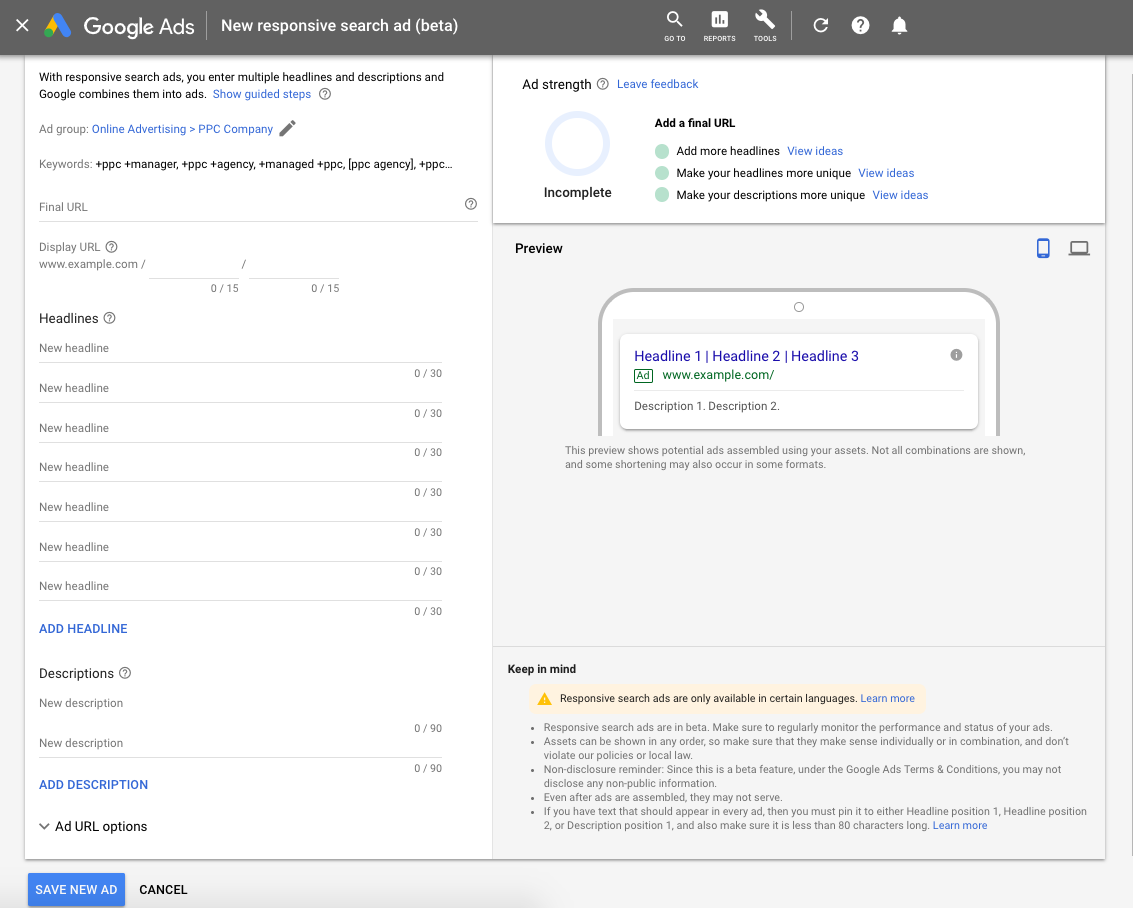
    Example of Google responsive search ads work performed by Search Influence in New Orleans, LA

    Responsive Search Ads Vs. Expanded Text Ads

    You might be wondering which ad type to use, and the answer is both. In fact, Google’s Matt Lawson writes that, because RSAs are still in beta, they aren’t going to capture all of the traffic that an ETA might.

    “Try to implement at least three ads per ad group with an optimized ad rotation. If you have access to responsive search ads already, you should remember to have at least one additional text ad in each of your ad groups. Responsive search ads are still in beta, and some traffic won’t be included in that experiment. You need a text ad to capture those impressions.”

    As for the differences between RSAs and ETAs, here’s a breakdown of assets:

    Responsive Search Ads Expanded Text Ads
    Number of Headlines Shown on the SERP 2 or 3 2 or 3
    Number of Headlines Written 3 – 15 2 – 3
    Characters in Each Headline 30 30
    Number of Descriptions Shown on the SERP 1 or 2 1 or 2
    Number of Descriptions Written 2 – 4 1 – 2
    Characters in Each Description 90 90

    As you can see, the searcher won’t be able to tell the difference between the two ad types. When responsive search ads were first announced, there was a lot of rejoicing of “more real estate on the SERP,” as the expanded text ads had lower character limits; however, the character counts of ETAs have been expanded once again to match the RSA character limit.

    What Are the Benefits of Using Responsive Search Ads?

    The most immediately obvious benefit of RSAs is that Google does the testing for you, virtually eliminating the need for you to run A/B tests. This can save tons of paid search account management time. Google claims that the constant testing will lead to the most relevant ad being shown for different search terms. This is something that a lot of advertisers need help with. Though there are scripts that can create reports approximating this effect, there is no way to segment ad copy performance by search term in the Google Ads interface.

    What About Disadvantages to Using Responsive Search Ads?

    All this time-saving automation comes at a price, of course: control. Someone with lots of time to test minor tweaks and analyze an abundance of data might prefer to conduct their own tests.

    Though there are options to “pin” a couple headlines and descriptions so that they always show (useful for compliance reasons or companies with strict branding), you are really limited in controlling the final version of the ad.

    Reporting options are subpar so far. We are offered very little insight into how each asset is performing, but we do have an asset-level report that shows how many impressions each headline and description has gotten, and a combination report that shows impressions for each combination.

    From this, you can infer which assets are performing best, but it’s only an assumption that’s based on trusting Google to properly optimize. Google says poor performers won’t be delivered, so if you see an asset getting few impressions, it might be underperforming.

    Along with the lack of control, RSAs also don’t support ad customizers at this time, with the exception of dynamic keyword insertion, which is actually encouraged. This means that you are unable to use countdowns, IF functions, inventory customizers, etc. with RSAs.

    Responsive Search Ad Best Practices

    Before you create responsive search ads, you might want to brainstorm a few benefits, features, and calls to action that you’ll want to include in your ads. Some of these features and tactics include…

    Unique and Varied Headlines

    You want your headlines to be distinct. Google says it has controls in place to prevent redundant assets from being served together, but headlines need to be different enough from each other that the system can adequately distinguish between them and serve relevant combinations. When building your ads, you will notice the Ad Strength meter in the upper right of your screen assessing the quality of your ads. This is what it might look like if your headlines are too similar:
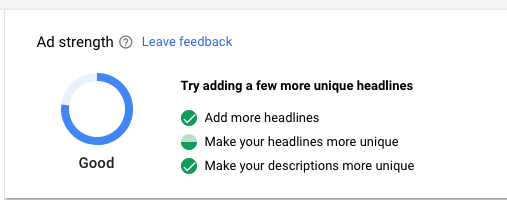
      

    Pay attention to the ad strength and get creative. You’ll also see the meter telling you to add more headlines. Strive to fill all 15 spots with a unique headline.

    You should also vary the length of your headlines. You don’t want to use all 30 characters in every headline. As with the content of the headlines, this gives Google more factors to test. Also, that third headline is more likely to show if it is short.

    Use Your Keywords—But Do So Sparingly

    You’ll want to include your keywords in some of your headlines, but not all of them. I like to keep only three or so keywords in the headlines and then maybe one or two in my descriptions. This leaves room for more of the business’ benefits, features, etc., and gives more variety. In addition to three keywords, I also use DKI in one of the headlines.

    Use Google’s Recommendations

    If you haven’t started implementing responsive search ads yet, but are opted into the beta program, you might see recommendations to do so in Google Ads.
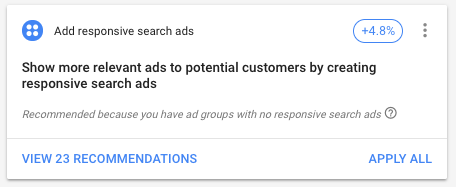
    Recommendations provided by Google Ads prior to starting campaign

    This is a great way to get started. When you view the recommendations, you’ll see that Google has already created some RSAs from headlines and descriptions that you are already using in your ETAs. Review these recommendations and make any necessary changes, then hit “Apply,” and you’ve got yourself a responsive search ad.

    Once you have ads running, you might also notice that when you go to add new headlines, Google will make suggestions based off your other ads and your landing page. Some of these might not be relevant to the particular keywords in your ad group, but some likely are relevant.
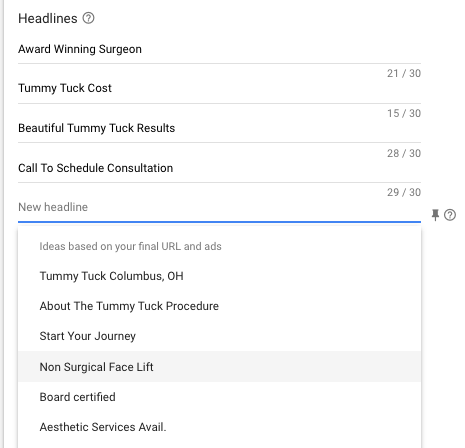
    More recommendations from Google prior to launching ad campaign

    How Many Responsive Search Ads Should I Use in an Ad Group?

    It’s best practice to have at least one RSA with two or three ETAs in an ad group, but you can include up to three responsive search ads in each ad group. Most advertisers won’t need this many, but if you are pinning headlines and descriptions, you might want to test pinning vs. not pinning, or A/B test the headlines you are pinning.

    Don’t Forget to Monitor Responsive Search Ad Performance

    Especially while RSAs are still in beta, advertisers need to be monitoring if they are performing as well or better than your ETAs. As always, focus on your bottom line, not solely on click metrics like CTR. Watch that Google’s optimizations aren’t suppressing your most profitable ad in favor of your most clickable ad. I recommend reading this piece on Search Engine Land about not relying too heavily on CTR and conversion rate for more information on this topic.

    A strong campaign for your business’ online advertising requires experts who are up-to-date on all of the latest roll-outs from Google and other advertising platforms. Search Influence can expand your business’ online presence. Start a conversation with one of our digital marketers today to grow your business.

  • Answer These Questions Before Creating a Strategy With Your Marketing Agency

    Desk with crumpled up marketing strategy next to plants and marketing books

    In the world of digital marketing, both asking and answering the correct questions can be the difference between success in a digital marketing campaign and frustration. Often, as a salesperson (or consultant or relationship-builder guy… whatever I am), I find myself realizing how many different types of potential clients there are. I have divided them into three tiers. In tier 1, you have potential buyers that have little to no knowledge of what digital marketing is or how it works, and I find myself educating more than partnering for a specific campaign. In tier 2, there are the prospects who know that digital marketing exists, know that they need it because their competitors have it, but nonetheless still need to be educated. And finally there is tier 3, which consists of the people who know all about it, have it, and are just looking for ways to improve it. Though different potential prospects have different levels of knowledge, what remains consistent across my three tiers are the types of questions that need to be answered to successfully put together a campaign.

    What Are These Questions?

    There are many foundational level questions we tend to ask business owners to get an idea of how much they know about digital marketing and what marketing efforts have worked for them in the past. But, from a strategy standpoint, the most important questions entail information that is very specific to what objectives have been put in place by the business. Those questions are…

    I have a question about digital marketing

    What Are Your Goals for This Advertising Campaign?

    Quite simple, right? What are you looking to accomplish from this campaign? Goals vary from industry to industry, business to business. For example, some businesses have a bigger need for brand awareness if they recently opened a new location. Other businesses have more of a need to drive new business to supplement their current book of business. This is often the case with insurance agents and attorneys. In the case of businesses that do e-commerce, the goal would be to drive more online sales. If a particular company wants to increase their sales in a particular area of the business, it is important for that to be outlined in their goals, as well, which makes this question very important for keyword purposes. For instance, if an attorney wants to push for more personal injury cases, we want to make sure that someone looking for a divorce lawyer doesn’t get served ads or content for a personal injury lawyer. This will just lead to wasted clicks and no conversions. Also, when asking this question, make sure it is explicitly clear what you consider to be a conversion. Sometimes a conversion can be considered a potential buyer filling out an on-site form fill with their personal info, which, in turn, makes it easy for a business to reach out to the person who seems to have some interest in their product or services.

    31 questions to ask a marketing agency

    How Much Is a New Customer Worth to the Business?

    This metric is a key detail when running digital marketing campaigns. The reason why it is important is because it can be a great tool when tracking ROI. If we know that each new lead you bring amounts to a certain amount of revenue, then we can use that info to understand how much of your product needs to be sold in excess of how much budget is being used on our campaign to net your profit goal. For example, if a person has a business selling sofas, and each sofa costs $1,000, and this business spends $1,500 a month on digital marketing services, and our services lead to two sofas sold based on our tracking, then we know we netted a $500 profit. Simple math, right?

    What Is Your Target Demographic and Area?

    This is an all-important detail. We, as marketers, use this information to be able to reach the actual audience you are after and target them where you, as a business, would want your content to be found. For instance, if you are a women’s clothing boutique in New Orleans, we wouldn’t want your ads being served to men in New Orleans, as they are less likely to click or convert. The same holds true with targeting, say, a woman in Houston because she is less likely to travel to New Orleans to come to the boutique. Obviously, the targeting can change if the boutique has an online store.

    31 Questions Checklist square image

    These details are important for keyword purposes, as well. Searching for a particular service and adding the city into the end of the search can drastically change results. For example, searching “cheap hotels near me” versus “cheap hotels New York City” will yield much different results.

    There are many other fine details that can be leveraged to create success within a digital marketing campaign, but these are the three major questions that can make or break your success and either lead to money down the drain or money into the pocket of your business. If you find yourself struggling to get the answer to any of these questions or don’t know where to find your start in digital marketing, download our checklist of questions and fill out this form, or call Search Influence at (504) 881-1467 to speak to one of our experts today!

  • What Are Good Backlinks Vs. Bad Backlinks?

    Backlinks are one of the many components of behind-the-scenes SEO strategy. A backlink is essentially a link on a site that leads users to a different site. Think of backlinks as a continuous chain that links websites to one another; some chains are firm, strong, and reliable (good backlinks) and others are rusty, neglected, and not doing their job (bad backlinks).

    The Role of Backlinks in an SEO Strategy

    Before diving into the nitty-gritty of backlinks, let’s differentiate between backlinks and internal links. While both sound similar and have substantial SEO value, they play different roles. An internal link is clickable text (a.k.a. a hyperlink) on your site that leads to another page within your site. We go into more detail about internal links and their juicy SEO power in our past blog post. (See? I just made an internal link!)

    A backlink is a hyperlink that lives on another site and links back to yours. WPBeginner points out that backlinks are one of the many tools used by search engines to calculate search result rankings. (And just like that, I gave a backlink to WPBeginner’s site!). Think of backlinks as an approving nod from one site to another. When used correctly, backlinks acknowledge the authority of another site.

    Dr. McCoy and Captan Kirk nodding in agreement about backlinks

    Google has used backlinks as a ranking signal for keyword searches for almost two decades. Google didn’t really differentiate between the quality and quantity of backlinks until their Penguin algorithm update rolled out in 2012 to closely monitor backlinks and prevent spammy “black hat” SEO backlink tactics. This update gave the SEO world a clearer picture of what Google considers legitimate backlinks that actually add to sites’ authority. Now, the strongest backlinks come from authentic, well-known sources, such as newsworthy press releases, trusted editorials, news articles, or webinars.

    For the sake of consistency, we’re going to focus on Google’s backlink policy and how sites are affected in Google search results in the remainder of this post. Because backlinks can have a significant impact on search rankings, we’re going to explore what separates strong backlinks from rusty ones.

    What Is a Good Backlink?

    A good backlink is a relevant outbound link to a trusted, authoritative site. Generally, a site is viewed as trustworthy if it has lots of strong backlinks pointing to it. Google views these backlinks as one way to confirm that your site contains helpful, quality content.
    New call-to-action
    Now, let’s break down some key factors of a good backlink.

    It Comes From an Authoritative Site

    Earlier we mentioned that a backlink should link to an authoritative site, but what exactly does this mean? An authoritative site provides trustworthy, well-sourced content that is updated regularly. It’s considered an expert in its field. For example, readers interested in sustainable building requirements may read multiple online blogs or articles on the topic, but they would likely consult the Environmental Protection Agency’s site, epa.gov, to reaffirm this information and treat it as the most authoritative source on the topic.

    Not all quality backlinks have to come from a source as renowned as the EPA, but keep in mind similar characteristics when searching authoritative sites.

    The Anchor Text Is Specific

    Hyperlinking to a page with clear, specific anchor text is a big win for both the user and search engines. Concise anchor text will give users an idea of where this link will bring them if they choose to click on it, while search engines will use the keywords in said anchor text to figure out the topic of the page it lives on.

    Let’s put this advice into action—which anchor text would you feel more comfortable clicking?

    1. Click here!
    2. Dive even deeper into why anchor text matters in backlink strategies.

    I hope you went with number two.

    Barack Obama gif related to importance of anchor text in backlinks

    It’s Relevant to On-page Content

    Backlinks aren’t just there to take up space and serve as an SEO metric—they should enhance the reader’s experience. Backlinks need to be relevant to the content they’re in and actually provide supplemental information. Think of it from the reader’s perspective—backlinks won’t add any value if they’re bringing readers to completely unrelated sites.

    Google aims to provide users with helpful, rich content that answers queries. Unrelated, distracting backlinks just get in the way of that. Google considers relevant backlinks to be much more valuable than a backlink from a random, unrelated site. A dermatology clinic site that links to a used car Q&A forum would probably send a red flag to Google (and also confuse readers browsing the site).

    What Is a Bad Backlink?

    Don’t let anyone tell you any backlink is a good backlink; it’s simply not true. Since Google focuses mostly on quality over quantity, they track and evaluate backlinks to flag potentially spammy practices.

    Here are a few clues that a backlink may be rusty and untrustworthy.

    They Come From One Site

    The well-known saying “variety is the spice of life,” may not be referring to backlinks, but it’s a mantra we can use here. If a site has a plethora of backlinks, but almost all of them come from one site, this will look spammy to Google. You should actively strategize to build strong backlinks from a range of relevant sites.  

    It’s Hidden or Paid

    Yes, a hidden backlink is basically what it sounds like—it is invisible to a user and Google. Sounds sketchy, right? It is. A backlink that is hidden—whether by manipulating text and background colors or hiding the link in a punctuation mark—is a “black hat” SEO strategy that clearly defies Google’s best practices.

    Gif of Homer sliding into bushes after violating Google's linking policy

    Paid backlinks are a grey area because some methods of paid links are viewed as legitimate. Just because a link has been paid for doesn’t automatically mean it’s bad. Since this a gray area, you should be highly selective with paid methods. If the site’s content is related to your industry, you won’t be penalized for paying for ad space. Paid directory business listings are also fine, as long as they’re reputable.

    It’s Sourced in Spammy Forum Comments

    New call-to-actionThis relates back to the importance of backlinks being relevant and actually helpful to readers. Linking back to your site from off-topic discussion forums just for the sake of a backlink will look suspicious. Like most things in SEO, the intent of posting links to forums may have originally been authentic, but this strategy can too easily turn from trustworthy to spammy.

    Acquiring Good Backlinks and Ditching the Bad

    Congratulations, you’re now armed and ready to differentiate good backlinks from the not-so-good! Because strategic link building is so effective for search rankings, it can be one of the most challenging SEO strategies. But great news—you don’t have to do it alone! Search Influence can help increase your website’s authority by building a strong backlink strategy that’s relevant to your business. Our range of SEO services can also help increase your online presence and ability to reach customers. Let’s start a conversation about how we can help you.
    Images

    Lock and chain

    Star Trek

    Barack Obama

    Homer

  • How to Market Your Business on LinkedIn

    Man sitting down typing on his laptop

    LinkedIn isn’t just for growing your personal network—it can be used to grow your business too! LinkedIn has over 560 million users, with 40 percent of active users using LinkedIn monthly. LinkedIn is a great tool to promote your brand and connect with business professionals in a very direct and effective manner.  

    Optimizing Your LinkedIn Company Page

    It’s important that your Company Page not only reflects the professional and personal side of your business, but also is optimized for maximum user engagement and conversions.

    • Business description and tagline – The company’s tagline is a short sentence that gives you an overview of the company and its purpose. The tagline is 120 characters or less, so be concise and specific when crafting it. The description is longer, and should be used to give a deeper dive into the business. You have 2,000 characters to convey your story, so let your fingers fly.
    • Logo profile pictureHaving a logo as the profile picture will make the company look more trustworthy to potential followers. LinkedIn states that companies with a logo as their profile picture get an average of six times more page traffic.
    • Company informationThis includes information like the company’s URL, industry, and number of employees. Having this section filled out completely shows that your profile is a reputable source of information.
    • Call to action buttonYou can choose from a variety of buttons to display on your Company Page, such as “Contact Us” or “Learn More,” which you can attach to any link of your choosing.
    • Consistent posts – It is not enough to just have an optimized Company Page. You need to create fresh and engaging content for your followers to interact with. Try to post at least once a week to keep your page active.

    What Makes a Good LinkedIn Post

    First and foremost, it’s best to keep your content professional, but that doesn’t mean you need to forego your company’s personality. Stay true to your brand when creating posts. Content should be curated with your audience in mind—what do they want to read? You can cater to this question by sharing articles, industry news, or company updates. Pair this with an image and relevant hashtags to increase engagement.

    Woman's hands typing on her laptop

    How to Advertise Through LinkedIn

    Before choosing the types of ads you want to run, you need to first define your goal for LinkedIn marketing. Are you trying to establish yourself as an industry leader to gain brand trust? Are you trying to promote your company’s work environment to attract new employees? Once this is determined, you can choose which ad types serve this goal the best.

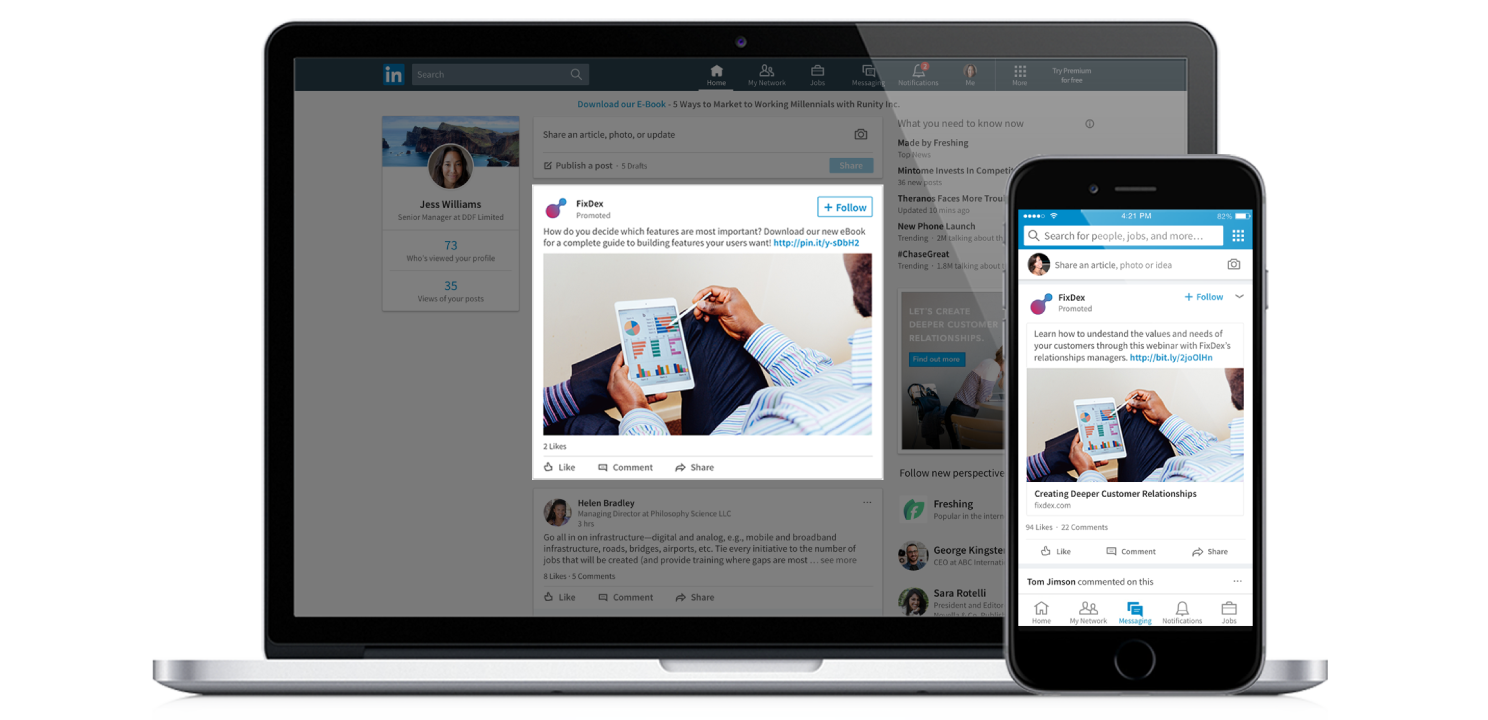
    • Sponsored content Sponsored content works similarly to promoted posts on Facebook. The post will live on your Company Page, as well as in the newsfeed of your specified target audience. This is a great way to gain new connections and spread your company’s message to a targeted audience. Computer screen displaying a man using an iPad
    • Sponsored InMail – Sponsored InMail allows businesses to send personalized messages to a wide audience. The message will appear in the person’s InMail, and will only send when the user is online and active. This is very effective both on mobile and desktop devices. However, the message will need to have a designated “sender” from your company. Whoever the “sender” is should have a relevant company title and an optimized profile.

    Leverage Personal LinkedIn Accounts for Your Business

    Marketing your business on LinkedIn doesn’t end with setting up your Company Page. Each and every one of your employees can market your business through LinkedIn in two ways: by having an updated, professional profile and by sharing content from the Company Page.  

    Each employee likely has hundreds of connections. Ensure they are presenting the company in the best possible light by encouraging team members to update their profile with their current job title with the company. You can also encourage team members to endorse each other’s skills. To take this one step further, you can provide your team an opportunity to take professional headshots and even make custom LinkedIn cover photos for your company for the team to utilize. These small details will help spread a clear, consistent message about your company and the quality of its employees across LinkedIn. Once your team’s profiles are optimized, encourage them to share posts from your Company Page. This will let your content reach a whole new set of connections in a free and organic fashion.

    LinkedIn is rated as the top social network for lead generation, and it is a great tool to connect with business leaders. With this taken into consideration, it is clear to see how this platform can be used to advance your business. Want to learn more? Check out our blog post about LinkedIn best practices.
    Whether you need assistance with lead generation or social media management, the digital marketing experts at Search Influence can help your business grow. Start a conversation with one of our marketers today to expand your online presence.

    Images:

    Woman typing on computer

    Computer screen

  • Search Influence Adds Five New Hires to Their Krewe

    No matter the time of year, Search Influence is dedicated to expanding our clients’ online presence and growing their businesses. Even though New Orleans just got done with its most hectic time of year, Mardi Gras, we’ve been focused on producing results for our clients. We also understand that we need a comprehensive team of digital marketing experts to create our best work. In the past few months, we’ve expanded our team to include five new Influencers! Meet the new additions to our “Krewe.”

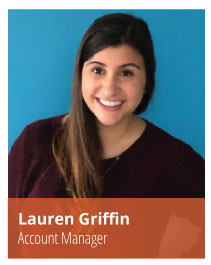
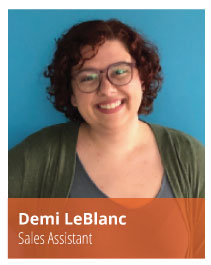
    Search Influence Account Manager Lauren GriffinSearch Influence Sales Assistant Demi LeBlancSearch Influence Sales Executive Michael Shargois

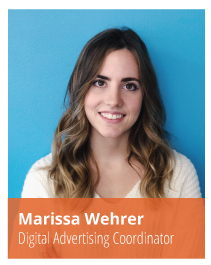
    Search Infuence Digital Advertising Coordinator Brandt "RC" ArceneauxSearch Influence Digital Advertising Coordinator Marissa Wehrer

    Lauren Griffin

    Lauren Griffin has been hired as an Account Manager.

    From a small town called Abbeville, Lauren grew up visiting New Orleans regularly. She was always drawn to the city due to its culture, history, and laissez-faire attitude. During her time at Louisiana State University, she discovered her passion for marketing. Lauren feels truly lucky to be doing what she loves in a city she loves.

    Demi LeBlanc

    Demi LeBlanc has been hired as a Sales Assistant.

    You can usually find Demi watching some movie with Barbra Streisand and attempting to be a world-renowned (yet terrible) watercolor artist. She loves finding creative solutions to everyday problems and using her creativity to design and customize whatever is in front of her. She’s always looking for ways to make things better.

    Michael Shargois

    Michael Shargois has been hired as a Sales Executive.

    Michael was born and raised in New Orleans, and he’s never leaving! He is a graduate of Lusher Charter School and Louisiana State University. Outside of business hours, you can find him supporting his favorite sports teams—the Saints, Tigers & Pelicans. Michael also enjoys listening to music and spending time with his girlfriend. Michael is an animal lover but doesn’t have any pets. If anyone needs a dog walker, let him know!

    Brandt “RC” Arceneaux

    Brandt “RC” Arceneaux has been hired as a Digital Advertising Coordinator.

    Brandt grew up in St. Charles Parish, just upriver from New Orleans. After high school, he enlisted in the military and spent the next six years traveling and working around the world, including Germany, Turkey, Iraq, and Florida. He learned German and developed his childhood French while working overseas. He returned to the city after Hurricane Katrina and worked as a police officer while earning his English degree. After working in the U.S. intelligence community for six years, Brandt returned home again to complete his master’s degree and started a consulting and translating business. Brandt lives with his wife and their cat, Professor Shorthair. He spends his time cooking, practicing music, and jogging at Audubon Park.

    Marissa Wehrer

    Marissa Wehrer has been hired as a Digital Advertising Coordinator.

    Marissa graduated from LSU with degrees in Marketing and Entrepreneurship. She fell in love with digital marketing after selling jewelry online during college. After college, Marissa lived in Spain, earning her International Master of Business Administration and working for a startup. After returning home, she combined her passion for fashion with digital marketing and started a blog. With her blog ItsRiss.com, she has the opportunity to express her creative side and incorporate her digital marketing skills. Now she gets to live out her passion all day, every day!

    Welcome to the team, Lauren, Demi, Michael, RC, and Marissa!

    If you’ve been hoping to expand your business’ digital marketing campaign, look to Search Influence. Our experts, whether tenured or new to our team, can help boost your company’s online presence while tracking leads and analyzing trends. We’re committed to helping you reach your marketing goals. Start a conversation with one of our strategists today.
    Interested in joining our team? Check out our open positions!

  • How to Develop a Strong Content Strategy

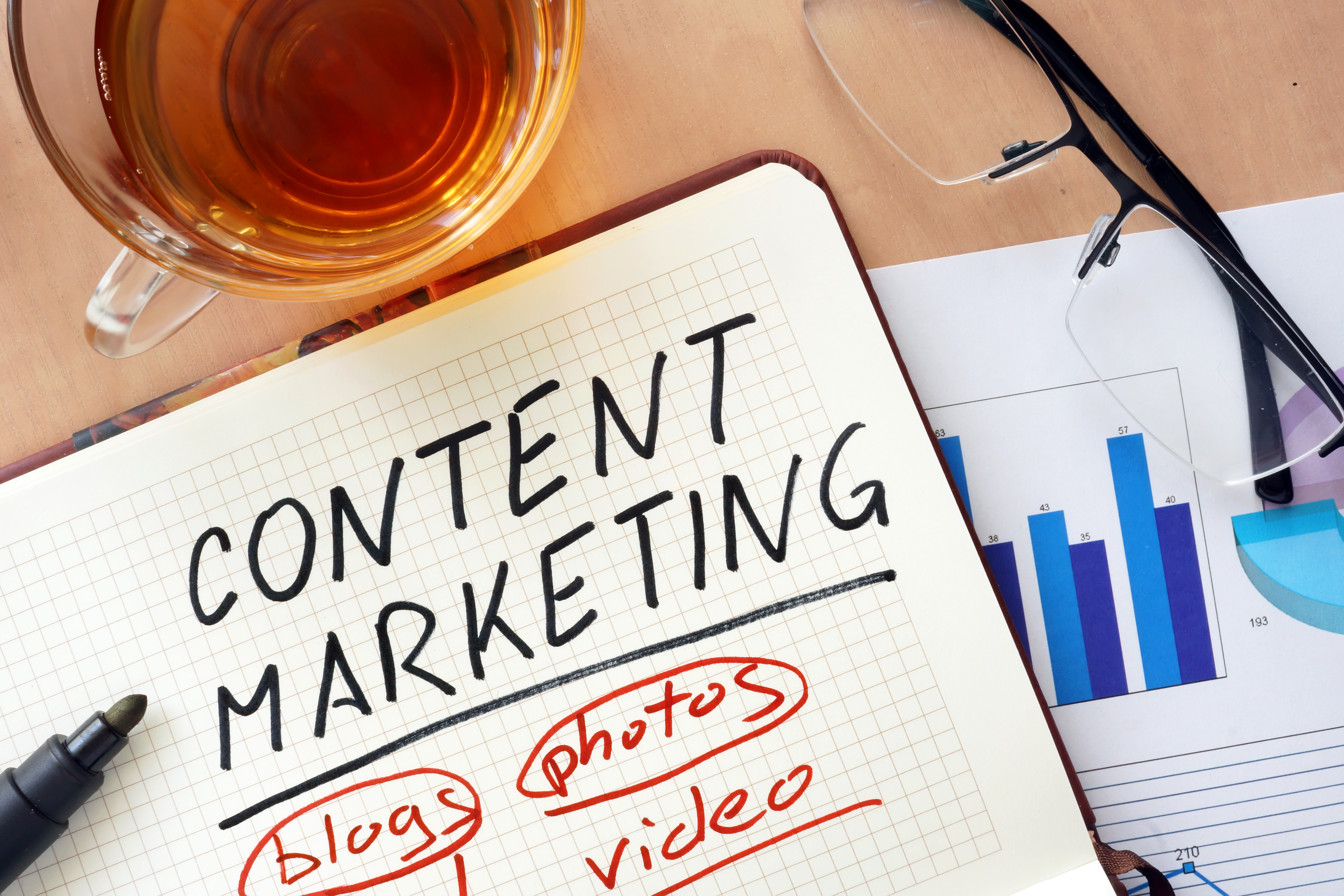
    Notepad with words content marketing concept and glasses

    You’ve heard it time and time again, “Creating a strong content marketing strategy is essential.” Is it really that important? Well, according to the Content Marketing Institute, content marketing produces three times as many leads as outbound marketing yet costs about 62 percent less.

    You might still be wondering, what goes into creating a content marketing strategy? Is all of this planning really necessary? While it might seem like something you can just do on a day-by-day basis, building a strategy helps you work more efficiently because you and your team will have already decided how to handle potential issues. But because there are many elements to putting together a successful marketing plan, we’ll walk through some of the most important ones.

    Define Your Goals and Set Your KPIs

    What are you hoping to achieve? You might be looking to get more traffic, position your company as an expert in the industry, increase revenue, improve your search engine rankings, or increase brand awareness. Hone in on what’s most important to your business and clearly define your goals. Set yourself up for success by making your goals S.M.A.R.T. When doing so, make sure your goals are measurable and decide which KPIs (Key Performance Indicators) make the most sense for tracking your campaign’s success. And remember, not every metric is a KPI.

    Know Your Audience and Solve Their Problems

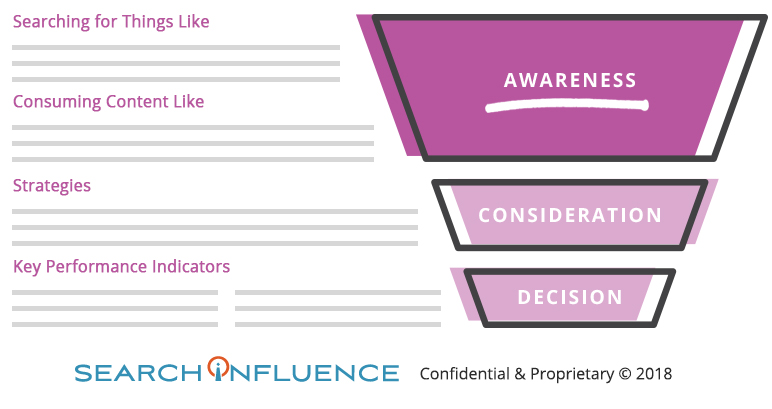
    How will your content help your customers? Your product or service exists and matters because it solves a problem for someone somewhere. Ideally, it should solve a variety of problems for many types of people. An effective content strategy addresses the appropriate audiences by using a variety of content types and educates your audience while they look for information about their problems. But not everyone is at the same stage in their problem-solving quest. Some might still be understanding their problems while others are out there looking for solutions. Keep the marketing funnel in mind as you build out your content strategy.

    Content strategy with words awareness, consideration, decision

    Decide on Publication Platforms and Content Types

    How do you reach your audience? As you work through the process of understanding your audience, you’ll get a better feeling for where they spend their time. First, focus on covering the essentials on your website and blog, and then consider opportunities to broadcast your content beyond that. Make sure your site covers everything that your audience needs to know about your company, its products and services, and what sets you apart. Use your blog to demonstrate your expertise in your niche and maybe even use this as an opportunity to build out other content types that can be shared elsewhere or repurposed into different formats (like infographics and videos).

    Create a Content Calendar

    When do you post what? Now that you know what you want to create, you need to think about how to execute your plan. Creating a content calendar makes it easier to stay focused, keep everything organized, and be productive. You can start with just one month of content in the beginning, but you’ll want to continue building it out in advance and take note of seasonal events, holidays, and other dates that might help you create timely, relevant content further down the road. Take a look at the content types you’ve decided on and then lay out your content strategy, keeping in mind the best times to post and how often to do so. Note any evergreen topics that are relevant throughout the year. They can help you fill in current gaps in your content or provide some flexibility in a time crunch.

    Distribute Your Content and Measure the Results

    What does success look like? It’s finally time to see how successful your strategy has been. To do so, you’ll want to refer back to the KPIs you set and see if you’ve hit your targets. Be sure to think about what’s changed in your industry. Were there any special events or seasonality that might have caused spikes or lowered performance? Be sure to look at your results month-to-month and year-over-year. Monitor your progress and make adjustments at regular intervals.

    Does all of this sound like too much? Creating an effective content marketing strategy can be challenging and stressful, but Search Influence can help! Our content marketing experts know how to research, plan, and execute the goals that are most important to you. If you’re looking to get support on building a content marketing strategy or if you would like a consultation while creating one internally, we’ve got you covered. Speak with one of our strategists today at (504) 208-3900 or fill out this form to request a marketing analysis and proposal.


  • Unfamiliar With “SEO?” Here’s Why Search Engine Optimization Is Important

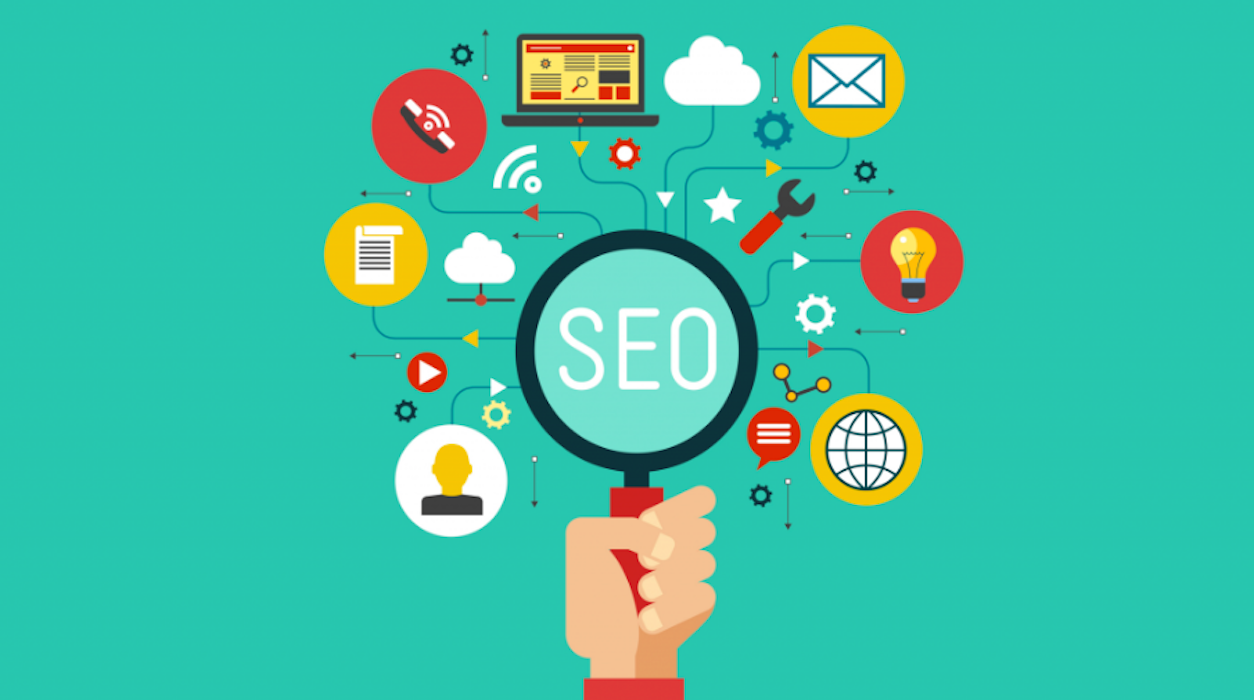
    Magnifying glass zooming in on SEO

    I entered the digital marketing industry in 2012 when Search Engine Optimization was a simple blend of keyword stuffing and link building. If anyone suggests those strategies still hold up, then they’re living in the past. SEO has changed because the search behavior of consumers has changed. According to Google, 84% of Americans are shopping for something at any given time, in up to six different categories. During their journey, shoppers are searching online, verifying references, reading reviews, connecting with local businesses, and (the most important step of all) converting.

    The once linear buyer’s journey has become a multilateral experience full of content consumption, brand impressions, strategic ad targeting, online searches, remarketing, and email marketing. To be successful, brands must be present in the ever-changing and always competitive online market.  As digital marketers, our job is to connect searchers to the right businesses, and SEO is one of the most effective ways to do that.

    What Is SEO?

    SEO allows businesses to connect with the right audiences by increasing the quality and likeliness to convert traffic to a website while improving brand recognition.

    The way Google connects businesses with audiences is through its algorithm, which changes about 500-600 times a year. The algorithm is intended to keep up with consumer behavior and keep searchers from ending up on untrustworthy websites. To quickly connect searchers to businesses, Google’s algorithm includes some of the most popular “checklists” that searches have indicated are important.

    Can I trust them?
    Are they located close to me?
    Do they offer the service I need?

    New call-to-action

    How SEO Works

    The three most effective constituents for any SEO campaign include content, brand authority, and local presence.

    Content

    Content helps answer the question “Do they offer the service I need?”

    It looks like on-site content, blogs, videos, whitepapers, email marketing, infographics, content marketing, product descriptions, information about the business’s history, and social posts.

    Shoppers consume content differently on mobile devices than on desktops and through different avenues like video, blogs, graphics, and social posts. Content is the most effective way to communicate who you are and what you do to search engines and your audience. This gives businesses a great opportunity to get creative and engage with audiences outside the traditional text of website content.

    Website content

    Create and optimize unique content for each service or product that you want to rank for next time a user is searching. For example, a lawyer who specializes in personal injury should have dedicated pages for each practice area they offer like medical malpractice, car accident, wrongful death, etc. Having dedicated pages for “medical malpractice” precisely and effectively communicates to Google that the content on these pages strictly focuses on “medical malpractice.” This strongly impacts content relevance and organic rankings when people search “medical malpractice lawyer.”

    A click to a site, organic or paid, is a very strong sign of a user’s level of intent and conversion. On-site content should be used to communicate competitive advantages, prices, products, and services. Onsite content should deliberately be written in to drive conversion behavior, with strong calls to action like “call now”, “sign up for our newsletters”, “contact us today”, or “buy”.

    Videos

    Research by HubSpot suggests that using videos on landing pages will increase conversions by 86 percent.

    Businesses need to communicate their message and engage with their audience. A video can be a 30-second teaser for a series of blogs, 2-minute testimonials of a happy client, or 5-minute highlight summary of a recently sponsored community event. Videos are great for users engagement and even better for product promotion.  Almost 50 percent of internet users look for videos related to a product or service before visiting a store.

    Blogs

    According to HubSpot, companies that published more than 16 blog posts per month got about 4.5 times more leads than companies that published zero to four monthly posts.

    This type of content should be slightly more engaging and address identified topics and related topics interesting to the audience. Blogs should always be shared on social, and including videos is a great way to complement the content and increase engagement.

    Brand Authority

    New call-to-actionThis helps answer the question “Can I trust this businss?“

    It looks like earned media like press releases and brand mentions, industry recognition and noted awards, customer reviews, backlinks for all off-site work and publications, and Google posts.

    88 percent of people trust a review from a stranger as much as they would a referral from a friend or family member. Having reviews on your site builds trust with readers while highlighting customer satisfaction. Potential customers trust user-generated content, and all businesses should encourage their clientele to leave reviews or have a dedicated strategy in place to generate them.

    Other ways to increase brand awareness off-site are through earned media publications like brand mentions and press releases. Anytime a business has a newsworthy topic like a major event, community sponsorship, new leadership, or a new location, creating and publishing a press release can establish brand trust and awareness while gaining reputable backlinks.

    Brands should always assure they are receiving link backs from any third party publications and sponsorships. Not only do links build trust with Google, but it also provides a way for referral site traffic from other sources and sites.

    Local Presence

    This help answer the question “Are they conveniently located to me?”

    It looks like local on-site content, correct and consistent listings on maps like Google, Apple, Yelp, and Bing, and showing up in Google’s Maps Pack.

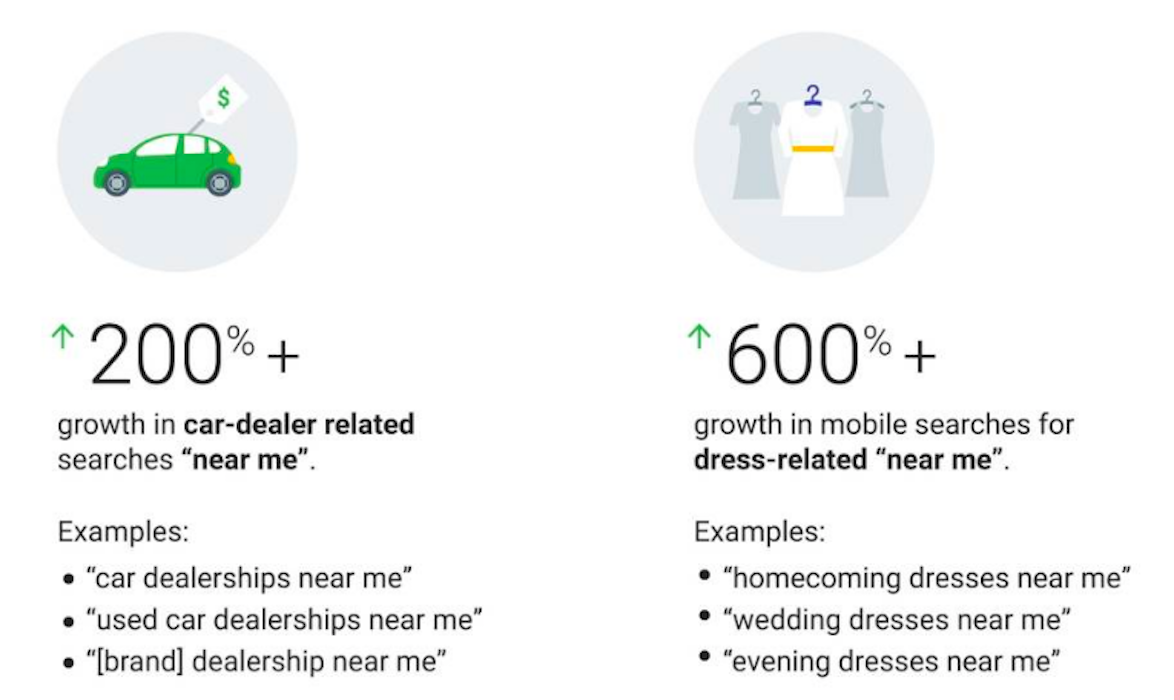
    While consumer behavior continues to move off of the streets and onto the internet, communities supporting local businesses stay strong. In 2018, HubSpot’s data stated that 72 percent of consumers who did a local search visited a store within five miles. Being found locally is crucial, especially for businesses in the service industry like landscapers, restaurants, groomers, mechanics, etc. According to Google, mobile searches that include the phrase “near me” have grown by 500 percent in the last two years.

    Google graphic showing the dramatic increases in near me searches

    So how can businesses communicate they are in fact “near” searchers? First, make sure that you claim and optimize the correct name, address, and phone number across the major local directories like Google, Apple, Yelp, and Bing. Also, build out local landing pages for each location on-site to include a map, local content, hours of operation, and directions. Check out our location page for a concrete example.

    The way consumers search for dresses, landscapers, and car dealers will continue to change, and therefore the digital marketing industry will too.  Just as our campaigns have strayed from the simplicity of keywords and link building, our marketing campaigns will continue to develop and change. In an everchanging and competitive industry catered to consumers, businesses must have a strategy to be successful. If you don’t, Search Influence’s digital marketing experts can help you develop one. Call us at 504-336-3379 to learn more.

    Images

    Magnifying Glass

    Google Data


  • Best Apps for Mardi Gras in New Orleans

    Mardi Gras in New Orleans is one of the most exciting times of the year! But with all of that excitement comes a bit of preparation. Make sure you’ve got these top apps downloaded on your phone so that you optimize your Mardi Gras experience.

    Listen to our radio interview covering some of these tips on WWNO New Orleans Public Radio.

    WDSU Parade Tracker car riding in Mardi Gras Parade in New Orleans, LA

    Parade Tracking Apps

    WDSU Parade Tracker | WWL Eye on Carnival Mardi Gras Parade Tracker

    Parade tracking apps are ESSENTIAL for Mardi Gras in New Orleans! These local apps provide real-time tracking of the parades so you’ll know exactly where they are on the route.  So how does it work? There’s a GPS tracker located in a vehicle at the front of the parade, so you’re able to see exactly where the beginning of the parade is at any given time.  

    It’s especially helpful for finding out if there are any delays along the route. Also, if you’re out parading and don’t want to miss anything, you’ll want to know how much time you have between parades to use the restroom or grab some food. Other nifty features include:

    • Parade schedules: See how many parades roll each day and what time they start.
    • Parade route maps: Find your spot and see where you are on the route.
    • Parade float count: See how many floats are in each parade. This is an indicator of how long it’ll last.
    • Weather info: Plan out what you need to wear. Weather during Mardi Gras tends to be pretty volatile—it can go from hot during the day to freezing at night, to raining, so you gotta make sure you’ve got the right attire!
    • Notifications: Real-time notifications for weather, parade starts, and delays.

    WDSU iOS | Android  WWL iOS | Android

    Transportation Apps

    Uber | Lyft

    These are the most popular for helping you get to and from the parade route without the dreaded headache of parking. It’s especially good for ride-sharing with friends or others who are going to the parade. It makes it easy because you don’t have to worry about spending extra time driving out to the parade and searching for a place to park, or even paying to park; and if you’re planning on drinking, you definitely shouldn’t be driving!

    Uber  iOS | Android  Lyft iOS | Android

    Blue Bikes

    If you’re a local, biking is one of the easiest, and sometimes even the fastest way to get around the city during Mardi Gras. Even if you already have your own bike, Blue Bikes are especially helpful for when you’ve got friends or family visiting from out of town that don’t have their own bike.

    Getting set up for this bike-sharing program is quick and easy. Simply download the mobile app and register for an account through the app. There’s a $5 sign up fee and pricing is either pay-as-you-go (10 cents/minute), or pay a monthly fee ($15/month). Through the app, you can find Blue Bikes and Blue Bike stations across the city, reserve bikes, and even see your trip history and miles ridden.  Using the bikes are even easier! When you’re ready to ride, you’ll enter your six digit account number and four-digit PIN into the keypad on the back of the bike to unlock it. Then ride it to wherever you need to go and return it to the nearest Blue Bike station, or you can lock it at a public bike rack for an additional fee.

    Transit Tracker – New Orleans RTA

    One good way to get downtown during Mardi Gras is public transportation. The French Quarter is typically closed off to drivers from Friday evening until midnight Tuesday, so driving there is impossible. Even if you try, you likely won’t be able to find a place to park.

    With Transit Tracker, you put in your starting location and destination and it will show you which streetcar or bus to take and where you will need to walk. There’s also real-time GPS data on the streetcar/bus locations. It does rely on the RTA keeping the trackers in working conditions, so this could be hit-or-miss.

    iOS only

    Waze

    If you decide to drive out to the parade route, we highly recommend using Waze to help you navigate. This GPS app is typically the most reliable for getting driving directions because it uses user-submitted road and traffic data, such as accident reports, police traps, closed roads, and other hazards along the way. It’s especially helpful during Mardi Gras in order to know which routes to avoid due to traffic (within or coming into the city) or to indicate which roads are closed because of the parade routes.

    iOS | Android

    Mardi Gras parade float in New Orleans, LA

    Location Apps

    Google Maps

    Google Maps is one of the most used and trusted location apps. It comes in handy during Mardi Gras for travelers and locals alike! Cell service can be pretty spotty when you’ve got a concentrated crowd of people, so if you’re trying to get in touch with someone to meet up, you can easily share your location by dropping a pin. Also, if you decide to drive out to the parade route and park, there’s a good chance you’ll need help remembering where you parked. Simply drop a pin and save it.

    Depending on where you are, restaurants may have different hours during Carnival, so if you’re hungry and need a quick bite, it’s great for finding what restaurants are open in the area around you.

    iOS | Android

    Find My Friends

    It’s essential to stay in touch with your fellow parade buddies during Mardi Gras. This app allows you to easily locate friends and family using your iPhone. Just install the app and share your location with your friends by choosing from your contacts. When you share your location, your friends can start following your location immediately and easily share their locations back to you so that you’re both in the loop. It’s easy to get lost in a crowd during the festivities, so if you’ve got a large group of people that want to stay together or find one another, this app is key.  

    iOS | Android

    Food Delivery

    Instacart

    Make sure you’re stocked up on snacks and drinks for the parades! If you live near or on the parade route and you’re having people over, you definitely want to make sure you’ve got food for yourself and all those visitors. Shopping at grocery stores during Carnival time can get a little crazy, so you can save yourself the headache of fighting the crowds and use an online grocery shopping and delivery service.

    iOS | Android

    Uber Eats | Grubhub | Waitr

    If you forgot to pack food and want a meal delivered to you while you’re out on the parade route, all of these services can deliver food to you from your favorite restaurant. Additional fees vary. There’s usually a $4.99 flat fee + additional fees depending on the distance from the restaurant. Good news, there is a promo code for first-time users!

    Uber Eats iOS | Android GrubHub iOS | Android  Waitr iOS | Android

    Mardi Gras partiers hanging out on Frenchman Street in New Orleans, LA

    Mardi Gras Attire

    While we always encourage shopping local to find your unique Mardi Gras attire, the convenience of shopping online sometimes can’t be beat.

    Amazon

    Amazon is one of the top online shops for buying any and all of your Mardi Gras attire: wigs, makeup, costumes, glitter, fanny packs, YOU NAME IT! The best part? Quick two-day shipping with Amazon Prime for those of you who waited until the last minute.

    iOS | Android

    eBay

    It’s not just used items! It’s essentially a ton of virtual stores and sellers, and not everything is an auction. Many sellers offer the “Buy It Now” option, so you can easily filter that way if you’re in a time crunch to get your items. eBay is a great place for finding unique attire and pieces to build your costume.

    iOS | Android

    Etsy

    If you’re not the craftiest person, but you want something unique that you can’t just buy off the rack, this is the place to look. It’s a mecca for finding awesome, vintage, and handmade items like headpieces. There are also numerous thrift stores that have their shop online, so you can find some really unique and funky pieces for your costume. Not to mention, tons of vintage sequin tops! If you’re into personalized cups, koozies, t-shirts, etc., they’ve got tons of sellers that make these.

    iOS | Android

    Most importantly, don’t forget to bring a portable charger with you so that your battery doesn’t run out after using all these helpful apps during Mardi Gras. Our team at Search Influence is in full preparation mode for Mardi Gras! Learn more about our digital marketing experience throughout the Greater New Orleans area and around the country. Even if you’re not celebrating in the Big Easy this year, don’t let Mardi Gras be just any other Tuesday.

    Images:

    Blue Bikes

    Parade Float

    Frenchman

  • Facebook Reviews: Increasing Reviews to Increase Credibility

    Facebook: the largest social media platform in the world. It’s used to keep up with family, friends, social trends, and marketing. It’s the second-most important review site, right between Google and Yelp. With 1.37 billion daily active users, there’s no avoiding Facebook when it comes to digital marketing.

    Gif counting Facebook likes

    The Benefits of Facebook Review

    You didn’t have to read this blog to know that building customer relationships are key. Online reviews are an instant way to gain trust with a potential customer. Did you know that 84 percent of people trust online reviews just as much as a personal recommendation? They’re more likely to trust the reviews since they’re experiences had by real customers.

    Along with reviews, customers leave star ratings as well. Customers can leave star ratings between 1 and 5, and the total average is used for your final rating. Since the star rating can be seen even without clicking through to the Facebook page, it’s easy to gain potential customers trust.

    Don’t Stress Over Bad Reviews

    As for reviews, I’ll be real with you. Bad reviews are going to happen, but only 14 percent of reviews are 3 stars or less. Truthfully, we don’t live in a world of perfect ratings, so if you have 5 stars that’s something to be proud of. However, studies show that 4.2 to 4.5 is the ideal average star rating. Furthermore, 68 percent of customers trust reviews more when they see both good and bad scores.

    When replying to reviews, always reply to both good and bad reviews.

    For bad reviews, do not delete reviews or argue with customers. Take time to reply to the unhappy customer with your contact information. From there, try to reach the customer by phone to listen to their complaint. Then you’ll be able to offer a solution outside of the review. Learn more tips in our previous blog post on managing reviews.

    How to Get More Facebook Reviews

    How do customers know to leave you reviews after a great experience? Ask them! Seven out of 10 customers are willing to leave a review if you ask. Here are some ideas on how to ask for reviews:

    1. Make sure there’s signage around the business reminding them to review.
    2. Reach out with personalized follow-up emails and/or text.
    3. Lastly, be direct and have a conversation about their experience.

    No matter the channel of communication, always make sure to thank the customer for their business and to ask for feedback on what could be improved. Being genuine is a way to receive genuine reviews.

    Another way to engage customers is by requesting them to check in to your business. Motivate customers by offering them something like a coupon code or free item. Checking in allows the customer to write something, post a photo, and tag others. Most importantly, Facebook will automatically send a notification to the person who created the check-in one to two days later and request them to leave a review.
    Creative Ways to Use Facebook Reviews

    Okay, you’ve collected all of these reviews, with some good and some bad. Now, what are you going to do with them?

    For good reviews, get creative! Create a Facebook post and put some ad spend behind it so a larger audience sees it. Print them and hang them around your business. Add them to your website. You and your employees are doing a great job, and it’s paying off. Make sure to tell people about the great experiences your customers are having!

    For bad reviews, analyze and compare to see if there are common trends. Maybe it’s an internal process, or maybe it’s because company-wide standards need to be implemented. Once you find a way to fix the repetitive issues, continue to monitor and adjust to solve problems as they arise. Always use feedback to continuously improve your business.

    Utilizing Facebook for Your Business = Brand Awareness

    Facebook is an easy way to gain brand awareness from previous and potential customers. Make sure your profile has as much information as possible, including a profile photo, background photo, and hours of operation.

    Keep followers updated on your latest projects or industry trends. Your posts should not all be product pushing. You’ll want them to be personal, relevant, and engaging. Create posts specifically for employee updates to announce promotions, work ethic, or any other relevant aspects of your business.

    If you’re just starting out on Facebook, your posts likely won’t be seen by many people organically. To increase the number of people who see your posts, try promoting some posts to reach more people. Get detailed by testing out targeting, including location and demographics.

    If you collect personal phone numbers and/or email addresses from current clients, you’ll want to look into lookalike audiences. This is Facebook’s way of finding people who have the same interests as your current customers, so when your brand is put in front of them, they’re more likely to convert.

    Whether you’re completely new to Facebook or just need to jumpstart your social media campaigns, Search Influence can help. Our social media experts can help you post, track leads, and manage reviews. Start a conversation today to learn how we can help your business grow.


    Images:

    Facebook Notification

    Review Icon

  • Get the Most Out of Your Website With These Essential Google Analytics Metrics

    iPhone screen with google analytics at Search Influence in New Orleans, LA

    In today’s world, having an online presence is essential to business. With 27,378,962 live websites currently using Google Analytics, most business owners have heard of Google Analytics. But simply knowing about Google Analytics isn’t enough. Learning how to use the platform can provide business owners with insight into targeted audiences and what they think and feel about your products or services. Knowing the details of your customers’ behaviors will help you determine which pages are drawing customers to your site and which pages need some optimizing. Consider these questions to determine what is most important to your business.

    What Are People Doing on My Website?

    This is a measure of your site’s audience. Tracking your audience reveals who is using your site. When you know the type of person that is visiting your site, you can establish the direction and language of your site’s content and messaging in order to cater to this specific type of person.

    Session Duration

    This metric measures the amount of time that people spend on your website before leaving. The longer someone’s visit, the more likely they are to convert. Tracking this metric can help you determine which pages are effectively supporting your marketing strategy and which might need to be optimized.

    Pages per Session

    Like session duration, pages per session allows you to determine whether you are driving the right people to your website. A higher pages/session rate can indicate that visitors are engaged with your content and, therefore, more likely to convert.

    User Demographics

    This data allows you to segment the people who visit your site based on different criteria, such as their location, age, gender, and interests. Tracking this data allows you to gain a better understanding of who your customers are.

    New vs. Returning Visitors

    If visitors return to your site, that’s good news. It probably means that your audience is engaged and will be more likely to convert. Even if someone did not make a conversion the first time they came to your site, your brand has made enough of an impression to encourage them to return.

    Which Channels Drive the Most Visitors?

    This is a measure of your site’s page tracking. Page tracking is helpful to your business because it tell you how your traffic is coming to your site. Understanding this can help you determine which avenues are best for bringing traffic (and hopefully, conversions) to your site. Use this data to make decisions about where you might want to promote your site’s content.

    Fingers typing on a keyboard at Search Influence in New Orleans, LA

    Landing Pages

    Reviewing this metric will provide insight into the specific pages visitors are landing on. This knowledge allows you to:

    • Pinpoint the most and least popular pages of content
    • Track which keywords are most effective at driving organic traffic to your site
    • Identify the landing pages and paths that convert the most visitors and share these highly effective pages on social platforms

    Bounce Rate

    This metric measures the percentage of visitors who landed on a single webpage and then left without visiting any other pages. You can look at the bounce rate of the entire site or the bounce rate of individual pages.

    Exit Pages

    Exit pages measure the percentage of visitors to a single page that click away and completely leave the website. For a visitor to be measured in the Exit Rate, they must have come to your website, visited multiple pages, and then left. Exit pages are important because they let you see where your traffic drops off.

    Pages you want your visitors leaving:

    • Form completion thank you pages
    • Order completion pages

    Pages you do not want visitors leaving from:

    • Your homepage
    • A conversion form
    • During the checkout process

    Is My Website Leading to Conversions?

    This is a measure of your site’s goal tracking. Creating and monitoring your Google Analytics goals are important to your business because it enables you to track the progress of specific user interactions (that you have pre-defined) on your site. Goals should act as your targets to ensure your website is moving in the right direction.

    Laptop screen at Search Influence in New Orleans, LA

    Conversions

    A conversion takes place when a visitor completes an action that you consider important to your business. Examples of conversions could be filling out a form, completing a purchase, or signing up for an email newsletter. You can track these by channel or landing page to determine which sources are leading to the highest and lowest conversion rate. If your marketing strategy includes paid advertisements such as Google Ads or Facebook Ads, you should also be tracking the cost per conversion for all of your paid ads.

    Google Analytics provides you with nearly endless ways to track and review your website metrics. The metrics that most impact  your business will depend greatly on your company goals and industry (like tourism and travel, for instance). Once you have identified the Google Analytics metrics that matter the most to your business, you can determine how and where to allocate your marketing budget. A digital marketing agency can take tracking metrics off of your plate. If you’re interested in partnering with Search Influence, request a marketing analysis today.


    Images:

    Phone screen with Google search

    Hands typing on keyboard