Blog

  • Sad That Google’s Retiring Average Position? Here’s How You’ll Be Better Off

    As Google has grown into an advertising powerhouse, it has created and improved ad performance metrics. After all, why would advertisers stick around without actionable data for boosting performance?

    Average Position is one metric that has been around since the launch of AdWords in 2000. You, like many other advertisers, may use this metric to track the success of your online ads.

    In late 2018, Google announced they would retire Average Position in September 2019. Let’s take a look at what this means for advertisers.

    What Does Average Position Mean?

    The Average Position metric shows the average position where ads are appearing on the search engine results page (SERP). At least, that was its original function.

    At first, Average Position helped advertisers gauge the effectiveness of their account changes. It’s easy to see why: if you know where your ads are appearing, you can work your way up to the top of the SERP with adjustments.

    Everyone wanted to be at the top because research showed that top search results get the most clicks by far. The Average Position metric was crucial for advertisers chasing the most valuable SERP space.

    What’s more, the immediate visibility of an ad at the top of the SERP made Average Position a popular, tangible metric.

    Great! We have an intuitive, valuable metric to measure our advertising performance. Why on Google Earth would they get rid of it?

    Princess Bridge gif for Search Influence blog post about Google Ads

    The Decline and Fall of the Average Position Metric

    … Because it’s no longer intuitive, and that makes it much less valuable. Let’s look at what changed over the years.

    Average Position used to be helpful when all ads appeared above the organic results. If your ad’s average position was 1, it meant the ad was at the very top of the SERP.

    Later, ads appeared at the top of the SERP and also down the right side. Google realized they could combine the ads’ spaces and create an auction for all the real estate on the page.

    Google restructured the SERP so only highly relevant ads would appear above the organic results. If no ad was relevant enough, they all appeared on the side of the SERP or below the organic results.

    Advertisers could no longer be certain where their ads were appearing. Even auction winners may never appear at the top of the page. By this point, Average Position was more of an “Average Auction Rank” metric.

    By now, Average Position data was less helpful for optimizing campaigns. There was just no good way to know where on the SERP your ads would appear. Even your best ads could be languishing at the bottom of the page in the dreaded No Click Zone.

    Average Position lost more value as Google reorganized the SERP and added features. So, what’s an advertiser to do? How can we find out how our ads are appearing to our audience? What will save our KPIs?

    New Metrics to Save the Day

    Google introduced two new position metrics ahead of the retirement of the Average Position. These new metrics are helping advertisers transition more easily. Here’s what they tell us:

    • Search Top Impression Rate is the ratio of impressions appearing anywhere above the organic results. It’s given by Impressions Above Organic / Total Impressions.
    • Search Absolute Top Impression Rate is the ratio of impressions appearing above all of the other ads that are above the organic results. It’s given by Absolute Top Impressions / Total Impressions.

    Raccoon gif for Search Influence blog about average position in Google Ads

    There are also a few helpful Impression Share (IS) metrics you can bid for to increase Impression Rates:

    • Impression Share (Top and Absolute Top) is the ratio of impressions at the top or absolute top of the SERP and the impressions you were eligible for.
    • Search Lost Impression Share Budget (Top and Absolute Top) shows how often your ad wasn’t top or absolute top because of budget limits. This metric can help with bidding and budget changes for more top-of-SERP impressions.
    • Search Lost Impression Share Rank (Top and Absolute Top) shows how often your ad wasn’t top or absolute top because of your ad rank. This metric can help identify ad copy and landing page changes for more top-of-SERP impressions.

    With these new metrics, advertisers are better able to gauge when and how often their ads appear at the top of the SERP. Moreover, with the Lost IS metrics, advertisers can dial in their optimization efforts to where they will have the most tangible impact on ad placement.

    Even though Google is retiring a much-loved metric, it’s safe to say that advertisers will wind up with even more and better information than before. Overall, this move is a boon to advertisers who crave control and incremental performance improvements.

    What This Means for Advertisers

    There’s no reason to be upset over Average Position. The first step is to familiarize yourself with the new metrics. Once you begin using them, you’ll quickly see how useful they are. Here are three ways the new metrics will benefit advertisers:

    First, advertisers will be able to create more competitive campaigns with these new metrics. For example, at Search Influence, the new metrics are working well along with the new Auction Insights tool. Using both gives us a starting point for optimization tasks. Now we have to do much less detective work to identify performance-increasing adjustments.

    Second, we can examine how our other KPIs (like CTR) are affected by our ad’s position on the SERP. This means we can zero in on the external and internal factors affecting our ad placements and we have more optimization options available.

    Finally, the new metrics will help engaged advertisers stay on top of their ad performance. Even not-so-engaged advertisers should find campaign optimization easier. Both groups should capture more valuable impressions and clicks with less testing, guesswork, and time.

    If you’d like to know more about how to boost your advertising power, get in touch with the digital advertising experts at Search Influence. We’ve got the expertise and experience to help you reach your business goals.

    Welcome! Everything is fine with Google Ads

    Images

    Princess Bride

    Raccoons

    Everything is fine. 

  • Only 4 Percent of Businesses Are Voice Search Ready—Are You in That Number?

    At the beginning of 2019, over 66 million people in the United States were uttering the phrases “Ok Google,” “Hey Siri,” or “Alexa!” to find information on the internet. When you consider that the adult population of the United States is around 253 million, that means that around 25 percent of people are using voice search to get answers to their questions. As marketers, we need to start to pay attention to this, and make sure that we are present to help them answer their questions. According to a recent study conducted by Uberall, only 4 percent of businesses are “voice search ready,” which means that there is opportunity to show up in searches for businesses that are prepared.  

    25 Percent Is Not That Significant, So Why Should I Care?

    In 2016, the number of smart speaker users in the United States was estimated to be 16 million. So, between 2016 and 2018, the segment grew by four times. But in order to really understand the impact, we need to understand usage. Thanks to a recent study conducted by Bright Local, we know that 58 percent of consumers have used voice search to find local business information in the last 12 months and that 46 percent of voice search users seek out local business information on a daily basis. This behavior has big implications for local brick and mortar businesses. So, although 25 percent may not seem like a huge number, the growth in adoption and usage make voice search a channel worthy of the attention of local businesses.

    Person using mobile device for voice search

    Ok, So, It’s Here, How Do I Take Advantage?

    The good news is that right now, voice search optimization looks a lot like regular SEO. If you are answering questions and providing valuable information to the searcher, you will be fine. If you are a local business, there is a silver bullet that many of your competitors are not using. Remember, 46 percent of voice search users are using their device to search for information about local businesses on a daily basis. If you couple that with Uberall’s finding that less than 4 percent of businesses have the six key elements of voice search readiness complete and consistent across the important platforms, you can see that with a little work, your business could show up in intent-based voice searches like those that end in “near me” and “near me now,” which are on the rise, according to Google.

    What Does It Mean to Be “Voice Search Ready”?

    Voice search readiness has a lot of parallels with local search optimization, especially for local businesses. To put it another way, if you have done the right things to optimize for local searches, your local business should perform well in voice search, especially for bottom-of-the-funnel (more likely to lead to conversion and store visits) searches. Uberall’s study identifies 37 directories that feed directly into voice search platforms. The good news is that not all of them may be relevant to your audience. Uberall found that 90 percent of the impact on Voice Readiness Score comes from the directories that we are all familiar with: Google, Yelp, and Bing. I would add Apple Maps, as well. Uberall states that Siri’s search is powered by Google, but I was not able to replicate that on my iPhone, and according to a recent article by Eric Shanfelt, Siri gets its business data from Apple Maps Connect and reviews any other information from Yelp, or sometimes other sources.

    What to optimize is pretty simple. Think about what users need to know about your business when they search:

    1. Address: Potential customers need to know where they can find you, and Siri, Alexa, and Google Assistant need to know what local searches to serve your business up for.
    2. Opening hours: How frustrating is it to show up to a place whose map listing asserts that it is open, only to find that it’s closed. BONUS: Remember to update any special hours that you have around holidays or any other periods where your normal business hours do not apply.
    3. Phone number: This is an easy conversion point.
    4. Business Name
    5. Website URL
    6. Zip Code

    This may seem pretty basic, but these attributes need to be consistent across all directories that you have out there to get the maximum benefit.

    Mobile device and smart speaker used for voice search on a desk

    Putting It Into Action

    If you are a local business and want to put this into action, there are three approaches that you can employ:

    1. Do it yourself: If you have the time, you can go to the four major platforms directly, claim your business (we have created step-by step-directions for claiming your Google My Business Profile), and input the information listed above. If you choose this option, you will want to review these periodically, as sometimes listings get changed with community edits, and you will also want to update the platforms when anything changes with your business—think holiday hours.
    2. Use a listing distributor like Vendasta or Yext: There are other aggregators out there as well, but the idea is this—put your information into one platform, and let them handle getting it to the directories in a consistent manner. This approach can allow you to go beyond the four major platforms, but still requires some manual effort on your part. Regular monitoring is still suggested, although this can be done in the aggregator, and not all directories have “two-way feeds,” which could mean that you will need to log into the directory platform to make the updates.
    3. Hire a digital marketing agency to manage your online presence: If your time is better spent on other areas of your business, or the prospect of managing listings overwhelms you, hiring an agency can be a great option. When selecting an agency, ask if they are using a listings distributor, which will help them keep your listings accurate, and can provide you with a dashboard to monitor their progress. The main benefits here are that the agency should be familiar with the listing’s distributors and directories, and they will know who to contact when there are any problems with consistency.

    Voice search and its intersection with local search is still in its infancy and is constantly evolving. With the increased adoption of both the devices and behaviors, this tactic is ripe for exploitation by savvy local businesses. If you’d like help building a dynamic marketing strategy that encompasses these trends, reach out to Search Influence to request your free marketing analysis.

  • Why Branding Is Vital in Your Marketing Campaigns

    Branding and marketing are terms often associated with each other. Though they’re not synonymous, they should be harmonious. Your brand is what you market. The colors, logos, voice, tone, and so much more dictate how you should market your products or services and ultimately show the world (or a tiny segment of it) exactly who you are.

    But wait a moment…what does that even mean?

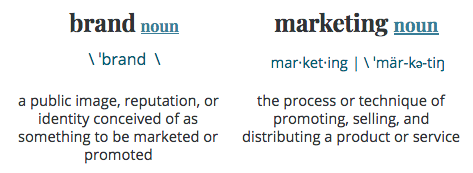
    Let’s break it down with Merriam-Webster:

    Brand vs. marketing graphic for Search Influence blog post

    As a New Orleans native, I like to think of a brand as the roux of a delicious marketing gumbo. Your branding, much like the roux, is the foundation and soul you put into your overall marketing campaigns. Without it, you’re simply not going to get the results you were hoping for.

    Your branding encompasses who you are as a company and what your customers see. Your culture, core principles, values, and ideas are the foundation of your brand, along with the way you present your company visually. An effective marketing plan will take who you are as a company and personify that as a character who is able to interact and relate to your customers. While your campaigns will have many objectives and goals, the overall structure, tone, and theme of these efforts should be consistent and more importantly, recognizable.

    So with that being said, what makes your company unique? What truly sets you apart, or how do you want to set yourself apart from the competition? Your brand is your company personified, so get creative! You may be incredibly focused on your commitment to quality, customer service, or your community. Customer loyalty may be an issue you need to improve, so build your brand around that key metric. While a marketing plan can exist separately from your values, the most successful campaigns will include your key strengths in the eyes of your current customers and broadcast them to your potential target base.

    Man screaming into megaphone about branding

    So We Got Branding Down…What Next?

    The connection between your brand and your marketing lies within the confines of what will have the biggest impact on the most important part of any campaign:

    Elvis dancing with conversions written in red

    Conversions!

    Getting potential customers to take action and engage with your business is critical. Marketing plans based on Google keywords and Facebook data alone won’t pack the punch needed to grab the attention of a market that is perpetually bombarded with the messaging of your competitors. Simply put, thoughtful and effective branding helps produce engaging content. In a world where the average consumer reads 11.4 pieces of content before making a decision, content reigns supreme in this crazy, competitive battle for attention.

    When your branding is developed and reinforced over time, you can use this foundation to create content that educates customers about your products or services, differentiates you from competitors, and influences your perceived value in the eyes of your customers. This brand-rich content should be utilized in every holistic approach of the digital marketing campaigns you create. (Or we create for you!)

    Gale Henry portrait photo for Search Influence blog

    Don’t Stop Now!

    You got the brand down, and people are converting, but you can’t stop there. This is an ongoing, endless ride, my friend. Between the continual upkeep of your search engine optimization, email marketing, content marketing, social media, and paid advertising, branding never stops! Your customers are hungry for more information from you, so it’s time to put on your thinking cap and start a blog. You can use blogs to demonstrate your industry expertise and meaningfully connect with your audience. It can also help establish your company’s authority in the eyes of search engines to increase your rankings in search results.

    The combined efforts of your marketing and branding can create a powerful message to the customers that you already have the ones you need to target to keep growing. A comprehensive marketing plan will bring in new business, while your branding and customer service will ensure their satisfaction and loyalty.

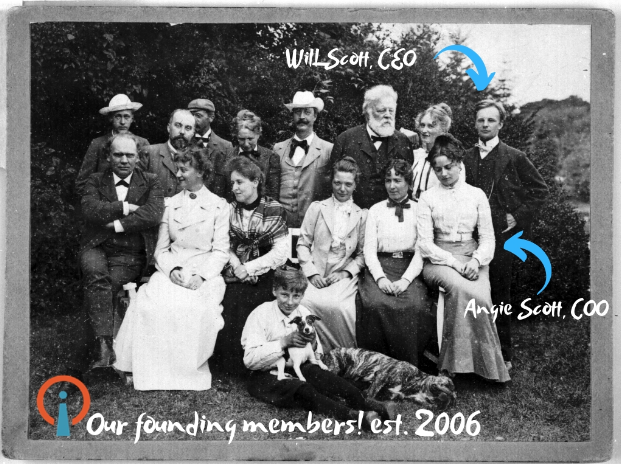
    Interested in learning more about how your brand is perceived online and how to build a successful campaign around it? Start a conversation with us today! As you can see, we’ve been doing this for a while…

    Old time-y photo of Search Influencer founders Will and Angie Scott

    Images

    Camera

    Megaphone

    Elvis

    Gale Henry

  • Influencers Take Part in Rebuilding Together New Orleans’ Build and Boil Event

    On April 6, a group of Influencers took part in the Build and Boil event hosted by Rebuilding Together New Orleans (RTNO). With the guidance of our group leaders (and a few Influencers who are particularly handy), we helped make the home of a Korean War veteran with a disability more suited to his daily needs by improving its accessibility. The team spent several hours working on the home before heading back to the RTNO warehouse to enjoy crawfish and drinks.

    Giving Back to Our Community

    Alula Amare with great waves and Search Influence CEO Will Scott at Rebuilding Together New OrleansDuring the build portion of the event, we had the privilege of working on the home of Clarence Gabriel. Mr. Gabriel was medically discharged after serving in the Air Force during the Korean War. Upon returning to civilian life, he worked for 35 years as a self-employed craftsman and has always enjoyed working with his hands. Mr. Gabriel has lived in New Orleans his entire life and purchased his 7th Ward home in 1996.

    Mr. Gabriel is wheelchair-bound, and his decreased mobility makes it difficult for him to get around. When we arrived at his home, we were greeted by his daughter Melissa, who gave us a bit of background on Mr. Gabriel and the house. A ramp had already been built at the front of the structure, so we got to work adding the finishing touches. Our team cut pieces of lumber with a chop saw, fit the wooden planks with brackets, installed them along the sides of the ramp, and then treated the handrails and latticework with sealant.

    After a day of hard work, we took part in the boil. We made sure to try the crawfish of as many participants as possible by keeping tabs on whose boils we had already sampled. We couldn’t agree on a winner, but we had a great time trying to decide on one.

    Lauren Griffin from Search Influence working at Rebuilding Together New Orleans

    Our Partnership With RTNO

    Rebuilding Together New Orleans is a program of the Preservation Resource Center that works to “improve the quality of life of low-income homeowners, particularly those who are elderly, disabled, veterans, or single heads of households with minor children, through home repair and revitalization of New Orleans’ neighborhoods.”

    Previously, Search Influence partnered with RTNO to secure them a much-needed website redesign and updates to make it more user-friendly and easier for their staff to maintain.

    The goals of RTNO’s new website included the following:

    • Making it easier for those in need of assistance to apply for help
    • Increasing volunteer sign ups
    • Increasing donations

    Based on the success of this April’s Build and Boil event, it seems like RTNO is well on their way to accomplishing those goals.

    Search Influence is proud to help support members of our community and local nonprofits. To keep tabs on our team, follow us on Instagram.

  • A Physician’s Guide to Choosing Target Audiences on Facebook

    One of the most important assets in any physician’s marketing strategy is knowing your potential patients. In a field as diverse as medicine, this can mean the difference between success and failure. Therefore, we’ve put together a helpful guide to Facebook’s targeting tools to help build and improve your online audiences.

    Define Your Patients

    The first step in any successful strategy is defining who you want to get in front of. Imagine the type of patient you’d like to attract and jot down every characteristic about them that you can think of. For example, if you’re a plastic surgeon who would like to do more tummy tucks, then what are some general attributes of a typical tummy tuck patient? Here are some questions to help you get started:

    • Are they women or men?
    • How old are they?
    • Are they married or single?
    • What is their household income?
    • How much disposable income do they have?
    • Do they have children? If so, how many and how old are they?
    • What kind of car do they drive?
    • What do they do for a living?
    • Which schools did they attend? What level of education did they reach?
    • What are their hobbies?
    • What types of clubs or organization are they typically involved in?
    • How do they spend their free time?
    • Have they ever had plastic surgery?
    • Have their friends had plastic surgery?

    Once your ideal patient has been defined, review Facebook’s guidelines to see which targeting options are available, or you can see all of Facebook’s Ad Targeting Options in one epic infographic.

    Locate Your Patients

    After your ideal patient has been profiled, the next step is to determine where they are. One of the biggest mistakes in marketing is casting your net too wide and spending advertising dollars on people who won’t turn into patients. Physicians must check their pride at the door and determine how far patients would realistically travel for their services. For example, a patient might travel 30 miles to see a specialist or surgeon but would likely never travel farther than 15 miles for primary care. Once you’ve determined how far a patient would be willing to travel to visit your practice, use Facebook’s tools to limit your targeting to these areas.

    Refine Audience Size

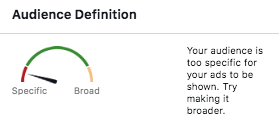
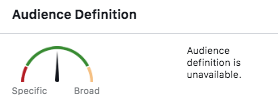
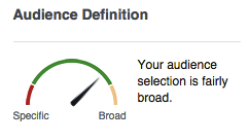
    Once your audience had been defined, take a step back to consider the size of the group. Review the  “Audience Definition” meter along with the “Potential Reach” number within Facebook’s campaign manager. The ideal audience has fairly specific targeting, but not so specific that the number of potential viewers is under 1,000. This ideal audience size is broad enough to be inclusive to anyone who shares the targeted interests but specific enough that the impressions aren’t wasted. You can tell that you’ve reached the ideal audience size once all of the necessary layers have been added and the numbers aren’t fluctuating as much.  

    Very specific Facebook audience targeting for Search Influence in New Orleans, LA

    Less specific, more general Facebook audience targeting for Search Influence in New Orleans, LA

    Very broad audience targeting for Facebook campaign done by Search Influence in New Orleans, LA

    Medical Industry Audience Limitations

    Due to ever-evolving privacy laws worldwide, specifically in the medical field, physicians must operate (pun intended) under more strict targeting regulations. This is especially true on Facebook. One of Facebook’s most useful features allows business to upload email addresses or phone numbers directly into the platform and create custom audiences from these lists. You can then create a wide variety of custom audiences based on those lists. However, businesses in the medical industry are not permitted to create such audiences through an upload or pixel users who have visited their site because it violates medical privacy laws. Therefore, medical practices must give their targeting even more thought to serve up ads to their ideal audience.

    With the tips outlined in this helpful guide to thoughtful audience creation, you, too, can be on your way to increasing engagement and building your online presence! At Search Influence, we have extensive experience working with clients in the medical industry. For more information about how we can help promote your practice on Facebook and other social media platforms, start a conversation with us today.

    Images

    Doctor

  • How to Track the Success of Your Online Ads

    Marketing can sometimes feel like a black box to business owners. Luckily, with digital marketing, there are ways to track pretty much everything so that you can know exactly how your campaigns are performing. As a marketer, I’m often up to my elbows in Excel sheets, pouring through the data provided from Google Ads or Google Analytics. But as you’ll soon learn, only looking at that data is not enough. To have successful campaigns, you, the business owner, must also be involved in the process to help track everything from the first impression to a closed lead.

    Gif of Colin Farrell shrugging about online ads

    How Do You Know If Advertising Is Effective?

    In order to determine if your advertising is working, you first need to do some self-reflection. Most business owners know they need to spend money on marketing in order to grow, and often, the first thing they do is begin vetting (and maybe even hiring) an agency. But truthfully, it’ll be more difficult for you and your agency to create winning campaigns if you haven’t defined your business and marketing goals before getting started.

    Luckily, we have put together an awesome guide that walks you step-by-step through the process of determining the metrics that matter to your business and how to tie those to marketing goals. To get started, gather the necessary stakeholders, download our guide, and fill out the worksheet. When you are done, you will have…

    The “M” in S.M.A.R.T. stands for “measurable,” and defining this on the front end helps you determine what Key Performance Indicators are important to you. This doesn’t have to be complicated, and the less metrics, the better!

    Man incorrectly measuring the success of his online ads campaign

    How Do You Measure the Success of a Campaign?

    Now that you’ve defined your metrics and KPIs, you’ll need to figure out what you need to track online and how you will track it. Some common things you might track are leads through phone calls and form fills, transactions and revenue through e-commerce purchases, or interest in your location through “Get Directions” button clicks. Let’s walk through some common platforms for tracking online actions.

    • Google Analytics: You can use this free platform to track user behavior on your website and set up goals to track form fills, clicks on buttons, views of key pages, and e-commerce transactions. This allows you to compare performance across all campaigns similarly, using the same attribution model and metrics. It integrates well with Google Ads (you can import your Google Analytics goals directly into Google Ads) but doesn’t send conversion data to other advertising platforms.
    • Ad Platform Pixels and Trackers: Each ad platform offers their own tracking solutions, so you can determine exactly which of your advertising campaigns, keywords, audiences, and ads are converting. If you are using something other than Google Ads, you’ll want to install these pixels in addition to Google Analytics. Most of them work very similarly to Google Analytics, but may have slight variations on how conversions are counted or tracked. Examples include Facebook Pixels, Google Ads Conversion Trackers, Bing Conversion tags, and LinkedIn Insight Tags.
    • Call Tracking Providers: Setting up call tracking is a must for businesses that receive a lot of phone calls. Call tracking works by placing a piece of code on your site that identifies the source of your site visitor and dynamically switches the phone number to attribute that call back to the source. More advanced call tracking providers are even able to tie these calls to specific ads. They offer a ton of features to make it easier for you to manage your internal process for answering and responding to these calls and to audit your team to ensure they are providing the best customer service. There are several different providers, so do your research on which one best meets your needs.

    Setting up all of these things on your website does require some coding skills, so it helps to consult with a developer (or a marketing agency like Search Influence) on the best ways to set up tracking.

    How Is ROI Calculated in Digital Marketing?

    I don't do math gif

    So now that you are tracking all of your online actions, you’re all set to calculate ROI, right? Well, not exactly. In fact, tracking just online conversions does not give you a full understanding of the success of your efforts. This is mostly true when it comes to lead-based businesses. If we deliver 100 leads to you, but not a single one turns into a client, would you call that a success? This is why it is SO CRUCIAL for you to track the quality of your leads and to provide that information to your marketing agency as close to real-time as possible.

    There are many ways to determine lead quality, but some important things to track include the following:

    • Lead Score: What is a lead worth to you? Devise a scoring system and train all customer service reps on this. Think about scoring the leads based on things like, “I want more leads like this!”
    • Score Reason: What makes the lead good or bad? What was the roadblock as to why this lead couldn’t become a customer?
    • Lead Stage: Did the person schedule a consultation? Have they been sent a proposal? Did they become a client? Document where each potential customer is in the process.
    • Customer Lifetime Value: What was the revenue associated with the services they received?

    Using a Customer Relationship Management (CRM) platform makes this process super easy. It can help you track the volume of leads, close rate, and average sale value, which are all important metrics to know and understand. It can also help your internal team keep track of who’ve they’ve talked to and when to follow up with them. The biggest benefit of having a CRM is having a ton of great actionable information to provide to your marketing agency so they can optimize campaigns to meet and succeed your marketing goals.

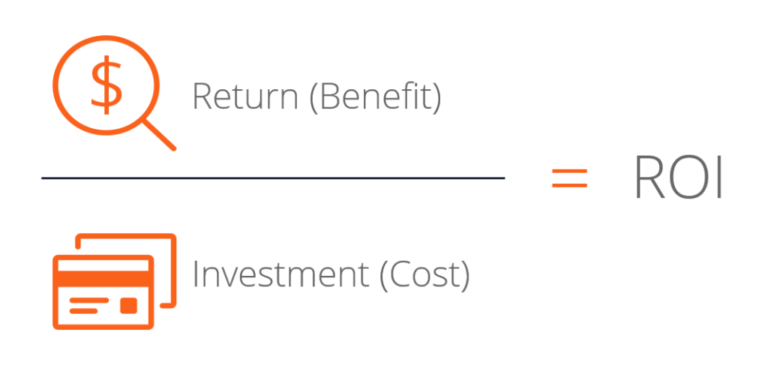
    Once this data is collected, you can also determine the Return on Investment (ROI) of your marketing efforts. You’ll take the total revenue you received, subtract the costs associated (return), and divide by your investment.

    ROI evaluation of online ads campaign from Search Influence in New Orleans, LA

    Combine the Data and Make Smart Decisions

    Implementing these tracking mechanisms and processes allows you to better understand exactly which campaigns and tactics are driving real revenue for your business. It is also one of the huge advantages of running digital advertising campaigns (real data that is tied directly to campaigns). It gives you and your marketing agency the insight to make decisions that you can trust will result in growth and allow you to continue to work toward your goals.

    If you need help figuring all of this out, don’t worry! Search Influence is stocked with seasoned pros at all things tracking and analytics, and we love to dive deep into numbers to figure out what is working for our clients. We will also provide guidance as you set up your internal systems to make it as easy as possible to track the data on your end. We find that the most successful campaigns we run are ones where there is open communication between our team and our clients—providing honest feedback on the work we are doing because, ultimately, we want to optimize their business’ potential. So start a conversation with one of our digital marketing experts today so you can feel confident in your marketing efforts!

    Images

    Colin Farrell

    Helpless Man

    Schitt’s Creek


  • The Strategic Marketing Method to Building Your Brand on Youtube

    In true Search Influence fashion, I am going to start this blog post the same way we typically start our weekly company meetings, with a quote:

    “You cannot teach a man anything; you can only help him discover it in himself.” – Galileo

    Though Galileo provided us with this insightful quote, Frances Bacon formulated one of the most important tools to aid in this self-discovery, the scientific method.

    Now, Let’s Get Started…

    Neil DeGrasse Tyson science meme

    There is a method to the madness! What if I told you that to build your brand on YouTube, all you need to know is the scientific method that you learned in 5th grade? You may ask yourself, what exactly are the six steps of the scientific method and how the heck does this relate to digital marketing? For a little refresher, I have listed the steps to get us started:

    1. Ask a question
    2. Do background research
    3. Construct a hypothesis
    4. Test your hypothesis
    5. Analyze the data and draw a conclusion
    6. Share your results

    STEP 1: Ask a Question

    In the first step, you are going to want to think of multiple questions around the reasoning your experiment. I highly recommend taking the time to write this out, whether it’s with a pen and paper or on your computer. Like any great scientist, you should be documenting all of your brainstorming, research, strategies, and data.

    • What is your niche?
    • What is the problem you want to solve?
    • What is your area of expertise?
    • Who do you want to target?
    • Why are you choosing to focus on this niche?

    The last question is key because there is never going to be the same level of commitment if you aren’t choosing something you are truly passionate about.

    STEP 2: Do Background Research

    Now that we have sorted through all of those questions and have a clearer idea of the direction we want to take, it’s time to start our background research.

    We need to look at what our competitors are doing. Our competitors will be the brands or people that are doing something similar to what we have chosen as our niche. When analyzing them, we should ask the following questions:

    • How do they engage?
    • Which formats do they use?
    • What is their content strategy?
    • Is what they’re doing working?
    • What is your market missing?
    • What can you do differently from them?

    Once again, this last question is the key to your success! What can you do differently that will set you apart from your competitors?

    STEP 3: Construct a Hypothesis

    Now the fun part (and my personal favorite)! We need to construct a hypothesis, or, in marketing terms, create a strategy. We will want to use our research from Step 2 to construct keywords, content, and visual styles that will work with your target audience while utilizing the competitive advantage you identified in Step 2. In this step, you will also want to determine your overall strategy to remain consistent. This is going to include your posting schedule, engagement plan, and who (brands or people) you would like to collaborate with in the future.

    An important part of this step is determining the metrics that matter, what we like to call “SMART Goals.” What are the metrics you should measure to prove the success of your strategy?  This will include constructing a timeline of when you would like to check in on these SMART Goals of your strategy.

    Neil DeGrasse Tyson meme about bracing yourself for digital marketing knowledge

    STEP 4: Test Your Hypothesis

    Testing your hypothesis is when the party really gets started. It’s time to experiment. You are going to implement your strategy. You will take the creative strategies you planned out in Step 3 and put them into action.

    STEP 5: Analyze the Data and Draw a Conclusion

    Using the timeline determined in Step 3, analyze the data and draw a conclusion. Look at those metrics that matter. Ask yourself the following questions:

    • Is your strategy helping you achieve your goals?
    • Did you determine the right goals to track in Step 3?

    STEP 6: Share Your Results

    Now, unfortunately, I can’t say that this is the final step because “sharing your results” means you will now use your conclusions to decide on optimizations for your strategy. You’ll know if you’ve achieved your goals or if certain aspects need to be revisited when you analyze the data in the previous step.

    Scientists share their results to provide insightful information that can be used as research for future experiments. Experiments aren’t meant to be done once. This process should be repeated and repeated to study and improve your marketing strategy.

    Once you’ve got your results, ask yourself the following questions:

    • Should you restrategize your brand?
    • Did you choose the right market?
    • Should you restrategize your execution?
    • What parts of your plan are working?

    And the final question to ask yourself after reading this post is… are you smarter than a 5th grader?

    Luckily, the marketing experts at Search Influence got straight A’s in 5th grade. If you need help developing an effective marketing strategy for your business or building brand awareness on YouTube or any other social media platform, start a conversation with one of our strategists today.

     Images

    NDT 1

    NDT 2

  • Five Steps to Boost Your Law Firm’s Online Reputation

    Reputation is everything. If you’re a fan of the TV series “Suits,” you already know that hotshot attorney Louis Litt’s most important character trait is his obsession with his reputation, as well as his firm’s. He does whatever it takes to make sure it’s immaculate. Since Louis doesn’t talk much about his strategy, I took it upon myself to shine some light on the perks of having a strong online reputation and how to improve yours (if it could use some work).

    “Reputation is an outcome, but it is also a valuable, strategic asset,” says Andrew Griffin.

    By cornering your social media game and online presence, you’ll be able to aptly manage your law firm’s online reputation and mold its online “personality” to set the stage for a reliable and effective firm in the eyes of future clients. The next five steps are vital to shaping your brand and ushering new clients through your virtual door.

    Step 1: Ask for Reviews

    When consumers are beginning their search for a law firm, they turn to the internet to do some digging. 65 percent of consumers claim to be swayed by the reviews they find on your firm, and a single negative review can drive away 22 percent of potential clients. Ouch.

    So How Do We Combat the Bad Publicity?

    Set up a system and a strategy to make it as easy as possible for your clients to leave you reviews (see Step 2). By flooding your Google My Business listing with bright and positive client reviews, you push the negative commenters further from the line of sight and cement your standing as a reputable firm. Asking for reviews may seem a little tricky, but the key is to ask at the optimal time, like right after you’ve won a case for a client.

    You might be asking why I’m mentioning Google reviews? Google has been proven to be the most frequently used review platform when customers search for attorneys. It’s the most popular search engine, so it makes sense that it would beat out other platforms. You really can’t beat convenience.  After Google, the most popular review platforms are Facebook, Yelp, then Avvo. This doesn’t mean you should ignore these sites, but asking your clients to leave their praise on Google is more important.

    "You're a genius" gif from the television show Suits

    Step 2: Find a Place to Filter All of Your Reviews in One Place

    My biggest piece of advice is to stay organized. If your law firm has multiple locations, this is even more important when managing your online reputation. Between Google, Facebook, Yelp, and Avvo, you’ll have a hard time bouncing from platform to platform, putting out fires, and responding to client praise. BirdEye is a great way to consolidate your online reviews and respond to them in kind.

    Bonus Perk

    BirdEye keeps your law firm’s contact and business information accurate across all review channels, and it also makes it easy to ask your clients for reviews by putting all of the tools right in their lap. As mentioned before, you really can’t beat convenience.

    "I'll make it happen" gif from the television show Suits

    Step 3: Respond to EVERY Review Within 24 Hours

    This is where BirdEye really comes in handy with managing your law firm’s reviews. The internet has given the world many wonderful things, but it also introduced an element of chaos. And when I say chaos, I mean a scathing online review about your firm (that may or may not be valid) that’s posted in public where your potential clients can see it.

    Fear not—you’ll be OK. It’s time for you to find your zen and craft an empathetic and professional reply that acknowledges the trouble the reviewer faced, offers an avenue to make it right, and then thanks them for their feedback. At the end of the day, these reviews can actually be very helpful in letting you know how to improve your business and pinpoint some issues that may be happening more often than you’d like.  

    Bonus Perk

    You have now positioned yourself in the public eye as a firm that’s genuinely interested and concerned about all of your clients, not just the happy ones.

    "Mission accomplished" gif from the television show Suits

    Step 4: Start a Blog

    Content. Content. Content.

    Position your law firm as a thought leader in your areas of practice and write content that speaks directly to your potential clients and, just as importantly, to Google. Creating more content for your site that’s relevant to what your potential clients are searching for directly translates into where you rank for relevant search results. There are other factors that affect your rankings, but content is among the most important.

    Let’s say a potential client, we’ll call him Gary, was in a wreck last week. The driver who hit him was uninsured. Gary is at a loss about what legal action he should take and doesn’t know if he even has a case. To answer his questions, he turns to Google and asks for some advice. If you’re a personal injury attorney, you could craft a blog that explains Gary’s rights and a step-by-step guide to finding the help he needs to file a lawsuit to cover the damages. So when Gary searches for clarification, your blog could be the first one to pop up, which prompts him to click onto your website and potentially become a paying customer.

    Consider the types of cases that generate the most revenue for your firm, research how consumers search for information about those practice areas, and craft your content strategy around the information you find!

    "That's more like it" gif from the television show Suits

    Step 5: Hire a Marketing Firm

    As cliché as it may sound, you have better things to be working on than creating a marketing strategy, monitoring your social engagement, and writing blog posts in your spare time on the weekends. Save yourself some time and energy and talk to one of our strategists about building a bulletproof strategy on managing your online reputation and drawing up a game plan to solidify your online presence. With several teams dedicated to each aspect of digital marketing, Search Influence has all hands on deck to craft the perfect strategy to make your positive online reviews more visible and create relevant blog topics that will have potential clients knocking on your digital doorstep. Start a conversation with one of our experts today.

    Images

    Suits 1

    Suits 2

    Suits 3

    Suits 4

  • Common Google Analytics Terms Explained

    Google Analytics is a free service provided by our friends at Google that automatically collects and allows you to analyze data about your website visitors. Google Analytics is an essential tool for digital marketers, businesses, bloggers, and everyone in between with a website.

    Google Analytics can help guide your decision-making processes and marketing strategies. You can figure out why your website visitors are bouncing, learn about the demographics of your audience, monitor progress towards your goals, and more.

    With the plethora of information available in Google Analytics, it can be difficult to understand all of its dashboards and metrics.

    Google Analytics Terms for Beginners

    • Users

      • The number of people who viewed your website at least once within a given time period is represented by users.
    • Pageviews

      • Pageviews is the number of times visitors to your site view a page. Every page visit is included in this number, including if someone refreshes the same page. Pageviews is a great metric to look at when you want to determine which pages are your website’s most popular.
    • Sessions

      • Sessions are the individual periods of time someone visits your website. A session resets in increments of 30 minutes. A website visit ends when 30 minutes have passed. If a visitor leaves and returns to your site within 30 minutes, that counts as one session.
    • Bounce Rate

      • Bounce rate is a number that is found by dividing the number of total bounces by total visits. This represents the percentage of people who visit one page on your website and then leave without going to any other pages. Bounce rates can be applied to an entire website or individual pages.

    Dimensions

    Dimensions are attributes of your Google Analytics data. Some examples of dimensions are the source/medium, which we’ll discuss later, or location. There are several options, including device category, language, and campaign. Dimensions are helpful for making sense of the data generated by different reports.

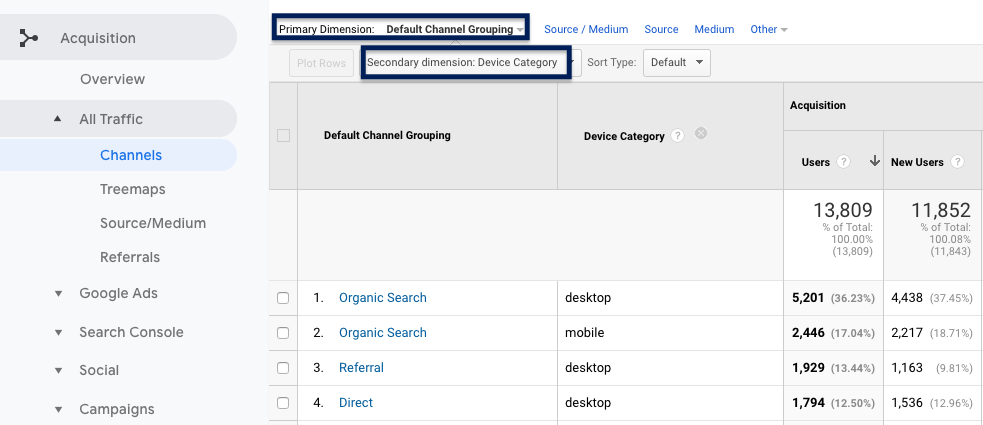
    • Primary dimension

      • A primary dimension in Google Analytics is the first displayed attribute of your data, which differs depending on the report you’re looking at. For example, if you’re looking at Channel under Acquisition, the channels by which people used to visit your website is the primary dimension.
    • Secondary dimension

      • A secondary dimension in Google Analytics allows you to add another layer to parse through your data. So, let’s say you wanted to know how many people visited your site through each channel and the device they used to get there, you can add “Device Category” as a secondary dimension to see the data sorted by the device.

    Screenshot of a Google Ads campaign managed by Search Influence in New Orleans, La

    Reviewing Acquisition Reports

    If you’re curious about how people found your website, acquisition reports will tell you which sources visitors used to get there. The acquisition report shows the origin of the visit (like a search engine, a Facebook ad, or email marketing campaign) and the specific medium.

    • Channels

      • Channels in Google Analytics provide a broad idea of where your website visitors came from. Analytics has a default channel grouping. This grouping consists of channels like Direct, Organic Search, Social, and Referral.
    • Organic Search Traffic

      • An organic search visit is a visit that came from a search engine. If someone typed in your business name or keywords related to your business in Google and clicked on your website in the Search Engine results page, this counts as an organic website visit.
    • Direct Traffic

      • Direct traffic is a result of a user typing in your exact web address in the address bar or clicking a bookmark in their browser.
    • Referral Traffic

      • Referral traffic visits are a result of visitors getting to your site from another site on the web. If I were on Yelp browsing restaurants for dinner and came across a place I’d like to check out and then clicked a link to their website from their Yelp listing, this would show up in their Analytics as a referral visit. Reviewing referral traffic can be helpful for deciding if certain off-site tactics are worth the time and effort. For example, if you’re doing a lot of posting and promotion on Facebook and you see that your referral traffic has not increased, you may decide to spend less time on that strategy and focus elsewhere.
    • Source/Medium

      • Source/medium provides a closer look at where your website visitors are coming from. Source identifies the referrer of a site visit. A source can be a search engine, an ad, a newsletter, etc. while the medium is the channel used. Examples of source/medium include the following:
            • Google/organic – Google is the source, organic the medium.
            • Google/CPC – Google again is the source, but the medium is a paid search ad.
            • Yelp/Referral – Yelp is the source and a referral is the medium.

    Search Influence employee working on Google Ads campaign in New Orleans, LA

    For Understanding User Behavior & Measuring Conversions

    • Landing Page/Exit Page

      • A landing page is the page a user first sees when they visit your website, and an exit page is last one they browse before leaving.
    • Events

      • Events are actions that a user takes on a website. Ideally, these should be created around your key performance indicators. For example, if you have a button on your website that allows users to check the rates of your B&B for a night’s stay, you can set up an event to know how many people clicked that button.
    • New vs. Returning Visitors

      • Google Analytics allows you to divide your site traffic into new and returning visitors. New visitors are people who had not previously visited your website during the time period you’ve selected. Returning visitors have viewed your website more than once during that time frame.
    • Goals

      • Goals are similar to events but are more focused on conversions. An example of a conversion is someone making a purchase or requesting a proposal from your company. Google Analytics provides 20 slots to track these.

    Navigating Google Analytics and all of its reports can be difficult. Properly utilizing the tools within Google Analytics to inform your business decisions can be even more challenging, but we can help with that. At Search Influence, we love analytics and lead tracking. Give us a call at 504-881-1597 to learn how we can help you know where your customers are coming from.

    Images

    Google Ads on Laptop

    Person Working on Laptop

  • Taking the IDK & WTH Out of Texting With Teens – Shawn Kelly From Search Influence on WWL

    Shawn Kelly, Sales Manager at Search Influence, helped WWL crack a difficult (but v important) code—teen textspeak. With two teenage daughters, he’s had to adapt his keyboard fast. Watch now for tips about:  

    • Keeping up with ever-changing text acronyms
    • Establishing open, honest communication with your teen
    • What it means when someone wishes you a “hmg”

    Text acronyms seem to change (almost) as quickly as teens type. At Search Influence, we may not all be fluent in textspeak, but we’re always up-to-date with digital marketing and SEO strategies. Learn more about our digital marketing services and how we can help your business get found online. Contact a strategist today to get started.