Blog

  • The Most Important Facebook Ad Metrics for Achieving Your Goals

    By now, most marketers buy into the idea that they need to advertise on Facebook and Instagram, but how do they know if those ads work? Enter about a million metrics to analyze.
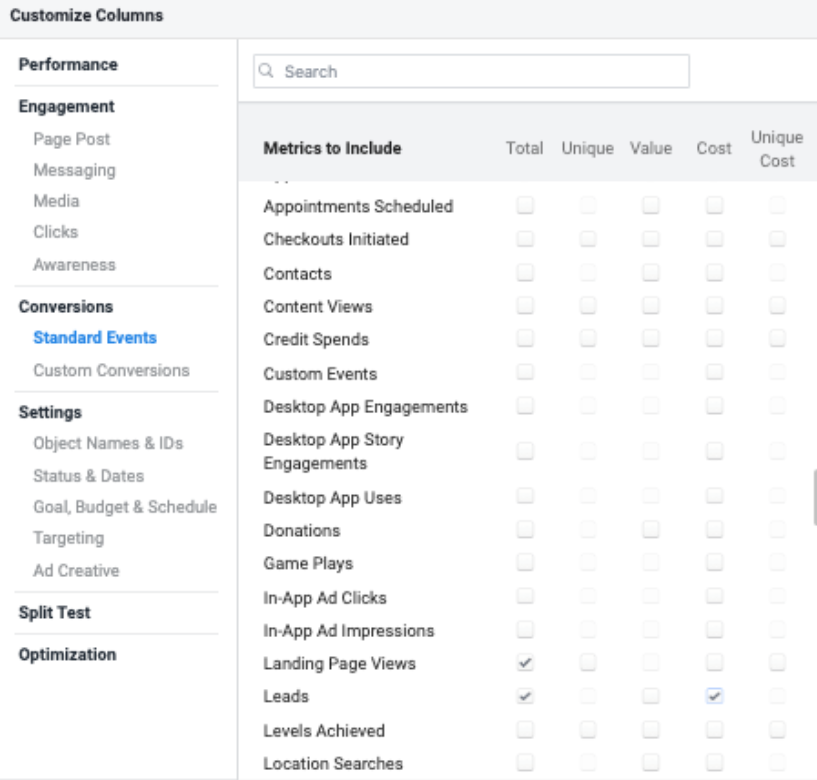
    A screenshot of some Facebook Ad metrics available

    That’s only a fraction of what is available, and yes, it can get overwhelming pretty quickly. The first step to figuring out which Facebook Ad metrics you need to monitor is figuring out your goals. Campaign goals usually break down to these four categories:

    • Increasing brand awareness
    • Driving traffic to your website
    • Generating leads
    • Generating sales

    Let’s look at these and determine what your primary KPIs (key performance indicators) should be for each goal, as well as some secondary KPIs to watch.

    To see some of these metrics, you’ll need to customize your columns. Some of these are not included in the preset table views. Select Customize Columns from the Columns dropdown menu.
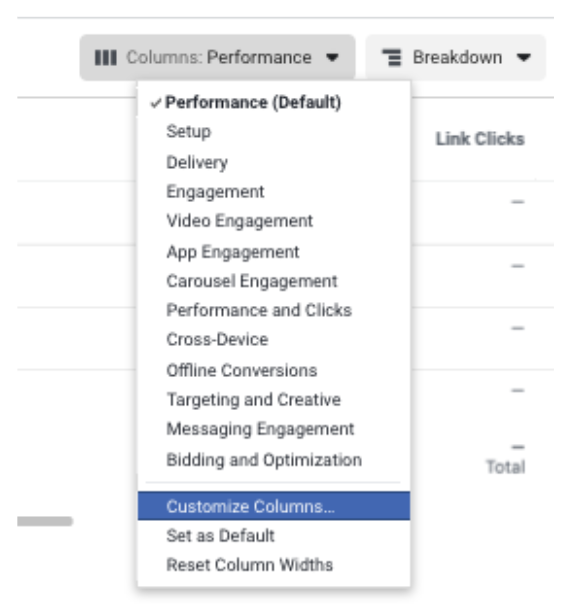
    The columns dropdown menu of Facebook ads

    Increase Brand Awareness

    When increasing brand awareness is your goal, you’ll probably want to show your ads to as many people within your target audience as possible. You’ll also want to show them those ads enough times to make an impression, but not so much that you drive them crazy.

    Brand awareness campaigns are a necessary and often undervalued piece of the marketing funnel. Their impact is notoriously difficult to measure, which means people often overlook their importance. Think about it; you can’t exactly put a number to how “top of mind” your brand is to your audience.

    Primary KPI

    Estimated Ad Recall Lift
    Estimated Ad Recall Lift (EARL) is a tricky metric because it doesn’t measure an action, which is what most other Primary KPIs will measure. Estimated Ad Recall Lift (People) is an “estimate of the number of additional people who may remember seeing your ads, if asked, within two days.”

    Secondary KPIs

    Estimated Ad Recall Lift Rate, Cost per Estimated Ad Recall Lift
    These are calculated based on the Estimated Ad Recall Lift metric. The rate is found by dividing the EARL by the Reach. The cost is found by dividing the Amount Spent by the EARL.

    Since EARL isn’t an action, it doesn’t tell us if the campaigns are “working,” but looking at the rate and cost does help us understand which creative is resonating for the audience and is best used as an indicator when optimizing campaigns. For example, when reviewing ad copy, the ads with the highest Estimated Ad Recall Lift Rate are the ones most likely to be remembered by a user.

    Drive Traffic to Your Site

    If your main goal is to get people to click through your ad and to your site, you might think clicks would be the primary KPI, but you would be wrong. Firstly, Facebook has several click metrics that can confuse newbies.

    The Clicks (All) metric measures ANY click on your ad. So if someone clicks the page name to go to your Facebook page or likes the post, that all gets counted. Link clicks are only counting clicks on your link. This link could be in the text description or the CTA button. Even this isn’t the main metric you want to watch, though.

    Primary KPI

    Landing Page Views
    While clicks on your ad are good (and necessary to get users to your site), what you really need to be reporting on is landing page views. A landing page view is counted when someone clicks the ad and then “successfully loads the destination webpage or Instant Experience.”

    Secondary KPIs

    Link Clicks
    While you don’t want to focus too much on link clicks, you do want to monitor the delta between link clicks and landing page views. If you are getting a lot of clicks and a drastically lower number of landing page views, your site might be too slow. When people lose patience with a slow loading page, they bounce.

    Cost Per Landing Page View
    When looking at creative or targeting performance, the cost per landing page view can help you optimize for efficiency.

    Click-Through Rate
    The CTR is the percentage of impressions that resulted in a click and is often a measure of your ads’ effectiveness. A high CTR is an indication that your ad is resonating with your audience. This measurement doesn’t necessarily mean that it’s a “good” ad; it just means it’s a good ad for that audience. Your top CTR ad for an audience of women over 40 in Manhattan might not perform as well with an audience of millennials in Los Angeles, even if the offer appeals to both.

    Generate Leads

    This one is pretty obvious…

    Primary KPI

    Leads
    If your goal is leads, make sure you have your pixel set up to track your calls, form fills, and other conversions. Hopefully, you’re already using the Facebook Pixel to track the success of your campaigns. This tool is a must for any campaign with a goal that occurs off of Facebook (leads, app downloads, sales, etc.)

    Secondary KPIs

    Cost Per Lead
    The only thing better than a lead is a cheap lead. Watch the CPL to monitor effectiveness.

    Generate Sales

    You would think the first thing you look at is sales, but what you really need to focus on is your return.

    Primary KPI

    Return on Ad Spend
    Your ROAS is a simple little formula—Revenue/Ad Spend—but it’s a big deal. Ten transactions for a $50 item is probably worth more to your business than 15 transactions for a $20 item. But if you spend $5,000 to get those ten transactions and only $100 to get those 15 transactions, you’re looking at 10% ROAS compared to 300% ROAS. Looking at the number of transactions or revenue alone does not give you the full picture. ROAS does.

    Secondary KPI

    Transactions and Revenue
    Though these don’t provide the same context as ROAS, they are still significant and should be monitored along with transaction rate (transactions/clicks) and average order value (revenue/transactions).

    Bonus KPI to Watch

    Frequency
    This indicator is the average number of times each person saw your ad. It is calculated by dividing the number of impressions by reach. It’s essential to monitor your ad frequency to make sure you are hitting the sweet spot between the audience not noticing your ad and users screaming if they have to look at it again. We’ve all experienced an ad that follows us around the Internet or shows up every time we log into Instagram.

    You’ll usually want people to see your ads more than once, but ad fatigue is real. People will start ignoring your ads entirely if they have seen them too many times. It might be a good idea to plot frequency along with your primary KPI to see how your rate affects performance. This Adspresso blog explores frequency’s effect on CTR and CPC. One last tip: once you figure out the KPIs you need to track, you can save your columns by checking the box at the bottom left of the Customize Columns box.
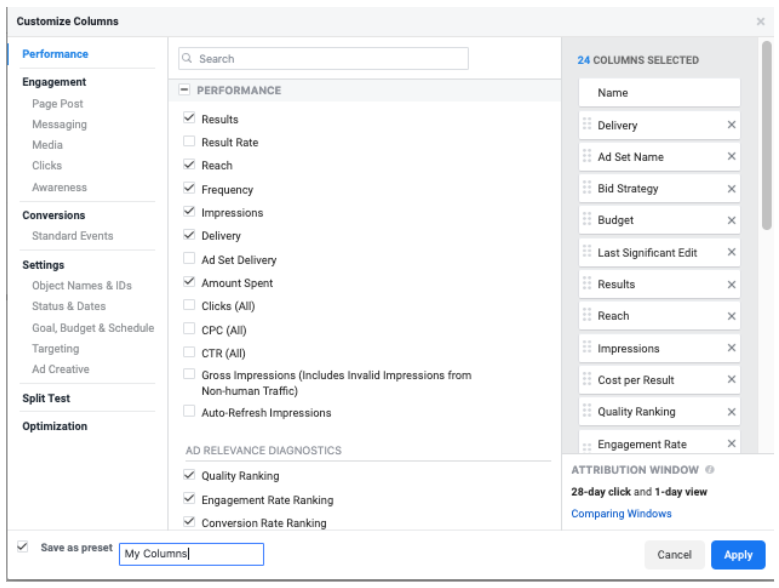
    A screenshot of some Facebook Ad performance metrics available

    By the way, if you’re wondering if there are a different set of metrics you need to monitor for your Google campaigns, we can help you sort through the metric options in Google Ads too. At Search Influence, we’ve helped businesses across the country improve their digital advertising campaigns. To take the performance of your ads to the next level, contact one of our strategists today.

    Images:
    Laptop
  • The Top Five Ways to Optimize Instagram Accounts for SEO

    Nowadays, it isn’t enough to simply have great content, because to be honest… a ton of people have great content. Businesses have to be smarter and more competitive to get their content in front of the right people. With the ever-growing popularity of social media, accomplishing this has become easier but harder.

    On one hand, businesses have more platforms to share their content and reach potential buyers. Gone are the days where a website is stuffed with all of a company’s information and events. On the other hand, businesses have more platforms to manage and keep optimized. Your website has to be in tip top shape for search engines, but so do your social profiles.

    Take Instagram for example. According to research done by Hootsuite, one billion people use Instagram every single month, with 500 million people on Instagram every day. More importantly, “200 million Instagram users visit at least one business profile daily.”

    That’s 200 million reasons you can’t slack on Instagram.

    There is a silver lining though. Optimizing an Instagram account for search engines is very similar to optimizing a website for search engines. Here are five ways to get your bangin’ IG optimized for SEO.

    Have Your Top Keyword in Your Handle

    You may not be able to change your domain name or business name at this point, but your Instagram handle is just itching to be optimized. If your username doesn’t include your main keyword, you should reevaluate it.

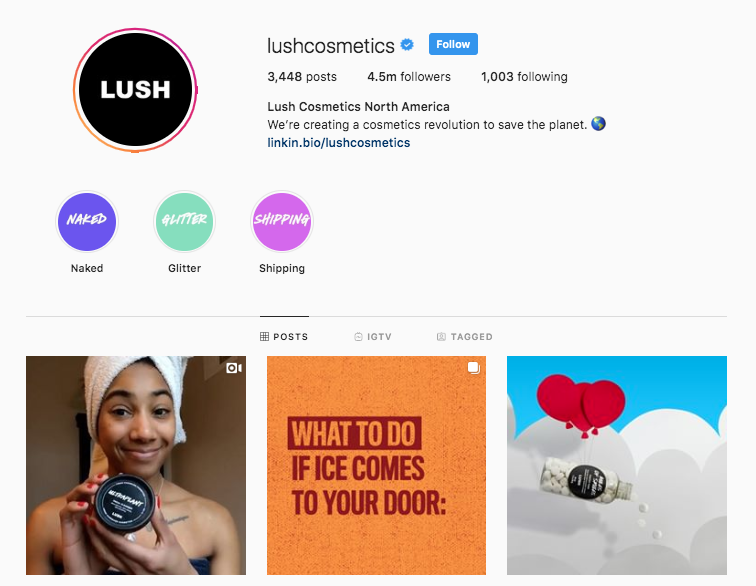
    Take Lush, a cosmetic company headquartered in the United Kingdom, for example. While the company’s name is simply Lush, it’s Instagram handle includes a very important keyword.

    Screenshot of Lush Cosmetics Instagram landing page

    “Cosmetics” is sitting pretty in their Instagram handle. Also notice that their business name isn’t the only part of their profile that has a keyword shining bright… which brings us to tip number two.

    Load Your Bio With Keywords… Naturally

    Why should your Instagram handle get all the keyword love? Well, it shouldn’t. Your business name and bio are great opportunities to get some more keywords on your profile. However, don’t be sloppy about it.

    Loading your bio with keywords should be done in a natural and clever way. After all, your potential buyers are watching.

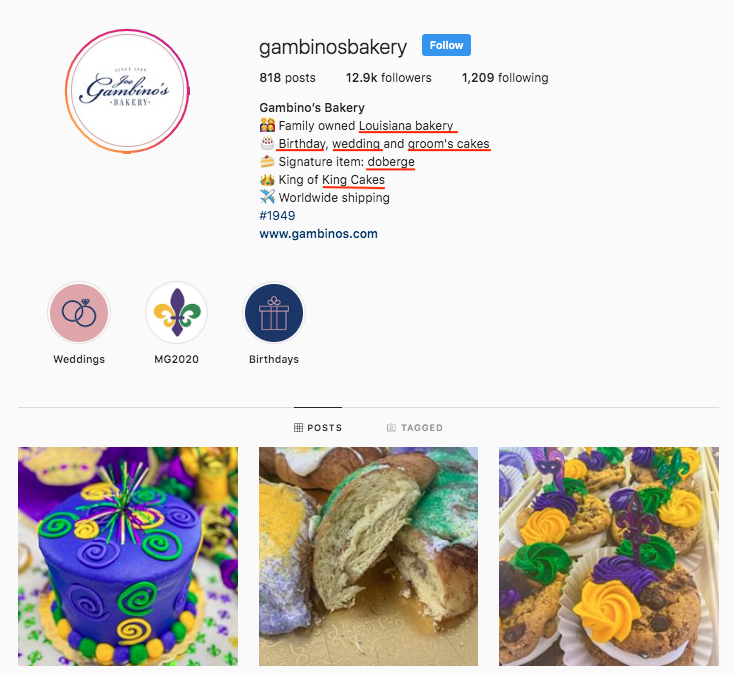
    Gambino’s Bakery does an excellent job of sneaking rich, top tier keywords into their bio.

    Screenshot of Gambino's Instagram landing page

    Utilize Instagram’s ALT Text Feature

    In late 2018, Instagram rolled out the ability to add ALT text to images in an effort to make the platform more enjoyable for visually impaired users. Don’t say Instagram has never done anything for companies, because this feature made business profiles accessible to more potential buyers and created another space to include keywords.

    When gearing up to share some great content on Instagram, keep your eyes peeled for the advanced settings option. The Advanced Settings are on the same screen as the caption, tagging, and location options way at the bottom in small print. After you press that, the accessibility section will be at the bottom.

    Load Your Captions and Hashtags With Keywords

    If it seems like optimizing your Instagram for search engines is all about keywords… then you’ve been paying attention. Congrats!

    Other perfect opportunities to get some nice, juicy, top-tier keywords on your profile are in the captions and hashtags. But again… this should be done naturally. Potential buyers don’t love several keywords thrown together.

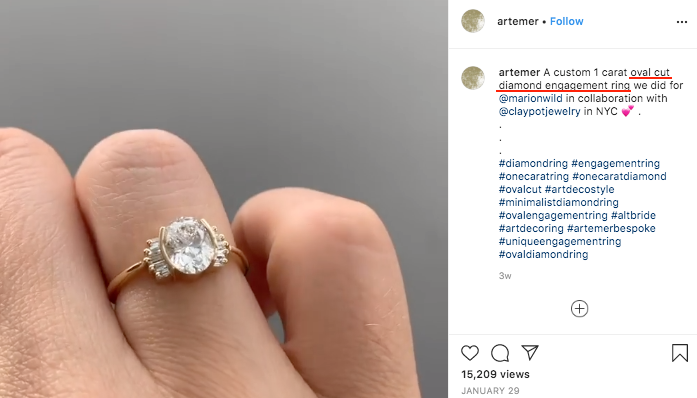
    Example of an ARTËMER Instagram post using keywords

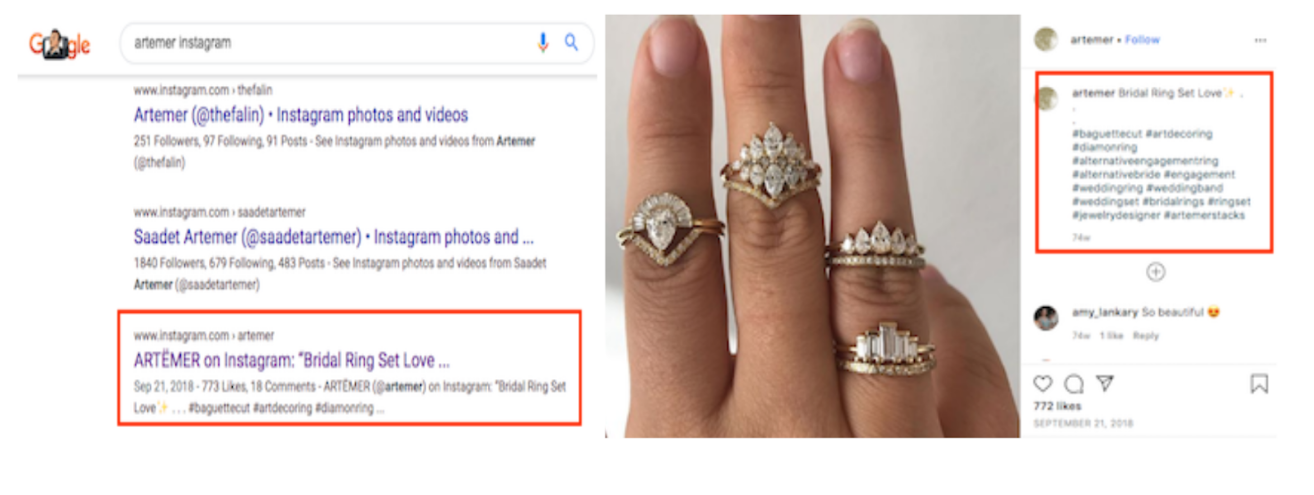
    ARTËMER, a nine-year-old jewelry brand, does a great job of integrating keywords with a natural caption. Sitting in this post are two keywords in the caption and a slew of keywords in the hashtags. If writing the perfect caption gives you anxiety, think about them as title tags because they act the exact same way.

    Example of an ARTËMER Instagram post ranking

    Add Your Instagram to Your Google My Business Profile

    This optimization tactic has nothing to do with keywords, but it is highly important. Having your Instagram profile linked on your Google My Business page will allow it to pop up on Google along with other pivotal need-to-knows, like your business address and phone number.

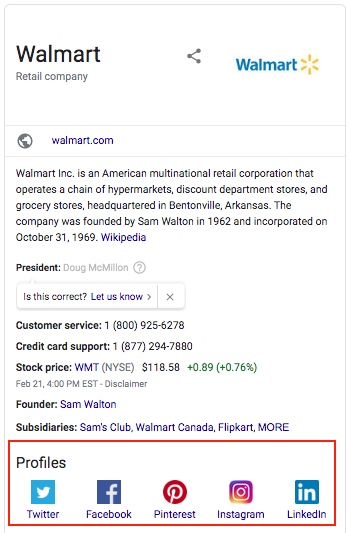
    Screenshot of Wal-Mart's Google knowledge panel

    While you cannot physically log in to GMB, link the profiles and watch them magically appear, Google will “automatically discover social profiles to include in Google knowledge panels.” To hurry the process along, Google recommends that the change is suggested by a verified representative.

    The last and final tip is sometimes easier said than done, but it is the most important: create great content. SEO will drive potential buyers to your social profiles, but great content will make the right buyers stay. If you need help, don’t sweat it! Our team is experienced in all things SEO. Contact us today!

    Images

    Instagram logo

    Phone on desk

  • A Quick (How-to) Guide on Updating Hours and Business Info on Google My Business

    During a crisis, some businesses can continue operating with modified hours while others might have to close temporarily. Google is working on implementing the “Temporarily Closed” feature on Google My Business (GMB) pages in the upcoming days. We will update this post when the “Temporarily Closed” feature is available.

    In the meantime, we recommend updating your hours and sharing a post via GMB to keep your customers informed on your status.

    How to Update Your Business Hours on Google My Business:

    1. Sign in to Google My Business
      a. If you have multiple locations, open the one you’d like to manage
    2. Click “Info” from the menu
    3. Next to “Add Hours” or your current business hours, click “Hours”
    4. Turn off each day of the week that your business will be closed temporarily
    5. Next to each day of the week that your business is open with limited hours, click “Opens At,” and then select the opening time
    6. Next to each day of the week that your business is open with limited hours, click “Closes At,” and then select the closing time
    7. After you’ve finished setting your hours, click “Apply”

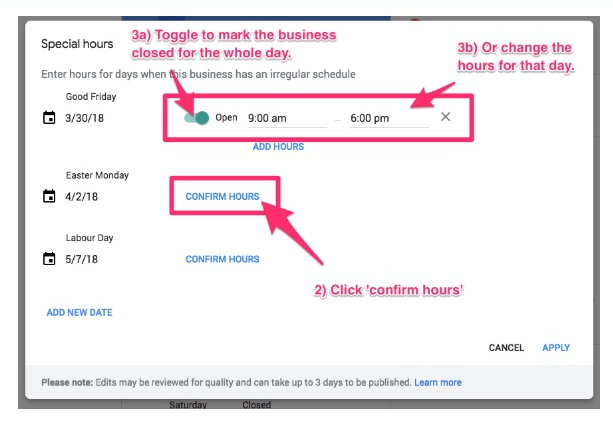
    A screenshot of Google My Business backend showing the special hours feature

    How to Post a Google My Business Post to Share More Details on Your Business Status:

    1. Sign in to Google My Business
    2. If you have multiple locations, open the one you’d like to manage
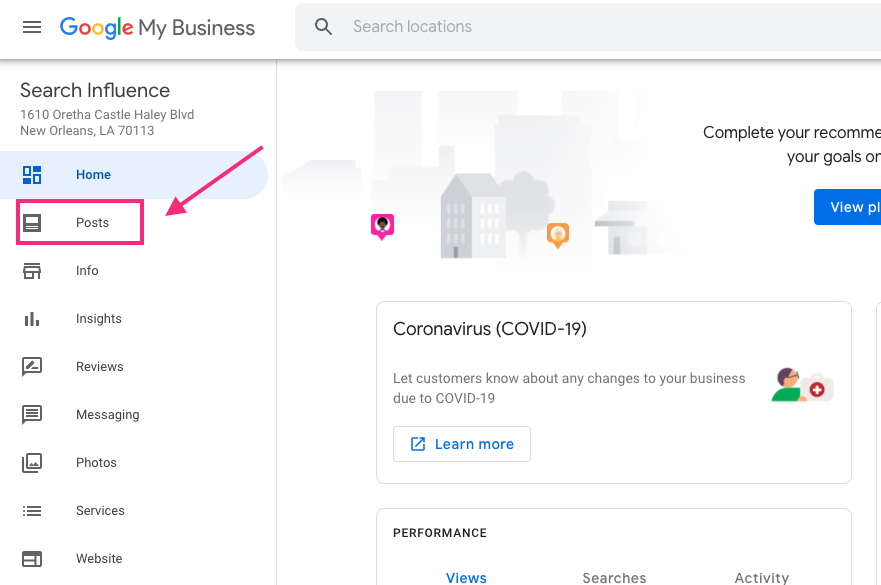
    3. Click “Posts” from the menu


    4. At the top of the page, choose the type of post you’d like to create from the options given. We recommend you use “What’s New” for the latest updates
      a. Options to add photos, videos, text, offers, and a button to your post appear. Click each field and enter relevant information
    5. To see a preview of your post, click “Preview”
    6. If you’re happy with your preview, click “Publish” in the top right. If you’d like to change your post, click “Back” in the top left. Edit your draft until it’s ready to publish
    7. Google removes published posts seven days after the post’s tab of your Google My Business listing

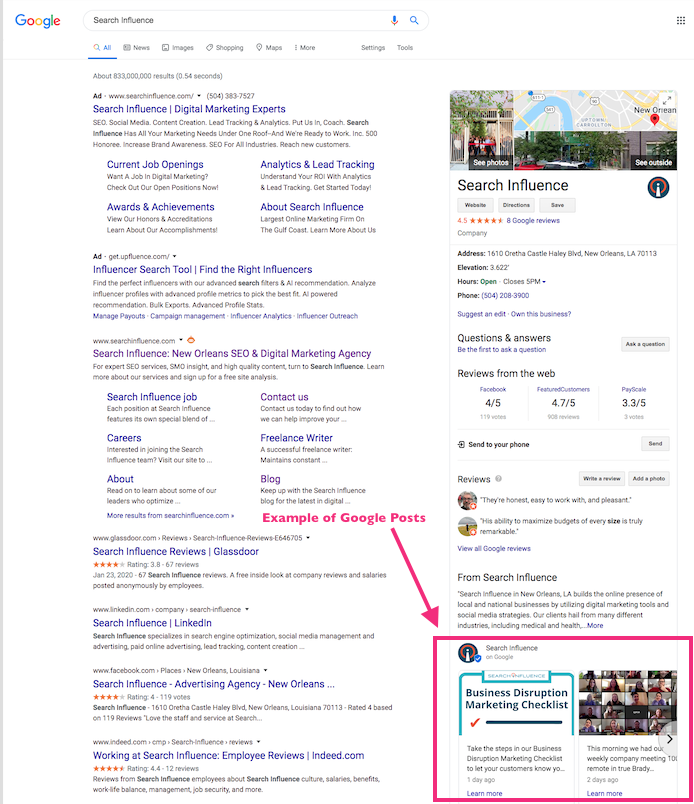
    A screenshot of Search Influence's Google My Business Listing showing an example of Google Posts


    All uploaded media must meet the following size requirements:

    • Minimum: 400×300 pixels and 10 KB size limit.
    • Maximum: 10000×10000 pixels and 25 MB size limit.

    Check out this video if you need to claim your business. We’re here to support you as we all work together and work through what this time means for businesses. For more tips on how to communicate your business status, check out our Business Disruption Marketing Checklist or contact our team directly if there is any way we can assist you.

    Images:

    Black Smart Phone

  • The Power of Utilizing Social Influencers for Your Brand

    What’s the Hype with Influencer Marketing?

    We are in the era of social media marketing being at the forefront of increasing brand revenue. I’m not talking about advertising on social media platforms in the traditional way. I am talking about teaming up with social media influencers or as many others may call them, bloggers.

    Influencers are proving to be one of the most trusted resources when it comes to consumer purchases. Consumers connect with influencers on a personal level and look to them for advice and insight on products and services. Each influencer has their own niche in which they thrive: cosmetics, clothing, home decor, health & fitness, parenting, traveling, food & booze, or even the best local spots in the area. They do their due diligence in growing their following and building trust, which is the true means to influencer success.

    Influencers are the way of the future, and it’s in your brand’s best interest to begin looking into this marketing method. Influencer marketing is just getting started, and according to Google Trends, the topic has grown tremendously since 2013 with no end in sight!

    Marketers around the world spent more than $5 billion on Influencer marketing on Instagram in 2018, helping to grow the influencer marketing industry’s success. It’s estimated that influencer marketing will grow to $10 billion by 2020.

    eBay reported that they had 1.3 million engagements (hashtags, reposts) per year, while American Express reported 3.7 million engagements per year, and Daniel Wellington had a record-breaking 1 million+ engagements per year—all thanks to Influencer marketing.

    Are you starting to believe the hype now?

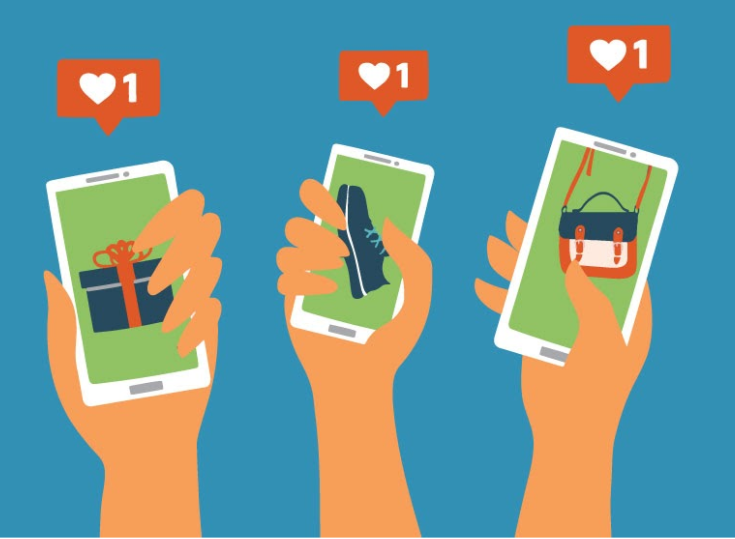
    Three hands holding phones representing users liking photos on Instagram

    Finding Your Brand’s Match

    Finding your brand’s perfect match can be tricky. That is why I have compiled a list of questions to begin your quest.

    • What is it that you want the influencer to help you with?
    • What is your budget for influencer marketing? Do you want to team up with more than 1 influencer?
    • Will there be a contract involved? If so, is the contract flexible to work with the influencer’s rates?
    • Is the influencer aligned with your brand?
    • Will your campaign content look natural?
    • Does the influencer speak to your brand’s niche frequently?
    • Is there alignment with your industry and brand values?
    • Does the influencer have the reach to accomplish your goals?
    • Is the influencer capable of engaging your target audience?
    • Are they on the social media channels your audience frequents?
    • Is the influencer relevant?
    • Is their fan base similar to the buyer personas you’ve built for your company?

    Now that the quest has begun, it’s time to determine which type of influencer is the best fit for your brand. You may be asking, “There are types of Influencers?” The answer to that is YES! Not all influencers are the same or can provide you with the return that you’re looking for.

    Review this list of a few types of influencers and the pros and cons for each below.

    • Brand advocates: Brand advocates are influencers who currently do not have a contract with a brand but pass on positive information about the brand or product to their followers. Brand advocates are a great example of a cost-effective partnership. The reason for this is that many brand advocate influencers would highly consider a trade for product instead of a paycheck for promoting your brand.
    • Micro-Influencers: Micro-influencers are a category of content creators with highly engaged social audiences that range in size of 100 to 5,000 followers. They can be beauty enthusiasts, solo travelers, mommy bloggers, fashionistas, or foodies—they represent any passion with an audience. Micro-influencers usually achieve around 8 percent of active engagement per post, while premium social influencers come in around 4 percent.
    • Macro-Influencers: These influencers have a very large following, usually between 100,000 and 1 million followers. Macro-influencers offer a blend of reach and impression, but they cannot match the engagement rates of micro-influencers.

    How to Measure Success

    There are a couple of really important metrics that you are going to want your influencer to report on during the campaign. The metrics that really matter are: clicks, likes, shares, reactions, comments, brand mentions, impressions, and purchases. You can keep track of these metrics by creating custom promotional codes, using SmartURL tracking links like Bit.ly, creating custom hashtags, and of course using Google Analytics to track users’ referral sources.

    An easy way to measure the success of influencer campaigns is to track the amount of engagement your influencers’ content receives. This is why it is important to ask your influencer to report on clicks, lives, shares, comments, and impressions per post, story, or blog post. Engagement is a better indicator of success, since we can assume that content that receives the most engagement is more compelling and makes an effective connection with your target audience. With higher engagement comes higher visibility for your brand.

    This all ties back to micro and macro-influencers. In many instances, the macro-influencers will have a widespread reach, while the micro-influencer will have better quality engagement.

    Looking at the trends for 2020 Influencer Marketing

    Now that you believe the hype, what does 2020 look like for social media influencers? According to Google, there has been a 1500% increase in consumer’s searching for “Influencer Marketing.” There is a huge takeover happening within the micro-influencer community! That’s right, those micro-influencers are taking over the Influencing world. According to Social Media Today, “61% of consumers say that micro-influencers produce the most relatable content!” Where can you find these micro-influencers? The biggest platforms in 2020 are Instagram, Twitter, and the influencer’s personal blogs.

    Ready to revamp your brand’s social media marketing strategy but don’t know where to start? Team up with Search Influence to learn what metrics matter for your marketing plan. Contact us to get started today.

  • Business Disruption Marketing Checklist: How to Communicate When You Are Closed, Remote, or Open

    Business Disruption Marketing Checklist: How to Communicate When You Are Closed, Remote, or Open

    Some businesses must close during a time of crisis. Others may be fortunate enough to remain open, even if that means limiting customer interaction or operating remotely. For a business equipped to operate during a time of crisis, saying that you’re open can be just as important as saying that you’re closed.

    Regardless of industry, communication about your status will help mitigate disruptions and profit loss as much as possible, and when you are reopen, can help you get back on your feet more quickly. Consider taking these steps to protect your business before, during, and after a time of business disruption.

    Marketing Checklist If Business Will Be Completely Closed

    1. Pause all advertisements for short-term actions or foot traffic. (Keep advertising long-term sales cycle services.)
    2. Pause any pre-scheduled social media posts.
    3. Add a special notice or banner across the top of the website and to any “Contact” pages notifying visitors that the business will be closed.
    4. Mark business as “temporarily closed” on Google My Business. Update hours on Facebook and other listing websites that show business hours of operation.
    5. Update all email signatures that the business will be closed and staff will have limited or no access to email (depending on the business). 
    6. Set up email auto replies for all accounts that will not be checked regularly, especially general inquiry emails like [email protected], [email protected], etc. 
    7. Update all voicemail recordings.
    8. Create a post on social media (Facebook, Instagram, Twitter, LinkedIn, etc.) to notify followers of the business’s status.
    9. Collect all passwords to ensure that all accounts (email, social media, website, etc.) can be accessed remotely. 
    10. Notify customers and vendors via email that the business will be closed and provide contact information should they need to contact the business during that time. 
    11. If applicable, forward calls to a mobile phone or a line that will have service. 
    12. Collect contact information for all employees, communicate the business’s plan company-wide, and provide regular updates during and after the crisis.

    Marketing Checklist If Business Will Remain Open Or With Modified Operations

    1. Pause advertisements for services that may be limited during this time. 
    2. Add a special notice or banner across the top of the website and to any “Contact” pages notifying visitors that business is operating.  
    3. Update all email signatures that the business is operating. 
    4. Update all voicemail recordings that the business is operating. 
    5. Create a post on social media (Facebook, Instagram, Twitter, LinkedIn, etc.) to notify followers that business is open.
    6. Pause any pre-scheduled social media posts that might be insensitive to the current climate. 
      1. For example: “It’s a beautiful day to go to the beach!” 
    7. Collect all passwords to ensure that all accounts (email, social media, website, etc.) can be accessed remotely. 
    8. Notify customers and vendors via phone or email that the business will remain open. If any communication will be modified during that time, provide the appropriate contact details.
    9. If applicable, forward calls to a mobile phone or a line that will have service. 
    10. Collect contact information for all employees, communicate the business’s plan company wide, and provide regular updates during and after the crisis. 

    Marketing Checklist For After The Crisis

    1. Unpause advertisements.
    2. Remove related messaging from email signatures and voicemails.
    3. Remove call forwarding and update auto reply email settings. 
    4. Update special notice or banner on website to indicate the business is open / back to standard operations. This message can be left on the website for a few days or until things get back to “normal”.
    5. Update social media followers (Facebook, Instagram, Twitter, LinkedIn, etc.) that the business is open and share any pictures, news, or any other updates that might be meaningful to that audience.
    6. Update hours on Google My Business, Facebook, and other listing websites that show business hours of operation.
    7. Notify customers and vendors via phone or email that the business is open and will be operating as usual moving forward. If the business is not able to operate as usual, provide the appropriate details and keep customers and vendors informed until business has returned to normal.

    We truly hope you find this list helpful during any business disruption period and that it helps mitigate the negative impacts of closure or altered operations. If you have any additional tips, comment with them below!

  • Search Influence Continues to Support You During COVID-19

    To our clients and our community,

    As the COVID-19 pandemic continues to evolve, we feel it’s important to share with you Search Influence’s plans for business continuity. Our top priorities are the health and well-being of our team and their families, and our clients, their families, and their businesses.

    Our plans for business continuity and employee wellness include:

    Remote Work: For 3 years, the Search Influence team has had the option to work remote as part of our flexible work policy. This means we are practiced in procedures and technology to assure consistent communication and collaboration – with each other and our clients.
    Employee Wellness: We have cancelled all employee travel and have stressed the importance of staying home to work remotely by desire or by need. We have regular cleaning of our office with emphasis on communal spaces, have reinforced all health guidelines to prevent exposure and transmission, and have ample hand soap and sanitizer available throughout our office.
    Cloud-based Systems: All work for clients and internal collaboration is in the cloud. Client projects and information can be accessed remotely.

    As you work through what this means for your business, we are here to support you. We have been working closely this week with clients in the heavily-impacted industries of tourism and education to adjust strategies and communication.

    Please, reach out to us personally or to your daily Search Influence contact if there is some way we can be of service.

    Sincerely,
    Will and Angie Scott


  • How to Use Facebook’s Campaign Budget Optimization to Your Advantage

    Who’s ready to spend their Facebook campaign budget more effectively?!

    Chris Pratt giddily rubbing his hands together

    If you waited until the last hour to adopt Facebook’s new mandatory update, Campaign Budget Optimization, you may be slightly panicked. This could disrupt your internal processes and current campaign structure. However, you’ll be thanking Facebook for forcing this change once you adopt it.

    What Is Campaign Budget Optimization?

    Campaign Budget Optimization (CBO) is Facebook’s latest mandatory update that makes you set your campaign budget at the campaign level, without the option to set ad set level budgets. Ideally, Facebook’s algorithm will optimize your campaign for your chosen “result” by effectively spreading your budget across each ad set.

    With CBO, you must accept that not all ad sets will spend the same, and that’s in your campaign’s best interest because the budget will spend on the best-performing ad sets.

    Do’s & Don’ts for Setting Campaign Objectives

    It’s important to use the correct campaign objective and ad set “Optimization for Ad Delivery” when setting up your campaign. Choose the proper result option that aligns with your client’s goals; this will affect who sees your ads and will help you achieve the desired outcome more effectively.

    To get a better understanding of what this means, review the do’s and don’ts below explaining common errors that occur when choosing campaign objectives and optimizations for ad delivery.

    Campaign Objective

    DO: Choose the conversion objective if you want to see an increase in conversions at a lower cost.
    DON’T: Choose a traffic objective to increase traffic to your website in hopes of also increasing conversions at a lower cost.

    DO: Choose the brand awareness objective if serving many impressions at the lowest cost meets your client’s goals.
    DON’T: Choose a conversion objective if your audience is not brand aware, since you will be paying a premium to reach users who are likely to convert online and not achieve your brand awareness goal effectively.

    Optimization for Ad Delivery

    DO: Select “Landing Page Views” if it’s important that the Facebook user loaded the landing page.
    DON’T: Select “Link Clicks” if you’re looking for high-quality clicks from interested users.

    DO: Select “Reach” if you set your campaign objective as reach so that Facebook optimizes to serve ads to the maximum amount of users within your frequency cap.
    DON’T: Select “Impressions” if your goal is to make users brand aware by serving ads to users as many times as possible. Your campaign would be better off using the brand awareness objective instead.

    Facebook always gives you the option for more control, but that doesn’t mean that there aren’t best practices that should be followed. Facebook’s algorithm will only optimize for the results you select when setting up your campaign.

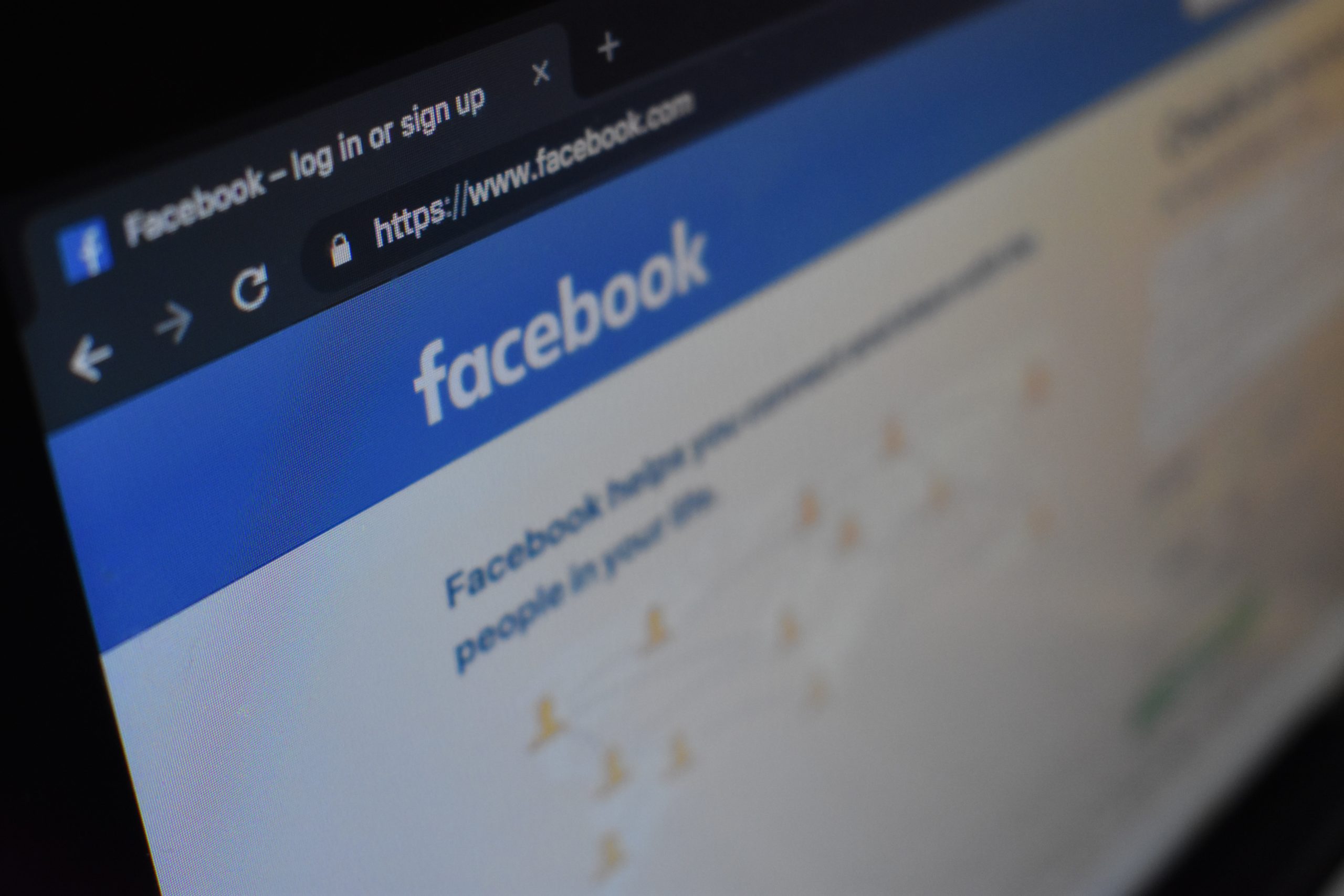
    Screenshot of Facebook landing page on a browser

    Maintaining Budget Control With Ad Set Spend Limits

    Sometimes you’ll need to maintain some control of spend at the ad set level. For this reason, Facebook allows ad set spend limits to be set as a minimum or maximum daily spend.

    • Here are five examples of why you may want to use ad set spend limits:
    • If you create a new ad set to test but it won’t spend, you can force a minimum daily spend until Facebook’s algorithm collects enough data about that ad set. This should only be set temporarily for 2-3 weeks.
    • If you want to control budget based on targeting, such as locals vs. tourists, you can set daily minimums/maximums to align with your desired budget allocation. However, this should only be a temporary solution until you can separate these into their own campaigns.
    • You may want to spend more on promoting a special or limited offer but only for a short period of time (less than 2-3 weeks).
    • You may need to promote an urgent message that requires more spend for a short period of time.
    • If one ad set is spending all of the budget on low-quality results, you should consider setting a daily maximum.

    Disclaimer: Facebook notes, “Use ad set spend limits sparingly, or not at all: The more budget that’s locked into specific ad sets, the less flexibility our delivery system has to optimize your campaign budget.”

    While there are valid reasons to control spend for a short period of time, ad set spend limits should not be a permanent solution if you want to maintain a healthy ad account. At the end of the day, marketers want to produce the most high-quality results at the lowest cost for their clients. It’s best to let Facebook’s algorithm spend the campaign’s budget in the most effective way for the results you chose to optimize for.

    Take Action Now

    As you can see, this mandatory update may require changes in your processes, but Campaign Budget Optimization benefits your Facebook ad account in the long run. If making this transition has been overwhelming, reach out to Search influence for specific recommendations and consulting services. Learn more about how we can also manage your ad account directly with an online advertising package.

    Images

    Mouse

    Hand rub

    Facebook

  • Search Influence’s Newest Influencers Are FOUR Real!

    Myah Catanzaro, who has been hired at Search Influence as an Account Coordinator

    Myah Catanzaro has been hired as an Account Coordinator.

    Myah grew up on the Northshore in Mandeville and graduated from Fontainebleau High in 2014. From there she then went on to go to LSU to study marketing. She has worked and done a little bit of everything—waitressing, leasing agent, promotional specialist for MillerCoors, nanny, and guest service coordinator for a local Metairie salon. When she is not at work, you can find her dancing down the streets of New Orleans with her fellow sisters on The Nola Bombshells dance team, or looking for any and all music events happening around the city. Her favorite thing about digital marketing is that it gives anyone anywhere around the globe, that has a dream or passion, a chance to make their mark on the world.

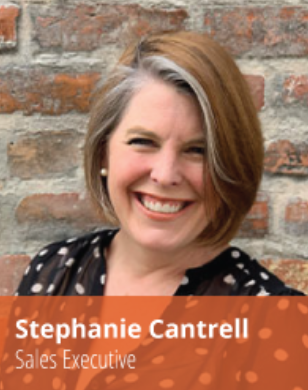
    Stephanie Cantrell, who has been hired at Search Influence as a Sales Executive

    Stephanie Cantrell has been hired as a Sales Executive.

    Stephanie was born and raised in the Pacific Northwest. She moved to New Orleans 15 years ago when she and her family decided they needed a new adventure. Stephanie has over 30 years of customer service, management, and sales experience. When offered the opportunity to join the Search Influence team, she jumped at the chance to experience the ever-changing world of Digital Media. When she is not working, you can find Stephanie offering unsolicited advice to her children, Madison and Liam, or swinging a hammer, remodeling her dream home with her husband Chris.

    Jacob Kliebert, who has been hired at Search Influence as a Junior Quality Assurance Analyst

    Jacob Kliebert has been hired as a Junior Quality Assurance Analyst.

    Born and raised in New Orleans, Jacob is a recent graduate of Louisiana State University. Before starting at Search Influence, he gained experience working in finance and analytics. He is hoping to continue to develop his analytical skills as well as learn new ones in the digital marketing space. He enjoys working with a team and helping foster a positive impact for others.

    Madison Rohr, who has been hired at Search Influence as an Account Manager

    Madison Rohr has been hired as an Account Manager.

    You can usually find Madison posted up at the cutest, coziest local coffee shop, adventuring in the great outdoors, capturing lots of love from behind the camera or networking with other local creatives. She loves anything outdoors (hiking, kayaking, biking), traveling, trying new things, her golden retriever pups, and recently got engaged! When she’s home, she enjoys experimenting with new food and cocktail recipes. Overall, Madison is fairly laid-back, outgoing, and motivated about things she is passionate about!

  • Want to Learn the Key to Raving Fans for Your Brand? Authenticity!

    Want to Learn the Key to Raving Fans for Your Brand? Authenticity!

    Brand authenticity is in the eye of the beholder. It’s easy to see when a person or a brand is inauthentic, but it’s not as easy to put one’s finger on what actually is authentic.

    When actions don’t match words, it’s easy to see the inauthenticity. Boeing, for instance, previously a vanguard of quality, recently covered up a very deadly error. Milli Vanilli, right?

    I can point to a small handful of brands that strike me as truly authentic. Two, in particular, are at opposite ends of the spectrum.

    Burger King

    Burger King, the #2 burger, has done a great job of using humor to demonstrate their brand ethos.

    Their mascot is creepy, no doubt. The head of the King used in their commercials and advertising is weird and discomforting.

    Instead of treating this and the associated press as a problem requiring management, Burger King humorously embraces the freaky King as an authentic representation of their brand. And, they do it while embracing other brands and current events to enhance their relevance.

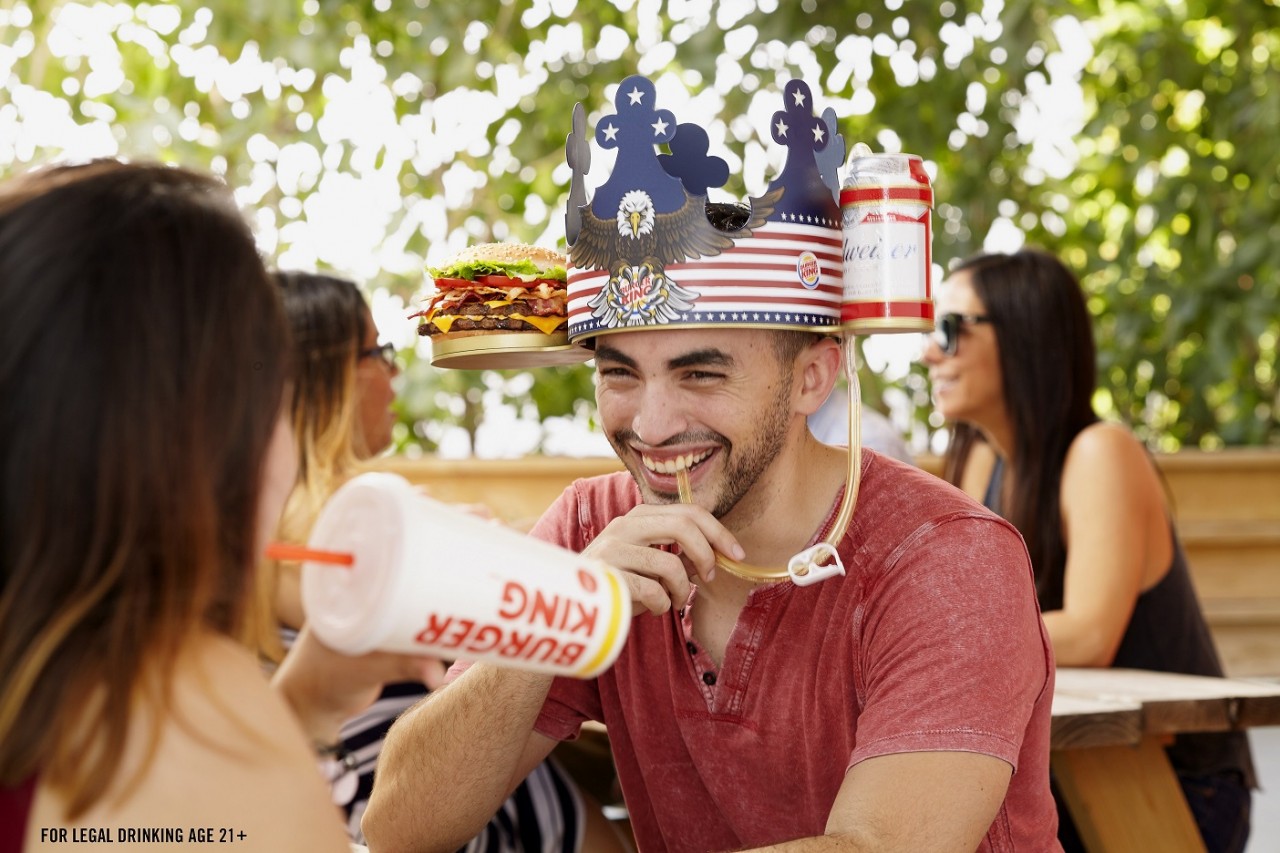
    Take, for example, Burger King taking McDonald’s head-on in a Halloween-themed commercial with the tagline “Come as a clown, eat like a king.” Or, the pantomime King’s first words, a throwback to a classic Budweiser commercial “Whassup”?

    Man with Burger King hat with burger and Budweiser attached and woman drinking soda

    More recently, Burger King Argentina reached out to the Duke and Duchess of Sussex as they seek to step back from their royal duties with an offer of a different source of income.

    As you can see, these are humorous and on-brand with a consistency that’s lasted a decade or more.

    I mean, come on, “Cheetos Chicken Fries!?”

    Picky Bars

    On a very different scale is a small sports nutrition brand in Bend, Oregon called Picky Bars.

    Picky Bars is the brainchild of three current and former professional athletes, two of whom are husband-and-wife team Lauren Fleshman and Jesse Thomas. Fleshman is a former professional runner and Thomas a former professional Ironman triathlete. For this brand, authenticity is apparent in their relationship and their sporting credentials.

    The two produce a weekly podcast called Work, Play, Love, where they talk about their lives, their kids, and their respective business ventures. There are moments when you feel like you just walked into a dinner party where the hosts are uncomfortably tense, having just finished a big argument. Lauren and Jesse both talk about their challenges with their kids, childcare, and the not-so-glamorous parts of their entrepreneurial adventures.

    Jesse Thomas posing in front of I Love Carbs bumper sticker

    It’s educational, funny, and sometimes sad, but very, very real.

    As a vehicle for getting to really know the minds behind the products, the podcast format is great.

    And, they’re equally transparent about the business, as exemplified in Jesse’s 2019 Year in Review blog post, which is a study in brand authenticity.

    Beyond the podcast and blog, Jesse’s humor shows through in the marketing for Picky Bars, particularly on Instagram.

    Jesse takes part in sporting events wearing an inflatable dinosaur costume he calls Barosaurus. In one of their more popular videos, Jesse places an I (heart) Carbs bumper sticker onto his car, which is immediately driven away by the couple’s pre-schooler.

    Pickybars owners posing in the Barosaurus costume at a race
    Original Instagram Post

    While these are very different examples, each is authentic in its own way, ultimately making us feel as though the brand or, in the case of Picky Bars, the founders are speaking to us directly.

    Capturing brand authenticity in marketing is a great way to build brand awareness and trust, but consumers often don’t appreciate when it feels forced. Finding this delicate balance is often a challenge as businesses create their brand voice. The marketing professionals at Search Influence can create advertising campaigns that capture your brand voice and showcase your products and services in a way that speaks to your customers in an effective way. Start a conversation today to learn how we can optimize your potential.

    Images

    Burger King

  • Search Influence Adds 1 New Employee to their Krewe

    Just as New Orleans rolls into Carnival season, Search Influence adds a new member to the Sales & Marketing Royal Court.

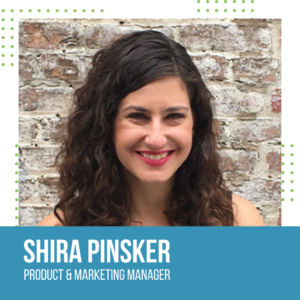
    Shira Pinsker, Product & Marketing Manager

    Whether it’s biking on side streets to find shorter commutes or rewriting copy to convey greater emotion, Shira Pinsker looks for ways to improve. And with 15 years of experience working across the communications spectrum, she understands that a marketer’s job is to revise, learn, and strive for better results. She looks forward to supporting Search Influence’s revenue growth through developing and improving the company’s marketing efforts and product offerings. 

    Shira has increased social media and email newsletter engagement for nonprofit organizations and national brands, with her work on behalf of French Market Coffee and Zatarins recognized with a Judges’ Award and a Gold award from the New Orleans American Advertising Federation Addys. In her roles as a publicist and marketing manager, she has secured media coverage in outlets including NOLA.com, NPR, USA Today, and The Washington Post.


    Welcome to Search Influence, Shira!

    Interested in joining our team? Check out our open positions!