Blog

  • What is Cost Per Inquiry (CPI) in Higher Ed Marketing?

    What is Cost Per Inquiry (CPI) in Higher Ed Marketing?

    What is CPI?

    Key Insights

    • Cost per inquiry is the most important metric to measure and drive the efficiency of campaigns.
    • Cost per inquiry is most frequently tracked as a KPI for digital marketing channels (i.e., CPI from paid search or CPI from organic), and it can also measure the effectiveness of digital marketing spend across all platforms.
    • Search Influence and UPCEA’s 2024 research established a reliable industry benchmark for cost per inquiry and cost per enrolled student in online and continuing education.
    • The joint study found a strong link between metric tracking capabilities and overall campaign performance satisfaction.

    As the education sector evolves and marketing programs — especially to adult learners — become more complex, understanding and harnessing the power of cost per inquiry (CPI) is essential for staying competitive and achieving your institution’s goals.

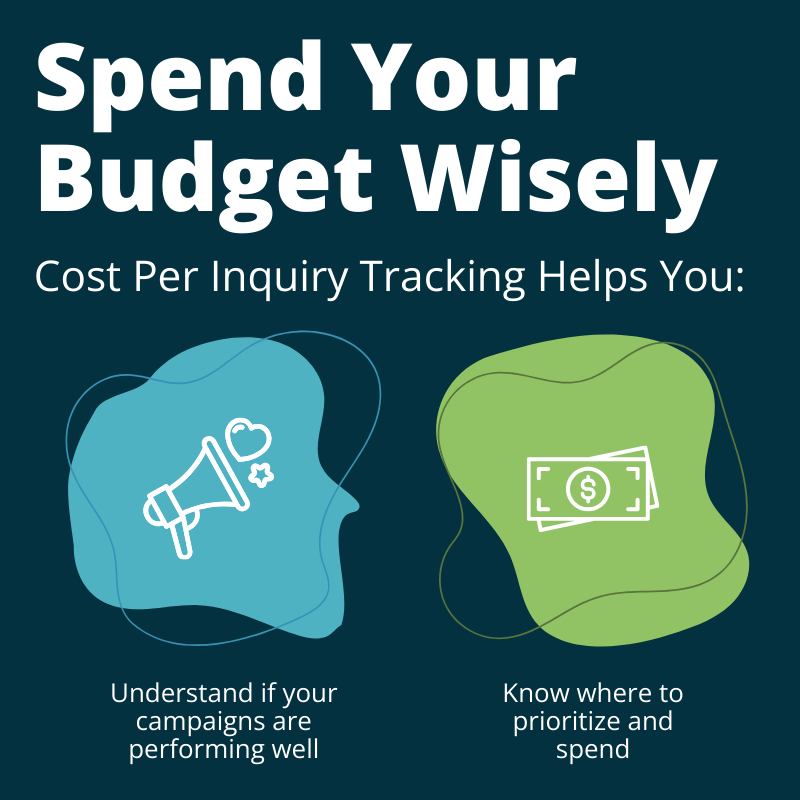
    CPI is the definitive key performance indicator for higher education marketers to track advertising campaign success. Serving as a dual compass, this metric guides your higher education marketing endeavors toward optimal campaign performance and strategic budget spending. It also empowers you to gauge your efficiency, optimize your ad spend, and make data-driven decisions.

    For far too long, higher education digital advertisers haven’t had a benchmark for this critical metric, and certainly not one specific to professional, continuing, and online (PCO) education.

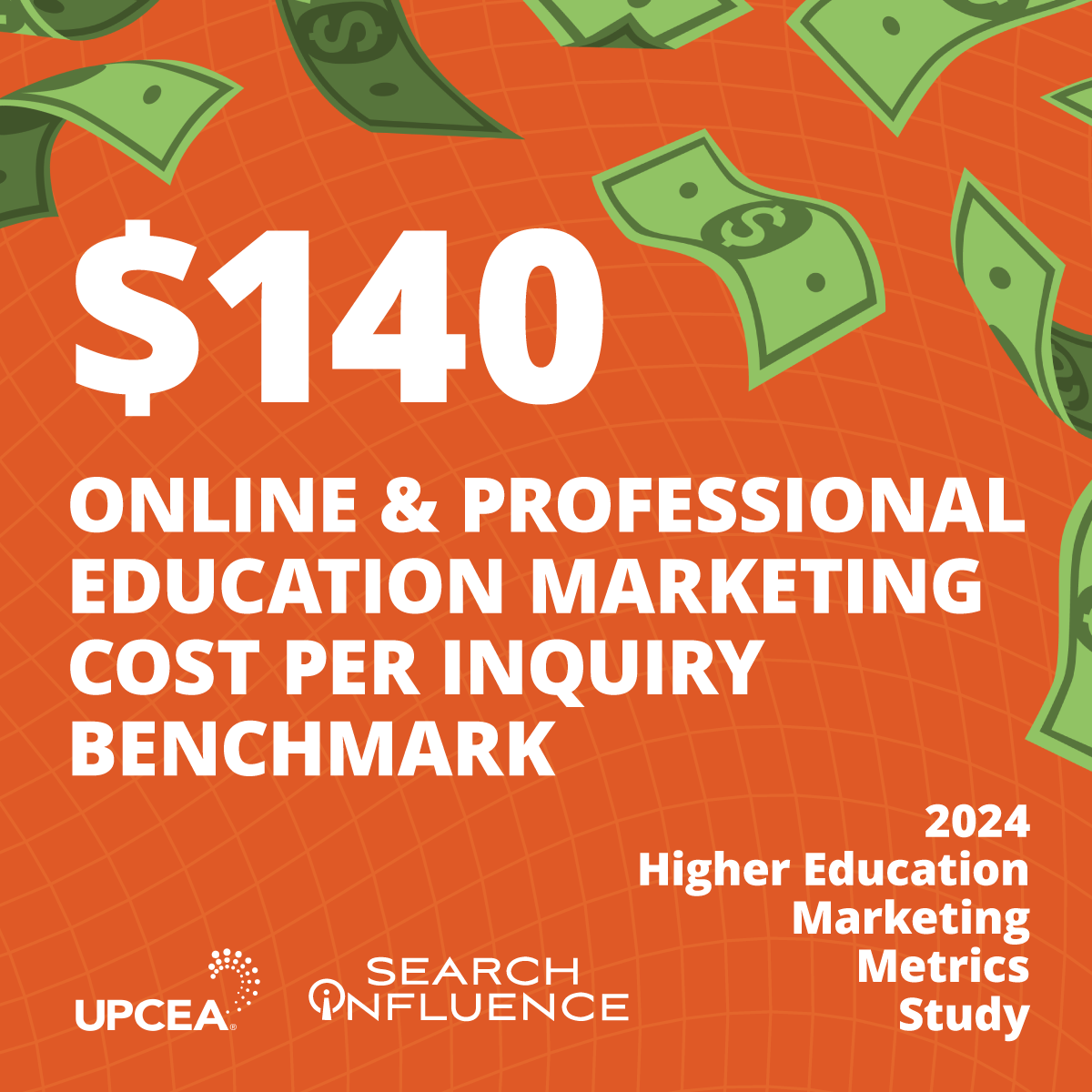
    That’s why Search Influence and our higher education partners at UPCEA (the leading online and professional education association) collaborated to establish the first industry-wide benchmark for CPI — to the tune of $140.

    An infographic courtesy of Search Influence detailing CPI information when doing Higher Education marketing

    In our 2024 study, “Search Influence and UPCEA Higher Ed Marketing Metrics Research Report: What Gets Measured Gets Managed,” we took a look at the state of CPI tracking among PCO units and what marketers need to know to get the most value from their budget spend.

    Before you dive into the research, here’s what to know about CPI in digital marketing, how it’s calculated, and why it should be your school’s top tracking priority.

    What is Cost Per Inquiry in Higher Education Marketing? How Do You Calculate Cost Per Inquiry?

    Cost per inquiry is a fundamental metric that plays a pivotal role in higher education marketing. CPI measures the financial investment required to generate a single inquiry or lead.

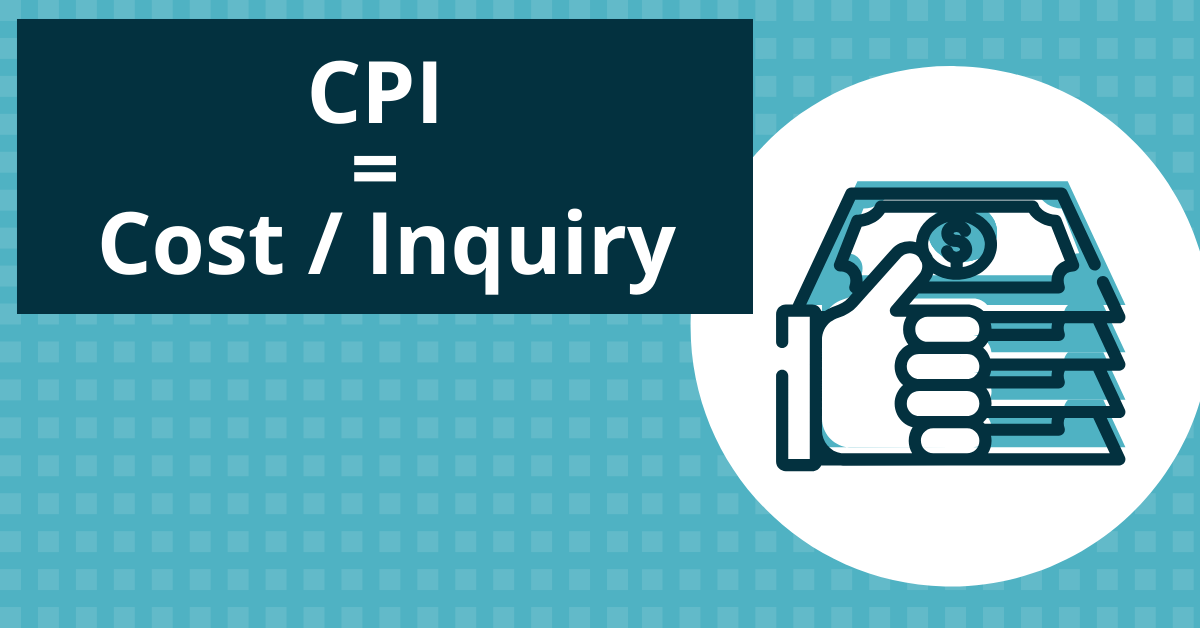
    CPI = Cost / Inquiry

    SI CPI Blog

    In the context of higher education digital marketing, an “inquiry” refers to a prospective student expressing interest in your institution’s programs, courses, or services. This expression of interest could manifest as filling out a contact form, requesting a brochure, or making direct inquiries via email or phone.

    The “cost” in the calculation depends on what marketing campaigns you are trying to measure, your marketing mix, and tracking technology (for example — are you able to track an inquiry back to the source?).

    Cost per inquiry is most frequently tracked as a KPI for:

    • Digital marketing channels (i.e., CPI from paid search or CPI from organic)
    • Digital marketing spend across all platforms

    Some may look at it:

    • CPI per program
    • Organic CPI (leads from organic search visitors)
    • Overall CPI across all marketing expenses

    Different ways to calculate CPI in marketing
    Cost Per Inquiry Worksheet for Higher Education Websites

    In our CPI worksheet, we provide two foundational calculations to help you get started:

    • Digital Advertising Media Spend ÷ # of Inquiries Attributed to Digital Advertising = Digital Advertising Cost Per Inquiry
    • Marketing Expenses ÷ Total Inquiries (All Sources) = Overall Cost Per Inquiry

    This industry-standard cost per inquiry calculation creates an “apples-to-apples” comparison, helping institutions like yours know the real cost and payoff of your marketing efforts.

    Why Measure Cost Per Inquiry in Higher Education Marketing?

    SI CPI Budgeting

    The significance of measuring CPI cannot be understated for marketers.

    CPI in advertising is THE most important metric for campaign efficiency.

    Once you know your CPI, you can begin to optimize your efficiency!

    When you consistently measure cost per inquiry in your higher ed marketing campaigns, you can:

    • Have confidence that you’re driving an appropriate amount of inquiries and yielding the desired results
    • Evaluate your outcomes against broader industry standards
    • Project your marketing results and how quickly you can generate necessary inquiries
    • Judge if the promises from third-party vendors are realistic

    Research Numbers at a Glance

    In our 2024 Marketing Metric Research Study, we examined not only whether PCO units tracked cost per inquiry but also their level of campaign performance satisfaction. Our findings yielded a strong correlation between CPI tracking and perceived campaign success — thus bringing to life the old adage, “What gets measured gets managed.

    Key Research Findings:

    • Less than half of PCO units track cost per inquiry (46%) and cost per enrolled student (43%).
    • Nearly one out of five (17%) higher ed marketers do not track the source of their inquiries, nor CPI or cost per enrolled student.
    • Among the PCO units that track cost per inquiry, the average CPI is $140, with a median of $106 and a range of $29.03 to $450.
    • 92% of those satisfied with their tracking capabilities also express satisfaction or strong satisfaction with the effectiveness of their marketing campaigns.

    For further insights into CPI, how it works, and why it works, be sure to check out our full research study. For more tactics to improve your marketing results, take a look at our Higher Education Marketing Resources & Guides.

    Learn More About CPI in Higher Education Marketing

    What is CPI?

    Search Influence and UPCEA are committed to elevating strategy standards in higher education marketing. We hope that, with this industry-wide benchmark for measuring cost per inquiry, you can implement practical strategies for achieving efficient ad spend.

    And, in a world where nearly one in five dollars of programmatic advertising goes to waste, this pivot to efficiency is much needed.

    Ready to see how you measure up to others in the sector? Download the Marketing Metrics Research Study today to take the guesswork out of CPI in advertising.

    Image Sources:

    Image 1: Unsplash

    Image 4: Unsplash

  • AI for Digital Marketing With Will Scott at DFWSEM State of Search

    Key Insights

    • AI-powered tools offer numerous opportunities for digital marketers, from generating content ideas to researching keywords and programming code efficiently.
    • While AI can produce impressive content, human intervention remains crucial. Relying solely on AI for content creation can lead to subpar results and may not align with Google’s E-E-A-T requirements.
    • Marketers should view AI as a valuable assistant rather than a sole content creator, harnessing its potential while upholding campaign integrity and customer satisfaction.

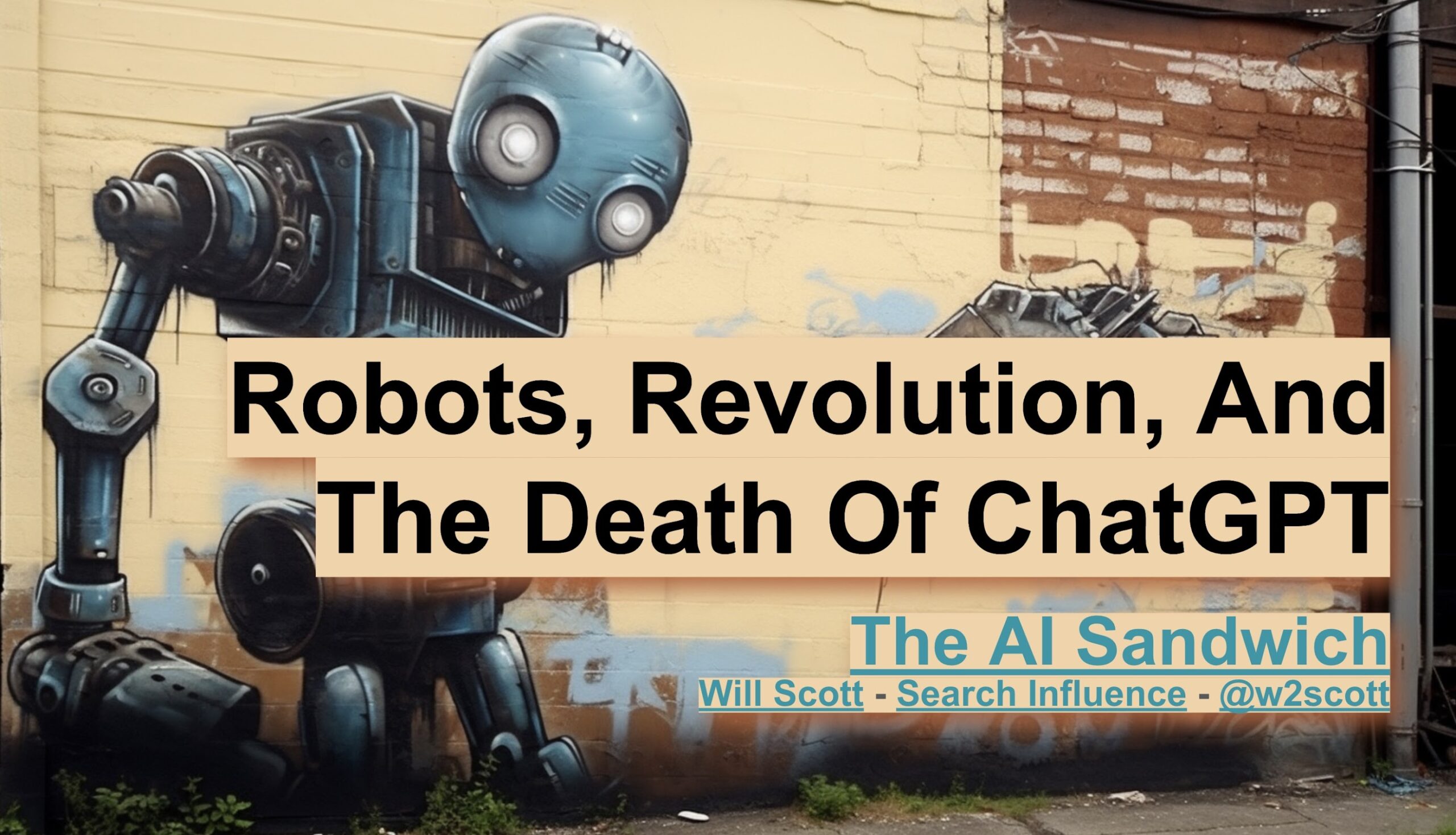
    Image of a robot, showcasing Will Scott of Search Influence in New Orleans' AI for digital marketing presentation.

    Search Influence Co-founder and CEO Will Scott presented “Robots, Revolution, and the Death of ChatGPT” at the 2023 State of Search Conference in Dallas, Texas.

    In Will’s artificial intelligence marketing strategy presentation, the SEO veteran discussed his vision of what incorporating AI into the content creation process will look like and how marketing teams can use AI technology responsibly.

    In this blog post, we’ll dive deep into Will’s thoughts on AI in digital marketing and provide AI-powered tools and content creation techniques to bring your processes into the robotic age.

    What Is the State of Search Conference?

    The State of Search Conference is an annual digital marketing event produced by DFWSEM (the Dallas, Fort Worth Search Engine Marketing Association) that brings together industry experts, seasoned practitioners, and marketing enthusiasts.

    One of the standout features of this conference is the expertise it brings under one roof. Digital marketers who attend this conference learn about the latest and greatest search marketing trends and gain valuable insights from experienced practitioners.

    The digital advertising landscape is in a constant state of flux. From social media dynamics and Google’s ever-evolving algorithms to the intricacies of effective content marketing, staying ahead of the curve is essential. This conference is meticulously designed to equip attendees with practical tips and tricks to master these facets.

    As the topics at the State of Search Conference are always on the cutting edge of marketing, it is no surprise that the main topic of this past year’s conference was AI in digital marketing.

    A long-time resident of the digital marketing world, Will Scott was interested in how artificial intelligence might change the neighborhood. Read on for his thoughts about AI marketing strategies.

    Lessons From “Robots, Revolution, And The Death Of ChatGPT”

    2023 State of Search Conference presentation on AI for digital marketing with Will Scott of Search Influence

    In the late months of 2022, Will began obsessively learning and experimenting with digital marketing AI tools. And while his first thoughts on AI might have brought him to the robot apocalypse — much to the fault of movies like The Terminator, The Matrix, and Blade Runner — he quickly recalculated and began creating practical use cases for AI in digital marketing.

    Everything you need to know about the AI sandwich

    The AI sandwich, coined by Will Scott of Search Influence in New Orleans

    In the ever-evolving content marketing landscape, the AI sandwich has emerged as a game-changing approach to crafting engaging and relevant content. This innovative content creation workflow combines the power of AI-driven tools with human creativity to produce high-quality content across various platforms, from social media posts to blog articles and ad copy.

    Let’s dive into the intricacies of the AI sandwich and explore how it can revolutionize your marketing campaigns.

    The AI Sandwich unwrapped

    At its core, the AI sandwich is a strategic content creation process that integrates the capabilities of AI-powered tools with human expertise. The workflow typically follows a three-step pattern:

    1. Human-Powered Prompts: The journey begins with a human writer who lays the foundation by creating thought-provoking prompts. These prompts serve as the guiding framework for the AI to work its magic.
    2. AI-Generated Content: Enter the AI marketing tool. This intelligent technology takes the provided prompts and crafts content that aligns with the desired objectives. It leverages machine learning algorithms to generate text that resonates with the target audience.
    3. Human Refinement: While AI can produce impressive content, human intervention remains crucial. Skilled editors review, refine, and enhance the AI-generated material. They ensure that the final output is grammatically correct and aligned with the brand’s voice and values.

    Elevating content quality

    The AI sandwich isn’t just about efficiency and cost savings; it’s a recipe for creating content that satisfies your audience’s cravings. By combining the strengths of AI and human oversight, you ensure your content meets the highest standards of relevance and quality.

    Meeting Google’s E-E-A-T requirements

    In today’s digital landscape, Google’s Search Quality Raters evaluate content based on criteria such as Experience, Expertise, Authoritativeness, and Trustworthiness (E-E-A-T). The AI sandwich is tailor-made to meet these standards.

    Beyond “empty calories”

    Think of content generated solely by AI as the equivalent of a quick solo meal — convenient but likely lacking substance. The AI sandwich, on the other hand, resembles a hearty home-cooked meal prepared with care. It’s nourishing content that informs, engages, and resonates with your audience.

    The path forward

    As AI marketing tools use continues to grow, we’re in the midst of an AI-generated content explosion. While some may use these tools for spammy purposes, legitimate content creators recognize the potential to enhance their work, develop creative ideas, and serve their organizations and clients more effectively.

    Embracing the AI opportunity

    For those of us rooted in the world of SEO and marketing, AI, including ChatGPT and its counterparts, offers a tremendous opportunity. It’s not just a means of automating tasks; it’s a tool for testing and refining strategies, optimizing marketing campaigns, and ultimately amplifying the impact for our clients.

    The AI sandwich emerges as a winning recipe in the journey to craft effective marketing campaigns and deliver relevant content. It combines the precision of AI-powered content generation with the finesse of human creativity, ensuring that your marketing efforts stand out in a crowded digital landscape.

    As we move forward, embracing AI as a valuable ally in the world of content marketing will lead to new heights of success and innovation.

    SEO and ChatGPT are alive and thriving together

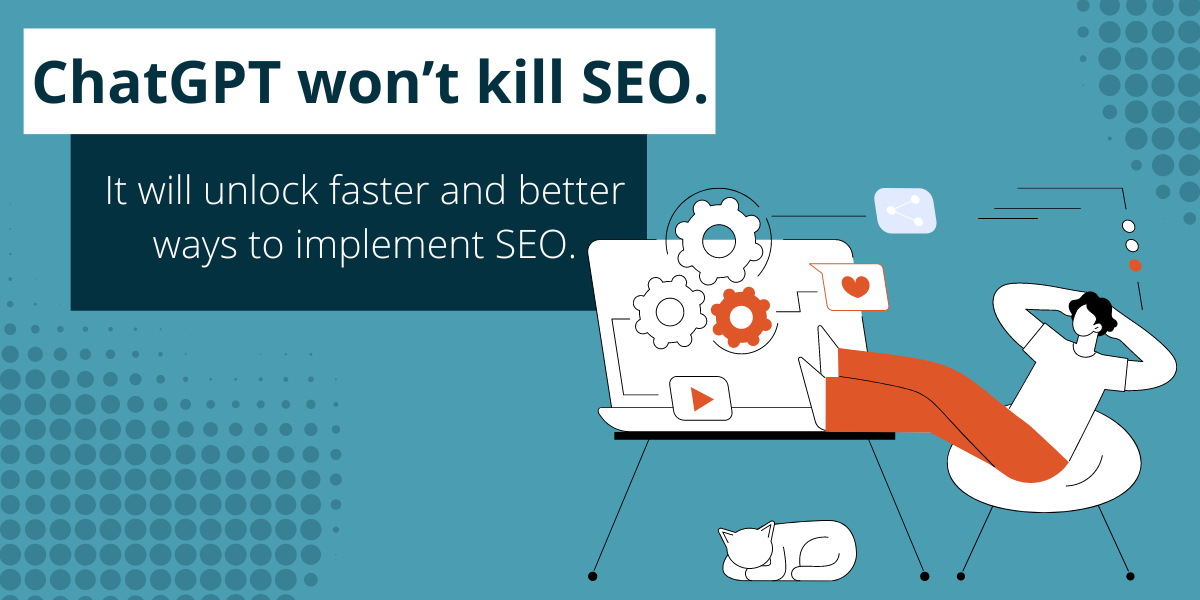
    Graphic depicting the future of ChatGPT and SEO

    SEO is not on life support — it’s adapting and thriving alongside AI advancements.

    ChatGPT and other artificial intelligence tools don’t spell doom for SEO; these machine-learning tools are catalysts for faster and more innovative SEO strategies. They empower SEO professionals to dive deeper into customer data and refine their advertising campaigns.

    Forward-thinking SEO experts should embrace AI tools as a means to enhance their skills. AI tools are becoming commonplace, but their true value lies in individuals who can wield them effectively.

    Content creation processes like the AI sandwich and the AIO method prove that machine learning tools still need a human touch to create content that improves customer experiences.

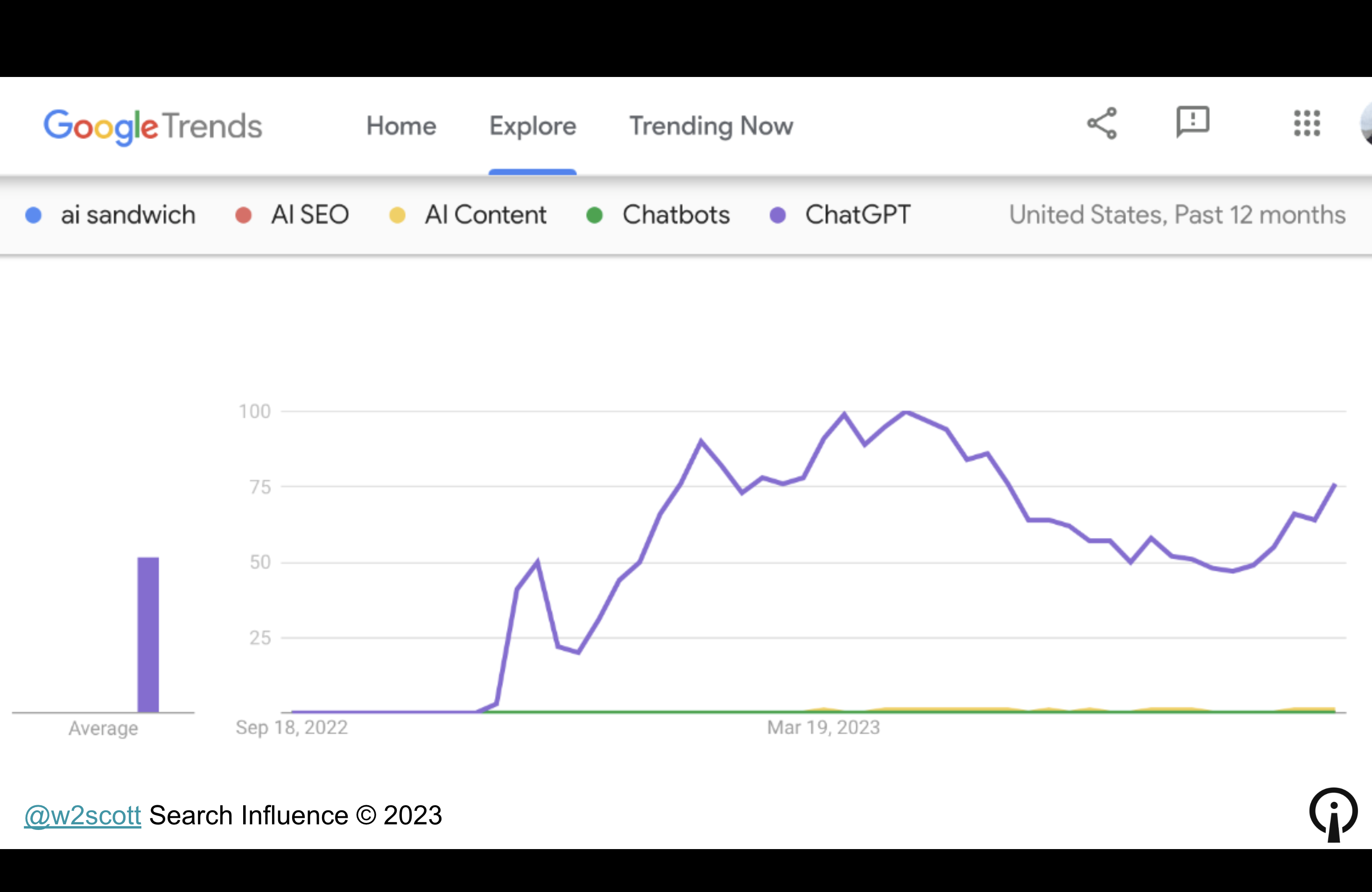
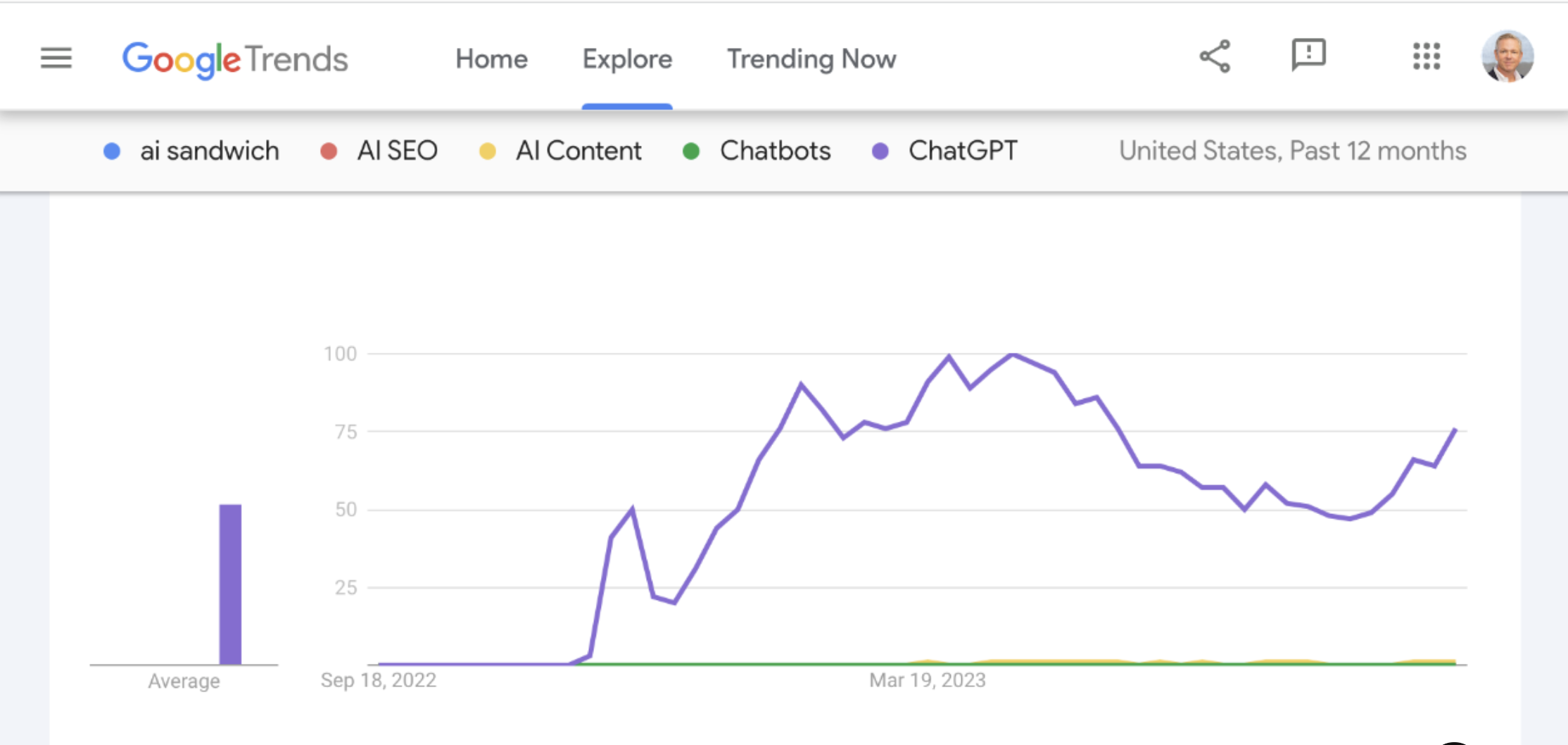
    Contrary to sensationalist headlines, ChatGPT is also far from death’s door. In fact, the screenshot below showing the last 12 months of Google Trends Data proves the AI-powered tool is quite young and spry.

    Graph showing high usage rates of ChatGPT in 2023

    Artificial intelligence tools for digital marketing

    As is the Search Influence way, we’d like you to leave this blog post with some things you can use immediately to improve your marketing campaigns. Below are the marketing tools we have recently used to do everything from automating repetitive tasks to finding relevant keywords.

    Artificial intelligence content tools for crafting engaging content:

    • Machined.ai
    • ZimmWriter
    • Content at Scale
    • Surfer SEO AI Writer

    Artificial intelligence image creation tools:

    • Midjourney
    • Dall-E 2
    • Stable Diffusion

    Artificial intelligence SEO and keyword tools:

    • Frase
    • Surfer
    • PageOptimizer Pro

    Artificial intelligence video tools:

    • Steve.ai
    • Wave.video

    The SEO Skyscraper Method and ChatGPT data mining are a match made in heaven

    Image of a skyscraper, symbolizing the Skyscraper Technique

    Early in 2023, Will explored “ChatGPT: Data Mining and SEO With OpenAI and Bing.” Since then, the landscape of machine learning, AI, OpenAI, ChatGPT, and content has evolved significantly.

    With substantial updates to the core OpenAI GPT, both in technological advancements and content processing capabilities, we’ve entered an era where we can delve deep and wide into topics like never before.

    The integration of web search capabilities through plugins and expanded data exploration tools has transformed ChatGPT into a data mining powerhouse, allowing for the summarization and comprehension of extensive and complex subjects.

    Recent experiments have demonstrated the prowess of ChatGPT in summarizing top articles on a given topic while highlighting unique perspectives. Natural language processing and AI-driven content analyses have made ChatGPT a vital tool for tasks that rely on data collection and correlation analysis.

    Now, let’s bring in the Skyscraper Method.

    The SEO Skyscraper Method, popularized by Brian Dean at Backlinko, is a strategy that’s been imitated repeatedly.

    It’s actually quite simple:

    • Step 1: Find content on your given subject that is worth linking to.
    • Step 2: Write content that is even more informative than the content you found.
    • Step 3: Reach out to the right people who might be willing to link to the web page/content you wrote.

    Back in the initial development of the Skyscraper Method, the focus was on links as indicators of authority. However, Google’s evolution towards a semantic, entity-based web has expanded the playing field. Content and its relationship to recognized entities now share the spotlight with links in SEO success.

    By combining the Skyscraper Method with ChatGPT’s knack for data mining, you can unearth valuable insights with ease.

    Rather than merely one-upping competitors, this approach looks at all content receiving Google’s attention. It acknowledges and respects the competition by summarizing and linking to their work, thereby incorporating semantic entities and keywords.

    By leveraging ChatGPT for data mining, you can simplify the process. It starts with a Google search for your target keyword, leading to fresh ideas and a wealth of links. Then, ChatGPT can extract common elements, such as keywords and subjects covered from the content you choose to use.

    While AI technology is a potent and valuable tool, you’re still Batman, and it’s still Robin.

    Although ChatGPT’s utility for data mining has grown immensely in recent months, challenges persist, particularly in ensuring data accuracy and reliability. This is one of the many reasons you shouldn’t use AI blindly.

    ChatGPT and the SEO Skyscraper Method form a harmonious partnership for extracting valuable insights from web pages and creating worthwhile content. This dynamic duo empowers content creators and SEO professionals to identify patterns, understand market trends, and anticipate future behaviors. As AI tools continue to evolve, their role in providing valuable insights into customer behavior and market trends will expand, making them indispensable assets for data analysis.

    Next in AI marketing: opportunities, concerns, and more robots

    AI-powered natural language generation tools offer marketers valuable capabilities, such as generating content ideas, researching keywords, compiling facts, and even simplifying programming tasks. However, it’s essential to recognize that these tools aren’t flawless and may produce typos or require editing and fact-checking.

    One critical concern is the risk of overreliance on AI. Relying solely on AI for content creation can lead to subpar results and may not align with Google’s E-E-A-T requirements, potentially impacting user satisfaction and campaign effectiveness. Nobody likes a lazy SEO or spammers, especially Google.

    A balanced approach is critical to ensure quality writing that combines AI content creation with human editing — thorough fact-checking is a must.

    By using AI as a valuable assistant rather than a sole content creator, marketers can harness its potential while maintaining the integrity of their digital advertising campaigns and ensuring customer satisfaction.

    There are no doubt more robots to come — AI is a worthwhile technology in a free market, after all. With everyone from venture capitalists to garage start-ups looking to get a piece of the pie (or sandwich?), we must be responsible as we forge these lands.

    As modern-day explorers trekking across this new technological landscape, it’s our duty to avoid making the same mistakes as the navigators of years past.

    We are not here to divide and conquer; we are here to build and progress.

    Image of robots and humans coexisting peacefully

    What’s Next for AI Algorithms in the Digital Marketing Landscape

    From social media marketing to email marketing and collecting data, AI algorithms will reshape the landscape of digital advertising.

    But there’s no need to fear; Search Influence is here! (Underdog is still cool, right?)

    Search Influence will happily be your guide during the AI for digital marketing revolution. No matter your business’s needs, our extensive list of services can help you grow.

    Contact us today to learn how we use the latest digital technology to get our clients real-world results.

  • Search Influence Wins Silver Award in the 2023 U.S. Agency Awards

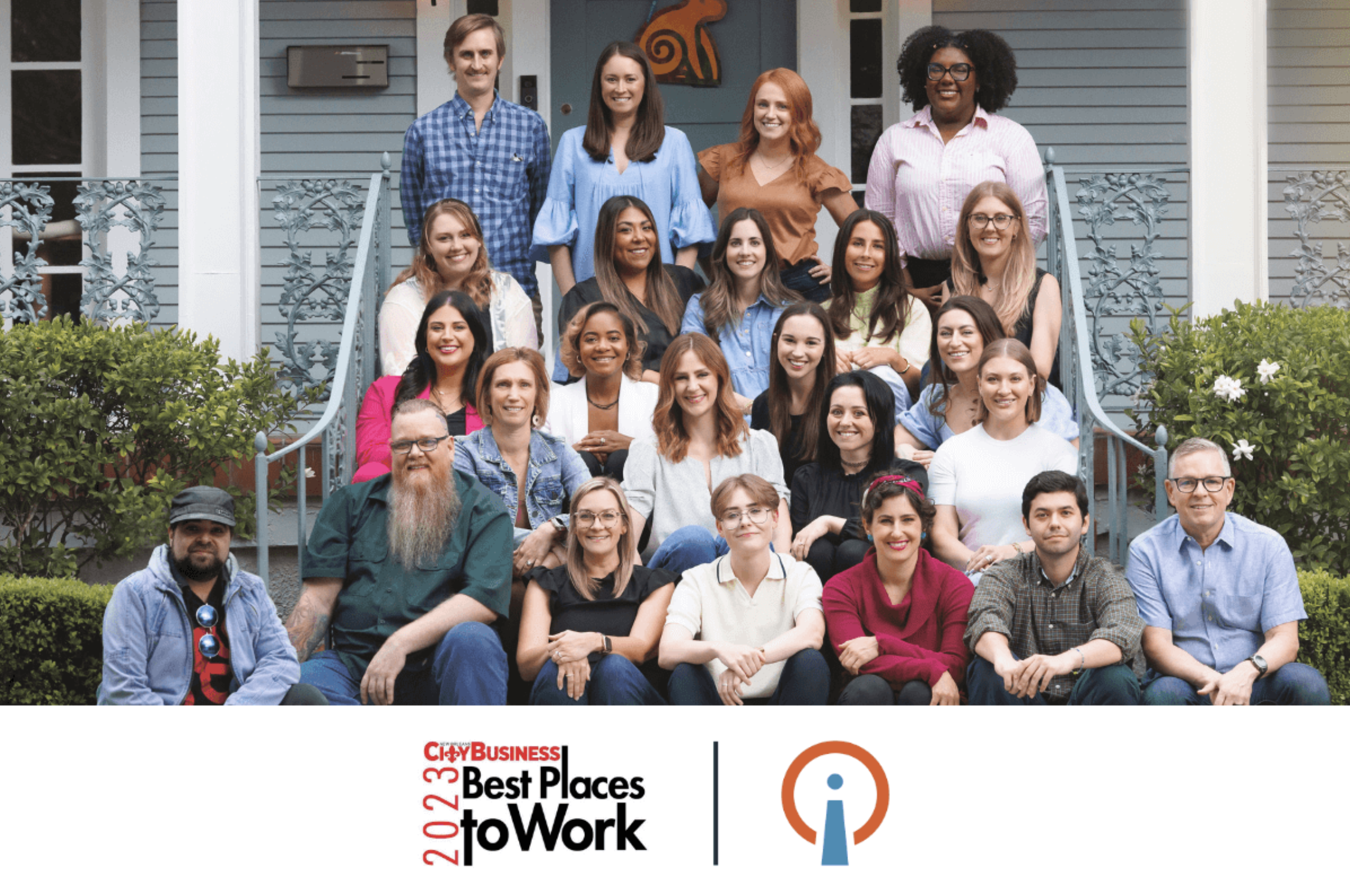
    Search Influence Best Places to Work 2023

    The Search Influence team has won a Silver Award in the 2023 U.S. Agency Awards’ “Best Integrated Campaign” category!

    The U.S. Agency Awards recognized our online advertising campaign for the Center for Restorative Breast Surgery (CRBS) — “Helping Women Find Care Through Meta Display and Google Paid Search” — for its exceptional combination of thought leadership, strategy, and collaboration.

    Our Partnership With the Center for Restorative Breast Surgery

    For over a decade, Search Influence has assisted the Center for Restorative Breast Surgery in using the power of digital marketing to help women find the knowledge and support they need when dealing with a breast cancer diagnosis.

    CRBS, a pioneer in breast cancer treatment, runs St. Charles Surgical Hospital, the only hospital in the world focused solely on breast reconstruction.

    Known for its innovative surgical methods, including flap surgeries and nipple-sparing mastectomies, CRBS is a worldwide authority in complete breast reconstruction, drawing patients from across the globe.

    The award-winning collaboration

    In our latest collaboration, the 2022-2023 Meta Display and Google Paid Search campaign, we helped CRBS increase their visibility, number of qualified inquiries, and amount of inquiries leading to education calls.

    These calls give women the information they need to make informed decisions about their breast reconstruction journey, doubling as a key conversion for the treatment center.

    While we are proud of the success of this campaign, it brings us even more satisfaction knowing our work helped women find the healthcare resources they need.

    The U.S. Agency Awards: Honoring Industry Vets

    Each year, the U.S. Agency Awards celebrate the most outstanding contributors in the marketing and advertising sectors across the country. These awards recognize digital marketing individuals and teams that consistently excel and produce impactful outcomes in their field.

    The event features 25 distinct award categories, each meticulously evaluated by a panel comprising industry insiders through a comprehensive two-stage judging procedure.

    We are honored to have won a Silver Award in the “Best Integrated Campaign “ category and to have spent many years collaborating with the Center for Restorative Breast Surgery.

    Our New Orleans Digital Marketing Agency’s Commitment to Excellence

    Search Influence crafts top-level digital marketing campaigns that help our clients reach new heights.

    Contact us today to learn more about our record of success in SEO and digital advertising.

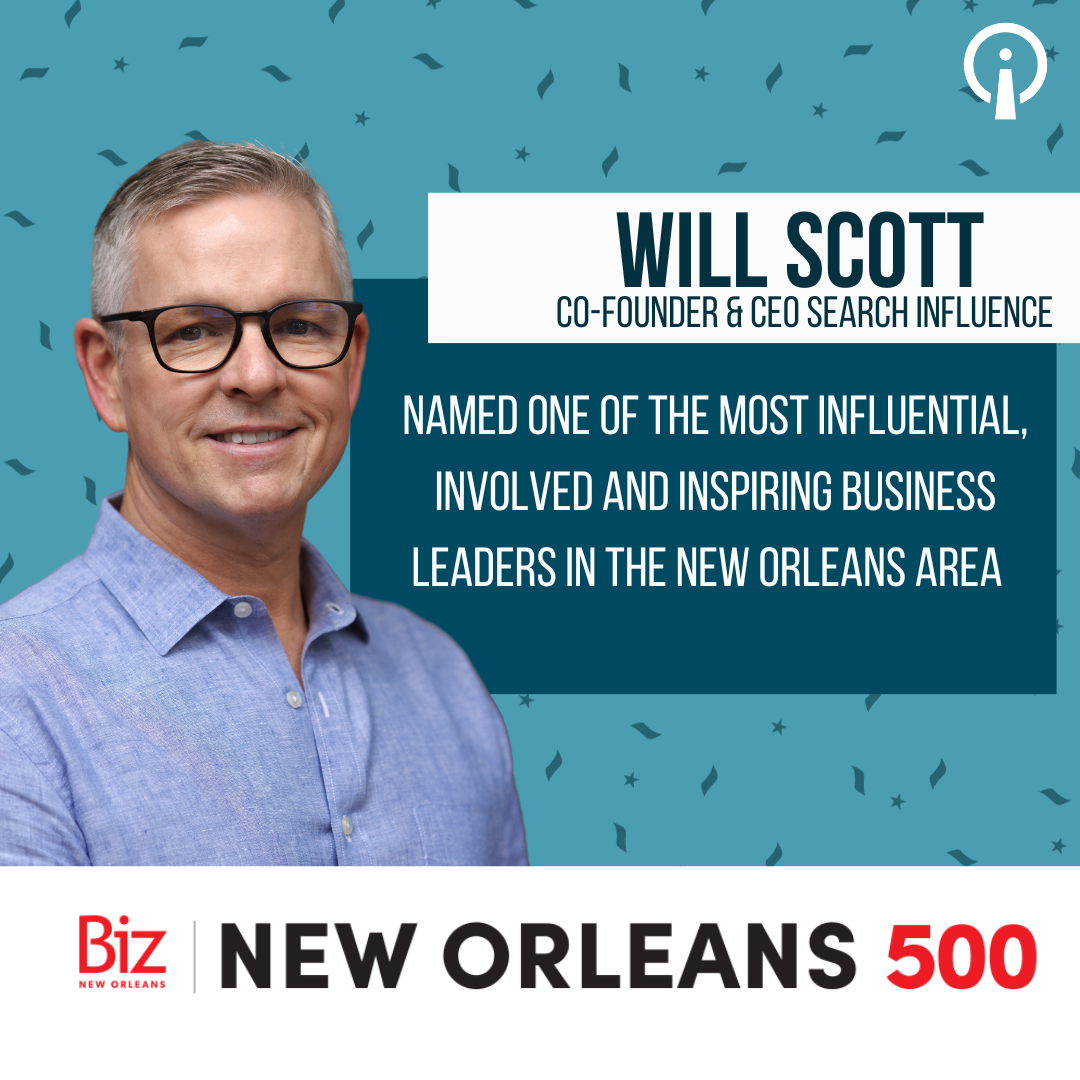
  • Search Influence CEO Will Scott Named a 2024 Biz New Orleans 500

    Biz New Orleans has named Search Influence CEO and Co-founder Will Scott to its 2024 New Orleans 500 list!

    Published annually by Biz New Orleans magazine, the New Orleans 500 recognizes and profiles all the business leaders driving growth in the metro New Orleans economy. Biz New Orleans is a national award-winning monthly publication covering all the latest business happenings in The Big Easy and its surrounding areas.

    Will is humbled to be mentioned alongside New Orleans’ sharpest minds and most forward-thinking entrepreneurs — but this journey to the top didn’t happen overnight. Will has spent the last 30 years learning, growing, and innovating in all things digital marketing.

    Biz New Orleans has named Search Influence CEO and Co-founder Will Scott to its 2024 New Orleans 500 list

    About Will Scott: Digital Marketing Mogul

    Since his first website went live in 1994, Will hasn’t taken his foot off the gas. He’s led innovative teams responsible for developing thousands of business websites, hundreds of thousands of web pages, and millions of visits from searchers across industries.

    Will has not only participated in the SEO industry — he’s helped to shape it.

    As a recognized digital marketing leader, Will coined the phrase “barnacle SEO” in 2008 to describe the act of leveraging authoritative websites for highly competitive keywords to boost one’s own content.

    Today, the strategy is used by everyone from Semrush to Moz.

    Alongside his wife and business partner Angie Scott, Will founded the digital marketing agency Search Influence in 2006. Together, Will and Angie have grown Search Influence from its humble beginnings as a spare bedroom operation serving local businesses to a nationally recognized digital marketing agency known for embracing the latest and greatest technologies.

    Like a surfer searching for the next big wave to conquer, Will has spent most of 2023 knee-deep in his latest SEO marketing obsession — artificial intelligence.

    From developing the AI sandwich to presenting at the UPCEA MEMS Conference and Pubcon, Will has quickly positioned himself as an AI marketing expert in this newfound landscape.

    Contact Will’s Digital Marketing Agency in New Orleans

    Will and the entire Search Influence team thank Biz New Orleans for their recognition.

    If you’re ready to work with an experienced SEO team backed by an award-winning CEO, contact Search Influence to learn more about all the SEO services we offer.

  • UPCEA MEMS Conference Insights: SEO Strategy for Higher Education

    UPCEA MEMS Conference Insights: SEO Strategy for Higher Education

    SI MEMS Conference

    Key Insights:

    • Research indicates that most people’s first interaction with a brand occurs through a search. This makes it critical to optimize your university’s online presence for SEO.
    • Despite 84% of marketing departments considering SEO as a core part of their strategy, 51% of institutions surveyed still lacked an established SEO strategy. This gap in readiness can result in missed opportunities to attract prospective students and increase enrollment numbers.
    • Building a successful SEO strategy for higher education starts with understanding search intent, conducting keyword research, and creating high-quality content that addresses these keywords. It’s also important to build authoritative links both internally and externally.
    • Beyond content, universities must focus on website architecture, user-centric design, site speed optimization, and mobile responsiveness to improve discoverability and enhance the user experience.

    For the second year in a row, Search Influence presented at UPCEA’s MEMS (Marketing, Enrollment Management, and Student Success) conference.


    The UPCEA MEMS conference serves as a watering hole for higher education marketers, specifically those within professional, continuing, and online education.

    At Search Influence, we help higher ed institutions ride the ever-changing waves of SEO strategies. We’ve spent years working on higher education SEO strategies that support universities nationwide in increasing organic traffic and attracting prospective students.

    This dedication to building high-level SEO strategies for educational institutions led us to partner with UPCEA to connect with like-minded individuals.

    Search Influence and UPCEA collaborated on a three-part research study to look at institutional and marketing leaders’ perspectives on SEO and evaluate the readiness of PCO (professional, continuing, and online education) units.

    Our findings shaped our 2023 MEMS presentation. Armed with the understanding that universities need guidance in their higher education SEO strategies, we wanted to show real examples, from multiple schools, of what they have done to improve their visibility in search engines. It was important for us to show not just what the tactics are, but how they drove results. We partnered with 3 great institutions who we knew were effectively executing SEO to share how they have found success.

    Keep reading to learn about our in-depth higher education SEO research and real-world SEO strategies you can implement on your university’s website.

    Search Influence / UPCEA SEO Research Study: Key Findings

    Our collaborative SEO for higher education research study with UPCEA began with a readiness audit of 100 UPCEA member institutions. This audit led to some surprising findings.

    When those surveyed were asked, “How would you rate the SEO capabilities of your PCO unit on a scale of 1 to 5, where a 1 is not very capable and a 5 is extremely capable?,” 3.5 was the average capability rating. 41% of those surveyed rated their SEO capabilities as average or below.

    An even more surprising finding is that 84% of marketing departments see SEO as a core part of their marketing strategy, but 51% do not have an established SEO strategy.

    This missed opportunity leads to fewer clicks from prospective students and lower enrollment numbers for your higher education institution.

    So, how can you improve your higher ed website’s SEO?
    What are the first steps you should take to create an established SEO strategy for your higher-ed website?

    Search Engine Optimization 101


    You must utilize these strategies to keep search engines happy: keywords, content, and links. Think of these three things as your university website’s building blocks.

    Keywords – what are people searching for when looking for your offerings?
    Content – how well does your website provide information that speaks to those keywords?
    Links – how well do other websites reinforce that you are an authority on those keywords?

    Let’s talk through how that might look when you actually do this foundation work:

    Every SEO for higher education strategy must start with determining a prospective student’s keywords (in other words, what terms do they search?).

    For example, say you do some digging in Google Search Console and see your website receives a lot of website traffic for the phrase “online master’s programs.” Recognizing your audience is searching “online master’s programs” is your first win.

    Now that you know your prospective students are scanning through search engines for “online master’s programs,” it’s time to do some keyword research to dial in your strategy.

    You choose to use one of the many SEO tools (even a free tool will work) on the market to take an in-depth look at the search volume of “online master’s programs.”

    Search volume looks good, but your SEO tools inform you this keyword will likely take much work to rank for. Not to worry, “flexible online master’s programs” has a similar search volume but will be much easier to rank higher for.

    After thorough keyword research, it’s time to write high-quality content that uses your focus keyword, “flexible online master’s programs.”

    You decide the best action is to write a 1,400-word blog titled “The Benefits of Flexible Online Master’s Programs for Working Adults.”

    While you’re writing, you link to the pages you want to be associated with this idea, which are the degree pages that offer flexible online master’s programs. You also include links from highly authoritative external sites — you’re really getting the hang of things!

    At the end of this process, you have an informative blog that answers your students’ search intent.

    Now to earn authority, you leverage online profiles, media and PR mentions, and partners to build links back to this blog post as well as related program / degree pages.

    Lather, rinse, and repeat this process continually. Over time, you’ll see your site’s search traffic rise.

    After you’ve mastered SEO 101, it’s time to move on to the next course.

    Search Engine Optimization 201

    You’ve established relevance with your high-quality content.

    You’ve taken the steps to earn authority with link building.

    Now, it’s time to improve your discoverability by focusing on your higher-ed website’s architecture.

    To earn rankings on a search engine, higher education websites must address three things: relevance, authority, and discoverability.

    Fixing the foundation of your virtual storefront

    Think of your website as a virtual storefront that welcomes and engages visitors. Sometimes, you need to fix things inside the walls or under ground to create a welcoming place for visitors, or perhaps improve signage to make it easier for visitors to find their way around. On a website, this is akin to the technical foundation and settings as well as the navigation and user experience.

    Similar to how a brick-and-mortar retail operation would welcome a walk-in customer, the virtual storefront should prioritize the visitor’s experience and ensure that it is user-friendly, informative, and tailored to their needs.

    One common pitfall many universities fall into is designing websites that prioritize their institution’s programs over the potential student’s needs. Additionally, while aesthetically pleasing, overly creative websites might lack a clear target audience, ultimately hindering their effectiveness.

    To succeed in the competitive landscape of higher education, universities must shift their focus and design their websites around students, as well as break down technical barriers that may prohibit a site’s performance.

    A few ways you can design your website around prospective students include:

    • Creating a user-centric design
    • Removing all broken links
    • Creating clear navigation
    • Ensuring your website is easily navigable when used on mobile phones (not just desktop)
    • Prioritizing site speed optimization

    Increase Lead-to-Application Conversion With Blogs — LSU Online

    Our MEMS conference presentation partners at LSU Online increased their lead-to-application conversions with blogs.

    The challenges they navigated included:

    • Their programs’ official names are “distinguished” (not what people actually search for).
    • They competed with on-campus version pages of the same degree.
    • Many adult learners don’t know what degree they want to pursue.

    LSU Online tested varying blog topic strategies to see results on search engine results pages, including:

    • Start your career blogs
    • Comparison content for two programs
    • Faculty/director authored blogs
    • Online student tips blogs
    • Student story blogs

    While these blog topics worked with varying success, this influx in targeted content led to an app increase of 17% in just one year. Moral of the story — high-quality content works.

    Search Influence/LSU Online - Lead to Application Conversion

    Leveraging SEO audit tools for direction and monitoring

    Like any other journey, you need a map to travel to the top of search engine rankings.

    LSU Online found success using site audit tools to guide their rise in organic search traffic. Their SEO audit revealed broken links, broken pages, and program pages missing basic meta information (title tag, meta description, etc.)

    These tools allowed LSU Online to bring their site audit score from 72% all the way up to 90%+.

    Keywords + Content When Launching New Degrees — Tulane SoPA

    In November of 2022, Tulane SoPA launched two new online bachelor degrees: An Online BS in Organizational Behavior & Management Studies and an Online BA in Human Resources.

    SoPA went all in on SEO, primarily content creation and smart optimization, for these two programs as the primary means of promotion, as there was no specific paid advertising budget.

    In one year, Tulane SoPA published 12 blogs that had high SEO value, including: “5 Reasons Every Business Needs An Organizational Management Professional,” “4 Key Legal Considerations for Starting a Small Business.”

    As a result of these higher education strategies, Tulane SoPA had 32 students declared as business majors in just over a year.
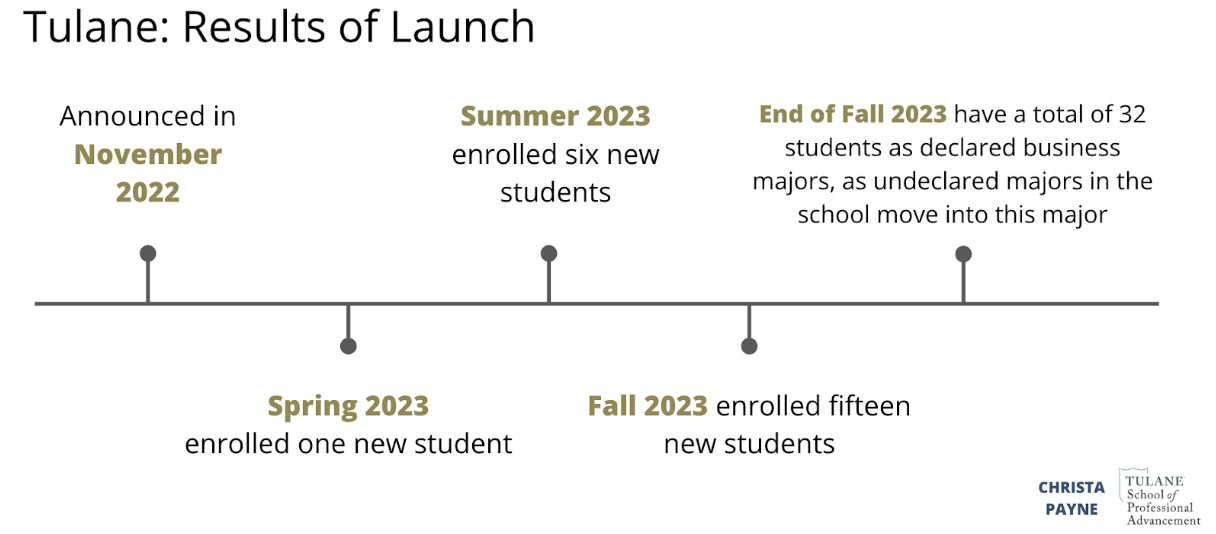
    Search Influence Keywords + Content When Launching New Degrees — Tulane SoPA

    Profiles and public relations to build links

    Search Influence also assisted Tulane SoPA in finding sites with premium (paid) placement for external link building that had value – meaning, they were both authoritative and relevant.

    We went through over 20 sites to help Tulane SoPA find the ones that might be worth it. In the end, Niche and Peterson’s had a fair price, high page and domain authority, and a relatively high percentage of followed links.

    These backlinks helped to build Tulane SoPA’s authority.
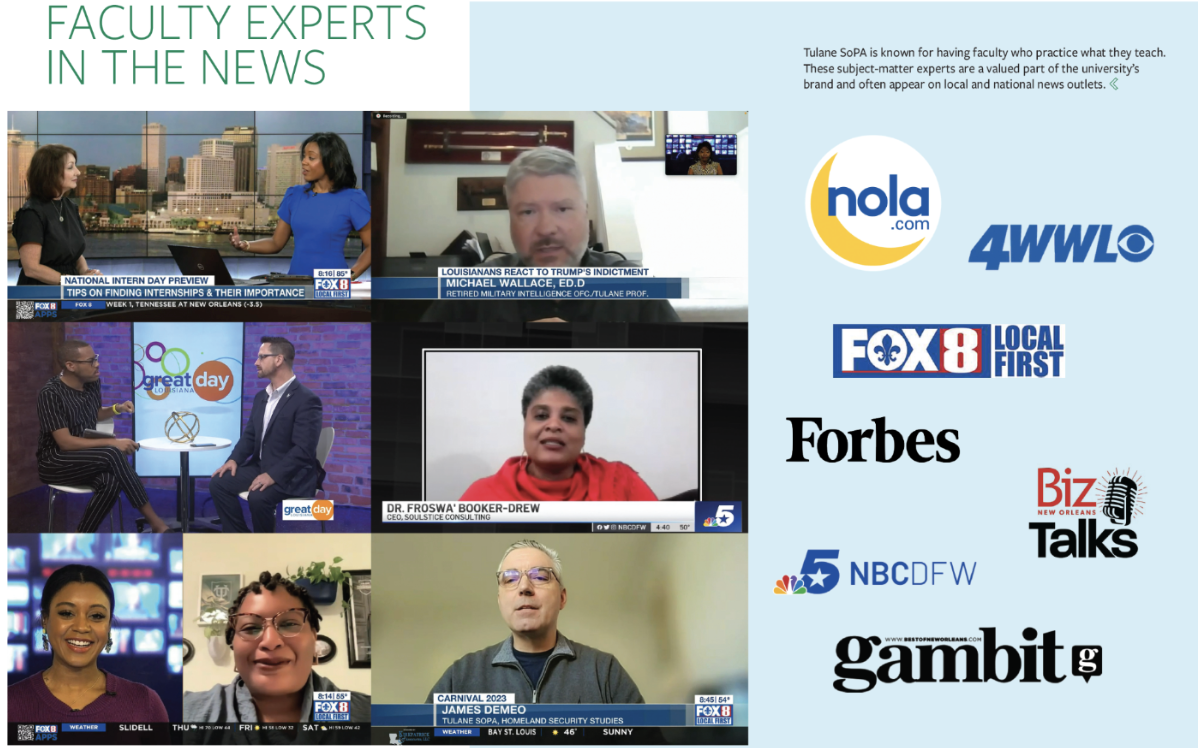
    Search Influence Backlink Authority - Tulane SOPA

    Tulane SoPA also used public relations and earned media to enhance online visibility.

    Tulane SoPA faculty completed over 100 earned media appearances in a year. Each appearance is shared on the Tulane SoPA news site, optimized for SEO value, as well as on social media.

    The above content strategy helped Tulane SoPA rise in search rankings, thus increasing their visibility to potential students.

    Drive New Website Users With Blogs — CCAPS at the University of Minnesota

    CCAPS (College of Continuing & Professional Studies) at the University of Minnesota used blogs to drive web traffic.

    Their content strategy goals:

    • Generate brand awareness
    • Increase web traffic and, ultimately, inquiries
    • Earn backlinks from other sites and pass link authority to program pages through internal links
    • Gain featured snippets

    To do this, CCAPS did the following:

    • Partnered with a digital marketing agency
    • Posted 2–3 blogs per month
    • Completed keyword research and targeting
    • Combined content with schema markup, internal links, and backlinks to improve authority
    • Amplification

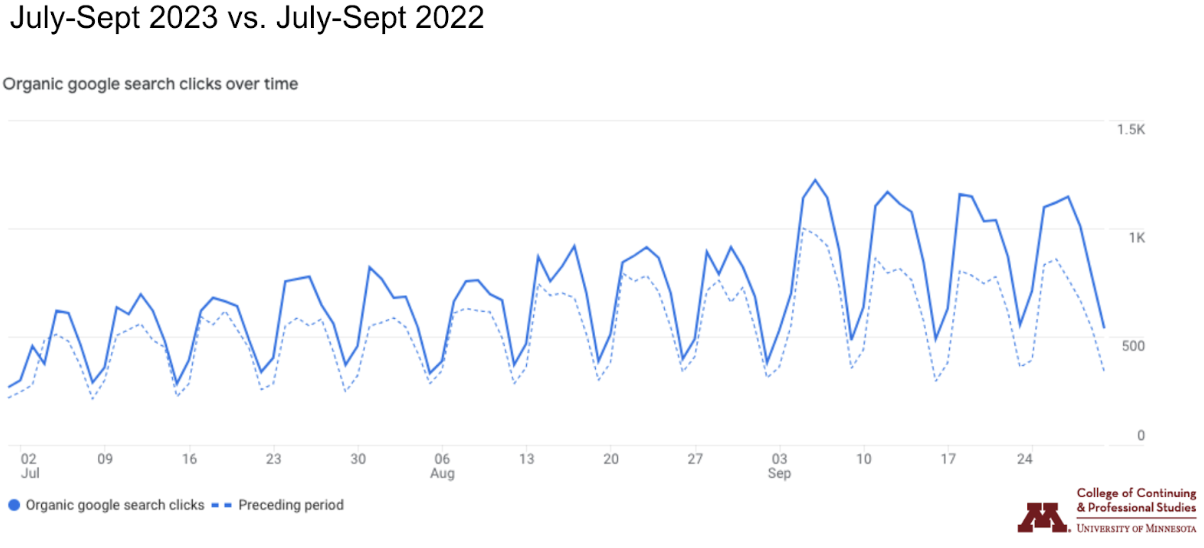
    Search Influence CCAPS Blog Content Performance

    Since July 2022, CCAPS published over 40 blogs, generating over 50,000 users by September 2023.

    Core web vitals for SEO health

    To climb search engines like Google Search, you must dive deeper into core web vitals for SEO health.

    CCAPS used LCP (Largest Contentful Paint) to measure website load speed, TBT (Total Blocking Time) to measure their website’s interactivity, and CLS (Cumulative Layout Shift) to measure their website’s stability.

    All of these web vitals allowed CCAPS to gauge their SEO health and adjust their strategies to rank higher on search results.

    Learn More About SEO for Your Higher Education Strategy With Search Influence

    Search Influence has helped organizations boost their search engine results and organic traffic for over 15 years.

    From our years of driving results for Tulane SoPA to helping our partners at Palo Alto University exceed their expectations, we understand the factors that can help you rank on Google search and beyond.

    Are you ready to identify keywords and Google trends on your own? Download our SEO Workbook for Higher Education Websites for SEO tips you can implement yourself.

    Need a little more hands-on help to understand Google Analytics and local SEO? Contact the higher education marketing moguls at Search Influence to learn more about successful strategies.


  • Search Influence and UPCEA to Present at the 2023 UPCEA MEMS Conference

    2023 UPCEA MEMS Conference

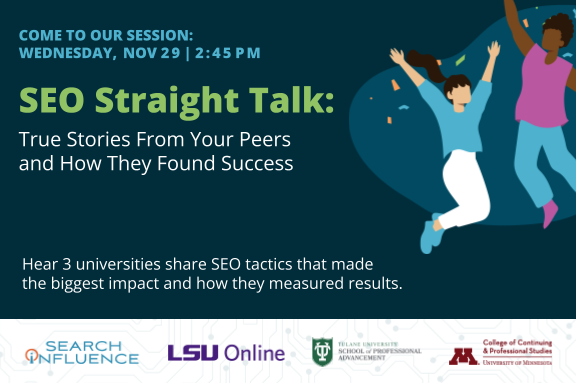
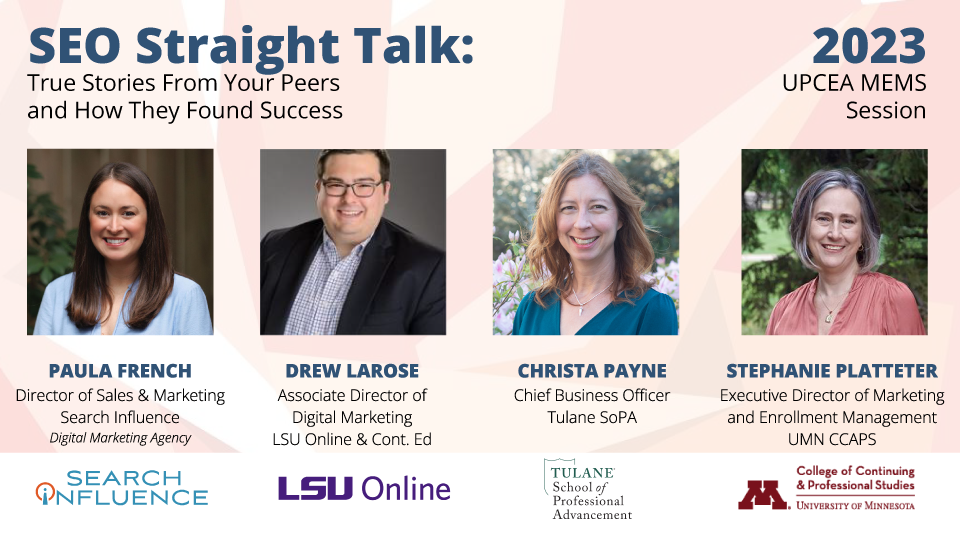
    This year at UPCEA’s 32nd annual MEMS Conference, Search Influence Director of Sales & Marketing Paula French will present “SEO Straight Talk: True Stories From Your Peers and How They Found Success” alongside:

    • Drew Larose, LSU Online & Continuing Education Associate Director of Digital Marketing
    • Christa Payne, Tulane SoPA Chief Business Officer
    • Stephanie Platteter, UMN CCAPS Executive Director of Marketing and Enrollment Management

    This year’s Marketing, Enrollment Management, and Student Success Conference (MEMS) will take place at the Hilton Portland Downtown from November 29th – December 1st.

    The conference offers all who attend networking opportunities, engaging programs, and a chance to learn the latest higher ed marketing strategies from energized thought leaders.

    Higher Education SEO Session Description

    Paula French and the other industry experts mentioned above will discuss a critical gap in higher education digital marketing: PCO units lack SEO strategies to attract new adult learners and nurture them down the recruitment funnel.

    Thankfully, our experienced higher education marketing presenters offer solutions.

    To address this gap, universities must prioritize SEO tactics that make it easy to access information about their programs or certificates via search.

    During the presentation, our presenters will review real-world examples of SEO strategies and tactics that addressed this gap for Search Influence, LSU, Tulane SoPA, and the University of Minnesota.

    The higher education SEO strategies and tactics they will explore include:

    • Using blogs to increase lead-to-application conversion
    • Leaning on keywords and content when launching new degrees
    • Using blogs to drive new website users
    • Utilizing profiles and public relations to build links
    • Leveraging tools for direction and monitoring
    • Using core web vitals to measure SEO health

    2023 UPCEA MEMS Conference

    Learn More About Higher Education SEO With Search Influence

    Since becoming an UPCEA Platinum Partner in 2022, Search Influence and the PCO industry leader have worked diligently to help higher ed marketers bridge the SEO gap.

    From our higher ed research study to our MEMS presentation in 2022 and now this year, we are dedicated to pushing higher education SEO to new heights.

    Contact us today to learn more about all our SEO services, or download our SEO workbook to identify three months of SEO techniques you can execute immediately.

  • Higher Education Marketers: Here’s How to Convince Your Boss to Invest in SEO

    Higher Education Marketers: Here’s How to Convince Your Boss to Invest in SEO

    Key Insights

    • SEO is critical for higher education institutions, yet only 51% have an established SEO strategy.
    • If your institution isn’t investing in SEO, you’re missing opportunities to reach prospective students and keep up with your competition.
    • Understanding and communicating the long-term benefits of SEO to your higher-ups can help your institution make the case for more resources.
    • Pitching the value of SEO to your boss doesn’t have to be a massive undertaking. All you need is a little bit of industry insight, institutional data, and the right angle.

    For today’s tech-savvy students, the quest for higher education starts with a simple Google search.

    Prospective students are looking for your institution online, but will they find you? Search engine optimization, or SEO, is a term often tossed around in marketing meetings, and it’s never been more relevant.

    So, how do you move it from a buzzword to a budgeted line item?

    And, more importantly, how do you get your decision-makers to hop on board?

    In this blog post, we’ll show you how to convince your boss to invest in SEO and make bigger waves in the search engines with a proper strategy.

    Business team members in a conference room discussing investing in SEO - Search Influence

    Benefits of SEO in Higher Education Marketing

    You’ve likely heard that a quality SEO strategy leads to better search performance.

    But what does SEO for higher ed really do? And what makes it such an influential marketing tactic?

    When you invest in the SEO process, you get:

    • Increased Visibility: A well-optimized website can dramatically increase your institution’s visibility in the search engines. This makes it easier for prospective students and their families to find you while searching for educational opportunities.
    • Higher Quality Traffic: Effective SEO efforts attract users actively seeking information related to higher education, thereby improving the quality of organic traffic to your website. These high-intent visitors are more likely to take desired actions, such as applying or requesting more information.
    • Better User Experience: SEO is not just about pleasing search engines; it’s also about providing a good user experience. A well-optimized website is generally more user-friendly. This positively impacts metrics like time spent on the site, bounce rate, and conversion rate, which in turn can boost your SEO rankings.
    • Competitive Advantage: A strong SEO strategy can give you a crucial edge over competitors. If your institution ranks higher in search results than other schools, students are more likely to visit your site first, giving you the first shot at making an impression.
    • Analytics and Insights: SEO tools provide valuable data on visitor behavior, popular content, and more. This data can be used to make informed decisions about your marketing strategy, academic programs, and even campus facilities.
    • Improved ROI: SEO allows you to reach the right audience at a lower cost by focusing on target keywords most relevant to your institution and its programs. This offers a better return on investment (ROI) than other marketing channels.
    Despite all the benefits, SEO in higher education lags. As we found in our Higher Education SEO Research Study conducted with UPCEA, 51% of universities don’t have a strategic SEO plan.This means over half of participating universities miss out on opportunities to grow their awareness, analytics, and applications.

    To truly win in the higher ed landscape, SEO must be a priority.

    Luckily, it’s not too late to make the financial case for SEO investment and start climbing the search engine results.

    But, if you keep pushing off investing in SEO, you just might pay later — in losses.

    How to Convince Your Boss to Invest in SEO

    While the merits of SEO are evident to those immersed in the digital realm, making them resonate with leadership is a different ballgame.

    Approaching the conversation with a combination of data, foresight, and understanding can be the key to unlocking the coveted resource you need: SEO buy-in from your boss.

    Follow this blueprint to advocate for SEO services in your marketing budget.

    Build a Strong Case

    Decision-makers want facts before dishing out dollars.

    Start by laying solid groundwork.

    • What is SEO?
    • What skill sets are needed?
    • What are the benefits?
    • How does it strategically fit within your institution’s goals?

    Be sure to also emphasize its return on investment (ROI) potential. Money talks.

    Show the Gaps

    Presenting an audit or analysis of your institution’s current website and online marketing strategy can highlight the areas where you’re falling short.

    You can tap tools like Sitebulb, Screaming Frog, Semrush, and Ahrefs for handy website analysis insights. But if you’d prefer to pass the baton to experts, you also could lean on an experienced SEO agency to conduct a professional-grade audit for you.

    Maybe you’re missing meta descriptions. Or you’re dealing with poor site speed and insufficient keyword research.

    Your task at hand is to show how SEO bridges these gaps.

    Leverage Competitor Analysis

    You may not invest in SEO. But your competition does.

    It’s one thing to understand the benefits of SEO. It’s another to see competitors already capitalizing on them.

    Creating a competitive analysis can be a strong motivator, especially if those competitors are outranking your institution in organic search results.

    Doing keyword searches of certain degrees or programs is one easy way to get started on your competitive analysis. Take note of who ranks in the top positions, compared to where you rank, and you have a baseline of where you currently stand — and where you need to go.

    Demonstrate to your higher-ups what SEO is doing for your rivals, and you increase your chances of seeing what it can do for you.

    Offer Scalable Solutions

    Don’t bite off more than you can chew. Present a phased SEO strategy that starts small and expands as you show results.

    A scalable approach ensures that initiatives will mature, evolve, and provide value over time.

    Your decision-makers are more likely to approve budgets if they see this sense of scalability.

    Scalability is sustainability. The SEO strategies that can adapt and grow are the ones that endure.

    Use Real-World Examples

    For the higher-ups, seeing is believing.

    Don’t just talk about what SEO can do for your university. Show its potential, armed with solid proof.

    Bring out higher education case studies and results from other institutions who’ve invested in SEO. Take, for example, New Orleans-based university Tulane SoPA, which saw a 569% increase in keyword ranking in the top 1-3 spots on Google — with help from frequent blogging.

    These real-world SEO examples can make the concept more relatable, compelling, and actionable.

    Connect SEO to Broader Initiatives

    SEO isn’t an isolated tool; it’s a cog in the larger machinery of a higher ed digital marketing strategy.

    It works best when used in tandem with paid search marketing, like Google ads or other well-performing marketing efforts. Therefore, it fits — not trumps — your institution’s broader marketing and outreach initiatives.

    This can make it easier to get buy-in if decision-makers see SEO as a component of a larger strategy rather than a stand-alone effort.

    Break down the big-picture, complementary value of SEO, and you may just seal the deal.

    Large group of spectators watching a presentation in a lecture hall - Search Influence

    Common Objections From Decision Makers

    Every proposal faces scrutiny, and SEO is no exception. It’s a natural part of the advocacy process.

    However, preparing for and addressing these objections head-on can turn potential setbacks into stepping stones.

    Prime yourself to deal with these common objections before setting up the proposal:

    • Objection: SEO is expensive! Think of the initial setup, the ongoing monitoring, and the potential need for hiring an external SEO company.
    • Counter-Argument: While SEO is an investment, the effects and impact on our website traffic are long-term, versus paid advertising, where once we stop paying, the traffic stops coming.
    • Objection: SEO typically doesn’t provide immediate results, so what’s the point?
    • Counter-Argument: SEO is a long-term strategy that requires time to yield results, but once it does, the benefits endure. A well-optimized website can maintain high rankings for a long time, ensuring a consistent inflow of targeted traffic.
    • Objection: SEO doesn’t align with our institution’s core goals and objectives.
    • Counter-Argument: Improved online visibility and targeted traffic can directly impact key performance indicators like student recruitment, donor contributions, and brand reputation — a goal any institution wants to reach.
    • Objection: We’re already ranking pretty well without investing in SEO.
    • Counter-Argument: There’s no way all of our web pages rank #1, or even on the first page, of the organic search results. Plus, there’s always the opportunity to increase our rankings for keywords that our competitors currently rank for.

    The Consequences of Neglecting SEO

    Ahrefs data shows that 90.63% of webpages receive no organic search traffic from Google.

    Why?

    They don’t prioritize SEO. Or, at least, they don’t prioritize it the right way.

    If your institution turns a blind eye to all that SEO has to offer, you risk:

    • Loss of Visibility: With numerous higher education institutions vying for the attention of prospective students and parents, failing to invest in SEO means your institution may not show up in search engine results. This results in lost opportunities to drive students to your website.
    • Decreased Enrollment Rates: Students nowadays often begin their college or university search online. If your institution isn’t visible during these crucial moments, you’re missing out on a large number of potential applicants, affecting your enrollment rates.
    • Increased Marketing Costs: Without a solid SEO strategy, your school may rely more heavily on paid advertising channels, which can be significantly more expensive in the long term. In contrast, organic search traffic generated through SEO is essentially free.
    • Losing Ground to Competitors: Other institutions that invest in SEO will take the top-ranking spots in search results, garnering more attention and credibility. This competitive advantage can result in a cycle where they continue to attract more students, donors, and faculty, widening the gap between you and them.
    • Damaged Reputation: A poorly optimized website that doesn’t rank well may be perceived as less reputable or authoritative. It’s a psychological factor — many people equate high search engine ranking with credibility.
    • Missed Opportunity for Data-Driven Decisions: SEO tools like Google Analytics provide valuable data that can help your higher ed institution understand what prospective students are looking for. Without this insight, you won’t be able to make more informed decisions on everything from course offerings to campus facilities.

    Be sure to drill these risks into the minds of your decision-makers. No one likes consequences or the act of underperforming, and these looming threats can help accelerate their decision.

    Higher Ed SEO Leads to Greater ROI

    UPCEA Chief Research Officer Jim Fong summed it up perfectly in our Higher Ed SEO Research Study webinar: “SEO is not something institutions can kick the can down the road on. It’s going to become increasingly important, especially as the number of programs increases and the number of potential students stays the same or even decreases.”

    As SEO industry veterans, Search Influence has the skills, expertise, and bandwidth to take on all of your SEO initiatives. Convince your higher-ups to invest in SEO, and we’ll take the heavy lifting off your plate with our expert SEO services.

    Ready to get started with SEO? Contact us today to learn about our SEO Roadmap and see how we’ll put our higher education marketing experience to work for you.


    Image sources:

    1. https://images.unsplash.com/photo-1573164574572-cb89e39749b4?ixlib=rb-4.0.3&ixid=M3wxMjA3fDB8MHxwaG90by1wYWdlfHx8fGVufDB8fHx8fA%3D%3D&auto=format&fit=crop&w=2938&q=80
    2. https://images.unsplash.com/photo-1492538368677-f6e0afe31dcc?ixlib=rb-4.0.3&ixid=M3wxMjA3fDB8MHxwaG90by1wYWdlfHx8fGVufDB8fHx8fA%3D%3D&auto=format&fit=crop&w=2940&q=80
  • #1 Organic & No Clicks? Google Ads 2023 SERP Smackdown!

    #1 Organic & No Clicks? Google Ads 2023 SERP Smackdown!

    High Ranking Keywords and Low Traffic?

    google ads 2023

    Are algorithm updates and AI just a red herring for more Google Ads in 2023?

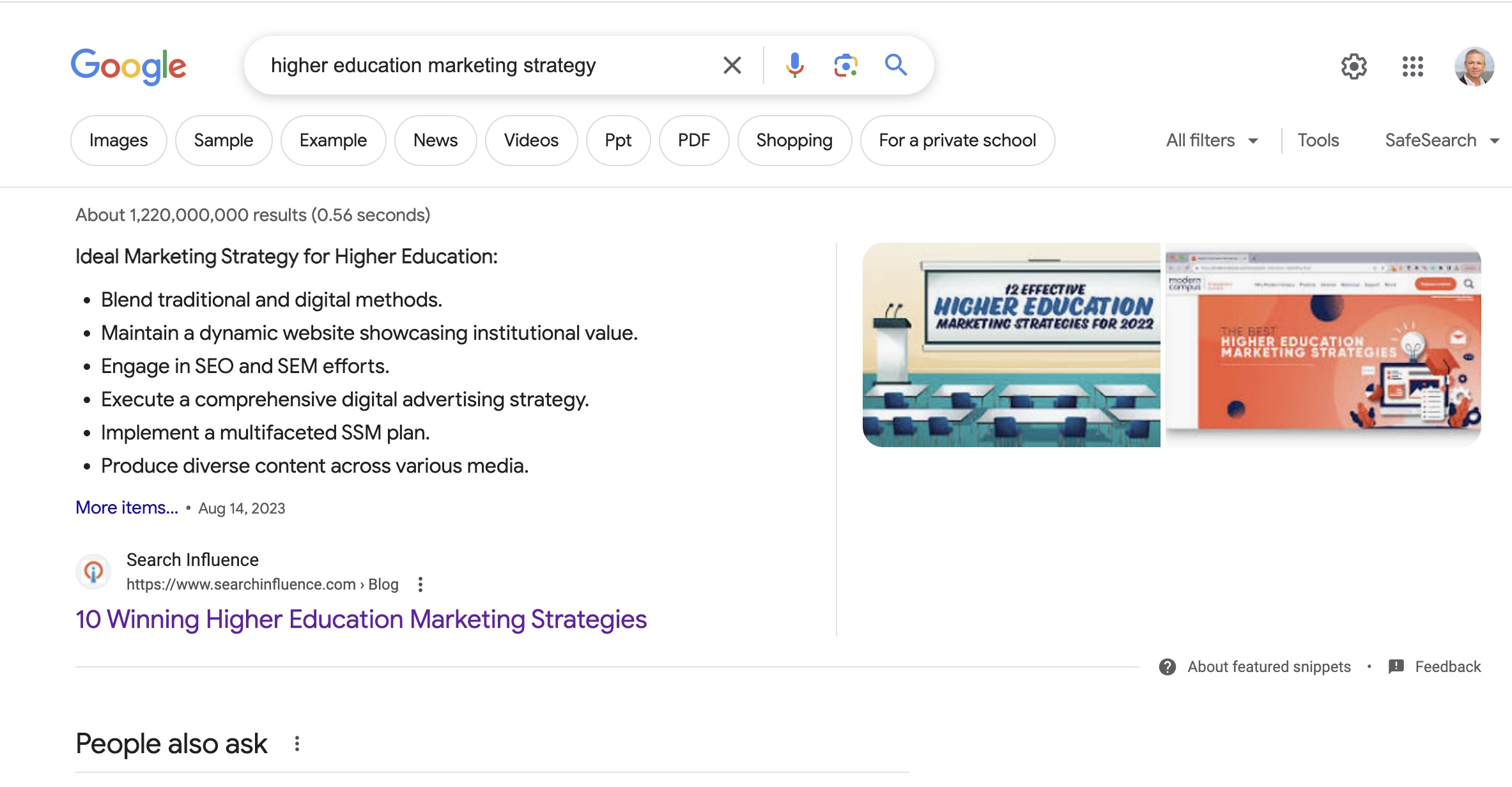
    It’s not just a #1 position. It’s a rich snippet. And a full-feature rich snippet with images, a bulleted list, and everything.

    But the CTR (click-through rate) is a measly 3%.

    We searched for the cause. Was it not a real ranking? Were we seeing a personalized search?

    higher ed marketing

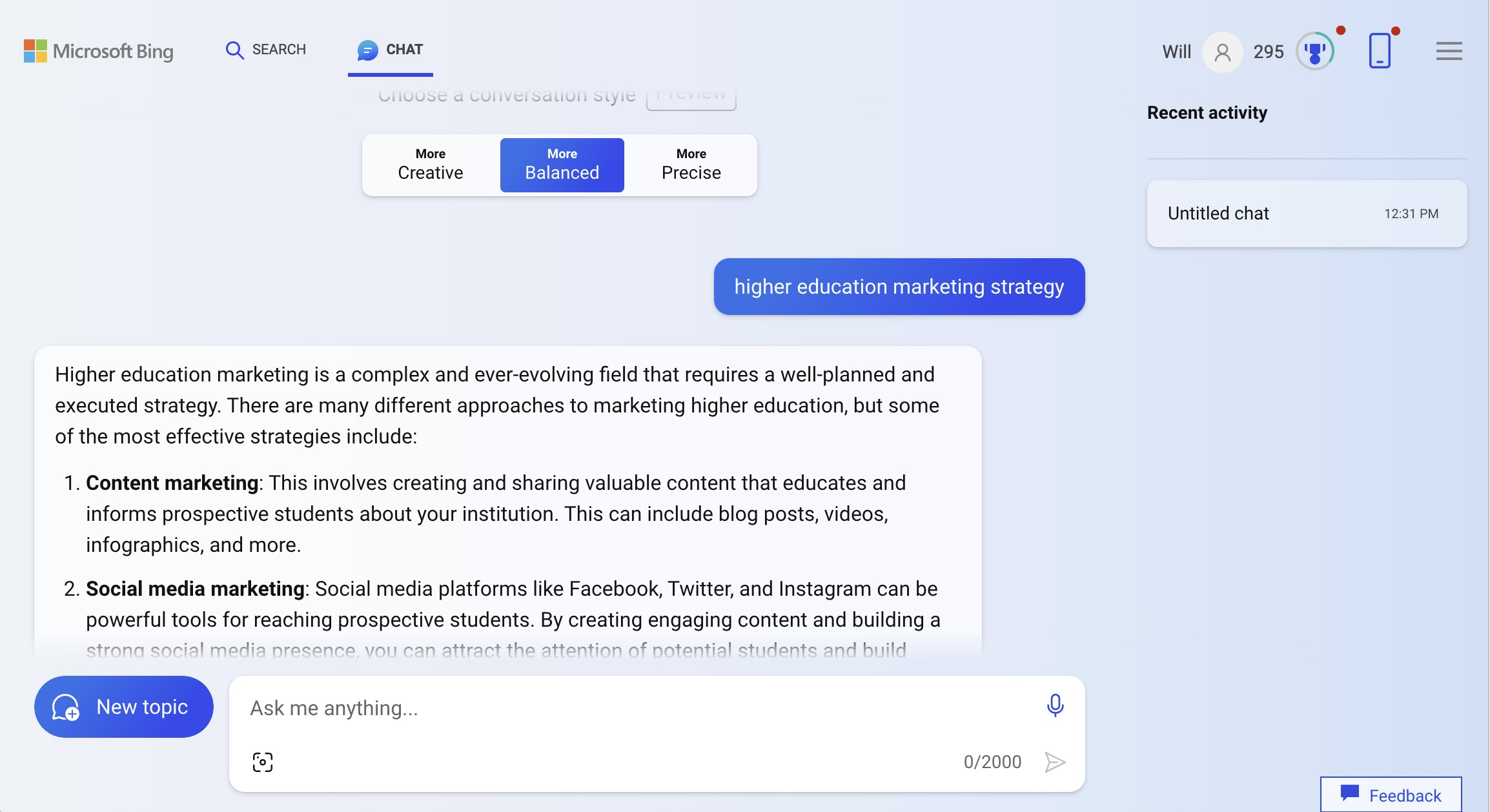
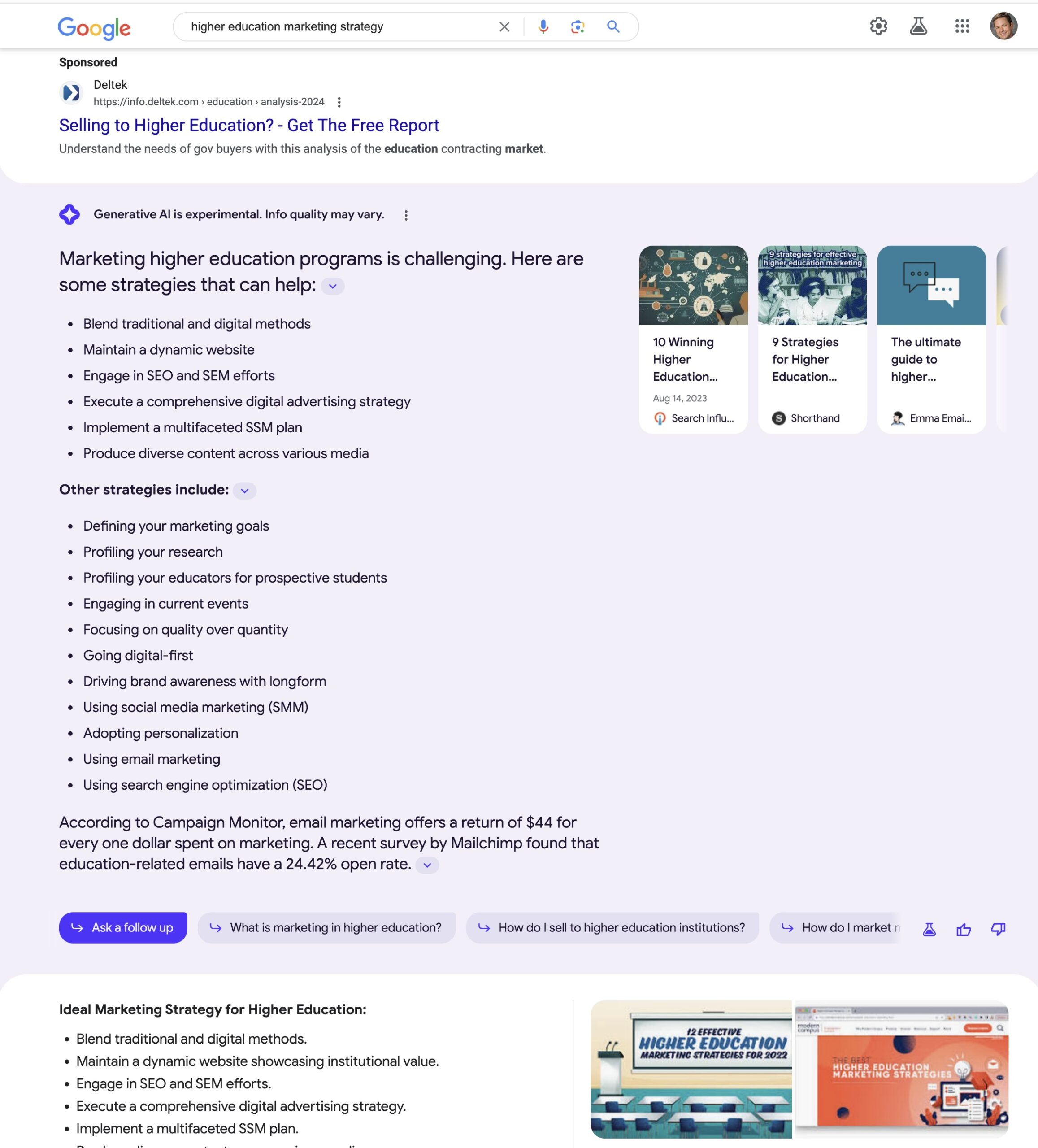
    Screenshot of “Higher Education Marketing Strategy” query on Google

    No. It was Google!

    Google Ads, to be specific.

    And for some searches, Google SGE, the new Search Generative Experience.

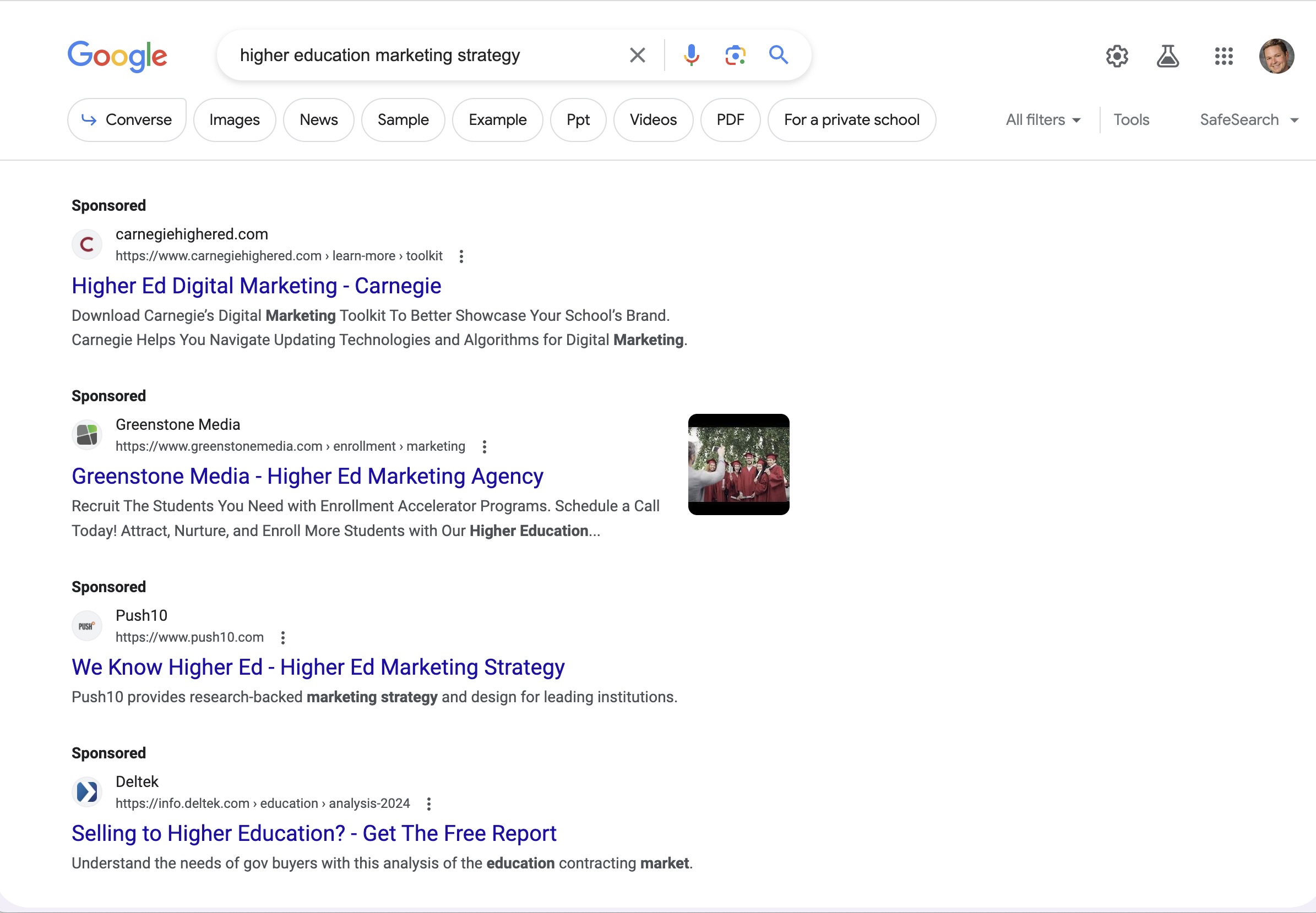
    We discovered that there was now a big fat pack of ads over the top of organic results. Where there used to be a couple of small ads, there are now four, with site links and lots of white space.

    Depending on the search, you have to scroll once, and sometimes twice, to get to the organic results.

    google ads 2023

    Screenshot of “Higher Education Marketing Strategy” query on Google from a non-SI account.

    Why would Google want to suppress organic search results? Let’s look at some examples and see what we find.

    While the SEO community has been worrying about Google Algorithm updates and the impact of AI, Google has quietly expanded the real estate devoted to Google Ads in 2023.

    Perhaps the talk of algorithm updates and AI was a red herring.

    Google SERP (Search Engine Results Page) 2023

    2023 was a busy year for Google. In addition to several algorithm updates, Google had to contend with AI, both in its index and in its user interface.

    AI, specifically the use of Large Language Models, exploded in early 2023. Tools for AI-enabled content creation, previously on the fringe, became mainstream.

    In addition to a flood of new content clogging up its index, Google — already an AI-powered platform — brought some of that intelligence to the search interface in the form of SGE (Search Generative Experience).

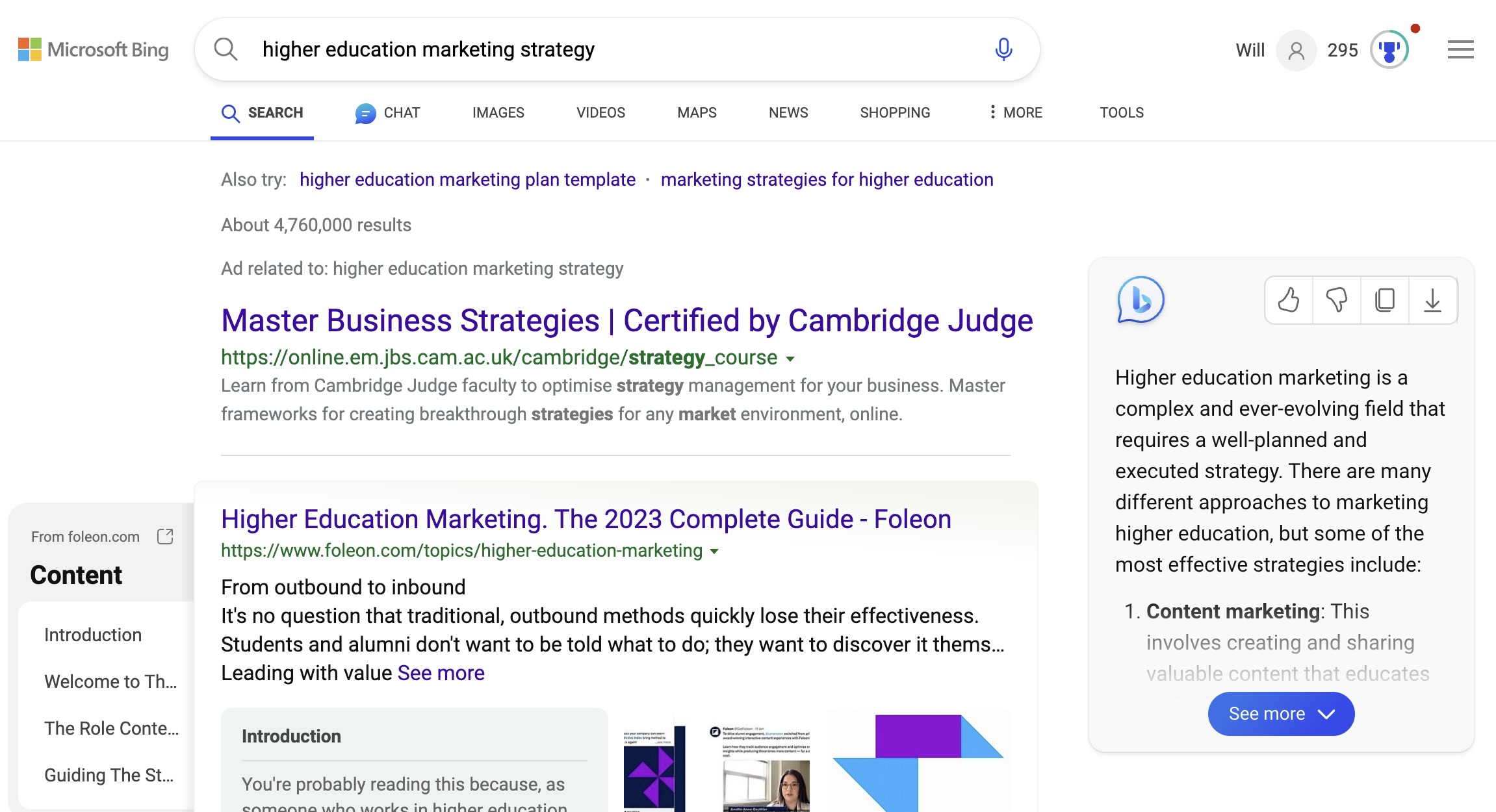
    Bing was the first to market with an AI-powered search experience. But, since it required the Microsoft Edge web browser, it only got a little play outside the Windows world.

    google ads 2023

    That little box on the right is the OpenAI-powered chat module.

    When BingGPT first launched, it was much more like the current Google interface, where the AI-powered elements were above the fold. This version is still accessible in “Chat” mode on Bing, but it’s not the default.

    google ads 2023

    Depending on the search query, Google has gone all in. Some see a slimming of the SGE box, but for our example search “Higher Education Marketing Strategy,” SGE is even more impactful than the ads.

    google ads 2023

    The good news is our content is good enough to be included in (scraped for) the SGE-generated result, but as you can see, even on my 27-inch monitor, I have to scroll to get past the ads and SGE to the rich snippet.

    Not to mention how far you would have to go to reach the traditional 10 blue links.

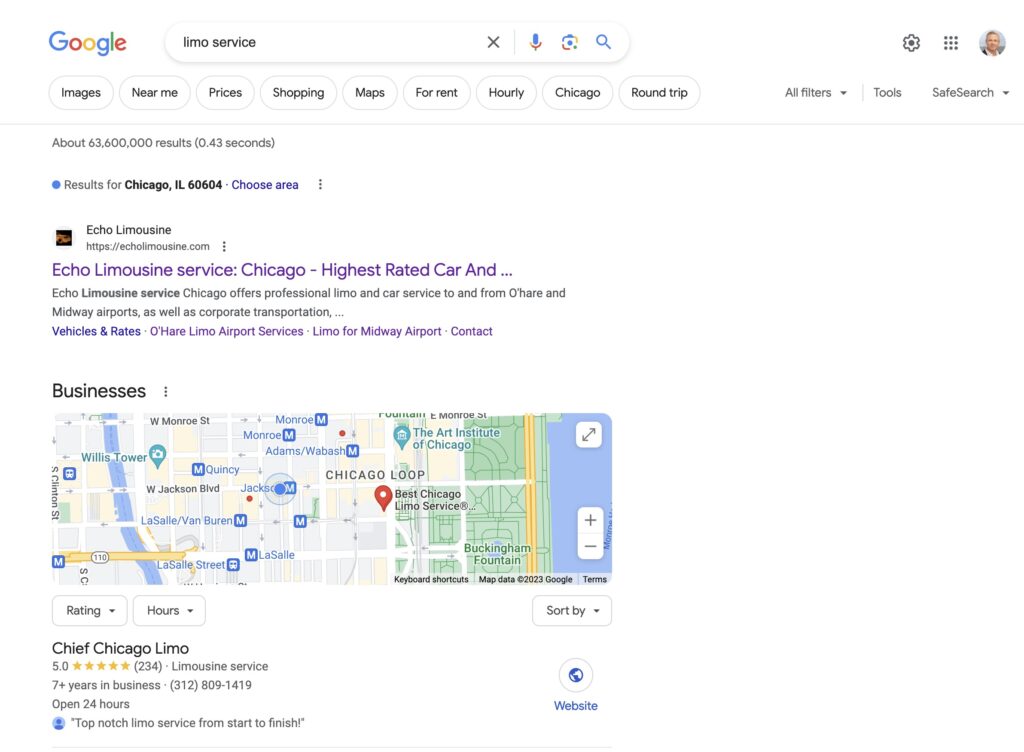
    More good news is that for many very local (hyperlocal, as Greg Sterling would say) searches, the map still prevails.

    google ads 2023

    Digital marketers and Google still have much to learn about user behavior on the SGE results page.

    It’s safe to say that, presented with the above and the typical attention span of the search engine user, the organic results will not get the clicks. And the ads may seem like the most useful part of the page.

    The Rise of Google’s Ad Empire

    Back in the early 2000s, Google ad placements were a speck on the vast landscape of organic search results. Today, as we see above, they’re monolithic.

    The History of Google Ads

    When I first ventured online in the late ’90s, online ads were the equivalent of newspaper ads. They were giant banners with obvious messaging that as much as screamed, “I’m an ad!”

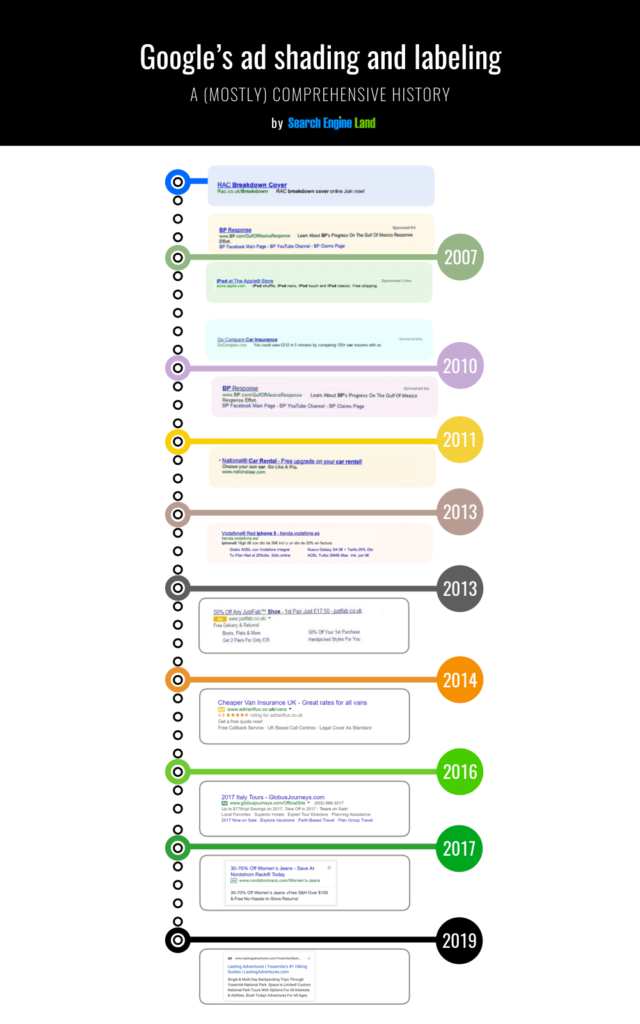
    Google, starting with “Premium Sponsorship,” over the years made their ads more and more subtle, ultimately looking like native content.

    This graphic from Ginny Marvin in her Search Engine Land article A visual history of Google ad labeling in search results tells a pretty good story of how what was originally an obvious ad has become increasingly subtle over time.

    google ads 2023

    It’s compelling to remember back to a time when ads were so obvious they were highlighted. It’s almost as if the original user interface engineers wanted to make sure you knew it was an ad.

    The graphic is a couple of years old and doesn’t account for the more visual ad types like product ads. In the case of product ads and some local service ads, they’re indiscernible from organic content.

    Follow the Money

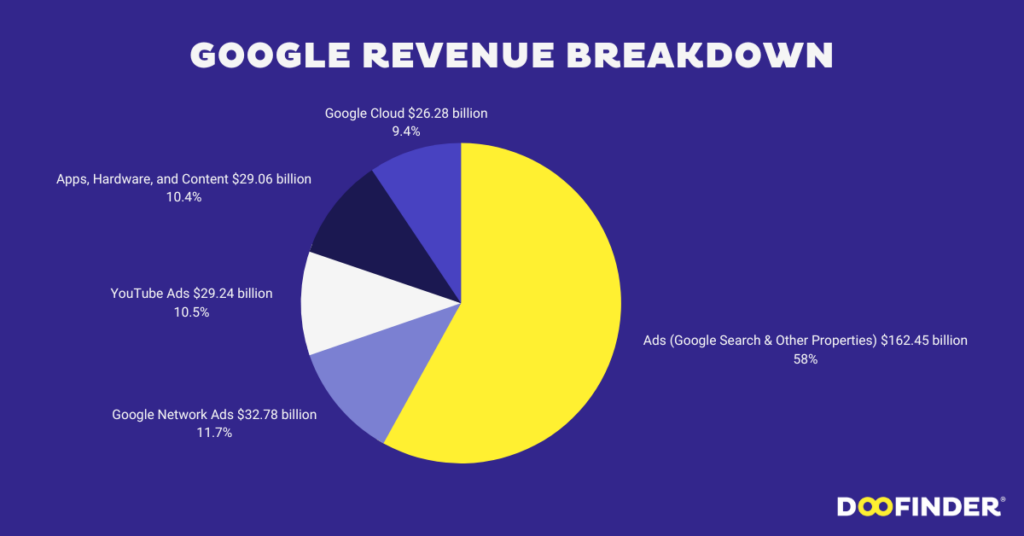
    As this chart from Doofinder, an e-commerce site search provider, shows, ads are the most significant part of Google’s revenue.

    google ads 2023

    Yes, Facebook, Amazon, and TikTok all take their share of the digital advertising market, but Google is still far and wide the leader with the most to lose.

    Why Is Google Doing This? Is This Ethical?

    On socials, there’s argument over whether Google should be regulated or if they’re entitled to do whatever they want.

    The argument goes, “They’re a public for-profit corporation, they can do as they please.” But can they? As the monopoly provider of access to business information, they have become a de-facto public utility.

    In the 1990s, the telephone companies were forced to give up their listing data to competitive phone books, and in the early 2000s, Microsoft was sued for antitrust violations and made two separate parts of their business.

    Is it crazy to think that when Google becomes self-serving (sometimes through aggressive — perhaps “unfair” competition), they should be regulated?

    What are some reasons Google would be taking this approach?

    1. Greed: It’s their search engine, and they can do what they want. The free listings aren’t paying anything, and they’re seeing benefits from inclusion.
    2. Spam: AI content is flooding the internet (not throwing stones, by the way.) Google has recently had issues indexing all the content.
    3. Resources: Indexing is hard. Even excluding spam, the rate of content production from “reputable” publishers is accelerating.
    4. Reality: The search engine results pages are getting pretty crappy. For most searches, authority sites dominate, whether or not they are niche-relevant. Some at Google might argue they at least have validation, by payment, of the trustworthiness of their advertisers.

    The European Union has started to regulate big tech, but the U.S. is not there yet. Arguably, the effect of regulation in the EU is a drop in the bucket compared to the valuations of Google, Facebook, and Amazon.

    We May Be on Our Way to a Pay-to-Play Google

    Until and unless Google reverts the SERP, we may have to buy back our hard-earned ranking for non-local searches.

    As an agency and a business owner, this is frustrating. We will have to watch the evolving SERP to understand the ratio between paid and organic search needs to maintain and grow the number of leads we’ve been accustomed to.

    I know that organic SEO will continue to deliver leads and value. While we wait to see the final form of the Google SERP, we should be focused on two strategies:

    1. Suck it up and buy our previously high-converting keywords.
    2. Continue developing content.
      • Long-tail content where there are fewer ads.
      • Alternative channels: YouTube, Social Media, etc. — the good news on this front is it doesn’t have to be new and unique but just repackaged for the medium.

    We would love to hear your thoughts. Are you seeing the same thing? Is it time to break up Alphabet? What else should we be looking for?

    Postscript – Google Ads 2023 Before & After Pics

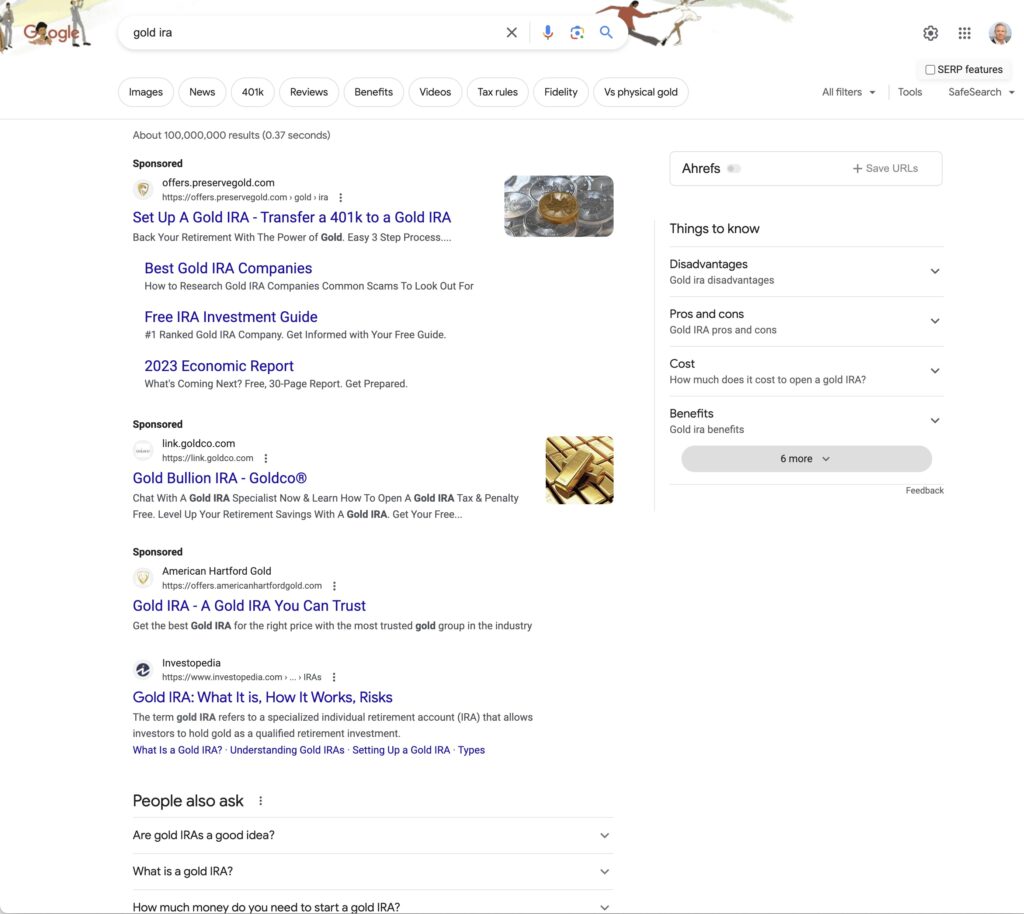
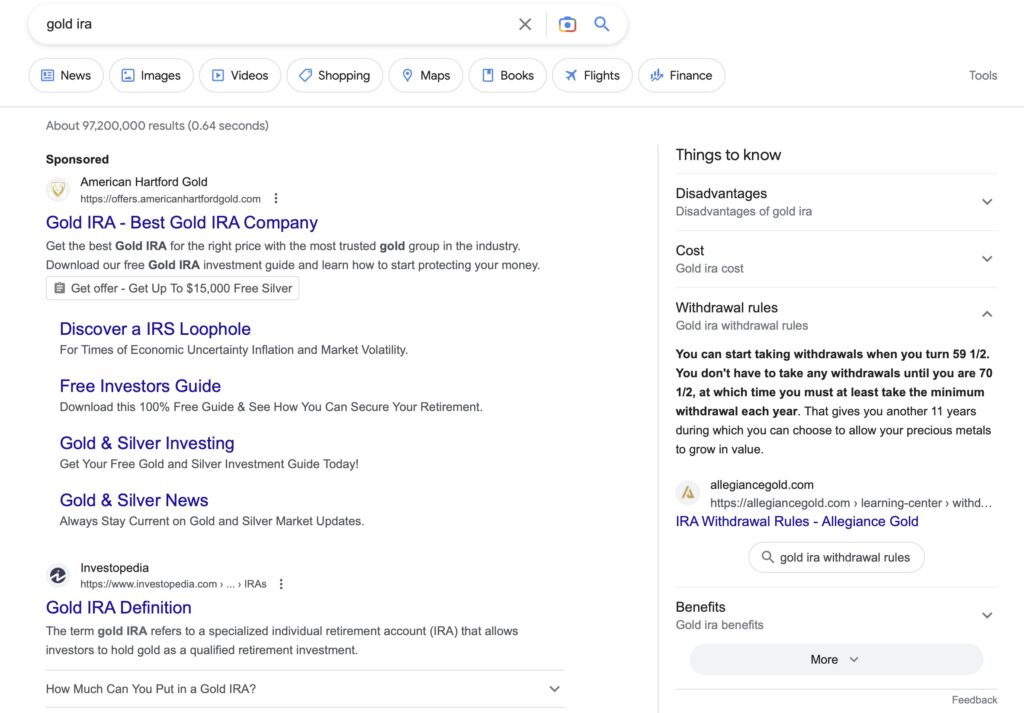
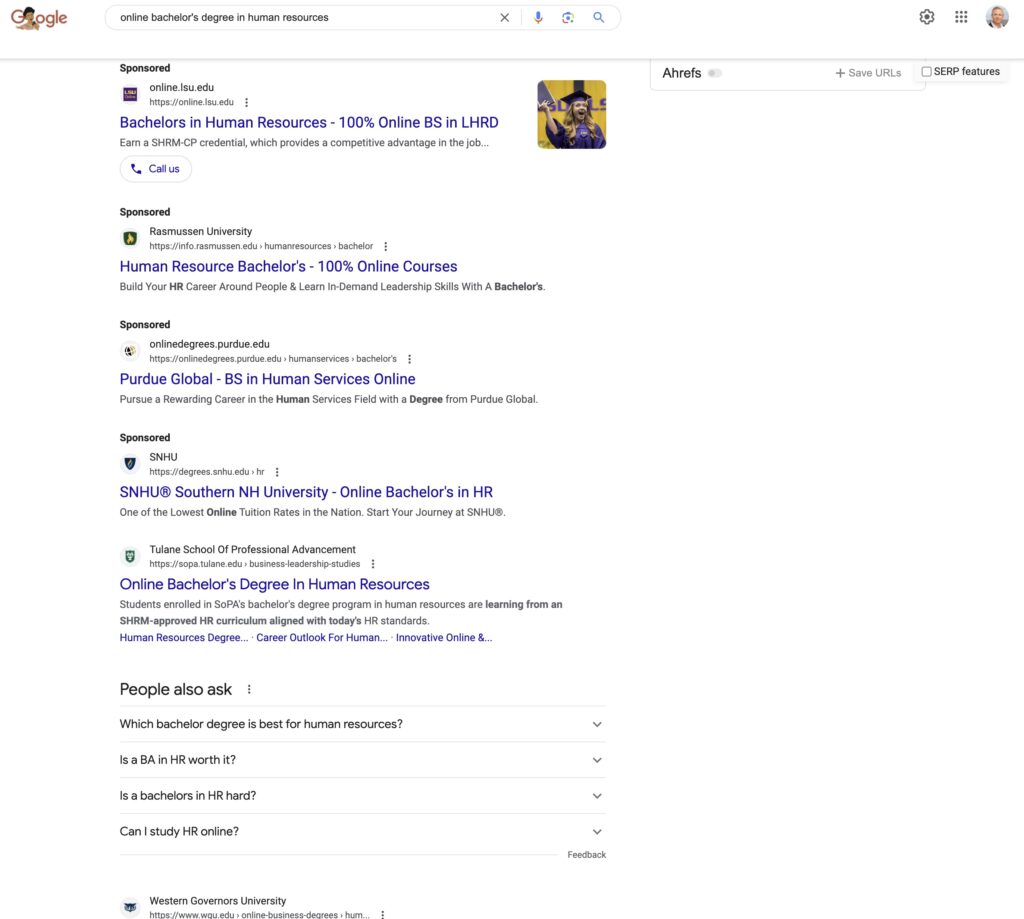
    I was asked to provide some screenshots of the new fat ads pack by our marketing associate and had surprisingly few SERP screenshots. The two below show the extreme nature of the Google Ads 2023 SERP smackdown.

    Gold IRA Today

    google ads 2023

    Gold IRA April 2023

    google ads 2023

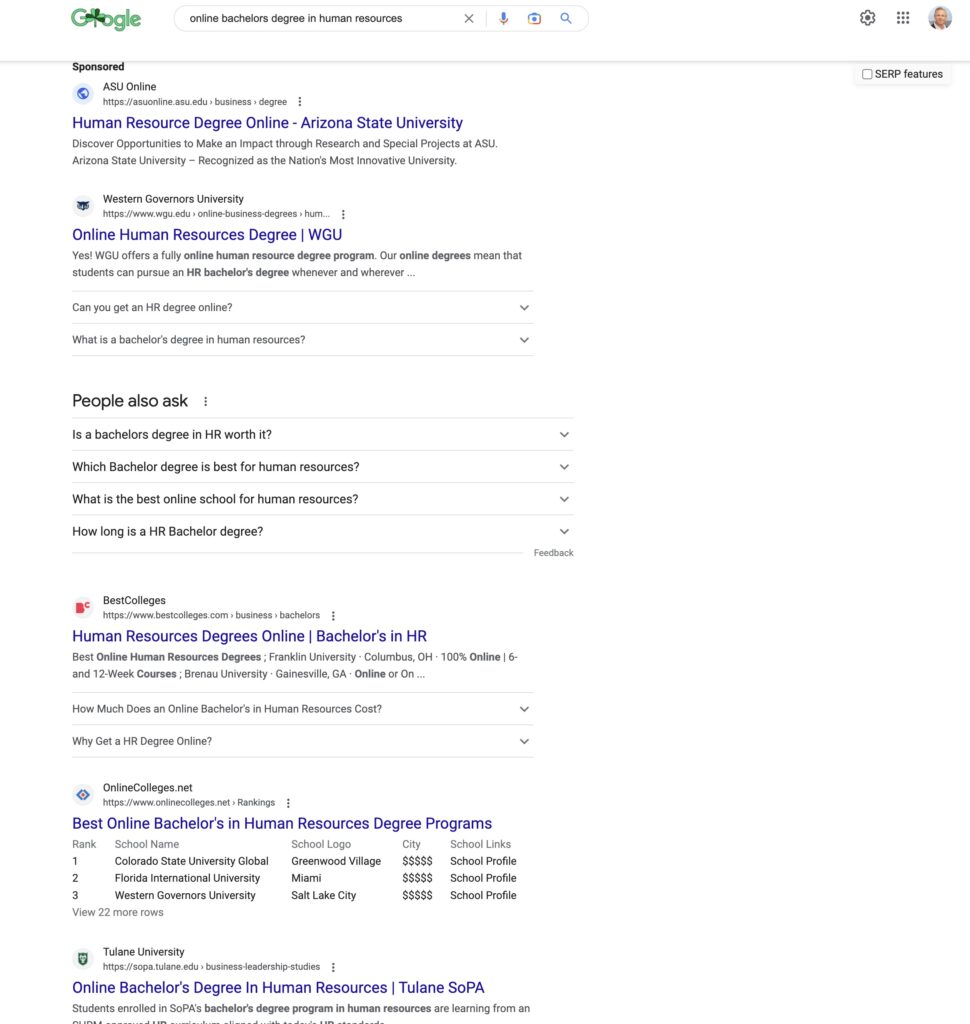
    Online Bachelor’s Degree in Human Resources Today

    google ads 2023

    Online Bachelor’s Degree in Human Resources March 2023

    google ads 2023

    Additional References

    Everything wrong with Google in one competitive result – Cyrus Shepard
    How Search Generative Experience works and why retrieval-augmented generation is our future – Mike King

  • Beyond the Hype: Is Geofencing the Right Strategy for Your Brand?

    Key Insights

    • While geofencing offers the unique advantage of targeting potential customers within a specific geographic range, it doesn’t guarantee ROI.
    • Geofencing holds the potential to drive impactful results by targeting specific geographic locations, but its effectiveness varies based on a brand’s goals and audience.
    • Geofencing is a potent tool that works best in conjunction with a broader marketing strategy — a strategy that incorporates multiple forms of online advertising and keeps the audience at the center.

    Marketers around the globe are touting geofencing as the new golden child of online advertising.

    While geofencing’s ability to target potential customers in a specific geographic radius makes it a worthwhile tool, it’s not a magic wand you can use to guarantee ROI.

    The strategy behind its use is more important than any tool.

    Targeting the right audience is the most critical tactic to pursue, whether that includes geofencing or traditional PPC ads.

    In this blog post, we will go beyond the hype and help you determine when to use geofencing ads.

    Geofencing Strategy

    How Do Geofencing Ad Campaigns Work?

    Patented in 1995 by American inventor Michael Dimino, geofencing allows businesses to advertise directly to mobile users within a targeted geographic radius.

    Since then, the success of geofencing has become evident. 95% of companies worldwide use some variation of geofence marketing in their online advertising campaigns.

    The power of geofencing is its ability to engage potential customers based on their location in real time — offering marketers a highly targeted advertising approach.

    This is advanced, exciting stuff!

    The nitty-gritty of how it works is even more interesting.

    Geofencing ads use GPS, Wi-Fi, and cellular data to determine a user’s location — all with varying levels of accuracy.

    Marketers use software to set up geofenced areas, ranging from broad (a neighborhood) to very specific (inside a store).

    When a user crosses a geofenced area, they trigger specific actions, such as being sent a push notification, text message, or an ad within an app. These conversion opportunities all have the potential to turn a prospect into a customer.

    Geofencing Example

    Say you’re a local pizza shop in Downtown NOLA trying to attract more customers on a Saints football Sunday.

    While people might not have traveled Downtown to grab a quick slice from your shop, they will undoubtedly be hungry after the game.

    You can use geofencing ads to target the area outside the Superdome. Once the user steps outside the Dome, they will be targeted with ads about your delicious za only being a 10-minute walk away.

    In scenarios like this, geofencing should be your go-to digital advertising strategy — like pizza is your go-to meal after the big game.

    The Benefits of Geofencing Ad Campaigns

    Geofencing ads offer many unique benefits that marketers can utilize as part of a broader digital marketing campaign, including:

    • Hyper-Localized Targeting: Allows businesses to target customers within a particular geographic area, even as precisely as a single building.
    • Real-Time Engagement: Provides the ability to engage consumers as they enter, leave, or linger in the geofenced area, offering timely and relevant promotions or messages.
    • Increased Foot Traffic: Drives customers to physical locations, such as retail stores or events.
    • Contextual Relevance: Brands can create highly relevant and contextual promotions, deals, or alerts based on a user’s location.
    • Personalization: The ability to tailor messages to individual user behavior, enhancing the user experience and increasing the likelihood of engagement.
    • Improved Data Collection: Geofencing allows businesses to collect valuable data on consumer behavior, such as how often they visit a location. Pro tip: Use this data for your future targeting and strategy.
    • Highly Measurable: Provides in-depth analytics to measure campaign effectiveness, including visit frequency, dwell time, and conversion rates.

    At this point, you might be thinking, “Wow! Geofencing ads cover all the bases necessary for a successful digital marketing campaign. Why would I use anything else?”

    While your excitement is warranted, it’s still important to remember that the digital marketing world is home to many valuable types of ads.

    Let’s learn about them and see how they compare to geofencing ads.

    Comparing Geofencing Ads vs. Typical Display Targeting vs. “Traditional” PPC/Paid Search Ads

    Online advertisement variations are tools. No one type of ad is better than another because they each serve a unique purpose.

    In the same way sandals are better for a beach day, and tennis shoes are better for a jog — each shoe has its specific use. Your ability to choose the right one is what optimizes your experience.

    Not one is better than the other — they’re just different.

    How they differ in their approach

    • Geofencing Ads: Most often used in display ad targeting, geofencing ads focus on a specific geographic location, targeting users within a particular area to drive actions like store visits, event attendance, or online conversions.
    • Typical Display Ad Targeting: Operates on a broader scale, focusing on demographics, interests, and behaviors to reach a broad but relevant audience.
    • Traditional PPC/Paid Search Ads: Focus on search intent or behavior-based angles, aiming to capture users already interested in a service, product, or topic.

    How they differ in their reach

    • Geofencing Ads: Limited to a specific geographic area or individual locations, such as a single building or street. The audience is inherently localized.
    • Typical Display Ad Targeting: Designed for flexibility, these ads can be cast wide or narrowed down based on various factors like demographics, interests, and behaviors. While they can target specific locations, they are not restricted by it, giving advertisers the freedom to reach audiences across regions, countries, or even continents.
    • Traditional PPC/Paid Search Ads: Have the potential for a broader, even global reach, depending on campaign settings.

    How their overall goals differ

    • Geofencing Ads: Primarily aim to drive real-world actions, such as increasing foot traffic to a physical location, engaging attendees at an event, or capturing consumers near a competitor’s site (geo-conquesting).
    • Typical Display Ad Targeting: These ads balance raising brand awareness and prompting specific user actions. While they can drive real-world interactions, their strength lies in reaching users across various digital touchpoints, aiming to increase brand visibility and online engagement.
    • Traditional PPC/Paid Search Ads: Typically aim to drive online actions, such as website visits, form submissions, or online sales, although you can also use them for local business promotion.

    Most Successful Geofencing Targets

    Geofencing ads work best in a largely populated city or when your brand has many locations or has a lot of foot traffic (such as a pizza shop with multiple locations in a city’s business district).

    This is where geofencing ads shine because you can use them to capture potential customers near your business location — even if unintentionally.

    Some examples of popular places to target using geofencing ads include:

    • Airports
    • Near competitor locations
    • Near schools for child-friendly activities (like visiting the zoo)
    • Near events (sporting events, concerts, business seminars)
    • Near universities

    The powers of geofencing are also best used when your other targeting options are limited.

    For example, Facebook has policies so you cannot target people based on housing. This has made it difficult for real estate companies and housing communities to target users on the platform. To mitigate these limitations, you can run geofencing display campaigns around competitors to help reach this audience.

    Limitations and Challenges of Geofencing Ad Campaigns

    While geofencing can be highly effective, it might not always be the best move for your business.

    Limitations and challenges of geofencing ads include:

    • Accuracy and Precision: While GPS technology is generally accurate, it’s not perfect. Buildings, lousy weather, and other physical obstructions can affect the accuracy of location data.
    • Privacy Concerns: Collecting and using location-based data raises concerns about user privacy. Brands need to be transparent and comply with data protection regulations.
    • User Opt-in Required: For geofencing to work, users must opt-in to location services for the particular app pushing the ad. This limits the pool of potential recipients.
    • Limited Reach: Geofencing is a hyper-local strategy targeting users within a defined geographic area. This can limit businesses with a more diverse or widespread audience.
    • Platform and Device Limitations: Not all devices support geofencing, and there may be variability in how different mobile operating systems interact with geofencing technology.
    • Scalability: While geofencing can be effective for local campaigns, it may not be easily scalable for national or global marketing initiatives.

    All expert marketers know the key to a successful campaign is targeting the right audience, not just the nearest audience. Your best customers could live on the other side of town.

    It would be a waste to lose out on those potential sales, right?

    The Importance of Audience Analysis

    In any online advertising campaign, the need for audience analysis is paramount to success.

    Creating a target based on audience behavior, needs, or preferences allows you to build a more personalized and effective strategy than focusing only on where your audience is located.

    When you only use geofencing ads, you’re actually doing the ads themselves a disservice.

    Geofencing ads are a team player — they work best when woven into a broader marketing strategy that keeps the audience at the center.

    Geofencing Strategy

    Integrating Geofencing into a Broader Marketing Strategy

    In today’s marketing landscape, brands need more than just a single tactic to make a lasting impact. Geofencing, while powerful, is just one tool in a marketer’s arsenal. To truly resonate with audiences and cultivate memorable brand experiences, it’s crucial to weave geofencing into a holistic marketing approach.

    Here are some strategies to consider when integrating geofencing into your overarching marketing blueprint:

    • Multi-Channel Synergy: Utilize geofencing as a complementary tactic alongside other display targeting, as well as other marketing channels like social media, email, and paid search, to create a seamless brand experience.
    • Consumer Journey Mapping: Integrate geofencing touchpoints into your overall consumer journey map to ensure that you’re reaching people at the right time and place.
    • Timing and Frequency: Align the timing of your geofencing ads with other marketing campaigns to maximize their impact.

    An example of geofencing integration in a broader marketing strategy

    When skilled marketing professionals use different variations of online advertising in tandem, the result is a return on investment for clients.

    Search Influence recently integrated a geofencing campaign with a Facebook ads campaign for our longtime higher education marketing collaborator Tulane SoPA’s Fall 2023 Grad Fair.

    To help boost enrollment in Tulane SoPA’s graduate programs, we put a geofence around other undergrad schools in hopes of capturing interesting students who might want to go to grad school once they finish undergrad.

    Once people became aware of the programs via the geofence campaign, we utilized Facebook event ads to get them to respond whether or not they were interested in attending the Fall Grad Fair.

    After this, we created a Facebook conversion campaign to remarket to those who responded to the event ads.

    Geofencing Ad Campaigns FAQs

    What’s the difference between geofencing and geotargeting?

    Geofencing involves setting up virtual boundaries around a specific location, allowing marketers to target users when they enter, exit, or spend time within these boundaries.

    Geotargeting refers to delivering content or ads to users based on broader geographical locations, like cities, regions, or countries, often leveraging criteria like user preferences, demographics, or search behavior in tandem with their location.

    Is there a minimum or maximum area that can be geofenced?

    Geofencing can be incredibly precise, targeting areas as small as a specific building or street. However, the exact minimum or maximum area can vary based on the platform or service provider used. Typically, there’s no strict maximum limit.

    How quickly can I see results from my geofencing ad campaign?

    The immediacy of results from a geofencing ad campaign largely depends on the targeted location’s foot traffic and the campaign’s specific objectives. You can observe interactions within hours of launching for areas with high foot traffic. However, it might take days or weeks to gauge significant results for campaigns with long-term goals or in less frequented areas.

    No matter how long it takes, the data shows you will likely see results. According to the U.S. Data Corporation, 53% of shoppers visited a retailer after receiving a location-based message.

    How do device permissions and location settings impact geofencing effectiveness?

    Geofencing heavily relies on users’ device location services. If a user has turned off location permissions for a specific app or their device in general, geofencing campaigns targeting them will be ineffective.

    What platforms or tools are best for setting up and monitoring geofencing campaigns?

    Several platforms excel in geofencing capabilities, with popular choices including Google Ads, Facebook Ads Manager, and dedicated platforms like GroundTruth or Simpli.fi. These platforms facilitate the setup of geofenced areas and provide robust analytics to monitor campaign performance in real time.

    Focus on the Best Return, Above All Else

    At Search Influence, we have the industry expertise to support you in reaching your online advertising goals. Our experience has helped clients from a multitude of industries reach their desired audience.

    Whether through geofencing, display targeting, or paid search, we will partner with you to build an all-encompassing digital ads strategy that delivers a return on your investment.

    If you’re ready to learn if geofencing ads are a good fit for your digital marketing strategy, contact our expert team to get started.


    Image sources:

    1. https://images.unsplash.com/photo-1608222351212-18fe0ec7b13b?auto=format&fit=crop&q=80&w=1974&ixlib=rb-4.0.3&ixid=M3wxMjA3fDB8MHxwaG90by1wYWdlfHx8fGVufDB8fHx8fA%3D%3D
    2. https://images.unsplash.com/photo-1570101945621-945409a6370f?auto=format&fit=crop&q=80&w=2070&ixlib=rb-4.0.3&ixid=M3wxMjA3fDB8MHxwaG90by1wYWdlfHx8fGVufDB8fHx8fA%3D%3D
  • Will Scott at Pubcon 2023: How to Use AI for Content Marketing

    Key Insights

    • It’s not hyperbole to say AI has the potential to change everything about how marketers produce content.
    • SEO is not dead, and neither is ChatGPT.
    • The AI sandwich is a content creation workflow that utilizes AI-powered tools and human creativity to create high-quality content that is helpful to readers.
    • The people who work with AI owe it to their fellow humans to use it responsibly.

    On September 21st, 2023, Search Influence Co-founder and CEO Will Scott presented at the Pubcon Pro Annual conference in Austin, Texas.

    This is the second time Will presented on AI Content at Pubcon in 2023, the first being in February 2023.

    Will presented “Robots, Revolution, and the Death of ChatGPT” under Pubcon’s session title “ChatGPT and AI Use Cases for Marketers.” President of Content at Scale, Julia McCoy showed off her own interesting findings in her presentation “Future of SEO Content is AI” during the same session.

    During their respective presentations, the two content creation experts discussed how marketers can utilize artificial intelligence to create content more efficiently — without sacrificing the quality of their writing.

    In this blog post, we’ll break down the key takeaways of Will’s thoughts on content marketing AI and how this new tech could produce a win-win situation for content marketers and their audiences.

    What Is Pubcon?

    The Pubcon Pro Annual 2023 conference was held on September 19-21, 2023, at the AT&T Conference Center in Austin, Texas. In its 22nd year, Pubcon boasts well-known speakers sharing both cutting-edge and tried-and-true digital marketing strategies focusing on search engine optimization and content creation.

    The conference helps attendees learn about new industry trends and generate ideas for their marketing efforts. At this conference, and at Pubcon earlier in the year, there has been much discussion about AI for content marketing and artificial intelligence in general.

    Session at a Glance: ChatGPT and AI Use Cases for Marketers

    As someone who has worked in the SEO and content marketing world for over 20 years, Will Scott has seen trends come and go. But he believes it’s not hyperbole to say AI has the potential to change everything about how marketers produce content.

    Since becoming (admittedly) obsessed with OpenAI ChatGPT and countless other AI content tools in the late winter months of 2022, Will brainstormed ways marketers can use AI to make digital marketing work leaner.

    In his presentation, “Robots, Revolution, and the Death of ChatGPT,” he shared his findings with the masses.

    Will’s session took an in-depth look at how big and small companies alike boost content creation productivity by tapping into the power of AI writing.

    All who attended learned effective strategies for harnessing AI to replace 7+ hours of work per piece while maintaining a genuine connection with their human audience and preserving their unique brand story and style.

    Will presented case studies and offered practical advice and inspiration for marketers based on months of hands-on work.

    Julia McCoy and Content at Scale

    Julia McCoy is a trailblazing entrepreneur and online content strategy thought leader who has spent her career helping marketers scale their content creation process for maximum revenue.

    In her role as President at Content at Scale, Julia helps human writers and marketers create high-quality AI-generated content.

    Content creators across the globe have implemented Julia’s ideas, and she is a trusted voice in the AI content creation space.

    Robots, Revolution, and the Death of ChatGPT

    Will’s presentation, “Robots, Revolution, and the Death of ChatGPT,” is the second installment in his “AI Sandwich” series. It’s an update from his previous Pubcon presentation, “Chatbots, AI, and the Marketer’s Conundrum,” when generative AI first broke ground in late 2022 and early 2023.

    In his first presentation, he discussed the AI buzz and listed some popular AI content creation tools (Midjourney, Jasper, Originality.ai, etc.).

    This experienced SEO and content marketer expanded upon these ideas in his second presentation, with updates that include:

    • Data points
    • Real-world case studies
    • Tips to help marketers improve content creation and edit AI-created content

    What is the AI Sandwich technique?

    AI sandwich

    This isn’t your average turkey sub or pastrami on rye.

    The AI sandwich is a content creation workflow that utilizes AI-powered tools and human creativity to create high-quality content (social media posts, blog posts, long-form content, short-form content, ad copy, etc.) that is helpful to readers.

    The process goes like this: A human writer creates the prompts, AI handles the content generation, and then the human edits the AI-generated content.

    This process helps to create content that satisfies Google’s Search Quality Raters, who review content for signals such as Experience, Expertise, Authoritativeness, and Trustworthiness (E-E-A-T).

    In essence, readers come to Google hungry for knowledge.

    They want content with nutritional value — not empty calories.

    Content created solely by AI is comparable to eating ramen noodles and chips in your college dorm room.

    The AI Sandwich is the meal your Mom makes you when you come home for the weekend — hearty and sure to satisfy.

    Will Scott on AI in Content Marketing 2.0

    Hundreds (probably thousands) of blog articles have been written about AI content and content creation tools in the last year or so — a lot of it written by artificial intelligence.

    In his Pubcon presentation, Will gave a human voice to the subject.

    Below is a brief review of some of the topics covered.

    Addressing the misconceptions

    SEO is not dead

    SEO is not dead, and AI tools will not take your job.

    Rather, it’s more likely that an expert using AI-powered tools will replace you. It’s a little harsh, but you still have plenty of time to become an AI tools expert.

    In fact, the AI Sandwich technique and Julia’s AIO method prove that AI tools still need human input to create content that converts.

    ChatGPT is not dead

    Despite what clickbait headlines might say, ChatGPT is also alive and well.

    As seen in the screenshot below depicting 12 months of Google Trends Data, people far and wide are still interested in the AI-powered creation tool.

    ChatGPT Google Trends

    Remember all the “Paul is dead” rumors after the Beatles star appeared on the Abbey Road cover in bare feet?

    It turned out the legendary musician was more than alive and was, in fact, gearing up for another slew of hit albums.

    Friends, ChatGPT is not only alive but might also be about to release its Band on the Run.

    Talking about tools

    Tools, tools, tools, and more tools!

    As with anything new that hits the market, there always seems to be an overflow before the tide settles.

    At Search Influence, we’ve tested several AI-powered tools for everything from social media captions to marketing strategy and idea generation. While we’re still feeling things out, we do have a few tools we plan to keep in the rotation.

    AI-generated content tools the SI team is using/testing

    • Content at Scale
    • Machined.ai
    • Surfer SEO AI Writer
    • ZimmWriter

    Image and visual content tools the SI team is using/testing

    • Dall-E 2
    • Midjourney
    • Stable Diffusion

    SEO and keyword research tools the SI team is using/testing

    • PageOptimizer Pro
    • Surfer
    • Frase

    Video tool the SI team is using/testing

    • Wave.video

    Opportunities, concerns, and next steps

    These natural language generation tools offer countless opportunities for marketers when used correctly. Tools like the ones above are great if you need to generate content ideas, research relevant keywords, develop lists of facts and FAQs, or program code.

    But don’t forget — these tools aren’t perfect. In fact, sometimes they can be wrong.

    Think of using AI tools like grading an eager middle school student’s paper. You recognize how marvelous their work is and how much progress they’ve made while still understanding they’re young, so there are bound to be typos, necessary edits, and fact-checking.

    The concern is that lazy SEOs and spammers will rely solely on AI content marketing tools to create their content. This practice is especially dangerous when working on YMYL (Your Money or Your Life) pages. Content marketers and SEOs that only use AI and don’t keep Google’s E-E-A-T requirements in mind will soon see their rankings drop.

    Don’t be a lazy SEO — test it, but don’t spam it.

    AI content creation + human editing + fact-checking = quality writing at an efficient rate.

    For example, Will used but didn’t abuse ChatGPT to create blog content on the Skyscraper Method and ChatGPT data mining. It’s an interesting, informative read assisted by AI but led by a human brain.

    If you can use AI for content tools while still being thoughtful about your work and using good sense methods like the AI sandwich, these little robots could be your new work bestie.

    AI in Content Creation and Marketing: Far From Over

    Will and the Search Influence team love being early adopters of generative AI. While we enjoy using it for everything from writing email subject lines to competitive research, we still exercise caution against leaning on it too heavily.

    We look forward to implementing more natural language processing tools in our content strategy as the industry develops. But as game-changing as we think these tools are, we use them while keeping a few key ideas in mind:

    • AI writing tools will lead to an overflow of information, some good, some not so good.
    • It is the responsibility of marketers, journalists, and creatives not to generate blog posts full of useless fluff and flood social media channels with unchecked facts and misinformation.
    • Those at the frontline of this new industry owe it to our fellow humans not to abuse it.

    With that being said, we think these content generation tools have an opportunity to positively impact the human experience in a similar way as the printing press and the Internet.

    Ready to make your impact?

    Contact us to learn more about generative AI in content marketing strategy and SEO.

    This blog was written entirely by a human between coffee breaks and a little too much early Halloween candy.


    Image Sources:

    1. Photo is from SI: https://townsend.bunksite.com/wp-content/uploads/2023/02/Image-of-an-AI-Sandwich-as-imagined-by-Midjourney.png
    2. Photo is from SI: https://imgur.com/bgQhPoD