Blog

  • Radiohead and Social Media: The Twitterized Release of “The King of Limbs”

    The members of Radiohead are a private bunch, often very selective with their interviews and keeping low-profile lives in their hometown of Oxford, England. As such, the press scrambles over every utterance that the band might put forth, which isn’t much. But their online presence, long established, is staggering. Their website, entitled “Dead Air Space,” has gone through countless incarnations, including wormholes of old information about their previous art and music. It primarily serves as the band’s blog, strewn with “office charts” of the music they’re listening to and links to new music or websites of political and social issues. Some of the members keep more-or-less active Twitter accounts, including one for the band itself, and the people they follow seem to form some of their inner circle, like the artist Stanley Donwood, amongst others.

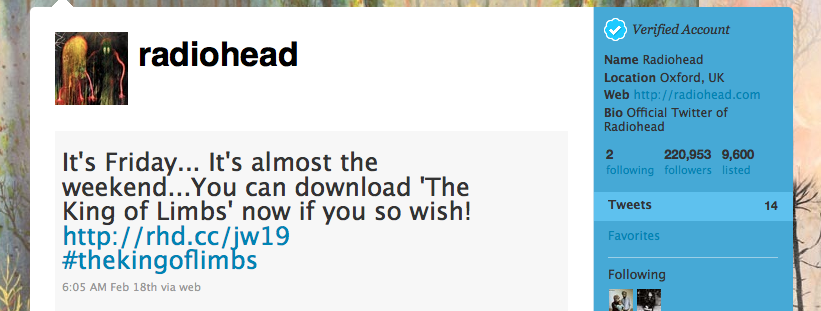
    These twitter accounts, along with those of their fans, were an epicenter of activity last week. On Monday, February 14th, Radiohead posted via Twitter: “Thank you for waiting…”, which was followed by a link to www.thekingoflimbs.com, a website designed for the release of “The King of Limbs,” their new album slated to become available for download the following Saturday. Four days later, on Friday the 18th, Radiohead tweeted again: “It’s Friday…It’s almost the weekend…You can download ‘The King of Limbs’ now if you so wish!”
    Fond of doing things differently, Radiohead are known for their innovative and genre-bending music. While the quintet could be cited as one of the most influential bands in modern music, it’s also clear that they are also exploring the marketing of their music in a way that no other mainstream band has attempted before.

    Anyone who followed the most recent album releases by Radiohead already knows that they’re changing the way music can be released to the public, especially by a major artist. After completing “Hail to the Thief” in 2003, they had fulfilled their recording contract with EMI, and they chose to remain independent rather than signing with another label. They recorded 2007’s “In Rainbows” on their own and released it on their website as a direct download with the asking price of “pay what you want.”

    This alone posed numerous questions to musicians, music lovers, and music industry professionals, causing a minor existential crisis in the recording industry. It called into question the value of music, especially considering the widespread piracy of music. It questioned whether musicians really need major record labels to market their work. But most importantly, it bridged the gap between the band and their fans. Radiohead offered an immediate and direct transaction, so one would know that the money they paid for the music (if they chose to pay at all) was going directly to the artists and producers responsible for creating it.

    By default, Radiohead relied on their previous successes, fan base, and name to market their new music, so their achievements with “In Rainbows” cannot be applied to unknown artists. However, the way “The King of Limbs” was released last Friday redefines the relationship between musicians and their fans. The band chose to use Twitter as the medium for announcing the album, and they again utilized their own web servers to facilitate the release. While the “pay what you want” aspect was ditched for a $9 price tag on a set of eight mp3s, fans could still remain happy knowing that their money was going directly to the artists that they want to support.

    Already on very short notice, the instantaneous “early” release of “The King of Limbs” caused Twitter and other social media sites to flood with reactions to the album, and it nearly caused Radiohead’s download site to crash. Music critics, eager to get the official first review, listened to the album hastily on their laptops that morning and posted track-by-track assessments merely an hour or two after the album was released–to much criticism by fans, claiming that new music cannot be properly reviewed so quickly. Regardless, the social media world was rocked by this new release, providing an open channel of communication between the band, their critics, and their fans. Whether you like the new music or not, it doesn’t take much to think that Radiohead might be up to something.

    Six days prior to the announcement of “The King of Limbs,” Ed O’Brien, guitarist and back-up vocalist, posted a blog entry on the band’s web site entitled “The Dignity Revolution.” (Also coupled with a tweet–they’ve connected their blog and Twitter account, a sign that they’re aware if the importance of social media.) It reads as follows:

    What have twitter and facebook ever done for us?

    Obviously, keeping in touch with everyone but I have to say I have become increasingly excited over the last 3 months about the possibilities of this form of communication.Yes I am very slow out of the blocks. It’s in the arena of public protest that it seems twitter and facebook are increasingly the means by which popular movements throughout the world are able to come together and mobilise.

    In some ways, one could argue that Radiohead are leading a popular movement, and Mr. O’Brien has an extremely valid point. Their use of social media, like Twitter, allowed for a direct and instantaneous connection between the artists and their audience, just as the release of “In Rainbows” allowed for a direct and open transaction. Thom Yorke, lead singer, once remarked in an interview: “If people want to play it for themselves, why don’t we just give it to them to listen to?”

    Aware of their massive fan base, the band decided that they can conduct business as they so please, using the high-speed connectivity of social media to do so. And while lesser-known artists may not have the audience that Radiohead has, thus being more vulnerable to reviews, it’s also clear that those musicians also use social networks as a way to market themselves on their own terms. That trend can only increase in the future, and that is what I believe Yorke and Co. are trying to prove.

    Is Radiohead leading a music industry revolution? It’s hard to say. With highly successful performers such as Justin Bieber and Taylor Swift, who are promoted and made famous through the marketing strategies of major recording labels, Radiohead’s business model might not be for everyone. Either way, social media provides an effective channel to promote their music, and Radiohead have become a successful example of a group of artists marketing and releasing their own work, instantly and directly, as they see fit.

  • Actionable Social Media Analytics: Likes to Leads

    Last week I had the pleasure of presenting on Social Media Analytics at SEMpdx SearchFest.

    Most of our customers have no interest in Likes and Followers for their own sake. What we’re interested in most is Leads. In other words, do our Social Media Analytics enable us to track actionable data, most importantly, leads?

    Likes to Leads – Actionable Social Media Analytics View more presentations from Search Influence

    From the Final Slide, bringing it all together for Social Media Analytics includes:

    • Some tracking is better than no tracking
      • Start with URL shorteners
    • Fans are great, but leads are better
      • And you can track them
    • The data is there, you may just need to unlock it
      • And communicate it to the decision makers

    Look forward to more from the Search Influence Team:

    At SMX West:

    What do you think about the methods above? What tools do you use to track social media leads?

  • Three Influencers To Speak At SMX West

    We’re very pleased to announce that the upcoming SMX West Search Marketing Expo will feature three Search Influence employees — Rodney Hess, Anthony Coleman and our CEO Will Scott — as speakers. The conference, which will take place March 8-9 at the San Jose McEnery Convention Center, features a wide array of panels on different aspects of online marketing, including SEO, paid search advertising, social media marketing, local and mobile search, landing page conversions and more.

    Rodney will be speaking on “Location Services: The New Local Search?” where he will be presenting some follow up interviews from our Foursquare Advertiser Survey. Anthony will be discussing Google Instant’s impact on paid search and how this is impacting buying ads and strategies, how auto-generated phrases distract searchers from their initial intent, and the overall decay of geo-modified terms in an era where search entities are organically focusing in on their users’ locations. Will will speak on the following points:
    * Reviewing the Yelp Review Filter
    * Buying Yelp Reviews
    * Why you’re not a Good Yelper

    Besides our talented teammates, SMX West will feature SEM experts from around the world speaking at over 60 sessions and keynotes. Congratulations to all of our Influencers for this exciting opportunity!

  • Facebook Privacy – New Orleans SEO Replies to FOX8

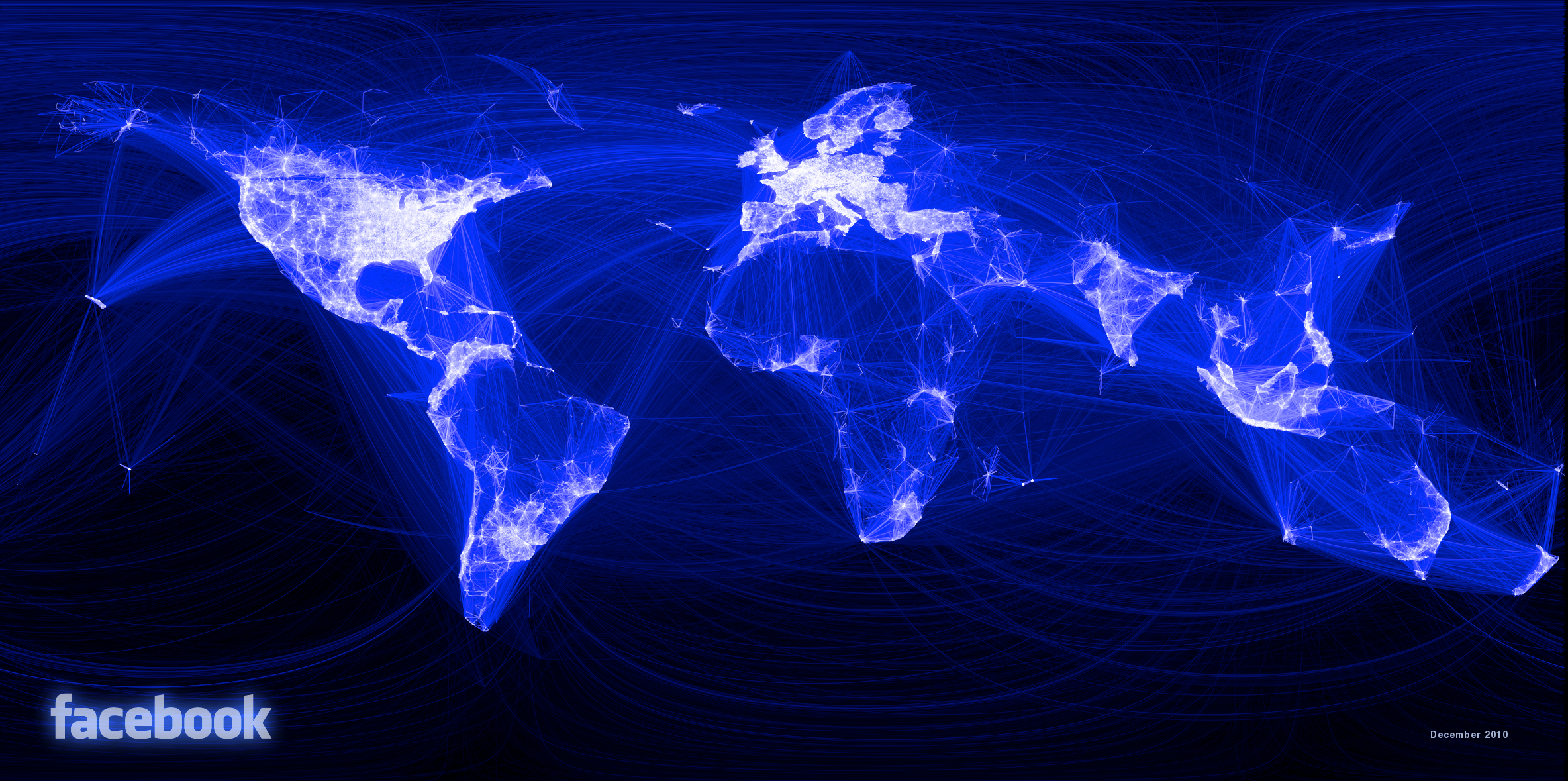
    Facebook Privacy - World Map
    The world according to Facebook.

    Following advertisements for a contest where Facebook fans can enter to win a 60” 3D television, anchors’ guffaws at “The Facebook” and “The Twitter,” and the third run of a talk about how Facebook and social media peacefully brought down a dictator in 18 days, FOX8, our beloved Fox affiliate network channel, ran a special report on Facebook privacy which showed how confused people are about Facebook.

    Stirring up fears about Facebook’s lackadaisical attitude towards users’ privacy is almost as old as the site itself, but really took off after the introduction of the news feed, prompting this post from Michael Cerahimself. But FOX8 reports that there yet is one more person who knows “everything” about you, even after 170 types of privacy options: the social media marketer.

    We’ve determined a rough estimate of the gay population of the military using the tools they’re talking about. Dr. Kimberly Mason, cyber-bullying expert at UNO, claims:

    “The majority of the individuals who use Facebook of course are on there to make their social connections and keeping in touch with friends and family. So looking at advertising and looking how they monitor that really is not in their realm of awareness.”

    Strengthening this argument is the general concern about privacy that Facebook users have cultivated. Avoiding questions of survey design, there is no attempt by Gallup/USAToday to reconcile this data with the knowledge users displayed about the privacy settings even at an early stage of development for the site, nor with the skyrocketing membership and constant activity seen as the site has become the second-most-trafficked site on the web. Obviously we’re not dealing with an all-or-nothing situation, and maybe even analysis of risk perception could be appropriate, though of course not under the language of physical harm.

    The FTC supports a browser-based “Do Not Track” system, while Rep. Jackie Speier (D-CA) offers a much more nebulous, but more proactive and far-reaching system. These proposals and recommendations are to protect the users of the site from their private lives being compromised.

    But the privacy argument driving interest, polls, and media stories is too muddled to be coherent — there’s privacy, and then there’s privacy, and then there’s privacy. These three realms where users can unknowingly give out information — your network, the public, and advertisers — have different priorities and different interdependencies when it comes to blocking access.

    The first kind of privacy — hiding your information from your own network — seems simply counterintuitive to me. Like having a private Livejournal, not using the social aspect of a social network seems a bit counterintuitive. There’s got to be some kind of control here — Reuben Foster of UNO says, “If I don’t want it to be public, then I won’t … click these things,” and that’s right on the money.

    Facebook Privacy Setting
    Found directly beneath the status box.

    In addition, the News Feed is smart. That first variable, the affinity score, is user-controlled. If you don’t talk to someone, they won’t show up as often. To boot, the other variables, weight and time, simply fulfill the definition of a social network. Combined with easy to navigate deletion and blocking capabilities, it’s a hard sell to me that there isn’t enough privacy options for the user.

    But that’s a straw man; privacy can be breached in other ways. While privacy settings can stop a lot, so many checkboxes to look at and discover over time might be overwhelming. Worse still, Facebook has a bad habit of resetting its users’ privacy settings when it updates its features. We’ve talked before about other people looking at your posts and online image branding. There are a number of news stories where someone posts something that unintentionally irritates the wrong people, all of which bring up the divide between what is or isn’t public speech.

    While I’m not about to open that can of worms, two alternate court cases show the two likely outcomes of privacy issues: either an out of court settlement or a court siding with the company, who can probably show a solid link between loudly kvetching about work and “job performance.” The question on the level of privacy and anonymity of your Facebook profile has not been answered; best to tread with care, but not necessarily lightly.

    Even with careful Facebook pruning, you still have your information going to advertisers, and it is this what puts Facebook in a unique position for privacy. Google doesn’t have the instant interest data to tailor their content offerings like Facebook does. Even Microsoft, whose use of Internet Explorer to strengthen Bing’s ranking pages is more insidious and less publicized, gets their data from Facebook

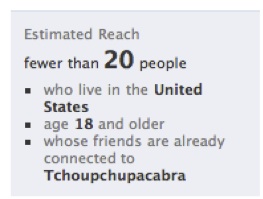
    Facebook Privacy - Fan Page Ad Reach
    Obviously not the best tool for small fanbases…

    WVUE reflects the average Facebook user’s view when it refers to all ads as “Sponsored Stories.” Ads are ads — it’s neither Facebook’s intent nor in their interest to try to fool you into thinking they’re not, and you’d have to ignore clear headings to think they’re from your friends. There is a difference, though: Sponsored Stories refers to ads that look more like regular news feed posts; however, they again have the telltale heading. They also can only be shown to people “whose friends are already connected to” the Facebook page or post that they’re connected to. Similarly, fan page ads can only be shown to people not already connected to the fan page.

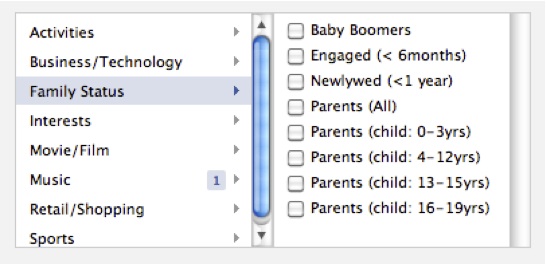
    Facebook Privacy - Basic Advertiser Interest Pane
    See, nothing terribly creepy here…

    Facebook’s ad targeting is much less sinister than it seems. You can filter by age, sex, and broad category of interest. While the Family Status category under interests is on one hand a bit questionable, it can heavily influence relevance of ads; you wouldn’t want to be showing ads for singles sites if a member is married with kids.

    You can then target by Connection to a Page, Event or App. The next section, the Advanced Demographics, provides advertisers with better opportunities to provide relevant content and avoid marketing gaffes. Finally, you can target by education level or workplace.

    And that’s it, right? You get your broad information, and nothing’s even tracked deeply enough to cause any concern. That doesn’t seem so bad.

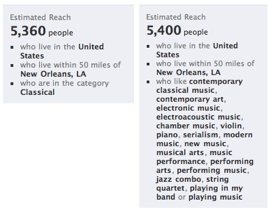
    Facebook Privacy - Targeting Comparison
    … But we could make this comparison much creepier. I just like music.

    But when something* happens with your account, the advertiser gets access to Likes & Interests. This narrows the interests so that it is more like traditional keyword bidding. This isn’t unusual, and follows the traditions from Google pay-per-click advertising. The advertising platform provides vague statistics to give advertisers an idea of how many people are interested in ideas that are related to your link.

    But not only does the advertiser get this information. Another privacy craze was raised over Facebook’s Open Graph Platform, which began the rash of “Like” buttons on the site. Extending the simplicity of the “Like” from every kind of “Edge” — the term Facebook uses for any post, link, comment, or ad — to web pages seems logical and extends not only the brand, but the whole social media mentality.

    Open Graph allows a content provider to, like Google Analytics, track his links’ likes and clicks on Facebook, even without having a Facebook presence. While this might seem like nothing new to your loss of privacy, an important distinction has to be drawn between this and Google’s tracking programs. Facebook offers this information with your personal information like your friends list in the unseen data. Obviously, this is used not for advertisers, but for the inner machinery. However, the concern remains that someone with a bit of knowhow can get that information.

    But that information isn’t useful for advertisers right now. A list of friends might be interesting on a massive level, but then again, the individual is lost looking at larger trends. The other factors, publicly displayed on your profile

    Through these three realms of privacy, it seems that there’s good reason to be afraid of Facebook and its privacy issues. But here’s the catch — who’s really looking at this? Advertisers and content providers, even among the slimiest of content farms, simply want to provide a better user experience. They, including us, are looking for the most people clicking on ads and, more importantly, interact with the content behind the ads.

    There’s a tendency for people versed in Facebook to blame the user — we all see the inner workings, we know how easy the whole system is if you turn off your brain. We know that all you have to do is click the “Like” button and you’re giving us good information that we can use to give you more of what you already, at least in a marketing sense, “Like.” Those that are trying to target you are trying to give you more of what you’ve already said you want, even if it’s an admittedly selfish gift, since advertisers obviously get benefits from you clicking the link.

    But the Skinner box that is Facebook, and particularly the games and apps that tweak and complicate privacy settings beyond the basic problems described, is ultimately something from which its users benefit. The on-first-glance underhanded data-gathering techniques are ultimately the way that Facebook serves its users, by providing content relevant to them, as determined by them.


    *We are looking into this. Check back for more info!
    Picture Courtesy of the Facebook Engineering Blog

    Don’t forget to “Like” this page. We promise to do every creepy thing we can with your information and show you what you’re sending to advertisers and content providers in an upcoming blog post.

  • The Huffington Post’s Business Strategy – SEO and Content Farms vs Branding and Customer Loyalty

    There has been much discussion about the Huffington Post since the announcement of its acquisition by AOL early this month.

    Content Farms are like the McDonald's of Content.

    There has been a lot of praise and criticism for its internet marketing and SEO tactics including content-farming, a practice of creating, many times tremendously low quality, pieces solely for the purpose of attracting visitors via trending searches.

    The Huffington Post’s content model has been under much scrutiny, especially in the wake of a debate about low quality content in Google search results. As Jason Calacanis of Mahalo.com said, “If you make Google look stupid, they’ll fuck you up.” A content farm is basically a website or company that produces a massive amount of content a day at low prices, and therefore low quality. Content Farms are like the McDonald’s of food, or the Soulja Boy of Rap, and you normally don’t want to find their efforts in your search results. A great laughable example of this results when you Google: what time does the Super Bowl start?

    Yeah, the Huffington Post, the serious political blog getting purchased for $315 million is responsible for that crap. Beyond this, it is a site for unpaid bloggers to submit their possibly low quality, redundant content. To get back to what Calacanis said, and what Matt Cutts of Google has been saying, sooner or later low quality (but not quite spam) and redundant content will be penalized to a greater extent by Google. Whether through Facebook likes, bounce rates, account personalization, or several other means, Google is looking at ways to do this.

    I would argue, however, that what should be even more important to the Huffington Post than SEO is its brand. A brand is not a logo, it’s a promise to customers, inherent in a company’s products. As of 2/15/11 – 10:15 am CSD, if you Google News “obama’s budget,” you get results from the Huffington Post among others, but what you don’t get in the first 30 results is the Economist, a weekly magazine, which in spite of current economic conditions and a $130 yearly subscription rate, is experiencing growth in the United States. This is because the company knows what matters to its readers. Economist readers know that the content will always be well above average, including the free stuff on the website. This is a real danger for the Huffington Post: if, as they claim, the bulk of its readership is interested in the serious, paid-for political pieces and the equally as serious unpaid contributions from people like John Kerry, then it risks alienating its most important customers by posting 153 word “articles” about Lady Gaga smoking pot.

    There are some pros. If you beleive that the perception of Huffington Post’s most loyal readers is not altered by the inclusion of subpar content, then there really is not much of a branding problem at all. Without this problem, the SEO strategy works wonders. As recently discussed in the New York Times, the Huffington Post sometimes creates search engine optimized content based on what they predict will be a popular search, or what is trending on Google and Twitter during any given time frame, like the Super Bowl page. If you can maintain a core audience and acquire additional readers who are interested in pop stars and what time the Super Bowl starts, you are cultivating more eyes to make more clicks to make more ad revenue. There is also the added bonus of the possibility that these newly acquired customers will stick around, actually read some real news, and maybe an Op-Ed here and there.

    Furthermore, whatever happens to be news at any given time will inevitably be trending online. It makes perfectly good sense to make sure you are using the right keywords and html optimizations to grab hold of the traffic that you are competing for. This is where the Huffington Post wins–where the New York Times spelled out the acronym SEO in its title tag, the Huffington Post would have stuck with the acronym, after a review of the evidence below.

    Ultimately, AOL is now responsible for answering these questions. What do you think about the Huffington Post’s business strategy?

    Image Source: Thanks to selective_hearing on Flickr for the McDonald’s image.

  • Word Up

    I wear many hats here at Search Influence. I am a junior account associate, office event coordinator, Google Maps expert-in-training, interim public relations intern and most recently, word-of-the-day aficionado.

    Word-of-the-day Aficionado? What does that have to do with internet marketing? Well, not much. You see, this type of program deals directly with what I like to call “personal marketing.” In this day and age, it is imperative for people to begin marketing themselves, especially in a professional atmosphere. No one will take you seriously with a second-grade vocabulary. Have you ever been on a date and become completely tongue-tied when trying to intellectually compliment the dream girl or boy sitting next to you? Or have you sat in on a meeting where the brown-nosing employee-of-the-month knows all the right things to say, while you look like a bumbling idiot? Or what about when you get on the phone with a VIP client who uses words that you have never heard of before?

    It is my job to help ensure that NO Search Influence employee finds themselves in these situations. (You can all thank me whenever you feel the need.) The story behind the word-of-the-day implementation is a funny one. I was editing a press release for Will, when I came across the word “BOON.” I had never encountered this word before, so I told Will that the word he was looking for was “BOOM.” Will sent me a link to the definition, and BAM, word-of-the-day was born. Search Influence employees have been participating in this program for a few weeks now, and the sentences we come up with are enlightening, to say the least.

    Paula Dupont: Your time as word-of-the-day go to girl has been a boon to Search Influence.

    Caroline Lind: I deserve a guerdon for risking my life in order to get Paula an apple from the kitchen.

    Chris Dollard: As the geese flew south over the meadow, they began to inosculate over the trees until they disappeared from view.

    Joseph Henson: The tree tops of the forest were inosculated which the squirrels of the forest thoroughly enjoyed.

    Caroline Lind: I have a gest regarding last Mardi Gras, but I believe it would be inappropriate to share at work.

    Jason Hamilton: Since I haven’t watched TV in about a month, I have been almost completely nescient of the Egypt hostility until I read about them in the paper today.

    Amanda Barth Graves: Rachel Zoe is persnickety when it comes to fashion,or her life in general.

    Paula Keller: He or she who does not win the word of the day contest will be dyspeptic!

    Olin Gallet: Caitiff people on the internet hide behind usernames to make fun of people without repercussion.

    Vocabulary is cool

    But what do these words mean?!?

    *boon- a blessing or benefit

    *guerdon- a reward

    *inosculate- to join or unite

    *gest- a story or tale

    *nescient- lack of knowledge, ignorance

    *persnickety- fussy about minor details, requiring keen attention to detail

    *dyspeptic- having a bad temper, gloomy, irritable

    *caitiff- a cowardly and despicable person

    Now that these definitions are at hand, I will be expecting everyone who reads this to use these words in a sentence and e-mail them to me.

    I am in the process of “tricking out” the word-of-the-day program to include some pretty amazing prizes. As of now, we have had one overall winner, Jason Hamilton, and we swiftly rewarded him with a gift of Ritz crackers.

    Not only has this program enhanced our vocabulary, it has brought us closer together as a team. Words bring people together, and allow them to communicate. Not a day goes by that I am not hounding some team member of mine to contribute. I’ve been called a “word pusher,” and I can’t think of anything else I’d rather be.

    Ready to give the word-of-the-day program a try at your business or office? Lucky for you I am willing to share my wealth of knowledge. I only respond to e-mails containing previous words of the day, like the ones outlined in this post. Yes, I’m “that girl.” Any questions?

  • Sponsored Stories: Bad News Or The Next Big Thing?

    Last week, Facebook announced its new ad unit, Sponsored Stories. With Sponsored Stories, advertisers will now have the ability to utilize user actions – such as Places check-ins, “Likes”, Page posts and even actions in custom Apps within their Facebook ads.

    This means that if I decide to “Like” Levi’s 514 Jeans (“Like” really doesn’t sum up my feelings about these jeans, but I digress…), Levi’s can now use that “Like” as an ad in the right-side column, slap their logo on it and show it to all of, and only, my friends.

    The concept behind this new format is that an ad unit that uses your friend’s content will build more trust and generate greater buzz than a traditional ad would. While I’m sure Facebook will allow advertisers to filter out some negative content, ultimately the message will be controlled by the users.

    For now, only a handful of large national advertisers and non-profits have been selected to partner with Facebook for the launch of Sponsored Stories. I’m curious to see how well this new unit fares especially with the already growing number of people saying that Facebook should allow users to opt-out of this ad experience.

    To add even more fuel to the fire, Sponsored Stories is being compared to Beacon, Facebook’s failed attempt at posting third-party activity, like renting a movie from Blockbuster, on your Facebook page. Beacon ended in a settlement from a class-action lawsuit and Mark Zuckerberg became everyone’s favorite privacy punching bag.

    If Sponsored Stories proves to be successful with the initial batch of partners, it will be exciting to see how well the new unit does in the realm of local. With rumors already circulating that Sponsored Stories will be offered as a self-serve product, it seems that Facebook might be betting on the new product to be a perfect companion piece to Facebook Pages and Places. A combination that I am sure many small businesses will “Like”.

    Another group that I believe will be quick to use this new unit is political candidates. If Sponsored Stories makes it through this initial testing period, I can almost guarantee you that at least one 2012 presidential candidate will have this as a part of their marketing plan. Word-of-mouth marketing is tops in political advertising and this is exactly that packaged into a cost-effective little Facebook ad.

    While the future of Sponsored Stories is yet to be determined, it certainly has created quite a bit of buzz in its infancy. It is clear that Facebook has big plans for Sponsored Stories and that they have developed a product that is on par with Google Retargeting and Twitter’s Promoted Tweets. It will be interesting to see how Sponsored Stories plays out when advertisers of all sizes are able to take advantage of this new product.

    Image Source:
  • Egypt Blocks Internet Access – What That Would Do To Us

    Starting last Thurday, Egypt “shut down Internet access to its 80 million citizens.” Possibly spurred by the Tunisian overthrow of President Zine al-Abidine Ben Al Ben Ali, the riots in Cairo, home to more than 16 million citizens, defied the rule of President Hosni Mubarak, head of state since 1981 and ruler for life since 2006, whose “government has for so long defied the mounting loathing felt for it by so many of its citizens.”

    Mubarak is by no means an innocent leader, having recently fired his Cabinet and delivering a Nixon-esque speech apparently appealing to the legitimacy of the rioters’ concerns while remaining official in tone. This smattering of front-page articles runs the gamut of support for the regime to nearly revolutionary reports of “the people advanc[ing] as Mubarak starts his retreat.”

    At 5:20 PM Eastern, Egypt completed the not-quite-unprecedented block on internet communications it started a few days earlier by blocking access to Facebook and Twitter. They killed the internet by forcing the Egyptian ISPs to withdraw over 3,500 Border Gateway Protocol routes — save for Noor Data Networks, the ISP for the Egyptian Stock Exchange. The Telegraph explains:

    BGP routes are one of the most vital parts of the internet. They are mostly used by ISPs so their networks can exchange information about how to best route the packets of data that make up all internet communications.

    If an ISP withdraws its BGP routes, its customers effectively disappear from the internet, unable to access websites and services, send and receive email, or use voice services such as Skype.

    What makes this action more devastating to Egypt is that it’s a clear action against the majority of people in the country. President Mubarak is targeting the youths who are at the core of the drive for regime change: the median age of the country is 24, and the majority of the country is under 35—prime ages for pandemic Internet usage. Egypt tops the Arab world for number of Facebook subscribers at 5 million, approximately 16% of the total population.

    Commentators are sighing a collective “Huh?” at the action. According to monitoring firm BGP’s “analysis, 88% of the ‘Egyptian Internet’ has fallen of the Internet.” To put this into a different perspective, let’s see what such a shutdown would do to US business.

    Facebook access from Egypt has been blocked for 5 days — in America, this would block about 22,341,785 people from accessing the site over that time, stopping approximately 25% of $6 million a day spent on PPC advertising, totaling $7.5 million of potential loss to the company. Though it is hard to parse out what that would mean for the advertising company given different spend rates and acceptable cost-per-lead, the high value top companies give to their Facebook fans shows the potential for lost business, not to mention that Aunt Irma can’t see the latest baby pics and her Farmville crops will wither—which may be a much more dire situation. For the internet at large, if we assume that 88% of e-commerce is completely blocked for four days, we’d see $1.624 billion lost just in e-commerce sales alone.

    To be clear: there is no way this would be allowed by industries if it were to happen here. ISPs are too independent to want to handle so many complaints and businesses would never forgive the financial losses come election day. It’ll never happen.

    The actions by President Mubarak, removing a vox populi in order to stymie efforts against his increasingly overt dictatorship, may end up hurting him more than he thinks it’ll help. While certainly Egypt doesn’t have the internet economy of the US, with the coming of the work week, already Egypt is feeling the pinch.

  • “Local University” Introduces SEO, SEM, and SMO to Alabama Businesses

    While many businesses are coming online and taking advantage of an increased web presence, some are beginning to learn how and why they should do the same. Yesterday in Birmingham, Alabama, Will Scott, owner of Search Influence, along with Mike Blumenthal, David Mihm, John Shehata, and Aaron Weiche, presented two workshops to the Alabama business community on the importance of a company’s online presence. Businesses were educated on how to utilize each tactic, what to avoid, and why SEO, SEM, and SMO can help them connect with their customers.

    Called “Local University,” the focus of the workshops was just that: the benefits of local search. To newcomers, it may seem like an arduous task to try and increase their page rankings into the top ten. However, local search enables small businesses to focus on their geographic location to boost their rankings. Customers are enlisting the services of local businesses more often, and with the proper use of SEO and SEM, businesses can amplify their web presence and connect with local customers–the customers that they need the most.

    During Will’s presentation, he discussed social media and how it can enable local businesses to reach out directly to their potential customers. As we all know, Facebook continues to grow, and over 500 million people use it! Currently, the biggest growing demographic is users over the age of 50, so it’s becoming an increasingly important area in which businesses can advertise and target specific customers based on age or location. When businesses use social media websites, they increase brand awareness and promote interaction with their customers. Social media provides an open forum where customers can find new businesses–and businesses can expand their customer base.

    Joining Will, among others, was David Mihm, President & CEO of GetListed.org. GetListed is an online resource to assist small businesses in understanding local search, giving them the tools to get started, and teaching them why it’s important how they can utilize it for their benefit. GetListed also refers businesses to SEO, SEM, and SMO professionals who can achieve the results that businesses need.

    According to information on GetListed concerning the importance of local search, there are “10 billion unique searches done each month, and that’s just in the United States! Of those searches, 40% of queries have local intent (source: Ian White), 5% use the city and/or state name, 2% use informal terms, like neighborhoods, and 0.5% use zip codes.”

    Wow. That’s a lot of local searches! And that presents a huge opportunity for businesses and customers alike. Facts like these prove that local search is an excellent way for businesses to attract new customers in their city, state, or region. Such specificity is coveted when it comes to advertising, and now it’s easier than ever to get it.

    When local search and social media tools are used together, businesses are presented with a comprehensive solution to advertising in specific areas and to specific groups of people–thus providing growth for businesses and connecting customers to the local products and services they need. Thanks to Local University, businesses in Alabama now have the knowledge and tools they need to take advantage of these unique opportunities.

  • Barnacle SEO – Local Search Engine Optimization for The Sam’s Club Crowd

    Barnacle SEO update for Pubcon New Orleans 2014 on slideshare: Barnacle SEO for Local Search at #Pubcon

    This post is republished here since the site on which it was originally published is now offline. Originally published. Many of the examples are no longer valid, but I hope the screenshots are still useful.

    Barnacle SEO for everyone.

    In the time since this was originally published, our number New Orleans SEO agency has gone from working almost exclusively with local small businesses to practicing Barnacle SEO on a much larger scale. Our clients today include higher education and healthcare concerns for whom the barnacles are bigger and more plentiful.

    Every industry has an opportunity to leverage directories, high-authority sites, and more to catch those searchers floating by in the current.


    Small business owners are generally a frugal lot.

    Of course there are some who’ve got the budget to invest heavily as long as they see a return, but what about those who don’t?A long time ago someone coined the phrase “Parasite SEO” talking about the abuse of Blogger and WordPress.com to get better search term positioning.  I love the term, but “parasite” is just so ugly sounding.  I prefer “Barnacle SEO”.

    Barnacle SEO: attaching oneself to a large fixed object and waiting for the customers to float by in the current.
    As we know, there are lots of large trusted sites out there which by virtue of all those factors we know and love take very little coaxing to rank well for long-tail phrases.

    And if I’ve said it once I’ve said it 1000 times “local search IS long tail search”.

    So, here’s a few of those large fixed objects:

    Local profiles have a lot of benefit for Barnacle SEO.  In many instances they play supporting roles — helping to increase the number of web references or “citations” as David likes to call them.

    The following examples are from real, Main Street, clients who pay less than $500.00 / month for SEO services.  Obviously these are not our most competitive categories, but we’ve found that for many small businesses it doesn’t take a lot to move the needle.

    Clearly we could, and will over time, better optimize the profile pages themselves.  And amazingly, in one of these cases the site uses a bad CMS so we can’t even control the on-page content.

    Merchant Circle and Yahoo in supporting roles:

    Property Damage Rhode Island - Image from Google

    Notice the client, Puroclean RI, has top billing in both Organic and on the Map for “Property Damage Rhode Island“, even with a very bad title tag, and is present with both Merchant Circle and Yahoo! Local listings.  So, with a little Barnacle SEO we’ve got 30% of page 1 (and this is just one of many search terms) without breaking the bank.

    Merchant Circle in a leading role:
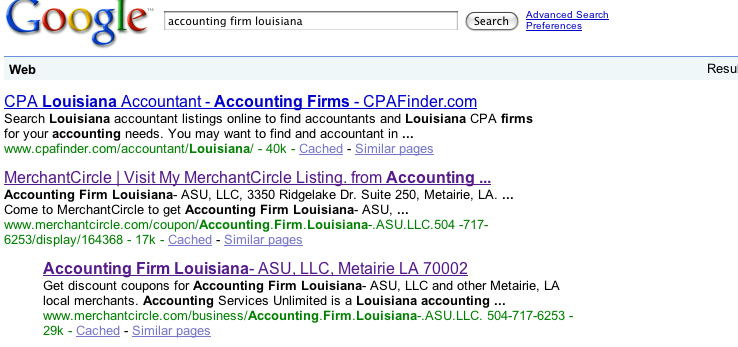
    Accounting Firm Louisiana - Image from Google

    As you can see, with the Merchant Circle listing we have 2 of the top 3 for “Accounting Firm Louisiana” for ASU, LLC in Metairie LA.  And this one is very early in our process.  Within 60 days or so we would expect his listing to supplant the Merchant Circle listing and hopefully knock out that top one as well.

    Picture of Sara Palin with an M-16
    Sara Palin Taking Aim on those Barnacles

    Like all SEO it’s not a case of “build it and they will come”, each of these listings needs to be cultivated, and promoted around the web.

    But, as the above demonstrate a little bit can go a long way when you first attach yourself to a big heavy object.

    With Barnacle SEO, even a Sam’s Club shopper can compete with the Neiman Marcus set in local search engine optimization.

    Image Credits (Wikipedia):
    Gooseneck barnacles taken at Limekiln Point on San Juan Island
    Camp Buehring, Kuwait – Lt. Col. David Cogdell helps Alaska Governor Sarah Palin test out the Engagement Skills

    Will Scott is president and founder of Search Influence a website promotion company in New Orleans, LA focused on local search engine optimization for small business.