Blog

  • Buyer Beware – How Negative Reviews Led to Positive Google Rankings

    I remembered the saying “any press is good press” as I read this amazing and cautionary article from The New York Times, A Bully Finds a Pulpit on the Web.  It’s a long article, but it’s definitely worth reading. In short, it tells the story of how one woman unfortunately found out the hard way that Google rankings do not incorporate “sentiment analysis” for how it crawls the Internet to produce its search rankings. What this equates to is that search engine results that appear in the coveted top of the search results might appear in this spot due to negative feedback, like customer complaints, posted on review sites.

    More precisely, the takeaway point of this article is summed up in this paragraph, referring to how Google ranks pages:

    “A crucial factor in Google search results, the spokesman explained, is the number of links from respected and substantial websites. The more links that a site has from big and well-regarded sites, the better its chances of turning up high in a search.”

    Wow! So this means that companies that seek out negative press, like DecorMyEyes (the company in question in the article), are just as likely to be ranked number 1 as law-abiding, hard-working and honest companies who legitimately deserve this ranking?

    What the what?

    And that is exactly what the almighty Google thought too. According to TechCrunch, in response to The New York Times article, Google has changed its algorithm to prevent any negative feedback helping a company’s search ranking.

    And all is well in the world again.

    But this brings me to my point, and please indulge me as I digress for a moment. As I read this story, I began to think of college. All through college a variety of my professors lectured to me the same golden rule: research is king.  And who says you don’t remember anything from college?

    Why would this article bring back memories of distant professors? Well, apparently they were right. Whether it was a history professor saying that there are two sides to every historical event or one of my public relations professors saying that without research you are just blindly throwing darts at the wall, the message was the same – do your research!

    Even though Google has changed the way it ranks to incorporate “sentiment analysis,” companies will always try to increase their rankings, and some might even find seemingly sordid ways to drive traffic to their site. While Google rankings can go a long way in your website visibility and client traffic, continue to do your research before opening your wallet.


  • How Many SEO Experts Does it Take…

    How many SEO experts does it take to change a light bulb, lightbulb, light, bulb, lamp, lighting, lightswitch, switch, energy…

    (courtesy of Twitter @YouAreAGeekWhen)

  • Best of the Best of Canadian Citations – Canada Business Directory

    Canada Business Directory Image

    The choice of local citation sources in Canada is sparse, especially when comparing the sheer amount available for use in America. Here at Search Influence, we figured we’d do our part and help out our neighbors to the north by doing a bit of research into the most valuable directories available to them. Before we get to the list, let’s first explain a little about the method we used to rank them.

    PageRank

    PageRank is a complicated algorithm that Google uses to measure the relative importance of a site when determining how it should rank within search results. The way it does this is by analyzing how many sites link to it and, more importantly, the strength of these sites. In other words, a site with one high-ranking site linking to it can have a higher PR than one that has multiple lower ranking sites pointing to it.

    If I were a math wiz, I might be able to explain how this algorithm works. Unfortunately I’m not, so I’ll just trust Wikipedia’s explanation: “The PageRank conferred by an outbound link is equal to the document’s own PageRank score divided by the normalized number of outbound links L( )” Or in other words,

    Canadian Business Directory Image

    mozRank

    mozRank and PageRank both measure the same thing. However, mozRank is generally said to be more accurate in its results. For example, a directory with a PR of 7 may have a mR of 6.15. Generally, any site that has a PR above 5 will typically be undervalued in its mR, as displayed above.

    Citations

    A citation is any time a business’s name, address, and phone number are listed on the web. Similar to PR, it’s not just about the number of citations a business has, but the trust of these citations as well. Using the local citation finder from WhiteSpark, we used three different keywords to crawl high-ranking local listings and found how many times these directories were listed as citation sources.

    Now, on to the findings! The top 10 Canadian citation source according to Search Influence:

    YellowPages.ca

    This one is the clear winner, and this should come as no surprise. It’s tied for the highest PageRank with 8, and has the second highest mozRank with 6.8. The reason this one is chosen for the top spot is because it has way more citations than the number two position. Its high Page and mozRank, coupled with the citations you’ll receive from it make this an invaluable source for your business’s listing. Only thing required to get listed is a business line registration from the Canadian YellowPages.

    BBB.org/Canada

    This directory isn’t specific to Canada, but it still holds high value due to its PageRank of 8, as well as its mozRank of 7.38. However, it has a comparatively pitiful number of citations with only 10. The sheer weight that a link and/or citation from the Better Business Bureau provides makes for a great resource.  The only way to get listed is by contacting the Vice President for Business Relations.

    CanPages.ca

    Very similar to look and layout of YellowPages, this directory is nearly as distinguished. PangeRank of 7 and mozRank of 6.15, we found a whopping 40 citations using WhiteSpark. Sign up here.

    WebLocal.ca

    With a PageRank of 6, a higher mozRank (which is pretty rare, I’ve found) of 6.5. and 27 citations found, this is another notable directory. Sign up now.

    411.ca

    Similar to America’s use of 411. PageRank – 7; mozRank – 5.63; Citations – 14. It may have a higher PageRank than WebLocal, but it gets beat out in the other two stats. Still, I wouldn’t pass the chance to get listed here.

    GoldBook.ca

    Another one trying to follow in the footsteps of YellowPages. PageRank – 7; mozRank 6.4; Citations – 7. It’s on the lower-end of the number of citations, but it’s the only other one with rankings that can compare to the above.

    Yelp.ca

    PageRank – 6; mozRank – 4.23; Citations – 17. Just as in the States, every business should be listed on Yelp. No doubt about it. Get listed now.

    iBegin.com

    PageRank – 6; mozRank – 6.05; Citations – 12. Submit you business here.

    ProfileCanada.com

    PageRank – 6; mozRank – 6.12; Citations – 5. You have to complete a downloadable form to sign up.

    ZipLocal.ca

    PageRank – 5; mozRank – 5.06; Citations – 16. High citations number. Too bad we can’t say the same for the rankings. Still, a valuable directory that I would not hesitate to get listed in.

    So that’s it! Submit your business to these directories and watch your rankings climb!

  • Google HotPots – As tasty as it sounds?

    I love Vietnamese food. The word “love,” as a rule, gets thrown around with some degree of carelessness. I doubt, for example, that my International Relations grad-student roommate is romantically enamoured with Nelson Mandela despite proclaiming her undying affection for his “dreamy” social policy, but there’s just no other verb to describe my all-consuming desire for bánh mě sandwiches and bánh bao steamed buns.

    I wanna marry it…

    When I heard about Google’s new HotPots feature, I immediately (possibly because it was close to lunchtime) started envisioning a sour soup, maybe canh chua tom, redolent of tamarind, spicy shrimp, pineapple and enough bean sprouts to keep me chock-full of phytochemicals for a month. Oh baby.

    HotPots, despite its deliciously misleading name, is Google’s new location-based “recommendation engine” that spells big news for both consumers and businesses looking to optimize their location-based advertising. Much like the soup I’m now craving, it’s an amalgamation of several complementary features– user reviews combined with a less subjective star rating system, location and preference-based recommendations and a social networking aspect.

    Google had already edged in this direction in late October with its new streamlined integration of content from review websites like Yelp and Zagat, but the addition of HotPots content to Places pages may prove the most relevant factor for searchers. Users are now encouraged to directly rank and review businesses from their own Google profile, but are given the option to create a unique HotPots handle that is not linked to their general Google information.

    Social results are relevant results here– there are options to display only reviews from friends, and places will get bumped up or down users’ search rankings depending on how said friends have rated in the past. The interface is a streamlined grid without an overabundance of information, making the feature remarkably user-friendly and available to consumers of all technical proficiencies. One feature I particularly like in the initial search page is the display of neighborhood or intersection in lieu of specific addresses; when I’m trying to decide if Cafe Minh is too far away to justify a sudden envie for summer rolls and beef pho garnished with lime and bristly Thai basil, I’m far more likely to immediately pick up on “Canal & Harney St.” than a context-less street number, and obtaining details such as phone number and address is as simple as clicking through into the establishment’s Places page.

    To be honest, I initially wasn’t sure what to think about HotPots– Google has already done a great job integrating external reviews into their results pages, and I’ve never had a complaint with the location-based rankings they’ve provided me with thus far. Having poked around the application, though, I’m impressed. Google has done an admirable job adapting what could have been an unwieldy and overcomplicated tool to its potentially enormous audience, and I love the different levels of detail the user is allowed to provide– from simple smiley/frowny faces to detailed verbal reviews. There’s also potential for it to be incredibly useful to travelers, as the service by its very nature promotes businesses that make their customers happy. Quality rises to the top, and local word-of-mouth promotion has suddenly gotten a whole new venue.

    HotPots is still in its beginning stages and it remains to be seen whether Google users will start providing rankings in earnest. However, I’ve thoroughly enjoyed poking around the interface and reviewing some of my own favorite (and least favorite) joints. I’m excited to see what interesting locales Google will suggest for me in the future, and will watch the service with interest as it accumulates more user data. Now if you’ll excuse me, I’m off to see if any of my friends have suggestions for the best noodle house in town.

  • Are Facebook Ads for All Businesses?

    Facebook Ads Image
    Facebook Ads. Are You Doing it Right?

    Recently a slew of articles have been popping up about the ineffectiveness of Facebook advertising. While we recently touched on this subject in a previous blog post, I thought I would explain why this statement has little credence when Facebook ads are done properly. If you’ve read any of our previous FB blog posts, you are aware that for Search Influence, Facebook yields a low cost per lead making it one of our most effective ways to drive leads to clients’ sites. With that being stated, I can proceed to explain (in a Clarissa-esque manner) why Facebook is effective and ineffective for some online marketers and industries.

    Are You a Facebook Friendly Business?
    I’ve mentioned this before but Facebook ads follow the same methodology that magazine and television ads follow.  While choosing images for your ads is important, determining whether your business is right for Facebook is the key to success. You would never hire a fertility specialist, carpal tunnel expert, or babysitter from a 30 second TV spot (well maybe you would. I would never trust my semen, wrist, or subsequent children in the hands of a stranger on TV, but I was raised right). I think that is the fundamental problem some advertisers have with Facebook. They’ve read a few cleverly written articles on online advertising on Facebook and they think they can create those successes for all their clients. However industries such as elective surgery, social causes, and the entertainment service industry fair considerably well for local businesses.

    Facebook Ads Image
    Facebook Ad Demographic

    Is the Facebook Demographic Right for You?
    Why do these previous mentioned industries succeed? Before I address that let me just get this out of the way – Facebook is not for everybody. If your business is a retirement home and a certified social media specialist tells you he can increase you fan base and leads from Facebook by some unthinkable number, he’s lying. Certain demographics just do not exist on Facebook, blame social media and technological darwinism. The largest demographic using Facebook are between ages of 18 – 34. They are the beauty obsessed, socially aware, fun-loving Youth of America. This is the age group your business must pander to in order to be truly effective.  From an ROI perspective, the subgroup of the young professionals between the ages of 25 – 34 are where the disposable income is the ripest. By targeting this age group with the correct interests and properly crafted ads you can increase your leads stream significantly.

    Are Facebook Ads Ineffective Because of Bad Advertising?
    We have all seen these ads. The married man being shown dating site ads despite his status being “married”, the teenage boy being shown breast augmentation ads because he has “breast” as a interest.  And my personal favorite, the work from home search marketing ads (as seen in the image below). I see these ads and I am filled with laughter, sorrow, and disdain. Is it such a surprise that Facebook is deemed ineffective with such a large percentage of ads misspelled, using irrelevant images, and just down right offensive ads running? I mean, get high on Jesus? Really?

    Facebook Ads Image
    Bad Facebook Ads are BAD

    At the end of the day, the performance of Facebook advertising is directly tied to your business, the demographic you are targeting, and how well you compose your ads.  People assume this is an ad space issue marketers and industries have dealt with since commercialization of goods. So instead of questioning whether Facebook is effective, social media marketers should be questioning whether Facebook fits their clients business model.

    Thanks to Salvo Vaccarella for the image.

  • New Study Suggests Using Facebook for Business Promotion May be Ineffective… We Suggest Otherwise

    Facebook Ads Image

    A recent study conducted by software and website training company Intellimon has revealed some fairly eye-opening findings about the use of social media in traffic generation for online businesses. They surveyed over 4,000 online business owners earlier this year and the results surprised everyone, including those conducting the study.

    67% of those surveyed utilize Facebook to promote their business. Of those, only 29% said the platform is an effective means of driving traffic to their site. Similarly, of those businesses using Twitter, only 27.2% found it effective.

    While these statistics alone seem jarring, when looking deeper into the study it begins to make a bit of sense. 70.1% of businesses operate on a part-time basis only. Not just that, but the vast majority of work is only done by one person, most likely the business owner. This includes a whopping 88.2% of them taking on traffic generation, with only 1.7% outsourcing the work.

    These numbers highlight the importance of hiring a professional online marketing company to handle traffic generation, especially by way of social media. I’d like to see which of these businesses even have a spend budget for Facebook advertising. These numbers are in direct conflict with the great success we’ve had in using paid ads and contests to drive fans and traffic. Here’s some proof from one of our clients:

    Facebook Ads Image

    And that’s just from the past 30 days. So next time you think about running social media campaigns on your own, think again. It can save you a lot of time and, more importantly, a lot of money.

    You can download the study here.

  • Have you measured it?

    It’s an honest question. Tons of people have. There’s nothing wrong with it. It let’s you know what you’re up against. Here at Search Influence, we do it all the time. In fact, we measure it so much that it’s almost become ritualized. So I’ll ask again, have you measured your return on investment for all those dollars you’re spending on marketing?

    Many business owners are under the impression that the more money they throw at a marketing strategy, the more money they’ll get back in return. It’s a logical strategy, but if you’re not measuring your ROI, how do you know is if it’s truly working? Luckily, there are plenty of tools out there that help you measure it.

    The first step anyone should take is setting up a Google Analytics account. Analytics is a free web-based service that tracks visitor behavior on your site.  It’s an amazing tool that helps track your various marketing efforts.  It lets you know which keywords are used to reach your site and where your visits are coming from. That’s really just the tip of the iceberg. It can also tell you your Cost Per Lead if you have a Pay Per Click campaign, and also let’s you know your site’s conversion rate, which is your number of  leads divided by the number of visits to your site. This is critical information to know. Traffic is great and all, but if those visitors aren’t doing anything once they get there, it’s kind of pointless. Conversion rate distinguishes between which businesses are showers and which are growers.

    The next step is to install call tracking. What this does is allow you to assign a unique phone number to all of your advertising efforts. You can have separate numbers for your ads in print, radio, television, or on the ‘Net. Not only does it allow you to distinguish which of your campaigns these calls are coming from, but it tells you when they called, where they’re calling from, the duration of the call, and whether or not it results in a sale. It also records information on calls that you miss.  This is invaluable information when measuring your ROI.

    Lastly, if your site offers a service or call to action, install a form system. Don’t be shy and hide it on your “Contact Us” page, either. You want it in people’s faces, so put one on every page you can. It’s so much more beneficial than having people email you directly, which only gives you a snapshot of what you can know. With a form, you not only get the same information as you would through email, but you can see how they found your site, through what search engine (if any), and by using what keyword (again, if any).

    There it is, the Holy Trinity of measuring your website advertising numbers and gains, or W.A.N.G. if you will. Now you’ve got no excuse. Pull out those proverbial rulers and start measuring!

  • Google Privacy Settlement is Just Strange

    The other day, every Google Mail user got the same message in their inbox:

    Just kidding. This is the actual message:

    Google rarely contacts Gmail users via email, but we are making an exception to let you know that we’ve reached a settlement in a lawsuit regarding Google Buzz (http://buzz.google.com), a service we launched within Gmail in February of this year.

    Shortly after its launch, we heard from a number of people who were concerned about privacy. In addition, we were sued by a group of Buzz users and recently reached a settlement in this case.

    The settlement acknowledges that we quickly changed the service to address users’ concerns. In addition, Google has committed $8.5 million to an independent fund, most of which will support organizations promoting privacy education and policy on the web. We will also do more to educate people about privacy controls specific to Buzz. The more people know about privacy online, the better their online experience will be.

    Just to be clear, this is not a settlement in which people who use Gmail can file to receive compensation. Everyone in the U.S. who uses Gmail is included in the settlement, unless you personally decide to opt out before December 6, 2010. The Court will consider final approval of the agreement on January 31, 2011. This email is a summary of the settlement, and more detailed information and instructions approved by the court, including instructions about how to opt out, object, or comment, are available at http://www.BuzzClassAction.com (no longer available).

    Again, to be clear, no Gmail or Buzz user can get money from the settlement because, as the class action notice states, “few, if any, Class members suffered compensable actual damages and because a pro-rata distribution of the fund to the class would not be feasible due to the size of the Class.”

    First filed around February 17 by Harvard law student Eva Hibnick, about a week after Google announced Buzz as an expansion of Gmail, the lawsuit almost seems like a class exercise. The complaint cites violations of the Federal Wiretap Act, the Federal Computer Fraud and Abuse Act, the Federal Stored Communications Act and California common law.

    None of the plaintiffs mentioned in the Class Action Complaint claim to have any palpable damages, all saying “Google automatically activated the Buzz program on [the plaintiff’s] email account, as a result of which Buzz broadcast her personal information to other Gmail users and/or made this information publicly viewable on the Internet.” In addition, the plaintiffs’ already liberal use of privacy-compromising internet apps, such as Facebook, doesn’t help their case.

    However, that litany lacking damages leads to a list of media accounts. Despite the cries of quelle horreur, the first example simply looks like good reporting and increased governmental transparency and the second only gives more credence to the use of COPPA. Later examples are more effective, but the question in my mind centers around the lawyers and their lack of willingness to contact more damning plaintiffs, such as a medical or legal office or the woman mentioned in the Times piece.

    The plaintiffs are concerned about the personal contact information automatically released by Buzz, such as place of residence, occupation, and email address. Furthermore, Google collected pictures and video from other Google-owned sites and showed them in Buzz, allowing anyone to view them. Finally, Google automatically created “Follow” lists, allowing Buzz to show a user’s list of contacts. These on their own would probably be a welcome change from the standard friend-finding on other social networking apps, but Buzz’s automatic enrollment ruined the experience for users.

    While it is a mystery how the privacy settings were missed in development—possibly it was a feature, not a bug—over four days, Google made 5 major edits noted in the settlement, and re-publicized the privacy setting change in April. These actions were clearly mitigating to the charges, and likely avoided any sizable penalty for the Company.

    So what is the penalty? Google publicizes an $8.5 million slush fund for internet privacy awareness, education, and policy formation. What they don’t tell you upfront is that the two attorneys for the suit, Gary E. Mason and Michael Ram, received 1/4 of the fund, $2.125 million, between them. In addition, each of the 7 named plaintiffs got $2500 each, leaving about $6.4 million for the fund.

    It’s clear Google wants to show they’re on top of privacy issues and certainly wants to keep the mindset of “Don’t be Evil,” despite officially dropping the motto. The question remains if the public will buy it. The public doesn’t really seem to care about privacy.

    Google’s share was up by 60¢ (.1%) after the emails went out two days ago, and was up $2.18 (.35%) at the time of writing. Looks like the public bought it–will those who were truly affected by the privacy leak feel the same way?

  • The Don Draper Guide to Internet Marketing

    Don Draper is the suave, womanizing Creative Director of Sterling Cooper Draper Pryce on AMC’s Emmy Award-winning Mad Men. He’s intelligent, handsome, and has a Superman chest for crying out loud, but he is also the epitome of a tragic hero. Despite his best efforts, he just can’t seem to get a grip on his personal life and constantly falls into the trap of his compulsive infidelity and lies. Yet, many fans of the show covet his life even though he barely wants it himself. I chalk this up to two things: fantastic writing and the character’s genius and success in his work. When it comes to the world of 60s advertising, his wisdom is unparalleled, and most of it can be applied to modern-era marketing as well. So before I digress into a raving fanboy over my love for this show, I present to you a few tips from the “Don Draper Guide to Internet Marketing.”

    “Give me more ideas to reject.”

    SEO is a game of trial and error. Sure, there is a playbook of rules to follow to ensure some success, but these are constantly changing and you need ideas on how to overcome the challenges you’ll face when they do. It doesn’t matter how many bad ideas you come up with as long as one of them is a winner.  Not everything you try is going to work. The only thing that matters is the one that does. That’s the one people will copy and that’s the one they’ll remember.

    “You manage people’s expectations.”

    As a member of the account management team at Search Influence, one of the main things I do is manage accounts (obviously); however, almost just as importantly, I manage the expectations of my clients as well. I can get any one of them to rank higher organically in Google, but this doesn’t mean they’ll see more sales simply because they’re listed above their competition. If their site is hideous and hard to navigate and they don’t want to put in the money necessary to fix it up, I can’t guarantee that our efforts will amount to more money for them. Don’t make promises just to make the client happy, unless you know for a fact that you can keep it.

    “Just so you know, the people who talk that way think that monkeys can do this. They take all this monkey crap and stick it in a briefcase, completely unaware that their success depends on something more than shoeshine.”

    Like I said previously, I can get someone higher Google rankings. That’s formulaic. It’s easy. The hard part is delivering an ROI to the client. That’s the service for which they are paying. They want to make much more money than they’re spending on me, and I’d better deliver. Ranking higher on Google is a simple shoeshine. Getting them more business is like giving them a new wardrobe. That’s what they want. It’s what they need. Otherwise they wouldn’t need me.

    I really want to end this blog post with a profound, Don Draper-esque quote, but I’m not that suave. Instead, I’ll let the real Don Draper close us out: “Yeah, I eat a lot of apples.” OK, maybe that wasn’t so profound. What do you want from me? I’m no Don Draper. I’m more of a Pete Campbell…

  • New Google Local Changes Everything

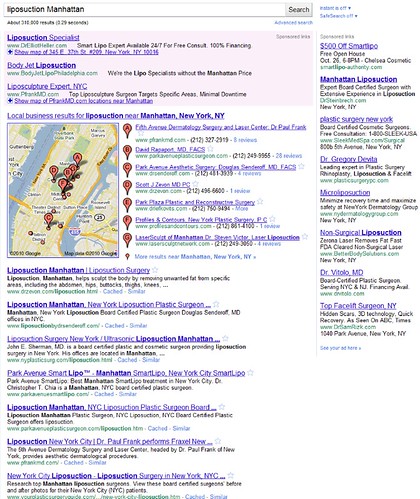
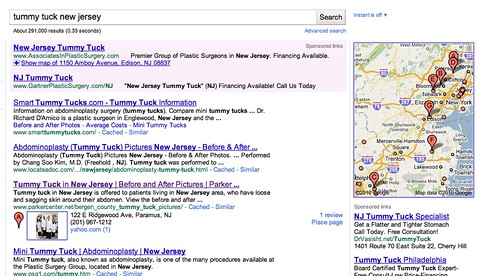
    Google is rolling out a nationwide update that drastically changes the way prospective customers see you and your competitors through what Google calls “Place Search.”

    The new integrated results combine your organic and local rankings in a new Google algorithm intended to make finding businesses easier.

    Old results:

    New results:

    A site which ranks well organically (below the map) has always had a better chance of ranking on the map. Those who weren’t strong organically could sneak on the map provided a low level of competition.

    This update hurts those businesses with strong local/maps presence and so-so organic presence. We do see, in some cases, that local prevails. A business with a strong local listing may be ranked within the organic results with just their listing data – not with any search specific information in the result.   The good news is that clients with strong local presence might get pushed up in the results.  The bad news is there is no search specific information in the result so click through might not be great.

    In the past businesses in suburbs who wanted to rank for “the big city” had a hard time getting on the map. This may continue to challenge suburban based businesses with this new Google update. Those with strong organic rankings who previously ranked organically for their targeted “big city” could count on traffic from the searchers who ignored the map and went straight to find what they wanted in organic rankings. This update, though, adds an additional factor to what Google considers relevant in regards to geography, which may pose a problem for suburban-located businesses.

    The new Google update stresses the importance of maintaining a strong presence in all aspects of the web.

    Rest assured, it appears an extremely strong organic ranking site will remain top of page even without a strong local listing attached to it, as in this picture:

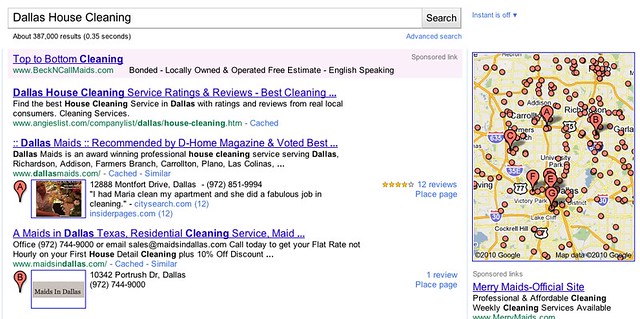
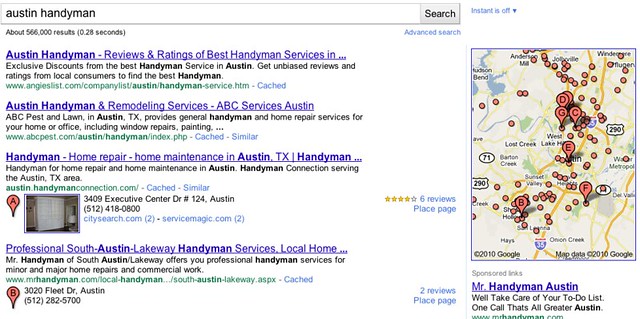
    Angie’s List, a directory of service providers, remains strong despite its lack of relation to a Place Page, as seen here for Dallas House Cleaning and Austin Handyman:

    New Google Local Results - Dallas House Cleaning

    New Google Local Results - Austin Handyman

    The new integrated results shows the importance of reviews, in particular on third party review sites such as Citysearch and Yelp by linking straight out to those sites from the main search engine results page.

    As seen in many of these screen shots shared above, If your Google Place page has pictures, your position on the search engine results pages will also be more prominent.

    There’s much more to be seen and discovered regarding this update. We look forward to working with our clients sites to be sure they maintain strong rankings.

    For further information on the subject, check out these blogs:

    Place Search: a faster, easier way to find local information – from the Official Google Blog
    What are the implications of the new integrated Local Search results? – by Mike Blumenthal on Understand Google Maps & LOcal Search
    5 Quick Impacts of Google’s New Local Search Results
    – by Matt McGee on Small Business Search Marketing
    Meet the New Google Local SERPS
    – by Andrew Shotland on Local SEO Guide
    New Place Search Shows Google’s Commitment to Local
    – by Greg Sterling on Search Engine Land