Blog

  • 5 For Friday — Links, Stories & Posts For Your Weekend (Plus An Announcement!)

    The Content Strategy that Made Justin Bieber a Star — Content Marketing Institute

    You may or may not be a fan of the teen star Justin Bieber and his ubiquitous haircut, but there’s no denying that some serious marketing has gone into making him one of the most famous and adored pop sensations in recent memory. Disney Media, geniuses that they are, have floated a unique campaign to make Bieber famous and skyrocket him to domination of his niche — in this case, pre-teen music. Content Marketing Institute’s Scott Aughtmon dissects the tactics Radio Disney undertook to market their star and how you can apply these concepts to your own campaigns.

    5 Keyword Research Alternatives for Mobile, News, Social, Image & Video Optimization — TopRank

    Search marketing isn’t just for Googlers sitting in front of their PCs anymore. Mobile search drives a huge portion of web traffic, while ancillary optimization opportunities such as video and images are a goldmine of untapped potential for the right marketers. This handy article by TopRank’s Lee Odden provides you with tools to hunt down the perfect keywords to target your audience — no matter what platform or medium they’re using.

    B&H Photo Shows How To Convert Customers Into Fans & Followers — Small Business SEM

    While we’ve elaborated on many good practices for small business SEO campaigns, but those carefully-tuned broadcasts can seem like a waste if there’s nobody there to listen. If your business is hitting all the marks in your social media sphere but just can’t seem to gain the followers, check this article out for several handy tips on converting your real-life fans into online followers.

    How Marketers Can Connect with the 3 Mindsets of Search [STUDY] — Search Engine Watch

    In this recently-released study, About.com and Latitude conclude that customers use search engines with one of three specific mindsets: Educate Me, Answer Me and Inspire Me. Check out Search Engine Watch’s writeup for in-depth exploration into these searchers’ motivations, as well as how to apply the concepts to your own campaigns.

    5 Cheat Sheet Basics for International SEO — TopRank

    As we’ve noted before, cross-borders SEO can be a tricky area — but also a rewarding one. No matter the distance between you and your client, these basic international SEO tips are sure to have you on your way to an effective and well-planned campaign.


    As a special bonus sixth feature, we’re proud to announce that several of our talented SI bloggers are taking part in the 2nd Annual Bad Ass SEO Guest Blogging Contest at Search Engine Marketing Group! Keep your eyes peeled for quick tips and insightful search marketing commentary from our homegrown team of experts. Our first entry, Doug Thomas‘s The Real Meaning of the Facebook Timeline – Are Display Ads Dead? has just been published today, so head on over and tell him what you think. All of us over here at SI thank SEM Group and the contest’s sponsors from the bottom of our hearts for enabling a great opportunity. Check out the great groups and businesses they have sponsoring this event:

    Contest Media Partner

    $500 Sponsors

    RankPop.com Affordable SEO

    $300 Sponsors

    Daniel McGonagle Link Building

    SEO-Peace.com Professional link building SEO Company

    $150 Sponsors

    Hesham Zebida Thesis Skins

    $100 Sponsors

    Scott Bradley Simple Weight Loss Tips For Entrepreneurs

    Milan Matchev Health Directory

    Jacob Share JobMob Job Search Tips

    Ileane Smith Blogging Tips

    Search Engine Marketing Group

    John Britsios www.SEOWorkers.com

    Magento Developer Magento Developer

    Doc Sheldon’s Clinic Critical Thinking for the Discerning SEO

    $50 Sponsors

    Vertical Measures Internet Marketing Services

    Whitney Michael Segura Greenhouses for Sale

    Butch Segura Wholesale Greenhouses by EarthCare

    Whitney “WeedyP” Segura Internet Marketing Blog by Whitney Segura

    Ernest Segura Greenhouse Supplies @ OurCrazyDeals.com

    Raxa Design Houston Internet marketing

    Ana Hoffman – Traffic Generation Cafe Web Traffic

    James Brown James Brown

    Anwar Barake Wholesale Herbal Incense

    Understand Technology with TechFume

    The Tech Blog TechnoZeast

    Wilderness Aware Rafting Colorado White Water Rafting

    Sales Nexus online CRM

    SEO Prize Sponsors

    David Harry A full years membership at SEO Dojo, a value of $250.SEO Training Dojo

    Lifetime membership to: My Blog Guest. MyBlogGuest.com is the free guest post exchange community where users meet to exchange guest posts and network.

    Link-Assistant.Com SEO PowerSuite Enterprise (max. functionality license) SEO tools

    SEMrush.com – the best tool to spy on your competitors ($210 value) www.semrush.com

    3 month Pro subscription to Raven Internet Marketing Tools ($297 value) Raven Internet Marketing Tools

  • Social Media For Readers and Writers: Cursor Takes the Publishing Industry To The Next Level

    Is the traditional trade paperback and remainder-bin production model of books doomed? With new devices for the digitization of books appearing every day, from the freshly-announced Kindle Fire to slick iPad e-reader apps, the conclusion that the publishing industry will soon go the way of the dodo is easy to come to. After all, literacy rates are plummeting, book sales are down and one of the original giants of big-box retail bookstores has recently crashed and burned in a spectacular fashion. Despite the failing numbers of traditional methods of publication, there are more novels and poems and stories and essays being written and consumed now than ever before. In the face of the instant-gratification model the Internet provides, where does the written word go from here? Richard Nash, former editor of Soft Skull Press, has an idea.

    The traditional delivery of a book from author’s pen to reader’s hand is long, complex and prone to errors in translation. The author-agent-publisher-printer-wholesaler-retailer-reader chain has failed in a significant way because it by its very nature promotes isolation between the reader and the writer. With that in mind, Nash and his business partner Mark Warholak have launched a new project called Cursor, designed to apply the concepts of social media and successful crowdsourcing to the creative writing world. In his Publisher’s Weekly article, Nash elucidates many of his problems with the industry as it stands today and how the diversification of Cursor’s services are key to promoting success both financial and artistic. Its first imprint Red Lemonade is just one of the many “self-organizing, self-selected, self-perpetuating communities [created] around a reading-writing platform” that are to come. Red Lemonade is “pop-lit-alt-cult” operation with charmQuark, a science fiction-fantasy genre community, soon to follow.

    Each of these subgroups will publish approximately one or two books a month using the Cursor software platform in both digital and trade paperback format, staggering the release dates in order to maximize profits. Importantly, though, Cursor’s source of revenue isn’t just from pure sales of its product. There are paid membership options available to widen the availability of tools and services, for example peer-to-peer writing groups, recommendation engines, access to established authors from within the Cursor system and beyond, and professional editing and marketing assistance. Other sources of income are available via advertising (this is social media, after all), connecting writers with providers of publishing services, agent fees and more. All of this will be balanced with the social component that allows writers and readers to interact and comment on each others’ works and postings. With the ability of the Internet to disseminate quality material and enable discussion thereof from commentators all over the world, this network hopes to create a thriving series of sensitive feedback loops that allow the showrunners to quickly identify and implement the features writers want, not to mention publishing the works that have gained the most reader support. “Book publishing doesn’t work with top down advertising,” says Nash. “It’s always done its best when one person says to another person: ‘You should read this book.’” The sharing and viral campaign potential for this kind of system seems self-evident, as the community, not the marketing department, is responsible for deciding what is ultimately rewarded with publication.

    Perhaps the most daring move that Cursor is taking is the eschewing of the traditional author copyright agreements. Contracts are limited to three-year terms with an option to renew as opposed to the old “seventy years after author’s death” chestnut. This is such a significant move because the latter type of agreement was largely what kept traditional publishing houses in business — the acquisition of intellectual property rights for, say, a movie adaptation or the backlist of a previously-obscure author who’s now selling like hotcakes because a prestigious award. With Cursor, authors will have the option to simply walk or renegotiate at the end of their three-year period. The philosophy of simple business tends toward the “maximize the profit from the property” mode. Nash’s viewpoint that authors deserve the benefit of renegotiation if and when the underlying value of their contribution increases. Quid pro quo, however; in exchange for this freedom to walk or adjust the terms of the deal, Cursor-owned properties will be licensed under “a fairly broad basket” of rights, including audio, English-language foreign publication, translation, and magazine republication, among others. It’s a bold move, and one that’s very indicative of the hyper-flexible approach Cursor is taking to publication instead of the narrow but powerful beam of traditional retail book-selling and marketing.

    In 2008, more than 275,000 new titles were published through a variety of sources. Data suggests that more recent numbers will be even higher. The music industry has gone almost completely digital, and sociality is being emphasized even further with Facebook’s recent seamless inclusion of Spotify plays into home page feeds. With the ubiquity of high-speed Internet becoming more and more a fact of daily life and the communication and sharing potential of the social web continuing to evolve, books still have a long way to go to catch up with their other media counterparts — but Cursor promises big things in the way of making up for lost time. As Nash himself says, “technology has emphasized a simple truth at the heart of my new enterprise: we are what we read, we are what we write, and we organize ourselves around and connect with one another through what we read and write.” Red Lemonade already has a number of titles in its store in both paperback and ebook format, and the word of mouth around them has been ebullient. Broadening the way readers and writers interface, Cursor isn’t designed to “save publishing” — it’s designed to bring it into its new form.

  • Influencer Profile: Colette Bennet

    Search Influence Internet Marketing Associate Colette Bennett is also a freelance writer who has been producing content across a wide variety of geeky topics since 2006. She has written for a wide variety of videogame blogs, including Kotaku, Destructoid, GamesRadar, Touch Arcade and Gamasutra. She also does work on color theory, culture and fashion for TIME magazine top 50 blog Colourlovers. Her most current project is running the Japanese culture section of Geek Out!, a new pop culture blog from CNN. At SI, she puts her word-nerd skills to work creating and editing a wide variety of web content, not to mention being one of our most prolific bloggers!

    Personality test time: if you were an old-school gaming system, what old-school gaming system would you be?

    The Nintendo Entertainment System, all the way. It’s my favorite to this day, and the reason why is because it was a low-cost platform to develop for and because of that, it had a lot of really wonky games on it. My childhood was spent on gambling/role playing game hybrids and far eastern war strategy. Guess it gave me a taste for the wild and weird, which comes in handy when you write about topics like I do!

    So you’ve been a blogger-at-large for some time now– how’d you get into the community?

    I moved to Los Angeles in late 2005 with the idea I was going to change careers and try to shift towards writing, and I ended up meeting some great circles of people in creative careers. One friend worked in comics and I used to hang out with him while he drew panels, which was tremendously inspiring. One day I mentioned to him I wanted to start a blog about gaming, and he looked up from his work directly at me and said, “Why haven’t you done it yet?” I never forgot that moment — it was the pivot that turned me in a new direction. I started my own gaming/tech blog, pitched myself as a freelancer to my favorite blogs, and cut my teeth over at several of the Gawker network blogs. Six years and a whole lot of published work have passed, and somehow I’m still scribbling.

    As one of the more regular writers for the SI blog, have you noticed any incongruity between writing for SEO/marketing topics and the more pop-culture focused stuff you’ve done in the past? Any skills you’d like to hone or bad habits to get rid of?

    I think the key to reaching people with any topic, be it pop culture, SEO or dog shampoo, is a passionate voice. If you believe strongly in the thing you are telling your audience, it is inevitable they will catch some of your enthusiasm and perhaps want to learn what it is that generates that enthusiasm. The more you continue to pursue those topics, the more you evolve as an authority. One thing I see on some SEO blogs is writers picking apart other SEO practices. I think challenging how people do things is fine, but pop culture suffers from this issue too — arguments cause page views and generate discussion, but they don’t necessarily get anything new accomplished. When I sit down to write something for an audience, I consider what I am going to say, and what effect it will have on my audience. Is it colored with my opinions, and if so, are they expressed in a way that is well-supported with evidence and makes sense? Or are they a rant? What can I contribute to the community I am writing for, in other words.

    I always love a chance to hone my skills on subjects outside of my natural pool of knowledge, so the SI blog is a nice arena for me to explore more SEO-based issues as well as social media, which is rapidly becoming a favorite topic.

    What do you find yourself doing around SI? Anything you’re excited about coming in to work on? In a perfect world, what would you be doing all day?

    I tend to focus on content here at SI, and my favorite thing to do is edit it and tweak it to make it better. Once an editor, always an editor! One thing I’ve actually been enjoying seeing on my task list is press releases, because I have never written them for any other job, and I think it’s a great skill to have. I’m getting better, but I still have a long way to go before they feel easy to do. Challenge is great — I have always thrived on it.

    Let’s see, in a perfect world… believe it or not, I would still be working. I thrive on accomplishment, so I don’t think I could just go to the beach (although I would totally put the four day work week into effect!) I feel like I could do a wide variety of things that would make me very happy. But as long as I’m writing, I feel good. I guess in my dream world, I would write about Japanese history and culture all day, cause you know, I’m kind of a nerd like that. And have to take “business trips” to Kyoto frequently, of course…

    Cranking out a steady stream of creative material can be hard — any techniques or tricks you use to get yourself psyched up or bust through writer’s block?

    My key rule for writer’s block is pretty old school: Write every day. If I could frame these words and put them over the desk of every writer who has ever struggled, I would. If you ignore going to the gym, it gets harder — writing is no different. Just keep flexing the muscle. If I don’t feel like writing, I sit down and I do it anyway. Maybe it won’t be as good at first, but eventually I fall into the rhythm. Staring at the blank page expecting yourself to perform on some perfect level is worse because it’s paralyzing. No matter what you write, always write something.

  • Social Media and the 2012 Election

    Facebook And Presidential Election Power

    As the 2012 presidential hopefuls cultivate their public personas through careful manipulation of social media outlets, it’s easy to forget that before the 2008 presidential election, social media had never been used on such a scale.

    Politicians had relied on old school phone banks and direct mailing campaigns for decades to mobilize their troops and direct voters to the polls on election day, but the power of the Internet had yet to be fully leveraged in a political campaign.

    What was groundbreaking in 2008 has become the standard for the 2012 presidential election, and politicians of all stripes are turning to the power of social networking sites to reach out to potential voters.

    Political Engagement Meets Social Engagement

    It all starts with a numbers game. How many times have you voted for president in your lifetime? How many times have you checked your inbox today? How about your curbside mailbox?

    If you are under 30, chances are you have cancelled and restarted your Netflix account more often than you have played a direct role in electing the most powerful politician in the world. You probably also have the Internet in your pocket or purse right now, just a few swipes and taps away from an email or a political tweet that could change your weekend plans from watching Arrested Development reruns to attending a political rally.

    Just as the 1993 Motor Voter bill was intended to give the young, the poor, the marginalized, and the otherwise politically disenfranchised a quick and easy way to register to vote, Obama leveraged the instant connectivity and infinite scalability of social media to energize his voting base through the free, easily accessible, and already tremendously popular medium of social media. And don’t think his competition didn’t notice.

    Social Media Comes of Age as a Political Tool

    Mobilizing the Internet generation has proven difficult, if not impossible, for many politicians that haven’t fully embraced the latest ways we communicate. And since energizing your core population of voters is the name of the game in modern American politics, it’s easy to see why every politician is turning to social media.

    While Sara Palin may have enjoyed berating the “community activist” ways of her one-time opponent back in 2008, by the end of the election cycle she had become one of the most vocal politicians on one of the largest active communities on the internet: Facebook.  And while she relied on her Facebook page as the main means of communication between her camp and the media, Palin has gone to great lengths and hired a team of “social media secret police” to control what ends up on her profile.

    While deleting comments made on your wall may be seen as either a necessity or black hat manipulation, it serves to underscore the importance of social media in American politics today. Now every major candidate for the 2012 election has a Twitter feed, Facebook page, and YouTube channel.

    So don’t be surprised if your mailbox remains empty as your Twitter feed and Gmail fill up as the election nears. Just as FDR proved the power of radio and JFK leveraged television to get into the White House – each game changing new technology forever altering the way the American public interacts with elected officials – President Obama ushered in the era of social media as a political tool. For better or worse.

  • 5 For Friday — Links, Stories & Posts For Your Weekend

    Mr. Spock’s guide to out-of-this-world SEO copywriting — SucessWorks

    Attention, Starfleet: the indubitable wisdom of Mr. Spock rings true even in the contemporary world of SEO. Join SuccessWorks’ director and lifelong Trekkie Heather Lloyd-Martin as she discusses some of her favorite Spock quotes and how everyone’s favorite half-Vulcan has wisdom to be applied to even the thorniest of search engine dilemmas.

    Miss The Live Q&A With Google’s Matt Cutts? Here It Is. — Search Engine Roundtable

    Matt Cutts, senior Google Search Quality expert and all-around SEO dominatrix, took a few minutes before the anti-trust hearing on Wednesday to answer live-tweeted questions from users all over the world. In case you weren’t there for the live stream, SER has you covered with a hard copy of the Q&A session that includes a brief rundown of Cutts’ recent movements and several timely questions about webmaster concerns and the state of the SEO world. Sign of Google’s openness with its users or last-minute PR stunt — what do you think?

    Mining YouTube for Keyword Research — SEOChat

    While it’s not the first place many of us think to look when it comes to keyword research, YouTube is a veritable bonanza of information to the savvy marketer. While many SEO professionals prefer to work within a specific subfield and pride themselves on their personal knowledge, countless others are faced with the problem of exploring new territories without the help of SEO-minded experts in the area. However, as titles, tags and text belonging to videos are by their nature relevant keywords, YouTube can be an excellent resource for filling in the gaps left behind by Google’s provided tools.

    Social Media is Sucking the Life Out of My Business! — Search Engine Guide

    Are you a small business owner who wants to break into social media, but are concerned with the time and resource investment it takes to run a campaign? Search Engine Guide’s Stoney deGeyter takes a look at the most common complaints from overwhelmed would-be media butterflies and addresses them with aplomb to help you get the most from your online efforts instead of pouring away the hours into them.

    Political Advertisements Invade Twitter: A Vote for Revenue — Search Engine Journal

    Twitter, that longtime proponent of egalitarian media sharing, has thrown its hat into the ring of political venue by opening up “promoted tweets” to political campaigners. These items will be distinguished via color coding and “sponsored by” markers that appear via hover box, appearing in the “top tweets” section of the site.

  • Facebook announces ‘Timeline’, redefines the social media experience


    This past Wednesday, Facebook rolled out a couple of new updates such as a ticker in the top right hand corner of the site showing live activity and a tab that allows you to control what gets shown in your top stories. As the internet is known to do on occasion, people flipped out, complaining about how much they hated the new changes. Someecards summed it up best in their e-cards on the subject (and those guys are always on top of the game, by the way), but the complainers had no idea just how much change they were going to have to cope with … and what was to come.

    This morning, Mashable posted a teasing article talking about the “new” Facebook, which was slated to be unveiled today at the F8 developers conference. The author of the blog said, “I have seen what Facebook is launching on Thursday, and it’s going to change the world of social media. And while I won’t talk about the mind-boggling things Facebook will be launching, I will say this: The Facebook you know and (don’t) love will be forever transformed.”

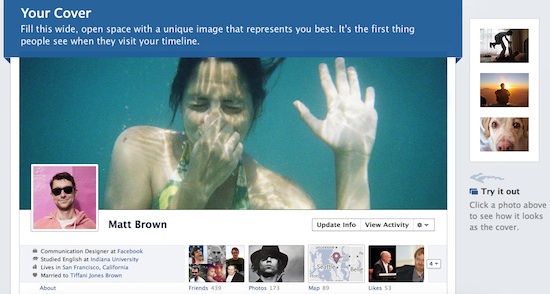
    Whether or not you agree with him is a matter of personal preference, but one thing is for sure: Facebook is going to be very different. The new format is called Timeline, and Mark Zuckerberg explained the thought process behind it as a way to stop losing the timeline of our lives in the social media format that scrolls past us on a day-to-day basis with no way to really accurately access the history. By adding the ability to click a year on the far right of your profile, you can easily go back to the past and see everything from photos to memorable moments. And that’s only the tip of the iceberg.

    By starring certain things you post, like a set of photos from a trip or an update, you can full screen them, contributing to a new profile page that’s reminiscent of the layout of the iPad app Flipboard. Apps are also highlighted on the profile, showing off everything from the movies you watch (directly pulled from your Netflix) and the music you play obsessively (culled from your Spotify account). Other companies such as IMDb, Flixster, DirecTV and Miso were also mentioned as partners, so you don’t have to feel left out no matter what you use.

    A search of the Facebook tag on Twitter shows that the haters are still at work, but I have a feeling that it’ll be harder to complain about a new user experience that is as innovative and interesting as this one. If anything, Facebook has shown that they don’t intend to fall into the graveyard that myspace and Friendster ended up in — because they are determined to evolve. Will users to choose to evolve with it? We’ll see soon enough.

  • Netflix splits into two companies, says they ‘messed up’


    It’s safe to say that Netflix pissed off a lot of people when they announced major changes to their pricing structure this past July. The new setup went something like this: $7.99 a month for unlimited streaming and $7.99 a month for one DVD out at a time. However, if subscribers didn’t actively go in and select a new plan, they would be automatically subscribed to both. The price increase, which was 60% higher than the previous prices, did not go over well. Netflix stocks plummeted, and the company found themselves with several million less subscribers than they bargained for, not to mention the massive internet backlash that followed.

    What to do? Well, desperate times call for desperate measures, and any good business owner knows it. In a major move, Netflix CEO Reed Hastings sent an email to every Netflix subscriber (which is also now posted on their blog) announcing that Netflix would separate into two businesses: One called Qwikster, which would handle physical DVDs and will also add video games, and Netflix would remain as an all-streaming service. But here’s the catch — If you want to use both, you need a separate account at both websites. Inconvenient? Just a bit.

    However, there are some advantages to the situation, as each business will have its own dedicated team, and Hastings promises that improvements for each service are on the drawing board. I’m sure that many users appreciate a forthcoming apology from a business of this size, and perhaps people will find this system works better for them. What is notable is that so much of the results of Netflix’s downfall in the eyes of the public was geared by social media: Within minutes of the price change announcements, people were in an uproar all over Facebook and Twitter, swearing they would drop their Netflix accounts and move to Hulu. Those people told their friends, and so on and so forth, and the chain continued. Whether businesses like it or not, they know that social media is powerful enough to literally cause a mass exodus, so they must consider carefully when it comes to making major decisions such as this.

    Speaking of Twitter, you may want to hold off on going to follow the @qwikster Twitter account for now, should you be interested to do so. Why? Well, apparently it’s being squatted on by a guy who is not exactly the epitome of class. He does have over 11,000 followers, however, who are probably getting just the show they bargained for. And he’s enjoying the attention, because he won’t give up the account. Hopefully Quikster has a gameplan to fix that messy little issue….


  • 5 For Friday — Links, Stories & Posts For Your Weekend

    The SoLoMo Landscape — Outspoken Media

    Are you one of the lucky search marketing professionals who’s experiencing SMX East in the Big Apple? For those of us following along at home, Outspoken Media’s Lisa Barone provides a thorough and thought-provoking overview of the topics discussed at SMX’s latest SoLoMO (social media, local and mobile search) panel with Gib Olander, Gregg Stewart and 15 Tips To Optimize Your LinkedIn Initiative — Techipedia

    Although LinkedIn doesn’t have the sheer weight of user numbers as its more socially-focused brethren like Facebook, its usability in the business world makes it an ideal source for adding contacts, keeping up with the latest industry news and exploring new business opportunities. If you’re interested in leveraging all that you can out of your presence in the online business world, these 15 handy tips should get you well on your way to sparkling content and increased interaction with colleagues and contacts.

    Google Places: Now Permanently Closed with 2 clicks — Blumenthals

    In another head-scratching move from the Google Places team, it’s now apparently even easier to get a business listed as closed without owner confirmation. With one experimental click, Mike Blumenthal saw his business listed “permanently closed” with twelve hours and received no notification of any sort. While Google has promised a fix “in coming days,” this experience is troubling for many business owners and we’ll be keeping an eye on the developing story.

    Google Launches First Google+ APIs — Mashable

    The first application programming interfaces for Google+ have at long last been unleashed, to the exultations of hoards of enthusiastic developers. While the APIs themselves are fairly bare-bones — limited to public data, with the ability to query a single person or activity on the network — developers have expressed great enthusiasm, with the majority surveyed expressing the opinion that G+ has what it takes to go toe-to-toe with Facebook.

    Why Zagat might be a smarter purchase for Google than Yelp — Search Engine Guide

    As we noted last week, Google’s acquisition of restaurant review giant Zagat is bound to make some waves as they hone in on Yelp’s local review market. Search Engine Guide’s Mike Moran presents this nuanced argument as to why this is a smart move for Google — perhaps even more savvy than their previous plan.

  • Influencer Profile: Kate Voisin

    After the ringing success of her Google acquisitions infographic, we’re proud to debut Kate Voisin as this week’s Featured Influencer! Kate is an illustrator and graphic designer who, before joining the SI team, worked as a freelancer. Like just about every New Orleanean, she spends much of her off-time writing what she hopes will turn into a novel, or browsing the stacks at Tulane’s library (where she is not actually a student). Her interests include coffee, dystopian novels, and cartoons.

    Hard-hitting question time: if you were an amphibian, what kind of amphibian would you be?

    A newt! (I’d get better.)

    Tell us about yourself! Are you a NOLA resident originally?

    I’m from a town a little south of New Orleans, but I’ve been living in and around the city for the past 6 years or so. If I lived on Sesame Street, I’d relate the most to Burt… Although in real life, I’m probably more of an Ernie.
    Apparently, I am pretty terrible at answering the question “tell us about yourself.” I don’t know how I got this job.

    You’re one of our newer employees — how long ago did you start? How’s SI been so far?

    I started at the beginning of August, so I’ve been at SI for a month and half now. It feels like I’ve been here longer, but in a good way. I really like my job– the work is challenging, and there is always coffee. And now that the hazing has stopped, I’m almost completely healed! Just kidding. The hazing was gentle.

    What do you find yourself doing around the office? Any particular favorites or disliked tasks?

    I do all the usual stuff that IMAs do, like submissions and lots of copying and pasting. But lately, I’ve been getting a lot of graphic design tasks.
    I was a freelance designer off and on for about 7 years, and any freelancer will tell you that it’s soul crushing. Designing at SI is heaven. Everyone’s been really open and supportive, and I’ve done everything from massive infographics, to logo retouching, to making a baby-on-board Photoshop of one of our (male) co-workers. (I still feel like I have to apologize for that every time I see him, too. Luke, I’m sorry!)

    How did you get into graphic design? Any favorite tools of the trade? Do you do fine art as well?

    I think I’ve been using Photoshop to make graphics for my various websites since version 5.0, maybe? That was in the 90s. I know Photoshop better than I know most people, and we’ve come a long way together.
    My favorite nerd tool of all time is my Wacom tablet (an Intuous4). I bought it last year, and it’s completely changed the way I think about design. It’s like drawing with pen on paper… but, like, way more amazing. I could go on and on about layers and tilt sensitivity, but I also still want to sound interesting, so… yeah. Wacom tablet. It’s awesome.
    And I draw all kinds of stuff! I have a Tumblr that gets seasonally neglected, but I post illustrations and doodles when I’m in the mood. And I’m almost always scribbling on something.

    Thanks to Kate for her tireless work making SI’s projects beautiful inside and out! Keep an eye on this space for many more informative and innovative graphic pieces in the near future.