Blog

  • 5 For Friday — Links, Stories & Posts For Your Weekend

    7 Technical SEO Wins for Web Developers — distilled

    Working with outside web developers is an integral part of SEO, but some of us less technically-minded folk may be confused as to where to start. Technical SEO, defined by Paddy Moogan of distilled as “elements of a page that the user can’t see without looking at the source code,” can be a tricky field to master. In this article, Moogan elucidates some of the most important things to know about this aspect of optimization, including how to keep an eye on your site speed and get a firm grasp on crawler access.

    Non-Profits: How to Get More Online Donations — Outspoken Media

    While “save the whales” isn’t the first thing that comes to mind when one thinks of search engine optimization, it’s vitally important for nonprofits to maintain an online presence in order to gain maximum exposure and precious monetary donations. Michelle Lowery, a copywriting professional and volunteer SEO master for her local animal shelter, shares some tips for online do-gooders to optimize their fundraising campaigns, make donations easy and publicize their cause.

    Content Marketing In The Echo Chamber — Content Marketing Institute

    The Internet has opened up a whole new world of possibility for the independent, the unestablished and the avant-garde to spread their ideas far and wide. However, the downside has been an “echo chamber” of sorts, where those who can speak the jargon pass themselves off as a social media expert, professional marketer or even the dreaded “guru” without any real experience or expertise to back it up. Here, Content Marketing Institute’s Keith Blanchard provides you with five handy points to “kick the tires” of your potential content marketing service and make sure you’re getting the bang for your buck.

    Don’t be afraid of fake reviews — Search Engine Guide

    While Yelp, Places and other review engines are excellent resources to learn more about the local world around you, fake reviews are the bane of every Yelp establishment’s public wall. In this informative SEG article, you’ll learn about the fake review phenomenon, how to respond to a rating you suspect is duplicitous and the possibility that, in the future, we won’t even have to worry about it at all.

    Evidence: Print Is Not Dead — B2B Bloggers

    While we may bemoan the diminishment of traditional publishing models, there’s no reason to be writing a funeral dirge for the printed book just yet. In a recent media usages study by Readex Research, a whopping 74% of the 2,095 professionals surveyed said that they regularly use print publications. Print as a medium is still a relevant and important part of the mix: the study seems to indicate that, instead of favoring one form of media over another, people are consuming more and more of all different kinds. Interesting stuff!
  • Naughty, naughty: Google Places turns up risqué photos for cosmetic surgery businesses


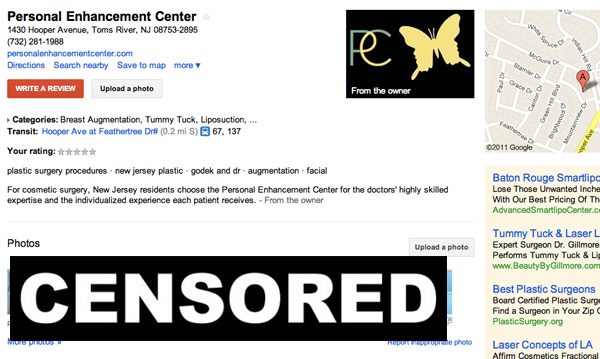
    Google has a crackerjack team of people helping to make their products bigger and better all the time, or at least, that’s the impression we get from them. I just might have caught an embarrassing typo in Google Docs last week, but otherwise, they seem to be pretty much on the ball. That is, unless you visit their Places page, which apparently is hot to show you photos of women’s bare breasts and much more — if the place you’re looking for happens to be a cosmetic surgeon’s office.

    Of course, the websites for most cosmetic surgeons feature a before and after page, but traditionally it takes some clicks to get to and obviously are not plastered all over the landing page. I’m sure some people would be impressed if they went to a doctor’s site and the first thing they saw was a pair of surgically-perfected double D’s, but most medical professionals prefer a subtler approach. And who can blame them?

    Speaking of class, Google, where’s yours? SafeSearch protects what images we see (although, admittedly, even Moderate can be a bit racy at times), but surely businesses will be less than pleased to see that they are being represented by a wall of women without their tops. Not that the images themselves are shameful, mind, but that’s the type of thing that should be taking place behind several layers of clickthrough. On the other hand, surely cosmetic surgeons will feel compromised if they have to pull their before and after galleries from their websites, as potential clients will want to see what the final products of their work looks like.

    It’s a little faux-pax … but nothing Google can’t remedy. Still, will they fix it? Since the images are clinical and not sexual in nature, they may have slipped through SafeSearch’s protocols. If Places automatically pulls the most viewed images, as intelligent as Google may seem, this still proves it to be a modern machine — not quite capable of thinking for itself just yet. We may have to wait a few more years until our networks can provide the same thoughtful attention to detail that humans do. Maybe we’ll be useful for a while longer after all!

  • INFOGRAPHIC: We Come From The Future

    For people born of a certain generation, “The Kids Are Alright,” is mainly a reference to a seminal work by The Who, which they originally heard on vinyl.  For a later generation, this phrase was likely linked to The Offspring’s “The Kids Aren’t Alright,” passed around via mix CD. And in five years, “The Kids Are All Right,” will probably be remembered as a groundbreaking film most people will see after they’ve downloaded or streamed it online.

    This sort of generational reference gap is being carefully– and often humorously– tracked by Beloit College’s faculty in The Mindset List, an annual compilation of political and pop culture references that the year’s college freshmen probably won’t get.  One anecdote on The Mindset List shows that people born before 1983, entering college around 2005, might not realize that the precise location of the Titanic’s final resting place wasn’t always known.  People born after the mid-1990s might not remember that OJ Simpson was once famous for his sports acumen, and wasn’t always a career trial defendant.

    One of the more startling trends on the Mindset List is technological: freshmen who will enter college in the year 2015 have no concept of what life was like before the Internet.  This is a generation for whom media has been, and forever will be, easily accessed by a few keystrokes and the touch of a button.

    Of course, since the advent of the Internet, no one has to stay completely in the dark about past pop culture or political events.  In fact, while taking away a kid’s Encyclopedia Brown books and making them read an actual encyclopedia was once considered a punishment (just me?), one could spend an entire day browsing Wikipedia and YouTube to find evidence of such ancient cultural touchstones of our peoples like the original McDonald’s sign (http://en.wikipedia.org/wiki/McDonald%27s_Sign_(Pine_Bluff,_Arkansas) ) or the Dick Van Dyke Show (http://www.youtube.com/results?search_query=dick+van+dyke+show).

    And while I’m grateful to live in a world where Diet Coke has “always existed” (#12, 2005) or where ATMs spit out my money (#16, 2004), I’m really interested to see how this list will look in ten more years.  For instance, my step-kid was shocked to find out that there was an animated version of Alice in Wonderland before Tim Burton laid his paws on it, and has often asked to “play” with my iPhone (or, as she views it, the Angry Birds device).

    And if you’re feeling really old or disparaged after reading this, worry not.  Kids these days still find the Three Stooges and Amelia Bedelia totally hilarious, so the future generation’s probably going to be all right.

    —-

    Kate Voisin is a graphic designer and IMA at Search Influence who carefully cobbled together this infographic using magazine clippings and paste.  Just kidding.  She did it in Photoshop and wouldn’t have it any other way.

  • INFOGRAPHIC: Why Content Marketing Matters

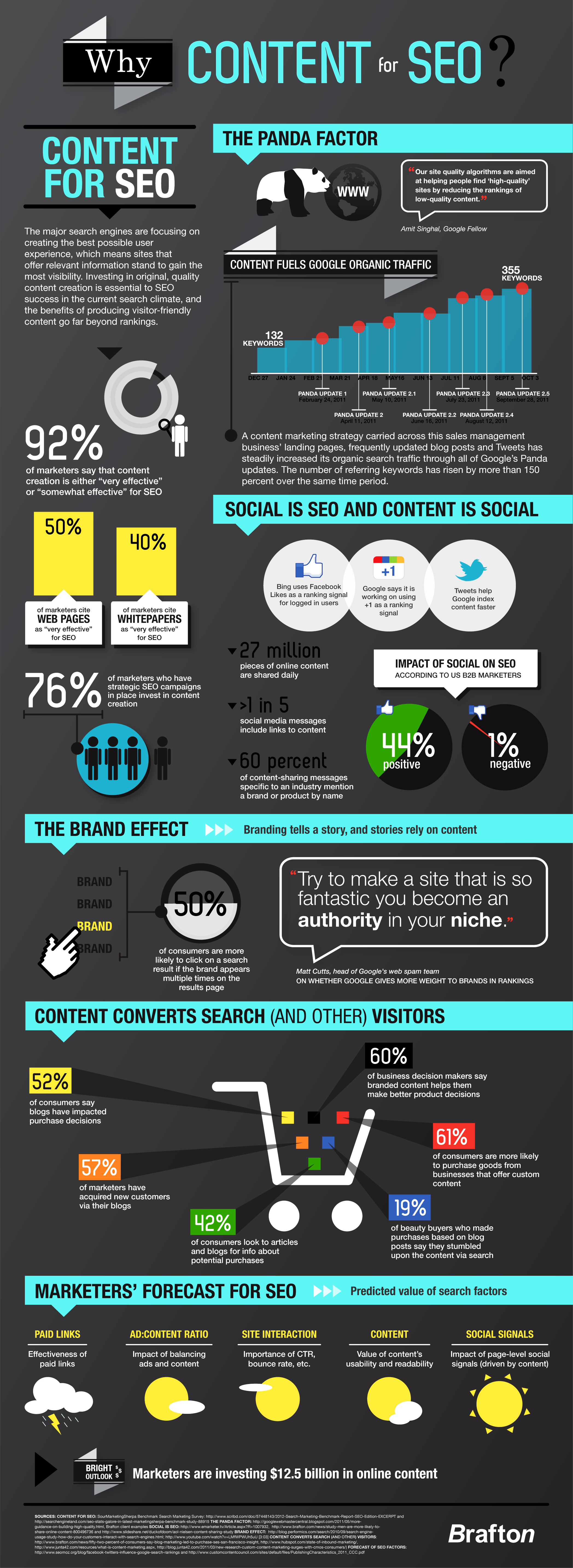
    Our friends at BraftoN have put together a great infographic on the importance of content in the world of SEO. It’s an established fact that search engines give preferential ranking to sites with the freshest and most pertinent content, but it’s eye-opening to really dig into how important content really is.

    As Google Fellow Amit Singhal is quoted as saying, “Our site quality algorithms are aimed at helping people find the ‘high-quality’ sites by reducing the rankings of low-quality content.” That quote alone should make everyone with any kind of Internet presence at all scramble for fresh, high quality content.

    Here are some other incredibly interesting facts from the infographic that deserve some consideration:

    • Ninety two percent of marketers say that content creation is either “very effective” or “somewhat effective” for SEO. The same percentage of Americans believe in God. Correlation, or causation?
    • Twenty seven million pieces of online content are shared daily. The same number of people eat at McDonald’s every day.
    • Sixty percent of content-sharing messages specific to an industry mention a brand or product by name. Sixty percent of adults can’t digest milk.
    • Fifty two percent of consumers say blogs have impacted purchase decisions. The same percentage of Americans don’t know who Pippa Middleton is. They obviously don’t read the blogs.
    • Marketers are investing $12.5 billion in online content. We could have just bought Motorola Mobility for the same price.

    So take a detailed look at the content you are offering on your website. Will it make Google jump for joy, or bump you 20 spots down the rankings? The quality of your online content is simply too important to ignore.

    Not sure what to do about your content? Contact us. We’re here to help.

  • 5 For Friday — Links, Stories & Posts For Your Weekend

    Search Optimization and 404 Errors — SEOChat

    If you’ve been on the Internet for any length of time, you’ve probably seen a colorful or visually engaging 404 page that pops up when you’ve reached an invalid page on a website. What you may not know, though, is that these pages have SEO potential and should be optimized for ease of use by your viewers. Check out this article to find out the four most important elements of a user-friendly 404 page, along with a bevy of other tips.

    How to Use 3 New Facebook Features for Better Social Media Marketing — CopyBlogger

    Facebook’s recent roll-out of the Timeline has many marketers worried that display ads and other traditional forms of Facebook marketing are kaput. Fortunately, CopyBlogger is here to show you how to adapt to these strange new waters and give your ‘book campaigns the updated punch they need to stay fresh and effective.

    Essential Checklist for Writing Guest Blogs — Pronet Advertising

    Being asked to guest blog is quite an honor, and it’s important to do it right. Jennifer Moline of PsPrint Blog elucidates some of the best practices for guest-blogging, including tips on how to be respectful of your host, engage your audience and format like a champ. (Speaking of guest blogging, have you read Influencer Colette Bennett‘s piece on the SEM Group Bad-Ass Blogger Contest? Check it out here — But I Don’t Have Enough Klout: How To Be Good At Social Media By Not Being A Jerk.)

    Are Google’s Local Efforts in Trouble? — Marketing Pilgrim

    As our own Joseph Henson blogged about earlier, Google’s new Place page policy is taking its cue from the “asking for forgiveness is easier than permission model,” updating page information with user-submitted information and allowing business owners to give input on the changes only after the fact. Marketing Pilgrim’s Frank Reed dissects some of the more troubling implications of this switch and throws out some thoughts on the potential future of Google’s local system.

    Speedy Site Prospecting Using Social Metrics & Natural Language Processing — SEOMoz

    With natural language processing, it’s now possible for an application to browse a website and algorithmically determine any given page’s topic and help humans determine what’s worthwhile and what’s not — effectively taking the elbow grease out of site prospecting. SEO Moz takes you through this exciting new capability and shows step-by-step how you can apply the concepts to your own campaigns.

  • There Will Be Blood – Competitors Can Now Destroy Your Google Listing

    The Villain

    Google is feeding local business owners to the wolves with their latest Places update. Lior Ron, Google Places Product Manger, announced yesterday evening that Google will be “helping” business owners keep their business listings updated by now allowing anyone, mischievous competitors included, to edit your entire Places listing for you. Yes, even if it is verified.

    How… thoughtful of Google.

    Google was already heading down this path. Earlier this year they started allowing verified business listings to be marked as closed by anyone and everyone. With this update, someone with ill-intent can now make changes to your business listing that can have detrimental effects on local search traffic.

    Yes, Google will be sending an email updating you about the recent changes to your Places listing. But, here’s the catch. Instead of giving the person that manages the listing the option to decline the edits, Google is “streamlining” the process by automatically updating the listing and basically saying, “well, if you don’t like it, go change it back and, after an unreasonable amount of time in which there is real potential for losing customers, we’’ll update it only for it to possibly happen again.”

    The most laughable part of this update announcement is Mr. Ron trying to spin these new features as something that Google hopes will “make it even easier for business owners to manage their online presence.” Yeah, maybe if we lived in a world where all of your competitors have scruples, and enough money to go around, but we don’t. The competition can be cut-throat in some industries and Google just gave them a knife.


  • Influencer Profile: Joe Luft

    Hailing from the frosty northlands of Chicago, IL, SI Internet Marketing Associate Joe Luft graduated from Tulane University in 2010 with a degree in Political Economy and no desire to be a politician or a lawyer. As an IMA Joe is responsible for a wide variety of tasks around the office, but finds hands-coding to be a productive and rewarding area. Some of his favorite things in the world include his family, dog, painstakingly broken-in denim jeans and, of course, his beloved Chicago Bears. (It’s okay, Joe. We don’t judge you… too much.)

    Joe showing off that rad 'tude and kicking style we love him for.

    First, and arguably most vital, question: if you were an antiquated dance craze, what antiquated dance craze would you be?

    Honest answer, the Cha Cha Slide. It takes me back to my days in middle and high school. Second choice would be “The Dougie” mainly cause my thirteen year old sister listens to it and does the dance at least twice a day. Guess those really aren’t antiquated, already failing at this interview.

    So what do you find yourself doing around here?

    On a daily basis I’m making edits to the code on our clients’ sites and publishing content for our clients. Whenever people ask me this, I always kind of pause and think for a second, then ramble on about computers and codes and the Google and by the time I look up that person is no longer standing there and I’m talking to myself about the computers. I’d say all my fellow Search Influencers are in that same boat, so many different things happening around here on a daily basis.

    Have you done any Internet or marketing work before working at SI? How’s the transition been so far?

    Just kidding! Here's the man himself.

    Yes, I have. I started dabbling with internet marketing in college when I worked for a sneaker store in the French Quarter. After a couple months working there they set me up with an admin account for their blog and I really got into it. From working at that sneaker store I was able to meet a lot of other local business owners and got a side gig running a blog for a men and women’s clothing store Uptown, and eventually created an e-commerce site for them. So my main focus, prior to SI, has been Internet marketing for fashion. I can’t even count how many pictures of shoes I have on my computer right now. I’d say a thousand.

    The transition at Search Influence has been fun and challenging. Instead of managing every aspect of a couple of websites, I’m in and out of numerous sites making edits on a daily basis. Along with working on more sites, I am doing more in-depth edits to site templates.

    How did you acquire an interest in coding? Any tips or favorite tools of the trade?

    I got interested in coding pretty soon after I started blogging. While WordPress and Tumblr can make some pretty cool templates, I always wanted to make the blogs I worked on a little more unique. During winter break of my senior year of college I bought a massive book about HTML and CSS coding and started poking around the world of Hyper Text Markup Language and Cascading Style Sheets.

    Biggest tip I would offer is to do it every day.

    What’s your favorite thing to do around the office? In an ideal world, what would you be sitting around doing all day?

    The most favorite thing I do around the office happens at 5 o’clock on the dot every Friday, I play “This Is How We Do It” by Montell Jordan out loud on my computer. Lets the people know it’s the weekend.

    In an ideal world I’m a “Whispers in the Dark” DJ on an old school Hip-Hop and RnB radio station spinning slow jams for the lovers all around the world. By law “Whispers in the Dark” programs can only occur during the hours of 11 at night until 2 or 3 in the morning (it’s whispers in the dark, not the light), so for the other portion of my day I’d like to design, clothing, sneakers, furniture. I’ve always found My Personalised T-Shirts to be the most interesting and often overlooked forms of art.

  • Netflix Pulls Plug on Qwikster


    You may recall that we were mulling over the whole Netflix situation only a few weeks ago, which has seemed to be getting more ridiculous ever since the company announced pricing changes in July that made users choke on their dinners. Twice the price for what they were getting before? Streaming-only services? People were just starting to recover, but Netflix had clearly spent a lot of time sitting alone in the dark listening to sad music; they knew they hadn’t pleased their audience. And so they decided to try to make it better (which as, many men can attest to, never works).

    I guess the Qwikster debacle was more than they could handle, what with people getting more upset than ever (not to mention the stoner squatting on the Qwikster Twitter account and all that jazz). Netflix has updated their blog yet again and emailed all their users to let us know that Qwikster is not going forward after all, which looks about as professional as taking off your shirt at an office party. There was also no word about the aforementioned video game rental plan that Qwikster was going to include, so I suppose we can assume that has been scrapped as well. Oh, the hoopla.

    What does this mean for Netflix now? Well, their stock has suffered dramatically since the original price change announcement. As of today their shares are still down 4.4%, which means this whole Qwikster cancellation thing has not eased anyone’s mind yet. Maybe Netflix didn’t go ahead with the crazy plan, but they announced the crazy plan and then reneged on it, which kind of makes them look even more nutty and unstable even if it was the right thing to do. It’s no surprise that investors don’t feel comfortable. It is commendable that Netflix has paid attention to the social media buzz surrounding the unpopular decision and realized that they’ve made a dumb move, but it also signifies that they aren’t thinking through major decisions enough — which is not a great sign for a company their size.

    What do you think — are you relieved there will be no Qwikster, or are you disappointed in the parent company for caving to the negative social media hubbub?


  • 5 For Friday — Links, Stories & Posts For Your Weekend

    Will small businesses survive the future of SEO? — Skyrocket SEO

    The SEO industry is constantly in flux and, while it can and has been dominated by those with deep pockets, small businesses have some significant advantages that the savvy marketer can leverage into a tightly-coordinated and effective campaign. Skyrocket SEO’s James Agate provides us with an informative overview of the links between getting your story out there and forming a bond with your consumer base, nurturing the community and establishing strong thought leadership.

    Mental Model for Minimal Viable Products — Chris McCann

    Have a great idea that you’re interested in testing on the open market, but don’t want to go straight to launch? Chris McCann’s concept of “minimal viable products,” or MVP for short, may be able to help. In this blog post he goes into the details of getting your concept out there to receive feedback from real potential customers on your initial concept without the risk of sinking time and money into a startup or campaign.

    Can Google Searches Predict Stock Price Performance? — Freakonomics

    Several recent objective studies have shown strong data evidence that Google searches can predict stock market findings by up to ten percentage points per year. This direct method of gauging investor interest is at loggerheads with tried-and-true methods of speculation such as news and advertising data; if one Googles a certain stock, it seems self-evident that one is paying particular attention to it. Check out this blog post to get the data and learn how El Goog has the potential to function as a real-time economic speculation barometer.

    Demystifying Facebook’s “People Are Talking About This” Metric — Search Engine Land

    Facebook has seen some big shakeups in the last few days, not the least among them the introduction of an algorithmically-sorted “people are talking about this” display on some pages. But where does this number come from and how is it aggregated? Search Engine Land has the scoop from both an external user and page owner perspective.

    What Does Eight Years Of Blogging Get You? — Six Pixels of Separation

    Twist Image president Mitch Joel has been blogging since 2003, accumulating over 2700 entries and some 20k comments over the years. Here, he takes us on a retrospective of his experiences with this unique medium. Was it worth it? His answer is an overwhelming “yes.”

  • “i” in the Sky: iPhone 4S and iOS 5 Release

    Apple iOS 5
    It’s that time of year again, when tech lovers gather around in a dimly lit room and attentively watch a group of middle-aged men dressed in overtly casual attire deliver the State of the iPhone. A tradition since the iPhone was
    first unveiled in 2007, this semi-annual (depending on Apple’s desire to have consumers fawn over the new stuff) gathering can be over-hyped, ridiculed or dismissed, but always seems to end in a state of awe. While technologies have faded, excitement has managed to intensify with each release, and this year was no different. On the docket for this year’s iPhone release is the highly coveted and mysterious Apple cloud technology. The new software aims to seamlessly intertwine all of one’s Apple devices. No longer do users have to download on one device and transfer via a clunky 5-inch cord. Apple also introduced an 8 mega-pixel camera, dual core processor and Siri, the ultra-intelligent voice recognition software. Despite all of these coups, though, there is an unsung hero of today’s news: iMessage. iMessage was actually announced in June at WWDC 2011, but the ramifications are just now becoming extraordinary. The software will allow users to communicate via 3G and WiFi over an Apple network at no cost to the consumer. Users will be able to send messages in real time, as well as see when someone else is typing and group chat. To further expand iMessage’s reach, Apple has made it accessible on all devices that support its cloud technology, not just limiting usage to individuals with iPhones.What does iMessage mean for the mobile landscape? iMessage is massive body shot to competitors. Many Blackberry users, myself included,  use to overlook the many shortfalls of Blackberry because it had the ever so mighty and addictive BBM (Blackberry Messanger) system. No, iMessage is not BBM, and users on iMessage can not communicate with Blackberry users. But with a similar product, iMessage, on a better operating system, i0S 5, Apple has made it likely that many folks will jump ship from their archaic Blackberries.

    Apple iOS 5While iMessage might have Apple ahead of Blackberry, what does the iPhone 4S mean in regards to the smartphone market, specifically Android? iMessage and iOS 5 are another opportunity for Apple to bundle its multiple products into one giant, dynamic force. iMessage is an exclusive communication platform that will engage and retain users. Similar to stubborn Blackberry users that were devoted to BBM, iMessage will create a subculture of communication that connects users with each other and will further tie them to the Apple brand. What does this mean for businesses? Users are only going to increase the amount of time socializing with and living within the confines of their smartphone. With constant improvements of devices such as the iPhone 4S, users are beginning to interact with technology in an incredibly life-like way. In terms of reaching out to customers, the newest wave of successful businesses and marketers will not only have to be able to comprehend the rapidly-growing mobile media landscape, but also use this technology to connect with and engage consumers on multiple platforms.