Blog

  • Search Influence Named In 2011 Inc. 500

    NEW YORK — Today, Inc. magazine released the 30th annual Inc. 500, an exclusive ranking of the nation’s fastest-growing private companies. The list represents the most comprehensive look at America’s independent entrepreneurs, an integral segment of the economy. This year, New Orleans-based internet marketing company Search Influence was included as an honoree on the prestigious list. Search Influence  Inc. Magazine Top 500

    “This is great news for not only Will Scott and his team at Search Influence but for the entire Greater New Orleans region,” said Michael Hecht, President and CEO of GNO, Inc. “This recognition is very well deserved and serves as further proof that our region is fostering innovation in the form of entrepreneurship and new businesses.”

    Search Influence, which provides its customers with full-service internet and social media marketing, currently has 32 full-time employees and 40 contractors that serve over 1,000 locally focused businesses across the United States and abroad, both directly and as an outsourcing provider to major national companies. With three-year sales growth of 825%, the company plans to expand up to a total of 50 full-time and 50 contract employees by the end of 2012. Search Influence is currently listing open positions on WorkNOLA.com.

    “We’re really validated to have made it on the Inc. 500,” said Will Scott, Co-Founder and CEO of Search Influence. “Our customers and our team have really been the engine of our success, and we’re glad to have the Inc. 500 award as a testament to that work. We’re happy to be among the companies helping New Orleans and Louisiana through new jobs, revenues, and our evangelism.”

    Search Influence joins Intuit, Jamba Juice, Microsoft, Oracle, Vizio, Zappos, Zipcar, and many other globally known companies that have gained early exposure as members of the Inc. 500. The 2011 Inc. 500, unveiled in the September issue of Inc., represents a group of companies smaller but much faster-growing than last year’s list.

    Aggregate revenue for the 2011 Inc. 500 is $10.5 billion, with a median three-year growth of 1,275%. The companies on this year’s list employ more than 46,000 people and have generated over 35,000 jobs in the past three years.

    In addition to Search Influence’s inclusion on the Inc. 500, several other businesses from Greater New Orleans were included on the 2011 Inc. 5000. The following companies based in Southeast Louisiana are featured on this year’s Inc. 5000:

    • Search Influence, New Orleans, #418
    • Ampirical Solutions, Covington, #578
    • Modern American Recycling Services, Mandeville, #1185
    • NewBath, New Orleans, #1219
    • AAC Enterprises, Metairie, #1245
    • Bottom Line Equipment, St. Rose, #1313
    • Cabildo Holdings, New Orleans, #1329
    • Geocent, Metairie, #1960
    • The Olinger Group, New Orleans, #2398
    • Netchex, Mandeville, #2649
    • Barrister Global Services Network, Hammond, #2771
    • Woodward Design+Build, New Orleans, #2777
    • PMOLink, Mandeville, #3236
    • Novaces, New Orleans, #3572
    • Keating Magee Marketing Communications, New Orleans, #3624
    • The Marketing Center, New Orleans, #3754
    • The Velez Corporation, New Orleans, #3866
    • Adams & Reese, New Orleans, #4598

    Together, these 18 companies employ a total of 1,614 people and have combined revenue of $589.2 million. Complete results, including company profiles and an interactive database that can be sorted by industry, region, and other criteria, are available at Inc.com/500.

    For more information on Search Influence, please visit townsend.bunksite.com/.
    Originally published by GNO Inc.

  • Facebook Canvas App Bug – Should You Have Been Concerned?

    On August 11, Facebook was voted as the worst API for developers, in part due to “APIs that… break frequently.” Just the day before, a bug was reported regarding the function of landing pages on Facebook Fan Pages. Canvas Apps, the ones governing FBML and iFrame tabs, are becoming a common way to apply the same concepts as landing pages for PPC ad campaigns to your social media marketing toolset. These pages act as conversion funnels, acquiring social engagement through likes, which spread the brand through “organic” and “paid” social marketing — newsfeed stories and social reach for display of ads. However, highly desirable leads can come from these Facebook Canvas Apps because of a key function.

    When a new visitor to the Facebook Page arrives, instead of visiting the page’s wall which may have a chaotic dialogue and brand message, he sees a branded tab with a clear call to action and a variety of “toys” to play with — videos, viral content, and user-generated content. When the user Likes the Facebook page (if it’s not bugged up), he’d stay on the tab to interact with more content before moving on. When he returns, the visitor would reach the Wall for the Facebook Page.

    For slightly over a week, the user would Like the page on the Canvas App tab, then would immediately go to the Wall, bypassing the ability to immediately remarket to the user. A “Thank You for Liking Us” tab can have an immediate payoff for the visitor in the form of links, RSS feeds, or other sharable content, and solicit him for his information by filling out a contact form. This kind of progressive funneling drives highly desirable leads to a website: since they already were engaged enough with your brand to Like your page, they will be more likely to contact you for what they were searching on Facebook.

    facebook canvas app guide
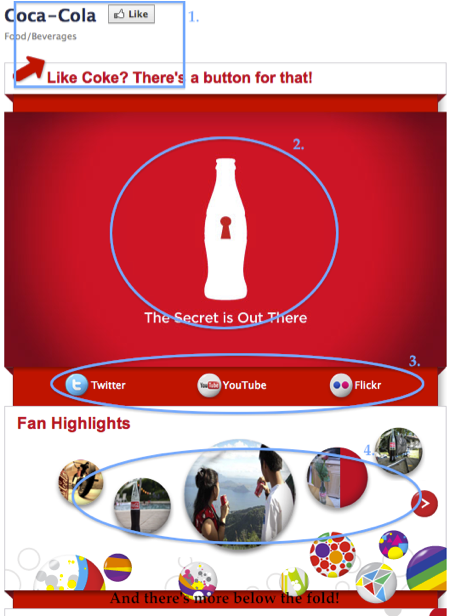
    1. Call to action. 2. Pulled in by brand/mysteriousness
    3. Share in other ways. 4. UGC

    Using Coca-Cola’s page as an example, there are four features of a Canvas App tab that increase conversions for the first half of the funnel — the Like.

    1. A direct call to action with a prominent arrow will bring attention to the point of conversion. Coke probably doesn’t need to focus so hard on getting people to Like them given the brand recognition, so more creative copy than that may be needed.
    2. Offer some kind of secret sauce, a benefit for liking the page. I was fooled into hoping for at least an ad about the secret recipe — more direct benefits would be needed for a brand that isn’t already a 12-pack in my refrigerator.
    3. Providing links to other social networks seems counter-intuitive as it takes the user away from the page. However, with opening the page in a new tab in the browser, you keep the viewer on the Facebook Page while offering a new place to share your brand message.
    4. A set of editors picks of user-generated content reinforces brand interaction on Facebook. Coke’s prioritizing of this content above branding or further lead generation could a sign of their focus on social branding over other methods of funneling social action.

    At the core of any news story is its effect on the reader’s business. As Facebook seems to count each Canvas App tab view before and after the like, you can find a rather direct metric of which tabs were affected worst under Insights>Users>Activity. Furthermore, if you’re tracking your Facebook tabs with cross-domain tracking or your tabs’ links with referral tracking encoded in the url, you’ll be able to look at Google Analytics or your tracking software and determine more specifically the effects on your campaign by searching the Content Drilldown.

    At the core of any discussion of unexpected downtime is the allowance for such downtimes in your marketing and advertising plans. Either by focusing on long-term gains or by re- or proactively acting on the acknowledged bugs in the Facebook Bug List, you’ll be able to weather the storm of any accidentally lost functionality.


  • 5 For Friday — Links, Stories & Posts For Your Weekend

    12 Incredible Internet Activists Changing the World Through Social Media — Mashable

    In honor of World Humanitarian Day, Mashable has assembled a collection of 12 movers and shakers in the human rights world who are using social media to pitch campaigns and raise awareness about issues from illiteracy to world hunger to clean water rights.

    How Small Business Can Build Links And Likes With Facebook — Link Spiel

    Facebook is free, easy to use and, for good or for ill, overwhelmingly dominant in the social media realm. So why are so few small businesses utilizing it to its full potential? Link Spiel’s Debra Mastaler gives this nuanced and thorough approach to the basics — along with sharing the astounding example of a small ice cream shop in a town of 216 that boasts 453 likes and a boom in consumer awareness at zero cost to them.

    HOW TO: Properly Use Badges To Engage Customers — Mashable

    Gamification of social media has been on the up and up since FourSquare poked its head into the scene in 2009. Instantly attention-grabbing, colorful and fun to collect, badges are a shareable media piece that everyone loves to show off. However, Foursquare has taken the focus off its badging system and as a result the approach has been derided as outmoded, gimmicky and just plain lame. However, a well-designed badge system offers a wide array of appeal to the savvy marketer. Click through to find out how to optimize your badge campaign!

    Statistics: Don’t Make These Mistakes – Whiteboard Friday — SEOmoz

    Everybody loses when skewed facts make its way into news sources, and the way you conduct your business shouldn’t be any different. SEOmoz’s Whiteboard Friday tackles the process of converting raw data to actionable numbers, using valid statistics to effectively make a point without compromising data integrity.

    Separate Social Media or Do You Live Your Brand? — Marketing Pilgrim

    Only 13% of small business owners maintain a separation between their work and personal social media presences, with only 5% not working weekends and nearly none at all banning cell phones from private spaces such as the dinner table or bedroom. While we all struggle with being constantly tuned in and tapped on to a frenetic data-intensive world, small business owners often don’t have the luxury of putting “my views are my own and not those of my company or employer” disclaimers on their online movements. Do you live your brand both online and off? How do you balance the two?

  • Local SEOlé!

    Dealing with local SEO from an international perspective can be quite the challenge. And, if you haven’t been keeping up with your Rosetta Stone lessons, it can get ugly fast. But here at Search Influence, we love a good challenge.

    Mexico Local SEOOur current goal is to improve an international client’s local rankings for their collection of Playa del Carmen hotels and condos. Now, if this would have been a U.S. or Canadian based client, I wouldn’t be writing this blog post, but taking local SEO to the land of the Aztecs and the Mayas certainly added a twist of lime to my typical local cocktail. The local SEO landscape of Mexico hasn’t been as thoroughly developed as it’s other North American neighbors. To give you an idea of how uncharted this territory is, Google Maps is still in beta testing for Mexico. This means there is a good deal of room for error, so you have to make sure to bring your A-game.

    First off, a tip for all of my other monolingual buddies out there, learn to love Google Translate. It isn’t 100% accurate, but it makes local SEO in a foreign setting as easy as it can be without being fluent in that particular language.

    Another important tip to keep in mind is that, when dealing with international Google Places listings, make sure to actually be in your client’s country’s version of Google. If you try to list an international business while in the U.S. version of Google Maps, Google will think it is a U.S. based location and will malfunction and place the business somewhere in the U.S.

    The biggest issue with international business listings is actually finding the directories to list the business in. In some cases, tools like Whitespark’s Local Citation Finder can be really helpful in sourcing new directories. Unfortunately, this tool isn’t currently optimized for use with Mexican businesses. Technically. I managed to finagle it into spitting out a few sources for me, but for the most part, I relied on good old-fashioned research skills. And, lucky for you, I’m willing to share a few of the gems that I have found.

    mx.wowcity.com

    Wowcity is a world-wide city guide that happens to be quite popular in Mexico. While it might not carry as much weight here in the states, all of the business in the keyphrases I was researching had a listing in Wowcity’s business directory. A tip to keep in mind when submitting to this directory is that, even though it might not be clearly stated, a logo and business hours are required in order to get a listing.

    olx.com.mx

    OLX is similar to Craigslist and in the States, is often seen as a less-trafficed imitation. But, unlike Craigslist, OLX offers a traditional business directory in addition to the typical grab-bag of classified ads. And luckily, the Mexican version of OLX is pretty straight-forward and plays well with Google Translate.

    tuugo.com.mx

    Tuugo is a “world-wide business to business and customer platform”, which is basically a fancy buzzword for a business directory that caters to businesses and people alike. I will have to say, Tuugo has an impressive list of countries that the service is available in. This will work in your favor because the site has high quality of universal usability and translates well.

    So there you have it folks, some muy caliente tips to help you out if you are south-of-the-border and in need of some local love. Be sure to pair them off with a nice cold cerveza and remember not to fill up on the chips and salsa.


  • 5 For Friday — Links, Stories & Posts For Your Weekend

    Reputation And The “Right To Be Forgotten”: Spain’s Radical Approach To Search And Personal Privacy — Search Engine Land

    In an era where privacy norms seem to be eroding every day with the advent of up-to-the-minute social media, Spain is taking an interesting tack with regard to the “right to be forgotten.” A Spanish court is asking Google to eliminate information from about 90 private users from its index. While El Goog is fighting the petition, the case raises some interesting questions: on one hand 75% of Europeans polled wanted the right to delete personal information at any time, this movement would potentially allow private users the power to pull down information displayed on third-party sites such as news sources and Wikipedia. What do you think?

    5 Low-Budget Ways to Distribute Your Blog Content — WordStream

    Do you have a well-optimized blog with great content, but are having some trouble pulling in eyeballs? WordStream’s Elisa Gabbert shares five handy ways to spread awareness of your work, from savvy utilization of social media to tactics as simple as a well-crafted email signature.

    Interview with Robert Sheinbein About Creating Quality Content — Graywolf’s SEO

    Content provider and all-around creative Internet mogul Robert Sheinbein talks in-depth about the importance of crafting dynamic, interesting content for your website, communicating instructions to writers with regard to tone, style and end goals and a solid floorboards-up keyword plan.

    4 Tips For Success With Seasonal, Local SEO — Search Engine Land

    It’s back-to-school time, and if you’re a savvy backpack or school supply retailer you’ll have gotten your optimization ducks in a row ahead of time to capitalize on the incoming demand. Whether you’re in the business of firecrackers, Christmas trees or haunted houses, this article is an excellent resource on ways to plan ahead to get the most out of your business’s seasonality.

    Optimizing social in support of search marketing — B to B Online

    Mike Jarvinen, VP Marketing Strategy at the Search Agency, gives some pointers on “strong social media outreach” and its importance to organic and paid search. When performed correctly, a strong social media platform can help build trust in a brand. Among his tips: prominently-displayed authoritative content such as studies and lists of associations are a big boon to a brand’s impact.

  • Starting Out on Facebook: Small Business Marketing Solutions or Useless Sales Pitch?

    facebook small business marketing
    That’s some brand love.

    A few weeks ago, Facebook Marketing Solutions, the advertising side of the social media giant, released its new education portal for small businesses just starting out online, titled Facebook for Business.

    The Facebook page for the group is nothing more than a simple sales pitch for businesses becoming involved on the site. It’s tips for publishing, appeals to outmoded user statistics, and overall tone is clearly directed at the first-time Facebook advertisers. Promoting Sponsored Stories seems to be the main goal, though the ability for a small business to achieve such a close relationship with the company behind the site is not clear at first glance: Nike, American Express, and a page that can get 100 answers to the question “Blue or purple?” are featured, but no one just starting out with limited brand awareness. However, as you delve deeper into the videos, a number of case studies can be heard by the part-time Internet marketer to help understand the basics of the varied services Facebook offers, explained in a way that focuses on what makes social media advertising different from traditional venues.

    But July 27th brought a new arena for the first-time marketer. The Facebook for Business site offers a set of introductory slides more like what one would expect on the Facebook page. The Best Practice Guide and other tips take the unedited rambling of the taped live webinars from the Facebook page and put them into clear slideshows (though inexplicably as unsharable and minimally-graphable PDFs). Discussing Pages, Ads, Sponsored Stories, and the “Platform,” Facebook lays out its basic services in an all-too-simple way.

    The site is clearly for someone who doesn’t muck with websites, as just one tab describing the Open Graph protocol for a new marketer would show a whole new world, integrating on-site tagging with a need to contact a Preferred Developer to best take advantage of the depth of information one can provide, shape, and offer to their clients.

    It’s easy, at least for the somewhat experienced marketer, to come up with counterexamples, glossed-over topics that are the core of Facebook advertising such as effective demographic targeting, and the just-seething disdain for squares who just haven’t gotten how cool Social Media is. But I applaud Facebook for their efforts; the only other major social media outlet for business is Twitter, which starts its Promoted links at $5,000 per month and provides little information for its non-paid business partners. Google+ recently purged business accounts, asking creators of those accounts to “hold off,” and have been “focusing on the consumer experience” — words that are hardly music to marketers’ ears.

    What the shortcomings of the Facebook for Business and Facebook Marketing Solutions pages really show off is that a business needs dedicated social media management, whether through an SEO firm or internally. The waters are murky and best handled by someone who knows not just the sales pitch for getting involved, but also the mechanics of the process and what little stuff can greatly improve the social footprint of the small business. It’s too hard to sum up everything that should and could be done to optimally advertise using social media just on a few webpages or through a few taped webinars — the best thing is to call Ghostbusters and let Peter and Ray and Egon worry about the ghosts so business owners can get back to directly helping their customers.

  • My Space’s Tom Anderson gives Google+ a stamp of approval


    Okay, so MySpace may be “dead” now that it’s been sold to Specific Media for a paltry 35 million, but you can bet that many of its years of success had something to do with its founder, Tom Anderson. Your first friend on MySpace now has a shiny Google+ account of his own, and he also had plenty to share about the new social network in a guest post on TechCrunch, most of it positive.

    The main theme of Tom’s post has to do with Facebook and how it is reacting to the debut of Google+. According to Tom, Google has the advantage. “When it comes to “monetization” on the G+ “website,” Google’s trump card against Facebook is that we may never even see an ad on G+.” Tom says.  “Google has plenty to gain without ever showing an ad and, put simply, Google doesn’t need the money. Facebook’s got to know this, and it’s got to have them just a little bit concerned.”

    Tom also alludes to Facebook considering changes to make their feeds real time rather than the current “Top News” setup because of complaints from advertisers and app developers. In fact, Facebook has taken some defensive actions since Google+ launched, which surely shows that they are considering the new social network to be a threat.

    Tom also mentions that Facebook gaffed when it came to the way they handled their relationships with developers, and that how Google handles this delicate issue will be crucial to the next step in Google+ development. In fact, he stresses the balance between advertisers, users, developers as crucial, and I absolutely agree — too much in one direction and social networks seem to suffer. We’ve seen plenty of that with past sites such as Friendster, Tribe and even MySpace.

    In summary, the social network field is in an interesting place at the moment, with Facebook and all its massive popularity up against Google and its bright new ideas and excellent resources. Google has something of a clean slate on this playing field, while Facebook has made its mistakes. But can Google capture the user base that Facebook has? It seems without those numbers, the key to success still would be out of reach.

    What do you feel is key to the success of a social network?

  • 5 For Friday — Links, Stories & Posts For Your Weekend

    We’re back with another 5 for Friday, a collection of the freshest and tastiest SEO news stories, blogs and recommendations from across the web!


    Google’s Spam Report Page Gets “Biggest Refresh” In Years — Search Engine Land

    The Webmaster Tools spam report form has been completely updated and refreshed, heralding the biggest change to the feature in a good 10 years. There are now several discrete forms for different kinds of spam instead of one catch-all field, with options for “paid links” and “malware” among other specific spam issues.

    The 3 Pillars of Local Search Reviews — Search Engine Journal

    Local search is a significantly dynamic and shifting branch of web search — just think of the onslaught of check-in services that have cropped up in recent memory — and this changeability has led to what SEJ’s Mike Ramsey dubs as “storm chasers,” those who are so quick to cash in on the next big thing that they abandon their efforts as soon as shiny new feature or social app comes onto the scene. This has proven true with Google’s recent focus on user-generated reviews and all but exclusion of third-party sources. Here, Ramsey gives a few pointers on the discerning review-seeker’s strategies for the local search industry.

    Outbrain for Mobile Integrates Content Recommendation Links for Mobile Websites — Social Times

    In some circumstances, a well-placed related content link can do a lot more for your viewing stats than the most carefully targeted advertisements. Outbrain, the recommendation engine that powers related content discovery services for high-profile sites such as USA Today, the New York Post and the Atlantic, has now adapted this strategy for mobile websites to “[enable] publishers to boost their mobile traffic and revenue, while enhancing the user experience by providing personalized links to recommended content for readers who are accessing the site from their mobile device.”

    Small Business SEO: How to Check Your Backlinks — Search Engine Watch

    Are you a small business just starting to navigate the wide world of SEO? Take a gander at this handy guide to basic backlinking and kick-start the journey into off-site marketing, monitoring your links and figuring out the numbers.

    Google Buys The Dealmap for Offers — ProNet Advertising

    Google has acquired DealMap, a local deal-mapping service that provides location-based deals to potentially tens of millions of bargain shoppers. For a company that was only just started in 2010, DealMap has had an impressive growth rate, already breaking the 2 million users mark with a substantial 85 million US visitor demographic. With the recent launch of Google Offers, the company’s foray into local Groupon-like deal networking could be picking up steam.

  • Influencer Profile: Scott Shockley

    This week’s profiled Influencer is Assistant Production Manager Scott Shockley. Originally from the Greater New Orleans area, Scott graduated from LSU in 2008 with a degree in Marketing after four years in Baton Rouge. He’s worked for a tech startup and Capital One, as well as serving as Tulane University’s Marketing Manager.

    Scott exemplifying the professional demeanor we strive for at SI.

    He finds himself interested in the technical side of marketing and business and appreciates SEO’s demand for these skills on a daily basis. Scott’s also a longtime Influencer, tied with developers Luke Ledet and Doug Thomas for longest-tenured Production member — all three have been with us since the company was based out of Will and Angie’s living room!

    What do you find yourself doing on a day-to-day basis? Any particular skills you’ve had to develop since joining SI?

    One of my biggest responsibilities is making sure that approximately 600,000 words per month are in proper order, not misspelled and make sense, and that approximately 21,600 links per month are intact and functioning properly. I spend a lot of my time looking for issues, fixing some and having good training in place to minimize errors. We do a great job at getting a massive amount of work done and it’s mostly because the work we do as individuals comes together like a nice smooth roux at the end of every month.

    At Search Influence I’ve learned a ton about management but also the technical skills required to work in this industry. I have also learned that you actually can go to Snake and Jake’s Christmas Club Lounge for several hours after work, with coworkers, and still have a job the next day.

    You were recently promoted from an Internet Marketing Associate to Assistant Manager of the Bad Boyz of Production. Congrats! How’d the changeover go?

    It wasn’t much of a change because it has been a constantly evolving progression for the last year. I’ve done almost everything in Production, from editing websites to being the subject of a horribly corny snakes in a can prank (Psych! I played along to be a good sport). I was here near the inception of the Production department and wanted to get my hands as dirty as possible from the beginning.

    Is there anything you’d like to be doing more or less of around the office? In a perfect world, what would you be doing all day?

    It would be pretty awesome if Will retired and made me CEO, but I don’t see that happening any time soon! It would be pretty cool to do some statistical research about correlations between all of the known SEO variables and rankings on search engines. I’ve also always fantasized about trading lives with Just Blaze or Diplo.

    Does keeping track of the hundreds upon hundreds of content we process every month get overwhelming? How do you deal with it?

    It’s usually not overwhelming because the training process is so thorough that we usually don’t make very many mistakes. On top of that, when I export task data from our project management system, I plug it in to one of the sickest spreadsheets known to man [=SUMPRODUCT(–(input!C2:C2000=””&A14&””),–(input!D2:D2000=”Deferred”))], and it warns me about many of the problems we might be having.

    Scott Shockley's own smoked pork shoulder.

    What do you find yourself doing outside of SI? Any cool projects?

    I’m trying to redesign my currently ugly, but juiced up website to promote 24 hour restaurants in New Orleans, mainly because I love SEO but I also love to eat. I’m also into cooking, especially smoking food, and will be roasting my first whole pig this Labor Day! On top of that, I manage to find time to tell all the jokes that are too inappropriate to tell at work.

    The editor would like it to go on the record that she appreciates both inappropriate jokes and copious amounts of pulled pork. Thanks for all the work you put in wrangling writers, content and SI employees, Scott! We’ll be back in two weeks with another exciting Influencer profile.

  • Can Bing Ever Compete with Google?

    If you keep up with what’s in the news in the world of search engines, you know that there’s been a bitter little rivalry between Bing and Google for some time. In early February, Bing accused Google of stealing their search results. It didn’t help Bing’s case that they didn’t deny the claim either, instead saying, “…we use multiple signals and approaches when we think about ranking, but like the rest of the players in this industry, we’re not going to go deep and detailed in how we do it.”

    Fast forward to now, where Microsoft was recently the topic of discussion in a lengthy article in the New York Times about Bing’s profitability — and how long it may take them before they have any chance of breaking even. Other reports claim that Microsoft has claimed 30% of the search market and that Google is “slowly sinking”, even though it still controls roughly 65% of the search market.

    Bing has made respectable strides since its launch two years ago, but even so, it hasn’t been able to match the brute force of Google, which was the leading search engine among ten competitors back in 2002, only two years after its launch.  Surely, Bing will continue to grow, but even if can find itself on equal footing with Google, can that be considered success?

    Microsoft’s Qi Lu says, “To break through, we have to change the game. But this is a long term journey.” He’s right … but how long will that journey be? Sources seem to think that Bing will need to demonstrate some sort of clear success before its tenth birthday to remain a contender.

    How can Microsoft accomplish this? Voices all over the web have tons of ideas, but several of the key ones seem to stick out. Some suggest that Bing work both ends of the user spectrum, finding a way to appeal to every age range (much like Nintendo did with the launch of their Wii videogame console). Since Google tends to appeal to a young, tech savvy audience, this could be a valid approach for Bing. Microsoft should also focus carefully on their acquisitions, and try to see what could work best for them (here’s a hint: buying Skype for $8.5 billion might not have been the best choice).

    Personally, I’m a fan of Google’s products, so until Bing can offer something better, I’m staying put. How do you feel about it?