Blog

  • Take A Breath Before You Tweet, OR: Internet ADD Wrecks the Good Ship Netflix

    Netflix ChaosJeez, it’s been practically seven minutes since I checked for new notifications on Facebook. Refresh, nothing. Ohhh, there’s a picture of a kid I vaguely knew from high school and now he’s linking his tweets into the Facebook feed, let me click over there. Do I follow Kim Kardashian or just Khloe? Any new tweets from the Biebs?

    It’s obvious that my attention span on the Internet can be severely limited at times. And why not? There’s barely any reason for one to even type in words, just a lot of pretty pictures to click on. Heaven forbid I forgot the name of some obscure reality television star, but if I do the answer is instantaneously at my fingertips. The Internet experience of today is different than it’s ever been before. Websites create a far more intimate and immersive experience than just 2 years ago, and are in a completely different arena than 10 years ago. Pictures are worth a thousand words, and they need to be when one only has 140 characters to elaborate on major personal news and global current events.

    While many years of information are archived in cyberspace, much of its utility is focused on the right now. Breaking news happens and a network of millions set to debate, coming to instantaneous conclusions. The people unite and use their freedom of speech to make a stand, but is this a good thing? Can the immediate evaluations made by web junkies actually be harmful?

    In the case of Netflix, popular web opinions have been shown to have a powerful influence over the productivity of the company. In July, the California-based company raised the prices for their various streaming and DVD rental plans. Since the price increase went into effect, July 13th, Netflix’s stock (NFLX) has decreased 36% and has lost 800,000 of their nearly 24 million customers. Aside from the tangible effects, Netflix has suffered far worse in the court of public opinion. Users across the net threw their arms up in a rage when Netflix announced that it would be dividing its business into two entities, one specifically for streaming and the other, Qwickster, for DVD’s by mail. The plan to split the company has since been scrapped due to the public outcry.
    Crumbling NetflixIs what has happened to Netflix in the last four months a good thing? Netflix is a tech company and should rightfully be judged by its tech savvy clientele, but technological Darwinism is a shaky field to venture into as a for-profit company. Is the customer always right? Sorry America, but the answer is no. While the almighty dollar may empower individuals to sway decisions of major companies, it does not mean that consumer pressure always leads to the right outcome. In the case of Netflix it is entirely possible that a month from now the once-glorified media company could be trading for pennies on the dollar and begging Hulu or Amazon to buy them, and everyone could dub Netflix a failure. This is all possible, but it would not necessarily make the actions of Netflix wrong. The immediate conclusions of the Internet-savvy can severely hinder companies’ ability to make improvements to their product, because one or two of those alterations rubs consumers the wrong way. My advice to consumers: take a breath, don’t jump to conclusions, quit sweating the technique and just give products wiggle room to evolve. Who knows — you might even like it.

  • 5 For Friday — Links, Stories & Posts For Your Weekend

    Methods for Evaluating Freshness — Justin Briggs

    After Google’s big “Freshness update” was announced yesterday, the SEO world has been in quite a tizzy. But for those of us who aren’t technically-minded, what does this update actually entail? Justin Briggs, an SEO expert and Big Fish Games marketing champion, gives us this exhaustive set of data analyses to come up with a comprehensive guide to link freshness, including handy data on how to think critically about your site’s “Freshrank.”

    How to Properly Use Facebook’s Advertising Features — ProNet Advertising

    Targeted Facebook ads are a bread-and-butter item of the SEO community, with FB’s enormous user base offering a nearly unlimited source of demographic information and marketing potential. However, they’re not without flaws; in order to maximize your ads’ potential, you’ll need to put some research into the best practices and what you can do to make sure that targeting translates to eyeballs and clicks. Sonia Tracy of PsPrint offers up these five basic tips that will get you on the road to a well-maintained, efficient Facebook ad campaign.

    Euclid Offers “Google Analytics For The Real World” — Search Engine Land

    Now here’s an idea: Euclid Elements, a brand-new startup from some of the innovators behind Google Analytics, promises to create an Analytics-like experience — for brick and mortar locations. Through the installation of small sensors in-store, Euclid can help business owners track repeat shoppers, identify consumer patterns, and gauge seemingly subjective metrics such as foot traffic appeal and customer loyalty. As SEL notes, this isn’t an entirely new concept, but Euclid is certainly the first service of its type to apply an Analytics-like sophistication to this kind of metric tracking, and can potentially be invaluable to savvy small business owners who want to “optimize” their physical location.

    Which Brain Is Your Website Selling To? — ClickZ

    A fascinating look at Internet marketing from an evolutionary psychology standpoint. ClickZ’s Tim Ash evaluates the different aspects of what goes on in your brain when you look at a webpage, and offers some tips on what you can do to make sure your site hits all the marks to be effective!

    250,000 Ninjas Chop Fruit Every 60 seconds on Mobile [Infographic] — Social Times

    Did you know that over 23k apps are downloaded every minute? The mobile world is expanding at an alarming rate, and Mobclix is here to give you the scoop on the pings, taps, requests and, yes, even tiny ninjas that are whizzing around us every second of the day. The numbers are impressive — I don’t know about you, but I’m rethinking giving up that Angry Birds habit.

  • What’s the REAL Organic Search Market Share?

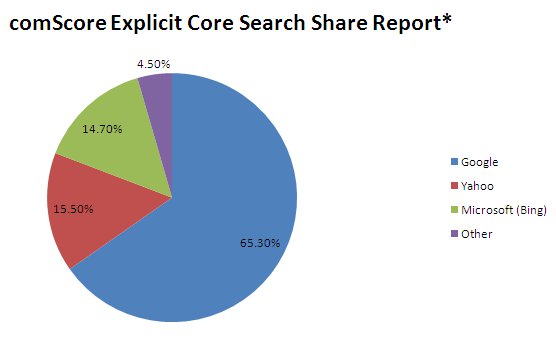
    If you work in interactive marketing, you’re are probably familiar with comScore and its monthly estimate of the United States search market share that consistently looks like the following graph, reflecting data collected September 2011. It’s safe to assume that these numbers apply to the websites that you promote as well, right? Not really.

    comscore search market share for September 2011

    For the past few years, it seems like every dataset that I’ve seen contradicts these market share reports, so I decided to dig a little deeper and see what I can find.

    comScore’s numbers:

    comScore is extremely thorough in its calculations. It obtains this information by installing software on the devices of a large number of paid users, which tracks and records all the searches performed on that device. In the month of September 2011, the company recorded over 17 billion search results. It claims to get data from a variety of users that is representative of the market share of major ISPs in the U.S., but other than that, I’m not sure how they pick users. Either way, 17 billion intuitively seems like a big enough sample to come to firm conclusions.

    My Tiny, but Interesting Dataset

    To find numbers that I thought would be representative of the search engine market share for our clients and sites, I created a custom report in Google Analytics that provides the number of site visits from organic searches, and breaks them down by each particular search engine, over the last month (10/2/11 – 11/1/11). To figure out which sites to use, I exported data for the first 75 sites I found that I was certain were active and received organic search visits. The total number of visits was approximately 350,000, so it’s a relatively small sample. There was one site that I excluded because its total visits exceeded all other sites by 3!

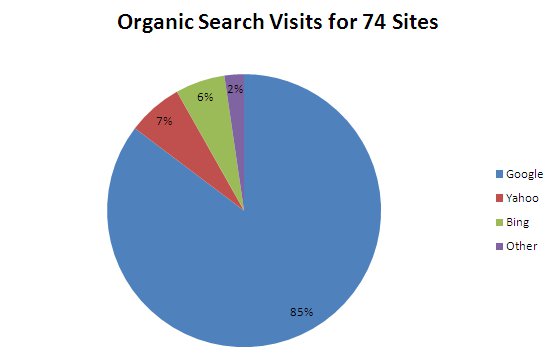
    organic search market share for search influence clients

    As you can see in the chart, Google searches account for a whopping 85% of the organic visits! Like the comScore data, Yahoo and Bing are about even. This is pretty amazing, right? Even though these numbers are too small to make comparisons to the U.S. market share as a whole, the information is representative of Search Influence clients and therefore important to us.

    Industry Segments

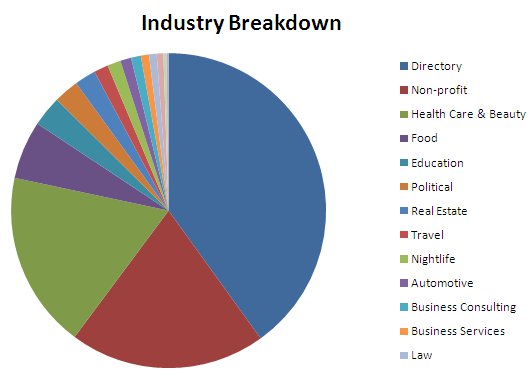
    Most of the sites we looked at are small businesses throughout the country. 40% of the results come from 2 medium sized yellow pages directories–but when you take these two sites out, the share is virtually the same. We also see big numbers from Health Care & Beauty and Non-profit. The Non-profit is actually one large organization and the Health & Beauty segment is mostly composed of dentists and plastic surgeons. Two of the sites included are informational sites that attract national visits. Those two sites alone, which represent about 1% of the total visits in this set, received on average 94% of their organic visits from Google.

    industry breakdown for market share information

    Why the Numbers are Different

    The numbers differ for many possible reasons, but none that I have been able to completely pin down. Obviously the set of websites used here is not representative of sites on the Internet as a whole. Another reason could be that Google inaccurately reports referrals from other search engines, or perhaps small businesses rank better on Google, so our small business clients get more visits from Google. Another factor may be that none of these sites target American users that search in a language other than English. Whatever the case may be, it’s obvious to me that Google has an even bigger impact on our small business clients than the comScore numbers suggest.

    What about you? Feel free to share your data, do a similar study, speculate on these results, or tell me why I’m full o’ bull.

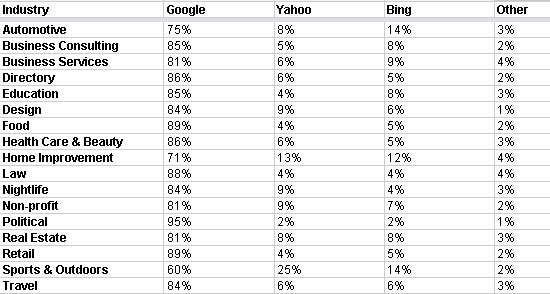
    Oh, and if you’re interested in a more detailed breakdown of the results in a particular industry, here it is. Here is a link to the spreadsheet.

  • Google Places Page Redesign — Local Search Goes Minimalist

    Hot on the heels of big redesigns to a whole suite of Google services, including Docs, Reader and Gmail, searchers will soon see shakeups in the way local listings are displayed on their results pages. Instead of the familiar red pin of Google Maps, searchers looking for businesses matching a given term such as breast augmentation Maryland will now be greeted with a row of grey icons which can be expanded with a click to show a highlighted popout with site preview, map and reviews:

    Google Places results page when no selection is highlighted.
    Results page with mini-Place page expanded.

    This is a noteworthy move for Google Local, given the powerful results that the “red pin” logo has attained over the last few years. The mini-Place Page embedded within search results seems to agree with the growing shift toward minimalism the company has encouraged in its recent redesigns, such as the sleek-and-clean new Google Reader. Additionally, the new system serves an important purpose in helping searchers find the things they’re looking for (location, directions, reviews, pictures and details, et cetera) without actually leaving the SERPs. Google is also making it easier on its searchers to review and edit local places listings by placing a feedback link (visible in the second, expanded screenshot) directly in the foldout, thus helping prevent problems like the infamous potential to mess with competitor’s listings via maliciously reporting a business as “closed.” With this error seemingly remedied or at least remediated, it will be interesting to see if other Google bugs such as the appearance of potentially inappropriate photos on Place pages will be given attention as well.

    Given the increased power of many browsers and the capability offered by new tools such as HTML5, it’s clear that most users’ browsing capabilities can handle the change — but is it an innovative way to get the data you need without having to trawl through multiple unique pages, or a confusing overload of information? What do you think?

  • 5 For Friday — Links, Stories & Posts For Your Weekend

    StumbleUpon: Where Should You Share? [Infographic] — Social Times

    StumbleUpon is one of the most powerful sharing vector services out there, allowing users to “stumble” to your page based on their set of stated interests. This Social Times infographic provides some valuable data on how sharing your content via stumbling can work for you, from hard numbers on how much social media traffic the service actually drives to comparisons of the “half-life” of links distributed via different venues (Twitter, Facebook, et cetera).

    Microsoft Wants You to Search the Web Like Miley Cyrus — Search Engine Watch

    Microsoft has applied for a patent on the “persona” model of search results, essentially allowing users to search as their favorite celebrity. Read on to learn about some of the potential ramifications of this new system and the advantages it can lend to everyday searchers.
    How Much Money Do Viral YouTube Videos Make? — Social Times

    As much as we may deride the uninspired lyrics of Rebecca Black or giggle at the uncoordinated antics of Afro Ninja, there’s no denying that the viral video phenomenon can net its stars some serious notoriety. But how about fortune to go along with the fame? Social Times takes a look at the cold hard cash generated by these Internet phenomena.

    How Big is Your Long Tail? – Whiteboard Friday — SEOMoz

    Optimizing for “long tail” or ultra-specific keywords can be rough, and the individualism in the way people search for things (according to Google, an astounding 20% of search queries at any given time are completely unique) is fascinating. Understanding the art of the long-tail keyword is key, and Rand is here to enlighten you on the basics of this integral part of product-specific SEO.

    8 More Habits of Highly Effective Bloggers — CopyBlogger

    As a follow-up to her previous set of good blogging practices, CopyBlogger’s Annabel Candy offers up yet another group of tips on how to make your content the belle of the blog.

  • How Do I Keep My Facebook Fans Happy and Engaged? — 3 Easy Ways To Get Likes And Keep Them

    Business Cat approves.
    Business Cat approves of your online conduct.

    Let’s face it: social media marketing jargon can sound like a different language, especially if you’re wrestling with the eternal question of “What do my Facebook fans want to see? How do I keep them happy?” You know your brand inside and out, so it can be helpful to think of your social media content in the same way you think about your business. Unless you’re a professional trapeze artist, chances are the day-to-day grind of your job can sometimes leave you bored to tears. The same applies to online communities in terms of marketing and promotion. For many of the 800+ million active Facebook users, logging on is habitual and something they’re doing multiple times per day. Facebookers who follow your page don’t want to see the same type of content over and over. That’s the fastest way to turn them off from interacting with your page in a positive way, or at all. The most successful Facebook pages have a give-and-take relationship with their fans. Three things to remember for growing and motivating your online communities:

    • Show them you care, you really care! Ensure your newest followers feel valued, appreciated and motivated to interact with your page. Welcome new fans personally, like you would a new co-worker, by tagging them in a welcome message or sending a quick and friendly (non-spammy, of course) direct message.
    • Beware of the disgruntled fan. When considering a Facebook contest as a way to gain likes, it’s important to keep in mind the resulting new “Fans” can easily turn on you should they be promised something that is not delivered. These are not the fans you want to attract to your page, as the wreckage they often leave can be detrimental to your brand’s reputation. Many a Facebook page has suffered when the competition gets ugly due to misunderstood rules. Fans can become aggressively competitive, rallying other fans around them. Remember, any competition on Facebook should comply with Facebook’s Promotion Guidelines, or you run the risk of having your page removed entirely. Don’t get me wrong, free stuff is awesome. Offering ‘added value’ as a way to gain more followers has proven successful in the past, but the lines between friendly competition and cut-throat rivalry can be blurred very quickly. There are tons of alternative ways to engage with people, and getting creative with your content doesn’t have to cost money but can work wonders for motivating your online community.
    Image macro rewards such as this "Cyber High-5!" seem simple, but can be a great way to motivate interaction and connect with your audience.
    • Creative content is king. Organically grow your fan base my keeping existing fans engaged with your page. Think about how you might get your co-workers motivated in the office and apply the same tactics to your Facebook fans. In terms of contests, sometimes the big ticket prize items will only spark jealousy and animosity among the group. Often a much smaller scale pat on the back will do the trick. Consider running a weekly trivia contest with a funny, motivating and free (for you) prize like a “cyber high-5” or an original Internet meme. Instead of gaining a bunch of superficial ‘Likes,’ your fans will engage, comment and even share your content with their own friends.

    Lighthearted, fun content will ensure you and your Facebook fans’ interactions are positive and mutually beneficial. Keep the fans you have engaged and your number of ‘Likes’ is bound to keep climbing.

    The SI Blog sends a special thanks to Lauren Litwinka for her insight and contribution to this post. Lauren is an Account Manager at aimClear where she’s pretty awesome at online community management.
  • SEO Copywriting Tips

    SEO Copywriting is a critical facet of online marketing. We are constantly giving our writers SEO copywriting tips to help them deliver better content for our customers.

    SEO Copywriting Tips from RoboScribe
    SEO Copywriting Tips from RoboScribe

    As such, we’re going to start giving SEO copywriting tips right here. Some of these content tips may be more applicable to our writers, some may be appropriate for the general public.

    Writers: Please give us your feedback and let us know if there’s anything you’d like our guidance on. Chances are if you have an SEO copywriting question there are many others who share that concern.

    And please, feel free to share your tips in the comments.

  • Influencer Profile: Megan Lindsey

    Today we’re proud to profile Junior Account Associate Megan Lindsey! Megan was born and raised in Lafayette and is a graduate from the University of Louisiana, Lafayette in Mass Communications. She has a background in media, including commercial broadcasting, film and television production, and Account Management. She loves living in New Orleans and makes it out to as many live music shows and festivals as possible.

    How did you get into marketing? Were you interested in online models or SEO from the start?

    After I moved out here to New Orleans, I was really interested in being a part of a new and growing field. I have a background in Communications, so I knew that I wanted to be in a field that involved collaborating with people and businesses of various backgrounds. Search marketing is something that I think is often over-looked and a little unknown. It feels pretty great being a part of a field that is constantly evolving. Everything I learn here is a really valuable part of growing business and brand awareness.

    How’s the transition to SI been? Picking up any new tips and tricks?

    The transition with Search Influence has been really nice. It’s a fairly laid back and collaborative environment that prides itself on getting things done correctly. I’m learning more here than many jobs I have had, and I enjoy the challenge. I’m also enjoying the fact that I am being taught new things and taking on new tasks with each different client project I work on.

    As far as tips and tricks, I can’t share the “secret sauce” — but it’s cool knowing that I’m a part of it!

    What do you find yourself doing around the office? Any particular favorites?

    On a normal day, I find myself picking up where I left off from the day before and making sure my “To Do” list has lots of crossed out tasks! Having our clients stay on schedule and increase in rankings is priority. I try my best to make sure we keep things moving in the right direction.

    My favorite thing would probably be collaborating with my co-workers. It’s a really great feeling when we all work towards one main goal and succeed, knowing that our work paid off. I think we all work well together and respect each others’ ideas and strengths. It makes me feel lucky to be working with such a smart and dynamic group. — Oh! And I really love randomly making my co-workers laugh. I’d like to think they find me funny, so I try to keep things pretty light as often as possible.

    In a perfect world, what would you be doing all day?

    In a perfect world, I’d probably be working as a Production Manager for a really awesome, successful comedic sitcom — or a ghost hunting show — or a reality show. A movie? Anything to keep me laughing… or crying. There’s something about knowing that you’re part of such a large outlet that reaches out to so many people. And your name is there for the credit. Oh, and Ebay. Can’t forget my small Ebay obsession.

    Most important of all: if you were an 80’s teen pop sensation, which 80’s teen pop sensation would you be?

    Tiffany. She was a teenage pop sensation that did a mall tour! You can’t get any cooler than that. Stone-washed Jordache jeans, denim jacket, big earrings and teased hair: awesome! Thousands of terribly dressed screaming fans: amazing! 20 years later you have immortal songs to prove it: oh yeah!

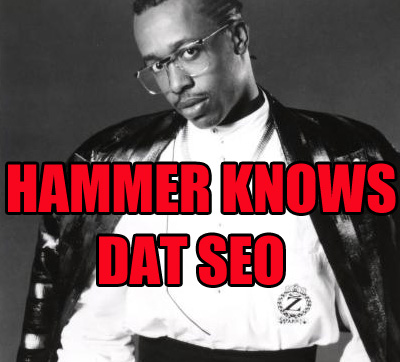
  • Can’t Touch These Metrics: MC Hammer Announces His Own Search Engine

    When it comes to the world of SEO and general web technology, some of us are so jaded we think we’ve heard of everything. Phones we talk to? Check. Virtual reality? Won’t be long until we’re standing on the holodeck. And as far as SEO, everyone and their mom is on deck calling themselves “social media experts” and promising they can make your business blast to the top of the search results.

    No matter how out-there the current trends are, I feel quite sure that nothing compares to the hard, cold fact that MC Hammer has just announced he will be launching his own web browser, which will be focused on “Deep Search.” No disrespect, Hammer, but before you get busy on that search engine you might want to hire someone to make your blog look less like a Blogspot nightmare. Just sayin’.

    Anyway, I’ll keep the dissin to a minimum, since it’s clear that Hammer’s too legit to stop at ministries and lifestyle clothing lines, so why stop at SEO? The search engine will be called WireDoo (I’ll leave that there for you to make cracks your own) and is about “finding the relationship beyond just the keywords,” as Hammer put it on stage at his presentation at the recent Web 2.0 Summit in San Francisco. He also claims that Google and other big-name search engines are not as skilled at connecting keywords to related topics. So is this the magic that WireDoo claims it will be able to perform?

    That’s all we know for now — that and that Hammer’s team has been working on the engine for the past two years. It can’t be denied that the rapper has come up with some ingenious ideas in the past — not to mention those cool 50 million albums he sold. But, you have to wonder what he’s got up his sleeve at this point. Taking on a beast like Google takes some serious balls, but as Hammer has repeatedly proven in the past, he’s got the cajones to try anything. And hey, he has well over 2 million Twitter followers.  He’s got to know something about how to make people listen to him … right?