Keeping up with SEO tactics isn’t always easy, which is why the general rule of thumb is to build a good site and network, and wait to be found. Even still, many people are attempting quick shortcuts that have long since been proven less than useful, or even damaging. If the sole reason for doing something—submitting a press release, for example—is to drive SEO, there’s a good chance it will backfire.
SEO mistakes fall into a few distinct categories: fishing for links, diluting personality, and failing to strategize.
Link Cheats
Creating a network relies on links to and from other reputable sources. Search engines analyze these links and count them as endorsements, so the more connected you are to other sites, the better you’ll be viewed by the all-powerful algorithms that control search results. The extension of this idea has led to link exchanges, article submissions, and pointless press releases—all of which are outlays of time and energy that don’t recoup their investment at all.
Instead of trying to find back ways into getting links, you’ll see the best results by actually building the connections that earn links. Link to resources your clientele and readers will find useful, and you’ll soon find others linking to you. Writing guests posts for industry bloggers will enhance their sites and earn you credibility at the same time. There are excellent tips on building links and networks out there: start with this post to understand how it works.
Individuality Flubs
Okay, you think, I need to write more content and be more connected. That’s an admirable goal, but there are a few pitfalls along the way that won’t help your SEO rankings. The tendency can be to write the same description, review, or promo in just slightly different wording—it’s quick, easy, and fills the spaces that search engines analyze.
But your content can’t just exist for its own sake—in order to work for you it must be relevant, interesting, and well written. Make sure you have a quality writer who knows how to build an audience and engage readers in discourse. And be careful not to automate too much of your social interaction. Clients can tell when they’re receiving a rote reply. Instead, highlight your businesses personality through both your content and social networking, to stand out to both customers and search engines.
Strategy Omissions
When you’re trying to “do all the right things” for SEO, you can miss the forest for the trees. SEO won’t get you anywhere unless you have an achievable goal, with a strategy that can be measured and reevaluated. Discovering your rankings does you no good unless you adapt your marketing plan and correlate your analytics to your aims.
There are plenty of good SEO tactics and SEO basics a site owner should know, but they all boil down to putting the effort into a well-designed, interactive, quality experience for both the users and the search engines. Don’t be trapped by outdated methods of bumping you to the top of the list; instead, focus on genuine content that reflects your brand and your goals.
Megan Totka is the Chief Editor for ChamberofCommerce.com. She specializes on the topic of small business tips and resources. ChamberofCommerce.com helps small businesses grow their business on the web and facilitates connectivity between local businesses and more than 7,000 Chambers of Commerce worldwide.
As Facebook has become a more robust advertising platform, a broad smattering of ad units have shown up all over the platform. Almost every kind of content can be advertised on Facebook, from a text status to a Facebook app to a web site, leading to increased interaction and ultimately stronger organic performance of the content. It’s important to keep in mind the same things that drives high organic action rates: the importance of EdgeRank, the necessity of AWESOME, and the value of truly social campaigns.
Marketplace Ads
The ads most people are familiar with on the social media network are Marketplace ads. These ads, usually showing in the sidebar of the News Feed, a Profile, or a Fan Page, are the constant companion to the Facebook user. Marketplace Ads compete with FBX retargeting as well as traditional advertiser-created ads. The thumbnail image can be up to 100 px by 72 px, The headline is 25 characters long, and the body copy is up to 90 characters long.
There are five main types of content that are promoted via Marketplace Ads:
This example, displayed on the soft blue of a profile or fan page, links to a traditional landing page. These ads are among the most common, but be wary of ad blindness and the cognitive disconnect between users moving from Facebook to your website.
This ad, found on the News Feed sidebar, brings you to a different site, but uses the social proof from the Facebook fan page to entice users to trust the site. This is easily set using OpenGraph meta tags.
The traditional Facebook ad links to a fan page. These ads can drive likes without clicks and can land on a specified tab. These ads default to reporting only on Page Likes.
Facebook also offers display ads for Apps. This ad lands on the app page, showing the number of monthly users as social proof.
Facebook also has Event ads, using Event Responses as the point of conversion.
Interestingly, Marketplace ads have begun showing in the News Feed itself as well. This should lead to higher click-through rates, especially on Mobile devices, which did not traditionally have Marketplace ads.
Sponsored Stories
Sponsored Stories are posts that promote single posts showing both in the News Feed and in the sidebar. In most cases, Sponsored Stories bolster a successful organic post; however, “Dark Posts” are great ways to test content, demographics, or targeted personas without affecting other aspects of your organic Facebook marketing. Sponsored stories are traditionally to increase interaction, but strong targeting combined with a clear organic strategy can garner “real” leads as well.
Some selected Sponsored Story ad types:
Text posts can do well on Facebook, especially when they prompt user interaction by asking a question.
Image posts are best when the post has a striking, square image. Links can be added to the post, but are best placed early for higher click-through to the landing page. Images can’t be over 20% text, using a 5×5 grid overlaid on the image.
Link posts, while common, are some of the lowest-reponse posts due to the limited kinds of solicited actions users can take on the post.
Video posts take up space like a smaller image post, but because of the high engagement needed to watch a video online, may not get as high of engagement rates.
Like Ads
Like ads are a subset of Sponsored Stories. Unlike most other ads, these ads are created and triggered by user interactions with your content. Like ads are an inexpensive way to target people who may be brand aware through their online friends’ activity. Created as a companion to Marketplace Ads or Sponsored Stories, these ads are much less controllable than standard Sponsored Stories, but lead to more organic interactions.
Examples of Like Ads:
The main type of Like ad is the Page Like Ad. This shows in the sidebar and in the News Feed. These ads let targeted friends of your existing fans see real proof that someone they know likes your page. With a quality thumbnail, you can reach single-digit click-through rates on these ads.
Post Like Ads can extend the reach of your posts, ensuring that friends of fans can see interactions taking place on your page.
Events, Apps, and other content is also shared, highlighting actions by a user’s friends on Facebook content such as RSVPs.
Promoted Posts
Promoted Posts and Pages are a simple way to set up Sponsored Stories, letting even the least savvy advertiser get a piece of the Facebook ads pie. Promotions are wholly untargeted, which can be a blessing in disguise for large pages with diverse fan bases and no need for location targeting — the only way to target a Promoted post is to target the organic post itself.
Promoted Posts and Pages are a shortcut for businesses that don’t have the time or energy to manage a full Facebook campaign.
Modern Facebook Targeting
What Facebook Promotions lacks is the hallmark of advertising on the social network: the targeting that allows an advertiser to hone in on specific psychographics and demographics to ensure that your ads perform significantly better than the average of 1 of every 2000 impressions leading to a click.
Some examples of targeting methods:
Location
Languages: This is the language setting of the user’s Facebook account.
Age & Gender
“Interested In” & Relationship Status
Education users list, including targeting of specific colleges or majors.
Workplaces users currently are listed as working at.
The workhorse of Facebook targeting, Interests are pulled from a user’s likes, statuses, and site interactions. #Hashed interests are broader categories which may include misspellings or a set of liked pages. Unhashed interests are largely individual Facebook pages, though with “little words” like and and the removed.
Facebook Broad Categories: These are more general groups of interests that Facebook has grouped together for easier targeting. These also include temporary demographic groups, like “Birthday in 1 Week” and “Recently Moved.”
3rd-Party Partner Categories from companies such as Datalogix, Acxiom, and Epsilon, which use real-world actions, transactions, and accounts to categorize users.
Connections and Friends of Connections to Pages or Apps that you are an admin of.
Custom Audiences from advertiser-submitted email, phone number, or Facebook ID lists
Lookalike Audiences generated by Facebook to match custom audiences, either inclusively or attempting to closely match the audience’s interests.
Facebook has become a robust ad platform with complex, interrelated, and mutually beneficial ad formats. For even the smallest business, the Facebook platform is a toolkit for social media interactions, driving brand awareness and ultimately real revenue.
Earlier this month, Google started slowly rolling out the new Google Places For Business Dashboard which includes an updated interface, deeper integration with Plus, and a promise of faster updates. The dashboard is now available to all new users in the U.S. To help better understand the new features, we have compiled a great list of resources on this much-needed updated.
Search Influence’s very own Will Scott gives a brief how-to on the essential methods of owning your search engine results page. The main points he hits in the post are the importance of branded SERP ownership, branded AdWords campaigns, branded organic results, Google+ and local optimization. But the “real win” of owning the whole SERP is obviously taking over your non-branded ranking page. One of the more surprising tidbits for PPC naysayers is “It may seem crazy to pay for clicks to your site, especially if your site shows up in the first position organically, but the data shows that having both the first and “zeroth” positions increases clicks by up to 89%.” Now, that’s a big increase!
This informative post briefly touches on the importance of content marketing (it’s the future!) before moving on to some examples of companies that are doing it right, with “it” being what the author calls “phenomenal content.” What these examples all have in common is that they are bite-sized and easily sharable examples of content that is pinpointed to the intended audience. Probably the most useful thing in the post is the detailed step-by-step content strategy.
We’ve already talked about why your business should be on Instagram, and these reasons also apply to Pinterest (and maybe its smaller, more bro-tastic counterparts like Gentlemint, Manteresting, and Dudepins). And now with analytics for business profiles, you can get data about how your followers are interacting with content. But how do you build trust and loyalty among those followers? This post is a great how-to. Main takeaways: tell your company’s story with humor and portray it as fun and friendly; recognize your loyal customers; make your boards a resource for your followers by including useful information; verify pins have valid, working links before sharing them.
This post telling you how to enhance your content marketing is itself great content marketing. What’s not to love? From the click-bait title down to the excerpts from his book, the author has made a great point about the usefulness of illustrations in your content and promoted his own product, making this whole post an example of how to do it.
How to Create and Promote Successful Social Media Giveaways (and build SEO Links) — Search Engine Journal
The title of this post really says it all. This is a fantastic step-by-step guide to setting up and executing a giveaway. Any business can benefit from the added exposure, but as the post mentions, you can also use this as an opportunity for link building. When you add the giveaway to an existing page on your site, the value of that page increases, even after the giveaway is over and you remove the code.
The author here discusses the impacts YouTube can have for your product. YouTube is a great resource if you are looking to build your brand. It is important that you put up quality videos over the quantity of videos. Check out the article for some great information if you are looking to build a presence on YouTube.
This talks about the transition from Google Places to Google + Local. The post describes how this should make the process easier to use, faster updates, and integration with Adwords (Express) and G +.
Here the author talks about how rankings should not be the ultimate goal when it comes to SEO services. The author lists 4 steps you should take to produce stronger SEO results in the long run.
Are we too dependent on social media to make simple decisions we face on a daily basis? I sure hope not. This is an interesting article about different apps that can help you make decisions you are not comfortable making, or if you just want some help making a decision.
This post has an informative video on how developers can develop apps for Google Glass. In this article, it lists four key developer guidelines from the video to help you better understand the process.
As the Paid Search Manager, I often recommend posting exciting content to increase engagement on Facebook fan pages. However due to algorithmic changes (which always reminds me of Pool’s Closed), just posting to Facebook will not reach all your audience. In fact, it has recently been shown that organic posts only reach about 16% of your audience! Facebook “solution” for this problem is sponsoring your posts. Sure, this isn’t new, but sponsoring your personal posts is (kind of…not really). So after I made the above post, I decided to open the can of Alpo and dig in.
Getting Started
It is a pretty painless process. You just click the Promote link at the bottom of your post, FB determines how much you can spend based on your total reach, and then you choose an payment option (either credit card or PayPal).
Due to my limited number of friends (I’m pretty exclusive), I was only able to buy 70 Facebook Credits.
Results
So what do I get from my $7.00 USD investment?
21 comments (6 unique commenters)
14 Likes
1 Share
That’s 19¢ cost per action* *<filler text>There was once three exclamations after the word “action” but then I realized it read like I was more excited than I really was </filler text>
To give you some reference on cost per action, it can range from $1.59 – $3.00 for some advertisers.
How do you know you wouldn’t have had the same reaction from just posting organically?
I don’t. BUT, I do know my previous ten posts averaged 2.7 actions per post. Which would make this a +1233.3% increase interaction total and +307.40% if we just look at uniques.
“That’s that $#!+ I don’t like” – Pusha T
One major thing I didn’t like about promoted profile post was the lack of reporting. Having the total impressions, reach, and frequency would give users the action rate which can be used to gauge what content should be promoted in the future. Instead Facebook thought a notification was enough reporting.
Hey FACEBOOK, I need more than this. Notification ≠ Results.
Why Does This Matter? A wise man once said, “Just because you paid for it doesn’t make it less satisfying”. This perfectly explains the Facebook landscape. It is no longer just about good content; it is also about how much you are willing to invest in that content. This also shows that people with major followings, like gay Star Trekker George Takei, can stop being so frustrated with their lack of reach. If you are so invested in your audience you should be willing to shill out a few coins to stay top of feed. I mean Facebook has to pay their code monkeys and keep the lights on somehow…right?
Editorial Note: Mr. Coleman’s official title at Search Influence is Online Advertising Supervisor. However he will answer to Paid Search Manager and money.
Many, including big brands, are convinced that Facebook Ads are a waste of money. Under their assumptions, even high rates of fan interaction don’t correlate to new business. However, it’s clear that promoting strong organic posts beyond the natural reach of a page drives the expected post interaction and page likes, while delivering real, money-making conversions.
By focusing on the psychographics, i.e. interest groups, who might be interested in each individual post, a marketer not only saves time and energy by merging organic and paid advertising campaigns, but also leverages the better position and higher click-through rate of Sponsored Stories to expand the business’s reach among its target groups.
If a business is regularly posting good content, a marketer will have no problem finding enough material on which to base his psychographics. Every post, even one somewhat unrelated to the business, has an inherent audience. When we noticed we could do more for one of our low-spending fanbuilding clients, we moved them over to a Sponsored Story-only advertising strategy.
Marketplace Ads for Like-Building
In most cases, Facebook ad campaigns center around “Marketplace” ads, traditional display ads that link to a website or Facebook page. These ads compete with retargeted FBX. On average, 1 of every 2000 to 2500 impressions will lead to a click, where the landing page experience takes over to call the user to action. That means that for a campaign that targets 100,000 people who see the ad 4 times each, an average advertiser only has 160 to 200 chances to get a like from a user.
Despite low interaction rates, Marketplace ads are still an effective generator of Likes. For our client, one of every thousand impressions led to a click, doubling the average rate, and one of every 625 targeted users Liked the page.
Sponsored Stories for Engagement-Building
Sponsored Stories, with both their prominent placement in the sidebar and their engaging display in the news feed for both mobile and desktop users, are by comparison click magnets. Like quality content marketing, Sponsored Stories seek mostly to increase user engagement; however, with the granular interest targeting available in Facebook’s ad platform, marketers can laser-target their content to people who are nearly guaranteed to actually enjoy the content and want more of it in their feed. It’s not uncommon to see 1 of every 100 impressions lead to a click, and many Sponsored Stories can attain a 10% click-through rate from significant audiences of brand-unaware people.
Facebook Actions, the measurement for engagement on the platform, is a major factor in the EdgeRank algorithm that drives placement in the News Feed. By paying for actions at a cost of less than $20 for 1000, marketers create social views for content and boost the overall page’s quality in Facebook’s eyes.
Sponsored Stories can be 95% cheaper per click than Marketplace Ads…
Even though most Sponsored Stories use a Cost per Thousand Impressions bid, Costs per Click are usually significantly lower, likely due to a less competitive auction and stronger bid effects from EdgeRank than in the Marketplace. However, it’s important to understand what a Sponsored Story Click really measures: content views, as opposed to Page or Tab views for Marketplace ads.
Campaign Strategy: Which is Best?
Changing a campaign strategy can obviously radically alter the way users interact with whatever ads are displayed to them. In the case of pivoting from Marketplace to Sponsored Story ads, the shift from page to content views ensures the need to slightly change metrics and goals. Comparing the Reach, Actions, and Page Likes allows a marketer to understand what strategy is best.
Reach is largely unaffected by type of campaign when spends are equal.
Reach gives a marketer a basis on which to judge all other metrics – on Facebook, Reach trumps impressions because the target is users, not something like search terms. Sponsored Stories and Marketplace ads have about the same overall reach at the same spend; however, it’s important to understand that typical Sponsored Story campaigns run more ads at once, reducing the overall Frequency of each individual ad.
Sponsored Stories drastically reduce Frequency of individual ads.
This has a twofold effect: users don’t feel overwhelmed with ads from one company, while the ads can more reasonably masquerade as organic content. As we look at all metrics, remember that the same amount of people are seeing ads and the same cost constraints were in effect.
Sponsored Stories can boost Actions by over 500%!
As mentioned earlier, Sponsored Stories are Action magnets, and switching to a campaign strategy focusing on those kinds of ads will rapidly ramp up measured Actions. For Sponsored Stories showing in the news feed, this is a pretty clear metric; however, Actions includes “Photo Views,” which is simply clicking on the ad if the ad is showing at the top of the sidebar. Regardless, that this interaction is considered an Action hints that simply opening images increases the overall EdgeRank of the post, providing value from even low-engagement users.
These Actions are key to understanding the true value of Sponsored Stories. Such ads are well-equipped to introduce both brand and content to a new user. Extending ideas from eBay’s recent research on paid search, these new users are most likely the ones who will respond to an ad. If a user enjoys the sponsored post, it would follow that they would enjoy more posts in their feed and would then Like the page.
Due to the more labyrinthine path to conversion, Sponsored Stories generate less Page Likes.
Regardless of marketers’ dreams and well-formed theories, that’s not always the case. Since Sponsored Stories campaigns are largely focused around EdgeRank curation through interactions and the current implementation of Sponsored Stories requires a multi-step process for converting to a Like, Sponsored Stories do somewhat worse at creating Likes for a brand on Facebook. The new display of sponsored stories may change this, as a Like button is significantly more prominent.
Sponsored Stories for Driving Real Business
What is the value of interaction if the user won’t Like the page? It’s easy to talk about social proof, exposing your brand and content to others through their friends, and other strengths of Social Media Marketing in general that won’t directly affect anyone’s bottom line.
The real value of these interactions comes from the ability for a user to get in touch with a page in a conversational way about business transactions. Though Facebook has recently implemented conversion tracking – a godsend for Marketplace Ads – there is little way to automatically count the conversions from increased reach and conversions.
Client 1’s Leads from Facebook skyrocket after switching to Sponsored Stories.
In this graph, we counted forms and calls resulting from Facebook referrals and combined those on-site conversion metrics with business-focused Facebook messages and Wall Posts. While certainly each conversion type isn’t equally valuable, all of these interactions give businesses new leads and ultimately paying customers.
Shooting Your Lead Generation in the Foot
The chart above might make it seem that Sponsored Stories are a consistently great way to drive online conversions to a business.
In short: you have to be good at organic social media to be good at paid social media.
Until we talked about leads, we showed two clients in our graphs. Here is the graph of conversions by campaign strategy:
Comparing Clients 1 & 2 paints two radically different pictures of Lead Generation with Sponsored Stories.
Why did Client 2 fail to produce leads, when it followed Client 1 in every other metric? If you’re used to social media marketing, the answers shouldn’t surprise you.
Client 2:
Posted far too often, sometimes more than 8 times a day. This didn’t allow any organic engagement on the posts and made it less inviting to talk to the business.
Blocked users from posting on the Wall. This cut off communication from existing clients or potential customers and forced the conversation to be one-way and unsocial.
Self-promotional posts were often only of interest to current customers, instead of showing off services to people who might not know the face behind the company.
These three factors are not the only conversion-killers, and may not be an albatross in every case; however, they outline the main tenets of getting ROI on Facebook: transparency, community, and openness.
How to Win at Facebook and Alienate Competitors
Any advertising campaign should ultimately be about one thing: new customers. Sponsored Stories, which demonstrates the added value to the user that Liking the page would bring, can also demonstrate the added value of the user patronizing the business. By maintaining a strong organic presence on Facebook, you boost your paid efforts while maintaining the relationships with your existing Fans. The Actions magnet, Sponsored Stories, is now an amplifier of your Facebook presence.
The Key to Real ROI on Facebook
Combine organic and paid social media campaigns into one unified strategy.
Foster a comfortable social community where your business seems responsive to client and potential client needs.
Focus on real metrics that not only affect Facebook, but your business’s bottom line.
We’re all used to the ads on Google and Facebook, but paid campaigns on Twitter are still unfamiliar for many businesses thinking about a paid advertising campaign online. Here are five different methods to get your tweets seen by more people.
Here’s a doozy for you! Last week, popular social bookmarking site Digg.com disappeared from Google’s SERPs! Read for the full report from Search Engine Journal.
Three Easy-to-Make Content Marketing Blunders – Blue Glass
Here are three big content marketing blunders that companies may find themselves falling into. This is a good guide if you find yourself getting stuck.
This is an interesting and engaging article on how and why blogger Neil Patel gets comments on his blogs. His methods are tried and true and it’s interesting to watch him prove his points in the comments below!
Enhancing your local search presence is one of the most important things a business can do to begin to build authority in the eyes of search engines, including Google. Here’s an easy guide for anyone looking to enhance their local search presence – no SEO knowledge required!
Around here we get new clients everyday. Among these, there is always one who comes to us with a website built and hosted by a proprietary CMS (content management system) developer instead of being an independently owned and maintained website.
Now, proprietary systems can be great and have some very real benefits. We absolutely see those benefits for the business owner. And we also see some of the challenges that may be things the business owner’s thinks about.
It’s a little like renting your place versus buying your place. Renting is awesome because someone else has to do the maintenance, someone else has to clean the gutters and mow the grass and fix leaking sinks. They own it, they maintain it. You’re just paying to borrow for a while. In some ways, I see signing on with a proprietary CMS a little like renting. You’re paying to borrow the system for a while, and you don’t own the website, the design or the content.
(Different systems operate differently so it’s a generalization to say you don’t own any of it. You might get to keep the content if you canceled your contract.)
Buying a house is a lot more intensive. You have to go through a learning curve and have money for the fees and down payments. You have to maintain your investment i.e. you have clean the gutters and mow the grass, or pay someone who will. But eventually you’ve invested heavily in something you own. Having an independent website is like buying a house in that you have to invest up front in a designer, and you have a learning curve of understanding hosting and getting that set up, and you have to maintain your property. You are responsible for it’s health and wellness; you own it.
Proprietary CMS vs Open Source CMS
Open source software means the source code is created by anyone and is available to anyone. The software is free, but of course custom design and hosting and maintenance is not free. An open source software platform site you build can be hosted anywhere you want, but you have to make sure the hosting service has the security you need to prevent hacking and to secure any sensitive data. Examples of open source platforms are WordPress, Joomla, and Drupal. You have to pay for design, hosting, and maintenance and version upgrades.
A proprietary CMS is developed by a firm, who will often specialize their product for a single industry. This helps them add in the security needs and hosting needs they usually see in the chosen industry. For schools which hold student information and grades, for credit unions holding account information, dentists and doctors holding patient data, having a website on an industry specific system that has nothing but schools or credit unions or doctors, is reassuring. You hope they have seen the typical website concerns specific for your industry and have addressed them for all of their similar clients. There is safety in numbers. Proprietary systems are usually a fee each month for which they provide design, hosting, maintenance and version upgrades.
Why Do Small Business Owners Like a Proprietary CMS?
There is a lot of good stuff to be said for having your website on a customized CMS.
It’s empowering. It’s the same reason why I love WordPress. It’s easy for us who don’t know how to build a website to log in and put some text in there just like we’re typing in Word or in an email, and hit a button, and it’s LIVE! Just like that. It’s always good to be able to spontaneously add in a special or a new video or whatever comes up, and I don’t have to go ask a developer to do what I know is a relatively simple edit.
It’s easy. Usually in a proprietary CMS, the hosting is part of your monthly fee. A business owner doesn’t have to understand hosting, nor does s/he have to worry with getting a hosting provider and worry that the hosting provider’s servers are secure. And design is easy. They have some templates, pick which one you want, done.
Security should already be addressed. Especially if you are going to store sensitive data which can be accessible online, a proprietary CMS is attractive. Hopefully, the system will address security concerns for all of the like businesses on their system, and the single business owner doesn’t have to worry about SSL and all of that stuff.
A proprietary system allows you to not have to manage hosting or security or system updates and maintenance. It can be a low-stress way to have a website; just be careful that you choose a development firm that will be around a while and has a solid reputation in your industry.
So Why NOT Get a Proprietary CMS Site?
It’s the standardization of these systems that often does not provide what an SEO agency needs to do the job you hired them for. It’s kinda like asking the landlord to fix a leaking sink but not allowing him a wrench nor any plumber’s tape. S/he would get the job done, but it would be twice as difficult and a little messier than if s/he had his usual tools in his toolbox.
Some of the challenges we have had with some proprietary platforms:
Content has a character limitation. … Informative, good content is a #1 priority in ranking on Google, and if the site owner is limited, s/he is a limited resource. We never want content that is sooooo long, but I don’t want to be cut short either.
Can’t create pretty, search engine friendly URLs. … This isn’t super imperative, but it sure is a benefit to have that ability.
We’re limited on changes to heading tags or heading tags simply don’t exist. … Again, not a make-it-or-break-it problem, but it would be nice to have heading tags.
Limited to adding new pages. … Ugh. This is a problem.
Can’t change the navigation. … Not great, but we can work around it.
Can’t change photos or images or we have to use stock images. … Bummer.
Any unique html is not going to happen – no forms, no side widgets, no extras can be added. … That’s disappointing.
But these are some of our biggest concerns that we often come across:
— We can’t set up redirects, can’t noindex pages, can’t set a robots file, all because we don’t have FTP access.
— Cookie cutter content on every page of a site. This is a killer. If a platform has 32 dentists, the thought is that the system will provide the same content for each dentist. It’s easy and cost efficient to write it once and use it for everyone, right? Everyone who went to high school knows plagiarism is bad. Google does too. Unique, relevant content is a high priority if you want your site to rank. If your site has the same content as 31 other dentists, Google knows this and doesn’t like it. Your site will see an negative effect in rankings.
— Sometimes these platforms do not use Google Analytics for website traffic tracking. Sometimes they use some other tracking system for which we may not get access. Sometimes there is no mechanisms in place for tracking traffic. I can’t prove or disprove that the website is working if I can’t show you the data.
— Sometimes the proprietary systems don’t have built in fields for standard optimization elements such as custom page titles and meta descriptions.
— On a rare occasion, we have optimized a proprietary system website as much as we can, and the system owner does a system version upgrade or some maintenance or whatever, and all of our edits are wiped out. We normally have a copy of a client’s site in a backup file internally, and we could just roll out our backup, but with one of these systems, we often can’t make those internal backups. If our work is overwritten, we have to start over, which is a significant set back for the website ranking.
A small business owner has to look at what s/he needs in a website, and how much time s/he has to devote to it. It’s a business decision, just make sure you ask a lot of questions, and hire people you sincerely trust.
(P. S. I read just yesterday that it’s because I’m Gen X that I am all-inclusive in my pronouns “s/he.” Maybe so, but I prefer “s/he” than how I was taught to switch from he to she to he with each pronoun use. That’s just confusing.)
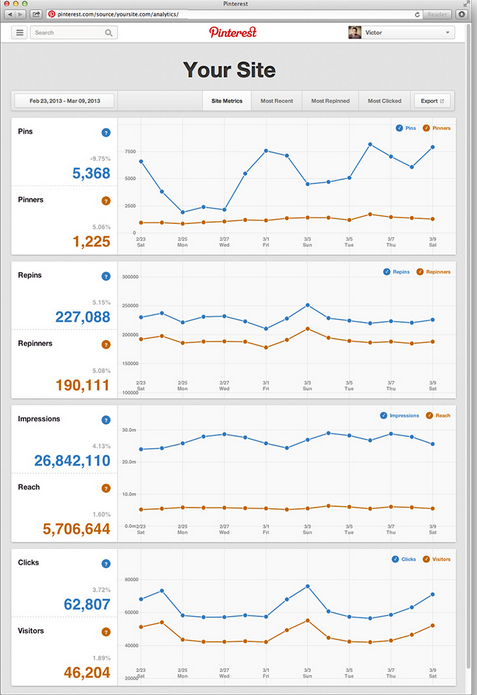
Recently, Pinterest launched its Web Analytics, allowing for businesses with verified accounts to track how many users are pinning from their site, the number of impressions from each pin, and incoming site traffic that is being generated directly from Pinterest.
Outside of SEO and social media campaigns, many may argue that there is no way to successfully tracking branding and traditional advertising efforts. Pinterest will argue this as this data now allows businesses to successfully track how users are interacting with their pins, products, and most importantly – how they are most likely to convert.
The launch of Pinterest for Business in late 2012 welcomed businesses to develop professional profiles and the implementation of “pin-it” widgets. Naturally this has been great for businesses across the board! Not only does having a professional Pinterest board increases brand awareness and a brand’s social presence, but also provides another avenue in generating site traffic.
By implementing social sharing widgets on a new product page, allows for users to quickly view a product they are interested in, and repin this great finding to the world of Pinterest.
So, yes we know how great Pinterest is, but what we really need to know is how it can make us money! As a business owner, our job is to create shareable content to promote products, and Pinterest’s job is to push it out. With this tool, we can track exactly how our marketing content is being socially pushed out! Businesses can now track how many pins are being pinned from the site, the impressions generated by each pin, and the number of repins generated by the original pin. Tracking of clicks and social reach is also available. Pretty cool we can now track the click through rate (CTR) for a specific product or pin!
Successfully tracking how customers pin their favorite blouse to a board where all their followings can see it (impression), allowing for new followers to visit your site (traffic), and potentially buy that same blouse (conversion), is a dream come true for e-commerce sites!
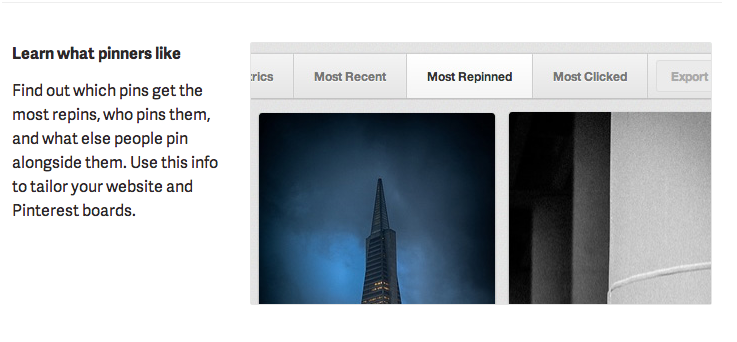
From a business perspective this allows us to really understand what our target market is interested in. Tracking which pin is the most successful allows us to analyze specific, engaging content that may lead to a higher conversion rate.
With social media constantly growing and changing, and the need to market businesses on social platforms only increasing, the launch of this new tracking device may even convince other business to get on board with Pinterest.
Now, how much longer until we see ads on Pinterest?
 Keeping up with SEO tactics isn’t always easy, which is why the general rule of thumb is to build a good site and network, and wait to be found. Even still, many people are attempting quick shortcuts that have long since been proven less than useful, or even damaging. If the sole reason for doing something—submitting a press release, for example—is to drive SEO, there’s a good chance it will backfire.
 As Facebook has become a more robust advertising platform, a broad smattering of ad units have shown up all over the platform. Almost every kind of content can be advertised on Facebook, from a text status to a Facebook app to a web site, leading to increased interaction and ultimately stronger organic performance of the content. It’s important to keep in mind the same things that drives high organic action rates: the importance of


 Promoted Posts and Pages are a simple way to set up Sponsored Stories, letting even the least savvy advertiser get a piece of the Facebook ads pie. Promotions are wholly untargeted, which can be a blessing in disguise for large pages with diverse fan bases and no need for location targeting — the only way to target a Promoted post is to target the organic post itself.






 Why Does This Matter?


 5 Ways To Pay For Twitter Exposure