Category: Social Media

  • Growing Your Practice on Facebook, Part 2: Shareable Content

    Now that you’ve learned why Facebook is such a crucial tool for your practice, it’s time to master one of the most important aspects of Facebook: engagement. Facebook is all about conversation and interaction. If you aren’t creating compelling content and engaging with your followers on a regular basis, your social media campaign will fall flat—making the next steps in this series much harder for you. Here’s how to polish up your content and keep your followers invested on Facebook.

    1. Create Shareable Content

    At one point or another, we’ve all come across a Facebook post that just speaks to us; one we couldn’t help but share with a friend or add to our timeline. The act of sharing a Facebook post seems simple enough, but for your business, these shares are crucial to your social media campaign.

    According to Kissmetrics, more than 30 billion pieces of content are shared on Facebook each month. Facebook shares are powerful stuff for business because they help your message to grow exponentially. Friends share content with Facebook friends in a way you couldn’t have managed organically on your own. So, how do you help make this happen?

    Well, if your practice wants to be included in those 30 billion pieces of shared content, it’s essential that you start writing interesting and relevant posts your fans will really want to read. If you’ve followed our blog for a while, you’ve probably heard us quote the great Bill Gates saying “Content is king.” This saying holds true across websites and platforms, and Facebook is no exception. Compelling, authentic, and viral content is what earns you those valuable shares, which in turn means more fans and more social influence.

    Just one thing to clarify: we’re not saying Likes aren’t valuable in their own way. They can be a sign of popularity, a mark of agreement, or a note that “I agree,” or “I’m with you.” However, if your goal is to get your content in front of more potential patients, you should always be on the hunt for the ever-elusive Share. Got it? Let’s get started.

    How to Create Shareable Content

    The tricky thing for medical practices is that you’re busy, and your staff might not always have the time or expertise to sit down and brainstorm ideas for compelling content. But don’t worry—here’s a list of tips to get you on the road to those shareable posts.

    • Keep it short and sweet. The ideal length for Facebook is around 40 characters.
    • Don’t use too much industry jargon. The medical industry is notorious for its jargon. Just don’t forget to consider your audience when posting. Complex terms can be off-putting, and your busy readers will appreciate your effort to break things down.
    • Don’t make every post promotional. Patients will find it helpful to know your biggest and most relevant updates, including new staff members, upcoming events, and special deals. But keep in mind that no one wants to read a revolving door of the same products and services your practice offers. This type of repetitive content is unlikely to be shared.
    • Know when to post for best results.
    • Use images whenever possible. According to Hubspot, Facebook posts with images get 2.3x more engagement than those without images. Consider adding more personal images as well, such as photos of your office, your team, or your patients. This lets readers get a glimpse at the faces behind the computer, and it adds a personal, familiar touch to your posts that can’t be gained with stock images alone.
    • Consider creating a weekly themed post. This gives your fans something unique and interesting to look forward to on a regular basis. Maybe you want to highlight a recent article you read, inspirational images, or products your practice recommends.
    • Share or repost interesting updates from other businesses. Give your readers a range of information by sharing relevant information posted by other practices, industry leaders, or medical associations. This can also be a good way to help build a referral network.
    • Share something silly every now and then. It’s true that the medical industry has a reputation for being serious, but adding silly content to your page just for the sake of sharing the joy can make you more relatable. Funny yet relevant comics, relatable e-cards, cute videos, and even animated reaction GIFs might seem off-topic, but these types of posts are often widely liked and shared. These can be great for extending your reach if your practice’s name is attached to the content.
    • Come up with interesting topics. Don’t be afraid to change things up! If you need help with this, try one of our favorite tools, Answer The Public, which can help you get an idea of what your patients might be searching for or interested in.
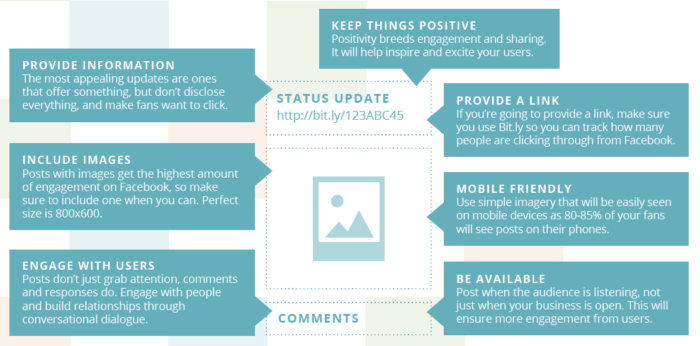
    Image Of The Ins And Outs Of Shareable Content - Search Influence

    These tips can go a long way in shaping your existing Facebook posts into something your fans will naturally be interested in. It can take time to master all of this, but even small steps can help increase your content’s shareability—and don’t forget that we’re always here to help!

    2. Engage With Your Audience

    Now that you’ve created your shareable posts, it’s time to sit back, relax, and watch the Shares and Likes roll in. Just kidding! The hidden “Part 2” to your shareable content journey is the engagement factor. Your audience will react and respond to your content, and they’ll also voice their own questions, comments, and concerns. Everyone wants to feel like they’re being heard, and responding to these inquiries shows your patients and potential patients that you’re invested in the discussion.

    One thing to keep in mind with Facebook is that if you’re in the habit of responding quickly, users will see your estimated response time right on the page. This estimate shows your attentiveness, which can be a great signal for potential patients on Facebook. So, don’t forget that taking even a few minutes to respond to your followers can go a long way.

    With the skills you’ve learned in this post, you’re already on your way to growing your medical practice on Facebook. Next time in our blog series, we’ll teach you how to enhance your Facebook campaign with promoted posts!
  • Growing Your Practice on Facebook, Part 1: Why Facebook Matters

    It’s no secret that Facebook isn’t going away anytime soon. Even with predictions a couple of years ago that the social media giant would lose a significant portion of its users to other contenders like Instagram, Twitter, WhatsApp, and Snapchat, they’ve managed to see steady growth. Since that prediction in 2015, they’ve gone from 1.2 billion monthly users to nearly 2 billion.

    So, let’s address the elephant in the digital room here. Is your practice on Facebook?

    In this series, we’ll break down the ins and outs of the best ways to reach your patients through Facebook, going over everything from advertising and shareable content to privacy rights and how to find the right images.

    Before we get into details of using Facebook to bring in more patients, let’s break down a broader question: Why is Facebook so important for your practice?

    Social Media Humanizes Medical Practices

    When’s the last time you talked with your patients outside of the office? In a report from the Health Research Institute, Ed Bennett, who oversees social media efforts at the University of Maryland Medical Center, notes, “If you want to connect with people and be part of their community, you need to go where the community is.”

    By using Facebook to interact with patients, physicians can create a dialogue that builds trust. Some patients may feel uncomfortable scheduling an appointment when all they wanted was to ask a personal medical question. Sometimes questions are just easier to ask through a direct message or comment rather than over the phone or in person.

    Medical Patient Sitting On Treatment Couch - Search Influence

    By commenting on, responding to, and answering questions directly through Facebook, unforeseen walls begin to break down. The best part? That starts to become what your practice is known for. Your medical office gets a reputation for being the place to go where people won’t feel afraid to ask about a diagnosis or procedure, how it affects them, or what their options are. It becomes the ideal venue for open communication. You’re no longer just a resource for patients when they come to your practice; you’re there for them at any time.

    Think about it this way. The average user checks their Facebook account daily. Will your practice be there to start a conversation when they log on?

    Expertise, Industry Experience, Specializations—Go Ahead and Tout It

    To go along the philosophical questioning of whether the falling tree in the forest makes any sound, are a physician’s best certifications and qualifications of value to patients if nobody knows about them?

    According to Search Engine Watch, nearly 90% of respondents aged 18–24 said they would trust medical information shared by others on their social media networks. This is also coming from a demographic that is more likely to share this information. Facebook gives physicians the tools to share their specific knowledge and expertise. Got a recent press release or blog post about a new technique offered exclusively at your practice? Put it on Facebook. It will demonstrate your expertise in your field while providing a great avenue for your patients to engage with and share this information.

    Also, in a time where anyone can share information and claim it as fact or scientifically true, physicians have the capability and responsibility to make sure accurate, helpful information is reaching their current and potential patients.

    Medical Patients Waiting In The Physician's Office On Facebook - Search Influence

    It’s All About Relevance

    Just as you shouldn’t make updating your Myspace page or LiveJournal your top priority anymore, you should be posting and staying up-to-date on Facebook to make your medical practice more relevant to what’s going on in your patients’ lives. It shows you’re a part of the online community, and ideally, it garners more traffic to your website and office.

    Ultimately, Facebook is more than just a place to share family pictures, an exciting recipe, or an awkward political conversation with an uncle. It’s a powerful resource for medical practices to reach their patients on a more personal level. Your patients are already there. We can show you how to utilize social media to find them and make them advocates for your practice. Reach out to us to learn how to implement a social media plan for your practice.

    For more information, stay tuned for our next blog post, which will teach you how to create and share content that moves your audience.

  • Grow Your LinkedIn Network With These 3 Optimizing Tips

    With over 400 million users, LinkedIn has become a social networking must for companies large and small. While other platforms like Facebook and Twitter are commonly used in marketing and SEO campaigns, LinkedIn can have a significant impact on online visibility and SEO opportunities. Instead of neglecting your LinkedIn account, utilize it to grow your business’ traffic and network.

    1. Be Consistent

    The Devil Wears Prada Who Are You - Search Influence

    For your traffic to increase, customers have to know it’s you. One of the biggest mistakes a company can make is not maintaining brand consistency across all marketing platforms. LinkedIn provides you with the opportunity to upload banners, background images, videos, and photos. Utilize all of these to tie back into your brand, logo, tagline, and color scheme.

    This also applies to the written content on your LinkedIn profile. If your business’ website uses a formal tone, don’t be overly casual on your social media. This creates brand confusion and can lead to customers not connecting with you because they think you’re someone else. Don’t lose out on growing roots with a client because someone can’t figure out if your profile is the right one.

    2. Engage Your Network

    Parks And Recreation Aziz Ansari On Social Media - Search Influence

    While you may have a lush profile, if it’s not active, no one is looking at it. It’s important to create, share, and like fresh and relevant content to your industry. Shower your followers with content at least twice a day and watch your network grow. This keeps your profile engaging as well as current. When creating or sharing content, make sure to add variety. For example, it can be good to post an interesting article in the morning and then ask an engaging question in the evening. This allows for different types of client interaction and can make a profile look more personable.

    As I’m sure you’re aware, blog posts are great when it comes to a site’s SEO. By posting your company’s blog posts on LinkedIn, you not only help your profile, but you also improve your website’s ratings, which can lead to more business.

    3. Let Your Keywords Shine

    SEO Friendly - Search Influence

    While your company can be searched on LinkedIn by name, it can also be found by keywords. The keywords used in your SEO campaign are the same words you should be using on your social media platforms. Your keywords should shine through your content from your posts, to your description, and to your headline. While it’s still important to stay natural, try to fit in a keyword or two in the first 156 characters of content on your profile. Google previews these first characters, and with the help of keywords, your profile can be more easily found.

    LinkedIn Superman - Search Influence

    By not growing your LinkedIn network, you’re leaving opportunities like referrals and website traffic in the dust. Social media platforms are crucial to interacting with current and potential clients. As LinkedIn’s numbers grow, so can yours. Make sure your profile is the cream of the crop and optimize.


    Image Sources:

    Devil Wears Prada Image

    Aziz Ansari On Social Media

    LinkedIn Superman


  • 5 Medical Professionals Who Use Twitter Effectively and What You Can Learn from Them

    With 319 million people on Twitter and 100 million daily users, it’s clear that this social media platform offers huge potential for growing a medical practice. For doctors striving to attract more patients, 42% of individuals viewing health information on social media look at consumer reviews to guide their medical decision-making. For doctors aiming to spread medical knowledge online, 60% of consumers say they trust the information in doctor’s posts—almost twice the number of people who trust information from pharmaceutical companies. And these numbers are expected to grow, as 18–24-year-olds are over two times as likely as 45–50-year-olds to use social media for health-related discussions.

    Yet, in spite of Twitter’s huge potential, it can be difficult for physicians to justify taking time away from patient care to focus on social media. In the medical industry, it’s especially important for tweets to reach the most people possible in as little time as possible so that doctors can spend less time on marketing and more time on medicine.

    Check out five of the most successful doctors on Twitter for some great inspiration and examples.

    1. Dr. Mehmet Oz

    Handle: @DrOz

    Followers: 4.05 million

    Before you write off Dr. Oz as more television host than medical professional, consider this: He has more followers than any other doctor on Twitter. While Oprah certainly helped him gain this following, he couldn’t keep it if he wasn’t engaging his followers with the media they find valuable. Dr. Oz knows what his audience wants to read, and he regularly posts health tips, news, and advice catered to this demographic. Check out Dr. Oz’s tweets for examples of medical articles you can share to engage your own following.

    2. Dr. Kevin Pho

    Handle: @kevinmd

    Followers: 151,000

    Unlike Dr. Oz, Dr. Pho rose to social media stardom largely through his own savvy use of integrated digital marketing. While he also regularly posts engaging articles, with topics ranging from science to politics to personal health journeys, much of this media comes from his own blog. Dr. Pho also publishes many posts written by guest bloggers, which not only cuts down the time required to maintain an active social media presence but also offers a great opportunity to collaborate and network with other doctors online. Visit Dr. Pho’s Twitter and blog for a great example of an integrated marketing plan.

    3. Dr. Joseph Kim

    Handle: @DrJosephKim

    Followers: 31,000

    If you’re worrying because Dr. Oz and Dr. Pho share a lot more personal stories than cold, hard science, never fear! Dr. Kim proves that you can take a largely academic approach to social media and still become a Twitter star. His posts strike the perfect balance of career resources and medical studies, appealing to both doctors and patients. Check out Dr. Kim’s twitter feed for strong examples of how to post academic information while still keeping your following engaged.

    4. Dr. Mike Sevilla

    Handle: @DrMikeSevilla

    Followers: 26,000

    Much more than the other doctors on this list, Dr. Sevilla projects a goofy, jovial personality into his tweets. He makes Family Medicine seem friendly and approachable, posting kooky holiday selfies and words of encouragement for residents going through the stressful match process. He is also a generous re-tweeter, interacting not only with other online physicians but also with local news and fundraising organizations. Scroll through Dr. Sevilla’s posts to see how to have fun with social media while still maintaining the knowledgeable persona of a physician.

    5. Dr. Val Jones

    Handle: @drval

    Followers: 25,800

    Women make up roughly 1/3 of all physicians in the United States, but they are underrepresented among the top doctors on Twitter. Nevertheless, Dr. Jones has fought her way to the top as a prolific author and lecturer, as well as the founder of Better Health, LLC, one of the largest networks of medical bloggers. Like Dr. Pho, she offers a great example of an effective integrated marketing plan, using her tweets to drive traffic to her blog and other writings, and her writings to provide engaging content for her Twitter following. Check out Dr. Jones’s Twitter feed and blog for examples of how to use social media to build on your professional accomplishments.

    Top Takeaway

    While these five physicians are great sources of inspiration, it can seem daunting to apply their successes to your own practice. If Oprah doesn’t introduce you to daytime television, where do you start?

    One main takeaway from successful physicians on Twitter is targeting the right demographic. Dr. Sevilla runs a Family Medicine practice, so his ideal audience includes parents and young children. Therefore, a friendly, goofy personality is appealing. No parent wants to bring her kids to a stern, intimidating doctor. Dr. Oz, on the other hand, is more interested in an audience that watches his daytime television show. Thus, his posts feature more “popular science” topics, such as popular diets or healthy recipes.

    The good news is you can easily apply this strategy to your own practice. As an expert in your field, you know what topics would interest your target demographic, be it low-sodium snack suggestions for dialysis patients or skin care tips for dermatology patients. So, post about it!

    With your target demographic in place, you are well equipped to take the next steps in growing and maintaining your Twitter following. Like the successful physicians in this post, you can collaborate online with other medical professionals, or write relevant, engaging blog posts to share on Twitter as part of an integrated social media marketing campaign.

    If you don’t want to go through this process alone, we can help you there as well! For a do-it-yourself approach, download “Up Your Social Media Game With This Handy Reference Guide.” It’s an infographic to equip you with insights into which social media platform and what time of day would be most effective for targeting your ideal demographic. For a more assisted approach, see how our social media services can help you.

    Happy tweeting!

    If you don’t want to go through this process alone, we can help you there as well! Contact an expert from our team today.

  • Lost about LinkedIn? Here Are 7 Tips for Legal Professionals

    Image Of Worker Using LinkedIn - Search Influence

    LinkedIn was used by 467 million users in 2016. A simple search in LinkedIn showed 384,071 lawyers. Not only are these numbers worth giving LinkedIn some notice, but the B2B and B2C client acquisitions are increasing at rates over 100% each year as well. There is no longer a reason to put off establishing yourself and your law firm on LinkedIn. If you are lost on where to start, here are seven simple tips to improve your LinkedIn presence.

    1. Know the Laws and Ethical Guidelines for Your Area

    This is the legal profession after all, so there are very particular rules to follow when marketing yourself. Depending on the state in which you practice, the words “specialist” and “expert” may be against ethical guidelines. The New York City Bar came out with a formal opinion on the matter in late 2015, which applied general advertising rules to social media explicitly. Though this is a great platform to reach out to colleagues and clients, make sure to follow the guidelines.

    2. Create Your Profile

    If you have already done this step, you are already ahead of the game. If not, signing up for a free profile is the easiest way to start. This will open the wide world of LinkedIn to you. You can also associate yourself with a firm profile. If your firm does not already have a profile, you can check to see if it meets LinkedIn requirements for company profiles and follow the steps to get one created yourself.

    3. Optimize Your Profile

    Once you have created your profile, there are some things that you should add to your personal profile to help you stand out. These include:

    • A professional photo
    • A headline
    • Title and description of your legal experience
    • Skills sections
    • Interest section
    • Education section
    • Volunteer experience & causes

    These sections have varying character counts, ranging from 100 to 1000 characters. All of these sections need to be unique and targeted to give clients a good view of the kind of attorney you are. However, these sections, especially skills, can lead to ethical issues so make sure to follow guidelines.

    4. Make Connections on LinkedIn

    After making and optimizing your profile, it’s time to make connections. These can easily be drawn from your already existing email connections through some simple downloading steps. This will automatically give you instant connections to people that you already interact with, both colleagues and clients. Adding yourself to your firm’s page will also allow other attorneys at your firm to find you easily.

    Continually adding more connections from outside of LinkedIn and through LinkedIn will build a network to interact with, share information with, and get new clients from.

    5. Join LinkedIn Groups

    Groups on LinkedIn are a great place to find pertinent information to share with your colleagues and clients. You should join your local Bar Association page, your former law school, and other ABA organizations that apply to your practice areas. Those can just be a jumping off point for what groups you should join. The possibilities are endless.

    6. Engage with Other Users

    Engaging with users on LinkedIn can be done in a large variety of ways. Just made a new connection? Message them and remind them how you know each other. See an excellent article? Comment on it. Know a fellow attorney you have seen in action? Verify one of their skills. Not only will this build the strength of your connection but it will also get others to interact with you. 50% of LinkedIn members said they are more likely to buy from a business they interact with on the site.

    Another good way to keep up to date is, if you have a smartphone, download the LinkedIn app to keep up to date without your computer.

    Image Of Coworkers Using A Mobile App - Search Influence

    7. Post Content

    This is the last tip on the list, but it just might be the biggest. LinkedIn is a professional network that connects professionals with each other. This is a perfect place to share industry specific news. If you already run a blog, make sure to share the content on your profile. Found an article that pertains to your practice area? Share it on your page with your take on the information. Have some information to share about a case? Share that on your page. The more content you post with your unique voice, the more you build your authority on LinkedIn on the topic. However, make sure to include proper disclaimers with any content you share that could be construed as legal advice.

    Great content on LinkedIn can grow your connections with those within the industry and those that need the help of attorneys. By following these tips and making your presence known on LinkedIn, you can increase your impact online and offline. For more strategic advice about LinkedIn, contact an expert from our team.

  • What You Can’t Do On LinkedIn: Hacking LinkedIn and Getting Results

    Hypertargeting. Automated bid management. Ad scheduling. We take for granted these social media advertising features available on platforms like Facebook. But, what do you do when these “advantages” are not available on other sites, like LinkedIn? Here at Search Influence, we decided to design some experiments to see if we could manually hack these features within the LinkedIn advertising platform.

    Targeting Options

    We all know how great Facebook’s targeting is with purchase behaviors and in-market audiences backed up by actual third-party data. There’s no way that LinkedIn can touch Facebook in this realm, right?

    According to Business Insider, LinkedIn is gradually increasing its user base, even as other platforms like Facebook and Twitter have seen decelerating growth. What LinkedIn has to offer is the opportunity to reach one of the fastest-growing groups of business-minded professionals when they are in “work-mode,” browsing for new career opportunities, exploring professional affiliation groups, and researching industry-specific content. In fact, Buffer reports that 60% of LinkedIn users are interested in seeing industry-related content with company news as a close second. So how can you capitalize on this information-hungry audience?

    LinkedIn offers the opportunity to target all levels of the professional hierarchy, from young company influencers, performing research and reporting on their findings, to higher-level corporate decision-makers looking for their next business partnership. The targeting opportunities on this platform are specifically geared towards a professional audience. With these options, you can:

    • Target specific Companies by name and narrow in your Job Titles to reach the exact people you want to hear your message,
    • Use specific Degrees or Skills to seek out only the users who meet your qualifications or
    • Sift through Member Groups to find people with similar or desirable professional or educational affiliations.

    With all of these occupation-oriented targeting options, LinkedIn offers advertisers the ability to closely align your social engagement goals with your company’s brand and mission to reach users who are demanding industry-relevant content.

    Ad Scheduling

    Facebook offers ad scheduling, and while it’s not as granular as other platforms, such as AdWords, which allows you to schedule your ads in 15-minute increments, it still provides a heightened level of control over when your ads are shown.

    Unfortunately, LinkedIn does not afford advertisers these same features, so we took it upon ourselves to apply manual ad scheduling to see if the benefit was worth the time. Research has shown that the best time to publish content on the LinkedIn platform is Mondays through Fridays, during business hours. Makes sense, right? Target working individuals with work-related content during work hours.

    Linked-In-Best-Times-to-post imge - Search Influence

    Our online advertising team put this premise to the test. Many of our clients suffer from budgets that are too small to run ads for the duration of the month. When you factor in LinkedIn’s $10 daily minimum and the fact that the platform allows you to spend up to 20% more than your daily budget on any given day, and you most often will, this effectively makes the minimum daily spend $12. If we extrapolate that figure across a 31-day month, an individual campaign needs AT LEAST $372 to run. To be most effective with our clients’ monthly spends, we wanted to capitalize on the users who are most likely to engage with the content, i.e. people who are on LinkedIn during the weekdays.

    We implemented a “Weekend Pausing” test for a few of our clients. This test included Sponsored Updates campaigns, and we ran our test from November of 2016 through December 2016, pausing on weekends and holidays when users are least likely to be browsing the platform with intent.

    We began by establishing baseline performance for each of the clients and decided that our main metrics for measurement would be engagement and cost per engagement.

    Image Of Engagement Metrics For Online Advertising LinkedIn - Search Influence

    So, what did we find? One client saw a 28% decrease in cost per social action and an 18% overall decrease in spend for a 14% overall social action increase. One client spent 23% less budget and received 63% more social actions for a cost per social action that was 53% less than the baseline. However, when we looked at overall engagement, which includes clicks as well as social actions, we saw an overall engagement decrease of 13% and a 39% decrease in engagement rate, refuting the idea that LinkedIn users are most active during weekdays. An extended period of testing would be required to investigate the full impact of weekend pausing on LinkedIn engagement rates.

    Bid Management

    Other platforms offer automatic bidding options to get you the lowest cost per result. Facebook does this across all of its placements, including Instagram and the Audience Network, to achieve the lowest average cost per result. There are also manual bidding options on the Facebook platform for those advertisers who want a little more control.

    Luckily, LinkedIn does provide some competitor bidding data so that you can make an informed decision when setting your manual bids, which is the only option available on this platform. Previously, the consensus for LinkedIn bidding best practices was to bid as high to the top of the bidding range provided by LinkedIn in the Bid & Budget tabs of the campaign manager as the client’s budget allows.

    Image Of Competitor Bidding Data For Online Advertising LinkedIn - Search Influence

    What we were curious to test was whether we could maximize clicks and decrease overall cost per click by strategically bidding down, towards the middle of the bidding range. Our online advertising team devised a test across multiple clients in various industries with different budgets. Since our goal was to maximize clicks and engagement, we chose clients with Sponsored Updates campaigns. We established baseline metrics for each of our client’s prior performance and began strategically lowering and raising our bids from the top of LinkedIn’s provided range to the bottom in predetermined increments each day.

    Once our bids were set towards the lower bound of the range, clicks and impressions significantly decreased. After moving up and down the range a couple of times, we hit a “sweet spot” right around the middle of LinkedIn’s bidding range where performance was optimized. We discovered that bidding around the middle of LinkedIn’s bidding range resulted in an average click increase of 39%, an average CTR increase of 14%, and an average CPC decrease of 30%. Through the manual manipulation of our bids, we were able to generate more engagement for our clients at a lower price!

    What Can You Do With LinkedIn?

    While many advertisers might suggest channeling efforts from LinkedIn to Facebook, I suggest rethinking the platform’s purpose. What our experiments have revealed is that if you can devise a strategy that considers the platform’s utility as a connector of business-minded individuals, and you’re willing to put in the effort to manually optimize your campaigns for the highest level of budget efficacy, you can churn out excellent results.

    If you have strategic questions about using Linkedin or need support getting started with Linkedin advertising, contact a member of our team.

  • Up Your Social Media Game With This Handy Reference Guide: The When, How, and Where of Social Posting

    Up-Your-Social-Media-Game-With-This-Handy-Reference-Guide - Search Influence
    Another year, another seemingly endless parade of social media posts gone by. If you haven’t jumped on the social marketing bandwagon yet, 2017 is the year to begin because things are continuing to go up and up. Here are some highlights.

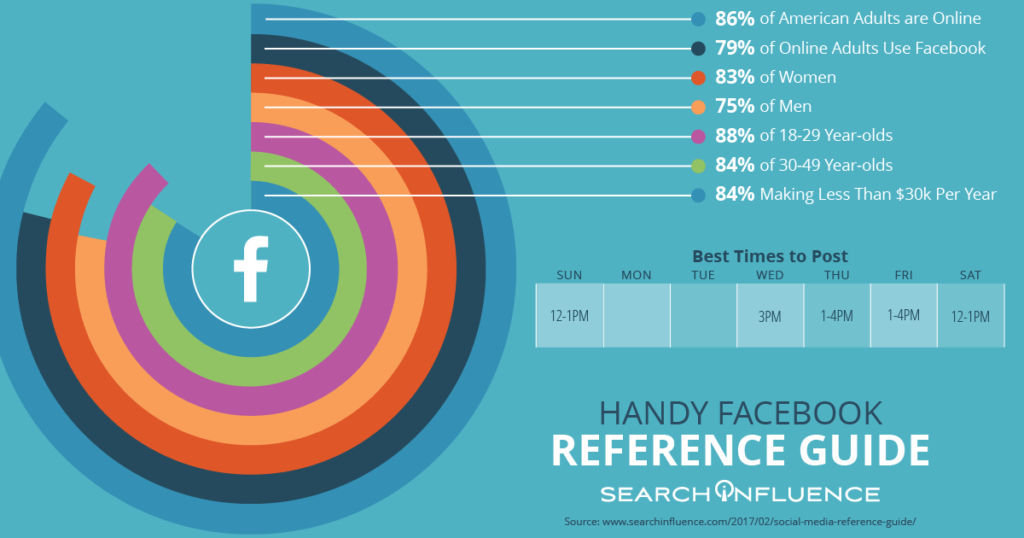
    79% of Online Adults Use Facebook

    The Pew Research Center has done a lot of work tracking the social media usage of American adults. Of all platforms, Facebook has a staggering reach among adults across demographics.

    Handy-Facebook-Reference-Guide - Search Influence

    Of these Facebook users, 76% check in every day and use Facebook as a way to learn about the news, local businesses, trending topics, and more. Facebook is truly on the way to becoming all pervasive, even among adults aged 65 and older.

    57% of Consumers Are Influenced by Online Information

    More than half of internet users surveyed said that they are influenced to think more positively of a business after reading positive reviews or comments about the business online. This means that creating a space for customers to give reviews and interacting with these reviews has tangible benefits and can convert potential customers that are lurking in the background of your social media.

    Social Media Ad Spending Has Hit $35.98 Billion – and Keeps Climbing

    Businesses are learning the advantages of using social media to market to their customers and using that knowledge to their advantage. Social media advertising is becoming the new normal, and we have abundant experience creating campaigns that convert. Contact us if you are ready to get started with paid ad campaigns for your institution or business.

    Sources:

    http://www.pewinternet.org/2016/11/11/social-media-update-2016/

    http://webbiquity.com/social-media-marketing/47-superb-social-media-marketing-stats-and-facts/

    http://www.pewinternet.org/2016/11/11/social-media-update-2016/

    http://coschedule.com/blog/best-times-to-post-on-social-media/

    https://www.emarketer.com/Article/Social-Network-Ad-Spending-Hit-2368-Billion-Worldwide-2015/1012357#sthash.eESedQLL.dpuf

    https://www.emarketer.com/Article/Facebook-Twitter-Will-Take-33-Share-of-US-Digital-Display-Market-by-2017/1012274#sthash.0WToy3rM.dpuf

  • The Ultimate Guide on How to Get Facebook Reviews

    5-star-reviews image - Search Influence

    There’s no introduction needed for Facebook—it’s one of the top social media platforms, and with over 1.79 billion users online, it’s hard to ignore when it comes to online marketing for your business. You have to encourage customers to not only like your page but also leave a positive review. It’ll help boost sales and excite others to leave a review as well. In summary:

    How To Get Facebook Reviews

    1. Ask customers to check-in to your business
    2. Utilize Email marketing
    3. Respond to reviews, whether positive or negative

    Reviews are becoming more and more common on the internet. According to the 2015 Social Recommendations Index, about 71% of Facebook users trust the content they see on this social media platform. Also, about 66% users will share their thoughts, experiences, and opinions on the company or their recent purchase. Facebook reviews are critical when it comes to being successful online. Here’s a guide on how to get more for your business.

    Image Of Fresh Prince And Uncle Phil Dancing - Search Influence

    Just Checking-in on You

    Users checking-in to your place of business on Facebook can help prompt reviews. They can tell their friends what they’re thinking or feeling, and they can add a photo or video to their post. The number of users that check-in to your business will also be added to your Facebook page. The more check-ins, the more people are attracted to your business!

    But how do you ask people to check-in? Often something as simple as signage in your place of business reminding customers to check-in can work. It can be a sticker posted on your register or a flyer in the front window. You can also provide rewards or discounts for those who check-in. Your customers will be prompted to tell their friends and family about the discount they can receive for checking-in on Facebook.

    Image Of Buzz Lightyear Describing The Abundance Of Emails - Search Influence

    Emails, Emails, and More Emails

    You can ask customers to leave a Facebook review through email marketing. It’s best to ask right after their visit since their experience will be fresh in their mind. Send them an offer, newsletter, post-purchase email, post-visit email, or confirmation. Make sure to provide a direct link to your Facebook page in the email to make it easier for consumers to leave their review.

    However, you don’t want to sound too pushy when asking for reviews. When sending customers a post-purchase email, make it personal. Mention their name in the email, thank them, and ask them how their visit went and if they have any ideas on improving your business. If you come across as genuine, you’re likely to get genuine reviews in return. Most importantly, don’t forget to tell them that you would like to hear from them. Their opinion matters!

    Image Of Office Employees Raising The Roof - Search Influence

    Respond to the Good and Bad

    It’s important to respond to customers who leave a review. That includes both positive and negative reviews. This will help build your reputation as a dependable business owner who cares about customers. When responding to reviews, stay professional and courteous, even if the commenter was unprofessional or impolite.

    There may be a time when you’ll have to deal with a Facebook troll. It’s best to respond to them professionally, but if their response is out of hand, you can send them a direct message to help solve the problem. You can also delete and block certain users who are truly trolling your business. Steer clear of deleting and blocking every person who posts a negative comment, because not every negative commenter is a troll.

    Facebook marketing is important for those who want to gain local reviews. Be sure to check out our previous blog about using hashtags on Facebook and how they can help benefit your online presence.

  • Three Simple Tips for Optimizing Your Facebook Page

    Facebook-for-business image - Search Influence

    For developing a meaningful online presence, proper management of your social media profiles is essential to any successful marketing effort. There are some very obvious, and important, actions to take: have a snazzy profile and cover photo, publish meaningful content, and engage with potential clients. However, beneath the surface, there are measures you should take to ensure your Facebook page is helping you reach your audience.

    Image Of Facebook Logo - Search Influence

    1. Ensure You Have Accurate Categories and Subcategories

    Often, businesses have neglected to fully flesh out this portion of their business page. This section is important because the category will indicate that you are, in fact, a local business trying to market a product or service while the subcategories will better define your products and services. In a crowded market, you want to make sure your page is helping guide potential customers directly to the goods and services they need. Facebook allows up to three subcategories, so if possible, find three that best fit the description of your business and the products or services you are marketing. This is editable in the “About” section of your page.

    2. Use a Custom URL and @Username

    Facebook allows businesses to edit their Facebook URL and use an @username to reflect their business name. First, this makes it much easier for new or repeat customers to find your information on Facebook. Additionally, it adds authority to your page because it reflects your business name rather than a random string of numbers and letters. Lastly, from a purely visual perspective, it just looks better. This is also editable in the “About” section of your page.

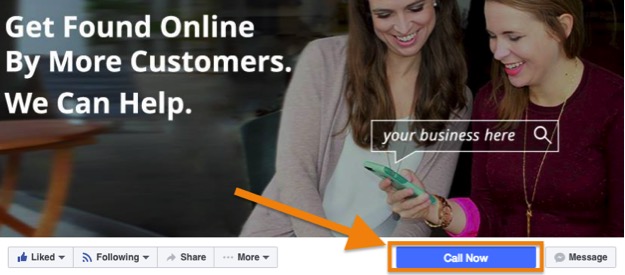
    Image of Call To Action Button On Facebook Page - Search Influence

    3. Add a Call to Action Button

    Facebook makes it easy for your potential customers to reach you by allowing you to have a Call to Action button right there on the cover photo. You want to ensure that you optimize this button so that customers can recognize it and that you get a response if it is used. Book Now, Contact Us, Use App, Play Game, Shop Now, Sign Up, and Watch Video are all options you can use to help boost a product, service, or special promotion your business may be running. You can easily find this where it says, “Add a Button.”

    While it’s easy to focus on the cosmetic and social aspects of your Facebook, it is important to remember that your Facebook can work for you without a great deal of effort from you. Creating accurate, well-written descriptions is another thing you can do to help with your page’s search value. In many cases, having a marketing business that understands how to make Facebook work for you can help you attract customers you would not have reached otherwise.

  • Don’t Feed the Trolls Part II: Facebook

    Search Influence’s resident troll has returned with the next installment of troll defense lessons. This edition will focus on the Facebook social media platform. Trolls inhabit every single corner of the infinitely expanded world wide web. Social media, forums, news articles, emails, Amazon reviews, and even online video games. The main strength that trolls have in most of these platforms is that they don’t have to expose their identity. But, what happens when someone trolls you on Facebook? Show me a person who trolls with their own identity, and I’ll show you a person who has nothing to lose. Though there is no surefire way to completely stop someone from trolling you into infinity, there are some pretty hard and fast rules that apply to all troll defense tactics.

    Image Of Trolls Dancing With Excitement - Search Influence

    Don’t Feed the Trolls

    Does this statement sound familiar? If it does, it means that you either read the previous entry into the troll stomping anthology, or you are a seasoned internet veteran. This is perhaps the easiest and simplest way to deter a troll from taking up residence on your business page. Though the easiest way to deal with a troll is to confront them face first, an excessive number of responses and back and forth will eventually cause you to devolve into the troll that you are trying to destroy.

    Don’t Assume Everyone Is a Troll

    The main reason that your business page exists is to connect with your customers and fans. It needs to be understood that a complaint is not always a troll setting up shop. Whether you have 50 followers or 50,000,000 followers, each and every one of them made the conscious decision to click the “like” button on your page because they like your product or service. Give users the benefit of the doubt and make an earnest attempt to make peace with them.

    Keep Your Cool

    When you’ve definitively identified that someone is actually trolling you, remember that you are a professional and a troll is a professional at making professionals profess professions unprofessionally. Your responses will be visible to everyone who follows your page and even some passersby as well. Those viewing your argument won’t necessarily feel the same rage that you do and may think you treat all customers in the same fashion. Not only that, but raging at a troll makes them seem like the victim, and the last thing that you want your fans and strangers to do is to sympathize with a troll living on your business page.

    Image Of SNL Being Slightly Angry - Search Influence

    Use All Provided Tools Available

    Similar to Twitter, Facebook has a few built-in tools to deal with users that attempt to interact with you in bad faith. First and foremost, you have the ability to delete comments. This should be used VERY carefully. A legitimate negative comment should not be deleted; that issue should be addressed directly and publicly. The only comments that should ever be deleted are deliberate and dishonest attacks made toward your business. Specific users can also be blocked on Facebook as well. If you do have to delete a user’s comment for legitimately trolling you, blocking them is probably a good idea as well. Facebook also has a direct messaging system that can be used to reach out to users in case they need to share private information.

    Sounds Tough

    With a whopping 1.79 billion users (that’s 25% of the entire world population) and not even plateauing quite yet, Facebook can be a challenge to navigate. Here at Search Influence, we offer a full suite of Social Media Management services to offer with a team of professionals to deal with the trolls for you.