Category: Social Media

  • Facebook Reviews: Increasing Reviews to Increase Credibility

    Facebook: the largest social media platform in the world. It’s used to keep up with family, friends, social trends, and marketing. It’s the second-most important review site, right between Google and Yelp. With 1.37 billion daily active users, there’s no avoiding Facebook when it comes to digital marketing.
    Gif counting Facebook likes

    The Benefits of Facebook Review

    You didn’t have to read this blog to know that building customer relationships are key. Online reviews are an instant way to gain trust with a potential customer. Did you know that 84 percent of people trust online reviews just as much as a personal recommendation? They’re more likely to trust the reviews since they’re experiences had by real customers.

    Along with reviews, customers leave star ratings as well. Customers can leave star ratings between 1 and 5, and the total average is used for your final rating. Since the star rating can be seen even without clicking through to the Facebook page, it’s easy to gain potential customers trust.

    Don’t Stress Over Bad Reviews

    As for reviews, I’ll be real with you. Bad reviews are going to happen, but only 14 percent of reviews are 3 stars or less. Truthfully, we don’t live in a world of perfect ratings, so if you have 5 stars that’s something to be proud of. However, studies show that 4.2 to 4.5 is the ideal average star rating. Furthermore, 68 percent of customers trust reviews more when they see both good and bad scores.

    When replying to reviews, always reply to both good and bad reviews.

    For bad reviews, do not delete reviews or argue with customers. Take time to reply to the unhappy customer with your contact information. From there, try to reach the customer by phone to listen to their complaint. Then you’ll be able to offer a solution outside of the review. Learn more tips in our previous blog post on managing reviews.

    How to Get More Facebook Reviews

    How do customers know to leave you reviews after a great experience? Ask them! Seven out of 10 customers are willing to leave a review if you ask. Here are some ideas on how to ask for reviews:

    1. Make sure there’s signage around the business reminding them to review.
    2. Reach out with personalized follow-up emails and/or text.
    3. Lastly, be direct and have a conversation about their experience.

    No matter the channel of communication, always make sure to thank the customer for their business and to ask for feedback on what could be improved. Being genuine is a way to receive genuine reviews.
    Another way to engage customers is by requesting them to check in to your business. Motivate customers by offering them something like a coupon code or free item. Checking in allows the customer to write something, post a photo, and tag others. Most importantly, Facebook will automatically send a notification to the person who created the check-in one to two days later and request them to leave a review.

    Creative Ways to Use Facebook Reviews

    Okay, you’ve collected all of these reviews, with some good and some bad. Now, what are you going to do with them?

    For good reviews, get creative! Create a Facebook post and put some ad spend behind it so a larger audience sees it. Print them and hang them around your business. Add them to your website. You and your employees are doing a great job, and it’s paying off. Make sure to tell people about the great experiences your customers are having!

    For bad reviews, analyze and compare to see if there are common trends. Maybe it’s an internal process, or maybe it’s because company-wide standards need to be implemented. Once you find a way to fix the repetitive issues, continue to monitor and adjust to solve problems as they arise. Always use feedback to continuously improve your business.

    Utilizing Facebook for Your Business = Brand Awareness

    Facebook is an easy way to gain brand awareness from previous and potential customers. Make sure your profile has as much information as possible, including a profile photo, background photo, and hours of operation.

    Keep followers updated on your latest projects or industry trends. Your posts should not all be product pushing. You’ll want them to be personal, relevant, and engaging. Create posts specifically for employee updates to announce promotions, work ethic, or any other relevant aspects of your business.

    If you’re just starting out on Facebook, your posts likely won’t be seen by many people organically. To increase the number of people who see your posts, try promoting some posts to reach more people. Get detailed by testing out targeting, including location and demographics.

    If you collect personal phone numbers and/or email addresses from current clients, you’ll want to look into lookalike audiences. This is Facebook’s way of finding people who have the same interests as your current customers, so when your brand is put in front of them, they’re more likely to convert.

    Whether you’re completely new to Facebook or just need to jumpstart your social media campaigns, Search Influence can help. Our social media experts can help you post, track leads, and manage reviews. Start a conversation today to learn how we can help your business grow.


    Images:

    Facebook Notification

    Review Icon

  • 7 Best Social Media Platforms for Your Digital Marketing Strategy in 2019

    A group of people using social media on their mobile devices at Search Influence in New Orleans, LA

    Social media is an essential element of a holistic and integrated marketing plan. Different social media platforms allow you to create and share content, reach specific audiences, and accomplish your marketing and business goals. Before you begin expanding your current social media marketing, make a plan. Here are some questions to help you get started:

    • Who are you trying to reach?
    • Where does your target audience consume content online?
    • Which message(s) do you want to send your target audience?
    • What is your end business goal?

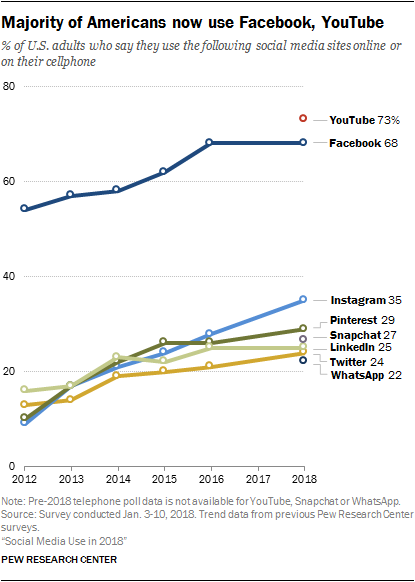
    Your answers to these questions will help you define your business goals and translate them into social media marketing goals. You will then be able to prioritize which social platform to use. If you are new to social media marketing, Facebook is where you should start. If you already have decent engagement on one platform, where should you go next? Most Americans are active on two to three social platforms, so why limit your marketing to just one?

    Screen shot of social media stats

    Which Social Media Platform Is Best for Marketing?

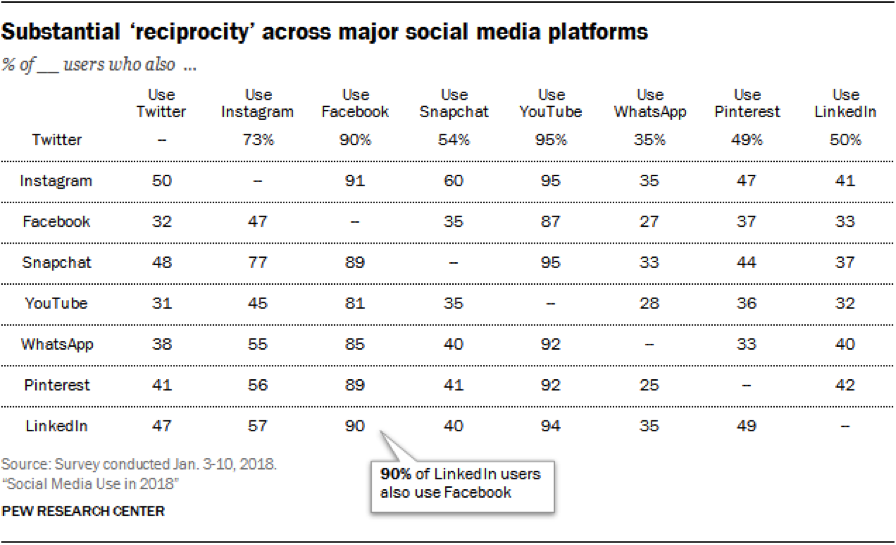
      1. Facebook – With more than 2.27 billion active monthly users, Facebook is definitely your number one choice. Through Facebook Ads Manager, you can target users based on their location, age, gender, level of education, relationship status, job title, interests, purchase behavior, device usage, and so much more. And it doesn’t end there! Facebook allows you to create Custom Audiences to reach current customers or patients. Custom Audiences can be created from the phone numbers or email addresses you’re already collecting, or from Facebook Pixel to target people who have visited your website. To reach new customers, use Lookalike Audiences; these are created from Facebook’s insights about Custom Audiences to target users with similar online behaviors. You may think “My target demographic isn’t on Facebook,” and you could be right, but Facebook Ads Manager takes the guesswork out of it. This platform allows you to create and serve your message to the right user on Facebook, Instagram, or (through the Audience Network) across the web. As stated by Facebook,

    “1 billion+ people see a [Facebook] Audience Network ad each month.”

      1. Instagram – Owned by Facebook, Instagram boasts more than 1 billion monthly active users and has the same advertising options as Facebook. First and foremost, it’s a visual platform, which provides you with an opportunity to showcase your business’s personality. There are a number of free tools you can use to improve your audience’s creative experience.
      2. YouTube – YouTube allows your business to post and share an unlimited amount of video content, which you can then share on social media, send via email, or embed on your website. As a product of Google, there is also an added SEO benefit of having a YouTube channel and producing video content on the platform. With more than 1.8 billion active monthly users worldwide, YouTube has essentially become the second largest search engine behind Google. When it comes to paid advertising on YouTube, it takes the lead over Facebook for video. Facebook charges your account for each 10-second view, while YouTube does not charge you until a user has consumed at least 30 seconds of an ad. According to expandedramblings.com,

    “YouTube overall reaches more 18-34 and 18-49 year-olds than any cable network in the U.S.”

    1. Google My Business – You may not consider Google My Business to be a social network per se, but this free platform offers features that Facebook, Instagram, Twitter, etc. do not. Posts are searchable via keywords, they positively affect your SEO rankings, and they provide an opportunity for backlinks. You can read more about why you should be posting on Google My Business.
    2. LinkedIn – This platform is known as the primary social networking platform for professionals. You can use LinkedIn to update customers on your business, connect with industry partners, and recruit new team members. As a professional network, it is the top choice for B2B social media marketing. According to Forbes, “LinkedIn is one of the best platforms for generating leads and now makes up 46 percent of the social media traffic generated to company websites for B2B firms.”
    3. Pinterest – Similar to Instagram, Pinterest is a visual platform. Pinterest allows your business to show off your product offerings, before-and-after images (great for home improvement, beauty, and cosmetic surgery industries), and curated pin-boards. As you are probably already aware, its audience is primarily female. Pinterest is an oasis for hobbyists, brides and grooms, and day-dreamers in general. Keep this in mind when sharing content. Travel itineraries, suggested packing lists, landscaping ideas, craft projects, and wedding inspiration are the bread and butter of this platform. But don’t think you’re limited to just engaging with your audience. According to Hootsuite, 87 percent of Pinners have made a purchase through the platform.
    4. Twitter – Twitter is a quick-paced platform that’s perfect for sharing the latest trends or your business’s take on current events. Its audience skews somewhat younger but is split pretty evenly between men and women. Your business can participate in a larger conversation by using hashtags for trending topics. These hashtags allow you to reach new potential customers in your industry. Twitter can also be used to monitor positive and negative reactions from existing customers, and you can use the platform to provide additional customer service.

    How Do You Decide Which Social Platforms to Use?

    So, now that you’re familiar with the seven best social platforms for your digital marketing strategy, you should keep these tips in mind. When trying to decide which platform(s) are best for your business, first review your goals and audience, and then make a plan. Then, meet your audience where they are engaging online. Once you have started sharing on one of these platforms, analyze your efforts and look for areas to fine-tune your targeting and content strategy before jumping to another platform. If you’d like more advice on how to use social media platforms to effectively target your ideal clients, start a conversation with our experts by calling (504) 208-3900.

    Whichever type of social media platform you decide to use in your marketing strategy, Search Influence has your back. Our social media experts can work with you to implement a strategy and track the campaign’s performance. Start a conversation with one of our strategists today to make the most of your social media.

    Images:
    Group of people using mobile devices
    Reciprocity Table
    Social Media Line Chart

  • Understanding Facebook’s Algorithm – Ariel Tusa from Search Influence on WDSU

    Ariel Tusa from Search Influence joins Christina Watkins on WDSU! She shares some knowledge about:

    • The Facebook Algorithm

    • Tips for tailoring your feed to show the types of posts you WANT to see


    These tips can be helpful for your personal Facebook page, as well as your business’s Facebook page. Social Media Optimization is beneficial for businesses in most industries, and understanding the basics of the Facebook Algorithm is the first step in developing a social media strategy for your business. To learn more about social media optimization, contact us at Search Influence.

  • Harness the Power of Video on Social Media

    To succeed in today’s competitive environment, companies have to convince us to choose their products and services in an instant.

    What better way to do that than with videos?

    Let’s face it, people love videos!

    Sight, sound, and motion can be a powerfully positive combination. We’ve all felt it.

    Two hands together making a heart with sun in background

    Videos are a very effective marketing tool, and businesses should make the most of them on different media platforms, including YouTube, Google Ads, and social media. According to Cisco’s Visual Networking Index on Forecasts and Trends, by 2019, global consumer internet video traffic will account for 80 percent of all consumer internet traffic. And this doesn’t even include the videos we send directly to each other.

    People really love videos!

    We also love to share them. According to Sprout Social, videos generated 12 times more shares on social media than images and text combined.

    Chris Pratt being mind blown

    This Is Where You Want to Be and Be Seen

    To really stand out today, business owners need to find ways to stay relevant in real time. That’s where posting videos on key social media channels comes in.

    Iphone on facebook app and scrabble words spelling out social media

    Facebook

    When asked why his company was making enormous investments in video on a 2017 earnings call with investors, Facebook CEO Mark Zuckerberg replied, “I see video as a megatrend.”

    Mark was spot on.

    Today, over 8 billion video views take place on Facebook every day.

    We encourage you to upload videos directly to Facebook, rather than sharing videos from other sites like YouTube, to boost your ability to reach potential clients organically.

    Instagram

    Last summer, Instagram reached 1 billion monthly active users, up from 800 million in September 2017.

    Instagram and video marketing are a match made in social media heaven.

    Videos on this platform can be highly effective at telling your brand’s story in 60 seconds or less. And storytelling is a sure-fire way to market your brand and create engaging content.

    Hashtags are everywhere these days, from casual conversations to TV commercials, and hashtags on Instagram are a game changer. They help Instagram users discover new content and can help optimize your campaign.

    Twitter

    According to Twitter: “Research shows that people who view videos on Twitter are 50 percent more likely to be aware of an advertiser’s brand, and that videos on Twitter are 2x as memorable as those on other premium platforms.”

    On Twitter, the length of your video is a significant consideration. Several studies have shown that a 15-second video on the platform is just as effective as a 30-second video, in terms of recall and impact. Since Twitter users are used to quick updates, it’s best to keep your video content brief.

    We Are Here for You

    Whether your business needs help with social media or video creation, Search Influence can handle all of your digital marketing needs. Start a conversation with one of our experts today.  

    Images:

    Heart Hands
    Mind Blown
    Social Media

  • Everything You Need to Know About Social Media Images

    Social media users are 10x more likely to engage with a post that includes a photograph or other visual. And, on platforms like Instagram, without a photo, you can’t post at all. So, no matter what industry you’re in—or even for your personal profiles—if you want to reach the 2.34 billion social media users worldwide, knowing the dos and don’ts of quality images is essential. Luckily, the social media experts at Search Influence are here to help.

    Use Professional Photos

    It’s the number one rule of social media—professional quality photos only. Nothing blurry or out of focus, no limbs cut out of the frame. And if no one on your team has top-notch photography skills, it’s worth hiring a professional or reaching out to your design agency, if you use one. As far as the content of these photos, always use positive imagery to keep viewers feeling happy and eager to return to your profile in the future. This might seem obvious, but it can be surprisingly easy to slide into negative territory. Many dentists, for example, feature before and after pictures on their social media—but viewers don’t want to see images of ugly teeth! Avoid the negativity and only showcase the after photos to keep things upbeat. Photos of people are also a good choice. These tend to perform better across social media channels because people relate to other people. Quite simply, if you’re taking social media photos in-house, keep it professional, keep it happy, and feature people whenever possible.

    Make It Personal

    Unique images will always get more traction than generic ones. So, whenever possible, make your social media photos specific to your corporate or personal brand. One great way for businesses to do this is sharing photos of team members or happy customers—taking those high-performing photos of people to the next level. When you post about team members, whether to welcome a new employee or profile a well-established manager, it helps viewers connect with your company on a personal level. Rather than a faceless corporation, you’ll seem like a group of individuals—a much more approachable and engaging online persona. When you post about happy customers, it not only reinforces positive messages about good customer service and high customer satisfaction, but it’s also a great opportunity to expand your presence online. Tag the featured customers whenever possible so their personal networks will see your post. And remember, social media is first and foremost a platform to build relationships.

    Choose Stock Images Wisely

    While it’s always better to take your own professional photos, unfortunately, it’s sometimes impossible to do so. For example, a new apartment complex should start advertising before it’s completed, but mid-construction photos won’t provide viewers with a good idea of the finished product. That’s where stock photos come in. They’ve developed a bit of a bad reputation for being cheesy, over-posed, and filled with women who are way too happy about salad or teams of coworkers that love giving the thumbs up. But, with a discerning eye, it’s possible to pick good stock photos to fill the gaps in your personal photos. Once again, go for photos that feature real people, and choose ones that look as candid as possible. Absolutely no clichéd photos of business people shaking hands!

    Bad stock images:

    Good stock images:

    Also, pay attention to the color palette and make sure it fits with your existing photos and branding. Upcity.com features a list of both free and paid websites for finding stock images. But remember, don’t go with the first photo you find. Hunting through pages of images might seem tedious, but the increased quality and social media engagement will be worth it in the end.

    Don’t Forget Your Audience

    Every social media platform has a different user demographic, and to maximize engagement, you should tailor your image choices to each audience. On Facebook, for example, users are looking for helpful information about your business and an authentic inside look at your company culture. Photos for this platform can be a bit more casual and candid and should especially focus on featuring team members and customers, as discussed earlier.

    Surfers on a beach - Search Influence

    Instagram, on the other hand, requires strong, visually appealing images geared toward a younger audience. In addition to informing image choices, your target audience should also determine how much you advertise on each platform. For example, if you run a community for active seniors, you should primarily advertise on Facebook rather than Instagram, since that’s the platform your target age demographic is more likely to use. If you do advertise on Instagram, your posts should be targeting your customers’ children. Whichever platform you choose, try to put yourself in your audience’s mindset.

    With these dos and don’ts of social media images in your knowledge bank, get ready to see your engagement rates soar. But, if you’re still not getting the results you want, it never hurts to contact the professionals. With services ranging from customized consulting to online advertising, the experts at Search Influence are always happy to help.

    Images:

    Happy Salad Woman

    Fresh Salad

    Surfers

  • Guide to Facebook’s Lead Generation Ads: What Can They Do for Your Business?

    You’ve probably heard this a million times by now, at least a couple thousand from us—if you aren’t on Facebook, then you’re doing your digital marketing all wrong. There are more than 2 billion people around the world who actively use Facebook monthly, and on average those people spend about 35 minutes a day swiping through their feeds and engaging with content from friends, family, and brands.

    Not only is Facebook’s audience large and engaged, Facebook offers an advertising tool that makes it easy for you to create advertising campaigns at a fraction of the price of traditional ad types. Our client Audubon Nature Institute generated $10,100 in total revenue while only investing $1,080 in ad spend on a Facebook Display campaign!

    What Are Facebook Lead Ads?

    Facebook Lead Ads are a type of Facebook ad that allows advertisers to collect information from prospective customers directly from the platform. Before Lead Ads, you would have to guide users to a landing page on your website to leave their contact information.

    Facebook has made it simple for you to create ad campaigns in a few taps and for potential customers to contact you with ease. Users simply tap your ad and their information is sent directly to you.

    Why Facebook Lead Generation Ads?

    • Facebook forms are made for mobile and allow users to submit their contact information in a flash
    • Because there is no need to click through to a landing page, there is potential for more conversions and less drop offs
    • You can reach your target customer where they are with Facebook’s countless targeting options
    • The Lead Generation forms are customizable, allowing you to build a form to ask the right questions
    • It’s easy to connect your CRM to Facebook to get your leads immediately and take action sooner
    • You can use Facebook Lead Generation Ads for quote and demo requests, sign-ups for your newsletter, event registration, access to gated content, and more
    • Many businesses and brands large and small have seen significant increases in lead generation and a reduction in cost per lead
    • Facebook advertising is cheaper than traditional ad types and can build more brand awareness
    • It saves you time

    Where Will My Leads Go?

    All of the leads you collect by way of your Facebook Lead Generation campaign will be stored on Facebook and can be downloaded to a CSV file. To download your leads, visit your Facebook page and click “Publishing Tools,” and you’ll see “Forms Library” under the “Leads Ads Forms” label.

    Pro Tip! Facebook also connects to popular CRMs like HubSpot and SugarCRM, enabling you to automate the process of pushing leads directly to your sales team. If you don’t take this step, you’ll have to download a CSV file regularly to see and take action on your new leads.

    Creating Your First Lead Generation Ad

    Before you begin building your campaign, you’ll need to make sure you have a Facebook Page for your business or brand. Building your campaign starts with visiting Facebook Ads Manager via business.facebook.com or accessing the drop-down menu on the top left of your screen. If you’ve never run ads before, you will need to create a Facebook Ads Manager account. You will be asked to link your business’s Facebook and Instagram page to your Facebook Ads Manager account.

    Building a campaign is simple and can be done in a few steps.

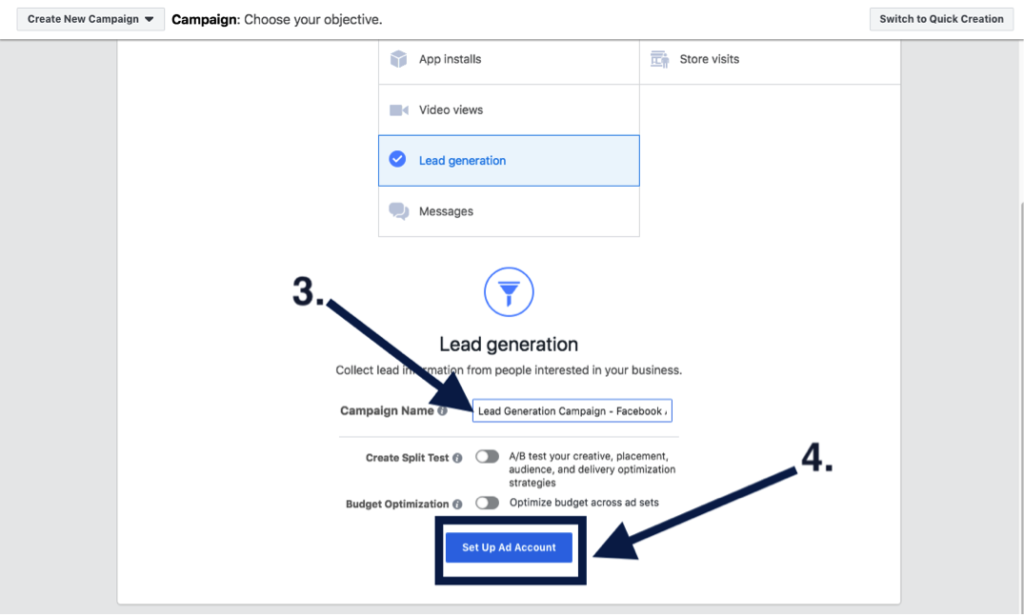
    1. Choosing Your Campaign Type

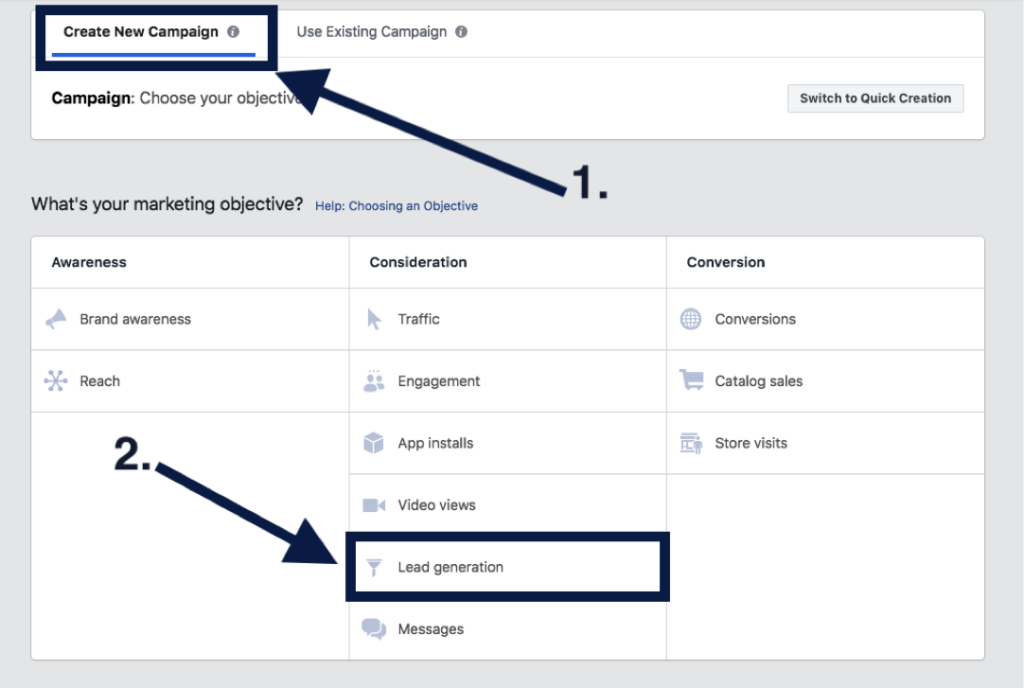
    Once you’re all set up and ready to go, you’ll want to create a new campaign and select “Lead generation” under the “Consideration” marketing objectives. You’ll want to give your campaign a relevant name and click “Continue.”

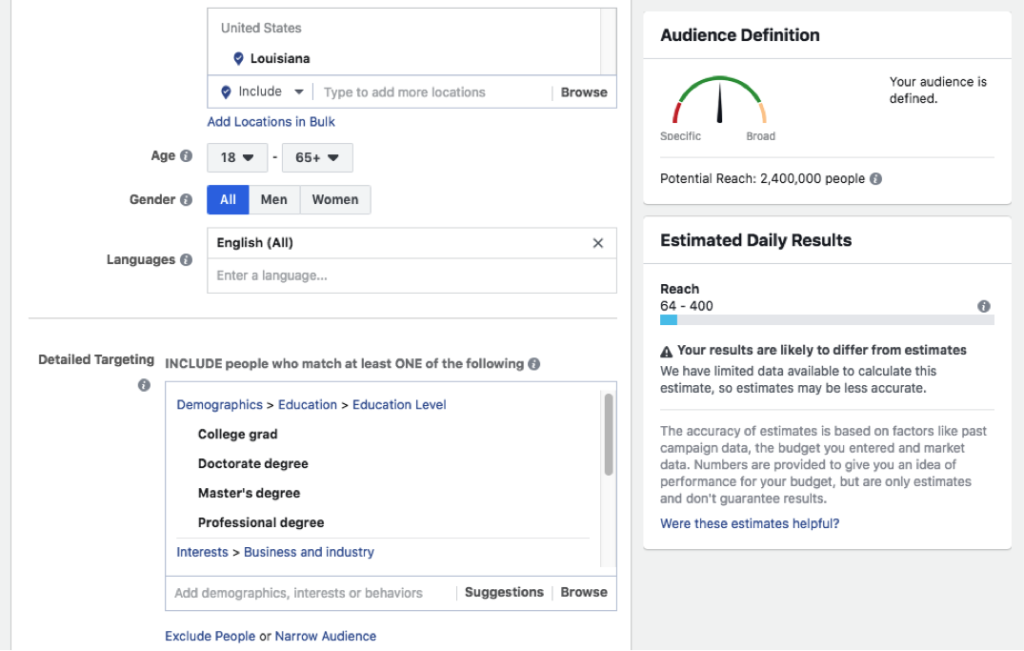
    2. Choosing Your Custom Audience & Budget

    Move forward with setting up your ad account, creating your custom audience, and setting your budgets. But don’t worry! Facebook offers optimization tools to help you adjust your budget and targeting after the campaign is launched, and they are always adjustable. Facebook offers several targeting options, including targeting by demographics like location, age, gender, and language. You can also target by other demographics, interests, and behaviors like education levels, if someone is interested in yoga, and behaviors like how they utilize Facebook. You also have the option to build an audience from a lookalike version of your current customers and website visitors.

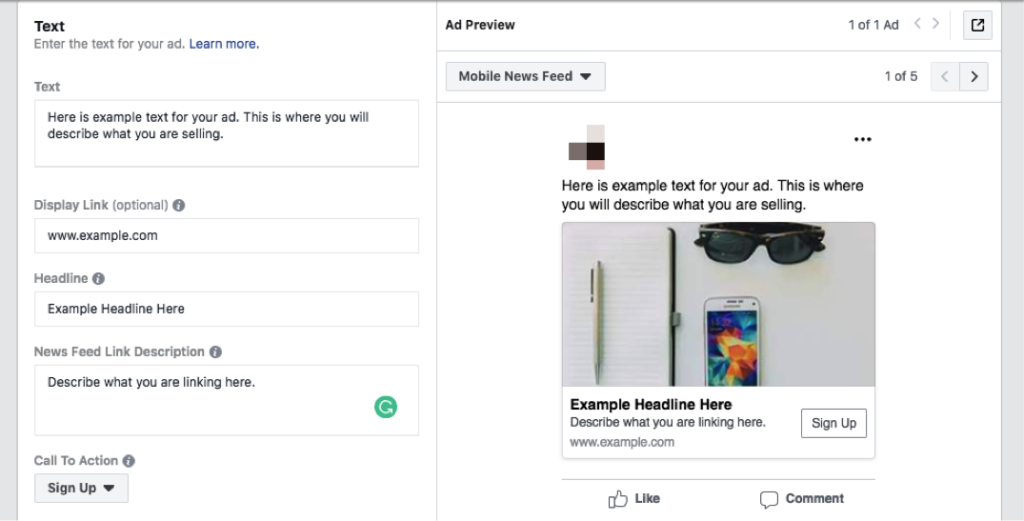
    3. Creating Your Ad

    After you have your custom audience and have set your budgets, you’re ready to create your ad. You’ll verify the pages you want your ads to be represented by and select your ad format. There are several ad formats to choose from. Carousel and video have been the most successful ad types in our experience. You’ll add in your ad text, display link, headline, news feed description, and a call to action.

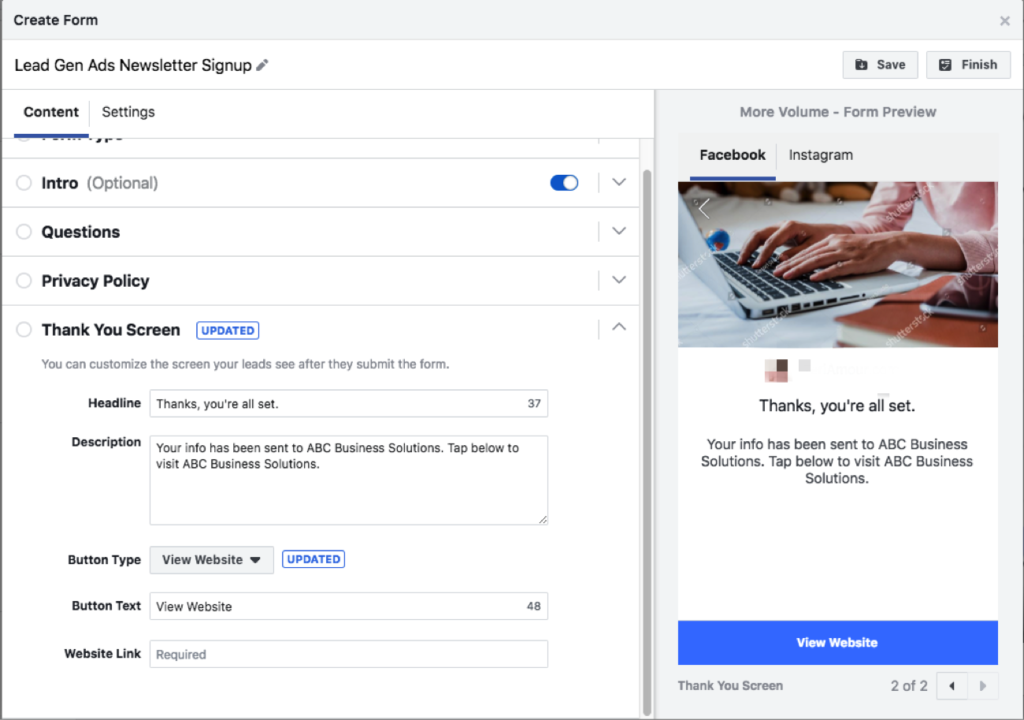
    4. Creating Your Lead Generation Form

    Finally, the last step before you launch your campaign will be to create your lead generation form. Here you’ll introduce the product or service you’re promoting, add the questions you’d like to ask your audience, insert your privacy policy (it is mandatory to have one), and build your “Thank You” screen. Be sure to give your form a descriptive name so that you can identify it later when you need to download your leads.

    5. Publishing Your Campaign and Launching

    Congrats! You’ve launched your Lead Generation campaign. This is the part where you celebrate and wait for the leads to come pouring in.

    You’ll want to monitor your ad’s performance by testing and checking on it regularly! Try changing out your ad copy and graphics, or trying different targeting options—narrow your targeting if you find you’re reaching too broad of an audience and thus receiving unqualified leads. You could also update your form to ask more specific questions.

    Here at Search Influence, we’re invested in helping our clients grow their businesses through dynamic marketing strategies that drive qualified leads. If you’re interested in utilizing Facebook to bolster your lead acquisition efforts, request your marketing analysis today to get started.

  • Why You Should be Posting on Google My Business

    “Just Yahoo it,” said no one ever. It just doesn’t have the same ring as “Google it,” which was officially added to the Oxford English Dictionary and the Merriam-Webster Collegiate Dictionary in 2006. That’s because Google has practically monopolized internet searching. According to NetMarketShare, Google accounted for over 79 percent of all global desktop search traffic in 2017, followed by Bing at 7.27 percent, Baidu at 6.55 percent, and Yahoo at 5.06 percent. In addition, Google receives over 63,000 searches per second on any given day. In the U.S., more Google searches take place on mobile devices than on computers, and 30 percent of mobile searches are related to a location. It’s obvious that to succeed in the SEO world, you have to play by Google’s rules.

    So, Just How Do You Play By Google’s Rules?

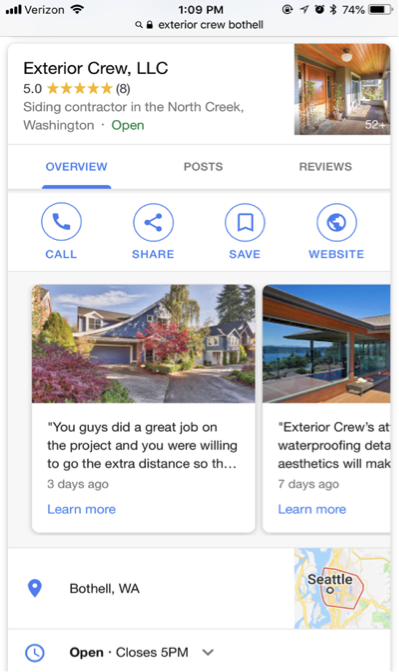
    One way to do this is by creating a Google My Business (GMB) page for your company. This page allows your businesses to manage their online presence across Google, through a physical location. Within this company page, Google has a social posting platform that allows business to provide “up-to-date posts from verified people, places or things, directly in search results.” These public posts allow businesses to share company updates to feature what’s new, respond to customer reviews, and add photos to highlight what makes your business special, and build brand awareness.

    Screenshot of a Google My Business post from Exterior Crew, LLC

    These posts are particularly captivating because, rather than appearing in the search results, they are displayed in the knowledge panel, which presents a more engaging visual aid. This is NOT to be confused with Google +, which was Google’s attempt to compete with Facebook as a social platform. And let’s be real; it was a major fail. Realizing this, Google reconstructed their platform and created GMB. Google + profiles and pages still exist, but they are now subpages of a GMB page.

    The Start of Google Posts With Candidate Cards

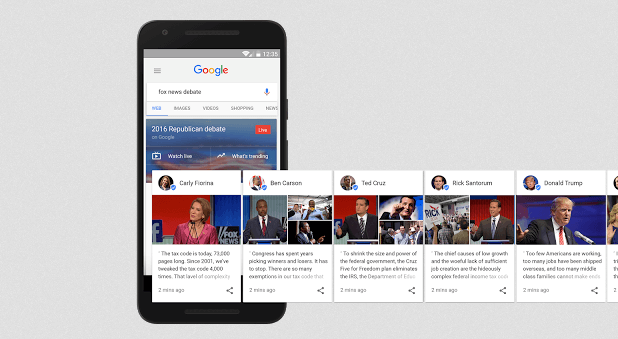
    Before July 2017, Google’s now-called “Google Posts” were only accessible to few. It all started with “Candidate Cards.” You may remember seeing these around the 2016 presidential election. Google described these as non-ad privileges, giving 2016 Republican and Democratic candidates a place in Google search.

    Image of Google's candidate cards - Search Influence

    Proving to be both appealing and informative by viewers, Google allowed the expansion of these cards for celebrities and sports teams. As of June 2017, GMB brought these now-called “Google Posts” to local businesses as an easy way to help attract new customers and build relationships with the customers you already have. These posts have proven particularly effective in promoting flash sales or promotions, emergency updates, such as school closings, and sharing job openings. In addition, these posts contain a call to action (CTA) feature, which provides an easy and direct way for customers to book appointments or reservations.

    Benefits of Google Posts Over Traditional Social Media Posts

    You may be thinking, why would I need to use Google as a social platform when I already use Facebook, Twitter, Instagram, etc.? And you have a point. These social platforms are still great ways to post updates about your business. Although similar, Google Posts offer a few advantages that the typical social media platforms do not, including the following:

    They’re more searchable

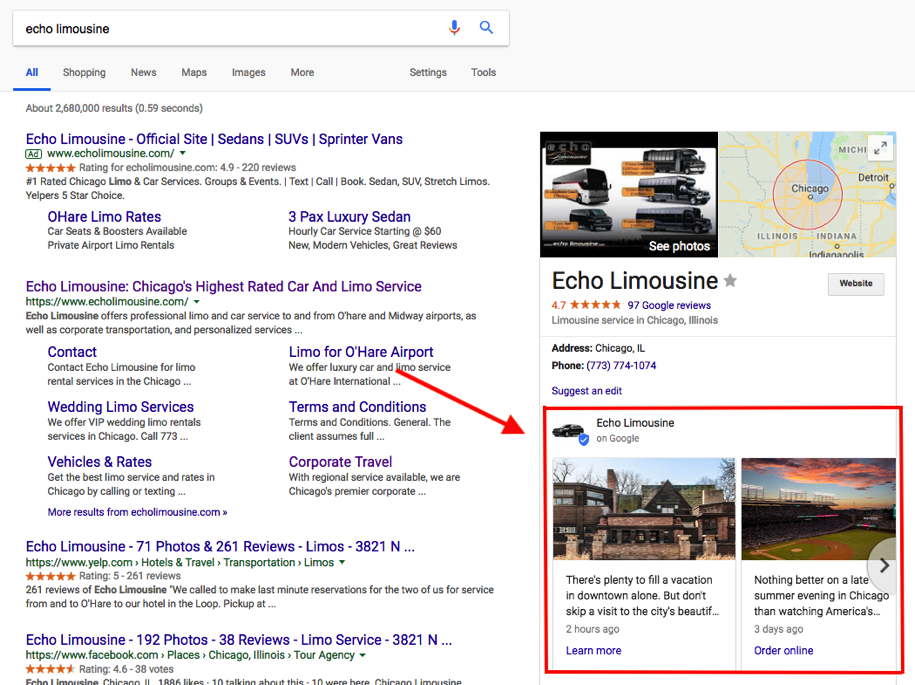
    You can literally “Google it.” When searching for a business, these posts will appear directly on Google Search and Google Maps pages. When someone searches for your business, your location address and phone number will appear in the knowledge panel on the right-hand side of your search results. Your company’s address/location is the primary piece of information searched for by local customers. In regard to mobile, local searches lead 50 percent of viewers to visit stores within one day.

    Screenshot of a GMB post by Echo Limousine - Search Influence

    You will expand your reach

    Not only does Google lead the way in search engine results, but it also surpasses Facebook search queries. According to Adweek, Google averages 3.5 billion searches per day, compared to Facebook’s 2 billion per day. In addition, 82 percent of people turn to search engines to find local information.

    Keyword Searches

    On Google, you can use keywords to target certain audiences—specifically, people that are already looking for your services. Since these people already have an idea of what they are looking for, they are likely to be further along in the decision stage, meaning they are more likely to convert into a client or customer. By contrast, Facebook is geared more toward targeting specific interests and in-depth personal information to lure in a potential customer.

    Impact on your ranking

    Google’s goal is to provide you with the most relevant information based on a search query. When you post new content directly through your GMB listing, you are sharing relevant content and information about your local business, which contributes to building your location authority. This tells Google that your business is legit. The more you legitimize your business to Google, the higher ranking you will get. The higher ranking you have, the higher you will appear on Google search and gain more traffic to your site.

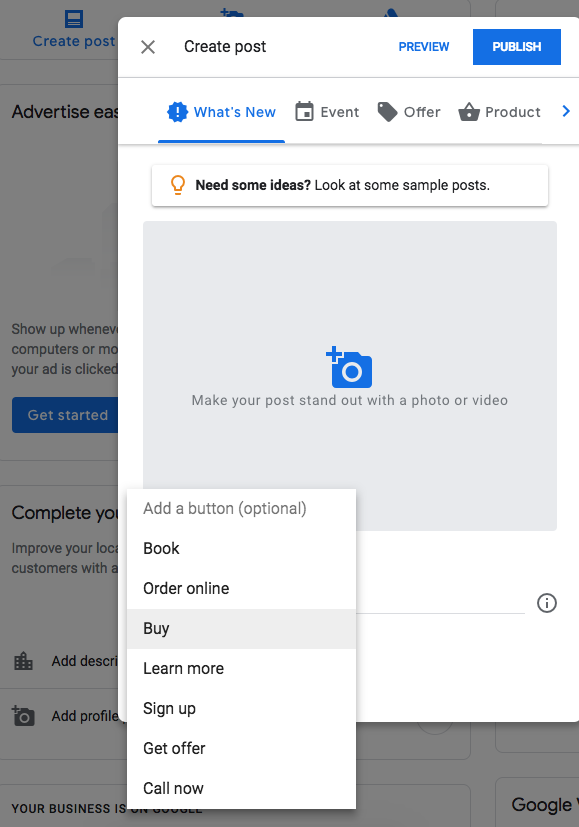
    Screenshot showing how to create a Google My Business post - Search Influence

    Connect with your customers directly

    You can include CTA buttons on all of your GMB posts. Call to action buttons have been proven priceless for converting customers. According to Everything You Need to Know About the Psychology of the Call to Action by Neil Patel, the human mind expects a call to action button. “Our minds are prepared for and are expecting an experience of being called to act and have already decided that there will be a CTA. We know that expectation affects behavior. That’s why people know to act on the CTA. They aren’t staring at the CTA button wondering what it is. They know its a button they are being asked to click.”

    Some examples of how a business can utilize these buttons include the following:

      1. Make a reservation
      2. Sign up for a newsletter
      3. Learn more about the latest offers
      4. Buy a specific product from your website
      5. Call now

    Get backlinks

    Everyone knows that backlinks have a huge effect on organic search results. By posting compelling content on your GMB posts, people are more likely to engage and reference information from your site. You can also link your site pages in a post, making it easier for researchers to find your pages.

    Start Posting!

    Although still green, GMB posting is projected to be incredibly valuable to local businesses. Facebook, Twitter, and Instagram are saturated with businesses looking to promote brand awareness. But since GMB posts are still in the early phases, it hasn’t been flooded by the masses just yet—which is why you should get in now! GMB is an excellent platform that allows your customers to stay in the know of what is going on with your businesses. Not to mention, it’s free! What do you have to lose?

    Here at Search Influence, we’re constantly staying on top of new ways in which we can help our clients be found online and thrive in their industry. If you’re interested in honing your local SEO strategy with rich, relevant Google My Business posts, then request your marketing analysis today to get started.

    Images:

    Candidate Cards

  • 8 Facebook & Instagram Features You Might Not Know About

    8 Facebook & Instagram Features You Might Not Know About

    Facebook is going cross-country with a free conference, bringing it to 30 cities, including New Orleans! This is part of Facebook’s mission to better educate businesses in using their platform. They state that… “By 2020, we’re committing to provide 1 million US workers and entrepreneurs the digital skills they need to compete in today’s workplace.”

    My evaluation is that their goal of this effort is to increase and improve business use of Facebook (and ultimately advertising dollars) and try to make up for their data privacy blunders earlier this year.

    Given that 2.07 billion people access FB monthly, and ¾  of those users come back daily, there’s an appropriate way for most businesses to engage with consumers.

    I really enjoyed seeing traditional advertising promoting this free event as I drove around New Orleans, from downtown digital billboards to suburban bus stop ads. While it may seem ironic that Facebook would use out-of-home media to promote their conference, it is not that surprising since part of their strategy is likely to reach NEW businesses in addition to improving the skills of those already on the platform.

    In case it’s not coming to a city near you, check out these tips from our team of Influencers who attended various sessions!

    Build Creative for Mobile

    Because 90% of time on Facebook is spent on mobile, businesses must get out their desktop-focused world and think about the screen size of their audience.

    One key media type for mobile optimization is video—your typical rectangle, landscape video (16:9 aspect ratio) videos are suboptimal for mobile. Square is better, but the best is to create vertical, full-screen videos—think Snapchat, Instagram Stories, and Facebook Live style.

    In addition to it being a more immersive and engaging experience, a key benefit is you aren’t sharing the screen with other content.

    If you use Instagram, you may not be surprised to hear that ⅓ of the content that people are engaging with on Instagram is BRAND content!

    Thanks to Alison Zeringue & Amanda Ball for this takeaway!

    Mobile Creative Doesn’t Have to Be Hard or Expensive

    All you need is a phone, lighting and a $20 Amazon tripod (for video) to make something look REALLY nice!

    These 10 apps can enable you to enhance your photos and videos on your mobile device, on the fly.

    Considering that by 2020, 75% of content on Facebook will be videos, it is time to put on your videographer hat!

    Photo Enhancing Apps

    1. Adobe Photoshop Express
    2. Adobe Spark Post
    3. PicLab
    4. Plotaverse
    5. RIPL

    Video Enhancing Apps

    1. Videoshop
    2. Quik
    3. Instagram Stories
    4. Boomerang
    5. Legend

    See here for direct links to these Top 10 Creative Apps.

    Remix

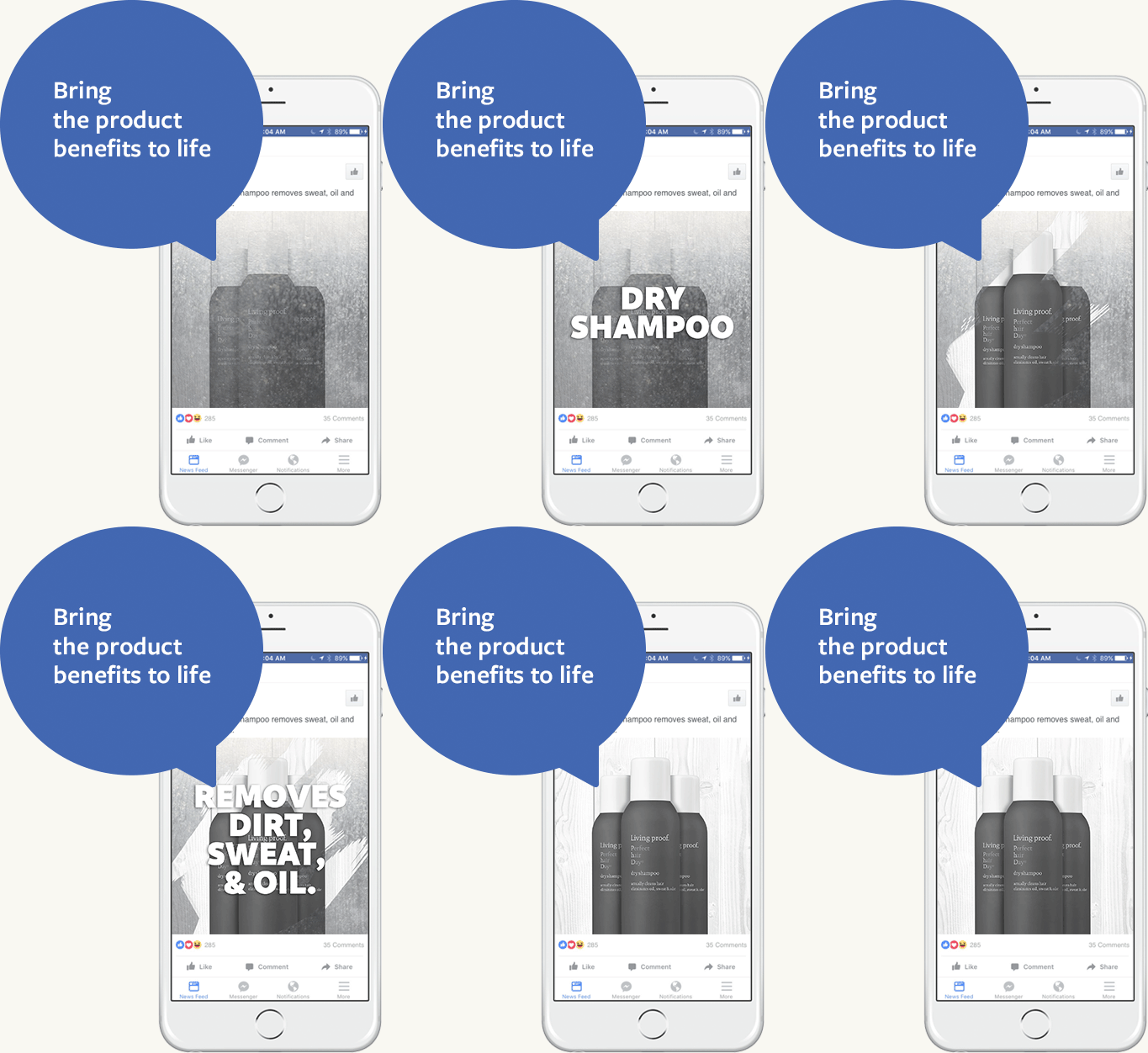
    The apps above and others allow you to “remix.” Easily take images you already have and create gifs and videos to better engage your audience, including overlaying text (love the Living Proof example… ask me how many bottles of Living Proof I have stocked—major “life hack” for professionals on the go!).

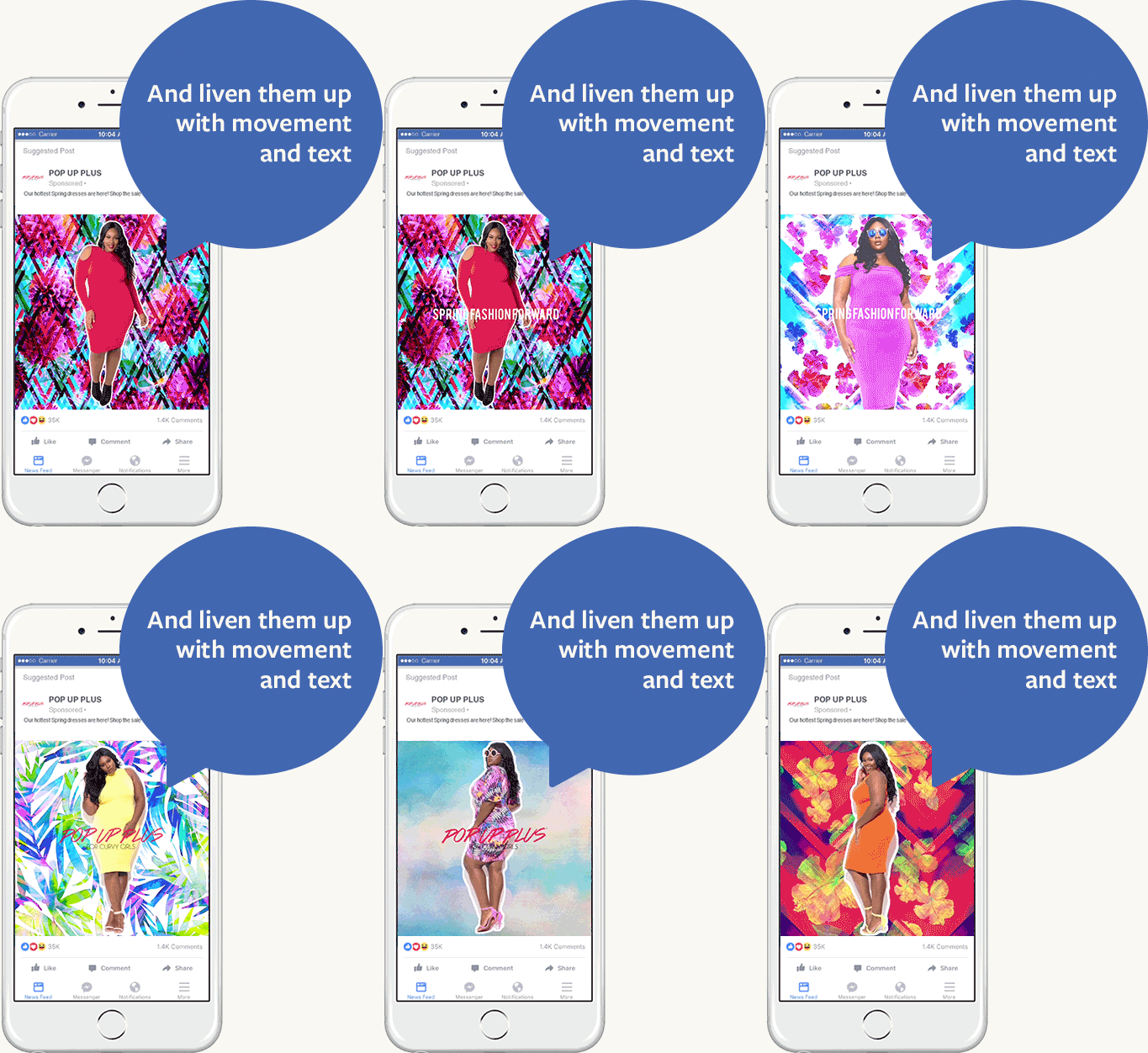
    Amanda Ball likes the Pop Up Plus example, which uses e-commerce product images and “remixes” them into fun videos with vibrant colors and movement. An app called Videoshop can help do this FOR FREE.

    Shooting from Scratch

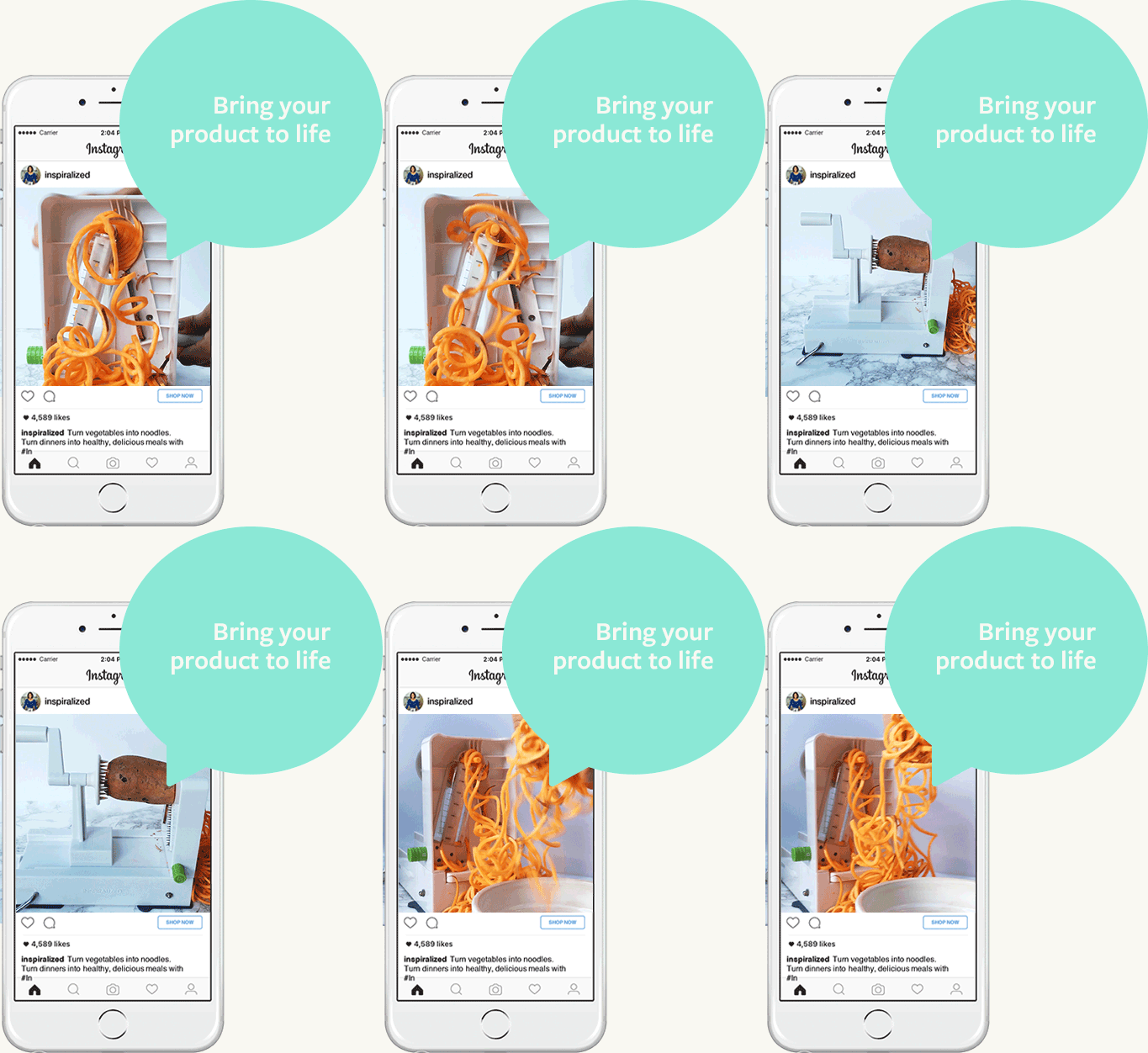
    Facebook also provides tips on making great videos from scratch for ads and posts. Check out this savvy use of Boomerang to show a spiralizer in action. As Amanda Ball describes it, “Potential buyers are prompted to feel like they know how the product works, making them more on board to dig deeper into your brand and products.“

    Thanks to Amanda Ball, Account Management Team Lead, for this tip!

    Secret Boomerang Menu

    Did you know Boomerang has a secret menu!? Learn how a four finger tap can bring up options on options to edit your video. You can smooth it out, speed it up, slow it down, and so much more.

    Thanks to Alison Zeringue, Director of Account Management, for this tip!

    Custom Contact Methods on Instagram Profile

    On a standard Instagram profile, call, email, and directions are standard calls to action that you can add.

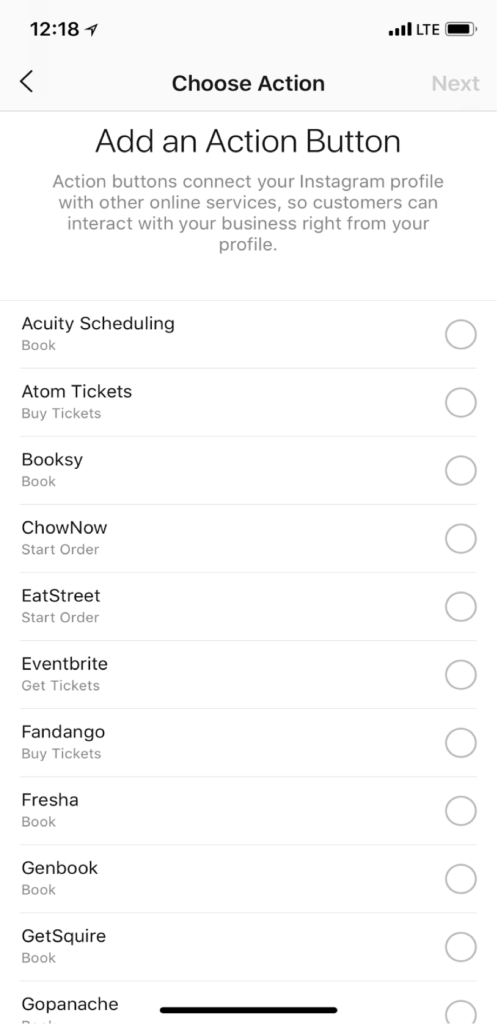
    Through settings, you can hook up third-party apps like Open Table and Eventbrite.

    1. Go to your profile
    2. Click “Edit Profile”
    3. Click “Contact Method”
    4. Choose from the ever-growing list of action buttons that correspond with other apps and services you may already be using

    Thanks to Alison Zeringue, Director of Account Management, for this tip!

    Get a “Shop” Button on Your Instagram Profile

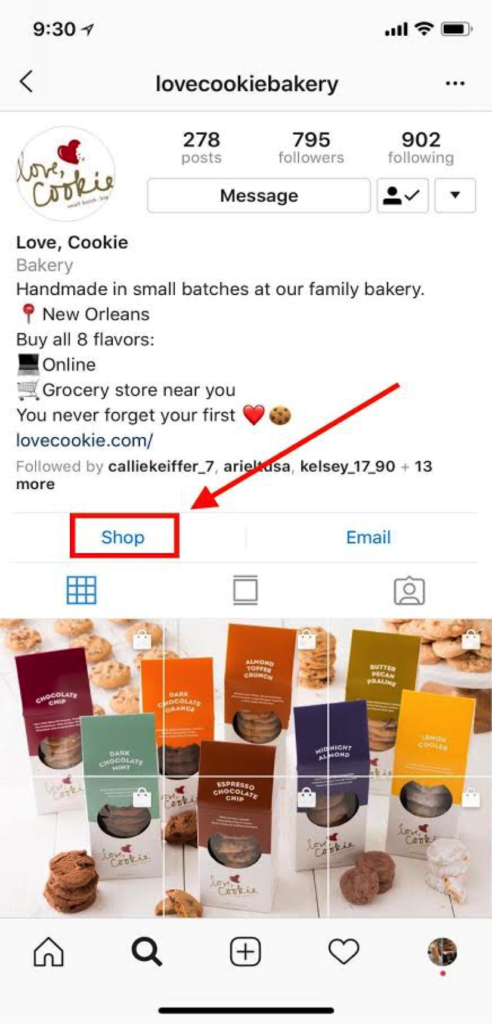
    Those who sell products may wonder how to activate the “Shop” button of their Instagram profile. After you’ve created nine “shoppable” Instagram posts, a “Shop” button will appear on your profile. It will direct users to all of your shoppable posts, making it that much easier for users to buy your product on their phone.

    Thanks to Ariel Tusa, Account Manager, for this takeaway!

    Vying for “Swipe Up for More”?—What to Do in the Meantime

    We're all vying for the "Swipe up for more" feature on Instastories, but, alas, you must have 10,000 followers for this feature to show up. In the meantime, use the "screen record" feature on your iPhone to create a video that guides users to important content. Then you can add that video to your Instastories.

    "https://townsend.bunksite.com/wp-content/uploads/2018/08/Screencast-of-Search-Influence-Blog-Post-for-Instagram-Story.mp4%22

    Thanks to Ariel Tusa, Account Manager, for this takeaway!

    Donate Button on Facebook Live

    Facebook has offered a selection of calls to action (CTAs) for your page and ads for some time. One way non-profits can use CTAs creatively is by using the “Donate” CTA button on a Facebook Live video. For example, you can “go live” at a fundraising event so those who aren’t in attendance can check out the action, and you can feature the “Donate” button on this post to capture their wallets while you are capturing their hearts. Bonus—giving a sneak peek into your event this year can create a buzz that translates to more attendees next year (as we talk about in our blog post with more tips to increase event attendance).

    Requirements for Fundraising on Facebook:

    In order to have access to features like the “Donate” button, you must be an approved non-profit.

    • 501c3
    • US-based
    • Verified page
    • Page meets community standards
    • Application approved

    Thanks to Ceallaigh Montgomery, Sales Executive & Digital Marketing Strategist, for this takeaway.

    Audience Network

    I find the Audience Network isn’t talked about nearly enough. By default, ads set up on Facebook will run on Instagram as well as the Audience Network, which is a collection of sites around the web. This idea is core to Google Display, which leverages the Google Content Network as the avenue for showing all ads. When people talk about Facebook ads, they take for granted this opportunity to be in front of people when they are “surfing the web”—not just browsing the “ ‘book.”

    Thanks to Shawn Kelly, Sales Manager, for this takeaway!

    Also, thanks to Shauntae Joseph, Account Manager, & Jenna Mire, Account Coordinator, for takeaways worked in throughout!

    If you need help implementing these tactics, let’s start a conversation about how we can help you.

  • Impact Your Tourism Marketing With Instagram Stories

    If you’ve been keeping up with our blog, then you already know how to market your travel and tourism business during the off-season, and how to engage with vacationers using mobile search. But, do you know how to leverage Instagram Stories for impactful tourism marketing? Stories are temporary videos or photos strung together to form a slideshow gallery that, well, tells a story. Since Instagram rolled them out in 2016, over 25 million active business profiles and 300 million active daily users have flocked to this feature, according to ClickZ.com. This means that Stories could be a huge area of opportunity for your business—if you use them the right way. If you’re unfamiliar with Stories, Cnet.com offers in-depth instructions on how to use this feature. But once you have the basics down, dive into our pro tips for how to make Instagram Stories most effective for your company.

    A graphic of someone using Instagram - Search Influence

    Promote Yourself Creatively

    Here’s the great thing about Stories—you no longer have to worry about over-posting. You are free to share as much content as you want throughout the day without taking over anyone’s feed. Plus, since the rollout of Instagram’s latest algorithm update, your traditional posts may have even less chance to be seen by followers in their feed, but Stories will appear right in front of your users at the top of their screens. This gives you more potential screen time and more creative ways to showcase your brand. But remember, it’s not about just posting links and asking users to click them. It’s about creating an experience where following your links is a natural and enticing option. Maybe you’ll be inspired by The North Face, who designed their Story to look like a dating app and asked users to swipe up to match with the perfect sleeping bag. Or, maybe you’ll start a little smaller by moving your weekly newsletter onto Instagram Stories. Whether you’re promoting events, products, newsletters, or just trying to drive extra traffic to your website, keep it creative and enticing and you can’t go wrong.

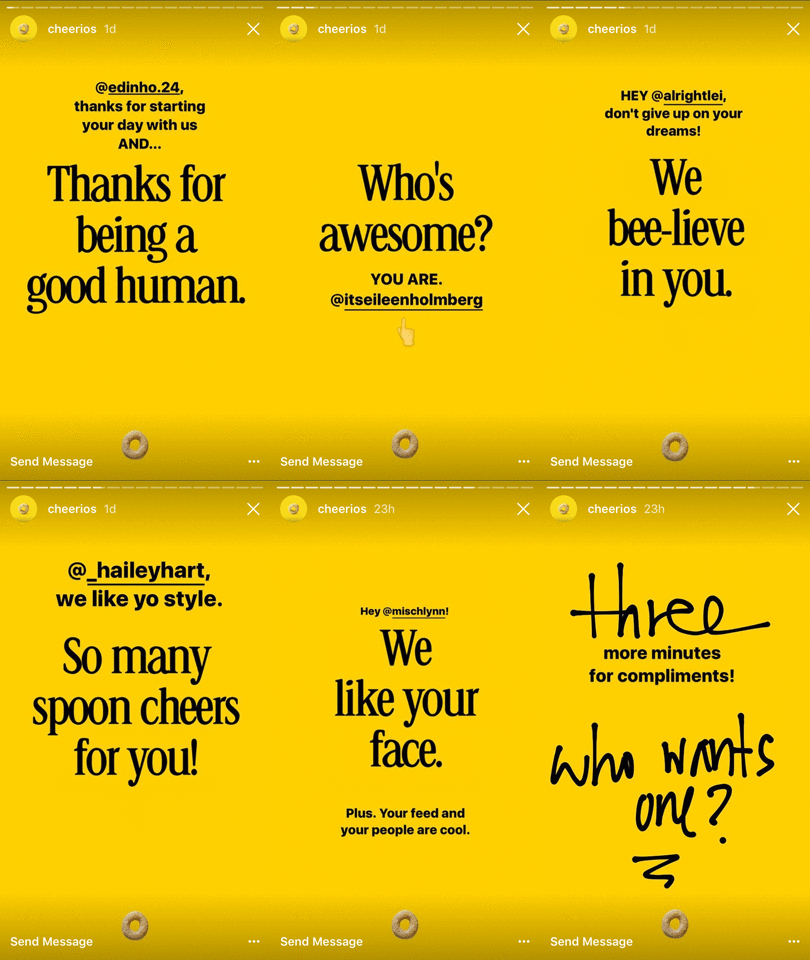
    A graphic of a stories page for Cheerios Instagram - Search Influence

    Actively Engage Followers

    Promoting your company is important, but the strongest marketing campaigns are customer-focused, not you-focused. Instagram Stories allow you to engage with your customers on a more personal level, while still reflecting your brand’s identity creatively. One great idea for customer engagement comes from Cheerios, who posted a Story that compliments their followers. When followers are tagged in a personalized compliment, they feel valued by the brand, which deepens their sense of connection with Cheerios and builds brand trust and loyalty.

    A more common approach is to leverage user-generated content—using your story to promote posts created by your followers. User-generated content is popular because it not only saves your company the time and energy of designing your own Story, but it also makes your customers feel like a valued part of your brand story, again building trust and loyalty.

    As a final engagement strategy, consider using an Instagram Story poll. Polls tend to be fun and entertaining, and most importantly they ask followers to take an action on your Story that feels far less pushy than clicking a link. They also provide the opportunity to get genuine customer feedback or opinions, which can inform your future marketing strategies. For example, you could post a poll asking followers to choose between an island cabana or a cozy ski lodge, and then use their results to determine whether your next campaign should be focused on the tropics or the mountains. Whether you opt for compliments, user-generated content, polls, or something even more creative, always keep your audience at the forefront of your mind and your engagement will likely be successful.

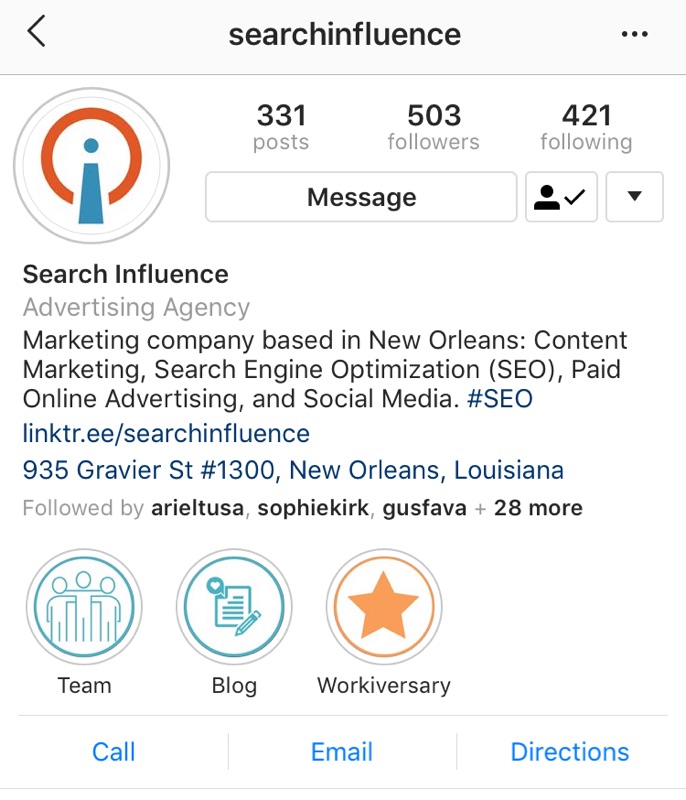
    A screenshot of Instagram highlights for Search Influence

    Customize Your Highlights

    Unlike regular Stories, which appear across the top of Instagram users’ home feeds, Stories Highlights are located on your company’s profile, between your bio and your photos. Highlights are kept for as long as you want—they will not automatically disappear after 24 hours like a regular Story. Because of this, Stories Highlights are a great way to share important brand information right on your profile, in an organized and aesthetically pleasing way. For an in-depth guide on how to customize your Stories Highlights, later.com walks you through the process of creating your own icons and covers in Canva. And, for an in-depth look at how to use Canva, our blog offers some friendly tips on what Canva can do for your business.

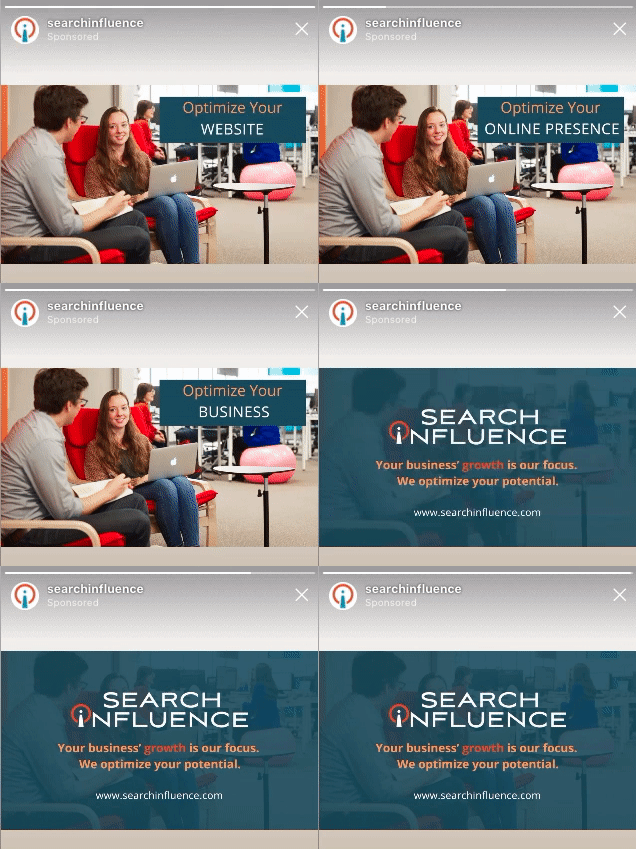
    An example of a sponsored Instagram ad from Search Influence

    Don’t Forget Advertising

    While authentically engaging with your followers is the ideal situation, sometimes it’s necessary to establish your brand or grow your network with paid advertising. On Instagram Stories, photo ads last 10 seconds, while video ads last for 15 seconds. It’s a very short window of time, but with the right approach, it can still be effective. Design your ads to catch your audience’s eyes quickly. Interest users with strong visuals, engage them with clear messaging, and then urge them into action. With this combination of tactics, you’ll have a good chance of achieving the goal of your ad campaign, whether it’s recruiting more followers, increasing sales, or gaining website traffic.

    Ask the Professionals

    If right now you feel confident and inspired to dive head first into creating exciting Instagram Stories, that’s awesome! But if you want more advice about managing your company’s social media, advertising online, or learning how to use additional Stories features like geotagging, the experts at Search Influence are here to help. Call 504-595-1623 with questions, or request a proposal online today.

    Images:

    Stories Demonstration

    Cheerios

  • 7 Tips for Eye-Catching Social Media Posts

    For years, social media has been the most cost-effective place to advertise your business, but it takes planning to stand out from the competition. In the up-to-the-minute marketplace of memes, it pays to use eye-catching colors, animated images, and consistent, compelling branding. Fortunately, once you develop a digital marketing strategy that reflects the strengths of your company, you’ll be able to create and share content with a minimal investment of time and effort.

    1. A “Social Media Strategy” is Key.

    Every month, 30 percent of millennials interact with a brand on social media platforms like Facebook. Consumers expect to find information about your business on social media, and they want to be able to reference your company’s page when bragging about their positive experience at your establishment. Pictures of meals have been some of the most popular content on Instagram, and a lot of those pictures are copied to other social media platforms. When the friends of your customers ask where they can get that ice cream fudge volcano, wouldn’t it be great if your business page was suggested as a hyperlink? Customers are already talking about your business online, but your business has to be on social media to join that conversation.

    Social media photographer holding up lens to nature scene

    2. Source High-Quality Images.

    We’ve all learned to spot them: bland stock photos show smiling employees or hands at a keyboard, but they don’t inspire trust in the business. Instead of using generic, one-size-fits-all images, consider hiring a photographer to take real photos of your business and products. Alternatively, grab your iPhone and take a few pictures yourself. DIY photos convey relatable authenticity, and they can work as short-term images on social media, but a professional photographer will take lighting and composition into account, digitally adjusting images as needed. Whenever you can afford the expense, make quality images a priority, especially for the long-term images that become profiles and header images on your social media pages.

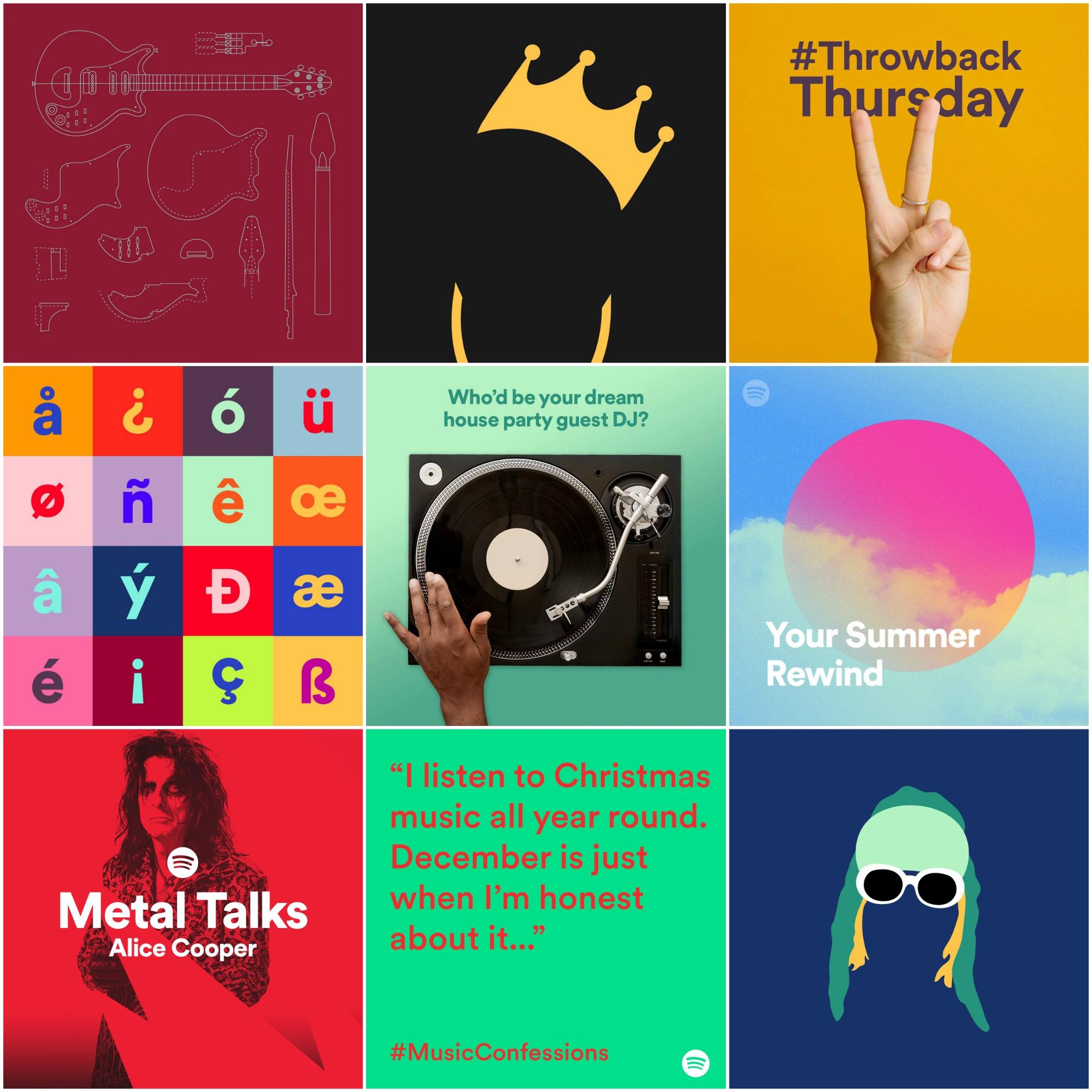
    Example of Spotify leveraging Instagram post

    3. Pay Attention to Color Schemes.

    Does your branding consistently utilize a couple of key colors? Great! But consider using slightly different (but still complementary) colors for different lines of products and services. Spotify is a great example of a brand that makes use of dynamic color schemes but still manages to keep it consistent. In the image from Venngage above, you can see how they’re easy to recognize but hard to forget.

    Colors convey a personality and warmth, and it’s worth a little time to evaluate whether to choose bright and bold colors or something more subdued and approachable. Rather than defaulting to flat reds and blues, use light and dark gradients to achieve something more unique than the local high school’s color scheme. Choose unconventional colors to make your posts more recognizable on social media. Spotify makes use of dynamic color schemes throughout all of their branding designs. This creates a stronger visual for their brand and allows visitors to instantly recognize their graphics and associate them with their company.

    Taylor Swift drinking a Diet Coke

    4. Make Your Own Custom Branded GIFs.

    A step beyond quality still images, GIFs are animated bitmap images. While its pronunciation is debatable, the acronym stands for graphics interchange format. Clips from TV shows and other videos are popular fodder for GIF images, where a gesture or a moment of action is captured and repeated in a short loop. Moving images naturally stand out in the newsfeeds of customers, and humorous GIFs inspire a lot of organic engagement. GIFs are recirculated for free online, but creating your own has distinct advantages. First, when you create your own content, it’s easier to avoid potential copyright issues. Second, when your custom GIFs are fun and compelling, those GIFs can lead people back to your website, helping you build authority online.

    Reeds blowing in the wind

    5. Leverage Cinemagraphs.

    Cinemagraphs can be made in video or GIF format, so there’s naturally some confusion and overlap. Still, GIFs tend to be loops of a video where the beginning and end are clear, not unlike an instant replay from a sporting event. Cinemagraphs, on the other hand, tend to be artistically made in a way in which it’s hard to tell when the image begins to repeat, giving the effect of a live picture or streaming video. A steaming cup of coffee, a waterfall, and a drink being poured are examples of subject matter for cinemagraphs. Naturally captivating, this type of media is harder to DIY, but it can make a crucial difference at the moment when users decide whether to stop or keep scrolling.

    Happy Father's Day custom graphic for Search Influence social media channels

    6. Keep It Consistent But Exciting!

    While experimenting with different types of media and formats, remember to keep your messaging on track. Don’t get bogged down with details, either in perfecting a single post or cramming as much information as possible. With the short attention spans on social media, clarity and brevity are essential.

    – Bullet points and clear headers are helpful with any text. If you haven’t hired a professional graphic designer, then avoid the temptation to use artistic (but hard to read) fonts.

    – Big, clear lettering is safest, especially when your target audience includes older demographics.

    – Numbers, percentages, and impressive statistics can help catch the reader’s eye.

    – Don’t be afraid to try different techniques and learn what works best for your audience, but stay close to home base while you develop your image as a reliable, professional authority.

    Alternatively, a broader presence in the community can make your business a topic of conversation, but that type of campaign can have a more gradual impact on walk-in clients and leads.

    Search Influence employees posing on Canal Street for social media channels

    7. Always Keep Your Marketing Goals in Mind

    Especially when you’re first getting started, it’s a good idea to check out the social media presence of others in the same industry. You may find businesses in the same industry that have a different service area, and therefore they aren’t direct competition. Take a look at how different types of posts inspire different amounts of engagement, and you may find ideas for developing content of your own. As with any type of marketing, it’s also important to clearly define your goals at the outset. Is your objective to build a following and make your brand more recognizable in the community? Or are you mainly looking to generate leads for potential clients? Depending on your industry, dominating local search may be the most effective way to get clients to call your company.

    If you don’t have the time to juggle business operations with digital marketing, then you can always outsource your social media management to professionals. The experienced team at Search Influence can provide a digital marketing and SEO consultation, identifying opportunities to strengthen your online presence. Follow our blog for the latest tips on GIFs and marketing trends.

    Images:

    Camera lens

    Spotify covers

    Taylor Swift

    Cinemagraph