Category: Social Media

  • How Do I Keep My Facebook Fans Happy and Engaged? — 3 Easy Ways To Get Likes And Keep Them

    Business Cat approves.
    Business Cat approves of your online conduct.

    Let’s face it: social media marketing jargon can sound like a different language, especially if you’re wrestling with the eternal question of “What do my Facebook fans want to see? How do I keep them happy?” You know your brand inside and out, so it can be helpful to think of your social media content in the same way you think about your business. Unless you’re a professional trapeze artist, chances are the day-to-day grind of your job can sometimes leave you bored to tears. The same applies to online communities in terms of marketing and promotion. For many of the 800+ million active Facebook users, logging on is habitual and something they’re doing multiple times per day. Facebookers who follow your page don’t want to see the same type of content over and over. That’s the fastest way to turn them off from interacting with your page in a positive way, or at all. The most successful Facebook pages have a give-and-take relationship with their fans. Three things to remember for growing and motivating your online communities:

    • Show them you care, you really care! Ensure your newest followers feel valued, appreciated and motivated to interact with your page. Welcome new fans personally, like you would a new co-worker, by tagging them in a welcome message or sending a quick and friendly (non-spammy, of course) direct message.
    • Beware of the disgruntled fan. When considering a Facebook contest as a way to gain likes, it’s important to keep in mind the resulting new “Fans” can easily turn on you should they be promised something that is not delivered. These are not the fans you want to attract to your page, as the wreckage they often leave can be detrimental to your brand’s reputation. Many a Facebook page has suffered when the competition gets ugly due to misunderstood rules. Fans can become aggressively competitive, rallying other fans around them. Remember, any competition on Facebook should comply with Facebook’s Promotion Guidelines, or you run the risk of having your page removed entirely. Don’t get me wrong, free stuff is awesome. Offering ‘added value’ as a way to gain more followers has proven successful in the past, but the lines between friendly competition and cut-throat rivalry can be blurred very quickly. There are tons of alternative ways to engage with people, and getting creative with your content doesn’t have to cost money but can work wonders for motivating your online community.
    Image macro rewards such as this "Cyber High-5!" seem simple, but can be a great way to motivate interaction and connect with your audience.
    • Creative content is king. Organically grow your fan base my keeping existing fans engaged with your page. Think about how you might get your co-workers motivated in the office and apply the same tactics to your Facebook fans. In terms of contests, sometimes the big ticket prize items will only spark jealousy and animosity among the group. Often a much smaller scale pat on the back will do the trick. Consider running a weekly trivia contest with a funny, motivating and free (for you) prize like a “cyber high-5” or an original Internet meme. Instead of gaining a bunch of superficial ‘Likes,’ your fans will engage, comment and even share your content with their own friends.

    Lighthearted, fun content will ensure you and your Facebook fans’ interactions are positive and mutually beneficial. Keep the fans you have engaged and your number of ‘Likes’ is bound to keep climbing.

    The SI Blog sends a special thanks to Lauren Litwinka for her insight and contribution to this post. Lauren is an Account Manager at aimClear where she’s pretty awesome at online community management.
  • Social Media For Readers and Writers: Cursor Takes the Publishing Industry To The Next Level

    Is the traditional trade paperback and remainder-bin production model of books doomed? With new devices for the digitization of books appearing every day, from the freshly-announced Kindle Fire to slick iPad e-reader apps, the conclusion that the publishing industry will soon go the way of the dodo is easy to come to. After all, literacy rates are plummeting, book sales are down and one of the original giants of big-box retail bookstores has recently crashed and burned in a spectacular fashion. Despite the failing numbers of traditional methods of publication, there are more novels and poems and stories and essays being written and consumed now than ever before. In the face of the instant-gratification model the Internet provides, where does the written word go from here? Richard Nash, former editor of Soft Skull Press, has an idea.

    The traditional delivery of a book from author’s pen to reader’s hand is long, complex and prone to errors in translation. The author-agent-publisher-printer-wholesaler-retailer-reader chain has failed in a significant way because it by its very nature promotes isolation between the reader and the writer. With that in mind, Nash and his business partner Mark Warholak have launched a new project called Cursor, designed to apply the concepts of social media and successful crowdsourcing to the creative writing world. In his Publisher’s Weekly article, Nash elucidates many of his problems with the industry as it stands today and how the diversification of Cursor’s services are key to promoting success both financial and artistic. Its first imprint Red Lemonade is just one of the many “self-organizing, self-selected, self-perpetuating communities [created] around a reading-writing platform” that are to come. Red Lemonade is “pop-lit-alt-cult” operation with charmQuark, a science fiction-fantasy genre community, soon to follow.

    Each of these subgroups will publish approximately one or two books a month using the Cursor software platform in both digital and trade paperback format, staggering the release dates in order to maximize profits. Importantly, though, Cursor’s source of revenue isn’t just from pure sales of its product. There are paid membership options available to widen the availability of tools and services, for example peer-to-peer writing groups, recommendation engines, access to established authors from within the Cursor system and beyond, and professional editing and marketing assistance. Other sources of income are available via advertising (this is social media, after all), connecting writers with providers of publishing services, agent fees and more. All of this will be balanced with the social component that allows writers and readers to interact and comment on each others’ works and postings. With the ability of the Internet to disseminate quality material and enable discussion thereof from commentators all over the world, this network hopes to create a thriving series of sensitive feedback loops that allow the showrunners to quickly identify and implement the features writers want, not to mention publishing the works that have gained the most reader support. “Book publishing doesn’t work with top down advertising,” says Nash. “It’s always done its best when one person says to another person: ‘You should read this book.’” The sharing and viral campaign potential for this kind of system seems self-evident, as the community, not the marketing department, is responsible for deciding what is ultimately rewarded with publication.

    Perhaps the most daring move that Cursor is taking is the eschewing of the traditional author copyright agreements. Contracts are limited to three-year terms with an option to renew as opposed to the old “seventy years after author’s death” chestnut. This is such a significant move because the latter type of agreement was largely what kept traditional publishing houses in business — the acquisition of intellectual property rights for, say, a movie adaptation or the backlist of a previously-obscure author who’s now selling like hotcakes because a prestigious award. With Cursor, authors will have the option to simply walk or renegotiate at the end of their three-year period. The philosophy of simple business tends toward the “maximize the profit from the property” mode. Nash’s viewpoint that authors deserve the benefit of renegotiation if and when the underlying value of their contribution increases. Quid pro quo, however; in exchange for this freedom to walk or adjust the terms of the deal, Cursor-owned properties will be licensed under “a fairly broad basket” of rights, including audio, English-language foreign publication, translation, and magazine republication, among others. It’s a bold move, and one that’s very indicative of the hyper-flexible approach Cursor is taking to publication instead of the narrow but powerful beam of traditional retail book-selling and marketing.

    In 2008, more than 275,000 new titles were published through a variety of sources. Data suggests that more recent numbers will be even higher. The music industry has gone almost completely digital, and sociality is being emphasized even further with Facebook’s recent seamless inclusion of Spotify plays into home page feeds. With the ubiquity of high-speed Internet becoming more and more a fact of daily life and the communication and sharing potential of the social web continuing to evolve, books still have a long way to go to catch up with their other media counterparts — but Cursor promises big things in the way of making up for lost time. As Nash himself says, “technology has emphasized a simple truth at the heart of my new enterprise: we are what we read, we are what we write, and we organize ourselves around and connect with one another through what we read and write.” Red Lemonade already has a number of titles in its store in both paperback and ebook format, and the word of mouth around them has been ebullient. Broadening the way readers and writers interface, Cursor isn’t designed to “save publishing” — it’s designed to bring it into its new form.

  • Social Media and the 2012 Election

    Facebook And Presidential Election Power

    As the 2012 presidential hopefuls cultivate their public personas through careful manipulation of social media outlets, it’s easy to forget that before the 2008 presidential election, social media had never been used on such a scale.

    Politicians had relied on old school phone banks and direct mailing campaigns for decades to mobilize their troops and direct voters to the polls on election day, but the power of the Internet had yet to be fully leveraged in a political campaign.

    What was groundbreaking in 2008 has become the standard for the 2012 presidential election, and politicians of all stripes are turning to the power of social networking sites to reach out to potential voters.

    Political Engagement Meets Social Engagement

    It all starts with a numbers game. How many times have you voted for president in your lifetime? How many times have you checked your inbox today? How about your curbside mailbox?

    If you are under 30, chances are you have cancelled and restarted your Netflix account more often than you have played a direct role in electing the most powerful politician in the world. You probably also have the Internet in your pocket or purse right now, just a few swipes and taps away from an email or a political tweet that could change your weekend plans from watching Arrested Development reruns to attending a political rally.

    Just as the 1993 Motor Voter bill was intended to give the young, the poor, the marginalized, and the otherwise politically disenfranchised a quick and easy way to register to vote, Obama leveraged the instant connectivity and infinite scalability of social media to energize his voting base through the free, easily accessible, and already tremendously popular medium of social media. And don’t think his competition didn’t notice.

    Social Media Comes of Age as a Political Tool

    Mobilizing the Internet generation has proven difficult, if not impossible, for many politicians that haven’t fully embraced the latest ways we communicate. And since energizing your core population of voters is the name of the game in modern American politics, it’s easy to see why every politician is turning to social media.

    While Sara Palin may have enjoyed berating the “community activist” ways of her one-time opponent back in 2008, by the end of the election cycle she had become one of the most vocal politicians on one of the largest active communities on the internet: Facebook.  And while she relied on her Facebook page as the main means of communication between her camp and the media, Palin has gone to great lengths and hired a team of “social media secret police” to control what ends up on her profile.

    While deleting comments made on your wall may be seen as either a necessity or black hat manipulation, it serves to underscore the importance of social media in American politics today. Now every major candidate for the 2012 election has a Twitter feed, Facebook page, and YouTube channel.

    So don’t be surprised if your mailbox remains empty as your Twitter feed and Gmail fill up as the election nears. Just as FDR proved the power of radio and JFK leveraged television to get into the White House – each game changing new technology forever altering the way the American public interacts with elected officials – President Obama ushered in the era of social media as a political tool. For better or worse.

  • Facebook announces ‘Timeline’, redefines the social media experience


    This past Wednesday, Facebook rolled out a couple of new updates such as a ticker in the top right hand corner of the site showing live activity and a tab that allows you to control what gets shown in your top stories. As the internet is known to do on occasion, people flipped out, complaining about how much they hated the new changes. Someecards summed it up best in their e-cards on the subject (and those guys are always on top of the game, by the way), but the complainers had no idea just how much change they were going to have to cope with … and what was to come.

    This morning, Mashable posted a teasing article talking about the “new” Facebook, which was slated to be unveiled today at the F8 developers conference. The author of the blog said, “I have seen what Facebook is launching on Thursday, and it’s going to change the world of social media. And while I won’t talk about the mind-boggling things Facebook will be launching, I will say this: The Facebook you know and (don’t) love will be forever transformed.”

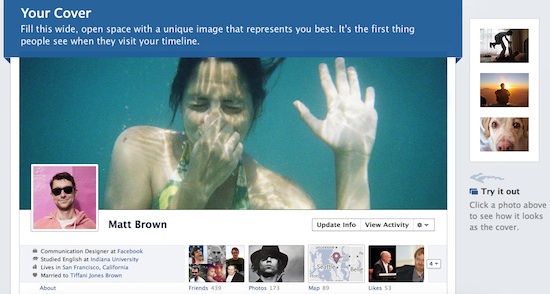
    Whether or not you agree with him is a matter of personal preference, but one thing is for sure: Facebook is going to be very different. The new format is called Timeline, and Mark Zuckerberg explained the thought process behind it as a way to stop losing the timeline of our lives in the social media format that scrolls past us on a day-to-day basis with no way to really accurately access the history. By adding the ability to click a year on the far right of your profile, you can easily go back to the past and see everything from photos to memorable moments. And that’s only the tip of the iceberg.

    By starring certain things you post, like a set of photos from a trip or an update, you can full screen them, contributing to a new profile page that’s reminiscent of the layout of the iPad app Flipboard. Apps are also highlighted on the profile, showing off everything from the movies you watch (directly pulled from your Netflix) and the music you play obsessively (culled from your Spotify account). Other companies such as IMDb, Flixster, DirecTV and Miso were also mentioned as partners, so you don’t have to feel left out no matter what you use.

    A search of the Facebook tag on Twitter shows that the haters are still at work, but I have a feeling that it’ll be harder to complain about a new user experience that is as innovative and interesting as this one. If anything, Facebook has shown that they don’t intend to fall into the graveyard that myspace and Friendster ended up in — because they are determined to evolve. Will users to choose to evolve with it? We’ll see soon enough.

  • Facebook Canvas App Bug – Should You Have Been Concerned?

    On August 11, Facebook was voted as the worst API for developers, in part due to “APIs that… break frequently.” Just the day before, a bug was reported regarding the function of landing pages on Facebook Fan Pages. Canvas Apps, the ones governing FBML and iFrame tabs, are becoming a common way to apply the same concepts as landing pages for PPC ad campaigns to your social media marketing toolset. These pages act as conversion funnels, acquiring social engagement through likes, which spread the brand through “organic” and “paid” social marketing — newsfeed stories and social reach for display of ads. However, highly desirable leads can come from these Facebook Canvas Apps because of a key function.

    When a new visitor to the Facebook Page arrives, instead of visiting the page’s wall which may have a chaotic dialogue and brand message, he sees a branded tab with a clear call to action and a variety of “toys” to play with — videos, viral content, and user-generated content. When the user Likes the Facebook page (if it’s not bugged up), he’d stay on the tab to interact with more content before moving on. When he returns, the visitor would reach the Wall for the Facebook Page.

    For slightly over a week, the user would Like the page on the Canvas App tab, then would immediately go to the Wall, bypassing the ability to immediately remarket to the user. A “Thank You for Liking Us” tab can have an immediate payoff for the visitor in the form of links, RSS feeds, or other sharable content, and solicit him for his information by filling out a contact form. This kind of progressive funneling drives highly desirable leads to a website: since they already were engaged enough with your brand to Like your page, they will be more likely to contact you for what they were searching on Facebook.

    facebook canvas app guide
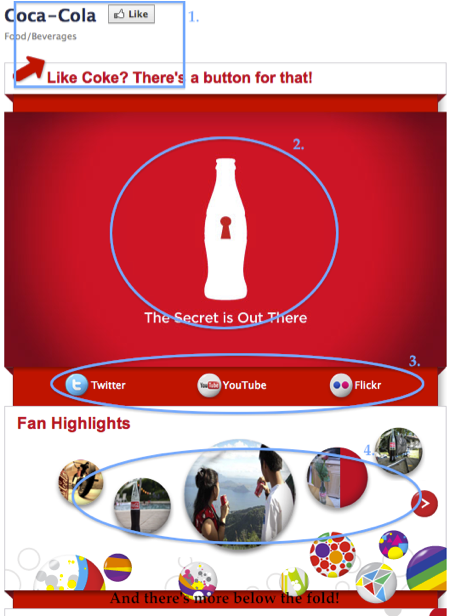
    1. Call to action. 2. Pulled in by brand/mysteriousness
    3. Share in other ways. 4. UGC

    Using Coca-Cola’s page as an example, there are four features of a Canvas App tab that increase conversions for the first half of the funnel — the Like.

    1. A direct call to action with a prominent arrow will bring attention to the point of conversion. Coke probably doesn’t need to focus so hard on getting people to Like them given the brand recognition, so more creative copy than that may be needed.
    2. Offer some kind of secret sauce, a benefit for liking the page. I was fooled into hoping for at least an ad about the secret recipe — more direct benefits would be needed for a brand that isn’t already a 12-pack in my refrigerator.
    3. Providing links to other social networks seems counter-intuitive as it takes the user away from the page. However, with opening the page in a new tab in the browser, you keep the viewer on the Facebook Page while offering a new place to share your brand message.
    4. A set of editors picks of user-generated content reinforces brand interaction on Facebook. Coke’s prioritizing of this content above branding or further lead generation could a sign of their focus on social branding over other methods of funneling social action.

    At the core of any news story is its effect on the reader’s business. As Facebook seems to count each Canvas App tab view before and after the like, you can find a rather direct metric of which tabs were affected worst under Insights>Users>Activity. Furthermore, if you’re tracking your Facebook tabs with cross-domain tracking or your tabs’ links with referral tracking encoded in the url, you’ll be able to look at Google Analytics or your tracking software and determine more specifically the effects on your campaign by searching the Content Drilldown.

    At the core of any discussion of unexpected downtime is the allowance for such downtimes in your marketing and advertising plans. Either by focusing on long-term gains or by re- or proactively acting on the acknowledged bugs in the Facebook Bug List, you’ll be able to weather the storm of any accidentally lost functionality.


  • Starting Out on Facebook: Small Business Marketing Solutions or Useless Sales Pitch?

    facebook small business marketing
    That’s some brand love.

    A few weeks ago, Facebook Marketing Solutions, the advertising side of the social media giant, released its new education portal for small businesses just starting out online, titled Facebook for Business.

    The Facebook page for the group is nothing more than a simple sales pitch for businesses becoming involved on the site. It’s tips for publishing, appeals to outmoded user statistics, and overall tone is clearly directed at the first-time Facebook advertisers. Promoting Sponsored Stories seems to be the main goal, though the ability for a small business to achieve such a close relationship with the company behind the site is not clear at first glance: Nike, American Express, and a page that can get 100 answers to the question “Blue or purple?” are featured, but no one just starting out with limited brand awareness. However, as you delve deeper into the videos, a number of case studies can be heard by the part-time Internet marketer to help understand the basics of the varied services Facebook offers, explained in a way that focuses on what makes social media advertising different from traditional venues.

    But July 27th brought a new arena for the first-time marketer. The Facebook for Business site offers a set of introductory slides more like what one would expect on the Facebook page. The Best Practice Guide and other tips take the unedited rambling of the taped live webinars from the Facebook page and put them into clear slideshows (though inexplicably as unsharable and minimally-graphable PDFs). Discussing Pages, Ads, Sponsored Stories, and the “Platform,” Facebook lays out its basic services in an all-too-simple way.

    The site is clearly for someone who doesn’t muck with websites, as just one tab describing the Open Graph protocol for a new marketer would show a whole new world, integrating on-site tagging with a need to contact a Preferred Developer to best take advantage of the depth of information one can provide, shape, and offer to their clients.

    It’s easy, at least for the somewhat experienced marketer, to come up with counterexamples, glossed-over topics that are the core of Facebook advertising such as effective demographic targeting, and the just-seething disdain for squares who just haven’t gotten how cool Social Media is. But I applaud Facebook for their efforts; the only other major social media outlet for business is Twitter, which starts its Promoted links at $5,000 per month and provides little information for its non-paid business partners. Google+ recently purged business accounts, asking creators of those accounts to “hold off,” and have been “focusing on the consumer experience” — words that are hardly music to marketers’ ears.

    What the shortcomings of the Facebook for Business and Facebook Marketing Solutions pages really show off is that a business needs dedicated social media management, whether through an SEO firm or internally. The waters are murky and best handled by someone who knows not just the sales pitch for getting involved, but also the mechanics of the process and what little stuff can greatly improve the social footprint of the small business. It’s too hard to sum up everything that should and could be done to optimally advertise using social media just on a few webpages or through a few taped webinars — the best thing is to call Ghostbusters and let Peter and Ray and Egon worry about the ghosts so business owners can get back to directly helping their customers.

  • Google+ Launches, Gains Positive Reviews From Early Users


    Early last month, we talked a bit about the launch of Google’s “Facebook killer” service, Google+, and the addition of the +1 button to major websites. The service launched a few days ago as invite only to start, and quickly overloaded to capacity. Some people that I sent invites to were unable to use them all day yesterday as Google worked out the kinks to allow the tsunami of people waiting to check out how to social network Google-style.

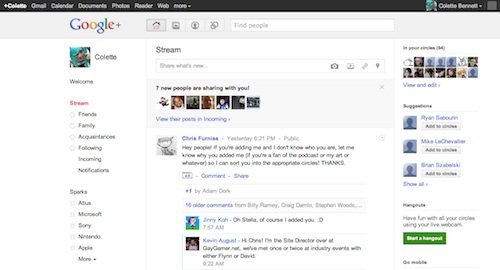
    So what does it have that Facebook doesn’t? Well, let’s start with what it has that Facebook does. You can update your status, update a profile, chat, add interests (called “Sparks”), and add pictures. The new stuff that FB doesn’t have: Circles, which is a pretty way of organizing your friends, family, acquaintances, and even the people you’ve blocked. There’s also Hangouts, where you can video call several people in your friend circles at a time, either in a limited status or open to other friends to join at anytime. Did we mention you can access all this from your phone, too?

    What else can we expect as Google+ finds its footing? Well, Google + Games, which is going to compete with the popularity of Facebook games such as FarmVille and Zuma Blitz. Google invested over $100 million in Zynga, the company that owns FarmVille, in 2010. We think it’s safe to say we will be seeing these popular titles on Google+ in the near future, which ought to soothe new users of the service who are missing the fix they get from Facebook gaming.

    Google has made smaller efforts in the past to attempt to topple the Facebook kingdom, but this is by far the most comprehensive offering. It seems to be coming at a good time, as more and more people seem to be finding reasons to dislike Facebook as it soars further along in popularity (MySpace syndrome, anyone?). Seamlessly integrating all of your current Google info, such as contacts and profile info, makes it feel like a very natural evolution. The only drawback is that Facebook has such a tremendous userbase already. Then again, I remember many years ago when a friend said to me, “You have to come to MySpace! It’s better than Friendster!” and my reply, “Oh, no way. Nothing could be better than Friendster.”

    Need a Google+ tutorial? Check the official videos out here.

  • Wal-Mart Purchases Social Media Firm Kosmix

    It appears that behemoth retailer Wal-Mart intends to push further into the world of social media after buying the SM firm Kosmix for an undisclosed sum of money (although its rumored to be $300 million) as of Monday, June 20th. Wal-Mart has announced that the Kosmix team will be heading up a new project called @WalMartLabs that will create businesses around shopping online or with your smartphone. You can read more in detail about the changes here.

    In regards to the purchase, Wal- Mart chief executive Mike Duke issued a statement in which he mentioned his priority for the year was to turn around same-store sales at the U.S. discount chain.

    What do these changes mean for Wal-Mart, competing brands, and the consumer?

    Wal-Mart clearly intends to follow the path of social commerce in order to evolve. Consumers are more frequently communicating through social media sites such as Twitter and Facebook, and it’s believed that these conversations are true to the ones people have in real life. If texting, Facebooking and Tweeting have become the consumer’s preferred language, then it makes sense that retailers have to learn to speak it in a way that genuinely engages the consumer, or risk being left behind.

    Kosmix investor and Lightspeed Venture Partners Managing Director Ravi Mhatre makes the point eloquently in his comment on social media’s influence on retail. “If I’m in Best Buy with my smartphone, Amazon can know I scanned the barcode for a DVD player. If I’m Amazon, I can serve an ad for the same product at 30% off,” Mhatre said. “I’m going to hit one button on my phone and save money, while Best Buy is handling all the inventory in a physical store.”

    What do you think we can expect next from Wal-Mart? What would make you pay more attention to them in a social media context?

  • Is there such a thing as a real Social Media Expert?

    Now that we’re in a society that boasts a Twitter and Facebook for every business from restaurants to fortune tellers, you have to be savvy when it comes to social media. But what if your business has been around for a few decades, and you have no idea how to manage these websites yourself? Social media presence? I know, I can feel your head hurting from here, and I assure you, it’s quite alright. The world of social media is a complex one, and there’s nothing wrong for searching for help within it.

    Social Media Entrepreneur Peter Shankman (founder of HARO) recently posted  a blog about “social media experts” and why hiring them is a waste of your time, which has made some waves in the social media industry. He makes some valid points — it’s perfectly possible that any dude with a laptop and an idea can go get some business cards printed and start calling himself a social media expert. Of course, people seeking social media help may be less educated on what to look for and can be suckered by these types. But does that mean all “social media experts” are actually con artists?

    Shankman points out that the dot com era gave Internet professionals the illusion of credibility much in the same way that titles like “social media expert” do now. This is true, but does it mean that every dot com was a sham with a bunch of clueless dudes behind it staying up late in their parents’ basement? Not at all. Several notable companies survived, Amazon.com being one of the biggest.

    Social media experts are a similar story. There are a ton of self-proclaimed experts out there who certainly cannot bring to the table what a website or personal business needs for growth. On the other hand, to generalize and say that they are useless as a whole because people are abusing the term is a mistake. A social media expert is merely a new form of PR rep, whose playing field is the Internet and whose toolbox is made up of key sites such as Facebook and Twitter. Sure, one can pour effort into posting on those sites and trying to get the name of your business out there, but unless you have the knowledge and experience needed to approach these sites appropriately, it’s just more spam that no one will read.

    What’s the solution then? If you want to hire a social media expert, research first. Know what you’re getting into and have an idea of what you want. Adding anyone to the payroll and not really understanding what they are doing, but instead waving your hand and expecting them to “take care of it” is the quickest way to get cheated. Ask questions about how they plan to approach promoting your business in this way. You don’t have to be an expert yourself to do some research and know what you are asking someone else to do for you.

    With 600 million Facebook users and nearly 200 million Twitter users to appeal to, it’s surely a mistake to assume that we know how to approach them with little or no experience in social media and how it can work for us. One thing we do know is that it’s a powerful platform, and one that only continues to grow and manifest possibilities for the people that choose to use it.

  • Please Tweet Responsibly – Learning From Others’ Social Media Mistakes

    Twitter is a social media force to be reckoned with, and nowhere is that more apparent than in recent news.  In case you’ve been living under a rock, Twitter is a global microblogging platform that allows users to broadcast information, ideas, status updates, etc. in 140 characters or less.  Tweeters subscribe to others’ broadcasts by “following” each other.  Boasting an estimated 200 million users, Twitter is definitely a service you should be utilizing to promote your business (or your “personal brand”) online.  Think about it – that’s 200 million potential followers for you!

    But remember how we said it’s a force to be reckoned with?  If you’re not mindful of what you’re sending out into the Twittersphere, you might accidentally create a lynch mob.  Designer Kenneth Cole created an uproar when a member of his social media team attempted to take advantage of the trending topic #Cairo to sell shoes; people were offended that the tweet made light of serious current events.  The tweet was quickly taken down and replaced with an apology message, but it was too late – who knows how many people had already seen the tweet?  Lesson learned:  think about how your tweet will be received by the general public before you post it.

    We can all finish the saying, “If you don’t have anything nice to say…”  Now let’s all memorize this:  if you don’t have anything public-appropriate to say, maybe you shouldn’t say it at all – just to be on the safe side.  Rep. Anthony Weiner has certainly learned this lesson over the past two weeks.  In an honest mistake, a scandalous photo that was meant to be sent to a Seattle woman as a DM (direct message) was posted to his account as a public tweet and viewed by countless Weiner followers.  #Oops.  We’ll have to wait and see how this affects his campaign for congress, but we’re thinking it won’t be favorably.  If you’re new to Twitter, you should check out one of the many helpful tutorials online; at least make yourself familiar with the locations of each button in whatever interface you’re using.  Even the most experienced Tweeters should double- and triple-check every post before sending; at the very least, you might catch an embarrassing spelling mistake.

    If you’re not careful, Twitter misuse could cost you your job – that’s exactly what happened back in March when someone with access to Chrysler’s Twitter account confused the official account with his own private account.  It seemed that Chrysler had posted a profane tweet with anti-Detroit sentiment.  Chrysler didn’t take too kindly to this and canned the guy after deleting the tweet and apologizing to its account’s followers.  Again, #oops.

    We can basically sum up all of the Twitter tips above with a lesson you should have learned long ago in elementary math – CHECK YOUR WORK!  It still applies and always will.  Now happy tweeting!