Category: Social Media

  • Sponsored Stories: Bad News Or The Next Big Thing?

    Last week, Facebook announced its new ad unit, Sponsored Stories. With Sponsored Stories, advertisers will now have the ability to utilize user actions – such as Places check-ins, “Likes”, Page posts and even actions in custom Apps within their Facebook ads.

    This means that if I decide to “Like” Levi’s 514 Jeans (“Like” really doesn’t sum up my feelings about these jeans, but I digress…), Levi’s can now use that “Like” as an ad in the right-side column, slap their logo on it and show it to all of, and only, my friends.

    The concept behind this new format is that an ad unit that uses your friend’s content will build more trust and generate greater buzz than a traditional ad would. While I’m sure Facebook will allow advertisers to filter out some negative content, ultimately the message will be controlled by the users.

    For now, only a handful of large national advertisers and non-profits have been selected to partner with Facebook for the launch of Sponsored Stories. I’m curious to see how well this new unit fares especially with the already growing number of people saying that Facebook should allow users to opt-out of this ad experience.

    To add even more fuel to the fire, Sponsored Stories is being compared to Beacon, Facebook’s failed attempt at posting third-party activity, like renting a movie from Blockbuster, on your Facebook page. Beacon ended in a settlement from a class-action lawsuit and Mark Zuckerberg became everyone’s favorite privacy punching bag.

    If Sponsored Stories proves to be successful with the initial batch of partners, it will be exciting to see how well the new unit does in the realm of local. With rumors already circulating that Sponsored Stories will be offered as a self-serve product, it seems that Facebook might be betting on the new product to be a perfect companion piece to Facebook Pages and Places. A combination that I am sure many small businesses will “Like”.

    Another group that I believe will be quick to use this new unit is political candidates. If Sponsored Stories makes it through this initial testing period, I can almost guarantee you that at least one 2012 presidential candidate will have this as a part of their marketing plan. Word-of-mouth marketing is tops in political advertising and this is exactly that packaged into a cost-effective little Facebook ad.

    While the future of Sponsored Stories is yet to be determined, it certainly has created quite a bit of buzz in its infancy. It is clear that Facebook has big plans for Sponsored Stories and that they have developed a product that is on par with Google Retargeting and Twitter’s Promoted Tweets. It will be interesting to see how Sponsored Stories plays out when advertisers of all sizes are able to take advantage of this new product.

    Image Source:
  • Lab organs and keg-stands: practicing smart online image branding

    A Kansas City nursing student recently sparked controversy by posting a Facebook picture of herself with with human placenta in the context of a lab dissection. Doyle Byrnes, a 22-year-old senior, appears smiling broadly and leaning over the specimen while wearing scrubs and a stethoscope, with no visible shenanigans or humorous posing. Despite the innocuousness of the picture her school promptly booted her out, along with three other students who had taken pictures but not posted them on the Internet. Byrnes won the ensuing lawsuit to reinstate her enrollment, but under the grounds that the instructor had given the students incorrect approval; a formal judgment hasn’t been made on the ethics of the case or as to whether publishing a picture of a donated organ was punishable under set-down academic or medical grounds. Although the student’s education will survive intact, she has the story– and all of the ensuing publicity– attached to her name and career record forever.
    This is a pretty typical Facebook story, right? Person updates with an ill-advised photo or a slip of the tweet, and it translates to career consequences that can be both severe and long-lasting. (There’s already some fervor about the personal consequences of social media– the cyber-schadenfreude market has been well-cornered by sites like failbook.com or Fix My Facebook.) Contemporary sociality has as much to do with online interaction and sharing as it does with face-to-face time, which has become true for search engines as well– increasingly in online services, social results are accurate results. Essentially, Faceboook has become something like a search engine for people; it’s nearly universal (are you on Facebook? How many people that you know aren’t?), thoroughly multi-faceted in its search parameters and more often than not offers up a wealth of information that isn’t available on a resume or in a professional environment. At the end of the day (and particularly into the evening), it’s crucial to remember the importance of keeping your online life in accordance with your professional one.

    I’m of the generation that started using the ‘book when it was in its infancy and still required a college-domain email address for access. Longstanding dorkiness has ensured that my requisite drunken pictures don’t contain anything too scandalous, and I’ve long since stopped using it for anything besides keeping in touch with college friends and the occasional gratuitous plug for my magazine, but it seems that the lesson of online discretion is one that’s missed by many. Moreover, its increased usage in the last few years has proven that one’s online identity is no longer easily separable from the real thing. Online actions can have real consequences. The precise numbers reported vary, but surveys indicate a dramatically increasing number of employers research job candidates on Facebook and aren’t shy about declining employment if the profile isn’t up to snuff. Don’t think that you can hide by simply using a fake moniker — with Facebook’s detailed search parameters (expounded upon by Anthony in a previous post), it’s difficult to make a profile that isn’t searchable, to some degree, by the information that makes you you.

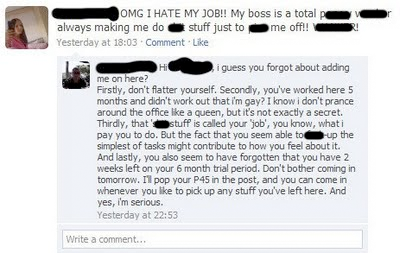
    OOPS!

    While all this isn’t necessarily a sign that you need to put your online identity on lockdown, de-tag all photographs and limit your tweets to “Eating dinner!” and “Good night!”, it should be a wake-up call for those who have assumed that their online identity was discrete from their real one. Thankfully, privacy settings have evolved along with the intricacy of the service itself, letting users customize what can be seen at different levels of access. And that itself may be the key to the whole thing: a potential employee who doesn’t have the common sense to limit their snapshots of private lab specimens (or illegal shenanigans, or extreme alcohol use, or…) to a small circle of approved personal friends probably doesn’t have the kind of common sense an employer is looking for anyway. Think of your profile page as your personal brand, and the appearance and quality of your profile as SEOing to potential professional contacts. Would you hire a mechanic who rItEs HiS sIneS liKe DIs?!?!??? Would a hair salon gain credibility by publishing pictures of their stylists doing sake bombs while trimming each others’ bangs? Probably not. The best method of keeping your online image safe is to either apply meticulous thought to your privacy settings or simply — as painful as it may be — prune your profile in accordance with professional and social standards.

    So after your next photo op with a large chunk of human placenta, no matter how educational or amusing the resulting picture may be, give some thought to its potential audience. Although it started as a free-for-all college kid project, Facebook is, for better or for worse, the home base for online personal information. What goes on the Internet connected with your name is pretty much there for all eternity, so practice smart branding and make your online image as important as your real one.

  • foursquare Gets Fancy with Photos & Comments

    Is foursquare is more than just a game?

    In attempts to drive more users and create revenue opportunities, foursquare has added comments and photos to their interface. This is a huge development for foursquare, which previously relied on Twitter and Facebook to be truly useful. However, is it too late? I’ve always seen foursquare, a location-based social networking site for mobile devices, as the adult version of Pokemon. The same principle that Nintendo follows with its “gotta catch ’em all” tag-line is the basis of foursquare’s success. Sure collecting badge and becoming the mayor of your favorite establishments is fun (I am the mayor of several Uptown New Orleans bars), but there has to be more than that or the game get old fast. The addition of images and comments allows more options than just telling absolute strangers (and employers) what establishments you visit, it also gives new depth to foursquare that it was previously missing.

    Here’s what the foursquare blog had to say about the new features:
    “Photos from Instagram pushed to foursquare will now be check-ins with photos (rather than just check-ins). Sightings on Foodspotting will be check-ins with your food photos. And picplz is the first service to allow check-in photos on both iPhone and Android”

    This is a win for foursquare and social media marketers, with the inclusion of images and comments, social media marketers can leverage the platform for promotionals and brand awareness for local business similar to the Yelp model.

    The foursquare blog continued with “There are a couple features we weren’t able to fit in for this release but we’re working to launch soon. These include sharing photos (to Facebook and Flickr)…”

    By allowing photo sharing with Facebook and Flickr, more user-generated content will be produced and more opportunities for branding are created. Having foursquare users take photos of your services saves local businesses the time and effort of doing it themselves.

    These updates are great, and certainly can be useful, but I ultimately question whether it’s a little too late. Facebook has already created its own check-in service that has all of the functionality of foursquare. They are also working on syncing business check-ins with Facebook fanpages which allows access to posts, reviews, and business information. Knowing all of this I am hard pressed to not think “is a little colorful badge really worth having the foursquare app on my phone?”

  • Merging Facebook Places with Facebook Fan Pages

    For those businesses that have taken advantage of Facebook Fan pages, brace yourself for some upcoming changes.

    Facebook Places, the network’s location-based service, now allows Fan Pages to merge with their “Place” page. This “Place page” is usually generated from information collected from the internet, particularly other location-based services such as Foursquare, Gowalla and Yelp.

    What’s the value of integrating your Facebook Fan Page and Place Page? Directly associating your business page with all the people that are checking into your location and commenting about it. People do not have to “like” your location in order to check-in to it, but when they do check-in, they display where they have visited to all their Facebook friends—giving your business visibility to a few hundred people that you may not have reached before.

    Change in Design
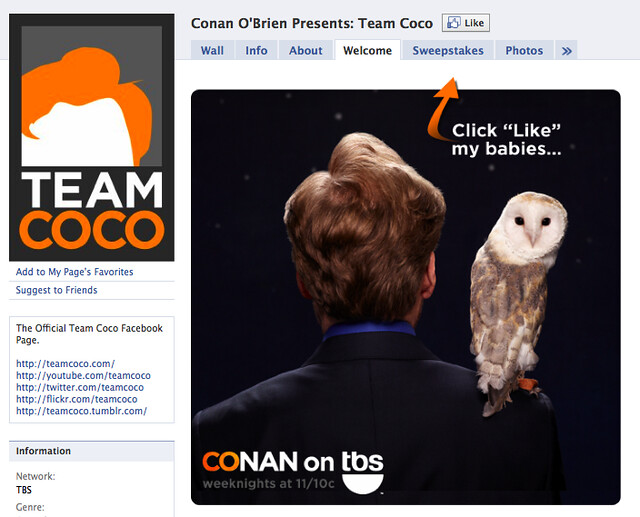
    There are a few challenges with this merge, particularly the evolution of the design, which removes the Facebook “tabs” and any FBML landing pages you may have created to attract customers, like this one:

    Once the integration is complete, your page will no longer feature the tabs. However, FBML custom designs can still be displayed on the side, on non-tab spaces with images of about 490 pixels wide. Before you complete the merge with your Facebook Fan page and Place page, make sure that any content and images is adapted to fit the new size specifications.

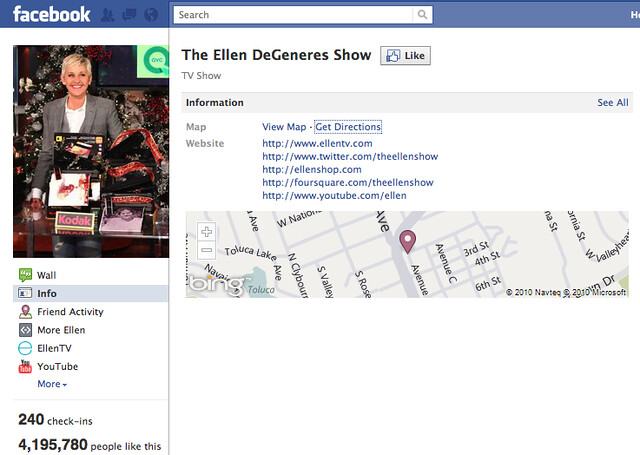
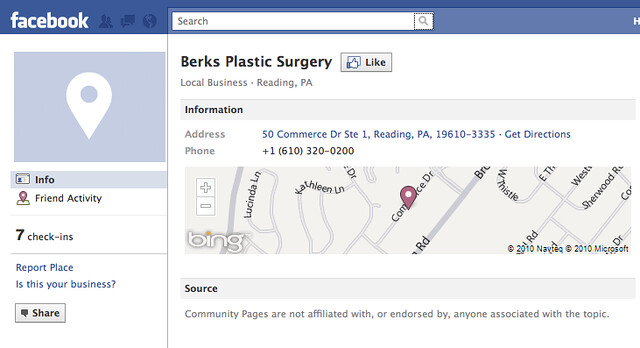
    Once the merge has been completed, the new design also displays the number of people checked in along with a Bing map of your location.

    Verifying My Place Page:
    Facebook Fan pages and Places pages can only be merged through a phone verification process.

    1)    On your computer, log on to Facebook under your Fan Page administrative login.
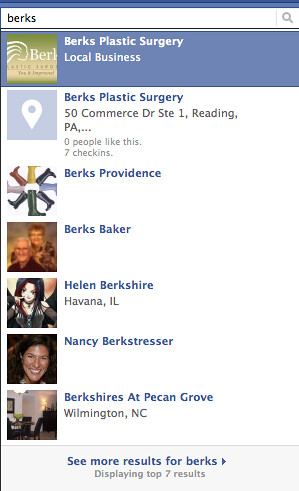
    2)    Search for your business name and the first result should be your Facebook fan page, when you look for more results a blue image icon of a white map pin should appear with your business name and address to the right.

    3)    If you cannot find your location, click on see more results. If you still can’t find your location, you may have to add it.
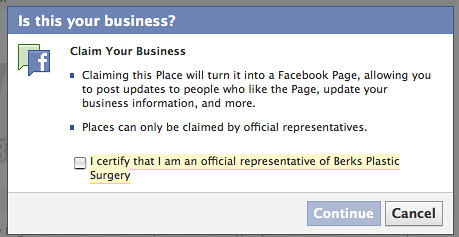
    4)    When you locate you business’s Place page – on the bottom left corner there will be an “Is This Your Business?”link.

    5)    If you are at your business’s location, be prepared to initiate a phone verification process.

    Adding A New Location To Places:
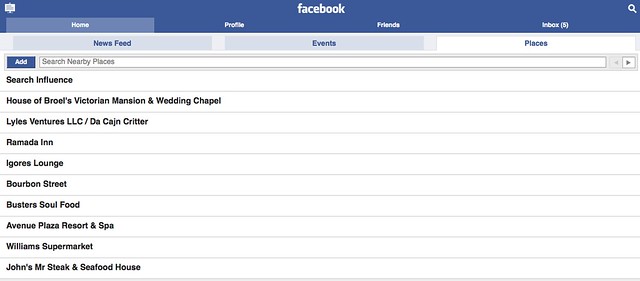
    If your location hasn’t been added yet, you can add yourself by visiting http://touch.facebook.com. Once you are logged in, you can click on “Places” on the right and you will be able to check in to a variety of places in your area.

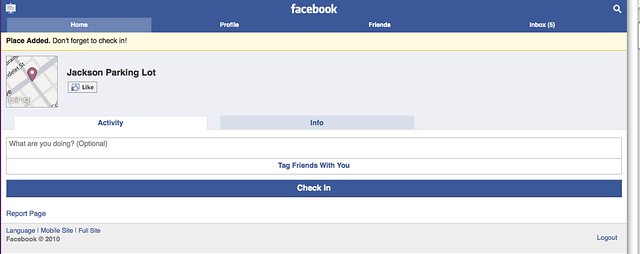
    If you do not see your location add it by clicking the “Add” button on the left.

    Your location will be added immediately and you can check in. Make sure you “Like” your own location as well!

  • Are Facebook Ads for All Businesses?

    Facebook Ads Image
    Facebook Ads. Are You Doing it Right?

    Recently a slew of articles have been popping up about the ineffectiveness of Facebook advertising. While we recently touched on this subject in a previous blog post, I thought I would explain why this statement has little credence when Facebook ads are done properly. If you’ve read any of our previous FB blog posts, you are aware that for Search Influence, Facebook yields a low cost per lead making it one of our most effective ways to drive leads to clients’ sites. With that being stated, I can proceed to explain (in a Clarissa-esque manner) why Facebook is effective and ineffective for some online marketers and industries.

    Are You a Facebook Friendly Business?
    I’ve mentioned this before but Facebook ads follow the same methodology that magazine and television ads follow.  While choosing images for your ads is important, determining whether your business is right for Facebook is the key to success. You would never hire a fertility specialist, carpal tunnel expert, or babysitter from a 30 second TV spot (well maybe you would. I would never trust my semen, wrist, or subsequent children in the hands of a stranger on TV, but I was raised right). I think that is the fundamental problem some advertisers have with Facebook. They’ve read a few cleverly written articles on online advertising on Facebook and they think they can create those successes for all their clients. However industries such as elective surgery, social causes, and the entertainment service industry fair considerably well for local businesses.

    Facebook Ads Image
    Facebook Ad Demographic

    Is the Facebook Demographic Right for You?
    Why do these previous mentioned industries succeed? Before I address that let me just get this out of the way – Facebook is not for everybody. If your business is a retirement home and a certified social media specialist tells you he can increase you fan base and leads from Facebook by some unthinkable number, he’s lying. Certain demographics just do not exist on Facebook, blame social media and technological darwinism. The largest demographic using Facebook are between ages of 18 – 34. They are the beauty obsessed, socially aware, fun-loving Youth of America. This is the age group your business must pander to in order to be truly effective.  From an ROI perspective, the subgroup of the young professionals between the ages of 25 – 34 are where the disposable income is the ripest. By targeting this age group with the correct interests and properly crafted ads you can increase your leads stream significantly.

    Are Facebook Ads Ineffective Because of Bad Advertising?
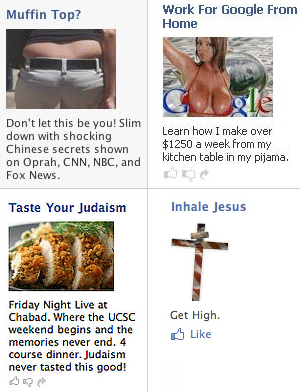
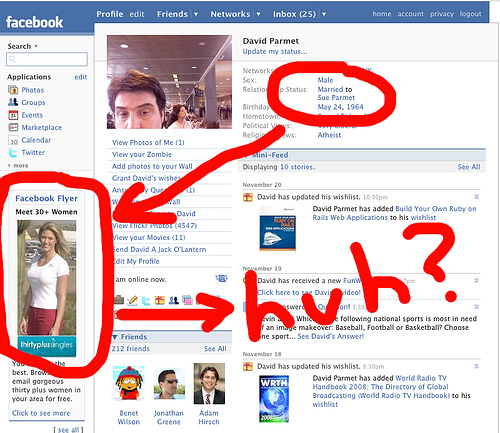
    We have all seen these ads. The married man being shown dating site ads despite his status being “married”, the teenage boy being shown breast augmentation ads because he has “breast” as a interest.  And my personal favorite, the work from home search marketing ads (as seen in the image below). I see these ads and I am filled with laughter, sorrow, and disdain. Is it such a surprise that Facebook is deemed ineffective with such a large percentage of ads misspelled, using irrelevant images, and just down right offensive ads running? I mean, get high on Jesus? Really?

    Facebook Ads Image
    Bad Facebook Ads are BAD

    At the end of the day, the performance of Facebook advertising is directly tied to your business, the demographic you are targeting, and how well you compose your ads.  People assume this is an ad space issue marketers and industries have dealt with since commercialization of goods. So instead of questioning whether Facebook is effective, social media marketers should be questioning whether Facebook fits their clients business model.

    Thanks to Salvo Vaccarella for the image.

  • New Study Suggests Using Facebook for Business Promotion May be Ineffective… We Suggest Otherwise

    Facebook Ads Image

    A recent study conducted by software and website training company Intellimon has revealed some fairly eye-opening findings about the use of social media in traffic generation for online businesses. They surveyed over 4,000 online business owners earlier this year and the results surprised everyone, including those conducting the study.

    67% of those surveyed utilize Facebook to promote their business. Of those, only 29% said the platform is an effective means of driving traffic to their site. Similarly, of those businesses using Twitter, only 27.2% found it effective.

    While these statistics alone seem jarring, when looking deeper into the study it begins to make a bit of sense. 70.1% of businesses operate on a part-time basis only. Not just that, but the vast majority of work is only done by one person, most likely the business owner. This includes a whopping 88.2% of them taking on traffic generation, with only 1.7% outsourcing the work.

    These numbers highlight the importance of hiring a professional online marketing company to handle traffic generation, especially by way of social media. I’d like to see which of these businesses even have a spend budget for Facebook advertising. These numbers are in direct conflict with the great success we’ve had in using paid ads and contests to drive fans and traffic. Here’s some proof from one of our clients:

    Facebook Ads Image

    And that’s just from the past 30 days. So next time you think about running social media campaigns on your own, think again. It can save you a lot of time and, more importantly, a lot of money.

    You can download the study here.

  • Facebook Groups- Old feature, new announcement

    Yesterday afternoon, Facebook head Mark Zuckerberg announced a “simpler way to communicate with the whole family” by upgrading the long forgotten Groups feature. While what used to be Groups became Pages as Facebook became more of a marketing platform than something for giddy college students to waste time on, the Groups feature languished as a poor “early adopter” penalty — a ploy used by far too many technology companies.

    The new Groups — Different then the old Groups?

    So, instead of Facebook being used for a bunch of unconnected people with similar interests, Groups has been reimagined as a way for smaller groups of people with real personal connections like “your family, your soccer team, your book club.” Members of a group, invited by the owner and other members, will be able to chat with each other in a group chat room that won’t be visible on your wall unless you want it to.

    …But that’s about all that Groups offers. Sure, like anything else with Facebook, you’ll receive spam an email whenever someone posts (though you can turn this feature off). The other real innovation—an email address that posts to the group—is more related to the second announcement in Zuckerberg’s blog than anything that changes the way the features work now.

    The site now lets you export “a copy of the information you’ve put on Facebook,” letting you see your account, photos, and wall posts. While the blog post claimed it’d be ready today and this shows it, my account hasn’t been upgraded yet.

    Facebook still isn’t quite sure what users might do with this feature except use it to backup files, but combining it with an ability to influence users while away from Facebook might open doors for new avenues for trying to market to- and interact with- users.

    Where's my new feature?
  • Google Me vs. Facebook: Coming this Fall to a Social Network Near You

    The rumors are true.  Google wants to challenge Facebook.

    You may have heard over the past few months from news sources and blogs (like this one which I’m sure you guys all read all the time) that Google was looking to add a social networking aspect to its plethora of internet magic.  Well, it appears it has arrived.

    On Tuesday, Google CEO Eric Schmidt confirmed that the project would debut this fall and referred to it as “adding a social layer” to the already existing Google products, which I think is their best bet at competing with Facebook’s 500 million users.  As we mentioned in our previous blog, plans for Google Me began coming forward after their failed attempt to win Facebook over old school style (with lots and lots of money).  Now it looks like Google is playing friendly with another social networking site.  They are hoping for this to be a Twitter friendly product, as the company has developed a couple new tools.

    And speaking of Twitter, Google is not the only company with big plans for their social networking options.  Twitter is hoping to integrate other popular media sharing options, such as photo and video, with a side by side viewing option rather than spilling bit.ly links all over Twitter and sending you across the internet.

    So here’s to the race to the top of the social networking ladder.  May the best company win.

  • Increasing Facebook Ads Performance with Images

    Choosing the Right Images for Your Facebook Ads

    From www.adrants.com
    Image from www.adrants.com

    In a previous Facebook Advertising blog post I mentioned the importance of selecting images for your Facebook ads. What I failed to do in that post was to fully explain that idea. Sure I threw out some fancy jargon about “magazine editorial ads”, but I wanted to take this time to show you three types:

    1) Contextually Relevant

    Facebook Ad 1
    Facebook Ad 1

    The least savvy online advertisers know, if you use a picture of what you are marketing people will interact with it. But what if you are advertising a cosmetic procedure? You can’t possibly use an image depicting the surgery. Not only could it be considered inappropriate by Facebook, it could also repulse your some of your more sensitive viewers. Instead choosing a doctor hammering away at a patient with a surgical suction device, find an image that suggest the outcome of the procedure. In Facebook Ad 1, you will see I’ve selected a graphic that implies weight loss and beauty at the same time. These ads are easiest to get approved and yield a good click rate if the right demographic is targeted.

    2) Good Ol’ Branding

    Facebook Ad 2
    Facebook Ad 2

    Good Ol’ Branding. Many people don’t understand why you would use imagery that incorporates branding, but this tactic not only makes viewers aware of your name and services offered but also makes your images more unique. Uniqueness is important when advertising on Facebook. In a given area there could be as many as 10 other advertisers using similar ad copy, offering the same competitive advantage, and using the same stock image as you. This is a big problem that not many online advertisers think about. We are so concerned with our targeted audience that we forget there are competitors who are aiming at the same demographic. By adding elements from your brand, images become instantly recognizable and unique. Uniqueness has always been the key to good advertising – whether it is in print, media, or online.

    3) Playful Imagery

    Facebook Ad 3
    Facebook Ad 3

    This is my favorite type of ad. In the section on branding, I mentioned that uniqueness is the key to good advertising but the best way to get remembered (and clicked on) is using suggestive and playful imagery. As seen in  the Facebook Ad 3 example, I’m advertising breast augmentation for a client. Instead of using the standard smiling woman in a low-cut shirt, I opted for something a little more colorful and fun. Paired with the right copy, images like this not only encourage a click through but also a form submission. However, be warned – if you are not targeting the right demographic, you could burn through your ad spend due to the curious nature of clickers.

    Are these the only ways to select Facebook ads? Of course not. I can think of at least four other methods when choosing images for Facebook advertising (which I will likely explore in a future post). So the next time you are planning a Facebook ad campaign for your local business, do not be scared to experiment with the imagery. Who knows, that picture of your Aunt Petunia break dancing at your son’s Bar Mitzvah might double your leads.

  • The Whopper Sacrifice on Facebook is Finally Sacrificed

    Whopper Sacrifice Picture
    The Whopper Sacrifice Comes to an End

    Not enough people know about sweet little pieces of code that run on your web pages that show you how many people came to visit your site, where they came from, how long they stayed, and how many of those visits converted into actual dollars. Sure, Google Analytics might not be on the tips of the tongues of, oh, say 500 million people. But Facebook is.

    Everyone who looks at this little gem below knows how well this viral internet marketing campaign worked, and how effective Facebook is when you want to reach the masses.

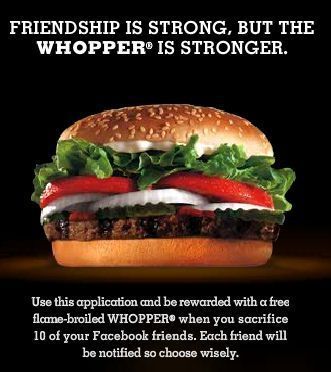
    A few months ago, Burger King decided to offer a free Whopper to anyone who would sacrifice 10 of their friends on Facebook. I mean, the average user has 130 friends. Who wouldn’t go down to 120 just to have a free tasty treat? Who wouldn’t wallow in self-pity for joy knowing their cyber friendship was given up for a free piece of meat?

    Apparently this viral marketing campaign worked well– maybe too well. The fine print says, “Facebook® has disabled WHOPPER® Sacrifice after your love for the WHOPPER® Sandwich proved to be stronger than 233,906 friendships.”

    Two hundred and thirty three thousand, nine hundred and six.

    Whopper Sacrifice Ends on Facebook
    Whopper Sacrifice Ends on Facebook

    These stats from viral marketing goldmine Facebook give so much more power to the phrase, “It’s all about who you know.”

    Facebook has more than 500 million active users. People spend over 700 billion minutes per month on Facebook. There are over 900 million objects that people interact with (pages, groups, events and community pages). The average user creates 90 pieces of content each month. More than 30 billion pieces of content (web links, news stories, blog posts, notes, photo albums, etc.) shared each month.

    So what did Burger King find out from Facebook? That it works. And that makes me hungry.