You may have recently read about the advances of Google’s +1 button, which originally debuted in March of this year. The button allowed Google users to recommend content from search results and ads, and as of June 1st, the button is showing up on other websites as well, for well known news outlets such as Mashable, The Huffington Post, Reuters, The Washington Post and TechCrunch. Retailers such as Best Buy and Nordstrom also made the list.
The way the button works is simple — by pressing it, you push that item up in Google’s search results, which means anyone in your Google network will see it when they search for the same thing or something related. If you want to get in on where this is going early, you can join in on the experiment through Google Labs here. Webmasters can also add the +1 button to their own sites by checking out the process on Google’s +1 Webmaster site.
Google enthusiasts will be happy to see this innovation growing, which works a lot like Facebook‘s Like button. In fact, it could be argued that the +1 button will be a direct competitor to Facebook’s system, since many sites have implemented Facebook connectivity by featuring the Like button beneath their articles and encouraging users to show their Facebook friends what they like. Soon, we may see the Like and +1 buttons sitting side by side on sites. Will people take the time to click both — or will they choose one?
Ultimately, the Google +1 system also manipulates SEO on a personal level, as users are more likely to click something another friend recommended than wade through unfamiliar search results. It’s a brilliant move on Google’s part, but will surely get the brains of SEO businesses churning as they’ll need to include this new system in their plans for clients along with Twitter and Facebook.
What do you think about the +1 system? Does it look interesting to you, or would you prefer to continue to use the already-familiar “Like” button and share with your Facebook friends?
I first discovered Quora just a few months ago, and quickly grew addicted. When searching for opinions, recent history, or even anything involving the tech world, Quora becomes my first stop. The site’s main strength lies in the quality of its users who also create quality questions and answers. Many of these users are Silicon Valley insiders, and for a while, Quora was the next big thing. Whether that is still the case can be debated, but Quora has a lot of collected knowledge that is easily accessible.
Quora looks similar to many other Q&A sites, and indeed, the basic format hasn’t changed. However, a few things Quora handles particularly well are the profile, the feed, and the search. When starting an account, Quora emphasizes ties to either Twitter or Facebook and insists that you use your real name. The real identity becomes especially important as your name and title accompany each answer. While anonymous answers and questions are an option, a real identity and relevant title greatly increase the answer’s credibility. This becomes particularly important when insiders answer questions about their company, often the case for questions about Quora itself, Twitter, or even Google.
Much like Facebook’s newsfeed (the two founders came from Facebook, after all), Quora provides questions and answers that should be relevant for each user. Not only can users follow topics, but they can also follow other users or particular questions to be notified of any new answers. As you develop your interests, the newsfeed becomes more interesting to explore as new things are constantly popping up.
The search bar at the top helps users find the content they need with suggestions much like Google’s, and by combining search with the question input field, redundant questions also get rooted out. Quora seeks to keep duplicate questions out, so users only have to find one place for the information they need. Once the right question is found, the answers are ranked by various up-votes and down-votes much like Digg, so the relevant information comes easily.
These features, an overall smooth performance, and a little bit of the right publicity have created a user experience that attracted many of the Silicon Valley insiders that laud the service. This emphasis has helped create valuable and high-quality content in a relatively niche subject. However, the scope of this subject has reached beyond just the tech world. Other topics such as politics, food, science, movies and business have good followings that have developed high quality answers. Already, I have found Quora to be a great way to learn about new topics such as cooking and real estate at a moderate depth. This way, you gain a little personality in your answers and also avoid much of the lower quality advice that can creep to the top of some Google searches.
I happen to eat through Quora’s content like candy, and there doesn’t seem to be an end to it in sight. However, I rarely feel guilty about spending my time there as I’m constantly learning new things, finding new viewpoints, or keeping up on relevant topics. If you are unfamiliar with this site, I strongly suggest you check it out. Chances are you’ll learn something.
Millions of Americans log onto Facebook every day without giving it a second thought, but something we consider a part of our everyday lives is very much a forbidden fruit in China. A recent protest has drawn attention in the news to just how fortunate we are to be able to use social media as a part of our regular communication.
Chinese internet regulator Fang Binxing may have known he’s not in most students’ good graces when we walked into Wuhan University to give a talk on internet security this past week, but he probably didn’t expect to be attacked by an angry student with projectiles such as shoes and eggs. However, that’s exactly what took place.
A student only identified by his Twitter handle, @hanunyi, claims that several other students had planned to join in on the protest, but got cold feet at the last minute. After being interrupted by the projectiles, Binxing cut the talk short and left to go to the airport.
In the hours that followed, a surge of support for the attack appeared on internet forums and channels, only to be deleted by censors. Less courageous voices named @hanunyi a hero for the people, offering him all sorts of rewards for his act.
Fang Binxing’s work in banning a tremendous number of websites from the Chinese public is considered a safety precaution. Websites such as YouTube and Facebook are considered a danger as they may enable Chinese citizens with a means to oppose Communist Party rule.
The incident has not been officially acknowledged, but the Associated Press quoted a policeman in saying it was “under investigation”.
The extent of the internet censorship in The People’s Republic of China is not commonly known to most people in other countries. China has a long history of not allowing its occupants to openly communicate, banning everything from books to films. In China, every key social media site including Facebook, Twitter, Tumblr, LinkedIn, Foursquare and many more are banned.
How would your business be different if you could no longer use social media?
While Google announced its own independent “liking” feature in the form of the Google +1 button several weeks ago, Microsoft competitor Bing announced on Monday that it would be directly incorporating Facebook “like” data into its search rankings. For the logged-in Bing user, a result that may have originally appeared lower in relevance will gain a boost toward the top simply by the virtue of having been liked by the user’s friends. In this gutsy move, Bing has divorced itself from the simple “search engine” label and is now something more like a community opinion aggregator, specifically relevant to the individual utilizing it.
The question is, how useful is this going to be to the average searcher? While I like and respect my Facebook friends, chances are I’m not going to be interested in what every one of the 400+ party acquaintances, elementary school buddies and past coworkers think that I should be looking at. While Facebook has some rudimentary measures in place to weigh whose profiles are more important to yours and vice versa, I’m not sure if this weighting will translate well to said friends’ opinions of search results. However, opinion harvesting is not simply related to your own friends list; Microsoft is touting this measure as a triumph of “collective IQ,” stating in its official blog post about the move that results will also be influenced by the likes of those who are not in your network. It’s the wisdom of the crowd, extended to large-scale. Popular recipes, for example, are markedly prominent when their ingredients are searched for:
While I’m unsure of the specific implementations of this move, such as incentivizing users to actually stay logged in to Facebook while they browse, I’m not sure if this is the death of objective search results. Google has always based its rankings at least partially on outside approval, and who’s to say that the average Bing user won’t benefit from the recommendations of their peers?
One intriguing and complex aspect of this new method will come in the form of “enabling conversation,” wherein Bing attempts to determine who (if anyone) in your friends network is most qualified to help make a decision or provide advice. If you’re searching for a certain city, for example, those in your network who live or have lived in said city will be suggested to provide recommendations. This is a useful but potentially enormously complex system involving huge amounts of data gathering, one whose practical applications remain to be seen when tested by user interaction.
With Bing and Facebook announcing this unprecedented merger of sociality and search, Microsoft’s rebranding of Bing as a “decision engine” instead of a “search” one is well-chosen. While results may be skewed toward the populist instead of the purely informational, there is unquestionably a specific niche for this kind of service, and I’ll be surprised if the coming months don’t usher in an even closer and more integrated relationship between the two.
In January, the world media and most of its consumers were riveted as events unfolded in #Egypt as the ouster of Hosni Mubarak gradually unfolded. It may have been the most widely televised, blogged, photographed, and tweeted-about revolution in the history of the planet, as people received up-to-the-second updates as to what was occurring in Cairo.
Social media, particularly Twitter and Facebook, allowed people all over the world, especially Egyptians (after a nationwide internet blackout was reversed), to voice their concerns, support, and questions regarding the revolution in Tahrir Square. In some ways, one could argue that social media websites allowed the revolution to take place, as people in Egypt could instantly communicate and coordinate with one another. One Egyptian man even named his newborn daughter “Facebook” to signify the network’s importance in coordinating the revolution successfully.
What does this mean? Well, for starters, rather than writing your Congressman, you can now tweet @ him or her and vice versa, opening up a new form of conversation in the political arena. As important legislative deadlines approach, like the budget debate earlier this month, constituents can get instant updates not only as to who’s voting for what, but also concerning behind-the-scenes negotiations and deals that can make-or-break a legislative agenda. The President can live-tweet his speeches and public events as they happen (#SOTU), and he often chooses to announce his press conferences via Twitter. In New Orleans, our mayor even has his own Twitter account and updates it frequently.
What’s even more interesting is that politicians’ use of social networks can essentially cut out the traditional media in the chain of communication between politician and constituent. Rather than having a reporter or broadcaster select and edit the quotes they choose to convey to their readers (we’re all too familiar with “sound bytes” that are taken out of context), politicians now have a direct line to speak to their supporters and discuss their views and actions on their own terms.
However, social media does the same for media outlets as well. Many Washington reporters have their own active Twitter accounts, and certain news organizations, like the New York Times, have them as well. (Hint: if you click on a link leading to any NYT article, you can bypass their new paywall and read it for free. @nytimes#FF)
Does this make American politics more democratic? Absolutely not, but it seemed to have that effect in Cairo. While business on Capital Hill will progress as it always has, social media allows for a deeper focus and scrutiny on political events. One now has greater access to inner workings of our political system and can speak up as speeches are made, negotiations are conducted, and votes tallied. If Egypt, is any indicator, social networks are now becomingly increasingly powerful tools in the political landscape, a trend that can only increase in the future.
(For further reading, check out NPR’s article entitled “Digital Media Could Make Or Break Presidential Race.”)
Nothing like the smell of hot plastic on a sunny day.
While I’m not the biggest video gamer — the glowing box, as a general rule, holds other and better appeals for me than pushing around pixels shaped like underwear-clad lady ninjas — when I came across this kerfluffle involving Reddit’s /r/games section my ears couldn’t help but perk up. Several notable gaming media entities such as GamePro and G4 TechTV have published stories on the section that were almost instantaneously upvoted for maximum viewability. An intrepid Redditor discovered this and unraveled an astonishing 20+ accounts belonging to the same “social media expert,” whose sole purpose seems to have been to create this plethora of fake handles and use them all to create a healthy crop of discrete upvotes for his selected domain’s stories. When confronted, the individual responded to complaints by pulling out all of his handles in an attempt to shame the accusing party into submission (the all-too-predictable “virgin nerd” comments are just the tip of the iceberg). The companies in question have all issued half-heartedapologies.
As a former politics junkie (currently on full media blackout for the sake of my blood pressure) I can’t help but immediately draw comparisons to the time-honored politico sleazebag tactic of astroturfing — planting paid “cheerleader” supporters in order to sway public opinion on unpopular issues due to perceived popular support. There was an little-publicized scandal of this note in 2003, when over 500 identical copies of a letter describing the ringing success of the war in Iraq were falsely attributed to soldiers and published the newspapers of said soldiers’ small-town homes. More recently, the ever-reprehensible Scott Walker has found himself embroiled in controversy yet again as small groups of bought-and-paid-for pro-Walker demonstrators attempt to face off against the seething milieu of pissed-off pro-union protestors. (Walker has since brought the cyber-stupid in the form of a half-hearted Twitter trend as well.)
Political astroturfing relies on a light form of peer pressure, the human instinct to go with popular opinion, but when the technique is applied to social media it takes on a less-than-egalitarian light. Instead of organically swaying opinion by tone and suggestion, virtual votes have real power — the power to decide what’s being seen in the first place. If entities with resources to burn on this kind of social promotion decide that they want all of their stories to be above the fold (so to speak) every day, the entire concept of sites like Digg or Reddit becomes moot. Essentially, it’s sort of an online, non-organic dysgenicism: when votes are worthless, massive inflation occurs and an individual personal recommendation becomes almost meaningless in the face of mechanical cranked-out upvotes.
So with these comparisons in mind, at what point does social media manipulation become sleazy? The core of the matter is at sites like Digg and Reddit’s model. By their very nature, social bookmarking sites want to promote what the people like: one vote = one recommendation from one real person. By manipulating this system with fake accounts, the sphere of viral media as a whole is corrupted. However, the trait which enables social media to be manipulated is also the very trait which allows it to regulate itself. The best and only way to control this phenomenon, at least in the simple scope of Reddit’s business model, is by a self-policing community. Every upvote from a fake user can be downvoted by a real and conscientious Redditor, and the system can thus correct itself — if the community is sharp and engaged in rooting out these false users.
The spammers… they… they could be anyone!
Cory Doctorow of BoingBoing compares the whole mess to The Monsters Are Due On Maple Street — the egalitarian nature of online handles makes the “monsters” (fake-account spammers) and real people upvoting their preferred stories pretty much indistinguishable. Given that the Reddit community at this point is around 5000K+ daily users, one guy abusing the system through twenty accounts won’t make that big of a ripple; however, it remains to be seen whether this tactic will take on real corporate value in the future, and if so what steps social bookmarking sites will take to correct the measure. It’s a thorny issue and, as the Internet becomes more and more socially-oriented (as the newly-announced Google +1 button indicates), one against which webmasters and e-entrepreneurs alike will have to continually fortify their defenses.
Last month, the world saw their attention turned to Egypt and watched media coverage unfold as its citizens protested in an effort to force long-term President Hosni Mubarak out of office. Subsequently, and like most hot button topics, the issue carried over to both Facebook and Twitter and lingered on them for several weeks.
Retailer and clothing designer Kenneth Cole found himself joining in on the social media coverage of the issue by posting a tweet that read: “Millions are in uproar in #Cairo. Rumor is they heard our new spring collection is now available online at http://bit.ly/KCairo-KC”. Almost immediately Kenneth Cole found himself in a firestorm of controversy, with those criticizing him for his tasteless tweet in an effort to promote his business and attaching it to a controversial issue. Just a few hours after the tweet, he issued an apology, admitting that it was inappropriate and insensitive.
Businesses are increasingly finding it more challenging to promote their products and services in social media, all while catching the consumer’s attention within a barrage of other competing businesses with Twitter handles and the same, if not better promotion tactics. With trending topics and hashtags changing every few hours, particularly on Twitter it is tempting for a business to attach themselves to a “topic of the moment” in order to gain consumers’ attention. Not to mention, the message has to be in 140 characters or less.
While businesses use social media tools even more to increase their business and platform, it’s important to keep a fine line of staying away from controversial topics that might offend potential customers.
Social media is a powerful tool that one can use for good or bad. Since its inception I’ve seen several celebrities “killed off” on Twitter more than I care to admit. I have also seen plenty of hashtags that made its way to trending topics that one might find very off-putting and offensive.
Still, with these challenges that businesses might face to “keep up,” it forces them to become even more creative with their tweets to consumers and keep them engaged with future sales and upcoming events.
Another byproduct of a business or individuals receiving negative feedback from a tweet is the creation of mock accounts, which usually spoofs the original account and its owner. Of course, Kenneth Cole wasn’t an exception. An account named @FakeKennethCole. was created and sent out a series of tweets which poked fun at the situation. Surely, businesses would not want to see themselves being made fun of. They probably would also not want consumers to get confused about a mock account being one that was part of the actual business.
Overall, businesses learned an important lesson using social media and the actions and words that should be carefully reviewed before clicking the post button.
The members of Radiohead are a private bunch, often very selective with their interviews and keeping low-profile lives in their hometown of Oxford, England. As such, the press scrambles over every utterance that the band might put forth, which isn’t much. But their online presence, long established, is staggering. Their website, entitled “Dead Air Space,” has gone through countless incarnations, including wormholes of old information about their previous art and music. It primarily serves as the band’s blog, strewn with “office charts” of the music they’re listening to and links to new music or websites of political and social issues. Some of the members keep more-or-less active Twitter accounts, including one for the band itself, and the people they follow seem to form some of their inner circle, like the artist Stanley Donwood, amongst others.
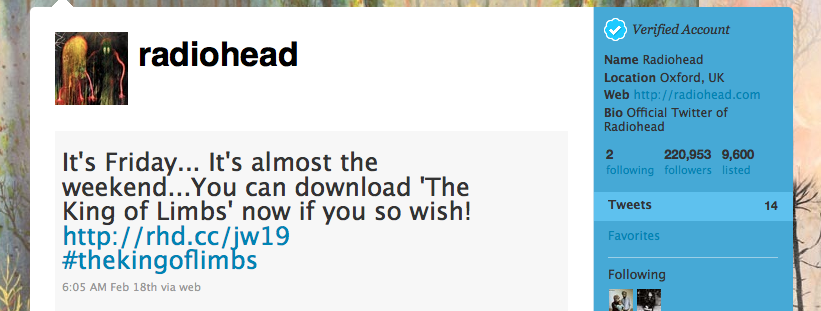
These twitter accounts, along with those of their fans, were an epicenter of activity last week. On Monday, February 14th, Radiohead posted via Twitter: “Thank you for waiting…”, which was followed by a link to www.thekingoflimbs.com, a website designed for the release of “The King of Limbs,” their new album slated to become available for download the following Saturday. Four days later, on Friday the 18th, Radiohead tweeted again: “It’s Friday…It’s almost the weekend…You can download ‘The King of Limbs’ now if you so wish!”
Fond of doing things differently, Radiohead are known for their innovative and genre-bending music. While the quintet could be cited as one of the most influential bands in modern music, it’s also clear that they are also exploring the marketing of their music in a way that no other mainstream band has attempted before.
Anyone who followed the most recent album releases by Radiohead already knows that they’re changing the way music can be released to the public, especially by a major artist. After completing “Hail to the Thief” in 2003, they had fulfilled their recording contract with EMI, and they chose to remain independent rather than signing with another label. They recorded 2007’s “In Rainbows” on their own and released it on their website as a direct download with the asking price of “pay what you want.”
This alone posed numerous questions to musicians, music lovers, and music industry professionals, causing a minor existential crisis in the recording industry. It called into question the value of music, especially considering the widespread piracy of music. It questioned whether musicians really need major record labels to market their work. But most importantly, it bridged the gap between the band and their fans. Radiohead offered an immediate and direct transaction, so one would know that the money they paid for the music (if they chose to pay at all) was going directly to the artists and producers responsible for creating it.
By default, Radiohead relied on their previous successes, fan base, and name to market their new music, so their achievements with “In Rainbows” cannot be applied to unknown artists. However, the way “The King of Limbs” was released last Friday redefines the relationship between musicians and their fans. The band chose to use Twitter as the medium for announcing the album, and they again utilized their own web servers to facilitate the release. While the “pay what you want” aspect was ditched for a $9 price tag on a set of eight mp3s, fans could still remain happy knowing that their money was going directly to the artists that they want to support.
Already on very short notice, the instantaneous “early” release of “The King of Limbs” caused Twitter and other social media sites to flood with reactions to the album, and it nearly caused Radiohead’s download site to crash. Music critics, eager to get the official first review, listened to the album hastily on their laptops that morning and posted track-by-track assessments merely an hour or two after the album was released–to much criticism by fans, claiming that new music cannot be properly reviewed so quickly. Regardless, the social media world was rocked by this new release, providing an open channel of communication between the band, their critics, and their fans. Whether you like the new music or not, it doesn’t take much to think that Radiohead might be up to something.
Six days prior to the announcement of “The King of Limbs,” Ed O’Brien, guitarist and back-up vocalist, posted a blog entry on the band’s web site entitled “The Dignity Revolution.” (Also coupled with a tweet–they’ve connected their blog and Twitter account, a sign that they’re aware if the importance of social media.) It reads as follows:
What have twitter and facebook ever done for us?
Obviously, keeping in touch with everyone but I have to say I have become increasingly excited over the last 3 months about the possibilities of this form of communication.Yes I am very slow out of the blocks. It’s in the arena of public protest that it seems twitter and facebook are increasingly the means by which popular movements throughout the world are able to come together and mobilise.
In some ways, one could argue that Radiohead are leading a popular movement, and Mr. O’Brien has an extremely valid point. Their use of social media, like Twitter, allowed for a direct and instantaneous connection between the artists and their audience, just as the release of “In Rainbows” allowed for a direct and open transaction. Thom Yorke, lead singer, once remarked in an interview: “If people want to play it for themselves, why don’t we just give it to them to listen to?”
Aware of their massive fan base, the band decided that they can conduct business as they so please, using the high-speed connectivity of social media to do so. And while lesser-known artists may not have the audience that Radiohead has, thus being more vulnerable to reviews, it’s also clear that those musicians also use social networks as a way to market themselves on their own terms. That trend can only increase in the future, and that is what I believe Yorke and Co. are trying to prove.
Is Radiohead leading a music industry revolution? It’s hard to say. With highly successful performers such as Justin Bieber and Taylor Swift, who are promoted and made famous through the marketing strategies of major recording labels, Radiohead’s business model might not be for everyone. Either way, social media provides an effective channel to promote their music, and Radiohead have become a successful example of a group of artists marketing and releasing their own work, instantly and directly, as they see fit.
Last week I had the pleasure of presenting on Social Media Analytics at SEMpdx SearchFest.
Most of our customers have no interest in Likes and Followers for their own sake. What we’re interested in most is Leads. In other words, do our Social Media Analytics enable us to track actionable data, most importantly, leads?
Following advertisements for a contest where Facebook fans can enter to win a 60” 3D television, anchors’ guffaws at “The Facebook” and “The Twitter,” and the third run of a talk about how Facebook and social media peacefully brought down a dictator in 18 days, FOX8, our beloved Fox affiliate network channel, ran a special report on Facebook privacy which showed how confused people are about Facebook.
Stirring up fears about Facebook’s lackadaisical attitude towards users’ privacy is almost as old as the site itself, but really took off after the introduction of the news feed, prompting this post from Michael Cerahimself. But FOX8 reports that there yet is one more person who knows “everything” about you, even after 170 types of privacy options: the social media marketer.
We’ve determined a rough estimate of the gay population of the military using the tools they’re talking about. Dr. Kimberly Mason, cyber-bullying expert at UNO, claims:
“The majority of the individuals who use Facebook of course are on there to make their social connections and keeping in touch with friends and family. So looking at advertising and looking how they monitor that really is not in their realm of awareness.”
Strengthening this argument is the general concern about privacy that Facebook users have cultivated. Avoiding questions of survey design, there is no attempt by Gallup/USAToday to reconcile this data with the knowledge users displayed about the privacy settings even at an early stage of development for the site, nor with the skyrocketing membership and constant activity seen as the site has become the second-most-trafficked site on the web. Obviously we’re not dealing with an all-or-nothing situation, and maybe even analysis of risk perception could be appropriate, though of course not under the language of physical harm.
The FTC supports a browser-based “Do Not Track” system, while Rep. Jackie Speier (D-CA) offers a much more nebulous, but more proactive and far-reaching system. These proposals and recommendations are to protect the users of the site from their private lives being compromised.
But the privacy argument driving interest, polls, and media stories is too muddled to be coherent — there’s privacy, and then there’s privacy, and then there’s privacy. These three realms where users can unknowingly give out information — your network, the public, and advertisers — have different priorities and different interdependencies when it comes to blocking access.
The first kind of privacy — hiding your information from your own network — seems simply counterintuitive to me. Like having a private Livejournal, not using the social aspect of a social network seems a bit counterintuitive. There’s got to be some kind of control here — Reuben Foster of UNO says, “If I don’t want it to be public, then I won’t … click these things,” and that’s right on the money.
Found directly beneath the status box.
In addition, the News Feed is smart. That first variable, the affinity score, is user-controlled. If you don’t talk to someone, they won’t show up as often. To boot, the other variables, weight and time, simply fulfill the definition of a social network. Combined with easy to navigate deletion and blocking capabilities, it’s a hard sell to me that there isn’t enough privacy options for the user.
But that’s a straw man; privacy can be breached in other ways. While privacy settings can stop a lot, so many checkboxes to look at and discover over time might be overwhelming. Worse still, Facebook has a bad habit of resetting its users’ privacy settings when it updates its features. We’ve talked before about other people looking at your posts and online image branding. There are a number of news stories where someone posts something that unintentionally irritates the wrong people, all of which bring up the divide between what is or isn’t public speech.
While I’m not about to open that can of worms, two alternate court cases show the two likely outcomes of privacy issues: either an out of court settlement or a court siding with the company, who can probably show a solid link between loudly kvetching about work and “job performance.” The question on the level of privacy and anonymity of your Facebook profile has not been answered; best to tread with care, but not necessarily lightly.
Even with careful Facebook pruning, you still have your information going to advertisers, and it is this what puts Facebook in a unique position for privacy. Google doesn’t have the instant interest data to tailor their content offerings like Facebook does. Even Microsoft, whose use of Internet Explorer to strengthen Bing’s ranking pages is more insidious and less publicized, gets their data from Facebook
Obviously not the best tool for small fanbases…
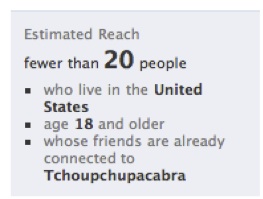
WVUE reflects the average Facebook user’s view when it refers to all ads as “Sponsored Stories.” Ads are ads — it’s neither Facebook’s intent nor in their interest to try to fool you into thinking they’re not, and you’d have to ignore clear headings to think they’re from your friends. There is a difference, though: Sponsored Stories refers to ads that look more like regular news feed posts; however, they again have the telltale heading. They also can only be shown to people “whose friends are already connected to” the Facebook page or post that they’re connected to. Similarly, fan page ads can only be shown to people not already connected to the fan page.
See, nothing terribly creepy here…
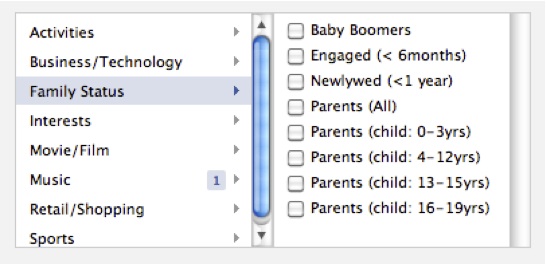
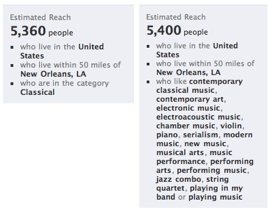
Facebook’s ad targeting is much less sinister than it seems. You can filter by age, sex, and broad category of interest. While the Family Status category under interests is on one hand a bit questionable, it can heavily influence relevance of ads; you wouldn’t want to be showing ads for singles sites if a member is married with kids.
You can then target by Connection to a Page, Event or App. The next section, the Advanced Demographics, provides advertisers with better opportunities to provide relevant content and avoid marketing gaffes. Finally, you can target by education level or workplace.
And that’s it, right? You get your broad information, and nothing’s even tracked deeply enough to cause any concern. That doesn’t seem so bad.
… But we could make this comparison much creepier. I just like music.
But when something* happens with your account, the advertiser gets access to Likes & Interests. This narrows the interests so that it is more like traditional keyword bidding. This isn’t unusual, and follows the traditions from Google pay-per-click advertising. The advertising platform provides vague statistics to give advertisers an idea of how many people are interested in ideas that are related to your link.
But not only does the advertiser get this information. Another privacy craze was raised over Facebook’s Open Graph Platform, which began the rash of “Like” buttons on the site. Extending the simplicity of the “Like” from every kind of “Edge” — the term Facebook uses for any post, link, comment, or ad — to web pages seems logical and extends not only the brand, but the whole social media mentality.
Open Graph allows a content provider to, like Google Analytics, track his links’ likes and clicks on Facebook, even without having a Facebook presence. While this might seem like nothing new to your loss of privacy, an important distinction has to be drawn between this and Google’s tracking programs. Facebook offers this information with your personal information like your friends list in the unseen data. Obviously, this is used not for advertisers, but for the inner machinery. However, the concern remains that someone with a bit of knowhow can get that information.
But that information isn’t useful for advertisers right now. A list of friends might be interesting on a massive level, but then again, the individual is lost looking at larger trends. The other factors, publicly displayed on your profile
Through these three realms of privacy, it seems that there’s good reason to be afraid of Facebook and its privacy issues. But here’s the catch — who’s really looking at this? Advertisers and content providers, even among the slimiest of content farms, simply want to provide a better user experience. They, including us, are looking for the most people clicking on ads and, more importantly, interact with the content behind the ads.
There’s a tendency for people versed in Facebook to blame the user — we all see the inner workings, we know how easy the whole system is if you turn off your brain. We know that all you have to do is click the “Like” button and you’re giving us good information that we can use to give you more of what you already, at least in a marketing sense, “Like.” Those that are trying to target you are trying to give you more of what you’ve already said you want, even if it’s an admittedly selfish gift, since advertisers obviously get benefits from you clicking the link.
But the Skinner box that is Facebook, and particularly the games and apps that tweak and complicate privacy settings beyond the basic problems described, is ultimately something from which its users benefit. The on-first-glance underhanded data-gathering techniques are ultimately the way that Facebook serves its users, by providing content relevant to them, as determined by them.
*We are looking into this. Check back for more info!
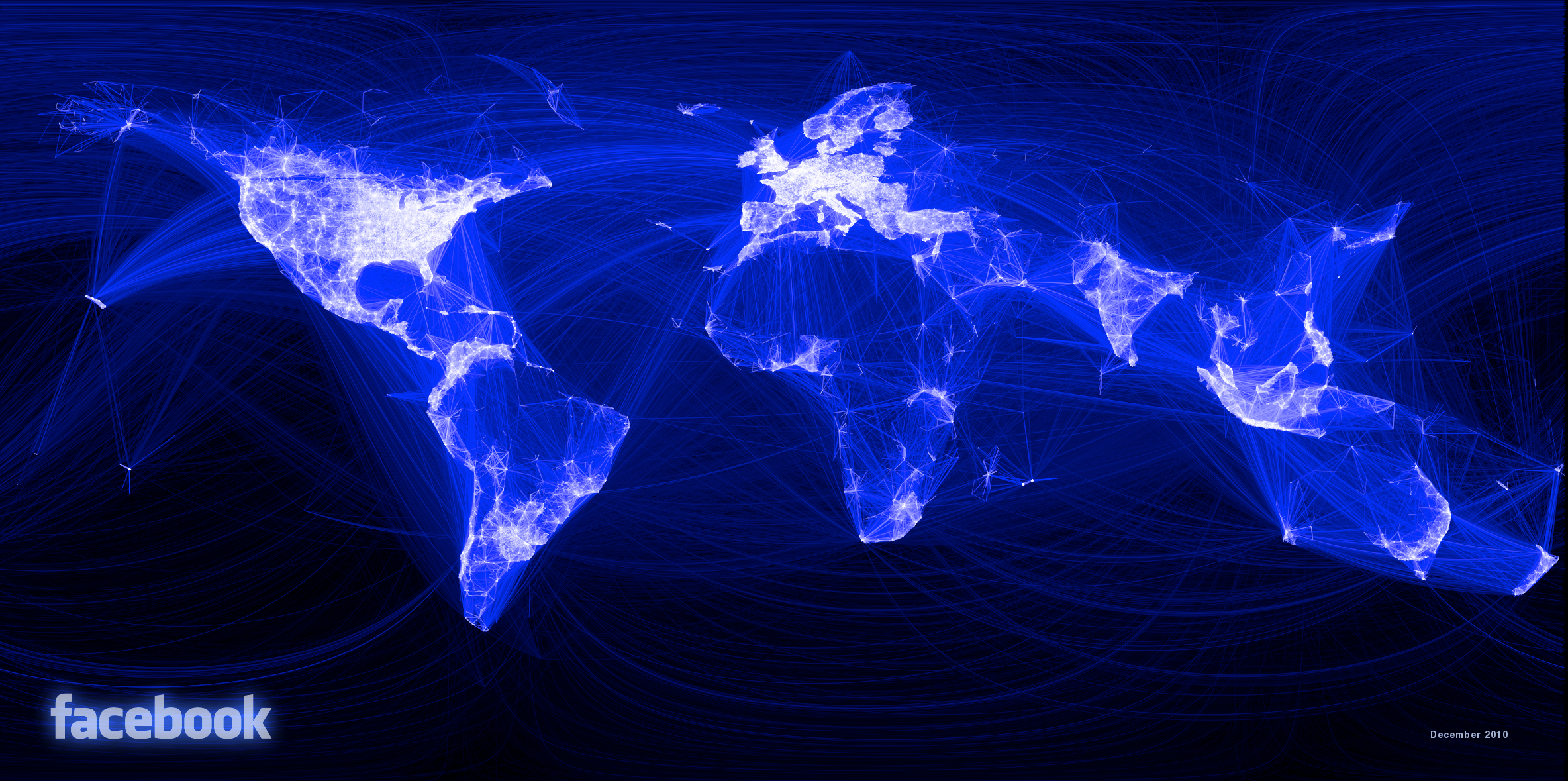
Picture Courtesy of the Facebook Engineering Blog
Don’t forget to “Like” this page. We promise to do every creepy thing we can with your information and show you what you’re sending to advertisers and content providers in an upcoming blog post.