Category: Social Media

  • 5 For Friday – Links, Stories, & Posts for your Weekend


    Welcome to the Twitter Olympics – CNN

    In case you live under a rock, the Olympics are going on, and the whole world is closely watching as the best of the best compete. Leave it to the internet to bring both humor and serious discussion to the event via Twitter. There was some mud-slinging, as to be expected, but when a Greek athlete was suspended from the games for racial comments via her Twitter account, it makes it clear that Twitter etiquette is becoming just as important as real life.

    The 10 Keys to Optimizing Facebook Engagement – Social Media Today

    So you spend all this time queuing up posts for your business Facebook page, only to have them sit there like a stone with no comments. You feel so unloved! But how can you optimize your Facebook posts to actually encourage more engagement? There are some great tips here to help you get savvy about how to get your clients talking.

    Helping or Hurting – The Debate Over Google+ Local – Search Engine Land

    I admit I personally haven’t given much thought to Google+ these last few months. After an exciting launch, it seemed to kind of fall under the radar, and everyone defaulted back to their old Facebook habit. In the background, however, Google+ kept working to offer more to its users, especially businesses. Over at Search Engine Land, the debate goes on as to whether or not Google+ Local is a good or a bad thing. SEOs love it, while consumers aren’t so sure they jive with what’s going on. What do you think?
    Facebook Working on Better Search, But Won’t Rival Google – Search Engine Watch

    Proper in-site search functionality means the difference between how many users will stick around and how many will bounce in frustration. Google’s pretty good when it comes to giving us what we want in searches, but it’s no surprise that the social behemoth Facebook wants to take a cue from them and make their internal search more efficient. They are currently searching for help to flesh out search, so who knows what’s coming down the road. Maybe tracking down people to add to your network will become easier than ever.

    Goodbye, Hotmail; Hello, Outlook – Mashable

    It’s hard for me to imagine using a client other than GMail, but apparently, some people still do (like my mom). Hotmail has needed an overhaul for a long time, so it’s good news to see that it’s finally happened, and it even has a new name. Now called Outlook, it has lots of cool social integration stuff built in. It’s probably going to scare my mom, but these changes will surely be handy if you want to use the platform for business.

  • A New Media Paradigm or Mismanaged Effort? Social Media and the London 2012 Olympics

    IMG_5649As the self-declared first “Social Games,” the London 2012 Olympics are currently wowing audiences worldwide with an arsenal of tactics for every social media outlet imaginable. In our digital age, the instant, hyper-specific gratification of Twitter and Facebook is playing a huge role in how fans engage, interact, and react to the show. It’s so big that there’s an entire page devoted to the social aspects of the Olympics on the games’ official website.

    The London 2012 Social Media dashboard on the official website shows the number of growing fans for the Olympics on Google+, Facebook, and Twitter. You can also view where to check in, which hashtags to use, and what are the most recent tweets from @London2012. Twitter leads with 1.39 million+ followers, while Facebook is edging up with 1.37 million fans. Google+ only has 698,647+ followers. By so prominently playing up the social media count, the IOC (International Olympic Committee) is encouraging athletes and fans to interact through these platforms — but snafus like the pearl-clutching fuss made over a US soccer player’s personal Twitter account or blaming fans for outages of sharing-heavy networks have caused many to be harshly critical of the International Olympics Committee’s handling of the issue.

    Aly_Raisman_GoldMedalIn addition to the three social media platforms mentioned above, fans can also watch “Gold Medal Moments” and behind the scene interviews with coaches and Olympic athletes on the Team USA YouTube page. If you can’t decide between the eight official Facebook pages to like or the five different Twitter accounts to follow, you can just check out the Olympic Hub page for the latest updates from your favorite athletes. The current top three most followed athletes are LeBron James, Kobe Bryant, and Roger Federer — as if that was any surprise. But the Olympics are also a time for the non-celebrity athletes to shine and create those true ‘Olympic moments’ with their world records and flawless routines.

    As with any large scale operation, there’s always potential for bumps in the road. One notable disadvantage of all the social media frenzy is that American viewers, who are 5 or more hours behind Greenwich mean time, often get the outcome of the events spoiled before being able to watch the competition itself. The NBC tape delay caused a stir with fans when they preemptively learned about the results of the games while waiting for prime-time TV. Some took to Twitter with #NBCFail to voice their complaints about the prime-time delay, while others made their voices heard on Facebook.

    Another social media mishap occurred during the men’s cycling road race when, according to Reuters and Gizmodo, the IOC asked fans to stop tweeting because it was interfering with their broadcast and to only tweet when it’s “urgent.” Later IOC blamed the issue on an “oversubscription on one particular network.”

    It’s indisputable that the new prevalence of social media, particularly Twitter (which has grown exponentially since the 2008 Beijing games), adds unparalleled amount of richness to the Olympics experience. Fans around the world can watch favorite athletes getting their gold medal, peep Missy Franklin’s fan gifts or get second-by-second updates from six sources at once. However, its immense presence can lead to downsides — even athletes have reported the negative effects of the constant distraction, and many have levied complaints against the IOC’s restrictive policies.

    Whether you’re tuning into the Olympics via live stream, on the tube or even with a list of Twitter feeds, you’re experiencing something completely new in the world of communications and of sport. However strong the effort, though, the IOC’s handling of it has been less than pristine — Search Influence CEO Will Scott weighed in on this very topic in Forbes earlier today, saying “The moment the IOC set restrictions that limited the voice of the athletes, they made the Olympics less relevant to the Millennials… They have taken a large, influential group out of the equation.”

    How do you think the Olympics have handled their social media presence so far? Is your experience better for all the new options, or is their oversaturation taking away from the games themselves?

  • Facebook Scheduling Tool for Business Improves EdgeRank

    Tiny clock

    Maximizing Facebook Fan engagement and excelling at the ever mysterious “EdgeRank” are top priorities for both business owners and marketing firms in this digital age. Unfortunately these lofty aims often take the backseat to more pressing demands, like actually running a business, rather than just writing about one online. Even if businesses have dedicated staff members available to not just to post but also to actively interact with fans, it can be difficult to coordinate posts for the right time of day for maximum fan engagement. Enter the Facebook scheduling tool for pages, which takes some of the inconsistency and stress out of posting regularly.

    How To Use the New Feature

    Teach me how to schedule

    The feature is easy to miss inside the update box, and was added with little fanfare or acknowledgment from Facebook in late May. It appears as a tiny clock in the bottom left side of the box, and offers you the ability to backdate or schedule posts. In order to use the feature, you must first set up a Timeline event for the founding date of your business. After finishing this simple step, you are free to schedule posts in 10 minute increments within a window of more than a year into the future. You are not limited to simply scheduling written posts, as you can also schedule links and images, which appear exactly the same as if you had posted them manually. There have been some issues with the new feature, but most of those were resolved rather quickly by the Facebook development team.

    Facebook Scheduler vs. Third Party Scheduling

    This new feature is great because it replaces any need to use third party scheduling sites, such as HootSuite or Postling. Many users have reported decreases in EdgeRank when using 3rd party scheduling sites, not to mention the fact that the post is clearly labeled as coming from an outside source. Pictures never looked quite right when scheduled through a third party, and links often seemed to be truncated or dead when the posts finally appeared through Facebook.

    Activity Log

    One of the major initial complaints about the Facebook scheduling feature was that there was no way to go back and view the posts after scheduling them. This is untrue as a full list of scheduled posts can be obtained under the Admin panel, but is rather difficult to locate unless you already know its there. Once you’re within the “Activity Log” you can change the date of scheduled posts, cancel them, or post them immediately. At this point, there is no way to edit the posts that have already been scheduled, but hopefully that feature will be added eventually.

    What We’ve Found

    Organic FB increases

    We began using Facebook scheduler instead of HootSuite to publish updates on many of our clients’ pages around June 15th. Over the course of the last few weeks, we have seen a dramatic increase in fan engagement and “likes”, as well as sharing. Here is a screenshot of one of our client’s organic reach over the last month. You can see that it has steadily increased (with a slight and expected dip on July 4th!) and is currently reaching about 500 more fans per week than it was in mid-June. These results are great, but we find something even more remarkable when we look at viral and total reach for this timeframe.

    Total FB increases

    As you can tell from this graph, we do not do any paid fan-building for this client, so this data is based entirely on the increase in visitors and shares on the page. Our organic reach has increased by about 500 fans per week, but our total reach has increased to over 15,000 people per week. This number is especially remarkable because this page only has about 3,400 fans.  Not only does it appear that this client’s EdgeRank increased dramatically, but that increase has had a huge effect on the viral nature of our posts, photos, and albums.

    Have you tried the Facebook scheduling tool yet? Try it out and let us know if it’s successful for your business in the comments!

  • Pinterest For Men: Infiltrating The She-Ra Club With Smart Marketing

    Pintrest-banner

    A digital corkboard where people can collect links to their favorite recipes, dapper clothing, and adorable cats with their heads stuck in something, Pinterest allows its users to effortlessly share evocative photos of their hobbies and interests. Launched a little over two years ago, this image-focused sharing site has taken the Internet by storm. (Just check out this infographic!) With over 10 million likes on Facebook, Pinterest has quickly inserted itself in to the inner circle of mainstream social media sites. It isn’t exactly a man-eating no-boys-allowed club — but with women making up nearly 70% of its users and a distinctively twee and vintage look to its features, it is unarguably lady-friendly. However, while it’s easy to write its possibilities off in a haze of vintage cloches and desaturated wedding schemes, Pinterest can be used to engage a wide number of demographics. If you’re looking to target male users, then, what to do?

    Create A Goal

    The first thing we must do as a business is to create the message we are trying to convey. It does not need to be overcomplicated, but something that lets our followers know where we are coming from. This can be accomplished through a theme of our posts or certain boards that show what a particular company does, sells, or is interested in.
    Keep in mind that the average person spends about 15 minutes at any given time on the site, so our boards have to be concise and engaging. In addition, the boards have to keep the target audience in mind. Whole Foods accomplishes this with tantalizing images of recipes that add to the food-porn addiction of many male Pinterest users. This can also be accomplished by making more male-dominant boards for male clients. By doing some demographic research and creating boards about less-trafficked topics such as cars or gadgets, a business can connect better with its male clients through shared interests.

    Personify Your Company

    Social media is filled with generic company pages or profiles that really only sell their products. This in itself is not necessarily a bad thing, but these companies overlook the fact that social media is supposed to be social — it’s in the name! So it’s important to take some time when setting up a company profile on Pinterest to imagine if your company was a person. What would that company-person do with their time? What is it interested in or passionate about?

    When the Pinterest profile is humanized, audiences have an easier time identifying with the message of the company. For example, if you are a men’s clothing store, you wouldn’t want to saturate your posts with images of kittens; instead, use things relevant to your consumers, such as types of formal suits or images of vintage men’s fashion.

    Interact With Your Fans

    Pinterest is a social site. I would be lying if I didn’t pursue it at least a few times a day to look up things like delicious Old Fashioned. (Click the link. I have a fantastic one already pinned for you.) Pinterest consists of about 90% repins, which translates to a lot of people sharing what they’ve found on someone else’s board. Because of this, it is especially important to take the time to see what people are pinning about and give them incentive to share your brand. For instance, Confused.com designed a contest to have its followers pin a picture of them driving with high-heels on for a chance to win a pair of high heels. This type of competition can be easily converted to fit any target: power tools for men, toys for kids, or rubber chew toys for pets.

    With the generation of traffic to your site, it is especially important to remember to keep your boards concise and organized. This will entice viewers to take a look and repin your posts, spreading your name your name all over the site in the process. In addition, remember to try offerings something for everyone. Even if you’re trying to appeal to a non-majority demographic, there’s no need to offend the site’s main user base by being gratuitously crude or racy.

    Be Creative

    Feel free to let your creativity shine when you design your boards. After all, you are competing with numerous collections of food and wedding planning, so feel free to do something simple that will appeals your male demographic. Think Geek, a nerdcore eCommerce site, does this with boards of their products and also other boards showcasing things they love — Star Wars, Dr. Who, and all things nerdy. This further proves that Pinterest can be used to appeal to your customers’ dorky sides, no matter what gender or walk of life.

    Don’t just stop at the contents of your boards! Peugeot Panama went as far as to cleverly design their boards to puzzle piece their cars to create an engaging board covers. This is successful because not only does it creatively engages the viewer, but also it appeals to its male demographic.

    Uniqlo gave the viewer an experience of a motion graphic that encourages the viewer to scroll down and watch as their pins animate to showcase their dry fit wear. This is a great way to create a gender-neutral board that appeals to both sexes.

    So no matter what kind of business you are in, Pintrest can help you better connect with your clients, whether they are male or female. Also, there’s no better way to discover some interesting ways a shipping pallet can be converted into a coffee table

  • Twitter Ditches LinkedIn, Says It’s Not Personal

    twitter linkedin split
    I'm a fan.

    “It’s not you. It’s me.” That’s what Twitter proclaimed to LinkedIn this morning, ending a two-year partnership between the micro-blogging giant and the social network site for job seekers. Breakups are hard to do, as the saying goes, but according to LinkedIn, they didn’t even care in the first place.

    “If you had previously synced your LinkedIn and Twitter accounts, and selected the option to share Tweets on LinkedIn, those Tweets generated from Twitter will no longer appear on LinkedIn,” says Ryan Rolansky on the official LinkedIn blog. “There will be no other changes to your LinkedIn experience.”

    In other words, you can still post updates to Twitter from LinkedIn, but not the other way around. ‘Cause Twitter totally blocked LinkedIn, bro. So uncool.

    Jokes aside, Twitter has been getting pretty fussy lately. Developers using their application programming interface (API) have their work cut out for them — it’s notoriously tricky to handle — and the initial Spartan interface has gotten more and more tricked-out over recent months. With all these new bells and whistles, Twitter wants its branding to remain as consistent as possible, which is why sites like LinkedIn are getting kicked off the bandwagon.

    While Twitter may seem like an infallible giant to the hyper-focused social media contigent, the truth of the matter is that most people are reading it through a variety of secondary services. If you connect your Twitter stream to Facebook, for example, you can read it all there at the same time as you read about Aunt Margaret and her eighteen cats. So why go to the source site when you can get it all in one place?

    Even though the service became famous for its brilliantly minimalistic-efficient service, the company seems determined to expand. Twitter Cards, a new option that offers partner websites a way to show off more content, seems interesting, but not necessarily what I want out of Twitter as a user. Just give me my feeds in Tweet form, let me post dumb photos, and I’ll be fine. Is the majority of the user base really craving more than that? Or is the thrust of Twitter’s new direction less about what the general consumer wants, and more about how Twitter can serve as a business tool?
     

  • Driven to Feed: Why Food Trucks Learned to Use Social Media

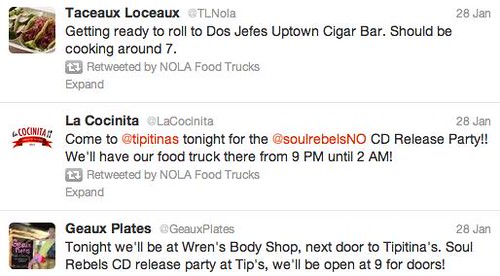
    NOLA Food Trucks' twitter feed


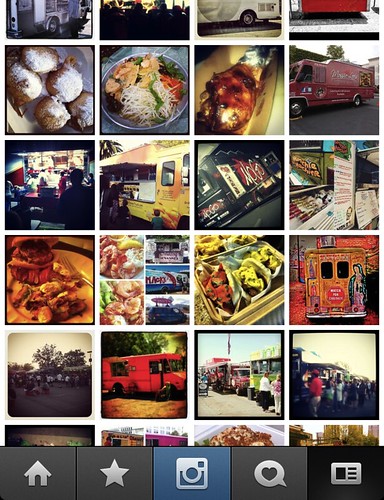
    You may have been told at one point or another that it’s a bad idea to go to the grocery store hungry. There’s another hunger hazard to watch out for that’s sprung up more recently: the Internet. More specifically, the major offenders are Twitter, Facebook, tumblr, Pintrest, and a variety of other social networking sites that constitute the delightful temptations of food truck social media. You won’t be in any danger of impulse-buying that Jimmy Fallon flavor of Ben & Jerry’s (which is quite good, in my ice cream connoisseur’s opinion), but a very real enemy of your hunger lurks in various social networking feeds.


    Imagine this scenario: you were going about your afternoon not thinking about BBQ beef sliders at all until, out of nowhere, there’s a picture of one right before your very eyes. And wait, the exact geographic point where you could acquire this small sandwich at this very moment in time is there, too. You can have a slider just like the one on the screen in a matter of minutes! The secret is out that street food vendors and pop-up restaurants thrive on this strategy to interact with, and subsequently make friends, fans, and (most importantly) patrons out of their followers.

    #foodtruckAccording to these Portland food truck proprietors, Twitter drives a remarkable 80% of their business. This is significantly higher than the amount of growth many other types of businesses can attribute to a social media outlet alone. For food trucks especially, social media outlets like Twitter and Facebook are uniquely suited to the sort of outreach that drives customers their way. Tweeting locations, posting pictures of daily specials, and receiving feedback are invaluable methods of getting and keeping customers coming to you day after day. Even stationary restaurants have caught up to the marketing strategy employed by food trucks and mobile eateries, tweeting specials and forming customer relationships before people even walk through their doors.


    Unfortunately it’s not all low-overhead and roses for trucks using social media to attract attention. The Sun Times reports that law enforcement in the city of Chicago — a city where food trucks have recently proliferated and gained popularity — has used social media against food truck owners by monitoring their Tweets and Facebook posts in order to intercept the roving food sellers and issue citations for violating strict laws dictating how close to an existing restaurant a mobile food establishment can set up shop. Vendors must tweet and post with caution, or face being charged with heinous crimes such as “premeditated selling of a cupcake…”


    As in many arenas in life, with risk often comes a satisfying reward. You’ve been warned: risk checking your sites hungry and you may end up sitting on a street corner with a mouthful of Brazilian BBQ, not even knowing how you got there. All it often takes is one Instagram of a skewer and the food truck has got you in its crosshairs. Enjoy it, target market. Enjoy your dinner.

  • TV Ads vs. Facebook Ads: Targeting the Money

    Moonrise Kingdom
    Go see this movie! …we know you want to…

    I came across a kind of shocking figure the other day while reading about the Facebook IPO. It appears Facebook ad sales generated $3 billion in revenue in 2011. That’s as much money as JP Morgan appears to have lost recently. Whoops.

    But here’s an even more brain-wrinkling number: traditional television ads generated $68 billion in revenue last year. You know what you could buy with that extra $65 billion? Bill Gates.

    But here’s the real question: how many television ads missed the mark entirely? How much bang for their $68 billion bucks did television advertisers really get in 2011? Think about it – when is the last time you saw a TV commercial, and then immediately went out to buy that product?

    It was a Super Soaker, wasn’t it?

    Zeroing In

    As we’ve discussed before, the beauty of Facebook pay per click ads lies in the ability to target your audience. If you don’t care about what grandmothers in Cincinnati think about your bicycle shop in New Orleans, you don’t have to show them your ad. But if you really want to move some spokes and pony up the big bucks to advertise on the major networks, everyone is going to see your commercial, whether they care or not. We won’t even get into DVRs. Fast forward feels like a minor miracle every time some idiot in a gaudy suit starts shouting at me about some car sale I don’t care about.

    What I do like, on the other hand, is the movie Rushmore. At some point I probably sought it out on Facebook and liked it. Took me 30 seconds, and made my day a little brighter. Months or even years later, I see an ad for Wes Anderson’s new movie, Moonrise Kingdom, next to my news feed on Facebook. Up to this point, I had no idea that movie existed, but will I go see it now? Possibly.

    More Hit than Miss

    Now, if you look at the picture of my recent Facebook ad experience, you will see a second ad for SEO, and a third for Orleans Shoring. The picture on the SEO ad makes me want to go buy a donut, but that’s about all. I have no interest in joining some anonymous “Largest SEO Community,” but Facebook at least knows I have an active interest in SEO. Orleans Shoring, now that’s a wash. Can’t win every time.

    But how many TV commercials have you fast forwarded through this week? How about this month? How many hundreds of thousands of advertising dollars were thrown your way while you were waiting impatiently for Ted’s baby announcement to load on your phone? The answer is incalculable, of course, but the point is that it’s a wash — literally and figuratively. The messages are so numerous and all-encompassing that they’re easy to tune out, while the hyper-targeted Facebook ads offer a precise and effective alternative.

    So as Facebook chomps away at the massive amount of advertising dollars out there, what would you rather see? A commercial aimed at the largest possible audience, or an ad targeted at you?

  • Trading Privacy for Employability: Job Candidates Increasingly Asked to Provide Facebook Logins

    In the fall of 2003, Mark Zuckerberg and a few friends created a simple social website to connect better with friends and classmates at Harvard University.  Little did he know that this social website would become the lodestar of today’s social networking — not just allowing for connections with school friends and classmates, but outside friends, families, and people across the world.  The term “friend me” or “Facebook me” is soon to be defined in Merriam Webster’s Dictionary:

    job candidates facebook

    – friend me (f’rend mē): “to give someone access to your profile, wall posts,  information, and photos… including  those pictures taken of you drunk last weekend.”

    But how many friends should we have? How many people should we allow to view our profile? Recently, businesses across America are requiring more and more job candidates to provide their Facebook username and password during interviews for employment.  These corporate executives  want to do more than a little digging into these candidate’s personal lives before saying “you’re hired.” You know — just to make sure they don’t belong to a cult, or certain fraternity, or social group, or political party, or gang.  Totally legal right?  But why stop here?  In addition to providing Facebook logins, should these candidates just hand over the keys to their home and give these companies copies of their bank statements and complete medical histories?

    Whatever happened to references from previous jobs?  When a job candidate gives a potential employer a list of references, does it give them the liberty to call and ask all the personal and professional questions needed?  Yes, of course. But who needs potentially inaccurate or hard-to-get-a-hold-of references when we have the vast slew of information available in Facebook… right?

    According to an August 2011 study by The Atlantic , 45% of employers use social networking sites to screen potential employees, with 29% using Facebook specifically and 26% using Linkedin.  Funny how the statistics are higher for a social site rather than a professional site.

    Many employers argue that people interact more on social networks rather than in real life, and viewing their profile will give them a better idea of what kind of person the applicant is outside the interview.  Although this statement may be true, Facebook officials are encouraging job candidates to hold their ground and withhold all private information from potential employers. Even The American Civil Liberties Union (ACLU) has spoken out saying “People are entitled to their private lives.”

    In an economy where getting a job is challenging enough, should we just allow businesses to have access to all aspects of our lives, even the ones that aren’t business related?  Or should employers be happy reviewing our resumes, our talents, attributes, and our contributions to their company, and leaving this privacy violation out of it?

  • Tips and Tricks to Become a Ferocious Facebook Fireball

    The end of February brought another successful and informative Search Marketing Expo West, where yours truly triumphantly (and successfully, if I may brag) returned to present on another mobile panel.  The presentation was so nice, I was named twice. Enough about that, as this post isn’t about me (sad, right?). If you want to read a bit about it, check out this blog from Erica Sendros and our best buds at aimClear. We also had a newb in our midst, with Joseph Henson making his SMX debut. This isn’t about him either, but Kathy Long and our other favorite friends at Bruce Clay Inc. wrote this cool post about it.

    “So if this isn’t about you, what the hell are you on about?” you might ask. Well, you won’t be taking that tone once you walk (click) away from this blog with some awesome Facebook tips and tricks, thanks to me and only me. Actually, you can thank our feminine friend Tami Dalley (Geez, how many friends do we have? Most importantly, how many times can I alliterate when mentioning mates?) from Buddy Media, for presenting this amazing information at SMX. If you apply this not-so-inside information to your business’s Facebook page, your posts will receive greater likes and comments and you’ll be a ferocious foe (last time, I promise) to your competitors.

    The most important thing is to keep it brief. Posts that clocked in at under 80 characters had a 30% higher rate of engagement than those with more. This rule is especially true for photos and videos. Photos should stick to the <80 character rule, while video descriptions should have less than 40. As we say at Search Influence, “Hemingway sentences, not Faulkner.” Another way to put it is, “Brevity is your Bosom Buddy” (I can quit when I want!).

    If you only post once or twice a week, be sure to do so on Thursdays and Fridays. On average, fans are 18% more likely to engage on these days than others. Surprisingly, Thursday receives the most, with Friday right behind it. This is not a hard and fast rule, though. You should monitor your own fan engagement and do what works best for you.

    When considering what type of content to post, photos are the way to go. They easily receive the most likes and comments, with plain status updates and videos trailing behind.  Links and events have the worst rate of interaction. They can have the tendency to peeve your pals (nailed it), so use these sparingly.

    Include clear calls to action in your posts, but the language used is important.  Words such as “like,” “post,” and “take” are much more likely to receive engagement than “order,” “see,” and “become a fan.” Likewise, ask for the sell, but do it softly. “Event,” “winner,” and “offer” are better received than “save,” “free shipping,” and “sale.”

    Lastly, posts that ask questions are a great way to spur comments and interaction on your page. When asking, place the question at the end of your post as opposed to the beginning.  Posts framed in this manner are 15% more likely to be answered. The theory is that if you ask at the start, you’ve lost their interest by the time they get to the end. Fans can be a lazy lot (maybe I have a problem). As with the above, the way in which they’re asked matters. Use words such as “where,” “when,” “would,” and “should” and avoid using “why,” “did,” “what,” and “who.” Fill-in-the-blank posts are fan fodder, with a comment rate nine times higher than the average.

    The study has even more information than what is provided in this post, and I’m going to make you work for the rest, which can be viewed on the Buddy Media site. You can’t have everything handed to you, my cordial comrades.

    For those of keeping count, that was nine.

  • Kony 2012: Viral Marketing & Media for Social Change

    If you haven’t heard of Kony 2012, chances are that you’ve been living under a rock – a rock without Wi-Fi – for the last month. Created by the non-profit organization Invisible Children, the 30-minute documentary about Joseph Kony, an African warlord, became an almost-instant viral video after its debut in March.

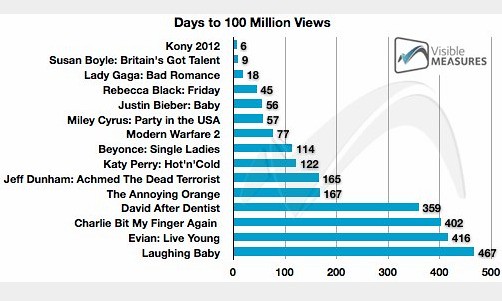
    In under a week, it garnered 100 million views, outpacing Susan Boyle’s audition on Britain’s Got Talent and even “David After Dentist.” The difference between this viral video and others is that it has compelled watchers to act in a way that involves more than just forwarding a link.

    According to Invisible Children, the goal of the film is “to make Joseph Kony famous, not to celebrate him, but to raise support for his arrest and set a precedent for international justice.” To achieve this, the organization took an unconventional approach. Not only does their marketing campaign include the use of a viral documentary, but also it encourages supporters to take action.

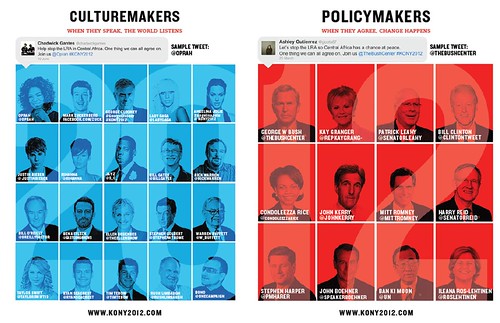
    In addition to sharing the video on their own social media networks, viewers were asked to appeal to 20 “culturemakers” like Bill Gates, Mark Zuckerberg, Lada Gaga, and George Clooney and 12 policymakers like Bill Clinton, John Boehner, and Condoleezza Rice do the same. Celebrities including Oprah, Ryan Seacrest, Rihanna, Justin Bieber, and Kim Kardashian all tweeted about the video to their millions of followers, taking the campaign’s virality to a whole new level. According to research conducted by the Pew Research Center’s Internet & American Life Project, over 5.4 million tweets referencing Kony 2012 were posted in the week after it went live.


    Click through for full image

    Becoming an overnight phenomenon, however, was not without its drawbacks. The increased attention for the cause brought with it an increased scrutiny for the organization. Criticisms came from a variety of sources and included everything from oversimplifying the issue to the more serious charge of presenting misleading information.

    To make matters worse, following a couple of especially high-profile weeks, Invisible Children co-founder and Kony 2012 filmmaker Jason Russell experienced a very public meltdown, drawing even more negative interest to the organization. Even with the critiques of the video and the ensuing PR nightmare, the marketing impact of the campaign can’t be denied.

    The sway of social media influenced millions of people to act, which has not only led to an increased awareness of the situation, but also has resulted in U.S. lawmakers making a political effort. In mid-March, a resolution was introduced in the House that would increase the number of regional forces in Africa to protect civilians and place restrictions on those supporting Kony. Shortly thereafter, another resolution was introduced in the Senate that would support ongoing international efforts to remove Kony and boost U.S. mobility, intelligence, and logistical support of regional forces pursuing Kony.

    In addition to achieving their goal of effecting change, Invisible Children’s utilization of an innovative, viral marketing campaign, also had the added benefit of increased brand recognition. The video directed viewers to their website, where supporters could purchase merchandise and download an “Action Kit,” which includes two posters that can be printed and plastered around the U.S. on April 20, as part of their “Cover the Night” event.

    A mere month ago, most people would not have been able to tell you anything about Joseph Kony, much less Invisible Children. Now, both are practically household names. In an effort to make Kony famous, Invisible Children became famous, too. It was a clever marketing tactic that, despite some extremely damaging PR, continues to benefit both the cause and the organization.