If you’ve been perusing the Search Marketing blogosphere, you no doubt heard the big news from Google today. If not, we’re here to give you the skinny on Google+ Local. What it means for you, how to prepare, and how this will change the local scene forever.
Long story short: Say goodbye to Google Places, and say hello to Google+ Local. It’s long been rumoured that Google would soon integrate the two, creating a more social experience for local search. So, what’s included in the update?
First, you can still access and manage your business in the Google Places LBC, and all of the user-generated content that exists there currently will be pulled over, e.g. reviews and photos. The content will display as coming from “A Google User” until you migrate them from your old Places page to Google+ Local.
You’ll also have the ability to decide which user content displays publicly and what remains privately attributed to “A Google User.”
Next, you may have read way back in September 2011 that Google acquired Zagat, the local reviews juggernaut. Now we all know why. Not only will Zagat’s reviews be brought over to Google+ Local, but their trusted 30-point rating system will now replace the measly 5 star system used in Places. This will enable users to provide a more personal experience than the previous system, with the ability to rate specific aspects such as food, atmosphere, and service.
OpenTable has also been integrated into the listing, where users can reserve a table directly from applicable Google+ Local business pages.
Another big change is that Google+ Local Pages will be indexed, according to Search Engine Land.
From a user standpoint, the new pages provide a much more social experience. They’ll be able to search for business reviews made by those within their circles, which adds much more trust than those from faceless strangers.
What does all this mean for the small business owner? It will place even more importance on having a clean Google+ page that is consistent across the board, and well-integrated with your site using authorship markup. Google+ Local makes reviews and photos more integral than ever before.
All these changes are allowing Google to get a much needed leg up over Facebook, Twitter, and Yelp. The “Local” tab will appear in your Google+ business page, and all of the listings will be available across Google organic search, maps, mobile, and Google+. For now the mobile look has already come to the Android phones but iPhone users will be able to start seeing these changes as soon as it’s approved by Apple.
If there’s one thing you should take out of this post it’s this: If you don’t have a Google+ page for your business yet, you better get to work ASAP. For a quick and easy guide on how to best create one, download our ebook.
This blog was written in collaboration with Tina Hua.
Much to the dismay of many morning paper readers, the technological media revolution has claimed another victim. Starting in the fall, New Orleans’s Pulitzer Prize-winning paper is dropping to a 3-weekday format, following other Southern papers owned by Advance Publications. However, the future might not be so bleak: web content gives the Times-Picayune writers constant work divorced from a traditional publishing schedule, and the frantic pace of online writing can cover stories effectively as they happen. We mourn the losses, but are hopeful for the future of the paper and online publication from traditional media.
Google recently gave advertisers a new research and diagnosis tool. AdWords advertisers now don’t need to go to a third-party site like SpyFu or KeywordSpy to figure out who is playing in their schoolyard. Now, Auction Insights shows how often your site shows above or below your competitors in the ad auction for a given keyword. Not only does this let you see what keywords have less competition, it also shows how well you’re doing in that competition. No new data is released, but the presentation of the information makes it a critical new tool for AdWords advertisers.
Yahoo has (sort of) joined the browser world, expanding in a Browser add-on and mobile app called Axis. This visual search and mobile browser attractively displays thumbnails of websites and images, allowing you to immediately see what you’re looking for and make the decision. A small hiccup early on was a security issue on Chrome, but after that, the product has received generally positive reviews and may end up being a killer app from an aging web portal scrambling to find its niche.
PinAlerts merges the worlds of Google Alerts and Pinterest. It emails you if your site gets pinned, letting you get more from the emerging social media sites. It also lets you identify target markets, figure out what goes viral, and check on competitor sites. Pinterest marketing is an up-and-comer in today’s social media landscape, and PinAlerts is a full-fledged tool for anyone interested in taking advantage of the fledgling image sharing site.
Earlier this month, Google Analytics expanded its social reporting, allowing you to see interactions about your site on social media networks that are a part of the Social Data Hub, a subset of social media sites that provide more data to Analytics. This new report allows you to see what exactly people across a wide swath of social media sites are doing with your posts. Saving links on Delicious, +1ing your post, trackbacks, ReadItLater, and Digg votes can be seen with these reports, letting you see exactly what people are doing with your pages.
It’s not only the cyberflâneurs that are the sources of invention for internet marketers. Music composition’s relationship to internet marketing seems like it would be improbable at best. Our world is one of visitor data and consumer behavior, conversion optimization and backlink profiles; how can that compare to harmonic keys and pitch classes, orchestral balance and melodic diminution? Even more so, how could the abstract world of Crumb’s graphic scores, Cage’s triple-tacet-threat, and Stockhausen’s helicopters be at all relevant to anything but the most strained of SEO metaphors?
The most basic concepts in music, those of theory, melody, and harmony, are directly applicable to marketing simply by recontextualizing the subject matter. Theory, the arena of blogs and papers, is at the core of internet marketing: what ought to be an optimized page? Where do forms go on a page for optimal conversion rate? Where should backlinks be from? Theory is both proscriptive and descriptive, guiding our actions while we use it to describe where we break from convention. SEO “rules” are distilled from testing and tweaking, but are maxims that often fall flat when deeply or individually investigated.
Similarly, diminution and augmentation of melody can be seen in advertisement copy, where small changes build to a radically different resonance of message. The long tail can be seen as one moves from an unornamented ii-V-I progression to “Rhythm Changes” to “Giant Steps.” Orchestration is unadulterated multiple attribution, where a brand PPC campaign adds the mezzo-forte piccolo over the booming brass section of offline advertising. These are simple comparisons, easily made as the underlying concepts apply to most pseudoscientific arts. But it’s from these three composers, Crumb, Cage, and Stockhausen, already very much the old guard of the avant scene, that an internet marketer can glean some important lessons for their own craft.
Graphic Scores: Infographics for Music Nerds
George Crumb, one of the most famous postwar composers, was a master of what some classical fans deride as “noise.” Regardless of the actual music, which is as beautiful as it is haunting, one of Crumb’s hallmarks is in his scores, which are often far removed from the staid black dots on parallel staves that are the default of much Western notation. One of the more striking examples is here, from Black Angels.
Infographics are one of the most common forms of viral marketing. They show complex, even opaque ideas in a way that truly makes it easier to understand. But it’s really about how “good” it looks. Is the infographic unique, showing the reader something that they wanted to know, and in a way that highlights the most important parts? Note how Crumb brings in and builds out the individual parts, gliding them together with elisions and separating them with breaks — this guides the music as well, giving shape to the overall end product while making a spectacle for the reader of the music and the musician.
But it’s not just Crumb’s design qualities that are meaningful to an SEO — this concept of highlighting through design should be at the core of any data presentation. At the start of every reporting cycle, businesses receive lists of data from their SEO. These reports should be focused on what information is most important: your return on investment. As we create these reports, it’s tempting to add graphs and other visual candy.
John Cage is a bit of a hot-button composer for many classical fans. Certainly, his work with Sun Ra is interesting, his Water Walk is a landmark piece of television, and his Sonatas for Prepared Piano are skilled miniatures. Regardless, he’ll forever be known for his 4’33” — a piece not quite that long that consists of complete silence.
Cage’s piece calls for “any instrument or group of instruments” to have a piece of three movements that each only includes the instructions “be quiet.” While one can view this piece, and others, as simple trolling or nose-thumbing, the piece explores the far limits of minimalism in music. Two lessons can be learned from this experiment: one of background noise and one of removal of the unnecessary.
Background noise is a key concept within SEO. It’s the long long tail, the organic traffic that even a totally un-optimized site with no backlinks will get. It’s also the fuzz in the data-driven world in which we work. How can you explain the value of someone who takes not only paid, organic, and direct channels, but converts on a seemingly random keyword? Multiple-attribution models try to clear the fog, but ultimately, you just have to bask in the glory of holistic website promotion and enjoy, much like the uncomfortable clearing of throats that are one of the focuses of 4’33”.
The other lesson, one of questioning what is necessary, is one of the hallmarks of projects like The Open Algorithm, an up-and-coming blog that tries to test the more well-established mantras of SEO. This willingness to strip away what is extraneous (in Cage’s world, even the music at the concert) in order to see what makes the experience meaningful creates a system that is simultaneously simple and focused. Try, as the Open Algorithm suggests, ranking without on-page factors or even links, the most basic SEO currency. Try removing even seemingly important items to get to the core of what you’re really doing.
Helicopter Quartet: Experimentation and Vision
Removing aspects to get to the pure core of your art is a great experiment; however, it’s not just the removal that helps. Karlheinz Stockhausen, one of the most famous of the Darmstadt school of composition, is a Colossus of experimentation. His early use of electronics in pieces such as Song of the Children, his Wagnerian gesamtkunstwerk of his Light cycle, and his fascination with the drones and pitter-patter of voices in Stimmung all show a desire to play with his craft.
One extreme example of this experimentation is his Helicopter Quartet, which combines spoken word, electric instruments, and the drone of helicopters to create his own vision of Vietnam. While the specifics don’t matter much, one can easily see that there is a spirit unlike the explicit minimalism of Cage which seeks something beyond the pale. It’s this experimentation that every SEO should revel in, expanding their skills beyond just 10 blue links and entering into rich snippets, post-Venice local SEO, or ranking via other methods like social marks. Beyond simple experimentation, the value of trying new things brings out a new vision of SEO, one not far from the “inbound marketing” of Moz and HubSpot — one of a holistic look at website promotion.
This new vision is the driving force behind all these composers. It was not hubris that led Ornette Coleman to call his first major album “The Shape of Jazz to Come.” It was the whole zeitgeist of the first wave of post-modernists. They were trying to blaze a new trail while remaining cognizant of their forebearers. Similarly, an SEO can take that attitude and apply it to their personal brand of marketing. Experimentation is the only way to best determine what can and can’t be successful, and even in this supposedly dark time of Pandas and Penguins all paths are open.
History: What Battles Have Already Been Fought?
All these composers are brilliant stars of a former era. New composers, like post-minimalist Nico Mulhy, Radiohead guitarist Johnny Greenwood, and band geek Eric Whitacre built upon Stockhausen, Cage, and Crumb. But even the revered composers knew what had come before. Stockhausen had the computer work of Millard Puckette, Cage had the ur-noisemaker Futurists, and Crumb had the Ars Nova style. SEOs have years of blog posts, books, and personal experiences to draw from, allowing them to worry more or less than the common din about a given industry development. SEO By The Sea, which hones in on the abstract world of search engine patents, understands this, citing 5- and 10-year-old patents that are the talk of the town today. Search Engine Land understands it too, drawing on almost two decades of experience working in the field to color his commentary less alarmist than others’.
Crumb again gives us a striking example upon which to expand — why reinvent what already has a long history? There’s usually little reason to backtrack when other have done existing research in the field. Academics know this, and spend much of their papers talking about already-extant data on their subjects. For SEOs, this means voracious reading, not only of superstars, but also of the little guys. It wasn’t a cursory look that showed Crumb this piece from the 1400s:
Compare this to his works above; it’s clear he’s simply following centuries-old footsteps to a totally different end point. Similarly, SEOs can walk the paths of links and social shares while still innovating.
Looking across disciplines can help give any marketer a little perspective and insight — what subjects have influenced your outlook?
A few months ago, I wrote a blog post about the difference between comScore’s organic search market share numbers and what I’ve seen in Google Analytics accounts over the years. In the numbers I’ve seen, Google’s share of search was always much more dominant than the approximately 65% market share reported by comScore.
So, what does comScore say this time?
In the graph above, you will see that Google, Bing and Yahoo had 66%, 15% and 14% of the search market share respectively in February 2012 (read the official report here).
For a little background on the comScore numbers, you can consult my previous blog post or check out their official word here, but as I’ve said before, they seem to go to incredible lengths to get valid, representative data — unlike me, who just has a spreadsheet featuring data from 69 websites.
Last time, I speculated that the inflated organic search visits from Google that I observed could have been due to traffic from Search Influence, since everyone here uses Google and we’re always viewing SERPs relevant to our clients (and likely clicking without regard). Since then, we have installed filters on every Analytics account that blocks data collection from Search Influence’s static IP address. In spite of this, the results were pretty much the same.
We no longer have access to 4 of the 73 (a random number… you get tired after 73 exports) Analytics accounts that we had access to in September of 2011. In spite of that, we still have an approximately 450,000 visit sample, and the sites that we lost were a very small percentage of the visits from last time. Out of that many visits, in a wide variety of industries, Google has an 88% share of search.
Why? DOES ANYONE KNOW WHY!? I still don’t know. I do believe that the comScore numbers are probably accurate, but I can’t think of many reasons outside of coincidence that our numbers differ from theirs so much. Maybe Google under-reports referrals from other search engines? Maybe we optimize solely based on Google results and our clients rank best in Google, therefore we don’t get a representative share of visits from Bing and Yahoo? That would ostensibly seem to hold water, but there are very few differences in SEO for Bing and Google that I know of.
The data is from Feb 1, 2012 – March 2, 2012 (to match the number of days of the September data). As you can see below, directories, health and beauty and non-profit make up a significant portion of the industries represented. Even if you remove the directories data from the mix, though, the numbers are approximately the same.
So once again, does anyone have any ideas why this information doesn’t mesh with comScore reporting? I’d truly love to hear your feedback on this issue. If anyone has any data they would like to contribute, that would be great — but even better would be a tool to extract GA data on a massive scale so that we could have more representative information.
Over the past couple of months, there has been a great deal of hysteria surrounding the unnatural link warnings being sent out in Google Webmaster Tools. These warnings and the release of Google’s Penguin update mean that now is definitely the time to start trying to “act natural” with your link-building methods. While I don’t have any major revelations about this alarming issue, I have been following it rather closely and have some informative posts on the subject to share.
Barry Schwartz’s article at Search Engine Land was interesting because it contains some insight from a Google spokesperson about the warnings people are receiving in Google Webmaster Tools. The spokesman says rather than it just being the effects of Google going after paid blog/link networks, it is Google choosing to report about these issues more so than in the past.
Carson Ward’s post on SEOmoz was especially insightful as it was from the point of view of a self-identified reformed link network spammer. This post gives a highly thorough run down of paid blog networks and identifying posts from them, the webmaster tools unnatural link warning and the best way to apply for reinclusion, and basic advice on how to build a more natural link profile going forward.
Norma Rickman’s post at redmenacemarketing.com has a message of staying calm and chugging along. It goes a bit further in the advice for building a natural link profile by detailing several safer sources of link building. Her ideas on using sources like social bookmarking, Youtube, and guest posting on blogs while maintaining a diverse set of anchor texts are definitely something to take a look at.
While there are many more great posts out there on this subject, I felt that many of them had too much of an alarmist tone to them. It is true that these warnings are cause for any webmaster to be alarmed but it doesn’t mean that panic and overreacting should occur. The best thing that you can do if you are currently dealing with the unnatural link warning issue is to keep a clear head. Do some research and try to get a broad understanding of the situation and how to tackle it before starting the sky-is-falling routine.
If you surf the Internet casually, you probably don’t particularly care what browser you use. Internet Explorer is the default on most people’s computers, and friends I love dearly and don’t judge have told me they just don’t feel like downloading and installing a new browser. Laziness is also probably the same reason people don’t upgrade their browsers, though if you’ve managed to avoid upgrading Internet Explorer 6 for the last decade, I’m going to assume you don’t actually use the Internet (or your computer) for much of anything at all.
But for people who make and play with sites, an elderly browser can create massive design headaches. The people who hate IE6 the most are website programmers. The quality assurance department that has to send tasks back to the worktable because of IE6 also hate it. And really, on some transcendental level, everything that has gone extinct because of natural selection should resent it, because IE6 is proof that people are willing and capable of prolonging the lifespan of something that, left in the wild, probably would’ve died out.
But I digress.
Every website programmer who works for a company has probably had to, at one point or another, spend a stupid amount of time on an IE6-specific fix, because, in social terms, IE6 is not hip or relevant. It doesn’t understand the new terminology and slang that younger browsers bandy about with ease. It does the best it can, but it needs to be catered to and pampered. It needs its own stylesheet (those other browsers can share one), and in the world of IE6, those darn tootin’ whippersnappers can just go fly a kite; IE6 will be IE6, and it’s way too late to teach an old dog new tricks.
Because — and here’s the shocker — if you teach it new tricks… it upgrades to IE7.
So are we going to whine IE6 into submission?
The thing is about angry programmers is that they can come up with spiteful, vengeful solutions. Recently, I found a WordPress plugin that will intentionally crash a person’s browsing session if he is using IE6; while that titillates the seething jerk itching under my skin, it’s a fairly invasive and unprofessional response to someone’s personal preference. Nobody can MAKE anybody upgrade their browser, no matter how frustrating it may be to walk by and see a stodgy citizen cautiously wading through the Internet one slow click at a time.
So the real answer is this: let them do as they will. Let them use their antiquated browsers to their heart’s content.
But let the companies and powers that shape the Internet stop enabling them. We need to be more selective when deciding to put unnecessary programming time into making an site Internet Explorer 6 friendly. Unless your site caters to clientele who are apt to stick to IE6 and older browsers, you may be wasting time and money for your web designers and yourself.
Let’s take a look at a site’s analytics and see if it was worth the hour spent here and there on Internet Explorer specific fixes.
Look at the numbers to make your decision.
We’re looking at a total of 907 visits to this website. We would like to note that 22 people were using Internet Explorer 6. We don’t want to discount that ONLY 22 people took a gander at the site; all 22 could end up being paying clients, and that could (though unlikely) be better than the traffic from other browsers.
Now let’s take a look at the average amount of time those 22 people actually spent on the website.
Yes. You are seeing that the 22 people who were using Internet Explorer 6 to visit your website stayed on average 5 seconds. That’s about enough time to look at your home page and decide that it’s just not their cup of tea.
There’s admittedly the chance that this site has not been configured to be functional in IE6 and that the confusing mess turned these visitors away (though, just to be honest and more vindicative, that possibility doesn’t hold true in this case because I worked on this site and it looks fabulous in IE6). But if you end up getting billed for even just two hours on IE6-specific fixes, you’re probably not really benefiting from the work.
And look. Really look. IE6 can’t render pretty things.
Other things that will probably sway your decision to support IE6 or not is that Google and YouTube don’t want to old browsers — that is, not just IE6, but outdated versions of Mozilla as well. This means that eventually, Google Maps and Youtube videos will not load well (or at all) in outdated browsers. With no directions or videos to idle the time away, maybe they’ll give in to the inevitable and finally upgrade.
IE6 also does not support transparency for PNG images, and if you created your site images recently with Mac, you may have those all over your site. If you’re really concerned about making your site beautiful in IE6, you might have to consider spending some extra time to have all your images switched over to old-school (and lower-quality) GIFs, or spend even more time on hacks and fixes that aren’t really worth the headache.
Making your site functional in IE6 may not take a lot of time, and if your code is sensible and clean from the start, you may never really have to worry about a massive failure. However, if your site is old, or multiple people with completely different styles have worked on it, or if you want to dandy your site up with all the fancy, flashy toys of today, you may end up with a fantastic mess that’ll take a lot of time and effort to fix… in just one browser, for 22 people, who only looked at your site for 5 seconds.
Take the time to research your audience. Decide if IE6 is a priority. And if it isn’t, please — save yourself some money and effort, and let your web designers do something more impactful with their time.
Getting Google Adwords Certified can be an invaluable update to your resume. Why? With this professional SEO accreditation, you’re making sure you’re doing everything you can to increase your worth to your clients or company.
Whether you are planning to start a paid search campaign for your business or if you’re just trying to understand what your PPC manager is always talking about, Adwords certification is an extremely beneficial feather in your cap. However, don’t think you can just roll out of bed, think “I’ll get certified today!” and pass the test with ease.
To officially become Google Adwords Certified, you must pass both the Advertising Fundamentals exam and one advanced-level exam. Everyone on the account management team here at Search Influence has decided to take on the challenge to get individually certified. Luckily we have two Google Adwords gurus, Anthony Coleman and Doug Thomas, to answer our never-ending questions while studying.
To make studying easier, Google has set up a Google AdWords Certification Program Learning Center, where you can find “lesson plans” for each Google Adword exam. Reading all the chapters (from start to finish) for each exam may be a bit time-consuming, but very worth it. I highly recommend the interactive e-learning lessons that are scattered throughout the chapters. Most e-learning lessons have quizzes to test your knowledge before taking the actual exam.
The first test is 113 questions with 1 hour and 30 minutes to complete the exam. You must get an 85% on the first test, which cost $50, and you must pass the first exam before moving on to the advanced. After passing the exams, you are certified for two years. Don’t worry if you don’t pass the exam the first time: you can always retake it. However, you must pay the $50 fee each time.
VS
You can become a qualified individual or a qualified company within the Google Professional Certification program. To qualify for an Individual Certification, you must pass both the Fundamentals exam and one of the three advanced exams. Also, you must accept the program Terms and Conditions (which happens automatically by enrolling in the program). Also, there is no minimum spend requirement to be Individually Qualified.
Doug and Anthony have already qualified Search Influence for a Company Certification. To qualify for a Company Certification, a company must have managed at least a $10,000 spend over 90 days, starting the day the AdWords account is linked to the My Client Center. The company must have at least one individually qualified employee and accept the program Terms and Conditions.
The Google Partner Search tool helps potential advertisers find a Certified AdWords Professional. People enter their estimated budget, along with the type of help they need, then Google compiles a list of certified professionals. Certified Partners receive a badge showing their qualification, while those who are Individually Qualified receive a certificate when they pass the necessary exams.
Tips for Taking the Exam
• Study. This is easy to put off, but during the exam you’ll be asked a question that you would only know if you read the exam learning materials. Luckily, the study materials are broken out according to which exams they’re covered on.
• Take the exam in a quiet area with no distractions. Get out of the house with no family, pets or TV shows to divert your focus from the exam.
• You cannot access any other part of your computer until you have completed the exam. Make sure you save and close everything you have open on your computer because once you start the test, it blocks you out of everything and you can’t pause the timer on the exam.
• One beneficial feature about the exam is that you can mark questions for review and come back to them later. I loved this because if I didn’t know the answer to a question, I marked it for review and moved on to the next.
Google is a tricky minx. I noticed when taking the first exam that some questions have multiple right answers, but Google wants you to choose the best right answer. Watch out for those questions and always go with your gut feeling.
You can sign up here to take the exam. Good luck!
SEO largely depends upon undisclosed and constantly evolving criteria for page authority, making it inherently unpredictable. Google makes the rules; the industry responds accordingly.
Local results in the SERPs exemplify this. Whether they appear, as well as how they appear, is entirely at Google’s discretion. That being said, Google’s discretion is sufficiently discreet in most instances. Furthermore, most people pay more attention to local results in the SERPs than they do to organic ones, which vindicates their prominence. However, local can get pretty sloppy sometimes. Unrelated businesses weasel into the results here and there.
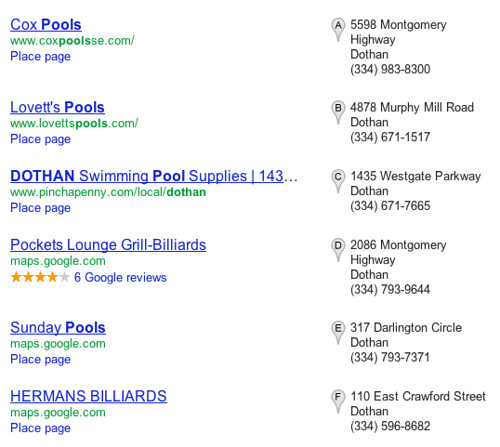
I recently saw a meaty example of this in a 7-pack for the term “pools dothan al.” By virtually all measures, that is an unremarkable keyword. I was understandably not expecting anything noteworthy.
Primarily, the businesses in the aforementioned 7-pack sell and install pools, but a couple listings are for billiards halls. Pool is a homonym, which makes it difficult for Google to distinguish which “pool” a user is looking for. Regardless, I would guess exactly 0 people in Dothan, AL are looking to play some “pools” at the local bar this weekend.
This made me realize what problems homonyms and homographs create for local search. For example, take the keyword “bank” and the location Westbank, a suburb of New Orleans. If I search for “westbank bank,” no relevant local results appear. If I then click on the Maps tab from that same results page, Google drops me onto a Wendy’s in Iowa. I’m sure there are a million other similarly dysfunctional examples; that’s just the first that came to mind. Joseph, our Maps guy, noticed a strip club twerked its way into the 7-pack for “new orleans pools”. But I digress.
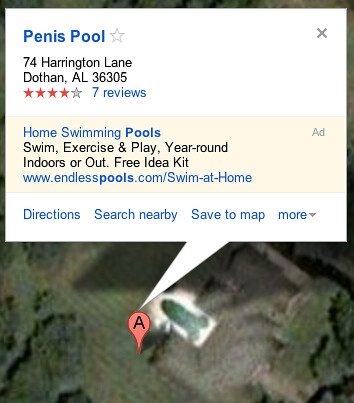
What really caught my eye in these results was a listing titled Penis Pool. Yep. Penis Pool. I’ve seen plenty of features sophomorically revised in Mapmaker before (for example, one enterprising young cartographer removed the J from a feature previously titled Janus Automation), but I’ve never seen a Place page like that.
I was very curious how Penis Pool snuck its way into the bottom of the 7-pack. I asked a few people to check it out, and Joseph quickly pointed out that the pool does in fact show up on the satellite view. Once I saw it, I couldn’t really disagree with the name or Penis Pool’s status as a landmark in Dothan.
How did this happen? Presumably, somebody spotted this on the map, added a Place page, and subsequently shared it with all of their friends. Glowing reviews ensued and the link eventually found its way to a few different blogs. Considering this cannot be an especially competitive field in a very small town, Penis Pool’s local authority grew into a veritable Leviathan, and perhaps even rudely whipped some other business out of the rankings.
Should you be worried about a Penis Pool near you? Maybe. It is safe to say the internet’s propensity for wiener jokes > your local SEO efforts. With the right mix, it’s easy to imagine similar examples popping up elsewhere. Just hope nobody starts digging a phallic-shaped pool in your city.
Over the past year, we’ve been fielding many questions related to mobile websites — and specifically mobile site SEO. Should I get a mobile site? Where do I get a mobile site? Will a mobile site bring me more business? How will a mobile site affect my SEO?
In the midst of working on some mobile site specific tasks this week, I also happened to be doing some online browsing / shopping on my mobile device (iPhone 4).
I went furniture shopping yesterday evening (you know, at a real store) and found a piece of furniture that I liked.
Later, I went on my phone, and instead of going straight to Pier 1’s site and navigating through all the other pieces of furniture, I went to Google, as most users tend to do these days out of convenience, and typed in “Pier 1 Mia Headboard” — I was thrilled to see a search result that would lead me straight to the product page.
I clicked on the result, and was let down when I was rerouted to the home page of their mobile site.
It’s no surprise they are looking to hire an SEO Specialist… too bad the job posting on LinkedIn doesn’t call for someone with mobile site experience.
On the other hand, I was also looking for Crate and Barrel bedding and did a similar search on Google.
When I clicked on the result, I was pleased to be immediately taken to the correct section on the site.
How can you be sure your mobile site is search engine friendly? There are a couple of different technical approaches to making mobile SEO happen, so stay tuned for a blog from the great Doug Thomas on how you can make it work best.
Have any examples of good or bad mobile sites that you love, or love to hate? Share with us! We just might use it in a future post on mobile website SEO!
Virtual offices have many uses. They are great for having a professional space to meet a client when you don’t have an office in the area. They can also be really useful if you are searching for a permanent office space and need somewhere to get business done in the meantime. However, using a virtual office address in a Google Places business listing is not something that will benefit your business. In fact, this practice technically goes against Google’s guidelines and could end up hurting your rankings in the long run.
According to Google, there is only supposed to be one business under the same address in Google Places. This isn’t an issue if each business at that address has a different suite number as they would in a traditional office complex. The issue with the majority of virtual offices is that, in order to keep the cost low, they assign all businesses the same address and suite number. This is where the problem with virtual offices truly lies: their ubiquity.
Virtual offices have become a popular way to, in essence, spam Google Places. Want to rank for Phoenix but your office is actually in Mesa? Not a problem; simply do a search for “Mesa virtual office” and with $100 and 30 minutes you can have your very own prime downtown address to use. Sound like a great deal, right? It should. In fact, some virtual office companies are using this as a selling point. However, as with many great deals, this one is just too good to be true.
Just as Google caught on to businesses buying UPS store P.O. boxes and using the store’s address as their own, it is catching on to virtual offices. When the virtual office provider is the first result to come up when searching for the virtual office address, it isn’t hard for Google to create an algorithm that can connect the dots. Not to mention there are a host of Google reviewers out there that are quick to flag a Places page that they believe to be associated with a virtual office.
Another thing to keep in mind when considering using a virtual office address for your business’s Places page is the fact that Google Places often merges different business’s listings together. This can happen to businesses that are across town from each other but might happen to have a similar name, phone number or even their profession. This common issue poses a significant problem for businesses that choose to use a virtual office address for their Places page. For instance, I’ve seen one law firm’s Places page share the same exact address and suite number with the Places pages of 17 other businesses. Some of them were other lawyers that would (or at least should) be attempting to rank locally for the same key phrases. Even the virtual office company itself had a Places page using that same exact address. This is common, especially for virtual offices with prominent addresses in large cities. It wouldn’t take much for Google to mix up information with so many businesses, some quite similar, sharing the same address.
Then again, maybe you could get away with it. Your business could end up being the exception and slip past the eyes of the spam watchdogs. Maybe your listing will beat the odds and stay free of merged information. But eventually, just as Google has done many times before, they will come out with an update targeted at the crack that your business happened to slip through.


 We’re back with another 5 for Friday, a collection of the freshest and tastiest SEO news stories, blogs and recommendations from across the web!
 Crumb again gives us a striking example upon which to expand — why reinvent what already has a long history? There’s usually little reason to backtrack when other have done existing research in the field. Academics know this, and spend much of their papers talking about already-extant data on their subjects. For SEOs, this means voracious reading, not only of superstars, but also of the little guys. It wasn’t a cursory look that showed Crumb this piece from the 1400s:


 If you surf the Internet casually, you probably don’t particularly care what browser you use. Internet Explorer is the default on most people’s computers, and friends I love dearly and don’t judge have told me they just don’t feel like downloading and installing a new browser. Laziness is also probably the same reason people don’t upgrade their browsers, though if you’ve managed to avoid upgrading Internet Explorer 6 for the last decade, I’m going to assume you don’t actually use the Internet (or your computer) for much of anything at all.


 Whether you are planning to start a paid search campaign for your business or if you’re just trying to understand what your PPC manager is always talking about, Adwords certification is an extremely beneficial feather in your cap. However, don’t think you can just roll out of bed, think “I’ll get certified today!” and pass the test with ease.
 VS
VS




 Virtual offices have many uses. They are great for having a professional space to meet a client when you don’t have an office in the area. They can also be really useful if you are searching for a permanent office space and need somewhere to get business done in the meantime. However, using a virtual office address in a Google Places business listing is not something that will benefit your business. In fact, this practice technically goes against Google’s guidelines and could end up hurting your rankings in the long run.