Category: SEO

  • Interview with Cracked Columnist John Cheese

    Cracked Columnist John Cheese
    John Cheese talks SEO

    Cracked columnist and longtime internet comedy writer John Cheese put out a call for interviews recently, and I jumped at the chance to talk to him. Out of all the writers on Cracked, a site I have been fairly addicted to since about 2007, John Cheese has probably spent the most time eloquently weaving his own life experiences into his always funny and often moving columns.

    John ended up really driving home a rather simple yet all-encompassing idea that we have adopted as a mantra at Search Influence: fresh content is king. It really doesn’t matter whether you are advertising a novel, a list-based comedy site, or a small business anywhere in the world – if you can produce quality content that people find interesting on a regular basis, everything else will fall into place. It doesn’t hurt if you are as insightful, funny, and talented as John is either.

    Take a look at the results of my email interview with John Cheese:

    (more…)

  • Google’s “Search Plus Your World” Combines Social, Personal, and Personalized Algorithms

    Google's Search Plus Your World ExampleGoogle search results have been getting more and more personalized since the introduction of personal results in 2005, but the search engine giant’s newest feature takes on your entire world.

    The new “Search Plus Your World” feature effectively erases the lines between standard search results, hits from social sites like Google+, search results that have been shaped by your personal search history, and results that are targeted at you personally.

    Sound to you like Google is tightening its grip on your online life? You may not be entirely wrong. This update, while ostensibly making strides to personalize your entire interaction with what is still essentially a massive online question and answer service, collapses most of the walls that have always existed between social media and the wilds of the internet.

    But only for you, apparently.

    The Google You See

    Search Plus Your World draws from not only the internet in general, but also from the pool of private online information that you or your friends have shared. So if someone in one of your Google+ Circles shares a picture of you, say, wearing an oversized sombrero, that image is likely to pop up in your search results the next time you search for “Cinco de Mayo.”

    Why? Because that picture is tied to you on Google+. It doesn’t even matter if that picture is only shared on a limited basis to five members of your circle – it may still show up in your search and the search results of anyone else you are connected to online.

    But here’s the really important part that may or may not help Google skirt what appear to be serious issues with sharing personal data: just because you and the people you have connections with see that picture doesn’t mean that it has been shared globally online.

    Now, that may come as cold comfort to someone whose boss is in one of their Google+ Circles if the boss just found out that the sombrero wearing employee wasn’t really sick with the flu on May 5th  and 6th, but the fact is that the picture will remain shared on a limited basis, as its settings on Google+ stipulate.

    So you may end up sharing more than you wanted to, but only to people you are connected to online. And none of us have Google+ or Facebook friends we’ve never met, right? We certainly all know every one of our Twitter followers, right? Right?

    But SEO Personalization is still a Good Thing

    Potential party related privacy issues aside, this update still represents a leap forward in personalizing your Internet experience. When you asked Jeeves for the name of a bicycle shop in 1998, he didn’t know or care that you were in New Orleans and not New York, at least not to the extent that Google does now.

    I’d argue that most of the advances Google has made in the realm of personalized searching have faded into the background rather than sparking outrage in the average user. Seriously, when is the last time you have given up a Google search in exasperation because 30 minutes of searching resulted in exactly zero relevant results? Five years ago? Ten?

    So while things that you have shared with friends may start popping up in what promises to be the next generation of ultra-personalized search results from Google, you are also more likely than ever before to find relevant information from every search.

    Just don’t take pictures while wearing silly hats and drinking tequila. And if you do, don’t post them online. You never know who in your circle may be looking.

  • Google’s Paid Links – A Short Lesson for Marketing Clients

    Google Paid Links
    Your Stance on your Internet Marketing
    As first reported by perennial Google watchdog SEOBook, the search engine company has been found using followed paid links for their online marketing, directly in violation of their best practices. Some, including Aaron Wall, see this as further proof of Google’s lack of self-commitment to the values they force on small businesses and other website owners; however, it’s clear that this story’s moral is more far-reaching than simple “Do As I Say, Not As I Do” and even a small business can come away from this story with another case study in outsourcing marketing to a firm.

    The most in-depth coverage is from Search Engine Land, who chronicles the story’s discovery, damage control, resolution, and culmination, giving the interested the whole story and showing Google to be somewhat fair by penalizing themselves. There likely isn’t any intentional foul here — already the Chrome page has a PageRank penalty, dropping it relatively in the SERPs.

    But for the average marketer, the rubbernecking and tin-foil hats are only window-dressing. Underlying this story, like the widespread story from earlier this week about another outsourced marketing fiasco, is the need to ask your marketing company “How are things going?” With both stories, there was a breakdown on the client’s side to check on the day-to-day running of the marketing campaign. For Google, this led to sloppy blog posting guidelines from a company that doesn’t understand the finer points of SEO or user design; for Ocean Marketing, it led to a one-man shop answering hundred of emails becoming frustrated and lashing out.

    Any business letting someone else do their outreach or marketing has to be an active participant. It is not enough to pass the buck, throwing those you’re working with under the bus. The “it’s not me” game played by Google, then Essence Digital, and finally Unruly shows not that the companies are all trying to act in good faith, but that not one of the three companies checked to see if the campaign would do more damage than good.

    Clients of marketing firms: read the copy written for you; it reflects your business. Ask for the guidelines for freelancers and writers; making sure that best practices are mandated, rather than suggested. Avoid bad press for your brand by being involved in the process, making sure that the campaign is following the vision you had when you left the planning meeting. Don’t be Google — be better.

  • Google Evolution Video: The Past, Present and Future of Search

    As a followup to their recently-released peek under the hood, the Google team has produced this video showing the remarkable evolution of their search service. Watch the once-humble engine (check out that MS Word Art logo!) exploding in under fifteen years from plain-text results with a month or more’s lag time between indexes to the omnipresent, light-speed information giant we all know and love today. Since its inception as a tool for data-gathering, Google has taken a keen emphasis on speed of results, with the end goal being an almost “seamless” meld between the user’s query and the answer to such; they’ve also expanded in other dimensions, covering new paradigms such as images, breaking news, and semantic results to help users navigate to the information they’re seeking as efficiently as possible.

    Google has evolved to an almost unthinkable degree of complexity in such a short time — and advances are coming at a breakneck pace, particularly with the social and business opportunities afforded by the introduction of G+. What do you think is next for Google and us?

  • Website Promotion – 7 Common Lies & Misconceptions

    After many conversations with existing and potential clients, I have come to find there are many misconceptions and straight-up lies about our industry. Some of these lies are just bogus and everyone should be aware, so I’ve whipped up this handy guide with explanations!

    7. You cannot make money with social media

    This is simply a lie. Social media can be a great source of revenue. The biggest complaint about social media I often hear is, “I cannot measure the success of social media.” With the use of iFrames and reporting tools, success can now be more easily measured. An iFrame allows us the ability to create a welcome tab on your page that acts like a website, so we can install analytics, implement a form and utilize call tracking to get a detailed and effective overview of what’s going on.

    Social media is the only outlet that allows you to target your proper demographic. Through the use of highly targeted Facebook display ads, we have the ability to put your brand in front of your target audience.  Social media is also one of the easiest and most effective ways to create interaction with your existing and potential customers.  There is no reason you cannot see profits through social media.

    6. SEO is a set-it-and-forget business

    I wish obtaining the best rankings was as easy as that.  I often hear potential clients ask me “Why am I paying for a monthly service?” to which I respond, “Your competition isn’t asleep.”  Much of the work for optimizing a site is done off-site. This comes a shock to many people who believe you can just make a few edits on your site and magically you are now in position 1.

    Yes, having your site speak properly to the keywords that potential customers are searching is very important, but it is not everything. This will not get you to the top position in a competitive industry. Ongoing link building is a key element to the success of any SEO campaign. Google looks at links as a form of “popularity contest” that proves to Google you really do what your site says.

    5. I need a new site before I do any SEO

    We can help almost any site rank, including ones that are not as attractive as others. There are a few exceptions to this rule, such as Flash and templates that do not give you access to the backend management. Many time people believe that their site needs to be “pretty” to rank well, when in reality, it is more about the conversion optimization of your site. This includes prominent display of your phone number and a small form located on every page of your site. Your design has no effect on the organic rankings.

    4. Guaranteed rankings

    Since my email also attached to [email protected], I have the privilege of receiving all of the spammy SEO emails we get on a daily basis. My favorites are the ones that use scare tactics and money back guarantees. These guys are full of it! I recently read one that was trying to make you believe the paid results were part of SEO. Ultimately, the money back gaurantee is just a ploy to get you in the door, give them some money, and sure enough a few months down the road you’ll be calling me cursing everything SEO.  These scammy SEO companies can offer these guarantees by choosing keywords that are so irrelevant there is no search-around and by paying to be on page one.

    Why we not guarantee results? Hint: it isn’t lack of confidence! We would have never been able to earn placement in the INC. 500 (with no sales team!) if we did not produce results. Unfortunately we do not have control of Google; if we did, I would be on a beach enjoying a Mojito right about now. Earlier this month Google made a change to the display of search results.

    3. Article marketing does not work

    I have recently read a number of blog post questioning the effects of using articles as an effective form of obtaining backlinks. For those of you who question the effectiveness, ask any of our clients who are in the top positions for their most popular searches. We have been and continue to use articles as an effective way to obtain backlinks. What doesn’t work is spammy, zero-effort articles with poor-quality or even plagiarized content. We put a great deal of effort into this part of our services and it shows. Article marketing works!

    2. Paid search affects organic rankings

    Paid search results have zero effect on organic rankings. They can not help nor hurt your organic rankings. You can do things to optimize for both organic rankings and paid search rankings, but you cannot affect one without the other.  Its that simple!

    1. TopSEOs.com is a legitimate SEO rankings site

    I won’t mince words: TopSEOs.com is the biggest bunch of bullshit out there. According to their website:

    “The independent authority on search vendors, topseos.com, evaluates and ranks the best in the internet marketing industry. Through in-depth vendor analysis, review of work completed, and client evaluation, we put together a list of the top search engine optimization companies in the industry. Our in-depth analysis delves into a vendor’s business practices and compares them against industry standards to ensure that the work is quality. Often times we connect directly to the clients of a vendor and ask about their overall experience as well as details about the processes, reporting, and success of the campaign.”


    Sound legit, right? Wrong! Companies like Webimax.com pay for their placement in TopSEOs.com so they can tout the fact that they have been ranked “#1” SEO company. Garbage! It’s complete garbage.  For just a few thousand dollars a month Webimax gets to claim to be the “#1 SEO Company in the U.S.” There are many blogs and forums that expose the scam for what it is. Oh yeah, and if you attempt to leave a negative comment about Top SEOs or one of their “valued clients,” they will filter your post to ensure only positive messages can be seen.

    Below are just a handful of resources that expose Top SEOs and Webimax for the scams they are:
    How Top SEO Companies like WebiMax Scam Clients – P.T. Barnum Unique Method
    TopSEOs.com – A Review of the Top SEOs Paid Rating Service – Aaron Wall
    Sphinn.com – Multiple posts about TopSEOs Scam

  • Crossed Over Into… The Nofollow Zone: Livejournal SEO And What Nofollows Mean For You

    It’s been a bit over three years since I’ve used the once-titanic blogging site LiveJournal for anything. LiveJournal’s still got an active community, but it’s true that asking “What’s your LJ name?” of a new acquaintance is a little bit more embarrassing today than it was in 2003. My account’s dead (nah, it’s not on DeadJournal), but every few months, some brave archaeologists attempt to set up some horrible advertisements within the internals of this hibernating brute.

    Here’s one of the emails I got:

    Here we see a knucklehead posting a comment in a misguided attempt at link building. It’s not really the fault of the “spammer” that the link building attempt is for naught: this is an obvious mass-submission. Really, enough sites were probably hit by this submission machine that this message had some kind of benefit, and if so, congratulations to your diet supplements, dude.

    Still, the fact stands that this carpet bombing of links missed its target with any LiveJournal comment fields it was posted on. Not because of LiveJournal’s disabling of HTML-formatted links on anonymous comments, or because this little comment is formatted in BB-code, but because of a little attribute on links that Google doesn’t like:

    After joking with our very own Anthony Coleman about offering “LiveJournal SEO” services at our company, he admitted to researching the viability of this. Sadly or possibly as expected, he said that this was an empty pursuit, letting me know that every external link on LiveJournal is “nofollow,” as depicted and highlighted in the above picture. While my area of expertise in this company does not qualify me to comment on the exact benefit (or lack thereof) a “nofollow” link provides to a page’s rank, such links are certainly less desirable for SEO.

    LiveJournal’s not the only site practicing the nofollow tactic to dissuade would-be spammers: Twitter takes the same approach, and so do the other social media giants. Even so, this doesn’t stop Search Influence from getting our clients a nutritious glass of “link juice” when we put links into our proverbial Juiceman Juicers all around the web. While “LiveJournal SEO” may not be a service that Search Influence will offer anytime in the future, we’ll always hold the site dear to us, and I’d personally like to thank my new pal “Odzywki” for reminding us of the respectable approach that Search Influence takes to SEO.

  • What’s the REAL Organic Search Market Share?

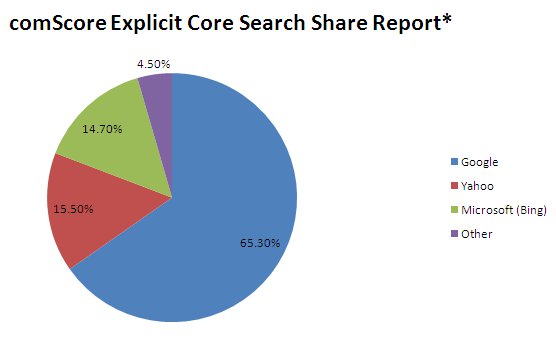
    If you work in interactive marketing, you’re are probably familiar with comScore and its monthly estimate of the United States search market share that consistently looks like the following graph, reflecting data collected September 2011. It’s safe to assume that these numbers apply to the websites that you promote as well, right? Not really.

    comscore search market share for September 2011

    For the past few years, it seems like every dataset that I’ve seen contradicts these market share reports, so I decided to dig a little deeper and see what I can find.

    comScore’s numbers:

    comScore is extremely thorough in its calculations. It obtains this information by installing software on the devices of a large number of paid users, which tracks and records all the searches performed on that device. In the month of September 2011, the company recorded over 17 billion search results. It claims to get data from a variety of users that is representative of the market share of major ISPs in the U.S., but other than that, I’m not sure how they pick users. Either way, 17 billion intuitively seems like a big enough sample to come to firm conclusions.

    My Tiny, but Interesting Dataset

    To find numbers that I thought would be representative of the search engine market share for our clients and sites, I created a custom report in Google Analytics that provides the number of site visits from organic searches, and breaks them down by each particular search engine, over the last month (10/2/11 – 11/1/11). To figure out which sites to use, I exported data for the first 75 sites I found that I was certain were active and received organic search visits. The total number of visits was approximately 350,000, so it’s a relatively small sample. There was one site that I excluded because its total visits exceeded all other sites by 3!

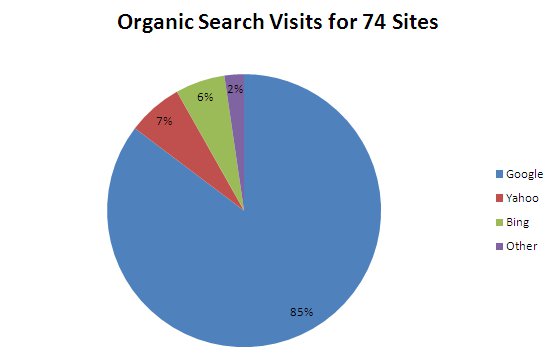
    organic search market share for search influence clients

    As you can see in the chart, Google searches account for a whopping 85% of the organic visits! Like the comScore data, Yahoo and Bing are about even. This is pretty amazing, right? Even though these numbers are too small to make comparisons to the U.S. market share as a whole, the information is representative of Search Influence clients and therefore important to us.

    Industry Segments

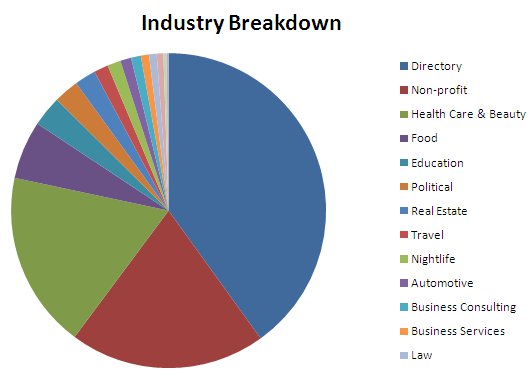
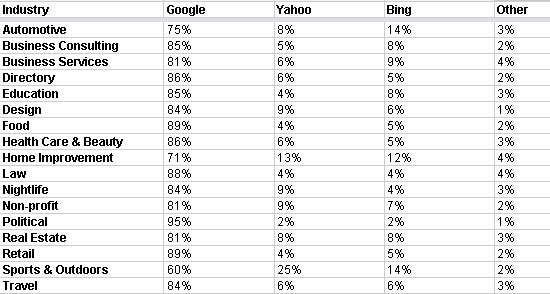
    Most of the sites we looked at are small businesses throughout the country. 40% of the results come from 2 medium sized yellow pages directories–but when you take these two sites out, the share is virtually the same. We also see big numbers from Health Care & Beauty and Non-profit. The Non-profit is actually one large organization and the Health & Beauty segment is mostly composed of dentists and plastic surgeons. Two of the sites included are informational sites that attract national visits. Those two sites alone, which represent about 1% of the total visits in this set, received on average 94% of their organic visits from Google.

    industry breakdown for market share information

    Why the Numbers are Different

    The numbers differ for many possible reasons, but none that I have been able to completely pin down. Obviously the set of websites used here is not representative of sites on the Internet as a whole. Another reason could be that Google inaccurately reports referrals from other search engines, or perhaps small businesses rank better on Google, so our small business clients get more visits from Google. Another factor may be that none of these sites target American users that search in a language other than English. Whatever the case may be, it’s obvious to me that Google has an even bigger impact on our small business clients than the comScore numbers suggest.

    What about you? Feel free to share your data, do a similar study, speculate on these results, or tell me why I’m full o’ bull.

    Oh, and if you’re interested in a more detailed breakdown of the results in a particular industry, here it is. Here is a link to the spreadsheet.

  • Google Places Page Redesign — Local Search Goes Minimalist

    Hot on the heels of big redesigns to a whole suite of Google services, including Docs, Reader and Gmail, searchers will soon see shakeups in the way local listings are displayed on their results pages. Instead of the familiar red pin of Google Maps, searchers looking for businesses matching a given term such as breast augmentation Maryland will now be greeted with a row of grey icons which can be expanded with a click to show a highlighted popout with site preview, map and reviews:

    Google Places results page when no selection is highlighted.
    Results page with mini-Place page expanded.

    This is a noteworthy move for Google Local, given the powerful results that the “red pin” logo has attained over the last few years. The mini-Place Page embedded within search results seems to agree with the growing shift toward minimalism the company has encouraged in its recent redesigns, such as the sleek-and-clean new Google Reader. Additionally, the new system serves an important purpose in helping searchers find the things they’re looking for (location, directions, reviews, pictures and details, et cetera) without actually leaving the SERPs. Google is also making it easier on its searchers to review and edit local places listings by placing a feedback link (visible in the second, expanded screenshot) directly in the foldout, thus helping prevent problems like the infamous potential to mess with competitor’s listings via maliciously reporting a business as “closed.” With this error seemingly remedied or at least remediated, it will be interesting to see if other Google bugs such as the appearance of potentially inappropriate photos on Place pages will be given attention as well.

    Given the increased power of many browsers and the capability offered by new tools such as HTML5, it’s clear that most users’ browsing capabilities can handle the change — but is it an innovative way to get the data you need without having to trawl through multiple unique pages, or a confusing overload of information? What do you think?

  • Local SEOlé!

    Dealing with local SEO from an international perspective can be quite the challenge. And, if you haven’t been keeping up with your Rosetta Stone lessons, it can get ugly fast. But here at Search Influence, we love a good challenge.

    Mexico Local SEOOur current goal is to improve an international client’s local rankings for their collection of Playa del Carmen hotels and condos. Now, if this would have been a U.S. or Canadian based client, I wouldn’t be writing this blog post, but taking local SEO to the land of the Aztecs and the Mayas certainly added a twist of lime to my typical local cocktail. The local SEO landscape of Mexico hasn’t been as thoroughly developed as it’s other North American neighbors. To give you an idea of how uncharted this territory is, Google Maps is still in beta testing for Mexico. This means there is a good deal of room for error, so you have to make sure to bring your A-game.

    First off, a tip for all of my other monolingual buddies out there, learn to love Google Translate. It isn’t 100% accurate, but it makes local SEO in a foreign setting as easy as it can be without being fluent in that particular language.

    Another important tip to keep in mind is that, when dealing with international Google Places listings, make sure to actually be in your client’s country’s version of Google. If you try to list an international business while in the U.S. version of Google Maps, Google will think it is a U.S. based location and will malfunction and place the business somewhere in the U.S.

    The biggest issue with international business listings is actually finding the directories to list the business in. In some cases, tools like Whitespark’s Local Citation Finder can be really helpful in sourcing new directories. Unfortunately, this tool isn’t currently optimized for use with Mexican businesses. Technically. I managed to finagle it into spitting out a few sources for me, but for the most part, I relied on good old-fashioned research skills. And, lucky for you, I’m willing to share a few of the gems that I have found.

    mx.wowcity.com

    Wowcity is a world-wide city guide that happens to be quite popular in Mexico. While it might not carry as much weight here in the states, all of the business in the keyphrases I was researching had a listing in Wowcity’s business directory. A tip to keep in mind when submitting to this directory is that, even though it might not be clearly stated, a logo and business hours are required in order to get a listing.

    olx.com.mx

    OLX is similar to Craigslist and in the States, is often seen as a less-trafficed imitation. But, unlike Craigslist, OLX offers a traditional business directory in addition to the typical grab-bag of classified ads. And luckily, the Mexican version of OLX is pretty straight-forward and plays well with Google Translate.

    tuugo.com.mx

    Tuugo is a “world-wide business to business and customer platform”, which is basically a fancy buzzword for a business directory that caters to businesses and people alike. I will have to say, Tuugo has an impressive list of countries that the service is available in. This will work in your favor because the site has high quality of universal usability and translates well.

    So there you have it folks, some muy caliente tips to help you out if you are south-of-the-border and in need of some local love. Be sure to pair them off with a nice cold cerveza and remember not to fill up on the chips and salsa.


  • 5 For Friday — Links, Stories & Posts For Your Weekend

    We’re back with another 5 for Friday, a collection of the freshest and tastiest SEO news stories, blogs and recommendations from across the web!

    Google’s Spam Report Page Gets “Biggest Refresh” In Years — Search Engine Land

    The Webmaster Tools spam report form has been completely updated and refreshed, heralding the biggest change to the feature in a good 10 years. There are now several discrete forms for different kinds of spam instead of one catch-all field, with options for “paid links” and “malware” among other specific spam issues.

    The 3 Pillars of Local Search Reviews — Search Engine Journal

    Local search is a significantly dynamic and shifting branch of web search — just think of the onslaught of check-in services that have cropped up in recent memory — and this changeability has led to what SEJ’s Mike Ramsey dubs as “storm chasers,” those who are so quick to cash in on the next big thing that they abandon their efforts as soon as shiny new feature or social app comes onto the scene. This has proven true with Google’s recent focus on user-generated reviews and all but exclusion of third-party sources. Here, Ramsey gives a few pointers on the discerning review-seeker’s strategies for the local search industry.

    Outbrain for Mobile Integrates Content Recommendation Links for Mobile Websites — Social Times

    In some circumstances, a well-placed related content link can do a lot more for your viewing stats than the most carefully targeted advertisements. Outbrain, the recommendation engine that powers related content discovery services for high-profile sites such as USA Today, the New York Post and the Atlantic, has now adapted this strategy for mobile websites to “[enable] publishers to boost their mobile traffic and revenue, while enhancing the user experience by providing personalized links to recommended content for readers who are accessing the site from their mobile device.”

    Small Business SEO: How to Check Your Backlinks — Search Engine Watch

    Are you a small business just starting to navigate the wide world of SEO? Take a gander at this handy guide to basic backlinking and kick-start the journey into off-site marketing, monitoring your links and figuring out the numbers.

    Google Buys The Dealmap for Offers — ProNet Advertising

    Google has acquired DealMap, a local deal-mapping service that provides location-based deals to potentially tens of millions of bargain shoppers. For a company that was only just started in 2010, DealMap has had an impressive growth rate, already breaking the 2 million users mark with a substantial 85 million US visitor demographic. With the recent launch of Google Offers, the company’s foray into local Groupon-like deal networking could be picking up steam.