Category: SEO

  • Rookie Website Mistakes, Part 1: Slow Loading Speed

    74 percent of customers will leave a website if it fails to load within 5 seconds. And the numbers don’t look too great even if your site is noticeably faster—according to Google engineers, anything slower than the blink of an eye, 400 milliseconds, can cause users to leave a page and search elsewhere. Google released their Caffeine update in 2010, placing importance on site speed for search ranking factors. With such a demand on site performance, it’s more important than ever that business owners and their partners understand not only why page speed is important but also what affects it and how to remedy a sluggish site.

    Snail crossing an asphalt road - Search Influence

    Why Is Speed Important for Search Factors?

    Overall site speed is based on a sample of different pages from the site. “Page speed” can be broken down either as “time to first byte” or “page load time.” The first of these, the time it takes for a browser to receive the first byte of information from the server, has been shown to correlate to search rankings. “Page load time” more noticeably affects the user experience, but it can also impact SEO.

    All of that hard work you’ve put into developing and designing your new site, implementing beautiful images, creating an intuitive navigation, and writing and implementing pages of content for users to scour—it can all mean nothing if your pages take longer to load than what has come to be expected. The longer someone waits for a page to load, the sooner he or she begins to look for other avenues to find a product, purchase a ticket, or make a reservation. And with the magnitude of resources available today, it’s only a matter of time until they leave your slow-loading site (bounce) and seek their information elsewhere via a new search.

    The average user doesn’t have time for your slow page to load, and rightly so. We shouldn’t be subjecting potential customers to a dull experience. We wait in traffic. We wait on elevators. We wait on our bread in the toaster. But when it comes to our web experience, we aren’t stuck in the ‘90s with pages that can’t possibly load any faster than 10 seconds. There are tools and practices at our fingerprints that can make your flashy new website lightning fast and more easily crawlable by search engines.

    Open exposure capture of cars driving on a road at night - Search Influence

    Page Performance Impacts User Experience

    Now, a slow loading page isn’t the be-all-end-all factor for search rankings. In fact, there are over 200 factors that go into search rankings. However, it can impact conversions and sales due to a poor user experience.

    When’s the last time you sat and waited for a page to load? How long until you gave up and tried a competitor that sells the same type of product or service? It’s worth repeating that users expect speed. Whether they’re searching on desktop or mobile (and most have been on mobile for close to two years), an inefficient website can frustrate users and result in lost business. So, what are some easy ways to make the user experience more friendly and eliminate high bounce rates that result from slow load times? Our developers can help diagnose more specific problems, but here are a few tips to get started:

    • Eliminate multiple pop-ups or spammy widgets used for sales on your site
    • Create smart site navigation to give users a clear path to a purchase
    • Implement direct calls to action with forms or buttons throughout your site

    There are other steps that can be made on the backend of your site that can help with load time, like limiting redirects, organizing your HTML, and compressing your images, but the above-mentioned tips are a step in right direction toward enhancing the way users will interact with your site.

    Co-workers sitting around a wooden table with electronic devices in hand - Search Influence

    Regain Potential Lost Conversions and Sales

    While load time might not be the biggest contributing factor to a poor search ranking, it can certainly contribute to a lower conversion rate. According to surveys done by Akamai and Gomez.com, 79 percent of web shoppers who have trouble with website performance say they won’t return to the site to buy again, and around 44 percent of them would tell a friend if they had a poor experience shopping online.

    In the same survey, they found that a 1-second delay in page response can result in a 7 percent reduction in conversions. To put that in a sales perspective, if an e-commerce site is making $100,000 per day, a 1-second page delay could potentially cost $2.5 million in lost sales every year. That’s a huge number for a 1-second delay. To give another example of a direct ROI, for every 1 second of speed improvement to Amazon’s website, their conversion rate went up 2 percent.

    For your landing pages to convert visitors into customers, you need to give them an enjoyable experience. The nice thing about doing technical work to decrease page load time is that it simultaneously benefits your bottom line. A faster, cleaner site means a higher likelihood that visitors will stay, peruse your content, fill out a form, and eventually convert into a customer.

    A Faster Site Helps You Serve Your Customers Better

    While there are many mistakes that rookies make when building a website, starting a marketing campaign, and attempting to grow their brand, not recognizing key SEO factors that slow down their pages’ load times is one of the more frequent culprits.

    Stay tuned for our next entry in our blog series: Rookie Mistakes, Part 2: Not Allowing Your Site to Be Found by Search Engines.

    Contact an expert from our team if page load time has been an issue for your business’s or institution’s website.

    Images:

    Snail

  • AI and How It’s Affecting, and Enhancing, Voice Search

    If 2016 was the year of the Internet of Things, 2017 has become the year of AI, and, in particular, voice search. The way people search on their phone, tablet, or computer is changing thanks to devices like Amazon Echo, Siri, Cortana, and Google Home—as of May 2016, 20% of mobile queries are through voice. You can now search for a business, order pizza, turn on your home’s lights, ask for movie reviews, and more just by asking a question or stating an instruction. According to the 2016 Internet Trends Report, by 2020, at least 50% of searches are going to be through images or voice, whereas in 2015, only 1 in 10 search queries came through voice. Understanding how your content is optimized for voice search can help your business succeed in the near future.

    AI, RankBrain, Machine Learning, Deep Learning…What’s the Difference?

    With all of the talk about AI these days, it’s best to separate different terms that get tossed around, like RankBrain, Machine Learning, and Deep Learning. The easiest way to understand their relationship is to think of them as smaller parts of a larger whole. AI has been around since Alan Turing first started trying to decode the Nazi’s Enigma in WWII. In the 1980s, we started to see more advancement with machine learning, which provided computers with the ability to learn predictions and statistics without being explicitly programmed. In the current decade, we have begun to see large advancements in deep learning.

    Image Of A Formula - Search Influence

    Deep Learning

    Also known as deep structured learning or hierarchical learning, deep learning uses neural networks with many hidden layers of processing and information. It mirrors the way the human brain works, learning from mistakes to come up with the best, new solution to an input, not one that it was given with code. For instance, Marie Dollé from SocialMediaToday explains how it recognizes your face in a Facebook photo.

    “For a face, it will first correlate pixels on a photo, then group them and conceptualize its features (eyes, nose, mouth). Finally, it’ll group all these concepts to recognize the unique collection of features as a single face.”

    It’s also how the world’s best Go player, Lee Sedol, got beat by Google’s DeepMind AI dubbed AlphaGo. Go is an ancient game of immense complexity—there are more possible positions on the game board than there are atoms in the universe. This is precisely why we never thought a machine could master a human in this game; it’s more about intuition and instinct. Wired Magazine said that the pivotal play in the game was also the moment that “machines and humanity finally began to evolve together. While the move that set up the machine to win was puzzling to humans, it opened Lee Sedol’s eyes to strategies he hadn’t considered before.” We’ve come a long way since the first game mastered by AI in 1952—Tic Tac Toe.

    Image Of An Artificial Intelligence Brain Versus A Human's - Search Influence

    What About RankBrain?

    It’s best to think of RankBrain as a facilitator for deep learning. Unveiled by Google in 2015, RankBrain converts words and phrases into mathematical vectors that can then be used by deep learning. One of the more interesting things about RankBrain is that it searches for phrases that have never been used before on Google and then attempts to find similar words or phrases that may relate, i.e. your rich content that may not match up perfectly with a user’s search but is close. To put it simply, Greg Corrado, a senior research scientist at Google involved with RankBrain states, “If RankBrain sees a word or phrase it isn’t familiar with, the machine can make a guess as to what words or phrases might have a similar meaning and filter the result accordingly, making it more effective at handling never-before-seen search queries.”

    So, why are we getting these never-before-seen queries? Well, in some way or another, this will always happen. New products will be released, and people will want to find them. However, the introduction and evolution of voice search as a viable tool has transformed the way we talk to search engines.

    The Importance of Semantic Content Marketing in the Age of Voice Search

    Gone are the days of planning your content marketing strategy based on one or two keywords. Sherry Bonelli from SearchEngineLand posits, “Now keywords are no longer just keywords. Keywords in the voice search world are long-tail+. The ‘plus’ refers to the conversational phrases that you need to add when optimizing for conversational voice search.” Because people speak things differently than typing, we have to start adjusting marketing strategies accordingly. In comes long-tail+ keywords and semantic SEO.

    Long-tail+ keywords should mimic the way people actually talk. Think about what types of questions people ask when they call your business, and then think about any follow-up Q&A you have with them. Also, in addition to thinking about what people might be asking or searching, it’s time to start thinking about all of the synonymous and relative topics to that search. The age of the “best digital camera” keyword could likely fall away. Instead, consider the question, “Google, where can I find a digital camera that is waterproof and can also sync w/ and stream Facebook Live?” Look at everything that’s in that question. It mentions streaming and Facebook Live capabilities, it specifies waterproof, and the whole thing is rooted in a local question: the “where.”

    So, if you were to then take a hard look at your content, does it mention syncing devices with live streaming, have you written a blog about waterproof devices that you offer, are all of your physical location pages up to date, and have you claimed your Google My Business listing? Or, have you made the mistake of optimizing for “best digital camera” and called it a day? We’re starting to get to the point wherein Google’s AI technology is becoming as quick thinking, on-the-fly, and complex as us. So, we need to optimize accordingly.
    Image Of OK Google Icon - Search Influence

    Optimizing for Voice and Conversational Searches

    Using long+tail keywords is a good first step to optimizing your content for voice search. Try to understand and predict the user’s next intent or action after finding the answer to their first query. For alternate words or keywords, instead of trying to go for the “be all end all” keyword, think, “tell me how to get to the store,” alongside, “directions to the store.” Experiment with different versions of the same idea.

    Local is going to continue to be a big part of success for a business. Research what interests customers in a targeted area and optimize all of your physical location pages by making sure they’re marked up with schema. Structured data markup from schema.org is crucial because it makes it easier for search engines to parse your site and understand your content within context. Here’s a helpful list of additional best practices that can help with showing up in voice search:

    • Claim Your Google My Business Listing: A large part of voice search is based around local. By claiming your Google My Business Listing, you provide Google with more rich information about your business, giving its AI more tools to serve your potential customers with rich, accurate answers to their questions.
    • Use Conversational Keywords: This goes without saying, but if people are searching more naturally, then you should be writing more naturally in your content.
    • Make Sure Your Content Is Trustworthy: Just as AI can evolve to find us the best possible answers to our queries, it also has the ability to learn from and reject black hat SEO practices. Steer clear of link spamming, keyword stuffing, and untrue statements in your content.
    • Set Up a FAQ Page: This may seem like a minor addition to a website, but it’s a simple way to get a lot of good answers to questions, providing content for a vast amount of subjects about your business that could then make it easier for Google to find you.

    Because RankBrain plays a big part of voice search, finding never-before-used phrases and pairing them with trustworthy, on-topic content, it’s worth remembering some advice from a former Influencer: “If your content is written in accord with Panda and Hummingbird, meaning it is rich text, educational, and really on topic, RankBrain should not be a problem for you.”

    How Google’s Cloud Video Intelligence Is Changing Video Search

    Ever wish you could search for a video online or in your cloud library just by asking certain words? Like, “Hey, Google, show me videos with fun cartoon animals,” and getting a result of Zootopia from your library. With Google’s Video Analysis, we’re getting to do just that. This can have a large impact on more than just personal queries. Pretend you’re a Realtor in your local area. By using this tool, you can make your videos more discoverable for potential clients. It’s just another way AI is changing the way we search.
    Image Of Google Adwords Icon - Search Influence

    The Future of Google AdWords

    Google recently held their Google Marketing Next event. One of the features that they mentioned talks about Life Event Targeting. In the past, Google’s AI had been able to run basic “if, then” scenarios for target buyers. Now, they’re able to parse through multiple languages to predict a similar response for the same event. For instance, they gave the example of those recently engaged. They were able to recognize the different but similar terms and phrases that cultures use when people are in a wedding life stage and then provide them with solutions to queries.

    Also, Google is learning to adjust ads and tailor them to each user’s preference. Instead of three people doing the same search getting the same ad display, there will be advertising that suits each person’s preferences for style, graphics, tone, or display. They may have alternate text that is highlighted, one focusing on price and another on the value of a product or service.

    Where Have We Seen This Before?

    Whenever I used to think about artificial intelligence, I would typically conjure images of a Terminator landscape, or a young Haley Joel Osment sentient robot in A.I., or the philosophical complexities that Harrison Ford faces as a replicant (or not?!) in Blade Runner. There have always been predictions about future technology that we can find in pop culture, from space invaders to complete AI domination. However, I think one that best represents where we’re currently exploring and where we may end up being is seen in Spike Jonze’s film, Her.

    Photo From The Movie Her - Search Influence

    There’s no dominating technology that overtakes our lives, no artificial intelligence that turns evil. Instead, it’s a future in which technology is doing what we’re trying to teach it to do now. An operating system’s AI is learning from conversations and adapting and adjusting accordingly. The OS can also see people and judge their facial reactions, something we can already do with facial recognition. Mark Zuckerberg even implemented it in his home.

    To quote the film’s production designer, K.K. Barrett, “This is not a future of harshness, but of bespoke details.”

    What Does the Future Hold for Search and SEO in Its Relation to AI?

    Voice should continue to rise in use; there’s nothing to suggest otherwise. And while this is a bit of a“Wild Wild West” time of development, there’s one nice thing that should placate marketers’ worries—the relationship between the marketer and the client isn’t going to change in some cosmic or complicated way. In fact, it’s the opposite. It gets more personal. Ideally, we’re headed for a future in which our old anxieties about technology are gone—a future in which we no longer worry about technology ruling or destroying us.

    Instead, it may be like what we’ve seen in the movie Her. It’s getting more intuitive. More seamless. More subtle. More adaptive. More inseparable from who we are. It may not be too much longer before voice commands aren’t even necessary—Deep Learning may evolve to where simply walking into a room turns on the lights, and those lights then adjust to a brightness or dimness reflecting your facial features and mood…maybe.

    Instead of a future of wild advancements of technology, of jetpacks and holograms (well, kind of not those), it’s more a future of subtlety. One where we’ll hopefully be able to teach a program to learn from us so well and so naturally that it doesn’t even feel like teaching. To quote a reaction from those watching Google’s AlphaGo win its matches of Go over Lee Sedol, “The machine did a very human thing even better than a human. But in the process, it made those humans better at what they do.” So, instead of tech moving to the forefront of our lives, in front of our faces on the ride home from work, disrupting family dinners with scrolls and feeds, it could dissolve to be part of the background, one that not only knows when to talk to us but also when we can be left alone to be better at what we do.

    Images:

    Math

    Brain

    Ok, Google

    Google AdWords

    Her

  • Gotta Go Fast! The Impact of Page Speed on Your Rankings

    “We have so much time and so little to do. Strike that, reverse it.”

    Roald Dahl, Charlie and the Chocolate Factory

    That may be a bit dramatic, but time is extremely important. In the digital age where a lot of people barely have the time to stop and say hello unless it was explicitly planned out in their schedule, a slow site can easily get lost in the abyss that is known as the internet. Though the forever relevant Bill Gates quote “content is king” should echo through anyone with a website, there are other factors that can make or break you as well. The best content in the world means nothing if no one sees it. If a tree falls in the woods and no one is around to hear, it does not make a sound; it makes vibrations that will never be converted into sound by ears. If a website has amazing content but a Page Speed as slow as molasses, does anyone ever read it? Probably not.

    How Optimized and Fast Page Speed can Bring in More Customers

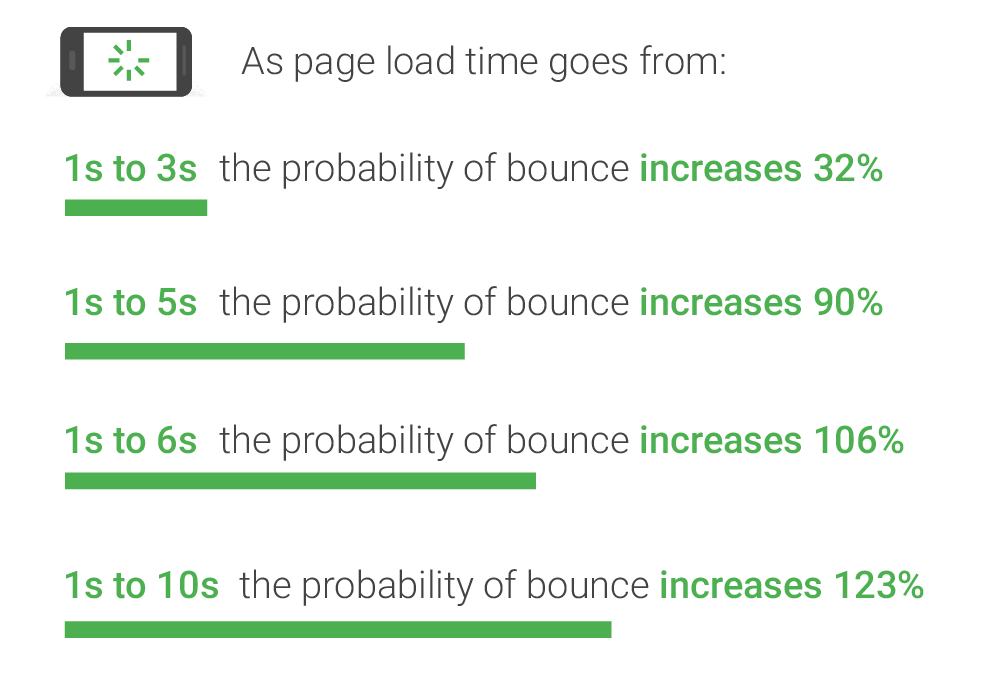
    As you may (or may not) have guessed, page speed is the amount of time it takes for your website to load. On the surface, slow page speed will turn visitors and potential conversions away from your site simply based on the fact that they can’t “use” it, per se. But surely someone would wait 7 seconds to view your homepage or interesting product, right? No. Straight from the source, Daniel An from Google provides this handy chart on the correlation of page speed and bounce rates:

    Image of bounce ratio percentages relative to page load time - Search Influence

    As you can see, if your page takes longer than one second to load, you may see a bounce, which is when a user leaves your site after viewing only one page. The bounce risk increases dramatically the longer it takes for your site to load. This stat doesn’t just apply to your home page either—these statistics will affect every single page on your website. Imagine running an online shop and having someone abandon an order because it takes their cart too long to load. Having engaging content is only half the battle; it has to be seen and digested for it to maximize its potential.

    Page Speed from the SEO Point of View

    From an SEO standpoint, Page Speed has a two-pronged effect on the ranking of your website. Back in 2010 (which is literally forever in internet time), Google spilled the beans on speed having a direct effect on the rankings of websites and encouraged everyone to analyze their page speed to ensure their pages were loading in a timely fashion. Looking at complex Content Management Systems that automatically add mountains of bloat to every single page you publish, it doesn’t seem like many people heeded the warning of Google.

    Image of a snail using a rocket to go fast - Search Influence

    From an indirect standpoint, Page Speed can have an impact on your website’s speed in relation to the crawl speed. Google’s web crawler has an allotted amount of time that it likes to spend crawling a website. Faster loading pages mean that Google’s web crawler can crawl the page faster and move on to the next one, which can lead to more of your pages being indexed. Mix that up with some spicy content and you’ve got a great stew going that can lead to increased Search Engine Rankings!

    Tips for What Website Owners Can Do to Improve

    I personally like to think of Google as the tough love parents that will always steer you in the correct direction, give you the tools to succeed, but punish you if you stray from the light. With that said, Google gives the entire internet a handy tool to test the speed of their website. My favorite online game, League of Legends, will be the topic of example for this go round. After running their URL through Google’s PageSpeed Insights tool, a score is given for both the desktop (61/100, Poor) and mobile (40/100, Poor) versions (it defaults to mobile speed, perhaps because mobile users are using the internet more than desktop users now) along with some details on how to fix the issues and exactly which files are causing the issues. An alternative to Google’s own tool (because we want to show our parents we can succeed our own way) is the Pingdom Website Speed Test. From my experience using both of these tools to compose Site Audits for our clients, Pingdom does give some more in depth information. For instance, the main reason for the League of Legends website taking so long to load is a video (listed below) that has to load twice before the website is considered to be loaded.

    Screenshot of video load time - Search Influence

    This video took over 17 seconds to load. Now for a website such as League of Legends that has the clout of millions of gamers fiending to see the details of the next character being released or an overview of the latest patch notes, these 17 seconds are no big deal. However, if your website was discovered by someone using the Google search “boutique new orleans,” that may be a different story, especially if they’re on the other end of our historic Magazine Street. They may have thought about venturing to your end of Magazine Street had they seen the flashy new “romphims” that your store was offering. Unfortunately for your shop, Magazine Street is loaded with boutiques, and potential customers may just tire themselves out on the other end instead of planning their Magazine Street romp around your boutique.

    Don’t fret, a lot of these fixes aren’t all that difficult to fix, so here are a few common fixes.

    1. Leverage Browser Caching: This fix allows some files on your site to be saved on a user’s local computer so that the next time they visit your site, they won’t have to be downloaded again. In addition to increasing Page Speed, it also lessens the stress on your server.
    2. Optimize Images: This fix involves formatting and compressing your images, which will drastically reduce their size.
    3. Minify CSS: Minifying your CSS is removing spaces, removing line breaks, and combining elements that have the exact styling to reduce the size of your CSS files (yes, even spaces increase the size of your files). You could do it yourself or use a tool such as CSS Minifier to do it for you, but make sure you test it before you completely remove your old CSS.
    4. Minify JavaScript: If you read the previous fix, you can guess what this section is about, just replace styling with functions and that’s the gist of it. JSCompress can take care of this for you.
    5. Enable compression: Using gzip to compress your resources allows them to transfer over the server quicker, which leads to faster page load speeds.

    These fixes are a great way to start pushing your Page Speed close to preferred industry benchmarks and are also among the easiest to implement. There are many more metrics that can be improved as well, but don’t fear—head to Google PageSpeed Insights and plug in your own URL to see how you fare and what you can do to improve. League of Legends has a team of web experts to make sure that even though their videos take close to 17 seconds to load, the rest of their site renders much faster. Here at Search Influence, we also have a team of web experts that are able to analyze and implement fixes to your website to improve its performance and rankings.

    The Importance of Mobile Page Speed Benchmarks

    As revealed in an article earlier in this blog, in November of 2016, the number of mobile and tablet internet users surpassed desktop internet users. This adds increased importance on your website’s mobile speed. With a society that is ever on the go, having a high level of accessibility and a mobile friendly website is considered a necessity for every business. A slow mobile site has a large chance of sending business elsewhere.

    An important addition to keep in mind is the impending rollout of Google’s “mobile-first index,” which should be rolled out soon according to Google and industry experts. This index will reportedly factor mobile content at a higher priority than desktop content. Though all details have not been made public as of yet since Google likes to release this info intermittently after the fact, mobile website speed will probably be one of the factors that are taken into account.

    With cell phones and tablets becoming more powerful and useful in everyday life, it is imperative that your website is optimized to be viewed on mobile if you want any hope of making a splash in the sea that we call the internet. No matter how powerful the receiving device is, there will always be the limiting factor of how quickly files can be transferred across the server. The simplest solution is to ensure that your website is optimized to make it as easy as possible to ford the data transfer river.

    If that sounds like a scary thought, feel free to reach out to the experts at Search Influence. We will gladly take the stress out of it and add you to the list of our many satisfied customers that continue to use our services year after year.

    Images:

    Bounce Rate Percentages

    Snail

    Screenshot

  • Site Audits and Your Business: An Introduction

    Just like any portion of your business, your website requires constant maintenance to ensure that it is running as optimal as it should. It’s very well known that Google loves to constantly change their algorithm, forcing websites to adapt quite frequently or else their search engine rankings will suffer. Whenever a video game patches in a major update, they release a list of patch notes so that players can stay abreast of changes. Google, however, does not afford webmasters that same luxury. The massive changelog initially has to be discovered, and then Google (most times) will decide to give some insight on how they just changed the internet. So, what does a site audit have to do with this? A site audit doesn’t just look at one aspect of a website; it looks at the entire thing. By inspecting every nook and cranny of a website, it’s tough to miss anything.

    What is a site audit?

    In essence, a site audit is exactly what it sounds like—an audit of your website in its entirety. A slew of benchmarks are measured to determine the overall “health” of your website and suggestions are made on how to improve any issue that may arise (and they will arise). The factors covered in site audits are technical, content, and off-site. These three topics also contain an array of subcategories that are necessary to cover.

    Endless Knowledge Image Of A Man With His Brain Open - Search Influence

    It is also important to know that a comprehensive site audit is no easy or simple task. They require a few days of dedicated brain power to aggregate all of the information that is necessary to give you an in-depth view of your site. These reports generally end up over 30–40 pages long and are full of pertinent information and screenshots. If they aren’t, you may have been fleeced.

    The Technical

    Technical factors on the website are simultaneously the most important and least important impacting parts of a website. For example, every website should have a robots.txt file on the root directory of their website. If you happen to disallow search engines from crawling your site with this file for whatever reason, it will never show up in any search engine. Ever. Never ever. The flipside of this is that having a good robots file also doesn’t guarantee that your website will ever reach high search engine results, even though a bad robots file will guarantee that you won’t reach them. Server configuration is also another large part of the technical aspect of site audits. Many people use sites like Godaddy to host their website, but these often have default settings that your site will be set to until you change them.

    Image Of Dog Moving Joysticks - Search Influence

    There is far too much to go over in the course of a standard blog post, but Search Influence does offer Comprehensive SEO site audits and can go over every nook and cranny of a website to measure its health.

    The Content

    As Bill Gates oh so famously quoted, “content is king,” and that still continues to ring true. While images and videos are definitely a plus for any website, the content is the real hero of this story. To make things even more confusing, quality is better than quantity but quantity is still a necessity or your content will be determined to have low quality. But, if your quality is too high, your content will be considered low quality.

    Content on your website should be a certain length —300 words per page is the gold standard, but more definitely doesn’t hurt. Your content must also be relevant to your business and to the page itself. In addition to this, the only way Google will be able to relate your content to your topic is if you add in relevant keywords. If you add too many keywords, however, Google gets very angry and stops liking your website. This makes content writing a sort of a magic area to ensure the best message is being sent to search engines crawling your site.

    After the main content is created, the next step is to set up the metadata for each page. Metadata is coding on the backend that gets read by search engines and can also be displayed in search engine results.

    Image Of SI Title Page In Search - Search Influence

    Image Of SI Meta Description - Search Influence

    The screenshots above show the metadata for our own site. Without having this code in place, search engines that encounter your website have no idea what it’s about. When a search is performed, the search engine will produce a snippet to show in their results.

    Image Of SI SERP - Search Influence

    This screenshot is the preview snippet for our company as displayed in Google. Notice how that title tag and meta description both populate into the search engine results page. This not only helps Google recognize your website and relate it to the topics you would like to rank for, it also provides users with a preview of the web page.

    The Off-Site

    Off-Site factors are probably the toughest part about increasing how favorably search engines see your site— it is also the most important. This section is overwhelmingly dominated by websites that are linking to your website. Having plenty of websites link to you helps to add authority to your site, but if one site links to your site too much, it will appear spammy and both websites can see punishment. A good start to increasing the number of unique domains that link to you, or your backlink profile, is to start with social profiles and high-ranking local profiles such as Yelp!

    After some time of making your business presence known online (and offline), you’ll find that news sites and blogs will link to your site as well. The more this happens, the more authoritative your website becomes, and the more search engines will prefer it to others.

    If this all seems overwhelming, contact our Sales Team. They are happy to go over the logistics of this process and see if it’s a fit for your company’s budget. The SEO Experts at Search Influence are always willing to help a website in need.

    Image Sources:

    Brain of Knowledge Image

    Shiba Image

  • Home Sweet Home: Think of Your Website Like a House to Help Your Business

    It’s the American dream: work hard, build your business up, start a family, and buy a house with a white picket fence. Most of us are cruising for the same kind of idyllic dream for our business as well, even if we have a harder time figuring out how to get there. But what if I told you that one of the biggest factors contributing to business growth was, basically, a house? One you don’t need a mortgage to buy.

    Ok, so it’s not really a house: it’s your website.

    Image Of A House Working Like A Website - Search Influence

    But a website is a lot like a house. Its construction and design both build on top of each other and work to create a structure that is your business’s online home where people come to visit you. If you need a general contractor to make sure your house isn’t going to cave in, you can request a site analysis from us. But if you’re unsure if that’s necessary, or you’re just really obsessed with House Hunters and need to see where this is going, read on.

    Building From the Ground Up

    Your realtor wants you to see a new house on the market. First things first: you have to drive to it. The road you’re on is like the internet. You can get pretty much anywhere, and each road feeds off into more roads, creating the path you take (or the black hole you find yourself in when you’re “taking a five-minute break”). To avoid following random roads and hoping you get where you want instead of the Arctic, you need to know what your destination is. For a house, that’s the address. For a website, that’s the domain, also called the web address. See, I’m not making this all up; they’re completely related. The domain name in the example URL www.exampleswag.com is “exampleswag.”

    Image Of Floating House From Disney's Up - Search Influence

    So you know how you’re getting there, and you know the address, but what are you going to? Houses don’t float in the sky, and it would be very difficult for municipalities to enforce building regulations if they did.

    Just as a house sits on a physical lot, so too does a website have a physical home—the hosting and server. The server is a physical machine that sits somewhere out in the world, storing all the files that comprise your website onto its hard drive. Your hosting administrator owns and maintains the servers. When you pay someone like GoDaddy or HostGator to host your site, you’re asking them to host your website’s files on their servers, essentially renting land from them to build your house on. Sketchy real estate practice, but totally normal and secure for websites.

    Front End and Back End

    So you roll up to the house with your realtor for the walk-through. What exactly are you looking at as you’re exploring the property? On a website, there are essentially two different halves: the front end and the back end. The front end is everything a visitor to your site can see and interact with, similar to the walls, furniture, and doorknobs in your house. The back end involves the more structural aspects of the site: the wiring, plumbing, and framing of your house. When you’re buying a house, you want it to look nice on the front end and to have all the features you need (clawfoot bathtub, anyone?), but you also need it to function well on the back end. It doesn’t matter how beautiful the granite countertops are if the roof leaks every time it rains. This is why it’s so important to ensure your website has good bones. You can request a site analysis from us to find out where yours stands.

    The Foundational Platform

    Your website is built on a platform just like your house is built on a foundation. Popular platforms include WordPress and SquareSpace, but there are others. These two, in particular, are so popular because they are CMSs (content management systems) with really user-friendly interfaces. Once you get your CMS “key,” meaning the CMS platform has been installed on your site, you get easy access to all the contents of the house and can move furniture around and paint walls to your heart’s content.

    You could, of course, build your house without a foundation, or build your website from scratch one line of code at a time instead of using a CMS. It’s a pretty big job, and it really only works best for websites with few, static pages. Best to leave the roughing it to the survivalists and Mainer moose hunters.

    Bricks and Mortar: What Is Your Site Actually Made Of?

    The first known use of lime mortar was in 4th century BC Greece and Egypt. The first publically available description of HTML was in 1991. Times are a-changing, but structural integrity never goes out of style. HTML stands for HyperText Markup Language, but essentially it’s just the basic coding language used to create a website. Its primary use is to create each page of the site. It’s the framework that holds all of your stylish branding and outstanding content. Speaking of style…

    External Stylesheets Are the New Black

    HTML can be used to add some style to your website, but it’s a bit limited to tinted plaster and popcorn ceiling—think of the oldest website you can remember visiting because it was probably all HTML. The reason it looks so basic is that HTML is also what makes the bones of the house, so it ends up being a bit like trying to use the insulation of your house to create the wall color when that’s just not the insulation’s job.

    CSS (cascading style sheet), however, exists outside of the construction of the functional aspects of the site. All the CSS code is accessed separately from the HTML, so the style is rendered on top of each page as it loads. If HTML is the framework, CSS is the paint, wallpaper, and fancy flooring of your house. You can go crazy with customization and design whatever you can envision (I’m thinking mauve, personally).

    CSS can be housed above the fold content, the chunk of code that fits within the frame you see when the page first loads, but it’s better when it’s kept on an external stylesheet. An external stylesheet is a separate file from the page file and is accessed from the server individually to render a given page. When your site keeps the styling on an external stylesheet, search engines can clearly distinguish between style and substance as they go through the page code, leading to faster and more accurate crawls.

    Bringing In Personal Style

    The house has been bought and built, it’s all spruced up with trendy finishings, and now it’s time to fill it with furniture. Website copy is your site’s furniture. Having stellar copy is important for two reasons: it gives function and form. Each room in your house is divided into different functions by the furniture. Having content on each page of your site that is focused on the topic of the page tells visitors what information they should be expecting from that page and makes it easier to navigate to the information they want. When a guest comes to your house looking for a bathroom, for example, they’ll know which room is the bathroom because they will see bathroom furniture, and they will skip over the room with a bed because they know beds don’t live in bathrooms.

    In addition to having informational and focused content, you need to have strong content. If your copy is full of typos, lacks value, or has a tone that is off-putting to your readers, they’re going to leave, no matter how well the rest of your site functions. Would a guest notice your stunning parquet floors if they’re covered in dirty rugs and chairs that probably aren’t safe to sit on?

    Putting All the Pieces Together

    In the end, each piece of your website ends up working with the others to create the site, and if one isn’t receiving top marks, the whole site isn’t meeting its potential. After all, it only takes one dealbreaker to turn a dream house into a fixer-upper. But you can make your dream house work for you and your business. Take a good hard look at how your website looks now (or use the audit you’ve cleverly gotten from us as a guide), and decide what work needs to be done. If you’re not the DIY home improvement type, don’t worry—Search Influence has master carpenters on staff, so reach out to us for help!

    Image Of A Beautiful House Revealed - Search Influence

  • The Do’s and Don’ts of Content Syndication for SEO

    A few weeks ago, I received a question about the value of content syndication in marketing strategies. Because it’s one that I also asked when I first started at Search Influence and began learning about SEO, I wanted to actually address this question in a full blog post.

    The Magic Of Mobile - Search Influence

    What Is Content Syndication?

    Content syndication is the process by which a piece of content (blog, news article, graphic, video, etc.) is pushed out to other sources. You see this, for example, when online news outlets pick up press releases or other articles and repost them verbatim to their own sites.

    From a UX point of view, this can be a great way to increase your reach to potential customers. From an SEO point of view, content syndication can garner valuable backlinks and help to increase website authority. And from an overall marketing point of view, the efforts spent on syndicating content can also build great relationships with other websites and organizations.

    Backlink and Authority Building

    The process for syndicating content is similar to that of general link outreach and is for a similar purpose as well: to generate authoritative backlinks that, down the line, contribute to your own site’s authority. Coupled with the opportunity of increasing reach to your business’s original content, this can be a worthwhile tool in your marketing arsenal.

    The Caveats of Content Syndication

    That said, there is a right and a wrong way to syndicate content when it comes to SEO. Here are some things to think about when considering it for your marketing strategy:

    1. Duplicate Content

    Syndication is inherently creating duplicate versions of your content and putting them on other websites. In the case of written content, this can actually detract from your SEO efforts if done incorrectly. It’s important to understand the policies and practices of the websites you’re syndicating to and ensure they are declaring yours the primary version.

               Genie From Aladdin Multiplying - Search Influence

    This can be done a number of ways but the primary ones are:

    – Rel=canonical – This is a meta attribute that basically tells search engines that the page they are on is the same as another page. In this scenario, syndicated versions of your content will set your original URL as the canonical. For more information, check out Google’s own post on the rel=canonical attribute.

    – Noindex – This is a robots meta tag that tells search engines not to index a page at all so that it won’t appear in search results. Ideally, in this case, syndicated versions of your content will be set to noindex so your original post isn’t competing for rankings with them.

    2. Backlinks

    Remember to include an actual backlink to your content when syndicating. This can be forgotten when you get caught up in pushing your content out there or when syndicating images and videos. Ideally, this would go to the original content’s URL, rather than another page on your website.

    3. Site Authority

    This is an oft forgotten consideration when choosing a syndication site. Quality and quantity both have their place when creating your syndication strategy.

    In an ideal situation, if you were to get one backlink from content syndication, you’d want it to be from a site with the authority equivalent of Google itself, and you’d want it to have a follow link back to your website.

    But, we don’t live in an ideal world, so it’s important to keep in mind the actual authority of syndicating websites and find out if the links you’re getting are follow or nofollow. Check out this resource to learn a little more about the importance of follow and nofollow links.

    With all this in mind, content syndication can be a great opportunity for websites. But, like I said in my last post “The Importance of Content Marketing to Your SEO Strategy,” it doesn’t matter if you don’t have great content to start with.

  • The Importance of Content Marketing to Your SEO Strategy

    content-marketing-is-important-for-SEO image

    A few weeks ago, I wrote about the basics of link building and how content is crucial to any editorial link building strategy. Today, I want to talk about exactly why it’s so important and what you can do to start writing great content, not only for SEO, but also for your overall content marketing strategy.

    What Is Content Marketing?

    Content marketing is the strategic creation, distribution, and promotion of content to generate leads, sales, and brand awareness. This could be anything from a social media post or a webpage to a regularly updated blog or news section of your website.

    Really it applies to any piece of content that a consumer could see.

    Content for SEO

    That’s why, when it comes to SEO, content is one of the most important factors in search engine algorithms and the basis for multiple other factors that affect search visibility and traffic. It is also why SEO factors into your content marketing strategy.

    Did you know:
    – 75% of consumers use search engines regularly when doing product/service research (CMI)

    – 60% of consumers purchase a product/service based on that research (UpScribed)

    Well, search engines like Google do. That’s why they include specific guidelines for creating content:

    screen-shot-2016-10-11-at-1-40-40-pm

    Because content is the foundation of the consumer experience, search engines have placed a premium on its value as a ranking factor.

    Consumer-Focused Content

    Like any foundation, you need to build upon your website’s existing content to really reap the benefits. More valuable content equals more visibility and more links. It’s not enough just to have a website with good content. You need to keep creating more new and germane content to maintain your relevance in the eyes of search engines and to continuously provide opportunities for references, backlinks, and lead generation.

    Did you know:
    – 86% of consumers stated that using a search engine allowed them to learn something new or important that helped them increase their knowledge. (Pew Research Center)

    – 95% of B2B buyers are willing to consider vendor-related content as trustworthy. (Curata)

    – Businesses with websites of 401–1000 pages get 6x more leads than those with 51–100 pages. (Hubspot)

    It all loops back to user experience. Search engine algorithms are developing to incorporate user experience as a ranking factor.

    Content Creation Strategies

    So, how can you create a content marketing strategy with search engines in mind?

    1. Create custom topical content. One of the major rules in SEO is to avoid duplicate content, so let’s start there. Your content should be completely unique and each page should have one main topic or focus, ideally centering on something potential customers would search.
    2. Utilize titles and headings. By organizing your content with descriptive titles and headings that focus on the topic you’ve picked, you’re more clearly indicating to search engines and users what the page is about.
    3. Reference products and services by name. Don’t skirt around the subject with euphemisms and colorful language. While advanced, search algorithms aren’t the best at gleaning information that’s not explicitly stated.
    4. Create new pages. Like I said before, each page should have a topic of its own so if there’s something you want to talk about, make a new page or post for it. Locations, products, and services are all examples of things that warrant their own pages, as long as there’s enough to say about them.
    5. Which leads me to my last tip: Fill up your pages. If you can’t come up with at least 300-ish words on a subject, it probably doesn’t actually deserve its own page.

    Did you know:
    – The average length for content ranking in the top 10 results of Google is at least 2000 words. (Quicksprout)

    Just remember, search engines are ever-developing to match user intent. So, when in doubt, write for your potential customers and make sure your content is reaching them.

    Image Sources:
    Image 1 (Keyboard Graphic): Google Photos
    Image 2 (Screenshot): Google Support
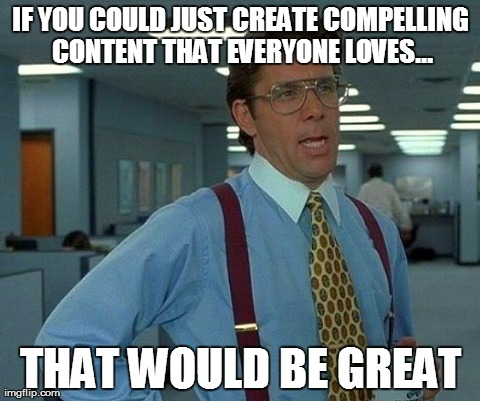
    Image 3 (Office Space Meme): Relatably


  • Link Building: How to Develop a Winning Link Profile

    The Basics of Link Building

    Backlinks are a significant factor in a website’s search visibility. When a site links back to your website, it signals to search engines that it’s authoritative enough to be an information resource for other websites. That’s why it’s so important to any SEO strategy.

    However, SEO’s and businesses alike walk a thin line when it comes to generating backlinks for their sites. Each backlink has a different value depending on that source site’s own authority and trustworthiness. The goal is to develop a diverse but high-value link profile of authoritative links from a variety of source types. This process is called link building.

    I like that your backlink profile's so natural image

    Link building can be categorized into two different types of work: manual link building, where a link is submitted to directories or included in profiles, and editorial link earning, where a site links to your website organically because they want to share or refer to your content.

    Manual Link Building

    It may seem like this is not the preferred method for link building. However, don’t forget that we want a diverse link profile. The character of your link profile reflects the character of your business to search engines.

    It’s natural to place your website and information on sites that potential customers may use to find a business like yours (i.e. directories) or in your social profiles. This is the same as adding your business’s information to a phone book or business card that you share with people.

    When doing manual link building, just remember that you want the sources of your links to make sense and reflect the authority and relevance you’d like your website to have. Ideally, these links come from sources like your social profiles, local directories like Google Maps or Yelp, and niche directories that apply to your industry (Healthgrades.com for doctors, for example).

    Editorial Link Earning (aka Link Attraction)

    It’s a little more difficult to build out the other side of your link building strategy—editorial link earning. You can’t control these links like those that you manually build. However, link earning is a great opportunity to show the internet just how great you are at what you do and can result in some of the most valuable links out there. It should also already fit into your overall branding strategy.

    So, what are editorial backlinks? These are links that people have shared on their own websites or social media back to your website. For example, if someone read a blog post that you wrote for your business and thought the content was so engaging and noteworthy, they shared it on Facebook or wrote their own blog referring to yours, you’ve just received an editorial backlink.

    Social interaction vector image

    This type of link building starts with creating great content and ends with sharing and strategically placing that content for the most relevant and influential users to see and engage with it.

    That’s it, the basic composition of any good link building strategy. Link building definitely takes some thinking but it is immensely valuable to your overall SEO. Directory and social profile links are important in building brand awareness, and creating and sharing great content is highly integral to exhibiting your business’s overall value and capabilities both on- and offline.

    To find out why link building is important for dentists, click here.

    Image 1 Credit

  • How Google Possum Has Affected 3 Pack: A Before and After Review

    Google Possum Update

    Throughout September, the local search industry has been watching the results of the dubbed Google Possum update.

    In August 2015, Google shook up local search results, which changed the Map Pack from a 7 Pack to a very exclusive 3 Pack. This change was a dramatic one by omitting many local businesses and by making inclusion nearly impossible for businesses in the exterior of city limits and in suburbs.

    Fast-forward two years, and we now have Possum.

    “Possum?”

    Joy Hawkins wrote an excellent blog post summarizing the effects observed by the Possum update, and in that post she attributes Phil Rozek with creating the Possum moniker because “it is fitting since many business owners think their Google My Business listings are gone, when in fact they are not. They have just been filtered — they’re playing possum.”

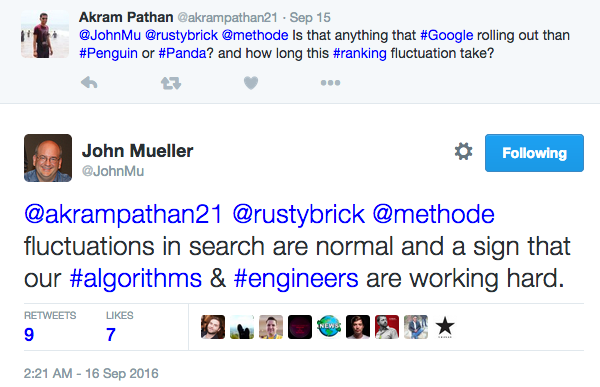
    And officially? … Possum is an unannounced update, meaning the SEO community collectively compared notes and decided this was an algo update. Google did not directly announce or confirm this update. However, John Mueller did Tweet a comment, which I completely paraphrase as “if you see stuff happening, maybe the Google Engineers are doing something.”

    Possum Update Tweet


    “Google is now filtering based on address and affiliation.”

    In her post on all things Possum, Joy Hawkins cleanly lists the effects of this change. Among her list is the observation that Google is now filtering results based on duplicate address, website, or affiliation.

    We see duplicates all the time in map results for local searches for any place that has multiple practitioners:

    • Doctors (plastic surgeons, orthopedists, dermatologists … )
    • Lawyers
    • Dentists and orthodontists
    • Hair salons
    • Etc.

    For example, a doctor’s clinic can have numerous Google-allowed listings: one for the practice and one for each physician or practitioner seeing patients at that practice. Each of these listings will have the same address, phone number, and website, so one clinic or practice can end up with multiple listings and dominate the results landscape.

    But user experience for such a repetitive Local Pack is not ideal, and Google is all about user experience. We have a plastic surgeon client, Deluca Plastic Surgery in Albany, NY, who has been fighting this battle for a long time.

    Dominating the Local Pack No More

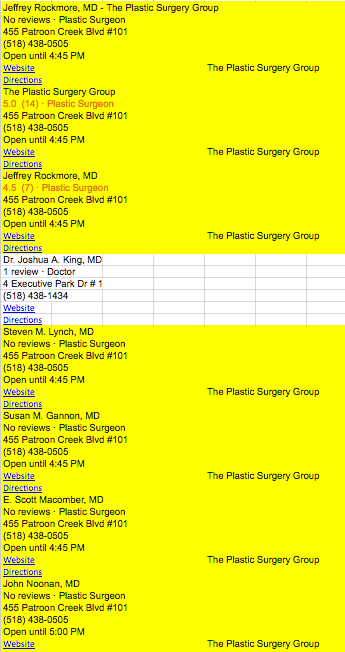
    Anyone searching “plastic surgery Albany NY” back in April 2016 would have seen the 3 Pack all leading to the same practice. In fact, in the “More Places” Maps results, the same practice completely dominated with positions 1, 2, 3, 5, 6, 7, 8, and 16. What the heck, Google?!

    I had copied and pasted the Maps results into a spreadsheet just for fun back in April. I’m glad I did, because I can share this story with you. Here are just the first eight results from that April 2016 Maps search—those in yellow all lead back to the same practice:

    April 2016 Maps Search Results

    Our client was ranked at 18th and 20th. Our client is in Albany, and the website had and has stronger Domain Authority, stronger NAP, more reviews, and on and on, so it just didn’t make sense.

    We did some work to mitigate those results. We had some minor success, but fighting a battle against Google’s algorithm, you might not always come out a winner.

    And Then Possum Came Along

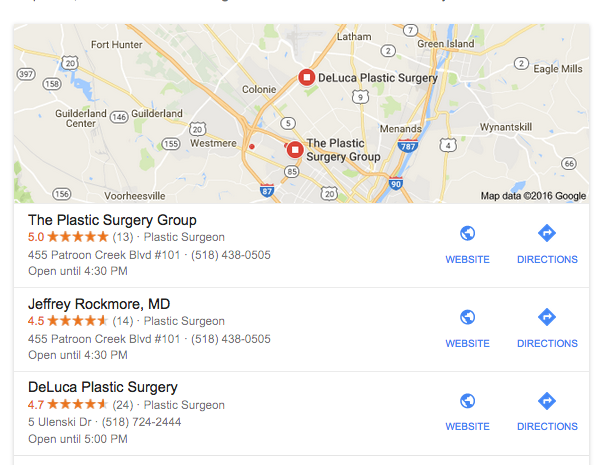
    Today, we now see Deluca in the 3 Pack. Woo hoo!
    Google maps results after Possum roll out

    We are feeling pretty good about this (don’t take the wind out of my sails), but we acknowledge that all is not perfect in this scenario. In this 3 Pack, the doctor in the second listing is a plastic surgeon at the practice represented in the first listing.  He has the same address and phone number, but he has his own, personally branded, website.

    This is one example among millions of searches, but it may suggest that domain is a primary indicator of the duplication filter. This needs lots more observation and input, and I encourage you to let us know if you have seen 3 Pack changes this September.

  • Here’s How to Take Advantage of Google’s Expanded Text Ads

    AdWords Text Ads Image 3

    In May, Google announced a major expansion of the traditional 25-35-35 text limits we’ve come to know and begrudgingly abide. Trying to squeeze your brand name, unique selling propositions, an emotional appeal, a sense of urgency, and a killer call to action into just 95 characters, at times, amounted to a game of linguistic Tetris.

    Now, with double the characters to convince potential customers why they should convert, it’s become crucial to rethink how we think about ad copy and develop new tools for improving our Paid Search ad copy strategy.

    1: ALWAYS Use All of the Available Characters

    Take full advantage of Google’s generous gift! There has been some debate in the PPC realm concerning the truncation of ad copy based on the user’s device. However, an overwhelming majority of the literature suggests that you should be trying to get as close to that 30-30-80 limit as you can.

    2: Lead With Your Most Important Copy

    54531900

    Put the most important information at the start of a line, such as your call to action or promotional text. Headline 1 will always show, but depending on the screen size of the searcher’s device, Headline 2 and the Description could be truncated depending on the pixel width of your text.

    Even though you should be trying to hit the full 150 characters, you do want to ensure that the absolutely crucial information in your ad copy is placed at the start of each line.

    3: Brand + USP + Emotional Appeal + CTA = Click!

    We all have a variation of a similar formula for winning ad copy, now you can make sure that your ads are checking each of those boxes. Expanded Text Ads allow you to include content that previously may have been bumped from an ad in lieu of the more important call to action or brand name. Now, you have the space to try out new versions of your formula and find what works for your business.

    4: Develop Thematic Content

    AdWords Text Ads Image 2
    Don’t treat the different elements of the ads as separate entities. Use your extra characters to create content that flows from Headline 1 to Headline 2 and through the description.

    5: Provide Pre-Qualifying Information

    Are your landing pages seeing a lot of traffic but not converting visitors into customers? Now you can pre-screen would-be bounces by including qualifying information in the ad copy!

    For instance, if your plastic surgery practice only accepts candidates for Breast Lift surgery who are physically healthy, non-smokers, you can include this information in your ad to prevent users who won’t end up converting from initiating that first click (and spending your ad dollars!).

    Bonus Tip: Path Fields = Not Optional

    The “optional” Path 1 and Path 2 fields have replaced Google’s Display URL with the domain name now automatically populated from the Final URL. These combined 30 characters are a great area of opportunity to showcase the relevancy of your landing page to the searcher’s query. Highlight topical keywords, location specific services, or even promotions that show the user that your business provides exactly what they’re looking for.

    The number one rule is to be creative and try new things, so get started augmenting your ad copy today and share your results with us in the comments! Need help? Call the experts at Search Influence.