Category: SEO

  • What Is Domain Authority & Why Does It Matter?

    Computer screen displaying domain authority metrics at Search Influence in New Orleans, LA

    Your website has been live for some time. You’re past the development stage, so now you’re starting to think about the nitty gritty side of its performance. What does Google think of your content? Are your pages valuable? Why is your site ranking below competitors in search results?

    Your website’s domain authority score can help answer these questions and provide valuable insight. But what exactly is domain authority and how can you utilize it to grow the number of visitors to your site?

    What Is Domain Authority?

    Domain Authority (DA) is a score given to your domain based on an algorithm developed by the SEO company, Moz. It is a projected numerical value of how well a site will rank in search engine results. The algorithm to determine Domain Authority takes into consideration link profiles (a list of all your website’s backlinks), content quality, SEO best practices, and more. Just as Google and other search engines must measure various front and back-end site features when fetching up search results, DA scoring tools also take numerous factors into consideration.

    But, what is a good domain authority score? Domain authority is relative—there is no ideal DA score. Ultimately, you want your authority to be higher than that of your competitors. There is so much variation in search results that it would be difficult to say a higher DA will lead to better results versus a competitor; however, it is a good indicator that you are utilizing sound digital marketing techniques and providing high-quality content for your industry.

    Additionally, there are tools that measure domain authority using different metrics than Moz, such as Ahrefs or SEMRush. In many cases, the DA measured by these tools is significantly different on a 1-100 scale and varies from tool to tool. Measuring DA requires a degree of relativity to the other results within that tool. Google claims it does not acknowledge or recognize domain authority score when serving up search results. The score is just an estimation based on several different factors of how well you will rank. As is common in the digital marketing industry, Moz announced a recent update to their process. They will release changes to their Domain Authority score calculations in early March. Algorithm changes can impact your score because it may change what Moz thinks is valuable about your domain. While the things being calculated in these scores may not directly correspond to how search engines are ranking your pages, there is still value in knowing your domain score.

    How Do I Check for Domain Authority?

    Now that you understand a little bit more about what a domain authority score is, how do you find yours? There are several tools available that provide you with your score and how your score ranks up among your competitors.

    Ahrefs

    This effective tool can provide extensive information about your domain’s authority score, as well as other insights into how your score is being calculated. With a paid subscription, you can see your DA score along with other statistics, like the number of healthy backlinks you have and how your organic traffic is doing. It will even show you how many points your score has gone up or down on a daily basis if there are any changes.

    Moz

    The originator of the DA score, Moz, offers a free Chrome extension, MozBar, to measure your Domain Authority. Subscription to a Moz Pro account gives you access to SEO campaign monitoring, as well as tools that can help increase your Domain Authority score overall.

    SEMRush

    Another leader in SEO tools for sites, SEMRush is a great option when monitoring your domain authority. Not only does it allow you to keep up with your DA score, but you can also use it to complete competitive research between you and your competitors.

    These are just a few of the top tools you can use, but you may still be wondering why you should even bother checking your domain authority.
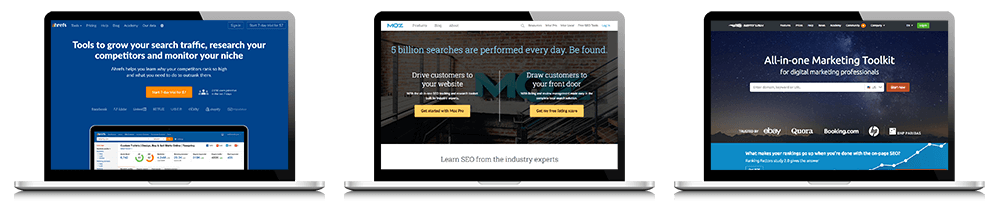
    Domain authority metrics displayed across three laptop screens at Search Influence in New Orleans, LA

    Why Does My Domain Authority Matter?

    Knowing your DA score can help improve your overall domain value in search engines. Having a higher DA means that you are predicted to be higher in the search results than domains with a lower score. It can be a good benchmark on your site’s SEO and the value of information present on your site. If you have a lower domain score compared to your competitors, then it might be time to start searching for strategies to increase your score.

    How Do I Increase My Domain Authority?

    Since so many factors go into the calculation of your DA, there are a variety of areas you can focus on. Here are some of the few more valuable points:

    Building Strong Backlinks

    Backlinks are arguably one of the most important contributors to high domain authority. What we are talking about here are quality backlinks. For a quick refresher of backlinks and their value, check out our previous blog post. Backlinks coming from other sites with high authorities shows that you are also a reliable source of valuable content and information. By acquiring a multitude of quality backlinks, you are in turn raising your own authority. This also has the opposite effect if you acquire backlinks that are not high quality. It is important to note that Moz has updated their algorithm to devalue purchased links. In the past, people have tried selling links from sites that claim to have high domain authorities to sites looking to boost their own domain authority. However, this will no longer be beneficial; in fact, it could be harmful to a site’s domain authority. Getting backlinks from sites that can be considered spammy in turn tell the algorithms that your site might be spammy as well. It is crucial to your site’s health to disavow bad backlinks in Google Search Console with this tool.

    Having Useful and Valuable Content

    People use search engines to find information; so, if your website provides valuable content that answers people’s questions or provides them with the knowledge they are looking for, your authority will be higher. A valuable threshold for content quality is Google’s E.A.T. guidelines—expertise, authoritativeness, and trustworthiness—so make sure your content hits these marks.

    Using Overall SEO Best Practices

    Engaging in Search Engine Optimization makes your content—therefore, your site—more easily accessible and reliable to search engines’ algorithms. Your site is more likely to have a higher domain score and display higher in the Search Engine Results Page (SERP) if your content is more accessible to search engines. Learning more about SEO best practices and how to implement them can not only be immensely beneficial for your domain authority but also for your site’s traffic overall.

    All in all, even if Google doesn’t calculate the domain authority of a site, it can still be a powerful estimation of how meaningful and reliable Google thinks the content on your site is. If you have a higher score than your competitors, then likelihood of you outranking them in the SERPs is pretty high. Working to increase your site’s DA authority can have plenty of positive SEO benefits. Still feel confused or overwhelmed? Request a free analysis from Search Influence to see how we can monitor your domain authority and help steadily increase it with a customized SEO strategy for your business.

    Images:

    Computer Screen With Metrics

  • How Long Does It Take to See the Benefits of SEO?

    Gif with matthew mcconaughey about SEO turnaround time from Search Influence in New Orleans, LA

    That’s always the question when a business starts something new: how long will it take? The short answer is that SEO campaigns generally see mature results in 6 to 12 months. But any business that starts working on SEO will also see several benefits immediately.

    SEO campaigns should have two goals: to tell external entities on the internet (especially search engines) that your website is an authoritative source of information within your industry, and to help convert potential customers into actual customers once they’re on your site. There are numerous ways to accomplish both of these. Over the course of this post, I will cover a general timeline of an SEO campaign and the accompanying deliverables businesses should expect.

    The Sales Process

    If you haven’t done any SEO work before, then your first step should be reaching out to digital advertising firms. They will perform competitive research before coming back to you with a pitch. This first step is critical because the timeline for the results of an SEO campaign depends on where a business starts off relative to its competition. Obviously, some industries are more competitive than others, but generally, a business’s presence online can be measured by several on-site and off-site factors. Digital marketers will evaluate your website’s content and layout, perform keyword research, and determine how easy it is for leads to complete conversions on your site. Common conversions include filling out on-site forms, booking consultations, product purchases, etc. There are also several off-site tactics that will signal your website’s authority within your industry to search engines, including backlinks from reputable websites, accurate and consistent listings, and social media activity. This research allows digital marketers to set realistic goals from the start and ensure that the work they perform will make a difference.
    New call-to-action

    Campaign Kickoff and Month One

    Once you’ve partnered with a digital marketing firm, they will schedule times to discuss which strategies you would like to move forward with and establish which metrics matter the most to your business. Then, they can use the research that they’ve already compiled to build a plan of attack. Several aspects of an SEO campaign can have immediate effects on your website, such as building out new pages, cleaning up bad links, setting up call tracking, making your site mobile-friendly, and purchasing an SSL certificate. Your team can also begin working on longer-term strategies, such as establishing an overall content strategy. This first month lays the groundwork for the rest of your campaign.

    Month Two and Beyond

    As your SEO campaign progresses, your digital marketing firm can use site data from Google Analytics and other tracking methods to analyze changes in your site’s traffic and on-site conversions to measure the performance of your current strategies.

    After reviewing the results of your campaign, it might make sense to complement your SEO work with other digital marketing strategies, including paid search or social media advertising. The effectiveness of these tactics will depend on your industry, but paid advertising is generally geared toward immediate results. Supplementing SEO with paid campaigns is a logical step to take if your business is more focused on e-commerce or other B2C transactions. However, several elements of SEO (creating landing pages, being HTTPS-secure, and having a mobile-friendly site) will help amplify your paid campaign’s results.

    Keywords, Keywords, Keywords

    Up to this point, I haven’t particularly focused on keyword rankings because it’s difficult to estimate how long improving them will take. Obviously, ranking well for relevant keywords is important and should be part of any SEO campaign. If you’ve never done any SEO or content work before, your rankings will quickly improve from their baseline once your campaign begins. A well-planned strategy can expedite the process, but it will probably take time to crack the first few results for more competitive keywords.

    New call-to-actionSimply being the first result for a search doesn’t necessarily offer value to your business. It’s essential to perform keyword research to see what your customers are actually searching for. By focusing on natural queries and long-tail keywords, businesses can be more selective about which keywords they target. Plus, earning strong rankings for long-tail keywords can be done relatively quickly and inexpensively while attracting people who are more likely to be interested in your services. As always, driving more potential customers to your site should be your focus. Ranking well for relevant keywords certainly helps, but there are other important factors to consider.

    So Now What?

    In general, the results of SEO are gradual, but your business can immediately benefit from on-site optimizations, reconciling conflicting listings, and having a clearer idea of where you stand relative to your competition. As search engine algorithms and user behavior change, you will also have to make adjustments along the way. With that in mind, you should choose the digital marketing firm that you work with carefully. Search Influence has helped businesses expand their client base online since 2006. If you’d like to know more about the timeline of SEO campaigns, give us a call at (504) 208-3900.

    Images

    Keywords

  • Getting The Most From Your Google My Business


    Two business owners making edits to their Google My Business listing as instructed by Search Influence in New Orleans, LA

    When was the last time you went to the second page of Google search? If you find yourself having difficulty remembering the answer to that question, you are not alone. Research shows that as of November 2018, the top 10 results of Google searches that make up the first page are responsible for 75 percent of all clicks on search engine results pages (SERPS). As a business owner, you may now be asking yourself the question, “How do I get my business on the first page of Google?” Google’s ranking is determined by a multitude of factors, two of them being the accuracy of your company’s Google My Business (GMB) listing and the volume of interaction associated with it. For many people making local searches on Google, your GMB listing is the first contact that they make with your business, so you want to make sure what they see is accurate and thorough.

    Claim or Create Your GMB Listing

    The step that precedes all others for your GMB listing is claiming or creating it. The age of your business and the volume of information that has previously been supplied about it on the internet will determine which step you need to take. If Google has already collected information regarding your business, you will need to simply claim the listing. If Google has not previously collected information regarding your business, you will need to create a listing. Either way, to begin the process, start here. The first and most important step in getting the most from an already-existing GMB listing is claiming it. Until you have achieved this end, the content of your listing is at the mercy of the internet. Any Google user can suggest edits on a GMB profile, which may become live. Because some of the data in GMB listings is user-generated, it is not always entirely accurate. Once you have claimed your business, you are in complete control of the information that is live on your listing.

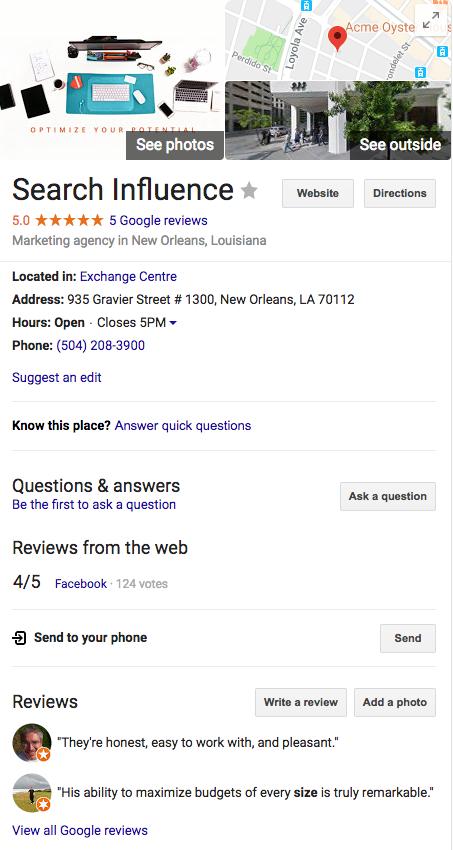
    Example of Google My Business listing from Search Influence in New Orleans, LA

    Give Your GMB Listing the Data It Deserves

    Now that you are in control of your GMB listing, it’s time to start making it as accurate and informative as possible. Initially, you will want to make sure that all of the essential information, such as your name, address, phone number, website, and hours of operation are correct across all of the other platforms that show your business’s information, such as Yelp. Selecting the correct category is also pertinent to your ranking in local searches. Don’t just choose the general category; choose as many subcategories as you find relevant and appropriate to your business. Additionally, a solid business description can help you stand out against your competitors. A good business description is one that attempts to cover all of the products or services that you offer, but that does so in a summarizing manner. You want the viewers of your listing to read the entire description, so say as much as you can in as few words as possible.  

    Review, Respond, and Post On Your GMB Listing

    At this point your GMB listing is in your control and displaying accurate and additional information; from here you will want to maintain it. Google publicly acknowledges that user interaction for business listings is a factor that affects its rankings. One way to satisfy this is by making frequent posts regarding updates affecting your business, or about products and services that your business offers. These posts are a free form of advertising that appears in local searches, and the more frequently you post, the more likely you are to get a boost in your rankings. Not everyone who uses the internet is on social media, but everyone who finds you in a local search can see your posts. So with that being said, a good rule of thumb is to make a GMB post every time you make a post on social media, or at least once a week. Additionally, these posts are a good way to increase traffic to your website by informing users of a product or service that they might not have realized your business offers.

    Another way that you should maintain your GMB listing is by responding to reviews about your business posted by other Google users. This is not only important from an SEO standpoint, but also from the viewpoint of the users who view your listing. Negative reviews should absolutely be given responses, as that is your only opportunity to defend your business to the users viewing your listing. Customers want to feel engaged, and a business that positively engages the customer is more likely to see that customer return and refer others.

    Because Google My Business is still relatively new, many people don’t understand the impact it can have on local rankings. If you’re ready to boost your local SEO with an optimized Google My Business listing and relevant posts, get in touch with one of the marketing experts at Search Influence today.


  • How Small Businesses Can Build Quality Backlinks in 2019 and Beyond

    A man drawing a graph representing backlink growth through Search Influence in New Orleans, LA

    Backlinks have traditionally been one of the most important ranking factors in Google’s mysterious SEO algorithm. So what exactly is a backlink, and why is it important? A backlink is simply a link on someone else’s site that leads to your site. Google values them because your site must be reputable and authoritative if lots of other sites value your content enough to share it. The classic ways to acquire backlinks can still be useful, but the landscape of link building is changing.

    What Makes a Good Backlink?

    The main thing about link building is that quality and quantity both matter. Google values links from sites with strong domain authority (think national sites that everyone in your niche has heard of) and relevance to your industry. For example, if a small business gets a backlink on The Wall Street Journal, they’re getting a top-notch link. That being said, a handful of great links won’t necessarily outweigh hundreds of decent links. For SEO purposes, a “follow” link is better than a “nofollow” link, as nofollow links are not technically backlinks. However, while they shouldn’t be a large focus of a link-building campaign, nofollow links help with branding and shouldn’t be discounted.

    A hand drawing a graph from current to target representing goal setting for Search Influence in New Orleans, LA

    Beware of Spammy Link-building Tactics

    Before Google’s Penguin algorithm update, the quantity of backlinks was most important, so businesses invested tons of money in “black hat” link-building tactics that placed backlinks on random sites with software. Though some sketchy SEO companies still employ software to build links, Google is not only aware of this tactic, they will actively punish a business’s rankings if they find that most of their backlinks are bought.

    The Penguin update came out in 2012, so the “quality over quantity” issue is well known throughout the SEO world, but many small businesses or recent start-ups aren’t aware of it. If you are paying a company to build backlinks for your site with software or other black hat methods, you are paying to penalize your search engine rankings.

    What Are the Tried-and-true Ways to Build Links?

    Building quality backlinks isn’t an easy task—that’s why links are still highly valuable in Google’s algorithm. These link-building strategies have been covered ad nauseam, so we won’t go into too much detail here. Most of the ways to get links back to your site start with an outreach campaign to other website owners and businesses.

    A woman on a laptop representing the backlink strategies at Search Influence in New Orleans, LA

    One of the simplest ways to find a potential backlink is searching for business mentions of your site that are unlinked and asking the site owner to add a link. Another straightforward tactic is to use competitive research, wherein you find who links to your competitors’ sites and target those businesses with your outreach campaign. A similar strategy, which we’ve already delved into, is to search for broken links on relevant sites and either ask them to replace the broken link with one to your own content or point out the error and ask for a different backlink on the page.

    How Do I Build Backlinks in 2019 and Beyond?

    The digital marketing industry received confirmation that SEO trends are changing when Moz published their survey of 2018’s local ranking factors, which found that interacting with Google My Business is one of the most important factors in Google’s local ranking system. So while this may mean that backlinks hold less value than they have in the past, link building is still crucial to a well-rounded SEO plan, as we explained in our analysis of Moz’s survey. The traditional methods of link building still apply, but, in today’s world, businesses need to remember that…

    Content Quality Is King 

    Link building nowadays relies heavily on getting people to share your content, and the main way to get people to share your content is—wait for it—to have great content that people want to share.

    An image of someone pantomiming their mind being blow at Search Influence in New Orleans, LA

    So, then, what qualifies as great content?

    One of the biggest factors for Google, and your audience, is that your content meets Google’s E-A-T guidelines. This means that your content demonstrates expertise, authority, and trustworthiness. It should thoroughly cover the topic and answer your audience’s questions, especially because most people find sites through indirect queries. In addition, useful content that draws people in is one of the main principles of inbound marketing. There are some more specific tactics to create fantastic content, but the main goal is that it helps your audience with their pain points.

    Once you’ve got high-quality content, how do you get people to share it?

    Include images or video. Articles with an image receive up to 94 percent more views than plain text articles, and social media posts that include an image or video get up to 10 times more engagement than content without one. Of course, you need to find a good image to include. You should also focus the content on channels targeted to your audience (so making your content easily shareable on Instagram is going to be different from posting it on YouTube).

    It should go without saying that you should share your awesome content on all of your social media channels (and get your friends to do so, too). However, sitting back and hoping it goes viral and is featured on Ellen isn’t exactly practical. You need to build networks with influencers in your niche, reach out to them, and ask them to include a link to your content.

    Optimize Your Outreach Strategy

    The businesses that you target for your link building campaign should find your content useful—as in, their audience will find it useful. You need to demonstrate to them why it’s worth their while to share your content or link to your site. And, while it’s best to have backlinks on websites with strong domain authority, don’t ignore smaller businesses that are relevant to your industry. Smaller businesses may be more likely to include your link in their content, and any backlink will help build brand awareness, which is a growing part of modern SEO strategies.

    A man at a desk representing the marketing strategies of Search Influence in New Orleans, LA

    Don’t Be Impersonal

    No one wants to read spam emails, and if your outreach emails have obviously been carbon-copied and sent to 200 people, it’s likely that the recipients won’t want to take their time to help you. Sending emails to tons of people does take a lot of time, so it’s fine to use the help of a template, such as these from Hubspot. But you should still make sure that the contents of your email are specific to the person you’re sending it to. Better yet…

    Find Content on Their Site That Could Use a Link to Your Content

    You’re going to be more successful building links if you find a specific article that would benefit from including your link in it, rather than just sending an email saying “Hey, I wrote this. Can you stick it on your site somewhere? Thanks!”

    Let’s say you’re a smoothie company, and you’ve written an amazing, super-detailed article about the nutrients in common smoothie ingredients. After scoping out businesses that would benefit from this information, such as a nutritionist’s website or a lifestyle blog, see if they have any pages that relate to your article. Maybe you find a parenting website that has a blog about making sure kids are getting enough vitamins from their food, and you know that your article would provide helpful additional information. The writer will likely be more receptive to including your link because you’ve shown them exactly where it should be on their site.

    Reciprocate the Link Love

    Website owners love seeing their name and work out there as much as you love seeing yours, so including relevant links to another business’s content on your own site is a great way to open the door. At the very least, they are more likely to share the article and could help create a partnership. You can offer to guest blog and invite them to guest blog on your site. You can even syndicate your content to get the most out of your work while maintaining a good relationship with influencers in your field.

    Link-building Tips for Local Businesses

    A local business owner representing the local seo services of Search Influence in New Orleans, LA

    To bolster their local SEO strategy, small businesses need to ensure that they create brand awareness, both on- and offline. You should build relationships with other related businesses. For example, a restaurateur could reach out to a local farmer’s market. Try to go even further and create strategic local partnerships, where you and another business leave reviews on each other’s sites and share each other’s content. You should also network and reach out to influencers in your industry.

    Link building can be one of the most challenging aspects of boosting your search rankings, but it doesn’t have to be. At Search Influence, we can help you find the right link-building strategy through both tried-and-true methods and by creating quality content to build brand awareness. If you’re ready to take your link building to the next level, start a conversation with one of our SEO experts today.

    Images:

    Mind Blown

    Internet, So Helpful

    No, Thanks

  • Year-end Trends: What’s Been Driving Local Search in 2018?

    Annually, the brightest minds in the local search field come together to provide their input on the major changes and trends in the industry via the Local Search Ranking Factors Survey. Coordinated by Darren Shaw from Whitespark and the fine folks at Moz, the 2018 review of local ranking factors helps to coalesce the general sentiment around the most impactful inputs as they relate to local searches. This survey is a great resource for digital marketers because it not only helps us understand the changes in the last year, but also how to better focus our efforts and energy moving forward.

    Here at Search Influence, we are fortunate to be one of the contributors to this survey. With our experience in the local search realm across numerous industry verticals, we are well-equipped to help add more context to an, at times, confusing digital marketing landscape. As expected, much of what we saw in the day-to-day management of our clients’ local search campaigns was reflected in the results of this year’s survey.

    What’s the Biggest Local Search Trend for 2018?

    According to the results of the survey, the biggest local search trend is Google My Business management.

    For those of us who spend countless hours wrangling Google My Business (GMB) and/or Google Maps accounts, the attention Google has put into the product is obvious. With the addition of Google Posts, Google Q&A, website builder, services, expanded attributes, primary and secondary categories, etc., it became clear that GMB was being re-positioned as a social, activity, and information hub for potential customers, current customers, and the business, in some part to offset the loss of Google+ as a business platform.

    Understandably, digital marketers have found GMB signals increasingly important year-over-year. It is pretty straightforward, intuitively—use the new features introduced by Google to help with local search performance. However, many businesses and digital managers fail to follow up once these new features are rolled out.

    Of the eight signals measured in the results, GMB makes up 25.12 percent. As you can see in the image above, this is a large increase from the previous year’s data. Ensuring that your business has a properly optimized listing will go a long way in determining the vitality of your business in a local search context.
    31 questions to ask a marketing agency

    Reviews Are an Increasingly Relevant Local Search Ranking Factor

    Along with increased profile options, Google has started taking steps to help increase review participation on the Google My Business listings themselves. Through new mobile app features, new messaging features, and other small tweaks, Google has made it clear that they do not just want users leaving reviews for the business; they want to make sure businesses are interacting with their reviewers as well. One prevailing thought derived from the data points is that Google is making an effort to create a quasi-community around business listings, making it so users do not even feel the need to click through to a client’s website. There is ample room for discussion about the pros and cons surrounding that concept, but, as a practical matter, digital marketers and businesses should be keenly aware of this trend and know how to best leverage it to convert potential customers.

    This fact is reflected in the breakdown of the influence of review signals. As seen in the table above, the influence of reviews on listings has increased significantly year-over-year. As businesses begin to compete more and more for the “Local Pack,” reviews may be a large factor in whether or not your business becomes listed. Encouraging your customers to review you on Google, whether positive or negative, will help Google know your business is active. What’s more, if you, as a business, respond to the positive and negative reviews, you are adding a valuable signal to Google, as well as displaying good customer service.

    But, What Happened to Links and Citations?

    One important thing to consider in regards to this survey is that just because something has become less important relative to other factors does not mean that it has lost significance. A good local search strategy encompasses a holistic approach that implements strategies for all of the different factors, of which linking and citations are a significant portion.31 Questions Checklist square image

    Part of the reason these factors have seen a dip in relevance is because the other factors have become more influential—in other words, the overall results have become a bit diluted due to the increasing number of factors. To rephrase, linking and citations are still a large, integral part of a good local search campaign; however, you might want to get a wrangle on your Google My Business and review situation prior to embarking on a full-fledged link/citation-building campaign.

    So, What Are the Other Factors?

    A large portion of the review is the section-by-section breakdown, along with a helpful glossary, to help you fully understand how each factor is weighed and what digital marketers think. It is important to distinguish between organic search results and the “Local Pack,” as both have different considerations when it comes to ranking signals. In lieu of breaking that down here, I suggest reading the data supplied in the post on Moz’s blog, as well as Darren Shaw’s companion piece explaining the survey.

    Local search is a constantly evolving, dynamic field that requires actively monitoring changes to platforms and signals, and to Google’s new product rollouts. Undoubtedly, there will be some disruption in the local search field via a new product, new algorithm, or cosmetic changes, but these surveys give us the historical context to better understand why these changes might have occurred and how they might impact future usage. If you’d like help building a dynamic marketing strategy that encompasses these trends, reach out to Search Influence to request your free marketing analysis.

    Images:

    Laptop

  • Non-Secure Site? Prepare Your Website for the Google Chrome 70 Rollout

    Since last year, we have been explaining what HTTPS means and the important updates announced by Google. Let’s do a brief refresher course.

    What Is the Difference Between HTTP and HTTPS?

    HTTP and HTTPS protocols both fulfill the same core function to transfer data over the internet. HTTPS stands for Hyper Text Transfer Protocol Secure and is the most secure protocol that enables data transfers. It allows for security because it applies encryption on the data being sent. This makes you far less vulnerable to attacks on your information.

    HTTP isn’t encrypted, therefore snoopers with access to a network could look at and modify your precious data passing between you and the website.

    For a more in-depth look at the importance of security, check out our blog post on the topic of “Internet and Security” by our web developer Jared Jones.

    What Are Google’s Upcoming HTTPS Changes?

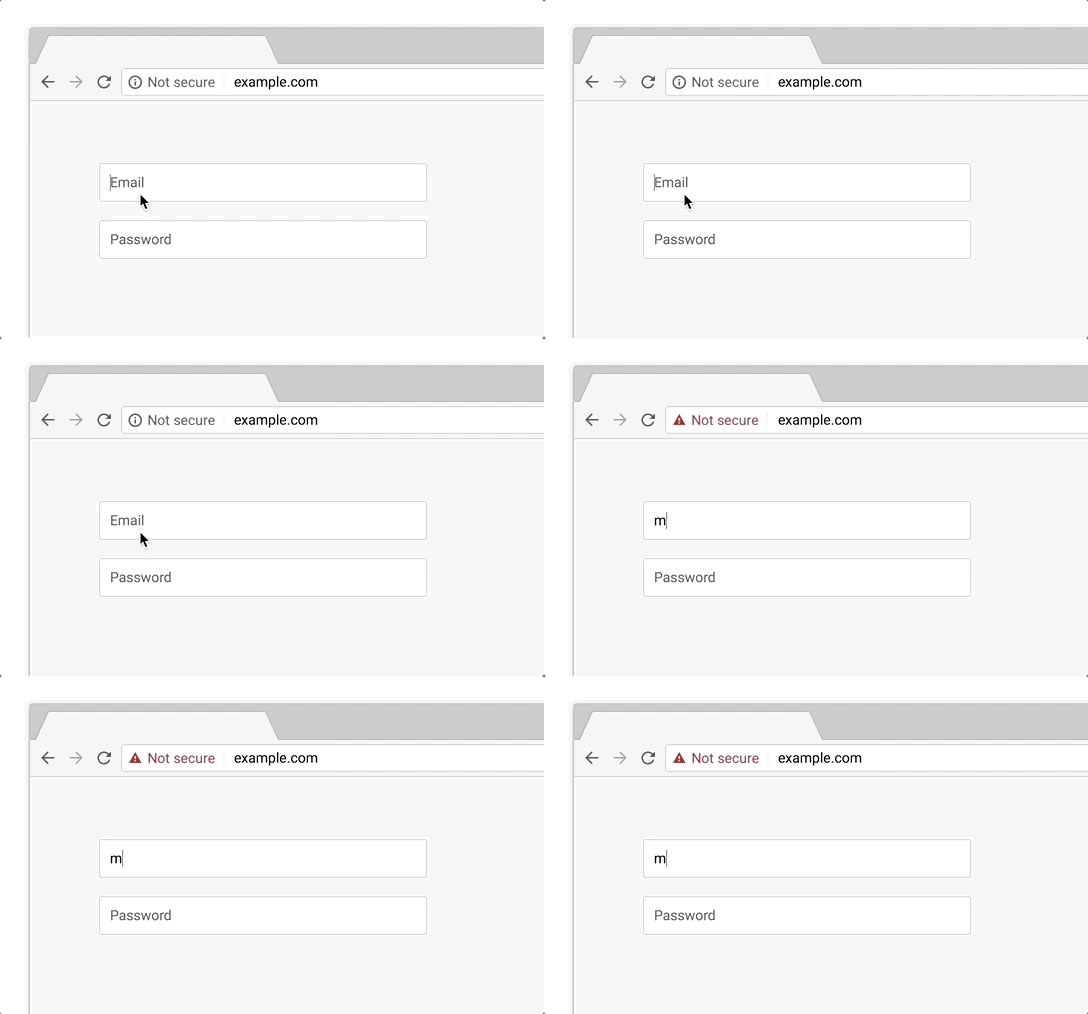
    The current version of Google Chrome shows a “not secure” sign alongside the web address bar for any websites that still use the HTTP standard.

    With the upcoming release of Chrome 70 in October 2018, Google announced that they will begin to shout out the “not secure” notification even louder. All websites still being served via HTTP will receive a negative visual indicator in red that reads, “not secure” beside the URL in Chrome’s address bar.

    “Eventually, our goal is to make it so that the only markings you see in Chrome are when a site is not secure, and the default unmarked state is secure. We will roll this out over time, starting by removing the “Secure” wording in September 2018. And in October 2018, we’ll start showing a red “not secure” warning when users enter data on HTTP pages,” according to Emily Schechter, the Chrome Security Product Manager.

    Example of a URL for a non-secure site - Search Influence

    In other words, now is the time to think of HTTPS as mandatory!

    How Do You Add HTTPS to Your Website?

    An SSL certificate is needed to convert your site to HTTPS. When you install this certificate and migrate your website to HTTPS, it facilitates the important encrypted connections.

    Google’s SSL requirements are crucial to your website because they provide authentication and establish trust when customers visit your pages.

    Brush up on our detailed explanation of SSL Certificates by reading Influencer, Alison Zeringue’s blog post.

    We Have Your Back!

    The majority of internet users tend to trust Google when it tells them something isn’t secure. Be prepared for all the new Google Chrome changes and keep your website secure. Call our team at Search Influence today at 504-595-1623 to help you protect your clients and provide encryption of all sensitive information on your website.

    Images:

    Not Secure

    We Got This

  • How to Drive Conversions With the Right Contact Form—And What to Avoid

    Your business’ shiny new website just launched and everyone assumed a deluge of fresh new leads would follow. To everyone’s dismay, the predicted deluge turns out to be nothing more than just a trickle. What gives exactly? “Build it and they will come” may ring true with your traffic itself but that quote lacks an “and convert” at the end. In years past, traffic was the key metric for a lot of businesses since it was assumed that those users would appreciate the brand awareness. Fast forward to the present day in the “Silicon Age” where users not converting is sure to set your business behind further than the Bronze Age.

    One easy way to convert users into customers is through the usage of a handy-dandy online form, but just having a form doesn’t guarantee a conversion rate anywhere near your industry benchmark. I’m here to help bolster those forms from some boxes into lead machines!

    Positioning

    Back when there were only brick and mortar buildings, there was always a huge focus on location, location, location. That phrase may seem like it belongs in the Bronze Age, but it instead adapted to the changing times and is still just as important as it was before. The location of your form is integral to the success of any lead collection campaign. Forms should always be placed in a very obvious place and above the fold, which is the portion of a page that initially loads in the screen’s viewport, as often as possible. Having a form in a good location puts it on users’ minds as soon as they visit your website and makes it more convenient to convert. Overlaying the form over a banner image is a good start for more visibility.

    Another excellent location for your form is on the sidebar of your site. This allows casual site perusers to convert at their own leisure instead of forcing them to a contact page or trying to lead them back to whatever landing page they entered the site within. One last location for a form is on your contact page, of course. Any site user would expect a way to contact your business on the contact page. In addition to an address, phone number, or email, a contact form is a perfect way to capture visitors’ information and nurture leads to eventually becoming loyal customers of your business.

    Layout

    Now that you’ve figured out where to place your form, the next step is to create a form that users can easily understand, fill out, and convert on. One big helper that was pointed out in a Google AI test is how users’ eyes focus on form fields. Having your labels above the inside of form fields is preferable to labels next to the form fields. This allows users to better scan the information and breeze through forms quicker, which leads to lower rates of dropout and errors in fields. Speaking of fields, try not to overwhelm your users with a bunch of unnecessary fields for information that can be gathered further down the line. If you aren’t shipping something to someone, why would you require a home address? If you’re sending users a brochure via email, why would you require a phone number? Requiring an excess of information makes users go “hmm…” and abandon the website completely. This is not to say that long forms have no place on the internet, rather every bit of information should be relative to the call to action.

    Here at Search Influence, we use our own proprietary lead tracking system to create fully customizable and extremely flexible forms that can keep track of your website leads in an easy-to-read reporting system. With our forms, you’ll know where your leads come from the most and learn how to optimize your campaigns to maximize your lead generation.

    Call-to-Action

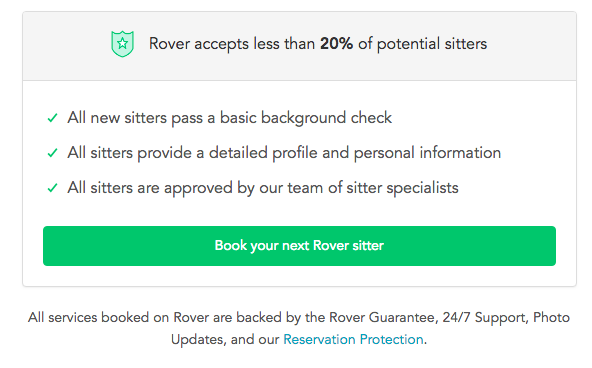
    A “Call-to-Action” (CTA) refers to the phrase that is meant to draw users into completing conversions. In the case of forms specifically, this would be the text that is on the submit button. Hubspot compiled a list of 31 Call-to-Action examples taken from many different corners of the internet and from varying industries. The main takeaway here is your CTA needs to be catchy and draw a user in. “Submit,” which may be seen fairly often around the internet, doesn’t quite cut it anymore. The end of a form should establish some sort of value to a user. Saying “Submit” simply tells the user that you’ll gladly collect their information and may or may not do anything with it.

    Screen shot of a call to action from Rover - Search Influence

    Having detailed text on the CTA button encourages users that your form is something worthwhile whether they’re about to “Subscribe to our newsletter” or Rover.com‘s “Book your next Rover sitter.” Users want to know the value of giving up their precious personal data, so make sure your form is honest and straightforward with how the users’ data will be used.

    Mobile

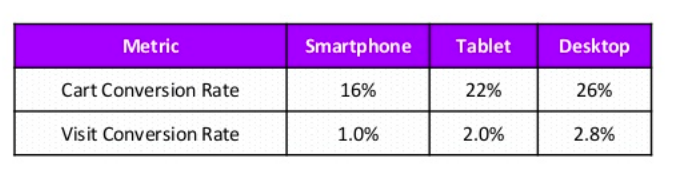
    One factor that can’t be ignored is the impact of mobile users on your website. Considering mobile users surpassed the amount of desktop traffic almost two years ago—eons in internet time—ignoring mobile users is a recipe for failure. What’s even more surprising is that in the same year, even though there were more mobile visits to websites worldwide, mobile users converted almost 65% less than desktop users according to the 2016 Adobe Mobile Retail Report.

    Table of mobile conversion rates - Search Influence

    Our advantage here is that this data is like, eons old. We’ve progressed since then and have become more accustomed to serving mobile users and Google even recognizes the efforts that developers put in to make their websites mobile friendly and adjusted their search to index mobile sites first. This coupled with the rising magnitude of mobile traffic means that being able to capture leads efficiently on mobile platforms is imperative for any campaign.

    At Search Influence, we have everything you need to start a lead generating campaign, from SEO services, digital advertising, social media management, and the capability to track your campaign with pinpoint accuracy. We also practice what we preach; check out the form in the sidebar if you don’t believe us.

  • Why You Should be Posting on Google My Business

    “Just Yahoo it,” said no one ever. It just doesn’t have the same ring as “Google it,” which was officially added to the Oxford English Dictionary and the Merriam-Webster Collegiate Dictionary in 2006. That’s because Google has practically monopolized internet searching. According to NetMarketShare, Google accounted for over 79 percent of all global desktop search traffic in 2017, followed by Bing at 7.27 percent, Baidu at 6.55 percent, and Yahoo at 5.06 percent. In addition, Google receives over 63,000 searches per second on any given day. In the U.S., more Google searches take place on mobile devices than on computers, and 30 percent of mobile searches are related to a location. It’s obvious that to succeed in the SEO world, you have to play by Google’s rules.

    So, Just How Do You Play By Google’s Rules?

    One way to do this is by creating a Google My Business (GMB) page for your company. This page allows your businesses to manage their online presence across Google, through a physical location. Within this company page, Google has a social posting platform that allows business to provide “up-to-date posts from verified people, places or things, directly in search results.” These public posts allow businesses to share company updates to feature what’s new, respond to customer reviews, and add photos to highlight what makes your business special, and build brand awareness.

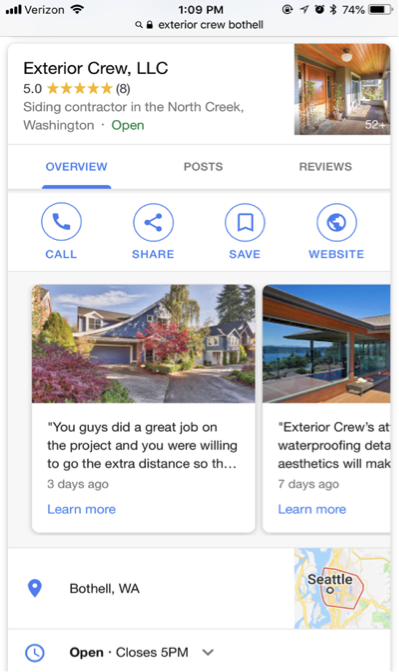
    Screenshot of a Google My Business post from Exterior Crew, LLC

    These posts are particularly captivating because, rather than appearing in the search results, they are displayed in the knowledge panel, which presents a more engaging visual aid. This is NOT to be confused with Google +, which was Google’s attempt to compete with Facebook as a social platform. And let’s be real; it was a major fail. Realizing this, Google reconstructed their platform and created GMB. Google + profiles and pages still exist, but they are now subpages of a GMB page.

    The Start of Google Posts With Candidate Cards

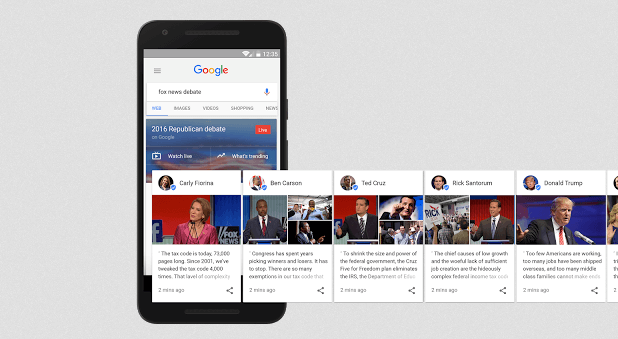
    Before July 2017, Google’s now-called “Google Posts” were only accessible to few. It all started with “Candidate Cards.” You may remember seeing these around the 2016 presidential election. Google described these as non-ad privileges, giving 2016 Republican and Democratic candidates a place in Google search.

    Image of Google's candidate cards - Search Influence

    Proving to be both appealing and informative by viewers, Google allowed the expansion of these cards for celebrities and sports teams. As of June 2017, GMB brought these now-called “Google Posts” to local businesses as an easy way to help attract new customers and build relationships with the customers you already have. These posts have proven particularly effective in promoting flash sales or promotions, emergency updates, such as school closings, and sharing job openings. In addition, these posts contain a call to action (CTA) feature, which provides an easy and direct way for customers to book appointments or reservations.

    Benefits of Google Posts Over Traditional Social Media Posts

    You may be thinking, why would I need to use Google as a social platform when I already use Facebook, Twitter, Instagram, etc.? And you have a point. These social platforms are still great ways to post updates about your business. Although similar, Google Posts offer a few advantages that the typical social media platforms do not, including the following:

    They’re more searchable

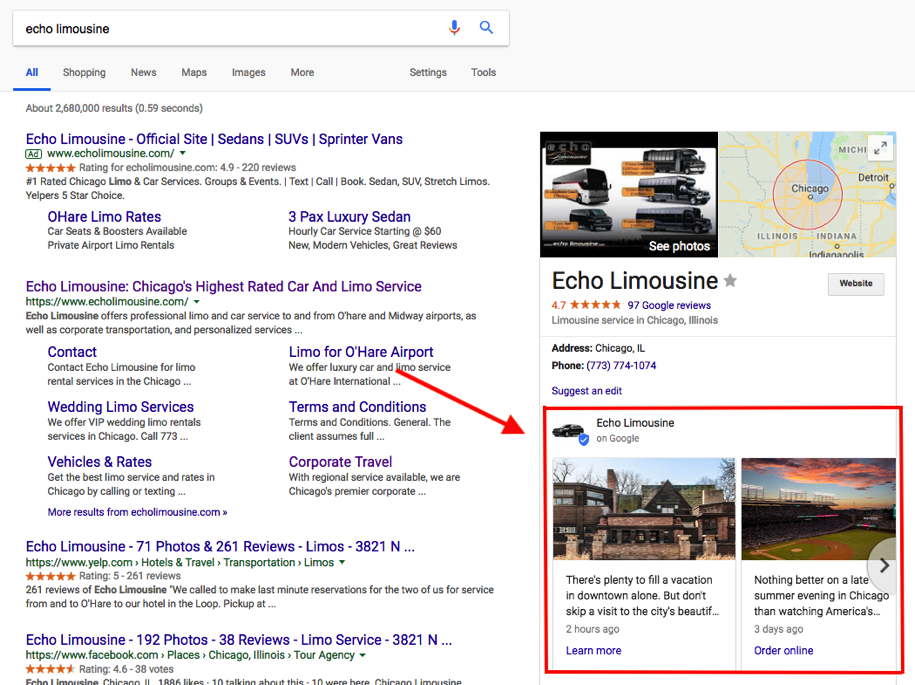
    You can literally “Google it.” When searching for a business, these posts will appear directly on Google Search and Google Maps pages. When someone searches for your business, your location address and phone number will appear in the knowledge panel on the right-hand side of your search results. Your company’s address/location is the primary piece of information searched for by local customers. In regard to mobile, local searches lead 50 percent of viewers to visit stores within one day.

    Screenshot of a GMB post by Echo Limousine - Search Influence

    You will expand your reach

    Not only does Google lead the way in search engine results, but it also surpasses Facebook search queries. According to Adweek, Google averages 3.5 billion searches per day, compared to Facebook’s 2 billion per day. In addition, 82 percent of people turn to search engines to find local information.

    Keyword Searches

    On Google, you can use keywords to target certain audiences—specifically, people that are already looking for your services. Since these people already have an idea of what they are looking for, they are likely to be further along in the decision stage, meaning they are more likely to convert into a client or customer. By contrast, Facebook is geared more toward targeting specific interests and in-depth personal information to lure in a potential customer.

    Impact on your ranking

    Google’s goal is to provide you with the most relevant information based on a search query. When you post new content directly through your GMB listing, you are sharing relevant content and information about your local business, which contributes to building your location authority. This tells Google that your business is legit. The more you legitimize your business to Google, the higher ranking you will get. The higher ranking you have, the higher you will appear on Google search and gain more traffic to your site.

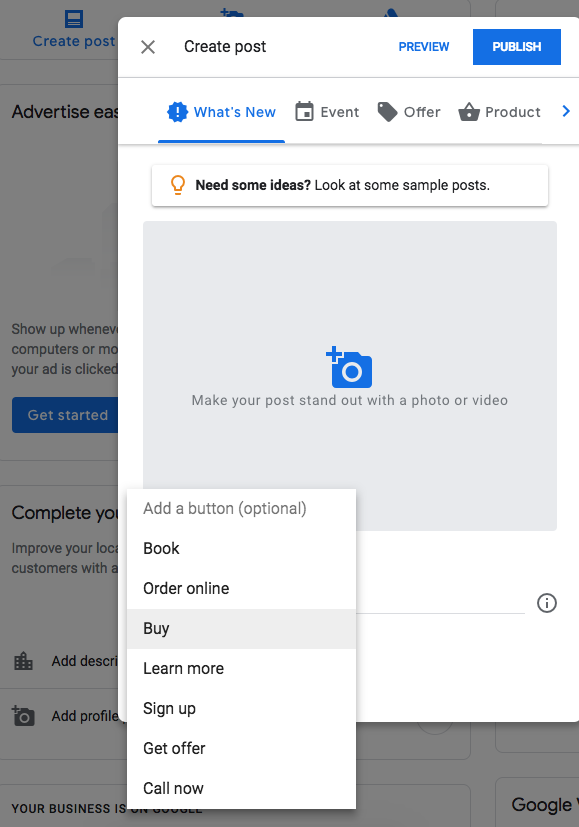
    Screenshot showing how to create a Google My Business post - Search Influence

    Connect with your customers directly

    You can include CTA buttons on all of your GMB posts. Call to action buttons have been proven priceless for converting customers. According to Everything You Need to Know About the Psychology of the Call to Action by Neil Patel, the human mind expects a call to action button. “Our minds are prepared for and are expecting an experience of being called to act and have already decided that there will be a CTA. We know that expectation affects behavior. That’s why people know to act on the CTA. They aren’t staring at the CTA button wondering what it is. They know its a button they are being asked to click.”

    Some examples of how a business can utilize these buttons include the following:

      1. Make a reservation
      2. Sign up for a newsletter
      3. Learn more about the latest offers
      4. Buy a specific product from your website
      5. Call now

    Get backlinks

    Everyone knows that backlinks have a huge effect on organic search results. By posting compelling content on your GMB posts, people are more likely to engage and reference information from your site. You can also link your site pages in a post, making it easier for researchers to find your pages.

    Start Posting!

    Although still green, GMB posting is projected to be incredibly valuable to local businesses. Facebook, Twitter, and Instagram are saturated with businesses looking to promote brand awareness. But since GMB posts are still in the early phases, it hasn’t been flooded by the masses just yet—which is why you should get in now! GMB is an excellent platform that allows your customers to stay in the know of what is going on with your businesses. Not to mention, it’s free! What do you have to lose?

    Here at Search Influence, we’re constantly staying on top of new ways in which we can help our clients be found online and thrive in their industry. If you’re interested in honing your local SEO strategy with rich, relevant Google My Business posts, then request your marketing analysis today to get started.

    Images:

    Candidate Cards

  • What Are The Most Important Review Sites? Start With These Three

    In order to remain competitive in the local search space, it is essential to encourage your customers to provide feedback about your business. Reviews and interaction with your digital properties help search engines and users learn more about your business; in today’s environment, if you are neglecting these review sites, then there is a chance you are missing conversion opportunities as well as losing ground to your competitors. With the number of review sites out there, it is important to prioritize their management in order to expose your business to the largest amount of potential customers without spending all day managing different profiles.

    What Are The Most Important Review Sites?

    While there are endless options out there, these are the most important review sites:

    1. Google My Business

    2. Facebook 

    3. Yelp 

    This should not be a huge surprise, even to casual internet searchers. These sites dominate a lot of the search space when it comes to search queries about businesses or services. Here are the basic reasons why these are the most trusted review sites:

    1. Traffic

    2. Reputation

    3. Authenticity

    According to Alexa, a widely accepted measure of websites’ ranking metrics, Google My Business, Facebook, and Yelp are the first, second, and fourth most visited websites in the United States for Consumer and Business Review websites. Amazon currently holds the third spot, but Amazon is not an option if you are in a service-based industry. All of these sites have millions of unique visits a month, meaning, people are undoubtedly coming to these sites for more information. Since these are free to manage, it would be like passing up an opportunity to have a free billboard on one of the most traveled roads in the country. Furthermore, reviews can now populate on organic search for Facebook, Google, and Yelp, so users may or may not click through to your site based on your review situation.

    One of the reasons these sites generate so much traffic is because of their reputation as a reliable source of business information. The amalgamation of traffic, number of reviews, and day-to-day use have made all of these sites integrated into our digital diet. Much like people reflexively would use the Yellow Pages or White Pages in a pre-internet world, people will reflexively use these sites to get more information about a business.

    Lastly, people trust these sites because the reviews are user-generated and moderated by a third party rather than the business itself. While it’s good practice to have reviews and testimonials on your main site, the obvious issue there from a user perspective is that you will probably only promote the positive reviews. These sites allow the opportunity for customers to express a range of thoughts or emotions, allowing potential customers to better discern the pros and cons.

    So, Why Should I Manage Business Review Sites?

    According to Vendasta, 88 percent of online shoppers utilize reviews to inform their purchase decision. Furthermore, the amount of people who do not research a business online prior to a purchase has decreased from 22 percent to 9 percent. The trends are obvious; more people are looking for your business online and more people are using reviews to make a judgment. Let’s take this even a step further—44 percent of users say they need reviews to be younger than a month old in order for them to consider it relevant. This highlights an important point—it is not enough to just let your reviews aggregate on these sites, you need to engage your audience.

    Screenshot of a typical yelp listing - Search Influence

    Screenshot of a facebook review listing - Search Influence

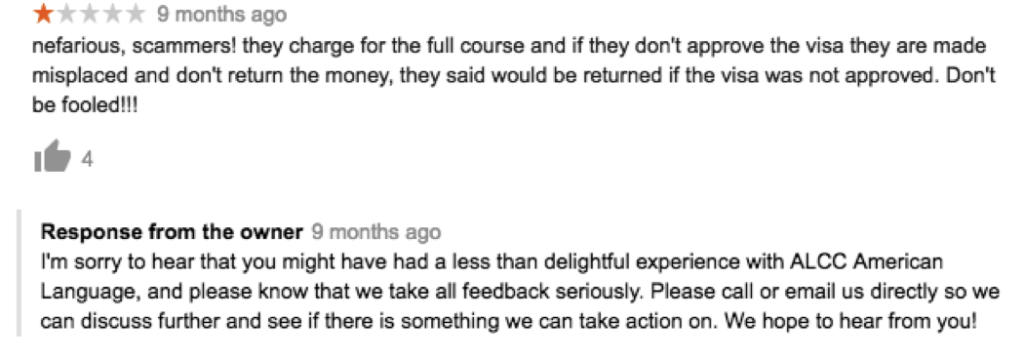
    One concern is that your business may aggregate a bunch of negative reviews. Without getting into the reasons for these negative reviews, it is important that you engage with customers who have had a negative experience. Other users looking at your business will see you engaging with customers who had a negative experience and see that you are making an effort to provide customer service.

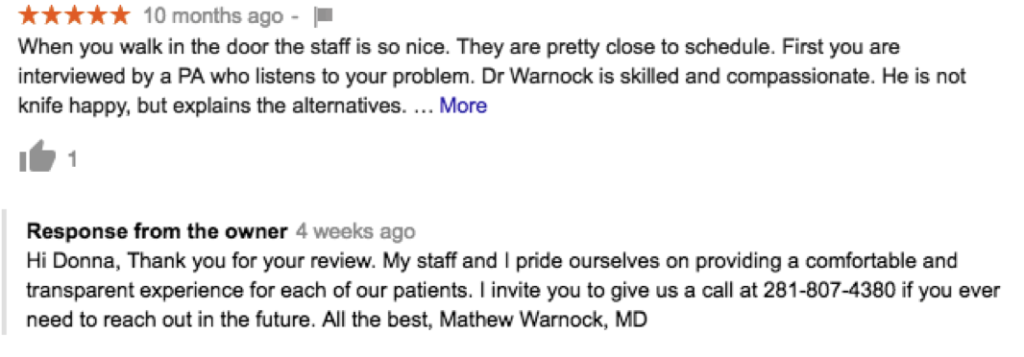
    Screenshot of a typical negative business review with a response from an owner - Search Influence

    You should also respond to the positive reviews. It is a simple gesture to show that you appreciate their business and that they took time out to engage further with your business online.

    Screenshot of a positive business review with a response from the owner - Search Influence

    Beyond the simple client facing, customer service reasons, these reviews are increasingly important to search ranking. It follows that Google will appreciate you using their Google My Business platform to gather and respond to reviews. It improves their product while also helping your business get in front of more people. Being active on your listing can have a positive impact on your local search rankings. When users visit Yelp or Facebook, having a robust review profile with engagement from the business could help you stand out in the crowded marketplace. Managing reviews is now a major factor in the realm of local SEO management.

    How Do I Get More Reviews?

    The simplest way? Just ask! There are numerous ways to interact with your clients and customers, whether it is through an email marketing campaign, adding a request to their receipts or billing, or asking them face-to-face when they are visiting your business. If they are delighted with their service, they may be inclined to help you out by spreading the gospel via Facebook, Yelp, and Google.

    Since running a business is time-consuming on its own, it is important to dedicate some time each week to ensure your digital presence is working for you. By auditing your review situation on Google, Yelp, and Facebook, you will be ensuring that you are monitoring three of the four most visited platforms in the United States among consumer and business review sites. Just a little effort in this area could lead to a surprising amount of new business for your location with the only expense being a bit of your time.

    If you need help getting your online reputation management off the ground, our team at Search Influence can streamline your local SEO strategy to better fit your business goals. Because we are dedicated to the needs of small and mid-sized local businesses, we offer pricing transparency. Request your marketing analysis today to get started.

    Images:
    Thumbs Up