Category: Industry Insights

  • Track and Report the Right Higher Ed Marketing Analytics to Improve Your Strategy

    Track and Report the Right Higher Ed Marketing Analytics to Improve Your Strategy

    Track and Report t

    Key Insights

    • Many institutions don’t track crucial metrics like cost per inquiry (CPI) and cost per enrolled student, missing opportunities to optimize their marketing efforts and better allocate resources.
    • Higher education institutions need precise tracking and insights to enhance their marketing strategies, effectively engage prospective students, and drive enrollment.
    • Institutions that actively track key metrics like CPI and cost per enrolled student see higher satisfaction with their marketing campaign performance.

    In the high-stakes arena of higher education, every marketing decision counts.

    Without precise tracking and insightful analysis, your marketing efforts are like a ship navigating without a compass — directionless and bound to get lost in the sea of competition.

    For years at Search Influence, we’ve partnered with institutions like Tulane SoPA and Tufts University College, helping them leverage analytics to optimize their marketing campaigns.

    Our experience has shown that those satisfied with their ability to track success are also more likely to be satisfied with their campaign performance.

    To further underscore the importance of tracking, this year we collaborated with UPCEA on a research study, “Higher Education Marketing Metrics Research Report: What Gets Measured Gets Managed.

    This report provides valuable insights into how data-driven marketing can lead to greater accountability, smarter decisions, and, ultimately, success in attracting and retaining students.

    Read on to learn how tracking the right metrics can empower your institution to thrive in a crowded higher education market.

    Why Tracking Marketing Metrics Is Important for Higher Ed Institutions

    As higher education institutions face increasing competition and evolving expectations from prospective students, it’s essential to track and analyze key performance indicators (KPIs).

    Higher education marketing metric tracking allows institutions to:

    • Measure their return on investment (ROI)
    • Manage campaign performance
    • Allocate resources effectively

    Tracking key metrics provides a clear picture of what’s working and what’s not, enabling higher education institutions to make informed decisions that directly impact student recruitment.

    By focusing on data, institutions can:

    • Determine which marketing channels yield the highest engagement
    • Identify the content that resonates most with their audience
    • Adjust their strategies in real-time to enhance results

    This kind of accountability is critical for marketers, program managers, and faculty who need to develop courses and offerings that align with market demand and student interests.

    Effective higher education marketing tracking can also have a significant impact on resource allocation and budgeting. When institutions measure their efforts to engage adult learners, they create a framework of accountability that drives smarter decisions.

    Track and report the right higher ed marketing analytics to improve your strategy - Search Influence

    Search Influence and UPCEA’s Higher Education Marketing Metrics Study
    Higher Ed Marketing Metrics Research Study 

    To gain a deeper understanding of the marketing metrics and costs associated with online and professional education programs, Search Influence partnered with UPCEA to conduct a comprehensive study.

    The findings of this research highlight the importance of data-driven decision-making for higher education marketing strategies.

    Follow along as we break down key findings from this study that can help your institution boost online conversions.

    Less than half of higher ed marketers track cost per inquiry

    One of the study’s top takeaways is the critical role of tracking specific metrics like cost per inquiry (CPI) and cost per enrolled student.

    Despite the significance of these metrics, less than half of higher education marketers track them. While nearly three-quarters (73%) of marketing units track the source of inquiries, only 46% track CPI, and just 43% track cost per enrolled student.

    Shockingly, nearly 17% of institutions don’t track any of these metrics.

    This gap in metric tracking reveals a missed opportunity for many universities to optimize their marketing efforts and ensure they effectively reach their target audience.

    The average professional and online education cost per inquiry is $140
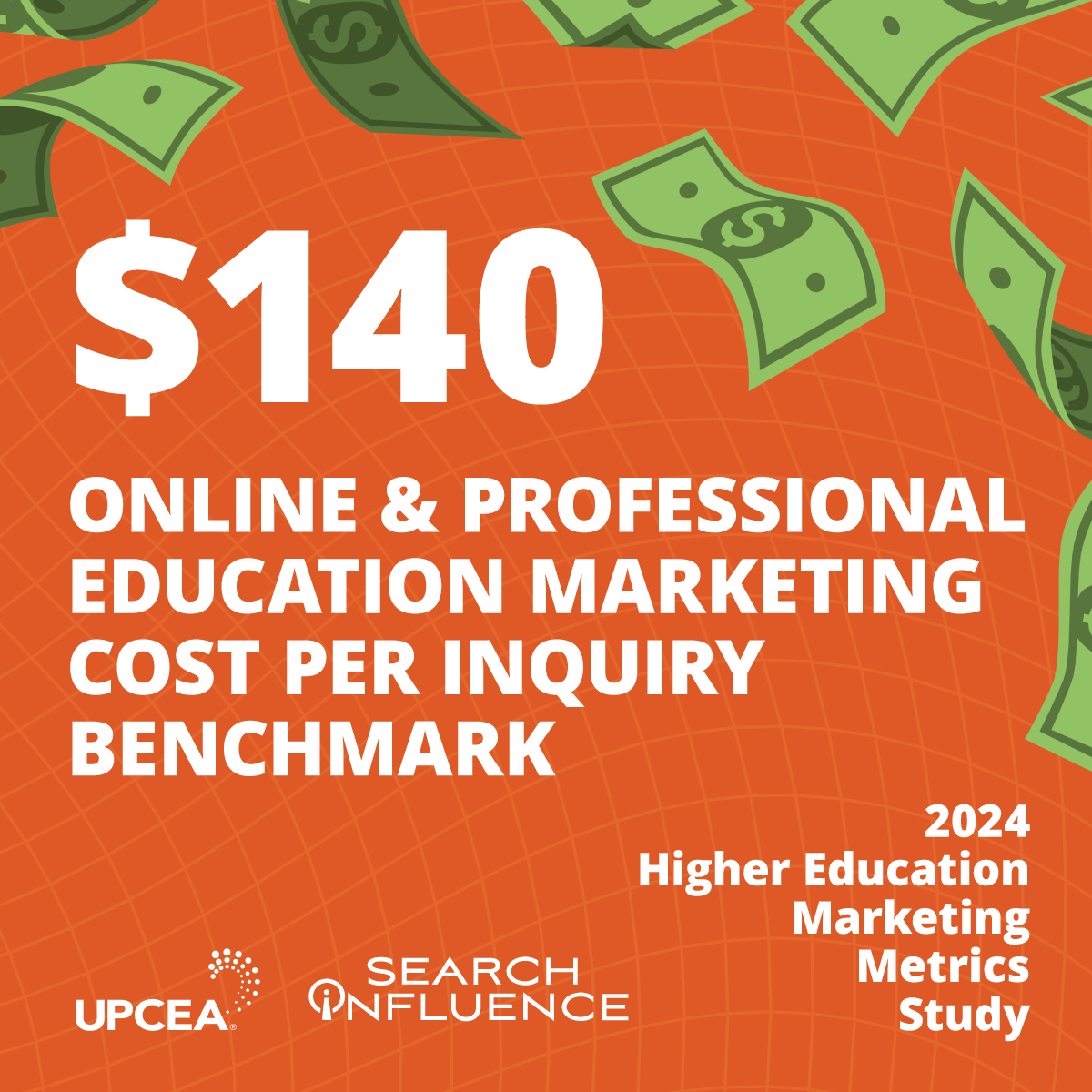
    Online and Professional Education Marketing Cost Per Inquiry Benchmark - Search Incluence

    For those tracking cost per inquiry, the study found that the average CPI for online and professional education programs is $140, with a median of $106.

    This metric is a crucial indicator of how well marketing dollars are being utilized to attract prospective students. Tracking these costs allows university marketing departments to make informed decisions about where to allocate their resources, ensuring that digital marketing efforts are cost-effective and impactful.

    Email marketing is most often managed in-house, while digital advertising is most often outsourced

    The study reveals that while 73% of higher education institutions manage email marketing in-house, half outsource their digital advertising (such as Google paid search) to external agencies.

    This trend indicates a potential missed opportunity for maximizing ROI, especially given email marketing’s high return of 36:1.

    When email campaigns and SEO are managed internally without adequate resources, universities may not fully optimize these channels, contributing to dissatisfaction with results.

    Conversely, outsourcing digital advertising allows for continuous tracking and optimization, often leading to better performance.

    Marketers who track their campaigns are more happy with performance

    Another significant finding is the correlation between tracking marketing metrics and overall satisfaction with campaign performance. Only 47% of respondents expressed satisfaction with their marketing campaigns’ performance, and just 29% were content with their ability to track campaign success.

    However, those who actively track metrics like cost per inquiry and cost per enrolled student report higher satisfaction levels, indicating that effective metric tracking is linked to better marketing outcomes.

    Analytics, Tracking, and Reporting Opportunities for Higher Education

    If you’ve read this far, we’ve made the case that it’s important and effective to track key metrics. You might be asking — what exactly are these key metrics?

    Below are the two most important metrics we recommend you track.

    Cost per inquiry

    By monitoring cost per inquiry, institutions can identify the most cost-effective methods for attracting inquiries and allocate resources accordingly, ensuring that marketing dollars are spent where they yield the highest return.

    CPI is a widely recognized metric, yet less than half of higher education marketers actively track it. This metric calculates the total marketing and advertising spend divided by the number of inquiries received, providing a clear measure of budget efficiency and effectiveness.

    Tracking CPI allows marketing teams to gain insights into which campaigns generate interest and drive students into the enrollment funnel.

    Cost per enrolled student

    Another crucial metric for higher education institutions is cost per enrolled student, which measures the total expenses involved in securing each student’s enrollment. This includes all costs from the initial marketing outreach through to the point of a student’s matriculation, encompassing media spend, agency fees, salaries, and other related marketing activities.

    Our study highlighted that less than half of higher education marketers track this metric, even though it offers invaluable insights into spending efficiency and the overall effectiveness of recruitment strategies.

    Understanding cost per enrolled student helps marketing departments optimize their strategies by identifying which campaigns are most successful at converting inquiries into enrolled students. This metric serves as a vital tool for aligning marketing efforts with enrollment goals.

    By integrating systems capable of tracking both cost per inquiry and cost per enrolled student, higher education institutions can make data-driven decisions that enhance the efficiency of their marketing plans and improve outcomes across the enrollment funnel.

    Tracking metrics can lead to new opportunities

    When you better understand your ad spend, you can reallocate funds to other areas of need.

    As our 2023 SEO research study found, 51% of universities don’t have an established SEO plan.


    Higher Ed SEO Research Study 

    Without a strong SEO focus, university websites may become challenging to navigate, leading to frustrated users who quickly leave the site. This can result in lower search engine rankings and less visibility among the target audience. By contrast, investing in SEO helps universities improve user experience, making it easier for prospective students to find information about programs, admissions, and campus life.

    For universities aiming to attract the modern adult learner, SEO offers a strategic way to capture attention and stand out in a competitive market. With an effective SEO plan, universities can ensure their websites rank higher in search results, making prospective students more likely to find them when searching for educational programs. This visibility is especially crucial as more students turn to online searches to explore their educational options.

    Reallocating budget and resources toward SEO could be a game-changer for universities. By gaining a deeper understanding of their website’s performance metrics and ad spend, marketers can identify gaps in their current strategy and shift focus to overlooked areas.

    Search Influence’s Higher Education Marketing Tracking Success

    Track and report the right higher ed marketing analytics to improve your strategy - Search Influence

    At Search Influence, our strategic approach to marketing tracking has consistently driven impressive results for higher education institutions.

    For Palo Alto University, we increased average monthly inquiries from 185 to 272 by expanding focus on key degree programs, optimizing paid advertising, and refreshing campaign messaging. This resulted in a 49% increase in leads within just two quarters.

    Similarly, we helped Tulane SoPA surpass its goal of 500 inquiries per month by implementing a full-funnel marketing strategy. Our efforts, including targeted paid advertising and optimized landing pages, led to an average of 791 inquiries per month — a 58% increase over the initial target.

    These successes demonstrate our commitment to helping higher education institutions enhance their enrollment strategies through effective marketing tracking and optimization.

    Learn More About Higher Education Marketing Analytics

    Accurate marketing tracking is essential for higher education institutions to optimize their campaigns, attract prospective students, and drive enrollment.

    Our UPCEA x Search Influence study sheds light on how universities can better measure the success of their marketing efforts through metrics like cost per inquiry and cost per enrolled student.

    By leveraging these insights, institutions can make data-driven decisions, improve resource allocation, and ultimately achieve their enrollment goals.

    Download our Marketing Metrics Research Study and SEO Research Study to gain valuable insights and start transforming your higher education digital marketing strategy today.
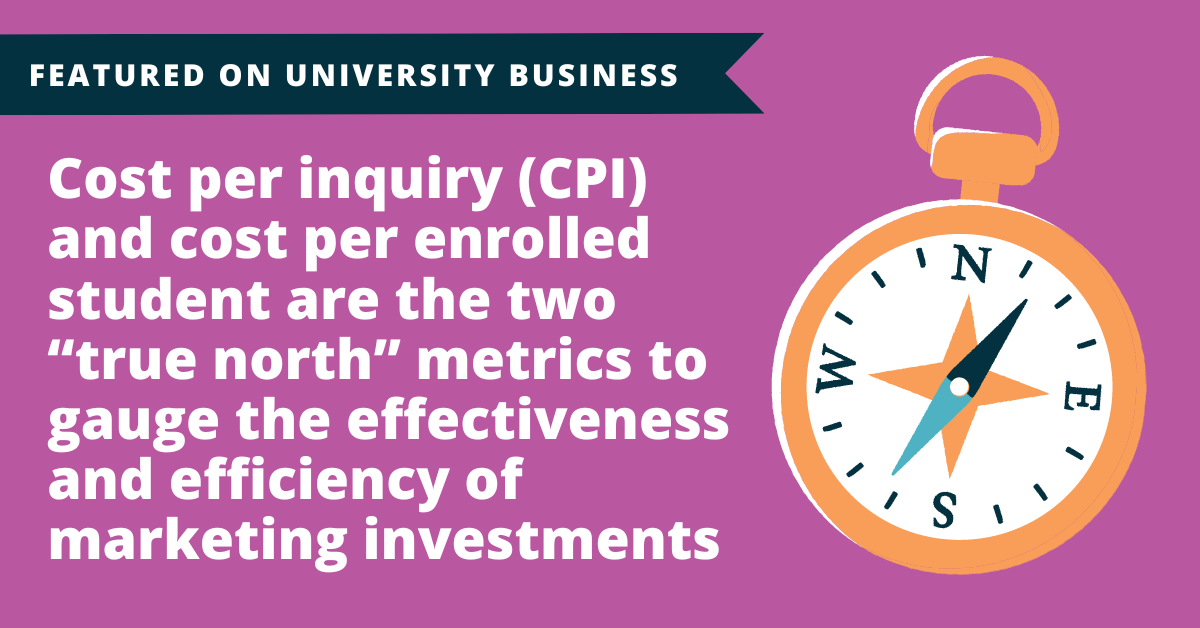
    Image Credits:

  • Higher Ed Marketing Insights From Paula French’s Article for University Business

    Search Influence - Boosting Adult Learner Enrollment with University Business

    Search Influence’s Director of Sales and Marketing Paula French recently wrote an article for University Business sharing expert insights for higher education marketers.

    This article, titled “How to boost adult learner enrollment by tracking the right costs,” discusses the importance of establishing a metric-driven approach to efficiently attract the modern learner.

    What Is University Business?

    University Business is a leading news outlet that caters to top decision-makers in higher education.

    It provides insights and strategies to college and university leaders across the United States, addressing challenges and trends in the academic world.

    University Business helps higher education leaders make informed decisions through a combination of news analysis, exclusive interviews, and practical resources.

    Insights From Paula French’s University Business Article

    Paula French’s article in University Business highlights the crucial need for universities to shift their focus toward adult learners. This demographic presents a significant growth opportunity amidst declining traditional undergraduate enrollment. Adult learners are driven by professional outcomes, flexibility, and program reputation — making their needs distinct from those of traditional students.

    Featured on University Business - CPI and CPE are the true north metrics

    To effectively market to this group, universities must prioritize tracking key metrics — namely, cost per inquiry (CPI) and cost per enrolled student. These “true north” metrics provide critical insights into the efficiency and effectiveness of marketing efforts, allowing institutions to allocate resources more strategically. Paula emphasizes that while campaign-level metrics like click-through rates are important, the ultimate goal is to drive enrollments, making CPI and cost per enrolled student the most valuable indicators of success.

    The article also notes that many institutions lack visibility into these metrics, presenting a missed opportunity to optimize marketing spend and improve ROI. By focusing on these metrics, universities can make data-driven decisions that enhance campaign performance, drive enrollment, and ensure long-term success in a competitive educational landscape.

    Read the full article for even more digital marketing for higher education insights.

    Contact Our Higher Education Marketing Agency

    Ready to strengthen your institution’s marketing strategy?

    At Search Influence, we specialize in helping universities optimize their potential.

    To get started, download our comprehensive research report, Higher Ed Marketing Metrics: What Gets Measured Gets Managed, created in collaboration with UPCEA.

    This report provides crucial benchmarks for CPI and cost per enrolled student, helping you track and improve your marketing outcomes.

    Contact us today to learn how we can help your institution achieve its enrollment goals with our higher education marketing services.

  • Not Tracking Cost Per Inquiry? Expect Budget Waste

    Not Tracking Cost Per Inquiry? Expect Budget Waste

    A woman looking out over her peers after graduation - Search Influence - Higher Education CPI

    Key Insights

    • Tracking and optimizing CPI is crucial for higher education marketers to ensure budget efficiency and maximize return on investment.
    • Failing to track CPI can make it difficult for higher ed marketers to correlate marketing success with enrollment, justify budget allocations, and optimize campaigns.
    • Tracking CPI empowers higher ed marketers to forecast conversion rates accurately, allocate resources cost-effectively, and refine strategies to attract the right audience.

    In the competitive realm of higher education marketing, efficiency is critical.

    Higher education marketers that understand cost per inquiry (CPI) will significantly influence the success of advertising campaigns, when the metric is leveraged properly. CPI, which measures the cost to acquire each inquiry is the first step to budget efficiency and maximum return on investment.

    Failing to track CPI can lead to you missing out on valuable insights that enable you to streamline your marketing efforts and better engage your target audience.

    Search Influence, in collaboration with (UPCEA), The Online and Professional Education Association, has conducted extensive research on the benefits of CPI tracking in higher education marketing.

    Through a comprehensive survey collecting data from industry leaders, we established the first higher ed cost per inquiry benchmark of $140. This initiative is part of a broader, multi-year goal to encourage higher education institutions to measure CPI diligently and consider all factors included in advertising costs.

    In this post, we’ll discuss how to successfully track your campaigns using CPI.

    The Importance of Tracking Cost Per Inquiry in Higher Education Marketing

    In higher education marketing, failing to track cost per inquiry results in inefficient budget use and an incomplete understanding of your marketing efforts. Without CPI tracking, higher ed marketers struggle to correlate marketing success to enrollment, making it challenging to justify budget allocations and optimize campaigns effectively.

    When you don’t track CPI, you risk:

    • Spending money on campaigns that drive clicks but no conversions
    • Making decisions solely on metrics like cost per click and click-through rate, rather than focusing on which campaigns are actually driving inquiries
    • Funneling money into underperforming campaigns based on the wrong metrics
    • Discontinuing campaigns that effectively generate leads because you’re not focusing on the right metrics

    Tracking CPI offers numerous benefits, including empowering higher ed marketers to:

    • Make data-driven decisions
    • Forecast conversion rates accurately
    • Allocate resources more cost-effectively

    By understanding the cost and quality of inquiries, institutions can refine their strategies to attract the right audience, thereby improving overall campaign performance. Metrics like CPI are vital for evaluating marketing health and success, enabling institutions to enhance enrollment processes and achieve a better return on investment.

    Insights from our higher ed marketing research study

    Our Higher Education Marketing Research Study, conducted in partnership with UPCEA, reveals critical insights that demonstrate the importance of tracking cost per inquiry.

    Higher education institutions spend an average of $800,970 on paid ads each year.

    Without tracking CPI, higher education marketers can’t be sure they’re allocating their resources effectively and getting the appropriate results for the amount they’re spending.

    Only 29% of higher ed marketers are satisfied with their capabilities to track the success of their campaigns. This is a frighteningly low percentage, considering the average higher ed marketer spends nearly a million dollars on paid ads yearly.

    You can achieve your enrollment goals more efficiently by focusing on tracking and reducing CPI.

    Tracking cost per inquiry allows you to:

    • Have confidence that you’re driving an appropriate amount of inquiries and yielding the desired results
    • Direct where to optimize your budget to make it more efficient
    • Understand how adjustments, including targeting and budget changes, impact results
    • Establish a jumping-off point that allows you to look at deeper metrics — such as the lead quality driven by these channels and conversion ratios as these inquiries move through the enrollment funnel

    By establishing a CPI benchmark, we encourage universities to track key metrics and be aware of all factors included in your advertising costs. This benchmark serves as a tool for your institution to compare its results with similar schools and programs, giving you confidence in your efforts by truly demonstrating how much you’re spending — no more guessing games.

    At Search Influence, we know these insights will empower institutions to improve their marketing strategies and achieve better results.

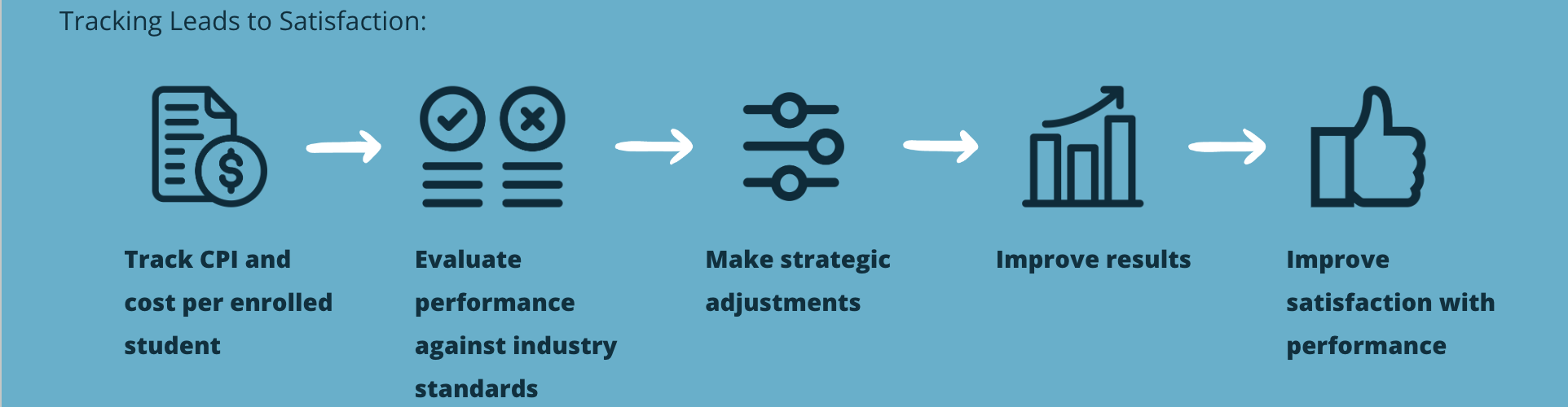
    Tracking leads to satisfaction - Search Influence

    Are You Able to Truly Track the Success of Your Ad Campaign?

    Universities investing in paid advertising must be setup to effectively track the success of their campaigns. Without the necessary information and strategies in place, you risk wasting significant portions of your budget. This underscores the true necessity of tracking cost per inquiry for higher education institutions.

    Some universities suffer from lack of data. Some universities suffer from an overabundance of data spread across disparate systems. Both scenarios hamper effective measurement.
    You need readily available information to make timely adjustments to your strategies, and a process that ensures you regularly analyze cost data and adjust your marketing strategy accordingly. Unfortunately, our research indicates that many institutions struggle in this area. Fewer than half (47%) of marketers are satisfied with their campaign performance, and only 29% are satisfied with their ability to track success. This dissatisfaction highlights a significant gap in campaign efficiency and effectiveness.

    CPI allows you to truly measure the success of your campaigns because your true success is measured by the number of students filling seats at your institution. By focusing on CPI, you get exactly what you pay for, ensuring your budget is used wisely and efficiently to boost enrollment.

    This correlation between tracking ability and campaign satisfaction reinforces the importance of CPI in driving higher ed marketing success.

    According to our research study, 92% of those who are satisfied with their ability to track also report they agree or strongly agree that they are satisfied with the performance of their marketing campaigns.

    Track Cost Per Inquiry With Confidence

    Don’t waste your budget — utilize CPI to achieve precise, measurable results and ensure every dollar spent on advertising contributes to your institution’s enrollment goals.

    At Search Influence, we advocate for robust CPI tracking to help you optimize your strategies and achieve the best possible outcomes. Our team has years of experience assisting higher ed institutions to maximize their marketing results including helping Tulane SoPA exceed its inquiry goal by 58%.

    Need support creating cost-effective campaigns with definitive KPIs?

    Download our Higher Education Marketing Research Study for further insights, or contact us directly to learn more about all our digital marketing services.


    Image Credits: Unsplash

  • AI Content Marketing: Achieve More in Less Time [ANYWORD X SEARCH INFLUENCE WEBINAR]

    Acheive More in Less Time - Search Influence & anyword Webinar

    Key Insights:

    • AI content marketing is changing the way agencies, internal marketing departments, and freelancers go about their daily workflow.
    • As more marketers add generative AI to their competitive toolkit, the gap between those who use AI versus those who don’t will grow. This makes jumping on the proverbial AI train today more crucial than ever.
    • Search Influence uses a suite of data-driven AI tools, including Anyword, to complement our content creation processes, thus maximizing our efficiency while ensuring our content is performance-optimized.
    • Just as AI has its benefits, it also has its limitations. To mitigate AI shortcomings, it’s important to maintain the magic touch of the human editor via the “AI sandwich.”
    • Intuitive prompting can distinguish between content that meets expectations and content that falls short of them.

    Over the course of history, countless tech advancements have reshaped how we view and approach our daily workload.

    In the late 19th century, the invention of the tractor revolutionized the average farmer’s day-to-day by enhancing planting and harvesting efficiency, thus reducing the need for manual labor. In the mid-20th century, the introduction of ATMs made banking more accessible, minimizing the necessity for bank tellers to be available around the clock. Now, fast forward to the early 21st century, and generative AI tools are empowering content marketers to maximize their productivity and automate the creation of performance-driven copy, all in just a few keystrokes.

    Recently, I had the pleasure of sitting down with our good friends at AI platform Anyword to discuss the impact of AI on content creation and how it helps our team work smarter. In our joint webinar “AI Performance Writing: How to Apply AI + Analytics to Your Content,” we dove deep into the state of AI content marketing, its opportunities and challenges, and how Search Influences uses data-driven tools like Anyword to better predict the success of our content collateral.

    In case you missed it, here’s a quick overview of our action-packed discussion for your convenience, and maybe — just maybe — you’ll consider giving it a watch in your free time if you’re interested (100% shameless plug there).

    The AI Train: Getting On or Getting Left Behind

    Few industries will be as affected by generative AI as marketing. That is, if you look at some hot takes by sites like Hotjar, Spiceworks, and U.S. News & World Report… among many, many others.
    The pressure is on many agencies, internal marketing departments, and freelancers to adopt AI into their daily workflows. This mounting pressure isn’t necessarily being applied from internal sources, but rather in the way the industry tides are naturally turning.

    The data shows that more and more marketers are integrating AI into their daily tasks, whether it’s to help generate a punchy headline or to save time in their workload altogether. With a steady influx of marketers leveraging the power of AI, those who do not will inevitably feel the brunt of a competitive disadvantage.

    Since generative AI first broke, Search Influence knew we couldn’t be one to miss the proverbial “AI train,” as it would only pass us right up on the route to our competitors. As Bora Tarimcilar, our Anyword webinar co-panelist and client support specialist, put it, “If you’re not on the train, there is this kind of sense of getting left behind.”

    Anyword: The AI Software Built for Content Marketing

    Search Influence started testing Anyword in 2023, at a time when generative AI was first starting to grow wings and take flight in the public eye. We set out on a mission to add another AI platform to our diverse suite of tools, which includes platforms like ChatGPT, Adobe Suite, Surfer SEO, and Google Gemini, among several others.

    With Anyword, we’ve found success in creating performance-driven content that resonates with our clients and their audiences. The tool has since become one of many key strategy components for producing high-quality, impactful content.

    Benefits of Using AI in Content Marketing

    Investing in AI today has its payoffs tomorrow.

    Timesaving for peak efficiency

    The phrase “time is money” rings true in content marketing. We all wish we had more hours in the day, especially when deadlines are looming.

    With AI as a +1 on our teams, we can now produce an entire ad campaign’s worth of copy in minutes versus the hours we’d have likely spent prior.

    The faster we produce content, the more time we have to focus on strategy, optimization, and the bigger picture as a whole.

    Relevant, competitive content

    An important disclaimer: Generative AI is not a subject matter expert. It doesn’t have a degree, it doesn’t have any certifications, and it certainly doesn’t have real-world industry experience.

    However, AI models do function by scraping the web for a “common consensus” on what to include in its outputs in response to your prompts.

    For example, let’s say you’re writing a blog for your legal client titled, “When Should You See a Personal Injury Lawyer?” and you default to AI to help get you started. After receiving your prompt, the AI model will analyze a vast dataset of online content, including articles, legal blogs, FAQs, and expert opinions on personal injury law. It will then identify common themes, important legal terms, and frequently mentioned advice to construct a well-rounded response.

    This helps ensure that the content you write is robust, researched, and in line with what your competitors are discussing. Plus, it may even help fill in some topic gaps that you’ve missed but your competitors haven’t.

    A hub for brainstorming

    Sometimes, the hardest part of content creation is simply getting that first word or sentence down.

    AI tools are perfect for those “blank page” moments. Need a catchy headline or an engaging intro? Generative AI’s brainstorming capabilities can spark creativity and help overcome writer’s block, setting the stage for compelling content that doesn’t leave you with a headache.

    If you’re not all in for AI automation, using tools for brainstorming purposes is one of the best use cases for getting your feet wet with this new tech. Even the best fires need an accelerant here and there, and AI is just that for your content creation process.

    Challenges of AI Content Marketing

    Despite all its benefits, AI content marketing is not without its limitations. To get the most value from an AI tool, you’ll need to know what to look out for — just as much as what to look for.

    Robotic tendencies

    AI is, in its truest form, just a robot. It’s not the kind you see in science fiction movies that are cynically threatening, but nonetheless, there’s no human behind the screen.

    Generative AI is not capable of experiencing human emotion, and it naturally lacks empathy. Unless you give it highly detailed context, it won’t automatically know that you’re maybe speaking to an audience with highly sensitive needs, like, for example, those in the “Your Money or Your Life” category.

    Because the model is not human, it also does not know how to distinguish fluff from lean, helpful content. With fluffy content, you lose the full extent your content can make on your audience simply by being generic and impactful. You’ll always need to bring humanness to the content, which also means double-checking that the content reads natural and conversational, not robotic.

    AI buzzwords

    “Unwavering,” “top-notch,” “a beacon of,” and so on — sometimes, it seems like AI has a few favorite words and a severely limited vocabulary.

    With these “AI buzzwords” comes one inevitable pitfall: Your content ends up using the same adjectives to describe your brand or services as your competitors.

    This can be beneficial in some areas, like when you’re trying to establish a place in the industry relative to your competitors, but it also leaves you with the risk of content that sounds the same as everyone else’s — thus affecting your ability to stand out.

    At one point, these terms likely did do considerable justice to content, and some could even have been classified as power words. Now, however, their impact seems diluted due to overuse.

    Machine hallucination

    AI is, again, no subject matter expert, and it is capable of making mistakes.

    The phenomenon “AI hallucination” occurs when an AI model generates content that is factually incorrect or nonsensical. This happens because the AI tries its best to create plausible-sounding information based on patterns it has learned, even if the actual data or facts do not exist.

    ChatGPT even has a disclaimer that it can make mistakes, and to always check information that isn’t common knowledge.

    By blindly trusting the facts and evidence AI provides you, you risk publishing inaccurate and possibly even offensive content that could harm your brand’s trustworthiness, authoritativeness, and overall bottom line.

    Mitigating Common AI Shortcomings

    Where there are problems, there are solutions.

    The AI Sandwich

    Generative AI is your teammate, it’s your dynamic +1, but it is not your replacement.

    The human editor will always be necessary to create a human-like feel in the content, fact-check all information, and optimize it for maximum engagement.

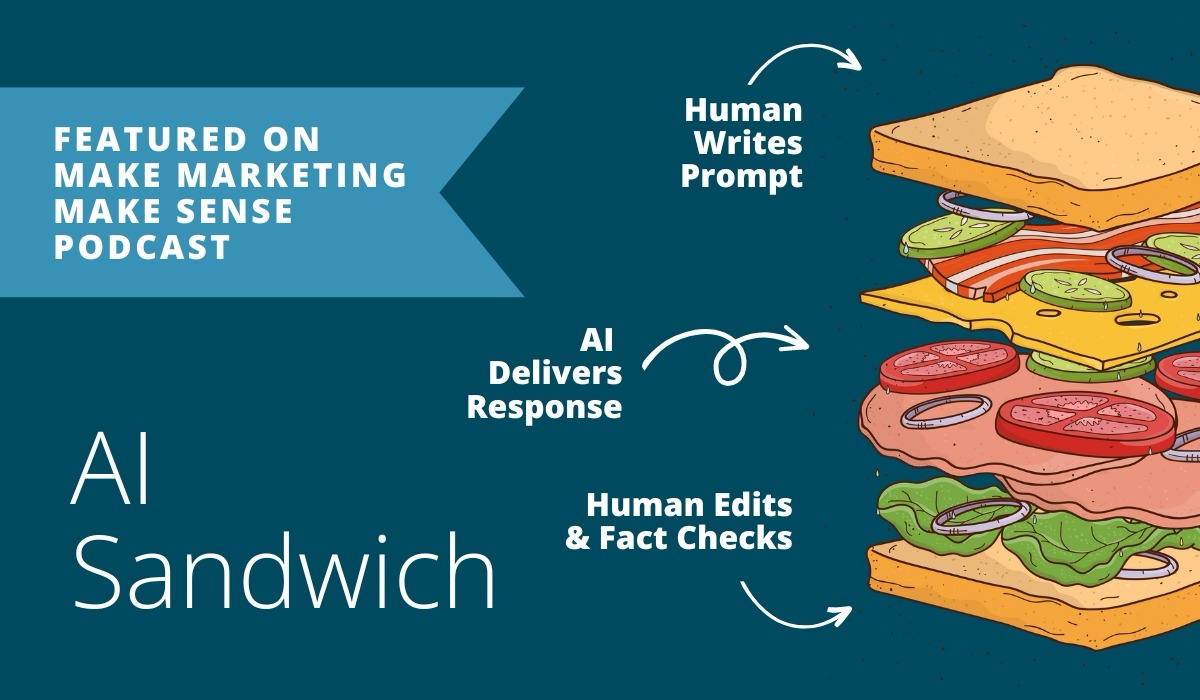
    At Search Influence, we like to call the relationship between the human and the AI model the “AI Sandwich.”*

    The human (acting as the top bun or slice of bread) prompts the machine with all the important information it needs to produce a quality output, and then they wait as the machine gets to work (acting as the sandwich’s hearty sandwich ingredients — think lettuce, tomato, onion, cheese, and meat). Once the machine produces its output, the human editor (now acting as the bottom bun or slice of bread) goes behind it, cleans it up, personalizes it more to the brand, fact-checks it, and overall adds that human touch.

    While the content is not produced top-to-bottom by a sole human writer, it is perfected by the human, which grants an overall stamp of approval that the copy meets quality standards.

    *Learn more about the AI Sandwich and its use cases with Search Influence CEO, Will Scott, on the “Make Marketing Make Sense” podcast.

    Practical prompting

    If you’re worried about generic, impactful content and the overuse of AI buzzwords in your content, the solution starts with your prompt.

    I’m a strong believer that the quality of your prompt determines the quality of your output. If you give the AI model a bare-bones prompt and expect it to fill in the gaps, it may do so in a way that doesn’t suit your brand or campaign goals.

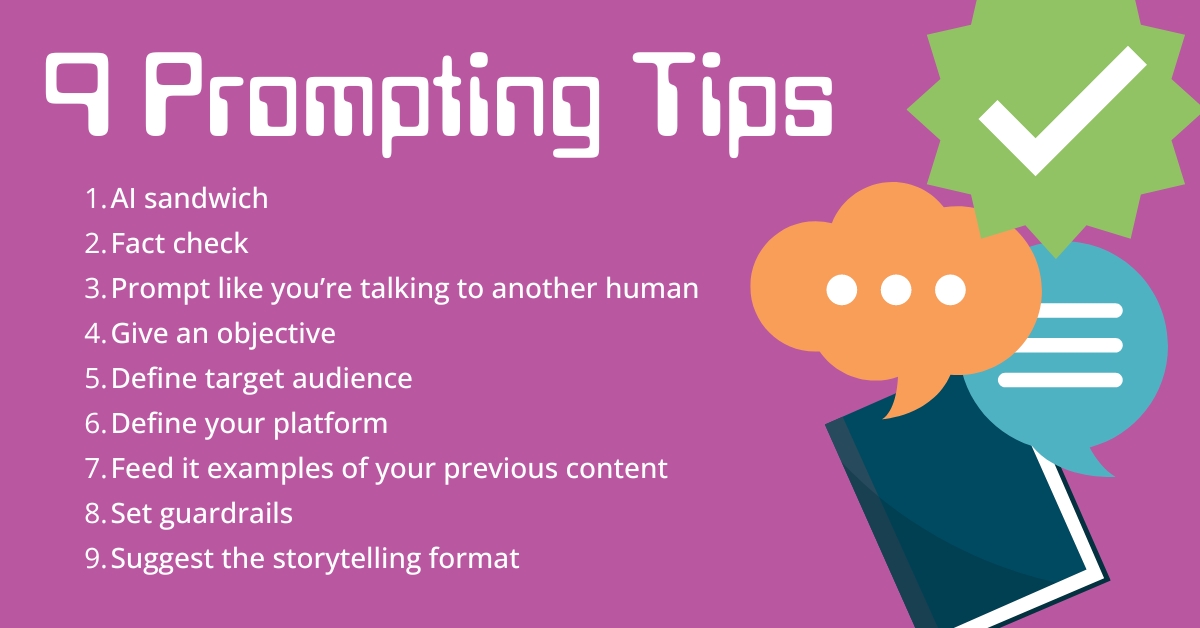
    I recommend you include these points to be as specific as possible with your prompts:

    • Your campaign goal and keywords (if applicable)
    • Your tone of voice and your target audience
    • Your desired call to action
    • Your desired word count
    • Any terms you do or do not want to be included in your output

    When you’re working with a platform like Anyword, with pre-built prompts, covering all your bases is simple. But if you aren’t using a tool with pre-built prompts provided, there are a ton of helpful articles, videos, and templates online that can get you started.

    9 Prompting Tips for AI Content Marketing - Courtesy of Search Influence and the Search Influence and anyword Webinar

    Dive Deeper Into AI Content Marketing

    A very, very big thank you to Anyword for inviting me to join “AI Performance Writing: How to Apply AI + Analytics to Your Content.” I hope that you all are just as excited and geeked out as we are about this new wave of content marketing.

    And, if you’re not, that’s perfectly okay. Just know the AI train does have a seat open for you.

    Search Influence specializes in full-service content marketing, from SEO and paid advertising to email marketing, social media, and beyond. To learn more about how we’re using AI content marketing to drive client success at scale, get in touch with us today.

  • Social Search: How Gen Z & Millennial Search Habits Are Changing

    Social Search: How Gen Z & Millennial Search Habits Are Changing

    Key Insights

    • Gen Z and Millennials increasingly favor social search over traditional search engines like Google.
    • As social search becomes more prominent, brands need to optimize their presence on social media platforms to capture the attention of younger, tech-savvy audiences.
    • Social search engines prioritize visual content, which resonates more with younger audiences. Platforms like Instagram and TikTok emphasize images and videos, making it crucial for brands to invest in high-quality visual media to capture attention and drive engagement.

    As has been true for countless generations, young people find their own unique way of doing things.

    From turning rhythm and blues into rock and roll to developing new ways to dress, youth always finds a way to adapt the norm.

    You can see this same trend in how this new generation searches the web.

    Gen Z and Millennials are moving away from traditional search engines like Google in favor of what they consider a more authentic experience — social search.

    Understanding and adapting to these changes is crucial for digital marketers trying to reach this ever-elusive demographic.

    As social SEO becomes increasingly important, brands need to optimize their presence on social media platforms to capture the attention of these younger, tech-savvy audiences.

    At Search Influence, we are committed to staying ahead of these trends and ensuring our strategies evolve to reach all audiences. Whether it’s optimizing for traditional search engines or harnessing the power of social media platforms, we dedicate ourselves to continual learning and adaptation.

    Just as previous generations adapted to Elvis and high-waisted jeans, today’s businesses must evolve with social search.

    What Is Social Search?

    A cloud of social media icons depicting popular platforms

    Social search refers to using social media channels to find information, discover products, and learn about services. This approach leverages social media platforms’ dynamic and interactive nature, where users can tap into a wealth of real-time, user-generated content (UGC).

    Traditional search engines like Google and Bing operate by crawling the web, indexing pages, and ranking them based on factors such as backlinks, page speed, keywords, and domain authority.

    Users input relevant keywords, and the search engine returns a list of websites and pages that best match the query while also considering the above ranking factors.

    Issues arise because the best answer to a searcher’s query can get overshadowed by big, trusted (by Google), websites’ desire to capitalize on the searches regardless of their relevance.

    And for generations obsessed with authenticity, it feels particularly shady that a search for “best hiking gear” yields results from The New York Times, CNN, and Forbes.

    These websites have the online authority and know-how to satisfy Google’s ranking factors, not necessarily the user’s query.

    In contrast, social search harnesses the power of social media channels and engagement to surface content that is often more current and contextually relevant.

    Reddit, for instance, enables users to find information through community discussions and “upvoted” posts, often providing more nuanced and diverse perspectives. Platforms like Instagram and TikTok allow users to search for content using hashtags, user profiles, and trending topics, providing results that are influenced by real-time interactions and community interests.

    Let’s contextualize this with a real-world example.

    Say you’ve had a long day at work and are on the hunt for an easy recipe.

    A simple search on TikTok for #quickrecipes will produce a bounty of popular, easy-to-follow, short-form videos based on past content you’ve interacted with, all from authentic sources in your community.

    This makes the search for dinner simple and satisfying.

    TikTok’s powerful algorithm has led to countless viral recipes, like Feel Good Foodie’s Baked Feta Pasta.

    @feelgoodfoodie If you love my Baked Feta Pasta recipe, you can now order it for pickup or delivery from the Creators Kitchen As Seen On TikTok! It’s a new brand that features my viral #bakedfetapasta ♬ original sound – Feel Good Foodie

    In contrast, a search for “quick recipes” on Google opens a floodgate of 3,000-word blogs from the likes of Food Network and Taste.

    While some might not mind this result, for many Gen Z and Millennials, all they see is hard-to-digest content from their parents’ favorite brands.

    Social media platforms show results based on what users engage with in their online communities, leading to a more personalized and trusted experience.

    This is an experience that Gen Z and Millennials can’t get enough of.

    Gen Z and Millennials Are Driving the Social Search Revolution

    There has been a significant cultural shift in how younger generations seek information. The phrase “Google it” is gradually being replaced with “Search it up” on social media.

    This change in language reflects a broader trend: Traditional search engines are no longer the default for discovering new products, services, and information for young people.

    Instead, Gen Z and Millennials are turning to social media search for visual content, peer reviews, and influencer recommendations.

    According to Persuasion Nation, 97.5% of Gen Z use social media as their primary source of shopping ideas, underscoring the dominance of these platforms in influencing purchasing decisions.

    Reasons behind the preference for social search

    • Visual content and peer reviews: Social media platforms offer rich visual content that resonates with Gen Z and Millennials. From Instagram stories to TikTok videos, visual media captures attention and conveys information quickly and effectively. Peer reviews and influencer recommendations add an extra layer of authenticity and trust, making it easier for users to make informed decisions based on real experiences.
    • Direct interaction and community engagement: Social media enables direct interaction with brands, influencers, and peers. Comment sections, likes, and shares facilitate community engagement and discussion, creating a sense of belonging and active participation. This interactive element is something traditional search engines cannot replicate, making social media search more appealing to younger users.
    • “Junk” in traditional search results: There is growing dissatisfaction with the commercialization and spam often found in traditional search results. Users are increasingly wary of ads and sponsored content that can clutter their search experience. While similar ads can be found on social media, they are often delivered by influencers users trust — not a pop-up while scrolling through a blog.

    Concerns about social media search

    While Hubspot reports that 29% of Gen Z and Millennials prefer to use social search engines, it’s not all sunshine and rainbows.

    There is an erosion of trust in social media platforms due to concerns about privacy, misinformation, and the authenticity of content.

    This duality highlights the complex relationship younger users have with social media as both a valuable resource and a potential source of mistrust.

    Impact of Social Search on Traditional SEO

    Traditional SEO involves optimizing a website’s content to improve its ranking on search engines. This includes:

    • Keyword research
    • On-page optimization
    • Building backlinks
    • Ensuring technical elements like site speed and mobile-friendliness are up to par

    The primary goal is to enhance visibility in search engine results pages and drive organic traffic to the website.

    On the other hand, social search SEO focuses on optimizing content for discovery on social media platforms. This involves creating engaging, shareable content that resonates with the target audience. Keywords still play a role, but the emphasis is more on user engagement, video content, and social sharing.

    A phone being held on a brick wall under a painting of a "Like" bubble commonly associated with Instagram

    The success of social search SEO is measured by the level of interaction and community engagement a post receives rather than just its ranking position. And, where those social posts might rank in Google and Bing.

    How social search is influencing changes in SEO strategies

    Social search is driving changes in SEO strategies by emphasizing the importance of creating content that is not only relevant but also highly engaging and shareable. Traditional SEO strategies are increasingly incorporating elements of social SEO, such as focusing on video content and community authenticity. This hybrid approach aims to enhance both search engine rankings and social media visibility.

    Brands now recognize that creating compelling visual content and leveraging influencers isn’t just for social media — it’s an integral part of SEO strategy as well.

    By mixing the powers of social media’s community-driven, user-generated content with the strengths of SEO, marketers can now grasp what has long eluded them… authenticity that ranks across all platforms.

    These strategies help increase brand identity and drive traffic from social platforms back to the website, enhancing overall SEO performance.

    Potential challenges and opportunities presented by social search

    The rise of social search presents several challenges for traditional SEO, particularly in adapting to the preferences of younger audiences.

    One significant challenge is creating content that Gen Z and Millennials trust and want to interact with.

    These generations prefer easily digestible, straightforward content that quickly satisfies their search queries.

    For example, short, informative videos or visually appealing infographics are more likely to engage these users compared to lengthy, text-heavy articles.

    Additionally, traditional SEOs must develop strategies for platforms outside of Google. While Google remains a dominant player, platforms like Instagram, TikTok, and Reddit are increasingly important for reaching younger audiences.

    This requires a shift in content marketing strategy to include the creation of shareable, engaging content tailored to these social media platforms.

    How to Adapt to This New Era of Search

    Optimize for social search

    To increase discoverability on social media sites, it is essential to conduct thorough research on relevant keywords and hashtags to include in your post captions and your profile bio.

    See? Some things never change.

    Utilizing keywords and hashtags can significantly enhance your social SEO performance.

    Ensure that your content descriptions and hashtags align with the latest search trends on social platforms.

    This strategic approach will help your brand appear in more search results on social media sites.

    Optimizing your social media profiles is crucial for strengthening your brand identity and enhancing your social media efforts. Use relevant keywords in your profile descriptions, and include clear, concise information about your brand.

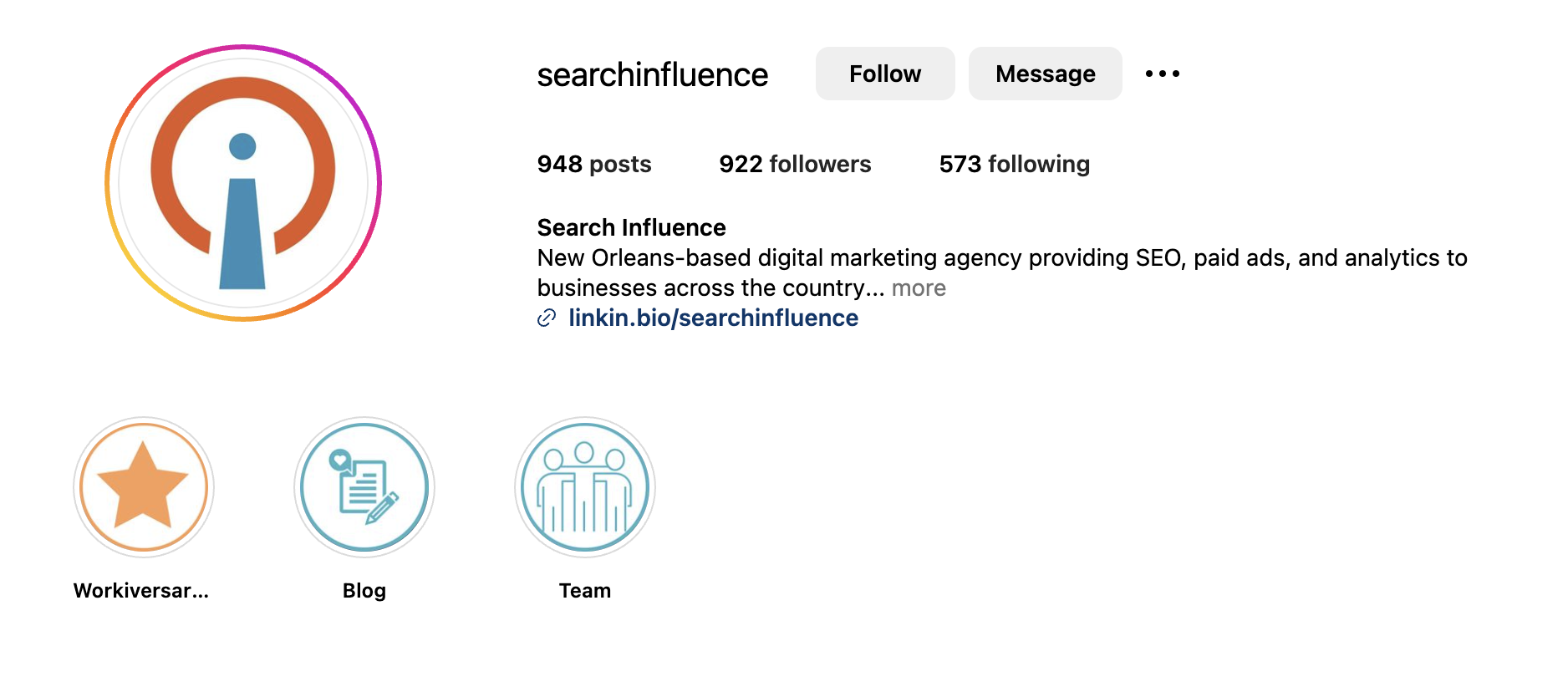
    A screenshot of Search Influence's Instagram profile header, showing the importance of proper optimization

    Make sure to link back to your website from your social media pages to drive traffic and improve your overall SEO strategy. Consistency across all social media accounts is key to creating a cohesive and recognizable brand presence.

    Understand the platform

    Each social media platform has unique features and algorithms, requiring tailored strategies to maximize your reach and engagement.

    For example, Instagram and TikTok both rely heavily on visual content, such as short-form videos, while Reddit relies on community interaction and conversation engagement.

    Developing specific strategies for each platform will allow you to leverage their strengths and connect with your target audience effectively.

    Social media algorithms and features are constantly evolving.

    To keep your strategies relevant, stay informed about these changes by following digital marketing news and updates. Regularly updating your knowledge ensures that your social media efforts remain effective and aligned with the latest trends and best practices.

    Create engaging visuals

    Investing in high-quality images, videos, and graphics is crucial for capturing attention on social media.

    Professional and visually appealing content stands out and attracts more engagement. Platforms like TikTok and Instagram Reels have popularized short-form video content, making it a powerful tool for social discovery. Create short, engaging videos that are informative, entertaining, and easily shareable.


    View this post on Instagram


    A post shared by Search Influence (@searchinfluence)

    Keeping your feed active with fresh content, even if it seems repetitive, helps maintain visibility and keeps your audience engaged.

    Leverage influencers and user-generated content

    Collaborating with influencers who align with your brand values and target audience can significantly boost your social media interactions with Gen Z and Millenials.

    Influencers can create authentic content that resonates with their followers, enhancing your brand’s reach and credibility. Influencer partnerships can also drive more brand mentions and improve your social media signals, ultimately benefiting your SEO strategy.

    Promoting user-generated content is an effective way to increase engagement and build community around your brand.

    Encourage customers to share their experiences using branded hashtags, making it easier for others to discover and engage with your content. UGC not only provides authentic, relatable content but also boosts your brand’s visibility and trustworthiness.

    Trust the Search Engine Experts at Search Influence

    No matter the year or the platform, marketers will always have to adapt their sails to the winds of young people.

    Before SEO and digital marketing, brands spent millions on 30-second spots between music videos on MTV.

    Before that, the mad men of ad agencies bought entire pages in Rolling Stone, trying to grab the ever-fleeting attention of youth.

    Allow Search Influence to be your first mate as you navigate the seas of social search.

    Our knowledgeable team has years of experience getting results for brands just like yours.

    As SEO thought leaders, we take pride in leveraging the latest industry trends to build result-driven campaigns for our clients.

    Get in touch with us today to learn more about all the services we offer.

    Image Credits

    Group of Social Media Logos, Credit to Alexander Shatov

    Phone on Brick Wall, Credit to Karsten Wingeart

  • Will Scott Talks Higher Education Schema in Seer Interactive Guest Blog

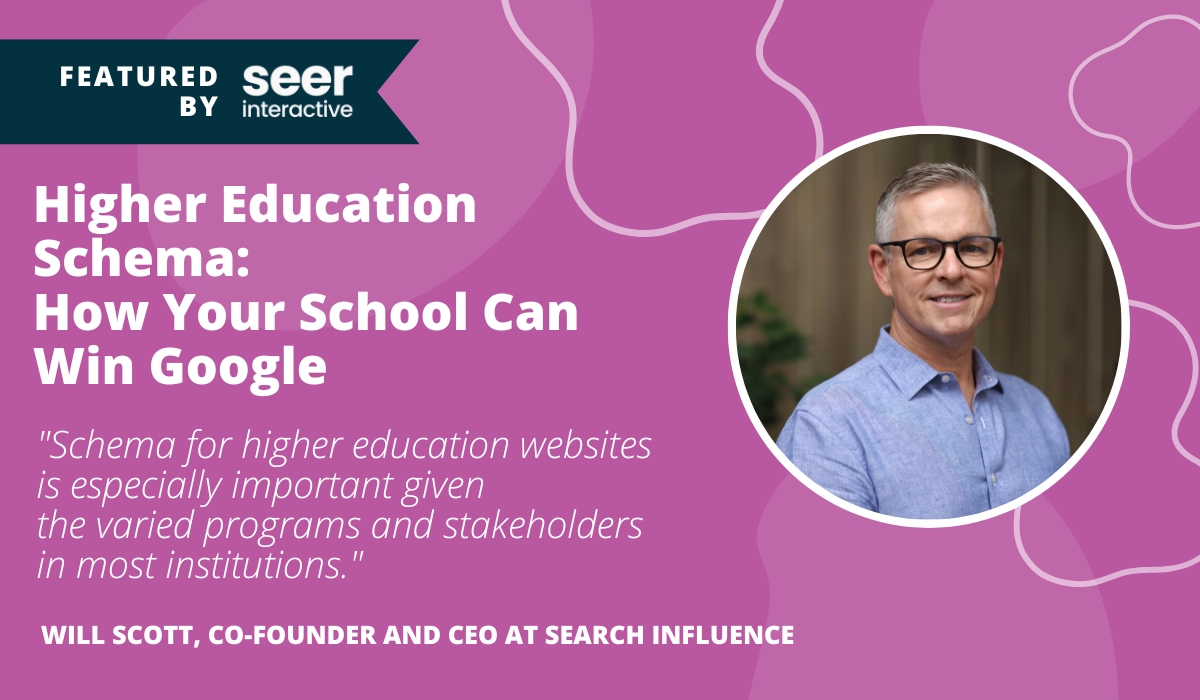
    Search Influence - Will Scott on schema for Seer Interactive

    In a June guest blog for B-Corp certified digital marketing agency Seer Interactive, Search Influence Co-Founder and CEO Will Scott breaks down a fundamental, yet often overlooked, higher education SEO tactic: schema markup.

    Schema markup for higher education websites is a form of microdata added to a website’s HTML to help search engines better understand the content. It uses a semantic vocabulary (i.e., code) known as Schema.org to annotate various webpage elements with metadata. By crawling your schema, search engines can get a better sense of who you are and surface your site in the SERPs in response to relevant search queries.

    Schema markup is the back-end roadmap for your higher ed website. It guides search engines, like Google, Bing, and Yahoo, through the campus of your content via structured data that’s easy to understand and follow. This helps streamline your site’s crawlability, boost your chances for rich snippets, and improve your visibility in the search engine results pages (SERPs).

    How do you know if your institution’s schema markup is up to par? See Will’s blog, “Higher Education Schema – How Your School Can Win Google,” for tips to better speak search engines’ language.

    Key Takeaways From “Higher Education Schema – How Your School Can Win Google”

    Schema is much beyond just simple code. In “Higher Education Schema – How Your School Can Win Google,” Will goes deep into this core technical SEO concept, offering insights on:

    • The Fundamentals of Schema Markup: Understand the basics and why it’s essential for higher education websites.
    • Step-by-Step Implementation: Detailed instructions (with a template) on how to apply schema markup using Schema.org, tailored specifically for educational institutions.
    • Practical Examples: Real-world applications and examples to illustrate how schema markup can be effectively used.
    • Impact Analysis: Insights on how schema markup can grow your institution’s online presence and drive more prospective students to your enrollment funnel.

    Search Influence - High Education Schema for Seer Interactive

    Dive Deeper Into Higher Education Schema

    2024 research from Schema App found that 1 in 5 digital marketers have trouble showing the value of their schema markup. If you’re unsure whether your school’s schema is truly search engine fluent, do your part in helping Google to translate it.

    See Will’s full article on Seer Interactive for more “higher ed schema 101” and how to optimize your site for search engines

  • Get Ahead With AI for SEO: Will Scott on “Make Marketing Make Sense” Podcast

    A Search Influence Graphic outlining the of the article

    Search Influence Co-Founder and CEO Will Scott made his first appearance on the Make Marketing Make Sense podcast to share how marketers should utilize AI to supercharge their SEO efforts.

    Make Marketing Make Sense is a weekly podcast hosted by Comfy Stone Films Co-Founder and Account Manager Josh Owen. The podcast invites entrepreneurs and marketing experts to simplify the latest trends in this ever-evolving industry.

    Comfy Stone Films helps businesses grow by making effective online video content on such topics as video marketing strategies and production tips.

    Watch the full podcast below to gain valuable insights into how AI can take your SEO strategies to the next level.

    AI for SEO Insights From Will Scott

    Since putting his first website online in the mid-90s, Will has worked through countless evolutions of SEO. Few advancements have had the same impact as Artificial Intelligence.

    During his guest appearance in Make Marketing Make Sense, on the episode Utilizing AI for SEO, Will discusses:

    • How AI can streamline SEO content creation
    • How to combine AI with a human touch using the “AI sandwich” method
    • How to prompt AI to create SEO-optimized content

    A Search Influence graphic depicted the "AI Sandwich"

    The SEO vet also explains how tools like Wave.video and Make.com can help you create worthwhile video content and automate your workflows.

    Looking for more ways to use AI to boost your marketing efforts?

    Read blogs from Will Scott to dive even deeper into the robot revolution.

    Learn How to Use AI for SEO With Search Influence

    Harness the power of AI to elevate your SEO and digital advertising strategies with Search Influence.

    Our team of experienced digital marketers has spent almost 20 years at the forefront of the industry.

    Contact us to take the first step towards supercharging your marketing efforts.

  • Google officially launches AI Overviews for search

    Google officially launches AI Overviews for search

    Google announces AI Overviews are available for all US searchers

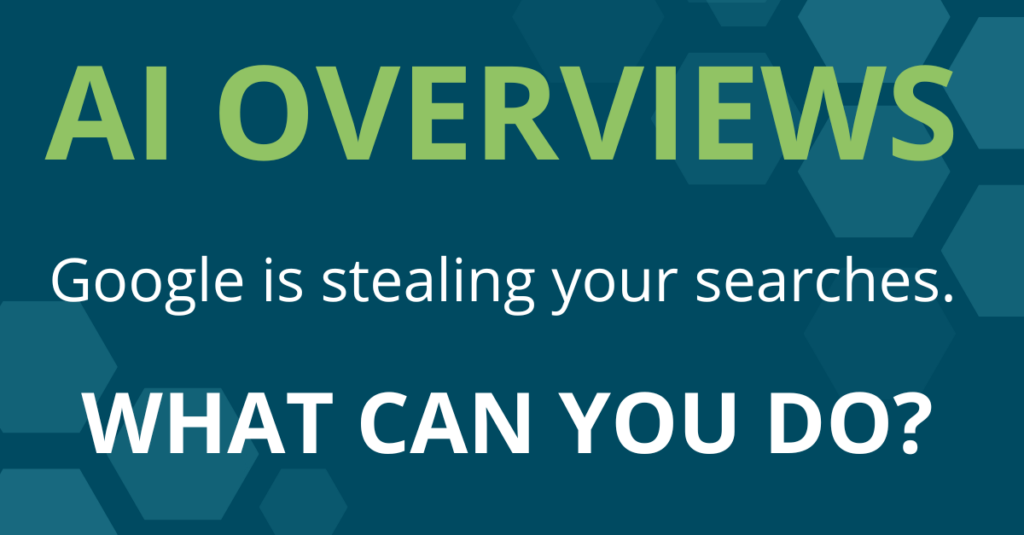
    Google is trying to steal your searches, what can you do about it?

    At yesterday’s Google I/O, Google announced it is rolling out “AI overviews” for all US searchers.

    Without getting too geeky, the AI Overviews are “retrieval augmented generation,” where essentially Google looks into its large language model (i.e. big ol’ database of knowledge) and compares what’s there to search data to build a better answer.

    If you’d like more information, Barry Schwartz has a good review on Search Engine Land.

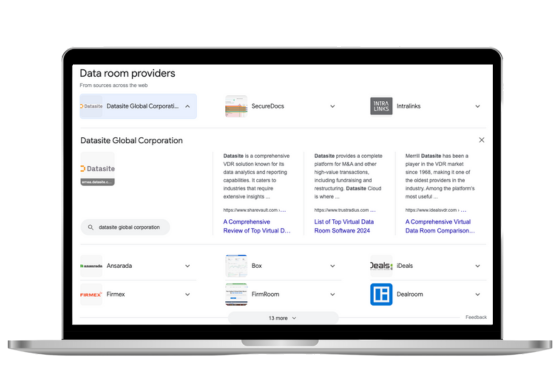
    Google Screenshot AI Overview Example - Datasite - Dataroom Providers

    If you’ve been watching what Google is doing with SGE (Search Generative Experience) during its beta, you may have seen that the Google “answers” are sometimes incorrect and potentially distract searchers away from the valid results below.

    What this means is that the “10 blue links” and the maps we were used to are pushed even further down the page.

    AI Overviews are only part of the problem, though. Google is also putting more ads at the top of the page, meaning your winning map or organic search is lower still.

    This is not the time to freak out, though. We are very early in this rollout, and at Search Influence we’ve been testing how to keep you on top even with these changes.

    If you’re a Search Influence client, look forward to some interesting new tactics in your SEO strategies.

    For the past decade, when we’ve said “search,” we’ve meant Google. In the coming decade, we may be talking about searches on any number of engines, apps, and devices.

    At Google, as in life, change is the only constant. Look forward to updates as we get further in our testing.

  • Google Renames Conversions in Google Analytics 4 (GA4) to “Key Events”

    Google Renames Conversions in Google Analytics 4 (GA4) to “Key Events”

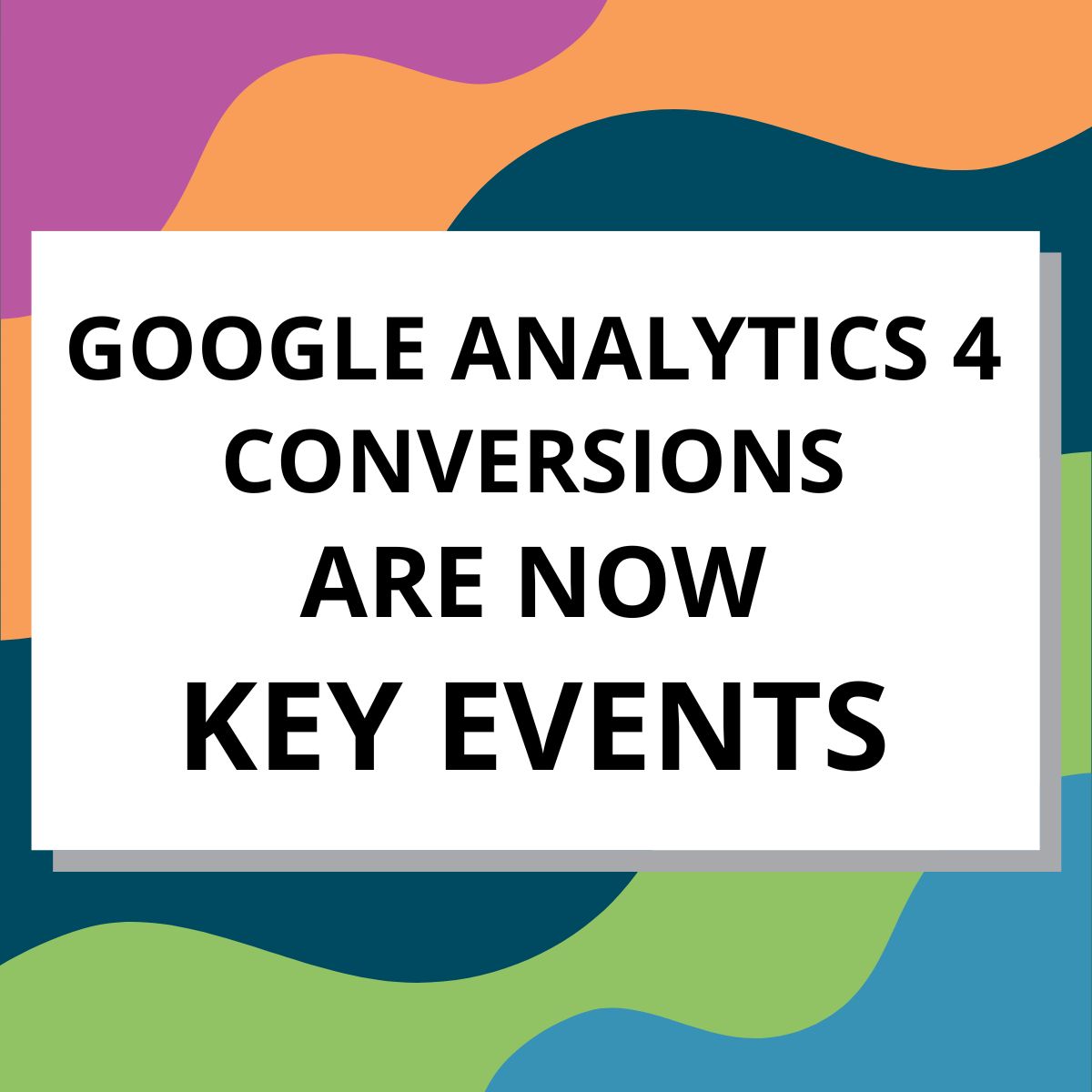
    Vector Illustration: Google Analytics 4 Conversions are now Key EventsTo differentiate from Google Ads, GA4 has renamed conversions to “key events.”

    What You Need to Know:

    • Analytics conversions have been renamed as “key events” in GA4 to distinguish them from conversions in Google Ads.
    • “Conversions” still exist, in the context of Google Ads which are also reported as Ads conversions in GA4. Advertisers can create conversions from Analytics key events, and optimize for those conversions in their ad campaigns.
    • No action is required from your end as key events are created and reported in the same way as previous conversions in Google Analytics.
    • If you have a linked Google Ads account, conversions created from Analytics key events will appear as conversions in the Analytics advertising section.

    Key events in Google Analytics measure the interactions most important to your business, such as form submissions or newsletter signups. These will now appear as key event metrics in Analytics reports.

    While changes like renaming an important metric can be hard to get used to, we believe that these changes will provide more clarity and consistency in reporting, ultimately helping agencies like us, and businesses like you better understand and optimize your digital marketing efforts.

    Learn more in Google’s resource about conversions vs. key events.

    Search Influence clients, reach out to your Account Manager if you have any questions about how this change may affect your data or campaigns.

    If you aren’t a Search Influence client (yet) and need help understanding how this and other Google Analytics 4 updates impact you, contact us to speak with a member of our sales team or learn more about our Analytics and Lead Tracking services.

  • Effective SEO Strategy Must-Haves: Why Partner With Search Influence

    Effective SEO Strategy Must-Haves: Why Partner With Search Influence

    seo best practices

    Key Insights

    • Not all SEO strategies are created equal. Effective SEO strategies demand a customized approach that takes into account the unique goals and challenges of a business.
    • Search Influence uses three pillars to drive SEO strategy: boosting search rankings, empowering local SEO, and enhancing technical SEO.
    • Partnering with a skilled SEO agency can make all the difference in your online advertising success.

    Search Influence isn’t just part of the SEO industry — we helped shape it.

    Since bursting onto the SEO scene in 2006, we have helped clients across countless industries climb search engine results pages and reach their goals. We maintain a firm hold as thought leaders in the digital advertising industry by speaking at conferences, writing guest blog posts, and sharing insights on podcasts.

    Our team fuels growth by constantly seeking inspiration from the many other prolific thinkers in the digital marketing and SEO world.

    After reading What Does “Strategy” Actually Mean to CMOs?, our thoughts returned to our recent SEO research study with UPCEA, where we learned that 51% of universities don’t have an established SEO plan.

    In this blog post, we’ll share the benefits of a true, customized search engine optimization strategy and pull the curtain back on our process.

    Search Influence’s SEO Best Practices

    At Search Influence, we value increasing your website’s traffic and search volume. However, we know that the bottom line for your business is a strategy that converts those visitors into inquiries and revenue.

    Through a medley of strategies, we help you gain more organic traffic.

    Our four pillars of a successful SEO strategy:

    1. Boosting topical relevance: Our team conducts thorough keyword research to identify the most relevant keywords for your business. We then optimize your web pages with these targeted, conversion-friendly key topics, ensuring that your website appears prominently in search results when potential customers seek your products or services.
    2. Empowering local relevance: We strengthen your online presence by focusing on local SEO strategies. By optimizing your website to reinforce your physical location, we ensure your business remains competitive in local search results. This approach makes it easier for nearby customers to discover and connect with your company.
    3. Driving authority: We bolster your website’s credibility and influence through strategic link building. By linking to reputable websites within your industry and adding internal links from across your own website, we signal to search engines that your content is valuable and authoritative. This practice helps to satisfy Google’s E-E-A-T requirements.
    4. Enhancing discoverability through technical SEO: We pay close attention to the technical aspects of your website to improve its overall performance. This includes many technical settings that help Google better access your site, as well as optimizing your website for mobile users, because a positive user experience is crucial for encouraging conversions. A user-friendly interface ensures that visitors can effortlessly navigate your site, increasing the likelihood that they will take a desired action.

    Effective SEO Strategy Step 1: Needs Analysis

    The first step in Search Influence’s process is getting to know you, your website, and your competition.

    In house, we call this a needs analysis.

    In this crucial step, we delve into understanding your unique requirements and challenges, ensuring that our SEO efforts align seamlessly with your goals and objectives.

    Our needs analysis process forms the bedrock upon which we build our SEO strategy, providing valuable data and context for optimizing your online presence.

    Our needs analysis process:

    • Learning your goals and objectives: By aligning our efforts with your goals, we ensure our actions contribute directly to your success. We collaborate with you to define what you want to achieve with your SEO endeavors. This may include enhancing online visibility, driving more targeted traffic, or increasing conversion rates.
    • Competitor analysis: We conduct a comprehensive competitor analysis to outperform your competition in the digital landscape. By identifying areas where your competitors excel and areas where they fall short, we can employ strategies and tactics that will help to set your website apart.
    • Technical audit: Our team conducts a meticulous technical audit of your website. By uncovering any technical issues or areas of improvement, we pave the way for a smoother user experience and improved search engine rankings. This audit thoroughly examines your website’s internal links, on-page optimization, and overall technical SEO health.
    • Content assessment: We assess your existing website content for its quality, relevance, and keyword optimization. Ensuring that your content aligns with your target audience’s interests and is optimized for relevant target keywords is crucial for attracting organic traffic and retaining user engagement.
    • Link profile analysis: Our team dives deep into your link profile, evaluating the quality and quantity of your inbound links. A strong and reputable backlink profile enhances your online authority and search engine rankings. We identify opportunities for acquiring high-quality backlinks and eliminating toxic links that may harm your SEO efforts.

    This process enables us to tailor our SEO strategy to your specific needs and maximize the impact of our efforts, ultimately catapulting your website content to new heights of online visibility.

    Effective SEO Strategy Step 2: Keyword Research

    Conducting keyword research is pivotal to understanding how users search for products or services related to your business.

    Our steps:

    • Brainstorm seed keywords: We create a list of core or seed keywords directly relevant to your products or services. These keywords are the foundation upon which we will build your keyword strategy. We discover these initial keywords through discussions with you about your industry and products to learn the words you use and the words your audience uses.
    • Utilize keyword research tools: Keyword research allows us to cast a wider net and capture a broader audience for your business. We leverage tools that uncover an array of related keywords and keyword phrases that users commonly enter into search engines.
    • Analyze search volume: During this step, we closely examine each keyword’s search volume to understand its popularity and potential impact. This data helps us prioritize the keywords more likely to drive significant traffic to your website.
    • Assess keyword relevance: We assess keyword relevance to ensure that the chosen keywords align with your audience’s search intent. This alignment verifies that visitors arriving at your site are genuinely interested in your products or services — leading to conversions, not just clicks.
    • Select targeted keywords by topic: We organize your selected keywords by topic, making it easier to create content that resonates with users’ interests. This strategy improves your website’s ranking on search engines and enhances the overall user experience by providing cohesive and informative content.
    • Balance keyword volume and competition: Our goal is to identify keywords that offer a favorable balance for your specific objectives. Highly competitive keywords may require more time and effort to rank for, while low-competition keywords may not drive enough traffic.

    Effective SEO Strategy Step 3: Creation of the Strategy

    Every client is unique, and your SEO strategy must reflect your distinct goals and challenges.

    Search Influence understands this diversity and crafts individualized strategies that align with your requirements.

    While the specifics may vary, here are some examples of tactics that we might include in your strategy:

    Keyword and on-page SEO optimization

    At Search Influence, we optimize your on-page SEO by ensuring that relevant keywords are seamlessly integrated into your website content, meta tags, and headers.

    Additionally, we create high-quality, keyword-rich content that directly addresses user intent, improving your website’s visibility on search engines.

    By including keywords and structuring your content for skimmers, swimmers, and divers, we improve your website’s readability and search engine ranking.

    Technical SEO

    We fine-tune technical settings that make it easier for Google to access your site, like implementing proper HTML markup and sitemaps, and configuring robots.txt files. We improve your website speed and mobile-friendliness to enhance the overall user experience of your website.

    Link building

    Our team builds high-quality, relevant backlinks from authoritative websites to boost your domain authority. Links are like votes for your website, and you must have more to win!

    We also avoid low-quality or spammy backlinks that could harm your site’s reputation.

    Content marketing

    Our content marketing strategy revolves around creating informative, engaging, and shareable content. We also employ social media and email marketing to increase content visibility and reach.

    Local SEO

    Local SEO is especially important for businesses with physical locations.

    For businesses targeting a local audience, we optimize your Google Business Profile listing and local citations. Encouraging customer reviews and ratings helps enhance your local reputation.

    User experience (UX)

    We focus on enhancing website usability and navigation to reduce bounce rates and improve user satisfaction. Additionally, optimizing for mobile devices caters to a mobile-first audience and ensures adherence to mobile SEO best practices.

    Schema markup

    Implementing schema markup provides search engines with structured data about your content, enhancing the appearance of rich snippets in search results.

    Search Influence employs all the tools at our disposal, including Google Analytics and other industry-leading SEO tools, to craft these individualized SEO strategies. We align each strategy with your specific goals, target audience, and unique challenges.

    Whether it’s optimizing page titles, improving page speed, or fixing broken links, we harness our expertise to ensure your website ranks higher for Google searches and provides an exceptional user experience.

    Search Influence’s Effective SEO Strategies for Higher Education

    As discussed earlier in this blog post, a majority of higher education institutions across the country lack a proper SEO strategy.

    Search Influence and our higher education marketing partners at UPCEA believe improving SEO must be a top priority for universities. We help universities build and deliver better SEO strategies through original research studies and our SEO Roadmap for higher education institutions.

    Our team of experts has years of experience helping universities boost their SEO rankings.

    Tulane SoPA + Search Influence = SEO Strategy Success

    When Tulane SoPA came to us looking for ways to boost organic traffic for their recently launched human resources program, we dove straight into our process to identify the strategy.

    We implemented five common tactics to increase their SEO rankings:

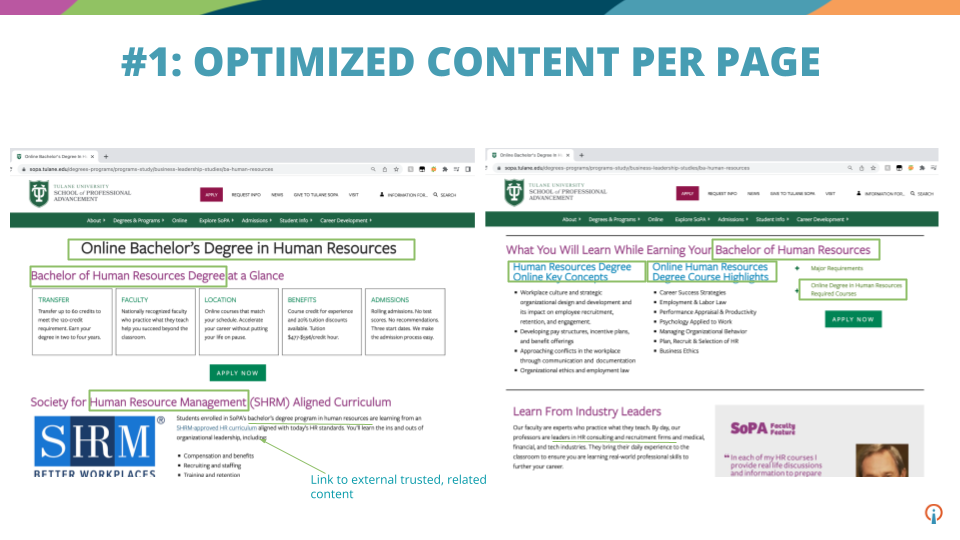
    #1: We optimized the degree page content

    optimized content per page

    Search Influence always prioritizes including the primary keyword and related keywords in headlines because they are an SEO ranking factor. This small attention to detail, amongst others, can help you get to the first page of the SERPs.

    In the example above, you can see where we included the keyword “online bachelor’s degree in human resources” and similar variations throughout the content. All the keywords are closely aligned to the program name, as they often will be.

    We incorporated keywords into the headings, the on-page content, and other related linked pages.

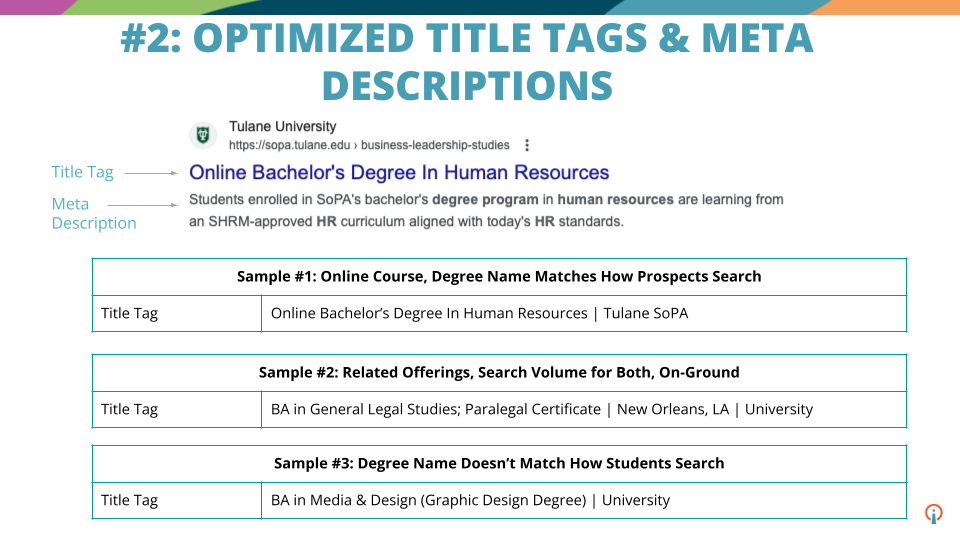
    #2: We optimized metadata with targeted keywords

    optimized title tags and meta descriptionsTitle tags and meta descriptions are closely related to content but are not shown directly to a user on the web page. A searcher will see them when your webpage appears in a Google search.
    Google search sees your title tag as the page title and uses it to learn what your page is about.

    Therefore, it’s the most important tag to optimize with keywords while avoiding keyword stuffing.

    Meta descriptions influence CLICKS to your site, but they do not influence RANKING.

    A well-optimized meta description will include the brand name, keyword, geo, if necessary, and relevant information about the program.

    Let’s go into more detail by reviewing the title tag examples for different Tulane SoPA programs above.

    Sample 1: This is for an online course, where the degree name closely matches how prospects search, and the wording is specifically tuned to variations of the particular keyword “human resources degree” — pretty straightforward.

    Sample 2: This page is about general legal studies, but there’s also info about Tulane SoPA’s paralegal certificate since the degree helps you get your paralegal certificate. It’s crucial here to optimize this title tag for both topics.

    Sample 3: Let’s say your degree name doesn’t match how prospects search. In that case, you can naturally work in the keyword, like in the example here.

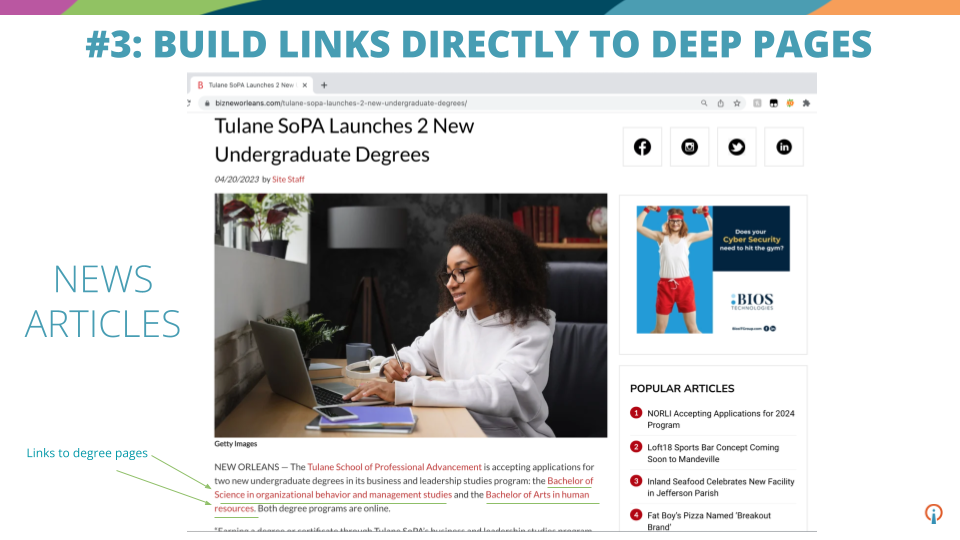
    #3: We built links directly to deep pages across Tulane SoPA’s website

    build links

    The above example is a news article in a local business publication. This was published as the result of a press release. You’ll see a link to the school’s homepage and specific degree pages.

    Another place you can build deep links is through profiles on sites like niche.com. The above example shows links to the overall degree/program page and directly to key the degree pages.

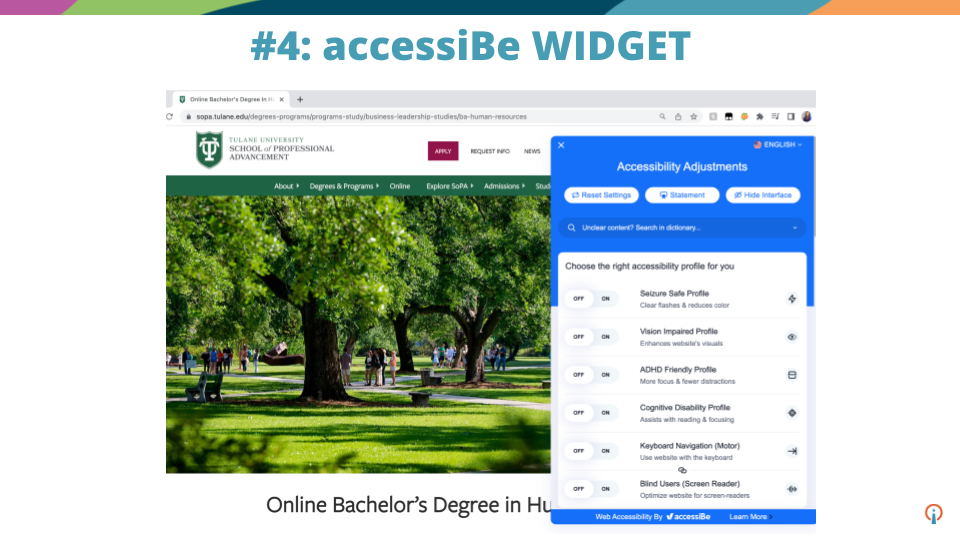
    #4: We used accessiBe to improve Tulane SoPA’s website accessibility

    accessiBe widgetMaking your site accessible to all is of the utmost importance.

    To do this for Tulane SoPA, we utilized accessiBe to make their website fully compliant and accessible to those with disabilities.

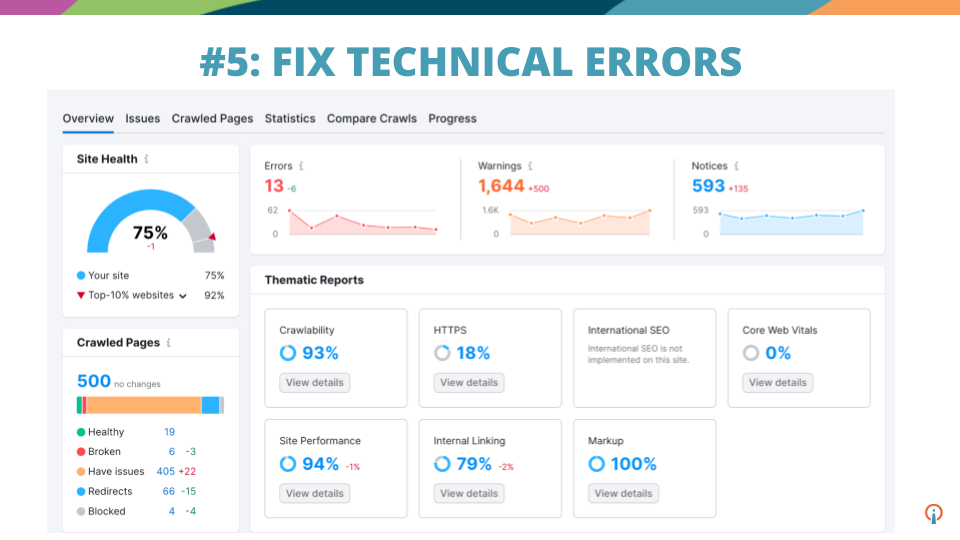
    #5: We fixed technical errors on Tulane SoPA’s website

    fix technical errors

    Technical errors can include a wide variety of things, such as 404s/broken links, crawlability issues, HTTPS, speed, and schema errors.

    We used Semrush and Google Search Console to identify and fix these issues for Tulane SoPA.

    Learn More About Effective SEO Strategies With Search Influence

    In digital marketing, the distinction between an SEO strategy and an effective SEO strategy can be the difference between existence and success.

    Partnering with an experienced SEO agency helps you build the powerful online presence your business needs.

    At Search Influence, we understand that crafting a genuinely effective strategy requires expertise, dedication, and a deep understanding of the ever-evolving digital landscape.

    Contact us today to learn more about our digital marketing services.


    Image sources:

    Image 1: https://images.unsplash.com/photo-1523875194681-bedd468c58bf?q=80&w=2942&auto=format&fit=crop&ixlib=rb-4.0.3&ixid=M3wxMjA3fDB8MHxwaG90by1wYWdlfHx8fGVufDB8fHx8fA%3D%3D