I’ve always been amazed by the power of crowd-sourced fundraising. Combined with the virility of social media, a project can get a lot of attention, which can introduce new backers and have the project funded rapidly before it’s deadline. Crowdfunding sites such as Kickstarter and Indiegogo are the most well known platforms. These sites serve as a great creative and entrepreneurial outlet that didn’t exist years ago. I’ve selected my three favorite projects below. (more…)
Category: Industry Insights
-
5 Ways Technology Has Changed the Olympic Games
Just like the rest of the world, the XXII Winter Olympics has captured my attention ever since Team USA walked out in those hideous sweaters Friday night. For 16 days the world will sit in front of the TV, eat King Cake, and watch every move, detail, and technique performed by these athletes. Six days in and I feel like a complete failure at life because I’m not an Olympian. I complained throughout the mere three weeks of training I put into the Rock-N-Roll half marathon, so how these athletes dedicate years of their lives to training is mind blowing. In addition to the support of family, friends, and coaches that help inspire and guide these athletes to Sochi, the growth of technology has also played a big part in reaching the gold.
Here are five ways technology has changed the Olympics.
1) Slim, Trim, and Faster Than the Speed of Light – Custom-Fit Track Suits Shave Off Seconds

Far from the flowing tanks and short shorts our parents remember on seeing Bruce Jenner, Nike’s custom-fit track suit has allowed for a faster, sleeker champion. Besides the fact that it may or may not take an hour for someone to squeeze themselves into this skin tight suit, athletes are able to move faster than ever. With the help of Nike, in 2008, Team Jamaica’s Usain Bolt broke the 100 meter record with a 9.63 second run, earning the title Fastest Man on Earth.
2) Not a Long Shot – Dual Lens Innovation for Measuring Long Jumpers
In 2012, Summer Olympic sponsor BMW launched a dual-lens camera with 3-D imaging to measure track and field long jumpers in motion. This piece of technology immediately measures velocity and calculates the athlete’s body motion and positions. In years past, analyzing movement at this level would rely heavily on the coach’s eye and basic video. Now, this data is immediately available for review and improvement to technique.

3) What a Drag – Speedo Creates Full-Body Swimsuit to Speed Up Swimmers
In 2008, Speedo introduced us to the very toned quads of Michael Phelps as he and the rest of Team USA sported the full-body swimsuit. The compression of this bodysuit is made to improve swiftness and reduce drag in the pool. I think it’s pretty obvious that this suit helped Phelps become the most decorated Olympian of all time – leaving Mark Spitz in the bubbles.
4) Every (One-Millionth of a) Second Counts – Finish Times Fine Tuned
What’s worse than winning silver? Losing to Phelps by one hundredth of a second! In the 2008 Summer Olympics in Beijing, Serbia’s Milorad Cavic finished second to Phelps by one hundredth of a second, helping Phelps earn his seventh gold medal. How did they find that time? Forget stopwatches and timers! Thanks to technological advancements in capturing finish times, athletes are measured by one-millionth of a second, making the games more competitive than ever.
5) Beyond Fame and Gold Fortune – Athletes and Host Cities Go Viral on Social Media
From athletes posting pictures of the atrocious living conditions in the Sochi Olympic Village, to news sources leaking pictures and interviews of athletes biting the gold, social media has taken over the Olympics. In postings, pictures, and tweets going viral, athletes invite viewers into their lives from training days in the US to the slopes in Sochi.
For example:
…With no phone to call for help, I used my bobsled push training to break out. #SochiJailBreak pic.twitter.com/apZRefgvCO
— Johnny Quinn (@JohnnyQuinnUSA) February 8, 2014
 At the 2012 London Summer Olympics, McKayla Maroney’s look of disappointment as she received her silver medal went viral! From generating memes to photoshopping her into pictures, “McKayla is not impressed” blew up on social media. At this year’s Winter Olympics, it was bound to happen again when Ashley Wagner’s similar face of disappointment lit up the screen after receiving her fourth place score in a team figure skating program.
Social media has allowed viewers back home in the States to stay updated with team members and make a personal connection with athletes. Not only does this help with support, it invites us to feel closer to Team USA than we’ve ever felt before.
Got a favorite social media update about the Olympics? Post in the comments!
-

Reputation Rescue: Dealing with Your Business’s Online Reviews
These days more customers are turning to their social networks and online review sites before making purchases. While local directories and review sites are important for your business’s online presence and SEO, it also opens up the door to both positive and negative reviews from customers.

Copy and paste the code in the area below to place “Reputation Rescue: Dealing with Your Business’s Online Reviews” image on your site for free.
Yes, People are Actually Looking at Them
It’s been estimated that about half of American consumers have written at least one online review. Even those not writing reviews are reading them, with 70% of consumers saying they read reviews before making a purchase decision. The same number, seven out of ten, share the reviews they read with friends and family, meaning that these reviews are reaching even more people.
And Making Decisions Based Off of Them
For positive reviews, this is great! In fact, 87% of consumers say a positive review confirmed their decision to make a purchase. As one might expect, a similar yet opposite effect comes from negative reviews. Four out of five consumers report having reversed a purchase decision based on negative reviews. Yep. That’s 80%.
But You Can Take Action
Luckily, for businesses, there is a positive way to handle negative reviews. Respond quickly and publicly, keeping your response polite yet personal. Own the issue without being defensive and try to rectify the situation while still keeping your response simple. A whopping 97% of people found the reviews of a product they purchased to be accurate. This confirms that no one should be brushing off negative reviews. Responding correctly will give future customers confidence that they will not have the same experience.
You know the saying about the best defense, right? Give your business a good offense by encouraging reviews from loyal customers. Reach out to customers via Facebook, Twitter, and email. Make reviewing your business as easy as possible and send those that do review a thank you.
Real Reviews = Real Revenue
Getting a considerable volume of real, accurate reviews will lead to real revenue. Positive online reviews have been shown to increase sales by 74%, and on a related note, consumers who conduct research online spend 18-36% more than those who do not.
Don’t be scared to put your business out there! Transform your online review portals into revenue-making tools by garnering your existing customer relationships, addressing negative experiences, and improving your online presence. Reviews also create 21% higher purchase satisfaction and 18% higher customer loyalty. These are huge numbers for something that you aren’t even spending money on.
-
How To Handle Automated Software Headaches
To set the ‘scene,’ you’ve either recently purchased or are about to purchase a piece of software that is meant to offer improvements for your business. Whether it’s some form of automated process, or software that adds another form of datum for you to analyze and use for future success (such as SEO analytics information), there’s a great deal of caution that you should take with these programs.
What Happens With Software

In short, I don’t mean that some of these programs aren’t worth their money or that they won’t do what you require of them. But you should expect a moderate amount of troubleshooting when applying this software into your business process.
Most of the software that is developed and published for sale and use work as they should to a certain degree, but only under the right circumstances. Software testers can only do so much. The only real test comes from real-world use by people who aren’t familiar with the inner workings of the software.
At the same time, patches and other forms of software updates are constantly in development (or at least, a good development team should always seek to make improvements) and can make drastic changes to a program that you are just getting used to, usually based on customer feedback that you might not be aware of, or agree with.
How To Deal
 In order to avoid, or at least brace yourself for these moments of frustration, the first step is to read the manual. It’s usually large, bulky, and annoying, but within it are the instructions that you need to run the program correctly and avoid some of the smaller problems.
The next thing to do is to make sure you always have a way to contact the original developers of the program, so that you can speak with an expert when there’s an issue that you can’t overcome on your own. Phone is always preferable in order to have instant contact, however most developers rely on e-mail.
Finally, in order to prepare for updates and patches, make sure that you read up on the developer blogs that tend to be published on the website for the program itself. Not only is it a way for them to keep their website active, but they generally tend to suggest ways to use their program, bugs or issues to avoid, as well as patches and fixes that are currently under development. Keeping up with these blog updates, will keep you informed of future changes for the software.
Now What?
Enough preparation allows you to be more familiar with the good and the bad of any automated software you’re using. You can then expect some of the unexpected, and you’ll know the steps you will need to take in order to make the proper fix and continue using software to suit your business needs.
If you’re interested in how a development team can improve your search rankings and help with your software issues, check out this blog on SEO Tips by one of our Software Developers, Shane Kretzmann!
-
The Scoop on Sender Score
 Any business that sends regular emails to a list of subscribers has a Sender Score. Your score is a method of determining how mail servers (inbox gatekeepers, so to speak) view your reputation as a trustworthy email source.
To keep it simple, think of it this way: if you’re not monitoring your Sender Score, the emails you send to your subscriber list may not have a positive impact on your business. Unfortunately, a poor Sender Score could land your emails in the spam folder, never to be seen by your subscribers.
Five Things You Need to Know about Email Marketing
Let’s start off by saying that Sender Score is important, and you should not only know what yours is, but you should constantly work to improve it. A great first step to take to acquaint (or reacquaint) yourself with email marketing protocol is to make sure you understand the CAN-SPAM Act.
Once you know the law, you can move on to nuances like double opt-in email marketing vs. single opt-in email marketing.
Many top email marketing firms are of the opinion that a double opt-in subscriber system is superior to a single because it ensures not only a higher level of recognition, but also of subscriber retention. In an article that defines both systems and gives advice on whether or not to use them, one email marketing expert adds,
“…Double opt-in serves you when you already have a good amount of interactive leads, and don’t want to have any more headaches with bad email addresses.”
Increase Your Score
No matter what system you decide to use, the goal is the same: you want to increase your Sender Score (trust us!), and here are the top 5 ways to do just that:
- People who get frustrated when they have trouble unsubscribing from email lists may be inclined to mark your emails as spam (which is BAD). Make it easy to unsubscribe from your email list.
- Use a consistent theme to reinforce your brand when you send emails to your subscriber list. Your email subject line should accurately reflect your email message and include a reference to your brand.
- Analyze your reader engagement data once you’ve sent out an email to your list. Knowing how many people are opening, reading and clicking around vs. unsubscribing from your list is a very handy way to evaluate the effectiveness of your email content.
- Maintain your reputation by focusing on how to avoid complaints and keeping up your subscriber list hygiene. List hygiene is determined by how frequently you send emails to unknown users and spam traps.
- Be sure your emails are coming through authenticated. That means ‘showing’ ISPs (Internet Service Providers) you’re doing your best to follow their authentication protocols, which may include reverse DNS, Sender Policy Framework (SPF), SenderID, and/or Domain Keys Identified Mail (DKIM). Using a reliable email marketing service will prevent many authentication issues.
How to Interpret Your Sender Score
Once you have your Sender Score, you can begin to interpret your level as an email marketer. But how do you know what the Score means? Here’s the gist: any score over 90 is GREAT. If you score that high, give yourself a pat on the back, because you’re doing it right!
If you score between 50 and 80, you’ll need to take a step back and spend some time figuring out what the problem is. For example, how many of your emails are accepted vs. rejected? How high is your unknown user rate? Any score under 50 indicates you’re a spammer. “But wait! I’m NOT a spammer!” you might be thinking. Unfortunately for you, the mail servers think you are. It’s up to you to rebuild your reputation.
That’s why it’s so important to maintain your Sender Score, lest your emails wind up marked as spam or worse: your IP is blacklisted and your emails never arrive to an inbox at all!
So pay close attention and monitor your email marketing activity and you’ll be well on your way to a great Sender Score. Good luck email marketers!
Kelly Lucia is the Lead Staff Writer atPostsbyGhost.com. A ghostwriting service that provides businesses with the opportunity to build their online presence and grow their companies, Posts by Ghost offers strategic blogging, content marketing and SEO assistance to businesses of all shapes and sizes. Kelly hit the ground running as a web copywriter several years ago and hasn’t stopped since. Over the last few years she’s developed a vast range of knowledge within the realm of content writing, and she prides herself on being able to write clear and unique content for an immense variety of industries, from overseas blogs about raffle tickets to small business and marketing advice on ChamberofCommerce.com.
-
Make Your Infographics Count
Infographics have been around for years. We have seen them in cave paintings and hieroglyphics. William Playfair was credited with the first area chart and pie chart in his 1790 book, The Commercial and Political Atlas. Over the years, we have pushed forward the design of learning concepts with the aid of images. This work has lead us to what we refer today as infographics.
If you haven’t been on Pinterest or read any major newspaper, you may be unfamiliar with the concept. An infographic is the process of using visual data to represent a complex idea in an easier to digest medium for the masses. You can’t get your PhD through an infographic, but they are handy at teaching you a quick synopsis of a subject.
The strength in infographics is found by following a few basic concepts:
Bring Multiple Ideas Together
The magic of an infographic is its ability to take a wide amount of information and consolidate it into a story that flows and ebbs. The beauty is in the point where all these ideas join to create a new message or way of looking at all those ideas together.
Be Understandable
When presenting new ideas and concepts, it is important that the viewer understands what the message is. Try not to get the viewer confused or use terminology that is way above their knowledge based. It is good to use this jargon, but remember to explain it in a way that your 80-year old grand pap may comprehend.
Less is More
When designing or writing for an infographic, it is important to remember not to bombard the viewer with copious amounts of data and figures. The idea is to keep the content flowing in a smooth way that is easy to understand and recall. Designers do this by narrowing the focus of an infographic into one main concept or story to gently guide the viewer into learning the message.
Be Welcoming
It is important to never be intimidating when designing an infographic. The message should never appear overbearing or intimidating. The overall goal of infographics is to be read and spread.
Eye Catching
The overall design of the infographic needs to be alluring for the viewer to want to read it. There is no sense in spending all that time researching, writing, and designing only to have viewers not be interested in what you have to say. It is important to make sure there is a visual hook that will pique the interest of any viewer.
All images in this post of the original work of Search Influence. Please give attribution if you should decide to share.
-
Kickstarter For Advertising and Funding
 Crowdfunding has been around for a while now, from major sites like Kickstarter to more niche spots, like Indiegogo. Crowd funding is a process in which a project finds its funding from a vast pool of minor investors as opposed to the traditional approach of loans, private partners, and venture capitalists. Proper utilization of this funding option has lead to product launches across a variety of fields, from independent films to music to video games.
Recently, major artists and established companies have turned to crowdfunding to act as both an additional revenue stream as well as viral marketing. By allowing fans and potential customers to feel included in the creative process, you can increase loyalty to the brand and to the project itself. Most projects have rewards associated with different levels of fund contribution, from early copies of products to names appearing in the credits of films and albums.
Small businesses can even capitalize on this process by starting projects to fund future store or service expansions, and future product lines. A great example of a potential user would be a clothing boutique that sells a mixture a vintage clothing and modern, locally sourced products. The boutique could start a crowdfunding project to expand the production of an in-house jewelry line, setting a funding goal of slightly higher than the cost of an item. This essentially results in pre sales of these items, as well as viral advertising amongst current and potential customers.
Avoid potential pitfalls, the major one being over promising. Make sure you understand the entire cost and potential extra expense associated with any new line or expansion and set your funding goal for above that amount. This way you will have all the capital you need to deliver the final product to your numerous investor/customers. And if you don’t meet your fundraising goal, sites like Kickstarter refund the money to the investors so you don’t have any unmet obligations among your existing customers.
-
A Quick Guide to Using the Internet to Your Advantage
 Small businesses have come a long way, thanks to the Internet. Now we all have websites touting our products and services, and we have more ways than ever to connect with our potential and existing clients. But there’s always room for improvement, isn’t there? If you’re not fully using the Internet to gain momentum for your business, you’re missing out on potential sales.
Be Smart About SEO
In case you weren’t aware, Google has made a lot of changes in the past year that affect how marketers use keywords and SEO. What that means for you is that you have to use keywords in a natural way (instead of shoving them in every sentence and sounding like a robot).
Be cautious about how you use anchor text, too. Here are some tips to help you stay in Google’s good graces:
- Rather than hyperlinking a generic word or phrase, such as “click here” or “page,” focus on specific words or phrases for your anchor text, as we’ve done throughout this post.
- Experts recommend using your brand name for about 30% of your inbound anchor links.
- Keep your links relevant to the overall theme of your site. Don’t link to a pet shop if your site is about accounting software or Google might see it as too out of the blue and penalize you.
Make Your Site Warm and Inviting
There’s nothing worse than going to a site that’s cluttered or has boxes popping up everywhere. If your website is your welcome mat for potential customers, you want it to be inviting, right? You do that in several ways:
- Simplify navigation.
- Make sure all links go where they should.
- Make the checkout process as simple as possible.
- Ask for minimal info for email subscribers or customers (just an email address vs. address and phone).
Be the Go-To Expert
Right now, the hottest tool for marketing online is content marketing. That comes in the form of blog content, white papers, ebooks, videos, infographics…the list goes on and on. Remember your goal with content marketing: to be helpful to your target audience. Your focus should be on useful content that answers a question or solves a problem for someone. The bonus is that it makes your company look like the leader in your industry.
Diversify the kinds of content you produce to attract different types of people:
- How to and advice-based blog posts should be short and scannable.
- White papers go more in depth on a given subject, and can be used as bait to get people to sign up for your emails.
- Videos attract people who learn through audio and visual imagery.
- Infographics draw in potential customers who prefer graphical representations of data, rather than only words.
Use Different Platforms
You’re no longer tethered to your desktop; you likely have a laptop, smartphone, and tablet that you also use to access the Internet, so use that to your advantage. Look for software that also offers a mobile option, like accounting software or a CRM web app, so that you can handle your business no matter where you are.
And here’s another content marketing tip: you can also use a CRM system to track and manage your assets for your content marketing. If you’ve ever missed a day publishing on your blog, you know how important it is to stay organized as far as who’s publishing what, and when.
Get Your Head in the Clouds
Another benefit the Internet has brought small businesses is cloud storage. Now you don’t have to worry about what happens if your computer is destroyed in a fire; all your files should be backed up in the cloud. That includes:
- Contracts and agreements.
- Client data.
- Articles, spreadsheets, and presentations.
It’s exciting that every day, technology brings us more ways to grow our businesses. Be open to what’s out there, and find the tools that work best for your business.
Susan Payton is the President of Egg Marketing & Communications, an Internet marketing firm specializing in marketing communications, copywriting and blog posts. She’s also the founder of How to Create a Press Release, a free resource for business owners. She’s written three books: DIY Press Releases: Your Guide to Becoming Your Own PR Consultant, 101 Entrepreneur Tips and Internet Marketing Strategies for Entrepreneurs, and contributes to several sites, including ChamberofCommerce.com, The Marketing Eggspert Blog, CorpNet, Small Business Trends, and BizLaunch. Follow her on Twitter @eggmarketing.
Contact one of our experts to learn how you can enhance your current marketing strategies.
-
Found: Yelp Reviews Copied and Published as Google Reviews
In the last week, one very alert client saw saw some very recent reviews on his Google Plus Local listing that looked pretty suspicious. All 4 of these reviews were published within the week:
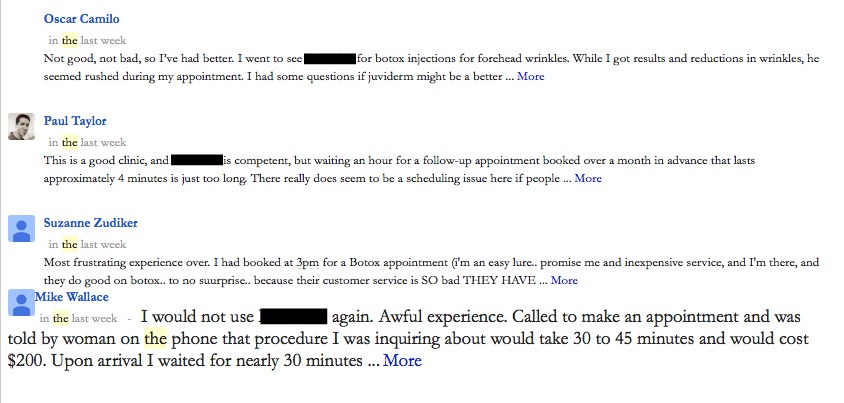
The client immediately flagged “Oscar” as a spam review on Friday, November 29th. By Tuesday, December 3rd, we saw that the review was gone. Removed from the client’s G+ Local. That was super fast response by Google, which was a pleasant surprise.
When we looked at the Google+ profiles for Paul, Suzanne, and Mike,
- none of the 3 had information on their G+ Profiles except where they lived. No posts. No videos.
- none of the 3 lived within 1,200 miles of our client.
- 2 of the 3 had 100-200 people in their Circle, despite having no account activity.
With the fast success of the first spam review removal, we immediately flagged the other 3 as spam reviews. Within 1 day, 2 of the 3 remaining spam reviews were removed. The only one that’s left is “Paul.” We’re watching Paul, and hopefully, that one will come down fast too.
Plagiarizing Yelp Reviews
These Google reviewers were pretty easy to mark as spam based on their Google+ profiles being so bare and their slim reviews profiles — only 1 review each — but I think the real reason they were taken down was because they are not original review text. They are all copy and pasted from Yelp reviews.
And stating the obvious, the copied reviews are for different businesses and from different reviewers, so there is nothing legitimate about the Google reviews published on our client’s Google listing.
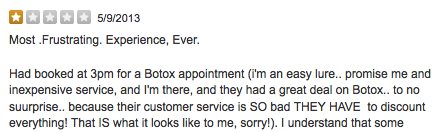
Suzanne’s Google review…

appears to be a close copy of “Cecile Mighty Mouse M.” May 2013 review on Yelp.
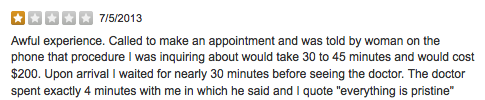
Mike’s Google review:

appears to be a close copy of “Ben S.” July 2013 review on Yelp.
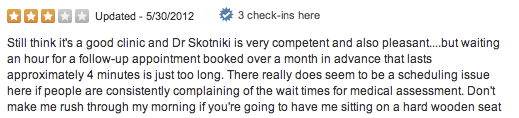
Paul whose review is still on our client’s G+ Local as of this moment,

is a close copy of “Grainne sounds like Grawn-ya…not Grainy M” May 2012 review on Yelp
If you’re curious to see if a review is spam, try dropping a chunk of it into Google to see if a Yelp review shows up as a close copy. If so, then definitely flag as spam to Google. Has this happened to you? Share your tips and stories of spam comments below.